Article

Rapid Analysis of the Chemical Composition of Xiaoban Kangfu Capsules Based on UHPLC-Q-Exactive Orbitrap MS/MS Combined with Molecular Networks


1
School of Pharmacy, Ningxia Medical University, Yinchuan 750004, China
2
School of Pharmaceutical Sciences, Hunan University of Medicine, Huaihua 418000, China
*
Authors to whom correspondence should be addressed.
Pharmaceuticals 2026, 19(3), 459; https://doi.org/10.3390/ph19030459
Submission received: 16 January 2026 / Revised: 6 March 2026 / Accepted: 7 March 2026 / Published: 11 March 2026
(This article belongs to the Topic Natural Compounds in Plants, 2nd Volume)

Abstract

Background/Objectives: Natural medicine analysis remains challenging due to chemical diversity. To the best of our knowledge, the comprehensive identification of multiple chemical constituents in Xiaoban Kangfu (XBKF) capsules has not been reported. Therefore, a combined approach utilizing ultra-high-performance liquid chromatography quadrupole-Exactive Orbitrap mass spectrometry (UHPLC-Q-Exactive Orbitrap MS) and molecular network analysis needs to be developed to comprehensively characterize the chemical constituents of XBK capsules in heat-clearing and toxin-eliminating granules, thereby enhancing annotation accuracy and enabling visualization. Methods: Firstly, chromatographic and mass spectrometry conditions were optimized to achieve good separation and a rich signal response. Subsequently, the literature searches, database consultations, and reference standards were employed to enhance annotation reliability. Finally, the raw data acquired under optimized conditions were uploaded to Global Natural Products Social (GNPSs), enabling component visualization by linking precursor ions of similar structural features with identical colors. Results: A total of 170 compounds were identified from this medicinal resource for the first time, including 50 flavonoids, 34 phenolic acids, 16 terpenoids, 14 quinones, 14 organic acids, eight coumarins, ive carbohydrates, and 29 other compounds. Conclusions: This study establishes a robust UHPLC-Q-Exactive Orbitrap MS/MS strategy for the comprehensive chemical profiling of XBKF capsules. The use of the presented validated analytical method for the comprehensive quality control of XBKF capsules is highly promising, offering fast, highly sensitive, and reliable analysis.

1. Introduction

Traditional Chinese medicine (TCM) formulas, composed of one or more drugs of plant origin, have been used as major remedies in China and other Asian countries for thousands of years with reliable efficacy [1]. XBKF capsules, composed of seven herbs including Fructus mori, Salvia miltiorrhiza Bunge, Tribulus terrestris L., Typhonium giganteum Engl., Eclipta prostrata, Glycyrrhiza uralensis, and Fallopia multiflora, have nourishing yin [2,3] and blood circulation promotion effects, benefiting the liver and enhancing complexion, removing blood stasis and freckles [4], and improving microcirculation [5]. Clinically, they are widely used to treat vitiligo, premature graying of hair, facial freckles, and melasma, making them an effective compound for treating related skin conditions [6,7]. Although XBKF capsules are widely used in clinical practice, due to their complex composition, their comprehensive chemical information about them remains unclear. Therefore, the development of a systematic strategy for the rapid detection and identification of constituents in XBKF capsules is necessary.
Multiple approaches have been used in an attempt to explore the chemical components of TCM prescriptions. Large-scale TCM analyses can be performed thanks to ultra-high-performance liquid chromatography (UHPLC) technology advancements that have emerged in parallel with the development of mass spectrometry (MS). Ultra-high-performance liquid chromatography–mass spectrometry (UHPLC-MS/MS) has emerged as a highly sensitive and powerful instrument in recent years, as it provides precise information on ion precursors and fragment ions from MS/MS. This is beneficial for improving the authenticity of the characterization of small- and medium-sized molecules in mixtures [8,9,10,11]. However, differentiating structural isomers remains a challenge due to their minor spectral and structural differences [12]. Recently, UHPLC-Q-Exactive Orbitrap MS has emerged as a prominent tool for the rapid screening and characterization of chemical components [13,14]. This technology can realize the simultaneous and rapid identification of multiple components, even in the absence of reference standards, rendering it an exceptionally effective tool for detecting and identifying chemical components in traditional Chinese medicine [15].
Recently, GNPS (https://gnps.ucsd.edu) molecular networking (MN) was proven to be a powerful tool for MS data processing, based on MS/MS spectral similarity, which was introduced for the rapid recognition of known compounds and efficient elucidation of unreported ones [16]. Researchers use this technique extensively to investigate natural products, metabolomics, foodborne hazards, and clinical medicine [17]. This outcome highlights the power of GNPS as an invaluable tool for discovering compounds from natural sources.
To the best of our knowledge, the comprehensive identification of multiple chemical constituents in the XBKF capsule has not been reported in the literature. In this study, we present a comprehensive analysis of the major chemical components in XBKF capsules using UHPLC-Q Exactive-Orbitrap-MS, combined with the molecular network method, to rapidly analyze complex components in XBKF. This study facilitated the first comprehensive identification of 170 chemical constituents, comprising 50 flavonoids, 31 phenolic acids, 16 terpenoids, 14 quinones, 14 organic acids, eight coumarins, five carbohydrates, three phenylpropanoids, and 29 other compounds, providing in-depth knowledge and offering valuable information regarding quality control and future pharmacological studies.

2. Results

2.1. Characterization of the Chemical Components in XBKF Capsules Using UHPLC-Q-Exactive Orbitrap Based on GNPS

In this study, we identified a total of 170 compounds, which included 50 flavonoids, 34 phenolic acids, 16 terpenoids, 14 quinones, 14 organic acids, eight coumarins, five sugars, and 29 additional compounds. Detailed information regarding these components, such as peak number, retention time (Rt), precise molecular ions, chemical formula, mass error (±5 ppm), fragment ions, and compound names, is presented in Table 1 and Supplementary Table S1. The high-resolution extraction ion chromatograms of XBKF capsules, captured in both positive- and negative-ion modes, are illustrated in Figure S1. Furthermore, the original data from both ionic modes were processed using GNPS to differentiate isomers with similar MS2 spectra, facilitating the clustering and annotation of the same types of compounds. Consequently, the molecular network diagram of XBKF capsules was generated based on the similarity of the MS/MS spectra.

2.1.1. Identification of Flavonoids

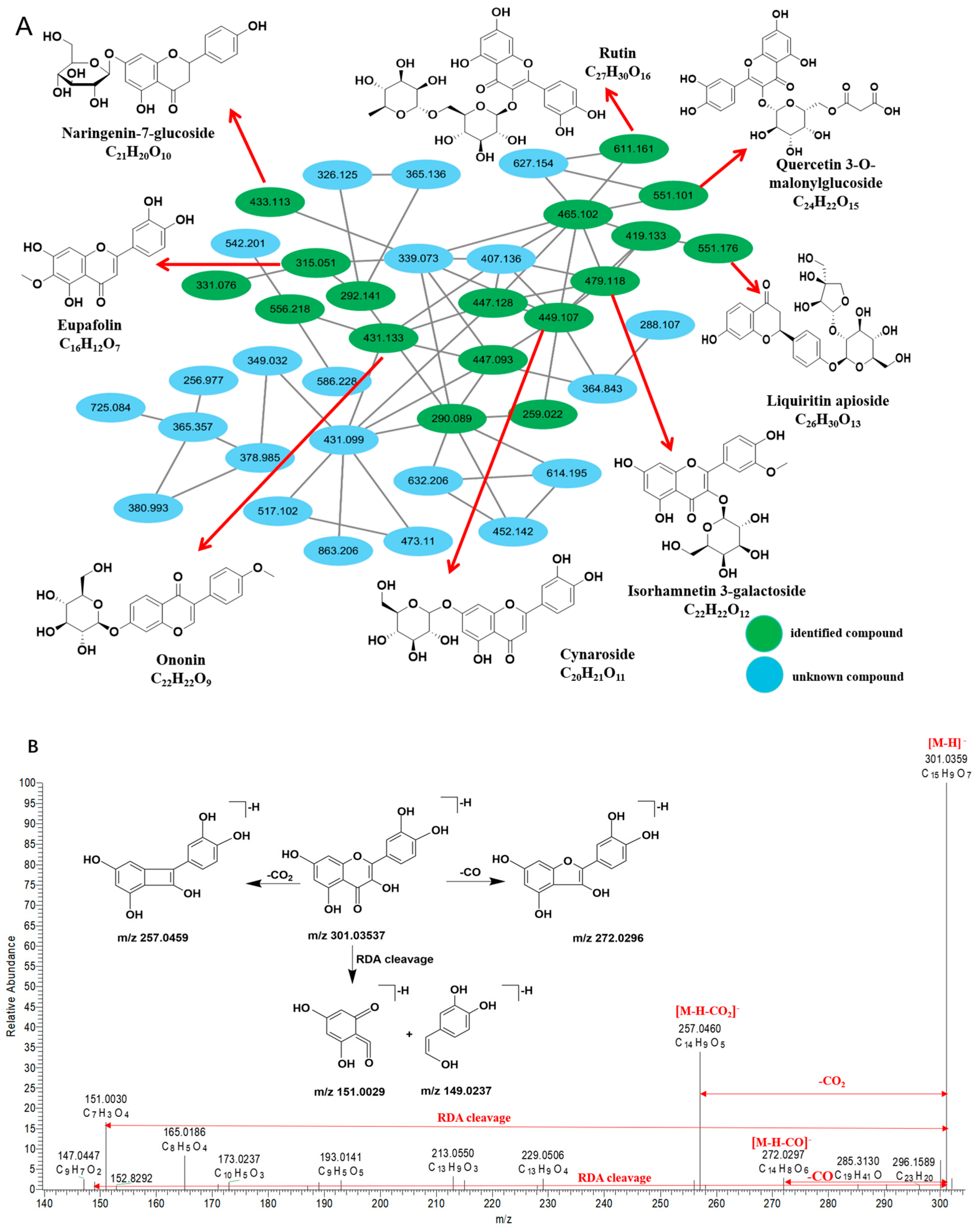
This study identified 50 flavonoid compounds in XBKF capsules, comprising 15 flavonoids, 10 isoflavones, 11 flavonols, nine dihydroflavonoids, and five chalcones. MN was constructed based on UHPLC-Q-Exactive Orbitrap data (Figure 1).
Peak 45, the fragment ion peak at m/z 289.07176, is observed in the secondary mass spectrometry analysis. Based on the OTCML database and data reported by Chen et al. (2024), Yang et al. (2025) and Gevrenova et al. (2025) [18,19,20], the MS/MS fragmentation of catechin exhibited fragment ions at m/z 245.0822 [M-H-CO2], m/z 203.0711 [M-H-CO2-C2H2O], m/z 179.0345 [M-H-C6H6O2], and m/z 125.0235 [M-H-C9H8O3]. In the case of peak 50, the excimer ion peak at m/z 417.1185 [M + H]+ is identified in positive-ion mode. This ion loses a neutral fragment, C4H8O4, resulting in the fragment ion at m/z 297.0744 [M + H-C17H13O5]+. After comparison with the OTCML and data reported by Grayer et al. (2000) [21], it was concluded that peak 50 corresponds to Puerarin, with the molecular formula C21H20O9.
Peak 59, observed at a retention time of 7.46 in negative-ion mode, exhibits an excimer ion peak corresponding to (C15H9O7, m/z 301.03537) [M-H]. The progressive loss of small molecules, specifically CO2 and CO, from the excimer ions yields fragment ions at m/z 257.0459 (C14H9O5) and m/z 273.0407 (C14H9O6). The B ring of the catechol structure experiences specific fragmentation, producing characteristic ions at m/z 151.0029 (C7H3O4) and m/z 149.0237 (C8H5O3). By comparing the data with the standards, OTCML database, and data reported by Chen et al. (2024) [18], peak 59 was identified as quercetin. The MS/MS fragmentation pathways are shown in Figure 1B.
The excimer ion peak for peak 71 is m/z 419.13365 [M + H]+. A notable feature of secondary mass spectrometry is the loss of one molecule of Glu, resulting in 257.0797 [M + H-Glu], m/z (C15H13O4+). Further loss of H2O (18.0101 Da) produces m/z 239.0694 (C15H11O3+). Through RDA cleavage, a pair of complementary characteristic ions is generated: ring A at m/z 147.0434 (C9H7O2+) and ring B at m/z 137.0228 (C7H5O3+). Comparison with GNPS and data reported by Pan et al. (2025) [22] allows for the compound at peak 71 to be identified as liquiritin.
In positive-ion mode, peak 75 exhibits a quimer ion peak corresponding to the precursor ion [M + H]+. At m/z 611.16066 (C27H31O16+), the glycosidic bond cleaves first, resulting in the loss of the entire rutin glycogroup (Rha + Glu). This process generates fragment ions at m/z 303.0485 (C15H11O7+). Additionally, oxygen-containing fragments at m/z 85.0286 (C4H5O2+) are formed from Rha following multiple dehydrations and carbon–carbon bond cleavages, along with ions at m/z 71.0495 (C4H7O+) resulting from the loss of small molecules. These fragments were compared with data from OTCML, GNPS, and the data reported by Wang et al. (2015) [23] and controlled substances. Consequently, it was determined that peak 75 corresponds to rutin, with the molecular formula C27H30O16.
Peak 77 displays an excimer ion peak identified as the precursor ion [M + H]+ at m/z 317.06557 (C16H13O7+). This ion undergoes cleavage through the RDA reaction, yielding a fragment ion at m/z 153.0162 (C7H5O4+). The carbon–oxygen bond in the methoxy group experiences homolytic cleavage, resulting in the loss of a neutral CH3 group and generating fragment ions at m/z 317.06557 (C16H13O7+), which possess an ortho-substituted structure of 3′-methoxy-4′-hydroxyl on its B ring. The loss of one methanol (CH3OH) produces a fragment ion at m/z 285.0382 (C15H9O6+). Therefore, by comparing its retention time and fragment ions with the data reported by Liu et al. (2024) [24], standard, and OTCML, it can be conclusively characterized that peak 77 corresponds to isorhamnetin, with the molecular formula C16H12O7.
The excimer ion peak of peak 99 in the positive-ion mode is detected at m/z 551.17591 (C26H31O13+). The loss of one molecule each of Rha and Glu results in the formation of m/z 257.0800 (C15H13O4+). The cleavage patterns and molecular characteristics of this compound closely resemble those of glycyrrhizoside. By the data from OTCML, PubChem, and GNPS, peak 99 is identified as liquiritin apioside.
Peak 102, which has a retention time of 12.10 min, is also observable in the positive-ion mode. The excimer ion peak for this compound has a mass-to-charge ratio of m/z 419.13365, with secondary fragment ions at m/z 257, 137, and 147. The cleavage patterns and molecular characteristics of peak 102 align with those of isoliquiritin. Combined with analysis from GNPS and data reported by Pan et al. (2025) [22], this compound was identified as isoliquiritin.
Peak 122, with a retention time of 14.93 in negative-ion mode, exhibits an excimer ion peak corresponding to the precursor ion [M-H] at m/z 271.06119 (C15H11O5). Fragment ions m/z 151.0030 (C7H3O4) and m/z 119.0493 (C8H7O) are generated through the retro-Diels–Alder (RDA) pyrolysis reaction. The m/z 151.0030 (C7H3O4) ions can undergo rearrangement and subsequent cleavage to yield m/z 107.0128 (C6H3O2). The m/z 119.0493 (C8H7O) ion, which loses C2H2, serves as a characteristic ion of the B ring and further cleaves to produce m/z 93.0335 (C6H5O). Based on comparisons with database entries and data reported by Zhu et al. (2022) [25], along with established mass spectrometry cleavage rules, it is concluded that peak 122 corresponds to naringenin, with the molecular formula C15H12O5.
Peak 157, also in negative-ion mode, shows an excimer ion peak for the precursor ion [M-H] at m/z 269.04554 (C15H9O5). This quimer ion undergoes a series of neutral losses of small molecules. The loss of CO results in the fragment ion m/z 241.0509 (C14H9O4), while the loss of CO2 generates the fragment ion m/z 225.0558 (C14H9O3). It is determined that peak 157 corresponds to baicalein, with the molecular formula C15H10O5.

2.1.2. Identification of Phenolic Acid Compounds

Ten nodes are interconnected, forming a cluster (Figure 2A). Among these nodes, cryptochlorogenic acid (39, m/z 353.0878), chlorogenic acid (46, m/z 353.0878), coumaroyl quinic acid (57, m/z 337.09289), and isochlorogenic acid B (80, m/z 517.13405) can be annotated using GNPS. Peak 28 displays excimer ions [M-H] at m/z 169.01424 (C7H5O5), with sub-ions at m/z 125.0235 resulting from the loss of CO2. According to the PubChem databases, as well as the data reported by Wang et al. (2015) [23], peak 28 is identified as gallic acid.
Peak 36 appears at 2.59 min, where the parent ion [M-H] undergoes cleavage at m/z 153.01933, producing daughter ions at m/z 109.0285 [M-H-CO2] and 108.0207 [M-H-CO2-H]. Integrating data from the data reported by Lv et al. (2023) [26], peak 36 is identified as gentisic acid. Peak 38 in the m/z 181.04953 (C9H9O4+) position shows an excimer ion [M + H]+, through the continuous loss of H2O [M + H-H2O]+ fragment ions, m/z 163.0383 (C9H7O3+) and [M + H-2H2O]+ fragment ions, and m/z 145.0278 (C9H5O2+). Further neutral loss of CO produces m/z 135.0435 [M + H-C8H7O2]+. Based on data reported by Shi et al. (2025) [27], along with the standard, peak 38 was accurately identified as caffeic acid.
Peak 39, associated with the presence of the caffeoyl group at the C4 hydroxyl position of quinic acid, exhibits a steric hindrance effect that favors its cleavage, leading to the direct formation of caffeic acid fragments with m/z 179.0345 (C9H7O4), alongside the neutral loss of dehydrated quinic acid (C7H10O5). Additionally, the secondary fragment at m/z 135.0443 [C9H8O4-CO2-H] arises from the decarboxylation of m/z 179.0345. Although the cleavage pathways for these fragments are fundamentally similar, variations in the positions of the acyl groups result in slight differences in the relative intensities of the fragment ions, which can be distinguished by their retention times. Consequently, utilizing GNPS, OTCML, and the chromatographic data, along with the fragmentation patterns from the standard, peak 39 was accurately identified as cryptochlorogenic acid.
The excimer ion peak at m/z 353.08780 (C16H17O9, [M-H]) is observed in the primary mass spectrometry of compound 46. In the secondary mass spectrometry, the fragment ion peak corresponding to the quinic acid fragment is noted at m/z 191.0558 (C7H11O6). Additionally, the fragment ion associated with the caffeic acid group appears at m/z 179.0344 (C9H7O4). This ion subsequently loses one molecule of CO2, resulting in the decarbonylation fragment ion of the caffeic acid group at m/z 135.0443 (C8H7O2). Alternatively, the loss of one molecule of H2O leads to the formation of m/z 161.0237 (C9H5O3). It is inferred that compound 46 is chlorogenic acid.
Compounds 48 and 66 both displayed excimer ions [M-H] at m/z 193.05063 (C10H9O4). Compound 48 loses a neutral CO2 molecule, forming the [M-H-CO2] ion at m/z 149.0601 (C9H9O2). This process occurs through a rearrangement reaction involving the adjacent phenolic hydroxyl group. The C-O bond in the methoxy group undergoes homolytic cleavage, releasing a neutral methyl radical (-CH3) and generating a stable orthoquinone radical anion at m/z 178.0266 [M-H-CH3]. Subsequently, it loses CO2 to yield the ion at m/z 134.0365 [M-H-CH3-CO2]. Due to the proximity of the hydroxyl and methoxy groups in ferulic acid, this rearrangement reaction proceeds with relative ease. Hence, the ion m/z 178.0266 (C9H6O4) typically exhibits a high abundance in its MS/MS spectrum. Conversely, ethyl caffeate, hindered by the positioning of its hydroxyl and methoxy groups, cannot easily undergo a favorable cyclic transition state, thereby impeding the CH3 loss pathway. In compound 66, the cleavage is influenced by the structure of the substituent at the central position. The ion m/z 149.0238 [M-H-CO2] is generated through a direct decarboxylation reaction, with the abundance of m/z 178.0269 (C9H6O4) being relatively lower. The sole discrepancy lies in the ion peak response value. Upon comparison with OTCML and data reported by Shi et al. (2025) [27] and standards, ferulic acid was confirmed as compound 48, while isoferulic acid was identified as compound 66.
Peak 76 exhibits the excimer ion [M-H] at m/z 521.13006 (C24H25O13). The glycosidic moiety is lost as a neutral molecule, C15H18O9 (342.0952 Da), resulting in the formation of m/z 179.0345 (C9H7O4). This ion subsequently undergoes decarboxylation, yielding m/z 135.0443 (C8H7O2). Peak 76 has been identified as salviaflaside.
Peak 88 displays the precursor ion peak [M + H]+ at m/z 209.08083 (C11H13O4+), with the subsequent loss of a neutral molecule C8H10O3 in the secondary fragmentation, yielding m/z 55.0184 (C3H3O+). Simultaneously, the loss of one molecule of H2O results in the formation of a fragment ion peak at m/z 191.0696 (C11H11O3+). Through comparison with the OTCML, compound 88 was conclusively identified as ethyl caffeate.
Peaks 80, 84, and 94, in positive-ion mode, all exhibit excimer ions [M + H]+ at m/z 517.13405 (C25H25O12+). In the secondary mass spectrometry, characteristic fragments are generated by the continuous loss of caffeyol groups through the cleavage of acyl–oxygen bonds. A distinct fragment ion peak m/z 163 (C9H7O3+) emerged. Further, one molecule of H2O was lost to form m/z 145 (C9H5O2+), and one molecule of CO was lost to generate m/z 117 (C8H5O+). It is speculated that its molecular formula is C25H24O12. Based on the signal strength of the elution and the elution sequence in reversed-phase chromatography, and given the comparison with the OTCML databases, GNPS isochlorogenic acid B, isochlorogenic acid A, and isochlorogenic acid C, the compounds were finally identified as isochlorogenic acid B, isochlorogenic acid A, and isochlorogenic acid C, respectively.
Peak 93, at m/z 359.07724 (C18H15O8), shows the excimer ion [M-H] through the loss of the coffee acyl group 179.0339. The characteristic fragment ions at m/z 161.0238 [M-H-C9H6O3] and 197.0452 [M-H-C9H6O3-2H2O] were generated. Therefore, based on the data reported by Liu et al. (2024) [28], the MS/MS fragmentation pathways of rosmarinic acid are shown in Figure 2B. It has been identified as rosmarinic acid.

2.1.3. Identification of Terpenoids

Peak 129 exhibits an excimer ion peak [M + H]+ at m/z 469.33123 (C27H45O3+). The neutral fragment [M + H-C8H16O2]+ results in m/z 273.2208 (C19H29O). Subsequent loss of H2O produces m/z 255.2103. Rearrangement via RDA cleavage generates m/z 161.1323 and m/z 69.0704. Cleavage of the parent ion [M + H]+ yields isoprene fragment ions [C5H]+. Comparison with the database and GNPS confirms that component 129 is Sarsasapogenin.
Using peak 135 (tR = 17.63 min) as a case study for identification and analysis, the excimer ion peak [M-H] for this component was observed at m/z 821.39650 (C42H61O16). Subsequent secondary cleavage produced a fragment ion peak at m/z 351.0579 [M-H-C30H46O4], followed by the loss of C6H6O5, resulting in a fragment ion peak at m/z 193.0350 (C6H9O7). Ultimately, the loss of one H2O molecule yielded a fragment ion peak at m/z 175.0243 (C6H7O6). The fragmentation pathways are illustrated in Figure 3B. Additionally, by comparing these findings with the relevant data reported by Pan et al. (2025) [22] and standard substances, it was concluded that component 135 is glycyrrhizic acid.
Peak 136 (tR = 17.65 min) corresponds to the excimer ion peak [M + H]+ with an m/z of 471.34688 (C30H47O4+). Subsequent secondary cleavage, resulting from the protonation of its hydroxyl or carboxyl groups, leads to the loss of one molecule of water, generating a fragment ion peak at m/z 453.3346 (C30H45O3+). The continuous loss of a neutral carbon monoxide molecule [M + H-H2O-CO]+ results in an ion at m/z 425.3401 (C29H45O2+). Through RDA cleavage, an ion at m/z 317.21042 (C20H29O3+) is produced, followed by the loss of C4H6 (54.0469 Da), yielding m/z 263.1634 (C16H23O3+). Further loss of CO (27.9949 Da) results in an ion at m/z 235.1687 (C15H23O2+). Comparison with relevant data reported by Pan et al. (2025) [22] and GNPS analysis identified component 136 as enoxolone.

2.1.4. Identification of Quinone Compounds

Peak 115 eluted at 13.58 min. Under positive-ion detection, the ion m/z 285.07575 [M + H]+ was observed, with the loss of one methanol molecule [M + H-CH3OH]+. Fragment ion m/z 253.0497 (C15H9O4+), lacking a methyl group, yielded m/z 270.0524 (C15H10O5+). Subsequent elimination of a COOH radical (45 Da) resulted in m/z 225.0548 (C14H9O3+). Through comparison with appropriate standards and the data reported by Zeng et al. (2024) [29], the compound was identified as physcion.
Using emodin as a case study, a peak at 118 in the positive-ion mode yields an excimer ion peak at m/z 271.06009 [M + H]+. The presence of one hydroxyl (-OH) group and one methyl (-CH3) group on either the A or C ring of the emodin molecule results in the loss of one neutral C2H2O molecule (42.0106 Da), leading to the formation of m/z 229.0499 [M + H-C2H2O]+. Additionally, the removal of one carbon monoxide molecule (CO, −28 Da) generates m/z 201.05498. The elimination of another CO molecule results in m/z 243.0652 [M + H-CO]+. By integrating data from OTCML and relevant standards, it was confirmed that this compound is emodin, and the lysis rule is illustrated as described.
Using peak 163 as a case in point, this compound exhibits a strong response in positive-ion mode. It was identified as cryptotanshinone based on data reported by Shen et al. (2022) [30]. The primary mass spectrometer generates an excimer ion peak at m/z 297.14852 [M + H]+ with a retention time of 21.89 min. The secondary mass spectrometer produces fragment ions at m/z 279.1368 and 251.1419. The ion at 237.0904 corresponds to [M + H-H2O]+, [M + H-H2O-CO]+, and [M + H-H2O-CO-2CH3]+.
The excimer ion peak 148 at m/z 311.12778 [M + H]+ can lose water molecules sequentially to produce m/z 293.11636 (C19H17O3+) and m/z 275.1055 (C19H15O2+). Subsequent elimination of ethylene [M + H-C2H4] results in m/z 283.1319 (C18H19O3+), followed by the loss of H2O to yield m/z 265.1213 (C18H17O2+). Comparison of secondary mass spectrometry fragments with databases, the data reported by Sun et al. (2019) [31], and standard substances confirmed that peak 148 corresponds to tanshinone IIB. The excimer ion peak 168 at m/z 295.13280 [M + H]+ corresponds to peak 168. During the cleavage process, one molecule of H2O is readily eliminated, followed by the continuous removal of CO, resulting in the formation of m/z 277.1213 (C19H17O2+) and m/z 249.1263 (C18H17O+). The loss of one methyl molecule, represented as [M + H-H2O-CH3]+, yields m/z 262.0979 (C18H14O2+), while the elimination of a neutral methyl fragment produces m/z 280.1087 [M + H-CH3]+. Based on secondary mass spectrometry fragments obtained from the PubChem databases, along with the data reported by Liu et al. (2024) [28], tanshinone IIA was identified.

2.1.5. Identification of Coumarin Compounds

Peak 47, with an m/z of 177.0193 [M-H] in negative ion detection mode, underwent CO2 and CO loss, forming fragment ions at m/z 133.0286 [M-H-CO2], m/z 149.0237 [M-H-CO], and m/z 105.0335 [M-H-3CO]. Compound 47 was identified as daphnetin through comparison with reports in the data reported by Pan et al. (2025) [22]. Peak 56 had a retention time of 7.27 min, with an m/z of 193.04953 [M + H]+ in positive ion detection mode. In secondary mass spectrometry, excimer ions lost methyl radicals or CH3OH, resulting in m/z 178.02557 [M + H-CH3]+ and m/z 161.0591 [M + H-CH3OH]+, followed by the sequential loss of two CO molecules to generate fragment ions at m/z 133.0643 [M + H-CH3OH-CO], m/z 165.0540 [M + H-CO]+, and m/z 137.0591 [M + H-2CO]. Direct loss of one molecule of methanol [M + H-CH3OH]+ yielded m/z 134.0596 (C8H6O2+). Compound 56 was identified as scopoletin through comparison with reports in the data reported by Yang et al. (2025) [19].
Peak 92 exhibited a mass-to-charge ratio (m/z) of 161.02441 [M-H] in negative-ion detection mode and subsequently lost one molecule of neutral carbon monoxide (CO), resulting in the formation of m/z 133.0287 (C8H5O2). A comparison with the data reported by Zhu et al. (2022) [25] led to the identification of compound 92 as 7-hydroxycoumarin. The retention time for peak 120 was recorded at 14.29 min. In positive ion detection mode, m/z 315.04992 [M + H]+ was observed, indicating the cleavage of the lactone ring (C ring). The loss of one molecule of neutral CO produced fragment ions at m/z 287.05590 [M + H-CO]+ and 259.0607 [M + H-2CO]+, while the loss of one molecule of neutral water (H2O) resulted in fragment ions at m/z 297.0401 [M + H-H2O]+. Based on comparisons with the PubChem databases and data reported by Lee et al. (2010) [32], compound 120 was identified as wedelolactone.

3. Discussion

This study uses UHPLC-Q-Exactive Orbitrap MS combined with MN technology for rapid qualitative identification of the characterizations in XBKF capsules, demonstrating the unparalleled synergy between the high-resolution power of the UHPLC-Q-Exactive Orbitrap and the high-throughput classification of MN. This approach overcomes the high-cost and low-efficiency issues associated with traditional methods used to discover constituents in TCM [33].
Pharmacological studies have shown that the seven plants in XBKF capsules have definite pharmacological activities, including antioxidant, anti-inflammatory, and promoting blood circulation and removing blood stasis and freckles effects. Salvia miltiorrhiza Bunge contains cryptotanshinone, salvianolic acid B, and rosmarinic acid (Peak 79, Rt 10.71 min). As a phenolic acid compound, rosmarinic acid can protect cells from oxidative damage, with potential applications in the treatment of conditions related to inflammation and oxidative stress [34]. Fructus mori has been reported to be rich in flavonoids, polyphenols, alkaloids, and anthocyanins, which have the effects of anti-oxidation, anti-inflammation, and melanin synthesis-inhibiting [35]. Tribulus terrestris L. is rich in flavonoids (quercetin) and alkaloids, which have significant effects on promoting blood circulation and removing blood stasis [36]. Typhonium giganteum extracts have anti-inflammatory effects via regulation of NF-κB signaling and ROS production, which contribute to ameliorating dermatological inflammation and hyperpigmentation disorders [37]. The pharmacological activities of Glycyrrhiza uralensis, including the antiviral and antimicrobial activities, have been most commonly reported, such as liquiritigenin [38]. Additionally, Eclipta prostrata and Fallopia multiflora contain coumarin derivatives, flavonoids, and triterpene saponins, exhibiting antibacterial, anticancer, hepatoprotective, and hair growth-promoting effects [39].
In this study, the identification of compounds was based on the relevant literature, databases, and multiple verifications by retention time and fragment ions. Consequently, it is logical to think that it comes from one of the components of the sample. It is worth mentioning that XBKF capsules are a prescription comprising seven herbs. Each herb is recognized for containing a significant number of compounds, and some compounds may appear in multiple herbs [40]. If a compound is identified that has not been previously described in any of the seven plants, it may be the result of complex chemical changes that have occurred gradually during the process of TCM processing. Moreover, newly formed chemical constituents may be the basis of clinical efficacy [41]. Another plausible explanation is that some compounds may have always existed in the individual herbs but remained undetected due to technological limitations of earlier studies, such as low sensitivity and being incapable of distinguishing compounds with very similar molecular mass [42]. With the advanced sensitivity and resolution of modern UHPLC-Orbitrap MS technology, it is now possible to detect trace constituents that were previously unrecognized. For example, Włodarczyk et al. (2022) [43] identified approximately 90 previously unreported saponins in Strophanthus seeds using UHPLC-MS/MS. Therefore, this study demonstrates an efficient method to identify compounds in complex herbal drug mixtures using UHPLC-Orbitrap MS and MN tools, which will support future research into quality controls and treatment mechanisms of TCM preparations.
By automatically searching the vast GNPS database and analyzing the generated MN, we can get more information for identification. The resulting molecular clusters may indicate potential compound types present in TCM. However, there are two significant concerns. There is a possibility of false positives in molecular network clustering analysis based on the similarity of MS/MS spectrometry in GNPS, such as molecules with clustering structures not necessarily sharing similar MS secondary spectra. In addition, the annotation efficiency of molecular network clusters is not high; compounds in some clusters cannot be identified [44]. After drawing a comparison with other reference standards and screening out the unreasonable redundant nodes and wrong annotations, 34 constituents were finally obtained from the MN [45]. Consequently, this research not only provides a solid platform for the further development of XBKF capsules but also demonstrates a versatile analytical workflow with broad applicability to other traditional Chinese medicine prescriptions.

4. Materials and Methods

4.1. Materials and Reagents

XBKF capsules were obtained from Hunan Medical College General Hospital (Huaihua, Hunan, China; batch number: 20240829). Chromatographic-grade methanol and acetonitrile were procured from Merck (Kenilworth, NJ, USA). Distilled water was sourced from Watsons Food & Beverage Co., Ltd. (Guangzhou, China). LC-MS grade formic acid was acquired from Fisher Scientific (Waltham, MA, USA). All other reagents used were of analytical grade. A total of 22 reference standards were utilized and details of these 22 reference standards are provided in Table S2.

4.2. Sample Preparation

The contents of the XBKF capsules (0.5 g) were subjected to ultrasonic extraction using 5 mL of 70% methanol at room temperature for 30 min. The mixture was then centrifuged at 13,523× g for 20 min and filtered through a 0.22 μm microporous filter prior to LC-MS analysis. The 22 standards were dissolved in methanol at a concentration of approximately 1 mg/mL. Each stock solution was then further diluted via mixing to obtain a standard mixture (approximately 30 μg/mL) [25]. Subsequently, the mixture was centrifuged at 13,523× g for 20 min, and these solutions were stored at 4 °C for analysis.

4.3. Liquid Chromatographic Conditions

To achieve improved chromatographic peak shape and separation resolution, several parameters were established during the detection and identification process. These included the chromatographic column (Thermo Syncronis aQ C18 (Thermo Fisher Scientific, San Jose, CA, USA), 2.1 × 100 mm, 1.7 µm), the column temperature (40 °C), and the mobile phase gradient. Each LC-MS analysis was interfaced with the Thermo Scientific Dionex Ultimate 3000 RS via an ESI source (Thermo Fisher Scientific Co., Ltd., Waltham, MA, USA) and performed using the Q-Exactive Focus Orbitrap MS. The mobile phase consisted of a 0.1% formic acid aqueous solution (C) and acetonitrile (D). The flow rate was set at 0.28 mL/min, and the optimized gradient elution program was as follows: from 0 to 5 min, 5–15% C; from 5 to 10 min, 15–30% C; from 10 to 15 min, 30–50% C; from 15 to 20 min, 50–75% C; from 20 to 28 min, 75–95% C; and from 28 to 33 min, 95–5% C, with an injection volume of 2 µL.

4.4. MS Spectrometry Conditions

Mass spectrometry analysis was conducted using the Q-Exactive Orbitrap MS (Thermo Fisher Scientific, Bremen, Germany), which is equipped with a heated electrospray ionization source (HESI). Data acquisition in both positive- and negative-ion modes was performed via full-scan data-dependent MS/MS (Full-scan-DDMS2), covering a mass range of m/z 100–1500. The mass spectrometry parameters were established as follows: the capillary voltage was set to 3.5 kV for positive-ion mode and 3.0 kV for negative-ion mode. The full mass resolution was configured to 70,000. The heater temperature was maintained at 350 °C, while the heated capillary tube temperature was set to 320 °C. The flow rates for sheath gas and auxiliary gas were 30 and 10 arb, respectively. The radio frequency (RF) level of the S-lens was set at 50. The resolution for ddMS2 was established at 17,500. Fragmentation was performed using step-normalized collision energies (NCEs) of 35%. Data collection and analysis were conducted using Xcalibur 4.2 software (Thermo Fisher Scientific, San Jose, CA, USA).

4.5. Integrated Strategy for Data Analysis

The purpose of this study is to systematically identify the chemical components of XBKF. An effective strategy has been established to comprehensively and accurately characterize the chemical composition of XBKF. The strategy comprises four main steps.
First, the chemical compounds in XBKF capsules were extracted and enriched using a 70% methanol ultrasonic extraction method. To achieve good separation and an abundant signal response, the proportion and variety of mobile phases, including acetonitrile-aqueous, methanolaqueous, acetonitrile-aqueous with 0.1% formic acid, and methanolaqueous with 0.1% formic acid, were optimized to obtain better chromatographic conditions. Thus, the mobile phases consisted of acetonitrile-aqueous with 0.1% formic acid, which could be considered as the most optimized separation condition; the proportion used is outlined in Section 4.3. Secondly, data from PubMed (https://pubmed.ncbi.nlm.nih.gov/, accessed on 6 June 2025), PubChem (https://pubchem.ncbi.nlm.nih.gov/, accessed on 6 June 2025), Web of Science (https://www.webofknowledge.com, accessed on 6 June 2025), CNKI (https://www.cnki.net, accessed on 6 June 2025), Google Scholar, and Wanfang Data Knowledge Service Platform were used to summarize the mass spectrometry information of XBKF-related components and identify the target components. The retrieved data encompass component names, relative molecular masses, ion modes, parent ion m/z values, and MS/MS spectral fragments to create a compound database. Unknown compounds are identified by comparing quasi-molecular ions and MS2 fragment ions against the internal library. Thirdly, GNPS was used to detect and identify unknown compounds based on fragment similarity. The original MS/MS spectral data were converted into the mzML format that contains all the analytical information. Then, the mzML format file was uploaded to the client through the FileZilla software (3.58.0) and imported into the GNPS platform (http://gnps.ucsd.edu, accessed on 6 June 2025) for analysis. Furthermore, the MS2 fragment ions were visualized on the GNPS platform within Cytoscape 3.10.4 to expedite precise analysis and modification of the complete molecular network dataset. Finally. Xcalibur 4.4 software was used to extract and match the peaks of the XBKF mass spectrum data. The relative molecular mass of the parent ion was calculated according to the information of the excimer ion or the additive ion, and its molecular formula was deduced. To satisfy a mass deviation of less than 5, the chemical composition of XBKF was identified and analyzed according to the fragment ion information provided by the GNPS platform and database and combined with the fragmentation law of the reference substance and compound mass spectrum.

4.6. Molecular Network Analysis Based on GNPS

Using the MsConvert software (3.0.19147), LC-MS/MS raw files (raw) were converted into mzXML format files, which were subsequently uploaded to the GNPS platform (https://gnps.ucsd.edu, accessed on 6 June 2025) via the FileZilla client to create molecular networks. The network parameters were configured with a Precursor Ion Mass Tolerance of 2.0 Da and a Fragment Ion Mass Tolerance of 0.5 Da. Additionally, the cosine fraction threshold (Min PairsCos) was set to 0.7, the Minimum Matched Fragment Ions to 6, and the Network TopK was set to 10. All the remaining parameters were maintained at their default settings. The final molecular network was visualized and analyzed using Cytoscape software (3.9.1).

5. Conclusions

In this study, we established a convenient and reliable analytical strategy combining UHPLC-Q-Exactive Orbitrap MS with GNPS-based MN to comprehensively characterize XBKF capsules. A total of 170 chemical components were successfully analyzed from XBKF capsules were successfully analyzed. These components encompass flavonoids, phenolic acids, quinones, alkaloids, terpenoids, phenylpropanes, and other substances. Moreover, numerous unassigned clusters and nodes were observed in the GNPS, which is conducive to the discovery of novel compounds. Future studies should focus on using more computational tools to discover compounds and developing automated approaches to investigate complex TCM prescriptions. The results of this study lay the foundation for in-depth research on the quality control of XBKFcapsules and promote the development of modern XBKF capsules prescription.

Supplementary Materials

The following supporting information can be downloaded at https://www.mdpi.com/article/10.3390/ph19030459/s1, Table S1: Identification of chemical components in XBKF using UHPLC-Q-Exactive Orbitrap MS; Table S2: Detailed information of the 22 reference standards. Figure S1: High-resolution extraction ion chromatograms (TIC) of XBKF capsules in positive-ion (P1,P2) and negative-ion (N1,N2) modes.

Author Contributions

X.L.: experiment performance and data sorting. Y.L.: software and investigation. T.Q.: data processing and curation. J.Z. and W.C.: writing—review and editing, conceptualization and supervision. All authors have read and agreed to the published version of the manuscript.

Funding

This study was supported by the Natural Science Foundation of Hunan Province of China, Grant No. 2023JJ50076.

Institutional Review Board Statement

Not applicable.

Informed Consent Statement

Not applicable.

Data Availability Statement

The original contributions presented in this study are included in the article/Supplementary Materials. Further inquiries can be directed to the corresponding authors.

Acknowledgments

We acknowledge the collective effort and contributions from all those involved in this research.

Conflicts of Interest

The authors declare no conflicts of interest.

References

  1. Wei, P.; Huang, S.; Yang, J.; Zhao, M.; Chen, Q.; Deng, X.; Chen, J.; Li, Y. Identification and characterization of chemical constituents in Mahuang Guizhi Decoction and their metabolites in rat plasma and brain by UPLC-Q-TOF/MS. Chin. Herb. Med. 2024, 16, 466–480. [Google Scholar] [CrossRef] [Scilit]
  2. Huang, J.; Kan, J.; Fan, T.; Quan, Q.; Li, X.; Jiang, Q.; Zhang, B.; Guo, G. Efficacy of the Nourishing Yin and Clearing Heat Therapy Based on Traditional Chinese Medicine in the Prevention and Treatment of Radiotherapy-Induced Oral Mucositis in Nasopharyngeal Carcinomas: A Systematic Review and Meta-Analysis of Thirty Randomized Controlled Trials. Evid. Based Complement. Altern. Med. 2022, 2022, 4436361. [Google Scholar] [CrossRef] [Scilit]
  3. Pan, L.; Wang, X.; Long, F.; Tang, A. Clinical efficacy and safety evaluation of traditional Chinese medicine for nourishing yin and Replenishing qi in combination with PD-1/PD-L1 inhibitors in the treatment of NSCLC patients: A meta-analysis. Toxicol. Res. 2025, 14, tfaf013. [Google Scholar] [CrossRef] [Scilit]
  4. Ji, Y.-Y.; Liu, S.-N.; Ping, X.; Qin, S. The use of traditional Chinese medicine internally and externally combined with auricular acupuncture point bloodletting in the treatment of vulvar leukoplakia. TMR Integr. Med. 2020, 4, e20003. [Google Scholar] [CrossRef] [Scilit]
  5. Shu, W.; Yang, X. Optimization for the Preparation Technology of Xiaoban Kangfu Capsules. Guid. J. Tradit. Chin. Med. Pharm. 2008, 77–78. [Google Scholar] [CrossRef]
  6. Xu, Y.; Zhang, L.; Wang, Q.; Luo, G.; Gao, X. An integrated strategy based on characteristic fragment filter supplemented by multivariate statistical analysis in multi-stage mass spectrometry chromatograms for the large-scale detection and identification of natural plant-derived components in rat: The rhubarb case. J. Pharm. Biomed. Anal. 2019, 174, 89–103. [Google Scholar] [CrossRef] [Scilit]
  7. Fu, S.; Cheng, R.; Deng, Z.; Liu, T. Qualitative analysis of chemical components in Lianhua Qingwen capsule by HPLC-Q Exactive-Orbitrap-MS coupled with GC-MS. J. Pharm. Anal. 2021, 11, 709–716. [Google Scholar] [CrossRef] [Scilit] [PubMed]
  8. Xiong, P.; Qin, S.-H.; Li, K.-L.; Liu, M.-J.; Zhu, L.; Peng, J.; Shi, S.-L.; Tang, S.-N.; Tian, A.-P.; Cai, W. Identification of the tannins in traditional Chinese medicine Paeoniae Radix Alba by UHPLC-Q-Exactive Orbitrap MS. Arab. J. Chem. 2021, 14, 103398. [Google Scholar] [CrossRef] [Scilit]
  9. Liu, L.; Zhang, J.; Zheng, B.; Guan, Y.; Wang, L.; Chen, L.; Cai, W. Rapid characterization of chlorogenic acids in Duhaldea nervosa based on ultra-high-performance liquid chromatography-linear trap quadropole-Orbitrap-mass spectrometry and mass spectral trees similarity filter technique. J. Sep. Sci. 2018, 41, 1764–1774. [Google Scholar] [CrossRef] [Scilit] [PubMed]
  10. Li, H.; Li, K.; Cheng, W.; Liu, M.; Wen, L.; Zhang, Z.; Zhang, W.; Su, J.; Cai, W. Rapid Characterization of the Potential Active of Sinomenine in Rats by Ultra-High-Performance Liquid Chromatography-Quadrupole-Exactive Orbitrap Mass Spectrometry and Molecular Docking. J. Sep. Sci. 2024, 47, e202400486. [Google Scholar] [CrossRef] [Scilit]
  11. Tang, H.; Zhang, Y.; Reng, Z.; Zhu, J.; Xie, Y.; Zhang, X.; Feng, H.; Yuan, K.; Pan, Y. In situ analysis of tobacco leaves based on microwave plasma torch desorption ionization mass spectrometry. J. Anal. Test. 2024, 8, 9–15. [Google Scholar] [CrossRef] [Scilit]
  12. Otsuki, K.; Zhang, M.; Tan, L.; Komaki, M.; Shimada, A.; Kikuchi, T.; Zhou, D.; Li, N.; Li, W. Isomer Differentiation by UHPLC-Q-Exactive-Orbitrap MS led to Enhanced Identification of Daphnane Diterpenoids in Daphne tangutica. Phytochem. Anal. 2025, 36, 1053–1062. [Google Scholar] [CrossRef] [Scilit]
  13. Wu, J.; Cai, K.; Chen, Z.; Hou, W.; Wang, Q.; Chen, H.; Xie, Z.; Liao, Q. Identification and screening of potential anti-pneumonia active ingredients and targets of Qing-Kai-Ling oral liquid via UHPLC-Q-Exactive Orbitrap mass spectrometry based on data post-processing. J. Chromatogr. A 2024, 1736, 465391. [Google Scholar] [CrossRef] [Scilit]
  14. Bai, Y.-L.; Hong, Z.-D.; Zhang, T.-Y.; Cai, B.-D.; Zhang, Y.-Z.; Feng, Y.-Q. A Method for simultaneous determination of 14 carbonyl-steroid hormones in human serum by ultra high performance liquid chromatography–tandem mass spectrometry. J. Anal. Test. 2020, 4, 1–12. [Google Scholar] [CrossRef] [Scilit]
  15. Cai, R.; Liu, J.; Wang, X.; An, T.; Zhang, L. Identification of daurisoline metabolites in rats via the UHPLC-Q-exactive orbitrap mass spectrometer. J. Pharm. Biomed. Anal. 2025, 252, 116482. [Google Scholar] [CrossRef] [Scilit] [PubMed]
  16. Pan, H.; Zhou, H.; Miao, S.; Cao, J.; Liu, J.; Lan, L.; Hu, Q.; Mao, X.; Ji, S. An integrated approach for global profiling of multi-type constituents: Comprehensive chemical characterization of Lonicerae Japonicae Flos as a case study. J. Chromatogr. A 2020, 1613, 460674. [Google Scholar] [CrossRef] [Scilit]
  17. Xue, X.; Jiao, Q.; Jin, R.; Wang, X.; Li, P.; Shi, S.; Huang, Z.; Dai, Y.; Chen, S. The combination of UHPLC-HRMS and molecular networking improving discovery efficiency of chemical components in Chinese Classical Formula. Chin. Med. 2021, 16, 50. [Google Scholar] [CrossRef] [Scilit] [PubMed]
  18. Chen, Y.; Dong, Y.; Song, L.; Bai, C.; Wang, B.; Sa, C. The Analysis of Leontopodium leontopodioides (Willd.) Beauv. Chemical Composition by GC/MS and UPLC-Q-Orbitrap MS. Int. J. Anal. Chem. 2024, 2024, 3525212. [Google Scholar] [CrossRef] [Scilit]
  19. Yang, Y.; Meng, F.; Wang, X. Analysis of chemical constituents in Beishashen Siwei Decoction and capsule preparation based on UPLC-Q-Exactive Orbitrap MS. Chin. J. Hosp. Pharm. 2025, 45, 1634–1642. [Google Scholar]
  20. Gevrenova, R.; Szakiel, A.; Pączkowski, C.; Zengin, G.; Kurt-Celep, I.; Stefanova, A.; Zheleva-Dimitrova, D. Erica spiculifolia Salisb. (Balkan Heath): A Focus on Metabolic Profiling and Antioxidant and Enzyme Inhibitory Properties. Plants 2025, 14, 1648. [Google Scholar] [CrossRef] [Scilit]
  21. Grayer, R.J.; Kite, G.C.; Abou-Zaid, M.; Archer, L.J. The application of atmospheric pressure chemical ionisation liquid chromatography–mass spectrometry in the chemotaxonomic study of flavonoids: Characterisation of flavonoids from Ocimum gratissimum var. gratissimum. Phytochem. Anal. Int. J. Plant Chem. Biochem. Tech. 2000, 11, 257–267. [Google Scholar] [CrossRef] [Scilit]
  22. Pan, L.; Gao, X.; Qiao, P.; Zhang, W.; Zhao, X.; Chi, Y.; Luo, Z.; Di, L. Chemical profiling of Wendan Decoction by UPLC-Q-TOF-MS/MS anddifferential components identified between different processes based on chemicalpattern recognition. Chin. Tradit. Herb. Drugs 2025, 56, 2811–2828. [Google Scholar]
  23. Wang, Q.; Liu, J.; Chen, X.; Zhang, J.; Liu, L.; Xin, G. Screening α—Glucosidase Inhibitors from Extracts of Chinese Medicine. Acta Chin. Med. Pharmacol. 2015, 43, 70–76. [Google Scholar] [CrossRef]
  24. Liu, H.; Nie, J.; Zhang, Y.; Wang, J.; Song, L.; Li, Y. Identification and Characterization of the Chemical Constituents of Qianlie Shule Capsules by UPLC-Q-Orbitrap-MS/MS. J. AOAC Int. 2024, 107, 396–415. [Google Scholar] [CrossRef] [Scilit]
  25. Zhu, L.; Ma, S.; Li, K.; Xiong, P.; Qin, S.; Cai, W. Systematic Screening of Chemical Constituents in the Traditional Chinese Medicine Arnebiae Radix by UHPLC-Q-Exactive Orbitrap Mass Spectrometry. Molecules 2022, 27, 2631. [Google Scholar] [CrossRef] [Scilit]
  26. Lv, L.; Zhang, C.; Wu, J.; Zhang, D.; Zhao, F.; Aga, L.B.; Wang, N.; Li, J.; Tang, L.; Zhao, B. Systematic Characterization of the Chemical Components of Canna edulis Ker-Gawl Based on UHPLC Q-Exactive Orbitrap MS Technology. J. Food Qual. 2023, 2023, 8230958. [Google Scholar] [CrossRef] [Scilit]
  27. Shi, G.; Fan, J.; Li, W.; Zhou, B.; Xiao, J.; Shi, J.; Guan, Y. Study of Chemical Constituents in Bidentis Herba from Different Origins Based on UPLC-Q-Exactive Orbitrap-MS Technology. Res. Pract. Chin. Med. 2025, 39, 36–42. [Google Scholar] [CrossRef]
  28. Liu, Y.; Ding, X.; Wang, N.; Gao, Y.; Yang, L.; Lv, J.; Han, L.; Fu, C.; Zhao, B. Component characterization of Salvia miltiorrhiza extracts based on UPLC-Q-Exactive Plus-Orbitrap MS and analysis of pharmacodynamic material basis related to spectral effect of its antithrombotic activity. Chin. Tradit. Herb. Drugs 2024, 55, 1609–1619. [Google Scholar]
  29. Zeng, L.; Yan, X.; Xu, Y.; Zheng, L.; Deng, W.; Li, M.; Li, H.; Wang, Z. Comprehensive characterization of anthraquinones in Damnacanthus indicus using mass spectrometry molecular networking and metabolomics-based herb discrimination. RSC Adv. 2024, 14, 37911–37924. [Google Scholar] [CrossRef] [Scilit]
  30. Shen, Q.; Wang, H.; Quan, B.; Sun, X.; Wu, G.; Huang, D.; Wang, Q.; Luo, P. Rapid quantification of bioactive compounds in Salvia miltiorrhiza Bunge derived decoction pieces, dripping pill, injection, and tablets by polarity-switching UPLC-MS/MS. Front. Chem. 2022, 10, 964744. [Google Scholar] [CrossRef] [Scilit]
  31. Sun, Z.; Zhao, L.; Zuo, L.; Kang, J.; Guo, S.; Zhang, S.; Zhou, L.; Lv, P.; Zhang, X. Identification of Various Chemical Constituents in Dandeng Tongnao Capsule by UHPLC-Q-OrbitrapHRMS. Chin. J. Mod. Appl. Pharm. 2019, 36, 191–199. [Google Scholar] [CrossRef]
  32. Lee, K.Y.; Ha, N.R.; Kim, T.B.; Kim, Y.C.; Sung, S.H. Characterization of triterpenoids, flavonoids and phenolic acids in Eclipta prostrata by high-performance liquid chromatography/diode-array detector/electrospray ionization with multi-stage tandem mass spectroscopy. Nat. Prod. Sci. 2010, 16, 164–168. [Google Scholar]
  33. Chen, C.; Wen, Y.; Wang, X.; Cheng, H.; Yu, J. Molecular networking-based discovery of components with antioxidant and α-glucosidase inhibitory activities in burdock root. Food Chem. 2025, 492, 145278. [Google Scholar] [CrossRef] [Scilit] [PubMed]
  34. Gheibi, S.A.; Alirezalu, A.; Shirzad, H.; Iaccarino, N.; Romano, F.; Amato, J.; Alipour, H. Phytochemical profiling, antioxidant potential, and UHPLC-HRMS analysis of Phlomis genus aerial parts for therapeutic applications. Sci. Rep. 2025, 15, 6732. [Google Scholar] [CrossRef] [Scilit]
  35. Liu, Y.; Liu, Y.; Mu, D.; Yang, H.; Feng, Y.; Ji, R.; Wu, R.; Wu, J. Preparation, structural characterization and bioactivities of polysaccharides from mulberry (Mori Fructus). Food Biosci. 2022, 46, 101604. [Google Scholar] [CrossRef] [Scilit]
  36. Fiske, A.; Wasnik, S.; Sabale, V. A systematic review on skin whitening product. Int. J. Pharm. Sci. Rev. Res. 2021, 71, 102–116. [Google Scholar] [CrossRef] [Scilit]
  37. Wang, W.; Wu, H.; Yu, H.; Zhang, X.; Cui, G.; Wang, K.; Mao, S.; Pan, Y. Typhonium giganteum lectin exerts A pro-inflammatory effect on raw 264.7 via ROS and the NF-κB signaling pathway. Toxins 2017, 9, 275. [Google Scholar] [CrossRef] [Scilit]
  38. Wang, L.; Yang, R.; Yuan, B.; Liu, Y.; Liu, C. The antiviral and antimicrobial activities of licorice, a widely-used Chinese herb. Acta Pharm. Sin. B 2015, 5, 310–315. [Google Scholar] [CrossRef] [Scilit]
  39. Timalsina, D.; Devkota, H.P. Eclipta prostrata (L.) L. (Asteraceae): Ethnomedicinal uses, chemical constituents, and biological activities. Biomolecules 2021, 11, 1738. [Google Scholar] [CrossRef] [Scilit]
  40. Li, X.; Zeng, J.; Cai, R.; Li, C.; Chen, X.; Chen, B.; Zhao, X.; Khan, S. Putative Identification of 47 Compounds from Jieyu Anshen Granule and Proposal of Pharmacopeia Quality-Assessment Strategy Using TCM-Specific Library with UHPLC-Q-Exactive-Orbitrap-MS. ChemistryOpen 2025, 14, e202400046. [Google Scholar] [CrossRef] [Scilit]
  41. Shen, J.; Pu, W.; Song, Q.; Ye, B.; Shi, X.; Chen, Y.; Yu, Y.; Li, H. Traditional Processing Can Enhance the Medicinal Effects of Polygonatum cyrtonema by Inducing Significant Chemical Changes in the Functional Components in Its Rhizomes. Pharmaceuticals 2024, 17, 1074. [Google Scholar] [CrossRef] [Scilit]
  42. Xue, J.; Lai, Y.; Liu, C.-W.; Ru, H. Towards Mass Spectrometry-Based Chemical Exposome: Current Approaches, Challenges, and Future Directions. Toxics 2019, 7, 41. [Google Scholar] [CrossRef] [Scilit] [PubMed]
  43. Włodarczyk, M.; Gleńsk, M. An in-depth look into a well-known herbal drug: Fingerprinting, isolation, identification, and content estimation of saponins in different Strophanthus seeds. Planta Medica 2022, 88, 576–586. [Google Scholar] [CrossRef] [Scilit] [PubMed]
  44. He, L.; Sun, H.; Mo, Q.; Xiao, Q.; Yang, K.; Chen, X.; Zhu, H.; Tong, X.; Yao, X.; Chen, J. A multi-module structure labelled molecular network orients the chemical profiles of traditional Chinese medicine prescriptions: Xiaoyao San, as an example. J. Chromatogr. A 2024, 1715, 464613. [Google Scholar] [CrossRef] [Scilit]
  45. Zhang, Y.; Liao, J.; Le, W.; Zhang, W.; Wu, G. In-depth analysis of molecular network based on liquid chromatography coupled with tandem mass spectrometry in natural products: Importance of redundant nodes discovery. Anal. Chem. 2024, 96, 15888–15897. [Google Scholar] [CrossRef] [Scilit] [PubMed]
Figure 1. Flavonoid structure based on MS2 spectral analysis. (A) MN of flavonoid compounds based on their characteristics. (B) The MS/MS fragmentation pathways of quercetin in the extract of XBKF capsules.
Pharmaceuticals 19 00459 g001
Figure 2. Phenolic acid structure based on MS2 spectral analysis. (A) MN of phenolic acid compounds based on their characteristics. (B) The MS/MS fragmentation pathways of rosmarinic acid in the extract of XBKF capsules.
Pharmaceuticals 19 00459 g002
Figure 3. Terpene structure based on MS2 spectral analysis. (A) MN of terpene compounds based on their characteristics. (B) The MS/MS fragmentation pathways of glycyrrhizic acid in the extract of XBKF capsules.
Pharmaceuticals 19 00459 g003
Table 1. Identification of chemical components in XBKF by UHPLC-Q-Exactive Orbitrap MS.
PeaktR
(min)
Theoretical Mass m/zExperimental Mass m/zError
(ppm)
FormulaIdentificationPeaktR
(min)
Theoretical Mass m/zExperimental Mass m/zError (ppm)FormulaIdentification
10.69259.02244259.022861.615C6H13O9PGlucose-6-Phosphate86 *10.37285.04046285.040921.609C15H10O6Luteolin
20.75665.21458665.216002.133C24H42O21Stachyose8710.47433.11402433.114721.616C21H22O10Naringenin-7-O-glucoside
30.78387.11441387.115262.031C13H24O132,3,4,5,6-pentahydroxy-7-[(2S,3R,4S,5S,6R)-3,4,5-trihydroxy-6-(hydroxymethyl)oxan-2-yl]oxyheptanoic acid8810.52209.08083209.08026−2.752C11H12O4Ethyl caffeate
4 *0.79341.10893341.109501.657C12H22O11Sucrose8910.60301.07066301.06964−3.403C16H12O6Fallacinol
5 *0.80179.05611179.05568−2.409C6H12O6D-Galactose9010.651079.526871079.52441−2.288C51H82O24Terrestrosin K
60.81191.05611191.05576−1.839C7H12O6Quinic acid9110.67654.36953654.36780−2.646C30H55NO14Morusimic acid C isomer + Glu
7 *0.82149.04554149.04485−6.074C5H10O5D-ribose9210.71161.02441161.02371−4.393C9H6O37-Hydroxycoumarin
80.82195.05102195.05072−1.722C6H12O7Gluconic acid93 *10.71359.07724359.077972.031C18H16O8Rosmarinic Acid
90.85177.04046177.04001−2.549C6H10O6Gluconolactone 9410.87517.13405517.13257−2.867C25H24O12Isochlorogenic acid C
100.86209.03029209.03012−0.816C6H10O8Mucic acid9510.98537.10384537.104921.994C27H22O12Salvianolic acid H/J
110.87266.12342266.12234−4.07C10H19NO7Fructose-Ethylglycine9610.98493.11402493.115082.15C26H22O10Salvianolic acid A
120.87161.04554161.04495−3.705C6H10O53-Hydroxy-3-methylglutaric
acid
9711.02341.06557341.06454−3.047C18H12O7Salvianolic acid G
13 *0.88133.01424133.01343−6.289C4H6O5Malic acid98 *11.38329.10306329.103611.667C18H18O6Acetylshikonin
140.88278.12342278.12238−3.77C11H19NO7Fructose-Proline9911.68551.17591551.174502.531C26H30O13Liquiritin apioside
150.88138.05495138.05449−3.369C7H7NO22-Aminobenzoic acid10011.75139.03897137.02286−3.361C7H6O3Protocatechualdehyde
160.88290.08813290.088621.656C11H17NO8N-Fructosyl pyroglutamate10111.76717.14610717.147521.885C36H30O16Salvianolic acid B
170.91173.00916173.00864−3.012C6H6O6Cis-Aconitic acid10212.10419.13365419.132482.812C21H22O9Isoliquiritin
18 *0.91191.01972191.01933−2.072C6H8O7Citric acid10312.48551.11949551.120853.466C28H24O12Salvianolic acid isomers
190.93130.08625130.08589−2.807C6H11NO2Pipecolic acid104 *12.64255.06628255.066761.874C15H12O4Liquiritigenin
201.18124.0393124.03903−2.217C6H5NO2Nicotinic acid10512.64285.07684285.077512.326C16H14O5Licochalcone B
211.18290.08813290.088711.966C11H17NO8Fructose-Pyrrolidonecarboxylic acid10612.74253.05063253.051121.928C15H10O4Daidzein
221.23344.13399344.13266−3.374C15H21NO8Fructose-tyrosine10712.80201.11323201.11310−0.685C10H18O43-tert-Butyladipic acid
231.23182.08116182.08061−3.074C9H11NO3L-Tyrosine10812.87285.04046285.041202.592C15H10O6Citreorosein
241.25147.02989147.02925−4.398C5H8O5α-Hydroxyglutaric acidα10912.90373.09289373.093662.062C19H18O8Methyl rosmarinate
251.29117.01933117.01845−7.537C4H6O4Succinic Acid11013.05299.05611299.056762.169C16H12O6Hispidulin
26 *1.33152.05668152.05615−3.528C5H5N5OGuanine11113.11551.11949551.121223.112C28H24O12Paederosidic acid methyl ester
271.38292.14017292.140872.378C12H23NO7Fructose-L-isoleucine11213.15556.21772556.218080.643C29H33NO10Isoflavone base + 1O, 1MeO, O-Hex + C7H12NO
281.73169.01424169.01373−3.056C7H6O5Gallic acid11313.37339.10744339.107450.018C16H18O8Gerberinside
292.19328.13907328.13770−4.201C15H21NO7Fructose-phenylalanine11413.48431.13365431.13159−4.789C22H22O9Ononin
302.19329.08780329.088592.384C14H18O9Phenylacetic acid + 2O, O-Hex115 *13.58285.07575285.075870.421C16H12O5Physcion
312.27166.08625166.08572−3.222C9H11NO2L-Phenylalanine11613.58285.07575285.075800.421C16H12O5Wogonin
322.53220.11794220.11717−3.540C9H17NO5Pantothenic acid11713.61441.20201441.202330.718C24H28N2O6Diferuloyl putrescine
332.54218.10339218.10336−0.165C9H17NO5D-pantothenic acid118 *13.91271.06009271.060421.181C15H10O5Emodin
342.56197.04554197.04530−1.252C9H10O5Salvianic acid A11913.92307.07243307.073031.954C17H12N2O4Flazin
352.58417.08271417.08142−3.117C20H18O10Salvianolic acid D12014.29315.04992315.050572.034C16H10O7Wedelolactone
362.59153.01933153.01868−0.652C7H6O4Gentisic acid12114.45461.10893461.110022.354C22H22O11Peonidin-3-O-beta-galactoside
373.31153.01933153.01868−4.261C7H6O4Protocatechuic acid12214.93271.06119271.061892.558C15H12O5Naringenin
38 *4.31181.04953181.04884−3.84C9H8O4Caffeic acid12315.04433.33123433.333194.508C27H44O4Gitogenin
39 *4.32353.08780353.088532.052C16H18O9Cryptochlorogenic acid12415.61271.09648271.097413.410C16H14O4Retrochalcone
40 *4.91137.02441137.02371−5.162C7H6O34-hydroxybenzoic acid12515.66875.41044875.412482.325C42H68O17SEclalbasaponin VI
415.07175.06119175.06073−2.666C7H12O52-Isopropylmalic acid12615.93445.11402445.114962.112C22H22O10Calycosin-7-O-β-D-glucoside
425.07165.05571165.05516−3.377C9H10O32-phenoxypropanoicacid12715.97313.07176313.072482.295C17H14O6Salvianolic acid F
435.54577.13514577.136963.137C15H11O6Cyanidin isomer12816.16469.33123469.332091.819C30H44O4Glabrolide
44 *5.54577.13514577.136961.811C30H26O12Procyanidin B112916.82417.33632417.33566−1.568C27H44O3Sarsasapogenin
455.94289.07176289.072392.175C15H14O6Catechin 13017.13837.39142837.393192.110C42H62O17Licoricesaponin G2
466.17353.08780353.088441.798C16H18O9Chlorogenic acid13117.23271.09648271.09576−0.725C16H14O4Medicarpin
476.41177.01933177.01892−2.327C9H6O4Daphnetin 13217.27269.08083269.08029−2.027C16H12O4Formononetin
486.76193.05063193.05028−1.824C10H10O4Ferulic acid13317.42469.33123469.33029−2.016C30H44O4Glabrolide isomers
496.82449.10783449.10599−4.114C21H20O11Cynaroside13417.52187.13396187.13358−2.072C10H20O33-Hydroxydecanoic acid
50 *7.00417.11800417.11621−4.312C21H20O9Puerarin135 *17.63821.39650821.398442.351C42H62O16Glycyrrhizic Acid
517.03167.03498167.03445−3.185C8H8O4Vanillic acid13617.65471.34688471.34561−2.708C30H46O4Enoxolone
527.04593.15119593.152592.355C27H30O15Keracyanin Chloride13717.80795.45362795.455632.515C42H68O14Eclalbasaponin IV
537.04449.10893449.110413.285C21H22O11Eriodictyol-glucoside13817.92471.34688471.34558−2.772C30H46O4Enoxolone isomers
547.04289.07176289.072422.278C15H14O6Epicatechin 13918.29431.31558431.31445−2.634C27H42O4Hecogenin
557.22151.04006151.03944−4.154C8H8O32-Hydroxyphenylacetic acid14018.59265.14790265.148411.911C12H26O4SDodecyl sulfate
567.27193.04953193.04892−3.187C10H8O4Scopoletin 14118.70353.13944353.140141.962C21H22O5Licochalcone D
577.31337.09289337.093752.549C16H18O8Coumaroyl quinic acid14218.73295.09648295.09564−2.865C18H14O43-Hydroxymethylenetanshinquinone
587.34433.11292433.11157−3.124C21H20O10Naringenin-7-glucoside14318.74633.40080633.402222.231C36H58O9Eclalbasaponin A
59 *7.46301.03537301.036102.405C15H10O7Quercetin14418.78805.40159805.403502.366C42H62O15Licoricesaponin C2
608.05563.14062563.141852.169C26H28O14isoschaftoside14518.93367.11871367.119381.821C21H20O6Glycycoumarin
618.07565.15518565.15344−3.082C26H28O14Schaftoside14618.98807.41724807.419192.41C42H64O15Licoricesaponin B2
628.10173.08193173.081472.670C8H14O4Suberic acid14719.04305.17583305.176452.203C18H26O4Octyl ferulate
638.12313.07176313.072422.104C17H14O6Salvianolic acid isomers14819.09311.12778311.12677−3.264C19H18O4Tanshinone IIB
648.12163.04006163.03947−3.664C9H8O3P-Coumaric acid14919.47315.08631315.08505−4.014C17H14O6Pectolinarigenin
658.29319.04484319.04355−4.055C15H10O8Myricetin15019.61597.30453597.306092.601C27H51O12P1-(9Z-octadecenoyl)-sn-glycero-3-phospho-(1′-myo-inositol)
668.32193.05063193.05031−1.668C10H10O4Isoferulic acid15119.64355.11761355.11633−3.618C20H18O6Licoflavonol
678.32625.14102625.142462.300C27H30O17Quercetin-3-O-neohesperidoside15219.64351.12379351.124542.116C21H20O5Gancaonin M
688.76539.11949539.120852.505C27H24O12Yunnanec acid D15319.68297.11213297.11118−3.216C18H16O4Danshenxinkun A
698.99549.16136549.162351.795C26H30O13Liguiritigenin-7-O-β-D-apiosyl-4′-O-β-D-glucoside15419.88339.15908339.15784−3.673C21H22O4Licochalcone A
709.02257.08083257.07977−4.144C15H12O4Isoliquiritigenin15520.11309.11213309.11102−3.609C19H16O4Salshenaldehyde
719.02419.13365419.13202−3.91C21H22O9Liquiritin15620.26335.09249335.093382.336C20H16O5Glabrone
729.08479.11840477.104521.406C22H22O12Isorhamnetin 3-galactoside15720.46269.04554269.046102.205C15H10O5Baicalein
739.08303.05102303.051541.696C15H12O7Taxifolin15820.79279.10157279.10056−3.622C18H14O3Dihydrotanshinone I
749.19609.14610609.146971.415C27H30O16Isorhamnetin-3-O-rutinoside15921.01339.12270339.12152−3.48C20H18O5Methyltanshinonate
75 *9.21611.16066611.15845−3.618C27H30O16Rutin16021.11393.20603393.20447−3.982C25H28O4Kanzonol C
769.33521.13006521.130981.758C24H26O13Salviaflaside 16121.76302.30535302.30405−4.320C18H39NO22,2′-(Tetradecylimino)diethanol
77 *9.47317.06557317.06439−3.751C16H12O7Isorhamnetin16221.83468.30846468.30676−3.642C22H46NO7P1-Myristoyl-sn-glycero-3-phosphocholine
789.55465.10275465.10120−3.338C21H20O12Isoquercitin16321.89297.14852297.14725−4.277C19H20O3Cryptotanshinone
799.63447.09328447.094212.07C21H20O115-O-β-D-glucosyl-4′,7-dihydroxycoumarin16422.18277.08592277.08493−3.576C18H12O3Tanshinone I
809.80517.13405517.13251−2.983C25H24O12Isochlorogenic acid B16522.27452.27826452.279362.427C21H44NO7P1-Palmitoyl-2-hydrOxy-sn-glycero-3-phosphoethanolamine
819.94539.11840539.11707−1.332C27H22O12Lithospermic acid16622.56293.11722293.11618−3.551C19H16O3Dehydrotanshinone II A
8210.00315.05102315.051510.484C16H12O7Eupafolin16722.76281.15360281.15265−3.402C19H20O2Dehydromiltirone
8310.01551.10314551.10150−3.314C24H22O15Quercetin 3-O-malonylglucoside16823.13295.13280295.13156−1.31C19H18O3Tanshinone IIA
84 *10.16517.13405517.13245−3.099C25H24O12isochlorogenic acid A16923.34283.16925283.16824−3.59C19H22O2Miltrione
8510.22492.31670492.31534−2.779C24H45NO9Morusimic acid C isomers I17024.42455.35306455.354062.177C21H20O6Oleanolic acid
* Compared with standard compounds.
Disclaimer/Publisher’s Note: The statements, opinions and data contained in all publications are solely those of the individual author(s) and contributor(s) and not of MDPI and/or the editor(s). MDPI and/or the editor(s) disclaim responsibility for any injury to people or property resulting from any ideas, methods, instructions or products referred to in the content.