2. Results and Discussion
The statistical performance of the conformation-independent QSAR models developed using the Monte Carlo optimization approach is summarized in
Table 1. Evaluation of the applied validation metrics demonstrates that the generated models exhibit both high predictive capability and satisfactory reproducibility across all data splits. Among the three examined splits, the most statistically robust model was obtained for the second split, corresponding to a threshold value (T) of 1 and an optimization epoch number (Nepoch) of 10. This parameter combination provided the most favorable balance between model fitting and external predictive performance, as reflected by the statistical criteria employed. This conclusion is supported by a quantitative comparison of the external validation metrics across the three data splits (
Table 1). On average, split 2 shows superior predictive performance, with higher test-set values of r
2 = 0.8992, q
2 = 0.8725, CCC = 0.9137, and IIC = 0.9479, compared to split 1 (r
2 = 0.8799, q
2 = 0.8195, CCC = 0.8016, IIC = 0.9380) and split 3 (r
2 = 0.8835, q
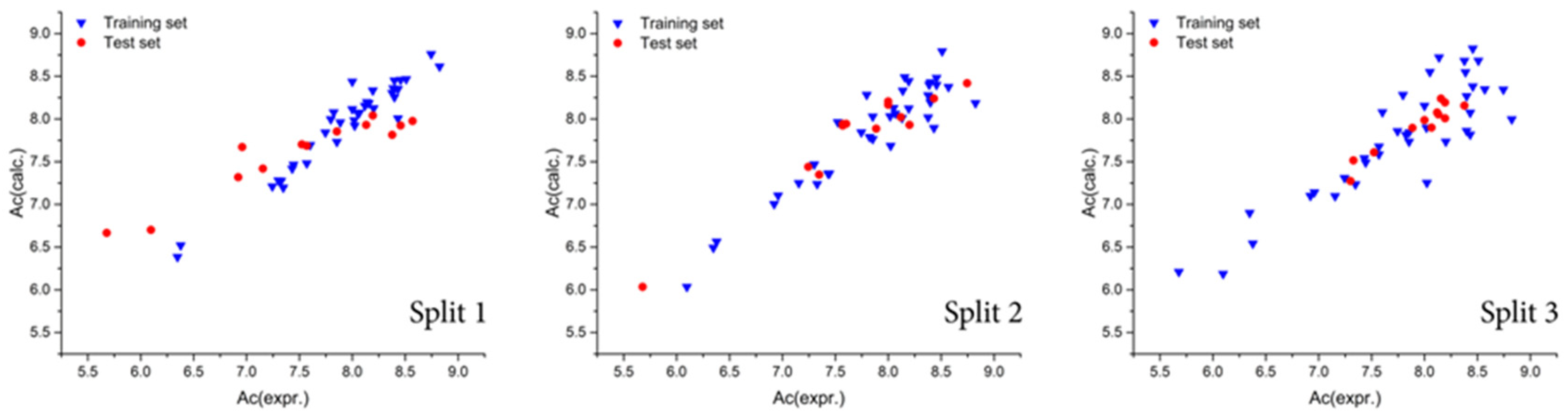
2 = 0.8355, CCC = 0.9269, IIC = 0.9396). In addition, split 2 shows a lower mean absolute error on the external test set (MAE = 0.235) than split 1 (MAE = 0.372), while maintaining a balanced relationship between training and test-set statistics. Collectively, these metrics indicate that split 2 offers the best compromise among predictive accuracy, robustness, and generalization ability across the examined data partitions. Applicability domain (AD) analysis indicated that all compounds included in the dataset fell within the defined domain of the developed models, and no outliers were identified. This finding confirms that the chemical space covered by the dataset is coherently represented by the descriptor framework used in the Monte Carlo QSAR modeling, supporting the reliability of the predictions within this domain. A graphical representation of the best-performing QSAR model, corresponding to the highest coefficient of determination (r
2) achieved in the optimal Monte Carlo optimization run, is presented in
Figure 1 for all three dataset splits. The close agreement between observed and predicted pIC
50 values across both training and test sets visually supports the statistical robustness of the developed models. Model reproducibility was further assessed using the concordance correlation coefficient (CCC), which provides a stringent measure of agreement between predicted and experimental values. The high CCC values across all models indicate strong reproducibility and consistency, reinforcing the reliability of the Monte Carlo-based QSAR approach. In addition, evaluation using MAE-based criteria classified the models as GOOD, providing further evidence of their predictive accuracy and practical utility. To rigorously assess the possibility of chance correlation and overfitting in Monte Carlo-optimized QSAR models, Y-randomization (response permutation across 1000 trials in 10 independent runs) tests were performed on the best-optimized run across three independent data splits (
Table S2). In this procedure, the pIC50 values were randomly permuted while preserving the descriptor matrix, and the modeling protocol was repeated. For all three splits, the original models (Run 0) exhibited high predictive performance (training r
2 = 0.767−0.935; test r
2 = 0.890–0.909). In contrast, models built on randomized response data showed very low training r
2 values (Rr2 ≈ 0.02–0.03), indicating the absence of systematic structure–activity relationships under scrambling conditions. Although occasional higher test r
2 values were observed in isolated randomized runs, these are attributable to the small test set size and are not accompanied by meaningful training performance. Importantly, the CRp
2 values (0.756–0.924) substantially exceed the commonly accepted threshold of 0.5, confirming that the predictive performance of the reported models is not due to chance correlation. These results collectively support the statistical robustness and reliability of the Monte Carlo QSAR models. The resulting statistics, reported in
Table S2, show a pronounced degradation of model performance upon scrambling, confirming that the original models are not the result of chance correlations and retain genuine structure–activity information. Finally, the predictive quality of the QSAR models was assessed using the index of ideality of correlation (IIC), which integrates correlation strength and prediction error into a single metric. The obtained IIC values further support the conclusion that the developed conformation-independent QSAR models possess high predictive potential and are suitable for subsequent interpretation and application in structure-guided ligand design.
The mathematical representations of the best QSAR models, according to the obtained test set r
2 for all the splits, are presented in Equations (1)–(3).
The presented Equations (1)–(3) indicate that, in the case of split 1, the preferable values for T and N
epoch are 1 and 8, respectively; The preferable values of T and N
epoch for split 2 are 1 and 10, respectively; and in the case of split 3, the preferable values for T and N
epoch are 1 and 13, respectively. The mathematical equations that represent the developed QSAR models generated via GA-MLR modeling for all the splits are illustrated by Equations (4)–(6), and their graphical representation is provided in the
Supplementary Material, while the numerical values for the metrics used for validation are given in
Table 2.
The numerical values of all calculated statistical parameters reported in
Table 2 indicate that the GA–MLR-based QSAR models exhibit satisfactory predictive performance and robustness across all three dataset splits. For each split, the applied internal and external validation metrics confirm that statistically reliable and predictive models were obtained, supporting the suitability of the GA–MLR approach for modeling serotonin transporter inhibition within the investigated chemical space.
For the first split (Equation (10)), model performance was determined by a combination of autocorrelation- and eigenvalue-based descriptors: AATS6p, AATSC3m, GATS1s, VR3_Dzs, and SpMin7_Bhi. The positive coefficient for AATS6p indicates that increased medium-range polarizability-weighted autocorrelation (lag 6) is associated with higher predicted activity. Chemically, this suggests that the spatial distribution of polarizable fragments across the scaffold—particularly within extended aromatic systems—enhances interactions compatible with the SERT binding environment. In contrast, AATSC3m (centered mass-weighted autocorrelation, lag 3) carries a negative coefficient, implying that increased short-range mass distribution effects are associated with reduced potency. This may reflect the unfavorable impact of locally concentrated heavy substituents that perturb optimal molecular balance. The descriptor GATS1s, a Geary autocorrelation term weighted by intrinsic state, also contributes negatively, suggesting that excessive short-range electronic-state disparity may reduce activity. Similarly, VR3_Dzs, a logarithmic Randić-like eigenvector-based index derived from the Barysz matrix and weighted by intrinsic state, encodes global topological–electronic organization; its negative coefficient suggests that increased topological complexity or electronic irregularity is not beneficial within this scaffold framework. Finally, SpMin7_Bhi, representing the smallest absolute eigenvalue of the Burden modified matrix weighted by relative first ionization potential, reflects ionization-related electronic extremity. Its negative contribution indicates that increased ionization-driven electronic asymmetry correlates with reduced predicted potency. Collectively, the descriptor pattern for Split 1 highlights a balance between favorable medium-range polarizability distribution and the avoidance of excessive local mass clustering, electronic disparity, or ionization-driven extremity. These findings support a SAR model in which optimal activity arises from electronically coherent and moderately polarizable scaffold organization rather than from highly uneven electronic or topological profiles.
In the second split (Equation (11)), which showed the best statistical performance among the evaluated models, the QSAR equation incorporated AATS5i, ATSC1c, SpMax1_Bhe, minHCsatu, and ETA_Epsilon_3. Importantly, the signs of the regression coefficients allow a more chemically meaningful interpretation. The descriptor AATS5i (average Broto–Moreau autocorrelation lag 5, weighted by ionization potential) has a negative coefficient, indicating that greater long-range, ionization-potential-weighted electronic correlation is associated with reduced predicted potency. Within this scaffold series, excessive propagation of ionization-related electronic effects across the aromatic framework may disrupt the optimal electronic balance required for favorable receptor interaction. In contrast, ATSC1c (centered autocorrelation lag 1 weighted by atomic charges) contributes positively, suggesting that short-range charge distribution plays a beneficial role. This implies that locally organized charge environments—likely influenced by substituent positioning and heteroatom presence—enhance predicted activity within the defined chemical space. The descriptor SpMax1_Bhe, representing the largest absolute eigenvalue of the Burden matrix weighted by Sanderson electronegativities, carries a negative coefficient. This indicates that increased electronegativity-driven spectral extremity correlates with reduced activity, supporting the notion that overly pronounced electronegative topological patterns are unfavorable in the predominantly hydrophobic SERT binding environment. The positive contribution of minHCsatu (minimum E-State value for hydrogen atoms on sp3 carbons bonded to unsaturated carbons) suggests that specific aliphatic–unsaturated junction environments are beneficial. In the present scaffold, such structural motifs may contribute to favorable conformational flexibility or appropriate hydrophobic–electronic balance. Finally, ETA_Epsilon_3, an electronegativity-related ETA-family descriptor, exhibits a strongly negative coefficient. This indicates that increases in this topochemical/electronic measure are associated with diminished potency, reinforcing the observation that excessive global electronegativity or topochemical imbalance is detrimental in this series. Overall, the descriptor pattern in Split 2 reflects a nuanced balance between favorable localized charge organization and controlled global electronic distribution. The superior predictive performance of this split likely arises from its ability to capture both short-range charge effects and longer-range electronic/topological constraints in a chemically coherent manner.
For the third split (Equation (12)), the developed model incorporated AATS5p, MATS1c, SpMax1_Bhi, minHCsatu, and fragC. As in previous splits, interpreting the regression coefficients provides insight into the structure–activity trends captured by the model. The descriptor AATS5p (average Broto–Moreau autocorrelation lag 5, weighted by polarizabilities) carries a positive coefficient, indicating that an enhanced distribution of medium-range polarizability across the molecular framework favors increased predicted potency. In the context of the present aromatic-rich scaffold, this suggests that appropriately distributed polarizable substituents contribute beneficially to receptor interaction, potentially through improved dispersion-driven complementarity within the binding pocket. Similarly, MATS1c (Moran autocorrelation lag 1, weighted by atomic charges) shows a positive contribution, underscoring the importance of short-range charge organization. This aligns with the notion that localized charge environments and substituent-induced electronic modulation near key structural junctions are relevant determinants of activity in this series. In contrast, SpMax1_Bhi, the largest absolute eigenvalue of the Burden modified matrix weighted by relative first ionization potential, enters the model with a negative coefficient. This indicates that increased ionization-driven spectral extremity correlates with reduced predicted potency, reinforcing the pattern observed in other splits that excessive global electronic imbalance is detrimental within this scaffold framework. The descriptor minHCsatu, also present in Split 2, contributes positively, supporting the idea that specific sp3–unsaturated junction environments are favorable for activity. These motifs may influence conformational adaptability and the hydrophobic–electronic balance required for optimal ligand accommodation. Finally, fragC, a fragment-based complexity descriptor, exhibits a small negative coefficient, suggesting that increased structural fragmentation or excessive molecular complexity provides only marginal or unfavorable contribution to activity within this controlled chemical space. Overall, the descriptor profile of Split 3 underscores the importance of a balanced polarizability distribution and a localized charge organization, while avoiding excessive global electronic extremity or unnecessary structural complexity. Although the predictive stability of this split was slightly lower than that observed for Split 2, the chemical trends remain consistent across models, further supporting the robustness of the derived SAR interpretation.
A comparative analysis of statistical metrics across modeling strategies shows that the second split consistently yields the most robust results for both conformation-independent Monte Carlo QSAR models and GA–MLR models. This convergence across distinct modeling paradigms supports the stability and generality of the identified structure–activity relationships and indicates that the selected training–test partition offers the most representative coverage of the underlying chemical space.
The applicability domain (AD) analysis further corroborates the reliability of the GA–MLR models. Graphical representations of the AD for all three splits, presented in
Figures S1–S3 in the
Supplementary Material, confirm that all compounds from the test set fall within the defined domain boundaries, indicating that the descriptor space employed in GA–MLR modeling adequately captures the structural diversity of the dataset and supports the validity of the reported predictions. A few compounds from the training set exceeded the leverage threshold but remained within acceptable residual limits, indicating structural influence without response deviation.
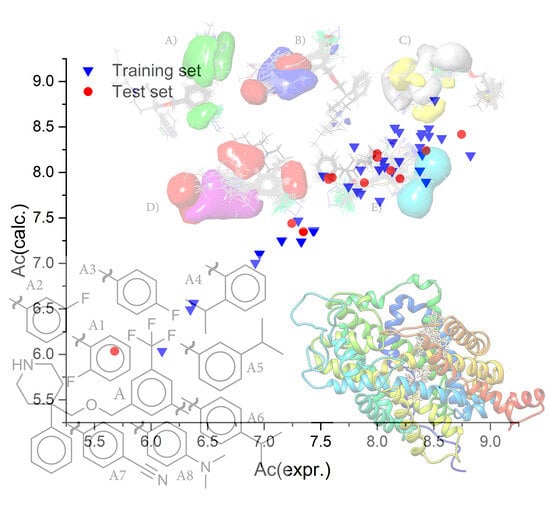
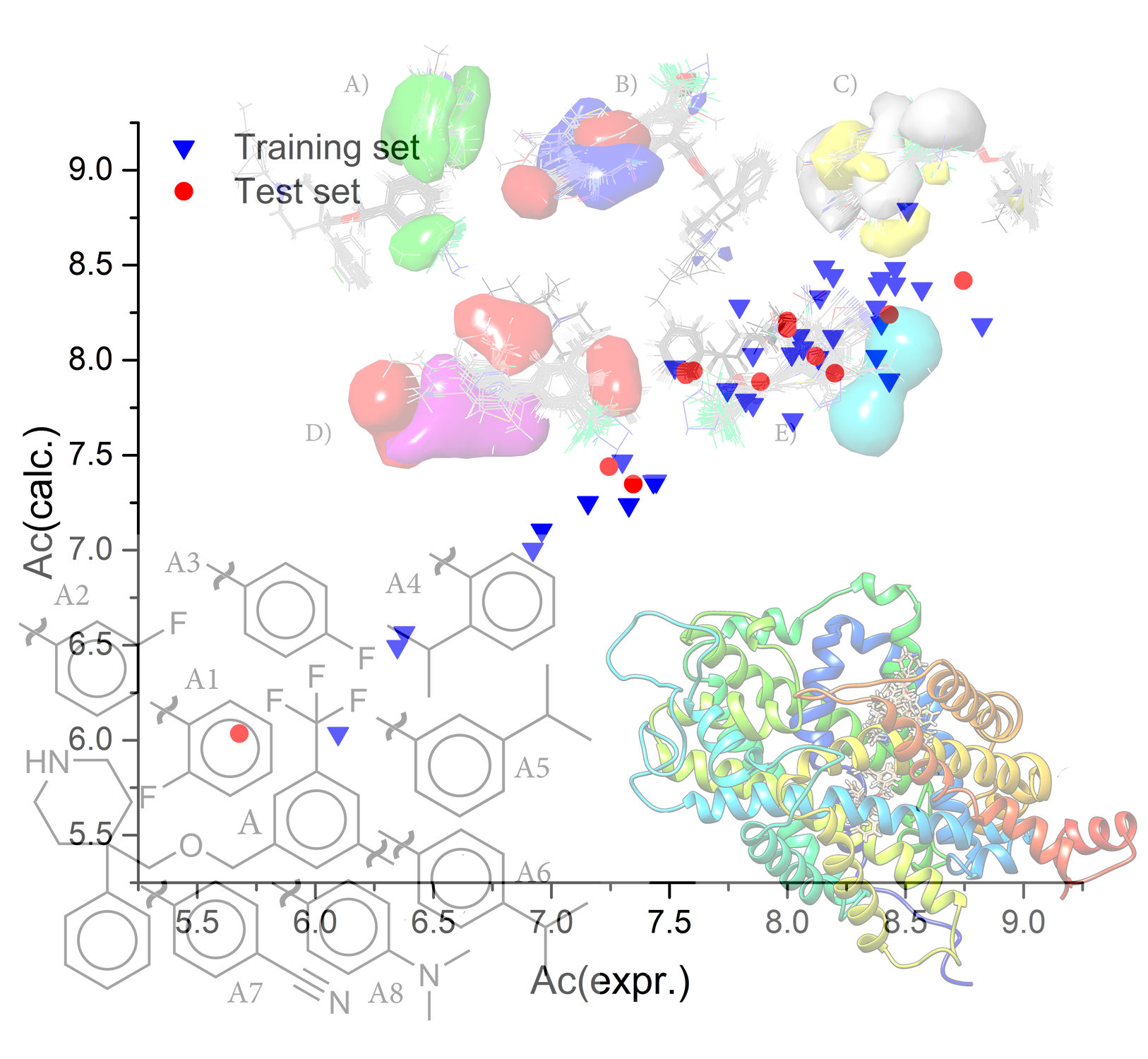
The developed three-dimensional QSAR model demonstrated good predictive performance within the studied chemical series. In the training set, the model achieved a high correlation coefficient (r2 = 0.9040) with a low standard deviation (SD = 0.2228), indicating a strong descriptive fit to the observed activity values. Importantly, predictive performance remained satisfactory in the independent test set (r2 = 0.8456; SD = 0.2824), suggesting that the model retains generalization capability and that its performance is not solely driven by fitting noise in the training data. Model development and selection were conducted within Schrödinger Maestro using the OPLS3 force field and PLS regression over Gaussian field descriptors. To reduce the risk of overfitting, the final model was not selected exclusively on the basis of maximizing r2. Instead, the number of PLS factors was determined by balancing goodness-of-fit, cross-validated predictivity (R2-CV/q2), stability metrics, and scrambling statistics. This multi-criterion selection strategy is particularly important in 3D-QSAR modeling, where increasing the number of latent factors can artificially inflate r2 without improving—and sometimes even degrading—predictive robustness. Overall, the close agreement between training and test set statistics, together with the applied cross-validation and stability-guided factor selection, supports the reliability of the derived 3D-QSAR trends within the defined applicability domain. Nevertheless, given the moderate dataset size, the model should be interpreted as a robust series-specific prioritization and SAR rationalization tool rather than as a universally transferable predictor across structurally unrelated SERT inhibitor classes.
Analysis of Gaussian field fraction contributions provides further mechanistic insight into the dominant interaction patterns governing serotonin transporter inhibition. Among the evaluated interaction fields, steric contributions were the most influential, accounting for 47.61% of the total model variance. This dominant steric component underscores the critical role of molecular size, shape, and spatial complementarity in ligand recognition within the serotonin transporter binding pocket. Hydrophobic interactions accounted for the second-largest contribution (22.01%), underscoring the importance of nonpolar contacts and lipophilic surface complementarity in stabilizing ligand–transporter complexes.
In contrast, electrostatic interactions accounted for a relatively minor fraction of the model variance (9.49%), while hydrogen bond acceptor (14.90%) and hydrogen bond donor (5.98%) fields played secondary roles. The comparatively low contribution of electrostatic and hydrogen-bond donor interactions suggests that polar, highly directional interactions are less critical determinants of activity in the studied ligand series. Instead, the results point toward a binding mode primarily driven by steric accommodation and hydrophobic packing, with hydrogen bonding acting as a fine-tuning rather than a governing factor.
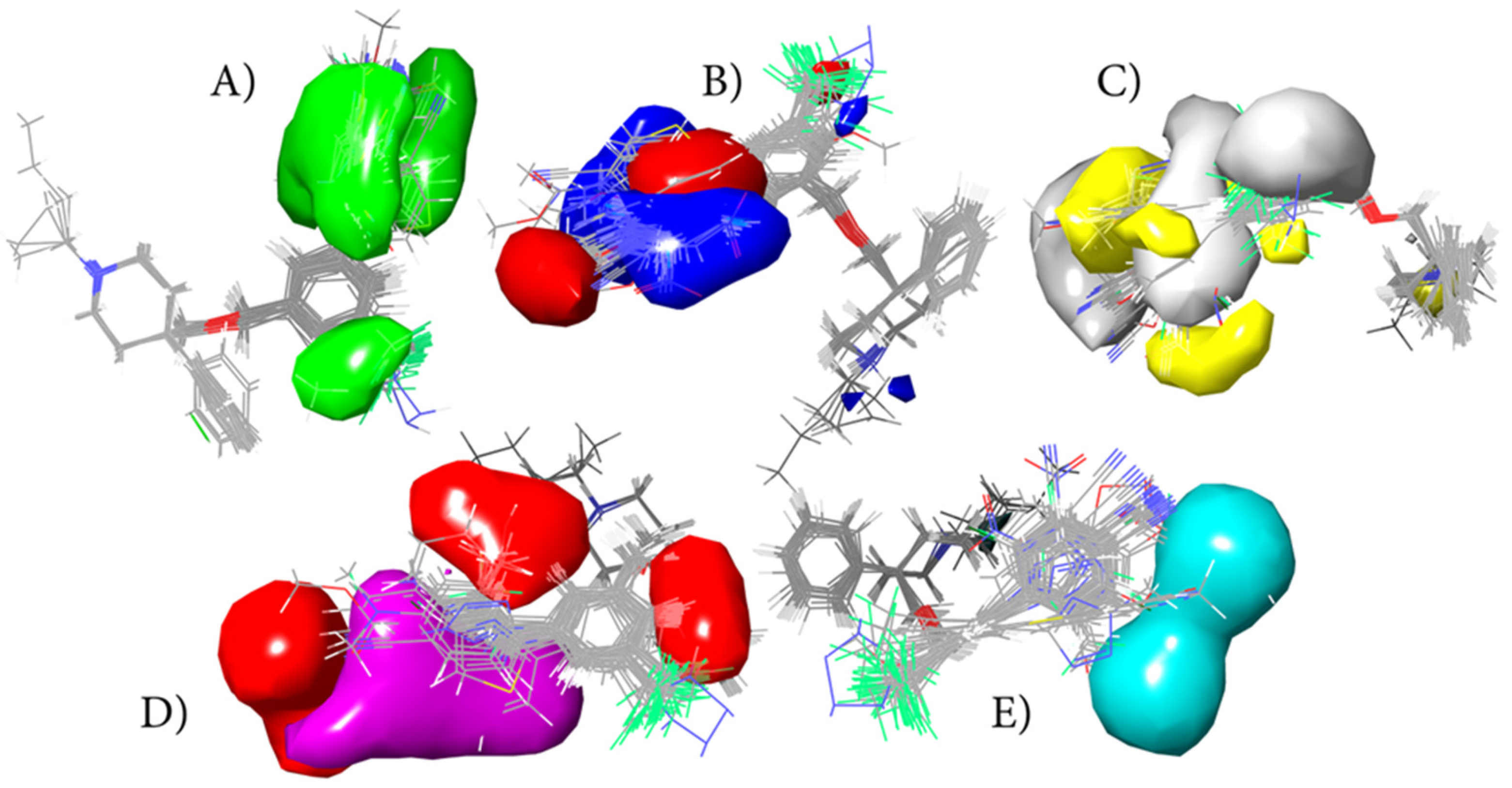
From a design perspective, these findings imply that activity enhancement within this chemical series is more effectively achieved by modulating substituent bulkiness and hydrophobic character than by introducing strongly polar or hydrogen-bond-donating functionalities. This interpretation is fully consistent with the fragment-level trends identified in the conformation-independent and GA–MLR QSAR analyses, as well as with the docking-derived interaction patterns. The three-dimensional contour maps of the steric, electrostatic, hydrophobic, and hydrogen-bonding fields for the optimized 3D QSAR model are shown in
Figure 2. These surfaces visually delineate regions where specific interaction types are favorable or unfavorable for activity and provide spatial guidance for further rational optimization of serotonin transporter inhibitors.
One of the central objectives of this study was to identify molecular fragments, expressed as optimal SMILES-based descriptors, that exert either a positive or a negative influence on serotonin transporter inhibitory activity [
33,
34,
35]. In this context, the conformation-independent QSAR framework enables direct association of individual SMILES features with activity-enhancing or activity-attenuating effects, thereby providing mechanistically interpretable insight at the fragment level. The complete set of calculated molecular descriptors, including both SMILES-based descriptors and molecular graph-based local invariants, is reported in
Table S3 (
Supplementary Material). While graph-based descriptors contribute to the overall predictive performance of the models, SMILES-derived descriptors offer a more intuitive interpretation because they correspond directly to chemically meaningful fragments.
To illustrate the practical interpretation of the Monte Carlo-derived optimal descriptors, a representative example of the calculation of the summarized descriptor correlation weight (DCW) in relation to the biological activity (pIC
50) is provided in
Table 3. For clarity and ease of interpretation, only SMILES-based descriptors were considered in this example, whereas molecular graph-based descriptors were omitted. This presentation highlights how individual fragment contributions are aggregated within the DCW framework and demonstrates the direct link between specific structural motifs and the observed inhibitory activity.
Fragment-level interpretation of the QSAR models enabled identification of SMILES-defined molecular motifs associated with either favorable or unfavorable contributions to inhibitory activity. SMILES fragments corresponding to aliphatic carbon environments, such as “C............” and “C...C.......”, which chemically translate to methyl and ethyl substituents, were consistently associated with positive contributions to pIC50. These fragments reflect the beneficial effect of small alkyl groups, which increase local steric bulk and hydrophobic surface area without introducing excessive polarity. Such modifications are consistent with the steric-dominant interaction pattern revealed by the 3D QSAR model. A particularly important class of activity-enhancing fragments consisted of aromatic SMILES motifs, including “c...1...(...”, “c...(...1...”, “c...(...C...”, “c...C...(...”, and “c...1...C...”. These fragments correspond to substituted benzene rings bearing alkyl substituents, most commonly methyl groups, which induce ring branching. From a chemical perspective, these modifications increase aromatic substitution density and steric contouring, thereby improving shape complementarity with the hydrophobic regions of the serotonin transporter binding pocket. This interpretation is in excellent agreement with the strong steric (47.6%) and hydrophobic (22.0%) field contributions observed in the 3D QSAR model. Additional SMILES fragments such as “(...(.......”, “(...........”, and “(...C...(...”, which are associated with molecular branching, further support the conclusion that increased three-dimensionality and steric complexity favor enhanced inhibitory activity. These branching motifs likely promote improved packing within the transporter cavity and restrict unfavorable ligand conformations.
Halogen substitution emerged as another favorable design element. SMILES fragments such as “F...........”, “c...F.......”, and “F...c...1...” correspond to the introduction of fluorine atoms on aromatic rings. Fluorination is known to modulate lipophilicity, electronic distribution, and metabolic stability, and in this series it consistently exerted a positive effect on pIC50. Chemically, fluorine substitution may enhance hydrophobic contacts and subtly alter π–π and σ–π interactions within the binding site, while maintaining minimal steric penalty.
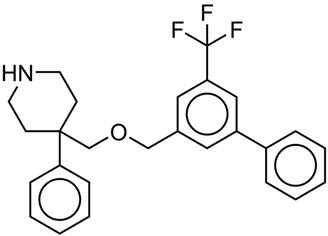
These favorable fragments were systematically introduced at different positions and in varying numbers onto the template molecule
A, which was selected for structural modification due to its sufficient activity and structural flexibility, which allow systematic optimization. This design strategy yielded eight new candidate molecules (
A1–
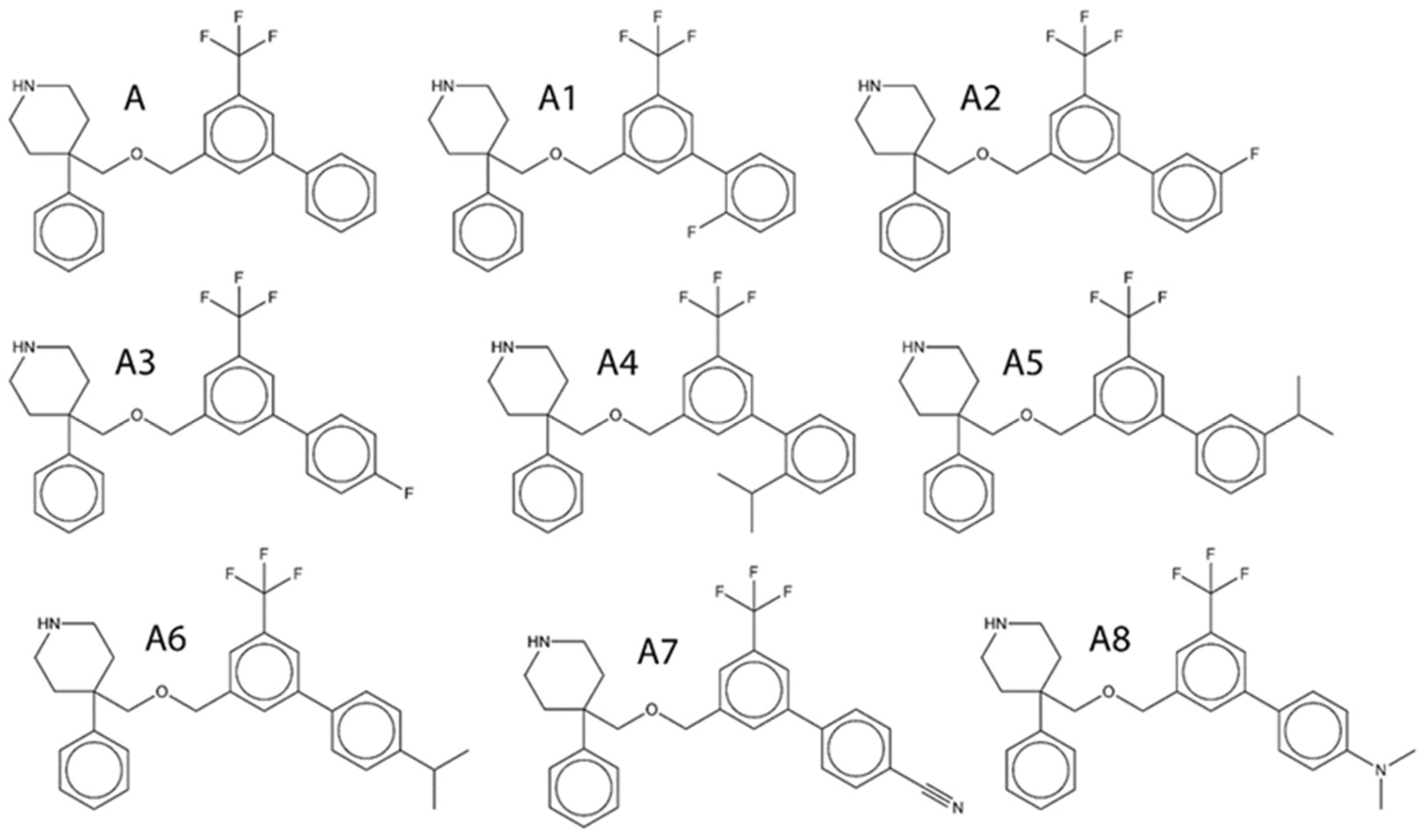
A8). The chemical structures of the designed compounds are shown in
Figure 3, while their calculated pIC
50 values are summarized in
Table 4.
With the exception of molecule A5, all designed compounds exhibited higher calculated pIC50 values relative to the parent scaffold A, indicating improved inhibitory activity. Molecules A1–A6 incorporated either fluorine or isopropyl substituents at ortho, meta, or para positions on the aromatic ring. An interesting and consistent positional effect was observed, with substitution at the meta position proving the least favorable. In the case of molecule A5, meta substitution resulted in a calculated pIC50 lower than that of the parent molecule A, highlighting the sensitivity of activity to substitution topology. Comparison of molecules A1–A3 further illustrates this effect. Although these compounds differ only in the positional arrangement of the fluorine atom on the benzene ring, as reflected in the SMILES fragments “Fc1ccccc1c1”, “Fc1cccc(c1)c1”, and “Fc1ccc(cc1)c1”, substantial differences in calculated activity were observed. This behavior arises from the fact that numerous descriptors—both favorable and unfavorable—are generated from these positional SMILES variants, making it impractical to attribute the reduced activity of meta substitution to a single descriptor. Instead, the observed trend reflects a cumulative, context-dependent descriptor effect, underscoring the value of holistic QSAR interpretation over single-fragment reasoning. Beyond steric and hydrophobic optimization, polar functionalization was explored by introducing nitrogen-containing groups. Molecule A7 incorporated cyano-related SMILES fragments (“N...#.......”, “N...#...C...”), which were associated with positive contributions to pIC50 and resulted in higher predicted activity relative to molecule A. The cyano group acts as a strong hydrogen bond acceptor and introduces localized polarity without significantly increasing steric bulk, thereby complementing the predominantly hydrophobic binding environment. Similarly, molecule A8 introduced substituted amine fragments (“N...........”, “N...(.......”, “N...C.......”), which also exhibited positive contributions to activity. These fragments introduce hydrogen bond acceptor functionality and may participate in secondary polar interactions within the transporter binding site, providing an alternative route to activity enhancement distinct from purely steric modulation. Overall, the CAD results are fully consistent with the conclusions drawn from the 3D QSAR analysis. Molecules A4–A6 primarily exploit steric and hydrophobic optimization, in line with the dominant steric field contribution, whereas molecules A7 and A8 introduce hydrogen bond acceptor functionalities that align with secondary polar interaction fields. This convergence between fragment-based QSAR interpretation, three-dimensional field analysis, and rational molecular design underscores the internal consistency of the applied computational strategy and supports the validity of the proposed structure–activity relationships.
To complement the QSAR-guided computer-aided design and to provide a structure-based perspective on the observed structure–activity trends, molecular docking analysis was employed as a qualitative and comparative tool. Docking was used to explore plausible binding modes of the designed serotonin transporter inhibitors and to examine whether the relative docking score functions and interaction patterns were consistent with the QSAR-predicted pIC
50 ranking. Importantly, docking was not used as a quantitative predictor of biological activity, but rather as supportive evidence to facilitate the structural interpretation of QSAR-derived activity trends within the serotonin transporter binding site. The calculated docking scores and individual interaction components are summarized in
Table 5, with the corresponding predicted inhibitory activities (pIC
50).
To examine the relationship between structure-based binding estimates and ligand-based activity predictions, correlation analyses were performed between docking scores (MolDock and Rerank) and the calculated pIC50 values for compounds
A–
A8. A statistically significant inverse correlation was observed between the MolDock score and predicted potency (Pearson r = −0.689,
p = 0.040; Spearman ρ = −0.717,
p = 0.030), indicating that more favorable (more negative) docking scores tend to be associated with higher predicted inhibitory activity within the series. A comparable trend was obtained for the Rerank score (Pearson r = −0.699,
p = 0.036), with an even stronger monotonic relationship observed in the rank-based analysis (Spearman ρ = −0.817,
p = 0.007). Scatter plots illustrating these relationships are provided in the
Supplementary Information, Figure S4. Although docking scoring functions are not intended to yield quantitatively accurate binding affinities, the observed moderate-to-strong inverse correlations suggest internal consistency between the structure-based docking results and the QSAR-derived potency predictions. In particular, the stronger rank-based correlation observed for the Rerank score may reflect improved sensitivity to steric and interaction-related contributions within the binding pocket. It is important to note that the dataset comprises a limited number of compounds (n = 9), which restricts statistical power and precludes overinterpretation of correlation strength. Accordingly, docking was primarily used for structural interpretation and binding-mode rationalization rather than as an independent predictive model. Nevertheless, the statistically significant trends observed across both scoring functions support the mechanistic plausibility of the QSAR-derived activity estimates and reinforce the coherence of the proposed structure–activity relationships within the designed compound series.
Overall, the docking results exhibit a consistent qualitative agreement with the QSAR-derived activity trends. Compounds with higher calculated pIC
50 values generally exhibit more favorable composite docking scores, particularly for steric, van der Waals, and Rerank contributions, supporting the notion that improved inhibitory activity in this series is primarily driven by enhanced shape complementarity and hydrophobic packing within the serotonin transporter binding site. Among the designed molecules, compounds
A3,
A6,
A7, and
A8 stand out as top-performing candidates in both QSAR prediction and docking evaluation. Molecule
A3, which shows a high predicted activity (pIC
50 = 8.1855), exhibits a markedly favorable steric contribution (−203.228 kcal/mol) and a strongly negative van der Waals term (−43.7415 kcal/mol), resulting in one of the most favorable MolDock (−174.068 kcal/mol) and Rerank (−139.04 kcal/mol) scores within the series. These results indicate efficient occupation of the binding cavity and optimal steric accommodation, consistent with the dominant steric field contribution identified in the 3D QSAR analysis. A similar pattern is observed for molecule
A6 (pIC
50 = 8.0295 kcal/mol), which combines a highly favorable steric term (−189.35 kcal/mol) with one of the most negative van der Waals contributions (−50.3446 kcal/mol), leading to a low Rerank score (−138.993 kcal/mol). The absence of significant hydrogen bond contributions for this compound further supports a binding mode dominated by hydrophobic and steric interactions, in full agreement with the QSAR-based interpretation. Molecules
A7 and
A8, which display the highest predicted activities in the series (pIC
50 = 8.1943 and 8.4814, respectively), show slightly different but complementary docking signatures. While their steric contributions remain strongly favorable (−182.255 kcal/mol for
A7 and −194.602 kcal/mol for
A8), these compounds additionally benefit from polar interaction terms. In particular, the presence of cyano (
A7) and tertiary amine (
A8) functionalities introduces hydrogen-bond acceptor character, reflected in nonzero hydrogen-bonding and NoHBond contributions. This mixed interaction profile suggests that, although steric and hydrophobic effects remain dominant, secondary polar interactions may further stabilize ligand binding and contribute to the superior predicted activity of these compounds. In contrast, molecule
A5 represents an instructive negative example. Despite exhibiting reasonable steric contributions (−181.313 kcal/mol),
A5 shows a substantially less favorable van der Waals term (25.7723 kcal/mol) and the least favorable Rerank score (−89.5642 kcal/mol) among the designed compounds. This unfavorable interaction pattern is consistent with its lower predicted activity (pIC
50 = 7.6785) relative to the parent molecule
A and underscores the detrimental effect of meta substitution observed in the QSAR-guided design phase. The docking results thus reinforce the conclusion that improper substituent positioning can disrupt optimal packing within the binding site, even when overall molecular size and composition are comparable. The parent molecule
A and the moderately active derivatives
A1 and
A2 occupy an intermediate position in both docking scores and predicted activity. Although these compounds exhibit acceptable steric interactions, their overall MolDock and Rerank scores are lower than those of the top-performing analogs, reflecting suboptimal engagement of the transporter’s hydrophobic binding pocket. Taken together, the docking analysis supports the QSAR- and CAD-derived structure–activity relationships by demonstrating that increased predicted inhibitory activity correlates with improved steric and hydrophobic complementarity within the serotonin transporter binding site. The convergence of docking scores with calculated pIC
50 values strengthens confidence in the designed compounds and highlights steric optimization, complemented by strategically placed polar functionalities, as an effective strategy for enhancing serotonin transporter inhibition. All the interactions between the selected molecules and the amino acids from the active site of the serotonin transporter have been identified. Moreover, two-dimensional representations of hydrogen bonding, hydrophobic, and hydrophilic interactions between the ligands and the serotonin transporter binding site are provided in the
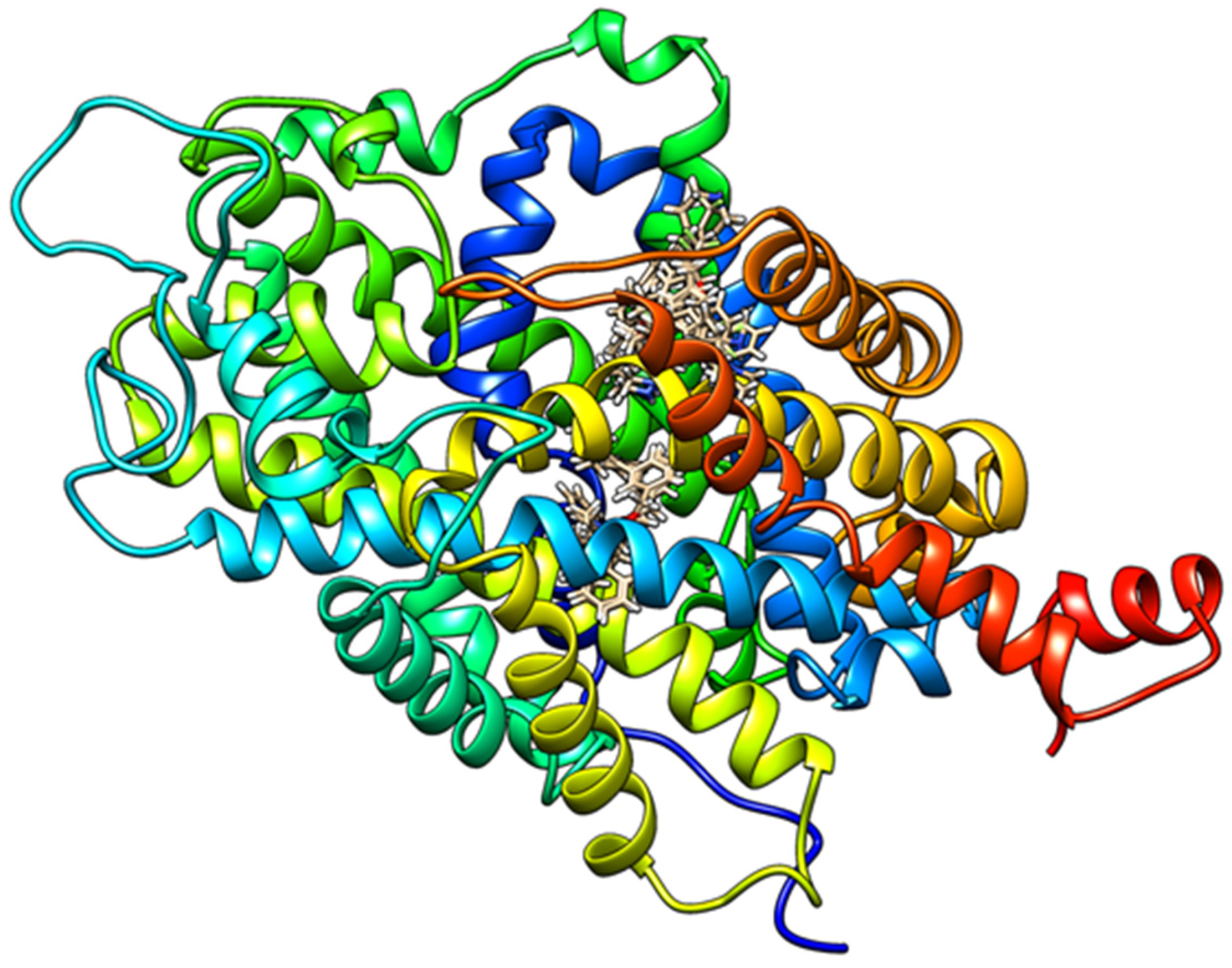
Supplementary Information, Figures S5–S13, while the best-ranked docking poses of all designed molecules within the active site are shown in
Figure 4. Analysis of docking poses reveals two distinct binding clusters within the transporter cavity. Molecules
A,
A2, and
A4 preferentially occupy one region of the binding site, whereas molecules
A1,
A3,
A5,
A6, and
A7 are positioned in an alternative subpocket. This spatial segregation indicates that structurally related compounds may adopt different binding orientations while maintaining comparable interaction patterns dominated by steric and hydrophobic complementarity. Importantly, the existence of multiple binding clusters supports the QSAR- and 3D QSAR-derived conclusions that activity within this chemical series is not governed by a single, highly specific interaction motif, but rather by overall shape accommodation and hydrophobic packing within the serotonin transporter binding cavity. The observed clustering behavior further suggests a degree of binding site plasticity, which may accommodate structurally diverse ligands through alternative, yet energetically favorable, binding modes.
In traditional molecular docking studies, we observe how a ligand binds in a pocket. However, docking results cannot be validated solely by the ligand’s binding to the receptor in a specific binding pocket. In silico analysis has shifted its focus from simple docking poses to binding time. A drug that stays bound to its target for a longer period often has better efficacy in the body. To understand the stability and effectiveness of the complex we use InducedFit Docking and BPMD, a “biased” simulation approach that works by applying an external computational force, a biasing potential to the ligand to encourage it to move out or “un-bind” from its docked position. The results of this study demonstrate how strongly a ligand binds to its receptor and how much energy is required to uncouple the binding of receptor-ligand complex; a higher energy amount required for unbinding indicates a more stable and robust ligand-receptor complex.
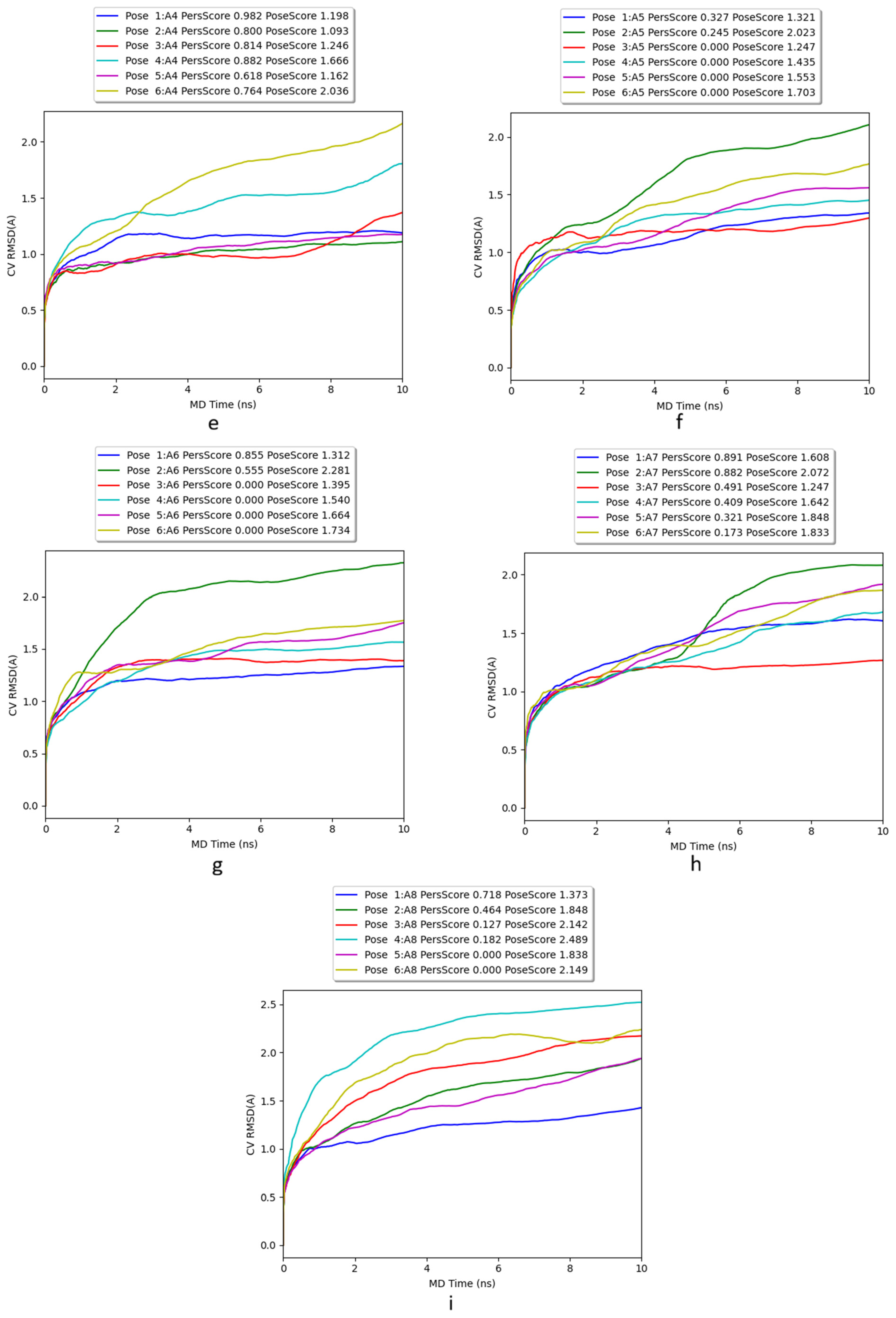
In this study, we employed BPMD on the receptor-ligand complexes. This approach applies a biasing potential along a specific Collective Variable (CV), defined by the RMSD of the ligand relative to its initial binding pose. The stability of the complex was evaluated using PoseScore, which tracks the average RMSD from the starting position, where a sharp increase indicates ligand dissociation, and Persistence Score (PersScore), which quantifies the stability of hydrogen bonds throughout the trajectory. The simulation systematically corrects the system for staying in its original state, effectively forcing the ligand to explore new conformations by adding this history-dependent potential.
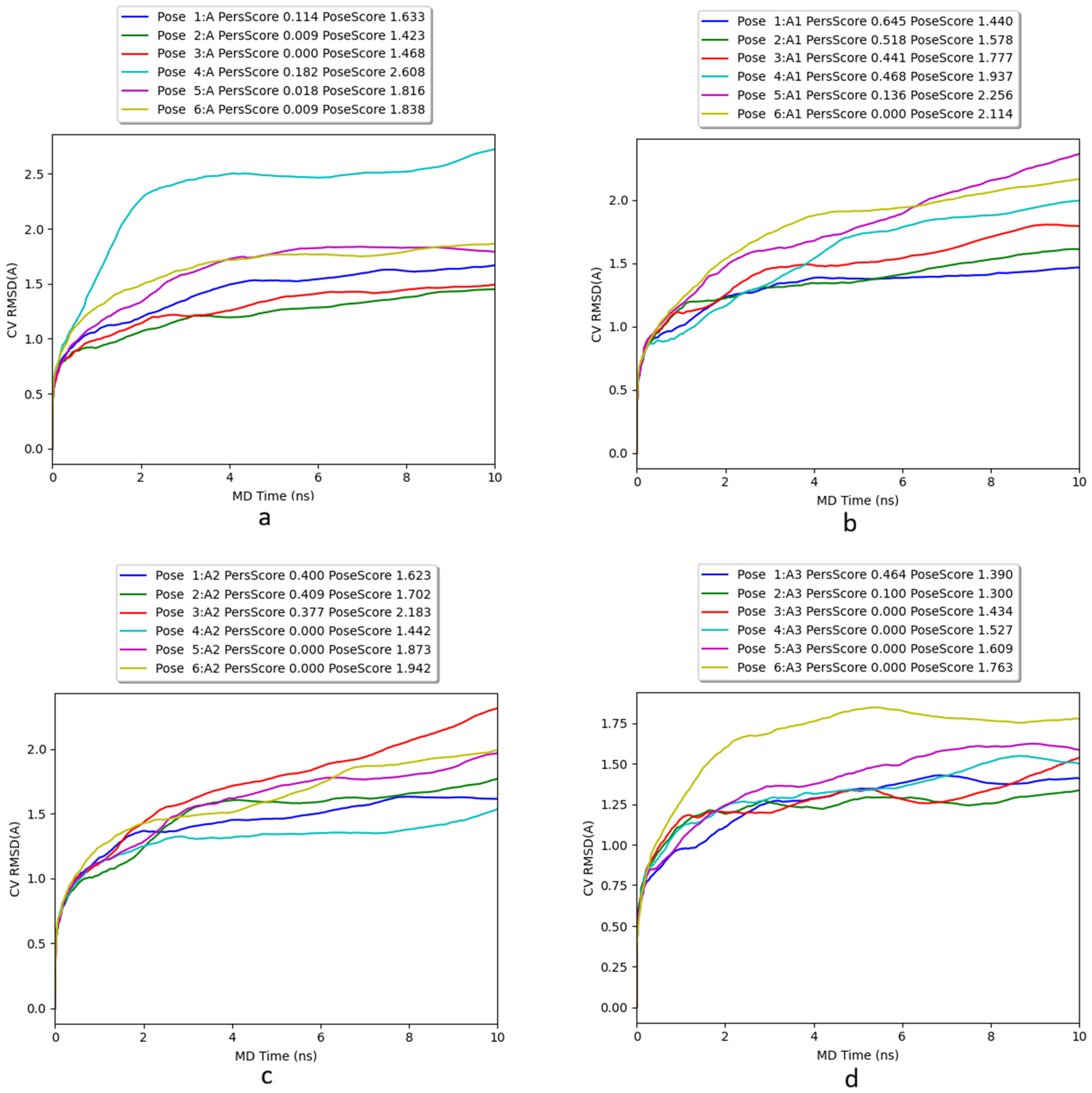
In
Figure 5, we reported the BPMD plots of the six best-ranked poses obtained from InducedFit Docking. In all the simulations, the six poses for each compound remain into the binding pocket with CV RMSD values (PoseScore) below 2.5 Å. Only one pose for compound
A and compound
A8 reaches a higher value but is compensated by the other poses that have a PoseScore not higher than 1.75 Å on average. Moreover, CompScore confirms the high binding capability of these compounds as reported in
Table 6. The advanced docking results from IFD and BPMD simulations confirm that the compounds identified by QSAR analysis could represent reliable SERT inhibitors.
The in silico ADMET analysis was performed to evaluate the pharmacokinetic suitability and preliminary safety profile of the designed serotonin transporter inhibitors (
A–
A8), with particular emphasis on parameters critical for central nervous system (CNS) drug candidates (
Table S4). All investigated compounds (
A–
A8) were predicted to be well absorbed in the human intestine (HIA: absorbed), indicating favorable oral absorption potential. Predicted Caco-2 permeability values were narrowly distributed, with logPapp ranging from −5.28 to −5.40, suggesting moderate and relatively uniform intestinal epithelial permeability across the series. The lack of pronounced variability in both HIA and Caco-2 permeability indicates that structural modifications introduced in the designed analogs did not adversely affect intestinal absorption. Importantly, none of the compounds were predicted to be P-glycoprotein substrates, while all were classified as P-gp inhibitors. The absence of P-gp substrate liability suggests reduced intestinal efflux and limited active extrusion at the blood–brain barrier, although the predicted P-gp inhibitory behavior may warrant attention in the context of potential drug–drug interactions.
Predicted blood–brain barrier (BBB) permeability was evaluated using the DeepPK platform, which provides both a quantitative CNS-related score and a machine learning-based categorical BBB penetration prediction. The numerical CNS scores for the designed compounds (A–A8) were distributed within a relatively narrow range (−1.27 to −1.79), indicating homogeneous predicted CNS distribution tendencies across the series. Importantly, according to the categorical classifier output, all compounds were predicted as “BBB Penetrable (High Confidence)”. The relatively consistent CNS-related scores across the series suggest that the introduced structural modifications did not markedly alter predicted brain exposure characteristics relative to the parent scaffold. The compounds exhibit elevated lipophilicity (LogD at pH 7.4 between 4.74 and 5.23) and high plasma protein binding, features frequently observed among clinically used serotonin reuptake inhibitors. In this context, the predicted BBB profile appears to reflect a balance between favorable lipophilicity and distribution-related parameters rather than structural constraints incompatible with CNS penetration. Overall, the BBB assessment supports the internal consistency of the designed series and does not indicate an intrinsic barrier to CNS exposure within the predictive limits of the applied in silico model.
All compounds exhibited very high predicted plasma protein binding (PPB 88.0–95.6%), resulting in relatively low predicted free fractions in human plasma (fraction unbound ≈ 1.8–2.2%). While high PPB is common among CNS-active small molecules, such extensive binding may further limit the free drug concentration available for brain penetration, thereby compounding the unfavorable BBB profile. Predicted steady-state volumes of distribution (Vdss) were generally high (log Vdss ≈ 4.7–5.4 L/kg), suggesting extensive tissue distribution. However, in the absence of effective BBB penetration, high Vdss alone does not translate into meaningful CNS exposure.
From a metabolic perspective, all compounds were predicted to be non-inhibitors of CYP2D6 and CYP3A4 (High Confidence), which is a favorable characteristic given the clinical relevance of these enzymes in antidepressant metabolism and the well-documented risk of drug–drug interactions associated with their inhibition. All compounds were uniformly predicted to be substrates of CYP3A4 (High Confidence), and six of nine compounds (A, A4–A8) were additionally predicted to be substrates of CYP2D6, indicating susceptibility to metabolic clearance via both pathways. This is consistent with the predicted high clearance values (≈5.4–9.4 mL/min/kg) and uniformly short elimination half-lives (<3 h, High Confidence) across the entire series, suggesting rapid systemic elimination. While such profiles may reduce the risk of long-term accumulation, they may also necessitate frequent dosing regimens or sustained-release formulations to maintain adequate therapeutic exposure. All compounds were additionally predicted to be P-glycoprotein inhibitors (High Confidence, probability 0.987–1.000), while none were predicted to be P-gp substrates, a profile that may influence intestinal absorption and CNS penetration and warrants consideration in the context of drug–drug interactions at the efflux transporter level.
From a safety perspective, all compounds were uniformly predicted to be hERG blockers (High Confidence, probability 0.995–0.999), representing the most significant in silico safety liability identified in this analysis. The associated risk of QT interval prolongation and cardiac arrhythmia is a well-recognized challenge in CNS drug development and underscores the need for experimental hERG patch-clamp validation prior to any further advancement of this series. AMES mutagenicity predictions were uniformly negative (Safe, High Confidence), and the DILI I model classified all compounds as non-hepatotoxic. However, the DILI II model predicted hepatotoxic potential for all compounds (probability 0.771–0.867), introducing a degree of ambiguity regarding hepatic safety that the DILI I result alone does not resolve; this discordance between the two hepatotoxicity models is itself an indication that experimental hepatotoxicity profiling should be included in any future in vitro characterization of the series. Additional toxicity signals of note include uniform predictions of micronucleus induction (High Confidence) and respiratory toxicity (High Confidence) across all compounds, as well as thyroid receptor-mediated activity (NR-TR Toxic) for eight of nine compounds—compound A7 being the sole exception, predicted as Safe with low confidence. Taken together, these findings indicate that while the series does not raise genotoxicity concerns in the AMES assay, a broader toxicological evaluation encompassing clastogenicity, pulmonary safety, and endocrine activity will be an essential component of any experimental follow-up. As with all findings reported in this section, the in silico nature of these predictions necessitates cautious interpretation, and experimental validation remains the definitive criterion for safety assessment.
Overall, ADMET profiling delineates a well-defined, internally consistent pharmacokinetic and safety landscape for the designed serotonin transporter inhibitors. The series is characterized by uniform intestinal absorption, the absence of clinically relevant CYP2D6 or CYP3A4 inhibition liabilities, and consistently low predicted genotoxic and hepatotoxic risks. These features collectively support the scaffold’s developability from an absorption, metabolism, and early safety perspective. At the same time, the ADMET results highlight specific distribution- and safety-related aspects that warrant targeted optimization. In particular, blood–brain barrier permeability and hERG liability emerge as structure-sensitive properties that may benefit from further fine-tuning, rather than constituting disqualifying limitations at this stage. Importantly, the narrow dispersion of ADMET descriptors across the series suggests that rational modulation of molecular polarity, charge distribution, and substituent patterns can be pursued without compromising the favorable absorption and metabolic interaction profile already established. In this context, the ADMET analysis does not serve as a filtering endpoint but rather as a guiding framework for iterative lead optimization, complementing the QSAR- and docking-based activity assessment and informing subsequent computational and experimental refinement steps.
The predicted inhibitory potency values for the designed compounds range from pIC50 = 7.68 to 8.48, corresponding to IC50 values of approximately 3.30–20.97 nM at SERT. To contextualize these values within the broader pharmacological landscape of serotonin transporter inhibition, they may be compared with the experimentally determined affinities of clinically approved SSRIs reported in the primary literature. Sertraline and Paroxetine are among the most potent clinically used SERT inhibitors, with reported Ki values of 0.1 nM and 0.13 nM, respectively. Escitalopram and R-fluoxetine exhibit Ki values of 1.1 nM and 1.4 nM, respectively, while the fluoxetine racemate has a reported IC50 of approximately 10 nM at human SERT. The predicted IC50 values for the designed compounds therefore fall within the low nanomolar range characteristic of therapeutic SERT inhibition. Compound A8, with a predicted IC50 of 3.30 nM, is situated within the activity range of escitalopram and R-fluoxetine, while compounds A7 and A3 (predicted IC50 = 6.39 and 6.52 nM, respectively) are comparably positioned. Seven of the nine designed compounds have predicted IC50 values below 13 nM. It must be emphasized that these are QSAR-predicted values derived from validated models (external validation r2 = 0.880–0.899), not experimentally measured affinities, and that direct comparison with clinical benchmarks is therefore indicative rather than definitive. Nevertheless, the predicted activity range, combined with the independent support from molecular docking and Binding Pose Metadynamics analyses, positions the designed series as computationally prioritized candidates warranting experimental follow-up. The structural distinction between the investigated scaffold and clinically approved SSRIs—which belong to pharmacologically distinct chemical classes—precludes their incorporation into the QSAR regression framework; however, this does not diminish the pharmacological relevance of the predicted activity values, which fall squarely within the therapeutic range established by approved antidepressants.
In addition to the statistical correlation analysis, structural validation was performed to ensure that the docking-derived trends are mechanistically meaningful. The docking protocol was validated by redocking the co-crystallized ligand from the 6AWN structure, yielding a heavy-atom RMSD of 1.72 Å relative to the crystallographic pose, confirming reliable reproduction of the experimental binding mode. Clustering analysis of the docked poses revealed two recurrent orientation patterns within the same orthosteric binding site. Importantly, these clusters correspond to alternative orientations of flexible peripheral substituents while preserving the key anchoring interactions within the binding pocket. To further assess the stability of these binding modes beyond static scoring, the top-ranked poses were subjected to binding pose meta dynamics (BPMD) simulations. The BPMD trajectories demonstrated sustained occupancy of the binding pocket and limited conformational drift, supporting the interpretation that the observed pose clusters represent alternative but energetically viable binding orientations rather than docking artifacts. Taken together, the redocking validation, pose stability analysis, and statistically significant correlation between docking scores and predicted pIC50 values provide convergent evidence for the structural plausibility of the proposed binding models. The present study is computational in nature. The computational workflow presented here is consistent with established practices in ligand-based drug design, where QSAR-guided prioritization and in silico ADMET profiling constitute independent and publishable contributions to early-stage drug discovery, preceding experimental synthesis and biological evaluation. While the QSAR models are grounded in experimentally determined IC50 values reported in the literature, the newly designed analogs remain theoretical candidates and require experimental validation of their biological activity. Clinically used SSRIs (e.g., paroxetine, sertraline, fluoxetine) exhibit distinct scaffold architectures compared to the series investigated herein; therefore, the present work focuses on internal scaffold optimization rather than cross-class comparative modeling. The proposed compounds should therefore be regarded as prioritized hypotheses for future synthesis and pharmacological evaluation rather than confirmed SERT inhibitors.




 ,
,