CopperNostics—Here We Are Now, Entertain Us!

 ,
,  , and
, and
Abstract
1. Introduction
2. Copper Radionuclides for Imaging and Therapy

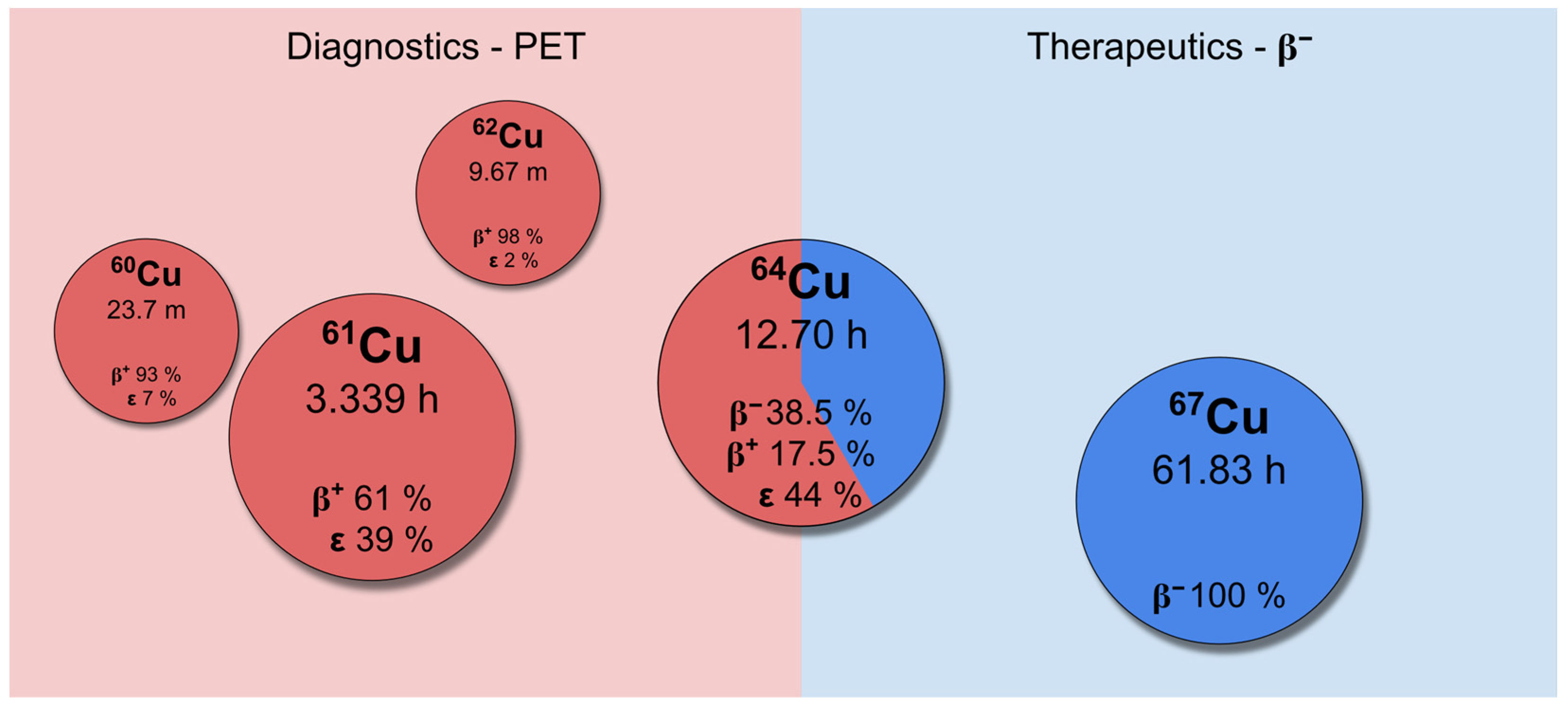
| Radionuclide | Half-Life | Eβ+,mean/keV (Intensity/%) | Eβ−,mean/keV (Intensity/%) | Eγ/keV (Intensity/%) | Reported Applications |
|---|---|---|---|---|---|
| 60Cu | 23.7 m | 970 (93) | - | 1333 (88) 1792 (45.4) 826.4 (21.7) 3124 (4.8) 1862 (4.8) i.a. | Perfusion [13] Hypoxia [25] |
| 61Cu | 3.34 h | 500 (61) | - | 282.9 (12.7) 656.0 (10.4) 67.41 (4.0) 1185 (3.6) i.a. | Hypoxia [25] PSMA [26] Peptide [27] |
| 62Cu | 9.67 m | 1320 (97.8) | - | 1173 (0.34) i.a. | Hypoxia [25] Perfusion [28] |
| 64Cu | 12.7 h | 278 (17.5) | 191 (38.5) | 1346 (0.47) | Perfusion [29] Hypoxia [25] PSMA [30] Peptide [31] Antibody [32] FAP [33] |
| 67Cu | 61.8 h | - | 141 (100) | 184.5 (48.7) 93.3 (16.1) 91.3 (7.9) i.a. | PSMA [34] Peptide [35] Antibody [36] |
2.1. Radionuclide Production
2.1.1. Copper-60 and Copper-62
2.1.2. Copper-61
2.1.3. Copper-64
2.1.4. Copper-67
2.2. Radiochemical Purification and Quality Control
2.2.1. Radiochemical Purification
2.2.2. Quality Control
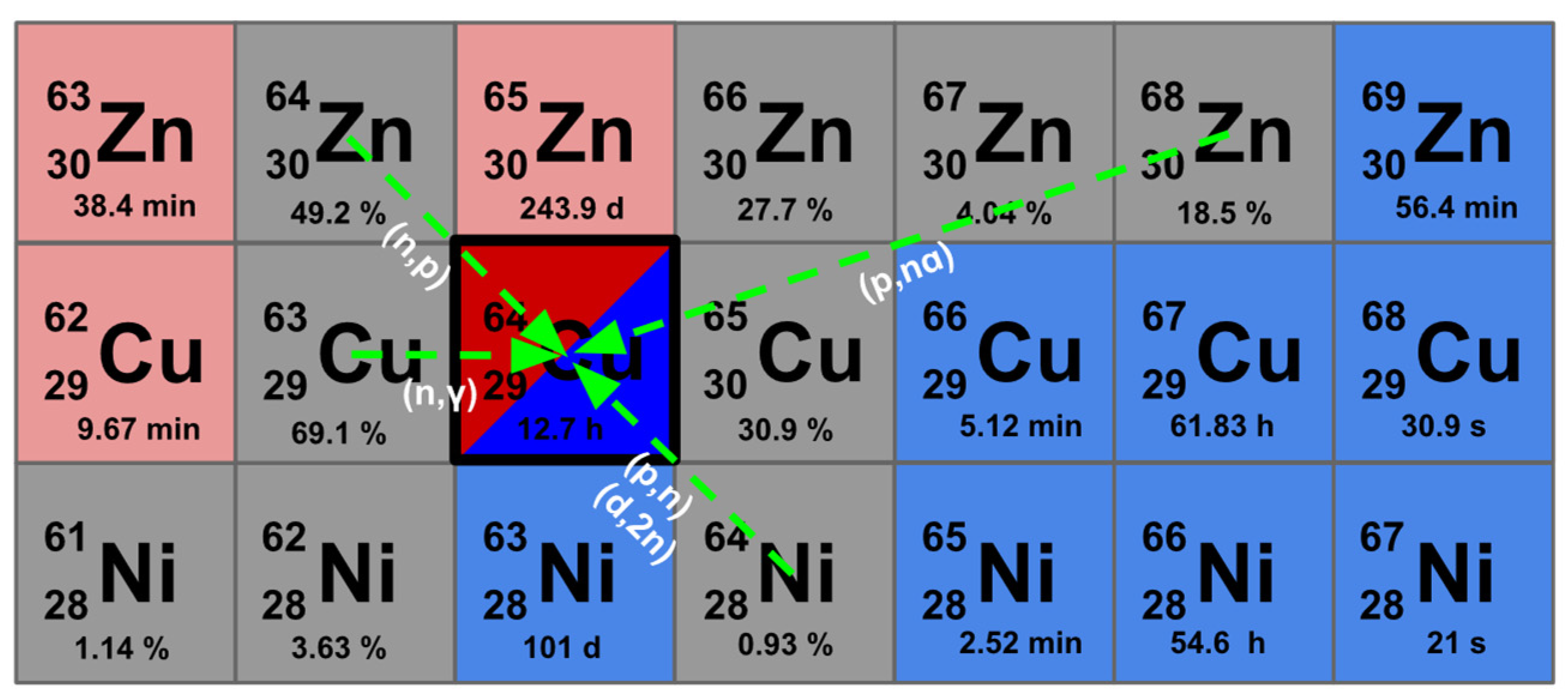
| Radionuclide | Typical Production Route | Reported Peak Cross Section (Particle Energy)/mb (MeV) | Reported Activities | Reported RNP at EOB/% | Reported MA/AMA/GBq/µmol | Challenges for Clinical Translation |
|---|---|---|---|---|---|---|
| 60Cu | 60Ni(p,n)60Cu [46] | 350 ± 100 [14,116] | >30 GBq | >99 | >50 (AMA) | In-house production due to short half-life. |
| 61Cu | 60Ni(d,n)61Cu [46,52] 61Ni(p,n)61Cu [38,46] 62Ni(p,2n)61Cu [53] 64Zn(p,α)61Cu [54,59] | 264 ± 13 [6] 470 ± 40 [11] 300 ± 150 [24,116] 71 ± 3 [16] | >2 GBq >20 GBq >20 GBq >3 GBq | >99 >99 >99 >99 | >80 (MA) >50 (AMA) >130 (AMA) 1000 (AMA) | Mature production established. |
| 62Cu | 62Ni(p,n)62Cu [45] 63Cu(p,2n)62Zn → 62Cu [28,47] | 530 ± 90 [12] 101 ± 5 [25] | XS measure >1.5 GBq | - >99 | - - | Short half-life and short generator use. |
| 64Cu | 64Ni(p,n)64Cu [61,62,63,64] 64Ni(d,2n)64Cu [66,117] 63Cu(n,γ)64Cu [43] 64Zn(n,p)64Cu [74,118] 68Zn(p,nα)64Cu [42] | 670 ± 50 [17] 960 ± 70 [21] ~10,000 (~keV) * [116] 250 ± 50 [11,116] 60 ± 4 [27] | >30 GBq >20 GBq >50 GBq >20 GBq ~5 GBq | >99 >99 >99 >99 >99 | >1000 (AMA) >10 (AMA) ~0.2 (MA) >750 (AMA) >150 (AMA) | Mature production established. Neutron capture on copper leads to low MA. |
| 67Cu | 64Ni(α,p)67Cu [80] 68Zn(γ,p)67Cu [101] 67Zn(n,p)67Cu [73,119] 68Zn(n,np)67Cu [75,77] 68Zn(p,2p)67Cu [84] 70Zn(p,α)67Cu [90,103] 70Zn(d,nα)67Cu [95] | 34 ± 4 [23,79] 11.7 ± 0.5 [23,116] 70 ± 40 [16,116] 110 ± 30 [26,116] ** 11.9 ± 0.9 [101] 12.4 ± 1.3 [16] 31 ± 1 [25,95] | ~60 MBq >15 GBq ~1 GBq XS measure >10 GBq >1.5 GBq XS measure | - >99 - - <20 >98 - | - >120 (AMA) - - >1 (MA) >60 (AMA) - | Availability issues. So far, clinical amounts only by (γ,p). |
3. Preclinical and Clinical Work
3.1. Copper-61
3.2. Copper-64
3.3. Copper-67
| Radiopharmaceutical | Radionuclide | Indication | Trial Acronym | Trial Phase | Enrollment | Trial Identifier | Status * | Reference |
|---|---|---|---|---|---|---|---|---|
| [61Cu]Cu-NODAGA-LM3 | 61Cu | Neuroendocrine tumors | Copper PET in NET | 1/2 | 27 | NCT06455358 | Recruiting | [132] |
| [64Cu]Cu-SAR-bisPSMA | 64Cu | Prostate cancer | Propeller | 1 | 30 | NCT04839367 | Completed | [165] |
| [64Cu]Cu-SAR-bisPSMA | 64Cu | Prostate cancer | Cobra | 1/2 | 52 | NCT05249127 | Completed | [30] |
| [64Cu]Cu-SAR-bisPSMA | 64Cu | Prostate cancer | - | 1/2 | 150 | NCT05286840 | Unknown | [262] |
| [64Cu]Cu-SAR-bisPSMA | 64Cu | Prostate cancer | Co-PSMA | 2 | 50 | NCT06907641 | Recruiting | [263] |
| [64Cu]Cu-SAR-bisPSMA | 64Cu | Prostate cancer | Clarify | 3 | 383 | NCT06056830 | Recruiting | [168] |
| [64Cu]Cu-SAR-bisPSMA | 64Cu | Prostate cancer | Amplify | 3 | 220 | NCT06970847 | Recruiting | [264] |
| [64Cu]Cu-SAR-bisPSMA [67Cu]Cu-SAR-bisPSMA | 64Cu 67Cu | Prostate cancer | Secure | 1/2a | 54 | NCT04868604 | Recruiting | [259] |
| [61Cu]Cu-PSMA I&T | 61Cu | Prostate cancer | - | 1 | 8 | NCT06736054 | Recruiting | [129] |
| [64Cu]Cu-PSMA I&T | 64Cu | Prostate cancer | - | 2 | 24 | NCT05653856 | Completed | [265] |
| [64Cu]Cu-PSMA I&T | 64Cu | Prostate cancer | Solar-Recur | 3 | 235 | NCT06235099 | Completed | [171] |
| [64Cu]Cu-PSMA I&T | 64Cu | Prostate cancer | Solar-Stage | 3 | 323 | NCT06235151 | Recruiting | [172] |
| [64Cu]Cu-DOTA-TATE | 64Cu | Neuroendocrine tumors | - | 3 | 63 | NCT03673943 | Completed | [137] |
| [64Cu]Cu-DOTA-TATE | 64Cu | Neuroendocrine tumors/prostate cancer | - | - | 50 | NCT05680675 | Completed | [142] |
| [64Cu]Cu-DOTA-TATE | 64Cu | Endocarditis | - | - | 69 | NCT05432427 | Completed | [141] |
| [64Cu]Cu-DOTA-TATE | 64Cu | Neuroendocrine tumors | - | Expanded access | - | NCT04334837 | Approved for marketing | [140] |
| [64Cu]Cu-DOTA-TATE | 64Cu | Neuroendocrine tumors | - | 1 | 10 | NCT06122610 | Recruiting | [139] |
| [64Cu]Cu-DOTA-TATE | 64Cu | Lyme Neuroborreliosis | DOTA-Lyme | - | 50 | NCT06392815 | Recruiting | [147] |
| [64Cu]Cu-DOTA-TATE | 64Cu | Neuroendocrine tumors | - | 2 | 200 | NCT05709171 | Enrolling by invitation | [145] |
| [64Cu]Cu-DOTA-TATE | 64Cu | Breast cancer | - | 2 | 30 | NCT05880394 | Active, not recruiting | [143] |
| [64Cu]Cu-DOTA-TATE | 64Cu | Neuroendocrine tumors | - | 4 | 6 | NCT06016855 | Recruiting | [146] |
| [64Cu]Cu-DOTA-TATE | 64Cu | Meningioma | - | 4 | 20 | NCT06377371 | Recruiting | [148] |
| [64Cu]Cu-DOTA-TATE | 64Cu | Cardiac Sarcoidosis | CuDosis | Observational | 76 | NCT06131112 | Recruiting | [144] |
| [64Cu]Cu-DOTA-TATE | 64Cu | Neuroendocrine tumors | - | Observational | 30 | NCT07195500 | Recruiting | [149] |
| [64Cu]Cu-SAR-TATE | 64Cu | Neuroendocrine tumors | - | 1 | 10 | NCT04440956 | Completed | [153] |
| [64Cu]Cu-SAR-TATE [67Cu]Cu-SAR-TATE | 64Cu 67Cu | Meningioma | - | 1/2a | 5 | NCT03936426 | Completed | [152] |
| [64Cu]Cu-SAR-TATE | 64Cu | Neuroendocrine tumors | Disco | 2 | 45 | NCT04438304 | Completed | [154] |
| [64Cu]Cu-SAR-TATE [67Cu]Cu-SAR-TATE | 64Cu 67Cu | Neuroblastoma | - | 1/2 | 21 | NCT04023331 | Terminated | [256] |
| [64Cu]Cu-SAR-Bombesin | 64Cu | Prostate cancer | BOP | 2 | 30 | NCT05613842 | Completed | [175] |
| [64Cu]Cu-SAR-Bombesin | 64Cu | Prostate cancer | Sabre | 2 | 53 | NCT05407311 | Completed | [266] |
| [64Cu]Cu-SAR-Bombesin [67Cu]Cu-SAR-Bombesin | 64Cu 67Cu | Prostate cancer | Combat | 1/2a | 4 | NCT05633160 | Terminated | [261] |
| [64Cu]Cu-TP3805 | 64Cu | Prostate cancer | - | 1 | 25 | NCT02989623 | Completed | [267] |
| [64Cu]Cu-TP3805 | 64Cu | Prostate cancer | - | 1 | 25 | NCT02603965 | Completed | [268] |
| [64Cu]Cu-TP3805 | 64Cu | Urothelial cancer | - | 1 | 20 | NCT03039413 | Completed | [269] |
| [64Cu]Cu-TP3805 | 64Cu | Breast cancer | - | - | 19 | NCT02810873 | Terminated | [270] |
| [64Cu]Cu-AKY-1189 | 64Cu | Nectin-4 positive cancers | Nectinium-2 | 1/2 | 150 | NCT07020117 | Recruiting | [213] |
| [64Cu]Cu-TLX592 | 64Cu | Prostate cancer | Cupid | 1 | 14 | NCT04726033 | Completed | [178] |
| [64Cu]Cu-trastuzumab | 64Cu | Breast cancer | Cu-64 HER2+ | 1 | 11 | NCT00605397 | Completed | [271] |
| [64Cu]Cu-DOTA-trastuzumab | 64Cu | Breast cancer | - | - | 18 | NCT01093612 | Active, not recruiting | [272] |
| [64Cu]Cu-DOTA-trastuzumab | 64Cu | Breast cancer | - | - | 10 | NCT02226276 | Active, not recruiting | [273] |
| [64Cu]Cu-DOTA-trastuzumab | 64Cu | Breast cancer | - | 2 | 18 | NCT02827877 | Active, not recruiting | [274] |
| [64Cu]Cu-DOTA-trastuzumab | 64Cu | Breast cancer | - | 4 | 10 | NCT05376878 | Recruiting | [275] |
| [64Cu]Cu-DOTA-trastuzumab | 64Cu | Gastric cancer | - | - | 8 | NCT01939275 | Completed | [276] |
| [64Cu]Cu-DOTA-daratumumab | 64Cu | Multiple myeloma | - | 1 | 12 | NCT03311828 | Completed | [184] |
| [61Cu]Cu-ATSM | 61Cu | Tumor hypoxia | - | - | 9 | NCT04621435 | Terminated | [128] |
| [64Cu]Cu-ATSM | 64Cu | Rectum cancer | - | 2 | 70 | NCT03951337 | Active, not recruiting | [277] |
| [64Cu]Cu-ATSM | 64Cu | Cervical cancer | - | 2 | 73 | NCT00794339 | Terminated | [278] |
| [64Cu]Cu-ATSM | 64Cu | Tumor hypoxia | - | 1 | 13 | NCT04875871 | Terminated | [279] |
| [64Cu]Cu-M5A | 64Cu | CEA positive cancers | - | - | 20 | NCT02293954 | Active, not recruiting | [193] |
| [64Cu]Cu-M5A | 64Cu | CEA positive cancers | - | - | 15 | NCT05245786 | Recruiting | [194] |
| [64Cu]Cu-LLP2A | 64Cu | Lymphoma | - | 1 | 42 | NCT06636175 | Recruiting | [189] |
| [64Cu]Cu-LLP2A | 64Cu | Multiple Myeloma | - | 1 | 10 | NCT03804424 | Terminated | [187] |
| [64Cu]Cu-LLP2A | 64Cu | Sickle cell disease | - | 1 | 20 | NCT04925492 | Recruiting | [191] |
| [64Cu]Cu-LNTH-1363S | 64Cu | Sarcoma/Gastrointestinal tumors | Phantom | 1/2 | 26 | NCT06298916 | Recruiting | [33] |
| [64Cu]Cu-LNTH-1363S | 64Cu | Sarcoma | Atlas | 1/2 | 26 | NCT07156565 | Recruiting | [202] |
| [64Cu]Cu-FAP-2286 | 64Cu | Solid tumors | - | 1 | 191 | NCT04621435 | Recruiting | [203] |
| [64Cu]Cu-FAPI-XT117 | 64Cu | Malignant solid tumors | - | 1 | 14 | NCT05814835 | Completed | [205] |
| [64Cu]Cu-FAPI-XT117 | 64Cu | Malignant solid tumors | - | 1 | 15 | NCT05930457 | Completed | [206] |
| [64Cu]Cu-NODAGA-TTX-MC138 | 64Cu | Solid tumors | - | 1 | 1 | NCT05908773 | Completed | [249] |
| [64Cu]Cu-DOTA-U3-1287 | 64Cu | Solid tumors | - | 1 | 12 | NCT01479023 | Terminated | [280] |
| [64Cu]Cu-NOTA-EB-ss-CPT | 64Cu | Colorectal cancer | - | 1 | 10 | NCT05891028 | Unknown | [281] |
| [64Cu]Cu-GRIP B | 64Cu | Genitourinary malignancies | - | 1/2 | 91 | NCT05888532 | Recruiting | [282] |
| [64Cu]Cu-DOTA-AE105 | 64Cu | uPAR | - | 1 | 10 | NCT02139371 | Completed | [218] |
| [64Cu]Cu-DOTA-AE105 | 64Cu | uPAR | uTRACE-101 | 2 | 168 | NCT06474806 | Recruiting | [220] |
| [64Cu]Cu-DOTA-alendronate | 64Cu | Breast cancer | - | 1 | 1 | NCT03542695 | Completed | [283] |
| [64Cu]Cu-DOTA-ECL1i | 64Cu | Abdominal aortic aneurysm | - | 1 | 50 | NCT04586452 | Completed | [232] |
| [64Cu]Cu-DOTA-ECL1i | 64Cu | Head and neck cancer | - | 1 | 11 | NCT04217057 | Terminated | [236] |
| [64Cu]Cu-DOTA-ECL1i | 64Cu | Heart diseases | - | 1 | 90 | NCT05107596 | Unknown | [230] |
| [64Cu]Cu-DOTA-ECL1i | 64Cu | Atherosclerosis | - | NCT04537403 | Recruiting | [237] | ||
| [64Cu]Cu-DOTA-ECL1i | 64Cu | Lung inflammation | - | 1 | 110 | NCT03492762 | Recruiting | [234] |
| [64Cu]Cu-DOTA-ECL1i | 64Cu | Pancreatic ductal adenocarcinoma | - | 1 | 69 | NCT03851237 | Active, not recruiting | [238] |
| [64Cu]Cu-25%CANF-Comb | 64Cu | Atherosclerosis | Volunteer—BioDistribution and Safety Study | 1 | 8 | NCT02498379 | Completed | [227] |
| [64Cu]Cu-25%CANF-Comb | 64Cu | Atherosclerosis | - | 1 | 44 | NCT02417688 | Completed | [228] |
| [64Cu]Cu-25%CANF-Comb | 64Cu | Atherosclerosis | - | - | 80 | NCT05838547 | Recruiting | [229] |
| [64Cu]Cu-FBP8 | 64Cu | Pulmonary embolus | - | 1 | 80 | NCT04022915 | Recruiting | [243] |
| [64Cu]Cu-FBP8 | 64Cu | Thrombosis | - | 1 | 165 | NCT03830320 | Recruiting | [241] |
| [64Cu]Cu-FBP8 | 64Cu | Alzheimer Disease | - | 1/2 | 30 | NCT05336695 | Recruiting | [244] |
| [64Cu]Cu-Plerixafor | 64Cu | CXCR4 | - | 1 | 2 | NCT02069080 | Terminated | [284] |
| [64Cu]Cu-Macrin | 64Cu | Sarcoidosis, cardiovascular diseases, cancer | - | 1 | 10 | NCT04843891 | Unknown | [222] |
| [64Cu]CuCl2 | 64Cu | Wilson disease | - | 1 | 5 | NCT07159581 | Enrolling by invitation | [285] |
| [64Cu]Cu-Super paramagnetic iron oxide nanoparticle | 64Cu | Extramedullary myeloma | Caramel | 1 | 10 | NCT05666700 | Recruiting | [247] |
| [64Cu]Cu-NOTA-PSMAi-PEG-Cy5.5-C’ | 64Cu | Prostate cancer | - | 1 | 16 | NCT04167969 | Recruiting | [286] |
| [64Cu]Cu-TRDC002 | 64Cu | Prostate cancer | - | 1 | 6 | NCT07236112 | Not yet recruiting | [287] |
| [64Cu]Cu-Porphysomes | 64Cu | Gynecological cancers | - | 1 | 24 | NCT06977126 | Not yet recruiting | [288] |
4. Conclusions
Author Contributions
Funding
Institutional Review Board Statement
Informed Consent Statement
Data Availability Statement
Conflicts of Interest
Abbreviations
| AMA | Apparent molar activity |
| CANF | C-type atrial natriuretic factor |
| CAR | Chimeric Antigen Receptor |
| CT | Computer tomography |
| DOTA | 2,2′,2′′,2′′′-(1,4,7,10-Tetraazacyclododecane-1,4,7,10-tetrayl)tetraacetic acid |
| EDQM | European Directorate for the Quality of Medicines & Healthcare |
| EMA | European Medicines Agency |
| EOB | End of bombardment |
| FAP | Fibroblast activation protein |
| FAPI | Fibroblast activation protein inhibitor |
| FDA | Food and drug administration |
| GMP | Good manufacturing practice |
| GRPR | Gastrin-releasing peptide receptor |
| HER2 | Human epidermal growth factor receptor 2 |
| MA | Molar activity |
| MRI | Magnetic resonance imaging |
| NODAGA | 1,4,7-triazacyclononane,1-glutaric acid-4,7-acetic acid |
| NOTA | 1,4,7-Triazacyclononane-1,4,7-triacetic acid |
| NPR | Natriuretic peptide receptor |
| PET | Positron emission tomography |
| PSMA | Prostate specific membrane antigen |
| RNP | Radionuclidic purity |
| SAR | 3,6,10,13,16,19-hexaazabicyclo(6,6,6)icosane |
| SPECT | Single-photon emission computed tomography |
| SPION | Super paramagnetic iron oxide nanoparticles |
| SSTR | Somatostatin receptor |
| SUV | Standardized uptake value |
| TETA | 1,4,8,11-Tetraazacyclotetradecane-1,4,8,11-tetraacetic acid |
| uPAR | Urokinase-type plasminogen activator receptor |
References
- Bodei, L.; Herrmann, K.; Schoder, H.; Scott, A.M.; Lewis, J.S. Radiotheranostics in oncology: Current challenges and emerging opportunities. Nat. Rev. Clin. Oncol. 2022, 19, 534–550. [Google Scholar] [CrossRef]
- Cutler, C.S.; Hennkens, H.M.; Sisay, N.; Huclier-Markai, S.; Jurisson, S.S. Radiometals for combined imaging and therapy. Chem. Rev. 2013, 113, 858–883. [Google Scholar] [CrossRef] [PubMed]
- Gudkov, S.V.; Shilyagina, N.Y.; Vodeneev, V.A.; Zvyagin, A.V. Targeted Radionuclide Therapy of Human Tumors. Int. J. Mol. Sci. 2015, 17, 33. [Google Scholar] [CrossRef]
- Nelson, B.J.B.; Krol, V.; Bansal, A.; Andersson, J.D.; Wuest, F.; Pandey, M.K. Aspects and prospects of preclinical theranostic radiopharmaceutical development. Theranostics 2024, 14, 6446–6470. [Google Scholar] [CrossRef] [PubMed]
- Rudd, S.E. Looking backward to move forward: A chemist’s perspective on the future of radiopharmaceuticals. J. Biol. Inorg. Chem. 2025. [Google Scholar] [CrossRef] [PubMed]
- Kostelnik, T.I.; Orvig, C. Radioactive Main Group and Rare Earth Metals for Imaging and Therapy. Chem. Rev. 2019, 119, 902–956. [Google Scholar] [CrossRef]
- Price, E.W.; Orvig, C. Matching chelators to radiometals for radiopharmaceuticals. Chem. Soc. Rev. 2014, 43, 260–290. [Google Scholar] [CrossRef]
- Dash, A.; Pillai, M.R.; Knapp, F.F., Jr. Production of (177)Lu for Targeted Radionuclide Therapy: Available Options. Nucl. Med. Mol. Imaging 2015, 49, 85–107. [Google Scholar] [CrossRef]
- Fendler, W.P.; Rahbar, K.; Herrmann, K.; Kratochwil, C.; Eiber, M. (177)Lu-PSMA Radioligand Therapy for Prostate Cancer. J. Nucl. Med. 2017, 58, 1196–1200. [Google Scholar] [CrossRef]
- Norenberg, J.; Wilson, D.; Harvey, J.; Harris, M.; Gleason, S.; Biggin, C. Environmental Considerations Resulting from the Increased Use of Theranostics: Advantages of Targeted Copper Theranostics. J. Nucl. Med. 2022, 63, 2655. [Google Scholar]
- Krasnovskaya, O.O.; Abramchuck, D.; Erofeev, A.; Gorelkin, P.; Kuznetsov, A.; Shemukhin, A.; Beloglazkina, E.K. Recent Advances in (64)Cu/(67)Cu-Based Radiopharmaceuticals. Int. J. Mol. Sci. 2023, 24, 9154. [Google Scholar] [CrossRef] [PubMed]
- Fujibayashi, Y.; Furukawa, T. Copper Complexes for Theranostics: From PET Imaging to Therapy. In Copper in Biology; Royal Society of Chemistry: London, UK, 2025; pp. 284–299. [Google Scholar]
- Williams, H.A.; Robinson, S.; Julyan, P.; Zweit, J.; Hastings, D. A comparison of PET imaging characteristics of various copper radioisotopes. Eur. J. Nucl. Med. Mol. Imaging 2005, 32, 1473–1480. [Google Scholar] [CrossRef]
- Smith, N.A.; Bowers, D.L.; Ehst, D.A. The production, separation, and use of 67Cu for radioimmunotherapy: A review. Appl. Radiat. Isot. 2012, 70, 2377–2383. [Google Scholar] [CrossRef]
- Mou, L.; Martini, P.; Pupillo, G.; Cieszykowska, I.; Cutler, C.S.; Mikolajczak, R. (67)Cu Production Capabilities: A Mini Review. Molecules 2022, 27, 1501. [Google Scholar] [CrossRef]
- Speltri, G.; Porto, F.; Boschi, A.; Uccelli, L.; Martini, P. Recent Advances in Preclinical Studies of the Theranostic Agent [(64)Cu]CuCl(2). Molecules 2024, 29, 4085. [Google Scholar] [CrossRef]
- Krecisz, P.; Stefanska, K.; Studzinski, J.; Pitucha, M.; Czylkowska, A.; Szymanski, P. Radiocopper in Radiopharmacy and Medical Use: Current Status and Perspective. J. Med. Chem. 2025, 68, 2356–2376. [Google Scholar] [CrossRef]
- National Nuclear Data Center (NNDC) BNL. NuDat 3.0: Search and Plot Nuclear Structure and Decay Data Interactively: Brookhaven National Laboratory. 2025. Available online: https://www.nndc.bnl.gov/nudat3/ (accessed on 4 December 2025).
- Hussain, M.; Qaim, S.M.; Spahn, I.; Aslam, M.N.; Neumaier, B. Copper radionuclides for theranostic applications: Towards standardisation of their nuclear data. A mini-review. Front. Chem. 2023, 11, 1270351. [Google Scholar] [CrossRef]
- Rowshanfarzad, P.; Sabet, M.; Jalilian, A.R.; Kamalidehghan, M. An overview of copper radionuclides and production of 61Cu by proton irradiation of (nat)Zn at a medical cyclotron. Appl. Radiat. Isot. 2006, 64, 1563–1573. [Google Scholar] [CrossRef] [PubMed]
- Brühlmann, S.; Walther, M.; Kopka, K.; Kreller, M. The radiocopper trio: Cyclotron production of the true theranostic matched radionuclides copper-61/64 and copper-67. Nukl.-Nucl. Med. 2024, 63, V19. [Google Scholar]
- Muller, C.; Zhernosekov, K.; Koster, U.; Johnston, K.; Dorrer, H.; Hohn, A.; van der Walt, N.T.; Turler, A.; Schibli, R. A unique matched quadruplet of terbium radioisotopes for PET and SPECT and for alpha- and beta- radionuclide therapy: An in vivo proof-of-concept study with a new receptor-targeted folate derivative. J. Nucl. Med. 2012, 53, 1951–1959. [Google Scholar] [CrossRef] [PubMed]
- Muller, C.; Domnanich, K.A.; Umbricht, C.A.; van der Meulen, N.P. Scandium and terbium radionuclides for radiotheranostics: Current state of development towards clinical application. Br. J. Radiol. 2018, 91, 20180074. [Google Scholar] [CrossRef]
- Huclier-Markai, S.; Alliot, C.; Kerdjoudj, R.; Mougin-Degraef, M.; Chouin, N.; Haddad, F. Promising Scandium Radionuclides for Nuclear Medicine: A Review on the Production and Chemistry up to In Vivo Proofs of Concept. Cancer Biother. Radiopharm. 2018, 33, 316–329. [Google Scholar] [CrossRef] [PubMed]
- Laforest, R.; Dehdashti, F.; Lewis, J.S.; Schwarz, S.W. Dosimetry of 60/61/62/64Cu-ATSM: A hypoxia imaging agent for PET. Eur. J. Nucl. Med. Mol. Imaging 2005, 32, 764–770. [Google Scholar] [CrossRef]
- Basaco Bernabeu, T.; Mansi, R.; Del Pozzo, L.; Zanger, S.; Gaonkar, R.H.; McDougall, L.; De Rose, F.; Jaafar-Thiel, L.; Herz, M.; Eiber, M.; et al. (61)Cu-PSMA-Targeted PET for Prostate Cancer: From Radiotracer Development to First-in-Human Imaging. J. Nucl. Med. 2024, 65, 1427–1434. [Google Scholar] [CrossRef] [PubMed]
- Nicolas, G.P.; Lafont, M.A.; McDougall, L.; Kaul, F.; Chirindel, A.; Weber, W.; Llmazares, A.; Johayem, A.; Baier, M.; Schubert, N.; et al. First-in-human administration of [(61)Cu]Cu-NODAGA-LM3 and head-to-head comparison with [(68)Ga]Ga-DOTA-TOC PET/CT as part of the phase I/II COPPER PET in NET study. Eur. J. Nucl. Med. Mol. Imaging 2026, 53, 710–712. [Google Scholar] [CrossRef]
- Haynes, N.G.; Lacy, J.L.; Nayak, N.; Martin, C.S.; Dai, D.; Mathias, C.J.; Green, M.A. Performance of a 62Zn/62Cu generator in clinical trials of PET perfusion agent 62Cu-PTSM. J. Nucl. Med. 2000, 41, 309–314. [Google Scholar]
- Lewis, J.S.; McCarthy, D.W.; McCarthy, T.J.; Fujibayashi, Y.; Welch, M.J. Evaluation of 64Cu-ATSM in vitro and in vivo in a hypoxic tumor model. J. Nucl. Med. 1999, 40, 177–183. [Google Scholar]
- 64Cu-SAR-bisPSMA Positron Emission Tomography: A Phase 1/2 Study of Participants with Biochemical Recurrence of Prostate Cancer [Internet]. 2022. Available online: https://clinicaltrials.gov/study/NCT05249127 (accessed on 4 December 2025).
- Pfeifer, A.; Knigge, U.; Mortensen, J.; Oturai, P.; Berthelsen, A.K.; Loft, A.; Binderup, T.; Rasmussen, P.; Elema, D.; Klausen, T.L.; et al. Clinical PET of neuroendocrine tumors using 64Cu-DOTATATE: First-in-humans study. J. Nucl. Med. 2012, 53, 1207–1215. [Google Scholar] [CrossRef]
- Mortimer, J.E.; Bading, J.R.; Park, J.M.; Frankel, P.H.; Carroll, M.I.; Tran, T.T.; Poku, E.K.; Rockne, R.C.; Raubitschek, A.A.; Shively, J.E.; et al. Tumor Uptake of (64)Cu-DOTA-Trastuzumab in Patients with Metastatic Breast Cancer. J. Nucl. Med. 2018, 59, 38–43. [Google Scholar] [CrossRef] [PubMed]
- A Phase 1/2a Study Utilizing 64Cu-LNTH-1363S (64Cu Radiolabeled FAPi PET/CT Imaging Agent) in Patients with Sarcoma or Gastrointestinal Tract Cancer (PHANTOM Trial) [Internet]. 2024. Available online: https://clinicaltrials.gov/study/NCT06298916 (accessed on 4 December 2025).
- Johnson, G.B.; Lengyelova, E.; Nordquist, L.; Prasad, V.; Song, H.; Anderson, M.; Gervasio, O.; Miller, R.M.; Sartor, A.O.; Tagawa, S.T. SECuRE: A dose escalation/expansion study to assess the anti-tumor efficacy of 67 Cu-SAR-bisPSMA in patients with metastatic castrate resistant prostate cancer. J. Clin. Oncol. 2025, 43, TPS5125. [Google Scholar] [CrossRef]
- Bailey, D.L.; Willowson, K.P.; Harris, M.; Biggin, C.; Aslani, A.; Lengkeek, N.A.; Stoner, J.; Eslick, M.E.; Marquis, H.; Parker, M.; et al. (64)Cu Treatment Planning and (67)Cu Therapy with Radiolabeled [(64)Cu/(67)Cu]MeCOSar-Octreotate in Subjects with Unresectable Multifocal Meningioma: Initial Results for Human Imaging, Safety, Biodistribution, and Radiation Dosimetry. J. Nucl. Med. 2023, 64, 704–710. [Google Scholar] [CrossRef] [PubMed]
- O’Donnell, R.T.; DeNardo, G.L.; Kukis, D.L.; Lamborn, K.R.; Shen, S.; Yuan, A.; Goldstein, D.S.; Mirick, G.R.; DeNardo, S.J. 67Copper-2-iminothiolane-6-[p-(bromoacetamido)benzyl-TETA-Lym-1 for radioimmunotherapy of non-Hodgkin’s lymphoma. Clin. Cancer Res. 1999, 5, 3330s–3336s. [Google Scholar]
- Vahidfar, N.; Farzanehfar, S.; Abbasi, M.; Mirzaei, S.; Delpassand, E.S.; Abbaspour, F.; Salehi, Y.; Biersack, H.J.; Ahmadzadehfar, H. Diagnostic Value of Radiolabelled Somatostatin Analogues for Neuroendocrine Tumour Diagnosis: The Benefits and Drawbacks of [(64)Cu]Cu-DOTA-TOC. Cancers 2022, 14, 1914. [Google Scholar] [CrossRef]
- Fani, M.; Nicolas, G.P. (61)Cu-Labeled Radiotracers: Alternative or Choice? J. Nucl. Med. 2023, 64, 1855–1857. [Google Scholar] [CrossRef] [PubMed]
- Szelecsényi, F.; Suzuki, K.; Kovács, Z.; Takei, M.; Okada, K. Production possibility of radioisotopes by alpha induced reactions on cobalt for PET studies. Nucl. Instrum. Methods Phys. Res. Sect. B Beam Interact. Mater. At. 2002, 187, 153–163. [Google Scholar] [CrossRef]
- Szelecsényi, F.; Kovács, Z.; Suzuki, K.; Okada, K.; Fukumura, T.; Mukai, K. Formation of 60Cu and 61Cu via Co +3He reactions up to 70 MeV: Production possibility of 60Cu for PET studies. Nucl. Instrum. Methods Phys. Res. Sect. B Beam Interact. Mater. At. 2004, 222, 364–370. [Google Scholar] [CrossRef]
- Dellepiane, G.; Casolaro, P.; Mateu, I.; Scampoli, P.; Braccini, S. Alternative routes for (64)Cu production using an 18 MeV medical cyclotron in view of theranostic applications. Appl. Radiat. Isot. 2023, 191, 110518. [Google Scholar] [CrossRef]
- Nelson, B.J.B.; Leier, S.; Wilson, J.; Wuest, M.; Doupe, J.; Andersson, J.D.; Wuest, F. (64)Cu production via the (68)Zn(p,nalpha)(64)Cu nuclear reaction: An untapped, cost-effective and high energy production route. Nucl. Med. Biol. 2024, 128–129, 108875. [Google Scholar] [CrossRef]
- Chakravarty, R.; Chakraborty, S.; Vimalnath, K.V.; Shetty, P.; Sarma, H.D.; Hassan, P.A.; Dash, A. CuCl produced by direct neutron activation route as a cost-effective probe for cancer imaging: The journey has begun. RSC Adv. 2015, 5, 91723–91733. [Google Scholar] [CrossRef]
- Fonseca, A.I.; Do Carmo, S.J.C.; Hrynchak, I.; Alves, V.; Alves, F.; Abrunhosa, A.J. Purification of Copper Radioisotopes for Medical Applications: Chromatographic Methods and Challenges. Sep. Purif. Rev. 2024, 53, 289–310. [Google Scholar] [CrossRef]
- Piel, H.; Qaim, S.M.; Stöcklin, G. Excitation Functions of (p,xn)-Reactions on natNi and Highly Enriched 62Ni: Possibility of Production of Medically Important Radioisotope 62Cu at a Small Cyclotron. Radiochim. Acta 1992, 57, 1–6. [Google Scholar] [CrossRef]
- McCarthy, D.W.; Bass, L.A.; Cutler, P.D.; Shefer, R.E.; Klinkowstein, R.E.; Herrero, P.; Lewis, J.S.; Cutler, C.S.; Anderson, C.J.; Welch, M.J. High purity production and potential applications of copper-60 and copper-61. Nucl. Med. Biol. 1999, 26, 351–358. [Google Scholar] [CrossRef]
- Szelecsényi, F.; Kovács, Z.; van der Walt, T.N.; Steyn, G.F.; Suzuki, K.; Okada, K. Investigation of the natZn(p,x)62Zn nuclear process up to 70 MeV: A new 62Zn/62Cu generator. Appl. Radiat. Isot. 2003, 58, 377–384. [Google Scholar] [CrossRef]
- Flower, M.A.; Zweit, J.; Hall, A.D.; Burke, D.; Davies, M.M.; Dworkin, M.J.; Young, H.E.; Mundy, J.; Ott, R.J.; McCready, V.R.; et al. 62Cu-PTSM and PET used for the assessment of angiotensin II-induced blood flow changes in patients with colorectal liver metastases. Eur. J. Nucl. Med. 2001, 28, 99–103. [Google Scholar] [CrossRef]
- Lewis, J.S.; Laforest, R.; Dehdashti, F.; Grigsby, P.W.; Welch, M.J.; Siegel, B.A. An imaging comparison of 64Cu-ATSM and 60Cu-ATSM in cancer of the uterine cervix. J. Nucl. Med. 2008, 49, 1177–1182. [Google Scholar] [CrossRef]
- Wong, T.Z.; Lacy, J.L.; Petry, N.A.; Hawk, T.C.; Sporn, T.A.; Dewhirst, M.W.; Vlahovic, G. PET of hypoxia and perfusion with 62Cu-ATSM and 62Cu-PTSM using a 62Zn/62Cu generator. AJR Am. J. Roentgenol. 2008, 190, 427–432. [Google Scholar] [CrossRef]
- Szelecsényi, F.; Blessing, G.; Qaim, S.M. Excitation functions of proton induced nuclear reactions on enriched 61Ni and 64Ni: Possibility of production of no-carrier-added 61Cu and 64Cu at a small cyclotron. Appl. Radiat. Isot. 1993, 44, 575–580. [Google Scholar] [CrossRef]
- Svedjehed, J.; Kutyreff, C.J.; Engle, J.W.; Gagnon, K. Automated, cassette-based isolation and formulation of high-purity [(61)Cu]CuCl(2) from solid Ni targets. EJNMMI Radiopharm. Chem. 2020, 5, 21. [Google Scholar] [CrossRef] [PubMed]
- Bruhlmann, S.A.; Walther, M.; Kopka, K.; Kreller, M. Production of the PET radionuclide (61)Cu via the (62)Ni(p,2n)(61)Cu nuclear reaction. EJNMMI Radiopharm. Chem. 2024, 9, 3. [Google Scholar] [CrossRef]
- Thieme, S.; Walther, M.; Preusche, S.; Rajander, J.; Pietzsch, H.J.; Lill, J.O.; Kaden, M.; Solin, O.; Steinbach, J. High specific activity (6)(1)Cu via (6)(4)Zn(p,alpha)(6)(1)Cu reaction at low proton energies. Appl. Radiat. Isot. 2013, 72, 169–176. [Google Scholar] [CrossRef]
- do Carmo, S.J.C.; Alves, V.H.P.; Alves, F.; Abrunhosa, A.J. Fast and cost-effective cyclotron production of (61)Cu using a (nat)Zn liquid target: An opportunity for radiopharmaceutical production and R&D. Dalton Trans. 2017, 46, 14556–14560. [Google Scholar] [CrossRef]
- Dellepiane, G.; Casolaro, P.; Mateu, I.; Scampoli, P.; Voeten, N.; Braccini, S. Cross-section measurement for an optimized (61)Cu production at an 18 MeV medical cyclotron from natural Zn and enriched (64)Zn solid targets. Appl. Radiat. Isot. 2022, 190, 110466. [Google Scholar] [CrossRef]
- Alves, V.H.; Do Carmo, S.J.C.; Alves, F.; Abrunhosa, A.J. Automated Purification of Radiometals Produced by Liquid Targets. Instruments 2018, 2, 17. [Google Scholar] [CrossRef]
- do Carmo, S.J.C.; Scott, P.J.H.; Alves, F. Production of radiometals in liquid targets. EJNMMI Radiopharm. Chem. 2020, 5, 2. [Google Scholar] [CrossRef] [PubMed]
- Fonseca, A.I.; Alves, V.H.; do Carmo, S.J.C.; Silva, M.; Hrynchak, I.; Alves, F.; Falcao, A.; Abrunhosa, A.J. Production of GMP-Compliant Clinical Amounts of Copper-61 Radiopharmaceuticals from Liquid Targets. Pharmaceuticals 2022, 15, 723. [Google Scholar] [CrossRef] [PubMed]
- Rodrigues, D.; Fonseca, A.I.; do Carmo, S.; Sereno, J.; Hrynchak, I.; Moreira, J.N.; Gomes, C.; Abrunhosa, A. Is Copper-61 the New Gallium-68? Automation and Preclinical Proof-of-Concept of (61)Cu-Based Radiopharmaceuticals for Prostate Cancer Imaging. Pharmaceuticals 2025, 18, 469. [Google Scholar] [CrossRef] [PubMed]
- McCarthy, D.W.; Shefer, R.E.; Klinkowstein, R.E.; Bass, L.A.; Margeneau, W.H.; Cutler, C.S.; Anderson, C.J.; Welch, M.J. Efficient production of high specific activity 64Cu using a biomedical cyclotron. Nucl. Med. Biol. 1997, 24, 35–43. [Google Scholar] [CrossRef]
- Obata, A.; Kasamatsu, S.; McCarthy, D.W.; Welch, M.J.; Saji, H.; Yonekura, Y.; Fujibayashi, Y. Production of therapeutic quantities of (64)Cu using a 12 MeV cyclotron. Nucl. Med. Biol. 2003, 30, 535–539. [Google Scholar] [CrossRef]
- Avila-Rodriguez, M.A.; Nye, J.A.; Nickles, R.J. Simultaneous production of high specific activity 64Cu and 61Co with 11.4 MeV protons on enriched 64Ni nuclei. Appl. Radiat. Isot. 2007, 65, 1115–1120. [Google Scholar] [CrossRef]
- Thieme, S.; Walther, M.; Pietzsch, H.J.; Henniger, J.; Preusche, S.; Mading, P.; Steinbach, J. Module-assisted preparation of 64Cu with high specific activity. Appl. Radiat. Isot. 2012, 70, 602–608. [Google Scholar] [CrossRef]
- Lee, J.Y.; Chae, J.H.; Hur, M.G.; Yang, S.D.; Kong, Y.B.; Lee, J.; Ju, J.S.; Choi, P.S.; Park, J.H. Theragnostic (64)Cu/(67)Cu Radioisotopes Production with RFT-30 Cyclotron. Front. Med. 2022, 9, 889640. [Google Scholar] [CrossRef]
- Hermanne, A.; Tárkányi, F.; Takács, S.; Kovalev, S.F.; Ignatyuk, A. Activation cross sections of the Ni(d,2n) reaction for the production of the medical radionuclide Cu. Nucl. Instrum. Methods Phys. Res. Sect. B—Beam Interact. Mater. At. 2007, 258, 308–312. [Google Scholar] [CrossRef]
- van der Meulen, N.P.; Hasler, R.; Blanc, A.; Farkas, R.; Benesova, M.; Talip, Z.; Muller, C.; Schibli, R. Implementation of a new separation method to produce qualitatively improved (64) Cu. J. Label. Comp. Radiopharm. 2019, 62, 460–470. [Google Scholar] [CrossRef]
- Isolan, L.; Malinconico, M.; Tieu, W.; Hollis, C.; Testa, M.; Melandri, M.; Brunetti, A.; Sumini, M. A digital twin for (64)Cu production with cyclotron and solid target system. Sci. Rep. 2022, 12, 19379. [Google Scholar] [CrossRef] [PubMed]
- Kreller, M.; Brühlmann, S.A.; Knieß, T.; Kopka, K.; Walther, M. Production of Medical Radionuclides in the Center for Radiopharmaceutical Tumor Research—A Status Report. Instruments 2024, 8, 10. [Google Scholar] [CrossRef]
- Hilgers, K.; Stoll, T.; Skakun, Y.; Coenen, H.H.; Qaim, S.M. Cross-section measurements of the nuclear reactions natZn(d,x)64Cu, 66Zn(d,alpha)64Cu and 68Zn(p,alphan)64Cu for production of 64Cu and technical developments for small-scale production of 67Cu via the 70Zn(p,alpha)67Cu process. Appl. Radiat. Isot. 2003, 59, 343–351. [Google Scholar] [CrossRef] [PubMed]
- Abbas, K.; Kozempel, J.; Bonardi, M.; Groppi, F.; Alfarano, A.; Holzwarth, U.; Simonelli, F.; Hofman, H.; Horstmann, W.; Menapace, E.; et al. Cyclotron production of 64Cu by deuteron irradiation of 64Zn. Appl. Radiat. Isot. 2006, 64, 1001–1005. [Google Scholar] [CrossRef]
- Bokhari, T.H.; Mushtaq, A.; Khan, I.U. Production of low and high specific activity Cu in a reactor. J. Radioanal. Nucl. Chem. 2010, 284, 265–271. [Google Scholar] [CrossRef]
- Johnsen, A.M.; Heidrich, B.J.; Durrant, C.B.; Bascom, A.J.; Ünlü, K. Reactor production of Cu and Cu using enriched zinc target material. J. Radioanal. Nucl. Chem. 2015, 305, 61–71. [Google Scholar] [CrossRef]
- Chakravarty, R.; Rajeswari, A.; Shetty, P.; Jagadeesan, K.C.; Ram, R.; Jadhav, S.; Sarma, H.D.; Dash, A.; Chakraborty, S. A simple and robust method for radiochemical separation of no-carrier-added (64)Cu produced in a research reactor for radiopharmaceutical preparation. Appl. Radiat. Isot. 2020, 165, 109341. [Google Scholar] [CrossRef]
- Kin, T.; Nagai, Y.; Iwamoto, N.; Minato, F.; Iwamoto, O.; Hatsukawa, Y.; Segawa, M.; Harada, H.; Konno, C.; Ochiai, K.; et al. New Production Routes for Medical Isotopes64Cu and67Cu Using Accelerator Neutrons. J. Phys. Soc. Jpn. 2013, 82, 034201. [Google Scholar] [CrossRef]
- Kawabata, M.; Hashimoto, K.; Saeki, H.; Sato, N.; Motoishi, S.; Takakura, K.; Konno, C.; Nagai, Y. Production and separation of 64Cu and 67Cu using 14 MeV neutrons. J. Radioanal. Nucl. Chem. 2014, 303, 1205–1209. [Google Scholar] [CrossRef]
- Kawabata, M.; Motoishi, S.; Ohta, A.; Motomura, A.; Saeki, H.; Tsukada, K.; Hashimoto, S.; Iwamoto, N.; Nagai, Y.; Hashimoto, K. Large scale production of Cu and Cu via the Zn(n, p)Cu and Zn(n, np/d)Cu reactions using accelerator neutrons. J. Radioanal. Nucl. Chem. 2021, 330, 913–922. [Google Scholar] [CrossRef]
- Capogni, M.; Capone, M.; Colangeli, A.; Dellepiane, G.; Fazio, A.; Frisoni, M.; Pillon, M.; Pietropaolo, A. The Zn-based production route to Cu β emitter using accelerator-driven 14 MeV fusion neutrons. Europhys. Lett. 2022, 137, 64001. [Google Scholar] [CrossRef]
- Skakun, Y.; Qaim, S.M. Excitation function of the Ni(α, p)Cu reaction for production of Cu. Appl. Radiat. Isot. 2004, 60, 33–39. [Google Scholar] [CrossRef]
- Ohya, T.; Nagatsu, K.; Suzuki, H.; Fukada, M.; Minegishi, K.; Hanyu, M.; Zhang, M.R. Small-scale production of (67)Cu for a preclinical study via the (64)Ni(alpha, p)(67)Cu channel. Nucl. Med. Biol. 2018, 59, 56–60. [Google Scholar] [CrossRef]
- Takács, S.; Aikawa, M.; Haba, H.; Komori, Y.; Ditrói, F.; Szűcs, Z.; Saito, M.; Murata, T.; Sakaguchi, M.; Ukon, N. Cross sections of alpha-particle induced reactions on natNi: Production of 67Cu. Nucl. Instrum. Methods Phys. Res. Sect. B Beam Interact. Mater. At. 2020, 479, 125–136. [Google Scholar] [CrossRef]
- Stoll, T.; Kastleiner, S.; Shubin, Y.N.; Coenen, H.H.; Qaim, S.M. Excitation functions of proton induced reactions on68Zn from threshold up to 71 MeV, with specific reference to the production of 67Cu. Radiochim. Acta 2002, 90, 309–313. [Google Scholar] [CrossRef]
- Katabuchi, T.; Watanabe, S.; Ishioka, N.S.; Iida, Y.; Hanaoka, H.; Endo, K.; Matsuhashi, S. Production of Cu via the Zn(p,2p)Cu reaction and recovery of Zn target. J. Radioanal. Nucl. Chem. 2008, 277, 467–470. [Google Scholar] [CrossRef]
- Medvedev, D.G.; Mausner, L.F.; Meinken, G.E.; Kurczak, S.O.; Schnakenberg, H.; Dodge, C.J.; Korach, E.M.; Srivastava, S.C. Development of a large scale production of 67Cu from 68Zn at the high energy proton accelerator: Closing the 68Zn cycle. Appl. Radiat. Isot. 2012, 70, 423–429. [Google Scholar] [CrossRef] [PubMed]
- Pupillo, G.; Sounalet, T.; Michel, N.; Mou, L.; Esposito, J.; Haddad, F. New production cross sections for the theranostic radionuclide Cu. Nucl. Instrum. Methods Phys. Res. Sect. B—Beam Interact. Mater. At. 2018, 415, 41–47. [Google Scholar] [CrossRef]
- Kastleiner, S.; Coenen, H.H.; Qaim, S.M. Possibility of production of Cu at a small-sized cyclotron via the (p,α)-reaction on enriched Zn. Radiochim. Acta 1999, 84, 107–110. [Google Scholar] [CrossRef]
- sr Jamriska, D.J.; Taylor, W.A.; Ott, M.A.; Heaton, R.C.; Phillips, D.R.; Fowler, M.M. Activation rates and chemical recovery of67Cu produced with low energy proton irradiation of enriched70Zn targets. J. Radioanal. Nucl. Chem. 1995, 195, 263–270. [Google Scholar] [CrossRef]
- Bruhlmann, S.A.; Walther, M.; Kreller, M.; Reissig, F.; Pietzsch, H.J.; Kniess, T.; Kopka, K. Cyclotron-Based Production of (67)Cu for Radionuclide Theranostics via the (70)Zn(p,alpha)(67)Cu Reaction. Pharmaceuticals 2023, 16, 314. [Google Scholar] [CrossRef]
- Dellepiane, G.; Casolaro, P.; Gottstein, A.; Mateu, I.; Scampoli, P.; Braccini, S. Optimized production of (67)Cu based on cross section measurements of (67)Cu and (64)Cu using an 18 MeV medical cyclotron. Appl. Radiat. Isot. 2023, 195, 110737. [Google Scholar] [CrossRef]
- Sondergaard, U.; Thomas, K.E.; Soborg Pedersen, K.; Kranz, M.; Sundset, R.; Moldes-Anaya, A.; Jensen, M. Production of (67)Cu at a biomedical cyclotron via (70)Zn(p,alpha)(67)Cu reaction and its evaluation in a preclinical study using small animal SPECT/CT. Appl. Radiat. Isot. 2025, 215, 111551. [Google Scholar] [CrossRef]
- Pupillo, G.; Mou, L.; Martini, P.; Pasquali, M.; Boschi, A.; Cicoria, G.; Duatti, A.; Haddad, F.; Esposito, J. Production of Cu by enriched Zn targets: First measurements of formation cross sections of Cu, Cu, Ga, Ga, Zn and Zn in interactions of Zn with protons above 45 MeV. Radiochim. Acta 2020, 108, 593–602. [Google Scholar] [CrossRef]
- Jung, M.H.; Park, J.K.; Yang, S.C.; Jang, H.M.; Chun, K.S.; Cho, W.J.; Kim, S.W. First (70)Zn(p,x) nuclear cross section measurements for theranostic (67)Cu radionuclide production extended up to 100 MeV. Appl. Radiat. Isot. 2025, 215, 111579. [Google Scholar] [CrossRef] [PubMed]
- Mou, L.; Pupillo, G.; Martini, P.; Pasquali, M. A Method and a Target for the Production of 67Cu. Patent WO/2019/220224, 21 November 2019. [Google Scholar]
- Kozempel, J.; Abbas, K.; Simonelli, F.; Bulgheroni, A.; Holzwarth, U.; Gibson, N. Preparation of67Cuviadeuteron irradiation of70Zn. Radiochim. Acta 2012, 100, 419–424. [Google Scholar] [CrossRef]
- Nigron, E.; Guertin, A.; Haddad, F.; Sounalet, T. Is (70)Zn(d,x)(67)Cu the Best Way to Produce (67)Cu for Medical Applications? Front. Med. 2021, 8, 674617. [Google Scholar] [CrossRef]
- Kotliarenko, A.; Azzolini, O.; Cisternino, S.; El Idrissi, M.; Esposito, J.; Keppel, G.; Pira, C.; Taibi, A. First Results on Zinc Oxide Thick Film Deposition by Inverted Magnetron Sputtering for Cyclotron Solid Targets Production. Materials 2023, 16, 3810. [Google Scholar] [CrossRef]
- Cisternino, S.; Kotliarenko, A.; Martini, P.; Piteo, G.; Porto, F.; Speltri, G.; Marvelli, L.; Pigato, M.; Cazzola, E.; Boschi, A.; et al. Spark plasma sintering in manufacturing and recycling of ZnO targets for medical radioisotopes cyclotron-based production. Ceram. Int. 2025, 51, 30693–30707. [Google Scholar] [CrossRef]
- Wang, G.; Li, X.; Yang, D.; Xu, Z.; Ma, F. Research on zinc electrodeposition for target preparation in medical isotope (67)Cu production. Appl. Radiat. Isot. 2025, 226, 112170. [Google Scholar] [CrossRef]
- Gopalakrishna, A.; Suryanarayana, S.V.; Naik, H.; Dixit, T.S.; Nayak, B.K.; Kumar, A.; Maletha, P.; Thakur, K.; Deshpande, A.; Krishnan, R.; et al. Production, separation and supply prospects of Cu with the development of fast neutron sources and photonuclear technology. Radiochim. Acta 2018, 106, 549–557. [Google Scholar] [CrossRef]
- Hovhannisyan, G.H.; Bakhshiyan, T.M.; Dallakyan, R.K. Photonuclear production of the medical isotope 67Cu. Nucl. Instrum. Methods Phys. Res. Sect. B—Beam Interact. Mater. At. 2021, 498, 48–51. [Google Scholar] [CrossRef]
- Iotron Medical—Advanced Radiopharmaceutical Technology: Iotron Medical. 2025. Available online: https://iotronmedical.com/ (accessed on 4 December 2025).
- Copper-67 (Cu-67)|NorthStar Medical Radioisotopes, LLC—Radiopharmaceutical Therapy: NorthStar Medical Radioisotopes, LLC. 2025. Available online: https://www.northstarnm.com/radiopharmaceutical-therapy/copper-67/ (accessed on 4 December 2025).
- Brühlmann, S.A.; Walther, M.; Zhutova, N.; Kopka, K.; Kreller, M. From bench to batch: Scaling up copper-67 production via the 70Zn(p,α)67Cu nuclear reaction. Radiochim. Acta 2025. [Google Scholar] [CrossRef]
- De Nardo, L.; Pupillo, G.; Mou, L.; Esposito, J.; Rosato, A.; Melendez-Alafort, L. A feasibility study of the therapeutic application of a mixture of (67/64) Cu radioisotopes produced by cyclotrons with proton irradiation. Med. Phys. 2022, 49, 2709–2724. [Google Scholar] [CrossRef]
- Søndergaard, U.; Thomas, K.E.; Sundset, R.; Deville, C.; Jensen, M.; Pedersen, K.S.; Moldes-Anaya, A. Validation of ICP-OES and γ-spectrometry methodologies for quality assessment of 67Cu from cyclotron production via the 70Zn(p,α)67Cu nuclear reaction. J. Radioanal. Nucl. Chem. 2025, 334, 5637–5648. [Google Scholar] [CrossRef]
- EMA. EPAR Cuprymina [European Public Assessment Report Cuprymina]. Available online: https://www.ema.europa.eu/en/medicines/human/EPAR/cuprymina (accessed on 4 December 2025).
- Neels, O.; Patt, M.; Decristoforo, C. Radionuclides: Medicinal products or rather starting materials? EJNMMI Radiopharm. Chem. 2019, 4, 22. [Google Scholar] [CrossRef] [PubMed]
- EDQM. Knowledge Database [Detailed View of Copper (64Cu) Solution for Radiolabelling]. Available online: https://extranet.edqm.eu/4DLink1/4DCGI/Web_View/mono/3278 (accessed on 4 December 2025).
- Schwarz, S.W.; Decristoforo, C.; Goodbody, A.E.; Singhal, N.; Saliba, S.; Ruddock, P.; Zukotynski, K.; Ross, A.A. Harmonization of United States, European Union and Canadian First-in-Human Regulatory Requirements for Radiopharmaceuticals-Is This Possible? J. Nucl. Med. 2019, 60, 158–166. [Google Scholar] [CrossRef]
- Schwarz, S.W.; Decristoforo, C. US and EU radiopharmaceutical diagnostic and therapeutic nonclinical study requirements for clinical trials authorizations and marketing authorizations. EJNMMI Radiopharm. Chem. 2019, 4, 10. [Google Scholar] [CrossRef]
- Gillings, N.; Hjelstuen, O.; Ballinger, J.; Behe, M.; Decristoforo, C.; Elsinga, P.; Ferrari, V.; Peitl, P.K.; Koziorowski, J.; Laverman, P.; et al. Guideline on current good radiopharmacy practice (cGRPP) for the small-scale preparation of radiopharmaceuticals. EJNMMI Radiopharm. Chem. 2021, 6, 8. [Google Scholar] [CrossRef]
- Decristoforo, C.; Neels, O.; Patt, M. Emerging Radionuclides in a Regulatory Framework for Medicinal Products—How Do They Fit? Front. Med. 2021, 8, 678452. [Google Scholar] [CrossRef]
- IAEA. Copper-64 Radiopharmaceuticals: Production, Quality Control and Clinical Applications; International Atomic Energy Agency: Vienna, Austria, 2022. [Google Scholar]
- Korde, A.; Patt, M.; Selivanova, S.V.; Scott, A.M.; Hesselmann, R.; Kiss, O.; Ramamoorthy, N.; Todde, S.; Rubow, S.M.; Gwaza, L.; et al. Position paper to facilitate patient access to radiopharmaceuticals: Considerations for a suitable pharmaceutical regulatory framework. EJNMMI Radiopharm. Chem. 2024, 9, 2. [Google Scholar] [CrossRef]
- Decristoforo, C.; Mikolajczak, R.; Naidoo, C.; Lapi, S.; Haddad, F.; Schmid, D.E.; Gano, L.; Koster, U.; Stora, T. To be GMP or not to be- a radionuclide’s question. EJNMMI Radiopharm. Chem. 2025, 10, 42. [Google Scholar] [CrossRef] [PubMed]
- OECD. JANIS Books Nuclear Energy Agency (NEA) 2025. Available online: https://www.oecd-nea.org/jcms/pl_44624/janis-books (accessed on 4 December 2025).
- ARRONAX. Cuivre-64—Production des Radionucléides (Arronax Nantes): ARRONAX Nantes. 2025. Available online: https://www.arronax-nantes.fr/production-des-radionucleides/thematique/isotopes/cuivre-64/ (accessed on 4 December 2025).
- Zinn, K.R.; Chaudhuri, T.R.; Cheng, T.P.; Morris, J.S.; Meyer, W.A., Jr. Production of no-carrier-added 64Cu from zinc metal irradiated under boron shielding. Cancer 1994, 73, 774–778. [Google Scholar] [CrossRef]
- Brown, L.C.; Callahan, A.P. The separation and purification of carrier-free copper isotopes for medical use. Int. J. Appl. Radiat. Isot. 1972, 23, 535–538. [Google Scholar] [CrossRef] [PubMed]
- Follacchio, G.A.; De Feo, M.S.; De Vincentis, G.; Monteleone, F.; Liberatore, M. Radiopharmaceuticals Labelled with Copper Radionuclides: Clinical Results in Human Beings. Curr. Radiopharm. 2018, 11, 22–33. [Google Scholar] [CrossRef]
- Bolzati, C.; Duatti, A. The emerging value of 64Cu for molecular imaging and therapy. Q. J. Nucl. Med. Mol. Imaging 2020, 64, 329–337. [Google Scholar] [CrossRef] [PubMed]
- Piccardo, A.; Ugolini, M.; Righi, S.; Bottoni, G.; Cistaro, A.; Paparo, F.; Giovanella, L.; Evangelista, L. Copper, PET/CT and prostate cancer: A systematic review of the literature. Q. J. Nucl. Med. Mol. Imaging 2020, 64, 382–392. [Google Scholar] [CrossRef] [PubMed]
- Pasquali, M.; Martini, P.; Shahi, A.; Jalilian, A.R.; Osso, J.A., Jr.; Boschi, A. Copper-64 based radiopharmaceuticals for brain tumors and hypoxia imaging. Q. J. Nucl. Med. Mol. Imaging 2020, 64, 371–381. [Google Scholar] [CrossRef] [PubMed]
- Yang, N.; Guo, X.Y.; Ding, J.; Wang, F.; Liu, T.L.; Zhu, H.; Yang, Z. Copper-64 Based PET-Radiopharmaceuticals: Ways to Clinical Translational. Semin. Nucl. Med. 2024, 54, 792–800. [Google Scholar] [CrossRef]
- Rodrigues, D.; Fonseca, A.I.; Moreira, J.N.; Gomes, C.; Abrunhosa, A. Molecular targets and the emerging role of copper radionuclides in prostate cancer theranostics. EJNMMI Res. 2025, 15, 136. [Google Scholar] [CrossRef] [PubMed]
- An, Y.; Huang, X.; Xu, M.; Li, X.; Shan, H.; Zhang, M. Diagnosis and Potential Therapy of Brain Diseases Using 64Cu: A Scoping Review. Curr. Med. Chem. 2025. [Google Scholar] [CrossRef]
- Baberwal, P.; Sonavane, S.; Basu, S. The current status and promising potential of copper-based radiopharmaceutical development towards future theranostics: An overview. Nucl. Med. Commun. 2025, 46, 781–792. [Google Scholar] [CrossRef]
- Pilot Study of (61)CuATSM-PET Imaging in Cancer Patients [Internet]. 2007. Available online: https://clinicaltrials.gov/study/NCT00585117 (accessed on 4 December 2025).
- A Phase I Trial of 61Cu-NODAGA-PSMA for Patients with Prostate Cancer [Internet]. 2024. Available online: https://clinicaltrials.gov/study/NCT06736054 (accessed on 4 December 2025).
- Ulaner, G.A.; Bassett, J.C.; Reddy, R.; Thomsen, B.; Reynolds, D.; Jerjian, K.J.; Wolfe, R.; Benjamin, D.J.; Fani, M.; O’Donoghue, J.; et al. (61)Cu-NODAGA Prostate-specific Membrane Antigen Imaging and Therapy for Prostate Cancer: Phase 1 Trial of a New Class of (61)Cu-labeled PET Radiotracers. Radiology 2025, 317, e251151. [Google Scholar] [CrossRef]
- Pais, B.; Bassett, J.C.; Reddy, R.; Thomson, B.; Reynolds, D.; Jerjian, K.J.; Wolfe, R.; Benjamin, D.J.; Fani, M.; O’Donoghue, J.; et al. Abstract B054: Phase 1 study of 61Cu-NU101 in patients with prostate cancer. Cancer Res. 2026, 86, B054. [Google Scholar] [CrossRef]
- 61Cu-NODAGA-LM3 PET/CT for the Detection of Neuroendocrine Tumors: The COPPER PET in NET Study A Prospective, Open-Label, Randomized, Controlled, Single Centre, Phase I/II PET/CT Study [Internet]. 2024. Available online: https://clinicaltrials.gov/study/NCT06455358 (accessed on 4 December 2025).
- Strosberg, J.; El-Haddad, G.; Wolin, E.; Hendifar, A.; Yao, J.; Chasen, B.; Mittra, E.; Kunz, P.L.; Kulke, M.H.; Jacene, H.; et al. Phase 3 Trial of (177)Lu-Dotatate for Midgut Neuroendocrine Tumors. N. Engl. J. Med. 2017, 376, 125–135. [Google Scholar] [CrossRef]
- Hennrich, U.; Kopka, K. Lutathera((R)): The First FDA- and EMA-Approved Radiopharmaceutical for Peptide Receptor Radionuclide Therapy. Pharmaceuticals 2019, 12, 114. [Google Scholar] [CrossRef]
- Strosberg, J.R.; Caplin, M.E.; Kunz, P.L.; Ruszniewski, P.B.; Bodei, L.; Hendifar, A.; Mittra, E.; Wolin, E.M.; Yao, J.C.; Pavel, M.E.; et al. (177)Lu-Dotatate plus long-acting octreotide versus high-dose long-acting octreotide in patients with midgut neuroendocrine tumours (NETTER-1): Final overall survival and long-term safety results from an open-label, randomised, controlled, phase 3 trial. Lancet Oncol. 2021, 22, 1752–1763. [Google Scholar] [CrossRef]
- Kjaer, A.; Binderup, T.; Johnbeck, C.; Carlsen, E.; Langer, S.; Federspiel, B.; Knigge, U. 64Cu-DOTATATE somatostatin receptor imaging in neuroendocrine tumors: Experience from 500 patients at Copenhagen ENETS Center of Excellence. J. Nucl. Med. 2019, 60, 504. [Google Scholar]
- An Open-Label, Single-Dose, Single Arm, Single-Center Clinical Trial of 64Cu(Copper)-DOTATATE (NETMedix™) PET-CT Scan for Imaging Patients with Known or Suspected Somatostatin Receptor-Positive Neuroendocrine Tumors (NETs) [Internet]. 2018. Available online: https://clinicaltrials.gov/study/NCT03673943 (accessed on 4 December 2025).
- Delpassand, E.S.; Ranganathan, D.; Wagh, N.; Shafie, A.; Gaber, A.; Abbasi, A.; Kjaer, A.; Tworowska, I.; Nunez, R. (64)Cu-DOTATATE PET/CT for Imaging Patients with Known or Suspected Somatostatin Receptor-Positive Neuroendocrine Tumors: Results of the First U.S. Prospective, Reader-Masked Clinical Trial. J. Nucl. Med. 2020, 61, 890–896. [Google Scholar] [CrossRef]
- Dosimetry-Guided 177Lu-DOTATATE Treatment Planning Using 64Cu-DOTATATE as a Surrogate [Internet]. 2023. Available online: https://clinicaltrials.gov/study/NCT06122610 (accessed on 4 December 2025).
- An Open-Label, Multi-Center Expanded Access Protocol of Copper Cu 64 Dotatate for the Detection, Localization and Monitoring of Somatostatin Receptor Expressing Neuroendocrine Tumors (NETs) [Internet]. 2020. Available online: https://clinicaltrials.gov/study/NCT04334837 (accessed on 4 December 2025).
- 64Cu-DOTATATE PET-CT-skanning to Diagnose Macrophage Infiltration in the Heart Valves of Patients with Infective Endocarditis [Internet]. 2022. Available online: https://clinicaltrials.gov/study/NCT05432427 (accessed on 4 December 2025).
- Dual-Tracer Theranostic PET [Internet]. 2022. Available online: https://clinicaltrials.gov/study/NCT05680675 (accessed on 4 December 2025).
- Somatostatin Receptor Imaging Study of Estrogen Receptor Positive (ER+) Metastatic Breast Cancer [Internet]. 2023. Available online: https://clinicaltrials.gov/study/NCT05880394 (accessed on 4 December 2025).
- Macrophage PET/CT Imaging for the Diagnosis of Cardiac Sarcoidosis [Internet]. 2023. Available online: https://clinicaltrials.gov/study/NCT06131112 (accessed on 4 December 2025).
- Dual 64Cu-DOTATATE and 18F-FDG PET/CT Imaging of Patients with Neuroendocrine Neoplasms [Internet]. 2023. Available online: https://clinicaltrials.gov/study/NCT05709171 (accessed on 4 December 2025).
- Surgical Debulking Prior to Peptide Receptor Radionuclide Therapy (PRRT) in Patients with Well Differentiated Gastroenteropancreatic Neuroendocrine Tumors [Internet]. 2023. Available online: https://clinicaltrials.gov/study/NCT06016855 (accessed on 4 December 2025).
- 64Cu-DOTATATE-PET Imaging for Lyme Neuroborreliosis [Internet]. 2024. Available online: https://clinicaltrials.gov/study/NCT06392815 (accessed on 4 December 2025).
- A Pilot Study to Evaluate Feasibility of Intraoperative Tracing of Meningioma Using [Cu64]DOTATATE [Internet]. 2024. Available online: https://clinicaltrials.gov/study/NCT06377371 (accessed on 4 December 2025).
- The Clinical Application of Somatostatin Receptor and Norepinephrine Transporter Targeted Imaging for the Diagnosis and Staging of Neuroblastoma and Pheochromocytoma/Paraganglioma [Internet]. 2025. Available online: https://clinicaltrials.gov/study/NCT07195500 (accessed on 4 December 2025).
- Paterson, B.M.; Roselt, P.; Denoyer, D.; Cullinane, C.; Binns, D.; Noonan, W.; Jeffery, C.M.; Price, R.I.; White, J.M.; Hicks, R.J.; et al. PET imaging of tumours with a 64Cu labeled macrobicyclic cage amine ligand tethered to Tyr3-octreotate. Dalton Trans. 2014, 43, 1386–1396. [Google Scholar] [CrossRef]
- Hicks, R.J.; Jackson, P.; Kong, G.; Ware, R.E.; Hofman, M.S.; Pattison, D.A.; Akhurst, T.A.; Drummond, E.; Roselt, P.; Callahan, J.; et al. (64)Cu-SARTATE PET Imaging of Patients with Neuroendocrine Tumors Demonstrates High Tumor Uptake and Retention, Potentially Allowing Prospective Dosimetry for Peptide Receptor Radionuclide Therapy. J. Nucl. Med. 2019, 60, 777–785. [Google Scholar] [CrossRef] [PubMed]
- Peptide Receptor Radionuclide Therapy Administered to Participants with Meningioma with 67Cu-SARTATE™: A Single-centre, Open-Label, Non- Randomised, Phase I-IIa Theranostic Clinical Trial [Internet]. 2019. Available online: https://clinicaltrials.gov/study/NCT03936426 (accessed on 4 December 2025).
- Positron Emission Tomography (PET) Imaging of Patients with Low & Intermediate Grade Neuroendocrine Tumors Using 64Cu-SARTATE: A Single Centre, Open-Label, Non-Randomized, Phase-0 Microdosing Investigation [Internet]. 2020. Available online: https://clinicaltrials.gov/study/NCT04440956 (accessed on 4 December 2025).
- Positron Emission Tomography Imaging of Participants with Known or Suspected Neuroendocrine Tumours Using 64Cu SARTATE: A Multi-Centre, Single Arm, Non-Randomised, Blinded-Review, Phase II Study [Internet]. 2020. Available online: https://clinicaltrials.gov/study/NCT04438304 (accessed on 4 December 2025).
- Benesova, M.; Schafer, M.; Bauder-Wust, U.; Afshar-Oromieh, A.; Kratochwil, C.; Mier, W.; Haberkorn, U.; Kopka, K.; Eder, M. Preclinical Evaluation of a Tailor-Made DOTA-Conjugated PSMA Inhibitor with Optimized Linker Moiety for Imaging and Endoradiotherapy of Prostate Cancer. J. Nucl. Med. 2015, 56, 914–920. [Google Scholar] [CrossRef]
- Afshar-Oromieh, A.; Hetzheim, H.; Kratochwil, C.; Benesova, M.; Eder, M.; Neels, O.C.; Eisenhut, M.; Kubler, W.; Holland-Letz, T.; Giesel, F.L.; et al. The Theranostic PSMA Ligand PSMA-617 in the Diagnosis of Prostate Cancer by PET/CT: Biodistribution in Humans, Radiation Dosimetry, and First Evaluation of Tumor Lesions. J. Nucl. Med. 2015, 56, 1697–1705. [Google Scholar] [CrossRef] [PubMed]
- Kratochwil, C.; Giesel, F.L.; Eder, M.; Afshar-Oromieh, A.; Benesova, M.; Mier, W.; Kopka, K.; Haberkorn, U. [(1)(7)(7)Lu]Lutetium-labelled PSMA ligand-induced remission in a patient with metastatic prostate cancer. Eur. J. Nucl. Med. Mol. Imaging 2015, 42, 987–988. [Google Scholar] [CrossRef]
- Kopka, K.; Benesova, M.; Barinka, C.; Haberkorn, U.; Babich, J. Glu-Ureido-Based Inhibitors of Prostate-Specific Membrane Antigen: Lessons Learned During the Development of a Novel Class of Low-Molecular-Weight Theranostic Radiotracers. J. Nucl. Med. 2017, 58, 17S–26S. [Google Scholar] [CrossRef] [PubMed]
- Sartor, O.; de Bono, J.; Chi, K.N.; Fizazi, K.; Herrmann, K.; Rahbar, K.; Tagawa, S.T.; Nordquist, L.T.; Vaishampayan, N.; El-Haddad, G.; et al. Lutetium-177-PSMA-617 for Metastatic Castration-Resistant Prostate Cancer. N. Engl. J. Med. 2021, 385, 1091–1103. [Google Scholar] [CrossRef]
- Herrmann, K.; Kraus, B.J.; Hadaschik, B.; Kunikowska, J.; van Poppel, H.; N’Dow, J.; Sartor, O.; Oyen, W.J.G. Nuclear medicine theranostics comes of age. Lancet Oncol. 2021, 22, 1497–1498. [Google Scholar] [CrossRef] [PubMed]
- Hennrich, U.; Eder, M. [(177)Lu]Lu-PSMA-617 (Pluvicto(TM)): The First FDA-Approved Radiotherapeutical for Treatment of Prostate Cancer. Pharmaceuticals 2022, 15, 1292. [Google Scholar] [CrossRef]
- Neels, O.C.; Kopka, K.; Liolios, C.; Afshar-Oromieh, A. Radiolabeled PSMA Inhibitors. Cancers 2021, 13, 6255. [Google Scholar] [CrossRef]
- Sallam, M.; Nguyen, N.T.; Sainsbury, F.; Kimizuka, N.; Muyldermans, S.; Benesova-Schafer, M. PSMA-targeted radiotheranostics in modern nuclear medicine: Then, now, and what of the future? Theranostics 2024, 14, 3043–3079. [Google Scholar] [CrossRef]
- Zia, N.A.; Cullinane, C.; Van Zuylekom, J.K.; Waldeck, K.; McInnes, L.E.; Buncic, G.; Haskali, M.B.; Roselt, P.D.; Hicks, R.J.; Donnelly, P.S. A Bivalent Inhibitor of Prostate Specific Membrane Antigen Radiolabeled with Copper-64 with High Tumor Uptake and Retention. Angew. Chem.-Int. Ed. 2019, 58, 14991–14994. [Google Scholar] [CrossRef]
- Positron Emission Tomography Imaging of Participants with Confirmed Prostate Cancer Using 64Cu-SAR-bisPSMA: A Multi-Centre, Blinded Review, Dose Ranging Phase I Study [Internet]. 2021. Available online: https://clinicaltrials.gov/study/NCT04839367 (accessed on 4 December 2025).
- Lengyelova, E.; Wong, V.; Lenzo, N.; Parker, M.; Emmett, L. 64Cu-SAR-bisPSMA (PROPELLER) positron emission tomography (PET) imaging in patients with confirmed prostate cancer. J. Clin. Oncol. 2023, 41, 5039. [Google Scholar] [CrossRef]
- Nordquist, L.; Lengyelova, E.; Saltzstein, D.; Josephson, D.; Franklin, G.E.; Morrish, G.; Gervasio, O.; Parker, M.; Miller, R.M.; Shore, N.D. COBRA: Assessment of safety and efficacy of 64Cu-SAR-bisPSMA in patients with biochemical recurrence of prostate cancer following definitive therapy. J. Clin. Oncol. 2024, 42, 5100. [Google Scholar] [CrossRef]
- Positron Emission Tomography Using 64Cu-SAR-bisPSMA in Participants with High-Risk Prostate Cancer Prior to Radical Prostatectomy: A Prospective, Single-Arm, Multi-Center, Blinded-Review, Phase 3 Diagnostic Performance Study [Internet]. 2023. Available online: https://clinicaltrials.gov/study/NCT06056830 (accessed on 4 December 2025).
- Gorin, M.A.; Lengyelova, E.; Nordquist, L.; Morrish, G.; Gervasio, O.; Miller, R.M.; Shore, N.D. CLARIFY: Positron emission tomography using 64Cu-SAR-bisPSMA in patients with high-risk prostate cancer prior to radical prostatectomy (a phase 3 diagnostic study). J. Clin. Oncol. 2024, 42, TPS5129. [Google Scholar] [CrossRef]
- Weineisen, M.; Schottelius, M.; Simecek, J.; Baum, R.P.; Yildiz, A.; Beykan, S.; Kulkarni, H.R.; Lassmann, M.; Klette, I.; Eiber, M.; et al. 68Ga- and 177Lu-Labeled PSMA I&T: Optimization of a PSMA-Targeted Theranostic Concept and First Proof-of-Concept Human Studies. J. Nucl. Med. 2015, 56, 1169–1176. [Google Scholar] [CrossRef]
- A Phase 3, Multi-Center, Open-Label Study to Test the Diagnostic Performance of Copper Cu 64 PSMA I&T PET/CT in Men with Biochemical Recurrence of Prostate Cancer [Internet]. 2024. Available online: https://clinicaltrials.gov/study/NCT06235099 (accessed on 4 December 2025).
- Phase 3, Multi-Center, Open-Label Study to Test the Diagnostic Performance of Copper Cu 64 PSMA I&T PET/CT in Staging Men with Newly Diagnosed Unfavorable Intermediate-Risk, High-Risk or Very High-Risk Prostate Cancer Electing to Undergo Radical Prostatectomy with Pelvic Lymph Node Dissection [Internet]. 2024. Available online: https://clinicaltrials.gov/study/NCT06235151 (accessed on 4 December 2025).
- Mansi, R.; Nock, B.A.; Dalm, S.U.; Busstra, M.B.; van Weerden, W.M.; Maina, T. Radiolabeled Bombesin Analogs. Cancers 2021, 13, 5766. [Google Scholar] [CrossRef]
- Ma, M.T.; Cooper, M.S.; Paul, R.L.; Shaw, K.P.; Karas, J.A.; Scanlon, D.; White, J.M.; Blower, P.J.; Donnelly, P.S. Macrobicyclic cage amine ligands for copper radiopharmaceuticals: A single bivalent cage amine containing two Lys3-bombesin targeting peptides. Inorg. Chem. 2011, 50, 6701–6710. [Google Scholar] [CrossRef]
- Assessment of the Diagnostic Value of 64Cu-SAR-BBN PET Imaging for Men with Negative PSMA PET in Prostate Cancer [Internet]. 2022. Available online: https://clinicaltrials.gov/study/NCT05613842 (accessed on 4 December 2025).
- Li, S.; Nguyen, A.; Counter, W.; John, N.C.; De Leon, J.; Hruby, G.; Joshua, A.M.; Stricker, P.; Crumbaker, M.; Ayati, N.; et al. Utility of (64)Cu-Sarcophagine-Bombesin PET/CT in Men with Biochemically Recurrent Prostate Cancer and Negative or Equivocal Findings on (68)Ga-PSMA-11 PET/CT. J. Nucl. Med. 2024, 65, 1371–1375. [Google Scholar] [CrossRef]
- Wong, K.; Sheehan-Dare, G.; Nguyen, A.; Ho, B.; Liu, V.; Lee, J.; Brown, L.; Dear, R.; Chan, L.; Sharma, S.; et al. (64)Cu-SAR-Bombesin PET-CT Imaging in the Staging of Estrogen/Progesterone Receptor Positive, HER2 Negative Metastatic Breast Cancer Patients: Safety, Dosimetry and Feasibility in a Phase I Trial. Pharmaceuticals 2022, 15, 772. [Google Scholar] [CrossRef] [PubMed]
- A Phase I, Single Centre, Open-Label Study of TLX592 to Assess the Safety and Tolerability, Pharmacokinetics, Biodistribution and Radiation Dosimetry in Patients Diagnosed with Prostate Cancer [Internet]. 2020. Available online: https://clinicaltrials.gov/study/NCT04726033 (accessed on 4 December 2025).
- Lenzo, N.; Capp, A.; Singh, A.; Cardaci, G.; Patel, N.; Wheatcroft, M.; Cade, D. CUPID (64 Cu-TLX592 phase I PK, biodistribution and dosimetry): A proof-of-concept study of TLX592-targeted alpha therapy in prostate cancer. J. Clin. Oncol. 2025, 43, 177. [Google Scholar] [CrossRef]
- Badier, L.; Quelven, I. Zirconium 89 and Copper 64 for ImmunoPET: From Antibody Bioconjugation and Radiolabeling to Molecular Imaging. Pharmaceutics 2024, 16, 882. [Google Scholar] [CrossRef]
- Mohr, P.; van Sluis, J.; Lub-de Hooge, M.N.; Lammertsma, A.A.; Brouwers, A.H.; Tsoumpas, C. Advances and challenges in immunoPET methodology. Front. Nucl. Med. 2024, 4, 1360710. [Google Scholar] [CrossRef]
- Mohr, P.; Li, Z.; van Sluis, J.; Lub-de Hooge, M.N.; van den Brom, R.R.H.; Lammertsma, A.A.; Tsoumpas, C.; Brouwers, A.H. Delayed [(89)Zr]Zr-N-Succinyldesferal-Trastuzumab Imaging Enabled by Long-Axial-Field-of-View PET/CT. J. Nucl. Med. 2026, 67, 160–161. [Google Scholar] [CrossRef]
- Rudd, S.E.; Van Zuylekom, J.; Cullinane, C.; Blyth, B.J.; Donnelly, P.S. Potential theranostics of breast cancer with copper-64/67 sarcophagine-trastuzumab. Chem. Sci. 2025, 16, 3998–4005. [Google Scholar] [CrossRef]
- A Pilot/Feasibility Trial of 64Cu-DOTA-Daratumumab Positron Emission Tomography in Patients with Newly Diagnosed or Relapsed Multiple Myeloma [Internet]. 2017. Available online: https://clinicaltrials.gov/study/NCT03311828 (accessed on 4 December 2025).
- Krishnan, A.; Adhikarla, V.; Poku, E.K.; Palmer, J.; Chaudhry, A.; Biglang-Awa, V.E.; Bowles, N.; Nathwani, N.; Rosenzweig, M.; Sahebi, F.; et al. Identifying CD38+ cells in patients with multiple myeloma: First-in-human imaging using copper-64-labeled daratumumab. Blood Adv. 2020, 4, 5194–5202. [Google Scholar] [CrossRef]
- Jiang, M.; Ferdani, R.; Shokeen, M.; Anderson, C.J. Comparison of two cross-bridged macrocyclic chelators for the evaluation of 64Cu-labeled-LLP2A, a peptidomimetic ligand targeting VLA-4-positive tumors. Nucl. Med. Biol. 2013, 40, 245–251. [Google Scholar] [CrossRef] [PubMed]
- Early Phase I Evaluation of 64Cu-LLP2A for Imaging Multiple Myeloma [Internet]. 2018. Available online: https://clinicaltrials.gov/study/NCT03804424 (accessed on 4 December 2025).
- Laforest, R.; Ghai, A.; Fraum, T.J.; Oyama, R.; Frye, J.; Kaemmerer, H.; Gaehle, G.; Voller, T.; Mpoy, C.; Rogers, B.E.; et al. First-in-Humans Evaluation of Safety and Dosimetry of (64)Cu-LLP2A for PET Imaging. J. Nucl. Med. 2023, 64, 320–328. [Google Scholar] [CrossRef] [PubMed]
- Early Phase I Evaluation of 64Cu-LLP2A for Imaging Hematologic Malignancies Part B [Internet]. 2024. Available online: https://clinicaltrials.gov/study/NCT06636175 (accessed on 4 December 2025).
- Perkins, L.A.; Nyiranshuti, L.; Little-Ihrig, L.; Latoche, J.D.; Day, K.E.; Zhu, Q.; Tavakoli, S.; Sundd, P.; Novelli, E.M.; Anderson, C.J. Integrin VLA-4 as a PET imaging biomarker of hyper-adhesion in transgenic sickle mice. Blood Adv. 2020, 4, 4102–4112. [Google Scholar] [CrossRef] [PubMed]
- Positron Emission Tomography (PET) Imaging of Vaso-Occlusive Crisis(VOC) in Sickle Cell Disease (SCD) [Internet]. 2020. Available online: https://clinicaltrials.gov/study/NCT04925492 (accessed on 4 December 2025).
- Reyes-Gonzalez, J.M.; Rajkumar, H.; Lee, W.; Baidoo, K.E.; Edinger, R.S.; Diehl, G.; Nambiar, D.; Okada, R.; Edmondson, E.F.; Fayn, S.; et al. Evaluation of VLA-4 (Integrin alpha4beta1) as a Shared Target for Radiopharmaceutical Therapy across Solid Tumors. Mol. Cancer Ther. 2025, 24, 896–906. [Google Scholar] [CrossRef]
- Pilot Study: Detection of Carcinomas Using 64Cu-Labeled M5A Antibody to Carcinoembryonic Antigen (CEA) [Internet]. 2014. Available online: https://clinicaltrials.gov/study/NCT02293954 (accessed on 4 December 2025).
- Pilot Study: Imaging Tumor Extent and Response Before and After Neoadjuvant Chemotherapy and Radiotherapy in Locally Advanced Rectal Cancer Using 64Cu-Labeled M5A Antibody to Carcinoembryonic Antigen (CEA) [Internet]. 2022. Available online: https://clinicaltrials.gov/study/NCT05245786 (accessed on 4 December 2025).
- Wong, J.Y.C.; Yamauchi, D.M.; Adhikarla, V.; Simpson, J.; Frankel, P.H.; Fong, Y.; Melstrom, K.A.; Chen, Y.J.; Salehian, B.D.; Woo, Y.; et al. First-In-Human Pilot PET Immunoimaging Study of (64)Cu-Anti-Carcinoembryonic Antigen Monoclonal Antibody (hT84.66-M5A) in Patients with Carcinoembryonic Antigen-Producing Cancers. Cancer Biother. Radiopharm. 2023, 38, 26–37. [Google Scholar] [CrossRef]
- Kratochwil, C.; Flechsig, P.; Lindner, T.; Abderrahim, L.; Altmann, A.; Mier, W.; Adeberg, S.; Rathke, H.; Rohrich, M.; Winter, H.; et al. (68)Ga-FAPI PET/CT: Tracer Uptake in 28 Different Kinds of Cancer. J. Nucl. Med. 2019, 60, 801–805. [Google Scholar] [CrossRef]
- Hicks, R.J.; Roselt, P.J.; Kallur, K.G.; Tothill, R.W.; Mileshkin, L. FAPI PET/CT: Will It End the Hegemony of (18)F-FDG in Oncology? J. Nucl. Med. 2021, 62, 296–302. [Google Scholar] [CrossRef]
- Mori, Y.; Dendl, K.; Cardinale, J.; Kratochwil, C.; Giesel, F.L.; Haberkorn, U. FAPI PET: Fibroblast Activation Protein Inhibitor Use in Oncologic and Nononcologic Disease. Radiology 2023, 306, e220749. [Google Scholar] [CrossRef]
- Garcia Megias, I.; Almeida, L.S.; Calapaqui Teran, A.K.; Pabst, K.M.; Herrmann, K.; Giammarile, F.; Delgado Bolton, R.C. FAPI radiopharmaceuticals in nuclear oncology and theranostics of solid tumours: Are we nearer to surrounding the hallmarks of cancer? Ann. Nucl. Med. 2025, 39, 407–423. [Google Scholar] [CrossRef]
- Hillier, S.; Tully, K.; Kazerounian, S.; Ruigrok, E.; DiMagno, S.; Ponnala, S.; Orcutt, K.; Amor, A.; Monks, N.; Friebe, M.; et al. Preclinical Characterization of [Cu-64]RTX-1363S: A Highly Selective and High-Affinity FAP Inhibitor for PET Imaging. J. Nucl. Med. 2024, 65, 241736. [Google Scholar]
- Hesterman, J.; Hillier, S.; DiMagno, S.; Orcutt, K.; Amor, A.; Novicki, A.; Fenn, E.; Friebe, M.; Purohit, A.; Kouri, S.; et al. First-in-human study of a high affinity FAP imaging agent [Cu-64]LNTH-1363S. J. Nucl. Med. 2024, 65, 241693. [Google Scholar]
- A Seamless Phase 1/2 Open-Label Study to Evaluate the Safety, Determine the Maximum Tolerated Dose of Administered Activity, and Evaluate the Efficacy of the Therapeutic Radiopharmaceutical [Ac 225]-RTX-2358 in the Treatment of Relapsed or Refractory Sarcoma [Internet]. 2025. Available online: https://clinicaltrials.gov/study/NCT07156565 (accessed on 4 December 2025).
- Imaging of Solid Tumors Using FAP-2286 [Internet]. 2020. Available online: https://clinicaltrials.gov/study/NCT04621435 (accessed on 4 December 2025).
- Zboralski, D.; Hoehne, A.; Bredenbeck, A.; Schumann, A.; Nguyen, M.; Schneider, E.; Ungewiss, J.; Paschke, M.; Haase, C.; von Hacht, J.L.; et al. Preclinical evaluation of FAP-2286 for fibroblast activation protein targeted radionuclide imaging and therapy. Eur. J. Nucl. Med. Mol. Imaging 2022, 49, 3651–3667. [Google Scholar] [CrossRef]
- First in Human Study of 68Ga/64Cu-FAPI-XT117 PET/CT in Patients with Malignant Solid Tumors [Internet]. 2023. Available online: https://clinicaltrials.gov/study/NCT05814835 (accessed on 4 December 2025).
- Study of 64Cu-FAPI-XT117 PET/CT in Patients with Malignant Solid Tumors [Internet]. 2023. Available online: https://clinicaltrials.gov/study/NCT05930457 (accessed on 4 December 2025).
- He, X.; Zhao, R.; Wang, X.; Lv, J.; Xu, S.; Liang, S.; Zhong, H.; Yan, Q.; Yimin, F. Novel FAP-targeted PET tracer [64Cu]Cu-FAPI-XT117 in patients with multiple solid tumor: A pilot study. J. Nucl. Med. 2024, 65, 241708. [Google Scholar]
- Kuttikrishnan, S.; Prabhu, K.S.; Habeeba, U.; Mariyam, Z.; Fernandes, Q.; Maqbool, M.; Khan, O.M.; Bhat, A.A.; Uddin, S. Nectin-4: A promising prognostic marker and therapeutic target in cancer. Int. Rev. Cell Mol. Biol. 2025, 391, 223–255. [Google Scholar] [CrossRef]
- Filippi, L.; Schillaci, O. NECTIN-4 targeted theranostics for urothelial cancer: Getting ready for primetime? Expert. Rev. Anticancer. Ther. 2024, 24, 1–4. [Google Scholar] [CrossRef] [PubMed]
- Kabunda, J.; Ndlovu, H.; Singh, K.; Sibiya, S.; Mdanda, S.; Ramonaheng, K.; Al-Ibraheem, A.; Herrmann, K.; Mokoala, K.; Sathekge, M. Nectin-4, Bladder Cancer, and Nuclear Medicine: A Theranostic Frontier. Semin. Nucl. Med. 2025. [Google Scholar] [CrossRef]
- Schafer, L.; Altunay, B.; Morgenroth, A.; Vogg, A.; Derks, Y.; Lammers, T.; Pena, Q.; Mottaghy, F.M.; Lutje, S. Nectin-4-Targeted Radiotheranostics for Personalized Cancer Therapy: A Systematic Review. J. Nucl. Med. 2025. [Google Scholar] [CrossRef] [PubMed]
- Speltri, G.; Badrane, I.; Napolitano, R.; Boschi, A.; Uccelli, L.; Filippi, L.; Guidoboni, M.; Brunelli, M.; Lancia, F.; Martini, P.; et al. Nectin-4-Targeting Radiotracers: Novel Theranostic Agents for Precision Oncology in Cancer. Mol. Diagn. Ther. 2025, 29, 453–463. [Google Scholar] [CrossRef]
- NECTINIUM-2: A Phase 1b, 2 Part, Multicenter, Single Arm, Open Label Study to Evaluate the Safety and Efficacy of a Nectin-4 Radiopharmaceutical ([225Ac]Ac-AKY-1189) in Patients with Previously Treated Locally Advanced or Metastatic Solid Tumors [Internet]. 2025. Available online: https://clinicaltrials.gov/study/NCT07020117 (accessed on 4 December 2025).
- Rigby, M.; Bennett, G.; Chen, L.; Mudd, G.E.; Harrison, H.; Beswick, P.J.; Van Rietschoten, K.; Watcham, S.M.; Scott, H.S.; Brown, A.N.; et al. BT8009; A Nectin-4 Targeting Bicycle Toxin Conjugate for Treatment of Solid Tumors. Mol. Cancer Ther. 2022, 21, 1747–1756. [Google Scholar] [CrossRef] [PubMed]
- Kronke, T.; Trommer, J.; Ullrich, M.; Laube, M.; Loser, R.; Kretzschmar, J.; Urbanova, M.; Stadlbauer, S.; Brandt, F.; Platzek, I.; et al. “Precision on Two Wheels” horizontal line Structural Refinement of (64)Cu- and (68)Ga-Labeled Bicyclic Peptides Targeting Nectin-4 for Improved Tumor Imaging: From Preclinical Development to First-in-Human Application. J. Med. Chem. 2025, 68, 21962–21987. [Google Scholar] [CrossRef]
- Leth, J.M.; Newcombe, E.A.; Gronnemose, A.L.; Jorgensen, J.T.; Qvist, K.; Clausen, A.S.; Knudsen, L.B.S.; Kjaer, A.; Kragelund, B.B.; Jorgensen, T.J.D.; et al. Targeted imaging of uPAR expression in vivo with cyclic AE105 variants. Sci. Rep. 2023, 13, 17248. [Google Scholar] [CrossRef]
- Persson, M.; Madsen, J.; Ostergaard, S.; Jensen, M.M.; Jorgensen, J.T.; Juhl, K.; Lehmann, C.; Ploug, M.; Kjaer, A. Quantitative PET of human urokinase-type plasminogen activator receptor with 64Cu-DOTA-AE105: Implications for visualizing cancer invasion. J. Nucl. Med. 2012, 53, 138–145. [Google Scholar] [CrossRef]
- 64Cu-DOTA-AE105. Evaluation of a New Radiotracer Targeting uPAR (Urokinase Plasminogen Activator Receptor) for Positron Emission Tomography Imaging of the Invasive Cancer Phenotype. First in Man [Internet]. 2014. Available online: https://clinicaltrials.gov/study/NCT02139371 (accessed on 4 December 2025).
- Persson, M.; Skovgaard, D.; Brandt-Larsen, M.; Christensen, C.; Madsen, J.; Nielsen, C.H.; Thurison, T.; Klausen, T.L.; Holm, S.; Loft, A.; et al. First-in-human uPAR PET: Imaging of Cancer Aggressiveness. Theranostics 2015, 5, 1303–1316. [Google Scholar] [CrossRef]
- An Open-label, Two-part, Phase 2 Clinical Trial to Investigate the Safety and Diagnostic Performance of uPAR PET Imaging for Non-Invasive Classification of ISUP Grades Among Patients with Localised, Untreated Prostate Cancer [Internet]. 2024. Available online: https://clinicaltrials.gov/study/NCT06474806 (accessed on 4 December 2025).
- Kim, H.Y.; Li, R.; Ng, T.S.C.; Courties, G.; Rodell, C.B.; Prytyskach, M.; Kohler, R.H.; Pittet, M.J.; Nahrendorf, M.; Weissleder, R.; et al. Quantitative Imaging of Tumor-Associated Macrophages and Their Response to Therapy Using (64)Cu-Labeled Macrin. ACS Nano 2018, 12, 12015–12029. [Google Scholar] [CrossRef]
- Preliminary Evaluation of [64Cu] Macrin in Healthy Individuals and Subjects with Cardiovascular Disease, Sarcoidosis and Malignancy [Internet]. 2021. Available online: https://clinicaltrials.gov/study/NCT04843891 (accessed on 4 December 2025).
- O’Shea, A.; Lewis, A.J.M.; Caravan, P.; Izquierdo-Garcia, D.; Le Fur, M.; Catalano, O.A.; Montesi, S.B.; Quintana, J.M.; Carlson, J.C.T.; Dubach, J.M.; et al. First-in-Human Study of the Carbohydrate Nanoparticle (64)Cu-Macrin. J. Nucl. Med. 2025. [Google Scholar] [CrossRef]
- Liu, Y.; Abendschein, D.; Woodard, G.E.; Rossin, R.; McCommis, K.; Zheng, J.; Welch, M.J.; Woodard, P.K. Molecular imaging of atherosclerotic plaque with (64)Cu-labeled natriuretic peptide and PET. J. Nucl. Med. 2010, 51, 85–91. [Google Scholar] [CrossRef]
- Woodard, P.K.; Liu, Y.; Pressly, E.D.; Luehmann, H.P.; Detering, L.; Sultan, D.E.; Laforest, R.; McGrath, A.J.; Gropler, R.J.; Hawker, C.J. Design and Modular Construction of a Polymeric Nanoparticle for Targeted Atherosclerosis Positron Emission Tomography Imaging: A Story of 25% (64)Cu-CANF-Comb. Pharm. Res. 2016, 33, 2400–2410. [Google Scholar] [CrossRef] [PubMed]
- Laforest, R.; Liu, Y.J.; Sultan, D.; Luehmann, H.; Pressly, E.; McGrath, A.; Hawker, C.; Schwarz, S.; Gropler, R.; Woodard, P. First-in-human safety and biodistribution of Cu-25%-CANF-Comb atherosclerosis PET imaging agent. J. Nucl. Med. 2015, 56, 353. [Google Scholar]
- PET-Magnetic Resonance (MR) Imaging of Natriuretic Peptide Receptor C (NPR-C) in Carotid Atherosclerosis with [64]Cu-25%CANF-Comb (Volunteer—BioDistribution and Safety Study) [Internet]. 2015. Available online: https://clinicaltrials.gov/study/NCT02498379 (accessed on 4 December 2025).
- PET-MR Imaging of Natriuretic Peptide Receptor C (NPR-C) in Carotid Atherosclerosis with [64]Cu-25%CANF-Comb [Internet]. 2015. Available online: https://clinicaltrials.gov/study/NCT02417688 (accessed on 4 December 2025).
- PET-MR Imaging of Natriuretic Peptide Receptor C (NPR-C) in Carotid Atherosclerosis with Cu[64]-25%-CANF-Comb-II [Internet]. 2023. Available online: https://clinicaltrials.gov/study/NCT05838547 (accessed on 4 December 2025).
- Preliminary Evaluation of 64Cu-DOTA-ECL1i in Patients Post-ST-Elevation Myocardial Infarction(STEMI) [Internet]. 2021. Available online: https://clinicaltrials.gov/study/NCT05107596 (accessed on 4 December 2025).
- Lavine, K.J.; Sultan, D.; Luehmann, H.; Detering, L.; Zhang, X.; Heo, G.S.; Zhang, X.; Hoelscher, M.; Harrison, K.; Combadiere, C.; et al. CCR2 Imaging in Human ST-Segment Elevation Myocardial Infarction. Nat. Cardiovasc. Res. 2023, 2, 874–880. [Google Scholar] [CrossRef] [PubMed]
- CCR2 Targeted Molecular Imaging and Treatment of Abdominal Aortic Aneurysms [Internet]. 2020. Available online: https://clinicaltrials.gov/study/NCT04586452 (accessed on 4 December 2025).
- Elizondo-Benedetto, S.; Sultan, D.; Wahidi, R.; Hamdi, M.; Zaghloul, M.S.; Hafezi, S.; Arif, B.; McDonald, L.K.; Harrison, K.; Thies, D.; et al. Pilot first-in-human CCR2 PET/CT to detect abdominal aortic aneurysm wall instability. Theranostics 2025, 15, 5518–5528. [Google Scholar] [CrossRef]
- PET Imaging CCR2 in Lung Inflammation [Internet]. 2018. Available online: https://clinicaltrials.gov/study/NCT03492762 (accessed on 4 December 2025).
- Brody, S.L.; Gunsten, S.P.; Luehmann, H.P.; Sultan, D.H.; Hoelscher, M.; Heo, G.S.; Pan, J.; Koenitzer, J.R.; Lee, E.C.; Huang, T.; et al. Chemokine Receptor 2-targeted Molecular Imaging in Pulmonary Fibrosis. A Clinical Trial. Am. J. Respir. Crit. Care Med. 2021, 203, 78–89. [Google Scholar] [CrossRef]
- Imaging CCR2 Receptors with 64Cu-DOTA-ECL1i in Head and Neck Cancer [Internet]. 2019. Available online: https://clinicaltrials.gov/study/NCT04217057 (accessed on 4 December 2025).
- PET Detection of CCR2 in Human Atherosclerosis [Internet]. 2020. Available online: https://clinicaltrials.gov/study/NCT04537403 (accessed on 4 December 2025).
- Novel CCR2 PET for Pancreatic Cancer Imaging and Prediction of Response to Standard and CCR2-Targeted Therapy [Internet]. 2019. Available online: https://clinicaltrials.gov/study/NCT03851237 (accessed on 4 December 2025).
- Blasi, F.; Oliveira, B.L.; Rietz, T.A.; Rotile, N.J.; Day, H.; Naha, P.C.; Cormode, D.P.; Izquierdo-Garcia, D.; Catana, C.; Caravan, P. Radiation Dosimetry of the Fibrin-Binding Probe (6)(4)Cu-FBP8 and Its Feasibility for PET Imaging of Deep Vein Thrombosis and Pulmonary Embolism in Rats. J. Nucl. Med. 2015, 56, 1088–1093. [Google Scholar] [CrossRef]
- Izquierdo-Garcia, D.; Desogere, P.; Philip, A.L.; Mekkaoui, C.; Weiner, R.B.; Catalano, O.A.; Iris Chen, Y.C.; DeFaria Yeh, D.; Mansour, M.; Catana, C.; et al. Detection and Characterization of Thrombosis in Humans Using Fibrin-Targeted Positron Emission Tomography and Magnetic Resonance. JACC Cardiovasc. Imaging 2022, 15, 504–515. [Google Scholar] [CrossRef] [PubMed]
- Preliminary Evaluation of [64Cu]FBP8 in Healthy Individuals and Subjects with Known or at Risk of Developing Thrombosis [Internet]. 2019. Available online: https://clinicaltrials.gov/study/NCT03830320 (accessed on 4 December 2025).
- Izquierdo-Garcia, D.; Desogere, P.; Philip, A.L.; Sosnovik, D.E.; Catana, C.; Caravan, P. First-in-human Evaluation of Safety and Dosimetry of [(64)Cu]FBP8: A fibrin-binding PET Probe. Mol. Imaging Biol. 2025, 27, 99–108. [Google Scholar] [CrossRef] [PubMed]
- PET Fibrin Imaging of DVT and PE [Internet]. 2019. Available online: https://clinicaltrials.gov/study/NCT04022915 (accessed on 4 December 2025).
- Assess the Brain Levels of Fibrin in Alzheimer’s Disease and Its Related Dementias Subjects Using 64Cu-FBP8 PET [Internet]. 2022. Available online: https://clinicaltrials.gov/study/NCT05336695 (accessed on 4 December 2025).
- Wahajuddin; Arora, S. Superparamagnetic iron oxide nanoparticles: Magnetic nanoplatforms as drug carriers. Int. J. Nanomed. 2012, 7, 3445–3471. [Google Scholar] [CrossRef] [PubMed]
- Dowling, M.R.; Scott, H.W.; Connor, T.L.; Kelly, H.; Lee, I.Y.; Domingues, M.; Manssour, S.; Iudica, R.; Kaur, S.; Davawala, J.; et al. CAR-T Cell Therapy in Advanced Myeloma with Extramedullary Disease—An In Vivo Imaging and Molecular Monitoring Study (CARAMEL): First Results of Cu-64 Radiolabelled Nanoparticle PET-CT and PET-MRI. Blood 2024, 144, 1029. [Google Scholar] [CrossRef]
- CAR-T Cell Therapy in RelApsed/Refractory Myeloma with ExtrameduLlary Disease—An In Vivo Imaging and Molecular Monitoring Study [Internet]. 2022. Available online: https://clinicaltrials.gov/study/NCT05666700 (accessed on 4 December 2025).
- Sheedy, P.; Medarova, Z. The fundamental role of miR-10b in metastatic cancer. Am. J. Cancer Res. 2018, 8, 1674–1688. [Google Scholar]
- An Open-Label, Single-Center, Phase 0, Microdose Study to Demonstrate Delivery of TTX-MC138-NODAGA-Cu64 to Radiographically Confirmed Metastases in Subjects with Advanced Solid Tumors [Internet]. 2023. Available online: https://clinicaltrials.gov/study/NCT05908773 (accessed on 4 December 2025).
- Medarova, Z.; Robertson, N.; Ghosh, S.; Duggan, S.; Varkaris, A. Initial clinical experience with the first-in-class anti-metastasis therapeutic TTX-MC138. J. Clin. Oncol. 2024, 42, e15072. [Google Scholar] [CrossRef]
- Novak-Hofer, I.; Schubiger, P.A. Copper-67 as a therapeutic nuclide for radioimmunotherapy. Eur. J. Nucl. Med. Mol. Imaging 2002, 29, 821–830. [Google Scholar] [CrossRef]
- Cooper, M.S.; Ma, M.T.; Sunassee, K.; Shaw, K.P.; Williams, J.D.; Paul, R.L.; Donnelly, P.S.; Blower, P.J. Comparison of (64)Cu-complexing bifunctional chelators for radioimmunoconjugation: Labeling efficiency, specific activity, and in vitro/in vivo stability. Bioconjug Chem. 2012, 23, 1029–1039. [Google Scholar] [CrossRef]
- Paterson, B.M.; Buncic, G.; McInnes, L.E.; Roselt, P.; Cullinane, C.; Binns, D.S.; Jeffery, C.M.; Price, R.I.; Hicks, R.J.; Donnelly, P.S. Bifunctional (64)Cu-labelled macrobicyclic cage amine isothiocyanates for immuno-positron emission tomography. Dalton Trans. 2015, 44, 4901–4909. [Google Scholar] [CrossRef]
- Cullinane, C.; Jeffery, C.M.; Roselt, P.D.; van Dam, E.M.; Jackson, S.; Kuan, K.; Jackson, P.; Binns, D.; van Zuylekom, J.; Harris, M.J.; et al. Peptide Receptor Radionuclide Therapy with (67)Cu-CuSarTATE Is Highly Efficacious Against a Somatostatin-Positive Neuroendocrine Tumor Model. J. Nucl. Med. 2020, 61, 1800–1805. [Google Scholar] [CrossRef] [PubMed]
- Dearling, J.L.J.; van Dam, E.M.; Harris, M.J.; Packard, A.B. Detection and therapy of neuroblastoma minimal residual disease using [(64/67)Cu]Cu-SARTATE in a preclinical model of hepatic metastases. EJNMMI Res. 2021, 11, 20. [Google Scholar] [CrossRef]
- 67Cu-SARTATE™ Peptide Receptor Radionuclide Therapy Administered to Pediatric Patients with High-Risk Neuroblastoma: A Multi-Center, Dose-Escalation, Open-Label, Non-Randomized, Phase 1-2a Theranostic Clinical Trial [Internet]. 2019. Available online: https://clinicaltrials.gov/study/NCT04023331 (accessed on 4 December 2025).
- Ullrich, M.; Wodtke, R.; Brandt, F.; Freudenberg, R.; Kotzerke, J.; Richter, S.; Kopka, K.; Pietzsch, J. The heterobivalent (SSTR2/albumin) radioligand [(67)Cu]Cu-NODAGA-cLAB4-TATE enables efficient somatostatin receptor radionuclide theranostics. Theranostics 2024, 14, 5371–5387. [Google Scholar] [CrossRef]
- McInnes, L.E.; Cullinane, C.; Roselt, P.D.; Jackson, S.; Blyth, B.J.; van Dam, E.M.; Zia, N.A.; Harris, M.J.; Hicks, R.J.; Donnelly, P.S. Therapeutic Efficacy of a Bivalent Inhibitor of Prostate-Specific Membrane Antigen Labeled with (67)Cu. J. Nucl. Med. 2021, 62, 829–832. [Google Scholar] [CrossRef] [PubMed]
- A Phase I/IIa Theranostic Study of 64Cu-SAR-bisPSMA and 67Cu-SAR-bisPSMA for Identification and Treatment of PSMA-expressing Metastatic Castrate Resistant Prostate Cancer [Internet]. 2021. Available online: https://clinicaltrials.gov/study/NCT04868604 (accessed on 4 December 2025).
- Huynh, T.T.; van Dam, E.M.; Sreekumar, S.; Mpoy, C.; Blyth, B.J.; Muntz, F.; Harris, M.J.; Rogers, B.E. Copper-67-Labeled Bombesin Peptide for Targeted Radionuclide Therapy of Prostate Cancer. Pharmaceuticals 2022, 15, 728. [Google Scholar] [CrossRef] [PubMed]
- A Phase I/IIa Theranostic Study of 64Cu-SAR-BBN and 67Cu-SAR-BBN for Identification and Treatment of GRPR-Expressing Metastatic Castrate Resistant Prostate Cancer in Patients Who Are Ineligible for Therapy with 177Lu-PSMA-617 [Internet]. 2022. Available online: https://clinicaltrials.gov/study/NCT05633160 (accessed on 4 December 2025).
- 64Cu-SAR-bisPSMA Positron Emission Tomography of Patients with Known or Suspected Prostate Cancer: A Prospective, Non-randomized, Single Arm, Single Center, Open-Label Phase 1/2 Study [Internet]. 2022. Available online: https://clinicaltrials.gov/study/NCT05286840 (accessed on 4 December 2025).
- Comparative Performance of 64Copper [64Cu]-SAR-bis-PSMA vs 68Ga PSMA-11 PET CT for the Detection of Prostate Cancer Recurrence in the Setting of Biochemical Failure Following Radical Prostatectomy [Internet]. 2025. Available online: https://clinicaltrials.gov/study/NCT06907641 (accessed on 4 December 2025).
- 64Cu-SAR-bisPSMA Positron Emission Tomography: A Phase 3 Study of Participants with Biochemical Recurrence of Prostate Cancer [Internet]. 2025. Available online: https://clinicaltrials.gov/study/NCT06970847 (accessed on 4 December 2025).
- A Multi-Center, Open-Label, Randomized Phase 2 Study of Copper Cu 64 PSMA I&T Injection in Patients with Histologically Proven Metastatic Prostate Cancer [Internet]. 2022. Available online: https://clinicaltrials.gov/study/NCT05653856 (accessed on 4 December 2025).
- 64Cu-SAR-BBN Positron Emission Tomography: A Phase 2 Study of Participants with PSMA-negative Biochemical Recurrence of Prostate Cancer [Internet]. 2022. Available online: https://clinicaltrials.gov/study/NCT05407311 (accessed on 4 December 2025).
- A Pilot Phase I Open Label Study of Cu-64-TP3805 PET Imaging for Detection of Prostate Cancer in Men with Persistently Elevated PSA [Internet]. 2016. Available online: https://clinicaltrials.gov/study/NCT02989623 (accessed on 4 December 2025).
- A Pilot Phase I Open Label Study of Cu-64-TP3805 PET Imaging for Detection of Prostate Cancer in Men Undergoing Radical Prostatectomy [Internet]. 2015. Available online: https://clinicaltrials.gov/study/NCT02603965 (accessed on 4 December 2025).
- Targeting a Genomic Biomarker for PET Imaging and Staging of Urothelial Cancer: A Preliminary Evaluation [Internet]. 2017. Available online: https://clinicaltrials.gov/study/NCT03039413 (accessed on 4 December 2025).
- PET Imaging of Breast Cancer Using Oncogene Expression [Internet]. 2016. Available online: https://clinicaltrials.gov/study/NCT02810873 (accessed on 4 December 2025).
- Pilot Trial of PET Imaging with Cu-64 Labeled Trastuzumab in HER2+ Metastatic Breast Cancer [Internet]. 2008. Available online: https://clinicaltrials.gov/study/NCT00605397 (accessed on 4 December 2025).
- 64 Cu-DOTA-Trastuzumab Positron Emission Tomography in Women with Advanced HER2 Positive Invasive Breast Cancer [Internet]. 2010. Available online: https://clinicaltrials.gov/study/NCT01093612 (accessed on 4 December 2025).
- A Pilot Study of 64Cu-DOTA-Trastuzumab Positron Emission Tomography in Treatment of Advanced HER2 Positive Breast Cancer with the Antibody Drug Conjugate Ado-Trastuzumab Emtansine [Internet]. 2014. Available online: https://clinicaltrials.gov/study/NCT02226276 (accessed on 4 December 2025).
- Use of 64Cu-DOTA-Trastuzumab PET Imaging and Molecular Markers for Prediction of Response to Trastuzumab and Pertuzum-Based Neoadjuvant Therapy [Internet]. 2016. Available online: https://clinicaltrials.gov/study/NCT02827877 (accessed on 4 December 2025).
- Pilot Study to Evaluate 64Cu-DOTA-Trastuzumab Imaging in Patients with HER2+ Breast Cancer with Brain Metastatsis Treated with Fam-Trastuzumab Deruxtecan [Internet]. 2022. Available online: https://clinicaltrials.gov/study/NCT05376878 (accessed on 4 December 2025).
- 64Cu-DOTA-Trastuzumab Positron Emission Tomography in Patients with Gastric Cancer [Internet]. 2013. Available online: https://clinicaltrials.gov/study/NCT01939275 (accessed on 4 December 2025).
- Evaluation of 64Cu-ATSM PET/CT in Predicting Neo Adjuvant Treatment Response in Locally Advanced Rectum Cancer [Internet]. 2019. Available online: https://clinicaltrials.gov/study/NCT03951337 (accessed on 4 December 2025).
- Copper Cu 64-ATSM and PET/CT Scan in Predicting Disease Progression in Patients with Newly-Diagnosed Stage IB, Stage II, Stage III, or Stage IVA Cervical Cancer Who Are Undergoing Chemoradiotherapy Per NCCN Guidelines [Internet]. 2008. Available online: https://clinicaltrials.gov/study/NCT00794339 (accessed on 4 December 2025).
- Particle-Based Partial Tumor Irradiation Targeting Hypoxic Segment and Sparing the Peritumoral Immune Microenvironment for Unresectable Bulky Tumors [Internet]. 2021. Available online: https://clinicaltrials.gov/study/NCT04875871 (accessed on 4 December 2025).
- A Phase 1 Evaluation of 64Cu-DOTA-U3-1287 in Subjects with Advanced Solid Tumors and Determination of Tumor Receptor Occupancy by U3-1287 [Internet]. 2011. Available online: https://clinicaltrials.gov/study/NCT01479023 (accessed on 4 December 2025).
- 64Cu/68Ga Labelled EB-ss-CPT PET/CT Scan in Colorectal Cancer [Internet]. 2023. Available online: https://clinicaltrials.gov/study/NCT05891028 (accessed on 4 December 2025).
- A First-in-Human, Phase I/II PET Imaging Study of 64Cu-GRIP B, a Radiotracer Targeting Granzyme B, in Patients with Advanced Malignancies [Internet]. 2023. Available online: https://clinicaltrials.gov/study/NCT05888532 (accessed on 4 December 2025).
- Use of 64Cu-DOTA-Alendronate PET Imaging for Localization and Characterization of Breast Calcifications [Internet]. 2018. Available online: https://clinicaltrials.gov/study/NCT03542695 (accessed on 4 December 2025).
- Imaging CXCR4 Expression in Subjects with Cancer Using 64 Cu-Plerixafor [Internet]. 2014. Available online: https://clinicaltrials.gov/study/NCT02069080 (accessed on 4 December 2025).
- Evaluation of the Effect of Gene Therapy for Wilson Disease with 64CuCl2 PET Imaging [Internet]. 2025. Available online: https://clinicaltrials.gov/study/NCT07159581 (accessed on 4 December 2025).
- Molecular Phenotyping and Image-Guided Surgical Treatment of Prostate Cancer Using Ultrasmall Silica Nanoparticles [Internet]. 2019. Available online: https://clinicaltrials.gov/study/NCT04167969 (accessed on 4 December 2025).
- A Prospective, Randomized, Open-Label, Phase I Study of TRDC002 in the Diagnosis of Patients with PSMA-Positive Recurrent or Metastatic Prostate Cancer [Internet]. 2025. Available online: https://clinicaltrials.gov/study/NCT07236112 (accessed on 4 December 2025).
- First-in Human Clinical Trial Assessing Porphysome Nanoparticles for Biodistribution and Safety, in Imaging of Advanced Metastatic Gynaecological Cancers [Internet]. 2025. Available online: https://clinicaltrials.gov/study/NCT06977126 (accessed on 4 December 2025).

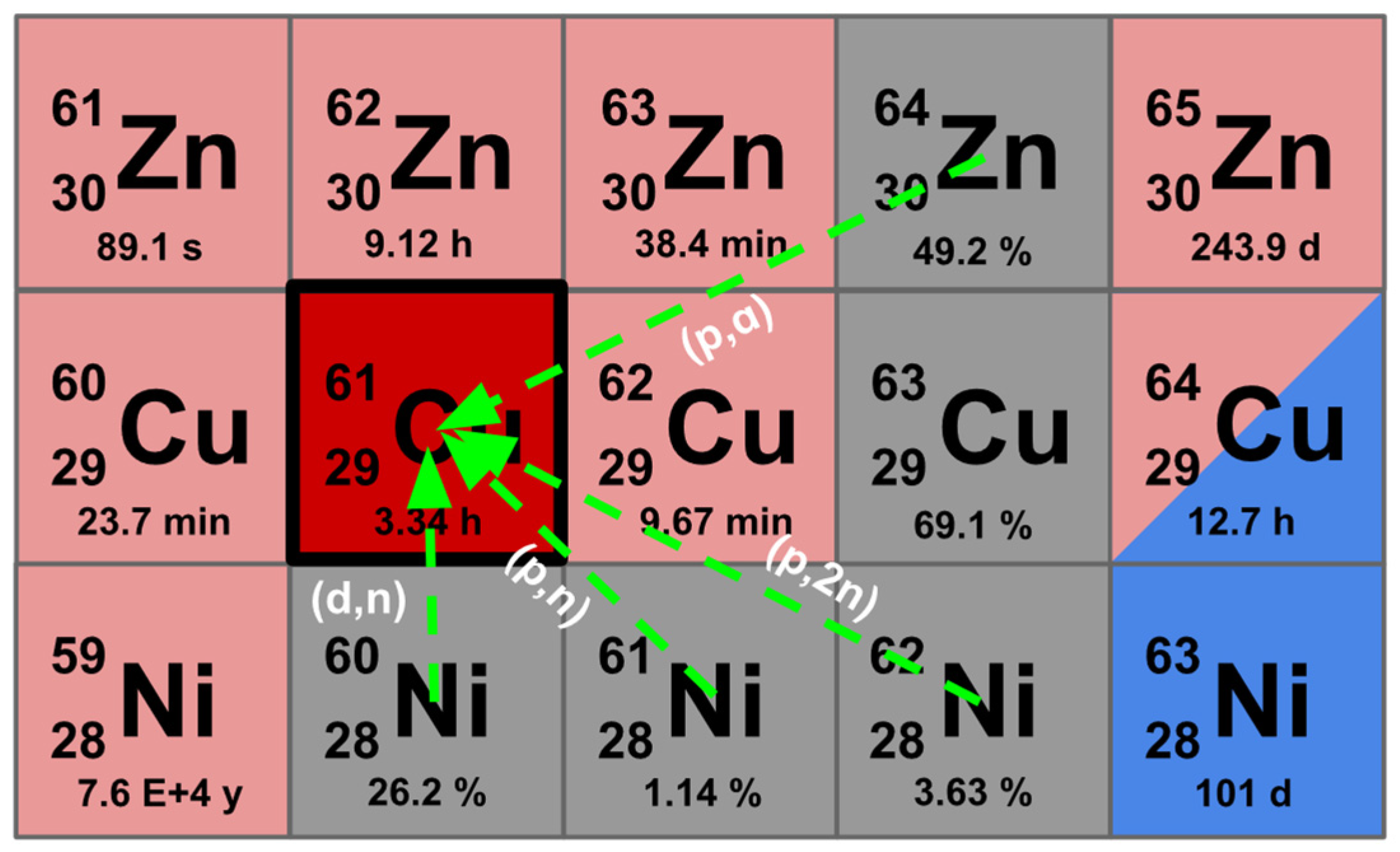

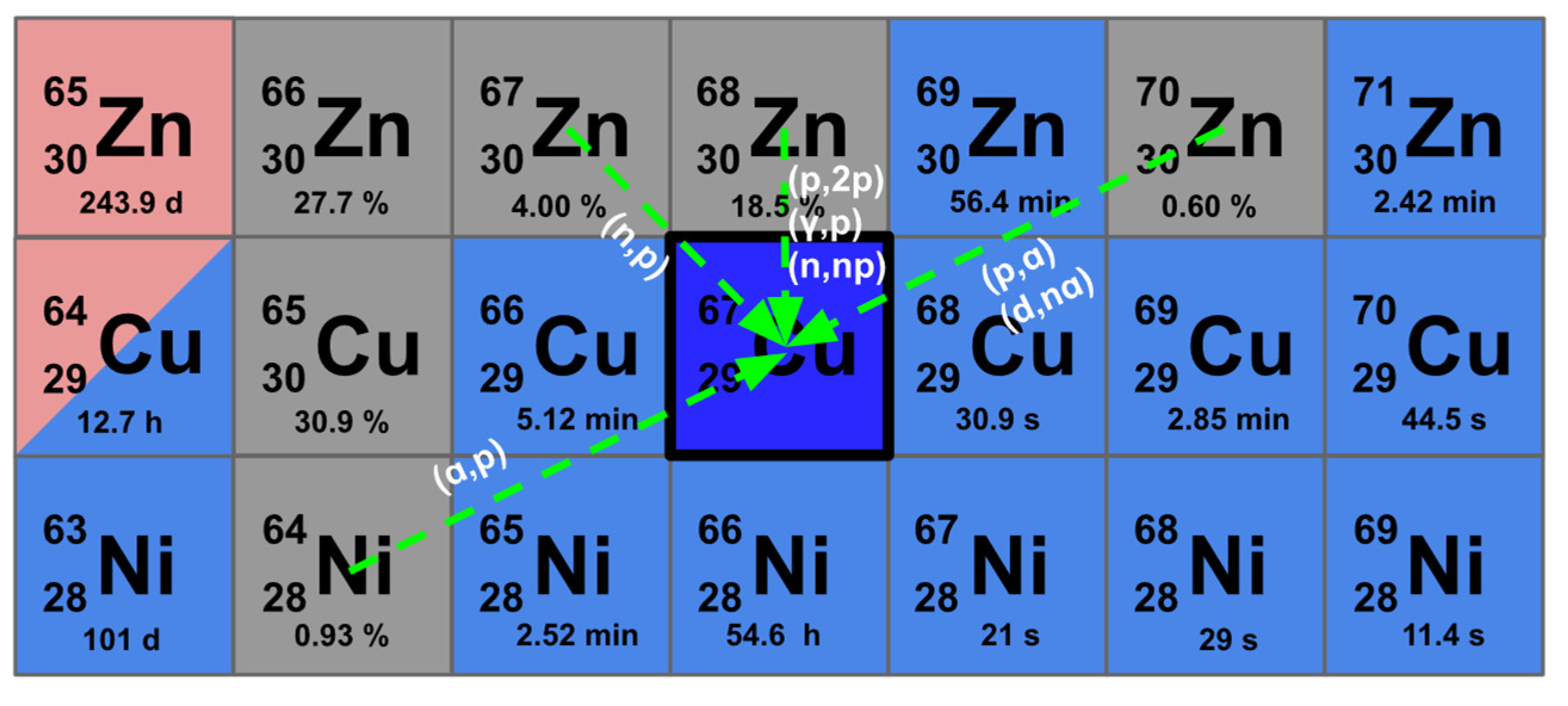
Disclaimer/Publisher’s Note: The statements, opinions and data contained in all publications are solely those of the individual author(s) and contributor(s) and not of MDPI and/or the editor(s). MDPI and/or the editor(s) disclaim responsibility for any injury to people or property resulting from any ideas, methods, instructions or products referred to in the content. |
© 2026 by the authors. Licensee MDPI, Basel, Switzerland. This article is an open access article distributed under the terms and conditions of the Creative Commons Attribution (CC BY) license.
Share and Cite
Brühlmann, S.A.; Walther, M.; Kopka, K.; Kreller, M.; Kiss, O.C. CopperNostics—Here We Are Now, Entertain Us! Pharmaceuticals 2026, 19, 321. https://doi.org/10.3390/ph19020321
Brühlmann SA, Walther M, Kopka K, Kreller M, Kiss OC. CopperNostics—Here We Are Now, Entertain Us! Pharmaceuticals. 2026; 19(2):321. https://doi.org/10.3390/ph19020321
Chicago/Turabian StyleBrühlmann, Santiago Andrés, Martin Walther, Klaus Kopka, Martin Kreller, and Oliver C. Kiss. 2026. "CopperNostics—Here We Are Now, Entertain Us!" Pharmaceuticals 19, no. 2: 321. https://doi.org/10.3390/ph19020321
APA StyleBrühlmann, S. A., Walther, M., Kopka, K., Kreller, M., & Kiss, O. C. (2026). CopperNostics—Here We Are Now, Entertain Us! Pharmaceuticals, 19(2), 321. https://doi.org/10.3390/ph19020321