Article

Synthesis of Hydrazidoureidobenzensulfonamides Incorporating a Nicotinoyl Tail and Their Carbonic Anhydrase I, II, IX and XII Inhibitory Activity


1
Dipartimento di Scienze della Vita e dell’Ambiente, Cittadella Universitaria di Monserrato, Università degli Studi di Cagliari, S.P. 8 CA, 09042 Monserrato, Italy
2
Dipartimento di Scienze Farmaceutiche, Università degli Studi di Milano, Via Mangiagalli 25, 20133 Milano, Italy
3
Laboratorio di Chimica Bioinorganica, Polo Scientifico Neurofarba Department, Università degli Studi di Firenze, Room 188, Via della Lastruccia 3, Sesto Fiorentino, 50019 Florence, Italy
*
Author to whom correspondence should be addressed.
These authors contributed equally to this work.
Pharmaceuticals 2026, 19(2), 290; https://doi.org/10.3390/ph19020290
Submission received: 14 January 2026 / Revised: 5 February 2026 / Accepted: 6 February 2026 / Published: 9 February 2026
(This article belongs to the Section Medicinal Chemistry)

Abstract

Background: Carbonic anhydrases (CAs) are known to play important roles in several physiological and pathological processes; among them, CAs IX and XII are of particular relevance in cancer therapy due to their involvement in tumor growth and progression. Methods: In this study, a novel series of benzenesulfonamides incorporating a hydrazinocarbonyl-ureido linker alongside a 6-arylpyridine tail was synthesized and evaluated for inhibitory activity through a stopped-flow CO2 hydrase assay on four hCA isoforms. Results: Some of the new compounds exhibited great activity and selectivity toward the tumor-expressed CA XII isoform over the off-target isoforms CA I and CA II. Based on these results, they were selected for ADME prediction studies, showing favorable drug-like properties. To further investigate their binding mode, these compounds were docked into the four hCA isoforms. Conclusions: Overall, the results underscore the potential of compounds bearing a 6-arylpyridine tail along with a hydrazinocarbonyl-ureido linker as a foundation for further inhibitor development.

Graphical Abstract

1. Introduction

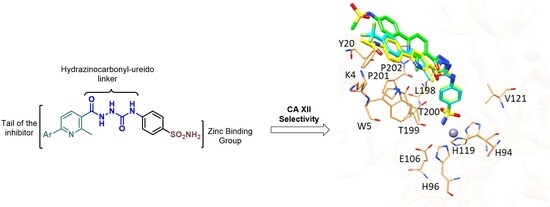
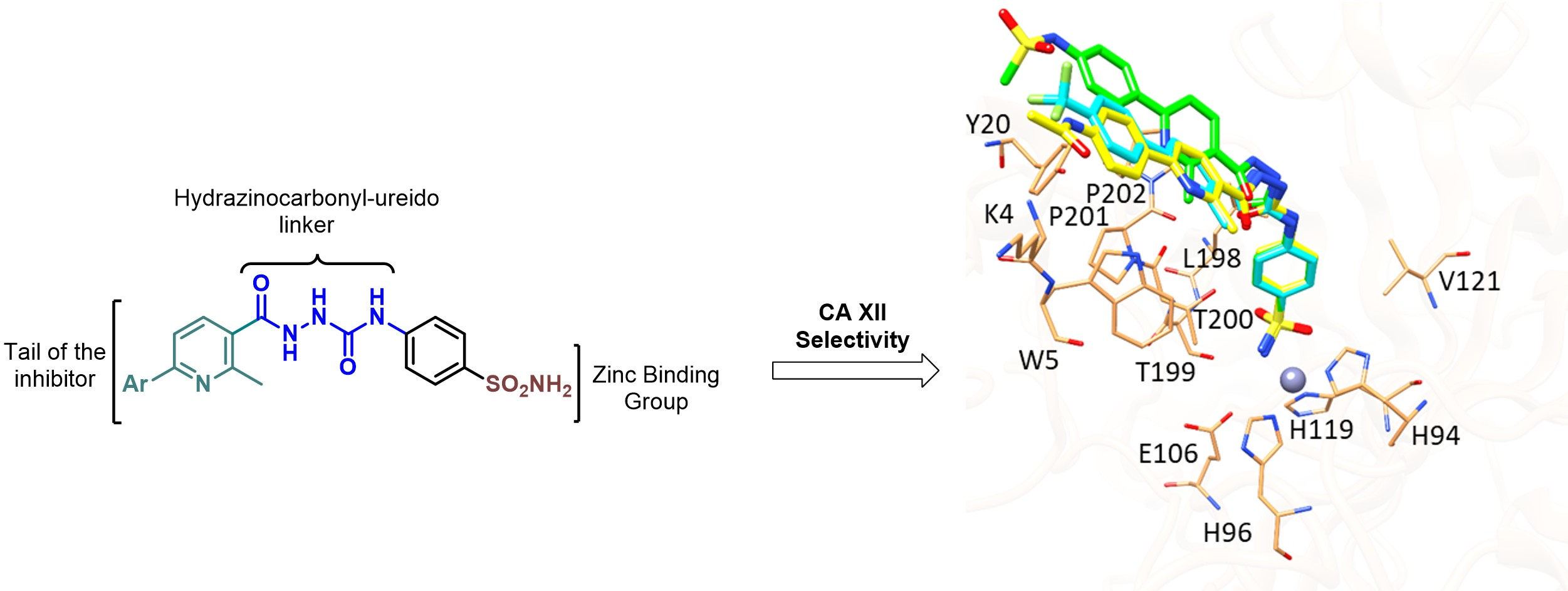
Carbonic anhydrases (CAs) are ubiquitous metallo-enzymes which catalyze the reversible hydration of carbon dioxide to a bicarbonate ion and a proton [1] (CO2 + H2O ⇆ HCO3 + H+). CAs are encoded by eight different genetic families: α-, β-, γ-, δ-, ζ-, η-, and θ-; human CAs (hCAs) belong to the α-class, which features a zinc ion as a cofactor. To date, at least 15 different isoforms have been described, differing in sequence, biochemical properties, distribution in organs and tissues, kinetic properties, and subcellular localization [2]. Of these isoforms, only twelve were found to be catalytically active (I, II, III, IV, VA, VB, VI, VII, IX, XII, XIII, and XIV), while three isoforms, known as CA-related proteins (CARPs VIII, X, and XI), lack any catalytic activity [3]. Apart from differing in the previously mentioned characteristics, these isoforms feature a different domain organization: cytosolic (CAs I, II, III, VII and XIII and CARPs VIII, X and XI), mitochondrial (CAs VA and VB), and secreted (CA VI) isoforms consist solely of the catalytic domain, while transmembrane isoforms (CAs IX, XII and XIV) also present a transmembrane region and an intracellular tail; in addition to this, CA IX also features an extracellular portion, known as a proteoglycan-like domain [4]. Several studies have demonstrated the importance of CAs in several physiological and pathological processes including glaucoma, obesity, osteoporosis, cancer, high-altitude sickness, epilepsy, neuropathic pain, and sleep apnea [5]. Although numerous efforts have been made, the development of selective inhibitors is still ongoing. No inhibitors currently in clinical use are selective for a single isoform, limiting their usefulness due to off-target and adverse effects [6]. The hCA transmembrane isoforms IX and XII are extensively studied as onco-targets due to their overexpression and role in solid tumors [7]. Under healthy conditions, CA IX is mainly expressed on the basolateral surface of epithelial cells, in the gallbladder and in the small intestine, while it is overexpressed in several tumor tissues, and its overexpression is correlated with poor prognosis [8]. This isoform’s expression is mainly regulated by the hypoxia-inducible factor (HIF-1alpha), which explains its high expression under hypoxic conditions [9]. On the other hand, CA XII is more widespread in healthy tissues, and it is also overexpressed in tumors when compared to normal cells [10]. In contrast to CA IX, CA XII expression is not mainly regulated by HIF-1alpha, but it was demonstrated that the von Hippel–Lindau (VHL) tumor suppressor protein can control the expression of the CA XII gene; in fact, it was found that CA is up-regulated in VHL-defective cells [11]. Both isoforms play a pivotal role in tumor proliferation, acidification and progression, regulating both intracellular and extracellular pH, also proving the role of CA XII in drug resistance [12,13,14]. The most common strategy used for the inhibition of hCAs is through molecules that can coordinate the zinc ion in the active site, in particular, sulfonamides and their isosters, carboxylates, dithiocarbamates or hydroxamates [15,16]. Even though inhibitors containing a sulfonamide group are known to be highly potent and have been widely used for the treatment of different pathological conditions, they show poor isoform selectivity, leading to the development of side effects [16,17,18,19]. To increase isoform-specific selectivity, the “tail approach” has emerged as the most efficient method and has been widely adopted. Molecules developed with this approach contain a zinc binding group, a linker and one or more tails; the latter could increase selectivity by binding to the hydrophobic or hydrophilic regions of hCA active sites [20,21]. The efficacy of this method was well validated by the development of the lead compound SLC-0111. This molecule, characterized by a benzensulfonamide moiety as a zinc binder, a urea linker and a 4-fluorophenyl group as a tail, is known to be selective for the isoforms IX and XII. This compound demonstrated its safety during phase I and phase II clinical trials; it also showed antitumor activity alone and in combination with other anticancer agents in preclinical studies [22,23,24]. The main feature of this lead compound is the presence of the ureido linker [25]. It was demonstrated in previous work by our group that the ureido group is able to give high CA selectivity to sulfonamide derivatives; this is due to the high flexibility conferred by this linker, allowing inhibitors to adopt suitable conformations when binding to the enzyme [26]. Moreover, compounds containing ureido and thioureido moieties have shown selective inhibitory properties against different CA isoforms [25,26,27,28]. In previous studies by our group, we also demonstrated the enhanced activity and selectivity of compounds containing hydrazidoureido or hydrazidothioureido linkers [29,30], showing the great potential for CA inhibition of compounds featuring these moieties. On the other hand, pyridine is a privileged ring system in medicinal chemistry due to its wide range of biological activities and well-established medicinal and pharmacological properties, making pyridine derivatives valuable in the treatment of various diseases [31,32]. Recently, a study showed the great activity of structural analogues of SLC-0111, where the 4-fluorophenyl tail was substituted by a 6-arylpyridine moiety. These compounds have shown favorable activity and selectivity, with no noticeable toxicity toward healthy cells [33]. As a continuation of our previous studies in this field, here we developed a small library of benzenesulfonamides linked to 6-arylpyridine derivatives, using a hydrazidoureido linker (Figure 1). These new compounds were then tested against hCA I and hCA II as off-target isoforms and hCAs IX and XII as target isoforms. To better understand the binding interactions with the various isoforms and to corroborate the inhibition data, docking studies were also performed.

2. Results and Discussion

2.1. Chemistry

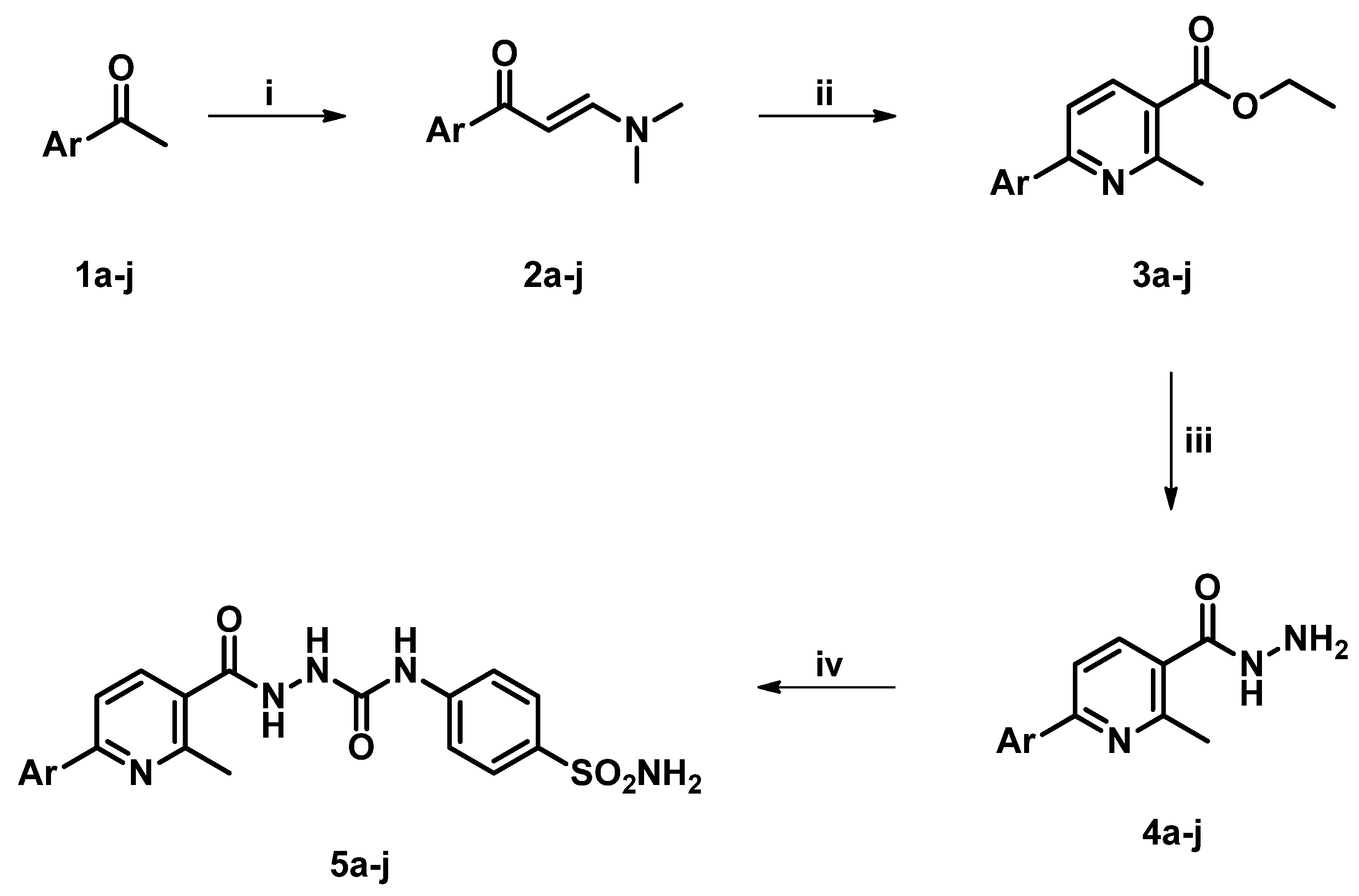
The desired compounds were obtained through the following synthetic pathway. The intermediate enaminone derivatives 2 were prepared by reaction of aryl ketones 1 with dimethylformamide dimethyl acetal (DMF-DMA) at reflux. The resulting enaminones 2 were heterocyclized to ethyl-2-methyl-6-arylnicotinates 3, by refluxing with ethyl acetoacetate and sodium acetate in an acetic acid solution. The obtained compounds 3 were then treated with hydrazine hydrate in absolute ethanol to afford the hydrazide derivatives 4. The final step was the reaction between the hydrazides 4 and phenyl(4-sulfamoylphenyl)carbamate in DMF to obtain the hydrazidoureido derivatives 5. The chemical structure of the synthesized compounds was confirmed by 1H NMR, 13C NMR, and IR spectroscopy (see Supplementary Materials), which showed the characteristic signals for aromatic and NH moieties, as well as by elemental analyses, whose results were fully consistent with the proposed structures (Scheme 1).

2.2. Carbonic Anhydrase Inhibition Assays

The novel sulfonamide derivatives 5a-j were tested for their enzymatic inhibitory activity against the four isoforms of hCA, the two off-target isoforms hCA I and II and the two cancer-related isoforms hCA IX and XII, by a stopped-flow CO2 hydrase assay using the standard inhibitor acetazolamide as a positive control (Table 1) [34].
The sulfonamide derivatives 5 exhibited activity toward cytosolic isoform hCA I, with inhibition values spanning from 21.4 nM to 750.4 nM. Compound 5d, which bears a bromine atom at the 3-position of the aryl ring, exhibited the highest activity toward this isoform. Substitution of the bromine with a methyl group (compound 5c) resulted in an activity reduction. We also explored the effects of different substituents in other positions of the aryl ring; in particular, compound 5e possessing a fluorine at the 4-position showed an inhibition value of 32.5 nM. The replacement of the fluorine with trifluoromethyl (compound 5f) produced a reduction in activity. Moreover, substitution with a methansulfonamide (compound 5i) or an acetamide group (compound 5j) resulted in a drastic reduction in the activity by about 23-fold and 3-fold respectively. The presence of a 3,4,5-trimethoxyphenyl group (compound 5g) resulted in greater activity compared to a 3,4-dimethoxyphenyl analogue (compound 5h). The presence of 3,5-bis(trifluoromethyl)phenyl (compound 5a) drastically reduced the activity to an inhibition value of 298.2 nM. We also tested the effects of the substitution of the aryl ring with a benzofuran (compound 5b), which showed an inhibition value of 77.5 nM.
The dominant cytosolic isoform hCA II was effectively inhibited by most of the synthesized compounds with inhibition values ranging between 3.8 nM and 223.0 nM. Compounds 5a-5e and 5h showed the greatest activity. Compound 5h showed the best activity, while a drastic reduction in activity of about 9-fold was observed when a supplementary methoxy group was introduced at the 5-position (compound 5g). Substitution of the aryl ring at the 4-position with an acetamide (compound 5j), a methansulfonamide (compound 5i) or a trifluoromethyl group (compound 5f) resulted in a decrease in inhibitory activity, with compound 5f being the weakest hCA II inhibitor.
Regarding the transmembrane isoform hCA IX, the best activity was observed with compound 5d, which features a 3-bromophenyl ring, with an inhibition value of 22.7 nM. The substitution of the bromine in the same position with a methyl group (compound 5c) drastically reduced the activity by about 6-fold. Other substitutions at other positions also resulted in an activity reduction, with compound 5i being the least active compound. Substitution of the 4-methansulfonamide group of 5i with an acetamide, fluorine or trifluoromethyl group to give, respectively, compound 5j, compound 5e or compound 5f resulted in a partial recovery of activity. Comparable activity was also observed for the 3,4,5-trimethoxyphenyl derivative (compound 5g) and for the benzofuran derivative (compound 5b). Substitution with a 3,5-bis(trifluoromethyl)phenyl group (compound 5a) and a 3,4-(dimethoxyphenyl) group (compound 5h) also resulted in a great loss of activity toward the isoform hCA IX.
On the other hand, all compounds showed a good inhibition profile toward the isoform hCA XII, showing inhibition values ranging from 5.8 nM to 56.2 nM; compound 5f, compound 5i and compound 5j also demonstrated good selectivity toward this isoform. Compound 5f, bearing a 4-fluorophenyl moiety, was the most active, with an inhibition value of 5.8 nM, a CA II/CA XII selectivity index of 8 and a CA I/CA XII selectivity index of 13. The replacement of 4-fluorine with 4-methansulfonamide (compound 5i) produced a CA I/CA XII selectivity index of 96, while replacement with 4-acetamide (compound 5j) reduced the CA I/CA XII selectivity index to 10. The compounds that showed the lowest activity were the benzofuran derivative 5b and 3-bromophenyl derivative 5d; these compounds showed inhibition values of 47.7 nM and 56.2 nM, respectively, and also greater selectivity toward the cytosolic isoform hCA II over the transmembrane, tumor-associated isoform hCA XII, with CA II/CA XII selectivity index values of 0.20 and 0.10, respectively.

2.3. ADME Predictions

Compounds 5f, 5i and 5j, endowed with both potency and selectivity against hCA XII, were further selected to evaluate their predicted drug-like properties through the SwissADME (Absorption, Distribution, Metabolism, Excretion) online tool [35], showing favorable pharmacokinetic properties, as shown in Table 2. Different crucial parameters were predicted, such as the predicted solubility, the LogP and the number of H-bond acceptors and donors. Moreover, it was also calculated if the selected compounds could be substrates or non-substrates of the permeability glycoprotein P-gp, in combination with BBB permeation, which can be useful to verify the brain permeability of the selected molecules. Concerning physicochemical properties, the selected compounds displayed acceptable solubility in water, according to the ESOL solubility parameter, which may favor drug formulation. The consensus Log-P values were calculated to be between 0.86 and 2.66; none of these compounds were found to be substrates for P-glycoproteins. Furthermore, the tested compounds showed no blood−brain barrier penetration and a bioavailability score between 0.55 and 0.17.

2.4. Docking Studies

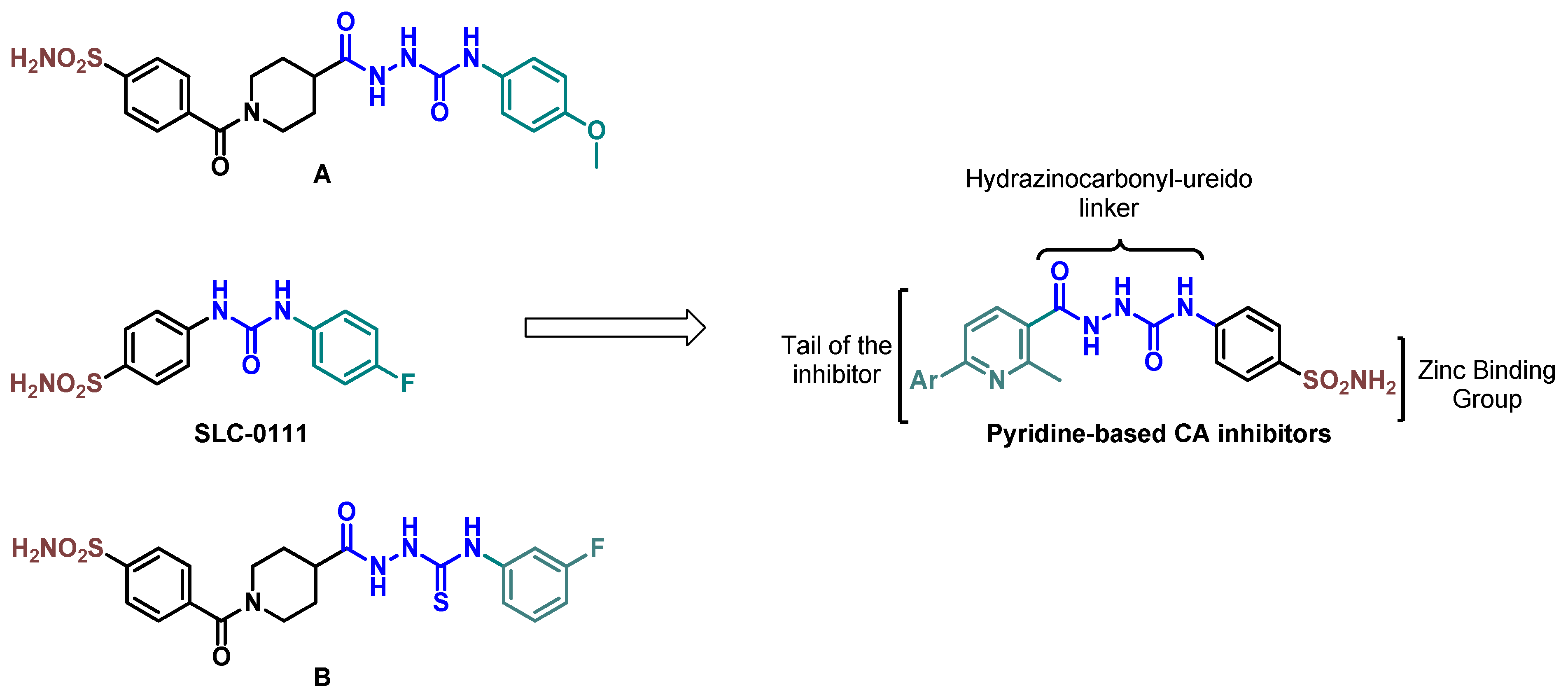
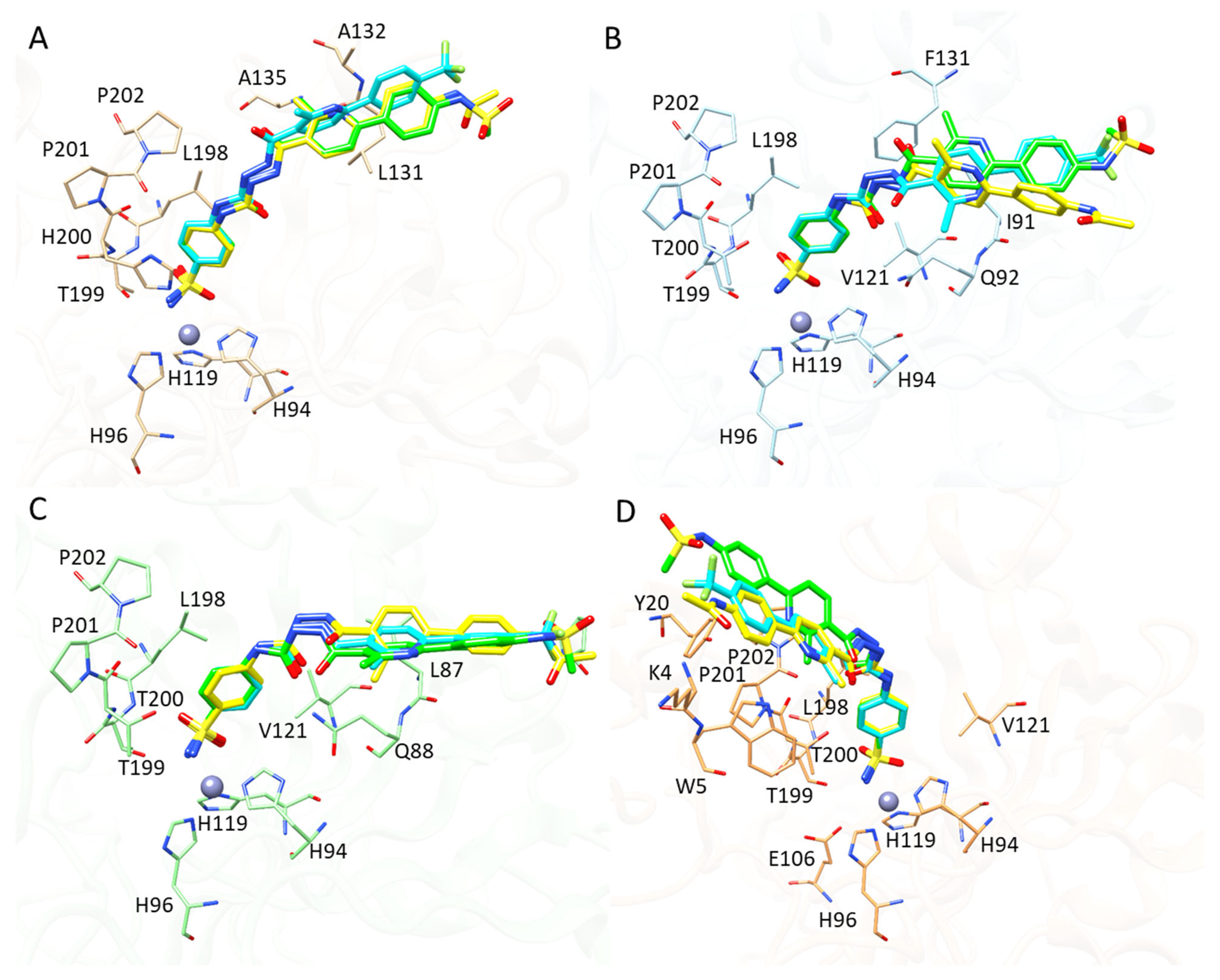
Molecular docking studies were conducted to elucidate the binding modes of inhibitors 5f, 5i, and 5j, which exhibited higher inhibitory activity toward the tumor-associated isoform hCA XII, to the studied hCA isoforms. As depicted in Figure 2, all analyzed compounds bind within the catalytic pocket of hCAs, with the benzensulfonamide moiety coordinating the Zn2+ ion and being further stabilized by a H-bond with T199 and hydrophobic contacts with L198, in agreement with the typical binding mode adopted by this class of hCAIs. In addition, this moiety is also implicated in hydrophobic interactions with V121 in all investigated hCA isoforms, except for hCA I.
Within the hCA I active site, the arylpyridine system is involved in hydrophobic contacts with A132, A135 and L131 (Figure 2A). In hCA II, the pyridine ring of the inhibitors elicits hydrophobic contacts with I91, while the carbonyl group of compounds 5i and 5j establishes a H-bond with Q92, which might account for their greater affinity toward hCA II compared to 5f (Figure 2B). Furthermore, the methyl group of 5i engages in hydrophobic interactions with F131. Regarding hCA IX, all analyzed compounds form a H-bond between their carbonyl group and Q88, along with hydrophobic interactions between the pyridine ring and L87 (Figure 2C). Interestingly, within the hCA XII binding site, the tails of 5f, 5i, and 5j assume a markedly different orientation with respect to the other investigated hCA isoforms, which may underlie their enhanced selectivity for hCA XII (Figure 2D). In more detail, the arylpyridine portion of 5f, 5i, and 5j establishes hydrophobic contacts with P201, P202 and K4, as well as pi-stacking interactions with W5 and Y20. In addition, the sulfonamide moiety is also implicated in a H-bond with E106, which may further contribute to the increased affinity of these compounds for hCA XII.

3. Materials and Methods

3.1. Chemistry

All commercially available solvents and reagents were used without further purification. 1H NMR spectra for compounds 3a-j, 4a-j and 5a-j were recorded on a Bruker Avance III HD 600 spectrometer (Bruker, Bremen, Germany). The chemical shifts (δ) are reported in parts per million downfield from tetramethylsilane (TMS), which was used as the internal standard. The spectra were recorded in hexadeuteriodimethylsulfoxide (DMSO-d6). Infrared spectra were recorded on a Nicolet iS10 spectrometer (Thermo Fisher Scientific Inc., Paisley, UK). The main bands are given in cm−1. Positive-ion electrospray ionization (ESI) mass spectra were recorded on a double-focusing MAT 95 instrument (Finnigan, Waltham, MA, USA) with BE geometry. Melting points (mps) were determined with an SMP1 Melting Point apparatus (Stuart Scientific, Stone, UK) and are uncorrected. All products reported showed 1H NMR spectra in agreement with the assigned structures. Compounds 2a-j were prepared as previously described [36,37,38,39,40,41,42,43]. The purity of the tested compounds was determined by combustion elemental analyses conducted by the Microanalytical Laboratory of the Chemistry Department of the University of Ferrara with an MT-5 CHN recorder elemental analyzer (Yanagimoto, Kyoto, Japan), and the values found were within 0.4% of theoretical values.

3.1.1. General Procedure for the Preparation of Ethyl 2-methyl-6-phenylnicotinates (3a-j)

(E)-3-(Dimethylamino)-1-phenylprop-2-en-1-ones (5 mmol) 2a-j were dissolved in glacial acetic acid (10 mL); then, ammonium acetate (3.08 g, 40 mmol) was added, followed by ethyl acetoacetate (0.76 mL, 6 mmol). The reaction mixture was refluxed for 12 h and then cooled down to room temperature. The reaction mixture was poured into water at 0 °C, and the formed solids were filtered off and washed with water, giving the corresponding ethyl nicotinates 3a-j.
Ethyl 6-(3,5-bis(trifluoromethyl)phenyl)-2-methylnicotinate (3a)
Following the general procedure, the title compound was prepared starting from 2a. Yield 77%; M.p. 147–148 °C. 1H NMR (DMSO-d6) δ 8.77 (s, 2H, Ar), 8.30 (d, J = 8.2 Hz, 1H, Ar), 8.26 (d, J = 8.2 Hz, 1H, Ar), 8.22 (s, 1H, Ar), 4.35 (q, J = 7.1 Hz, 2H, CH2), 2.82 (s, 3H, CH3), 1.36 (t, J = 7.1 Hz, 3H, CH3). IR 3022, 1722, 1684 cm−1. Elemental analysis calculated for C17H13F6NO2 (377.28): %C, 54.12; %H, 3.47; %N, 3.71. Found: %C, 54.11; %H, 3.47; %N, 3.73. m/z 378.
Ethyl 6-(benzofuran-2-yl)-2-methylnicotinate (3b)
Following the general procedure, the title compound was prepared starting from 2b. Yield 61%; M.p. 162–163 °C. 1H NMR (DMSO-d6) δ 8.31 (d, J = 8.3 Hz, 1H, Ar), 7.90 (d, J = 8.2 Hz, 1H, Ar), 7.76 (d, J = 7.9 Hz, 1H, Ar), 7.68–7.72 (m, 2H, Ar), 7.42 (t, J = 7.8 Hz, 1H, Ar), 7.32 (t, J = 7.5 Hz, 1H, Ar), 4.34 (q, J = 7.1 Hz, 2H, CH2), 2.80 (s, 3H, CH3), 1.35 (t, J = 7.1 Hz, 3H, CH3). IR 3009, 1728, 1677 cm−1. Elemental analysis calculated for C17H15NO3 (281.31): %C, 72.58; %H, 5.37; %N, 4.98. Found: %C, 72.57; %H, 5.38; %N, 4.99. m/z 282.
Ethyl 2-methyl-6-(m-tolyl)nicotinate (3c)
Following the general procedure, the title compound was prepared starting from 2c. Yield 82%; M.p. 155–157 °C. 1H NMR (DMSO-d6) δ 8.21 (d, J = 8.2 Hz, 1H, Ar), 7.96 (s, 1H, Ar), 7.92 (d, J = 7.8 Hz, 1H, Ar), 7.88 (d, J = 8.3 Hz, 1H, Ar), 7.39 (t, J = 7.7 Hz, 1H, Ar), 7.29 (d, J = 7.5 Hz, 1H, Ar), 4.32 (q, J = 7.2 Hz, 2H, CH2), 2.78 (s, 3H, CH3), 2.39 (s, 3H, CH3), 1.34 (t, J = 7.2 Hz, 3H, CH3). IR 3102, 1736, 1692 cm−1. Elemental analysis calculated for C16H17NO2 (255.31): %C, 75.27; %H, 6.71; %N, 5.49. Found: %C, 75.26; %H, 6.72; %N, 5.49. m/z 256.
Ethyl 6-(3-bromophenyl)-2-methylnicotinate (3d)
Following the general procedure, the title compound was prepared starting from 2d. Yield 49%; M.p. 142–143 °C. 1H NMR (DMSO-d6) δ 8.33 (s, 1H, Ar), 8.24 (d, J = 8.3 Hz, 1H, Ar), 8.14 (d, J = 7.9 Hz, 1H, Ar), 7.98 (d, J = 8.3 Hz, 1H, Ar), 7.68 (d, J = 7.9 Hz, 1H, Ar), 7.48 (t, J = 7.9 Hz, 1H, Ar), 4.33 (q, J = 7.2 Hz, 2H, CH2), 2.79 (s, 3H, CH3), 1.34 (t, J = 7.2 Hz, 3H, CH3). IR 3112, 1729, 1699 cm−1. Elemental analysis calculated for C15H14BrNO2 (320.18): %C, 56.27; %H, 4.41; %N, 4.37. Found: %C, 56.29; %H, 4.40; %N, 4.39. m/z 321.
Ethyl 6-(4-fluorophenyl)-2-methylnicotinate (3e)
Following the general procedure, the title compound was prepared starting from 2e. Yield 65%; M.p. 139–140 °C. 1H NMR (DMSO-d6) δ 8.18–8.25 (m, 3H, Ar), 7.92 (d, J = 8.3 Hz, 1H, Ar), 7.34 (t, J = 8.8 Hz, 2H, Ar), 4.33 (q, J = 7.1 Hz, 2H, CH2), 2.78 (s, 3H, CH3), 1.34 (t, J = 7.1 Hz, 3H, CH3). IR 3122, 1736, 1684 cm−1. Elemental analysis calculated for C15H14FNO2 (259.28): %C, 69.49; %H, 5.44; %N, 5.40. Found: %C, 69.49; %H, 5.42; %N, 5.39. m/z 260.
Ethyl 2-methyl-6-(4-(trifluoromethyl)phenyl)nicotinate (3f)
Following the general procedure, the title compound was prepared starting from 2f. Yield 59%; M.p. 155–156 °C. 1H NMR (DMSO-d6) δ 8.33 (d, J = 8.5 Hz, 2H, Ar), 8.27 (d, J = 8.4 Hz, 1H, Ar), 8.01 (d, J = 8.4 Hz, 1H, Ar), 7.85 (d, J = 8.3, 2H, Ar); 4.33 (q, J = 7.2 Hz, 2H, CH2), 2.79 (s, 3H, CH3), 1.34 (t, J = 7.0 Hz, 3H, CH3). IR 3110, 1741, 1698 cm−1. Elemental analysis calculated for C16H14F3NO2 (309.28): %C, 62.13; %H, 4.56; %N, 4.53. Found: %C, 62.15; %H, 4.57; %N, 4.51. m/z 310.
Ethyl 2-methyl-6-(3,4,5-trimethoxyphenyl)nicotinate (3g)
Following the general procedure, the title compound was prepared starting from 2g. Yield 41%; M.p. 147–149 °C. 1H NMR (DMSO-d6) δ 8.21 (d, J = 8.3 Hz, 1H, Ar), 7.97 (d, J = 8.3 Hz, 1H, Ar), 7.46 (s, 2H, Ar), 4.33 (q, J = 7.1 Hz, 2H, Ar), 3.89 (s, 6H, CH3), 3.73 (s, 3H, CH3), 2.79 (s, 3H, CH3), 1.34 (t, J = 7.1 Hz, 3H, CH3). IR 3119, 1728, 1679 cm−1. Elemental analysis calculated for C18H21NO5 (331.36): %C, 65.24; %H, 6.39; %N, 4.23. Found: %C, 65.22; %H, 6.41; %N, 4.22. m/z 332.
Ethyl 2-methyl-6-(3,4-dimethoxyphenyl)nicotinate (3h)
Following the general procedure, the title compound was prepared starting from 2h. Yield 41%; M.p. 152–153 °C. 1H NMR (DMSO-d6) δ 8.19 (d, J = 8.3 Hz, 1H, Ar), 7.89 (d, J = 8.3 Hz, 1H, Ar), 7.72–7.76 (m, 2H, Ar), 7.07 (d, J = 8.4 Hz, 1H, Ar), 4.32 (q, J = 7.1 Hz, 2H, CH2), 3.86 (s, 3H, CH3), 3.83 (s, 3H, CH3), 2.78 (s, 3H, CH3), 1.34 (t, J = 7.1 Hz, 3H, CH3). IR 3121, 1726, 1674 cm−1. Elemental analysis calculated for C17H19NO4 (301.34): %C, 67.76; %H, 6.36; %N, 4.65. Found: %C, 67.75; %H, 6.36; %N, 4.66. m/z 302.
Ethyl 2-methyl-6-(4-(methylsulfonamido)phenyl)nicotinate (3i)
Following the general procedure, the title compound was prepared starting from 2i. Yield 63%; M.p. 166–168 °C. 1H NMR (DMSO-d6) δ 10.11 (s, 1H, NH), 8.31 (s, 1H, Ar), 8.26 (d, J = 8.3 Hz, 1H, Ar), 7.84 (d, J = 8.2 Hz, 1H, Ar), 7.75–7.81 (m, 2H, Ar), 7.43 (t, J = 7.9 Hz, 1H, Ar), 4.33 (q, J = 7.2 Hz, 2H, CH2), 2.80 (s, 3H, CH3), 2.07 (s, 3H, CH3), 1.34 (t, J = 7.1 Hz, 3H, CH3). IR 3223, 1733, 1682 cm−1. Elemental analysis calculated for C16H18N2O4S (334.40): %C, 57.47; %H, 5.43; %N, 8.38. Found: %C, 57.45; %H, 5.44; %N, 8.37. m/z 335.
Ethyl 6-(4-acetamidophenyl)-2-methylnicotinate (3j)
Following the general procedure, the title compound was prepared starting from 2j. Yield 77%; M.p. 184–185 °C. 1H NMR (DMSO-d6) δ 8.25 (d, J = 8.3 Hz, 1H, NH), 8.17 (d, J = 8.7 Hz, 2H, Ar), 7.94 (d, J = 8.3 Hz, 1H, Ar), 7.55 (d, J = 8.8 Hz, 2H, Ar), 4.33 (q, J = 7.1 Hz, 2H, CH2), 2.99 (s, 3H, CH3), 2.79 (s, 3H, CH3), 1.34 (t, J = 7.1 Hz, 3H, CH3). IR 3237, 1741, 1695 cm−1. Elemental analysis calculated for C17H18N2O3 (298.34): %C, 68.44; %H, 6.08; %N, 9.39. Found: %C, 68.43; %H, 6.08; %N, 9.38. m/z 299.

3.1.2. General Procedure for the Preparation of 2-methyl-6-phenylnicotinohydrazides (4a-j)

A mixture of Ethyl 2-methyl-6-phenylnicotinates (3 mmol) (3a-j) and hydrazine monohydrate (0.5 mL, 10 mmol) in ethanol (EtOH) (20 mL) was refluxed overnight. After cooling, the precipitate formed was filtered off, washed with water and dried, giving the corresponding phenylnicotinohydrazides 4a-j, which were used in the next step without further purification.
6-(3,5-Bis(trifluoromethyl)phenyl)-2-methylnicotinohydrazide (4a)
Following the general procedure, the title compound was prepared starting from 3a. Yield 84%; M.p. 203–204 °C. 1H NMR (DMSO-d6) δ 9.68 (s, 1H, NH), 8.76 (s, 2H, Ar), 8.20 (d, J = 8.0 Hz, 2H, Ar), 7.86 (d, J = 8.0 Hz, 1H, Ar), 4.68 (s, 2H, NH2), 2.64 (s, 3H, CH3). IR 3344, 3022, 1679 cm−1. Elemental analysis calculated for C15H11F6N3O (363.26): %C, 49.60; %H, 3.05; %N, 11.57. Found: %C, 49.61; %H, 3.07; %N, 11.58. m/z 364.
6-(Benzofuran-2-yl)-2-methylnicotinohydrazide (4b)
Following the general procedure, the title compound was prepared starting from 3b. Yield 88%; M.p. 222–223 °C. 1H NMR (DMSO-d6) δ 9.64 (s, 1H, NH), 7.83 (s, 2H, Ar), 7.74 (d, J = 7.6 Hz, 1H, Ar), 7.68 (d, J = 8.3 Hz, 1H, Ar), 7.61 (s, 1H, Ar), 7.38–7.42 (m, 1H, Ar), 7.31 (t, J = 7.5 Hz, 1H, Ar), 4.54 (s, 2H, NH2), 2.61 (s, 3H, CH3). IR 3329, 3108, 1682 cm−1. Elemental analysis calculated for C15H13N3O2 (267.28): %C, 67.40; %H, 4.90; %N, 15.72. Found: %C, 67.40; %H, 4.88; %N, 15.73. m/z 268.
2-Methyl-6-(m-tolyl)nicotinohydrazide (4c)
Following the general procedure, the title compound was prepared starting from 3c. Yield 74%; M.p. 201–202 °C. 1H NMR (DMSO-d6) δ 9.59 (s, 1H, NH), 7.93 (s, 1H, Ar), 7.88 (d, J = 8.0 Hz, 1H, Ar), 7.81 (d, J = 8.0 Hz, 1H, Ar), 7.75 (d, J = 8.0 Hz, 1H, Ar), 7.38 (t, J = 7.6 Hz, 1H, Ar), 7.26 (d, J = 8.3 Hz, 1H, Ar), 4.52 (s, 2H, NH2), 2.60 (s, 3H, CH3), 2.40 (s, 3H, CH3). IR 3342, 3115, 1674 cm−1. Elemental analysis calculated for C14H15N3O (241.29): %C, 69.69; %H, 6.27; %N, 17.41. Found: %C, 69.67; %H, 6.28; %N, 17.40. m/z 242.
6-(3-Bromophenyl)-2-methylnicotinohydrazide (4d)
Following the general procedure, the title compound was prepared starting from 3d. Yield 80%; M.p. 223–225 °C. 1H NMR (DMSO-d6) δ 9.62 (s, 1H, NH), 8.30 (s, 1H, Ar), 8.11 (d, J = 8.0 Hz, 1H, Ar), 7.90 (d, J = 8.0 Hz, 1H, Ar), 7.78 (d, J = 8.0 Hz, 1H, Ar), 7.65 (d, J = 7.9 Hz, 1H, Ar), 7.47 (t, J = 7.9 Hz, 1H, Ar), 4.54 (s, 2H, NH2), 2.60 (s, 3H, CH3). IR 3324, 3108, 1669 cm−1. Elemental analysis calculated for C13H12BrN3O (306.16): %C, 51.00; %H, 3.95; %N, 13.72. Found: %C, 51.01; %H, 3.96; %N, 13.72. m/z 307.
6-(4-Fluorophenyl)-2-methylnicotinohydrazide (4e)
Following the general procedure, the title compound was prepared starting from 3e. Yield 78%; M.p. 220–222 °C. 1H NMR (DMSO-d6) δ 9.59 (s, 1H, NH), 8.14–8.18 (m, 2H, Ar), 7.83 (d, J = 8.0 Hz, 1H, Ar), 7.76 (d, J = 8.0 Hz, 1H, Ar), 7.32 (t, J = 8.9 Hz, 2H, Ar), 4.52 (s, 2H, NH2), 2.60 (s, 3H, CH3). IR 3343, 3119, 1672 cm−1. Elemental analysis calculated for C13H12FN3O (245.25): %C, 63.66; %H, 4.93; %N, 17.13. Found: %C, 63.66; %H, 4.95; %N, 17.12. m/z 246.
2-Methyl-6-(4-(trifluoromethyl)phenyl)nicotinohydrazide (4f)
Following the general procedure, the title compound was prepared starting from 3f. Yield 69%; M.p. 208–210 °C. 1H NMR (DMSO-d6) δ 9.64 (s, 1H, NH), 8.32 (d, J = 8.3 Hz, 2H, Ar), 7.95 (d, J = 8.0 Hz, 1H, Ar), 7.86 (d, J = 8.4 Hz, 2H, Ar), 7.83 (d, J = 8.0 Hz, 1H, Ar), 4.55 (s, 2H, NH2), 2.62 (s, 3H, CH3). IR 3339, 3124, 1683 cm−1. Elemental analysis calculated for C14H12F3N3O (295.26): %C, 56.95; %H, 4.10; %N, 14.23. Found: %C, 56.96; %H, 4.08; %N, 14.22. m/z 246.
2-Methyl-6-(3,4,5-trimethoxyphenyl)nicotinohydrazide (4g)
Following the general procedure, the title compound was prepared starting from 3g. Yield 89%; M.p. 238–239 °C. 1H NMR (DMSO-d6) δ 9.58 (s, 1H, NH), 7.88 (d, J = 7.9 Hz, 1H, Ar), 7.75 (d, J = 8.2 Hz, 1H, Ar), 7.41 (s, 2H, Ar), 4.52 (s, 2H, NH2), 3.88 (s, 6H, CH3), 3.72 (s, 3H, CH3), 2.60 (s, 3H, CH3). IR 3327, 3109, 1672 cm−1. Elemental analysis calculated for C16H19N3O4 (317.34): %C, 60.56; %H, 6.03; %N, 13.24. Found: %C, 60.56; %H, 6.02; %N, 13.25. m/z 318.
6-(3,4-Dimethoxyphenyl)-2-methylnicotinohydrazide (4h)
Following the general procedure, the title compound was prepared starting from 3h. Yield 81%; M.p. 227–228 °C. 1H NMR (DMSO-d6) δ 9.56 (s, 1H, Ar), 7.80 (d, J = 8.1 Hz, 1H, Ar), 7.67–7.73 (m, 3H, Ar), 7.06 (d, J = 8.3 Hz, 1H, Ar), 4.51 (s, 2H, NH2), 3.85 (s, 3H, CH3), 3.82 (s, 3H, CH3), 2.59 (s, 3H, CH3). IR 3319, 3115, 1673 cm−1. Elemental analysis calculated for C15H17N3O3 (387.32): %C, 62.71; %H, 5.96; %N, 14.63. Found: %C, 62.72; %H, 5.97; %N, 14.63. m/z 388.
N-(4-(5-(Hydrazinecarbonyl)-6-methylpyridin-2-yl)phenyl)methanesulfonamide (4i)
Following the general procedure, the title compound was prepared starting from 3i. Yield 76%; M.p. 244–246 °C. 1H NMR (DMSO-d6) δ 10.09 (s, 1H, NH), 9.59 (s, 1H, Ar), 8.25 (s, 1H, Ar), 7.70–7.79 (m, 4H, Ar), 7.41 (t, J = 7.9 Hz, 1H, Ar), 4.50 (s, 2H, NH2), 2.60 (s, 3H, CH3), 2.07 (s, 3H, CH3). IR 3317, 3208, 1662 cm−1. Elemental analysis calculated for C14H16N4O3S (320.37): %C, 52.49; %H, 5.03; %N, 17.49. Found: %C, 52.50; %H, 5.03; %N, 17.49. m/z 321.
N-(4-(5-(Hydrazinecarbonyl)-6-methylpyridin-2-yl)phenyl)acetamide (4j)
Following the general procedure, the title compound was prepared starting from 35. Yield 64%; M.p. 239–241 °C. 1H NMR (DMSO-d6) δ 9.60 (s, 1H, NH), 8.13 (d, J = 8.7 Hz, 2H, Ar), 7.85 (d, J = 8.0 Hz, 1H, Ar), 7.77 (d, J = 8.0 Hz, 1H, Ar), 7.53 (d, J = 8.8 Hz, 2H, Ar), 4.52 (s, 2H, NH2), 2.99 (s, 3H, CH3), 2.60 (s, 3H, CH3). IR 3333, 3217, 1670 cm−1. Elemental analysis calculated for C15H16N4O2 (284.31): %C, 63.37; %H, 5.67; %N, 19.71. Found: %C, 63.35; %H, 5.68; %N, 19.69. m/z 285.

3.1.3. General Procedure for the Preparation of 2-(Aryl)-2-methylnicotinoyl)-N-(4-sulfamoylphenyl)hydrazinecarboxamide (5a-j)

A mixture of phenyl (4-sulfamoylphenyl)carbamate (0.29 g, 1 mmol) and substituted phenylnicotinohydrazides 4a-j (1 mmol), in anhydrous DMF (3 mL), was stirred at room temperature for 24 h. Then, water (10 mL) was added, and the mixture was stirred at room temperature until a solid formed. The formed solid was filtered off, washed with water, air-dried and recrystallized from EtOH to give the desired sulfamoylphenyl)hydrazinecarboxamide 5a-j.
2-(6-(3,5-Bis(trifluoromethyl)phenyl)-2-methylnicotinoyl)-N-(4-sulfamoylphenyl)hydrazinecarboxamide (5a)
Following the general procedure, the title compound was prepared starting from 4a. Yield 43%; M.p. >250 °C. 1H NMR (DMSO-d6) δ 10.31 (s, 1H, NH), 9.33 (s, 1H, NH), 8.79 (s, 2H, Ar), 8.50 (s, 1H, NH), 8.27 (d, J = 8.1 Hz, 1H, Ar), 8.22 (s, 1H, Ar), 8.02 (d, J = 6.1 Hz, 1H, Ar), 7.73 (d, J = 8.8 Hz, 2H, Ar), 7.66 (d, J = 8.9 Hz, 2H, Ar), 7.20 (s, 2H, NH2), 2.72 (s, 3H, CH3). 13C NMR (DMSO-d6) δ 167.5, 162.3, 156.1, 152.6, 142.8, 140.3, 137.1, 137.0, 131.1, 130.8, 130.6, 129.9, 127.1, 124.2, 122.8, 122.4, 120.6, 118.2, 117.7, 35.8, 30.7, 23.0. IR 3348 (stretching -NH), 3262 (stretching -NH), 1662 (stretching -C=O) cm−1. Elemental analysis calculated for C22H17F6N5O4S (482.51): %C, 47.06; %H, 3.05; %N, 12.47. Found: %C, 47.06; %H, 3.03; %N, 12.48. m/z 483.
2-(6-(Benzofuran-2-yl)-2-methylnicotinoyl)-N-(4-sulfamoylphenyl)hydrazinecarboxamide (5b)
Following the general procedure, the title compound was prepared starting from 4b. Yield 58%; M.p. >250 °C. 1H NMR (DMSO-d6) δ 10.26 (s, 1H, NH), 9.34 (s, 1H, NH), 8.52 (s, 1H, NH), 7.99 (s, 1H, Ar), 7.90 (d, J = 8.0 Hz, 1H, Ar), 7.72–7.77 (m, 3H, Ar), 7.70 (d, J = 8.3 Hz, 1H, Ar), 7.64–7.69 (m, 3H, Ar), 7.41 (t, J = 8.4 Hz, 1H, Ar), 7.30–7.34 (m, 1H, Ar), 7.20 (s, 2H, NH2), 2.69 (s, 3H, CH3). 13C NMR (DMSO-d6) δ 167.6, 156.6, 154.8, 154.2, 148.4, 142.8, 137.0, 136.8, 129.3 (2C), 129.1, 128.3, 126.7, 125.8, 123.5, 122.0, 117.7, 116.5, 115.2, 111.5, 105.9, 22.9. IR 3322 (stretching -NH), 1662 (stretching -C=O) cm−1. Elemental analysis calculated for C22H19N5O5S (465.48): %C, 56.77; %H, 4.11; %N, 15.05. Found: %C, 56.76; %H, 4.10; %N, 15.06. m/z 466.
2-(2-Methyl-6-(m-tolyl)nicotinoyl)-N-(4-sulfamoylphenyl)hydrazinecarboxamide (5c)
Following the general procedure, the title compound was prepared starting from 4c. Yield 76%; M.p. >250 °C. 1H NMR (DMSO-d6) δ 10.20 (s, 1H, NH), 9.30 (s, 1H, NH), 8.46 (s, 1H, NH), 7.96 (s, 1H, Ar), 7.91 (d, J = 8.0 Hz, 2H, Ar), 7.88 (d, J = 8.1 Hz, 1H, Ar), 7.73 (d, J = 8.9 Hz, 2H, Ar), 7.66 (d, J = 8.9 Hz, 2H, Ar), 7.40 (t, J = 7.7 Hz, 1H, Ar), 7.28 (d, J = 7.4 Hz, 1H, Ar), 7.20 (s, 2H, NH2), 2.68 (s, 3H, CH3), 2.41 (s, 3H, CH3). 13C NMR (DMSO-d6) δ 167.9, 156.4, 155.9, 155.1, 142.8, 138.0, 137.9, 137.0, 136.6, 128.7 (2C), 127.3 (2C), 126.7 (2C), 123.9 (2C), 117.7, 117.0, 23.1, 21.1. IR 3338 (stretching -NH), 3261 (stretching -NH), 1651 (stretching -C=O) cm−1. Elemental analysis calculated for C21H21N5O4S (439.49): %C, 57.39; %H, 4.82; %N, 15.94. Found: %C, 57.41; %H, 4.81; %N, 15.96. m/z 440.
2-(6-(3-Bromophenyl)-2-methylnicotinoyl)-N-(4-sulfamoylphenyl)hydrazinecarboxamide (5d)
Following the general procedure, the title compound was prepared starting from 4d. Yield 39%; M.p. >250 °C. 1H NMR (DMSO-d6) δ 10.24 (s, 1H, NH), 9.30 (s, 1H, NH), 8.48 (s, 1H, NH), 8.33 (s, 1H, Ar), 8.15 (d, J = 8.1 Hz, 1H, Ar), 7.98 (d, J = 8.0 Hz, 1H, Ar), 7.73 (d, J = 8.8 Hz, 2H, Ar), 7.64–7.70 (m, 3H, Ar), 7.49 (t, J = 7.8 Hz, 1H, Ar), 7.20 (s, 2H, NH2), 6.75 (d, J = 8.8 Hz, 1H), 2.69 (s, 3H, CH3). 13C NMR (DMSO-d6) δ 167.7, 156.1, 154.5, 142.8, 140.2, 137.0, 136.9, 132.2, 131.0, 129.3, 129.2, 128.9, 126.7, 125.7, 122.4, 118.9, 117.7, 117.4, 115.2, 23.0. IR 315 (stretching -NH), 1644 (stretching -C=O) cm−1. Elemental analysis calculated for C20H18BrN5O4S (504.36): %C, 47.63; %H, 3.60; %N, 13.89. Found: %C, 47.63; %H, 3.59; %N, 13.91. m/z 505.
2-(6-(4-Fluorophenyl)-2-methylnicotinoyl)-N-(4-sulfamoylphenyl)hydrazinecarboxamide (5e)
Following the general procedure, the title compound was prepared starting from 4e. Yield 65%; M.p. >250 °C. 1H NMR (DMSO-d6) δ 10.21 (s, 1H, NH), 9.30 (s, 1H, NH), 8.47 (s, 1H, NH), 8.18–8.22 (m, 2H, Ar), 7.89–7.96 (m, 2H, Ar), 7.73 (d, J = 8.9 Hz, 2H, Ar), 7.66 (d, J = 8.8 Hz, 2H, Ar), 7.34 (t, J = 8.9 Hz, 2H, Ar), 7.20 (s, 2H, NH2), 2.68 (s, 3H, CH3). 13C NMR (DMSO-d6) δ 167.8, 163.9, 162.3, 156.0, 155.2, 155.1, 142.8, 137.0, 136.8, 134.4 (2C), 129.0, 128.9, 128.2, 126.7, 117.7, 116.8, 115.7, 115.6, 23.1. IR 3266 (stretching -NH), 1648 (stretching -C=O) cm−1. Elemental analysis calculated for C20H18FN5O4S (443.45): %C, 54.17; %H, 4.09; %N, 15.79. Found: %C, 54.16; %H, 4.09; %N, 15.77. m/z 444.
2-(2-Methyl-6-(4-(trifluoromethyl)phenyl)nicotinoyl)-N-(4-sulfamoylphenyl)hydrazinecarboxamide (5f)
Following the general procedure, the title compound was prepared starting from 4f. Yield 34%; M.p. >250 °C. 1H NMR (DMSO-d6) δ 10.26 (s, 1H, NH), 9.50 (s, 1H, NH), 8.58 (s, 1H, NH), 8.35 (d, J = 7.8 Hz, 2H, Ar), 8.02 (t, J = 10.7 Hz, 2H, Ar), 7.88 (d, J = 7.9 Hz, 2H, Ar), 7.74 (d, J = 8.5 Hz, 2H, Ar), 7.67 (d, J = 7.9 Hz, 2H, Ar), 7.20 (s, 2H, NH2), 2.71 (s, 3H, CH3). 13C NMR (DMSO-d6) δ 167.7, 156.3, 155.1, 154.6, 142.9, 141.7, 136.9, 129.6, 129.4, 129.3, 127.5 (2C), 125.8, 125.7 (2C), 125.7, 125.1, 123.3, 117.8, 117.6, 23.0. IR 3284 (stretching -NH), 1674 (stretching -C=O) cm−1. Elemental analysis calculated for C21H18F3N5O4S (493.46): %C, 51.11; %H, 3.68; %N, 14.19. Found: %C, 51.10; %H, 3.68; %N, 14.17. m/z 494.
2-(2-Methyl-6-(3,4,5-trimethoxyphenyl)nicotinoyl)-N-(4-sulfamoylphenyl)hydrazinecarboxamide (5g)
Following the general procedure, the title compound was prepared starting from 4g. Yield 66%; M.p. >250 °C. 1H NMR (DMSO-d6) δ 10.20 (s, 1H, NH), 9.31 (s, 1H, NH), 8.46 (s, 1H, NH), 7.95 (d, J = 8.2 Hz, 1H, Ar), 7.88 (d, J = 8.1 Hz, 1H, Ar), 7.73 (d, J = 8.9 Hz, 2H, Ar), 7.66 (d, J = 8.9 Hz, 2H, Ar), 7.44 (s, 2H, Ar), 7.20 (s, 2H, NH2), 3.89 (s, 6H, CH3), 3.73 (s, 3H, CH3), 2.68 (s, 3H, CH3). 13C NMR (DMSO-d6) δ 168.4, 156.4, 156.3, 155.5, 153.7, 143.3, 139.4, 137.5, 137.0, 136.7, 133.9, 129.8, 128.4 (2C), 127.2, 118.2, 117.5, 115.7, 104.7, 60.6, 56.5 (2C), 23.7. IR 3312 (stretching -NH), 1659 (stretching -C=O) cm−1. Elemental analysis calculated for C23H25N5O7S (515.54): %C, 53.58; %H, 4.89; %N, 13.58. Found: %C, 53.60; %H, 4.89; %N, 13.59. m/z 516.
2-(6-(3,4-Dimethoxyphenyl)-2-methylnicotinoyl)-N-(4-sulfamoylphenyl)hydrazinecarboxamide (5h)
Following the general procedure, the title compound was prepared starting from 4h. Yield 74%; M.p. >250 °C. 1H NMR (DMSO-d6) δ 10.17 (s, 1H, NH), 9.32 (s, 1H, NH), 8.47 (s, 1H, NH), 7.88 (s, 2H, Ar), 7.71–7.75 (m, 4H, Ar), 7.66 (d, J = 8.8 Hz, 2H, Ar), 7.19 (s, 2H, NH2), 7.08 (d, J = 8.6 Hz, 1H, Ar), 3.87 (s, 3H, CH3), 3.83 (s, 3H, CH3), 2.67 (s, 3H, CH3). 13C NMR (DMSO-d6) δ 167.9, 156.1, 155.8, 155.0, 150.2, 148.9, 142.8, 137.0, 136.5, 130.6, 127.4 (2C), 126.8, 126.7, 119.6, 117.7, 116.3, 111.7, 110.0, 55.6 (2C), 23.2. IR 3303 (stretching -NH), 1643 (stretching -C=O) cm−1. Elemental analysis calculated for C22H23N5O6S (485.51): %C, 54.76; %H, 4.60; %N, 17.42. Found: %C, 54.77; %H, 4.59; %N, 17.44. m/z 486.
2-(2-Methyl-6-(4-(methylsulfonamido)phenyl)nicotinoyl)-N-(4-sulfamoylphenyl)hydrazinecarboxamide (5i)
Following the general procedure, the title compound was prepared starting from 4i. Yield 60%; M.p. >250 °C. 1H NMR (DMSO-d6) δ 10.21 (s, 1H, NH), 10.11 (s, 1H, NH), 9.30 (s, 1H, NH), 8.47 (s, 1H, NH), 8.29 (t, J = 2.0 Hz, 1H, Ar), 7.94 (d, J = 9.7 Hz, 1H, Ar), 7.82 (d, J = 8.0 Hz, 1H, Ar), 7.72–7.78 (m, 4H, Ar), 7.66 (d, J = 8.5 Hz, 2H, Ar), 7.43 (t, J = 7.9 Hz, 1H, Ar), 7.20 (s, 2H, NH2), 2.68 (s, 3H, CH3), 2.08 (s, 3H, CH3). 13C NMR (DMSO-d6) δ 167.8, 156.1, 155.5, 155.1, 142.8, 142.7, 137.0, 136.8 (2C), 136.2 (2C), 127.4, 126.7 (2C), 126.1 (2C), 117.7, 117.0 (2C), 35.3, 23.1. IR 3235 (stretching -NH), 1652 (stretching -C=O) cm−1. Elemental analysis calculated for C21H22N6O6S2 (518.47): %C, 48.64; %H, 4.28; %N, 16.21. Found: %C, 48.65; %H, 4.29; %N, 16.21. m/z 519.
2-(6-(4-Acetamidophenyl)-2-methylnicotinoyl)-N-(4-sulfamoylphenyl)hydrazinecarboxamide (5j)
Following the general procedure, the title compound was prepared starting from 45. Yield 78%; M.p. >250 °C. 1H NMR (DMSO-d6) δ 10.22 (s, 1H, NH), 9.30 (s, 1H, NH), 8.47 (s, 1H, NH), 8.14–8.18 (m, 2H, Ar), 7.92 (d, J = 8.0 Hz, 2H, Ar), 7.73 (d, J = 9.0 Hz, 2H, Ar), 7.66 (d, J = 8.8 Hz, 2H, Ar), 7.55 (d, J = 8.8 Hz, 2H, Ar), 7.20 (s, 2H, NH2), 3.00 (s, 3H, CH3), 2.68 (s, 3H, CH3). 13C NMR (DMSO-d6) δ 168.5, 167.9, 156.2, 156.0, 155.1, 142.8, 139.8, 138.4, 137.0, 136.8, 129.2 (2C), 128.4, 126.7 (2C), 121.4, 120.1, 117.7, 117.4, 117.0, 24.0, 23.0. IR 3278 (stretching -NH), 1647 (stretching -C=O) cm−1. Elemental analysis calculated for C22H22N6O5S (482.51): %C, 54.76; %H, 4.60; %N, 17.42. Found: %C, 54.76; %H, 4.59; %N, 17.41. m/z 483.

3.2. Carbonic Anhydrase Inhibition

An Applied Photophysics stopped-flow instrument was used for assaying the CA-catalyzed CO2 hydration activity using the Khalifah procedure [44]. The indicator used was phenol red (0.2 mM), the absorbance maximum was 557 nm, and the buffer was 20 mM Hepes (pH 7.5), whereas 20 mM sodium sulfate was employed to maintain a constant ionic strength. The initial rates of the CA-catalyzed CO2 hydration reaction were monitored over 10–100 s, working at CO2 concentrations of 1.7 to 17 mM. Six traces of the initial 5–10% of the reaction were used for each inhibitor for the assessment of the initial velocity. The uncatalyzed rates were subtracted from the observed total rates. Standard acetazolamide and test compound stock solutions (0.1 mM) were prepared in a 10% DMSO aqueous solution and diluted to 0.01 nM with the assay buffer. Inhibitor and enzyme solutions were preincubated together for 15 min, to ensure the formation of the E–I complex. The inhibition constants were obtained by non-linear least squares using the Cheng–Prusoff equation, as reported earlier [45,46,47], and represent the mean of at least three different determinations. All CA isoforms were recombinant ones obtained in-house, as reported earlier [48,49]. Their concentrations in the assay system were 5.7–11.9 nM.

3.3. Molecular Docking

Molecular docking simulations were carried out by means of the GOLD software (2024.1 CSD Release) [50]. The crystal structures of hCA I (PDB ID 3W6H), hCA II (PDB ID 3HS4), hCA IX (PDB ID 3IAI) and hCA XII (PDB ID 1JD0), all in complex with AAZ, were used as 3D coordinates. Protein and ligand preparation protocols, as well as the docking simulation procedures, were performed as previously described in our earlier work [51]. The top-ranked docking pose was selected for analysis and graphical representation.

4. Conclusions

CAs are well known to be involved in several physiological and pathological processes including glaucoma, obesity, osteoporosis, cancer, high-altitude sickness, epilepsy, neuropathic pain, and sleep apnea, making them highly studied targets in medicinal chemistry. The potential of hydrazidoureido or hydrazidothioureido benzene sulfonamide derivatives as isoform-selective CAIs led us to synthesize a novel series of 2-(aryl)-2-methylnicotinoyl)-N-(4-sulfamoylphenyl)hydrazinecarboxamide 5 bearing the 6-arylpyridine tail to evaluate their effect on four hCA isozymes (hCAs I, II, IX and XII). Kinetic studies revealed that all compounds exhibited strong inhibition against the tested isozymes in the nanomolar range. All compounds showed a good inhibition profile toward the tumor-associated isoform hCA XII, showing inhibition values ranging from 5.8 nM to 56.2 nM; compound 5f, compound 5i and compound 5j also demonstrated good selectivity toward this isoform. Docking studies revealed that the high hCA XII selectivity of 5f, 5i, and 5j arises from the different orientation of their tails with respect to the other investigated hCA isoforms. Furthermore, compounds 5f, 5i and 5j showed favorable pharmacokinetic properties in SwissADME predictions. Based on these findings, these compounds could constitute a starting point for the development of isoform-selective hCAIs, particularly for highly effective and selective molecules targeting cytosolic hCA II and tumor-associated hCA XII.

Supplementary Materials

The following supporting information can be downloaded at https://www.mdpi.com/article/10.3390/ph19020290/s1, S1: 1H and 13C NMR spectra of the final compounds 5a-j; S2: IR spectra of the final compounds 5a-j.

Author Contributions

Conceptualization, V.O. and C.T.S.; software, S.V.; validation, V.O. and C.T.S.; formal analysis, S.V.; investigation, D.M., A.A. and A.D.; resources, C.T.S. and V.O.; data curation, D.M. and A.A.; writing—original draft preparation, D.M. and A.D.; writing—review and editing, D.M., S.V., A.D., A.A., C.T.S. and V.O.; visualization, D.M., A.A. and S.V.; supervision, V.O. and C.T.S.; funding acquisition, V.O. All authors have read and agreed to the published version of the manuscript.

Funding

This research was funded by University of Cagliari FIR Funds awarded to V.O.

Data Availability Statement

The original contributions presented in this study are included in the article/Supplementary Material. Further inquiries can be directed to the corresponding author.

Conflicts of Interest

The authors declare no conflicts of interest.

Abbreviations

The following abbreviations are used in this manuscript:
CACarbonic anhydrase
HIF-1αHypoxia-inducible factor alpha
VHLvon Hippel–Lindau
DMF-DMADimethylformamidedimethyl acetal
DMFDimethylformamide

References

  1. Giovannuzzi, S.; Supuran, C.T. Human carbonic anhydrase modulators: The past, present, and future. Trends Pharmacol. Sci. 2025, 46, 836–847. [Google Scholar] [CrossRef] [PubMed]
  2. Alterio, V.; Di Fiore, A.; D’Ambrosio, K.; Supuran, C.T.; De Simone, G. Multiple binding modes of inhibitors to carbonic anhydrases: How to design specific drugs targeting 15 different isoforms? Chem. Rev. 2012, 112, 4421–4468. [Google Scholar] [CrossRef] [PubMed]
  3. Imtaiyaz Hassan, M.; Shajee, B.; Waheed, A.; Ahmad, F.; Sly, W.S. Structure, function and applications of carbonic anhydrase isozymes. Bioorg. Med. Chem. 2013, 21, 1570–1582. [Google Scholar] [CrossRef] [PubMed]
  4. Di Fiore, A.; Supuran, C.T.; Scaloni, A.; De Simone, G. Human carbonic anhydrases and post-translational modifications: A hidden world possibly affecting protein properties and functions. J. Enzyme Inhib. Med. Chem. 2020, 35, 1450–1461. [Google Scholar] [CrossRef] [PubMed]
  5. Supuran, C.T.; Winum, J.Y. Drug Design of Zinc Enzyme Inhibitors; John Wiley and Sons: Hoboken, NJ, USA, 2009. [Google Scholar]
  6. Mishra, C.B.; Tiwari, M.; Supuran, C.T. Progress in the development of human carbonic anhydrase inhibitors and their pharmacological applications: Where are we today? Med. Res. Rev. 2020, 40, 2485–2565. [Google Scholar] [CrossRef] [PubMed]
  7. Clement, S.; Richeter, S.; Winum, J.Y. Targeting Tumor-Associated Carbonic Anhydrases in Photothermal Therapy. ChemMedChem 2025, 20, e202400893. [Google Scholar] [CrossRef]
  8. Svastova, E.; Hulikova, A.; Rafajova, M.; Zat’ovicova, M.; Gibadulinova, A.; Casini, A.; Cecchi, A.; Scozzafava, A.; Supuran, C.T.; Pastorek, J.; et al. Hypoxia activates the capacity of tumor-associated carbonic anhydrase IX to acidify extracellular pH. FEBS Lett. 2004, 577, 439–445. [Google Scholar]
  9. McDonald, P.C.; Winum, J.Y.; Supuran, C.T.; Dedhar, S. Recent developments in targeting carbonic anhydrase IX for cancer therapeutics. Oncotarget 2012, 3, 84–97. [Google Scholar] [CrossRef]
  10. Kivela, A.; Parkkila, S.; Saarnio, J.; Karttunen, T.J.; Kivela, J.; Parkkila, A.K.; Waheed, A.; Sly, W.S.; Grubb, J.H.; Shah, G.; et al. Expression of a novel transmembrane carbonic anhydrase isozyme XII in normal human gut and colorectal tumors. Am. J. Pathol. 2000, 156, 577–584. [Google Scholar] [CrossRef]
  11. Chiche, J.; Ilc, K.; Laferriere, J.; Trottier, E.; Dayan, F.; Mazure, N.M.; Brahimi-Horn, M.C.; Pouyssegur, J. Hypoxia-inducible carbonic anhydrase IX and XII promote tumor cell growth by counteracting acidosis through the regulation of the intracellular pH. Cancer Res. 2009, 69, 358–368. [Google Scholar] [CrossRef]
  12. Singh, S.; Lomelino, C.L.; Mboge, M.Y.; Frost, S.C.; McKenna, R. Cancer Drug Development of Carbonic Anhydrase Inhibitors beyond the Active Site. Molecules 2018, 23, 1045. [Google Scholar] [CrossRef] [PubMed]
  13. Tonissen, K.F.; Poulsen, S.A. Carbonic anhydrase XII inhibition overcomes P-glycoprotein-mediated drug resistance: A potential new combination therapy in cancer. Cancer Drug Resist. 2021, 4, 343–355. [Google Scholar] [CrossRef] [PubMed]
  14. Han, R.; Li, J.; Hony, J.; Xiao, Z.; Wang, J.; Yao, M.; Liang, S.; Lu, L. CAXII inhibitors: Potential sensitizers for immune checkpoint inhibitors in HCC treatment. Front. Immunol. 2023, 14, 1052657. [Google Scholar] [CrossRef] [PubMed]
  15. Supuran, C.T. Structure-based drug discovery of carbonic anhydrase inhibitors. J. Enzyme Inhib. Med. Chem. 2012, 27, 759–772. [Google Scholar] [CrossRef]
  16. Casini, A.; Scozzafava, A.; Mincione, F.; Menabuoni, L.; Ilies, M.A.; Supuran, C.T. Carbonic anhydrase inhibitors: Water-soluble 4-sulfamoylphenylthioureas as topical intraocular pressure-lowering agents with long-lasting effects. J. Med. Chem. 2000, 43, 4884–4892. [Google Scholar] [CrossRef]
  17. Weber, A.; Casini, A.; Heine, A.; Kuhn, D.; Supuran, C.T.; Scozzafava, A.; Klebe, G. Unexpected nanomolar inhibition of carbonic anhydrase by COX-2-selective celecoxib: New pharmacological opportunities due to related binding site recognition. J. Med. Chem. 2004, 47, 550–557. [Google Scholar] [CrossRef]
  18. Hen, N.; Bialer, M.; Yagen, B.; Maresca, A.; Aggarwal, M.; Robbins, A.H.; McKenna, R.; Scozzafava, A.; Supuran, C.T. Anticonvulsant 4-aminobenzenesulfonamide derivatives with branched-alkylamide moieties: X-ray crystallography and inhibition studies of human carbonic anhydrase isoforms I, II, VII, and XIV. J. Med. Chem. 2011, 54, 3977–3981. [Google Scholar] [CrossRef]
  19. Garaj, V.; Puccetti, L.; Fasolis, G.; Winum, J.Y.; Montero, J.L.; Scozzafava, A.; Vullo, D.; Innocenti, A.; Supuran, C.T. Carbonic anhydrase inhibitors: Novel sulfonamides incorporating 1,3,5-triazine moieties as inhibitors of the cytosolic and tumour-associated carbonic anhydrase isozymes I, II and IX. Bioorg. Med. Chem. Lett. 2005, 15, 3102–3108. [Google Scholar] [CrossRef]
  20. Bonardi, A.; Nocentini, A.; Bua, S.; Combs, J.; Lomelino, C.; Andring, J.; Lucarini, L.; Sgambellone, S.; Masini, E.; McKenna, R.; et al. Sulfonamide Inhibitors of Human Carbonic Anhydrases Designed through a Three-Tails Approach: Improving Ligand/Isoform Matching and Selectivity of Action. J. Med. Chem. 2020, 63, 7422–7444. [Google Scholar] [CrossRef]
  21. Bozdag, M.; Ferraroni, M.; Nuti, E.; Vullo, D.; Rossello, A.; Carta, F.; Scozzafava, A.; Supuran, C.T. Combining the tail and the ring approaches for obtaining potent and isoform-selective carbonic anhydrase inhibitors: Solution and X-ray crystallographic studies. Bioorg. Med. Chem. 2014, 22, 334–340. [Google Scholar] [CrossRef]
  22. De Simone, G.; Supuran, C.T. Anticancer drugs: Where are we now? Expert Opin. Ther. Pat. 2024, 34, 525–527. [Google Scholar] [CrossRef] [PubMed]
  23. McDonald, P.C.; Chia, S.; Bedard, P.L.; Chu, Q.; Lyle, M.; Tang, L.; Singh, M.; Zhang, Z.; Supuran, C.T.; Renouf, D.J.; et al. A Phase 1 Study of SLC-0111, a Novel Inhibitor of Carbonic Anhydrase IX, in Patients With Advanced Solid Tumors. Am. J. Clin. Oncol. 2020, 43, 484–490. [Google Scholar] [CrossRef]
  24. Bonardi, A.; Nocentini, A.; de Luca, V.; Capasso, C.; Elkaeed, E.B.; Eldehna, W.M.; Supuran, C.T. Hydrogen Sulfide-Releasing Carbonic Anhydrase Inhibitors Effectively Suppress Cancer Cell Growth. Int. J. Mol. Sci. 2024, 25, 10006. [Google Scholar] [CrossRef]
  25. Pacchiano, F.; Carta, F.; McDonald, P.C.; Lou, Y.; Vullo, D.; Scozzafava, A.; Dedhar, S.; Supuran, C.T. Ureido-Substituted Benzenesulfonamides Potently Inhibit Carbonic Anhydrase IX and Show Antimetastatic Activity in a Model of Breast Cancer Metastasis. J. Med. Chem. 2011, 54, 1896–1902. [Google Scholar] [CrossRef] [PubMed]
  26. Congiu, C.; Onnis, V.; Deplano, A.; Balboni, G.; Ceruso, M.; Supuran, C.T. Synthesis and carbonic anhydrase I, II, IX and XII inhibitory activity of sulfamates incorporating piperazinyl-ureido moieties. Bioorg. Med. Chem. 2015, 23, 5619–5625. [Google Scholar] [CrossRef] [PubMed]
  27. Liu, L.; Wang, W.; Huang, J.; Zhao, Z.; Li, H.; Xu, Y. Novel benzoyl thioureido benzene sulfonamides as highly potent and selective inhibitors of carbonic anhydrase IX: Optimization and bioactive studies. MedChemComm 2018, 9, 2100–2105. [Google Scholar] [CrossRef]
  28. Mincione, F.; Starnotti, M.; Masini, E.; Bacciottini, L.; Scrivanti, C.; Casini, A.; Vullo, D.; Scozzafava, A.; Supuran, C.T. Carbonic anhydrase inhibitors: Design of thioureido sulfonamides with potent isozyme II and XII inhibitory properties and intraocular pressure lowering activity in a rabbit model of glaucoma. Bioorg. Med. Chem. Lett. 2005, 15, 3821–3827. [Google Scholar] [CrossRef]
  29. Moi, D.; Deplano, A.; Angeli, A.; Balboni, G.; Supuran, C.T.; Onnis, V. Synthesis of Sulfonamides Incorporating Piperidinyl-Hydrazidoureido and Piperidinyl-Hydrazidothioureido Moieties and Their Carbonic Anhydrase I, II, IX and XII Inhibitory Activity. Molecules 2022, 27, 5370. [Google Scholar] [CrossRef]
  30. Moi, D.; Nocentini, A.; Deplano, A.; Osman, S.M.; AlOthman, Z.A.; Piras, V.; Balboni, G.; Supuran, C.T.; Onnis, V. Appliance of the piperidinyl-hydrazidoureido linker to benzenesulfonamide compounds: Synthesis, in vitro and in silico evaluation of potent carbonic anhydrase II, IX and XII inhibitors. Bioorg. Chem. 2020, 98, 103728. [Google Scholar] [CrossRef]
  31. Sahu, N.K.; Mahajan, A.T.; Chaudhary, S. Pharmaceutically Privileged Bioactive Pyridine Derivatives as Anticancer Agents: Synthetic Developments and Biological Applications. In Heterocyclic Chemistry—New Perspectives; IntechOpen: London, UK, 2024. [Google Scholar]
  32. Dong, G.L.; Feng, Y.P.; Wang, J.J.; Sun, X. Current Scenario of Pyridine/Quinoline-Sulfonamide Hybrids with Anticancer Potential (A Review). Russ. J. Gen. Chem. 2024, 94, 989–1005. [Google Scholar] [CrossRef]
  33. Eldehna, W.M.; Mohammed, E.E.; Al-Ansary, G.H.; Berrino, E.; Elbadawi, M.M.; Ibrahim, T.M.; Jaballah, M.Y.; Al-Rashood, S.T.; Binjubair, F.A.; Celik, M.; et al. Design and synthesis of 6-arylpyridine-tethered sulfonamides as novel selective inhibitors of carbonic anhydrase IX with promising antitumor features toward the human colorectal cancer. Eur. J. Med. Chem. 2023, 258, 115538. [Google Scholar] [CrossRef]
  34. Khalifah, R.G. The Carbon Dioxide Hydration Activity of Carbonic Anhydrase. J. Biol. Chem. 1971, 246, 2561–2573. [Google Scholar] [CrossRef]
  35. Daina, A.; Michielin, O.; Zoete, V. SwissADME: A free web tool to evaluate pharmacokinetics, drug-likeness and medicinal chemistry friendliness of small molecules. Sci. Rep. 2017, 7, 42717. [Google Scholar] [CrossRef]
  36. Liu, C.-C.; So, L.-C.; Lo, J.C.Y.; Chan, M.C.W.; Kaneyoshi, H.; Makio, H. Highly Fluorinated (σ-Aryl)-Chelating Titanium(IV) Post-Metallocene: Characterization and Scalar [C–H···F–C] Coupling. Organometallics 2012, 31, 5274–5281. [Google Scholar] [CrossRef]
  37. Ommi, O.; Dhopat, P.S.; Sau, S.; Estharla, M.R.; Nanduri, S.; Kalia, N.P.; Yaddanapudi, V.M. Design, synthesis, and biological evaluation of pyrazole–ciprofloxacin hybrids as antibacterial and antibiofilm agents against Staphylococcus aureus. RSC Med. Chem. 2025, 16, 420–428. [Google Scholar] [CrossRef] [PubMed]
  38. Shi, Y.; Gong, Y.; Li, G.; Zhao, X.-J.; He, Y. Cobalt-salen complexes/organic photoredox-cocatalyzed selective oxidative formylation of enaminones. Chem. Commun. 2025, 61, 17173–17176. [Google Scholar] [CrossRef] [PubMed]
  39. Shaydullin, R.R.; Galushko, A.S.; Ilyushenkova, V.V.; Vlasova, Y.S.; Ananikov, V.P. Are activation barriers of 50–70 kcal mol−1 accessible for transformations in organic synthesis in solution? Chem. Sci. 2025, 16, 5289–5298. [Google Scholar] [CrossRef]
  40. Chang, M.-R.; Wu, Y.-X.; Li, H.-Y.; Li, Y.-Y.; Cui, J.-J.; Chi, R.-A.; Guan, Z.-P.; Han, Q.-W.; Dong, Z.-B. TBAI-promoted synthesis of thioenamines via C–S bond formation between enaminones and thiosulfonates. Org. Biomol. Chem. 2025, 23, 10194–10199. [Google Scholar] [CrossRef] [PubMed]
  41. Liang, G.; Rong, J.; Sun, W.; Chen, G.; Jiang, Y.; Loh, T.-P. Synthesis of Polyaromatic Rings: Rh(III)-Catalyzed [5 + 1] Annulation of Enaminones with Vinyl Esters through C–H Bond Functionalization. Org. Lett. 2018, 20, 7326–7331. [Google Scholar] [CrossRef]
  42. Huang, Q.; Jin, X.; Wang, H.; Zhao, C.; Zhu, L.; Wang, X. Water-Controlled Geminal Hydroxyphosphinoylation and Diphosphinoylation of Enaminones with H-Phosphine Oxides. J. Org. Chem. 2025, 90, 3862–3876. [Google Scholar] [CrossRef] [PubMed]
  43. Huo, X.-S.; Jian, X.-E.; Ou-Yang, J.; Chen, L.; Yang, F.; Lv, D.-X.; You, W.-W.; Rao, J.-J.; Zhao, P.-L. Discovery of highly potent tubulin polymerization inhibitors: Design, synthesis, and structure-activity relationships of novel 2,7-diaryl-[1,2,4]triazolo[1,5-a]pyrimidines. Eur. J. Med. Chem. 2021, 220, 113449. [Google Scholar] [CrossRef] [PubMed]
  44. Khalifah, R.G. Carbon dioxide hydration activity of carbonic anhydrase: Paradoxical consequences of the unusually rapid catalysis. Proc. Natl. Acad. Sci. USA 1973, 70, 1986–1989. [Google Scholar] [CrossRef] [PubMed]
  45. Kiss, L.E.; Ferreira, H.S.; Torrao, L.; Bonifacio, M.J.; Palma, P.N.; Soares-da-Silva, P.; Learmonth, D.A. Discovery of a long-acting, peripherally selective inhibitor of catechol-O-methyltransferase. J. Med. Chem. 2010, 53, 3396–3411. [Google Scholar] [CrossRef] [PubMed]
  46. Del Prete, S.; Angeli, A.; Ghobril, C.; Hitce, J.; Clavaud, C.; Marat, X.; Supuran, C.T.; Capasso, C. Sulfonamide Inhibition Profile of the beta-Carbonic Anhydrase from Malassezia restricta, An Opportunistic Pathogen Triggering Scalp Conditions. Metabolites 2020, 10, 39. [Google Scholar] [CrossRef]
  47. Nocentini, A.; Bonardi, A.; Gratteri, P.; Cerra, B.; Gioiello, A.; Supuran, C.T. Steroids interfere with human carbonic anhydrase activity by using alternative binding mechanisms. J. Enzyme Inhib. Med. Chem. 2018, 33, 1453–1459. [Google Scholar] [CrossRef]
  48. Bonardi, A.; Vermelho, A.B.; da Silva Cardoso, V.; de Souza Pereira, M.C.; da Silva Lara, L.; Selleri, S.; Gratteri, P.; Supuran, C.T.; Nocentini, A. N-Nitrosulfonamides as Carbonic Anhydrase Inhibitors: A Promising Chemotype for Targeting Chagas Disease and Leishmaniasis. ACS Med. Chem. Lett. 2019, 10, 413–418. [Google Scholar] [CrossRef]
  49. Sippel, K.H.; Robbins, A.H.; Domsic, J.; Genis, C.; Agbandje-McKenna, M.; McKenna, R. High-resolution structure of human carbonic anhydrase II complexed with acetazolamide reveals insights into inhibitor drug design. Acta Crystallogr. Sect. F Struct. Biol. Cryst. Commun. 2009, 65, 992–995. [Google Scholar] [CrossRef]
  50. Jones, G.; Willett, P.; Glen, R.C.; Leach, A.R.; Taylor, R. Development and validation of a genetic algorithm for flexible docking. J. Mol. Biol. 1997, 267, 727–748. [Google Scholar] [CrossRef]
  51. Moi, D.; Vittorio, S.; Angeli, A.; Balboni, G.; Supuran, C.T.; Onnis, V. Investigation on Hydrazonobenzenesulfonamides as Human Carbonic Anhydrase I, II, IX and XII Inhibitors. Molecules 2022, 28, 91. [Google Scholar] [CrossRef]
Figure 1. Rational design of the new class of pyridine-based carbonic anhydrase inhibitors.
Pharmaceuticals 19 00290 g001
Scheme 1. Synthetic procedure for hydrazidoureidosulfonamides 5a-j. Reagents and conditions: (i) DMF-DMA, and reflux for 12 h; (ii) ethyl acetoacetate, ammonium acetate, acetic acid, and reflux for 2 h; (iii) hydrazine hydrate, ethanol, and reflux for 5 h; and (iv) phenyl(4-sulfamoylphenyl)carbamate, DMF, and stirring 24 h.
Pharmaceuticals 19 00290 sch001
Figure 2. Docking poses of compounds 5f (cyan sticks), 5i (green sticks), and 5j (yellow sticks) within hCA I—Panel (A); hCA II—Panel (B); hCA IX—Panel (C); and hCA XII—Panel (D).
Pharmaceuticals 19 00290 g002
Table 1. Inhibition activity of compounds 5a-j on hCA I, hCA II, hCA IX and hCA XII, using Acetozolamide (AAZ) as a reference compound.
Pharmaceuticals 19 00290 i001
Ki (nM) *
CompoundArCA ICA IICA IXCA XII
5a3,5-diCF3 phenyl298.29.3195.78.9
5b2-Benzofuryl77.59.787.447.7
5c3-CH3 phenyl41.47.1145.06.9
5d3-Br phenyl21.45.522.756.2
5e4-F phenyl32.56.492.79.4
5f4-CF3 phenyl73.8223.094.15.8
5g3,4,5-triOCH3 phenyl34.234.690.38.5
5h3,4-diOCH3 phenyl74.43.8317.18.8
5iN-4-methanesulfonamide750.444.2474.47.8
5jN-4-acetamide90.037.290.48.7
AAZ 250.012.025.020.8
* Ki values are reported as the mean of three independent experiments. Errors are in the range of ±5–10% of the reported values.
Table 2. Predicted drug-like properties of selected compounds 5f, 5i and 5j.
CompoundSolubility
(ESOL)
Consensus
LogP
H-Bond
Acceptors
H-Bond DonorsP-gp SubstrateBB
Permeation
Bioavailability
Score
5fModerately soluble2.6694NoNo0.55
5iSoluble0.8685NoNo0.17
5jSoluble1.2575NoNo0.55
Disclaimer/Publisher’s Note: The statements, opinions and data contained in all publications are solely those of the individual author(s) and contributor(s) and not of MDPI and/or the editor(s). MDPI and/or the editor(s) disclaim responsibility for any injury to people or property resulting from any ideas, methods, instructions or products referred to in the content.