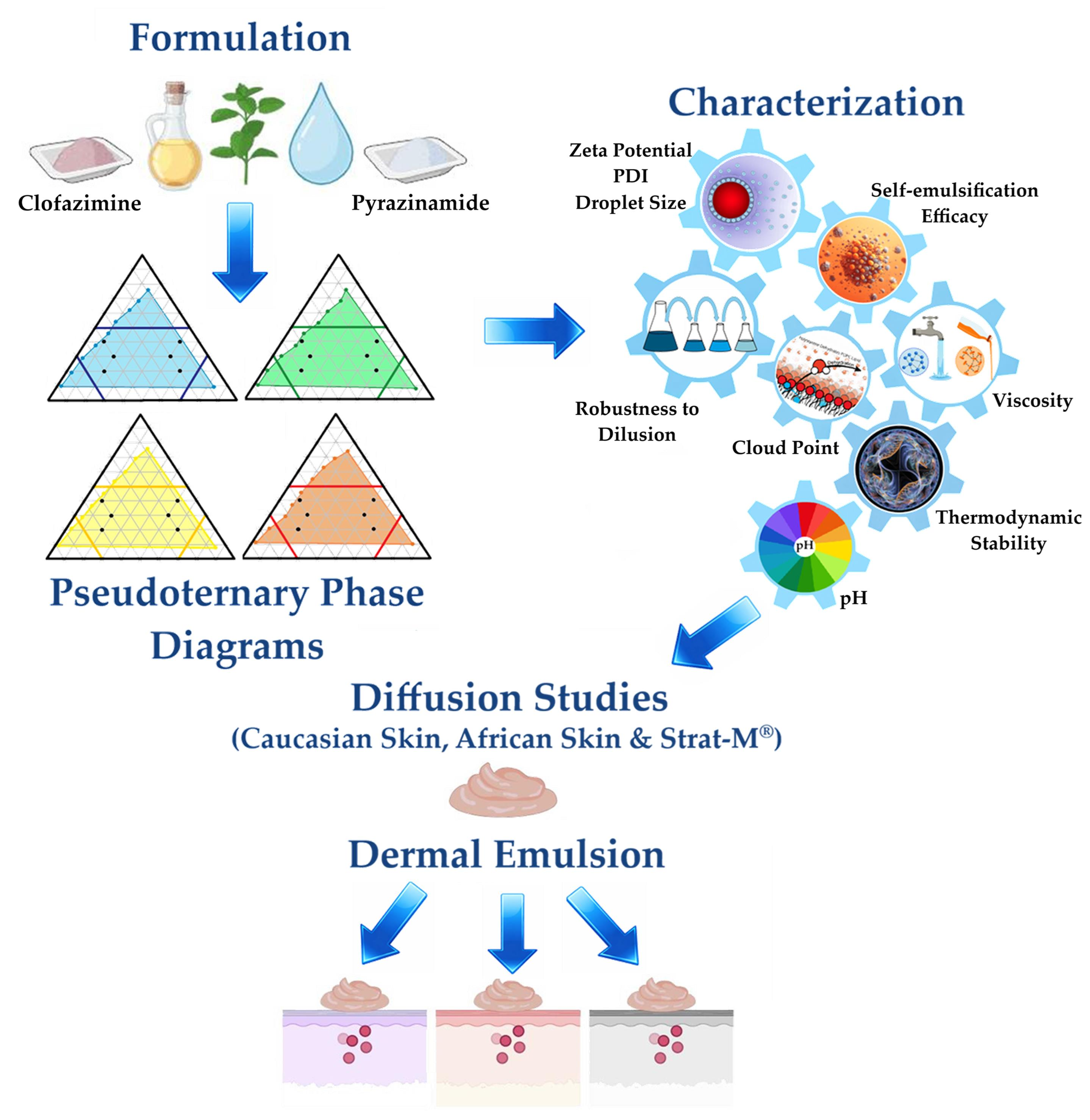
Quality-by-Design Development of a Clofazimine–Pyrazinamide Dermal Emulsion and Its Diffusion Behavior in Strat-M® and Human Skin




Abstract
1. Introduction

| Physicochemical Characteristics | CFZ | PZA |
|---|---|---|
| Molecular formula | C27H22Cl2N4 | C5H5N3O |
| Molecular weight | 473.40 Da | 123.11 Da |
| Chemical structure |  |  |
| Appearance | Reddish-brown, fine powder; odorless/almost odorless | White, crystalline powder or needles; odorless/almost odorless |
| Log p | ≈7.66 | ≈−0.71 |
| pKa value | 8.37–8.51 | 0.5 |
| Melting point | 210–212 °C | 88–191 °C |
| Solubility (mg.mL−1, 25 °C) | Water: 0.0015 Absolute ethanol: 0.2 Dimethyl sulfoxide: 1 Dimethyl formamide: 2 | Water: 15 Methanol: 13.8 Absolute ethanol: 5.7 Isopropanol: 3.8 Ether: 1.0 Isooctane: 0.01 Chloroform: 7.4 |
| BCS class | II | I or III |
2. Results and Discussion
2.1. Preformulation Studies
2.1.1. Solubility
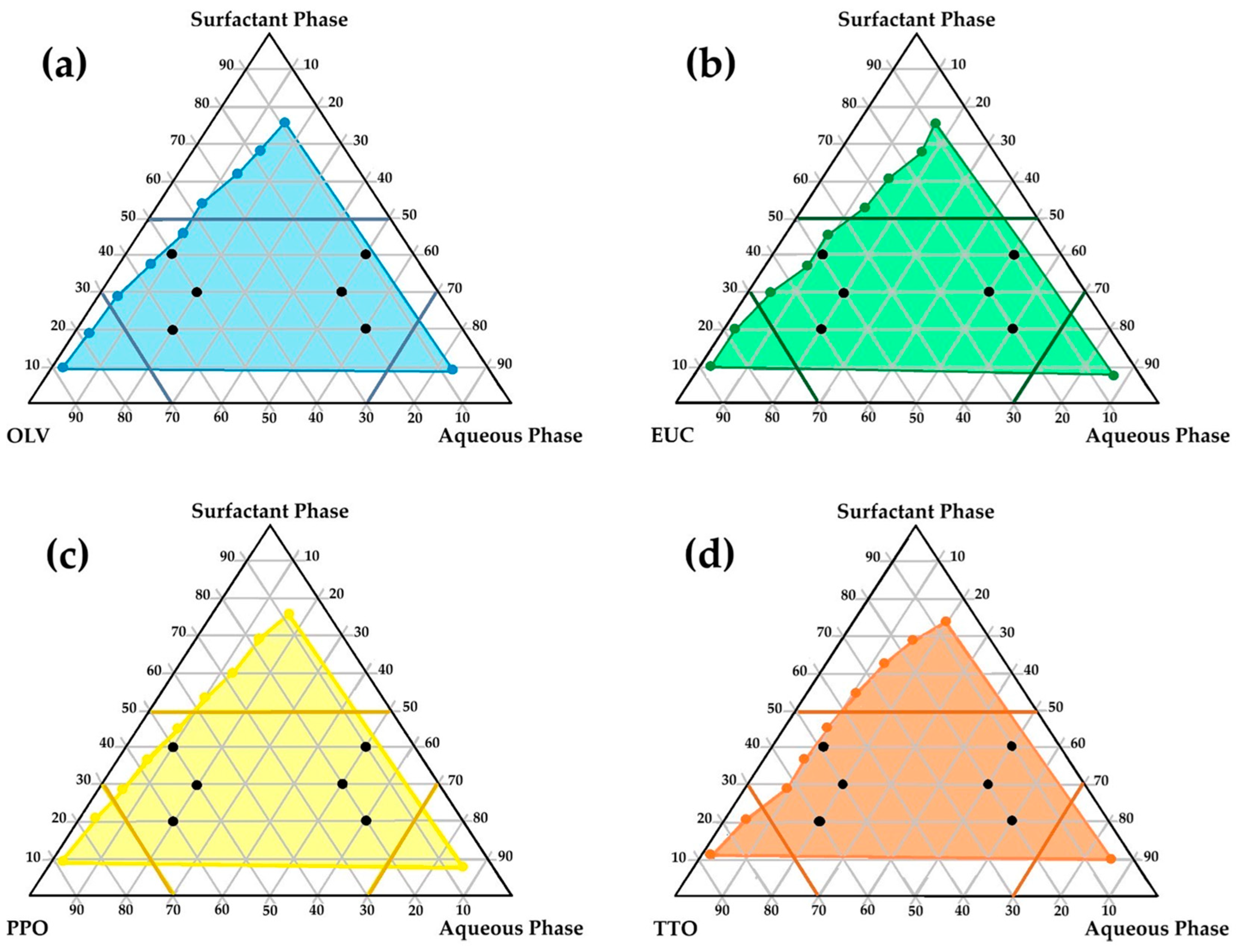
2.1.2. Dermal Formulation Using Pseudoternary Phase Diagrams
2.2. Characterization of Formulated Self-Emulsifying Drug Delivery Systems
2.2.1. Droplet Size, Polydispersity Index (PDI), and Zeta Potential
2.2.2. Robustness to Dilution
2.2.3. Self-Emulsification Efficacy and Time
2.2.4. Viscosity Testing
2.2.5. Cloud Points Determined
2.2.6. Thermodynamic Stability of Checkpoint Dermal Emulsions
2.2.7. pH Determination of Dermal Emulsions
2.3. Encapsulation Efficiency (%EE)
2.4. Assay Analysis
2.5. Dermal Drug Delivery of a Fixed-Dose CFZ/PZA Combination
2.5.1. Drug Release Studies
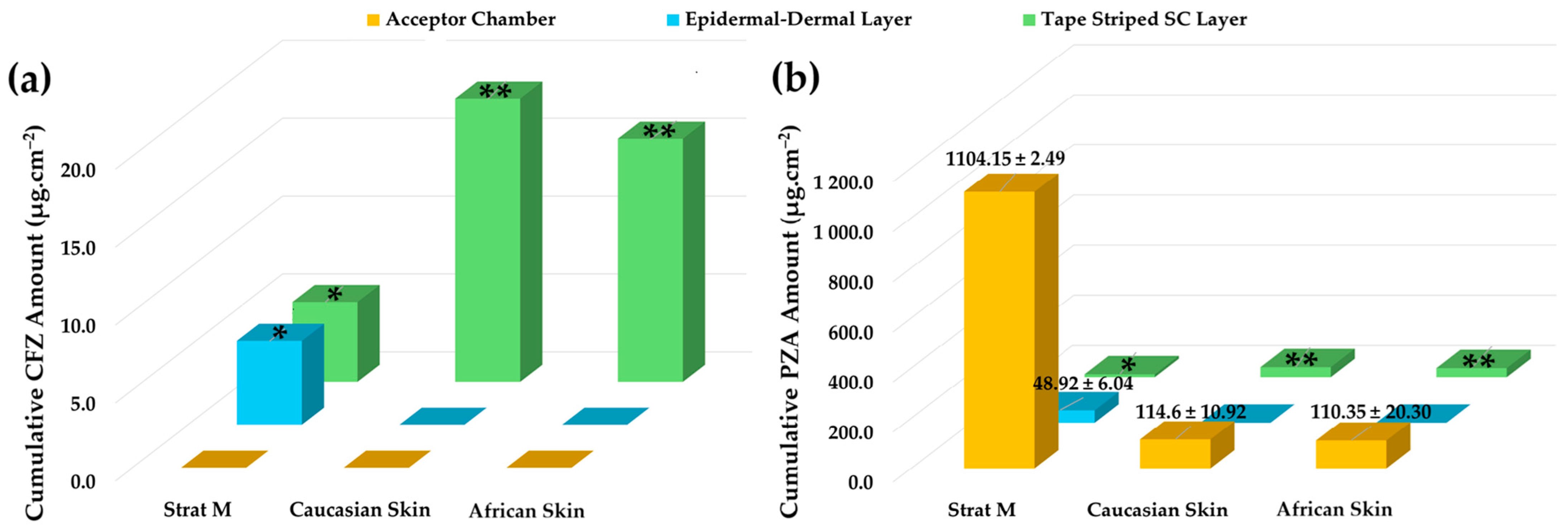
2.5.2. Comparative Dermal Drug Diffusion Studies
3. Materials and Methods
3.1. Materials
3.2. Preformulation Experiments
3.2.1. Preparation of Different Oil Phases Selected
3.2.2. Solubility Studies
3.2.3. High Performance Liquid Chromatographic Analysis
3.2.4. Determining Self-Emulsification Regions Using Pseudoternary Phase Diagrams
3.3. Dermal Formulation Preparation
3.4. Characterization of Formulated Emulsions
3.4.1. Zeta Potential, Polydispersity Index, and Droplet Size Determination
3.4.2. Robustness to Dilution Studies
3.4.3. Evaluating Self-Emulsification Efficacy and Time
3.4.4. Viscosity Determination
3.4.5. Cloud Point Verification
3.4.6. Thermodynamic Stability Experiments
3.4.7. pH Determination
3.5. Encapsulation Efficiency (%EE)
3.6. Assay
3.7. Topical Delivery
3.7.1. Drug Release Studies
3.7.2. Preparation of Skin Samples
3.7.3. Skin Diffusion Studies
3.7.4. Tape Stripping
3.8. Statistical Analyses
4. Conclusions
Author Contributions
Funding
Institutional Review Board Statement
Informed Consent Statement
Data Availability Statement
Acknowledgments
Conflicts of Interest
Abbreviations
| ANOVA | Analysis of Variance |
| BCS | Biopharmaceutical Classification System |
| CFZ | Clofazimine |
| CLSM | Confocal Laser Scanning Microscope |
| CTB | Cutaneous tuberculosis |
| DAD | Diode array detector |
| %EE | Encapsulation Efficiency |
| EMA | European Medicines Agency |
| EUC | Eucalyptus oil |
| FC | Franz diffusion cell |
| FDC | Fixed-dose drug combination |
| GCP | Good Clinical Practice |
| GLP | Good Laboratory Practice |
| HLB | Hydrophilic-lipophilic balance |
| HPLC | High-performance liquid chromatography |
| ICH | International Council for Harmonization |
| MDR | Multidrug-resistant |
| MeOH | Methanol |
| OLV | Olive oil |
| o/w | Oil-in-water |
| PBS | Phosphate-buffer solution |
| PDI | Polydispersity index |
| PPO | Peppermint oil |
| PVDF | Polyvinylidene fluoride |
| PZA | Pyrazinamide |
| r2 | Correlation coefficient |
| %RSD | Relative Standard Deviation |
| SC | Stratum corneum |
| SEDDS | Self-emulsifying drug delivery system |
| STc | Fixed-dose drug combination solubility |
| STi | Individual stability |
| TB | Tuberculosis |
| TTO | Tea tree oil |
| UP | Ultra purified |
| US FDA | United States Food and Drug Administration |
| WHO | World Health Organization |
| w/o | Water-in-oil |
References
- Costa Gagosian, V.S.; Coronel, R.; Buss, B.C.; Dos Santos, M.L.F.; Liste, I.; Anta, B.; Foti, L. In vitro skin models as non-animal methods for dermal drug development and safety assessment. Pharmaceutics 2025, 17, 1342. [Google Scholar] [CrossRef] [Scilit]
- Neupane, R.; Boddu, S.H.S.; Renukuntla, J.; Babu, R.J.; Tiwari, A.K. Alternatives to biological skin in permeation studies: Current trends and possibilities. Pharmaceutics 2020, 12, 152. [Google Scholar] [CrossRef] [Scilit]
- Mohammed, Y.H.; Moghimi, H.R.; Yousef, S.A.; Chandrasekaran, N.C.; Bibi, C.R.; Sukumar, S.C.; Grice, J.E.; Sakran, W.; Roberts, M.S. Efficacy, safety and targets in topical and transdermal active and excipient delivery. In Percutaneous Penetration Enhancers Drug Penetration into/Through the Skin: Methodology and General Considerations, 1st ed.; Dragicevic, N., Maibach, H.I., Eds.; Springer: Berlin/Heidelberg, Germany, 2017; pp. 369–391. [Google Scholar] [CrossRef] [Scilit]
- Bouwstra, J.A.; Nădăban, A.; Bras, W.; McAbe, C.; Bunge, A.; Gooris, G.S. The skin barrier: An extraordinary interface with an exceptional lipid organization. Prog. Lipid Res. 2023, 92, 101252. [Google Scholar] [CrossRef] [Scilit]
- Salminen, A.T.; Davis, K.J.; Felton, R.P.; Nischal, N.; VonTungeln, L.S.; Beland, F.A.; Derr, K.; Brown, P.C.; Ferrer, M.; Katz, L.M.; et al. Parallel evaluation of alternative skin barrier models and excised human skin for dermal absorption studies in vitro. Toxicol. Vitr. 2023, 91, 105630. [Google Scholar] [CrossRef] [Scilit] [PubMed]
- Olkowska, E. Permeability of dimethyl phthalate through human skin models—Health risk assessment. Expo. Health 2024, 16, 369–376. [Google Scholar] [CrossRef] [Scilit]
- Todo, H. Transdermal permeation of drugs in various animal species. Pharmaceutics 2017, 9, 33. [Google Scholar] [CrossRef] [Scilit]
- Nair, R.S.; Billa, N.; Morris, A.P. Optimizing in vitro skin permeation studies to obtain meaningful data in topical and transdermal drug delivery. AAPS PharmSciTech 2025, 26, 147. [Google Scholar] [CrossRef] [Scilit] [PubMed]
- United States Food and Drug Administration. Implementing Alternative Methods. Available online: https://www.fda.gov/science-research/advancing-alternative-methods-fda/implementing-alternative-methods (accessed on 11 October 2025).
- ICH. ICH M3 (R2) Non-Clinical safety Studies for the Conduct of Human Clinical Trials for Pharmaceuticals—Scientific Guideline. Available online: https://www.ema.europa.eu/en/ich-m3-r2-non-clinical-safety-studies-conduct-human-clinical-trials-pharmaceuticals-scientific-guideline (accessed on 11 October 2025).
- Song, G.; Banov, D.; Song, H.; Liu, Y.; Ip, K.; Bassani, A.S.; Valdez, B.C. Evaluation of an anhydrous permeation-enhancing vehicle for percutaneous absorption of hormones. AAPS PharmSciTech 2022, 23, 198. [Google Scholar] [CrossRef] [Scilit] [PubMed]
- Kichou, H.; Bonnier, F.; Dancik, Y.; Bakar, J.; Michael-Jubeli, R.; Caritá, A.C.; Perse, X.; Soucé, M.; Rapetti, L.; Tfayli, A.; et al. Strat-M® positioning for skin permeation studies: A comparative study including EpiSkin® RHE, and human skin. Int. J. Pharm. 2023, 647, 123488. [Google Scholar] [CrossRef] [Scilit]
- Arce, F.J.; Asano, N.; See, G.L.; Itakura, S.; Todo, H.; Sugibayashi, K. Usefulness of artificial membrane, Strat-M®, in the assessment of drug permeation from complex vehicles in finite dose conditions. Pharmaceutics 2020, 12, 173. [Google Scholar] [CrossRef] [Scilit]
- Haq, A.; Goodyear, B.; Ameen, D.; Joshi, V.; Michniak-Kohn, B. Strat-M® synthetic membrane: Permeability comparison to human cadaver skin. Int. J. Pharm. 2018, 547, 432–437. [Google Scholar] [CrossRef] [Scilit] [PubMed]
- Kovács, A.; Zsikó, S.; Falusi, F.; Csányi, E.; Budai-Szűcs, M.; Csóka, I.; Berkó, S. Comparison of synthetic membranes to heat-separated human epidermis in skin permeation studies In vitro. Pharmaceutics 2021, 13, 2106. [Google Scholar] [CrossRef] [Scilit]
- Bouwer, F.; Brits, M.; Viljoen, J.M. Cracking the Skin Barrier: Models and Methods Driving Dermal Drug Delivery. Pharmaceutics 2025, 17, 1586. [Google Scholar] [CrossRef] [Scilit]
- González, J.F.M.; González, A.L.R.; Servín, M.M.; Ávila, P.I.N.; Almanza, A.M. Cutaneous tuberculosis: A comprehensive review of etiopathogenesis, clinical subtypes, diagnostic modalities, and contemporary therapeutic approaches. Int. J. Med. Sci. Clin. Res. Stud. 2025, 5, 710–714. [Google Scholar] [CrossRef] [Scilit]
- Nguyen, K.H.; Alcantara, C.A.; Glassman, I.; May, N.; Mundra, A.; Mukundan, A.; Urness, B.; Yoon, S.; Sakaki, R.; Dayal, S.; et al. Cutaneous manifestations of Mycobacterium tuberculosis: A literature review. Pathogens 2023, 12, 920. [Google Scholar] [CrossRef] [Scilit]
- Van Zyl, L.; Du Plessis, J.; Viljoen, J.M. Cutaneous tuberculosis overview and current treatment regimens. Tuberculosis 2015, 95, 629–638. [Google Scholar] [CrossRef] [Scilit]
- Gramminger, C.; Biedermann, T. Recognising cutaneous tuberculosis. J. Dtsch. Dermatol. Ges. 2025, 23, 793–802. [Google Scholar] [CrossRef] [Scilit]
- Chen, Q.; Chen, W.; Hao, F. Cutaneous tuberculosis: A great imitator. Clin. Dermatol. 2019, 37, 192–199. [Google Scholar] [CrossRef] [Scilit] [PubMed]
- Brito, A.C.; Oliveira, C.M.M.; Unger, D.A.; Bittencourt, M.J.S. Cutaneous tuberculosis: Epidemiological, clinical, diagnostic and therapeutic update. An. Bras. Dermatol. 2022, 97, 129–144. [Google Scholar] [CrossRef] [Scilit]
- Gopalaswamy, R.; Dusthackeer, V.N.A.; Kannayan, S.; Subbian, S. Extrapulmonary tuberculosis—An update on the diagnosis, treatment and drug resistance. J. Respir. 2021, 1, 141–164. [Google Scholar] [CrossRef] [Scilit]
- Thakur, A. Advancements in tuberculosis treatment: From epidemiology to innovative therapies. Int. J. Sci. Res. 2024, 13, 206–216. [Google Scholar] [CrossRef] [Scilit]
- Li, Q.; Song, Y.; Chen, H.; Xie, L.; Gao, M.; Ma, L.; Huang, Y. Retrospective analysis of 28 cases of tuberculosis in pregnant women in China. Sci. Rep. 2019, 9, 15347. [Google Scholar] [CrossRef] [Scilit]
- Mirnejad, R.; Asadi, A.; Khoshnood, S.; Mirzaei, H.; Heidary, M.; Fattorini, L.; Ghodousi, A.; Darban-Sarokhalil, D. Clofazimine: A useful antibiotic for drug-resistant tuberculosis. Biomed. Pharmacother. 2018, 105, 1353–1359. [Google Scholar] [CrossRef] [Scilit]
- Ammerman, N.C.; Swanson, R.V.; Bautista, E.M.; Almeida, D.V.; Saini, V.; Omansen, T.F.; Guo, H.; Chang, Y.S.; Li, S.Y.; Tapley, A.; et al. Impact of clofazimine dosing on treatment shortening of the first-line regimen in a mouse model of tuberculosis. Antimicrob. Agents Chemother. 2018, 62, e00636-18. [Google Scholar] [CrossRef] [Scilit]
- Godman, B.; McCabe, H.; Leong, T.D.; Mueller, D.; Martin, A.P.; Hoxha, I.; Mwita, J.C.; Rwegerera, G.M.; Massele, A.; Costa, J.d.O.; et al. Fixed dose drug combinations—Are they pharmacoeconomically sound? Findings and implications especially for lower- and middle-income countries. Expert Rev. Pharmacoecon. Outcomes Res. 2020, 20, 1–26. [Google Scholar] [CrossRef] [Scilit]
- Lange, C.; Chesov, D.; Heyckendorf, J. Clofazimine for the treatment of multidrug-resistant tuberculosis. Clin. Microbiol. Infect. 2019, 25, 128–130. [Google Scholar] [CrossRef] [Scilit] [PubMed]
- John, M.; Gopinath, D.; Kalra, S. Triple fixed drug combinations in type 2 diabetes. Indian J. Endocrinol. Metab. 2015, 19, 311–313. [Google Scholar] [CrossRef] [Scilit]
- Zhang, Y.; Scorpio, A.; Nikaido, H.; Sun, Z. Role of acid pH and deficient efflux of pyrazinoic acid in unique susceptibility of Mycobacterium tuberculosis to pyrazinamide. J. Bacteriol. 1999, 181, 2044–2049. [Google Scholar] [CrossRef] [Scilit] [PubMed]
- Fontes, F.L.; Peters, B.J.; Crans, D.C.; Crick, D.C. The acid-base equilibrium of pyrazinoic acid drives the pH dependence of pyrazinamide-induced Mycobacterium tuberculosis growth inhibition. ACS Infect. Dis. 2020, 6, 3004–3014. [Google Scholar] [CrossRef] [Scilit] [PubMed]
- Diacon, A.H.; Dawson, R.; Von Groote-Bidlingmaier, F.; Symons, G.; Venter, A.; Donald, P.R.; Van Niekerk, C.; Everitt, D.; Hutchings, J.; Burger, D.A.; et al. Bactericidal activity of pyrazinamide and clofazimine alone and in combinations with pretomanid and bedaquiline. Am. J. Respir. Crit. Care Med. 2015, 191, 943–953. [Google Scholar] [CrossRef] [Scilit]
- Van Deventer, M.; Haynes, R.K.; Brits, M.; Viljoen, J.M. Formulation of topical drug delivery systems containing a fixed-dose isoniazid-rifampicin combination using the self-emulsification mechanism. Pharmaceutics 2025, 17, 680. [Google Scholar] [CrossRef] [Scilit]
- Xie, B.; Liu, Y.; Li, X.; Yang, P.; He, W. Solubilization techniques used for poorly water-soluble drugs. Acta Pharm. Sin. B 2024, 14, 4683–4716. [Google Scholar] [CrossRef] [Scilit] [PubMed]
- Ait-Touchente, Z.; Zine, N.; Jaffrezic-Renault, N.; Errachid, A.; Lebaz, N.; Fessi, H.; Elaissari, A. Exploring the versatility of microemulsions in cutaneous drug delivery: Opportunities and challenges. Nanomaterials 2023, 13, 1688. [Google Scholar] [CrossRef] [Scilit] [PubMed]
- Porter, C.J.; Trevaskis, N.L.; Charman, W.N. Lipids and lipid-based formulations: Optimizing the oral delivery of lipophilic drugs. Nat. Rev. Drug Discov. 2007, 6, 231–248. [Google Scholar] [CrossRef] [Scilit]
- Dos Santos Sousa, J.d.P.; Feitosa, R.S.; De Matos Monteiro Lira, B.S.; Carvalho, A.L.M. Vegetable oils as skin penetration enhancer in topical and transdermal anti-inflammatory formulations: An integrative review. Res. Soc. Dev. 2021, 10, e541101220308. [Google Scholar] [CrossRef] [Scilit]
- Zhang, Y.; Feng, J.; McManus, S.A.; Lu, H.D.; Ristroph, K.D.; Cho, E.J.; Dobrijevic, E.L.; Chan, H.K.; Prud’homme, R.K. Design and solidification of fast-releasing clofazimine nanoparticles for treatment of cryptosporidiosis. Mol. Pharm. 2017, 14, 3480–3488. [Google Scholar] [CrossRef] [Scilit]
- Tyagi, S.; Ammerman, N.C.; Li, S.Y.; Adamson, J.; Converse, P.J.; Swanson, R.V.; Almeida, D.V.; Grosset, J.H. Clofazimine shortens the duration of the first-line treatment regimen for experimental chemotherapy of tuberculosis. Proc. Natl. Acad. Sci. USA 2015, 112, 869–874. [Google Scholar] [CrossRef] [Scilit]
- Gopal, M.; Padayatchi, N.; Metcalfe, J.Z.; O’Donnell, M.R. Systematic review of clofazimine for the treatment of drug-resistant tuberculosis. Int. J. Tuberc. Lung Dis. 2013, 17, 1001–1007. [Google Scholar] [CrossRef] [Scilit] [PubMed]
- Villagracia, A.R.; Ong, H.L.; Lagua, F.M.; Alea, G. Chemical reactivity and bioactivity properties of pyrazinamide analogs of acetylsalicylic acid and salicylic acid using conceptual density functional theory. Heliyon 2020, 6, e04239. [Google Scholar] [CrossRef] [Scilit]
- National Center for Biotechnology Information. PubChem Compound Summary for CID 2794, Clofazimine. Available online: https://pubchem.ncbi.nlm.nih.gov/compound/Clofazimine (accessed on 28 October 2025).
- National Center for Biotechnology Information. PubChem Compound Summary for CID 1046, Pyrazinamide. Available online: https://pubchem.ncbi.nlm.nih.gov/compound/Pyrazinamide (accessed on 28 October 2025).
- Hussain, A.; Altamimi, M.A.; Alshehri, S.; Imam, S.S.; Shakeel, F.; Singh, S.K. Novel approach for transdermal delivery of rifampicin to induce synergistic antimycobacterial effects against cutaneous and systemic tuberculosis using a cationic nanoemulsion gel. Int. J. Nanomed. 2020, 15, 1073–1094. [Google Scholar] [CrossRef] [Scilit]
- Sutradhar, I.; Zaman, M.H. Evaluation of the effect of temperature on the stability and antimicrobial activity of rifampicin quinone. J. Pharm. Biomed. Anal. 2021, 197, 113941. [Google Scholar] [CrossRef] [Scilit]
- Trousil, J.; Pavliš, O.; Kubíčková, P.; Škorič, M.; Marešová, V.; Pavlova, E.; Knudsen, K.D.; Dai, Y.S.; Zimmerman, M.; Dartois, V.; et al. Antitubercular nanocarrier monotherapy: Study of In vivo efficacy and pharmacokinetics for rifampicin. J. Control. Release 2020, 321, 312–323. [Google Scholar] [CrossRef] [Scilit] [PubMed]
- Papich, M.G.; Martinez, M.N. Applying biopharmaceutical classification system (BCS) criteria to predict oral absorption of drugs in dogs: Challenges and pitfalls. AAPS J. 2015, 17, 948–964. [Google Scholar] [CrossRef] [Scilit]
- Van Staden, D.; Lemmer, H.J.R.; Liebenberg, W.; Hamman, J.H. Novel liquid-based approaches for transmucosal drug delivery. Acta Pharm. Sin. B 2025, in press. [Google Scholar] [CrossRef] [Scilit]
- Van Staden, D.; Haynes, R.K.; Viljoen, J.M. Adapting clofazimine for treatment of cutaneous tuberculosis by using self-double-emulsifying drug delivery systems. Antibiotics 2022, 11, 806. [Google Scholar] [CrossRef] [Scilit]
- Zanchetta, B.; Chaud, M.V.; Santana, M.H.A. Self-emulsifying drug delivery systems (SEDDS) in pharmaceutical development. J. Adv. Chem. Eng. 2015, 5, 1000130. [Google Scholar]
- Czajkowska-Kośnik, A.; Szekalska, M.; Amelian, A.; Szymańska, E.; Winnicka, K. Development and evaluation of liquid and solid self-emulsifying drug delivery systems for atorvastatin. Molecules 2015, 20, 21010–21022. [Google Scholar] [CrossRef] [Scilit]
- Wang, W.; Wei, H.; Du, Z.; Tai, X.; Wang, G. Formation and characterization of fully dilutable microemulsion with fatty acid methyl esters as oil phase. ACS Sustain. Chem. Eng. 2015, 3, 443–450. [Google Scholar] [CrossRef] [Scilit]
- Amin, N.C.; Fabre, H.; Blanchin, M.D.; Montels, J.; Aké, M. Determination of artemether and lumefantrine in anti-malarial fixed-dose combination tablets by microemulsion electrokinetic chromatography with short-end injection procedure. Malar. J. 2013, 12, 202. [Google Scholar] [CrossRef] [Scilit] [PubMed]
- Wang, Z.; Pal, R. Enlargement of nanoemulsion region in pseudo-ternary mixing diagrams for a drug delivery system. J. Surfact. Deterg. 2014, 17, 49–58. [Google Scholar] [CrossRef] [Scilit]
- Van Staden, D.; Du Plessis, J.; Viljoen, J.M. Development of a self-emulsifying drug delivery system for optimized topical delivery of clofazimine. Pharmaceutics 2020, 12, 523. [Google Scholar] [CrossRef] [Scilit] [PubMed]
- Topalović, I.A.; Marković, O.S.; Pešić, M.P.; Kathawala, M.H.; Kuentz, M.; Avdeef, A.; Serajuddin, A.T.M.; Verbić, T. Effects of different weak small organic acids on clofazimine solubility in aqueous media. Pharmaceutics 2024, 16, 1545. [Google Scholar] [CrossRef] [Scilit] [PubMed]
- Queiroz, L.H.; Lage, M.R.; Dos Santos, C.C.; Sarraguça, M.C.; Ribeiro, P.R. Thermodynamic and structural characterization of a mechanochemically synthesized pyrazinamide–acetylsalicylic–acid eutectic mixture. Pharmaceuticals 2025, 18, 211. [Google Scholar] [CrossRef] [Scilit]
- Becker, C.; Dressman, J.B.; Amidon, G.L.; Junginger, H.E.; Kopp, S.; Midha, K.K.; Shah, V.P.; Stavchansky, S.; Barends, D.M. Biowaiver monographs for immediate release solid oral dosage forms: Isoniazid. J. Pharm. Sci. 2007, 96, 522–531. [Google Scholar] [CrossRef] [Scilit]
- Rani, S.; Rana, R.; Saraogi, G.K.; Kumar, V.; Gupta, U. Self-emulsifying oral lipid drug delivery systems: Advances and challenges. AAPS PharmSciTech 2019, 20, 129. [Google Scholar] [CrossRef] [Scilit]
- Haque, T.; Talukder, M.M.U. Chemical enhancer: A simplistic way to modulate barrier function of the stratum corneum. Adv. Pharm. Bull. 2018, 8, 169–179. [Google Scholar] [CrossRef] [Scilit]
- Viljoen, J.M.; Cowley, A.; Du Preez, J.; Gerber, M.; Du Plessis, J. Penetration enhancing effects of selected natural oils utilized in topical dosage forms. Drug Dev. Ind. Pharm. 2015, 41, 2045–2054. [Google Scholar] [CrossRef] [Scilit]
- Alhasso, B.; Ghori, M.U.; Conway, B.R. Systematic review on the effectiveness of essential and carrier oils as skin penetration enhancers in pharmaceutical formulations. Sci. Pharm. 2022, 90, 14. [Google Scholar] [CrossRef] [Scilit]
- Crizel, R.L.; Hoffmann, J.F.; Zandoná, G.P.; Lobo, P.M.S.; Jorge, R.O.; Chaves, F.C. Characterization of extra virgin olive oil from Southern Brazil. Eur. J. Lipid Sci. Technol. 2020, 122, 1900347. [Google Scholar] [CrossRef] [Scilit]
- Jimenez-Lopez, C.; Carpena, M.; Lourenço-Lopes, C.; Gallardo-Gomez, M.; Lorenzo, J.M.; Barba, F.J.; Prieto, M.A.; Simal-Gandara, J. Bioactive compounds and quality of extra virgin olive oil. Foods 2020, 9, 1014. [Google Scholar] [CrossRef] [Scilit] [PubMed]
- Chinnaraja, A.; Murugan, B.; Baskaran, D.; Veerapandian, V. Physicochemical properties of olive oil and its stability at different storage temperatures. Int. J. Chem. Stud. 2018, 6, 1012–1017. [Google Scholar]
- Rotondi, A.; Morrone, L.; Bertazza, G.; Neri, L. Effect of duration of olive storage on chemical and sensory quality of extra virgin olive oils. Foods 2021, 10, 2296. [Google Scholar] [CrossRef] [Scilit]
- Shiekh, R.A.E.; Atwa, A.M.; Elgindy, A.M.; Mustafa, A.M.; Senna, M.M.; Alkabbani, M.A.; Ibrahim, K.M. Therapeutic applications of eucalyptus essential oils. Inflammopharmacology 2025, 33, 163–182. [Google Scholar] [CrossRef] [Scilit]
- Wang, M.; Lee, J.; Zhao, J.; Chatterjee, S.; Chittiboyina, A.G.; Ali, Z.; Khan, I.A. Comprehensive quality assessment of peppermint oils and commercial products: An integrated approach involving conventional and chiral GC/MS coupled with chemometrics. J. Chromatogr. B 2024, 1232, 123953. [Google Scholar] [CrossRef] [Scilit]
- Masyita, A.; Sari, R.M.; Astuti, A.D.; Yasir, B.; Rumata, N.R.; Emran, T.B.; Nainu, F.; Simal-Gandara, J. Terpenes and terpenoids as main bioactive compounds of essential oils, their roles in human health and potential application as natural food preservatives. Food Chem. X 2022, 13, 100217. [Google Scholar] [CrossRef] [Scilit] [PubMed]
- Hart, P.H.; Brand, C.; Carson, C.F.; Riley, T.V.; Prager, R.H.; Finlay-Jones, J.J. Terpinen-4-ol, the main component of the essential oil of Melaleuca alternifolia (tea tree oil), suppresses inflammatory mediator production by activated human monocytes. Inflamm. Res. 2000, 49, 619–626. [Google Scholar] [CrossRef] [Scilit]
- Khayyat, S.A.; Roselin, L.S. Recent progress in photochemical reaction on main components of some essential oils. J. Saudi Chem. Soc. 2018, 22, 855–875. [Google Scholar] [CrossRef] [Scilit]
- Vaishnavi, B.C.; Ananya, S.J.; Jitendra, N.Y.; Rajendra, B.S. Strategies to improve stability of essential oils. J. Pharm. Sci. Res. 2021, 13, 416–425. [Google Scholar]
- Turek, C.; Stintzing, F.C. Stability of essential oils: A review. Compr. Rev. Food Sci. Food Saf. 2013, 12, 40–53. [Google Scholar] [CrossRef] [Scilit]
- Shelepova, O.V.; Dilovarova, T.A.; Gulevich, A.A.; Olekhnovich, L.S.; Shirokova, A.V.; Ushakova, I.T.; Zhuravleva, E.V.; Konovalova, L.N.; Baranova, E.N. Chemical components and biological activities of essential oils of Mentha × piperita L. from field-grown and field-acclimated after in vitro propagation plants. Agronomy 2021, 11, 2314. [Google Scholar] [CrossRef] [Scilit]
- Hubert-Schöler, C.; Tsiaparas, S.; Luhmer, K.; Moll, M.D.; Passon, M.; Wüst, M.; Schieber, A.; Pude, R. Essential oil composition and physiology of three mentha genotypes under shaded field conditions. Plants 2024, 13, 3155. [Google Scholar] [CrossRef] [Scilit]
- Carson, C.F.; Hammer, K.A. Chapter 9: Chemistry and bioactivity of essential oils. In Lipids and Essential Oils as Antimicrobial Agents; Thormar, H., Ed.; John Wiley & Sons: Hoboken, NJ, USA, 2011; pp. 203–238. [Google Scholar] [CrossRef] [Scilit]
- Boskou, D. Olive Oil: Chemistry and Technology; AOCS Publishing: Champaign, IL, USA, 2006. [Google Scholar]
- Chudasama, A.; Patel, V.; Nivsarkar, M.; Vasu, K.; Shishoo, C. Role of lipid-based excipients and their composition on the bioavailability of antiretroviral self-emulsifying formulations. Drug Deliv. 2015, 22, 531–540. [Google Scholar] [CrossRef] [Scilit] [PubMed]
- Pouton, C.W. Lipid formulations for oral administration of drugs: Non-emulsifying, self-emulsifying and ‘self-microemulsifying’ drug delivery systems. Eur. J. Pharm. Sci. 2000, 11, S93–S98. [Google Scholar] [CrossRef] [Scilit] [PubMed]
- Salawi, A. Self-emulsifying drug delivery systems: A novel approach to deliver drugs. Drug Deliv. 2022, 29, 1811–1823. [Google Scholar] [CrossRef] [Scilit] [PubMed]
- Sirvi, A.; Kuche, K.; Chaudhari, D.; Ghadi, R.; Date, T.; Katiyar, S.S.; Jain, S. Supersaturable self-emulsifying drug delivery system: A strategy for improving the loading and oral bioavailability of quercetin. J. Drug Deliv. Sci. Technol. 2022, 71, 103289. [Google Scholar] [CrossRef] [Scilit]
- Viljoen, J.M.; Cilliers, L.; Du Plessis, L.H. Developing self-nanoemulsifying drug delivery systems comprising an artemether-lumefantrine fixed-dose combination to treat malaria. Front. Biosci. 2024, 16, 25. [Google Scholar] [CrossRef] [Scilit]
- Seo, E.B.; Du Plessis, L.H.; Viljoen, J.M. Solidification of self-emulsifying drug delivery systems as a novel approach to the management of uncomplicated malaria. Pharmaceuticals 2022, 15, 120. [Google Scholar] [CrossRef] [Scilit]
- Margetts, L.; Sawyer, R. Transdermal drug delivery: Principles and opioid therapy. Contin. Educ. Anaesth. Crit. Care Pain 2007, 7, 171–176. [Google Scholar] [CrossRef] [Scilit]
- AboulFotouh, K.; Allam, A.A.; El-Badry, M.; El-Sayed, A.M. Development and in vitro/in vivo performance of self-nanoemulsifying drug delivery systems loaded with candesartan cilexetil. Eur. J. Pharm. Sci. 2017, 109, 503–513. [Google Scholar] [CrossRef] [Scilit]
- Costa, I.; Rodrigues, R.; Almeida, F.; Favacho, H.; Falcão, D.; Ferreira, A.; Vilhena, J.; Florentino, A.; Carvalho, J.C.; Fernandes, C. Development of jojoba oil (Simmondsia chinensis (Link) C.K. Schneid.) Based nanoemulsions. Lat. Am. J. Pharm. 2014, 33, 459–463. [Google Scholar]
- Fernandes, C.P.; Mascarenhas, M.P.; Zibetti, F.M.; Lima, B.G.; Oliveira, R.P.; Rocha, L.; Falcão, D.Q. HLB value, an important parameter for the development of essential oil phytopharmaceuticals. Rev. Bras. Farmacogn. 2013, 23, 108–114. [Google Scholar] [CrossRef] [Scilit]
- Wang, L.; Dong, J.; Chen, J.; Eastoe, J.; Li, X. Design and optimization of a new self-nanoemulsifying drug delivery system. J. Colloid Interface Sci. 2009, 330, 443–448. [Google Scholar] [CrossRef] [Scilit] [PubMed]
- Magis Pharma. Available online: https://magis-pharma.be/en/hbl-values (accessed on 28 October 2025).
- Colucci, G.; Santamaria-Echart, A.; Silva, S.C.; Fernandes, I.P.M.; Sipoli, C.C.; Barreiro, M.F. Development of water-in-oil emulsions as delivery vehicles and testing with a natural antimicrobial extract. Molecules 2020, 25, 2105. [Google Scholar] [CrossRef] [Scilit]
- Kampa, J.; Frazier, R.; Rodriguez-Garcia, J. Physical and chemical characterisation of conventional and nano/emulsions: Influence of vegetable oils from different origins. Foods 2022, 11, 681. [Google Scholar] [CrossRef] [Scilit]
- Kaspute, G.; Ivaskiene, T.; Ramanavicius, A.; Ramanavicius, S.; Prentice, U. Terpenes and essential oils in pharmaceutics: Applications as therapeutic agents and penetration enhancers with advanced delivery systems for improved stability and bioavailability. Pharmaceutics 2025, 17, 793. [Google Scholar] [CrossRef] [Scilit]
- Mojeiko, G.; De Brito, M.; Salata, G.C.; Lopes, L.B. Combination of microneedles and microemulsions to increase celecoxib topical delivery for potential application in chemoprevention of breast cancer. Int. J. Pharm. 2019, 560, 365–376. [Google Scholar] [CrossRef] [Scilit]
- Kiselmann, C.; Dobler, D.; Schmidts, T.; Eicher, A.C.; Möbs, C.; Pfützner, W.; Runkel, F. Development of a skin-friendly microemulsion for dermal allergen-specific immunotherapy. Int. J. Pharm. 2018, 550, 463–469. [Google Scholar] [CrossRef] [Scilit]
- Van Staden, D.; Haynes, R.K.; Viljoen, J.M. The development of dermal self-double-emulsifying drug delivery systems: Preformulation studies as the keys to success. Pharmaceuticals 2023, 16, 1348. [Google Scholar] [CrossRef] [Scilit] [PubMed]
- Abdel-Messih, H.A.; Ishak, R.A.H.; Geneidi, A.S.; Mansour, S. Tailoring novel soft nano-vesicles ‘flexosomes’ for enhanced transdermal drug delivery: Optimization, characterization and comprehensive ex vivo—In vivo evaluation. Int. J. Pharm. 2019, 560, 101–115. [Google Scholar] [CrossRef] [Scilit]
- Hegde, R.R.; Verma, A.; Ghosh, A. Microemulsion: New insights into the ocular drug delivery. Int. Sch. Res. Not. 2013, 2013, 826798. [Google Scholar] [CrossRef] [Scilit] [PubMed]
- El Zaafarany, G.M.; Awad, G.A.; Holayel, S.M.; Mortada, N.D. Role of edge activators and surface charge in developing ultradeformable vesicles with enhanced skin delivery. Int. J. Pharm. 2010, 397, 164–172. [Google Scholar] [CrossRef] [Scilit]
- Uttreja, P.; Karnik, I.; Adel Ali Youssef, A.; Narala, N.; Elkanayati, R.M.; Baisa, S.; Alshammari, N.D.; Banda, S.; Vemula, S.K.; Repka, M.A. Self-emulsifying drug delivery systems (SEDDS): Transition from liquid to solid—A comprehensive review of formulation, characterization, applications, and future trends. Pharmaceutics 2025, 17, 63. [Google Scholar] [CrossRef] [Scilit] [PubMed]
- Pu, W.; Yuan, C.; Hu, W.; Tan, T.; Hui, J.; Zhao, S.; Wang, S.; Tang, Y. Effects of interfacial tension and emulsification on displacement efficiency in dilute surfactant flooding. RSC Adv. 2016, 6, 50640–50649. [Google Scholar] [CrossRef] [Scilit]
- De Aguiar, H.B.; De Beer, A.G.; Strader, M.L.; Roke, S. The interfacial tension of nanoscopic oil droplets in water is hardly affected by SDS surfactant. J. Am. Chem. Soc. 2010, 132, 2122–2123. [Google Scholar] [CrossRef] [Scilit]
- Ujilestari, T.; Dono, N.D.; Ariyadi, B.; Martien, R.; Zuprizal, Z. Formulation and characterization of self-nano emulsifying drug delivery systems of lemongrass (cymbopogon citratus) essential oil. Malays. J. Fundam. Appl. Sci. 2018, 14, 360–363. [Google Scholar] [CrossRef] [Scilit]
- Zaichik, S.; Steinbring, C.; Menzel, C.; Knabl, L.; Orth-Höller, D.; Ellemunter, H.; Niedermayr, K.; Bernkop-Schnürch, A. Development of self-emulsifying drug delivery systems (SEDDS) for ciprofloxacin with improved mucus permeating properties. Int. J. Pharm. 2018, 547, 282–290. [Google Scholar] [CrossRef] [Scilit]
- Balata, G.F.; Essa, E.A.; Shamardl, H.A.; Zaidan, S.H.; Abourehab, M.A. Self-emulsifying drug delivery systems as a tool to improve solubility and bioavailability of resveratrol. Drug Des. Dev. Ther. 2016, 10, 117–128. [Google Scholar] [CrossRef] [Scilit]
- Mahapatra, A.K.; Murthy, P.N.; Swadeep, B.; Swain, R.P. Self-emulsifying drug delivery systems (SEDDS): An update from formulation development to therapeutic strategies. Int. J. PharmTech Res. 2014, 6, 546–568. [Google Scholar]
- De Almeida, I.A.A.; Honório, T.D.S.; Do Carmo, F.A.; De Freitas, Z.M.F.; Simon, A.; Rodrigues, C.R.; De Sousa, V.P.; Cabral, L.M.; De Abreu, L.C.L. Development of SEDDS formulation containing caffeine for dermal delivery. Int. J. Cosmet. Sci. 2023, 45, 255–265. [Google Scholar] [CrossRef] [Scilit] [PubMed]
- Gul, S.; Sridhar, S.B.; Jalil, A.; Akhlaq, M.; Arshad, M.S.; Sarwar, H.S.; Usman, F.; Shareef, J.; Thomas, S. Solid self-nanoemulsifying drug delivery systems of furosemide: In vivo proof of concept for enhanced predictable therapeutic response. Pharmaceuticals 2024, 17, 500. [Google Scholar] [CrossRef] [Scilit] [PubMed]
- Mahajan, N.; Mujtaba, M.A.; Fule, R.; Thakre, S.; Akhtar, M.S.; Alavudeen, S.S.; Anwer, M.K.; Aldawsari, M.F.; Mahmood, D.; Alam, M.S. Self-emulsifying drug delivery system for enhanced oral delivery of tenofovir: Formulation, physicochemical characterization, and bioavailability assessment. ACS Omega 2024, 9, 8139–8150. [Google Scholar] [CrossRef] [Scilit]
- Kaur, R.; Ajitha, M. Transdermal delivery of fluvastatin loaded nanoemulsion gel: Preparation, characterization and in vivo anti-osteoporosis activity. Eur. J. Pharm. Sci. 2019, 136, 104956. [Google Scholar] [CrossRef] [Scilit]
- Danaei, M.; Dehghankhold, M.; Ataei, S.; Hasanzadeh Davarani, F.; Javanmard, R.; Dokhani, A.; Khorasani, S.; Mozafari, M.R. Impact of particle size and polydispersity index on the clinical applications of lipidic nanocarrier systems. Pharmaceutics 2018, 10, 57. [Google Scholar] [CrossRef] [Scilit]
- Tadros, T.; Izquierdo, P.; Esquena, J.; Solans, C. Formation and stability of nano-emulsions. Adv. Colloid Interface Sci. 2004, 108–109, 303–318. [Google Scholar] [CrossRef]
- McClements, D.J. Nanoemulsions versus microemulsions: Terminology, differences, and similarities. Soft Matter 2012, 8, 1719–1729. [Google Scholar] [CrossRef] [Scilit]
- Lobel, B.T.; Baiocco, D.; Al-Sharabi, M.; Routh, A.F.; Zhang, Z.; Cayre, O.J. Nonspherical particle stabilized emulsions formed through destabilization and arrested coalescence. Langmuir 2025, 41, 550–562. [Google Scholar] [CrossRef] [Scilit] [PubMed]
- Van Zyl, L.; Viljoen, J.M.; Haynes, R.K.; Aucamp, M.; Ngwane, A.H.; Du Plessis, J. Topical delivery of artemisone, clofazimine and decoquinate encapsulated in vesicles and their in vitro efficacy against Mycobacterium tuberculosis. AAPS PharmSciTech 2019, 20, 33. [Google Scholar] [CrossRef] [Scilit] [PubMed]
- Jamous, Y.F.; Altwaijry, N.A.; Saleem, M.T.; Alrayes, A.F.; Albishi, S.M.; Almeshari, M.A. Formulation and characterization of solid lipid nanoparticles loaded with troxerutin. Processes 2023, 11, 3039. [Google Scholar] [CrossRef] [Scilit]
- Qiu, H.; Chen, X.; Wei, X.; Liang, J.; Zhou, D.; Wang, L. The emulsifying properties of hydrogenated rosin xylitol ester as a biomass surfactant for food: Effect of pH and salts. Molecules 2020, 25, 302. [Google Scholar] [CrossRef] [Scilit] [PubMed]
- Kupikowska-Stobba, B.; Domagała, J.; Kasprzak, M.M. Critical review of techniques for food emulsion characterization. Appl. Sci. 2024, 14, 1069. [Google Scholar] [CrossRef] [Scilit]
- Grumezescu, A.M. Lipid Nanocarriers for Drug Targeting; William Andrew: Norwich, NY, USA, 2018. [Google Scholar]
- Zafeiri, I.; Norton, J.E.; Smith, P.; Norton, I.T.; Spyropoulos, F. The role of surface active species in the fabrication and functionality of edible solid lipid particles. J. Colloid Interface Sci. 2017, 500, 228–240. [Google Scholar] [CrossRef] [Scilit]
- Liu, F.; He, W.; Huang, X.; Yin, J.; Nie, S. The emulsification and stabilization mechanism of an oil-in-water emulsion constructed from tremella polysaccharide and citrus pectin. Foods 2024, 13, 1545. [Google Scholar] [CrossRef] [Scilit]
- Alpha Chemique. Polysorbate 60: Properties, Functions, and Applications. Available online: https://www.alphachem.biz/polysorbate-60-properties-functions-and-applications/#:~:text=Stabilizer:%20Polysorbate%2060%20acts%20as,creams%2C%20lotions%2C%20and%20cosmetics (accessed on 18 October 2025).
- Umerska, A.; Cassisa, V.; Matougui, N.; Joly-Guillou, M.L.; Eveillard, M.; Saulnier, P. Antibacterial action of lipid nanocapsules containing fatty acids or monoglycerides as co-surfactants. Eur. J. Pharm. Biopharm. 2016, 108, 100–110. [Google Scholar] [CrossRef] [Scilit]
- Carter, P.; Narasimhan, B.; Wang, Q. Biocompatible nanoparticles and vesicular systems in transdermal drug delivery for various skin diseases. Int. J. Pharm. 2019, 555, 49–62. [Google Scholar] [CrossRef] [Scilit] [PubMed]
- Grumezescu, A.M. Multifunctional Systems for Combined Delivery, Biosensing and Diagnostics; William Andrew: Norwich, NY, USA, 2017. [Google Scholar]
- Ibrahim, S.A.; Li, S.K. Efficiency of fatty acids as chemical penetration enhancers: Mechanisms and structure enhancement relationship. Pharm. Res. 2010, 27, 115–125. [Google Scholar] [CrossRef] [Scilit]
- Kezutyte, T.; Desbenoit, N.; Brunelle, A.; Briedis, V. Studying the penetration of fatty acids into human skin by ex vivo TOF-SIMS imaging. Biointerphases 2013, 8, 3. [Google Scholar] [CrossRef] [Scilit] [PubMed]
- Vaughn, A.R.; Clark, A.K.; Sivamani, R.K.; Shi, V.Y. Natural oils for skin-barrier repair: Ancient compounds now backed by modern science. Am. J. Clin. Dermatol. 2018, 19, 103–117. [Google Scholar] [CrossRef] [Scilit] [PubMed]
- Van Zyl, L.; Du Preez, J.; Gerber, M.; Du Plessis, J.; Viljoen, J.M. Essential fatty acids as transdermal penetration enhancers. J. Pharm. Sci. 2016, 105, 188–193. [Google Scholar] [CrossRef] [Scilit]
- Lane, M.E. Skin penetration enhancers. Int. J. Pharm. 2013, 447, 12–21. [Google Scholar] [CrossRef] [Scilit]
- Salvo, P.; Pingitore, A.; Barbini, A.; di Francesco, F. A wearable sweat rate sensor to monitor the athletes’ performance during training. Sci. Sports 2018, 33, e51–e58. [Google Scholar] [CrossRef] [Scilit]
- Asghar, A.A.; Akhlaq, M.; Jalil, A.; Azad, A.K.; Asghar, J.; Adeel, M.; Albadrani, G.M.; Al-Doaiss, A.A.; Kamel, M.; Altyar, A.E.; et al. Formulation of ciprofloxacin-loaded oral self-emulsifying drug delivery system to improve the pharmacokinetics and antibacterial activity. Front. Pharmacol. 2022, 13, 967106. [Google Scholar] [CrossRef] [Scilit]
- Keurentjes, A.J.; Maibach, H.I. Percutaneous penetration of drugs applied in transdermal delivery systems: An in vivo based approach for evaluating computer generated penetration models. Regul. Toxicol. Pharmacol. 2019, 108, 104428. [Google Scholar] [CrossRef] [Scilit]
- Kathe, K.; Kathpalia, H. Film forming systems for topical and transdermal drug delivery. Asian J. Pharm. Sci. 2017, 12, 487–497. [Google Scholar] [CrossRef] [Scilit]
- Shahnaz, G.; Hartl, M.; Barthelmes, J.; Leithner, K.; Sarti, F.; Hintzen, F.; Rahmat, D.; Salvenmoser, W.; Bernkop-Schnürch, A. Uptake of phenothiazines by the harvested chylomicrons ex vivo model: Influence of self-nanoemulsifying formulation design. Eur. J. Pharm. Biopharm. 2011, 79, 171–180. [Google Scholar] [CrossRef] [Scilit]
- Solans, C.; Morales, D.; Homs, M. Spontaneous emulsification. Curr. Opin. Colloid Interface Sci. 2016, 22, 88–93. [Google Scholar] [CrossRef] [Scilit]
- Dheda, K.; Chang, K.C.; Guglielmetti, L.; Furin, J.; Schaaf, H.S.; Chesov, D.; Esmail, A.; Lange, C. Clinical management of adults and children with multidrug-resistant and extensively drug-resistant tuberculosis. Clin. Microbiol. Infect. 2017, 23, 131–140. [Google Scholar] [CrossRef] [Scilit]
- Duan, H.; Chen, X.; Li, Z.; Pang, Y.; Jing, W.; Liu, P.; Wu, T.; Cai, C.; Shi, J.; Qin, Z.; et al. Clofazimine improves clinical outcomes in multidrug-resistant tuberculosis: A randomized controlled trial. Clin. Microbiol. Infect. 2019, 25, 190–195. [Google Scholar] [CrossRef] [Scilit] [PubMed]
- Wu, Y.; Sun, S.; Li, X.; Li, X.; Huang, Y.; An, F.; Huang, Q.; Song, H. Effect of gel composition interaction on rheological, physicochemical and textural properties of methyl cellulose oleogels and lard replacement in ham sausage. Int. J. Biol. Macromol. 2024, 280, 135902. [Google Scholar] [CrossRef] [Scilit] [PubMed]
- Agrawal, A.G.; Kumar, A.; Gide, P.S. Self emulsifying drug delivery system for enhanced solubility and dissolution of glipizide. Colloids Surf. B Biointerfaces 2015, 126, 553–560. [Google Scholar] [CrossRef] [Scilit]
- Aziz, A.; Zaman, M.; Khan, M.A.; Jamshaid, T.; Butt, M.H.; Hameed, H.; Rahman, M.S.U.; Shoaib, Q.U. Preparation and evaluation of a self-emulsifying drug delivery system for improving the solubility and permeability of ticagrelor. ACS Omega 2024, 9, 10522–10538. [Google Scholar] [CrossRef] [Scilit] [PubMed]
- Smail, S.S.; Ghareeb, M.M.; Omer, H.K.; Al-Kinani, A.A.; Alany, R.G. Studies on surfactants, cosurfactants, and oils for prospective use in formulation of ketorolac tromethamine ophthalmic nanoemulsions. Pharmaceutics 2021, 13, 467. [Google Scholar] [CrossRef] [Scilit] [PubMed]
- Bnyan, R.; Khan, I.; Ehtezazi, T.; Saleem, I.; Gordon, S.; O’Neill, F.; Roberts, M. Surfactant effects on lipid-based vesicles properties. J. Pharm. Sci. 2018, 107, 1237–1246. [Google Scholar] [CrossRef] [Scilit]
- Cortés, H.; Hernández-Parra, H.; Bernal-Chávez, S.A.; Prado-Audelo, M.L.D.; Caballero-Florán, I.H.; Borbolla-Jiménez, F.V.; González-Torres, M.; Magaña, J.J.; Leyva-Gómez, G. Non-ionic surfactants for stabilization of polymeric nanoparticles for biomedical uses. Materials 2021, 14, 3197. [Google Scholar] [CrossRef] [Scilit]
- Creaming. ScienceDirect Topics. Elsevier. Available online: https://www.sciencedirect.com/topics/agricultural-and-biological-sciences/creaming (accessed on 7 January 2026).
- Loi, C.C.; Eyres, G.T.; Birch, E.J. Protein-stabilised emulsions. In Encyclopedia of Food Chemistry; Elsevier: Amsterdam, The Netherlands, 2019; pp. 404–409. [Google Scholar] [CrossRef] [Scilit]
- Zhang, J.; Ge, D.; Wang, X.; Wang, W.; Cui, D.; Yuan, G.; Wang, K.; Zhang, W. Influence of Surfactant and Weak-Alkali Concentrations on the Stability of O/W Emulsion in an Alkali-Surfactant-Polymer Compound System. ACS Omega 2021, 6, 5001–5008. [Google Scholar] [CrossRef] [Scilit]
- Xiao, T.; Ma, X.; Hu, H.; Xiang, F.; Zhang, X.; Zheng, Y.; Dong, H.; Adhikari, B.; Wang, Q.; Shi, A. Advances in emulsion stability: A review on mechanisms, role of emulsifiers, and applications in food. Food Chem. X 2025, 29, 102792. [Google Scholar] [CrossRef] [Scilit]
- Sheshala, R.; Anuar, N.K.; Abu Samah, N.H.; Wong, T.W. In vitro drug dissolution/permeation testing of nanocarriers for skin application: A comprehensive review. AAPS PharmSciTech 2019, 20, 164. [Google Scholar] [CrossRef] [Scilit] [PubMed]
- Hwang, J.H.; Lee, S.; Lee, H.G.; Choi, D.; Lim, K.M. Evaluation of skin irritation of acids commonly used in cleaners in 3D-reconstructed human epidermis model, KeraSkin™. Toxics 2022, 10, 558. [Google Scholar] [CrossRef] [Scilit] [PubMed]
- Laudouze, J.; Canaan, S.; Gouzy, A.; Santucci, P. Unraveling Mycobacterium tuberculosis acid resistance and pH homeostasis mechanisms. FEBS Lett. 2025, 599, 1634–1648. [Google Scholar] [CrossRef] [Scilit]
- Leister, N.; Karbstein, H.P. Determination of the dominating coalescence pathways in double emulsion formulations by use of microfluidic emulsions. Processes 2023, 11, 234. [Google Scholar] [CrossRef] [Scilit]
- Mohanraj, V.; Chen, Y. Nanoparticles—A review. Trop. J. Pharm. Res. 2006, 5, 561–573. [Google Scholar] [CrossRef] [Scilit]
- Pereira, A.; Gadad, A.P.; Patil, A.S.; Mallappa, P. Development and bioavailability assessment of ramipril nanoparticle formulation. Indian J. Pharm. Educ. Res. 2019, 54, s587–s595. [Google Scholar] [CrossRef] [Scilit]
- Qian, K.; Lin, Y.; Zhao, B.; Liu, X. Droplet size reduction of self-emulsifying drug delivery system (SEDDS) using the hybrid of medium and long-chain triglycerides. Pharmaceutics 2025, 17, 822. [Google Scholar] [CrossRef] [Scilit]
- Jacob, S.; Kather, F.S.; Boddu, S.H.S.; Shah, J.; Nair, A.B. Innovations in nanoemulsion technology: Enhancing drug delivery for oral, parenteral, and ophthalmic applications. Pharmaceutics 2024, 16, 1333. [Google Scholar] [CrossRef] [Scilit]
- Ho, T.M.; Razzaghi, A.; Ramachandran, A.; Mikkonen, K.S. Emulsion characterization via microfluidic devices: A review on interfacial tension and stability to coalescence. Adv. Colloid Interface Sci. 2022, 299, 102541. [Google Scholar] [CrossRef] [Scilit]
- Bhalani, D.V.; Nutan, B.; Kumar, A.; Singh Chandel, A.K. Bioavailability enhancement techniques for poorly aqueous soluble drugs and therapeutics. Biomedicines 2022, 10, 2055. [Google Scholar] [CrossRef] [Scilit] [PubMed]
- Savjani, K.T.; Gajjar, A.K.; Savjani, J.K. Drug solubility: Importance and enhancement techniques. Int. Sch. Res. Not. 2012, 2012, 195727. [Google Scholar] [CrossRef] [Scilit]
- Thomas, N.; Holm, R.; Müllertz, A.; Rades, T. In vitro and in vivo performance of novel supersaturated self-nanoemulsifying drug delivery systems (super-SNEDDS). J. Control. Release 2012, 160, 25–32. [Google Scholar] [CrossRef] [Scilit]
- Park, H.; Ha, E.S.; Kim, M.S. Current status of supersaturable self-emulsifying drug delivery systems. Pharmaceutics 2020, 12, 365. [Google Scholar] [CrossRef] [Scilit] [PubMed]
- Sharma, A.; Arora, K.; Mohapatra, H.; Sindhu, R.K.; Bulzan, M.; Cavalu, S.; Paneshar, G.; Elansary, H.O.; El-Sabrout, A.M.; Mahmoud, E.A.; et al. Supersaturation-based drug delivery systems: Strategy for bioavailability enhancement of poorly water-soluble drugs. Molecules 2022, 27, 2969. [Google Scholar] [CrossRef] [Scilit]
- Cilurzo, F.; Casiraghi, A.; Selmin, F.; Minghetti, P. Supersaturation as a tool for skin penetration enhancement. Curr. Pharm. Des. 2015, 21, 2733–2744. [Google Scholar] [CrossRef] [Scilit] [PubMed]
- Kunita, R.; Nishijima, T.; Todo, H.; Sugibayashi, K.; Sakaguchi, H. A mathematical approach using Strat-M® to predict the percutaneous absorption of chemicals under finite dose conditions. Pharmaceutics 2022, 14, 1370. [Google Scholar] [CrossRef] [Scilit]
- Anjani, Q.K.; Nainggolan, A.D.C.; Li, H.; Miatmoko, A.; Larrañeta, E.; Donnelly, R.F. Parafilm® M and Strat-M® as skin simulants in in vitro permeation of dissolving microarray patches loaded with proteins. Int. J. Pharm. 2024, 655, 124071. [Google Scholar] [CrossRef] [Scilit] [PubMed]
- Murashov, M.D.; LaLone, V.; Rzeczycki, P.M.; Keswani, R.K.; Yoon, G.S.; Sud, S.; Rajeswaran, W.; Larsen, S.; Stringer, K.A.; Rosania, G.R. The physicochemical basis of clofazimine-induced skin pigmentation. J. Investig. Dermatol. 2018, 138, 697–703. [Google Scholar] [CrossRef] [Scilit]
- Uchida, T.; Kadhum, W.R.; Kanai, S.; Todo, H.; Oshizaka, T.; Sugibayashi, K. Prediction of skin permeation by chemical compounds using the artificial membrane, Strat-M™. Eur. J. Pharm. Sci. 2015, 67, 113–118. [Google Scholar] [CrossRef] [Scilit] [PubMed]
- Kesharwani, R.; Jaiswal, P.; Patel, D.K.; Yadav, P.K. Lipid-Based Drug Delivery System (LBDDS): An Emerging Paradigm to Enhance Oral Bioavailability of Poorly Soluble Drugs. Biomed. Mater. Devices 2023, 1, 648–663. [Google Scholar] [CrossRef] [Scilit]
- Barry, B.W. Novel mechanisms and devices to enable successful transdermal drug delivery. Eur. J. Pharm. Sci. 2001, 14, 101–114. [Google Scholar] [CrossRef] [Scilit] [PubMed]
- Godin, B.; Touitou, E. Dermal and Transdermal Delivery. In Encyclopedia of Nanotechnology; Bhushan, B., Ed.; Springer: Dordrecht, The Netherlands, 2012; pp. 517–526. [Google Scholar]
- Simon, A.; Amaro, M.I.; Healy, A.M.; Cabral, L.M.; de Sousa, V.P. Comparative evaluation of rivastigmine permeation from a transdermal system in the Franz cell using synthetic membranes and pig ear skin with in vivo-in vitro correlation. Int. J. Pharm. 2016, 512, 234–241. [Google Scholar] [CrossRef] [Scilit]
- Brito, S.; Baek, M.; Bin, B.-H. Skin structure, physiology, and pathology in topical and transdermal drug delivery. Pharmaceutics 2024, 16, 1403. [Google Scholar] [CrossRef] [Scilit]
- Ohnari, H.; Naru, E.; Sakata, O.; Obata, Y. Distribution of domains formed by lateral packing of intercellular lipid in the stratum corneum. Chem. Pharm. Bull. 2023, 71, 31–40. [Google Scholar] [CrossRef] [Scilit]
- Vaseem, R.S.; D’Cruz, A.; Shetty, S.; Hafsa; Vardhan, A.; Shenoy, S.; Marques, S.M.; Kumar, L.; Verma, R. Transdermal drug delivery systems: A focused review of the physical methods of permeation enhancement. Adv. Pharm. Bull. 2024, 14, 67–85. [Google Scholar] [CrossRef] [Scilit]
- Hmingthansanga, V.; Singh, N.; Banerjee, S.; Manickam, S.; Velayutham, R.; Natesan, S. Improved topical drug delivery: Role of permeation enhancers and advanced approaches. Pharmaceutics 2022, 14, 2818. [Google Scholar] [CrossRef] [Scilit]
- Alkilani, A.Z.; McCrudden, M.T.; Donnelly, R.F. Transdermal drug delivery: Innovative pharmaceutical developments based on disruption of the barrier properties of the stratum corneum. Pharmaceutics 2015, 7, 438–470. [Google Scholar] [CrossRef] [Scilit]
- Tanwar, H.; Sachdeva, R. Transdermal drug delivery system: A review. Int. J. Pharm. Sci. Res. 2016, 7, 2274–2290. [Google Scholar]
- Williams, A. Transdermal and Topical Drug Delivery from Theory to Clinical Practice; Pharmaceutical Press: London, UK, 2003. [Google Scholar]
- Pham, Q.D.; Gregoire, S.; Biatry, B.; Cassin, G.; Topgaard, D.; Sparr, E. Skin hydration as a tool to control the distribution and molecular effects of intermediate polarity compounds in intact stratum corneum. J. Colloid Interface Sci. 2021, 603, 874–885. [Google Scholar] [CrossRef] [Scilit]
- Von Stebut, E.; Helbig, D. Anatomical and functional differences of the skin in various ethnic groups. Die Dermatol. 2023, 74, 80–83. [Google Scholar] [CrossRef] [Scilit]
- Muizzuddin, N.; Hellemans, L.; Van Overloop, L.; Corstjens, H.; Declercq, L.; Maes, D. Structural and functional differences in barrier properties of African American, Caucasian and East Asian skin. J. Dermatol. Sci. 2010, 59, 123–128. [Google Scholar] [CrossRef] [Scilit] [PubMed]
- Brits, M.; Bouwer, F.; Viljoen, J.M. RP-DAD-HPLC Method for the Quantitative Analysis of Clofazimine and Pyrazinamide for inclusion in a Fixed-dose Combination Topical Drug Delivery System. Methods Protoc. 2026, 9, 16. [Google Scholar] [CrossRef] [Scilit]
- Van Staden, D.; Haynes, R.K.; Van Der Kooy, F.; Viljoen, J.M. Development of a HPLC method for analysis of a combination of clofazimine, isoniazid, pyrazinamide, and rifampicin incorporated into a dermal self-double-emulsifying drug delivery system. Methods Protoc. 2023, 6, 104. [Google Scholar] [CrossRef] [Scilit] [PubMed]
- ICH. Validation of Analytical Procedures Q2(R2). Available online: https://database.ich.org/sites/default/files/ICH_Q2-R2_Document_Step2_Guideline_2022_0324.pdf (accessed on 11 October 2025).
- Mohamed, J.M.M.; Nasreen, A.; Al Mohaini, M.A.; El-Sherbiny, M.; Eldesoqui, M.B.; Dawood, A.F.; AlMadani, M.; Ibrahim, A.M.; El-Mansi, A.A. Optimization of capsaicin microemulgel: A comprehensive in vitro evaluation and pseudo ternary diagram. Chem. Pap. 2024, 78, 2155–2164. [Google Scholar] [CrossRef] [Scilit]
- Debraj, D.; Carpenter, J.; Vatti, A.K. Understanding the effect of the oil-to-surfactant ratio on eugenol oil-in-water nanoemulsions using experimental and molecular dynamics investigations. Ind. Eng. Chem. Res. 2023, 62, 16766–16776. [Google Scholar] [CrossRef] [Scilit]
- Pal, N.; Alzahid, Y.; AlSofi, A.M.; Ali, M.; Yekeen, N.; Hoteit, H. An experimental workflow to assess the applicability of microemulsions for conformance improvement in oil-bearing reservoir. Heliyon 2023, 9, e17667. [Google Scholar] [CrossRef] [Scilit] [PubMed]
- Dhaval, M.; Vaghela, P.; Patel, K.; Sojitra, K.; Patel, M.; Patel, S.; Dudhat, K.; Shah, S.; Manek, R.; Parmar, R. Lipid-based emulsion drug delivery systems—A comprehensive review. Drug Deliv. Transl. Res. 2022, 12, 1616–1639. [Google Scholar] [CrossRef] [Scilit] [PubMed]
- Fadhel, A.Y.; Rajab, N.A. Tizanidine nano emulsion: Formulation and in-vitro characterization. J. Pharm. Negat. Results 2022, 13, 572–581. [Google Scholar] [CrossRef] [Scilit]
- Abdellatif, A.; Abou-Taleb, H.A. Optimization of nano-emulsion formulations for certain emollient effect. World J. Pharm. Pharm. Sci. 2015, 4, 1314–1328. [Google Scholar]
- Syed, H.K.; Peh, K.K. Identification of phases of various oil, surfactant/co-surfactants and water system by ternary phase diagram. Acta Pol. Pharm. 2014, 71, 301–309. [Google Scholar]
- Kang, B.K.; Lee, J.S.; Chon, S.K.; Jeong, S.Y.; Yuk, S.H.; Khang, G.; Lee, H.B.; Cho, S.H. Development of self-microemulsifying drug delivery systems (SMEDDS) for oral bioavailability enhancement of simvastatin in beagle dogs. Int. J. Pharm. 2004, 274, 65–73. [Google Scholar] [CrossRef] [Scilit] [PubMed]
- Agubata, C. Self-emulsifying formulations: A pharmaceutical review. J. Drug Deliv. Ther. 2020, 10, 231–240. [Google Scholar] [CrossRef] [Scilit]
- Zhang, Q.; Murawsky, M.; LaCount, T.; Hao, J.; Kasting, G.B.; Newman, B.; Ghosh, P.; Raney, S.G.; Li, S.K. Characterization of temperature profiles in skin and transdermal delivery system when exposed to temperature gradients in vivo and in vitro. Pharm. Res. 2017, 34, 1491–1504. [Google Scholar] [CrossRef] [Scilit]
- Sri, M.U. A novel approach—Self emulsifying drug delivery systems. World J. Pharm. Res. 2023, 12, 623–660. [Google Scholar]
- Shah, V.P.; Simona Miron, D.; Ștefan Rădulescu, F.; Cardot, J.M.; Maibach, H.I. In vitro release test (IVRT): Principles and applications. Int. J. Pharm. 2022, 15, 122159. [Google Scholar] [CrossRef] [Scilit]
- Prausnitz, M.R.; Langer, R. Transdermal drug delivery. Nat. Biotechnol. 2008, 26, 1261–1268. [Google Scholar] [CrossRef] [Scilit] [PubMed]
- U.S. Food and Drug Administration (US FDA). In Vitro Release Test Studies for Topical Drug Products Submitted in ANDAs. Guidance for Industry. Available online: https://www.fda.gov/media/162476/download (accessed on 25 November 2025).
- Naik, A.; Kalia, Y.N.; Guy, R.H. Transdermal drug delivery: Overcoming the skin’s barrier function. Pharm. Sci. Technol. Today 2000, 3, 318–326. [Google Scholar] [CrossRef] [Scilit] [PubMed]
- Ng, S.F.; Rouse, J.J.; Sanderson, F.D.; Meidan, V.; Eccleston, G.M. Validation of a Static Franz Diffusion Cell System for In Vitro Permeation Studies. AAPS PharmSciTech 2010, 11, 1432–1441. [Google Scholar] [CrossRef] [Scilit] [PubMed]
- Esposito, E.; Carducci, F.; Mariani, P.; Huang, N.; Simelière, F.; Cortesi, R.; Romeo, G.; Puglia, C. Monoolein liquid crystalline phases for topical delivery of crocetin. Colloids Surf. B Biointerfaces 2018, 171, 67–74. [Google Scholar] [CrossRef] [Scilit]
- Mattiasson, J. Method Development of an In Vitro Vertical Franz Diffusion Cell System to Assess Permeation of Cosmetic Active Ingredients. Master’s Thesis, Uppsala University, Uppsala, Sweden, 2020. [Google Scholar]
- Van Staden, D.; Du Plessis, J.; Viljoen, J.M. Development of topical/transdermal self-emulsifying drug delivery systems, not as simple as expected. Sci. Pharm. 2020, 88, 17. [Google Scholar] [CrossRef] [Scilit]

| CFZ | PZA | |||
|---|---|---|---|---|
| STi (mg.mL−1) | STc (mg.mL−1) | STi (mg.mL−1) | STc (mg.mL−1) | |
| Water | 0.00 | 0.00 | 23.98 | 24.99 |
| (0.00) | (0.00) | (1.64) | (0.32) | |
| OLV | 7.95 | 7.23 | 0.69 | 0.42 |
| (0.31) | (0.65) | (0.02) | (0.01) | |
| EUC | 7.98 | 7.33 | 0.67 | 0.35 |
| (0.66) | (0.92) | (0.02) | (0.02) | |
| PPO | 8.08 | 7.45 | 0.68 | 0.49 |
| (0.10) | (0.02) | (0.02) | (0.02) | |
| TTO | 7.24 | 7.18 | 0.69 | 0.41 |
| (0.70) | (0.06) | (0.03) | (0.02) | |
| Emulsion | Zeta Potential (mV) | Droplet Size (µm) | PDI | pH | Self-Emulsification Time (min:s) | Self-Emulsification Grading | Viscosity (mPas) | Cloud Point (°C) |
|---|---|---|---|---|---|---|---|---|
| OLV325 | −43.07 | 1.527 ± 0.047 | 0.33 | 7.92 | 00:28 | A | 1747.53 | 38 |
| OLV415 | −42.87 | 1.851 ± 0.082 | 0.31 | 7.92 | 08:31 | D | 106,062.50 | 44 |
| EUC325 | −64.60 | 1.055 ± 0.050 | 0.45 | 7.92 | 01:22 | C | 1848.67 | 36 |
| EUC415 | −39.57 | 1.438 ± 0.152 | 0.44 | 8.11 | 06:07 | D | 102,542.00 | 42 |
| PPO325 | −36.87 | 0.953 ± 0.097 | 0.36 | 7.92 | 00:45 | A | 1127.30 | 34 |
| PPO415 | −42.80 | 1.290 ± 0.173 | 0.50 | 8.06 | 09:35 | D | 88,962.08 | 40 |
| TTO325 | −42.17 | 0.932 ± 0.093 | 0.33 | 7.92 | 01:20 | C | 3945.80 | 36 |
| TTO415 | −40.17 | 1.453 ± 0.114 | 0.51 | 7.95 | 10:34 | D | 103,516.25 | 38 |
| Emulsion | %CFZ | %PZA |
|---|---|---|
| OLV325 | 92.8 ± 1.8 | 92.9 ± 2.1 |
| OLV415 | 100.4 ± 3.4 | 99.9 ± 4.0 |
| EUC325 | 95.0 ± 2.1 | 91.8 ± 0.9 |
| EUC415 | 97.0 ± 2.3 | 93.7 ± 0.7 |
| PPO325 | 95.6 ± 2.9 | 97.1 ± 0.7 |
| PPO415 | 101.8 ± 1.1 | 97.5 ± 0.9 |
| TTO325 | 86.5 ± 4.5 | 93.2 ± 1.1 |
| TTO415 | 92.7 ± 0.7 | 95.6 ± 0.8 |
| %PZA Released | Release Rate (µg.cm2/h) | Cumulative Amount (µg.cm−2) | |
|---|---|---|---|
| OLV415 | 21.11 ± 0.74 | 575.73 | 3190.11 ± 131.39 |
| EUC415 | 18.94 ± 0.72 | 531.99 | 2832.44 ± 115.50 |
| PPO415 | 21.61 ± 0.49 | 568.79 | 3056.17 ± 94.23 |
| TTO415 | 18.15 ± 0.49 | 497.59 | 2527.79 ± 76.35 |
| Time (min) | Mobile Phase A (% v/v) | Mobile Phase B (% v/v) | Comment |
|---|---|---|---|
| 0–4 | 93.0–90.0 | 7.0–10.0 | Linear gradient |
| 4–6 | 90.0–50.0 | 10.0–50.0 | Linear gradient |
| 6–10 | 50.0 | 50.0 | Isocratic |
| 10–12 | 50.0–93.0 | 50.0–7.0 | Linear gradient |
| 12–15 | 93.0 | 7.0 | Re-equilibration |
| Parameter | CFZ | PZA |
|---|---|---|
| Specificity | No interference detected by oils, surfactants, or solvents | No interference detected by oils, surfactants, or solvents |
| Range of the analytical method | 7.8–500.0 µg.mL−1 | 7.8–500.0 µg.mL−1 |
| Linearity | = 0.9999 | = 0.9999 |
| Accuracy: % Recovery at the specified concentration | ~25 µg.mL−1: 100.3% (%RSD(n = 3): 0.4%) ~250 µg.mL−1: 100.1% (%RSD(n = 3): 0.6%) ~500 µg.mL−1: 99.0% (%RSD(n = 3): 0.5%) | ~25 µg.mL−1: 99.0% (%RSD(n = 3): 0.0%) ~250 µg.mL−1: 99.5% (%RSD(n = 3): 0.5%) ~500 µg.mL−1: 99.9% (%RSD(n = 3): 0.5%) |
| Precision Repeatability at ~250 µg.mL−1 for CFZ, and ~250 µg.mL−1 for PZA (n = 6) expressed as %RSD | 0.6% | 0.5% |
| Intermediate precision at the specified concentrations expressed as %RSD | ~25 µg.mL−1: (%RSD(n = 3): 0.4%) ~250 µg.mL−1: (%RSD(n = 3): 0.6%) ~500 µg.mL−1: (%RSD(n = 3): 0.5%) | ~25 µg.mL−1: (%RSD(n = 3): 0.0%) ~250 µg.mL−1: (%RSD(n = 3): 0.5%) ~500 µg.mL−1: (%RSD(n = 3): 0.5%) |
| Limit of detection (LOD) | 6.328 µg.mL−1 | 7.14 µg.mL−1 |
| Limit of quantification (LOQ) | 19.18 µg.mL−1 | 21.62 µg.mL−1 |
| Grading | Visual Observation |
|---|---|
| Grade A | Rapidly forming within 1 min— Clear/blush appearance |
| Grade B | Rapidly forming within 1 min— Less clear, with a blush white appearance |
| Grade C | Forming within 2 min— Milky appearance with fine droplets |
| Grade D | Forming steadily after more than 2 min— Dull grayish/white, with a slight oily appearance |
| Grade E | Forming after more than 2 min— Exhibits poor/minimal emulsification and presents large oil droplets on the surface. |
Disclaimer/Publisher’s Note: The statements, opinions and data contained in all publications are solely those of the individual author(s) and contributor(s) and not of MDPI and/or the editor(s). MDPI and/or the editor(s) disclaim responsibility for any injury to people or property resulting from any ideas, methods, instructions or products referred to in the content. |
© 2026 by the authors. Licensee MDPI, Basel, Switzerland. This article is an open access article distributed under the terms and conditions of the Creative Commons Attribution (CC BY) license.
Share and Cite
Bouwer, F.; Brits, M.; van Staden, D.; Viljoen, J.M. Quality-by-Design Development of a Clofazimine–Pyrazinamide Dermal Emulsion and Its Diffusion Behavior in Strat-M® and Human Skin. Pharmaceuticals 2026, 19, 255. https://doi.org/10.3390/ph19020255
Bouwer F, Brits M, van Staden D, Viljoen JM. Quality-by-Design Development of a Clofazimine–Pyrazinamide Dermal Emulsion and Its Diffusion Behavior in Strat-M® and Human Skin. Pharmaceuticals. 2026; 19(2):255. https://doi.org/10.3390/ph19020255
Chicago/Turabian StyleBouwer, Francelle, Marius Brits, Daniélle van Staden, and Joe M. Viljoen. 2026. "Quality-by-Design Development of a Clofazimine–Pyrazinamide Dermal Emulsion and Its Diffusion Behavior in Strat-M® and Human Skin" Pharmaceuticals 19, no. 2: 255. https://doi.org/10.3390/ph19020255
APA StyleBouwer, F., Brits, M., van Staden, D., & Viljoen, J. M. (2026). Quality-by-Design Development of a Clofazimine–Pyrazinamide Dermal Emulsion and Its Diffusion Behavior in Strat-M® and Human Skin. Pharmaceuticals, 19(2), 255. https://doi.org/10.3390/ph19020255