Design and Synthesis of 4-Arylazo Pyrazole Carboxamides as Dual AChE/BChE Inhibitors: Kinetic and In Silico Evaluation
 , , ,
, , ,  , and
, and
Abstract
1. Introduction
2. Results and Discussion
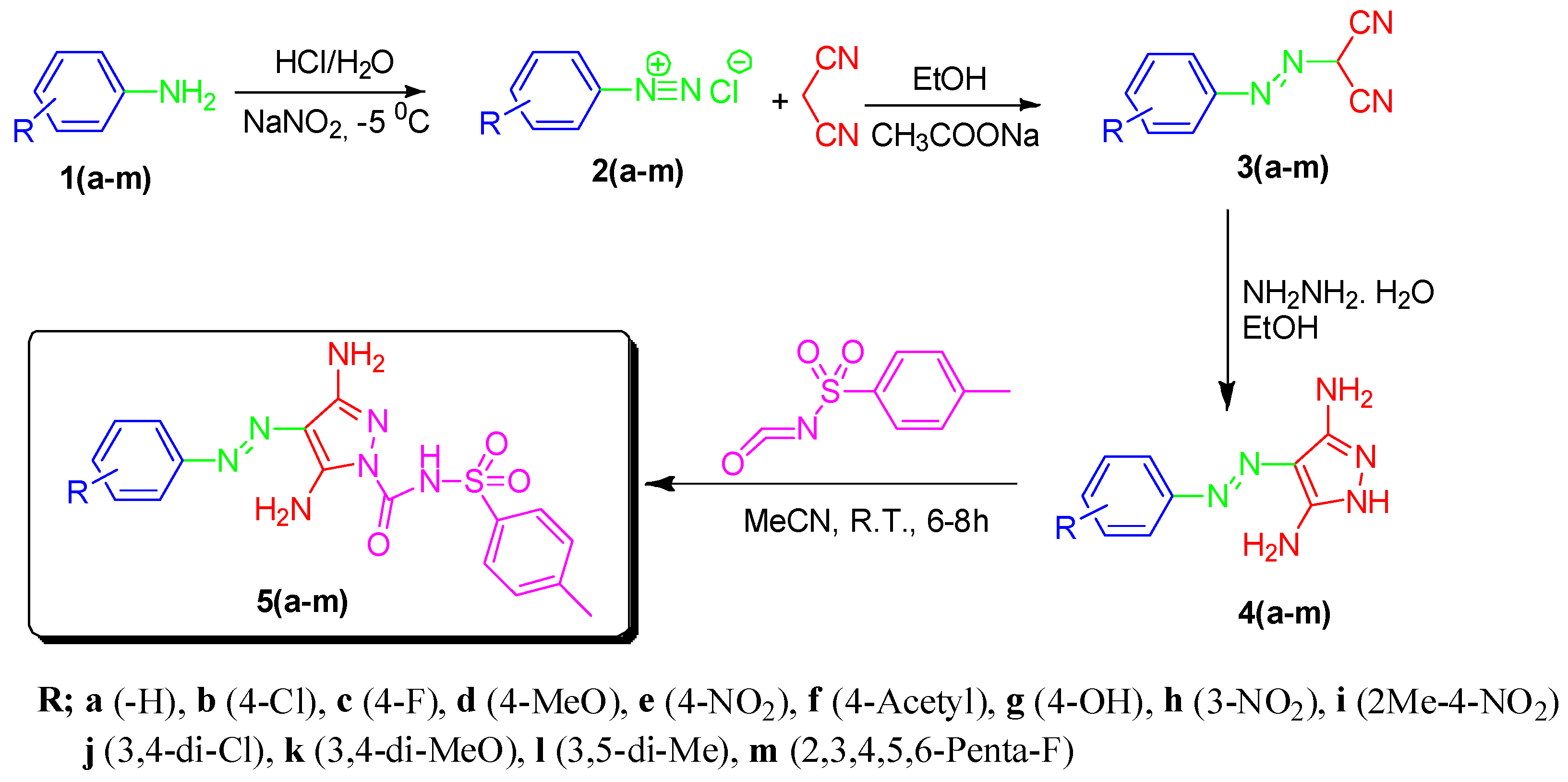
2.1. Chemistry
2.2. Biological Evaluation
2.2.1. In Vitro Cholinesterase Inhibition Profile
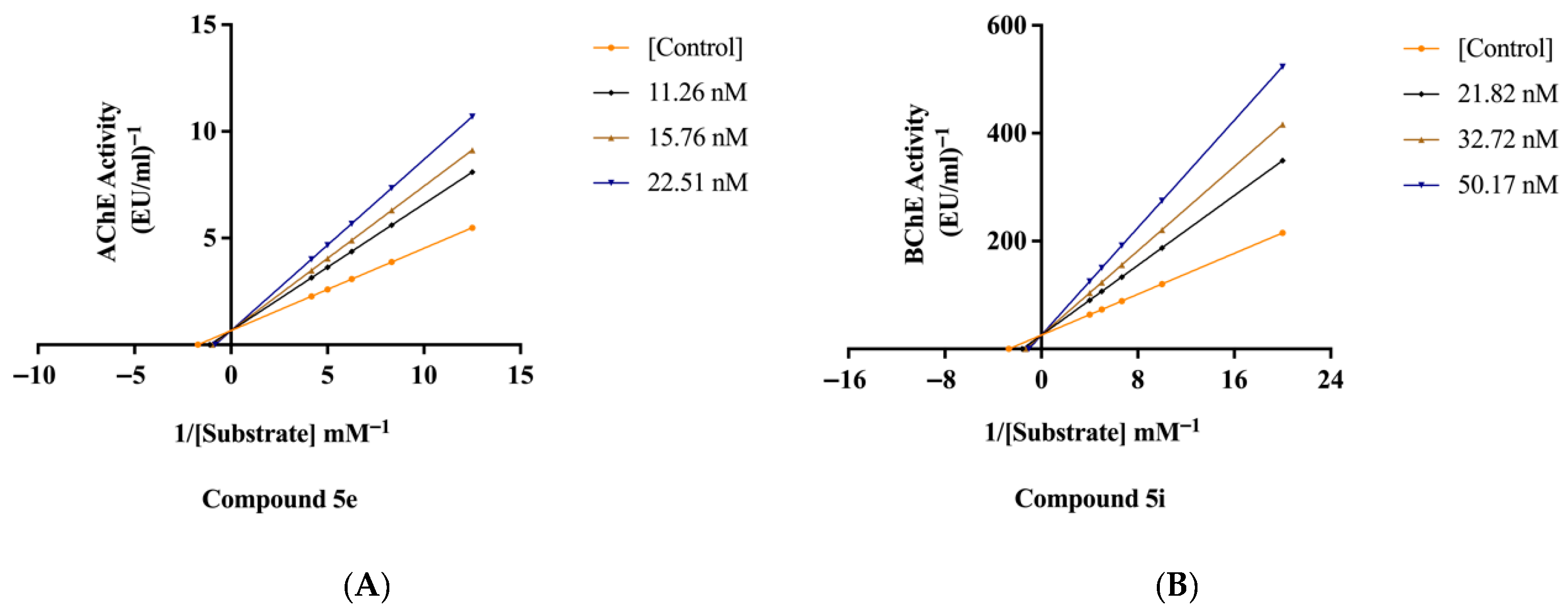
2.2.2. Most Active Compounds and Enzyme Preference
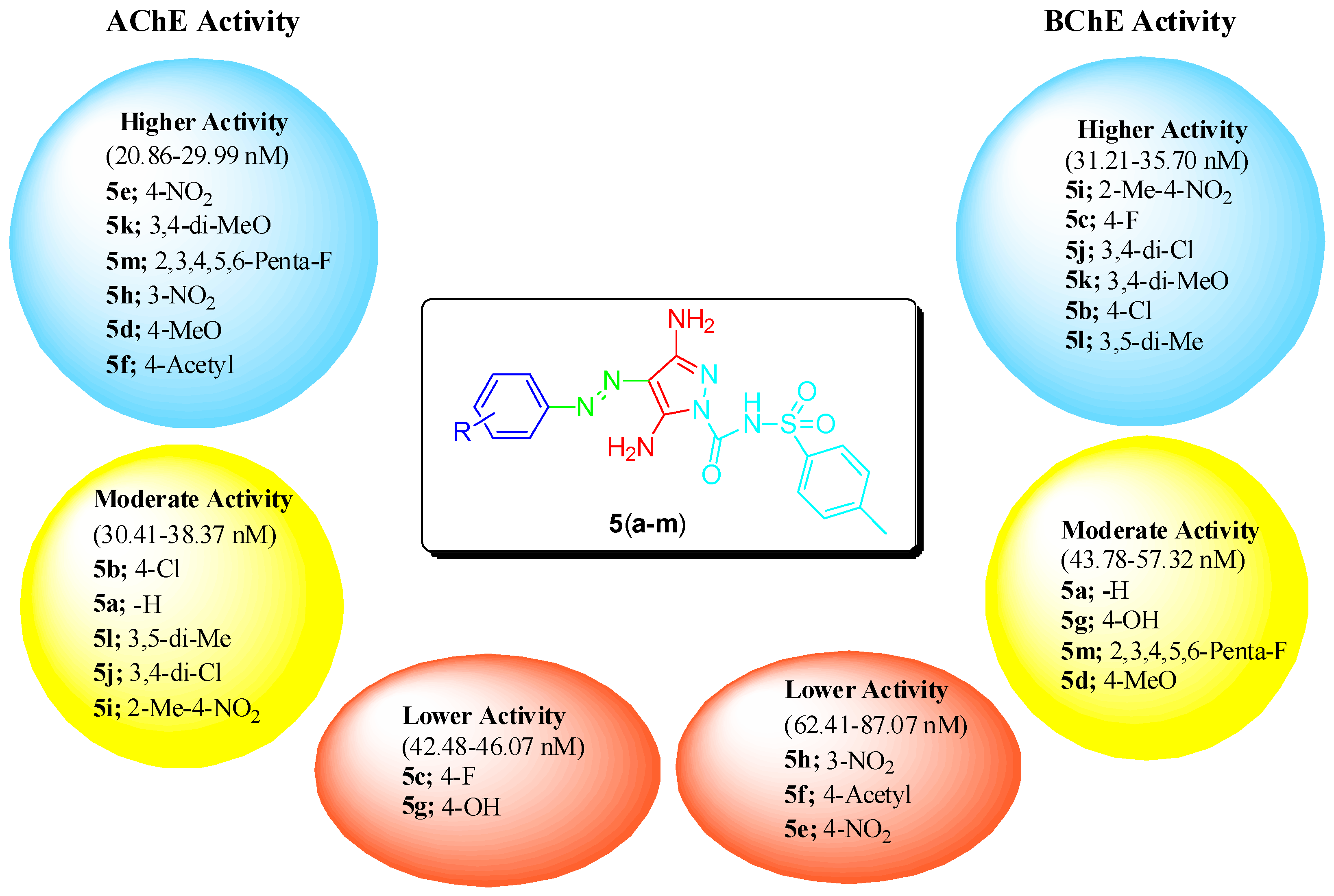
2.2.3. Structure–Activity Observations Within the 5(a–m) Set
2.2.4. Cytotoxicity Effects on Normal and Cancer Cell Lines
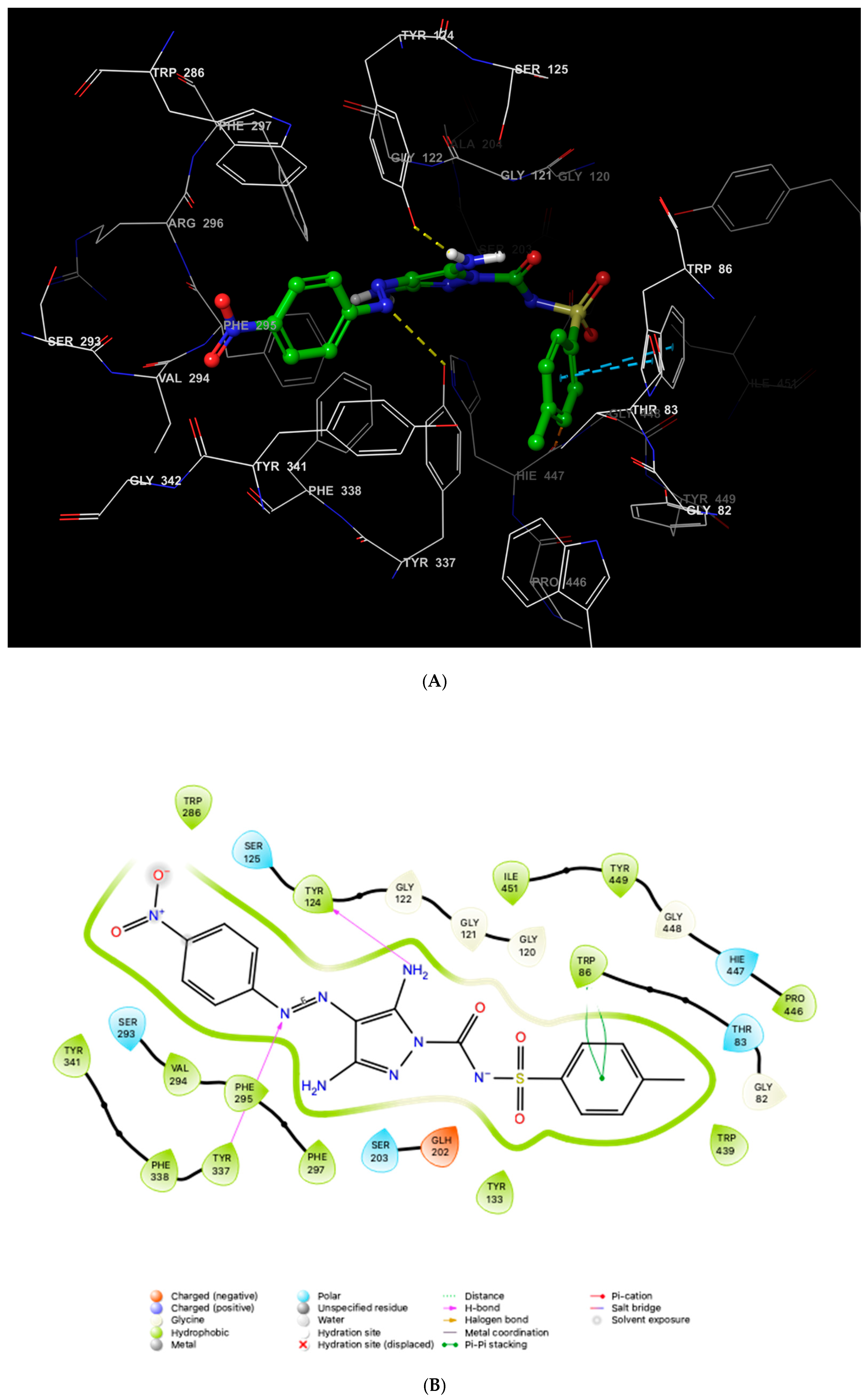
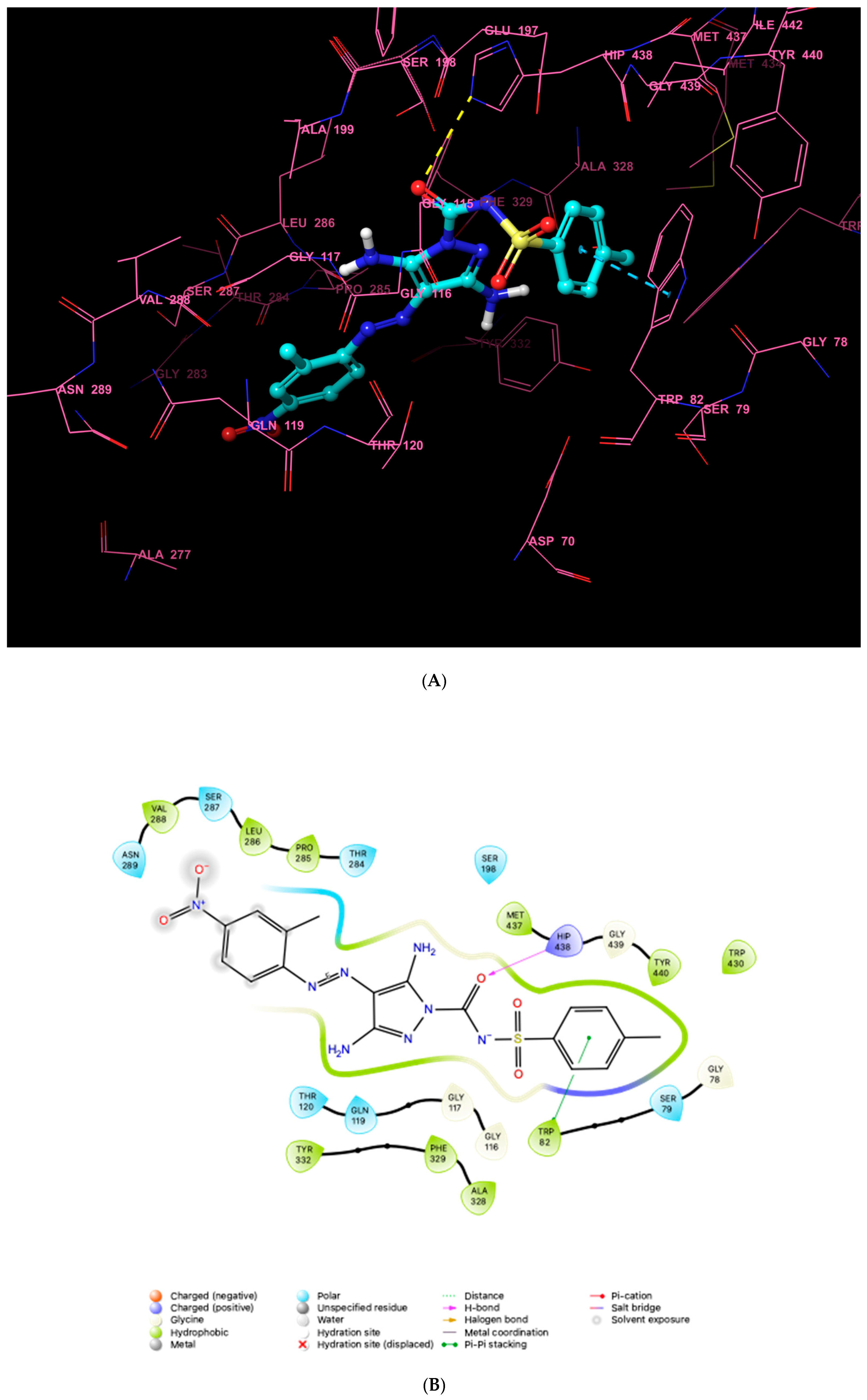
2.3. Molecular Docking Study
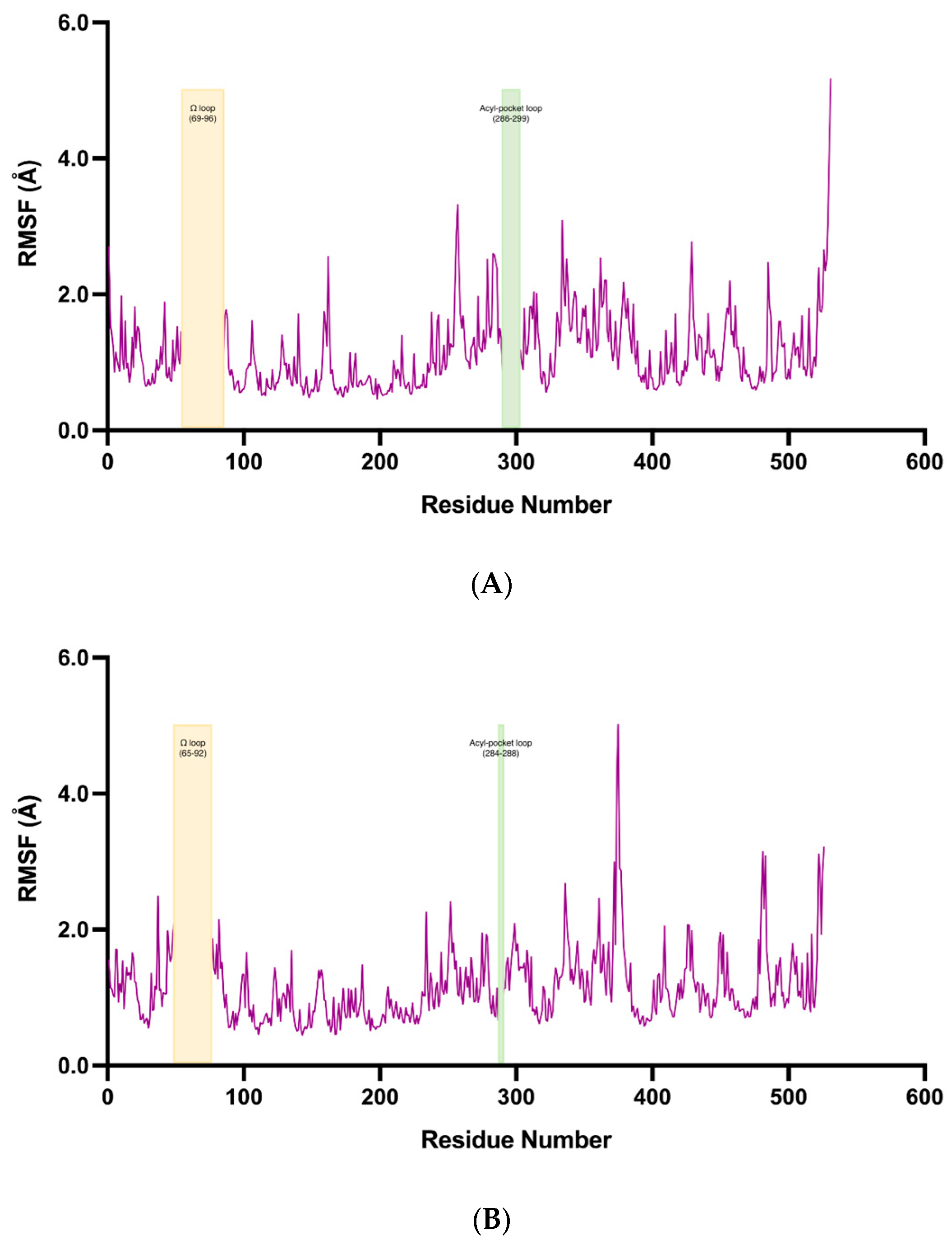
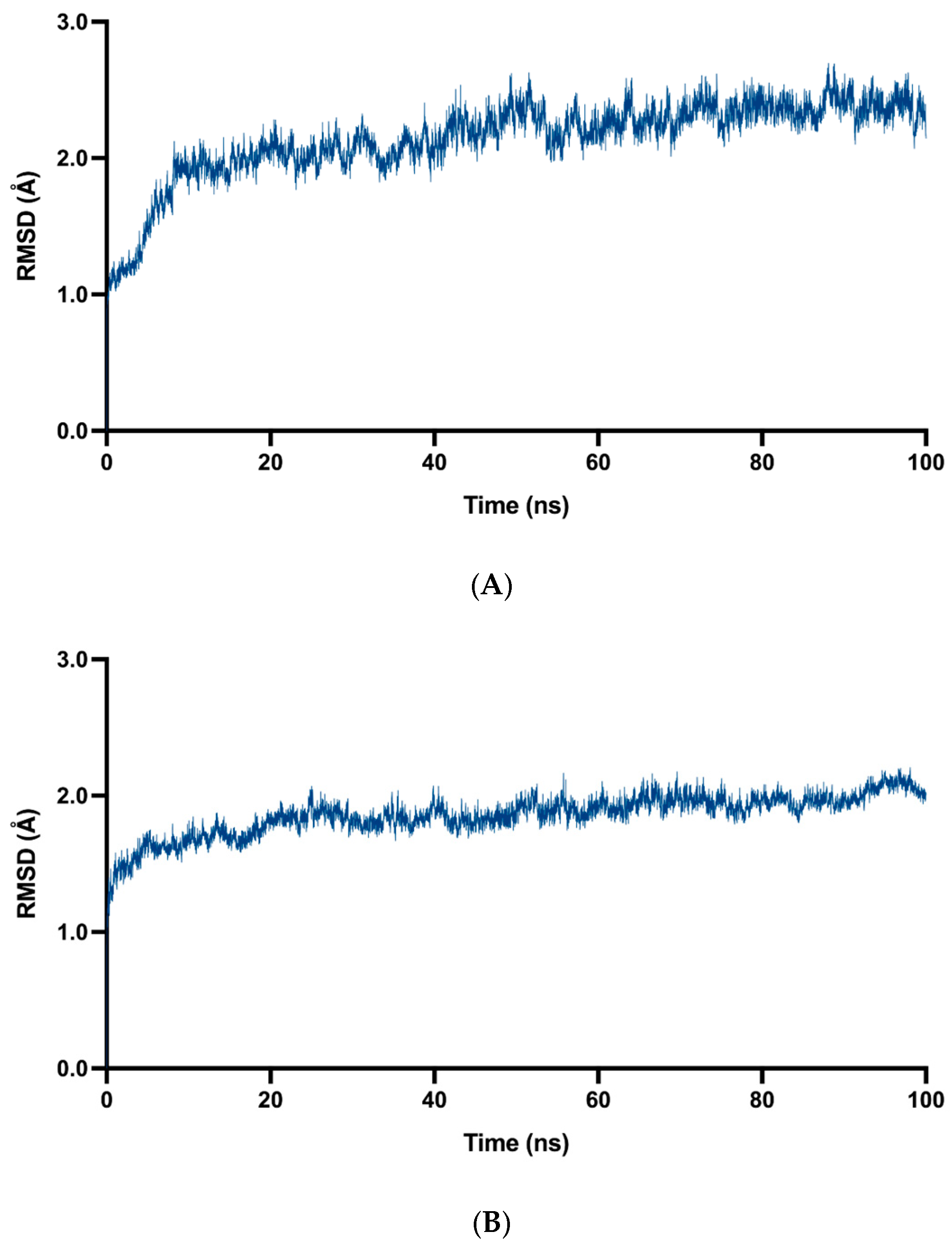
2.4. Molecular Dynamics (MD) Simulation
2.5. ADME/Tox. Study
3. Materials and Methods
3.1. Chemistry
3.2. Comprehensive Synthetic Approaches for the Novel 4-Arylazo-3,5-Diamino-N-Tosyl-1H-Pyrazole-1-Carboxamide Derivatives 5(a–m)
3.2.1. Diazotization and Coupling
3.2.2. Cyclization to Pyrazoles
3.2.3. Carbamoylation
3.2.4. 3,5-Diamino-4-(Phenyldiazenyl)-N-Tosyl-1H-Pyrazole-1-Carboxamide (5a)
3.2.5. 3,5-Diamino-4-[(4-Chlorophenyl)Diazinyl]-N-Tosyl-1H-Pyrazole-1-Carboxamide (5b)
3.2.6. 3,5-Diamino-4-[(4-Fluorophenyl)Diazinyl]-N-Tosyl-1H-Pyrazole-1-Carboxamide (5c)
3.2.7. 3,5-Diamino-4-[(4-Methoxyphenyl)Diazinyl]-N-Tosyl-1H-Pyrazole-1-Carboxamide (5d)
3.2.8. 3,5-Diamino-4-[(4-Nitrophenyl)Diazinyl]-N-Tosyl-1H-Pyrazole-1-Carboxamide (5e)
3.2.9. 3,5-Diamino-4-[(4-Acetylphenyl)Diazinyl]-N-Tosyl-1H-Pyrazole-1-Carboxamide (5f)
3.2.10. 3,5-Diamino-4-[(4-Hydroxyphenyl)Diazinyl]-N-Tosyl-1H-Pyrazole-1-Carboxamide (5g)
3.2.11. 3,5-Diamino-4-[(3-Nitrophenyl)Diazinyl]-N-Tosyl-1H-Pyrazole-1-Carboxamide (5h)
3.2.12. 3,5-Diamino-4-[(2-Methyl-4-Nitrophenyl)Diazinyl]-N-Tosyl-1H-Pyrazole-1-Carboxamide (5i)
3.2.13. 3,5-Diamino-4-[(3,4-Dichlorophenyl)Diazinyl]-N-Tosyl-1H-Pyrazole-1-Carboxamide (5j)
3.2.14. 3,5-Diamino-4-[(3,4-Dimethoxyphenyl)Diazinyl]-N-Tosyl-1H-Pyrazole-1-Carboxamide (5k)
3.2.15. 3,5-Diamino-4-[(3,5-Dimethylphenyl)Diazinyl]-N-Tosyl-1H-Pyrazole-1-Carboxamide (5l)
3.2.16. 3,5-Diamino-4-[(Perfluorophenyl)Diazinyl]-N-Tosyl-1H-Pyrazole-1-Carboxamide (5m)
3.3. Cholinesterase Inhibition Assay
3.4. Cytotoxicity and Anticancer Assay
3.5. Molecular Docking and ADME/Tox Analysis
3.6. Molecular Dynamics (MD) Analysis
4. Conclusions
Supplementary Materials
Author Contributions
Funding
Institutional Review Board Statement
Informed Consent Statement
Data Availability Statement
Acknowledgments
Conflicts of Interest
References
- 2024 Alzheimer’s disease facts and figures. Alzheimer’s Dement. 2024, 20, 3708–3821. [CrossRef]
- Azam, S.; Haque, M.E.; Balakrishnan, R.; Kim, I.-S.; Choi, D.-K. The Ageing Brain: Molecular and Cellular Basis of Neurodegeneration. Front. Cell Dev. Biol. 2021, 9, 683459. [Google Scholar] [CrossRef]
- Aarsland, D.; Batzu, L.; Halliday, G.M.; Geurtsen, G.J.; Ballard, C.; Ray Chaudhuri, K.; Weintraub, D. Parkinson disease-associated cognitive impairment. Nat. Rev. Dis. Prim. 2021, 7, 47. [Google Scholar] [CrossRef] [PubMed]
- Jia, J.; Xu, J.; Liu, J.; Wang, Y.; Wang, Y.; Cao, Y.; Guo, Q.; Qu, Q.; Wei, C.; Wei, W.; et al. Comprehensive Management of Daily Living Activities, behavioral and Psychological Symptoms, and Cognitive Function in Patients with Alzheimer’s Disease: A Chinese Consensus on the Comprehensive Management of Alzheimer’s Disease. Neurosci. Bull. 2021, 37, 1025–1038. [Google Scholar] [CrossRef] [PubMed]
- Zhang, J.; Zhang, Y.; Wang, J.; Xia, Y.; Zhang, J.; Chen, L. Recent advances in Alzheimer’s disease: Mechanisms, clinical trials and new drug development strategies. Signal Transduct. Target. Therap. 2024, 9, 211. [Google Scholar] [CrossRef]
- Se Thoe, E.; Fauzi, A.; Tang, Y.Q.; Chamyuang, S.; Chia, A.Y.Y. A review on advances of treatment modalities for Alzheimer’s disease. Life Sci. 2021, 276, 119129. [Google Scholar] [CrossRef]
- Chen, Z.-R.; Huang, J.-B.; Yang, S.-L.; Hong, F.-F. Role of Cholinergic Signaling in Alzheimer’s Disease. Molecules 2022, 27, 1816. [Google Scholar] [CrossRef]
- Huang, Q.; Liao, C.; Ge, F.; Ao, J.; Liu, T. Acetylcholine bidirectionally regulates learning and memory. J. Neurorestoratol. 2022, 10, 100002. [Google Scholar] [CrossRef]
- Giacobini, E.; Cuello, A.C.; Fisher, A. Reimagining cholinergic therapy for Alzheimer’s disease. Brain 2022, 145, 2250–2275. [Google Scholar] [CrossRef] [PubMed]
- Bekdash, R.A. The Cholinergic System, the Adrenergic System and the Neuropathology of Alzheimer’s Disease. Int. J. Mol. Sci. 2021, 22, 1273. [Google Scholar] [CrossRef]
- Obaid, R.J.; Mughal, E.U.; Naeem, N.; Al-Rooqi, M.M.; Sadiq, A.; Jassas, R.S.; Moussa, Z.; Ahmed, S.A. Pharmacological significance of nitrogen-containing five and six-membered heterocyclic scaffolds as potent cholinesterase inhibitors for drug discovery. Process Biochem. 2022, 120, 250–259. [Google Scholar] [CrossRef]
- Bingul, M.; Ercan, S.; Boga, M.; Arslan, Z.; Tuneğ, M.; Akocak, S.; Bingul, A.A.; Sengul, İ.F.; Sahin, H. The Anticholinesterase Perspective of Dimethoxyindole Based Benzenesulfonamides: Synthesis, Biological Investigation and Molecular Docking Applications. ChemistrySelect 2024, 9, e202400895. [Google Scholar] [CrossRef]
- Haake, A.; Nguyen, K.; Friedman, L.; Chakkamparambil, B.; Grossberg, G.T. An update on the utility and safety of cholinesterase inhibitors for the treatment of Alzheimer’s disease. Expert Opin. Drug Saf. 2020, 19, 147–157. [Google Scholar] [CrossRef]
- Miles, J.A.; Ross, B.P. Recent Advances in Virtual Screening for Cholinesterase Inhibitors. ACS Chem. Neurosci. 2021, 12, 30–41. [Google Scholar] [CrossRef]
- Varadharajan, A.; Davis, A.D.; Ghosh, A.; Jagtap, T.; Xavier, A.; Menon, A.J.; Roy, D.; Gandhi, S.; Gregor, T. Guidelines for pharmacotherapy in Alzheimer’s disease—A primer on FDA-approved drugs. J. Neurosci. Rural. Pract. 2023, 14, 566–573. [Google Scholar] [CrossRef]
- Bortolami, M.; Rocco, D.; Messore, A.; Di Santo, R.; Costi, R.; Madia, V.N.; Scipione, L.; Pandolfi, F. Acetylcholinesterase inhibitors for the treatment of Alzheimer’s disease—A patent review (2016–present). Expert Opin. Ther. Pat. 2021, 31, 399–420. [Google Scholar] [CrossRef]
- Pardo-Moreno, T.; González-Acedo, A.; Rivas-Domínguez, A.; García-Morales, V.; García-Cozar, F.J.; Ramos-Rodríguez, J.J.; Melguizo-Rodríguez, L. Therapeutic Approach to Alzheimer’s Disease: Current Treatments and New Perspectives. Pharmaceutics 2022, 14, 1117. [Google Scholar] [CrossRef]
- Yu, T.-W.; Lane, H.-Y.; Lin, C.-H. Novel Therapeutic Approaches for Alzheimer’s Disease: An Updated Review. Int. J. Mol. Sci. 2021, 22, 8208. [Google Scholar] [CrossRef]
- Kerru, N.; Gummidi, L.; Maddila, S.; Gangu, K.K.; Jonnalagadda, S.B. A Review on Recent Advances in Nitrogen-Containing Molecules and Their Biological Applications. Molecules 2020, 25, 1909. [Google Scholar] [CrossRef]
- Ansari, A.; Ali, A.; Asif, M. Biologically active pyrazole derivatives. New J. Chem. 2017, 41, 16–41. [Google Scholar] [CrossRef]
- Bräse, S. Privileged Scaffolds in Medicinal Chemistry: Design, Synthesis, Evaluation; Royal Society of Chemistry (RSC) Publisher: Cambridge, UK, 2015. [Google Scholar] [CrossRef]
- Bennani, F.E.; Doudach, L.; Cherrah, Y.; Ramli, Y.; Karrouchi, K.; Ansar, M.h.; Faouzi, M.E.A. Overview of recent developments of pyrazole derivatives as an anticancer agent in different cell line. Bioorg. Chem. 2020, 97, 103470. [Google Scholar] [CrossRef]
- El-Sehemi, A.G.; Bondock, S.; Ammar, Y.A. Transformations of naproxen into pyrazolecarboxamides: Search for potent anti-inflammatory, analgesic and ulcerogenic agents. Med. Chem. Res. 2014, 23, 827–838. [Google Scholar] [CrossRef]
- Küçükgüzel, Ş.G.; Şenkardeş, S. Recent advances in bioactive pyrazoles. Eur. J. Med. Chem. 2015, 97, 786–815. [Google Scholar] [CrossRef]
- Srour, A.M.; Fahmy, H.H.; Khater, M.A.; Zarie, E.S.; Mohamed, S.S.; Abdelhameed, M.F. Synthesis, anti-inflammatory properties, molecular modelling and potential COX-2, TNF-α, PGE2 and IL1β inhibitors of pyrazole-based scaffolds. J. Mol. Struct. 2022, 1266, 133499. [Google Scholar] [CrossRef]
- Priya, D.; Gopinath, P.; Dhivya, L.S.; Vijaybabu, A.; Haritha, M.; Palaniappan, S.; Kathiravan, M.K. Structural Insights into Pyrazoles as Agents against Anti-inflammatory and Related Disorders. ChemistrySelect 2022, 7, e202104429. [Google Scholar] [CrossRef]
- Ramadan, M.; Ashraf, A.A.; Lamiaa, E.A.; Mohammed, B.A.; Bräse, S. Substituted Pyrazoles and Their Heteroannulated Analogs—Recent Syntheses and Biological Activities. Molecules 2021, 26, 4995. [Google Scholar] [CrossRef]
- Aly, A.A.; Sayed, S.M.; Abdelhafez, E.M.N.; Abdelhafez, S.M.N.; Abdelzaher, W.Y.; Raslan, M.A.; Ahmed, A.E.; Thabet, K.; El-Reedy, A.A.M.; Brown, A.B.; et al. New quinoline-2-one/pyrazole derivatives; design, synthesis, molecular docking, anti-apoptotic evaluation, and caspase-3 inhibition assay. Bioorg. Chem. 2020, 94, 103348. [Google Scholar] [CrossRef] [PubMed]
- Kattimani, P.P.; Kamble, R.R.; Nesaragi, A.R.; Kariduraganavar, M.Y.; Joshi, S.D.; Dodamani, S.S.; Jalalpure, S.S. Novel pyrazole derivatives via ring transformations: Anti-inflammatory and antifungal activity studies. Synth. Commun. 2021, 51, 3125–3140. [Google Scholar] [CrossRef]
- Lusardi, M.; Spallarossa, A.; Brullo, C. Amino-Pyrazoles in Medicinal Chemistry: A Review. Int. J. Mol. Sci. 2023, 24, 7834. [Google Scholar] [CrossRef]
- Delpe-Acharige, A.; Zhang, M.; Eschliman, K.; Dalecki, A.; Covarrubias-Zambrano, O.; Minjarez-Almeida, A.; Shrestha, T.; Lewis, T.; Al-Ibrahim, F.; Leonard, S.; et al. Pyrazolyl Thioureas and Carbothioamides with an NNSN Motif against MSSA and MRSA. ACS Omega 2021, 6, 6088–6099. [Google Scholar] [CrossRef] [PubMed]
- Liu, T.; Cui, R.; Chen, J.; Zhang, J.; He, Q.; Yang, B.; Hu, Y. 4,5-Diaryl-3-aminopyrazole Derivatives as Analogs of Combretastatin A-4: Synthesis and Biological Evaluation. Arch. Pharm. 2011, 344, 279–286. [Google Scholar] [CrossRef] [PubMed]
- Burgart, Y.V.; Agafonova, N.A.; Shchegolkov, E.V.; Krasnykh, O.P.; Kushch, S.O.; Evstigneeva, N.P.; Gerasimova, N.A.; Maslova, V.V.; Triandafilova, G.A.; Solodnikov, S.Y.; et al. Multiple biological active 4-aminopyrazoles containing trifluoromethyl and their 4-nitroso-precursors: Synthesis and evaluation. Eur. J. Med. Chem. 2020, 208, 112768. [Google Scholar] [CrossRef] [PubMed]
- Burgart, Y.V.; Makhaeva, G.F.; Krasnykh, O.P.; Borisevich, S.S.; Agafonova, N.A.; Kovaleva, N.V.; Boltneva, N.P.; Rudakova, E.V.; Shchegolkov, E.V.; Triandafilova, G.A.; et al. Synthesis of 4-Aminopyrazol-5-ols as Edaravone Analogs and Their Antioxidant Activity. Molecules 2022, 27, 7722. [Google Scholar] [CrossRef] [PubMed]
- Modi, P.; Patel, S.; Chhabria, M. Discovery of newer pyrazole derivatives with potential anti-tubercular activity via 3D-QSAR based pharmacophore modelling, virtual screening, molecular docking and molecular dynamics simulation studies. Mol. Divers. 2023, 27, 1547–1566. [Google Scholar] [CrossRef]
- Abdellatif, K.R.A.; Abdelall, E.K.A.; Lamie, P.F.; Labib, M.B.; El-Nahaas, E.-S.; Abdelhakeem, M.M. New pyrazole derivatives possessing amino/methanesulphonyl pharmacophore with good gastric safety profile: Design, synthesis, cyclooxygenase inhibition, anti-inflammatory activity and histopathological studies. Bioorg. Chem. 2020, 95, 103540. [Google Scholar] [CrossRef]
- Hebishy, A.M.S.; Salama, H.T.; Elgemeie, G.H. New Route to the Synthesis of Benzamide-Based 5-Aminopyrazoles and Their Fused Heterocycles Showing Remarkable Antiavian Influenza Virus Activity. ACS Omega 2020, 5, 25104–25112. [Google Scholar] [CrossRef]
- Brullo, C.; Massa, M.; Rapetti, F.; Alfei, S.; Bertolotto, M.B.; Montecucco, F.; Signorello, M.G.; Bruno, O. New Hybrid Pyrazole and Imidazopyrazole Antinflammatory Agents Able to Reduce ROS Production in Different Biological Targets. Molecules 2020, 25, 899. [Google Scholar] [CrossRef]
- Kryštof, V.; Cankař, P.; Fryšová, I.; Slouka, J.; Kontopidis, G.; Džubák, P.; Hajdúch, M.; Srovnal, J.; de Azevedo, W.F.; Orság, M.; et al. 4-Arylazo-3,5-diamino-1H-pyrazole CDK Inhibitors: SAR Study, Crystal Structure in Complex with CDK2, Selectivity, and Cellular Effects. J. Med. Chem. 2006, 49, 6500–6509. [Google Scholar] [CrossRef]
- Ismail, M.M.F.; Soliman, D.H.; Sabour, R.; Farrag, A.M. Synthesis of new arylazopyrazoles as apoptosis inducers: Candidates to inhibit proliferation of MCF-7 cells. Arch. Pharm. 2021, 354, 2000214. [Google Scholar] [CrossRef]
- Corona, A.; Onnis, V.; Deplano, A.; Bianco, G.; Demurtas, M.; Distinto, S.; Cheng, Y.-C.; Alcaro, S.; Esposito, F.; Tramontano, E. Design, synthesis and antiviral evaluation of novel heteroarylcarbothioamide derivatives as dual inhibitors of HIV-1 reverse transcriptase-associated RNase H and RDDP functions. Pathog. Dis. 2017, 75, ftx078. [Google Scholar] [CrossRef]
- Jansen, C.U.; Uhd, J.; Andersen, J.B.; Hultqvist, L.D.; Jakobsen, T.H.; Nilsson, M.; Nielsen, T.E.; Givskov, M.; Tolker-Nielsen, T.; Qvortrup, K.M. SAR study of 4-arylazo-3,5-diamino-1H-pyrazoles: Identification of small molecules that induce dispersal of Pseudomonas aeruginosa biofilms. RSC Med. Chem. 2021, 12, 1868–1878. [Google Scholar] [CrossRef]
- Akocak, S.; Lolak, N.; Giovannuzzi, S.; Supuran, C.T. Potent and selective carbonic anhydrase inhibition activities of pyrazolones bearing benzenesulfonamides. Bioorg. Med. Chem. Lett. 2023, 95, 129479. [Google Scholar] [CrossRef]
- Yapar, G.; Lolak, N.; Bonardi, A.; Akocak, S.; Supuran, C.T. Exploring the potency of diazo-coumarin containing hybrid molecules: Selective inhibition of tumor-associated carbonic anhydrase isoforms IX and XII. ChemMedChem 2024, 19, e202300626. [Google Scholar] [CrossRef]
- Jorda, R.; Schütznerová, E.; Cankař, P.; Brychtová, V.; Navrátilová, J.; Kryštof, V. Novel arylazopyrazole inhibitors of cyclin-dependent kinases. Bioorg. Med. Chem. 2015, 23, 1975–1981. [Google Scholar] [CrossRef]
- Schütznerová, E.; Popa, I.; Kryštof, V.; Koshino, H.; Trávníček, Z.; Hradil, P.; Cankař, P. Utilization of DmbNHNH2 in the synthesis of amino-substituted 4-((3,5-diamino-1H-pyrazol-4-yl)diazenyl)phenols. Tetrahedron 2012, 68, 3996–4002. [Google Scholar] [CrossRef]
- Husseiny, E.M.; Abulkhair, H.S.; El-Dydamony, N.M.; Anwer, K.E. Exploring the cytotoxic effect and CDK-9 inhibition potential of novel sulfaguanidine-based azopyrazolidine-3,5-diones and 3,5-diaminoazopyrazoles. Bioorg. Chem. 2023, 133, 106397. [Google Scholar] [CrossRef]
- Akocak, S.; Lolak, N.; Ammara, A.; Güler, Ö.Ö.; Supuran, C.T. Exploring the Carbonic Anhydrase Activation Properties of 4-arylazo-3,5-diamino-1H-pyrazoles against hCA I, II, IV, and VII isoenzymes. Curr. Top. Med. Chem. 2025, 25, 3281–3290. [Google Scholar] [CrossRef]
- Lolak, N.; Akocak, S.; Topal, M.; Koçyiğit, Ü.M.; Işık, M.; Türkeş, C.; Topal, F.; Durgun, M.; Beydemir, Ş. Sulfonamide-Bearing Pyrazolone Derivatives as Multitarget Therapeutic Agents: Design, Synthesis, Characterization, Biological Evaluation, In Silico ADME/T Profiling and Molecular Docking Study. Pharmacol. Res. Pers. 2025, 13, e70088. [Google Scholar] [CrossRef]
- Li, H.-H.; Wu, C.; Zhang, S.-L.; Yang, J.-G.; Qin, H.-L.; Tang, W. Fluorosulfate-containing pyrazole heterocycles as selective BuChE inhibitors: Structure-activity relationship and biological evaluation for the treatment of Alzheimer’s disease. J. Enzym. Inhib. Med. Chem. 2022, 37, 2099–2111. [Google Scholar] [CrossRef] [PubMed]
- Benazzouz-Touami, A.; Chouh, A.; Halit, S.; Terrachet-Bouaziz, S.; Makhloufi-Chebli, M.; Ighil-Ahriz, K.; Silva, A.M.S. New Coumarin-Pyrazole hybrids: Synthesis, Docking studies and Biological evaluation as potential cholinesterase inhibitors. J. Mol. Struct. 2022, 1249, 131591. [Google Scholar] [CrossRef]
- Durgun, M.; Akocak, S.; Lolak, N.; Topal, F.; Koçyiğit, Ü.M.; Türkeş, C.; Işık, M.; Beydemir, Ş. Design and Synthesis of Pyrazole Carboxamide Derivatives as Selective Cholinesterase and Carbonic Anhydrase Inhibitors: Molecular Docking and Biological Evaluation. Chem. Biodivers. 2024, 21, e202301824. [Google Scholar] [CrossRef] [PubMed]
- Becker, K.; Erckenbrecht, J.F.; Häussinger, D.; Fueling, T. Cardiotoxicity of the Antiprolif erative Compound Fluorouracil. Drugs 1999, 57, 475–484. [Google Scholar] [CrossRef]
- Gundogdu, S.; Duran, H.E.; Arslan, M.; Çetinkaya, B.D.; Türkeş, C. Fluorenyl-phthalimide hybrids as potent aldose reductase inhibitors with selective anticancer activity: Rational design, synthesis, and molecular insights. Bioorg. Chem. 2025, 163, 108689. [Google Scholar] [CrossRef] [PubMed]
- Lica, J.J.; Wieczór, M.; Grabe, G.J.; Heldt, M.; Jancz, M.; Misiak, M.; Gucwa, K.; Brankiewicz, W.; Maciejewska, N.; Stupak, A.; et al. Effective Drug Concentration and Selectivity Depends on Fraction of Primitive Cells. Int. J. Mol. Sci. 2021, 22, 4931. [Google Scholar] [CrossRef] [PubMed]
- Dileep, K.V.; Ihara, K.; Mishima-Tsumagari, C.; Kukimoto-Niino, M.; Yonemochi, M.; Hanada, K.; Shirouzu, M.; Zhang, K.Y.J. Crystal structure of human acetylcholinesterase in complex with tacrine: Implications for drug discovery. Int. J. Biol. Macromol. 2022, 210, 172–181. [Google Scholar] [CrossRef]
- Nachon, F.; Carletti, E.; Ronco, C.; Trovaslet, M.; Nicolet, Y.; Jean, L.; Renard, P.-Y. Crystal structures of human cholinesterases in complex with huprine W and tacrine: Elements of specificity for anti-Alzheimer’s drugs targeting acetyl- and butyryl-cholinesterase. Biochem. J. 2013, 453, 393–399. [Google Scholar] [CrossRef] [PubMed]
- Ellman, G.L.; Courtney, K.D.; Andres, V.; Featherstone, R.M. A new and rapid colorimetric determination of acetylcholinesterase activity. Biochem. Pharmacol. 1961, 7, 88–95. [Google Scholar] [CrossRef]
- Türkeş, C.; Lolak, N.; Duran, H.E.; Yapar, G.; Akocak, S. Molecular and structural characterization of ureido-benzenesulfonamides as dual inhibitors of aldose reductase and cholinesterases. Arch. Biochem. Biophys. 2025, 773, 110594. [Google Scholar] [CrossRef]
- Yung-Chi, C.; Prusoff, W.H. Relationship between the inhibition constant (KI) and the concentration of inhibitor which causes 50 per cent inhibition (I50) of an enzymatic reaction. Biochem. Pharmacol. 1973, 22, 3099–3108. [Google Scholar] [CrossRef]
- Lineweaver, H.; Burk, D. The Determination of Enzyme Dissociation Constants. J. Am. Chem. Soc. 1934, 56, 658–666. [Google Scholar] [CrossRef]
- Mosmann, T. Rapid colorimetric assay for cellular growth and survival: Application to proliferation and cytotoxicity assays. J. Immunol. Methods 1983, 65, 55–63. [Google Scholar] [CrossRef]
- Ince-Erguc, E.; Durgun, K.; Akdemir, A.; Suzen, S.; Gurer-Orhan, H. Design, Synthesis, and Investigation of Anticancer and Antioxidant Potential of Novel Indole-Based Melatonin Analogues in Breast Cancer. ChemistrySelect 2024, 9, e202400817. [Google Scholar] [CrossRef]
- Shelley, J.C.; Cholleti, A.; Frye, L.L.; Greenwood, J.R.; Timlin, M.R.; Uchimaya, M. Epik: A software program for pKaprediction and protonation state generation for drug-like molecules. J. Comput.-Aided Mol. Des. 2007, 21, 681–691. [Google Scholar] [CrossRef] [PubMed]
- Halgren, T.A. Identifying and Characterizing Binding Sites and Assessing Druggability. J. Chem. Inf. Model. 2009, 49, 377–389. [Google Scholar] [CrossRef]
- Friesner, R.A.; Banks, J.L.; Murphy, R.B.; Halgren, T.A.; Klicic, J.J.; Mainz, D.T.; Repasky, M.P.; Knoll, E.H.; Shelley, M.; Perry, J.K.; et al. Glide: A New Approach for Rapid, Accurate Docking and Scoring. 1. Method and Assessment of Docking Accuracy. J. Med. Chem. 2004, 47, 1739–1749. [Google Scholar] [CrossRef]
- Halgren, T.A.; Murphy, R.B.; Friesner, R.A.; Beard, H.S.; Frye, L.L.; Pollard, W.T.; Banks, J.L. Glide: A New Approach for Rapid, Accurate Docking and Scoring. 2. Enrichment Factors in Database Screening. J. Med. Chem. 2004, 47, 1750–1759. [Google Scholar] [CrossRef]
- Daina, A.; Michielin, O.; Zoete, V. SwissADME: A free web tool to evaluate pharmacokinetics, drug-likeness and medicinal chemistry friendliness of small molecules. Sci. Rep. 2017, 7, 42717. [Google Scholar] [CrossRef]
- Türkeş, C. Machine learning-guided repurposing of FDA-approved quinolones as dual cholinesterase inhibitors: A multi-level docking, molecular dynamics, DFT, and SHAP-based analysis. J. Mol. Graph. Model. 2026, 143, 109259. [Google Scholar] [CrossRef] [PubMed]




| Compound ID | AChE | BChE | ||
|---|---|---|---|---|
| KI (nM) | R2 | KI (nM) | R2 | |
| 5a | 30.65 ± 2.54 | 0.9874 | 43.78 ± 2.68 | 0.9876 |
| 5b | 30.41 ± 2.65 | 0.9864 | 35.58 ± 2.06 | 0.9881 |
| 5c | 42.48 ± 3.36 | 0.9884 | 31.45 ± 2.80 | 0.9886 |
| 5d | 29.84 ± 2.37 | 0.9875 | 57.32 ± 3.65 | 0.9870 |
| 5e | 20.86 ± 1.61 | 0.9883 | 87.07 ± 5.67 | 0.9868 |
| 5f | 29.99 ± 2.30 | 0.9885 | 86.18 ± 4.92 | 0.9888 |
| 5g | 46.07 ± 2.31 | 0.9892 | 44.56 ± 3.94 | 0.9882 |
| 5h | 28.78 ± 2.28 | 0.9873 | 62.41 ± 6.11 | 0.9867 |
| 5i | 38.37 ± 2.05 | 0.9875 | 31.21 ± 2.65 | 0.9890 |
| 5j | 36.52 ± 2.71 | 0.9886 | 34.13 ± 2.99 | 0.9888 |
| 5k | 27.04 ± 2.10 | 0.9879 | 34.55 ± 3.21 | 0.9872 |
| 5l | 32.82 ± 2.44 | 0.9888 | 35.70 ± 3.08 | 0.9889 |
| 5m | 27.20 ± 2.20 | 0.9876 | 53.05 ± 3.31 | 0.9874 |
| THA a | 164.40 ± 20.84 | 0.9716 | 341.80 ± 53.35 | 0.9568 |
| Compound ID | IC50 (μM) | SI | |||
|---|---|---|---|---|---|
| Beas-2B | A549 | MCF-7 | A549 | MCF-7 | |
| 5a | 185.12 | 226.99 | ND b | 0.82 | ND b |
| 5b | 221.49 | 260.00 | 142.55 | 0.85 | 1.55 |
| 5c | 502.47 | 139.53 | 113.76 | 3.60 | 4.42 |
| 5d | 10.36 | 105.34 | 28.18 | 0.10 | 0.37 |
| 5e | 93.61 | 236.01 | 1245.98 | 0.40 | 0.08 |
| 5f | 496.79 | 492.63 | 258.05 | 1.01 | 1.93 |
| 5g | 28.28 | 26.98 | 129.93 | 1.05 | 0.22 |
| 5h | 88.38 | 110.27 | ND b | 0.80 | ND b |
| 5i | 272.25 | 82.96 | ND b | 3.28 | ND b |
| 5j | ND a | 212.18 | ND b | ND b | ND b |
| 5k | 62.18 | 114.30 | 271.94 | 0.54 | 0.23 |
| 5l | 200.00 | 174.52 | 277.07 | 1.15 | 0.72 |
| 5m | 226.06 | ND a | ND b | ND b | ND b |
| 5-FU a | 213.26 | 249.08 | 248.79 | 0.86 | ND b |
| Complex | Residue | Interaction Type | Occupancy (% Frames) |
|---|---|---|---|
| 7XN1–5e | Trp86 | π–π/aromatic contact | 62.9; 53.1 |
| 7XN1–5e | Tyr124 | Hydrogen bond | 44.8 |
| 7XN1–5e | Tyr449 | Hydrogen bond | 37.9 |
| 7XN1–5e | Trp439 | Hydrogen bond | 36.0 |
| 7XN1–5e | Tyr449 | π–π/aromatic contact | 32.4 |
| 7XN1–5e | Ser125 | Hydrogen bond | 32.0 |
| 4BDS–5i | Ser287 | Hydrogen bond | 42.8; 13.0 |
| 4BDS–5i | Tyr332 | π–π/aromatic contact | 32.0 |
| 4BDS–5i | Asp70 | Salt bridge/ionic interaction | 26.6; 15.1 |
| 4BDS–5i | Gln119 | Hydrogen bond | 23.1 |
| Properties | Parameters | Compound ID | |||||||||||||
|---|---|---|---|---|---|---|---|---|---|---|---|---|---|---|---|
| 5a | 5b | 5c | 5d | 5e | 5f | 5g | 5h | 5i | 5j | 5k | 5l | 5m | THA a | ||
| Physicochemical properties | MW (g/mol) | 399.43 | 433.87 | 417.42 | 429.45 | 444.42 | 441.46 | 415.43 | 444.42 | 458.45 | 468.32 | 459.48 | 427.48 | 489.38 | 198.26 |
| Heavy atoms | 28 | 29 | 29 | 30 | 31 | 31 | 29 | 31 | 32 | 30 | 32 | 30 | 33 | 15 | |
| Aromatic heavy atoms | 17 | 17 | 17 | 17 | 17 | 17 | 17 | 17 | 17 | 17 | 17 | 17 | 17 | 10 | |
| Rotatable atoms | 6 | 6 | 6 | 7 | 7 | 7 | 6 | 7 | 7 | 6 | 8 | 6 | 6 | 0 | |
| H-bond acceptors | 6 | 6 | 7 | 7 | 8 | 7 | 7 | 8 | 8 | 6 | 8 | 6 | 11 | 1 | |
| H-bond donors | 3 | 3 | 3 | 3 | 3 | 3 | 4 | 3 | 3 | 3 | 3 | 3 | 3 | 1 | |
| Molar refractivity | 103.89 | 108.90 | 103.85 | 110.38 | 112.71 | 114.08 | 105.91 | 112.71 | 117.68 | 113.91 | 116.87 | 113.82 | 103.68 | 63.58 | |
| Lipophilicity | M Log P | 1.04 | 1.54 | 1.42 | 0.78 | 0.26 | 0.68 | 0.54 | 0.26 | 0.49 | 2.04 | 0.53 | 1.51 | 2.96 | 2.33 |
| Water solubility | LogS (ESOL) | −4.30 | −4.90 | −4.46 | −4.38 | −4.37 | −4.25 | −4.16 | −4.37 | −4.67 | −5.49 | −4.45 | −4.91 | −5.11 | −3.27 |
| Pharmacokinetics | BBB permeant | No | No | No | No | No | No | No | No | No | No | No | No | No | Yes |
| CYP1A2 inhibitor | No | No | Yes | No | No | No | No | No | No | Yes | No | No | Yes | Yes | |
| CYP2C19 inhibitor | No | No | No | No | Yes | No | No | Yes | Yes | Yes | Yes | No | No | No | |
| CYP2C9 inhibitor | Yes | Yes | Yes | Yes | Yes | Yes | No | Yes | Yes | Yes | Yes | Yes | No | No | |
| CYP3A4 inhibitor | No | Yes | No | Yes | Yes | Yes | No | No | Yes | Yes | Yes | Yes | No | Yes | |
| Druglikeness | Lipinski violation | 0 | 0 | 0 | 1 | 1 | 1 | 1 | 1 | 1 | 0 | 1 | 0 | 0 | 0 |
| Ghose violation | Yes | Yes | Yes | Yes | Yes | Yes | Yes | Yes | Yes | Yes | Yes | Yes | Yes | Yes | |
| Veber violation | 1 | 1 | 1 | 1 | 1 | 1 | 1 | 1 | 1 | 1 | 1 | 1 | 1 | 1 | |
| Medicinal chemistry | Synthetic accessibility | 3.57 | 3.53 | 3.56 | 3.65 | 3.67 | 3.67 | 3.58 | 3.71 | 3.80 | 3.55 | 3.83 | 3.79 | 3.59 | 2.08 |
| Organ toxicity | Hepatotoxicity | Inactive | Inactive | Inactive | Inactive | Inactive | Inactive | Inactive | Inactive | Inactive | Inactive | Inactive | Inactive | Inactive | Inactive |
| Neurotoxicity | Inactive | Inactive | Inactive | Inactive | Inactive | Inactive | Inactive | Inactive | Inactive | Inactive | Inactive | Inactive | Inactive | Active | |
| Nephrotoxicity | Inactive | Inactive | Inactive | Inactive | Inactive | Active | Active | Inactive | Inactive | Inactive | Inactive | Inactive | Inactive | Inactive | |
| Toxicity endpoints | Carcinogenicity | Inactive | Inactive | Inactive | Inactive | Active | Inactive | Active | Active | Active | Inactive | Inactive | Inactive | Inactive | Inactive |
| BBB-barrier | Active | Active | Active | Inactive | Active | Active | Inactive | Active | Active | Active | Inactive | Active | Active | Active | |
| Clinical toxicity | Active | Active | Active | Active | Inactive | Inactive | Active | Inactive | Inactive | Active | Inactive | Active | Active | Active | |
Disclaimer/Publisher’s Note: The statements, opinions and data contained in all publications are solely those of the individual author(s) and contributor(s) and not of MDPI and/or the editor(s). MDPI and/or the editor(s) disclaim responsibility for any injury to people or property resulting from any ideas, methods, instructions or products referred to in the content. |
© 2026 by the authors. Licensee MDPI, Basel, Switzerland. This article is an open access article distributed under the terms and conditions of the Creative Commons Attribution (CC BY) license.
Share and Cite
Akocak, S.; Lolak, N.; Duran, H.E.; Demir Çetinkaya, B.; Hashem, H.; Bräse, S.; Türkeş, C. Design and Synthesis of 4-Arylazo Pyrazole Carboxamides as Dual AChE/BChE Inhibitors: Kinetic and In Silico Evaluation. Pharmaceuticals 2026, 19, 239. https://doi.org/10.3390/ph19020239
Akocak S, Lolak N, Duran HE, Demir Çetinkaya B, Hashem H, Bräse S, Türkeş C. Design and Synthesis of 4-Arylazo Pyrazole Carboxamides as Dual AChE/BChE Inhibitors: Kinetic and In Silico Evaluation. Pharmaceuticals. 2026; 19(2):239. https://doi.org/10.3390/ph19020239
Chicago/Turabian StyleAkocak, Suleyman, Nebih Lolak, Hatice Esra Duran, Büşra Demir Çetinkaya, Hamada Hashem, Stefan Bräse, and Cüneyt Türkeş. 2026. "Design and Synthesis of 4-Arylazo Pyrazole Carboxamides as Dual AChE/BChE Inhibitors: Kinetic and In Silico Evaluation" Pharmaceuticals 19, no. 2: 239. https://doi.org/10.3390/ph19020239
APA StyleAkocak, S., Lolak, N., Duran, H. E., Demir Çetinkaya, B., Hashem, H., Bräse, S., & Türkeş, C. (2026). Design and Synthesis of 4-Arylazo Pyrazole Carboxamides as Dual AChE/BChE Inhibitors: Kinetic and In Silico Evaluation. Pharmaceuticals, 19(2), 239. https://doi.org/10.3390/ph19020239