



Effect of Celery Seed (Apium graveolens L.) Administration on the Components of Metabolic Syndrome, Insulin Sensitivity, and Insulin Secretion: A Clinical Trial

 , , and
Abstract
1. Introduction
2. Results
2.1. Study Population
2.2. Effects of Celery Seed and Placebo on Clinical and Biochemical Parameters
2.3. Adverse Events and Safety Profile
3. Discussion
4. Materials and Methods
4.1. Study Design
4.2. Selection Criteria
4.3. Randomization
4.4. Pharmacological Intervention
4.5. Clinical and Laboratory Determinations
4.6. Statistical Analysis
4.7. Ethical Considerations
5. Conclusions
Author Contributions
Funding
Institutional Review Board Statement
Informed Consent Statement
Data Availability Statement
Acknowledgments
Conflicts of Interest
Abbreviations
| MetS | Metabolic syndrome |
| SBP | Systolic blood pressure |
| DBP | Diastolic blood pressure |
| TG | Triglycerides |
| VLDL | Very low-density lipoprotein |
| LDL-c | Low-density lipoprotein cholesterol |
| BP | Blood pressure |
| HDL-c | High-density lipoprotein cholesterol |
| IDF | International Diabetes Federation |
| WC | Waist circumference |
| FPG | Fasting plasma glucose |
| NBP | 3-n-butylphthalide |
| Ang II | Angiotensin II |
| IR | Insulin resistance |
| PPAR-α | Peroxisome proliferator-activated receptor-α agonist |
| LPL | Lipoprotein lipase |
| T2DM | Type 2 diabetes mellitus |
| FFA | Free fatty acids |
| TC | Total cholesterol |
References
- Fahed, G.; Aoun, L.; Zerdan, M.; Allam, S.; Zerdan, M.; Bouferraa, Y.; Assi, H. Metabolic syndrome: Updates on pathophysiology and management in 2021. Int. J. Mol. Sci. 2022, 23, 786. [Google Scholar] [CrossRef] [Scilit] [PubMed]
- Gutiérrez, A.; Datta, S.; Méndez, R. Prevalence of metabolic syndrome in Mexico: A Systematic Review and Meta-Analysis. Metab. Syndr. Relat. Disord. 2018, 16, 395–405. [Google Scholar] [CrossRef] [Scilit] [PubMed]
- Alberti, G.; Zimmet, P.; Shaw, J. Metabolic syndrome--a new world-wide definition. A Consensus Statement from the International Diabetes Federation. Diabet. Med. 2006, 23, 469–480. [Google Scholar] [CrossRef] [Scilit] [PubMed]
- Dobrowolski, P.; Prejbisz, A.; Kurylowicz, A.; Baska, A.; Burchardt, P.; Chlebus, K.; Dzida, G.; Jankowski, P.; Jaroszewicz, J.; Jaworski, P.; et al. Metabolic syndrome a new definition and management guidelines. Arch. Med. Sci. 2022, 18, 1133–1156. [Google Scholar] [CrossRef] [Scilit]
- Ramírez-Damián, M.; Cortes-Perez, N.; Quintana, E.; Ortiz-Moreno, A.; Noguez, C.; Cruceño-Casarrubias, C.; Sánchez Pardo, M.; Bérmudez-Humarán, L.G. Functional foods, nutraceuticals and probiotics: A focus on human health. Microorganisms 2022, 21, 1065. [Google Scholar] [CrossRef] [Scilit]
- Gharouni, M.; Sarkarati, A. Application of Apium graveolen in treatment of hypertension. J. Fac. Med. 2000, 3, 1379. [Google Scholar]
- Madhavi, D.; Kagan, D.; Rao, V.; Murray, M.T. A pilot study to evaluate the antihypertensive effect of a celery extract in mild to moderate hypertensive patients. J. Nat. Med. 2013, 1, 7–9. [Google Scholar]
- Shayani Rad, M.; Moohebati, M.; Mohajeri, S.A. Effect of celery (Apium graveolens) seed extract on hypertension: A randomized, triple-blind, placebo-controlled, cross-over, clinical trial. Phytother. Res. 2022, 36, 2889–2907. [Google Scholar] [CrossRef] [Scilit]
- Gautam, K. Analyzing celery seed extract’s role in hypertension Management: A clinical trial commentary. Hypertens. J. 2023, 9, 23–25. [Google Scholar] [CrossRef] [Scilit]
- Hedayati, N.; Bemani Naeini, M.; Mohammadinejad, A.; Mohajeri, S.A. Beneficial effects of celery (Apium graveolens) on metabolic syndrome: A review of the existing evidences. Phytother. Res. 2019, 33, 3040–3053. [Google Scholar] [CrossRef] [Scilit]
- Al-Asmari, A.K.; Athar, M.T.; Kadasah, S.G. An updated phytopharmacological review on medicinal plant of arab region: Apium graveolens Linn. Pharmacogn. Rev. 2017, 11, 13–18. [Google Scholar] [CrossRef] [Scilit]
- Sowbhagya, H. Chemistry, technology and nutraceutical functions of celery (Apium graveolens L.): An Overview. Crit. Rev. Food Sci. Nutr. 2014, 54, 389–398. [Google Scholar] [CrossRef] [Scilit]
- Singh, M.; Nara, U.; Rani, N.; Pathak, D.; Sangha, M.K.; Kaur, K. Mineral content variation in leaves, stalks, and seeds of celery (Apium graveolens L.) genotypes. Biol. Trace Elem. Res. 2023, 201, 2665–2673. [Google Scholar] [CrossRef] [Scilit] [PubMed]
- Kooti, W.; Ali-akbari, S.; Asadi-samani, M.; Ghadery, H.; Ashtary-larky, D. A review on medicinal plant of Apium graveolens. Adv. Herb. Med. 2014, 1, 48–59. [Google Scholar]
- Kwon, E.; Jung, U.; Park, T.; Yun, J.; Choi, M. Luteolin attenuates hepatic steatosis and insulin resistance through the interplay between the liver and adipose tissue in mice with diet-induced obesity. Diabetes 2015, 64, 1658–1669. [Google Scholar] [CrossRef] [Scilit]
- Masoud, F.T.; Sabzevar, T.; Hossein, R. Protective and hypoglycemic effects of celery seed on streptozotocin-induced diabetic rats: Experimental and histopathological evaluation. Acta Diabetol. 2016, 10, 4–11. [Google Scholar]
- Tashakori-Sabzevar, F.; Razavi, B.; Imenshahidi, M.; Daneshmandi, M.; Fatehi, H.; Sarkarizi, Y.E.; Ahmad, S.M. Evaluation of mechanism for antihypertensive and vasorelaxant effects of hexanic and hydroalcoholic extracts of celery seed in normotensive and hypertensive rats. Rev. Bras. Farmacogn. 2016, 26, 619–626. [Google Scholar] [CrossRef] [Scilit]
- Al-Kurdy, M.J.J. Effects of hydroalcoholic extract of celery (Apium graveolens) seed on blood & biochemical parameters of adult male rats. Kufa J. Vet. Med. Sci. 2016, 7, 89–95. [Google Scholar]
- Mans, K.; Aburjai, T. Accessing the hypoglycemic effects of seed extract from celery (Apium graveolens) in alloxan-induced diabetic rats. J. Pharm. Res. Int. 2019, 26, 1–10. [Google Scholar] [CrossRef] [Scilit]
- Yusni, Y.; Zufry, H.; Meutia, F.; Sucipto, K. The effects of celery leaf (Apium graveolens L.) treatment on blood glucose and insulin levels in elderly pre-diabetics. Saudi Med. J. 2018, 39, 154–160. [Google Scholar] [CrossRef] [Scilit] [PubMed]
- Liu, D.; Zhao, H.; Xu, H.; Hu, J. Effects of celery (Apium graveolens) on blood pressure, glycemic and lipid profile in adults: A systematic review and meta-analysis of randomized controlled trials. Front. Nutr. 2025, 22, 1597680. [Google Scholar] [CrossRef] [Scilit]
- Mohsenpour, M.; Samadani, M.; Shahsavani, Z.; Golmakani, M.T.; Pishdad, G.R.; Ekramzadeh, M. The effect of celery (Apium graveolens) powder on cardiometabolic factors in overweight/obese individuals with type 2 diabetes mellitus: A pilot randomized, double-blinded, placebo-controlled clinical trial. Food Sci. Nutr. 2023, 11, 5351–5363. [Google Scholar] [CrossRef] [Scilit]
- Bovolini, A.; Garcia, J.; Andrade, M.A.; Duarte, J.A. Metabolic syndrome pathophysiology and predisposing factors. Int. J. Sports Med. 2021, 42, 199–214. [Google Scholar] [CrossRef] [Scilit] [PubMed]
- Canoy, D.; Nazarzadeh, M.; Copland, E.; Bidel, Z.; Rao, S.; Li, Y.; Rahimi, K. How much lowering of blood pressure is required to prevent cardiovascular disease in patients with and without previous cardiovascular disease? Curr. Cardiol. Rep. 2022, 24, 851–860. [Google Scholar] [CrossRef] [Scilit]
- Beltagy, N.; Mahmoud, A.; Ghazi, A.; Metwalli, S. Using of celery (Apium graveolens L.) for lowering obesity of experimental rats. Food Dairy Sci. (Mansoura Univ.) 2018, 9, 59–67. [Google Scholar] [CrossRef] [Scilit]
- Jun, H.; Lee, J.; Kim, J.; Jia, Y.; Kim, K.; Hwang, K.; Yun, E.J.; Do, K.R.; Lee, S.J. Linalool is a PPARα ligand that reduces plasma TG levels and rewires the hepatic transcriptome and plasma metabolome. J. Lipid Res. 2014, 55, 1098–1110. [Google Scholar] [CrossRef] [Scilit] [PubMed]
- Farnier, M.; Zeller, M.; Masson, D.; Cottin, Y. Triglycerides and risk of atherosclerotic cardiovascular disease: An update. Arch. Cardiovasc. Dis. 2021, 114, 132–139. [Google Scholar] [CrossRef] [Scilit] [PubMed]
- Elam, M.; Lovato, L.C.; Ginsberg, H. Role of fibrates in cardiovascular disease prevention, the ACCORD-Lipid perspective. Curr. Opin. Lipidol. 2011, 22, 55–61. [Google Scholar] [CrossRef] [Scilit]
- Bhatt, D.; Steg, P.; Brinton, E.; Jacobson, T.; Miller, M.; Tardif, J.C.; Ketchum, S.B.; Doyle, R.T.; Murphy, S.A.; Soni, P.N.; et al. Rationale and design of REDUCE-IT: Reduction of cardiovascular events with icosapent ethyl–intervention trial. Clin. Cardiol. 2017, 40, 138–148. [Google Scholar] [CrossRef] [Scilit]
- Raya-Cano, E.; Vaquero-Abellán, M.; Molina-Luque, R.; De Pedro-Jiménez, D.; Molina-Recio, G.; Romero-Saldaña, M. Association between metabolic syndrome and uric acid: A systematic review and meta-analysis. Sci. Rep. 2022, 12, 18412. [Google Scholar] [CrossRef] [Scilit]
- Dolati, K.; Rakhshandeh, H.; Golestani, M.; Forouzanfar, F.; Sadeghnia, R.; Sadeghnia, H. Inhibitory effects of Apium graveolens on xanthine oxidase activity and serum uric acid levels in hyperuricemic mice. Prev. Nutr. Food Sci. 2018, 23, 127–133. [Google Scholar] [CrossRef] [Scilit]
- Ross, R.; Neeland, I.; Yamashita, S.; Shai, I.; Seidell, J.; Magni, P.; Santos, R.D.; Arsenault, B.; Cuevas, A.; Hu, F.B.; et al. Waist circumference as a vital sign in clinical practice: A consensus statement from the IAS and ICCR working group on visceral obesity. Nat. Rev. Endocrinol. 2020, 16, 177–189. [Google Scholar] [CrossRef] [Scilit]
- Girona, J.; Amigó, N.; Ibarretxe, D.; Plana, N.; Rodríguez-Borjabad, C.; Heras, M.; Ferré, R.; Gil, M.; Correig, X.; Masana, L. HDL triglycerides: A new marker of metabolic and cardiovascular risk. Int. J. Mol. Sci. 2019, 20, 3151. [Google Scholar] [CrossRef] [Scilit] [PubMed]
- Aburjai, T.; Mansi, K.; Abushoffa, A.; Disi, A. Hypolipidemic effects of seed extract of celery (Apium graveolens) in rats. Pharmacogn. Mag. 2009, 5, 301. [Google Scholar] [CrossRef] [Scilit]
- Niaz, K.; Gull, S.; Zia, M.A. Antihyperglycemic/hypoglycemic effect of celery seeds (Ajwain/Ajmod) in streptozotocin induced diabetic rats. J. Rawalpindi Med. Coll. 2013, 17, 134–137. [Google Scholar]
- Matsuda, M.; De Fronzo, R. Insulin sensitivity indices obtained from oral glucose tolerance testing. Diabetes Care 1999, 22, 1462–1470. [Google Scholar] [CrossRef] [Scilit]
- Abdul-Ghani, M.; Matsuda, M.; Balas, B.; De Fronzo, R.A. Muscle and liver insulin resistance indexes derived from the oral glucose tolerance test. Diabetes Care 2007, 30, 89–94. [Google Scholar] [CrossRef] [Scilit]
- Stumvoll, M.; Van Haeften, T.; Fritsche, A.; Gerich, J. Oral glucose tolerance test indexes for insulin sensitivity and secretion based on various availabilities of sampling times. Diabetes Care 2001, 24, 796–797. [Google Scholar] [CrossRef] [Scilit]
- Hudak, S.; Huber, P.; Lamprinou, A.; Fritsche, L.; Stefan, N.; Peter, A.; Birkenfeld, A.L.; Fritsche, A.; Heni, M.; Wagner, R. Reproducibility and discrimination of different indices of insulin sensitivity and insulin secretion. PLoS ONE 2021, 16, e0258476. [Google Scholar] [CrossRef] [Scilit]
- Xu, N.; Zhang, L.; Dong, J.; Zhang, X.; Chen, Y.G.; Bao, B.; Liu, J. Low-dose diet supplement of a natural flavonoid, luteolin, ameliorates diet-induced obesity and insulin resistance in mice. Mol. Nutr. Food Res. 2014, 58, 1258–1268. [Google Scholar] [CrossRef] [Scilit]
- Mottillo, S.; Filion, K.B.; Genest, J.; Joseph, L.; Pilote, L.; Poirier, P.; Rinfret, S.; Schiffrin, E.L.; Eisenberg, M.J. The metabolic syndrome and cardiovascular risk a systematic review and meta-analysis. J. Am. Coll. Cardiol. 2010, 56, 1113–1132. [Google Scholar] [CrossRef] [Scilit] [PubMed]
- Gaede, P.; Lund-Andersen, H.; Parving, H.H.; Pedersen, O. Effect of a multifactorial intervention on mortality in type 2 diabetes. N. Engl. J. Med. 2008, 358, 580–591. [Google Scholar] [CrossRef] [Scilit] [PubMed]
- Jeyaseelan, L.; Rao, P.S. Methods of determining sample sized in clinical trials. Indian Pediatr. 1989, 26, 115–121. [Google Scholar]
- Méndez-Del Villar, M.; González-Ortiz, M.; Martínez-Abundis, E.; Pérez-Rubio, K.G.; Lizárraga-Valdez, R. Effect of resveratrol administration on metabolic syndrome, insulin sensitivity, and insulin secretion. Metab. Syndr. Relat. Disord. 2014, 12, 497–501. [Google Scholar] [CrossRef] [Scilit] [PubMed]


| Placebo Group | Celery Seed Group | |||||||||||
|---|---|---|---|---|---|---|---|---|---|---|---|---|
| Baseline | 12 weeks | Baseline | 12 weeks | |||||||||
| n = 14 | n = 14 | n = 14 | n = 14 | |||||||||
| Body weight, kg | 88.1 | ± | 12.0 | 88.5 | ± | 12.1 | 81.2 | ± | 10.2 | 80.9 | ± | 11.3 |
| BMI, kg/m2 | 31.5 | ± | 3.1 | 31.6 | ± | 3.2 | 30.9 | ± | 2.7 | 30.7 | ± | 3.0 |
| WC women, cm | 105.2 | ± | 5.1 | 105.4 | ± | 5.6 | 100.8 | ± | 4.7 | 100.5 | ± | 5.6 |
| WC men, cm | 106.6 | ± | 11.6 | 107.0 | ± | 11.7 | 103.9 | ± | 8.5 | 104.3 | ± | 9.6 |
| Body fat, % | 37.1 | ± | 10.0 | 37.4 | ± | 9.6 | 39.1 | ± | 7.0 | 39.2 | ± | 7.6 |
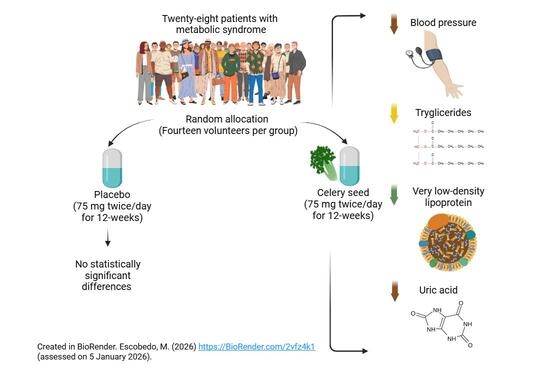
| SBP, mmHg | 122.2 | ± | 13.1 | 125.4 | ± | 9.6 | 121.1 | ± | 9.7 | 115.7 | ± | 12.8 ** |
| DBP, mmHg | 82.0 | ± | 6.5 | 82.3 | ± | 5.4 | 82.2 | ± | 5.9 | 78.5 | ± | 8.6 ** |
| FPG, mmol/L | 6.0 | ± | 0.3 | 5.9 | ± | 0.4 | 5.9 | ± | 0.3 | 5.6 | ± | 0.5 |
| TG, mmol/L | 2.2 | ± | 1.2 | 2.1 | ± | 1.1 | 2.3 | ± | 0.9 | 1.8 | ± | 0.6 ** |
| TC, mmol/L | 4.7 | ± | 0.9 | 4.8 | ± | 0.9 | 4.4 | ± | 0.5 | 4.4 | ± | 0.7 |
| LDL-c, mmol/L | 2.6 | ± | 0.8 | 2.8 | ± | 0.7 | 2.3 | ± | 0.7 | 2.5 | ± | 0.8 |
| VLDL, mmol/L | 0.4 | ± | 0.2 | 0.4 | ± | 0.2 | 0.4 | ± | 0.1 | 0.3 | ± | 0.1 ** |
| HDL-c women, mmol/L | 1.1 | ± | 0.2 | 1.0 | ± | 0.2 | 1.0 | ± | 0.2 | 1.0 | ± | 0.2 |
| HDL-c men, mmol/L | 1.0 | ± | 0.1 | 1.1 | ± | 0.1 | 0.9 | ± | 0.0 | 1.0 | ± | 0.1 |
| Creatinine, µmol/L | 70.7 | ± | 8.8 | 70.7 | ± | 0.1 | 61.8 | ± | 8.8 | 61.8 | ± | 8.8 |
| Uric acid, µmol/L | 291.4 | ± | 65.4 | 309.3 | ± | 83.2 | 297.4 | ± | 53.5 | 261.7 | ± | 53.5 ** |
| AST, U/L | 24.6 | ± | 11.4 | 23.6 | ± | 11.6 | 24.6 | ± | 18.6 | 25.0 | ± | 10.8 |
| ALT, U/L | 34.7 | ± | 12.5 | 32.9 | ± | 13.0 | 31.5 | ± | 22.7 | 33.8 | ± | 24.4 |
| Matsuda index | 2.1 | ± | 1.2 | 2.0 | ± | 0.9 | 2.3 | ± | 0.9 | 2.3 | ± | 1.6 |
| Stumvoll index | 2262.1 | ± | 1105.4 | 2299.5 | ± | 1021.6 | 1532.0 | ± | 720.9 | 1645.7 | ± | 650.3 |
| Total insulin secretion | 0.7 | ± | 0.3 | 0.8 | ± | 0.3 | 0.5 | ± | 0.2 | 0.5 | ± | 0.2 |
| Placebo Group | Celery Seed Group | p * | R ** | |||||
|---|---|---|---|---|---|---|---|---|
| n = 14 | n = 14 | |||||||
| Body weight, kg | 0.37 | ± | 1.41 | −0.34 | ± | 3.12 | 0.419 | −0.15 |
| BMI, kg/m2 | 0.13 | ± | 0.52 | −0.16 | ± | 1.22 | 0.489 | −0.13 |
| WC women, cm | 0.25 | ± | 1.44 | −0.29 | ± | 2.99 | 1.000 | 0.00 |
| WC men, cm | 0.39 | ± | 0.87 | 0.36 | ± | 2.20 | 0.366 | −0.17 |
| Body fat, % | 0.35 | ± | 1.48 | −0.13 | ± | 1.71 | 0.852 | −0.04 |
| SBP, mmHg | 3.14 | ± | 7.81 | −5.43 | ± | 5.21 | 0.001 | −0.61 |
| DBP, mmHg | 0.57 | ± | 2.95 | −3.72 | ± | 4.79 | 0.011 | −0.48 |
| FPG, mmol/L | −0.11 | ± | 0.42 | −0.31 | ± | 0.57 | 0.490 | −0.13 |
| TG, mmol/L | −0.06 | ± | 0.39 | −0.45 | ± | 0.61 | 0.066 | −0.35 |
| TC, mmol/L | 0.13 | ± | 0.68 | 0.03 | ± | 0.65 | 0.713 | −0.07 |
| LDL-c, mmol/L | 0.16 | ± | 0.63 | 0.23 | ± | 0.70 | 0.854 | −0.03 |
| VLDL, mmol/L | −0.01 | ± | 0.07 | −0.09 | ± | 0.12 | 0.066 | −0.35 |
| HDL-c women, mmol/L | −0.03 | ± | 0.08 | −0.01 | ± | 0.14 | 0.376 | −0.17 |
| HDL-c men, mmol/L | 0.02 | ± | 0.18 | 0.02 | ± | 0.04 | 0.266 | −0.21 |
| Creatinine, µmol/L | −1.23 | ± | 6.70 | −1.67 | ± | 5.26 | 0.982 | 0.00 |
| Uric acid, µmol/L | 14.45 | ± | 35.60 | −34.56 | ± | 29.70 | 0.001 | −0.61 |
| AST, U/L | −1.04 | ± | 9.00 | 0.38 | ± | 16.38 | 0.357 | −0.17 |
| ALT, U/L | −1.81 | ± | 11.92 | 2.32 | ± | 17.68 | 0.963 | −0.01 |
| Matsuda index | −0.13 | ± | 0.54 | −0.26 | ± | 1.38 | 0.581 | −0.10 |
| Stumvoll index | 37.40 | ± | 315.05 | 113.64 | ± | 397.45 | 0.323 | −0.19 |
| Total insulin secretion | 0.02 | ± | 0.10 | 0.03 | ± | 0.11 | 0.696 | −0.07 |
| Characteristic | Present Study | Mohsenpour et al. [22] | Shayani Rad et al. [8] | Yusni et al. [20] | Madhavi et al. [7] | Gharouni & Sarkarati [6] |
|---|---|---|---|---|---|---|
| Study design | Randomized, double-blind, placebo-controlled clinical trial | Randomized, double-blind, placebo-controlled pilot trial | Randomized, triple-blind, placebo-controlled, cross-over trial | Quasi-experimental, with control group | Single-arm, open-label pilot study | Experimental (single group) |
| Population | Patients with MetS | Overweight/obese with T2DM patients | Hypertensive patients | Pre-diabetic participants | Hypertensive patients | Hypertensive patients |
| Sample size | 28 subjects | 50 subjects | 52 subjects | 16 subjects | 30 subjects | 37 subjects |
| Intervention | Standardized celery seed extract (Natural Factors®) 85% 3-n-butylphthalide | Celery powder (obtained from stem and leaves) Not standardized. | Celery seed extract | Celery leaf extract. Not standardized | Standardized celery seed extract 85% 3-n-butylphthalide | Celery seed powder Not standardized |
| Daily dose | 150 mg/day (75 mg twice daily) | 750 mg | 1.34 g/day | 750 mg/day (250 mg, 3 times a day) | 150 mg/day (75 mg twice daily). | 6 g/day |
| Intervention duration | 12 weeks | 12 weeks | 4 weeks | 12 days | 6 weeks | Not clearly reported (before–after comparison) |
| Results | ↓ SBP ↓ DBP ↓ TG ↓ VLDL ↓ UA ↔ HDL-c ↔ LDL-c ↔ TC ↔ FPG ↔ Matsuda index ↔ Stumvoll index ↔ BW ↔ BMI ↔ WC ↔ BF ↔ AST ↔ ALT | ↓ BW ↓ BMI ↓ HC ↑ SBP ↑ DBP ↔ WC ↔ BF ↔ FPG ↔ Insulin ↔ HOMA-IR ↔ HOMA-B ↔ TG ↔ TC ↔ LDL-c ↔ HDL-c ↔ AST ↔ ALT | ↓ SBP ↓ DBP ↓ TG ↓ TC ↓ LDL-c ↑ HDL-c ↓ FPG | ↓ FPG ↓ PPG ↔ Insulin | ↓ SBP ↓ DBP ↔ TC ↔ LDL-c ↔ HDL-c ↔ VLDL | ↓ SBP ↓ DBP |
| Insulin sensitivity/secretion assessment | Matsuda index Stumvoll index | HOMA-IR HOMA-B | Not evaluated | Plasma insulin measured | Not evaluated | Not evaluated |
Disclaimer/Publisher’s Note: The statements, opinions and data contained in all publications are solely those of the individual author(s) and contributor(s) and not of MDPI and/or the editor(s). MDPI and/or the editor(s) disclaim responsibility for any injury to people or property resulting from any ideas, methods, instructions or products referred to in the content. |
© 2026 by the authors. Licensee MDPI, Basel, Switzerland. This article is an open access article distributed under the terms and conditions of the Creative Commons Attribution (CC BY) license.
Share and Cite
Escobedo-Gutiérrez, M.d.J.; Cortez-Navarrete, M.; Martínez-Abundis, E.; Pérez-Rubio, K.G. Effect of Celery Seed (Apium graveolens L.) Administration on the Components of Metabolic Syndrome, Insulin Sensitivity, and Insulin Secretion: A Clinical Trial. Pharmaceuticals 2026, 19, 110. https://doi.org/10.3390/ph19010110
Escobedo-Gutiérrez MdJ, Cortez-Navarrete M, Martínez-Abundis E, Pérez-Rubio KG. Effect of Celery Seed (Apium graveolens L.) Administration on the Components of Metabolic Syndrome, Insulin Sensitivity, and Insulin Secretion: A Clinical Trial. Pharmaceuticals. 2026; 19(1):110. https://doi.org/10.3390/ph19010110
Chicago/Turabian StyleEscobedo-Gutiérrez, Miriam de J., Marisol Cortez-Navarrete, Esperanza Martínez-Abundis, and Karina G. Pérez-Rubio. 2026. "Effect of Celery Seed (Apium graveolens L.) Administration on the Components of Metabolic Syndrome, Insulin Sensitivity, and Insulin Secretion: A Clinical Trial" Pharmaceuticals 19, no. 1: 110. https://doi.org/10.3390/ph19010110
APA StyleEscobedo-Gutiérrez, M. d. J., Cortez-Navarrete, M., Martínez-Abundis, E., & Pérez-Rubio, K. G. (2026). Effect of Celery Seed (Apium graveolens L.) Administration on the Components of Metabolic Syndrome, Insulin Sensitivity, and Insulin Secretion: A Clinical Trial. Pharmaceuticals, 19(1), 110. https://doi.org/10.3390/ph19010110


