Article

Possible Association Between Concomitant Use of SSRIs with NSAIDs and an Increased Risk of Adverse Events Among People with Depressive Disorders: Data Mining of FDA Adverse Event Reporting System

1
Key Laboratory of Environmental Medicine and Engineering of Ministry of Education, School of Public Health, Southeast University, Nanjing 210009, China
2
Shenzhen Institute of Pharmacovigilance and Risk Management, Shenzhen 518024, China
3
Jiangsu Health Development Research Center, Nanjing 210029, China
4
NHC Key Laboratory of Contraceptives Vigilance and Fertility Surveillance, Nanjing 210029, China
5
Jiangsu Provincial Medical Key Laboratory of Fertility Protection and Health Technology Assessment, Nanjing 210029, China
*
Authors to whom correspondence should be addressed.
These authors contributed equally to this work.
Pharmaceuticals 2025, 18(7), 1062; https://doi.org/10.3390/ph18071062
Submission received: 23 April 2025 / Revised: 13 July 2025 / Accepted: 16 July 2025 / Published: 18 July 2025
(This article belongs to the Special Issue Therapeutic Drug Monitoring and Adverse Drug Reactions: 2nd Edition)

Abstract

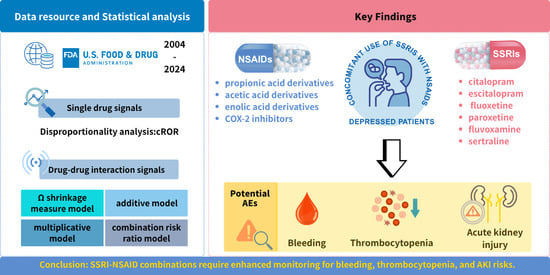
Background: Depression, a major global health issue, is commonly treated with selective serotonin reuptake inhibitors (SSRIs). Given the link between depression and inflammation, nonsteroidal anti-inflammatory drugs (NSAIDs) may have adjunctive benefits. Clinically, SSRIs and NSAIDs are often co-prescribed for comorbid pain or inflammatory conditions. However, both drug classes pose risks of adverse effects, and their interaction may lead to clinically significant drug–drug interactions. Objectives: This study analyzed FDA Adverse Event Reporting System (FAERS) data (2004–2024) to assess gastrointestinal bleeding, thrombocytopenia, and acute kidney injury (AKI) potential risks linked to SSRIs (citalopram, escitalopram, fluoxetine, paroxetine, fluvoxamine, and sertraline) and NSAIDs (propionic/acetic/enolic acid derivatives, COX-2 inhibitors) in depression patients, alone and combined. Methods: Disproportionality analysis (crude reporting odds ratios, cROR) identified possible associations; drug interactions were evaluated using Ω shrinkage, additive, multiplicative, and combination risk ratio (CRR) models. Results: Gastrointestinal bleeding risk was potentially elevated with citalopram (cROR = 2.81), escitalopram (2.27), paroxetine (2.17), fluvoxamine (3.58), sertraline (1.69), and propionic acid NSAIDs (3.17). Thrombocytopenia showed a potential correlation with fluoxetine (2.11) and paroxetine (2.68). AKI risk may be increased with citalopram (1.39), escitalopram (1.36), fluvoxamine (3.24), and COX-2 inhibitors (2.24). DDI signal analysis suggested that citalopram in combination with propionic acid derivatives (additive model = 0.01, multiplicative model = 1.14, and CRR = 3.13) might increase the risk of bleeding. Paroxetine combined with NSAIDs (additive model = 0.014, multiplicative model = 2.65, and CRR = 2.99) could potentially increase the risk of thrombocytopenia. Sertraline combined with NSAIDs (Ω025 = 0.94, multiplicative model = 2.14) might be associated with an increasing risk of AKI. Citalopram combined with propionic acid derivatives (Ω025 = 1.08, multiplicative model = 2.17, and CRR = 2.42) could be associated with an increased risk of acute kidney injury. Conclusions: Certain combinations of SSRIs and NSAIDs might further elevate these risks of gastrointestinal bleeding, thrombocytopenia, and acute kidney injury in patients with depression. Given the potential drug–drug interactions, heightened clinical vigilance is advised when prescribing SSRIs and NSAIDs in combination to patients with depression.
Keywords: drug–drug interactions; adverse event; Adverse Event Reporting System; FAERS database; data mining drug–drug interactions; adverse event; Adverse Event Reporting System; FAERS database; data mining
Graphical Abstract