Population Pharmacokinetics of Radotinib in Healthy Volunteers and Patients with Chronic Myeloid Leukemia

 , , , , and
Abstract
1. Introduction
2. Results
2.1. Participant Characteristics
2.2. Bioanalytical Assay
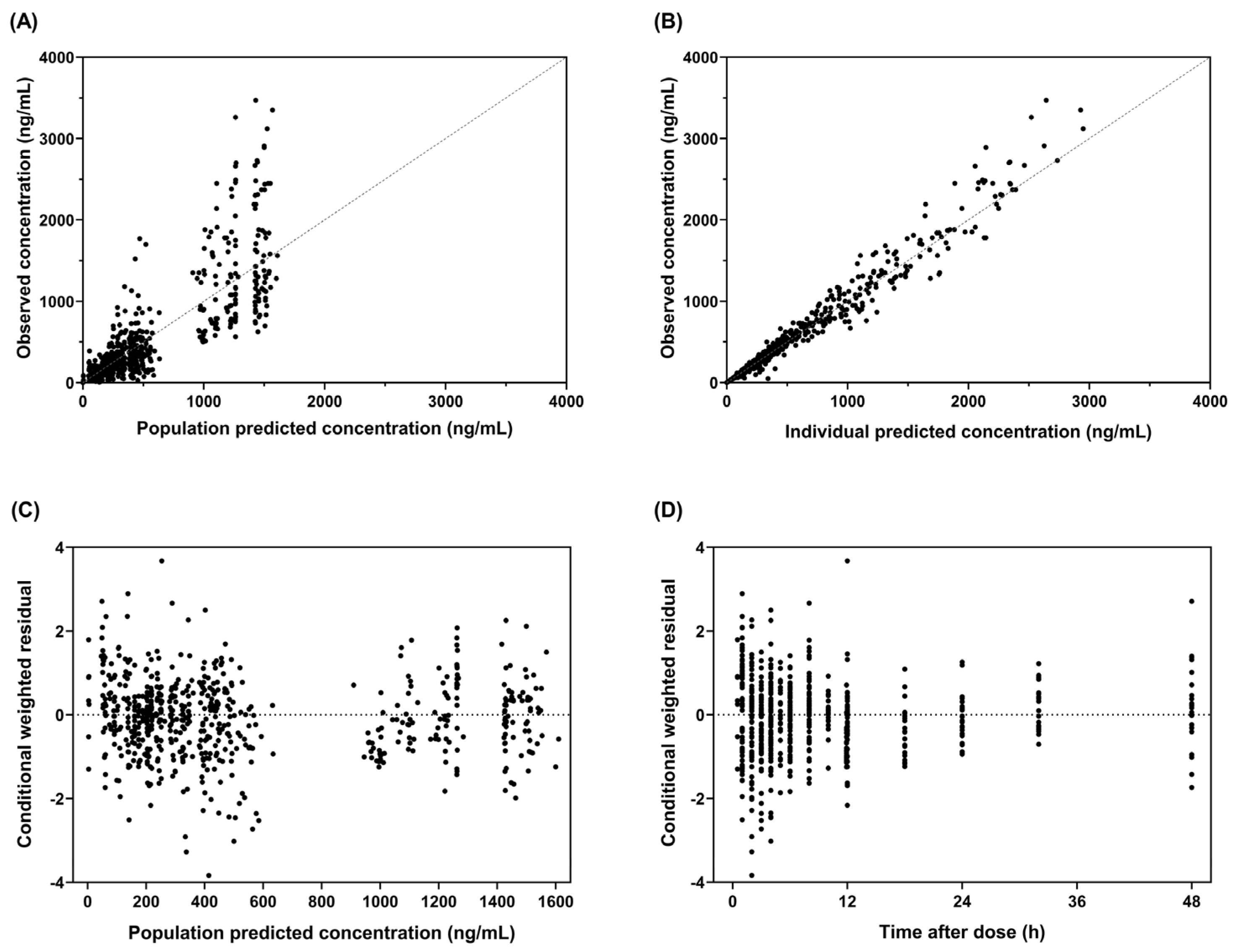
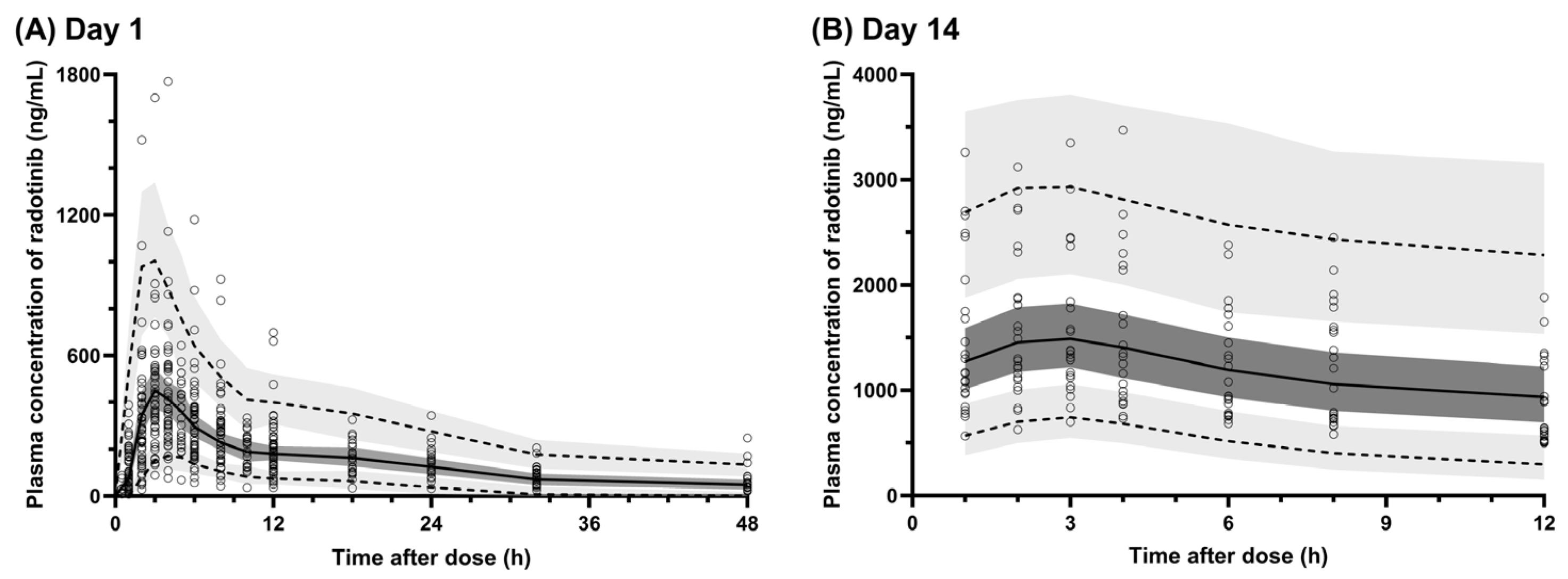
2.3. Population Pharmacokinetic Model
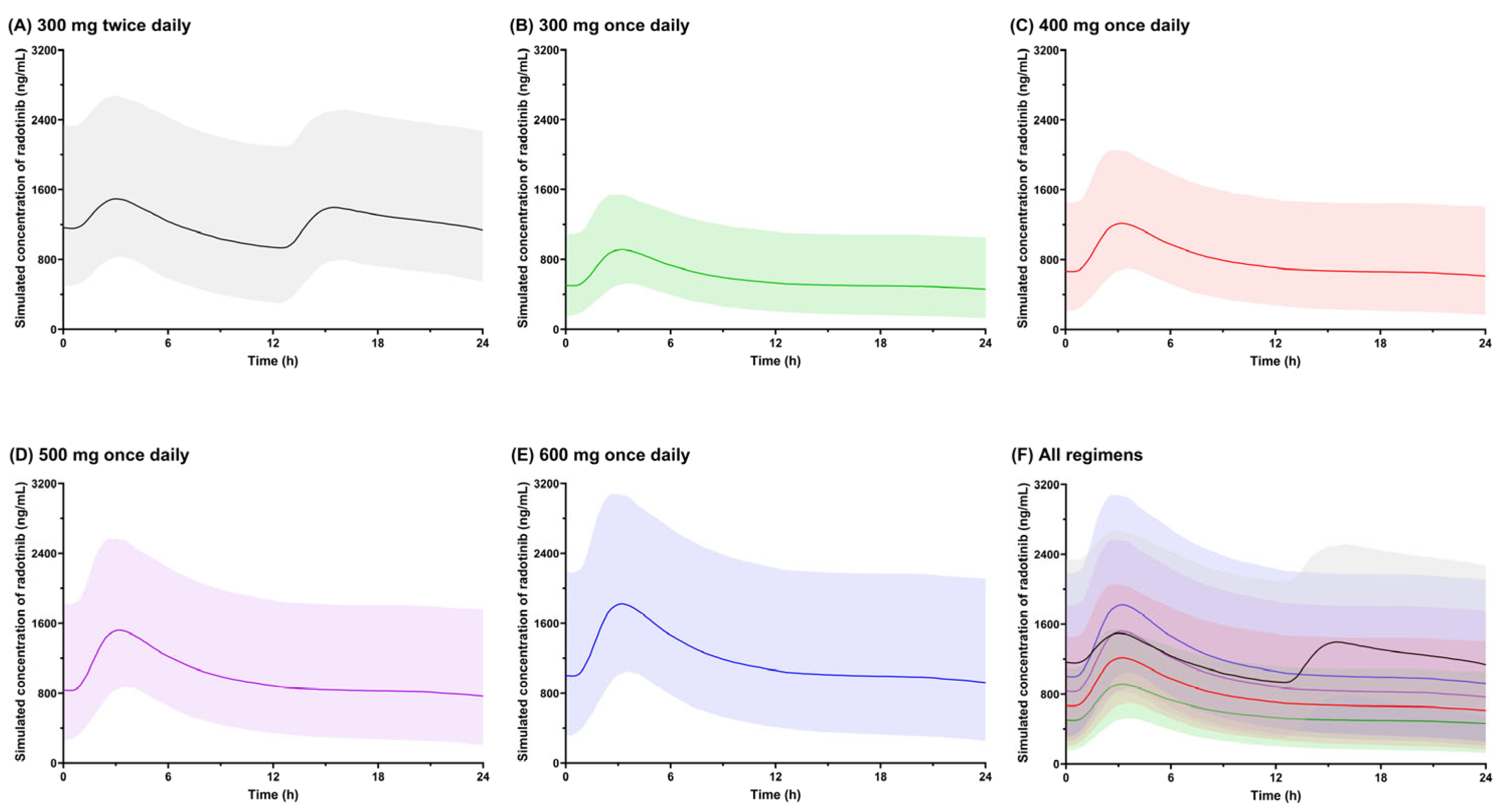
2.4. Exploration of Alternative Dosing Regimens Using Monte Carlo Simulations
3. Discussion
4. Materials and Methods
4.1. Study Participants and Design
4.2. Bioanalytical Assay and Validation
4.3. Population Pharmacokinetic Characterization
4.4. Exploration of Dosing Regimen Using Monte Carlo Simulations
5. Conclusions
Author Contributions
Funding
Institutional Review Board Statement
Informed Consent Statement
Data Availability Statement
Acknowledgments
Conflicts of Interest
References
- Rowley, J.D. Letter: A new consistent chromosomal abnormality in chronic myelogenous leukaemia identified by quinacrine fluorescence and Giemsa staining. Nature 1973, 243, 290–293. [Google Scholar] [CrossRef]
- Rinaldi, I.; Winston, K. Chronic Myeloid Leukemia, from Pathophysiology to Treatment-Free Remission: A Narrative Literature Review. J. Blood Med. 2023, 14, 261–277. [Google Scholar] [CrossRef]
- Jabbour, E.; Kantarjian, H. Chronic myeloid leukemia: 2025 update on diagnosis, therapy, and monitoring. Am. J. Hematol. 2024, 99, 2191–2212. [Google Scholar] [CrossRef]
- Jabbour, E.; Kantarjian, H. Chronic Myeloid Leukemia: A Review. JAMA 2025, 333, 1618–1629. [Google Scholar] [CrossRef]
- Osman, A.E.G.; Deininger, M.W. Chronic Myeloid Leukemia: Modern therapies, current challenges and future directions. Blood Rev. 2021, 49, 100825. [Google Scholar] [CrossRef]
- Zabriskie, M.S.; Vellore, N.A.; Gantz, K.C.; Deininger, M.W.; O’Hare, T. Radotinib is an effective inhibitor of native and kinase domain-mutant BCR-ABL1. Leukemia 2015, 29, 1939–1942. [Google Scholar] [CrossRef] [PubMed]
- Eskazan, A.E.; Keskin, D. Radotinib and its clinical potential in chronic-phase chronic myeloid leukemia patients: An update. Ther. Adv. Hematol. 2017, 8, 237–243. [Google Scholar] [CrossRef]
- Sun, L.; Yang, P.C.; Luan, L.; Sun, J.F.; Wang, Y.T. Harmonizing the craft of crafting clinically endorsed small-molecule BCR-ABL tyrosine kinase inhibitors for the treatment of hematological malignancies. Eur. J. Pharm. Sci. 2024, 193, 106678. [Google Scholar] [CrossRef]
- Niu, Z.X.; Wang, Y.T.; Sun, J.F.; Nie, P.; Herdewijn, P. Recent advance of clinically approved small-molecule drugs for the treatment of myeloid leukemia. Eur. J. Med. Chem. 2023, 261, 115827. [Google Scholar] [CrossRef]
- Kim, S.H.; Menon, H.; Jootar, S.; Saikia, T.; Kwak, J.Y.; Sohn, S.-K.; Park, J.S.; Jeong, S.H.; Kim, H.J.; Kim, Y.-K.; et al. Efficacy and safety of radotinib in chronic phase chronic myeloid leukemia patients with resistance or intolerance to BCR-ABL1 tyrosine kinase inhibitors. Haematologica 2014, 99, 1191–1196. [Google Scholar] [CrossRef] [PubMed]
- Kwak, J.Y.; Kim, S.H.; Oh, S.J.; Zang, D.Y.; Kim, H.; Kim, J.-A.; Do, Y.R.; Kim, H.J.; Park, J.S.; Choi, C.W.; et al. Phase III clinical trial (RERISE study) results of efficacy and safety of radotinib compared with imatinib in newly diagnosed chronic phase chronic myeloid leukemia. Clin. Cancer Res. 2017, 23, 7180–7188. [Google Scholar] [CrossRef]
- Noh, H.; Park, M.S.; Kim, S.H.; Oh, S.J.; Zang, D.Y.; Park, H.L.; Cho, D.J.; Kim, D.-W.; Lee, J.I. Optimization of radotinib doses for the treatment of Asian patients with chronic myelogenous leukemia based on dose-response relationship analyses. Leuk. Lymphoma 2016, 57, 1856–1864. [Google Scholar] [CrossRef]
- Noh, H.; Jung, S.Y.; Kwak, J.Y.; Kim, S.H.; Oh, S.J.; Zang, D.Y.; Lee, S.; Park, H.L.; Jo, D.J.; Shin, J.S.; et al. Determination of a radotinib dosage regimen based on dose-response relationships for the treatment of newly diagnosed patients with chronic myeloid leukemia. Cancer Med. 2018, 7, 1766–1773. [Google Scholar] [CrossRef] [PubMed]
- Mould, D.R.; Upton, R.N. Basic concepts in population modeling, simulation, and model-based drug development—Part 2: Introduction to pharmacokinetic modeling methods. CPT Pharmacomet. Syst. Pharmacol. 2013, 2, e38. [Google Scholar] [CrossRef]
- Aarons, L. Population pharmacokinetics: Theory and practice. Br. J. Clin. Pharmacol. 1991, 32, 669–670. [Google Scholar] [CrossRef]
- U.S. Food and Drug Administration. Population Pharmacokinetics Guidance for Industry. 2022. Available online: https://www.fda.gov/media/128793/download (accessed on 4 April 2025).
- Mould, D.R.; Upton, R.N. Basic concepts in population modeling, simulation, and model-based drug development. CPT Pharmacomet. Syst. Pharmacol. 2012, 1, e6. [Google Scholar] [CrossRef]
- Ette, E.I.; Williams, P.J. Population pharmacokinetics I: Background, concepts, and models. Ann. Pharmacother. 2004, 38, 1702–1706. [Google Scholar] [CrossRef] [PubMed]
- Jung, S.Y.; Yug, J.S.; Clarke, J.M.; Bauer, T.M.; Keedy, V.L.; Hwang, S.; Lim, S.J.; Chung, E.K.; Lee, J.I. Population pharmacokinetics of vactosertib, a new TGF-β receptor type I inhibitor, in patients with advanced solid tumors. Cancer Chemother. Pharmacol. 2020, 85, 173–183. [Google Scholar] [CrossRef] [PubMed]
- Berezowska, M.; Hayden, I.S.; Brandon, A.M.; Zats, A.; Patel, M.; Barnett, S.; Ogungbenro, K.; Veal, G.J.; Taylor, A.; Suthar, J. Recommended approaches for integration of population pharmacokinetic modelling with precision dosing in clinical practice. Br. J. Clin. Pharmacol. 2025, 91, 1064–1079. [Google Scholar] [CrossRef]
- Williams, P.J.; Ette, E.I. The role of population pharmacokinetics in drug development in light of the Food and Drug Administration’s ‘Guidance for Industry: Population pharmacokinetics’. Clin. Pharmacokinet. 2000, 39, 385–395. [Google Scholar] [CrossRef]
- U.S. Food and Drug Administration. Bioanalytical Method Validation Guidance for Industry. 2018. Available online: https://www.fda.gov/media/70858/download (accessed on 4 April 2025).
- Lee, Y.; Kang, M.; Kim, J.; Han, J.; Kim, N.Y.; Shin, J.S.; Park, M.S.; Kim, C.O.; Jin, B.H.; Choi, M.K.; et al. Clinical pharmacokinetic characteristics and the effect of food on radotinib in healthy volunteers. In Proceedings of the EHA Congress 2025, Milan, Italy, 12–15 June 2025. [Google Scholar]
- Kim, J.; Kang, M.; Lee, Y.; Yoo, S.; Han, J.; Cho, D.J.; Lee, G.Y.; Kim, N.Y.; Jiang, Q.; Lee, J. Pharmacokinetic characteristics of radotinib assessed in Asian patients with chronic myeloid leukemia. In Proceedings of the AAPS PharmSci 360 2024, Salt Lake City, UT, USA, 20–23 October 2024. [Google Scholar]
- Nievergall, E.; Reynolds, J.; Kok, C.H.; Watkins, D.B.; Biondo, M.; Busfield, S.J.; Vairo, G.; Fuller, K.; Erber, W.N.; Sadras, T.; et al. TGF-α and IL-6 plasma levels selectively identify CML patients who fail to achieve an early molecular response or progress in the first year of therapy. Leukemia 2016, 30, 1263–1272. [Google Scholar] [CrossRef]
- Reynaud, D.; Pietras, E.; Barry-Holson, K.; Mir, A.; Binnewies, M.; Jeanne, M.; Sala-Torra, O.; Radich, J.P.; Passegue, E. IL-6 controls leukemic multipotent progenitor cell fate and contributes to chronic myelogenous leukemia development. Cancer Cell 2011, 20, 661–673. [Google Scholar] [CrossRef] [PubMed]
- Taiwo, K.A.; Ahmed, I.O.; Asafa, M.A.; Olarewaju, O.J.; Omoyiola, O.A.; Oguns, O.O.; Owojuyigbe, T.O.; Bolarinwa, R.A. Pro-inflammatory cytokines in patients with chronic phase-chronic myeloid leukaemia treated with imatinib: Any role in the monitoring of treatment response? Biomark. Insights 2025, 20, 11772719251351687. [Google Scholar] [CrossRef] [PubMed]
- Machavaram, K.K.; Almond, L.M.; Rostami-Hodjegan, A.; Gardner, I.; Jamei, M.; Tay, S.; Wong, S.; Joshi, A.; Kenny, J.R. A physiologically based pharmacokinetic modeling approach to predict disease-drug interactions: Suppression of CYP3A by IL-6. Clin. Pharmacol. Ther. 2013, 94, 260–268. [Google Scholar] [CrossRef] [PubMed]
- Dickmann, L.J.; Patel, S.K.; Rock, D.A.; Wienkers, L.C.; Slatter, J.G. Effects of interleukin-6 (IL-6) and an anti-IL-6 monoclonal antibody on drug-metabolizing enzymes in human hepatocyte culture. Drug Metab. Dispos. 2011, 39, 1415–1422. [Google Scholar] [CrossRef]
- Lee, J.I.; Zhang, L.; Men, A.Y.; Kenna, L.A.; Huang, S.M. CYP-mediated therapeutic protein-drug interactions: Clinical findings, proposed mechanisms and regulatory implications. Clin. Pharmacokinet. 2010, 49, 295–310. [Google Scholar] [CrossRef] [PubMed]
- Klyushova, L.S.; Perepechaeva, M.L.; Grishanova, A.Y. The role of CYP3A in health and disease. Biomedicines 2022, 10, 2686. [Google Scholar] [CrossRef]
- Larson, R.A.; Yin, O.Q.; Hochhaus, A.; Saglio, G.; Clark, R.E.; Nakamae, H.; Gallagher, N.J.; Demirhan, E.; Hughes, T.P.; Kantarjian, H.M.; et al. Population pharmacokinetic and exposure-response analysis of nilotinib in patients with newly diagnosed Ph+ chronic myeloid leukemia in chronic phase. Eur. J. Clin. Pharmacol. 2012, 68, 723–733. [Google Scholar] [CrossRef]
- Li, X.; He, Y.; Ruiz, C.H.; Koenig, M.; Cameron, M.D.; Vojkovsky, T. Characterization of dasatinib and its structural analogs as CYP3A4 mechanism-based inactivators and the proposed bioactivation pathways. Drug Metab. Dispos. 2009, 37, 1242–1250. [Google Scholar] [CrossRef]
- Peng, B.; Hayes, M.; Resta, D.; Racine-Poon, A.; Druker, B.J.; Talpaz, M.; Sawyers, C.L.; Rosamilia, M.; Ford, J.; Lloyd, P.; et al. Pharmacokinetics and pharmacodynamics of imatinib in a phase I trial with chronic myeloid leukemia patients. J. Clin. Oncol. 2004, 22, 935–942. [Google Scholar] [CrossRef]
- Peng, B.; Lloyd, P.; Schran, H. Clinical pharmacokinetics of imatinib. Clin. Pharmacokinet. 2005, 44, 879–894. [Google Scholar] [CrossRef]
- Jorgensen, H.G.; Elliott, M.A.; Allan, E.K.; Carr, C.E.; Holyoake, T.L.; Smith, K.D. Alpha1-acid glycoprotein expressed in the plasma of chronic myeloid leukemia patients does not mediate significant in vitro resistance to STI571. Blood 2002, 99, 713–715. [Google Scholar] [CrossRef]
- Gambacorti-Passerini, C.; Zucchetti, M.; Russo, D.; Frapolli, R.; Verga, M.; Bungaro, S.; Tornaghi, L.; Rossi, F.; Pioltelli, P.; Pogliani, E.; et al. Alpha1 acid glycoprotein binds to imatinib (STI571) and substantially alters its pharmacokinetics in chronic myeloid leukemia patients. Clin. Cancer Res. 2003, 9, 625–632. [Google Scholar]
- Goswami, D.; Gurule, S.; Lahiry, A.; Anand, A.; Khuroo, A.; Monif, T. Clinical development of imatinib: An anticancer drug. Future Sci. OA 2016, 2, FSO92. [Google Scholar] [CrossRef]
- Rowland, M.; Benet, L.Z.; Graham, G.G. Clearance concepts in pharmacokinetics. J. Pharmacokinet. Biopharm. 1973, 1, 123–136. [Google Scholar] [CrossRef]
- Wilkinson, G.R.; Shand, D.G. Commentary: A physiological approach to hepatic drug clearance. Clin. Pharmacol. Ther. 1975, 18, 377–390. [Google Scholar] [CrossRef] [PubMed]
- Gora-Tybor, J.; Sacha, T.; Waclaw, J.; Niesiobedzka-Krezel, J.; Grzybowska-Izydorczyk, O.; Medras, E.; Deren-Wagemann, I.; Patkowska, E.; Seferynska, I.; Lewandowski, K.; et al. Comorbidity burden and use of concomitant medications at CML diagnosis: A retrospective analysis of 527 patients from the Polish Adult Leukemia Group Registry. Clin. Lymphoma Myeloma Leuk. 2018, 18, e283–e285. [Google Scholar] [CrossRef] [PubMed]
- Batar, P.; Alizadeh, H.; Rokszin, G.; Abonyi-Toth, Z.; Demeter, J. Comorbidities and outcomes of patients with chronic myeloid leukemia treated with tyrosine kinase inhibitors: A real-world, nationwide, retrospective study from Hungary. Pathol. Oncol. Res. 2024, 30, 1611497. [Google Scholar] [CrossRef]
- Drenth-van Maanen, A.C.; Wilting, I.; Jansen, P.A.F. Prescribing medicines to older people-how to consider the impact of ageing on human organ and body functions. Br. J. Clin. Pharmacol. 2020, 86, 1921–1930. [Google Scholar] [CrossRef] [PubMed]
- Ngcobo, N.N. Influence of ageing on the pharmacodynamics and pharmacokinetics of chronically administered medicines in geriatric patients: A review. Clin. Pharmacokinet. 2025, 64, 335–367. [Google Scholar] [CrossRef]
- St-Onge, M.P. Relationship between body composition changes and changes in physical function and metabolic risk factors in aging. Curr. Opin. Clin. Nutr. Metab. Care 2005, 8, 523–528. [Google Scholar] [CrossRef]
- St-Onge, M.P.; Gallagher, D. Body composition changes with aging: The cause or the result of alterations in metabolic rate and macronutrient oxidation? Nutrition 2010, 26, 152–155. [Google Scholar] [CrossRef] [PubMed]
- Tomalik-Scharte, D.; Suleiman, A.A.; Frechen, S.; Kraus, D.; Kerkweg, U.; Rokitta, D.; Di Gion, P.; Queckenberg, C.; Fuhr, U. Population pharmacokinetic analysis of circadian rhythms in hepatic CYP3A activity using midazolam. J. Clin. Pharmacol. 2014, 54, 1162–1169. [Google Scholar] [CrossRef]
- Yu, F.; Liu, Y.; Zhang, R.; Zhu, L.; Zhang, T.; Shi, Y. Recent advances in circadian-regulated pharmacokinetics and its implications for chronotherapy. Biochem. Pharmacol. 2022, 203, 115185. [Google Scholar] [CrossRef] [PubMed]
- Takiguchi, T.; Tomita, M.; Matsunaga, N.; Nakagawa, H.; Koyanagi, S.; Ohdo, S. Molecular basis for rhythmic expression of CYP3A4 in serum-shocked HepG2 cells. Pharmacogenet. Genom. 2007, 17, 1047–1056. [Google Scholar] [CrossRef]
- Ohdo, S.; Koyanagi, S.; Matsunaga, N. Chronopharmacological strategies focused on chrono-drug discovery. Pharmacol. Ther. 2019, 202, 72–90. [Google Scholar] [CrossRef]
- Park, S.I.; Felipe, C.R.; Pinheiro-Machado, P.G.; Garcia, R.; Tedesco-Silva, H., Jr.; Medina-Pestana, J.O. Circadian and time-dependent variability in tacrolimus pharmacokinetics. Fundam. Clin. Pharmacol. 2007, 21, 191–197. [Google Scholar] [CrossRef]
- Levi, F. Chronopharmacology and chronotherapy of cancers. Pathol. Biol. 1996, 44, 631–644. [Google Scholar] [PubMed]
- Tian, X.; Zhang, H.; Heimbach, T.; He, H.; Buchbinder, A.; Aghoghovbia, M.; Hourcade-Potelleret, F. Clinical Pharmacokinetic and Pharmacodynamic Overview of Nilotinib, a Selective Tyrosine Kinase Inhibitor. J. Clin. Pharmacol. 2018, 58, 1533–1540. [Google Scholar] [CrossRef]
- Miura, M. Therapeutic drug monitoring of imatinib, nilotinib, and dasatinib for patients with chronic myeloid leukemia. Biol. Pharm. Bull. 2015, 38, 645–654. [Google Scholar] [CrossRef]
- I.C.H. Integrated Addendum to ICH E6(R1): Guideline for Good Clinical Practice E6(R2). 2016. Available online: https://database.ich.org/sites/default/files/E6_R2_Addendum.pdf (accessed on 4 April 2025).
- Wang, Y. Derivation of various NONMEM estimation methods. J. Pharmacokinet. Pharmacodyn. 2007, 34, 575–593. [Google Scholar] [CrossRef] [PubMed]
- Aoki, Y.; Nordgren, R.; Hooker, A.C. Preconditioning of nonlinear mixed effects models for stabilisation of variance-covariance matrix computations. AAPS J. 2016, 18, 505–518. [Google Scholar] [CrossRef]
- Karlsson, M.O.; Sheiner, L.B. The importance of modeling interoccasion variability in population pharmacokinetic analyses. J. Pharmacokinet. Biopharm. 1993, 21, 735–750. [Google Scholar] [CrossRef]
- Kristoffersson, A.N.; Friberg, L.E.; Nyberg, J. Inter-occasion variability in individual optimal design. J. Pharmacokinet. Pharmacodyn. 2015, 42, 735–750. [Google Scholar] [CrossRef]
- Bressolle, F.; Joulia, J.M.; Pinguet, F.; Ychou, M.; Astre, C.; Duffour, J.; Gomeni, R. Circadian rhythm of 5-fluorouracil population pharmacokinetics in patients with metastatic colorectal cancer. Cancer Chemother. Pharmacol. 1999, 44, 295–302. [Google Scholar] [CrossRef]
- Jonsson, E.N.; Karlsson, M.O. Xpose—An S-PLUS based population pharmacokinetic/pharmacodynamic model building aid for NONMEM. Comput. Methods Programs Biomed. 1999, 58, 51–64. [Google Scholar] [CrossRef]
- Mosteller, R.D. Simplified calculation of body-surface area. N. Engl. J. Med. 1987, 317, 1098. [Google Scholar] [CrossRef]
- Cockcroft, D.W.; Gault, M.H. Prediction of creatinine clearance from serum creatinine. Nephron 1976, 16, 31–41. [Google Scholar] [CrossRef] [PubMed]
- Hutmacher, M.M.; Kowalski, K.G. Covariate selection in pharmacometric analyses: A review of methods. Br. J. Clin. Pharmacol. 2015, 79, 132–147. [Google Scholar] [CrossRef]



| Healthy Volunteers (n = 23) | Patients with CML (n = 24) | Total (n = 47) | |
|---|---|---|---|
| Sex, n (%) | |||
| Male | 23 (100) | 13 (54) | 36 (77) |
| Female | 0 (0) | 11 (46) | 11 (23) |
| Age, years | |||
| Median (range) | 29 (20–51) | 32 (21–72) | 31 (20–72) |
| Height, cm | |||
| Median (range) | 173 (166–186) | 168 (155–178) | 171 (155–186) |
| Body weight, kg | |||
| Median (range) | 71.0 (55.1–85.2) | 65.0 (47.0–96.0) | 65.7 (47.0–96.0) |
| BMI, kg/m2 | |||
| Median (range) | 22.8 (18.6–26.2) | 22.5 (18.4–30.3) | 22.8 (18.4–30.3) |
| Ethnicity, n (%) | |||
| Korean | 23 (100) | 23 (49) | |
| Chinese | 24 (100) | 24 (51) | |
| ALT, IU/L | |||
| Median (range) | 16 (7–80) | 21 (15–75) | 20 (7–80) |
| AST, IU/L | |||
| Median (range) | 19 (11–76) | 25 (15–41) | 20 (11–76) |
| CLCr, mL/min | |||
| Median (range) | 117 (72–139) | 109 (74–200) | 114 (72–200) |
| Population Estimates | RSE % | Bootstrap Estimate Median (95% CI) | |
|---|---|---|---|
| Model parameters | |||
| CL/F (L/h) a | 23.0 | 7.3 | 23.2 (20.0–26.5) |
| CL/FCircadian effect | 0.683 | 14.8 | 0.686 (0.502–0.871) |
| CL/FDisease status | 0.646 | 30.0 | 0.625 (0.249–1.02) |
| Vc/F (L) b | 383 | 13.8 | 395 (281–526) |
| Vc/FAge | −0.0129 | 37.6 | −0.0127 (−0.0258–−0.003) |
| Q/F (L/h) | 132 | 11.6 | 126 (88.9–185) |
| Vp/F (L) | 519 | 15.6 | 529 (398–733) |
| ka (h−1) | 1.59 | 21.6 | 1.56 (1.07–3.14) |
| MTT (h) | 1.88 | 10.4 | 1.86 (1.43–2.27) |
| N | 6.58 | 17.0 | 6.34 (4.46–10.6) |
| Interindividual variability | |||
| ωCL/F | 0.389 | 20.1 | 0.379 (0.301–0.459) |
| ωVc/F | 0 | NA | 0 |
| ωQ/F | 0 | NA | 0 |
| ωVp/F | 0 | NA | 0 |
| ωka | 0 | NA | 0 |
| ωMTT | 0.316 | NA | 0.316 |
| ωN | 0.447 | NA | 0.447 |
| Interoccasion variability | |||
| ωIOV | 0.698 | 25.1 | 0.669 (0.494–0.829) |
| Residual variability | |||
| σproportional (%) | 20.0 | NA | 20.0 |
| Parameter (Units) | 300 mg BID | 300 mg QD | 400 mg QD | 500 mg QD | 600 mg QD |
|---|---|---|---|---|---|
| tmax (h) | 3 (2–3) | 3 (3–4) | 3 (3–4) | 3 (3–4) | 3 (3–4) |
| Cmax (ng/mL) | 1551 (1234–1959) | 955 (758–1173) | 1274 (1011–1564) | 1592 (1264–1955) | 1910 (1516–2345) |
| Ctrough (ng/mL) | 960 (645–1368) | 443 (297–658) | 591 (396–877) | 739 (495–1097) | 887 (594–1316) |
| AUC0–24h (ng∙h/mL) | 29,669 (22,710–38,990) | 14,276 (10,627–19,234) | 19,034 (14,169–25,645) | 23,793 (17,711–32,056) | 28,551 (21,253–38,467) |
Disclaimer/Publisher’s Note: The statements, opinions and data contained in all publications are solely those of the individual author(s) and contributor(s) and not of MDPI and/or the editor(s). MDPI and/or the editor(s) disclaim responsibility for any injury to people or property resulting from any ideas, methods, instructions or products referred to in the content. |
© 2025 by the authors. Licensee MDPI, Basel, Switzerland. This article is an open access article distributed under the terms and conditions of the Creative Commons Attribution (CC BY) license (https://creativecommons.org/licenses/by/4.0/).
Share and Cite
Kang, M.; Kim, J.; Lee, Y.; Shin, J.S.; Park, M.S.; Jiang, Q.; Chung, E.K.; Lee, J.I. Population Pharmacokinetics of Radotinib in Healthy Volunteers and Patients with Chronic Myeloid Leukemia. Pharmaceuticals 2025, 18, 1705. https://doi.org/10.3390/ph18111705
Kang M, Kim J, Lee Y, Shin JS, Park MS, Jiang Q, Chung EK, Lee JI. Population Pharmacokinetics of Radotinib in Healthy Volunteers and Patients with Chronic Myeloid Leukemia. Pharmaceuticals. 2025; 18(11):1705. https://doi.org/10.3390/ph18111705
Chicago/Turabian StyleKang, Minseo, Jiwon Kim, Yerin Lee, Jae Soo Shin, Min Soo Park, Qian Jiang, Eun Kyoung Chung, and Jangik I. Lee. 2025. "Population Pharmacokinetics of Radotinib in Healthy Volunteers and Patients with Chronic Myeloid Leukemia" Pharmaceuticals 18, no. 11: 1705. https://doi.org/10.3390/ph18111705
APA StyleKang, M., Kim, J., Lee, Y., Shin, J. S., Park, M. S., Jiang, Q., Chung, E. K., & Lee, J. I. (2025). Population Pharmacokinetics of Radotinib in Healthy Volunteers and Patients with Chronic Myeloid Leukemia. Pharmaceuticals, 18(11), 1705. https://doi.org/10.3390/ph18111705