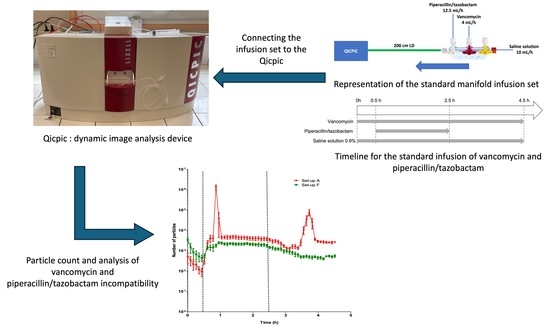
Evaluation of the Impact of Infusion Set Design on the Particulate Load Induced by Vancomycin–Piperacillin/Tazobactam Incompatibility

 , , ,
, , , Abstract
Share and Cite
Négrier, L.; Décaudin, B.; Treizebré, A.; Guilbert, M.; Odou, P.; Martin Mena, A. Evaluation of the Impact of Infusion Set Design on the Particulate Load Induced by Vancomycin–Piperacillin/Tazobactam Incompatibility. Pharmaceuticals 2024, 17, 1222. https://doi.org/10.3390/ph17091222
Négrier L, Décaudin B, Treizebré A, Guilbert M, Odou P, Martin Mena A. Evaluation of the Impact of Infusion Set Design on the Particulate Load Induced by Vancomycin–Piperacillin/Tazobactam Incompatibility. Pharmaceuticals. 2024; 17(9):1222. https://doi.org/10.3390/ph17091222
Chicago/Turabian StyleNégrier, Laura, Bertrand Décaudin, Anthony Treizebré, Marie Guilbert, Pascal Odou, and Anthony Martin Mena. 2024. "Evaluation of the Impact of Infusion Set Design on the Particulate Load Induced by Vancomycin–Piperacillin/Tazobactam Incompatibility" Pharmaceuticals 17, no. 9: 1222. https://doi.org/10.3390/ph17091222
APA StyleNégrier, L., Décaudin, B., Treizebré, A., Guilbert, M., Odou, P., & Martin Mena, A. (2024). Evaluation of the Impact of Infusion Set Design on the Particulate Load Induced by Vancomycin–Piperacillin/Tazobactam Incompatibility. Pharmaceuticals, 17(9), 1222. https://doi.org/10.3390/ph17091222