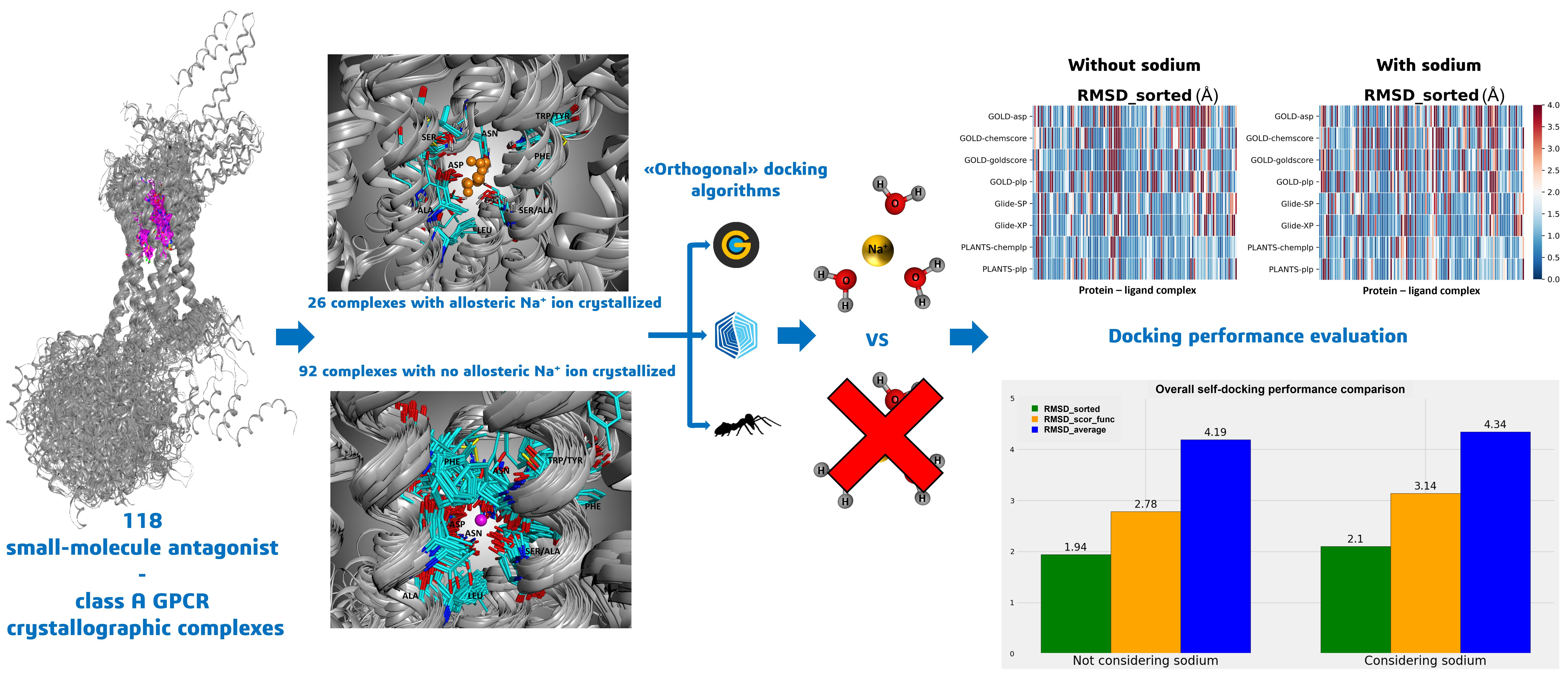
Sodium or Not Sodium: Should Its Presence Affect the Accuracy of Pose Prediction in Docking GPCR Antagonists?



Abstract
Share and Cite
Bassani, D.; Pavan, M.; Sturlese, M.; Moro, S. Sodium or Not Sodium: Should Its Presence Affect the Accuracy of Pose Prediction in Docking GPCR Antagonists? Pharmaceuticals 2022, 15, 346. https://doi.org/10.3390/ph15030346
Bassani D, Pavan M, Sturlese M, Moro S. Sodium or Not Sodium: Should Its Presence Affect the Accuracy of Pose Prediction in Docking GPCR Antagonists? Pharmaceuticals. 2022; 15(3):346. https://doi.org/10.3390/ph15030346
Chicago/Turabian StyleBassani, Davide, Matteo Pavan, Mattia Sturlese, and Stefano Moro. 2022. "Sodium or Not Sodium: Should Its Presence Affect the Accuracy of Pose Prediction in Docking GPCR Antagonists?" Pharmaceuticals 15, no. 3: 346. https://doi.org/10.3390/ph15030346
APA StyleBassani, D., Pavan, M., Sturlese, M., & Moro, S. (2022). Sodium or Not Sodium: Should Its Presence Affect the Accuracy of Pose Prediction in Docking GPCR Antagonists? Pharmaceuticals, 15(3), 346. https://doi.org/10.3390/ph15030346