Individual-Tree DBH Estimation from Airborne LiDAR Data Using MSFS–XGBoost

Highlights
- A Multi-Stage Feature Selection (MSFS) framework integrating Pearson correlation, mutual information, and Boruta was developed to optimize high-dimensional airborne LiDAR point cloud features for individual-tree DBH estimation.
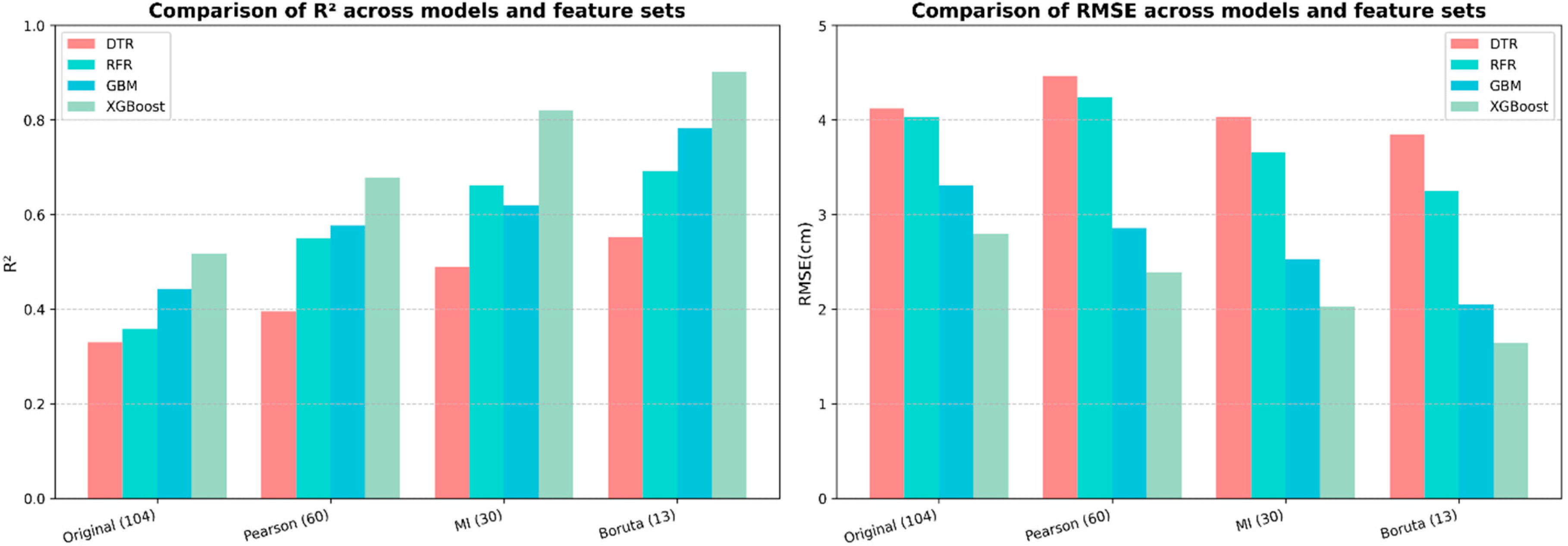
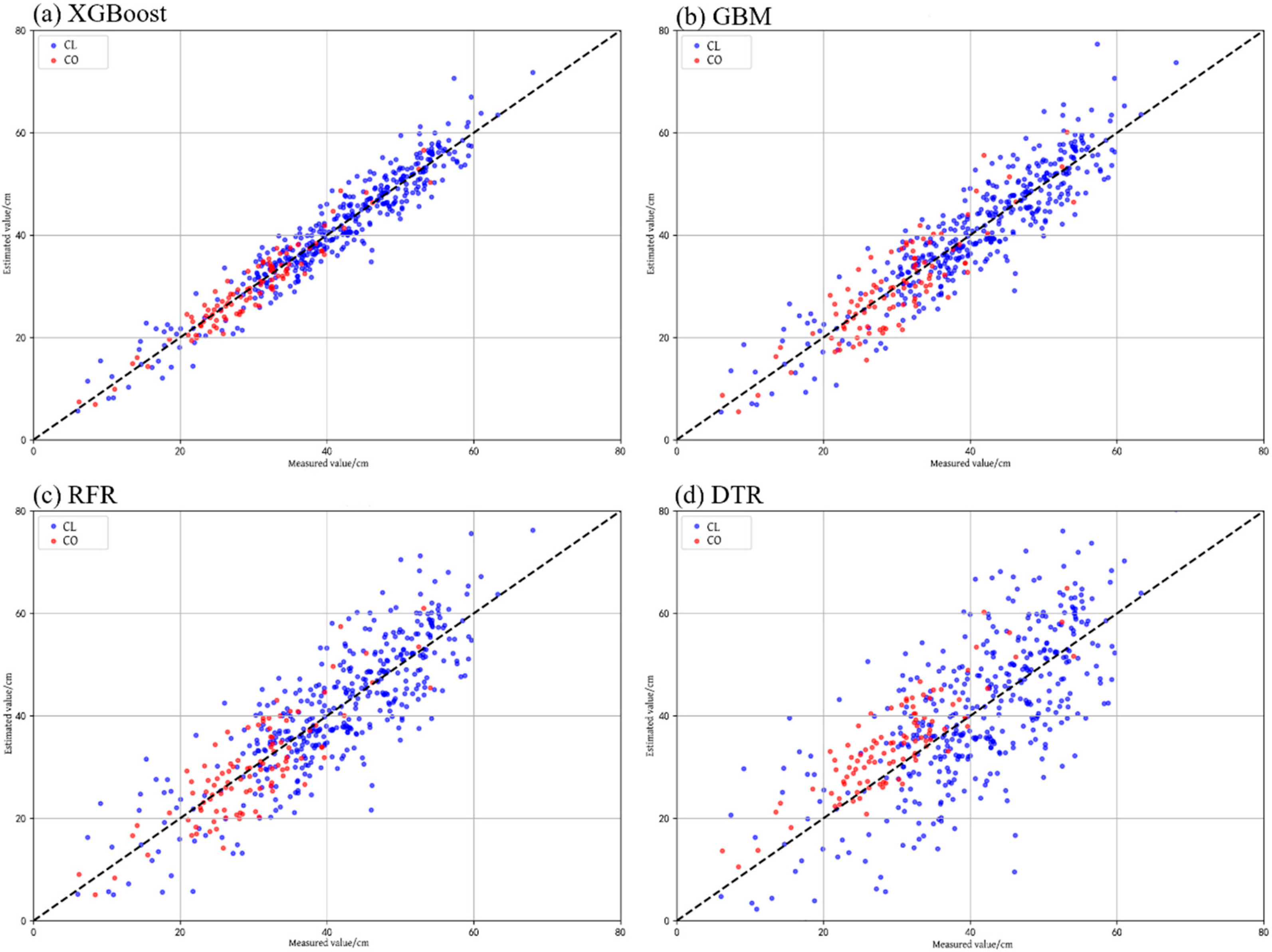
- The proposed MSFS–XGBoost model significantly improved prediction accuracy, achieving an of 0.901 and an RMSE of 1.647 cm, outperforming DTR, RFR, and GBM models.
- The proposed feature optimization strategy effectively reduces redundancy in LiDAR-derived features and enhances model stability for forest structural parameter estimation.
- The MSFS–XGBoost framework provides a reliable approach for accurate individual-tree DBH estimation and supports refined forest resource monitoring using airborne LiDAR data.
Abstract
1. Introduction
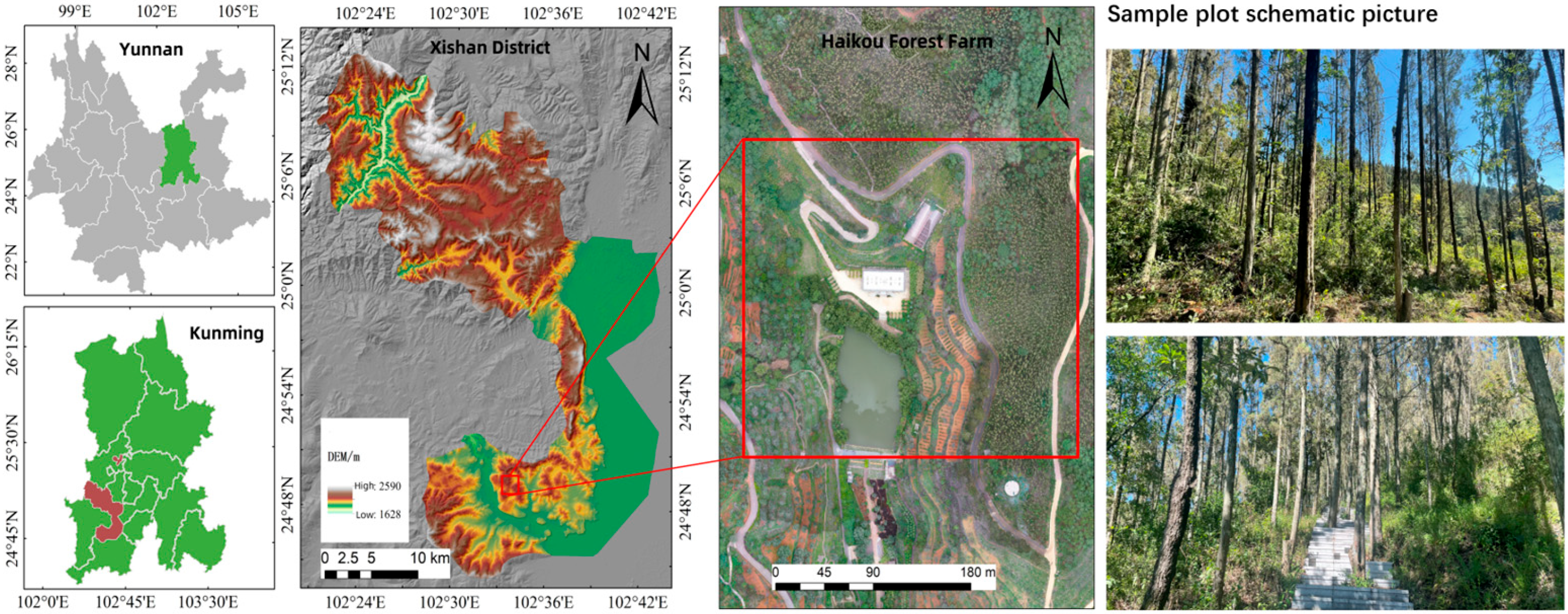
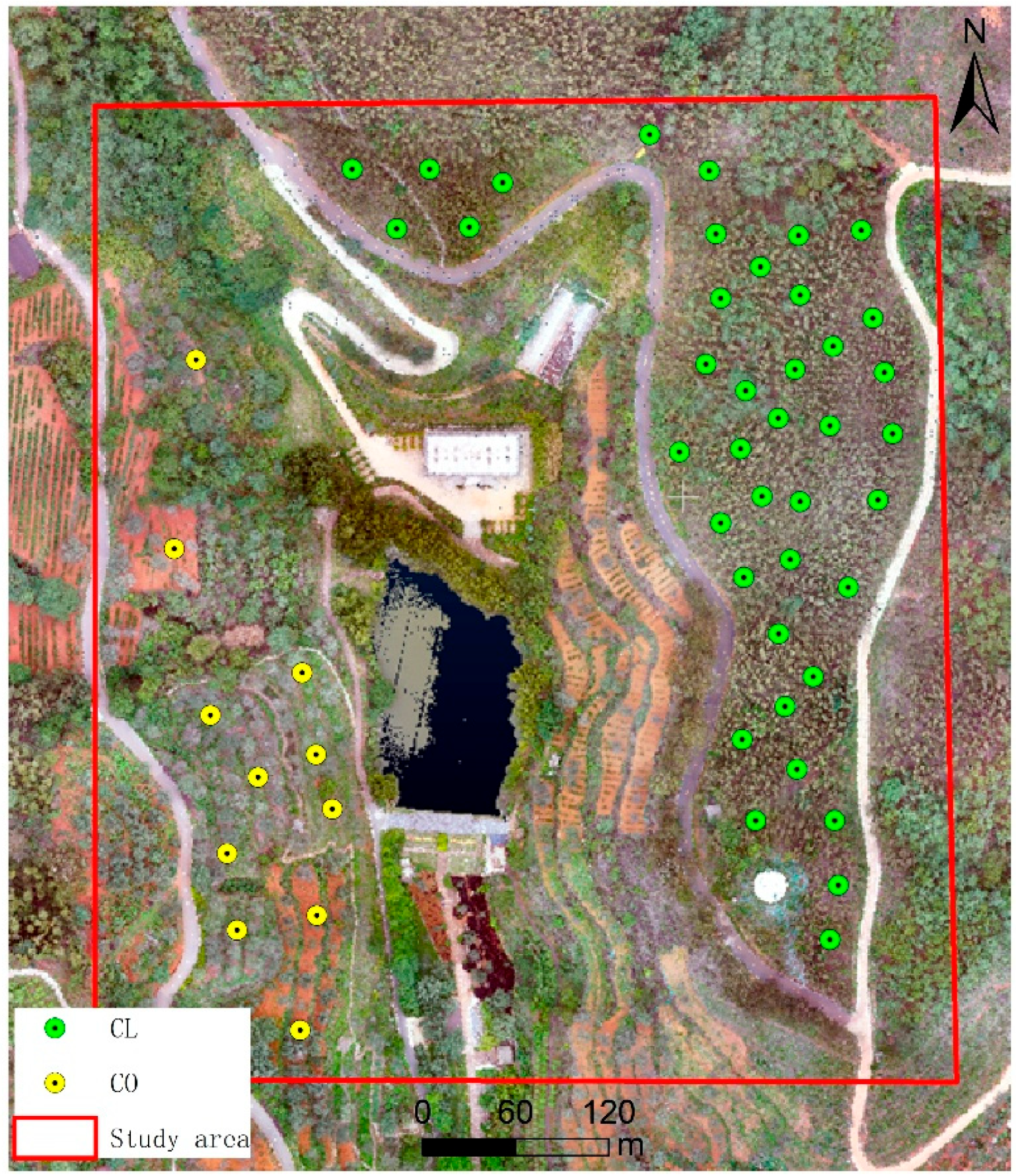
2. Study Area and Data
2.1. Study Area
2.2. Data Acquisition
2.3. Data Preprocessing
3. Methods
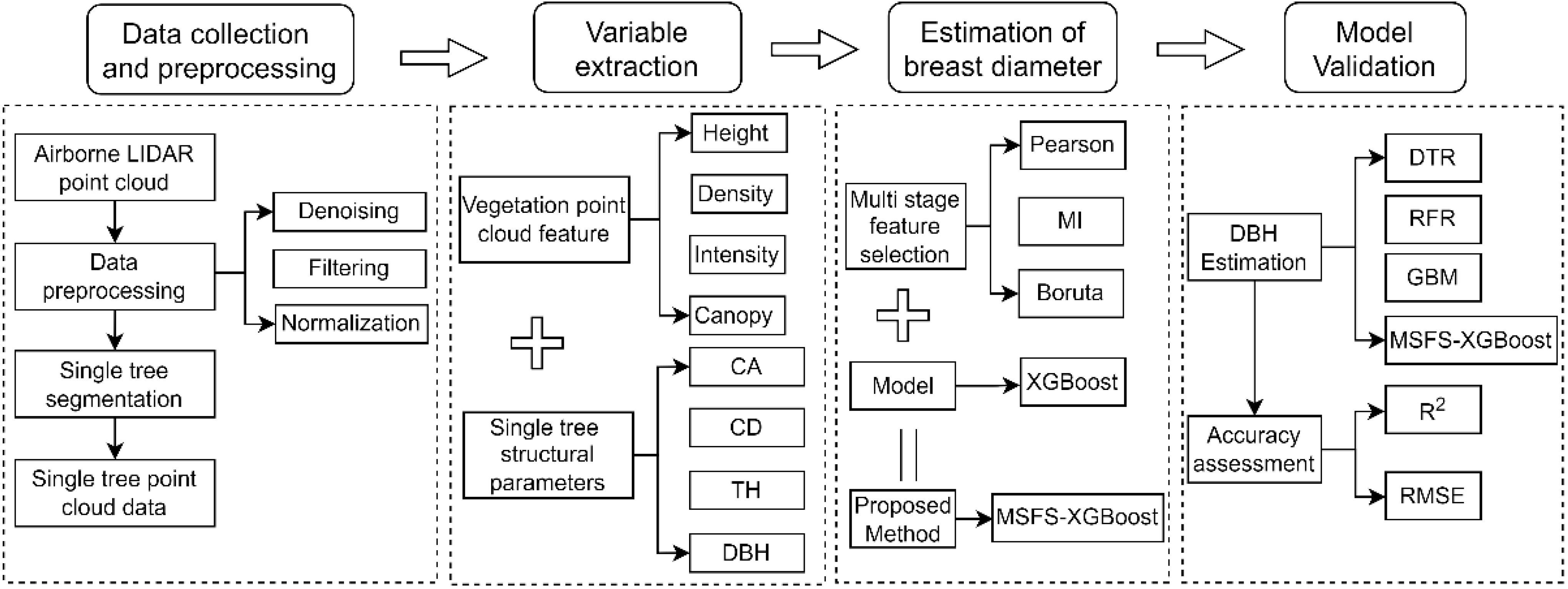
3.1. Technical Workflow

3.2. Individual Tree Segmentation
3.3. Variable Extraction
3.4. Multi-Stage Feature Selection
3.5. Model Construction
4. Results
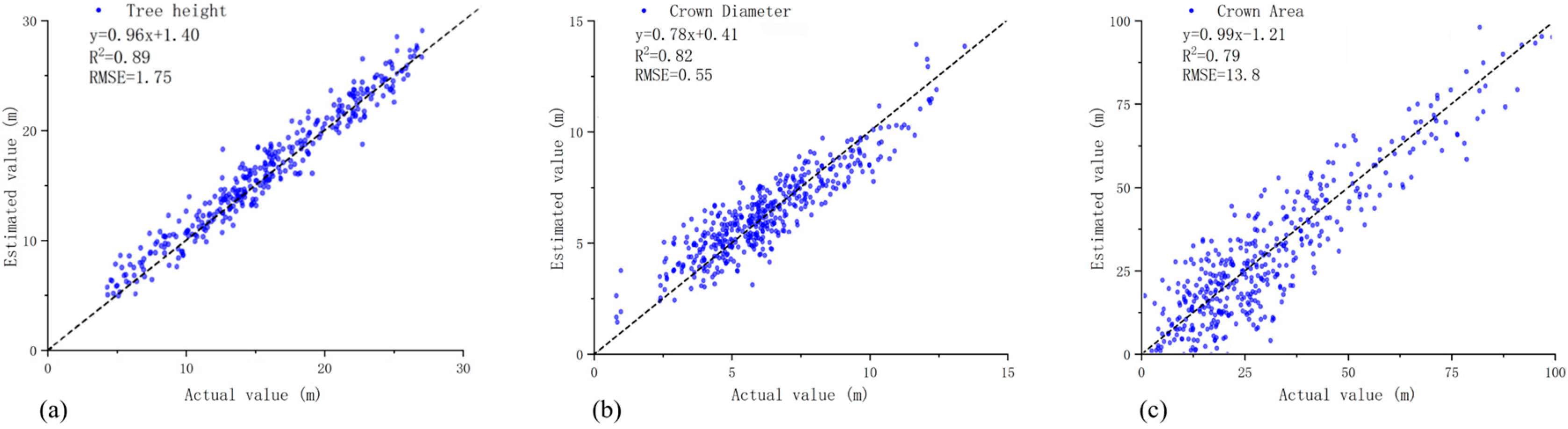
4.1. Results of Individual Tree Segmentation
4.2. Results of Feature Selection
4.3. Individual-Tree DBH Estimation
4.4. Model Evaluation and Validation
5. Discussion
6. Conclusions
Author Contributions
Funding
Institutional Review Board Statement
Informed Consent Statement
Data Availability Statement
Conflicts of Interest
References
- Gao, Q.; Kan, J. Automatic Forest DBH Measurement Based on Structure from Motion Photogrammetry. Remote Sens. 2022, 14, 2064. [Google Scholar] [CrossRef]
- Shao, T.; Qu, Y.; Du, J. A low-cost integrated sensor for measuring tree diameter at breast height (DBH). Comput. Electron. Agric. 2022, 199, 107140. [Google Scholar] [CrossRef]
- Kalwar, O.P.P.; Hussin, Y.A.; Weir, M.J.C.; de Bie, C.A.J.M.; Karna, Y. Deriving forest plot inventory parameters using terrestrial laser scanning in the tropical rainforest of Malaysia. Int. J. Remote Sens. 2021, 42, 884–901. [Google Scholar] [CrossRef]
- Austin, D.U.O.; Yirdaw, E. Models for predicting tree diameter at breast height from over- and under-bark diameter of stump in Eucalyptus camaldulensis plantations. Forests 2015, 6, 3769–3786. [Google Scholar] [CrossRef]
- Wang, P.; Gan, X.; Zhang, Q.; Bu, G.; Li, L.; Xu, X.; Li, Y.; Liu, Z.; Xiao, X. Analysis of Parameters for the Accurate and Fast Estimation of Tree Diameter at Breast Height Based on Simulated Point Cloud. Remote Sens. 2019, 11, 2707. [Google Scholar] [CrossRef]
- Chavesta, M.C.T.; Godo, A.F.M.; Romero-Cabello, E.A.; Cabello-Torres, R.J. Capture and storage of carbon in the dry forests of Pomac (Lambayeque, Peru) to improve the focus of reforestation on new ecosystem services. Chem. Eng. Trans. 2023, 105, 505–510. [Google Scholar] [CrossRef]
- Aulia, R.; Kaswanto; Arifin, H.S.; Mosyaftiani, A.; Syasita, N.; Wahyu, A.; Wiyoga, H. Assessing the benefits and management of urban forest in supporting low carbon city in Jakarta, Indonesia. Biodiversitas 2023, 24, 6151–6159. [Google Scholar] [CrossRef]
- Certini, G.; Manetti, M.C.; Mariotti, B.; Maltoni, A.; Moretti, G.; Pelleri, F. Does association with N-fixing nurse trees improve carbon sequestration in walnut plantations? Case study on a reclaimed opencast mine in Italy. For. Ecol. Manag. 2023, 545, 121245. [Google Scholar] [CrossRef]
- Olofsson, K.; Holmgren, J.; Olsson, H. Tree stem and height measurements using terrestrial laser scanning and the RANSAC algorithm. Remote Sens. 2014, 6, 4323–4344. [Google Scholar] [CrossRef]
- Chirico, G.B.; Bonavolontà, F. Metrology for agriculture and forestry 2019. Sensors 2020, 20, 3498. [Google Scholar] [CrossRef]
- Liang, X.; Hyyppä, J.; Kaartinen, H.; Lehtomäki, M.; Pyörälä, J.; Pfeifer, N.; Holopainen, M.; Brolly, G.; Francesco, P.; Hackenberg, J.; et al. International benchmarking of terrestrial laser scanning approaches for forest inventories. ISPRS J. Photogramm. Remote Sens. 2018, 144, 137–179. [Google Scholar] [CrossRef]
- Iizuka, K.; Yonehara, T.; Itoh, M.; Kosugi, Y. Estimating tree height and diameter at breast height (DBH) from digital surface models and orthophotos obtained with an unmanned aerial system for a Japanese cypress (Chamaecyparis obtusa) forest. Remote Sens. 2018, 10, 13. [Google Scholar] [CrossRef]
- Cao, L.; Coops, N.C.; Sun, Y.; Ruan, H.; Wang, G.; Dai, J.; She, G. Estimating canopy structure and biomass in bamboo forests using airborne LiDAR data. ISPRS J. Photogramm. Remote Sens. 2019, 148, 114–129. [Google Scholar] [CrossRef]
- Chen, J.; Li, X.; Huang, Z.; Xuan, J.; Chen, C.; Hu, M.; Tan, C.; Zhang, Y.; Wang, T. Forest age estimation using UAV-LiDAR and Sentinel-2 data with machine learning algorithms: A case study of Masson pine (Pinus massoniana). Geo-Spat. Inf. Sci. 2025, 28, 1051–1071. [Google Scholar] [CrossRef]
- Chen, S.; McDermid, G.J.; Castilla, G.; Linke, J. Measuring vegetation height in linear disturbances in the boreal forest with UAV photogrammetry. Remote Sens. 2017, 9, 1257. [Google Scholar] [CrossRef]
- Zhang, L.; Zhao, Y.; Chen, C.; Li, X.; Mao, F.; Lv, L.; Yu, J.; Song, M.; Huang, L.; Chen, J.; et al. UAV-LiDAR Integration with Sentinel-2 Enhances Precision in AGB Estimation for Bamboo Forests. Remote Sens. 2024, 16, 705. [Google Scholar] [CrossRef]
- Rocha, K.D.; Silva, C.A.; Cosenza, D.N.; Mohan, M.; Klauberg, C.; Schlickmann, M.B.; Xia, J.; Leite, R.V.; Almeida, D.R.A.d.; Atkins, J.W.; et al. Crown-Level Structure and Fuel Load Characterization from Airborne and Terrestrial Laser Scanning in a Longleaf Pine (Pinus palustris Mill.) Forest Ecosystem. Remote Sens. 2023, 15, 1002. [Google Scholar] [CrossRef]
- Zhou, S.; Kang, F.; Li, W.; Kan, J.; Zheng, Y.; He, G. Extracting diameter at breast height with a handheld mobile LiDAR system in an outdoor environment. Sensors 2019, 19, 3212. [Google Scholar] [CrossRef]
- Neuville, R.; Bates, J.S.; Jonard, F. Estimating forest structure from UAV-mounted LiDAR point cloud using machine learning. Remote Sens. 2021, 13, 352. [Google Scholar] [CrossRef]
- Meng, Y.; Gou, R.; Bai, J.; Moreno-Mateos, D.; Davis, C.C.; Wan, L.; Song, S.; Zhang, H.; Zhu, X.; Lin, G. Spatial patterns and driving factors of carbon stocks in mangrove forests on Hainan Island, China. Glob. Ecol. Biogeogr. 2022, 31, 1692–1706. [Google Scholar] [CrossRef]
- Wang, L.; Yang, L.; Xiong, J.; Shen, G.; Fu, L.; Wang, H. Integrating CNN with PolInSAR multidimensional backscattering for enhanced forest height retrieval. IEEE Trans. Geosci. Remote Sens. 2025, 63, 1–19. [Google Scholar] [CrossRef]
- Cloude, S.R.; Papathanassiou, K.P. Three-stage inversion process for polarimetric SAR interferometry. IEE Proc. Radar Sonar Navig. 2003, 150, 125–134. [Google Scholar] [CrossRef]
- Askne, J.; Santoro, M.; Smith, G.; Fransson, J.E.S. Multitemporal repeat-pass SAR interferometry of boreal forests. IEEE Trans. Geosci. Remote Sens. 2003, 41, 1540–1550. [Google Scholar] [CrossRef]
- Treuhaft, R.N.; Law, B.E.; Asner, G.P. Forest attributes from radar interferometric structure and its fusion with optical remote sensing. BioScience 2004, 54, 561–571. [Google Scholar] [CrossRef]
- Li, Y.; Peng, D.L.; Yuan, Y.N. Application of the XGBoost algorithm for estimating forest aboveground biomass using airborne LiDAR. J. Northeast For. Univ. 2023, 51, 106–112, 129. [Google Scholar] [CrossRef]
- Zhao, X.; Yue, C.R.; Li, C.G.; Zhang, L.M.; Gu, L. Estimation of mean stand height using airborne LiDAR data. For. Res. 2020, 33, 59–66. [Google Scholar] [CrossRef]
- Tarsha Kurdi, F.; Gharineiat, Z.; Lewandowicz, E.; Shan, J. Modeling the Geometry of Tree Trunks Using LiDAR Data. Forests 2024, 15, 368. [Google Scholar] [CrossRef]
- Sheng, Y.; Zhao, Q.; Wang, X.; Liu, Y.; Yin, X. Tree diameter at breast height extraction based on mobile laser scanning point cloud. Forests 2024, 15, 590. [Google Scholar] [CrossRef]
- Mu, Z.Y.; Zhang, Z.P.; Zhang, H.; Jiang, L.C. Predicting aboveground biomass of Larix gmelinii using machine learning models. J. Northeast For. Univ. 2024, 52, 41–47. [Google Scholar] [CrossRef]
- Yan, X.; Li, J.; Smith, A.R.; Yang, D.; Ma, T.; Su, Y.; Shao, J. Evaluation of machine learning methods and multi-source remote sensing data combinations to construct forest above-ground biomass models. Int. J. Digit. Earth 2023, 16, 4471–4491. [Google Scholar] [CrossRef]
- Xiang, B.; Wielgosz, M.; Kontogianni, T.; Peters, T.; Puliti, S.; Astrup, R.; Schindler, K. Automated forest inventory: Analysis of high-density airborne LiDAR point clouds with 3D deep learning. Remote Sens. Environ. 2024, 305, 114078. [Google Scholar] [CrossRef]
- Zhang, X.; Jia, W.; Sun, Y.; Wang, F.; Miu, Y. Simulation of spatial and temporal distribution of forest carbon stocks in long time series—Based on remote sensing and deep learning. Forests 2023, 14, 483. [Google Scholar] [CrossRef]
- An, Y.P.; Wang, X.; Zhang, R.; Liu, X.R.; Zhang, G.X.; Tang, J.K.; Zhou, Z.Q. Assessment of geological hazard susceptibility in Lingtai County using multiple machine learning models. J. Lanzhou Univ. Nat. Sci. 2025, 61, 84–90, 98. [Google Scholar] [CrossRef]
- Gao, L.; Zhang, X. Above-ground biomass estimation of plantation with complex forest stand structure using multiple features from airborne laser scanning point cloud data. Forests 2021, 12, 1713. [Google Scholar] [CrossRef]
- Tang, J.J.; Chai, Z.Z. Remote sensing estimation of mean stand diameter at breast height using airborne LiDAR and machine learning. For. Grassl. Res. 2024, 1, 56–64. [Google Scholar] [CrossRef]
- Qin, H.; Zhou, W.; Yao, Y.; Wang, W. Individual tree segmentation and tree species classification in subtropical broadleaf forests using UAV-based LiDAR, hyperspectral, and ultrahigh-resolution RGB data. Remote Sens. Environ. 2022, 280, 113143. [Google Scholar] [CrossRef]
- Wang, Z.H.; Gan, S.; Lv, J.; Yang, Z.S. Comparison of airborne LiDAR point cloud filtering algorithms for debris flow gully terrain. J. Lanzhou Univ. Nat. Sci. 2023, 59, 770–777. [Google Scholar] [CrossRef]
- Zhao, X.Q.; Guo, Q.H.; Su, Y.J.; Xue, B.L. Improved progressive TIN densification filtering algorithm for airborne LiDAR data in forested areas. ISPRS J. Photogramm. Remote Sens. 2016, 117, 79–91. [Google Scholar] [CrossRef]
- Lee, H.; Slatton, K.C.; Roth, B.E.; Cropper, W.P. Adaptive clustering of airborne LiDAR data to segment individual tree crowns in managed pine forests. Int. J. Remote Sens. 2010, 31, 117–139. [Google Scholar] [CrossRef]
- Parkan, M.; Tuia, D. Estimating Uncertainty of Point-Cloud Based Single-Tree Segmentation with Ensemble Based Filtering. Remote Sens. 2018, 10, 335. [Google Scholar] [CrossRef]
- Montealegre, A.L.; Lamelas, M.T.; de la Riva, J.; García-Martín, A.; Escribano, F. Use of low point density ALS data to estimate stand-level structural variables in Mediterranean Aleppo pine forest. Forestry 2016, 89, 373–382. [Google Scholar] [CrossRef]
- Watt, M.S.; Meredith, A.; Watt, P.; Gunn, A. Use of LiDAR to estimate stand characteristics for thinning operations in young Douglas-fir plantations. N. Z. J. For. Sci. 2013, 43, 18. [Google Scholar] [CrossRef]
- Hao, H.K. Study on Forest Parameter Inversion Based on Airborne LiDAR. Master’s Thesis, Northwest A&F University, Yangling, China, 2019. [Google Scholar] [CrossRef]
- Pawan; Dhiman, R. Electroencephalogram channel selection based on Pearson correlation coefficient for motor imagery brain–computer interface. Meas. Sens. 2023, 25, 100616. [Google Scholar] [CrossRef]
- Li, Y.; Zhang, J.L. Analysis and implementation of several correlation coefficients in the R language. J. Stat. Inf. 2019, 34, 3–11. [Google Scholar]
- Huang, L.; Zhou, X.; Shi, L.; Gong, L. Time series feature selection method based on mutual information. Appl. Sci. 2024, 14, 1960. [Google Scholar] [CrossRef]
- Guindo, M.L.; Kabir, M.H.; Chen, R.; Liu, F. Potential of Vis-NIR to measure heavy metals in different varieties of organic fertilizers using Boruta and deep belief network. Ecotoxicol. Environ. Saf. 2021, 228, 112996. [Google Scholar] [CrossRef] [PubMed]
- Marshall, T.L.; Nickels, L.C.; Brady, P.W.; Edgerton, E.J.; Lee, J.J.; Hagedorn, P.A. Developing a machine learning model to detect diagnostic uncertainty in clinical documentation. J. Hosp. Med. 2023, 18, 405–412. [Google Scholar] [CrossRef] [PubMed]
- Chen, T.; Guestrin, C. XGBoost: A scalable tree boosting system. In Proceedings of the 22nd ACM SIGKDD International Conference on Knowledge Discovery and Data Mining (KDD ’16), San Francisco, CA, USA, 13–17 August 2016; Association for Computing Machinery: New York, NY, USA; pp. 785–794. [CrossRef]
- Zhao, P.; Lu, D.; Wang, G.; Wu, C.; Huang, Y.; Yu, S. Examining spectral reflectance saturation in Landsat imagery and corresponding solutions to improve forest aboveground biomass estimation. Remote Sens. 2016, 8, 469. [Google Scholar] [CrossRef]
- Breiman, L. Random forests. Mach. Learn. 2001, 45, 5–32. [Google Scholar] [CrossRef]
- Jubanski, J.; Ballhorn, U.; Kronseder, K.; Franke, J.; Siegert, F. Detection of large above-ground biomass variability in lowland forest ecosystems by airborne LiDAR. Biogeosciences 2013, 10, 3917–3930. [Google Scholar] [CrossRef]
- Liu, Y.J.; Liu, K.; Cao, J.J. Classification of coastal wetlands in the Pearl River Estuary using Zhuhai-1 hyperspectral imagery and XGBoost algorithm. Bull. Surv. Mapp. 2023, 12, 136–141. [Google Scholar]
- Kong, Z.; Yin, Z.; Cheng, Y.; Li, Y.; Zhang, Z.; Mei, L. Modeling and evaluation of the systematic errors for the polarization-sensitive imaging lidar technique. Remote Sens. 2020, 12, 3309. [Google Scholar] [CrossRef]
- Xu, J.; Zhao, Y.; Li, X.; Lv, L.; Yu, J.; Song, M.; Huang, L.; Mao, F.; Du, H. Improving Chinese fir plantations DBH inversion accuracy using ensemble learning models based on UAV-LiDAR. IEEE J. Sel. Top. Appl. Earth Observ. Remote Sens. 2025, 18, 10846–10863. [Google Scholar] [CrossRef]
- Li, R.; Wang, L.; Zhai, Y.; Huang, Z.; Jia, J.; Wang, H.; Ding, M.; Fang, J.; Yao, Y.; Ye, Z.; et al. Modeling LiDAR-derived 3D structural metric estimates of individual tree aboveground biomass in urban forests: A systematic review of empirical studies. Forests 2025, 16, 390. [Google Scholar] [CrossRef]
- Zhang, L.X.; Yan, H.; Liu, Y.; Xu, J.; Song, J.N.; Yu, D.J. Enhancing characteristic gene selection and tumor classification by the robust Laplacian supervised discriminative sparse PCA. J. Chem. Inf. Model. 2022, 62, 1794–1807. [Google Scholar] [CrossRef]
- Hu, T.; Sun, Y.; Jia, W.; Li, D.; Zou, M.; Zhang, M. Study on the estimation of forest volume based on multi-source data. Sensors 2021, 21, 7796. [Google Scholar] [CrossRef]
- Wang, P.; Tan, S.; Zhang, G.; Wang, S.; Wu, X. Remote sensing estimation of forest aboveground biomass based on Lasso-SVR. Forests 2022, 13, 1597. [Google Scholar] [CrossRef]
- Zhang, L.; Zhuang, D.; Zou, B.; Duan, B.; Chen, H. A slope three-layer scattering model for forest parameter inversion of PolInSAR. IEEE Geosci. Remote Sens. Lett. 2020, 19, 4001605. [Google Scholar] [CrossRef]
- Gupta, S.K.; Schulze, F.; Mallast, U.; Gründling, R.; Brede, B.; Kleidon-Hildebrandt, A.; Rebmann, C.; Dienstbach, L.; Schmidt, P. Validating tree inventory: Analysing tree structural properties from high-density airborne LiDAR point clouds and UAV imagery. In Proceedings of the EGU General Assembly 2025, Vienna, Austria, 27 April–2 May 2025. EGU25-18078. [Google Scholar] [CrossRef]
- Li, Q.; Yin, J.; Zhang, X.; Hao, D.; Ferreira, M.P.; Yan, W.; Tian, Y.; Zhang, D.; Tan, S.; Nie, S.; et al. Tree-level carbon stock estimations across diverse species using multi-source remote sensing integration. Comput. Electron. Agric. 2025, 231, 109904. [Google Scholar] [CrossRef]
- Lopez, O.A.; Johansen, K.; Scilla, D.; Elías-Lara, M.; Angulo, V.; Almashharawi, S.; McCabe, M.F. Using low-resolution LIDAR on a ground-based agile robot to estimate height, DBH and crown volume of trees. Sci. Remote Sens. 2025, 12, 100296. [Google Scholar] [CrossRef]





| Zhihang SF1650 Hexacopter UAV | |
| Parameter | Specification |
| Maximum take-off weight | 21 kg |
| Maximum payload | 6 kg |
| Maximum flight speed | 18 km/h |
| Maximum control range | 10 km |
| RTK positioning accuracy | (horizontal) 1 cm ± 1 ppm |
| RTK positioning accuracy | (vertical) 2 cm ± 1 ppm |
| South Surveying & Mapping SAL-1500 LiDAR Sensor | |
| Parameter | Specification |
| Weight | 1 kg |
| Measurement range | 1.5–1500 m |
| System accuracy | ±5 cm |
| Maximum measurement rate | 2 million points/s |
| Field of view | 360° |
| Scanning angle | (horizontal) 80° × (vertical) 4.5° |
| Scanning frequency | 200 kHz |
| Forest Type | Broadleaf Forest | Coniferous Forest | ||
|---|---|---|---|---|
| No. of Plots | 11 | 40 | ||
| Parameter | Range | Mean | Range | Mean |
| DBH (cm) | 6.2–51.0 | 28.2 | 9.7–64.3 | 33.5 |
| Tree Height (m) | 5.1–25.6 | 11.2 | 6.2–22.6 | 15.7 |
| Crown Diameter (m) | 0.8–12.9 | 6.8 | 0.8–11.8 | 5.2 |
| Crown Area (m2) | 0.6–118.8 | 37.4 | 0.5–108.7 | 23.8 |
| Height Features (46) | |||
| Variable Name | Abbreviation | quantity | Variable Description |
| Average absolute deviation | E-aad | 1 | |
| Canopy relief rate | E-crr | 1 | |
| Accumulate height percentiles | E-AIH | 15 | |
| Interquartile range of accumulate height percentile | E-AIH-IQ | 1 | |
| Variable coefficient | E-cv | 1 | |
| Kurtosis | E_kurtosis | 1 | |
| Median of median absolute deviation | E-Mad median | 1 | The median absolute deviation of the median height value at all points in the region. |
| Maximum, minimum, mean, median, skewness, standard deviation, and variance | E-max,E-min,E-mean, E-median,E-skewness, E-stddev,E-var | 7 | The maximum, minimum, mean, median, skewness, standard deviation, and variance of all point heights in the region. |
| Quadratic power mean | E-sms | 1 | |
| The mean to the third power | E-cmc | 1 | |
| Percentile of height | E-P | 15 | |
| Interquartile range of Percentile of height | E-PIQ | 1 | |
| Intensity features (42) | |||
| Mean absolute deviation | I-aad | 1 | |
| Accumulate intensity percentiles | I-AII | 15 | |
| Variable coefficient | I-cv | 1 | |
| Kurtosis | I_kurtosis | 1 | |
| Median of median absolute deviation | I-Mad median | 1 | The median absolute deviation of the median intensity value at all points in the region. |
| Percentile of intensity | I-P | 15 | |
| Interquartile range of percentile of intensity | I-PIQ | 1 | |
| Maximum, minimum, mean, median, skewness, standard deviation, and variance | I-max,I-min,I-mean,I-median,I-skewness,I-stddev, I-var | 7 | The maximum, minimum, mean, median, skewness, standard deviation, and variance of intensity values of all points in the region. |
| Density and other features (13) | |||
| Density | D-M | 10 | In the region, the point cloud data are divided into ten equal height slices from low to high and the proportion of echo numbers in each layer is the corresponding density variable. |
| Canopy cover | CC | 1 | ( is the number of vegetation points, is the total number of points) |
| Leaf area index | LAI | 1 | (ang is the average scan Angle, GF is the gap rate, and k is the extinction coefficient) |
| Gap Fraction | GF | 1 | ( is the number of ground points whose height is lower than the height threshold and n is the total number of points) |
| Model | Basic Principle | Advantages | Representative Significance |
|---|---|---|---|
| DTR [50] | Constructs a tree structure through recursive feature splitting and predicts target values at leaf nodes | Simple structure; easy to interpret | Serves as a baseline model for comparison with ensemble methods |
| RFR [51] | Integrates multiple decision trees using bootstrap sampling and voting/averaging to reduce variance | High stability; strong resistance to noise | Represents bagging-based ensemble methods; suitable for high-dimensional point cloud data |
| GBM [52] | Iteratively learns residuals to progressively improve the performance of weak learners | High fitting accuracy; capable of modeling complex relationships | Represents boosting-based methods and evaluates their regression performance |
| Forest Type | Actual Number | Segmented Number | TP | FN | FP | R | P | F |
|---|---|---|---|---|---|---|---|---|
| Coniferous forest | 586 (trees) | 635 (trees) | 532 | 54 | 133 | 0.91 | 0.80 | 0.85 |
| Broadleaf forest | 150 (trees) | 161 (trees) | 138 | 12 | 24 | 0.92 | 0.85 | 0.88 |
| Method | Category | Variable Names |
|---|---|---|
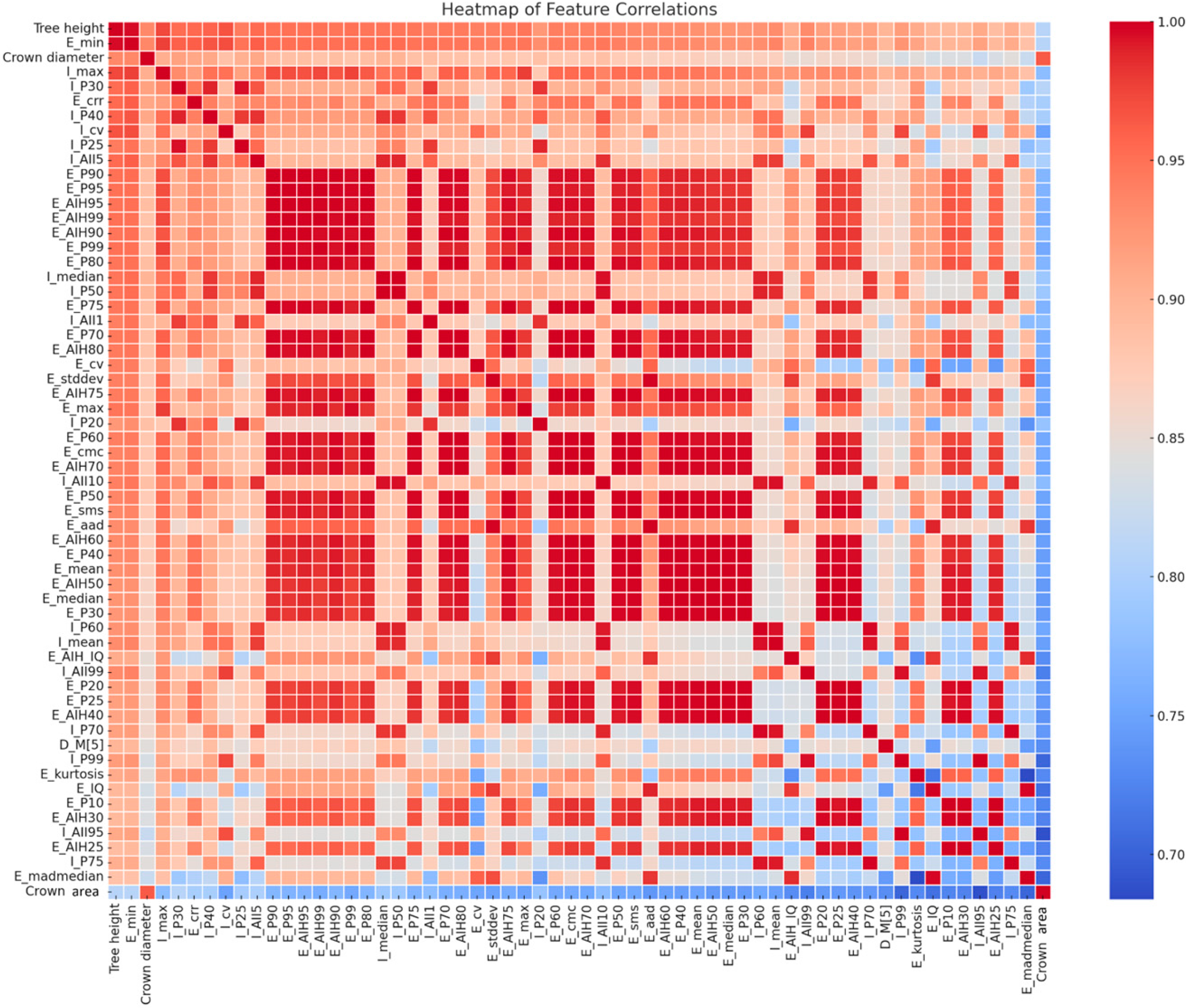
| Pearson (60 features retained) | Structural parameters (3) | Tree height, Crown diameter, Crown area |
| Height features (38) | E_min, E_crr, E_P90, E_P95, E_AIH95, E_AIH99, E_AIH90, E_P99, E_P80, E_P75, E_P70, E_AIH80, E_ cv, E_ stddev, E_AIH75, E_ max, E_P60, E_ cmc, E_AIH70, E_P50, E_ sms, E_ aad, E_AIH60, E_P40, E_ mean, E_AIH50, E_ median, E_P30, E_AIH_IQ, E_P20, E_P25, E_AIH40, E_kurtosis, E_IQ, E_P10, E_AIH30, E_AIH25, E_ mad median | |
| Intensity features (18) | I_ max, I_P30, I_P40, I_cv, I_P25, I_AII5, I_P50, I_ median, I_AII1, I_P20, I_AII10, I_P60, I_ mean, I_AII99, I_P70, I_P99, I_AII95, I_P75 | |
| Density features (1) | D_M [5] | |
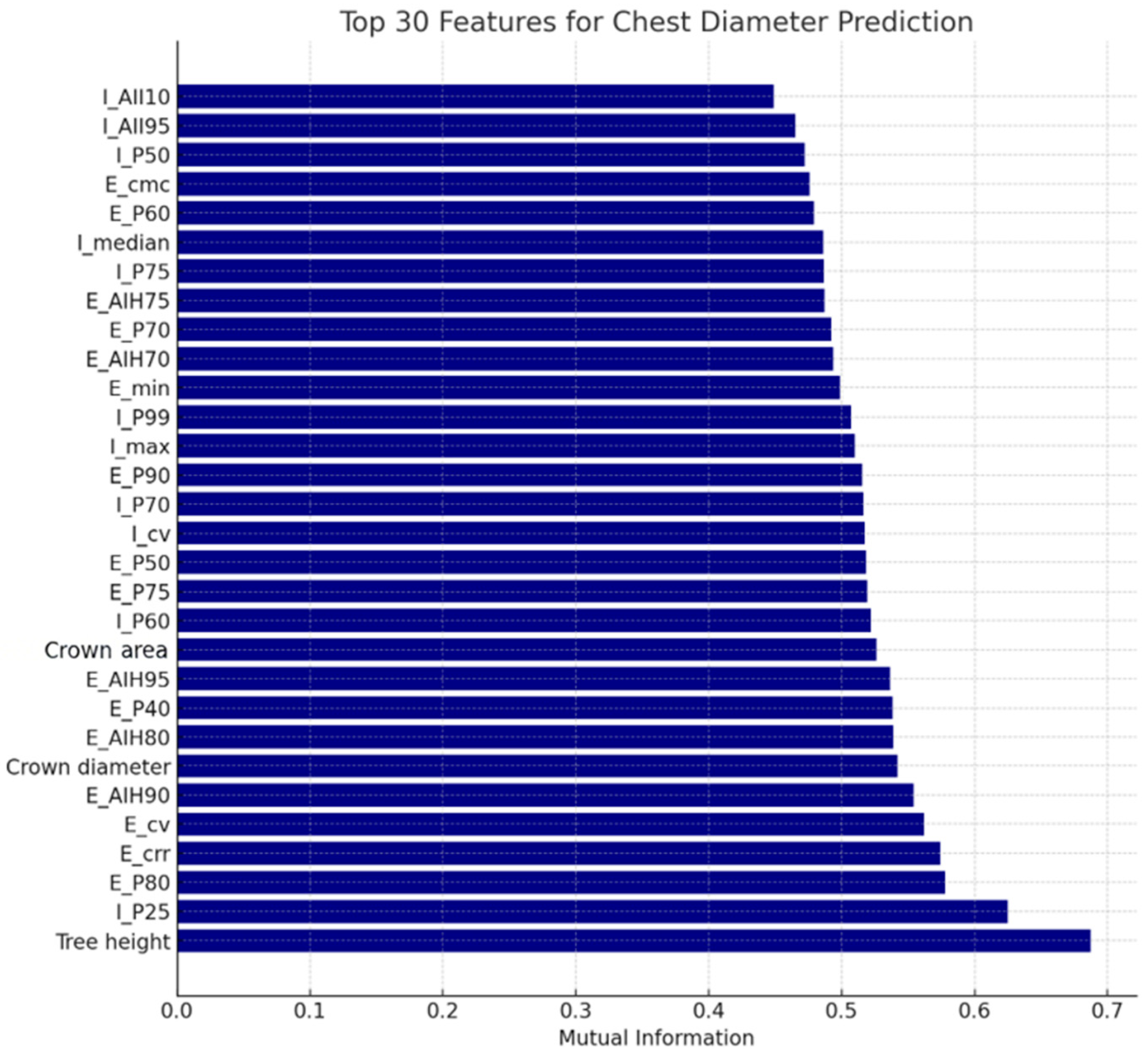
| MI (30 features retained) | Structural parameters (3) | Tree height, Crown diameter, Crown area, |
| Height features (16) | E_P80, E_crr, E_cv, E_AIH90, E_AIH80, E_P40, E_AIH95, E_P75, E_P50, E_P90, E_min, E_AIH70, E_P70, E_AIH75, E_P60, E_ cmc, | |
| Intensity features (11) | I_P25, I_P60, I_ cv, I_P70, I_ max, I_P99, I_P75, I_ median, I_P50, I_AII95, I_AII10 | |
| Boruta (13 features retained) | Structural parameters (3) | Tree height, Crown diameter, Crown area |
| Height features (5) | E_min, E_crr, E_cv, E-AIH90, E-P75 | |
| Intensity features (5) | I-cv, I-max, I-P99, I-AII95, I-AII10 |
| Category | Variable Names | Correlation Coefficient | Importance Index | Significance Level |
|---|---|---|---|---|
| Structural parameters | Tree height | 0.756 | 0.823 | 0.000 |
| Crown diameter | 0.724 | 0.781 | 0.000 | |
| Crown area | 0.689 | 0.756 | 0.000 | |
| Height features | E_min | 0.664 | 0.689 | 0.000 |
| E_crr | 0.693 | 0.718 | 0.000 | |
| E_cv | 0.542 | 0.561 | 0.015 | |
| E-AIH90 | 0.612 | 0.635 | 0.010 | |
| E-P75 | 0.578 | 0.597 | 0.010 | |
| Intensity features | I-cv | 0.523 | 0.548 | 0.000 |
| I-max | 0.681 | 0.697 | 0.000 | |
| I-P99 | 0.635 | 0.658 | 0.001 | |
| I-AII95 | 0.574 | 0.593 | 0.010 | |
| I-AII10 | 0.653 | 0.673 | 0.000 |
| Tree Species | Number | Train Set | Test Set | ||||
|---|---|---|---|---|---|---|---|
| Number | DBH/cm | Mean/cm | Number | DBH/cm | Mean/cm | ||
| Cupressus lusitanica | 500 | 333 | 5.1–60.8 | 28.8 | 167 | 6.8–65.1 | 30.9 |
| Canarium oleosum | 100 | 67 | 6.2–48.0 | 21.5 | 33 | 8.4–45.3 | 19.8 |
| Model | Dimension | Max-Depth | n-Estimators | Train Set | Test Set | ||
|---|---|---|---|---|---|---|---|
| R2 | RMSE | R2 | RMSE | ||||
| DTR | 104 | 5 | — | 0.365 | 4.090 | 0.330 | 4.121 |
| 60 | 5 | — | 0.412 | 4.120 | 0.395 | 4.468 | |
| 30 | 7 | — | 0.528 | 3.912 | 0.490 | 4.027 | |
| 13 | 7 | — | 0.603 | 3.824 | 0.553 | 3.850 | |
| GBM | 104 | 3 | 50 | 0.478 | 2.889 | 0.443 | 3.314 |
| 60 | 3 | 50 | 0.629 | 2.651 | 0.577 | 2.860 | |
| 30 | 5 | 110 | 0.675 | 2.524 | 0.619 | 2.528 | |
| 13 | 7 | 170 | 0.835 | 1.975 | 0.783 | 2.049 | |
| RFR | 104 | 5 | 50 | 0.391 | 3.912 | 0.358 | 4.027 |
| 60 | 7 | 90 | 0.598 | 4.050 | 0.550 | 4.243 | |
| 30 | 7 | 100 | 0.649 | 3.535 | 0.661 | 3.658 | |
| 13 | 9 | 150 | 0.711 | 3.031 | 0.693 | 3.248 | |
| XGBoost | 104 | 3 | 250 | 0.558 | 2.651 | 0.517 | 2.793 |
| 60 | 3 | 150 | 0.731 | 2.355 | 0.679 | 2.389 | |
| 30 | 3 | 200 | 0.875 | 1.928 | 0.820 | 2.030 | |
| 13 | 3 | 250 | 0.916 | 1.501 | 0.901 | 1.647 | |
| Model | Dimension | Max-Depth | n-Estimators | R2 (Mean ± Std) | RMSE (Mean ± Std) |
|---|---|---|---|---|---|
| DTR | 13 | 7 | — | 0.533 ± 0.022 | 3.880 ± 0.043 |
| RFR | 13 | 9 | 150 | 0.673 ± 0.023 | 3.288 ± 0.045 |
| GBM | 13 | 7 | 170 | 0.763 ± 0.019 | 2.079 ± 0.036 |
| XGBoost | 13 | 3 | 250 | 0.881 ± 0.016 | 1.677 ± 0.031 |
| Method | Dimension | Max-Depth | n-Estimators | R2 | RMSE (cm) |
|---|---|---|---|---|---|
| MSFS | 13 | 3 | 250 | 0.901 | 1.647 |
| LASSO | 20 | 3 | 250 | 0.814 | 2.219 |
| Tree Species | Model | Dimension | Max-Depth | n-Estimators | R2 | RMSE |
|---|---|---|---|---|---|---|
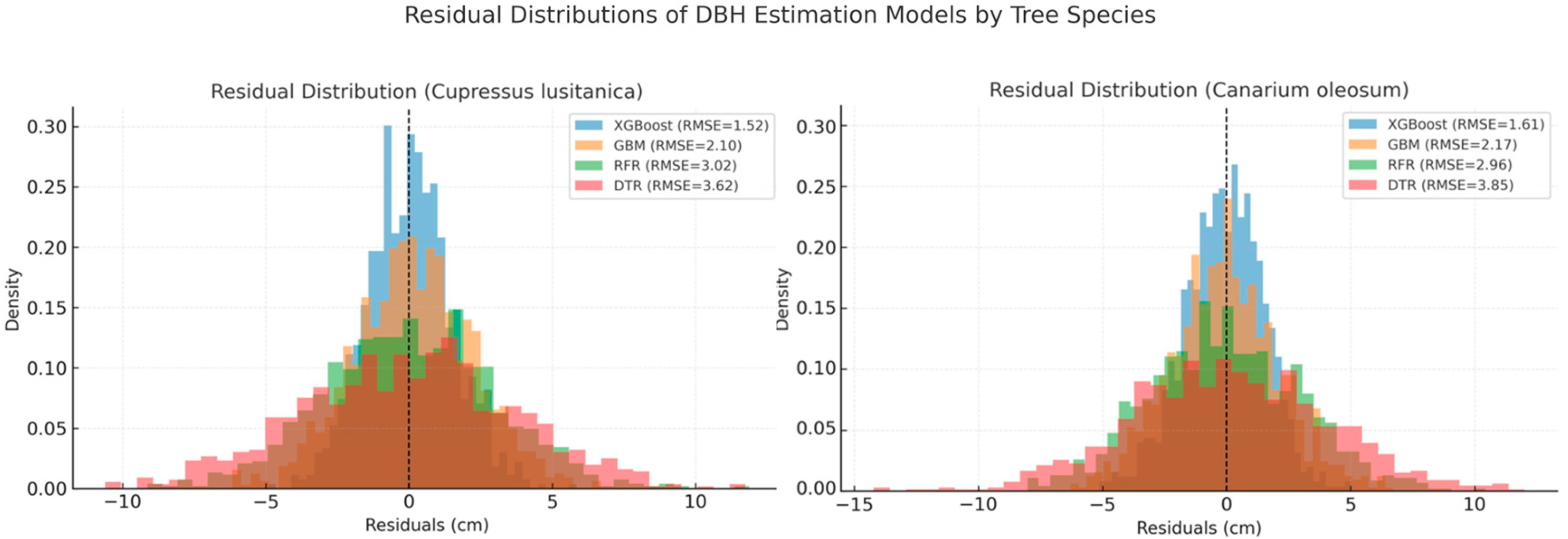
| Cupressus lusitanica | XGBoost | 13 | 3 | 250 | 0.905 | 1.518 |
| GBM | 13 | 7 | 170 | 0.813 | 2.096 | |
| RFR | 13 | 9 | 150 | 0.675 | 3.025 | |
| DTR | 13 | 7 | none | 0.537 | 3.621 | |
| Canarium oleosum | XGBoost | 13 | 3 | 250 | 0.896 | 1.614 |
| GBM | 13 | 7 | 170 | 0.782 | 2.167 | |
| RFR | 13 | 9 | 150 | 0.691 | 2.959 | |
| DTR | 13 | 7 | none | 0.553 | 3.855 |
Disclaimer/Publisher’s Note: The statements, opinions and data contained in all publications are solely those of the individual author(s) and contributor(s) and not of MDPI and/or the editor(s). MDPI and/or the editor(s) disclaim responsibility for any injury to people or property resulting from any ideas, methods, instructions or products referred to in the content. |
© 2026 by the authors. Licensee MDPI, Basel, Switzerland. This article is an open access article distributed under the terms and conditions of the Creative Commons Attribution (CC BY) license.
Share and Cite
Li, P.; Jia, Y. Individual-Tree DBH Estimation from Airborne LiDAR Data Using MSFS–XGBoost. Sensors 2026, 26, 2873. https://doi.org/10.3390/s26092873
Li P, Jia Y. Individual-Tree DBH Estimation from Airborne LiDAR Data Using MSFS–XGBoost. Sensors. 2026; 26(9):2873. https://doi.org/10.3390/s26092873
Chicago/Turabian StyleLi, Pengfei, and Yue Jia. 2026. "Individual-Tree DBH Estimation from Airborne LiDAR Data Using MSFS–XGBoost" Sensors 26, no. 9: 2873. https://doi.org/10.3390/s26092873
APA StyleLi, P., & Jia, Y. (2026). Individual-Tree DBH Estimation from Airborne LiDAR Data Using MSFS–XGBoost. Sensors, 26(9), 2873. https://doi.org/10.3390/s26092873