4.2. Analysis of the Results of Multi-Objective Trajectory Planning
Due to the fact that multi-objective optimization problems involve requirements such as operation time, energy consumption, and joint impact, and these objectives often have significant differences in magnitude and dimension, if direct optimization and comparison are conducted, it is easy for one objective to dominate the evaluation function, thereby weakening the role of the other objectives and affecting the balance of the Pareto solution set. To eliminate the bias caused by the dimensional differences, this paper adopts the min–max normalization method to map each objective to a dimensionless interval, achieving scale unification among the different objectives. After normalization, the algorithm can more reasonably seek a compromise solution among operation time, energy consumption, and impact, thereby promoting the multi-objective optimization process to discover a more balanced Pareto optimal solution set. Moreover, normalization also simplifies the comprehensive evaluation process of the multi-objective indicators, providing convenience for the subsequent selection of representative optimal solutions based on the ideal point distance criterion. The specific steps are as follows:
(1) Summarize the Pareto front solution sets obtained for each generation. Suppose the front solution set contains multiple non-dominated solutions, each corresponding to three objective function values—operation time, joint impact, and energy consumption. Based on the value range of each objective in this solution set, perform min–max normalization calculations on the operation time, impact, and energy consumption, respectively, to obtain the corresponding dimensionless normalized indicators.
In this formula,
represents the runtime objective value corresponding to the
i-th candidate solution in the Pareto solution set.
and
represent, respectively, the minimum and maximum runtime objective values in the current Pareto solution set.
denotes the dimensionless runtime value obtained by min–max normalization. The other symbols are defined in a similar manner.
(2) Search for the ideal solution point
The ideal point can be calculated through the following formula:
(3) To select representative compromise solutions from the Pareto solution set, this paper calculates the Euclidean distance from the
k-th solution to the ideal point. The calculation formula is:
(4) Ultimately, taking the Euclidean distance as a comprehensive evaluation criterion, the candidate solution that minimizes is selected from the Pareto solution set, i.e., the trajectory corresponding to the min(dk) is taken as the overall optimal compromise solution.
In the context of robotic joint trajectory planning, a smaller value of the evaluation index signifies that the robot can complete the specified task in a shorter duration while simultaneously maintaining lower levels of joint impact and energy consumption. Guided by the aforementioned comprehensive evaluation methodology, 30 independent experiments were conducted using the MGJO algorithm. The optimal evaluation index obtained from these trials was 0.033486, as depicted in
Figure 7. Although this result satisfies the fundamental requirements for trajectory planning, it indicates that there remains considerable potential for enhancing the overall performance. Consequently, the MGJO algorithm was improved, leading to the proposal of the IMGJO algorithm. To assess its effectiveness, 30 independent experiments were also performed using IMGJO, yielding an optimal evaluation index of 0.0233. Compared to the MGJO result, this represents a 30.41% reduction in the evaluation index, demonstrating a significant improvement in comprehensive performance. The corresponding experimental results are illustrated in
Figure 8.
As illustrated in
Figure 7,
Figure 8,
Figure 9 and
Figure 10, a comparative analysis was conducted to evaluate the trajectory optimization performance of the IMGJO, MGJO, MPSOD, and NMOPSO algorithms. Overall, the trajectories generated by IMGJO exhibit the highest quality, characterized by superior smoothness, continuity, and adherence to kinematic constraints. The optimization results of MGJO and NMOPSO are comparable, both outperforming MPSOD and producing trajectories with reasonably good quality. In contrast, MPSOD demonstrates the least effective trajectory optimization performance among the four algorithms evaluated.
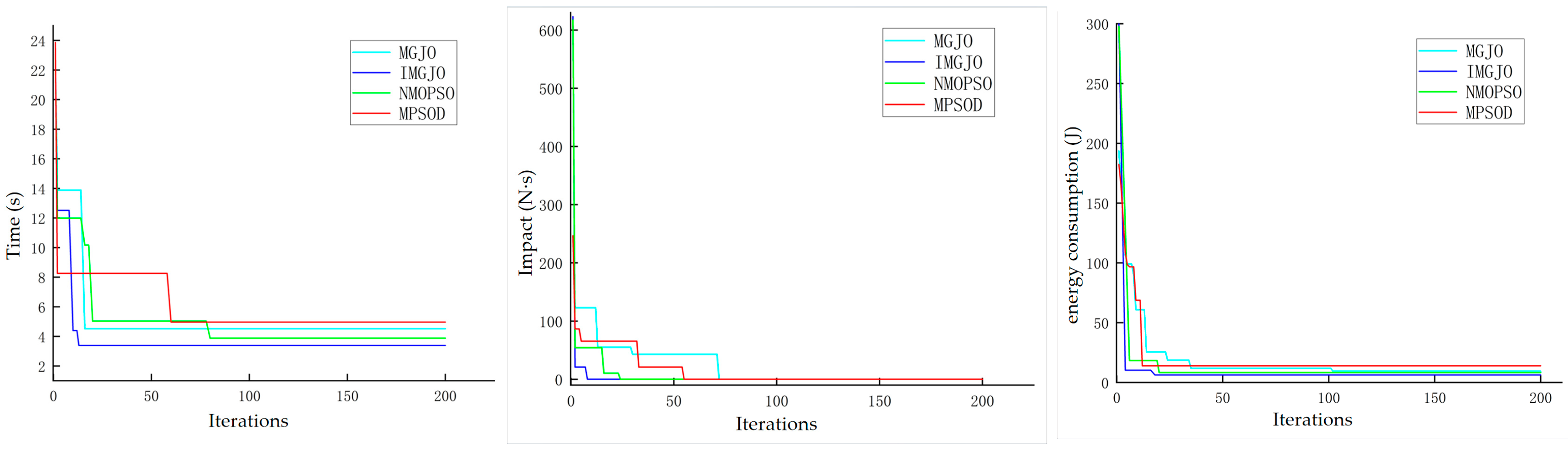
Figure 11 illustrates the convergence characteristics of four multi-objective optimization algorithms—IMGJO, MGJO, MPSOD, and NMOPSO—when applied to the trajectory planning of the robotic arm and evaluated across the three objectives of operation time, motion impact, and energy consumption. The results indicate that IMGJO consistently demonstrates the fastest convergence rate and achieves the lowest final objective values across all three metrics, thereby exhibiting a superior comprehensive optimization performance. Specifically, regarding the convergence curve for operation time, IMGJO starts from an initial value of approximately 23 s and rapidly converges within just a few iterations, stabilizing at around 3.6 s, reflecting the highest optimization efficiency. In comparison, MGJO begins with an initial time of roughly 14 s and converges to approximately 5 s. NMOPSO exhibits moderate convergence speed and final values, whereas MPSOD displays the slowest convergence behavior. For the motion impact objective, IMGJO and NMOPSO converge quickly toward zero, followed by MGJO and MPSOD, whose convergence speeds are comparatively slower. Nevertheless, all four algorithms eventually drive the impact index close to zero, confirming their effectiveness in mitigating motion shocks. Regarding energy consumption, IMGJO maintains its superior performance, converging to the lowest energy consumption level within approximately 20 iterations and remaining stable thereafter. MGJO, NMOPSO, and MPSOD exhibit slightly slower convergence rates, with final stabilized values marginally higher than those achieved by IMGJO. In summary, IMGJO shows better convergence behavior than the benchmark algorithms across the three objectives in this test case, suggesting improved optimization efficiency. Its repeated run results further indicate a relatively stable performance with respect to the adopted comprehensive evaluation index. NMOPSO ranks second in overall performance, while MGJO and MPSOD are more susceptible to convergence stagnation during iterative processes and display a greater tendency to become trapped in local optima.
To verify the stability and repeatability of the proposed IMGJO algorithm, IMGJO, MGJO, MPSOD, and NMOPSO were independently executed 20 times each under identical parameter settings. From the final Pareto solution set obtained in each run, the compromise optimal solution was determined using the ideal point distance method, and the best values, mean values, and standard deviations of the evaluation indicators were calculated. The results are presented in
Table 4.
As shown in
Table 4, IMGJO achieves the lowest mean value and the smallest standard deviation for the adopted comprehensive evaluation index among the compared algorithms. This suggests that IMGJO provides relatively stable results across the repeated independent runs under identical parameter settings. Although MPSOD can also achieve relatively good results in some individual runs, its mean evaluation index and variability are both inferior to those of IMGJO. In contrast, MGJO and NMOPSO exhibit relatively large standard deviations, indicating that they are more sensitive to random initialization and show more pronounced fluctuations across repeated runs.
4.3. Pareto Frontier Analysis
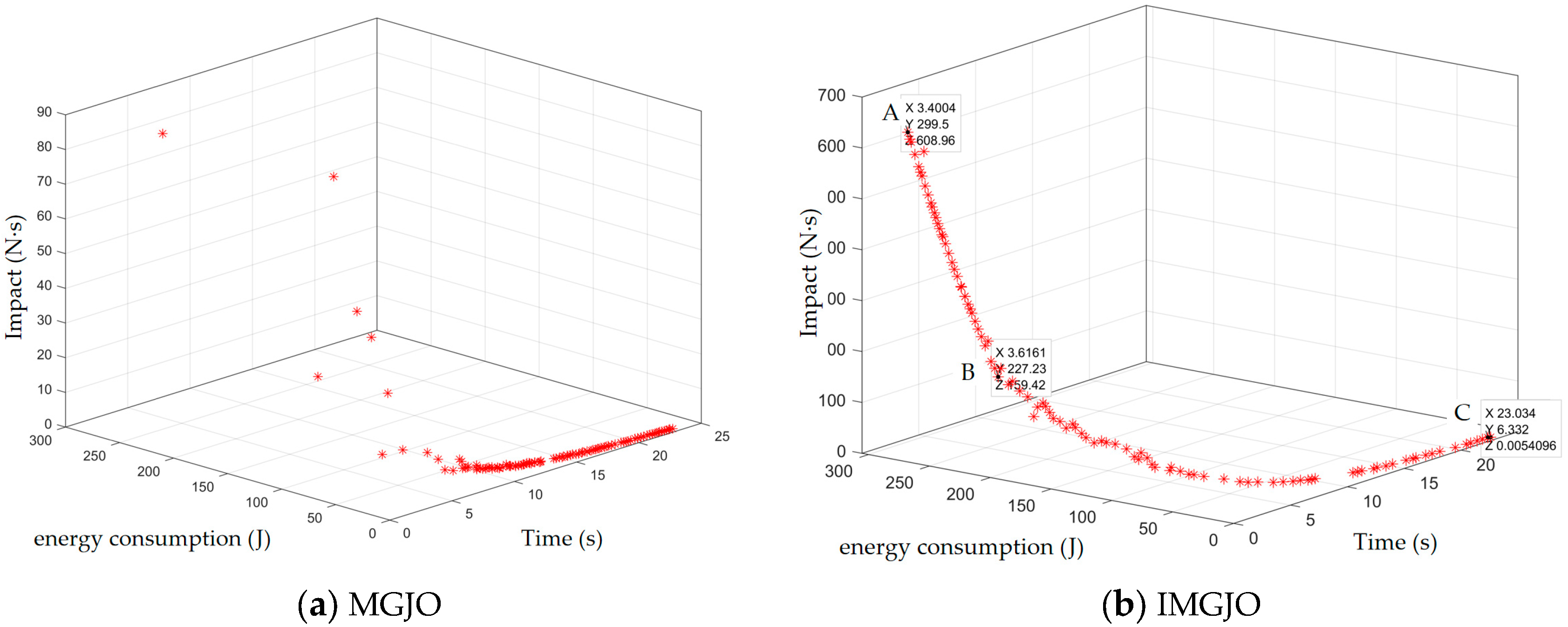
As illustrated in
Figure 12a, the Pareto front generated by the MGJO algorithm exhibits several notable limitations. Specifically, the solution set is prone to stagnation within local optimal regions, resulting in a relatively scattered distribution of front points and insufficient overall convergence. In stark contrast, the Pareto front obtained using the proposed IMGJO algorithm
Figure 12b demonstrates markedly superior optimization characteristics. The IMGJO algorithm effectively circumvents the influence of local optima, achieving significant improvements in both the uniformity of the solution set distribution and the precision of the convergence. These visual results provide compelling evidence of the effectiveness of the proposed enhancement strategies in elevating the performance of multi-objective optimization.
To analyze the distribution and trade-off characteristics of the obtained Pareto front, three representative non-dominated solutions were selected and designated as A, B, and C, which were listed sequentially from the top to the bottom of the front. Solution A represents the scheme with the shortest operation time, whereas Solution C achieves the minimum values in both energy consumption and motion impact. Solution B, which exhibits the smallest value for the comprehensive evaluation index, is identified as the most balanced compromise solution across all the performance metrics. As the Pareto front transitions from Solution A to Solution C, a clear trend emerges: the operation time progressively increases, while both energy consumption and motion impact decrease correspondingly. This observation highlights a positive correlation between the energy consumption and the motion impact, as well as a pronounced trade-off relationship between these two objectives and the operation time. The specific objective function values corresponding to these three characteristic solutions are summarized in
Table 5.
A comparative evaluation was conducted among candidate solutions A, B, and C to identify the most effective trade-off. As indicated in the results, Solution B exhibits the lowest value for the comprehensive evaluation index, signifying its superior overall performance. Specifically, the trajectory execution time for Solution B is 3.616 s, representing a marginal increase of 6.34% compared to Solution A. However, this slight extension in time yields substantial benefits: Solution B achieves a 24.13% reduction in energy consumption and a 73.82% decrease in motion shock relative to Solution A. Thus, with a relatively minor time investment, the system gains significant improvements in energy efficiency and operational stability. While Solution C demonstrates an even better performance in terms of energy consumption and shock mitigation, these advantages are attained at the cost of a considerably longer operation time. A comprehensive trade-off analysis suggests that Solution C does not constitute a more practical compromise. Therefore, guided by the principle of minimizing the comprehensive evaluation index, Solution B is ultimately selected as the optimal, all-encompassing solution for this study and is adopted as the implementation benchmark for the project.
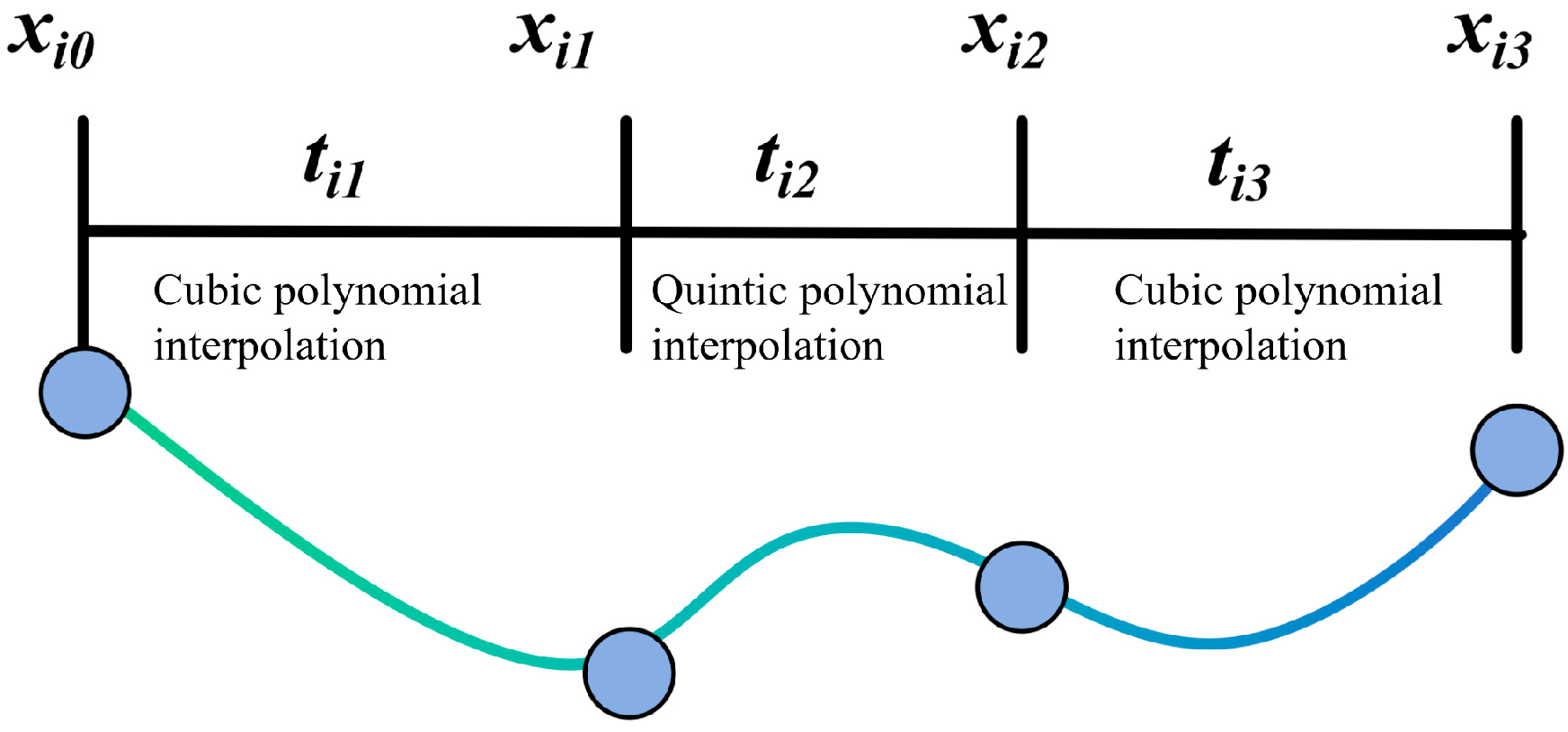
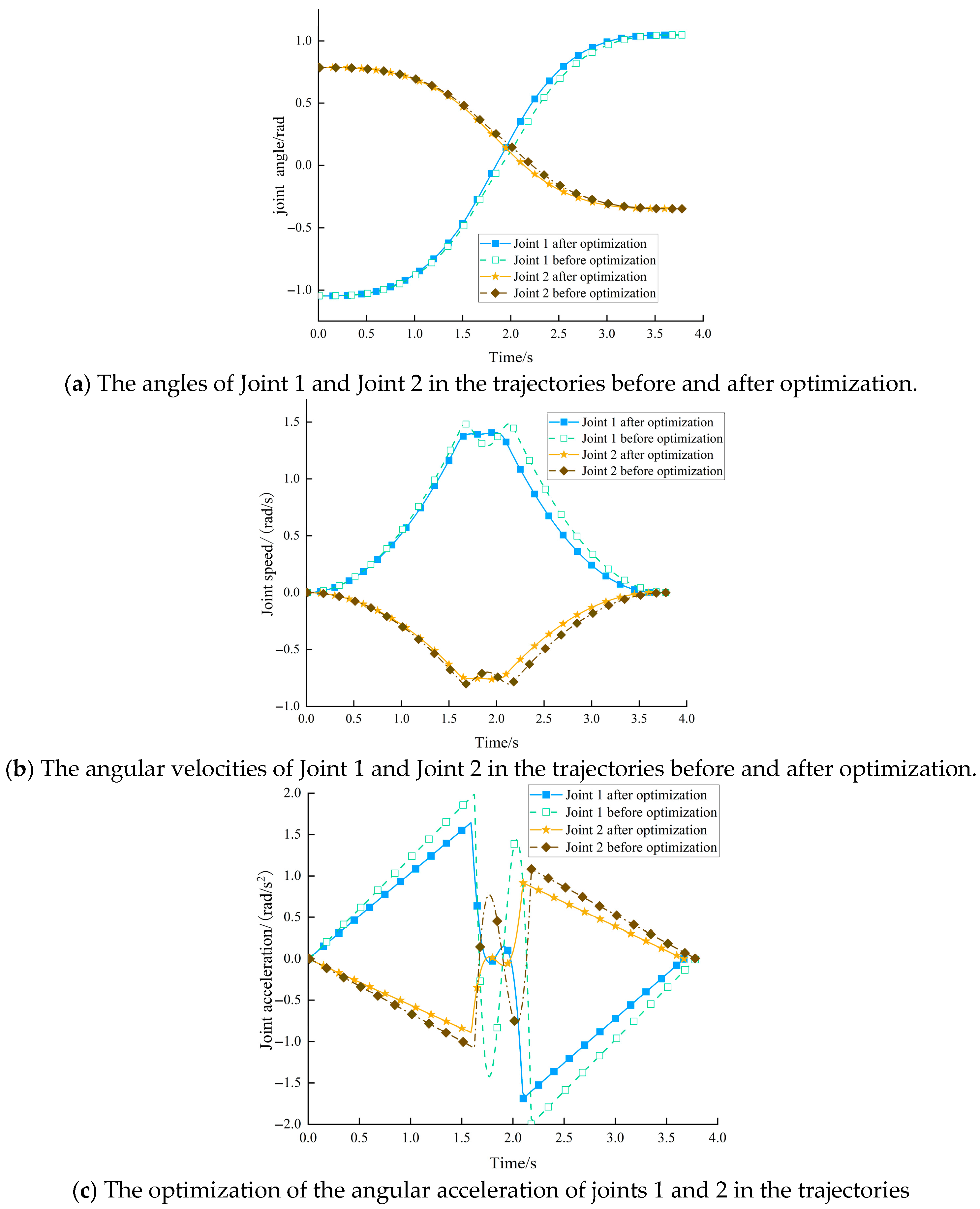
To evaluate the optimization performance of IMGJO, the pre-optimization trajectory is defined as the baseline trajectory, which is generated without applying any intelligent optimization algorithm. Specifically, given the same starting point, via points, and end point, only 3-5-3 piecewise polynomial interpolation is employed to construct the joint trajectory. The trajectory coefficients are then determined using empirically preset segment time parameters, thereby yielding a baseline trajectory that satisfies the constraints on joint angle, angular velocity, and angular acceleration. A comparative analysis was conducted between the pre-optimization baseline trajectory and the optimized solution B obtained via IMGJO. The angular position, angular velocity, and angular acceleration profiles for the two critical joints are presented in
Figure 13. A visual inspection of the figure reveals that the post-optimization curves are markedly smoother, with a significant reduction in the fluctuation range of both angular velocity and angular acceleration. This indicates that the IMGJO algorithm not only achieves a reduction in the total operation time but also effectively suppresses drastic changes in angular acceleration. Consequently, the execution efficiency and operational stability of the robotic arm are substantially improved.
As depicted in
Figure 13, the optimized joint trajectory strictly adheres to the predefined kinematic constraints. The resulting trajectory curves are characterized by high continuity and smoothness, exhibiting no discernible discontinuities or abrupt changes throughout the motion sequence. A quantitative assessment, based on the relevant kinematic and dynamic formulas, is presented in
Table 6. This table summarizes the calculated impact indices, energy consumption, and the maximum velocity and acceleration for each joint, both before and after the optimization process. The data in
Table 6 clearly demonstrate the efficacy of the IMGJO algorithm. Specifically, the optimization yields a 74.65% reduction in motion impact and a 27.11% decrease in energy consumption for Joint 1. Similarly, for Joint 2, the impact is reduced by 75.82%, and the energy consumption is lowered by 26.83%. In conclusion, the IMGJO-based optimization framework not only effectively shortens the total operation time but also significantly mitigates the motion impact and reduces the energy consumption. This leads to a substantial enhancement in the smoothness and overall stability of the robotic arm’s movement, thereby providing a robust and effective solution for high-performance trajectory planning.
4.4. Experimental Verification
The physical experimental platform consisted of a six-degree-of-freedom Yaskawa HP-20D industrial manipulator and an NX100 robot controller. The host computer communicated with the controller via Ethernet for program transfer and data management. In the experiments, the robot was operated in a joint space trajectory tracking mode, in which the optimized joint trajectories generated offline were executed by the controller. Specifically, the optimized joint trajectories obtained in MATLAB were first discretized into time-ordered joint reference points at a sampling interval of 0.01 s. These reference points were then converted into executable robot programs using offline programming software and uploaded to the NX100 controller via Ethernet. The controller executed the uploaded trajectory at a sampling frequency of 100 Hz. To ensure repeatability, each experiment started from the same initial joint configuration used in the simulation. The same target trajectory, controller settings, and operating conditions were maintained throughout all the tests. No additional payload or external disturbance was introduced during the repeatability experiments. Under these identical conditions, ten repeated physical experiments were conducted to evaluate the execution repeatability and practical feasibility of the proposed method. During execution, the controller synchronously recorded the actual joint position feedback of all six joints. The recorded data were exported and processed offline in MATLAB. The main preprocessing steps included time-axis alignment between the reference and measured trajectories, unit unification of the joint variables, and consistency checking of the sampled data. The actual end-effector trajectory was then reconstructed through the forward kinematic model based on the measured joint angles.
Let
and
denote the desired and actual joint trajectories, respectively. The joint tracking error is defined as:
The maximum joint tracking error is calculated as:
Similarly, let
and
denote the desired and actual end-effector positions, respectively. The end-effector position error is defined as
The maximum end-effector error is calculated as
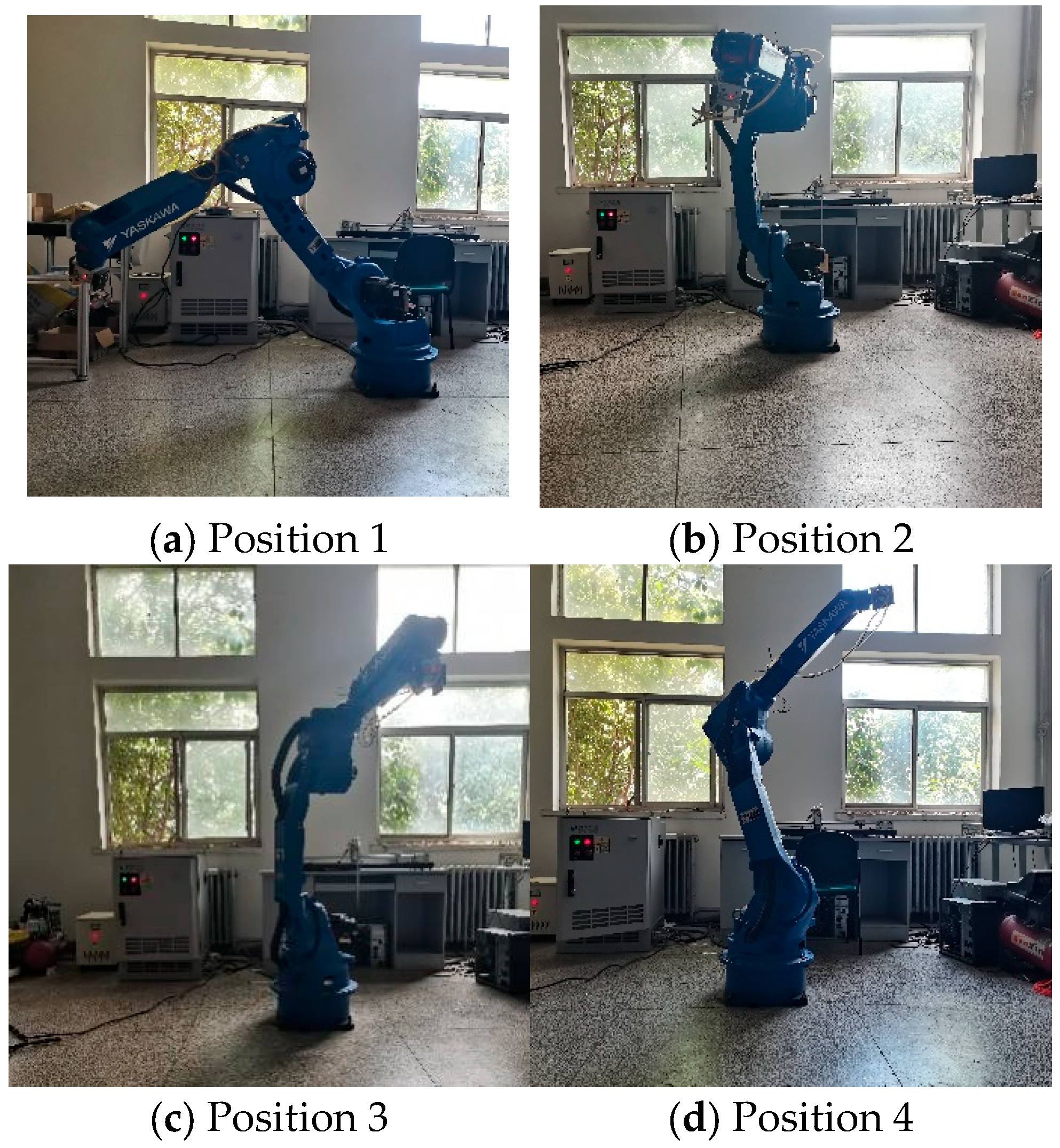
The dynamic variations in the end-effector pose of the robotic arm during operation are shown in
Figure 14, and
Table 7 lists the representative joint-angle and position data at several sampling instants. The statistical results of the repeatability tests are summarized in
Table 8.
A comprehensive analysis of
Figure 14 and
Table 7 reveals that the Yaskawa HP-20D robotic arm is capable of strictly adhering to the trajectory generated by the IMGJO algorithm, executing the motion plan with high stability. Throughout the entire operational cycle, the displacement, velocity, and acceleration profiles of all joints exhibit continuous and smooth transitions, devoid of any discernible discontinuities, abrupt changes, or oscillatory behavior. These experimental observations confirm that the proposed IMGJO framework can effectively deliver a comprehensively optimized trajectory for industrial robotic arms. The high-fidelity tracking performance demonstrates the method’s exceptional reliability in practical execution and confirms its capacity to ensure superior operational stability.
Furthermore, to verify the stability and repeatability of the proposed algorithm, ten repeated experiments were conducted under identical operating conditions. The corresponding statistical results are presented in
Table 8. The results show that the total operation time of the manipulator, the end position error, and the joint tracking error all remain within a narrow fluctuation range, indicating that the proposed method has good repeatability under the tested experimental conditions and shows promising engineering applicability.