DeepSense: An Adaptive Scalable Ensemble Framework for Industrial IoT Anomaly Detection


Abstract
1. Introduction
- Proposed a new multi-layer IIoT intrusion detection architecture that combines the previously evaluated standalone models into an adaptive ensemble layer jointly operating with a lightweight rule-based screening layer.
- Extended the previously introduced DataSense data infrastructure into a deployable framework component that supports online feature preparation, device profiling, and interaction with adaptive detection layers within the full DeepSense architecture.
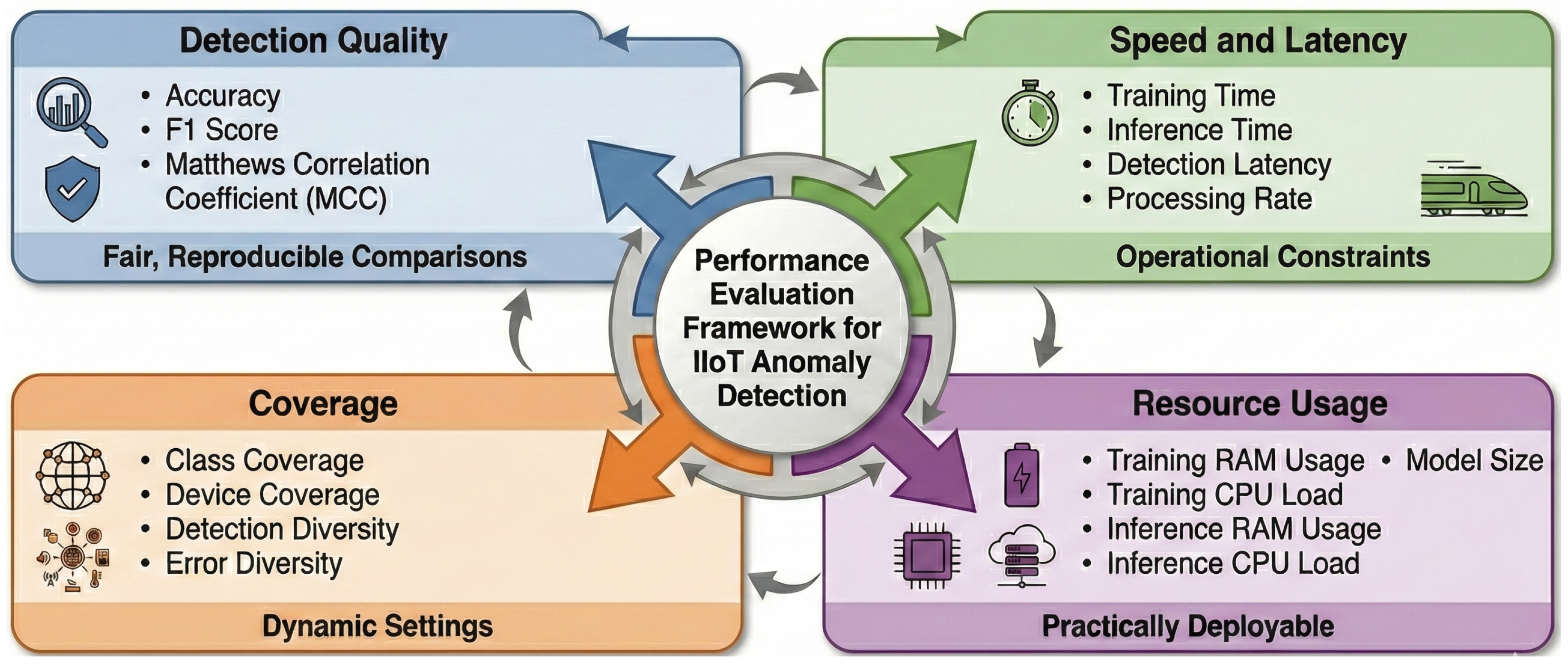
- Proposed and empirically validated a comprehensive performance evaluation framework that extends beyond accuracy-centric metrics to jointly assess detection quality, response speed and latency, resource efficiency, and detection coverage.
- Proposed and implemented a practical window-based adaptive retraining, reprofiling, and drift monitoring mechanism to mitigate detection performance degradation caused by environmental dynamics and concept drift in long-running IIoT deployments.
- Proposed and implemented a lightweight and effective decision fusion mechanism within the DeepSense framework that aggregates outputs from heterogeneous detection methods, improving robustness and reducing false positives while maintaining suitability for resource-constrained IIoT environments.
- Proposed and implemented a theoretically grounded optimization process for selecting an effective ensemble of detection models within NeuroSense, maximizing detection performance while explicitly considering practical IIoT constraints such as computational overhead, memory usage, and inference latency.
- Performed extensive experimental evaluations across diverse operational scenarios and threat models, demonstrating the effectiveness, robustness, and practical trade-offs of the integrated DeepSense framework under competing performance and efficiency metrics.
2. Related Work
2.1. Lightweight and Edge-Oriented Intrusion Detection
2.2. Machine Learning and Ensemble-Based IDS for IIoT
2.3. Deep Learning and Attention-Based Detection Models
2.4. Adaptive Learning and Concept Drift Handling
2.5. Surveys and Foundational Studies
2.6. Discussion and Research Gaps
3. Proposed DeepSense Framework
3.1. Framework Architecture
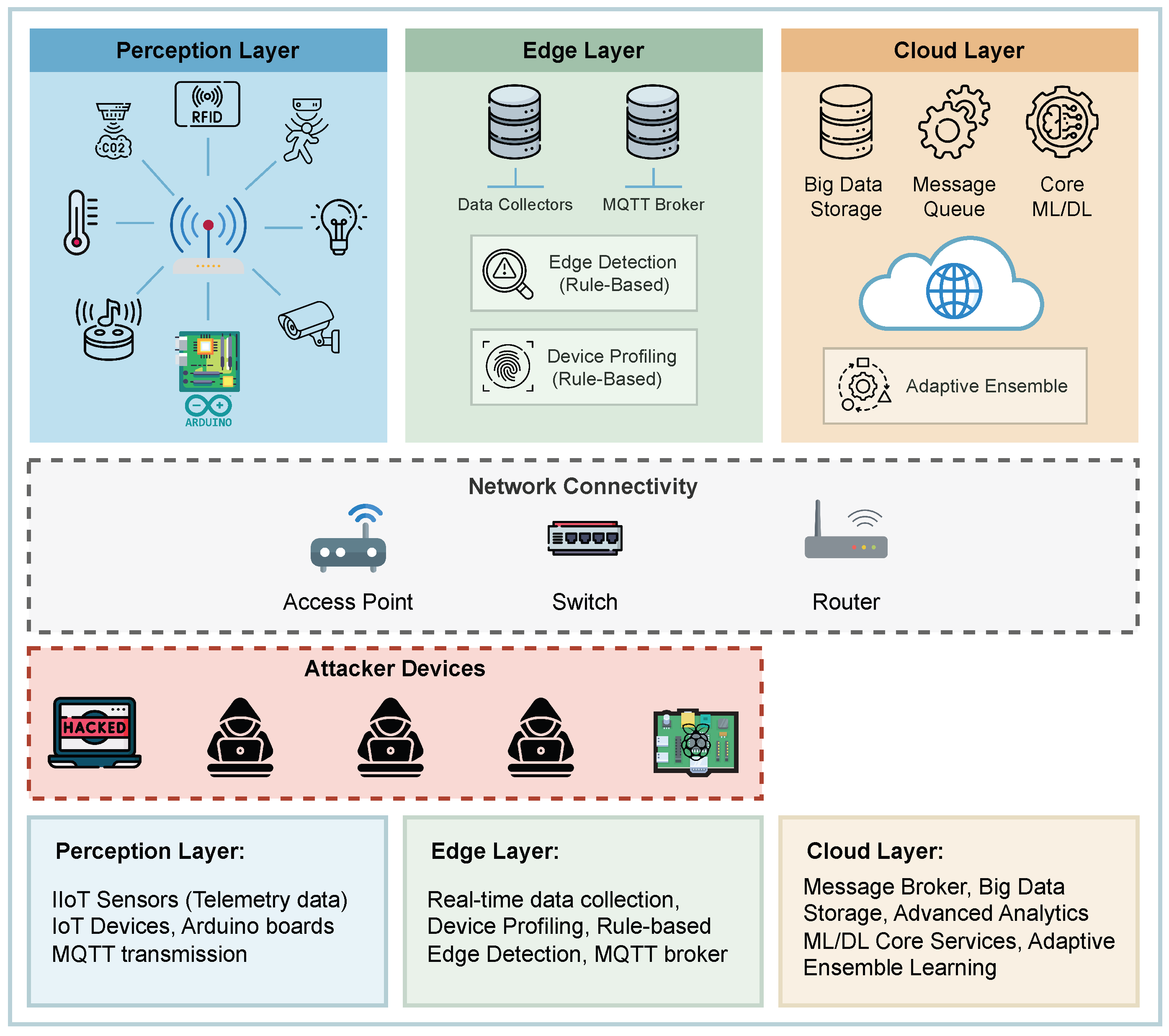
- Perception Layer: Interfaces with physical sensors and devices to collect telemetry data (e.g., temperature, motion, traffic flows). Data is transmitted via MQTT to higher layers.
- Edge Layer: Performs real-time processing and rule-based detection close to the data source. It constructs device behavior profiles and applies lightweight rules to flag anomalies, forwarding suspicious samples to the cloud for further analysis.
- Cloud Layer: Supports adaptive, scalable analysis using ensemble ML/DL models. It hosts rule generation, storage, and advanced classification components, facilitating long-term learning, detailed attribution, and threat intelligence.
3.2. System Design
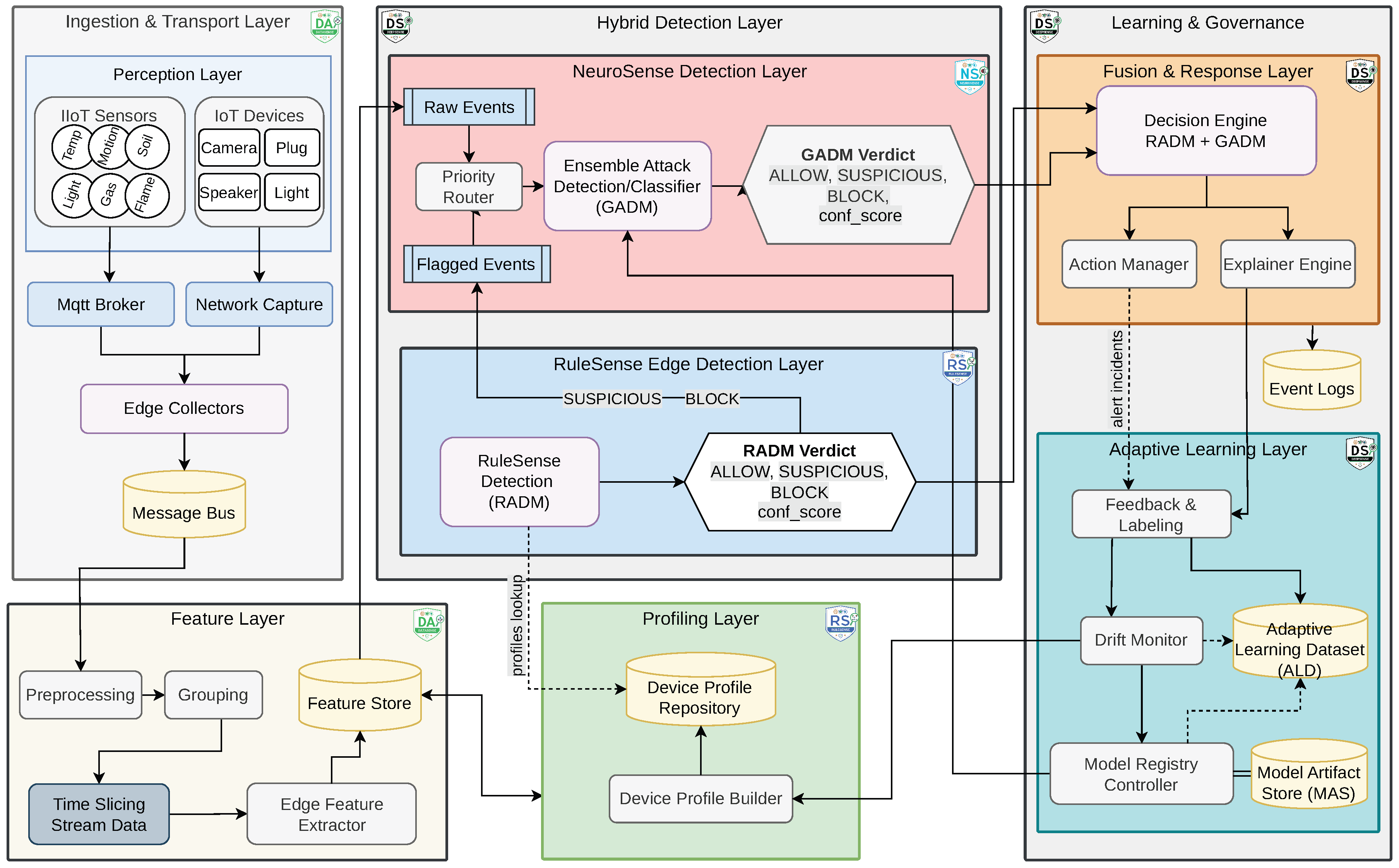
- Ingestion & Transport Layer (DataSense): Aggregates heterogeneous IIoT data streams using MQTT and network capture modules. As the data acquisition backbone of DeepSense, this layer ensures reliable, low-latency delivery of synchronized sensor and network observations for downstream processing.
- Feature Layer (DataSense): Preprocesses and transforms raw data into structured features using grouping, time slicing, and statistical extraction. Features are stored for inference and retraining.
- Profiling Layer (RuleSense): Builds device behavior profiles from structured features. These profiles serve as baselines for real-time, rule-based anomaly detection at the edge.
- Hybrid Detection Layer (DeepSense): Combines two submodules:
- -
- RuleSense Edge Detection Layer: Uses behavior profiles and detection rules to issue real-time anomaly verdicts (ALLOW, SUSPICIOUS, BLOCK), providing lightweight edge-level anomaly screening and early decision making.
- -
- NeuroSense Detection Layer: Applies an ensemble of ML/DL models to classify both flagged and raw samples, performing deeper validation, attack categorization, and fine-grained anomaly characterization with confidence scores.
- Fusion & Response Layer (DeepSense): Fuses outputs from RuleSense and NeuroSense to generate unified verdicts. The decision engine enforces mitigation via an action manager, and provides interpretable outputs through an explainer engine.
- Adaptive Learning Layer (DeepSense): Enables continuous improvement through feedback collection, drift detection, and dataset curation. It manages model retraining, versioning, and secure storage using a model registry and artifact store.
3.3. Adaptive Scalable Ensemble Implementation
3.3.1. Data and Infrastructure Layers
3.3.2. Processing Layer and Detection Hierarchy
3.3.3. Model Registry and API Layer
3.3.4. Fusion Engine
3.3.5. Concept Drift Detection
Stage 1: Scoring-Based Detection
Stage 2: Drift Attribution
Drift Response
- Scenario A triggers rule re-profiling and fusion threshold calibration.
- Scenario B initiates model retraining via the Model Registry.
3.3.6. Summary of the Drift Monitoring Procedure
| Algorithm 1: Two-Stage Drift Detection and Attribution (Loss → FPR/FNR) |
 |
Windowed Adaptation Datasets
4. Performance Evaluation Framework
4.1. Overview and Motivation
4.2. Evaluation Dimensions and Metrics
4.3. Detection Quality Metrics
4.4. Speed and Latency Metrics
4.5. Coverage Metrics
4.6. Resource Usage Metrics
- : RAM usage (in MB) at training time step i; : during inference.
- : CPU usage (fraction in [0, 1]) at training time step i; : during inference.
- n: Number of monitoring intervals.
- : Min/max RAM usage across models; similarly for CPU: , and model size: .
4.7. Metric Aggregation Techniques
4.7.1. Dimension-Level Scoring
TOPSIS-Based Scoring
VIKOR-Based Scoring
Augmented Chebyshev Scoring
4.7.2. Final Aggregation Vector and Method Comparison
4.8. Optimization-Based Ensemble Selection
4.8.1. Problem Formulation
4.8.2. NSGA-II Framework
- is the set of indices of the top models selected for objective k,
- is the k-th dimension score for model .
4.8.3. Post-Ranking with TOPSIS
4.8.4. Output
- The complete Pareto front of candidate ensembles
- A ranked list of ensembles based on TOPSIS scores
- The top-k ensembles recommended for deployment or further analysis
5. Experimental Results and Analysis
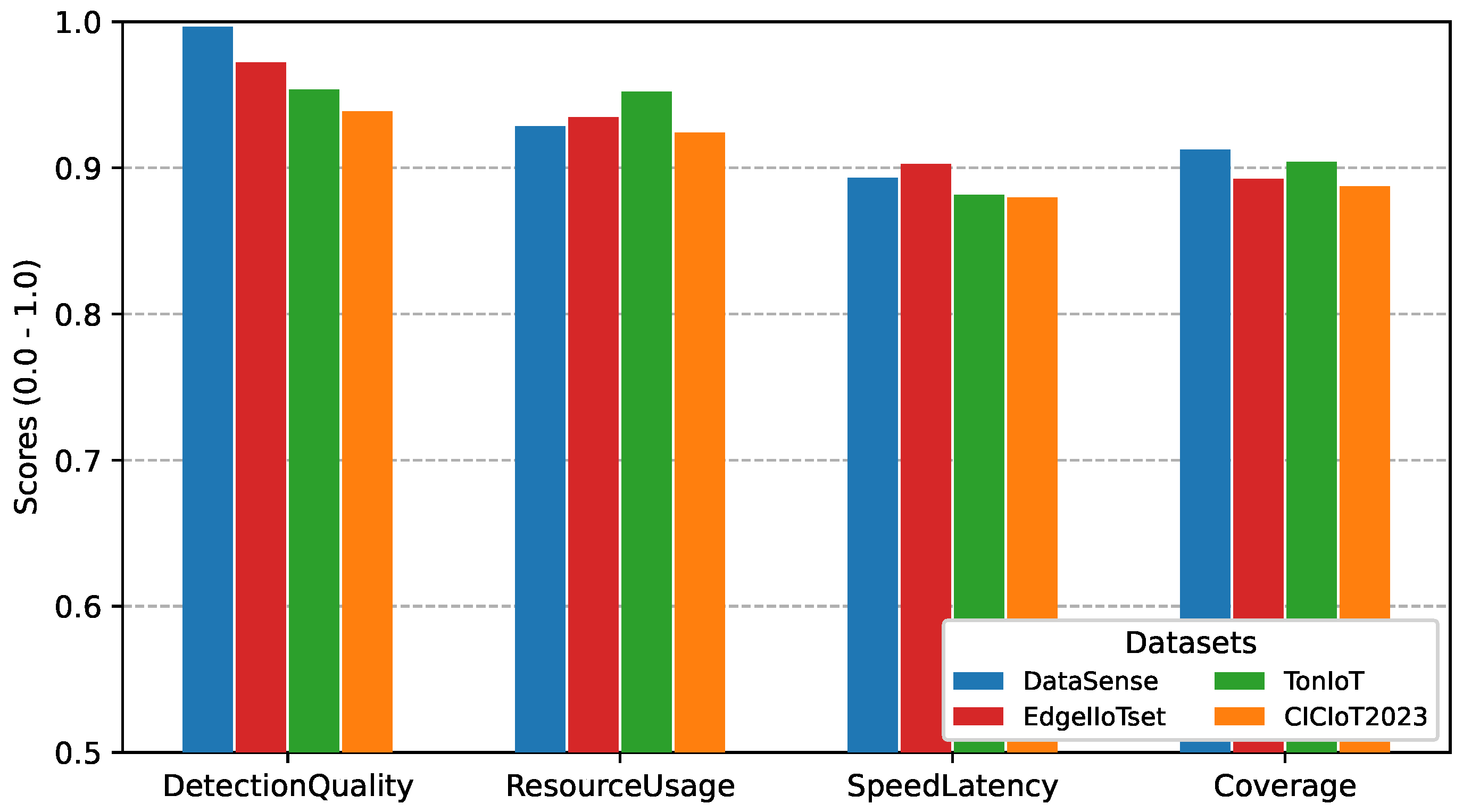
5.1. Aggregated Performance Metrics Across Models
5.2. Optimization-Based Ensemble Selection Results
5.3. Sensitivity Analysis of Metric Weighting and Ranking Stability
5.4. Adaptive Scalable Ensemble Evaluation Results
Baseline Ensemble Performance
5.5. Comparative Performance Against Recent IIoT Detection Frameworks
5.5.1. Scalability and Robustness Under Deployment Constraints
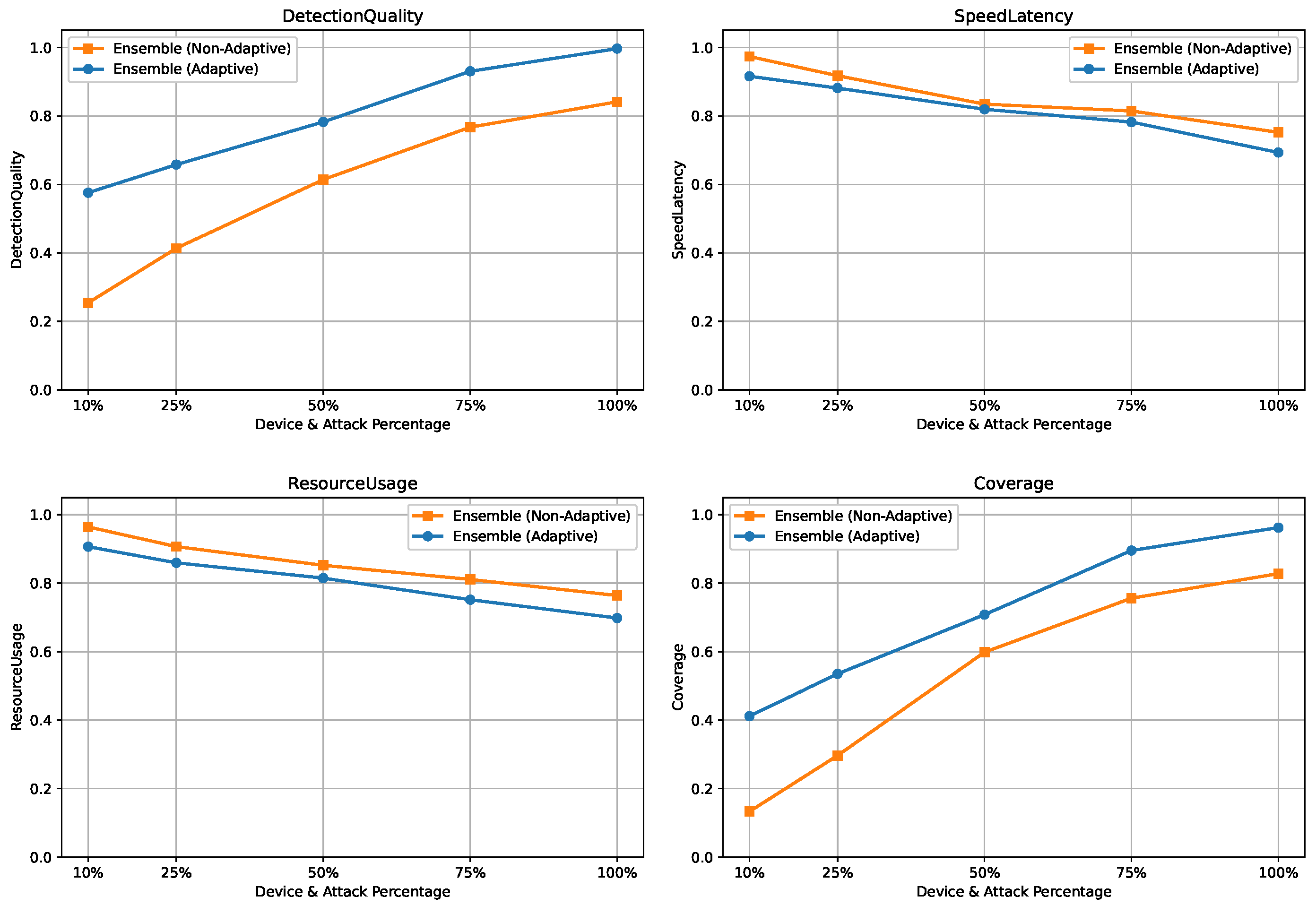
5.5.2. Binary Classification Under Device and Attack Constraints
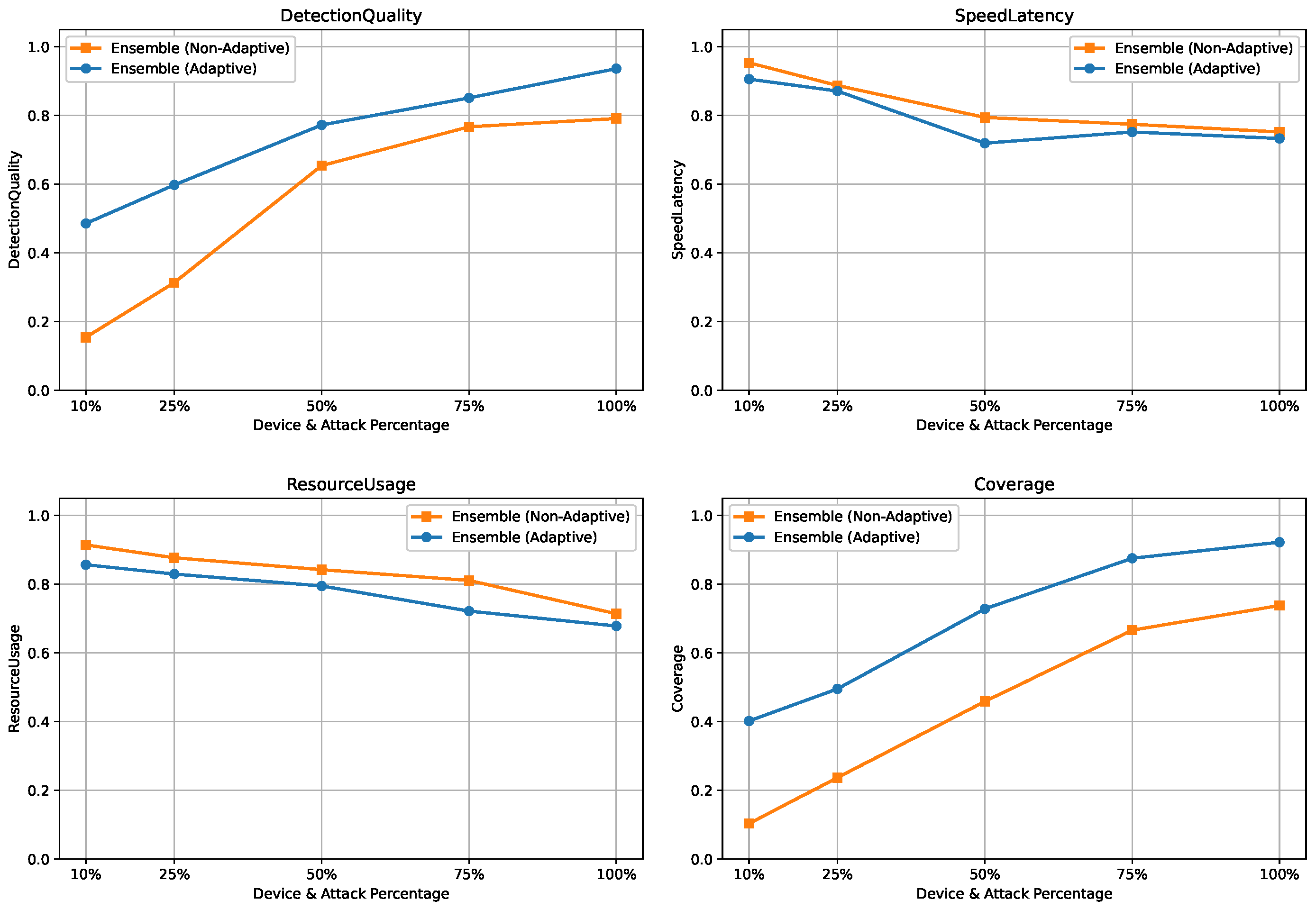
5.5.3. Attack Category Classification Under Device and Attack Constraints
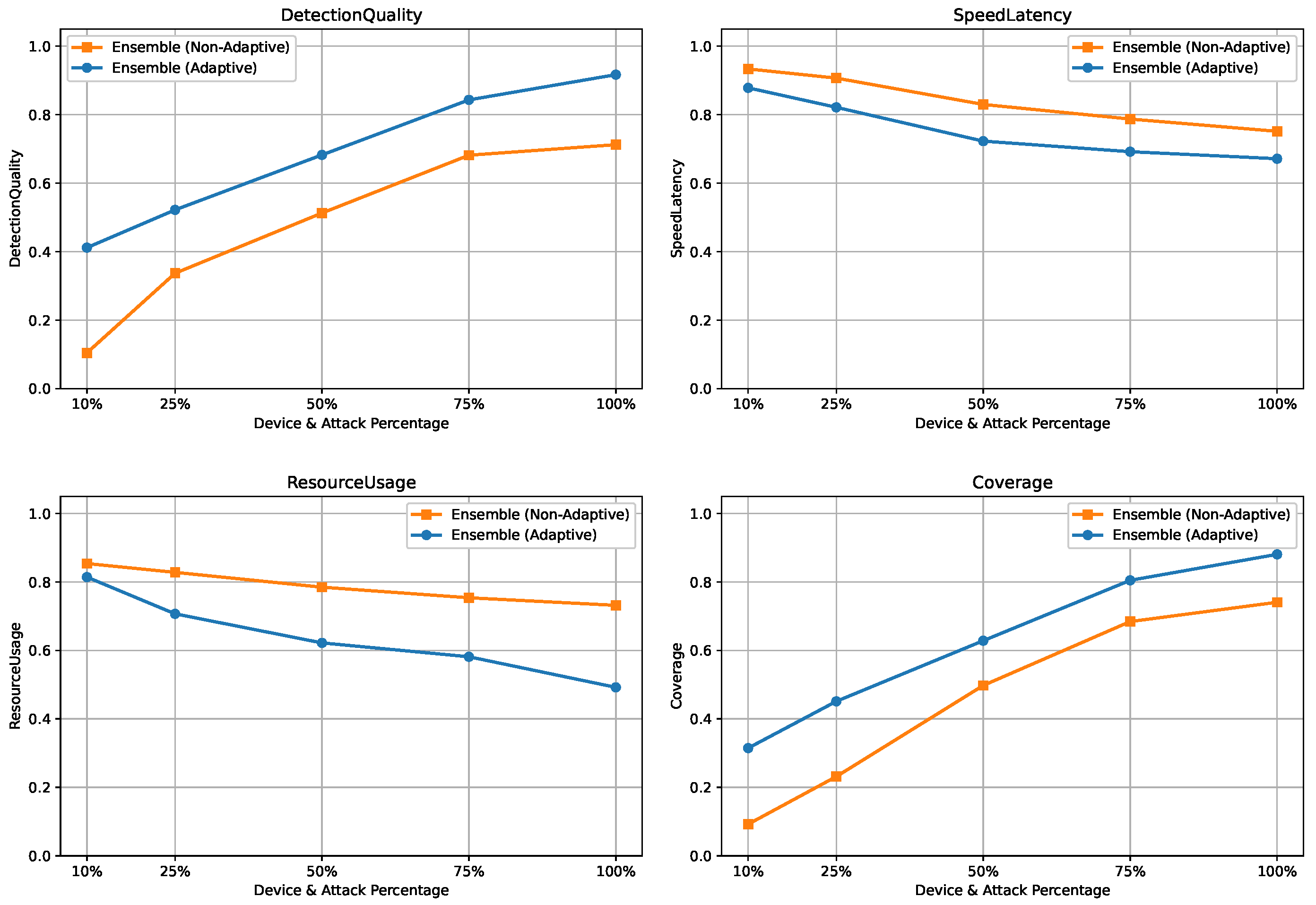
5.5.4. Attack Type Classification Under Device and Attack Constraints
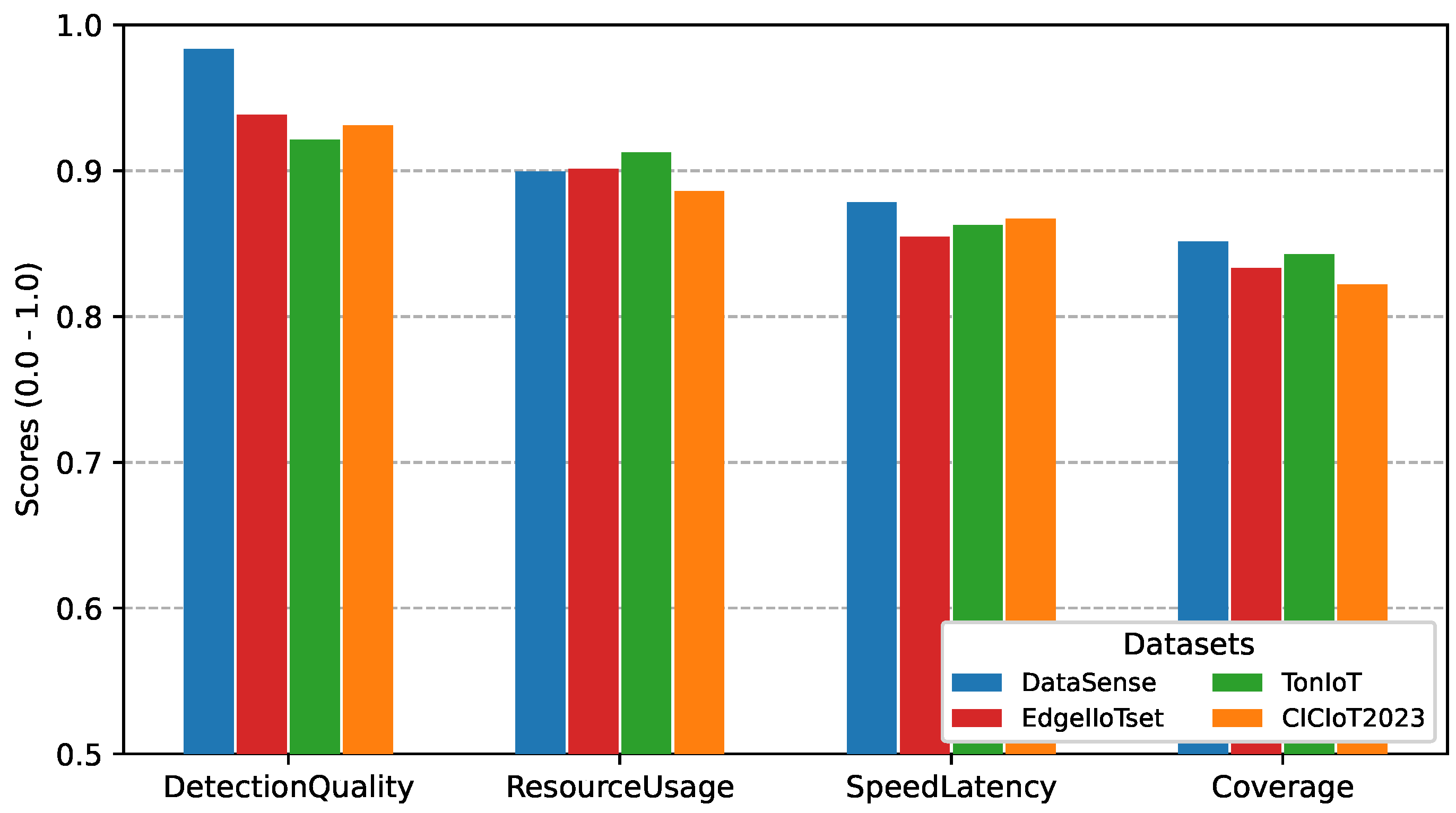
5.5.5. Cross-Dataset Validation on Public IIoT Benchmarks
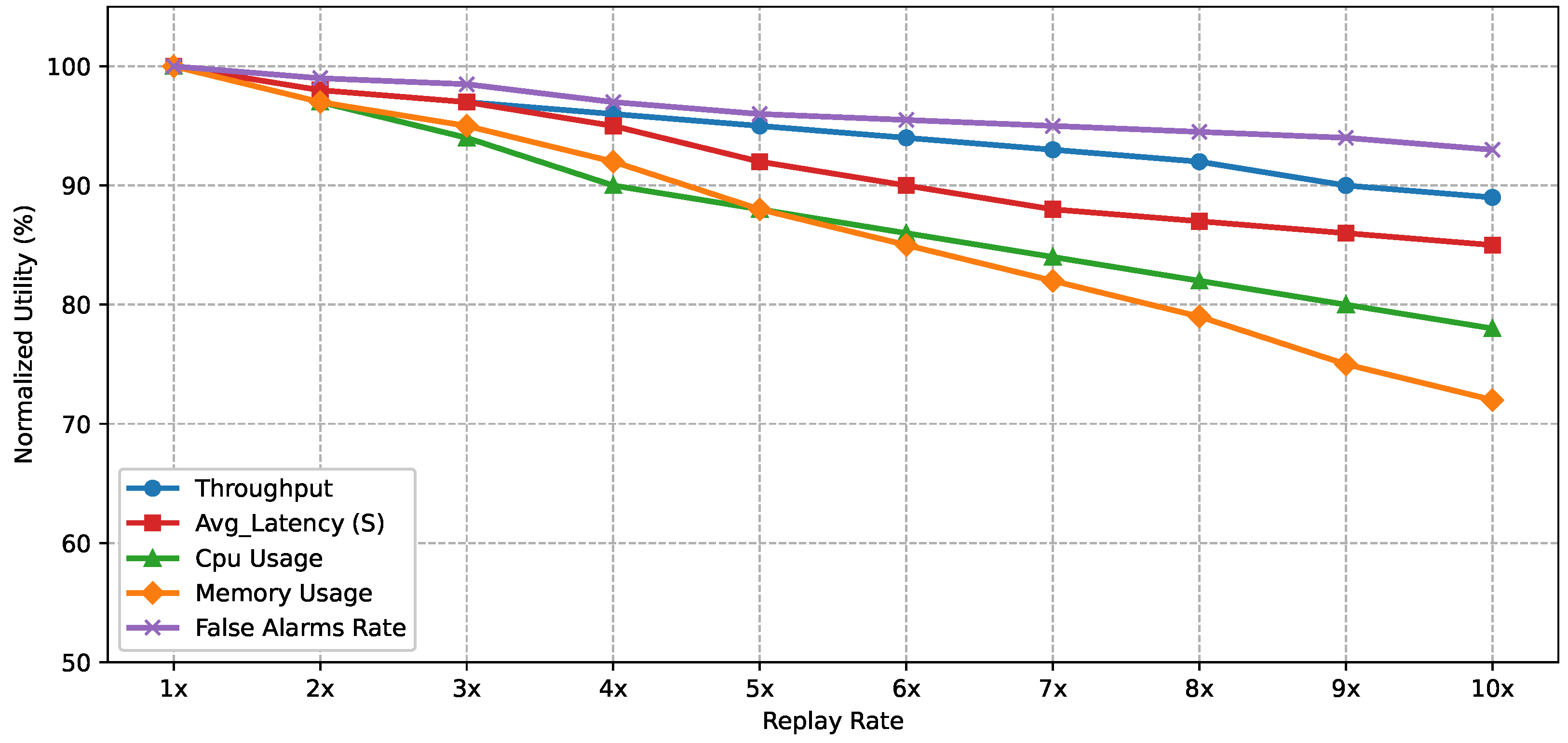
5.5.6. High-Throughput and Stress-Test Evaluation
5.6. Explainability and Decision Transparency
6. Conclusions and Future Work
Author Contributions
Funding
Data Availability Statement
Conflicts of Interest
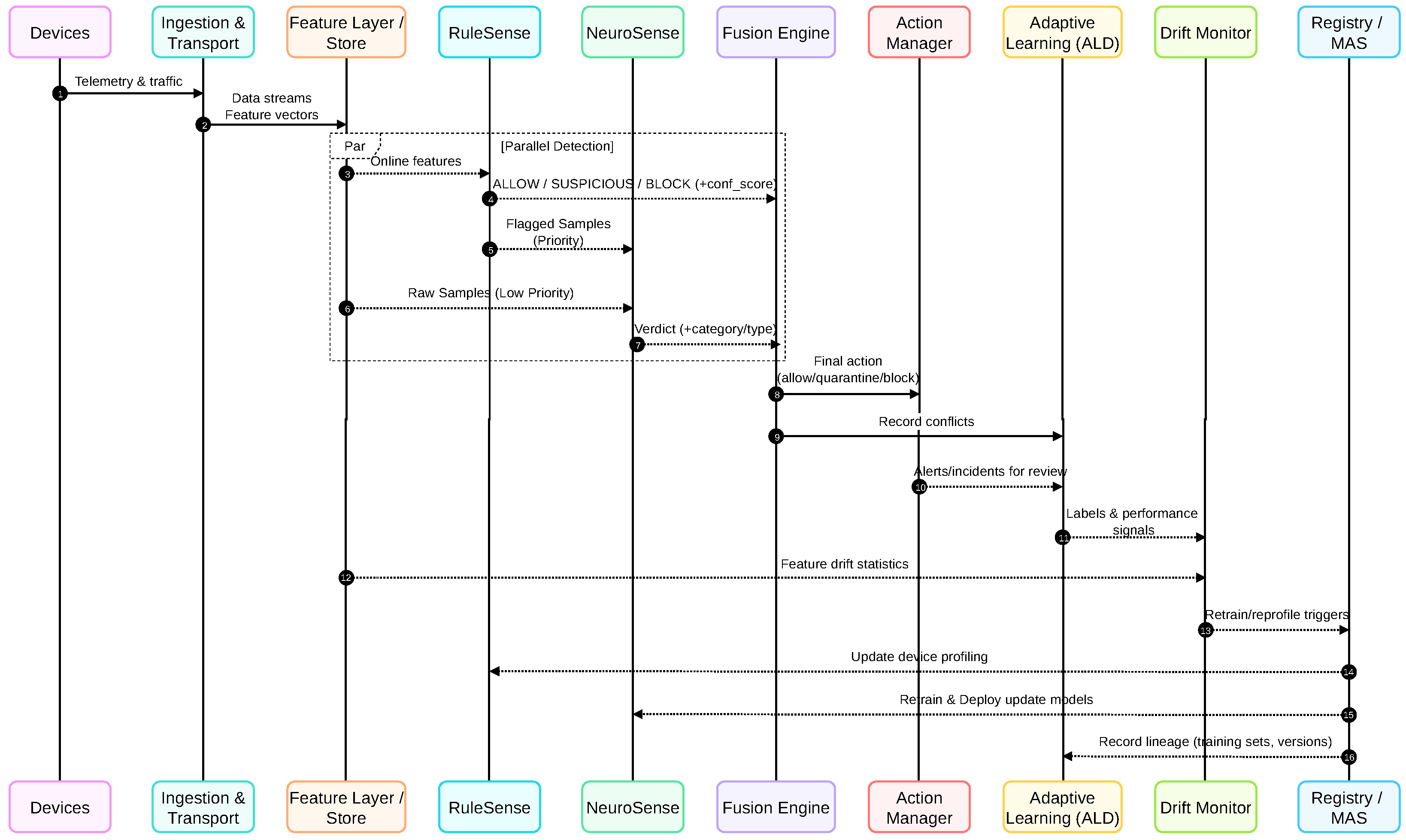
Appendix A. DeepSense Operational Workflow

Appendix A.1. DataSense: Data Pipeline and Experimental Testbed
Appendix A.2. RuleSense: Lightweight Rule-Based Detection Layer
Appendix A.3. NeuroSense: Learning-Driven Detection and Adaptive Ensemble
Appendix B. Example Explainability Output
Device: weather-sensor_A12Predicted verdict: AttackRuleSense confidence: 0.96Triggered abnormal features:
ML/DL confidence scores:
Final ensemble confidence: 0.96
References
- Choudhary, A. Internet of Things: A comprehensive overview, architectures, applications, simulation tools, challenges and future directions. Discov. Internet Things 2024, 4, 31. [Google Scholar] [CrossRef]
- Calderón, D.; Folgado, F.; González, I.; Calderón, A. Implementation and Experimental Application of Industrial IoT Architecture Using Automation and IoT Hardware/Software. Sensors 2024, 24, 8074. [Google Scholar] [CrossRef] [PubMed]
- Alotaibi, B. A Survey on Industrial Internet of Things Security: Requirements, Attacks, AI-Based Solutions, and Edge Computing Opportunities. Sensors 2023, 23, 7470. [Google Scholar] [CrossRef] [PubMed]
- Afrin, S.; Rafa, S.J.; Kabir, M.; Farah, T.; Alam, M.S.B.; Lameesa, A.; Ahmed, S.F.; Gandomi, A.H. Industrial Internet of Things: Implementations, challenges, and potential solutions across various industries. Comput. Ind. 2025, 170, 104317. [Google Scholar] [CrossRef]
- Ficili, I.; Giacobbe, M.; Tricomi, G.; Puliafito, A. From Sensors to Data Intelligence: Leveraging IoT, Cloud, and Edge Computing with AI. Sensors 2025, 25, 1763. [Google Scholar] [CrossRef]
- Attaran, S.; Attaran, M.; Celik, B.G. Digital Twins and Industrial Internet of Things: Uncovering operational intelligence in industry 4.0. Decis. Anal. J. 2024, 10, 100398. [Google Scholar] [CrossRef]
- Li, C.; Wang, J.; Wang, S.; Zhang, Y. A review of IoT applications in healthcare. Neurocomputing 2024, 565, 127017. [Google Scholar] [CrossRef]
- Abdelkader, S.; Amissah, J.; Kinga, S.; Mugerwa, G.; Emmanuel, E.; Mansour, D.E.A.; Bajaj, M.; Blazek, V.; Prokop, L. Securing modern power systems: Implementing comprehensive strategies to enhance resilience and reliability against cyber-attacks. Results Eng. 2024, 23, 102647. [Google Scholar] [CrossRef]
- Aydin, B.; Aydin, H.; Gormus, S. Intrusion detection systems in IoT: A detailed review of threat categories, detection strategies, and future technologies. J. Inf. Secur. Appl. 2025, 95, 104291. [Google Scholar] [CrossRef]
- Miller, T.; Staves, A.; Maesschalck, S.; Sturdee, M.; Green, B. Looking back to look forward: Lessons learnt from cyber-attacks on Industrial Control Systems. Int. J. Crit. Infrastruct. Prot. 2021, 35, 100464. [Google Scholar] [CrossRef]
- Marković, F.; Kovačević, A. Cyber threats and energy security: Development and analysis of an incident dataset for the period 2022–2024. Energy Policy 2026, 208, 114913. [Google Scholar] [CrossRef]
- Rahman, M.M.; Al Shakil, S.; Mustakim, M.R. A survey on intrusion detection system in IoT networks. Cyber Secur. Appl. 2025, 3, 100082. [Google Scholar] [CrossRef]
- Ismail, S.; Dandan, S.; Qushou, A. Intrusion Detection in IoT and IIoT: Comparing Lightweight Machine Learning Techniques Using TON_IoT, WUSTL-IIOT-2021, and EdgeIIoTset Datasets. IEEE Access 2025, 13, 73468–73485. [Google Scholar] [CrossRef]
- Anwer, R.W.; Abrar, M.; Ullah, M.; Salam, A.; Ullah, F. Advanced intrusion detection in the industrial Internet of Things using federated learning and LSTM models. Ad Hoc Netw. 2025, 178, 103991. [Google Scholar] [CrossRef]
- Kheddar, H. Transformers and large language models for efficient intrusion detection systems: A comprehensive survey. Inf. Fusion 2025, 124, 103347. [Google Scholar] [CrossRef]
- Liang, P.; Yang, L.; Xiong, Z.; Zhang, X.; Liu, G. Multi-Level Intrusion Detection Based on Transformer and Wavelet Transform for IoT Data Security. IEEE Internet Things J. 2024, 11, 25613–25624. [Google Scholar] [CrossRef]
- Al Rawajbeh, M.; Maria Soosai, A.J.; Ramasamy, L.K.; Khan, F. Trustworthy Adaptive AI for Real-Time Intrusion Detection in Industrial IoT Security. IoT 2025, 6, 53. [Google Scholar] [CrossRef]
- Laiq, F.; Al-Obeidat, F.; Amin, A.; Moreira, F. DDoS Attack Detection in Edge-IIoT using Ensemble Learning. In Proceedings of the 2023 7th Cyber Security in Networking Conference (CSNet); IEEE: Piscataway, NJ, USA, 2023; pp. 204–207. [Google Scholar] [CrossRef]
- Mohy-eddine, M.; Guezzaz, A.; Benkirane, S.; Azrour, M. An effective intrusion detection approach based on ensemble learning for IIoT edge computing. J. Comput. Virol. Hacking Tech. 2023, 19, 469–481. [Google Scholar] [CrossRef]
- Mohy-Eddine, M.; Guezzaz, A.; Benkirane, S.; Azrour, M.; Farhaoui, Y. An Ensemble Learning Based Intrusion Detection Model for Industrial IoT Security. Big Data Min. Anal. 2023, 6, 273–287. [Google Scholar] [CrossRef]
- Eid, A.M.; Nassif, A.B.; Soudan, B.; Injadat, M.N. IIoT Network Intrusion Detection Using Machine Learning. In Proceedings of the 2023 6th International Conference on Intelligent Robotics and Control Engineering (IRCE); IEEE: Piscataway, NJ, USA, 2023; pp. 196–201. [Google Scholar] [CrossRef]
- Nandanwar, H.; Katarya, R. Deep learning enabled intrusion detection system for Industrial IOT environment. Expert Syst. Appl. 2024, 249, 123808. [Google Scholar] [CrossRef]
- Alshehri, M.S.; Saidani, O.; Alrayes, F.S.; Abbasi, S.F.; Ahmad, J. A Self-Attention-Based Deep Convolutional Neural Networks for IIoT Networks Intrusion Detection. IEEE Access 2024, 12, 45762–45772. [Google Scholar] [CrossRef]
- Saheed, Y.K.; Omole, A.I.; Sabit, M.O. GA-mADAM-IIoT: A new lightweight threats detection in the industrial IoT via genetic algorithm with attention mechanism and LSTM on multivariate time series sensor data. Sens. Int. 2025, 6, 100297. [Google Scholar] [CrossRef]
- Gueriani, A.; Kheddar, H.; Mazari, A.C.; Ghanem, M.C. A robust cross-domain IDS using BiGRU-LSTM-attention for medical and industrial IoT security. ICT Express 2025, in press. [Google Scholar] [CrossRef]
- Lin, C.C.; Deng, D.J.; Kuo, C.H.; Chen, L. Concept Drift Detection and Adaption in Big Imbalance Industrial IoT Data Using an Ensemble Learning Method of Offline Classifiers. IEEE Access 2019, 7, 56198–56207. [Google Scholar] [CrossRef]
- Raeiszadeh, M.; Ebrahimzadeh, A.; Glitho, R.H.; Eker, J.; Mini, R.A.F. Real-Time Adaptive Anomaly Detection in Industrial IoT Environments. IEEE Trans. Netw. Serv. Manag. 2024, 21, 6839–6856. [Google Scholar] [CrossRef]
- Yang, Y.; Yang, X.; Heidari, M.; Khan, M.A.; Srivastava, G.; Khosravi, M.R.; Qi, L. ASTREAM: Data-Stream-Driven Scalable Anomaly Detection with Accuracy Guarantee in IIoT Environment. IEEE Trans. Netw. Sci. Eng. 2023, 10, 3007–3016. [Google Scholar] [CrossRef]
- Li, Y.; He, Z.; He, Y.; Niu, Z.; Li, A.D. An adaptive online learning scheme for anomaly detection in IIoT data streams under varying operating conditions. Int. J. Prod. Res. 2025, 64, 2009–2035. [Google Scholar] [CrossRef]
- Yang, L.; Shami, A. A Multi-Stage Automated Online Network Data Stream Analytics Framework for IIoT Systems. IEEE Trans. Ind. Inform. 2023, 19, 2107–2116. [Google Scholar] [CrossRef]
- Latif, S.; Driss, M.; Boulila, W.; Huma, Z.e.; Jamal, S.S.; Idrees, Z.; Ahmad, J. Deep Learning for the Industrial Internet of Things (IIoT): A Comprehensive Survey of Techniques, Implementation Frameworks, Potential Applications, and Future Directions. Sensors 2021, 21, 7518. [Google Scholar] [CrossRef]
- Chen, B.; Wan, J.; Lan, Y.; Imran, M.; Li, D.; Guizani, N. Improving Cognitive Ability of Edge Intelligent IIoT through Machine Learning. IEEE Netw. 2019, 33, 61–67. [Google Scholar] [CrossRef]
- Yan, X.; Xu, Y.; Xing, X.; Cui, B.; Guo, Z.; Guo, T. Trustworthy Network Anomaly Detection Based on an Adaptive Learning Rate and Momentum in IIoT. IEEE Trans. Ind. Inform. 2020, 16, 6182–6192. [Google Scholar] [CrossRef]
- Firouzi, A.; Dadkhah, S.; Maret, S.A.; Ghorbani, A.A. DataSense: A Real-Time Sensor-Based Benchmark Dataset for Attack Analysis in IIoT with Multi-Objective Feature Selection. Electronics 2025, 14, 4095. [Google Scholar] [CrossRef]
- Apache Software Foundation. Apache Kafka. 2023. Available online: https://kafka.apache.org/ (accessed on 19 January 2026).
- Apache Software Foundation. Apache ZooKeeper. 2023. Available online: https://zookeeper.apache.org/ (accessed on 19 January 2026).
- Ramírez, S. FastAPI. 2023. Available online: https://fastapi.tiangolo.com/ (accessed on 19 January 2026).
- Logeswari, G.; Purbia, R.; Tamilarasi, T.; Bose, S. IA-IDS: An Intelligent Adaptive Intrusion Detection System for IoT Security Using CNN, BiLSTM, and Attention Mechanism. Peer-to-Peer Netw. Appl. 2026, 19, 32. [Google Scholar] [CrossRef]



| Algorithm | Scenario | Detection Quality | Resource Usage | Speed Latency | Coverage |
|---|---|---|---|---|---|
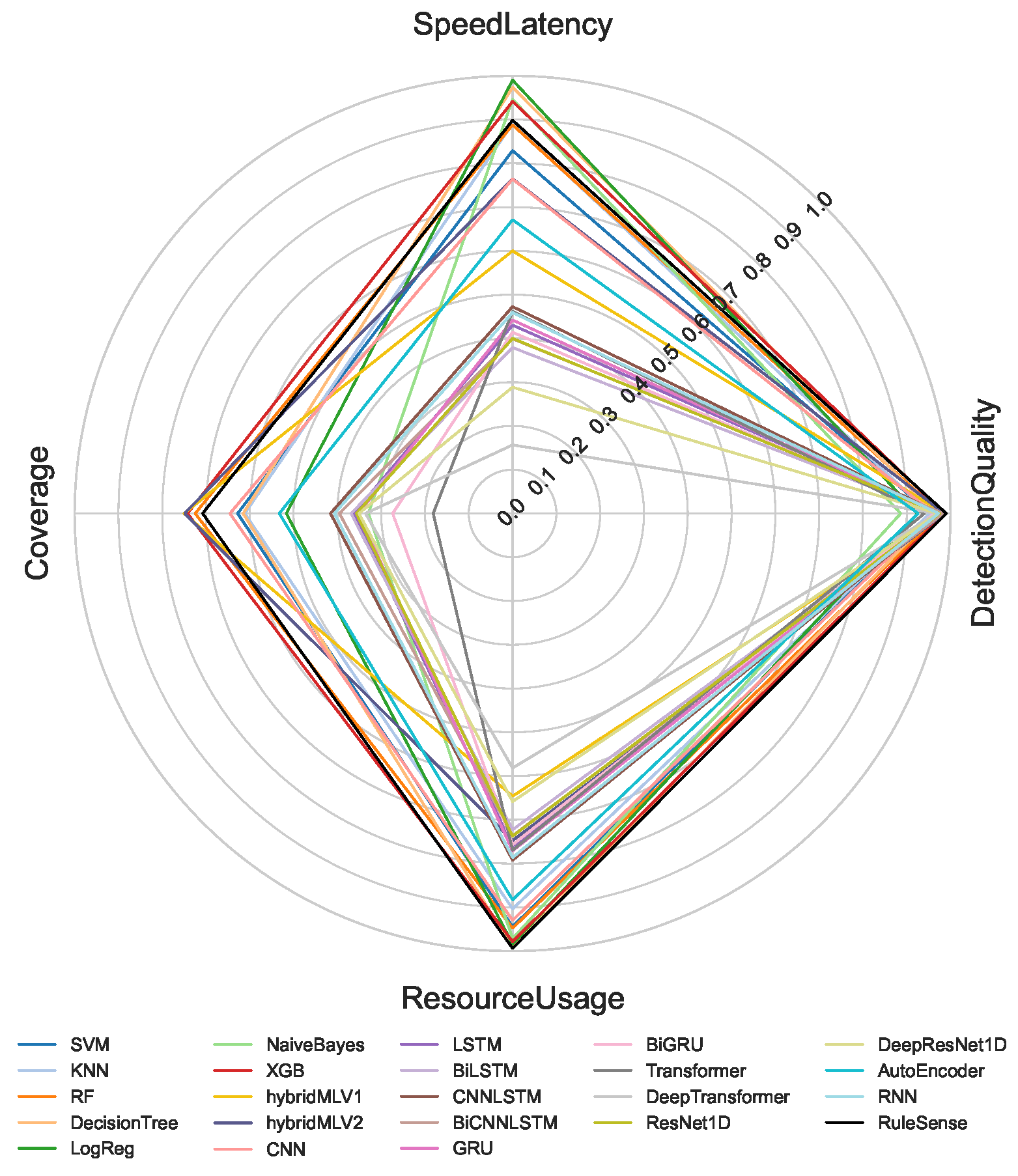
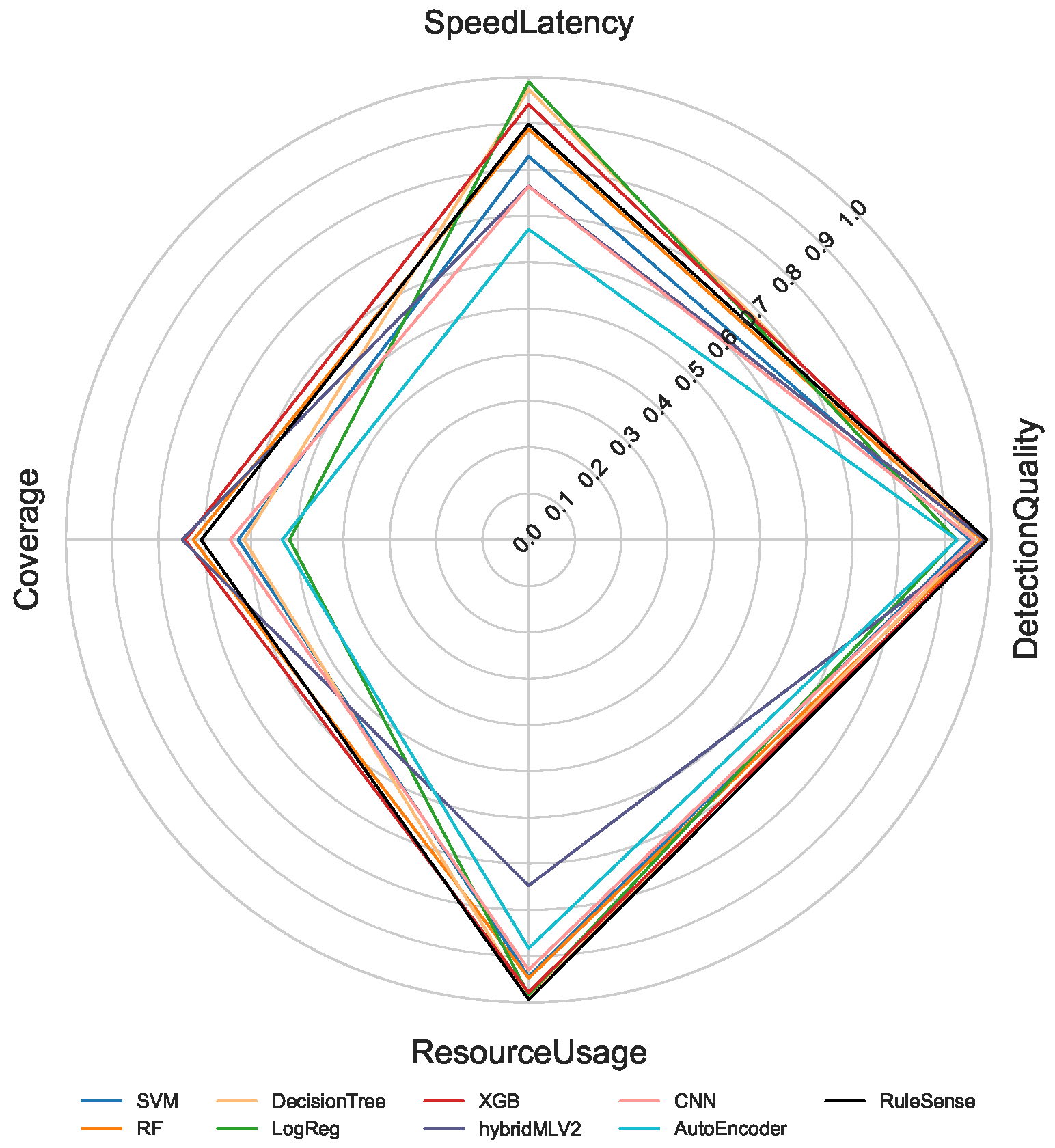
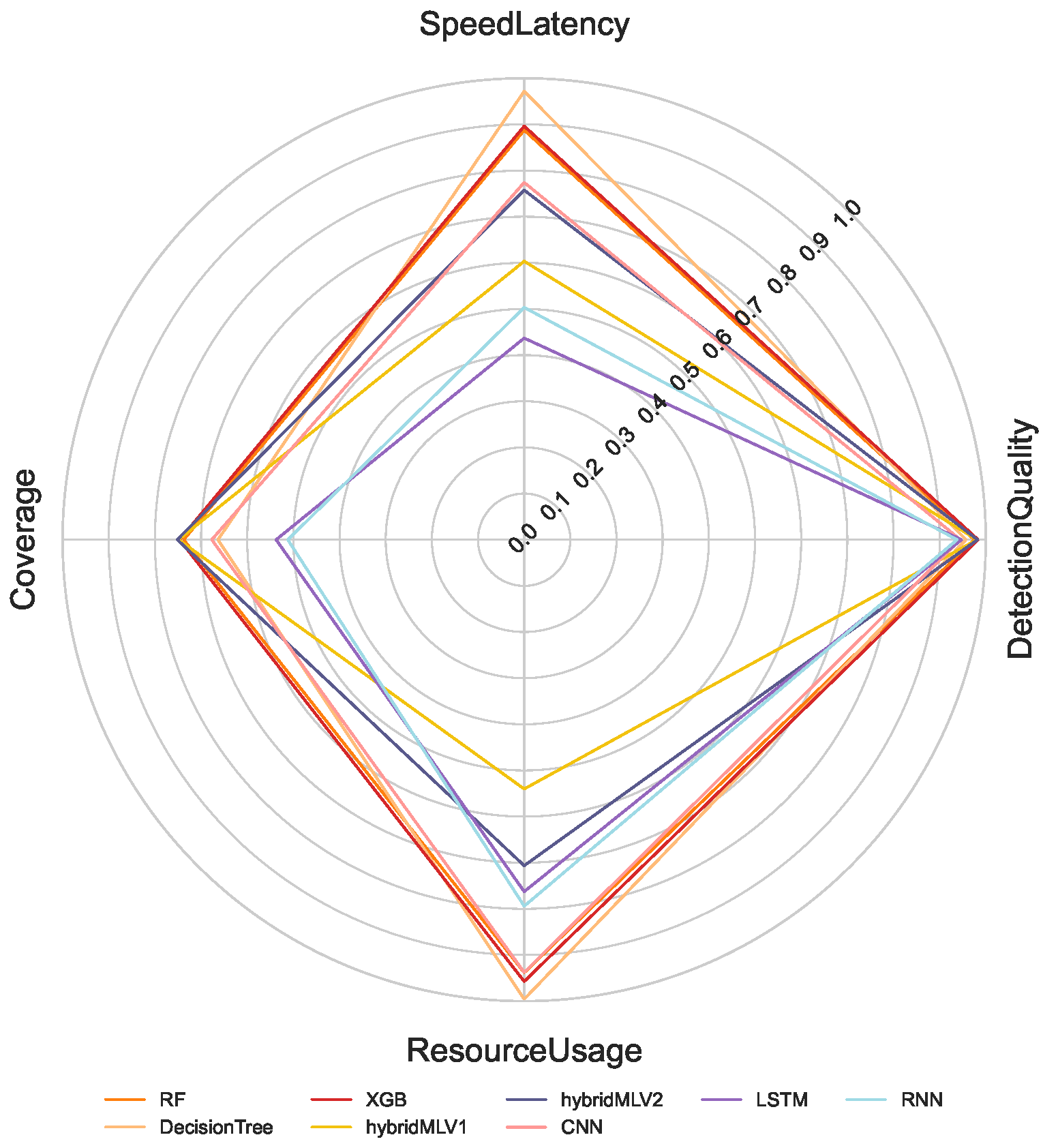
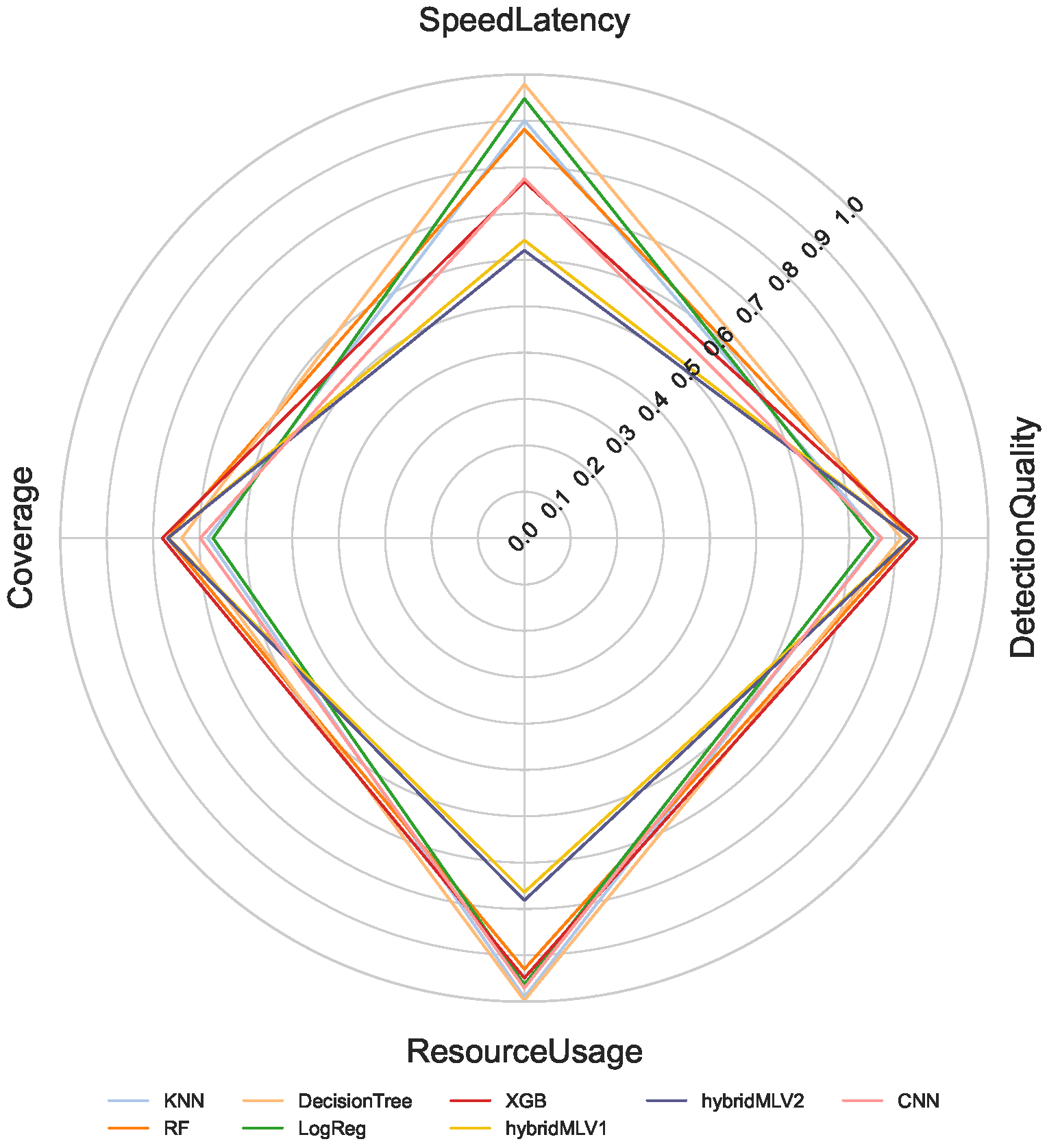
| SVM | 2 Class | 0.9539 ± 0.0147 | 0.9443 ± 0.0368 | 0.8291 ± 0.0523 | 0.6278 ± 0.0416 |
| 8 Class | 0.9323 ± 0.0214 | 0.9427 ± 0.0485 | 0.7907 ± 0.0679 | 0.6501 ± 0.0338 | |
| 50 Class | 0.7585 ± 0.0386 | 0.9731 ± 0.0712 | 0.7285 ± 0.0847 | 0.6855 ± 0.0569 | |
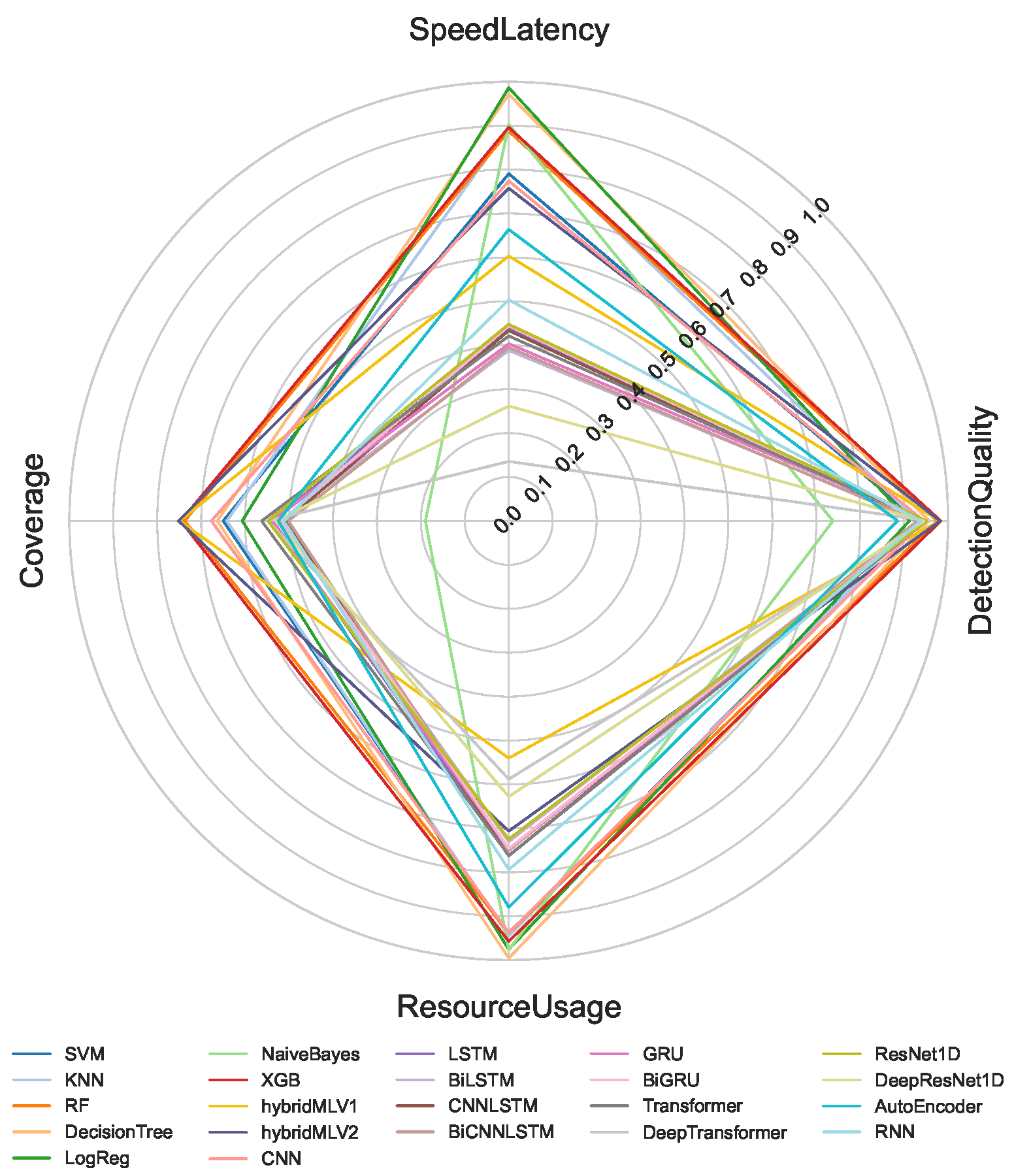
| KNN | 2 Class | 0.9528 ± 0.0879 | 0.9035 ± 0.0941 | 0.8906 ± 0.1248 | 0.6116 ± 0.0394 |
| 8 Class | 0.9319 ± 0.0743 | 0.9450 ± 0.0616 | 0.8964 ± 0.1387 | 0.6420 ± 0.0472 | |
| 50 Class | 0.7669 ± 0.1118 | 0.9909 ± 0.0927 | 0.9010 ± 0.0815 | 0.6828 ± 0.1221 | |
| RandomForest | 2 Class | 0.9782 ± 0.0116 | 0.9476 ± 0.0394 | 0.8879 ± 0.0432 | 0.7248 ± 0.0267 |
| 8 Class | 0.9753 ± 0.0138 | 0.9381 ± 0.0569 | 0.8874 ± 0.0493 | 0.7376 ± 0.0315 | |
| 50 Class | 0.8339 ± 0.0271 | 0.9298 ± 0.0674 | 0.8818 ± 0.0586 | 0.7689 ± 0.0437 | |
| DecisionTree | 2 Class | 0.9658 ± 0.0152 | 0.9923 ± 0.0286 | 0.9737 ± 0.0341 | 0.6152 ± 0.0379 |
| 8 Class | 0.9570 ± 0.0197 | 0.9957 ± 0.0248 | 0.9718 ± 0.0295 | 0.6635 ± 0.0413 | |
| 50 Class | 0.8127 ± 0.0349 | 0.9974 ± 0.0196 | 0.9791 ± 0.0257 | 0.7387 ± 0.0546 | |
| LogReg | 2 Class | 0.9246 ± 0.0264 | 0.9838 ± 0.0337 | 0.9902 ± 0.0246 | 0.5167 ± 0.0289 |
| 8 Class | 0.9120 ± 0.0315 | 0.9760 ± 0.0418 | 0.9865 ± 0.0312 | 0.6065 ± 0.0438 | |
| 50 Class | 0.7520 ± 0.0374 | 0.9634 ± 0.0591 | 0.9479 ± 0.0486 | 0.6710 ± 0.0528 | |
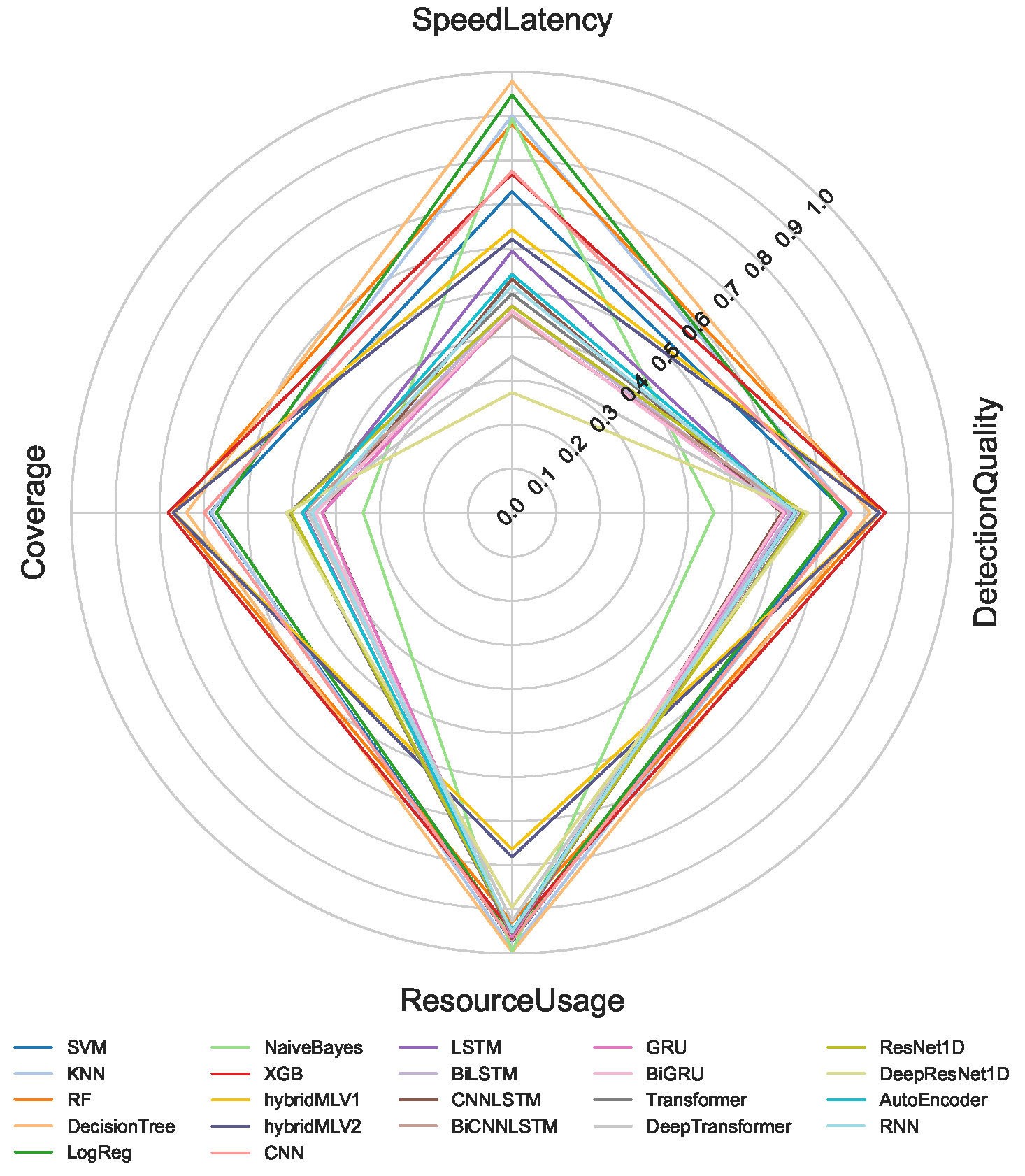
| NaiveBayes | 2 Class | 0.8864 ± 0.0547 | 0.9716 ± 0.1463 | 0.9464 ± 0.0717 | 0.3295 ± 0.0686 |
| 8 Class | 0.7380 ± 0.0682 | 0.9766 ± 0.1321 | 0.9027 ± 0.0978 | 0.1898 ± 0.0349 | |
| 50 Class | 0.4580 ± 0.1093 | 0.9961 ± 0.0418 | 0.8941 ± 0.0736 | 0.3379 ± 0.0324 | |
| XGB | 2 Class | 0.9863 ± 0.0119 | 0.9783 ± 0.0275 | 0.9415 ± 0.0376 | 0.7423 ± 0.0258 |
| 8 Class | 0.9833 ± 0.0128 | 0.9573 ± 0.0439 | 0.8962 ± 0.0475 | 0.7464 ± 0.0287 | |
| 50 Class | 0.8468 ± 0.0267 | 0.9488 ± 0.0613 | 0.7690 ± 0.0715 | 0.7806 ± 0.0396 | |
| hybridML_V1 | 2 Class | 0.9861 ± 0.0124 | 0.6460 ± 0.0792 | 0.6000 ± 0.0838 | 0.7503 ± 0.0314 |
| 8 Class | 0.9809 ± 0.0143 | 0.5402 ± 0.0847 | 0.6034 ± 0.0785 | 0.7488 ± 0.0279 | |
| 50 Class | 0.8327 ± 0.0298 | 0.3639 ± 0.0816 | 0.3425 ± 0.0893 | 0.7676 ± 0.0418 | |
| hybridML_V2 | 2 Class | 0.9856 ± 0.0131 | 0.7474 ± 0.0684 | 0.7648 ± 0.0547 | 0.7492 ± 0.0261 |
| 8 Class | 0.9819 ± 0.0149 | 0.7064 ± 0.0728 | 0.7576 ± 0.0596 | 0.7516 ± 0.0295 | |
| 50 Class | 0.8337 ± 0.0284 | 0.5315 ± 0.0773 | 0.6206 ± 0.0739 | 0.7686 ± 0.0384 | |
| CNN | 2 Class | 0.9620 ± 0.0168 | 0.9296 ± 0.0427 | 0.7641 ± 0.0574 | 0.6454 ± 0.0346 |
| 8 Class | 0.9449 ± 0.0216 | 0.9376 ± 0.0493 | 0.7742 ± 0.0618 | 0.6768 ± 0.0415 | |
| 50 Class | 0.7706 ± 0.0337 | 0.9705 ± 0.0678 | 0.7754 ± 0.0731 | 0.6987 ± 0.0529 | |
| LSTM | 2 Class | 0.9698 ± 0.0149 | 0.7602 ± 0.0734 | 0.4303 ± 0.0817 | 0.3630 ± 0.0264 |
| 8 Class | 0.9475 ± 0.0198 | 0.7626 ± 0.0689 | 0.4369 ± 0.0763 | 0.5374 ± 0.0387 | |
| 50 Class | 0.6376 ± 0.0351 | 0.9623 ± 0.0596 | 0.5934 ± 0.0694 | 0.4718 ± 0.0458 | |
| BiLSTM | 2 Class | 0.9742 ± 0.0437 | 0.7229 ± 0.0776 | 0.3791 ± 0.0849 | 0.3687 ± 0.1198 |
| 8 Class | 0.9380 ± 0.0524 | 0.7305 ± 0.0713 | 0.3884 ± 0.0796 | 0.5201 ± 0.0371 | |
| 50 Class | 0.6318 ± 0.1268 | 0.9509 ± 0.0828 | 0.4699 ± 0.0711 | 0.4578 ± 0.0633 | |
| CNNLSTM | 2 Class | 0.9760 ± 0.0529 | 0.7623 ± 0.0697 | 0.4326 ± 0.0784 | 0.3759 ± 0.0612 |
| 8 Class | 0.9355 ± 0.1137 | 0.7621 ± 0.0665 | 0.4336 ± 0.0938 | 0.5080 ± 0.0596 | |
| 50 Class | 0.6118 ± 0.0784 | 0.9664 ± 0.0867 | 0.5301 ± 0.1471 | 0.4297 ± 0.0974 | |
| BiCNNLSTM | 2 Class | 0.9837 ± 0.1118 | 0.7364 ± 0.1729 | 0.3990 ± 0.1815 | 0.3953 ± 0.0887 |
| 8 Class | 0.9303 ± 0.1248 | 0.7506 ± 0.1687 | 0.3954 ± 0.0774 | 0.5017 ± 0.0665 | |
| 50 Class | 0.6463 ± 0.1042 | 0.9564 ± 0.0814 | 0.4479 ± 0.0993 | 0.4746 ± 0.0721 | |
| GRU | 2 Class | 0.9675 ± 0.0354 | 0.7710 ± 0.0673 | 0.4419 ± 0.0746 | 0.3518 ± 0.0249 |
| 8 Class | 0.9521 ± 0.0187 | 0.7470 ± 0.0718 | 0.4036 ± 0.0761 | 0.5392 ± 0.0388 | |
| 50 Class | 0.6202 ± 0.0376 | 0.9624 ± 0.0583 | 0.4577 ± 0.0688 | 0.4311 ± 0.0446 | |
| BiGRU | 2 Class | 0.9629 ± 0.0363 | 0.7569 ± 0.0716 | 0.4140 ± 0.0783 | 0.2738 ± 0.0217 |
| 8 Class | 0.9409 ± 0.0521 | 0.7463 ± 0.0694 | 0.4445 ± 0.0739 | 0.5176 ± 0.0374 | |
| 50 Class | 0.6171 ± 0.1079 | 0.9555 ± 0.0808 | 0.4579 ± 0.0972 | 0.4457 ± 0.0439 | |
| Transformer | 2 Class | 0.9404 ± 0.0218 | 0.7695 ± 0.0667 | 0.4618 ± 0.0725 | 0.1813 ± 0.0142 |
| 8 Class | 0.9495 ± 0.0184 | 0.7418 ± 0.0703 | 0.3912 ± 0.0791 | 0.5324 ± 0.0391 | |
| 50 Class | 0.6579 ± 0.0346 | 0.9546 ± 0.0617 | 0.4965 ± 0.0684 | 0.5043 ± 0.0418 | |
| DeepTransformer | 2 Class | 0.9703 ± 0.0141 | 0.5815 ± 0.0824 | 0.1566 ± 0.0879 | 0.3359 ± 0.0248 |
| 8 Class | 0.9564 ± 0.0176 | 0.5880 ± 0.0791 | 0.1355 ± 0.0894 | 0.5481 ± 0.0386 | |
| 50 Class | 0.6481 ± 0.0358 | 0.9264 ± 0.0643 | 0.3549 ± 0.0816 | 0.4629 ± 0.0445 | |
| ResNet1D | 2 Class | 0.9750 ± 0.0133 | 0.7375 ± 0.0731 | 0.3999 ± 0.0776 | 0.3567 ± 0.0273 |
| 8 Class | 0.9513 ± 0.0189 | 0.7249 ± 0.0748 | 0.3879 ± 0.0802 | 0.5481 ± 0.0368 | |
| 50 Class | 0.6618 ± 0.0334 | 0.9495 ± 0.0621 | 0.4686 ± 0.0697 | 0.5020 ± 0.0427 | |
| DeepResNet1D | 2 Class | 0.9714 ± 0.0146 | 0.6583 ± 0.0789 | 0.2885 ± 0.0843 | 0.3509 ± 0.0268 |
| 8 Class | 0.9451 ± 0.0207 | 0.6279 ± 0.0814 | 0.2616 ± 0.0876 | 0.5304 ± 0.0382 | |
| 50 Class | 0.6712 ± 0.0331 | 0.8958 ± 0.0662 | 0.2728 ± 0.0837 | 0.5122 ± 0.0434 | |
| AutoEncoder | 2 Class | 0.9261 ± 0.0249 | 0.8828 ± 0.0518 | 0.6712 ± 0.0637 | 0.5327 ± 0.0375 |
| 8 Class | 0.8851 ± 0.0314 | 0.8798 ± 0.0546 | 0.6638 ± 0.0661 | 0.5244 ± 0.0392 | |
| 50 Class | 0.6434 ± 0.0357 | 0.9485 ± 0.0616 | 0.5410 ± 0.0713 | 0.4758 ± 0.0448 | |
| RNN | 2 Class | 0.9729 ± 0.0139 | 0.7860 ± 0.0664 | 0.4490 ± 0.0731 | 0.3569 ± 0.0259 |
| 8 Class | 0.9378 ± 0.0228 | 0.7941 ± 0.0638 | 0.5033 ± 0.0695 | 0.5121 ± 0.0377 | |
| 50 Class | 0.6421 ± 0.0363 | 0.9514 ± 0.0594 | 0.5158 ± 0.0679 | 0.4539 ± 0.0436 | |
| RuleSense | 2 Class | 0.9904 ± 0.0102 | 0.9937 ± 0.0126 | 0.8685 ± 0.0219 | 0.6578 ± 0.0184 |
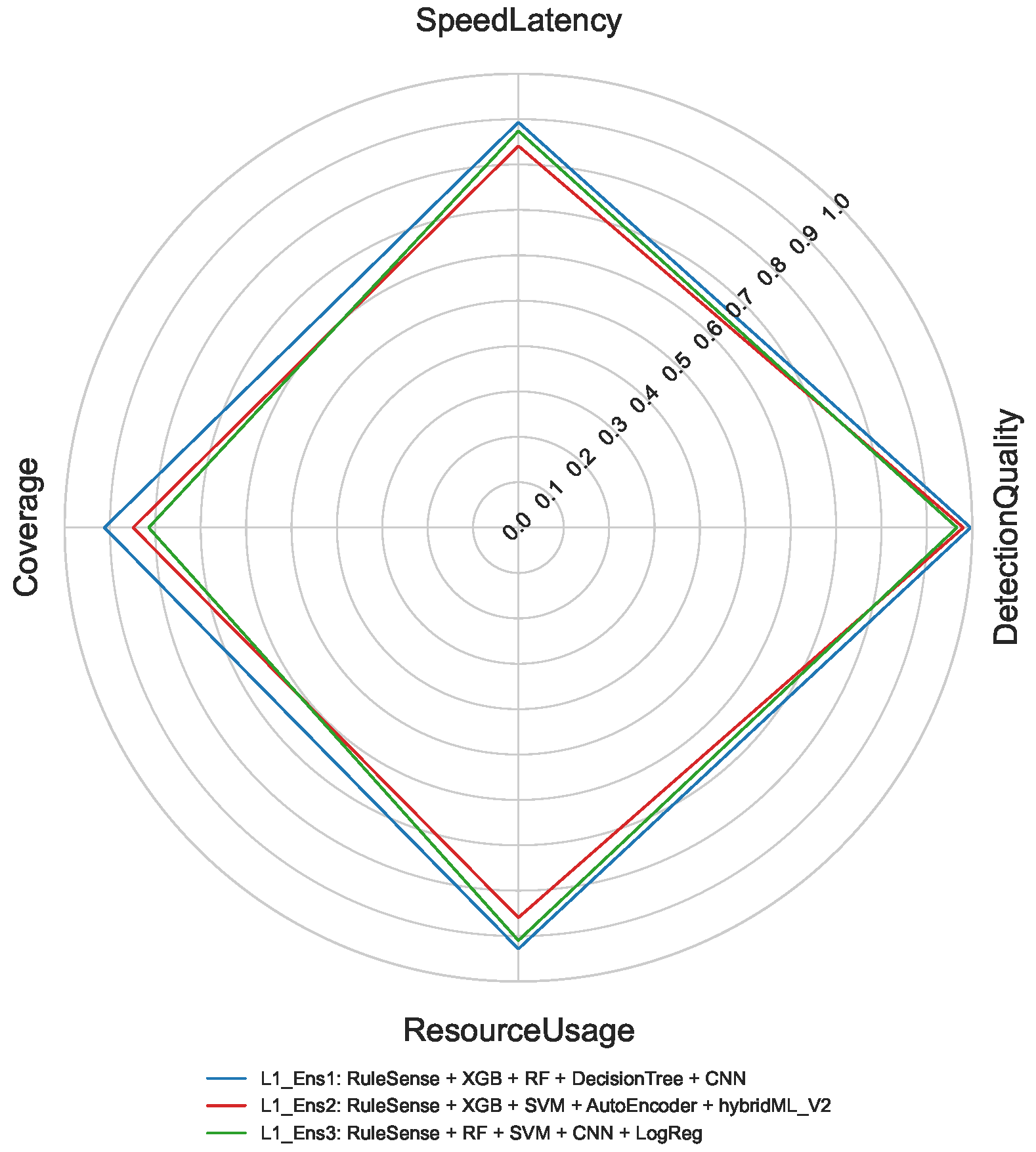
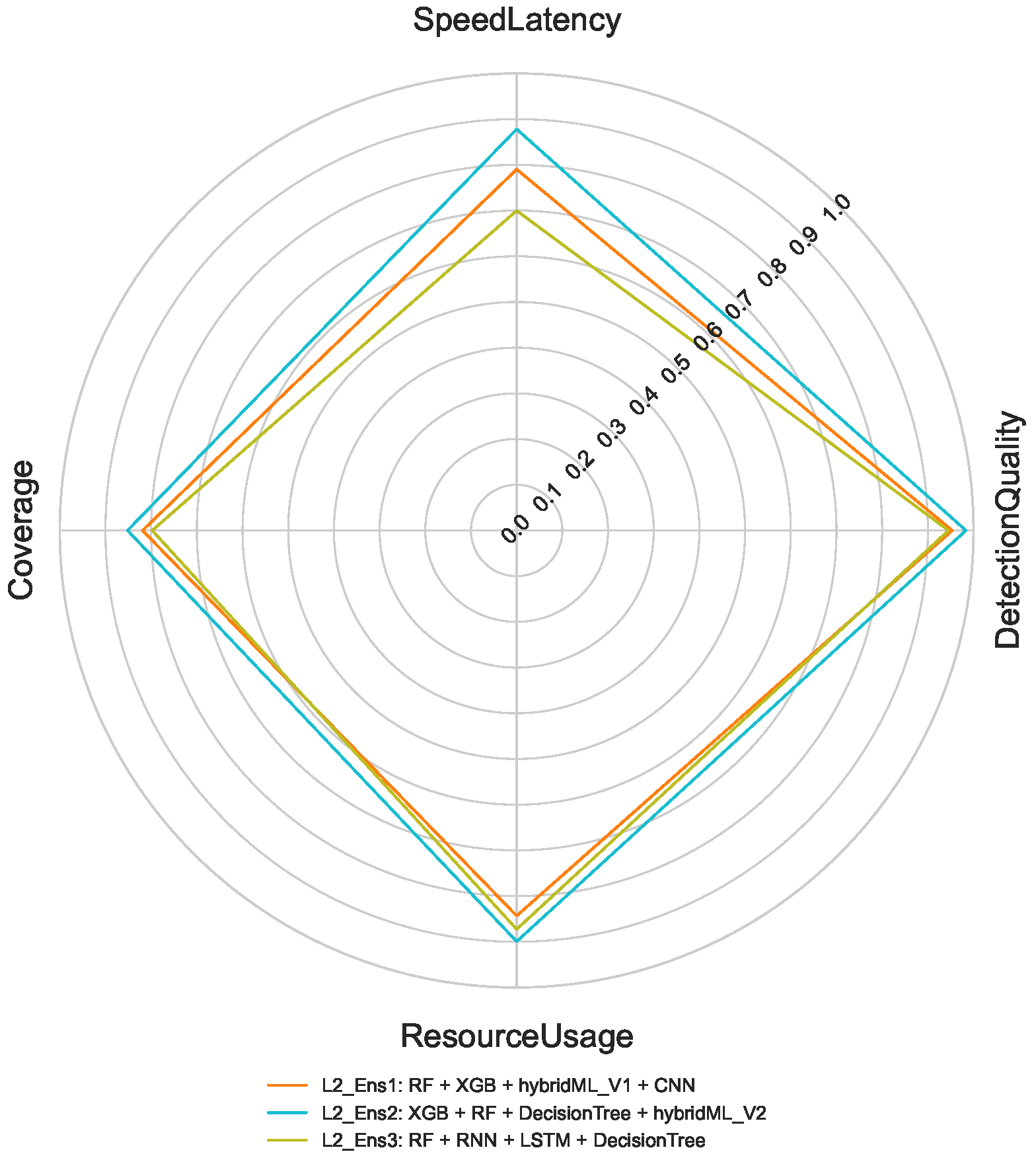
| Ens ID | Task | Selected Ensemble Components |
|---|---|---|
| L1_Ens1 | 2-Class | RuleSense + XGBoost + Random Forest + DecisionTree + CNN |
| L1_Ens2 | 2-Class | RuleSense + XGBoost + SVM + AutoEncoder + hybridML_V2 |
| L1_Ens3 | 2-Class | RuleSense + Random Forest + SVM + CNN + LogReg |
| L2_Ens1 | 8-Class | Random Forest + XGBoost + hybridML_V1 + CNN |
| L2_Ens2 | 8-Class | XGBoost + Random Forest + DecisionTree + hybridML_V2 |
| L2_Ens3 | 8-Class | Random Forest + RNN + LSTM + DecisionTree |
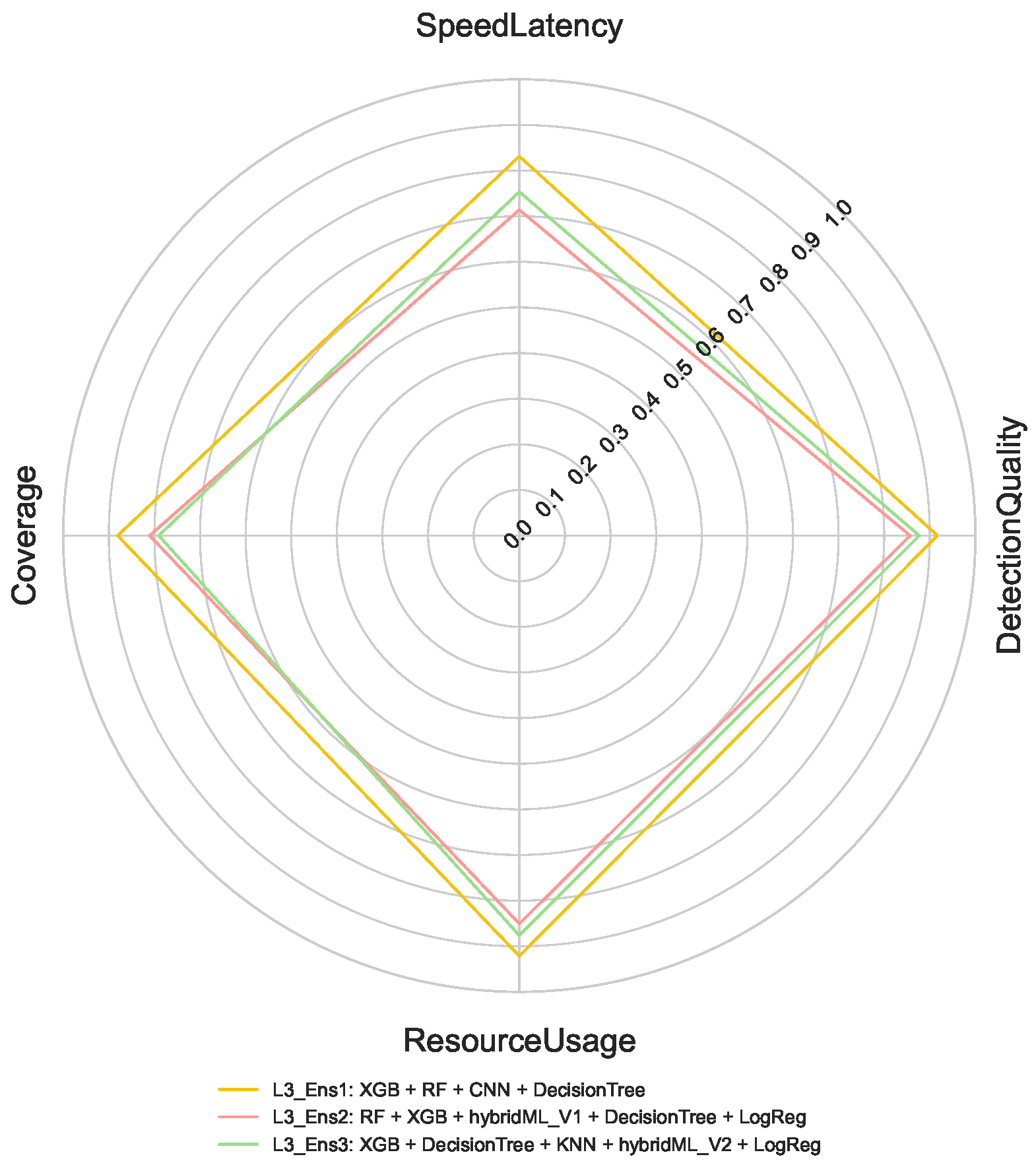
| L3_Ens1 | 50-Class | XGBoost + Random Forest + CNN + DecisionTree |
| L3_Ens2 | 50-Class | Random Forest + XGBoost + hybridML_V1 + DecisionTree + LogReg |
| L3_Ens3 | 50-Class | XGBoost + DecisionTree + KNN + hybridML_V2 + LogReg |
| Task | Weight Settings | TOPSIS Top 3 | VIKOR Top 3 | Chebyshev Top 3 |
|---|---|---|---|---|
| 2-Class | W1 | XGB, RF, RuleSense | RuleSense, XGB, RF | XGB, RF, hybridML_V2 |
| W2 | XGB, RF, hybridML_V2 | XGB, RF, RuleSense | XGB, hybridML_V2, RF | |
| W3 | RuleSense, XGB, hybridML_V1 | RuleSense, XGB, hybridML_V1 | RuleSense, XGB, BiCNNLSTM | |
| W4 | XGB, DecisionTree, RF | DecisionTree, XGB, RF | DecisionTree, XGB, RF | |
| 8-Class | W1 | XGB, RF, hybridML_V2 | XGB, RF, DecisionTree | XGB, RF, hybridML_V2 |
| W2 | XGB, RF, DecisionTree | XGB, DecisionTree, RF | XGB, RF, hybridML_V2 | |
| W3 | XGB, hybridML_V2, hybridML_V1 | XGB, hybridML_V2, RF | XGB, hybridML_V2, RF | |
| W4 | DecisionTree, XGB, RF | DecisionTree, XGB, RF | DecisionTree, XGB, RF | |
| 50-Class | W1 | XGB, RF, DecisionTree | XGB, RF, CNN | RF, XGB, DecisionTree |
| W2 | RF, XGB, DecisionTree | XGB, RF, DecisionTree | RF, XGB, DecisionTree | |
| W3 | XGB, RF, hybridML_V2 | XGB, RF, hybridML_V1 | XGB, RF, hybridML_V2 | |
| W4 | DecisionTree, RF, KNN | DecisionTree, RF, XGB | DecisionTree, RF, KNN |
| Metrics | ||||||||
|---|---|---|---|---|---|---|---|---|
| Task | Work | Approach | Acc | Prec | Rec | F1 | MCC | %p Improvement |
| Binary (L1) | DeepSense | Ensemble (L1_Ens1) | 99.71 | 99.65 | 99.69 | 99.67 | 99.41 | – |
| DeepSense | Base Models (Max) | 99.28 | 99.13 | 99.05 | 99.09 | 98.49 | – | |
| DeepSense | Base Models (Mean) | 97.27 | 97.37 | 97.27 | 97.28 | 94.58 | – | |
| Logeswari et al. [38] | IA-IDS | 98.67 | 98.60 | 98.45 | 98.51 | NR | +1.16 (F1) | |
| Al Rawajbeh et al. [17] | Trustworthy AI | 96.40 | 96.10 | 95.70 | 95.90 | NR | +3.31 (Acc) | |
| Mohy-Eddine et al. [20] | RF-PCCIF | 99.30 | 85.18 | 99.87 | 91.94 | NR | +7.73 (F1) | |
| Yang and Shami [30] | MSANA | 98.88 | 98.88 | 99.94 | 99.41 | NR | +0.83 (Acc) | |
| 8-Class (L2) | DeepSense | Ensemble (L2_Ens2) | 99.12 | 98.85 | 99.03 | 98.94 | 98.19 | – |
| DeepSense | Base Models (Max) | 98.52 | 98.53 | 98.49 | 98.40 | 97.97 | – | |
| DeepSense | Base Models (Mean) | 94.36 | 94.72 | 94.36 | 94.42 | 92.27 | – | |
| 50-Class (L3) | DeepSense | Ensemble (L3_Ens1) | 95.05 | 94.62 | 94.94 | 94.78 | 90.07 | – |
| DeepSense | Base Models (Max) | 86.01 | 85.55 | 86.01 | 85.72 | 82.39 | – | |
| DeepSense | Base Models (Mean) | 72.43 | 73.21 | 72.41 | 71.65 | 65.43 | – | |
Disclaimer/Publisher’s Note: The statements, opinions and data contained in all publications are solely those of the individual author(s) and contributor(s) and not of MDPI and/or the editor(s). MDPI and/or the editor(s) disclaim responsibility for any injury to people or property resulting from any ideas, methods, instructions or products referred to in the content. |
© 2026 by the authors. Licensee MDPI, Basel, Switzerland. This article is an open access article distributed under the terms and conditions of the Creative Commons Attribution (CC BY) license.
Share and Cite
Firouzi, A.; Ghorbani, A.A. DeepSense: An Adaptive Scalable Ensemble Framework for Industrial IoT Anomaly Detection. Sensors 2026, 26, 2662. https://doi.org/10.3390/s26092662
Firouzi A, Ghorbani AA. DeepSense: An Adaptive Scalable Ensemble Framework for Industrial IoT Anomaly Detection. Sensors. 2026; 26(9):2662. https://doi.org/10.3390/s26092662
Chicago/Turabian StyleFirouzi, Amir, and Ali A. Ghorbani. 2026. "DeepSense: An Adaptive Scalable Ensemble Framework for Industrial IoT Anomaly Detection" Sensors 26, no. 9: 2662. https://doi.org/10.3390/s26092662
APA StyleFirouzi, A., & Ghorbani, A. A. (2026). DeepSense: An Adaptive Scalable Ensemble Framework for Industrial IoT Anomaly Detection. Sensors, 26(9), 2662. https://doi.org/10.3390/s26092662