Uncertainty-Aware Probabilistic Fusion Post-Processing for Continuous Wrist Motion Estimation in Myoelectric Control


Abstract
1. Introduction
- We propose a practical uncertainty-aware post-processing mechanism that enables plug-and-play compatibility with existing regressors without retraining or architectural modification.
- We formulate post-processing as a Gaussian fusion problem with a closed-form adaptive gain, where predictive uncertainty dynamically regulates smoothing strength.
- We validate the method through open-loop wrist joint motion estimation and closed-loop myoelectric control experiments, demonstrating superior performance in task completion time, trajectory smoothness, and trajectory tracking error compared to traditional post-processing techniques.
2. Apparatus and Experiments
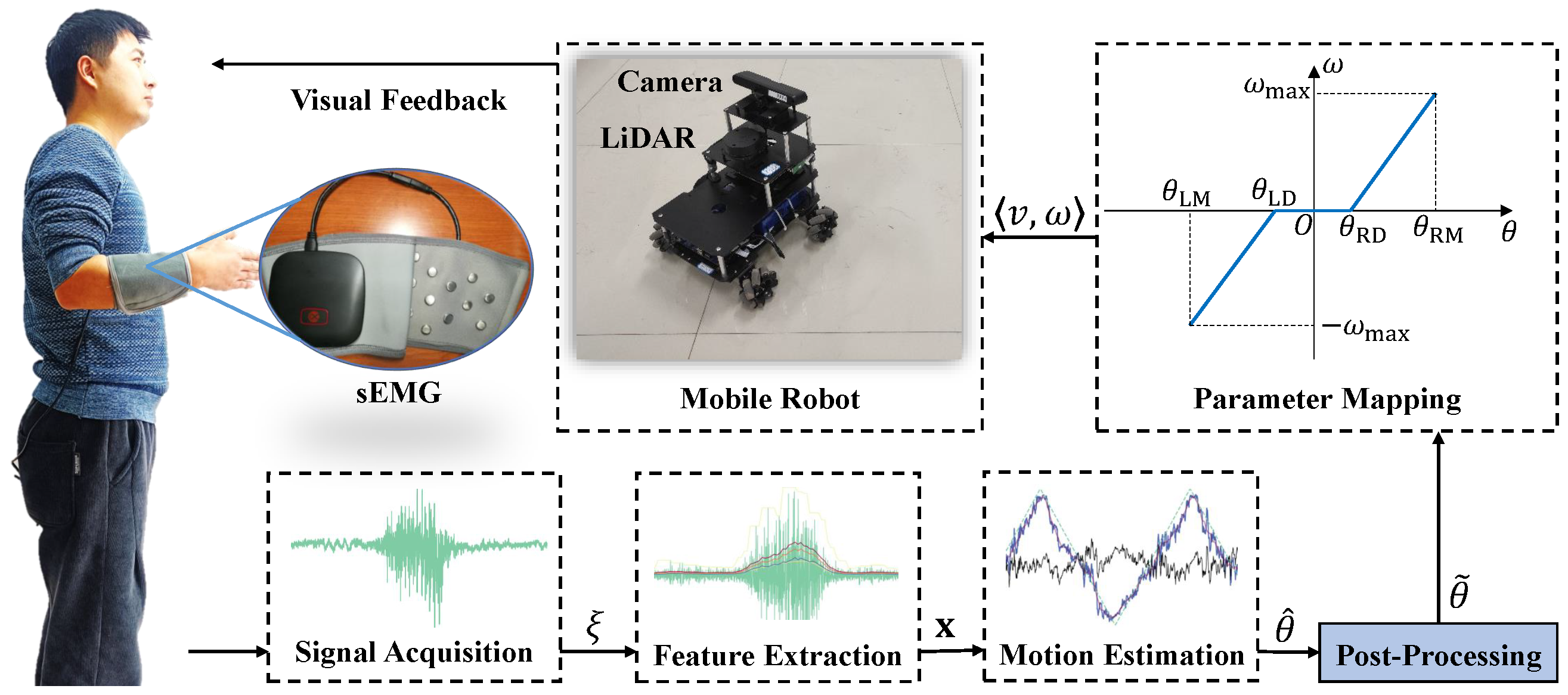
2.1. Mobile Platform
2.2. Parameter Mapping
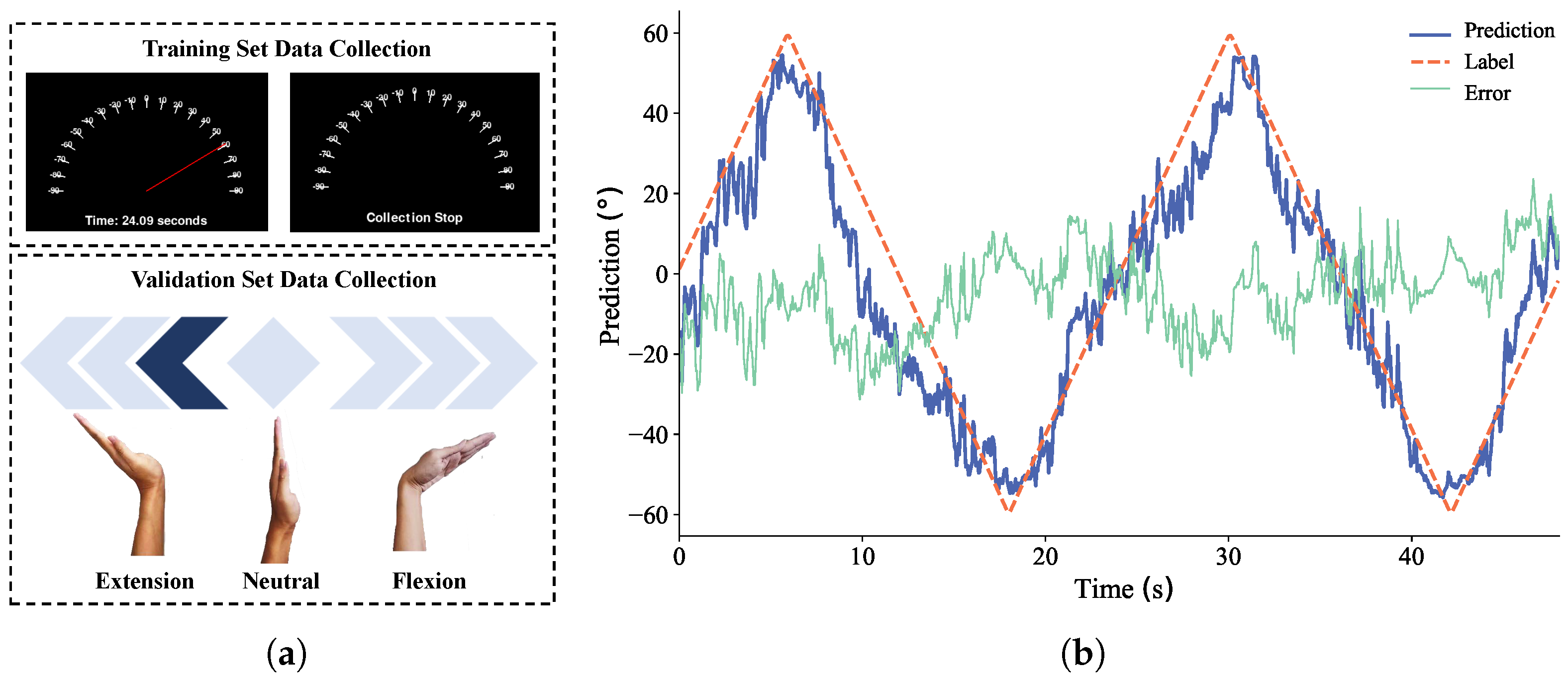
2.3. Data Collection
2.4. Feature Extraction
2.5. Decoding Model
3. Proposed Method
3.1. Sliding Window Dataset Construction
3.2. LGPR Modeling
3.3. Theoretical Justification for Uncertainty Proxy
3.4. Uncertainty-Aware Probabilistic Fusion
| Algorithm 1 Uncertainty-Aware Probabilistic Fusion Post-Processing |
| Input: Trained regression model ; Sliding window size N; Prior variance |
| Output: Smoothed wrist angle estimate |
| 1: Initialize |
| 2: for each t do |
| 3: Extract sEMG feature vector |
| 4: Compute instantaneous prediction: |
| 5: if then |
| 6: |
| 7: else |
| 8: Construct LGPR using dataset |
| 9: Compute using Equations (7)–(10) |
| 10: Compute adaptive gain: |
| 11: Perform probabilistic fusion: |
| 12: end if |
| 13: Update while keeping size N |
| 14: end for |
4. Results and Analysis
4.1. Review of Existing Post-Processing Methods
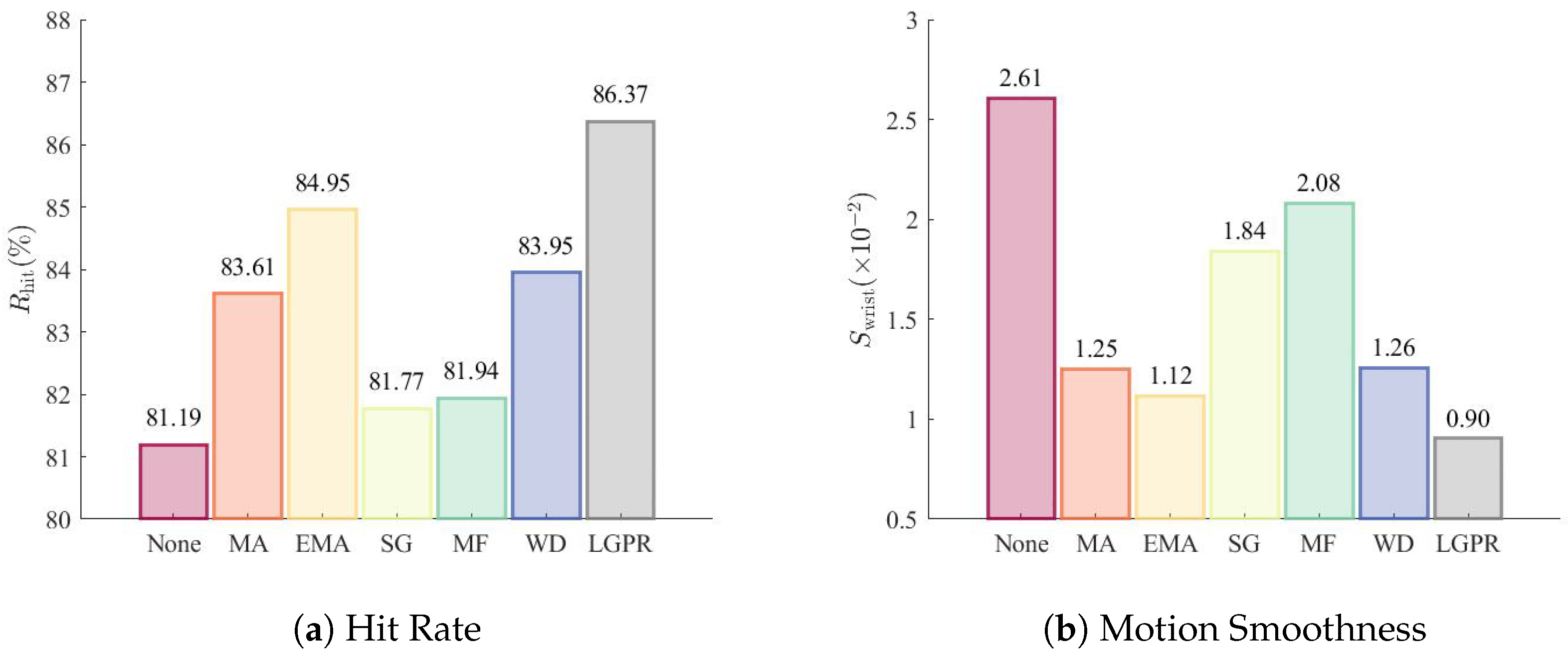
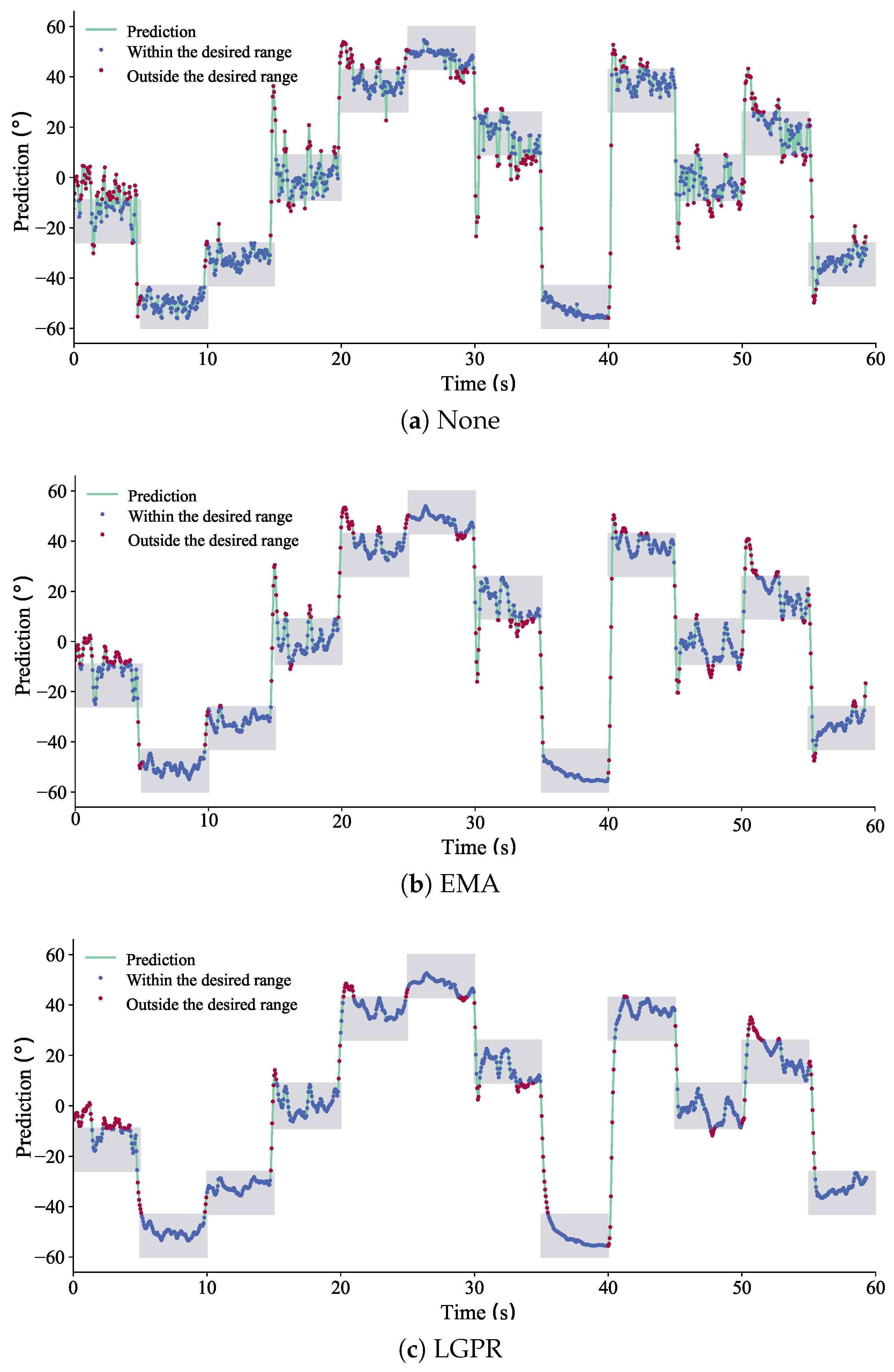
4.2. Open-Loop Continuous Wrist Motion Estimation
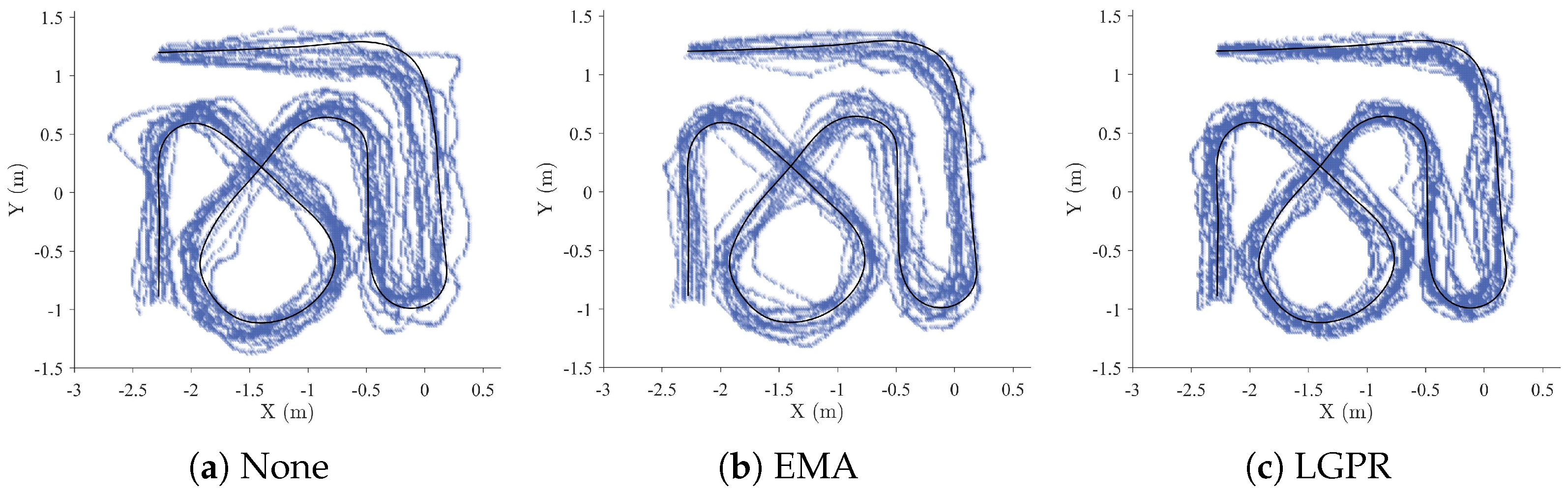
4.3. Closed-Loop Myoelectric Control
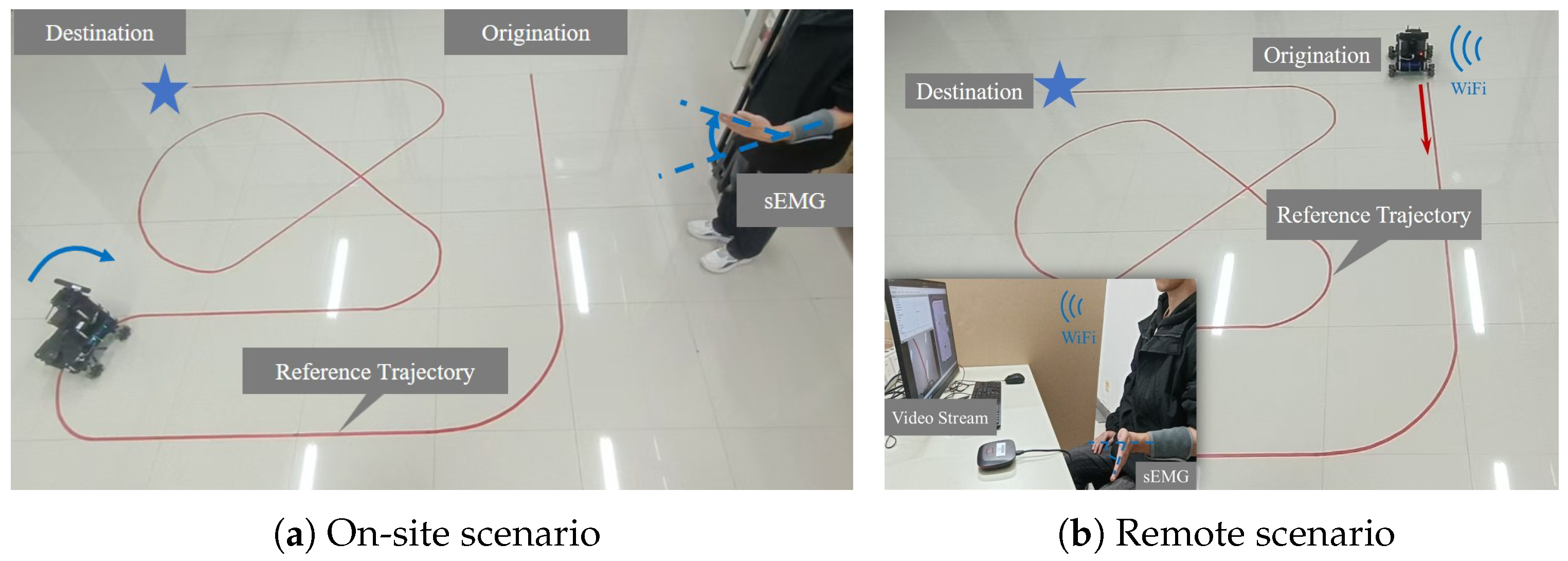
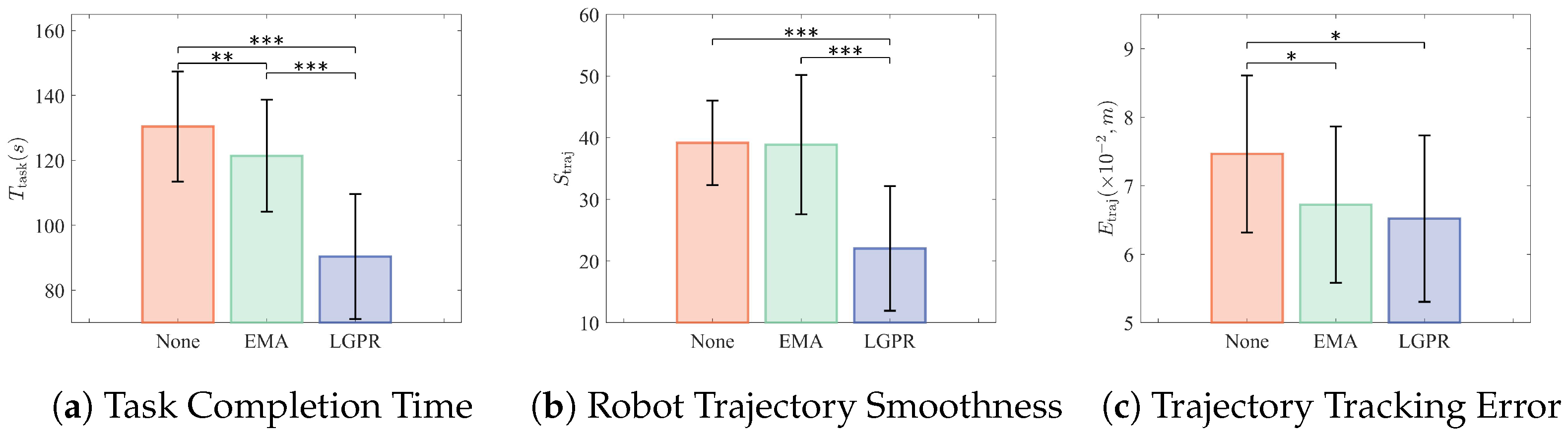
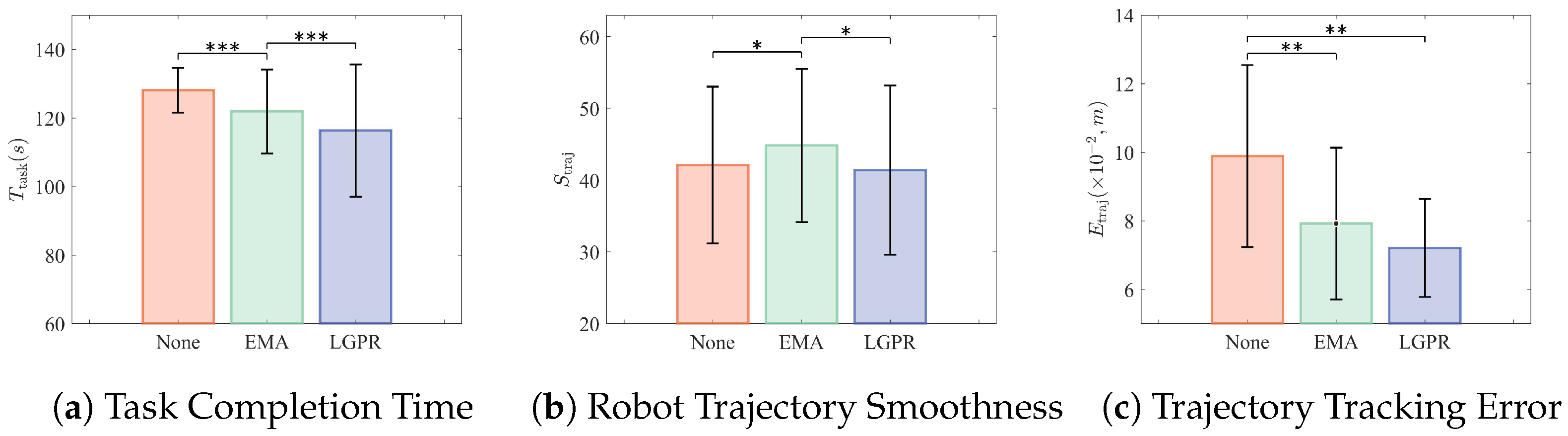
- Task Completion Time : the time required for the robot to move from the start point to the destination.
- Robot Trajectory Smoothness : computed as the average curvature difference between adjacent time steps during the motion. A smaller value indicates a smoother trajectory.
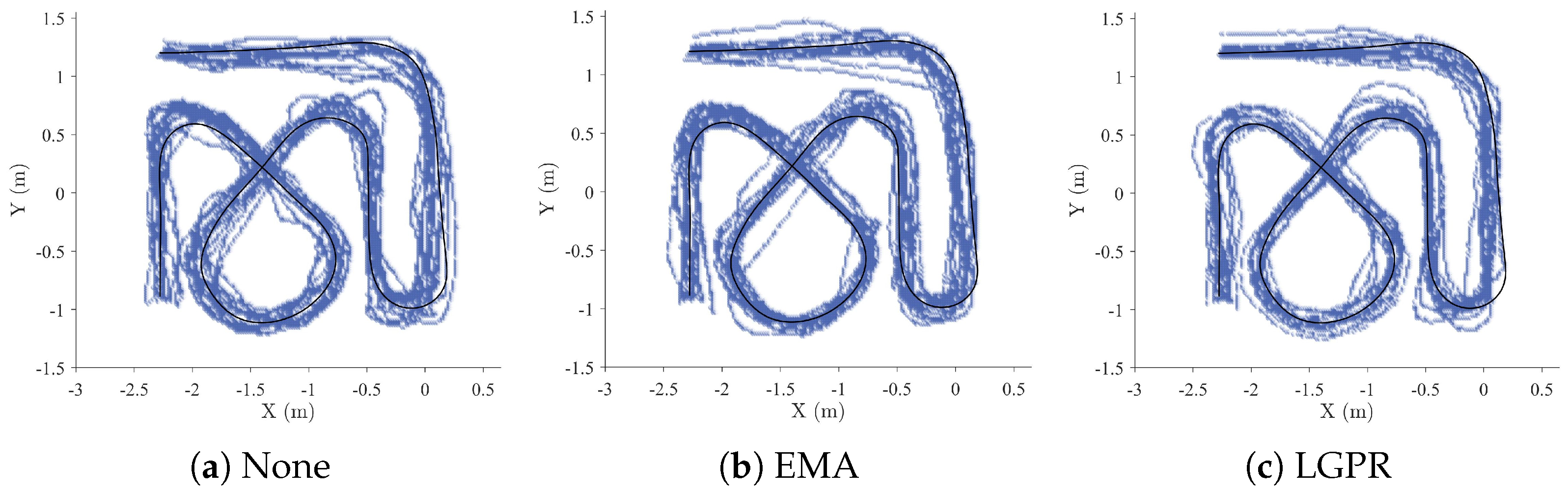
- Trajectory Tracking Error : calculated as the average shortest distance from each point on the robot trajectory to the reference trajectory. A smaller value indicates better tracking performance.
4.4. Discussion
5. Conclusions
Author Contributions
Funding
Institutional Review Board Statement
Informed Consent Statement
Data Availability Statement
Acknowledgments
Conflicts of Interest
References
- Hahne, J.M.; Schweisfurth, M.A.; Koppe, M.; Farina, D. Simultaneous control of multiple functions of bionic hand prostheses: Performance and robustness in end users. Sci. Robot. 2018, 3, eaat3630. [Google Scholar] [CrossRef] [PubMed]
- Mouchoux, J.; Carisi, S.; Dosen, S.; Farina, D.; Schilling, A.F.; Markovic, M. Artificial perception and semiautonomous control in myoelectric hand prostheses increases performance and decreases effort. IEEE Trans. Robot. 2021, 37, 1298–1312. [Google Scholar] [CrossRef]
- Chen, J.; Cheng, Z.; Cai, Y.; Zhang, S.; Zhu, C.; Zhang, Y. Robot-assisted mirror rehabilitation for post-stroke upper limbs: A personalized control strategy. Sensors 2025, 25, 5659. [Google Scholar] [CrossRef]
- DelPreto, J.; Rus, D. Plug-and-play gesture control using muscle and motion sensors. In Proceedings of the ACM/IEEE International Conference on Human-Robot Interaction (HRI), Cambridge, UK, 23–26 March 2020; pp. 439–448. [Google Scholar]
- Guan, B.; Godoy, R.V.; Sanches, F.; Dwivedi, A.; Liarokapis, M. On semi-autonomous robotic telemanipulation employing electromyography based motion decoding and potential fields. In Proceedings of the IEEE/RSJ International Conference on Intelligent Robots and Systems (IROS), Detroit, MI, USA, 1–5 October 2023; pp. 6991–6997. [Google Scholar]
- Wang, Z.; Suga, S.; Nacpil, E.J.C.; Yang, B.; Nakano, K. Effect of fixed and sEMG-based adaptive shared steering control on distracted driver behavior. Sensors 2021, 21, 7691. [Google Scholar] [CrossRef]
- Furukawa, J.i.; Chiyohara, S.; Teramae, T.; Takai, A.; Morimoto, J. A collaborative filtering approach toward plug-and-play myoelectric robot control. IEEE Trans. Hum.-Mach. Syst. 2021, 51, 514–523. [Google Scholar] [CrossRef]
- Zhang, X.; Qu, Y.; Zhang, G.; Wang, Z.; Chen, C.; Xu, X. Review of sEMG for exoskeleton robots: Motion intention recognition techniques and applications. Sensors 2025, 25, 2448. [Google Scholar] [CrossRef] [PubMed]
- Zhao, Y.; Zhang, Z.; Li, Z.; Yang, Z.; Dehghani-Sanij, A.A.; Xie, S. An EMG-driven musculoskeletal model for estimating continuous wrist motion. IEEE Trans. Neural Syst. Rehabil. Eng. 2020, 28, 3113–3120. [Google Scholar] [CrossRef]
- Wang, J.; Cao, D.; Liang, G.; Wu, Y. A surface electromyography-driven state space model for joint angle estimation. IEEE Sens. J. 2025, 25, 3048–3060. [Google Scholar] [CrossRef]
- Luo, J.; Lin, Z.; Li, Y.; Yang, C. A teleoperation framework for mobile robots based on shared control. IEEE Robot. Autom. Lett. 2020, 5, 377–384. [Google Scholar] [CrossRef]
- Borzelli, D.; Pastorelli, S.P.; d’Avella, A.; Gastaldi, L. Virtual stiffness: A novel biomechanical approach to estimate limb stiffness of a multi-muscle and multi-joint system. Sensors 2023, 23, 673. [Google Scholar] [CrossRef]
- Xiong, D.; Zhang, D.; Chu, Y.; Zhao, Y.; Zhao, X. Intuitive human-robot-environment interaction with EMG signals: A review. IEEE/CAA J. Autom. Sin. 2024, 11, 1075–1091. [Google Scholar] [CrossRef]
- Dwivedi, A.; Shieff, D.; Turner, A.; Gorjup, G.; Kwon, Y.; Liarokapis, M. A shared control framework for robotic telemanipulation combining electromyography based motion estimation and compliance control. In Proceedings of the IEEE International Conference on Robotics and Automation (ICRA), Xi’an, China, 30 May–5 June 2021; pp. 9467–9473. [Google Scholar]
- Dwivedi, A.; Kwon, Y.; McDaid, A.J.; Liarokapis, M. A learning scheme for EMG based decoding of dexterous, in-hand manipulation motions. IEEE Trans. Neural Syst. Rehabil. Eng. 2019, 27, 2205–2215. [Google Scholar] [CrossRef] [PubMed]
- Feng, C.; Li, Y.; Yan, W.; Cui, R. Enhancing Underwater Teleoperation with Simultaneous Estimation of Multi-DOF Hand Movements using Electromyography. In Proceedings of the International Conference on Advanced Robotics and Mechatronics (ICARM), Tokyo, Japan, 8–10 July 2024; pp. 698–703. [Google Scholar]
- Yu, Y.; Chen, C.; Zhao, J.; Sheng, X.; Zhu, X. Surface electromyography image-driven torque estimation of multi-DoF wrist movements. IEEE Trans. Ind. Electron. 2021, 69, 795–804. [Google Scholar] [CrossRef]
- Gurgone, S.; Borzelli, D.; de Pasquale, P.; Berger, D.J.; Baldi, T.L.; D’Aurizio, N.; Prattichizzo, D.; d’Avella, A. Simultaneous control of natural and extra degrees of freedom by isometric force and electromyographic activity in the muscle-to-force null space. J. Neural Eng. 2022, 19, 016004. [Google Scholar] [CrossRef]
- Ma, C.; Lin, C.; Samuel, O.W.; Guo, W.; Zhang, H.; Greenwald, S.; Xu, L.; Li, G. A bi-directional LSTM network for estimating continuous upper limb movement from surface electromyography. IEEE Robot. Autom. Lett. 2021, 6, 7217–7224. [Google Scholar] [CrossRef]
- Abdikenov, B.; Zholtayev, D.; Suleimenov, K.; Assan, N.; Ozhikenov, K.; Ozhikenova, A.; Nadirov, N.; Kapsalyamov, A. Emerging frontiers in robotic upper-limb prostheses: Mechanisms, materials, tactile sensors and machine learning-based EMG control: A comprehensive review. Sensors 2025, 25, 3892. [Google Scholar] [CrossRef]
- Raghu, S.T.P.; MacIsaac, D.; Scheme, E. Decision-change informed rejection improves robustness in pattern recognition-based myoelectric control. IEEE J. Biomed. Health Inform. 2023, 27, 6051–6061. [Google Scholar] [CrossRef]
- Ghalyan, M.; Alher, M.; Jweeg, M. Human gait cycle classification improvements using median and root mean square filters based on EMG signals. IOP Conf. Ser. Mater. Sci. Eng. 2021, 1067, 012146. [Google Scholar] [CrossRef]
- Dombi, J.; Dineva, A. Adaptive Savitzky-Golay filtering and its applications. Int. J. Adv. Intell. Paradig. 2020, 16, 145–156. [Google Scholar] [CrossRef]
- Fraser, G.D.; Chan, A.D.; Green, J.R.; MacIsaac, D. Removal of electrocardiogram artifacts in surface electromyography using a moving average method. In Proceedings of the IEEE International Symposium on Medical Measurements and Applications, Budapest, Hungary, 18–19 May 2012; pp. 1–4. [Google Scholar]
- Hahne, J.M.; Dähne, S.; Hwang, H.J.; Müller, K.R.; Parra, L.C. Concurrent adaptation of human and machine improves simultaneous and proportional myoelectric control. IEEE Trans. Neural Syst. Rehabil. Eng. 2015, 23, 618–627. [Google Scholar] [CrossRef]
- Sobahi, N. Denoising of EMG signals based on wavelet transform. Asian Trans. Eng. 2011, 1, 17–23. [Google Scholar]
- Zheng, K.; Liu, S.; Yang, J.; Al-Selwi, M.; Li, J. SEMG-based continuous hand action prediction by using key state transition and model pruning. Sensors 2022, 22, 9949. [Google Scholar] [CrossRef] [PubMed]
- Furui, A.; Hayashi, H.; Nakamura, G.; Chin, T.; Tsuji, T. An artificial EMG generation model based on signal-dependent noise and related application to motion classification. PLoS ONE 2017, 12, e0180112. [Google Scholar] [CrossRef]
- Martins, J.; Cerqueira, S.M.; Catarino, A.W.; da Silva, A.F.; Rocha, A.M.; Vale, J.; Ângelo, M.; Santos, C.P. Integrating sEMG and IMU sensors in an e-textile smart vest for forward posture monitoring: First steps. Sensors 2024, 24, 4717. [Google Scholar] [CrossRef]
- Merletti, R.; Cerone, G. Tutorial. Surface EMG detection, conditioning and pre-processing: Best practices. J. Electromyogr. Kinesiol. 2020, 54, 102440. [Google Scholar] [CrossRef]
- Montecinos, C.; Espinoza, J.; Zamora Zapata, M.; Meruane, V.; Fernandez, R. Improving fast EMG classification for hand gesture recognition: A comprehensive analysis of temporal, spatial, and algorithm configurations for healthy and post-stroke subjects. Sensors 2025, 25, 6980. [Google Scholar] [CrossRef]
- Porcu, E.; Bevilacqua, M.; Schaback, R.; Oates, C.J. The Matérn model: A journey through statistics, numerical analysis and machine learning. Stat. Sci. 2024, 39, 469–492. [Google Scholar] [CrossRef]


Disclaimer/Publisher’s Note: The statements, opinions and data contained in all publications are solely those of the individual author(s) and contributor(s) and not of MDPI and/or the editor(s). MDPI and/or the editor(s) disclaim responsibility for any injury to people or property resulting from any ideas, methods, instructions or products referred to in the content. |
© 2026 by the authors. Licensee MDPI, Basel, Switzerland. This article is an open access article distributed under the terms and conditions of the Creative Commons Attribution (CC BY) license.
Share and Cite
Feng, S.; Xu, G.; Li, Y. Uncertainty-Aware Probabilistic Fusion Post-Processing for Continuous Wrist Motion Estimation in Myoelectric Control. Sensors 2026, 26, 2614. https://doi.org/10.3390/s26092614
Feng S, Xu G, Li Y. Uncertainty-Aware Probabilistic Fusion Post-Processing for Continuous Wrist Motion Estimation in Myoelectric Control. Sensors. 2026; 26(9):2614. https://doi.org/10.3390/s26092614
Chicago/Turabian StyleFeng, Sheng, Guangyong Xu, and Yinglin Li. 2026. "Uncertainty-Aware Probabilistic Fusion Post-Processing for Continuous Wrist Motion Estimation in Myoelectric Control" Sensors 26, no. 9: 2614. https://doi.org/10.3390/s26092614
APA StyleFeng, S., Xu, G., & Li, Y. (2026). Uncertainty-Aware Probabilistic Fusion Post-Processing for Continuous Wrist Motion Estimation in Myoelectric Control. Sensors, 26(9), 2614. https://doi.org/10.3390/s26092614