LTiT: A Deep Learning Model for Subway Section Passenger Flow Prediction Based on LSTM-TSSA-iTransformer

Abstract
1. Introduction
- ➢
- A method for calculating subway section passenger flow based on AFC passenger entry/exit data, and subway schedules is proposed. Unlike traditional station-level prediction, this approach provides interval-based flow forecasting, offering precise decision support for subway operational resource scheduling and line optimization. Additionally, we incorporate external variables such as temperature and precipitation into the data. It provides new data support for passenger flow prediction.
- ➢
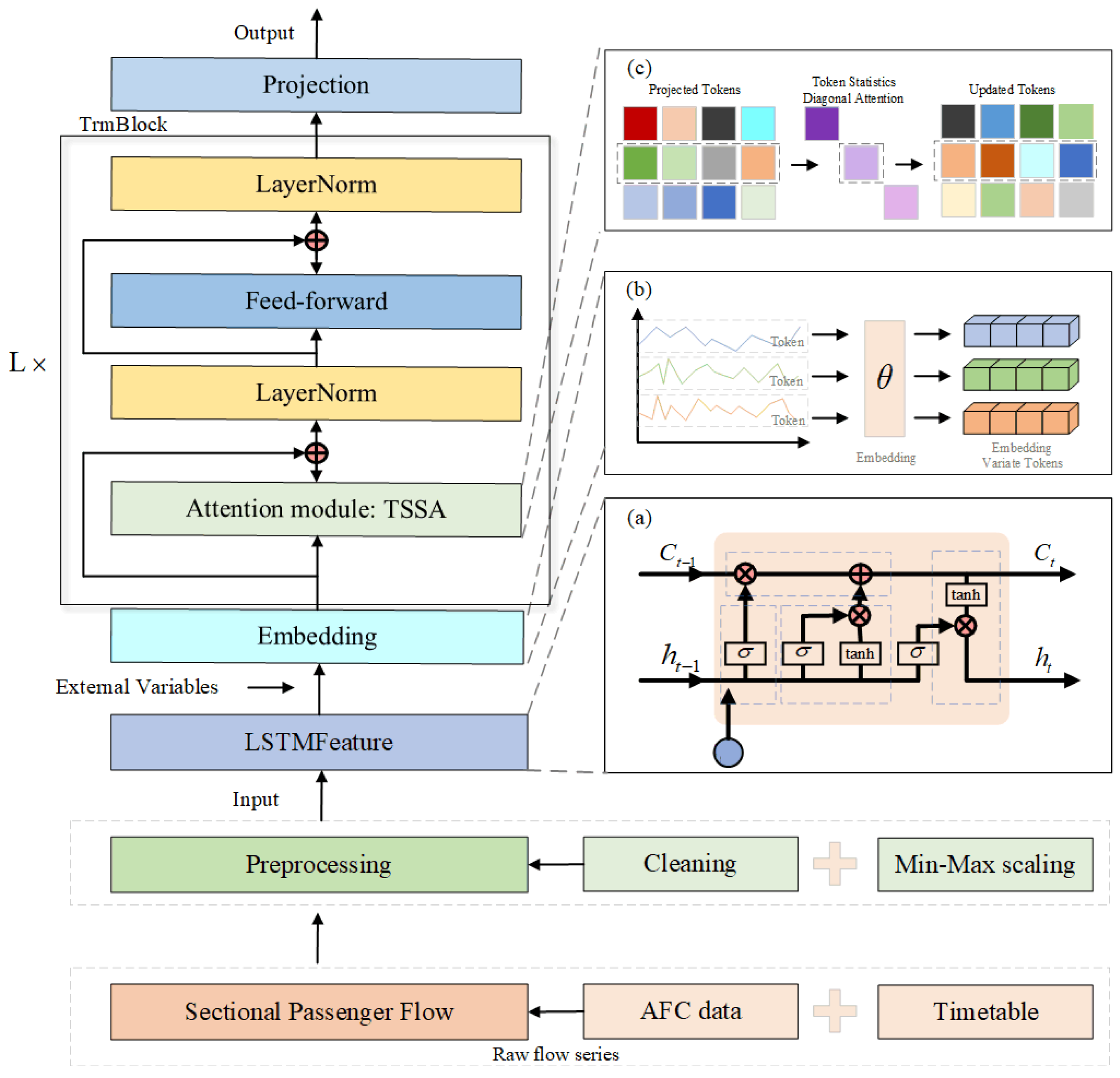
- An LTiT prediction model was designed. This model uses LSTM to capture the temporal characteristics of subway section passenger flow, and uses TSSA to identify high-information time periods. The iTransformer architecture was employed to effectively learn these temporal features. By combining these strengths, the model better handles complex temporal data and adapts to the impact of external variables on passenger flow.
- ➢
- We conducted comparative experiments between the LTiT model and traditional benchmark models on both high-flow section and low-flow section. The results show that the LTiT model significantly outperforms other models in evaluation metrics such as R2, MAE, MSE, and MAPE, particularly in tasks involving subway section passenger flow forecasting with complex time series and external variable influences, demonstrating higher accuracy and stability.
2. Methodology
2.1. Problem Definition and Framework
2.2. LSTM: For Temporal Representation
2.3. Inspired by TSSA: Attention Module
2.4. LTiT: LSTM-TSSA-iTransformer
3. Experiment
3.1. Data Preparing
- Subway platforms have sufficient capacity to accommodate passengers entering, waiting and exiting, and there is no queue overflow caused by congestion.
- The stop times of the subway are determined by the subway schedule and are not affected by the number of passengers boarding and alighting.
- Passengers on the same subway are distributed evenly throughout the carriages.
- When passengers get on, wait and get off subway, there will be no additional delays caused by conflicts and evasive maneuvers.
- Passengers will not engage in unnecessary travel by continuing their ride because of missing their destination stop.
| Algorithm 1. The Framework of Passenger Trajectory Inference |
 |
3.2. Baseline Models and Experimental Setup
3.3. Prediction
4. Discussion
- Comparison with Baseline Models: Compared to baseline methods such as SARIMA, BP neural networks, LightGBM, LSTM, and iTransformer, LTiT achieved best performance in metrics including R2, RMSE, MSE, MAE, and MAPE. This shows that the model can more accurately capture the true changes of subway section passenger flow, while reflecting lower errors and higher stability.
- Experimental Validation of Module Effectiveness: We compared LSTM-iTransformer and TSSA-iTransformer with the full model LTiT. Results show that if we incorporate LSTM to capture the temporal characteristics of subway section passenger flow and introduce TSSA for adaptive weighting the model will perform better. The combination of these two parts further improves prediction accuracy, showing that different modules complement each other in capturing temporal characteristics and modeling global relationships.
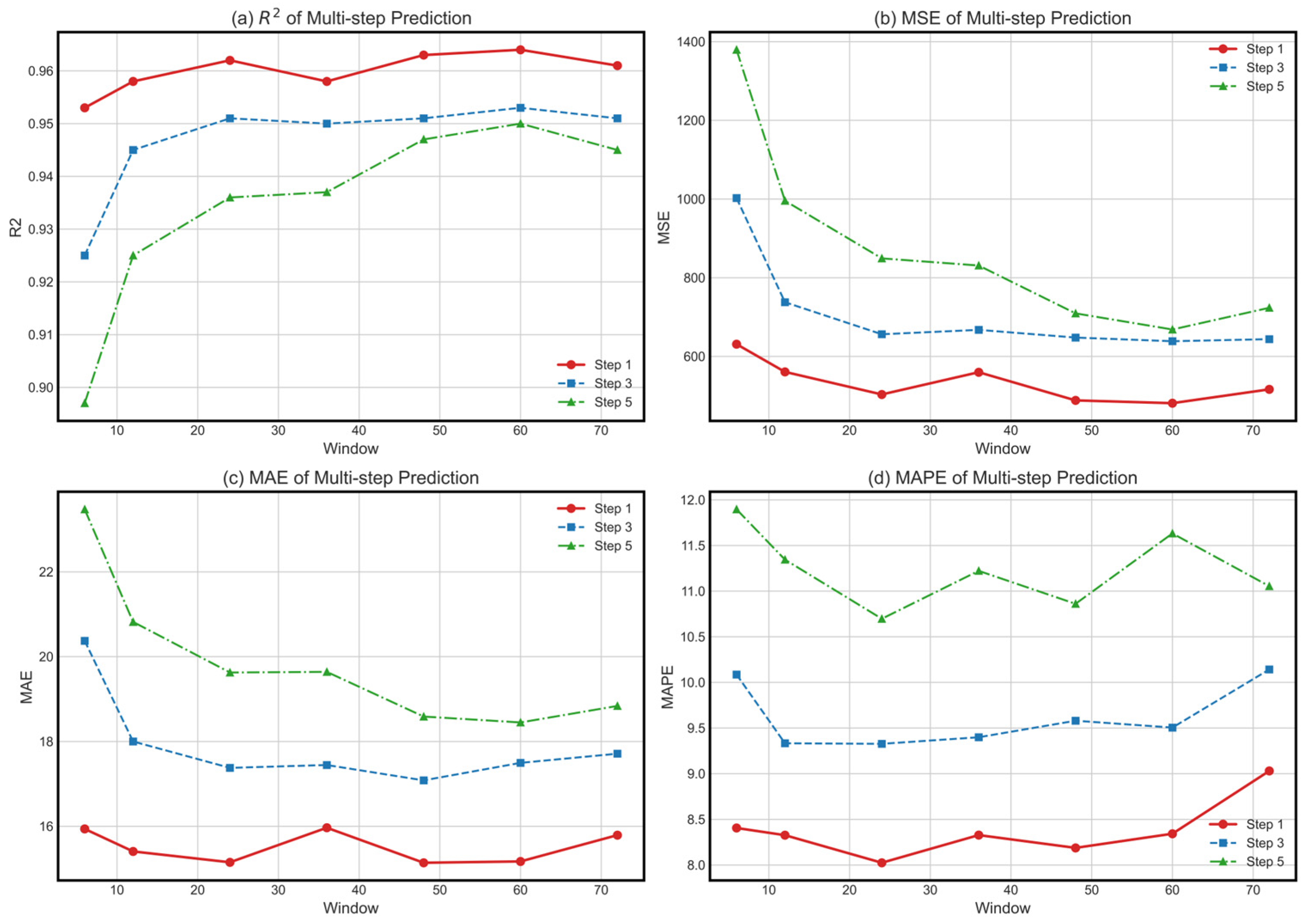
- Different Input Windows and Prediction Steps: In sensitivity experiments, we select past time points at 6, 12, 24, 36, 48, 60, and 72 as input windows to predict future time points at 1, 3, and 5 as prediction steps. The results show that as the input window lengthens, the model demonstrates a greater ability to capture temporal features. However, excessively long input windows may introduce increased noise and redundant information. As the prediction step size extends, the model experiences cumulative error, resulting in a decrease in model accuracy. The model still performs well in accomplishing the prediction tasks.
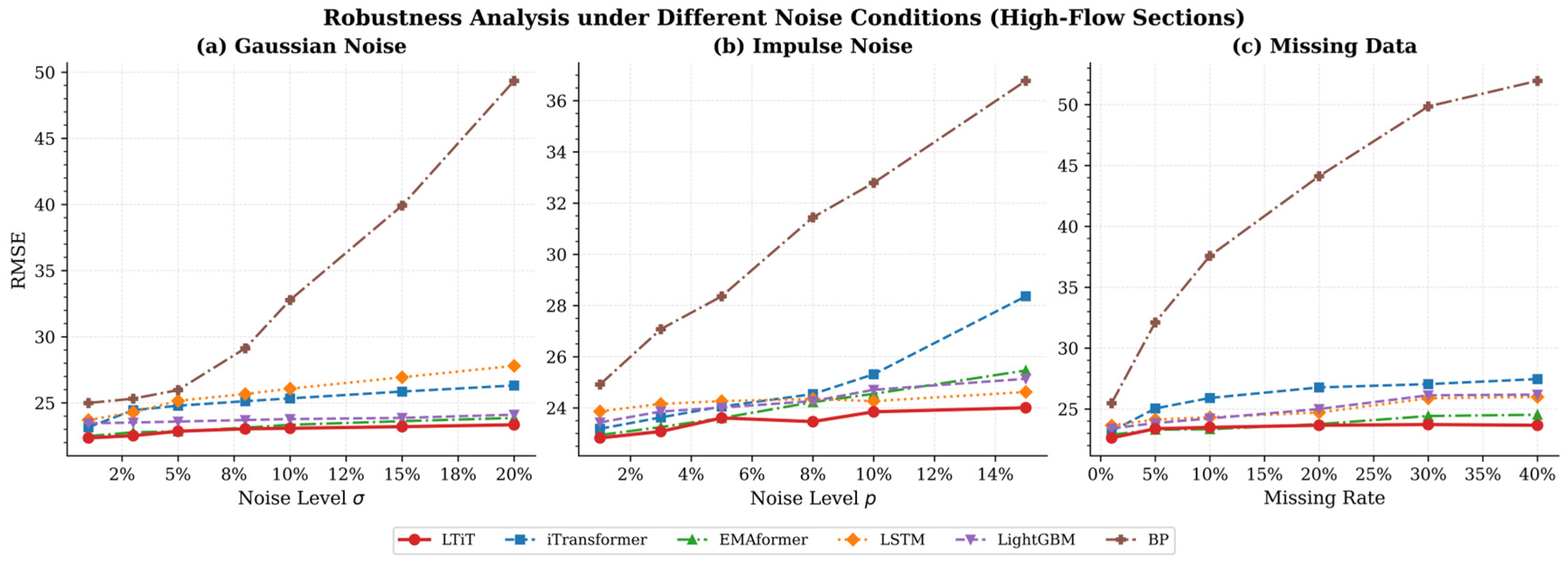
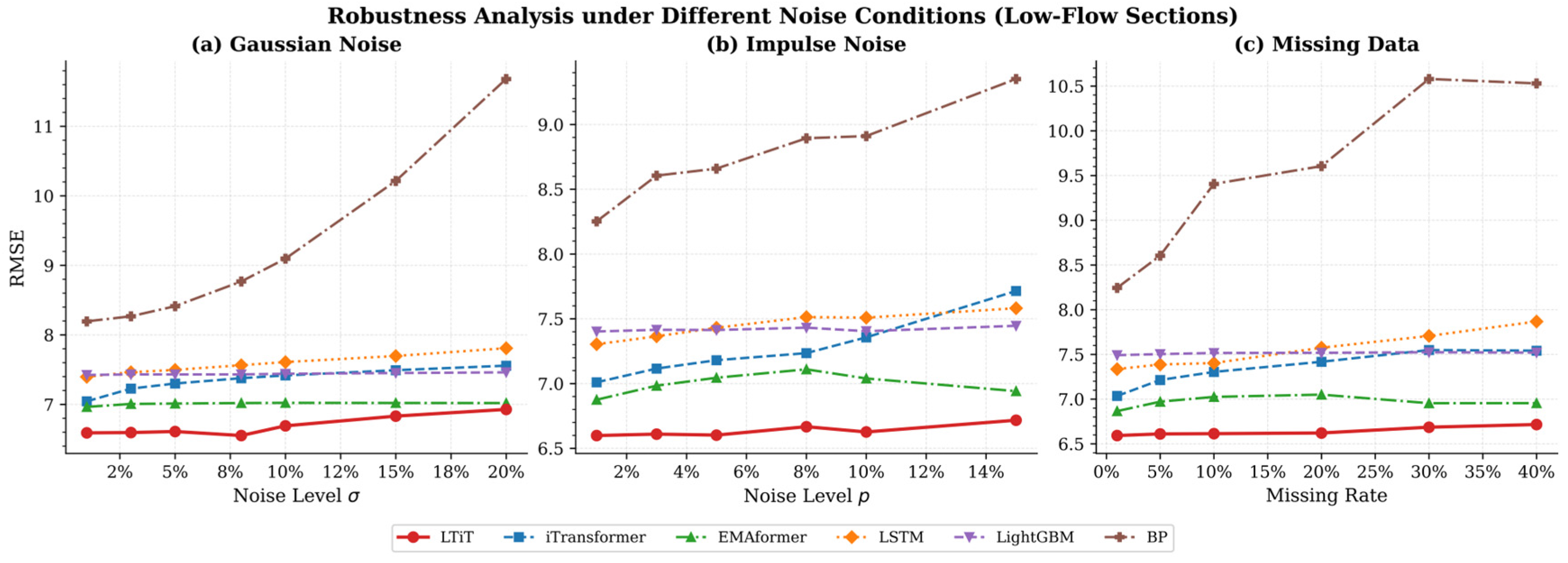
- Robustness Analysis under Different Noise Conditions: We perform robustness analysis with six models under Gaussian noise, impulse noise, and missing data. Results show that LTiT outperforms other models in both high-flow and low-flow sections, exhibiting strong robustness with a stable RMSE across noise levels. The BP network is highly sensitive to noise, with its RMSE worsening exponentially. iTransformer and LSTM showed some resistance, but errors still increased gradually. The introduction of the TSSA attention mechanism in iTransformer significantly improved its robustness, particularly against impulse noise. LTiT demonstrated the best generalization and interference resistance capabilities.
5. Conclusions
Author Contributions
Funding
Data Availability Statement
Conflicts of Interest
References
- Okutani, I.; Stephanedes, Y.J. Dynamic Prediction of Traffic Volume through Kalman Filtering Theory. Transp. Res. Part B Methodol. 1984, 18, 1–11. [Google Scholar] [CrossRef]
- Zhong, Z.; Zhaosheng, Y. A Real-Time Isoparametric Traffic Volume Prediction Model Based on the Kalman Filtering Theory. In Proceedings of the IEEE International Vehicle Electronics Conference (IVEC’99) (Cat. No.99EX257), Changchun, China, 9 September 1999; IEEE: New York, NY, USA, 1999; Volume 1, pp. 102–105. [Google Scholar]
- Williams, B.M. Multivariate Vehicular Traffic Flow Prediction: Evaluation of ARIMAX Modeling. Transp. Res. Rec. 2001, 1776, 194–200. [Google Scholar] [CrossRef]
- Chen, C.; Hu, J.; Meng, Q.; Zhang, Y. Short-Time Traffic Flow Prediction with ARIMA-GARCH Model. In Proceedings of the 2011 IEEE Intelligent Vehicles Symposium (IV), Baden-Baden, Germany, 5–9 June 2011; IEEE: New York, NY, USA, 2011; pp. 607–612. [Google Scholar]
- Kumar, S.V.; Vanajakshi, L. Short-Term Traffic Flow Prediction Using Seasonal ARIMA Model with Limited Input Data. Eur. Transp. Res. Rev. 2015, 7, 21. [Google Scholar] [CrossRef]
- Wang, C.; Ye, Z. Traffic Flow Forecasting Based on a Hybrid Model. J. Intell. Transp. Syst. 2016, 20, 428–437. [Google Scholar] [CrossRef]
- Williams, B.M.; Hoel, L.A. Modeling and Forecasting Vehicular Traffic Flow as a Seasonal ARIMA Process: Theoretical Basis and Empirical Results. J. Transp. Eng. 2003, 129, 664–672. [Google Scholar] [CrossRef]
- Zuo, T.; Tang, S.; Zhang, L.; Kang, H.; Song, H.; Li, P. An Enhanced TimesNet-SARIMA Model for Predicting Outbound Subway Passenger Flow with Decomposition Techniques. Appl. Sci. 2025, 15, 2874. [Google Scholar] [CrossRef]
- Tang, Y.; Shang, Q.; Yin, L.; Zhang, H. Traffic Flow Prediction Framework That Can Appropriately Process the Noise, Volatility, and Nonlinearity in Traffic Flow Data. Int. J. Intell. Syst. 2025, 2025, 1789796. [Google Scholar] [CrossRef]
- Ren, C.; Fu, F.; Yin, C.; Lu, L.; Cheng, L. A Combined Model for Short-Term Traffic Flow Prediction Based on Variational Modal Decomposition and Deep Learning. Sci. Rep. 2025, 15, 17142. [Google Scholar] [CrossRef]
- Li, X.; Huang, Z.; Liu, S.; Wu, J.; Zhang, Y. Short-Term Subway Passenger Flow Prediction Based on Time Series Adaptive Decomposition and Multi-Model Combination (IVMD-SE-MSSA). Sustainability 2023, 15, 7949. [Google Scholar] [CrossRef]
- Ding, C.; Wang, D.; Ma, X.; Li, H. Predicting Short-Term Subway Ridership and Prioritizing Its Influential Factors Using Gradient Boosting Decision Trees. Sustainability 2016, 8, 1100. [Google Scholar] [CrossRef]
- Yan, J.; Li, H.; Bai, Y.; Liu, J.; Lv, H.; Bai, Y. Timestamp-Guided Knowledge Distillation for Robust Sensor-Based Time-Series Forecasting. Sensors 2025, 25, 4590. [Google Scholar] [CrossRef]
- Ma, T.; Liu, J.; Xu, P.; Song, Y. Traffic Forecasting for Industrial Internet Gateway Based on Multi-Scale Dependency Integration. Sensors 2026, 26, 795. [Google Scholar] [CrossRef]
- Lv, Y.; Duan, Y.; Kang, W.; Li, Z.; Wang, F.-Y. Traffic Flow Prediction with Big Data: A Deep Learning Approach. IEEE Trans. Intell. Transp. Syst. 2015, 16, 865–873. [Google Scholar] [CrossRef]
- Fu, R.; Zhang, Z.; Li, L. Using LSTM and GRU Neural Network Methods for Traffic Flow Prediction. In Proceedings of the 2016 31st Youth Academic Annual Conference of Chinese Association of Automation (YAC), Wuhan, China, 11–13 November 2016; IEEE: New York, NY, USA, 2016; pp. 324–328. [Google Scholar]
- Braz, F.J.; Ferreira, J.; Gonçalves, F.; Weege, K.; Almeida, J.; Baldo, F.; Gonçalves, P. Road Traffic Forecast Based on Meteorological Information through Deep Learning Methods. Sensors 2022, 22, 4485. [Google Scholar] [CrossRef]
- Jin, X.-B.; Gong, W.-T.; Kong, J.-L.; Bai, Y.-T.; Su, T.-L. PFVAE: A Planar Flow-Based Variational Auto-Encoder Prediction Model for Time Series Data. Mathematics 2022, 10, 610. [Google Scholar] [CrossRef]
- Wei, W.; Wu, H.; Ma, H. An AutoEncoder and LSTM-Based Traffic Flow Prediction Method. Sensors 2019, 19, 2946. [Google Scholar] [CrossRef]
- Li, P.; Abdel-Aty, M.; Yuan, J. Real-Time Crash Risk Prediction on Arterials Based on LSTM-CNN. Accid. Anal. Prev. 2020, 135, 105371. [Google Scholar] [CrossRef]
- Mou, L.; Zhao, P.; Xie, H.; Chen, Y. T-LSTM: A Long Short-Term Memory Neural Network Enhanced by Temporal Information for Traffic Flow Prediction. IEEE Access 2019, 7, 98053–98060. [Google Scholar] [CrossRef]
- Xiao, Y.; Yin, Y. Hybrid LSTM Neural Network for Short-Term Traffic Flow Prediction. Information 2019, 10, 105. [Google Scholar] [CrossRef]
- Liu, Z.; Li, X.; Lu, Z.; Meng, X. IWOA-RNN: An Improved Whale Optimization Algorithm with Recurrent Neural Networks for Traffic Flow Prediction. Alex. Eng. J. 2025, 117, 563–576. [Google Scholar] [CrossRef]
- Hou, Z.; Han, J.; Yang, G. Analysis of Passenger Flow Characteristics and Origin–Destination Passenger Flow Prediction in Urban Rail Transit Based on Deep Learning. Appl. Sci. 2025, 15, 2853. [Google Scholar] [CrossRef]
- Zhang, D.; Zhu, Y. Dynamic Temporal Network-Based Spatio-Temporal Evolution and Passenger Flow Prediction: A Case Study of Beijing Subway. Appl. Sci. 2026, 16, 1292. [Google Scholar] [CrossRef]
- Zeroual, A.; Messai, N.; Kechida, S.; Hamdi, F. Calibration and Validation of a Switched Linear Macroscopic Traffic Model. In Proceedings of the 2015 3rd International Conference on Control, Engineering & Information Technology (CEIT), Tlemcen, Algeria, 25–27 May 2015; IEEE: New York, NY, USA, 2015; pp. 1–5. [Google Scholar]
- Yang, H.; Yu, W.; Zhang, G.; Du, L. Network-Wide Traffic Flow Dynamics Prediction Leveraging Macroscopic Traffic Flow Model and Deep Neural Networks. IEEE Trans. Intell. Transp. Syst. 2024, 25, 4443–4457. [Google Scholar] [CrossRef]
- Chang, J.; Yin, J.; Hao, Y.; Gao, C. STFDSGCN: Spatio-Temporal Fusion Graph Neural Network Based on Dynamic Sparse Graph Convolution GRU for Traffic Flow Forecast. Sensors 2025, 25, 3446. [Google Scholar] [CrossRef]
- Yang, H.; Wei, S.; Wang, Y. PT-TDGCN: Pre-Trained Trend-Aware Dynamic Graph Convolutional Network for Traffic Flow Prediction. Sensors 2025, 25, 6709. [Google Scholar] [CrossRef]
- Li, X.; He, M.; Qin, D.; Zhou, T.; Jiang, N. Spatio-Temporal Heterogeneity-Oriented Graph Convolutional Network for Urban Traffic Flow Prediction. Sensors 2025, 25, 5127. [Google Scholar] [CrossRef]
- Yan, Z.; Yang, H.; Li, F.; Lin, Y. A Deep Learning Approach for Short-Term Airport Traffic Flow Prediction. Aerospace 2021, 9, 11. [Google Scholar] [CrossRef]
- Zeng, Y.; Hu, M.; Chen, H.; Yuan, L.; Alam, S.; Xue, D. Improved Air Traffic Flow Prediction in Terminal Areas Using a Multimodal Spatial–Temporal Network for Weather-Aware (MST-WA) Model. Adv. Eng. Inform. 2024, 62, 102935. [Google Scholar] [CrossRef]
- Vaswani, A.; Shazeer, N.; Parmar, N.; Uszkoreit, J.; Jones, L.; Gomez, A.N.; Kaiser, Ł.; Polosukhin, I. Attention Is All You Need. In Proceedings of the Advances in Neural Information Processing Systems, Long Beach, CA, USA, 4–9 December 2017; Curran Associates, Inc.: Red Hook, NY, USA, 2017; Volume 30. [Google Scholar]
- Radford, A.; Narasimhan, K.; Salimans, T.; Sutskever, I. Improving Language Understanding by Generative Pre-Training. OpenAI 2018, preprint. [Google Scholar]
- Brown, T.; Mann, B.; Ryder, N.; Subbiah, M.; Kaplan, J.D.; Dhariwal, P.; Neelakantan, A.; Shyam, P.; Sastry, G.; Askell, A.; et al. Language Models Are Few-Shot Learners. Adv. Neural Inf. Process. Syst. 2020, 33, 1877–1901. [Google Scholar]
- Chen, M.; Radford, A.; Child, R.; Wu, J.; Jun, H.; Luan, D.; Sutskever, I. Generative Pretraining from Pixels. In Proceedings of the 37th International Conference on Machine Learning, PMLR, Virtual, 21 November 2020; pp. 1691–1703. [Google Scholar]
- Huang, J.; Yan, H.; Chen, Q.; Liu, Y. Multi-Granularity Temporal Embedding Transformer Network for Traffic Flow Forecasting. Sensors 2024, 24, 8106. [Google Scholar] [CrossRef]
- Li, M.; Yang, M.; Chen, S.; Li, H.; Xing, G.; Li, S. FCP-Former: Enhancing Long-Term Multivariate Time Series Forecasting with Frequency Compensation. Sensors 2025, 25, 5646. [Google Scholar] [CrossRef]
- Zhang, Y.; Yan, J. Crossformer: Transformer Utilizing Cross-Dimension Dependency for Multivariate Time Series Forecasting. In Proceedings of the 11th International Conference on Learning Representations (ICLR), Kigali, Rwanda, 29 September 2022. [Google Scholar]
- Liu, Y.; Hu, T.; Zhang, H.; Wu, H.; Wang, S.; Ma, L.; Long, M. iTransformer: Inverted Transformers Are Effective for Time Series Forecasting. arXiv 2024, arXiv:2310.06625. [Google Scholar] [CrossRef]
- Tang, Y.; Cai, Z. iTransformer-FFC: A Frequency-Aware Transformer Framework for Multi-Scale Time Series Forecasting. Electronics 2025, 14, 2378. [Google Scholar] [CrossRef]
- Sun, Y.; Leng, B.; Guan, W. A Novel Wavelet-SVM Short-Time Passenger Flow Prediction in Beijing Subway System. Neurocomputing 2015, 166, 109–121. [Google Scholar] [CrossRef]
- Yang, X.; Xue, Q.; Ding, M.; Wu, J.; Gao, Z. Short-Term Prediction of Passenger Volume for Urban Rail Systems: A Deep Learning Approach Based on Smart-Card Data. Int. J. Prod. Econ. 2021, 231, 107920. [Google Scholar] [CrossRef]
- Liu, J.; Jiang, R.; Zhu, D.; Zhao, J. Short-Term Subway Inbound Passenger Flow Prediction Based on AFC Data and PSO-LSTM Optimized Model. Urban Rail Transit 2022, 8, 56–66. [Google Scholar] [CrossRef]
- Dai, X.; Sun, L.; Xu, Y. Short-Term Origin-Destination Based Metro Flow Prediction with Probabilistic Model Selection Approach. J. Adv. Transp. 2018, 2018, 5942763. [Google Scholar] [CrossRef]
- Zhang, W.; Wang, G.; Liu, X.; Zhu, T. AttnOD: An Attention-Based OD Prediction Model with Adaptive Graph Convolution. In Proceedings of the Neural Information Processing; Luo, B., Cheng, L., Wu, Z.-G., Li, H., Li, C., Eds.; Springer Nature: Singapore, 2024; pp. 459–470. [Google Scholar]
- Ye, J.; Zhao, J.; Zheng, F.; Xu, C. A Heterogeneous Graph Convolution Based Method for Short-Term OD Flow Completion and Prediction in a Metro System. IEEE Trans. Intell. Transp. Syst. 2024, 25, 15614–15627. [Google Scholar] [CrossRef]
- Miao, H.; Fei, Y.; Wang, S.; Wang, F.; Wen, D. Deep Learning Based Origin-Destination Prediction via Contextual Information Fusion. Multimed. Tools Appl. 2022, 81, 12029–12045. [Google Scholar] [CrossRef]
- Sattarzadeh, A.R.; Kutadinata, R.J.; Pathirana, P.N.; Huynh, V.T. A Novel Hybrid Deep Learning Model with ARIMA Conv-LSTM Networks and Shuffle Attention Layer for Short-Term Traffic Flow Prediction. Transp. A Transp. Sci. 2025, 21, 2236724. [Google Scholar] [CrossRef]
- Katambire, V.N.; Musabe, R.; Uwitonze, A.; Mukanyiligira, D. Forecasting the Traffic Flow by Using ARIMA and LSTM Models: Case of Muhima Junction. Forecasting 2023, 5, 616–628. [Google Scholar] [CrossRef]
- Milenković, M.; Švadlenka, L.; Melichar, V.; Bojović, N.; Avramović, Z. SARIMA Modelling Approach for Railway Passenger Flow Forecasting. Transport 2016, 33, 1113–1120. [Google Scholar] [CrossRef]
- Luo, X.; Niu, L.; Zhang, S. An Algorithm for Traffic Flow Prediction Based on Improved SARIMA and GA. KSCE J. Civ. Eng. 2018, 22, 4107–4115. [Google Scholar] [CrossRef]
- Wu, Z.; Ding, T.; Lu, Y.; Pai, D.; Zhang, J.; Wang, W.; Yu, Y.; Ma, Y.; Haeffele, B.D. Token Statistics Transformer: Linear-Time Attention via Variational Rate Reduction. arXiv 2024, arXiv:2412.17810. [Google Scholar] [CrossRef]
- Rumelhart, D.E.; Hinton, G.E.; Williams, R.J. Learning Representations by Back-Propagating Errors. Nature 1986, 323, 533–536. [Google Scholar] [CrossRef]
- Ke, G.; Meng, Q.; Finley, T.; Wang, T.; Chen, W.; Ma, W.; Ye, Q.; Liu, T.-Y. LightGBM: A Highly Efficient Gradient Boosting Decision Tree. In Proceedings of the Advances in Neural Information Processing Systems, Long Beach, CA, USA, 4–9 December 2017; Curran Associates, Inc.: Red Hook, NY, USA, 2017; Volume 30. [Google Scholar]
- Hochreiter, S.; Schmidhuber, J. Long Short-Term Memory. Neural Comput. 1997, 9, 1735–1780. [Google Scholar] [CrossRef]
- Zhang, Z.; Du, X.; Guo, X.; Wang, W.; Han, W. EMAformer: Enhancing Transformer through Embedding Armor for Time Series Forecasting. Proc. AAAI Conf. Artif. Intell. 2026, 40, 28636–28644. [Google Scholar] [CrossRef]



| Model | R2 | MSE | RMSE | MAE | MAPE |
|---|---|---|---|---|---|
| SARIMA | 0.893 | 1247.86 | 35.325 | 19.256 | 14.253 |
| BP Neural Network | 0.932 | 620.830 | 24.916 | 18.084 | 11.138 |
| LightGBM | 0.952 | 535.700 | 23.145 | 15.875 | 8.532 |
| LSTM | 0.948 | 557.990 | 23.622 | 16.835 | 11.436 |
| iTransformer | 0.955 | 532.847 | 23.084 | 15.626 | 8.335 |
| EMAformer | 0.962 | 507.416 | 22.526 | 15.025 | 7.968 * |
| LSTM-iTransformer | 0.959 | 527.261 | 22.963 | 15.264 | 8.246 |
| TSSA-iTransformer | 0.960 | 526.343 | 22.943 | 15.425 | 8.433 |
| LTiT | 0.964 * | 498.002 * | 22.316 * | 14.957 * | 8.028 |
| LTiT (without temperature) | 0.947 | 557.564 | 23.613 | 17.796 | 9.350 |
| LTiT (without precipitation) | 0.950 | 546.068 | 23.368 | 17.266 | 9.236 |
| LTiT (without external variables) | 0.935 | 601.048 | 24.516 | 18.603 | 9.789 |
| Model | R2 | MSE | RMSE | MAE | MAPE |
|---|---|---|---|---|---|
| SARIMA | 0.621 | 149.705 | 12.235 | 8.231 | 41.254 |
| BP Neural Network | 0.812 | 63.125 | 7.945 | 4.937 | 27.767 |
| LightGBM | 0.844 | 55.534 | 7.452 | 4.770 | 23.408 |
| LSTM | 0.854 | 53.599 | 7.321 | 4.744 | 25.739 |
| iTransformer | 0.895 | 48.109 | 6.936 | 4.433 | 17.923 |
| EMAformer | 0.896 | 47.848 | 6.917 | 4.083 | 17.595 |
| LSTM-iTransformer | 0.912 | 43.624 | 6.567 | 4.189 | 17.783 |
| TSSA-iTransformer | 0.904 | 43.703 | 6.611 | 4.213 | 16.556 |
| LTiT | 0.918 * | 43.474 * | 6.594 * | 4.027 * | 15.803 * |
| LTiT (without temperature) | 0.894 | 48.387 | 6.956 | 4.468 | 18.459 |
| LTiT (without precipitation) | 0.889 | 49.661 | 7.047 | 4.547 | 19.805 |
| LTiT (without external variables) | 0.877 | 52.407 | 7.239 | 4.677 | 20.561 |
| Step | Window | R2 | RMSE | MSE | MAE | MAPE |
|---|---|---|---|---|---|---|
| 1 | 6 | 0.953 | 25.121 | 631.079 | 15.937 | 8.405 |
| 12 | 0.958 | 23.677 | 560.593 | 15.406 | 8.326 | |
| 24 | 0.962 | 22.433 | 503.222 | 15.150 | 8.024 * | |
| 36 | 0.958 | 23.659 | 559.736 | 15.965 | 8.327 | |
| 48 | 0.963 | 22.094 | 488.151 | 15.139 * | 8.187 | |
| 60 | 0.964 * | 21.933 * | 481.072 * | 15.170 | 8.342 | |
| 72 | 0.961 | 22.720 | 516.221 | 15.790 | 9.030 | |
| 3 | 6 | 0.925 | 31.662 | 1002.464 | 20.374 | 10.086 |
| 12 | 0.945 | 27.160 | 737.686 | 17.999 | 9.333 | |
| 24 | 0.951 | 25.617 | 656.250 | 17.377 | 9.327 * | |
| 36 | 0.950 | 25.834 | 667.405 | 17.444 | 9.399 | |
| 48 | 0.951 | 25.452 | 647.813 | 17.082 * | 9.580 | |
| 60 | 0.953 * | 25.269 * | 638.542 * | 17.495 | 9.505 | |
| 72 | 0.951 | 25.374 | 643.822 | 17.711 | 10.142 | |
| 5 | 6 | 0.897 | 37.140 | 1379.377 | 23.474 | 11.896 |
| 12 | 0.925 | 31.552 | 995.555 | 20.819 | 11.345 | |
| 24 | 0.936 | 29.140 | 849.132 | 19.626 | 10.697 * | |
| 36 | 0.937 | 28.826 | 830.959 | 19.641 | 11.222 | |
| 48 | 0.947 | 26.633 | 709.333 | 18.587 | 10.861 | |
| 60 | 0.950 * | 25.852 * | 668.319 * | 18.448 * | 11.632 | |
| 72 | 0.945 | 26.899 | 723.529 | 18.837 | 11.054 |
Disclaimer/Publisher’s Note: The statements, opinions and data contained in all publications are solely those of the individual author(s) and contributor(s) and not of MDPI and/or the editor(s). MDPI and/or the editor(s) disclaim responsibility for any injury to people or property resulting from any ideas, methods, instructions or products referred to in the content. |
© 2026 by the authors. Licensee MDPI, Basel, Switzerland. This article is an open access article distributed under the terms and conditions of the Creative Commons Attribution (CC BY) license.
Share and Cite
Liu, J.; Chen, Y.; Li, Y.; Yu, F. LTiT: A Deep Learning Model for Subway Section Passenger Flow Prediction Based on LSTM-TSSA-iTransformer. Sensors 2026, 26, 2584. https://doi.org/10.3390/s26092584
Liu J, Chen Y, Li Y, Yu F. LTiT: A Deep Learning Model for Subway Section Passenger Flow Prediction Based on LSTM-TSSA-iTransformer. Sensors. 2026; 26(9):2584. https://doi.org/10.3390/s26092584
Chicago/Turabian StyleLiu, Jie, Yanzhan Chen, Yange Li, and Fan Yu. 2026. "LTiT: A Deep Learning Model for Subway Section Passenger Flow Prediction Based on LSTM-TSSA-iTransformer" Sensors 26, no. 9: 2584. https://doi.org/10.3390/s26092584
APA StyleLiu, J., Chen, Y., Li, Y., & Yu, F. (2026). LTiT: A Deep Learning Model for Subway Section Passenger Flow Prediction Based on LSTM-TSSA-iTransformer. Sensors, 26(9), 2584. https://doi.org/10.3390/s26092584