Contactless Cardiac Health Monitoring with Millimeter-Wave Radar Based on PMG-SATNet

Abstract
1. Introduction
- (1)
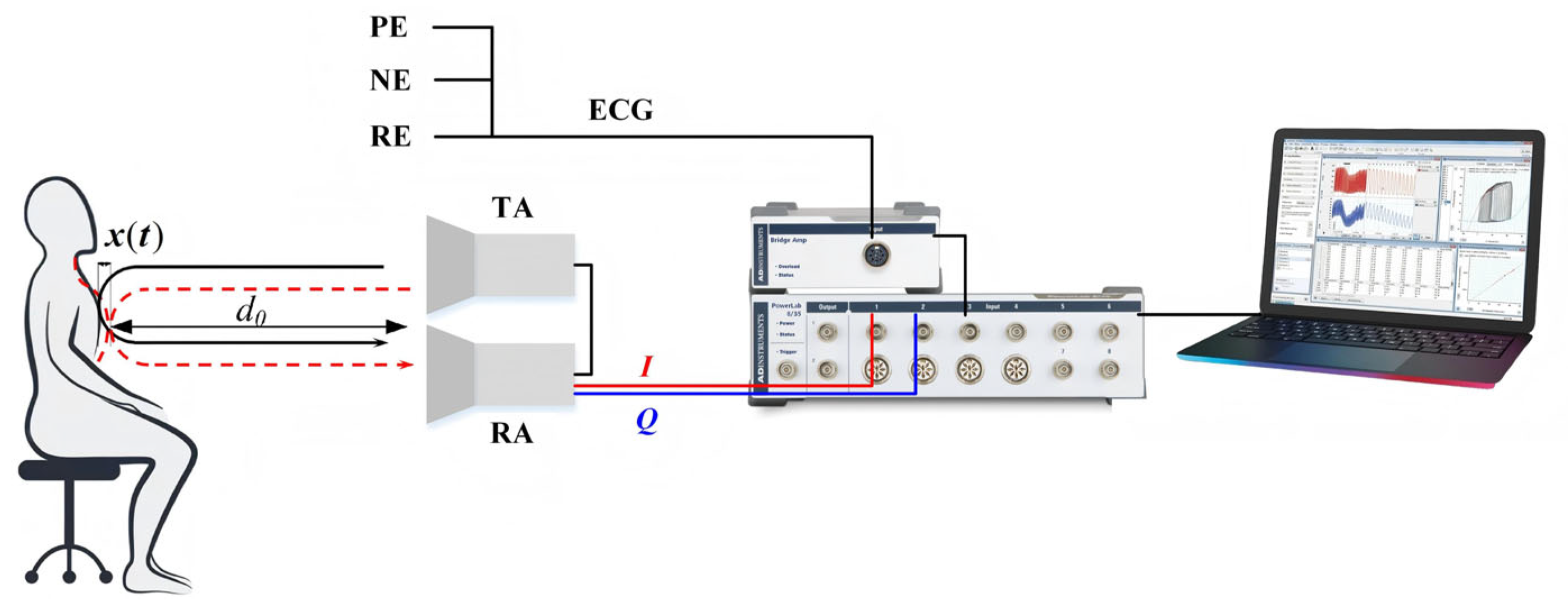
- Unlike the data acquisition scheme for cardiac mechanical and electrical signals in existing research, seven experimental scenarios that represent the primary static lifestyles of individuals in in-home environments, such as sitting (awake) and lying (asleep), were designed. In those scenarios, radar antennas were placed at different orientations relative to the human body to capture cardiac mechanical motion. The relatively rich dataset provides real data support for research on cardiac health monitoring methods in in-home environments.
- (2)
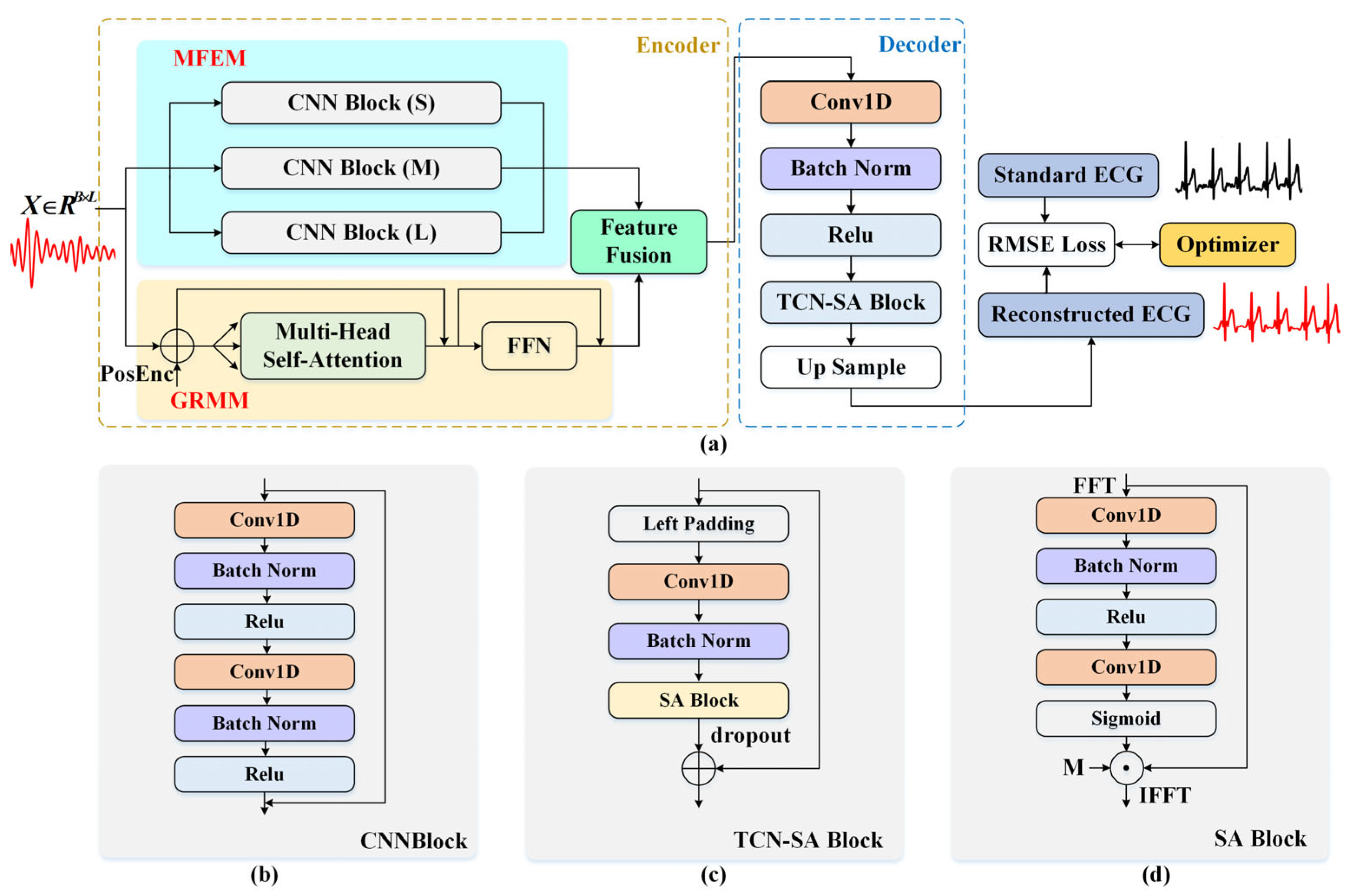
- Based on the collected data under various postures and physiological states, a novel deep learning architecture named PMG-SATNet for radar-to-ECG mapping was designed in this study. Unlike existing feature extraction models that rely solely on either convolution or attention mechanisms, PMG-SATNet innovatively integrates multi-scale feature extraction and a spectral attention mechanism, and balances local feature modeling with the capture of long-term temporal dependencies. It significantly enhances the modeling capability of ECC across multiple states.
- (3)
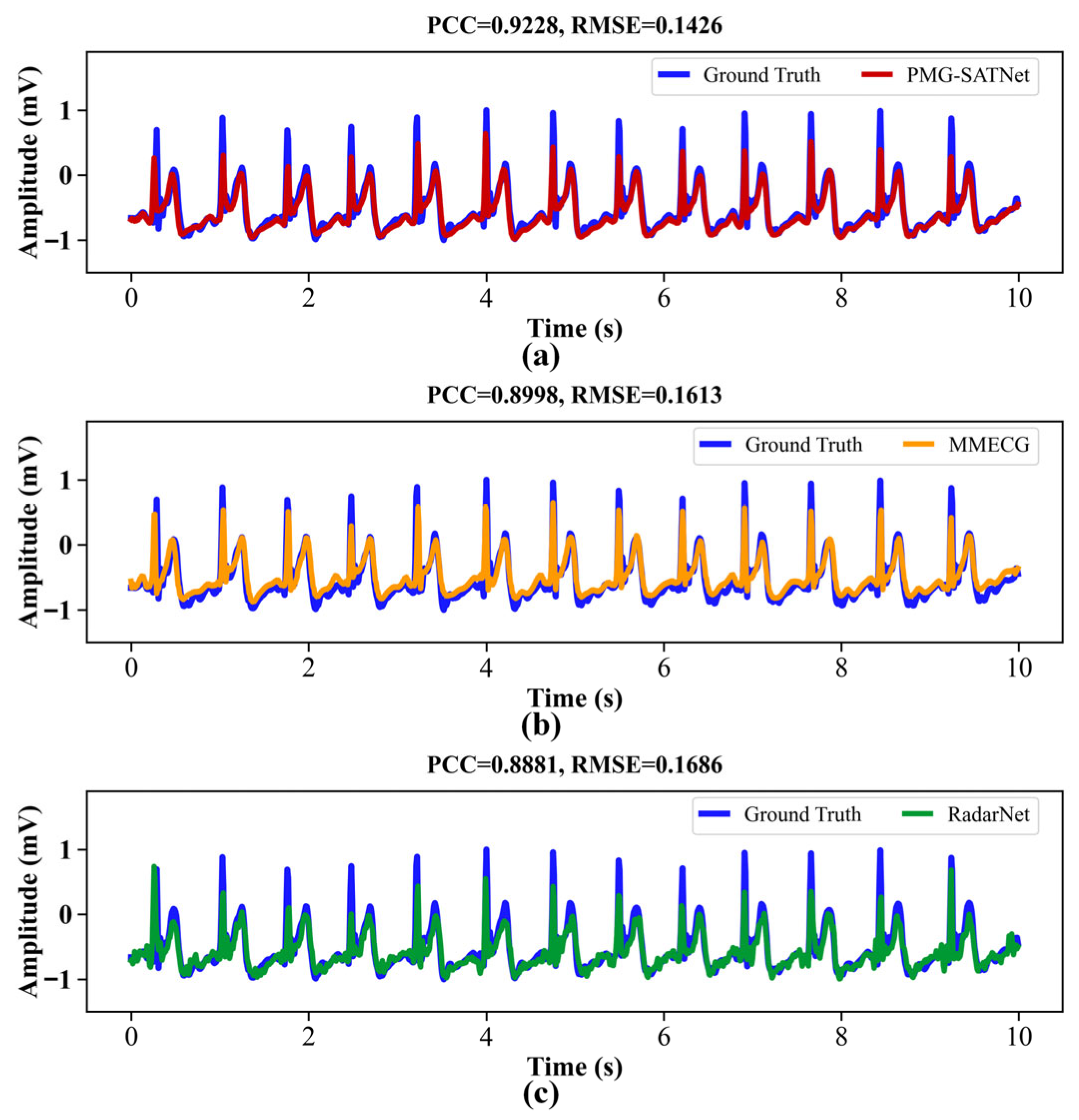
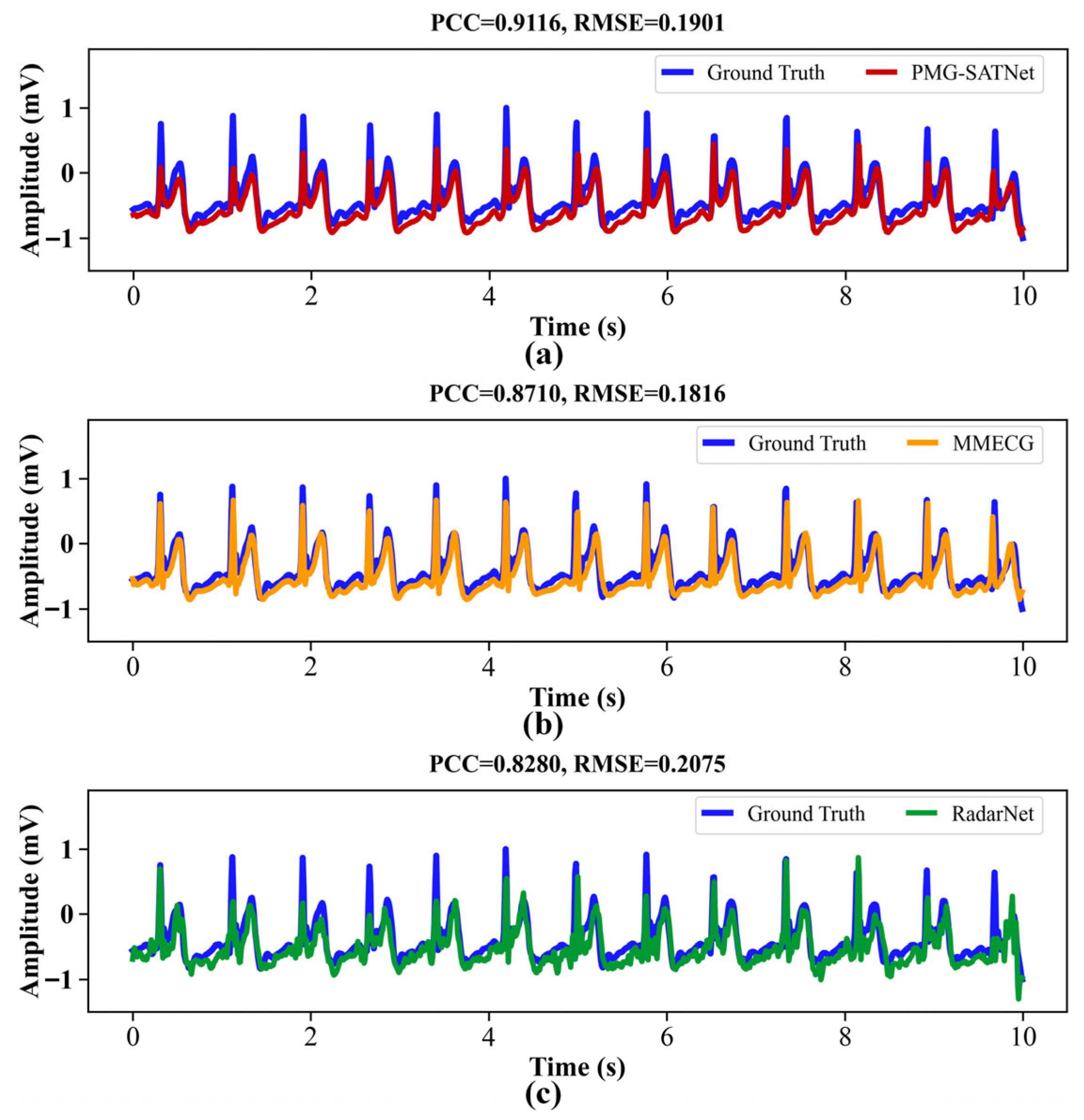
- Comprehensive performance evaluation and ablation studies were implemented. On the one hand, the results demonstrate that the proposed PMG-SATNet achieves superior capabilities in morphology, wave timing localization error, and intuitive reconstruction results under various postures and physiological states. On the other hand, the ablation studies further verify the effectiveness of each core module in the proposed model.
2. Materials and Methods
2.1. Hardware Experimental Platform
2.2. Experimental Setup
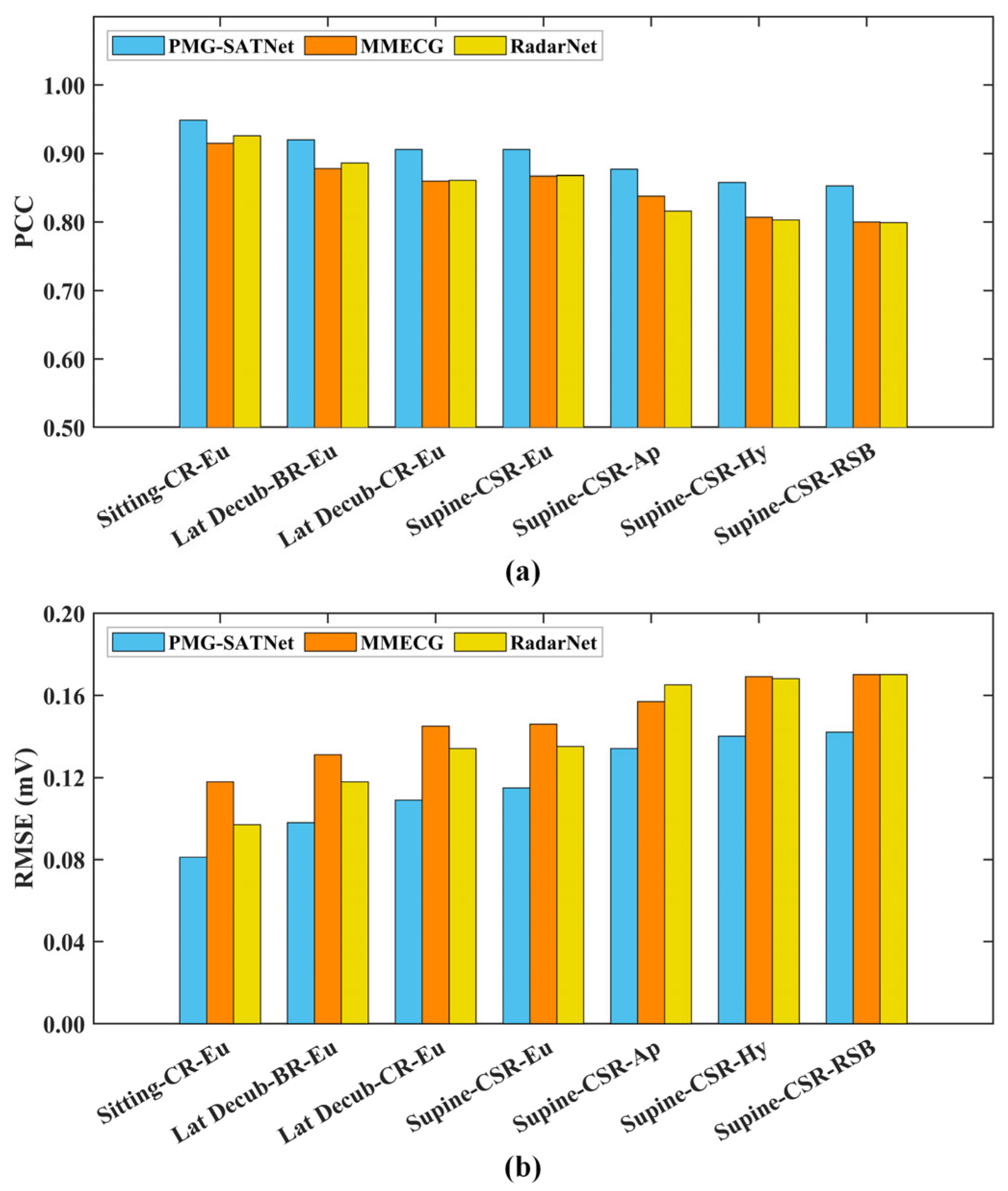
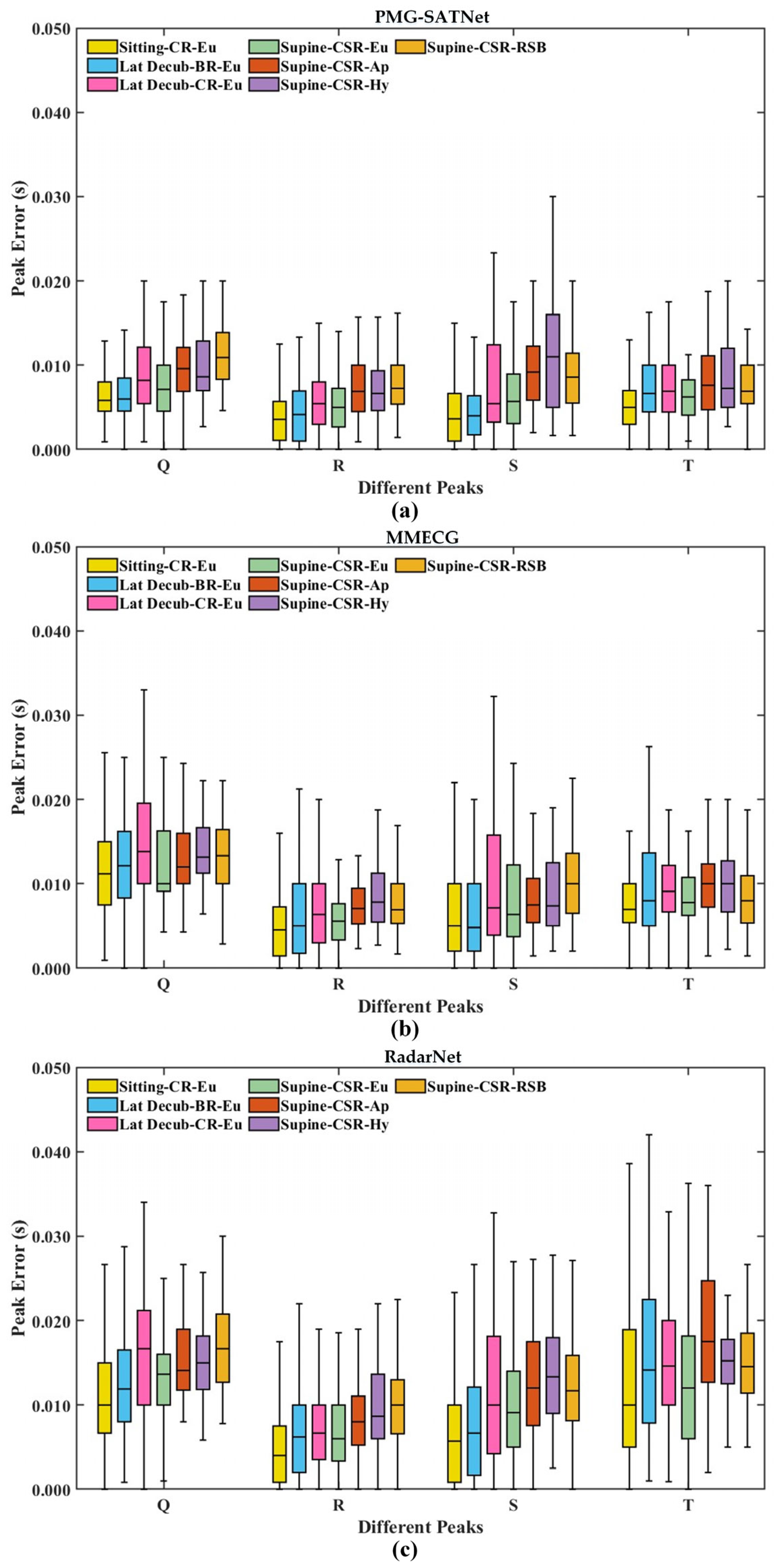
- Sitting-CR-Eu: Upright sitting posture (Sitting), the chest facing the radar antenna (CR), under eupneic breathing (Eu).
- Lat Decub-BR-Eu: Lateral decubitus position (Lat Decub), the back facing the radar antenna (BR), under eupneic breathing (Eu).
- Lat Decub-CR-Eu: Lateral decubitus position (Lat Decub), the chest facing the radar antenna (CR), under eupneic breathing (Eu).
- Supine-CSR-Eu: Supine position (Supine), the lateral side of the chest facing the radar antenna to ensure detection of chest micro-motion induced by cardiac mechanical activity (CSR), under eupneic breathing (Eu).
- Supine-CSR-Ap: Supine position (Supine), the lateral side of the chest facing the radar antenna to ensure detection of chest micro-motion induced by cardiac mechanical activity (CSR), under intermittent apnea (Ap).
- Supine-CSR-Hy: Supine position (Supine), the lateral side of the chest facing the radar antenna to ensure detection of chest micro-motion induced by cardiac mechanical activity (CSR), under hypoxic breathing (Hy).
- Supine-CSR-RSB: Supine position (Supine), the lateral side of the chest facing the radar antenna to ensure detection of chest micro-motion induced by cardiac mechanical activity (CSR), under rapid shallow breathing (RSB).
2.3. Methods and Models
2.3.1. Signal Model of Radar
2.3.2. Signal Preprocessing
- Radar Signal Preprocessing
- 2.
- ECG Signal Preprocessing
- Baseline Drift Removal
- Electrode Noise Suppression
2.3.3. ECG Reconstruction Model
- Multi-scale Feature Extraction Module
- 2.
- Global Relation Modeling Module
- 3.
- Feature Fusion Unit
- 4.
- TCN-SA
- TCN
- SA
- 5.
- Loss Function
- 6.
- Morphological Metrics
3. Results
3.1. Dataset and Details
3.2. Results Analysis
3.2.1. Comparison Analysis
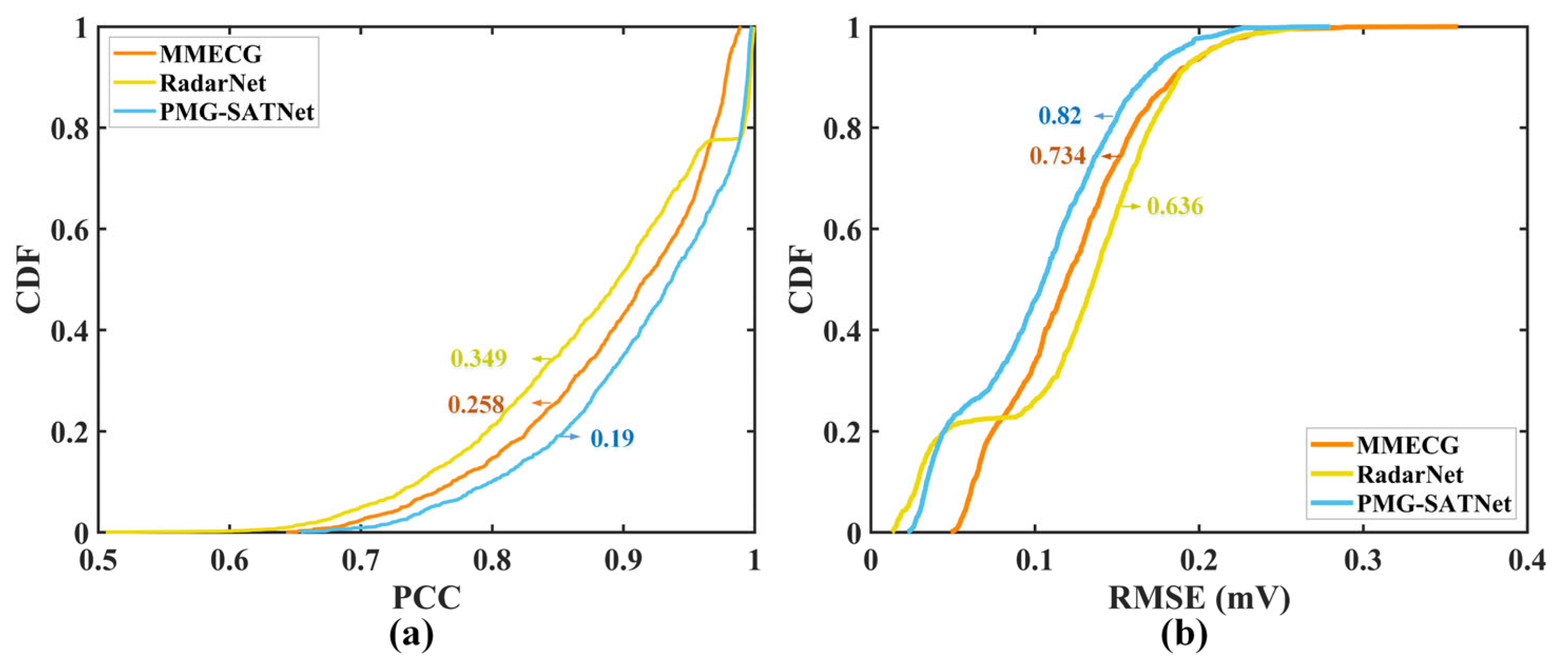
- Morphological Evaluation
- 2.
- Temporal Wave Localization Error
- 3.
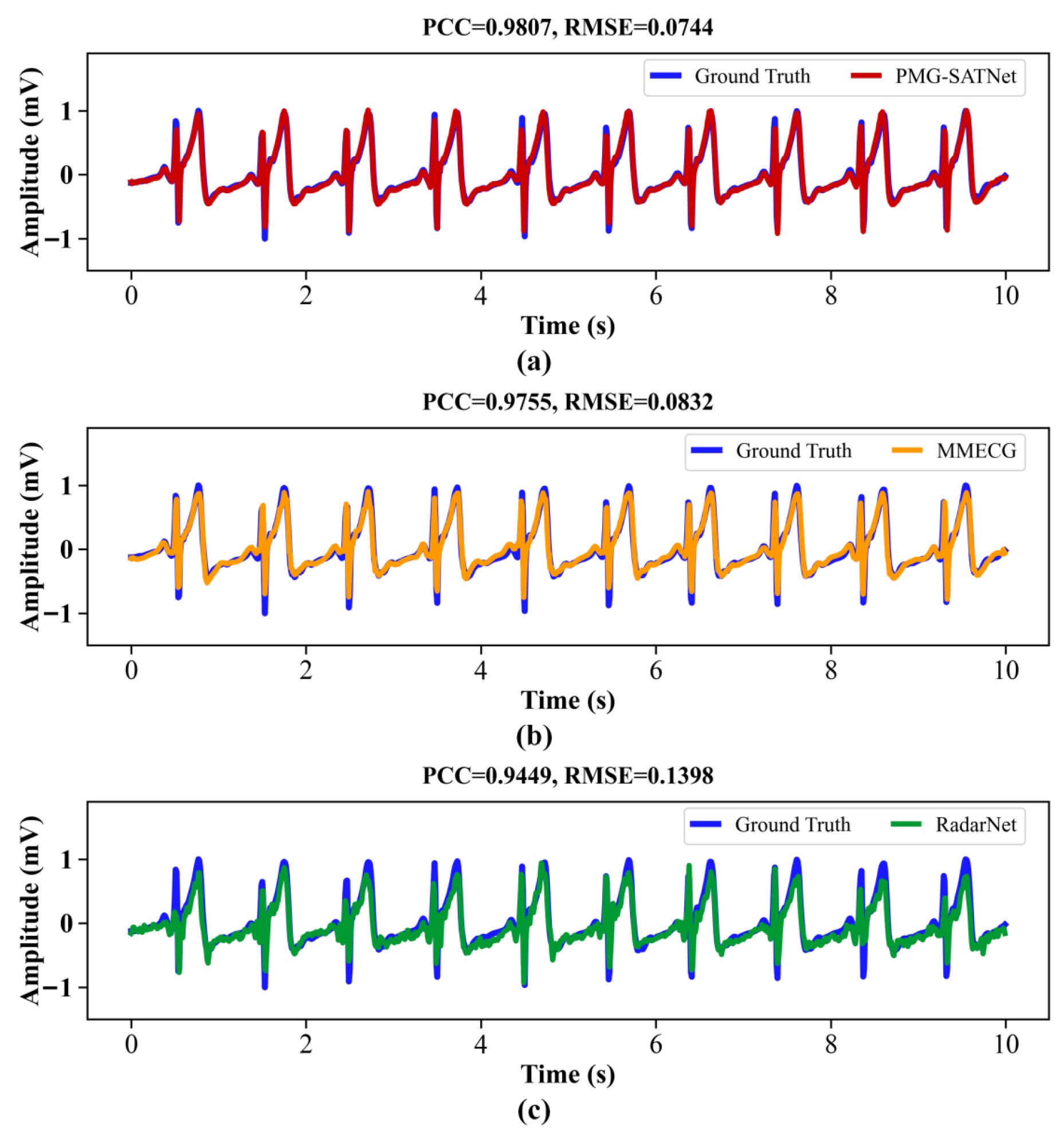
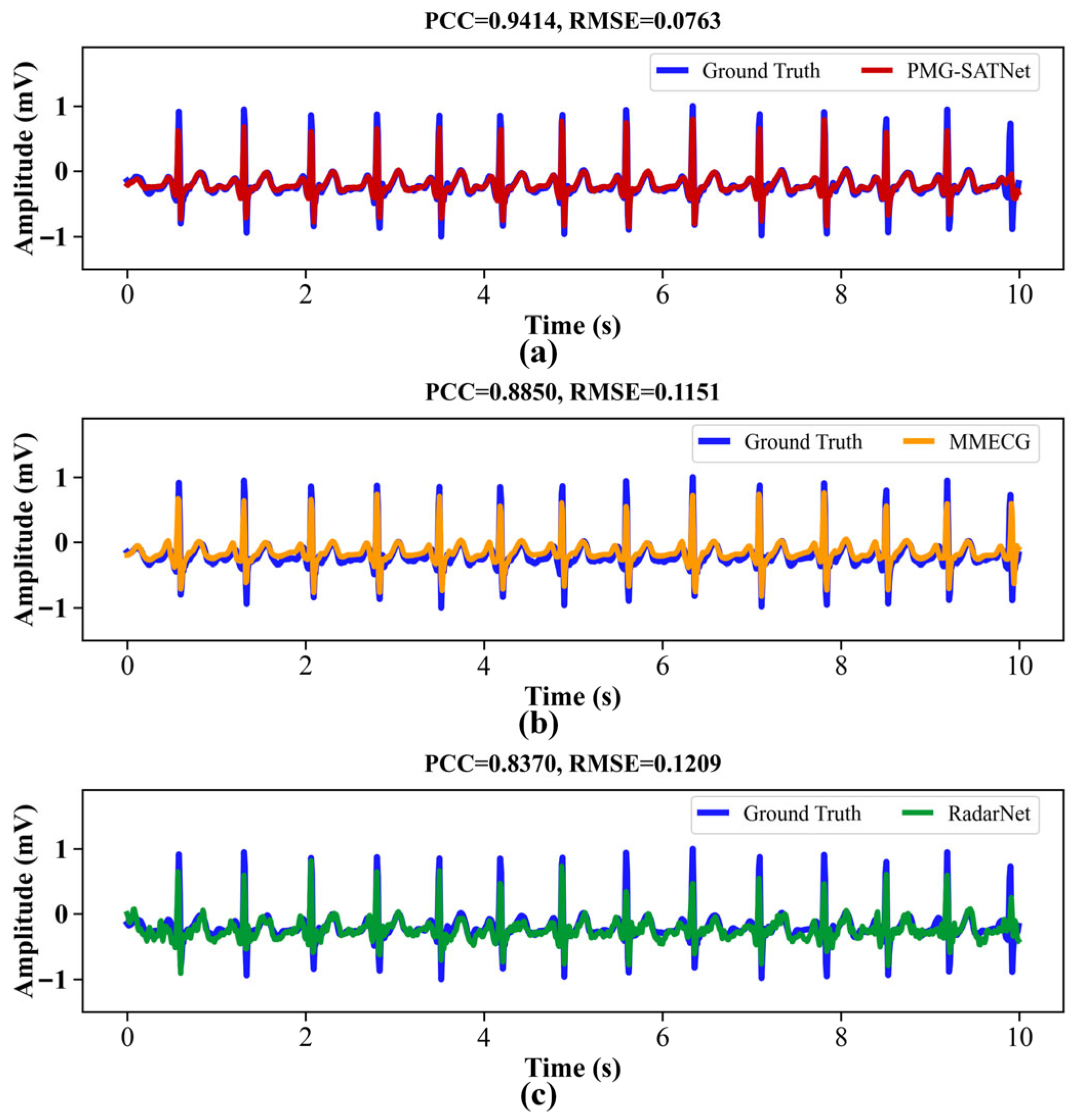
- Visual Reconstruction Results
3.2.2. Ablation Studies
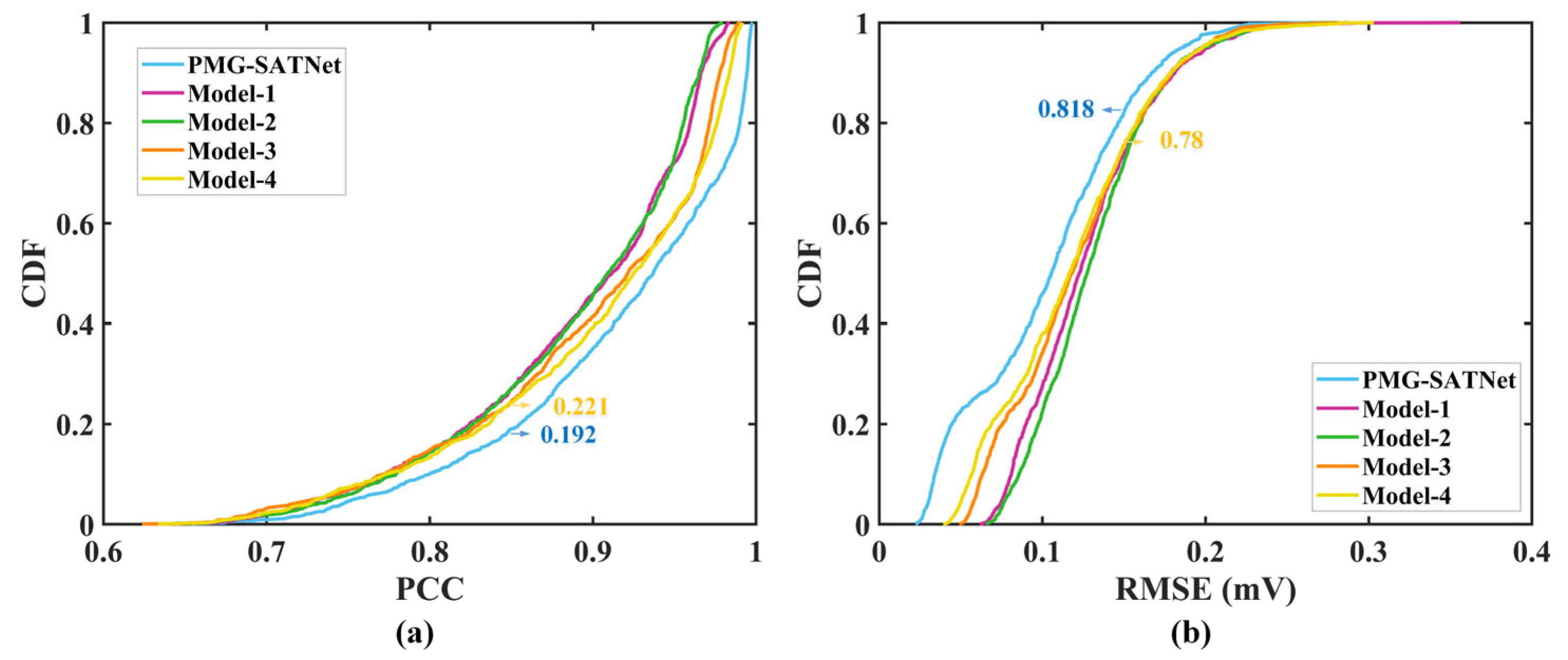
- Morphological Evaluation
- 2.
- Temporal Wave Localization Error
4. Discussion
5. Conclusions
Author Contributions
Funding
Data Availability Statement
Acknowledgments
Conflicts of Interest
References
- Tan, S.C.W.; Zheng, B.-B.; Tang, M.-L.; Chu, H.; Zhao, Y.-T.; Weng, C. Global Burden of Cardiovascular Diseases and Its Risk Factors, 1990–2021: A Systematic Analysis for the Global Burden of Disease Study 2021. QJM Int. J. Med. 2025, 118, 411–422. [Google Scholar] [CrossRef]
- Chong, B.; Jayabaskaran, J.; Jauhari, S.M.; Chan, S.P.; Goh, R.; Kueh, M.T.W.; Li, H.; Chin, Y.H.; Kong, G.; Anand, V.V.; et al. Global Burden of Cardiovascular Diseases: Projections from 2025 to 2050. Eur. J. Prev. Cardiol. 2025, 32, 1001–1015. [Google Scholar] [CrossRef]
- Kuan, P.X.; Chan, W.K.; Fern Ying, D.K.; Rahman, M.A.A.; Peariasamy, K.M.; Lai, N.M.; Mills, N.L.; Anand, A. Efficacy of Telemedicine for the Management of Cardiovascular Disease: A Systematic Review and Meta-Analysis. Lancet Digit. Health 2022, 4, e676–e691. [Google Scholar] [CrossRef]
- Brignole, M.; Moya, A.; De Lange, F.J.; Deharo, J.-C.; Elliott, P.M.; Fanciulli, A.; Fedorowski, A.; Furlan, R.; Kenny, R.A.; Martín, A.; et al. Practical Instructions for the 2018 ESC Guidelines for the Diagnosis and Management of Syncope. Eur. Heart J. 2018, 39, e43–e80. [Google Scholar] [CrossRef]
- Kligfield, P.; Gettes, L.S.; Bailey, J.J.; Childers, R.; Deal, B.J.; Hancock, E.W.; Van Herpen, G.; Kors, J.A.; Macfarlane, P.; Mirvis, D.M.; et al. Recommendations for the Standardization and Interpretation of the Electrocardiogram: Part I: The Electrocardiogram and Its Technology: A Scientific Statement From the American Heart Association Electrocardiography and Arrhythmias Committee, Council on Clinical Cardiology; the American College of Cardiology Foundation; and the Heart Rhythm Society Endorsed by the International Society for Computerized Electrocardiology. Circulation 2007, 115, 1306–1324. [Google Scholar] [CrossRef]
- Ullah, A.; Anwar, S.M.; Bilal, M.; Mehmood, R.M. Classification of Arrhythmia by Using Deep Learning with 2-D ECG Spectral Image Representation. Remote Sens. 2020, 12, 1685. [Google Scholar] [CrossRef]
- Daphin Lilda, S.; Jayaparvathy, R. Enhancing Cardiovascular Disease Classification in ECG Spectrograms by Using Multi-Branch CNN. Comput. Biol. Med. 2025, 186, 109737. [Google Scholar] [CrossRef]
- Muthukumar, K.A.; Nandi, D.; Ranjan, P.; Ramachandran, K.; Pj, S.; Ghosh, A.; M, A.; Radhakrishnan, A.; Dhandapani, V.E.; Janardhanan, R. Integrating Electrocardiogram and Fundus Images for Early Detection of Cardiovascular Diseases. Sci. Rep. 2025, 15, 4390. [Google Scholar] [CrossRef]
- Li, J.; Huang, L.; Zhai, Y.; Ling, S.; Ouyang, H.; Li, L. MFF-IBL: A Lightweight Cascade Network Based on Multibranch Feature Fusion and Incremental Broad Learning for Lead-Independent ECG Classification. IEEE Trans. Instrum. Meas. 2025, 74, 4000515. [Google Scholar] [CrossRef]
- Soman, A.; Sarath, R. Optimization-Enabled Deep Convolutional Neural Network with Multiple Features for Cardiac Arrhythmia Classification Using ECG Signals. Biomed. Signal Process. Control 2024, 92, 105964. [Google Scholar] [CrossRef]
- Yildirim, O.; Talo, M.; Ciaccio, E.J.; Tan, R.S.; Acharya, U.R. Accurate Deep Neural Network Model to Detect Cardiac Arrhythmia on More than 10,000 Individual Subject ECG Records. Comput. Methods Programs Biomed. 2020, 197, 105740. [Google Scholar] [CrossRef] [PubMed]
- Hasan, M.N.; Hossain, M.A.; Rahman, M.A. An Ensemble Based Lightweight Deep Learning Model for the Prediction of Cardiovascular Diseases from Electrocardiogram Images. Eng. Appl. Artif. Intell. 2025, 141, 109782. [Google Scholar] [CrossRef]
- Tyagi, P.K.; Agrawal, D. Automatic Detection of Sleep Apnea from a Single-Lead ECG Signal Based on Spiking Neural Network Model. Comput. Biol. Med. 2024, 179, 108877. [Google Scholar] [CrossRef]
- Sofos, S.S.; Tehrani, H.; Shokrollahi, K.; James, M.I. Surgical Staple as a Transcutaneous Transducer for ECG Electrodes in Burnt Skin: Safe Surgical Monitoring in Major Burns. Burns 2013, 39, 818–819. [Google Scholar] [CrossRef]
- Rabinstein, A.A. Prolonged Cardiac Monitoring for Detection of Paroxysmal Atrial Fibrillation After Cerebral Ischemia. Stroke 2014, 45, 1208–1214. [Google Scholar] [CrossRef][Green Version]
- Heikenfeld, J.; Jajack, A.; Rogers, J.; Gutruf, P.; Tian, L.; Pan, T.; Li, R.; Khine, M.; Kim, J.; Wang, J.; et al. Wearable Sensors: Modalities, Challenges, and Prospects. Lab. Chip 2018, 18, 217–248. [Google Scholar] [CrossRef]
- Preejith, S.P.; Dhinesh, R.; Joseph, J.; Sivaprakasam, M. Wearable ECG Platform for Continuous Cardiac Monitoring. In Proceedings of the 2016 38th Annual International Conference of the IEEE Engineering in Medicine and Biology Society (EMBC), Orlando, FL, USA, 16–20 August 2016; IEEE: Orlando, FL, USA, 2016; pp. 623–626. [Google Scholar]
- Alimbayeva, Z.N.; Alimbayev, C.A.; Bayanbay, N.A.; Ozhikenov, K.A.; Bodin, O.N.; Mukazhanov, Y.B. Portable ECG Monitoring System. Int. J. Adv. Comput. Sci. Appl. 2022, 13, 64–73. [Google Scholar] [CrossRef]
- Li, H.; Sun, G.; Li, Y.; Yang, R. Wearable Wireless Physiological Monitoring System Based on Multi-Sensor. Electronics 2021, 10, 986. [Google Scholar] [CrossRef]
- Blachowicz, T.; Ehrmann, G.; Ehrmann, A. Textile-Based Sensors for Biosignal Detection and Monitoring. Sensors 2021, 21, 6042. [Google Scholar] [CrossRef]
- Lee, H.; Baek, K. Developing a Smart Multifunctional Outdoor Jacket with Wearable Sensing Technology for User Health and Safety. Multimed. Tools Appl. 2021, 80, 32273–32310. [Google Scholar] [CrossRef]
- Park, J.-E.; Lee, G.-H.; Lee, I.-S.; Yang, J.-R. Heart Rate Extraction Technique with Mitigation of Respiration Harmonic for Bio-Radar Sensors. IEEE Sens. J. 2025, 25, 929–939. [Google Scholar] [CrossRef]
- Sun, G.; Kurosawa, M.; Ninomiya, Y.; Baba, K.; Son, N.H.; Yen, H.T.; Suzuki, S.; Kano, Y. Contactless Monitoring of Respiratory Rate Variability in Rats under Anesthesia with a Compact 24GHz Microwave Radar Sensor. Front. Vet. Sci. 2025, 12, 1518140. [Google Scholar] [CrossRef]
- Wang, P.; He, Q.; Li, H. MIMO Radar Joint Heart Rate and Respiratory Rate Estimation and Performance Bound Analysis. IEEE Signal Process. Lett. 2025, 32, 1266–1270. [Google Scholar] [CrossRef]
- Seifizarei, S.; Elnaggar, I.; Anzanpour, A.; Sandelin, J.; Lahdenoja, O.; Glassee, M.; Castro, I.D.; Torfs, T.; Van De Poll, M.C.; Airola, A.; et al. Continuous Radar-Based Heart Rate Monitoring Using Autocorrelation-Based Algorithm in Intensive Care Unit. IEEE J. Biomed. Health Inform. 2025, 1–9. [Google Scholar] [CrossRef]
- Zhang, F.; Zhang, Z.; Kang, L.; Zhou, A.; Ma, H. mmTAA: A Contact-Less Thoracoabdominal Asynchrony Measurement System Based on mmWave Sensing. IEEE Trans. Mob. Comput. 2025, 24, 627–641. [Google Scholar] [CrossRef]
- Yuan, Y.; Chen, J.; Zhang, D.; Geng, R.; Gong, H.; Xu, G.; Pu, Y.; Lu, Z.; Hu, Y.; Zhang, D.; et al. Atrial Fibrillation Detection via Contactless Radio Monitoring and Knowledge Transfer. Nat. Commun. 2025, 16, 4317. [Google Scholar] [CrossRef]
- Ravindran, K.K.G.; della Monica, C.; Atzori, G.; Lambert, D.; Hassanin, H.; Revell, V.; Dijk, D.-J. Reliable Contactless Monitoring of Heart Rate, Breathing Rate, and Breathing Disturbance During Sleep in Aging: Digital Health Technology Evaluation Study. JMIR mHealth uHealth 2024, 12, e53643. [Google Scholar] [CrossRef]
- Li, D.; Huang, Y.; Li, H.; Cheng, J.; Zhu, W.; Feng, H. A Novel Approach to Accurate Respiratory Rate and Heart Rate Estimation via FMCW Radar. IEEE Sens. J. 2025, 25, 13937–13945. [Google Scholar] [CrossRef]
- Yang, G.; Metcalfe, B.W.; Watson, R.J.; Evans, A.N. A Noncontact Cardiorespiratory Monitoring System for Drivers Using Millimeter Wave Radar with Phase Continuity Tracking and Signal Quality Index. IEEE Internet Things J. 2025, 12, 43480–43494. [Google Scholar] [CrossRef]
- Gharamohammadi, A.; Bagheri, M.O.; Abu-Sardanah, S.; Riad, M.M.Y.R.; Abedi, H.; Ansariyan, A.; Wang, K.; Saragadam, A.; Chumachenko, D.; Abhari, S.; et al. Smart Furniture Using Radar Technology for Cardiac Health Monitoring. Sci. Rep. 2025, 15, 1392. [Google Scholar] [CrossRef]
- Sriranga, A.K.; Lu, Q.; Birrell, S.A. A Deep Learning Based Contactless Driver State Monitoring Radar System for In-Vehicle Physiological Applications. IEEE Trans. Intell. Transp. Syst. 2025, 26, 9491–9499. [Google Scholar] [CrossRef]
- Petrovic, V.L.; Jankovic, M.M.; Lupsic, A.V.; Mihajlovic, V.R.; Popovic-Bozovic, J.S. High-Accuracy Real-Time Monitoring of Heart Rate Variability Using 24 GHz Continuous-Wave Doppler Radar. IEEE Access 2019, 7, 74721–74733. [Google Scholar] [CrossRef]
- Wang, Y.; Wang, W.; Zhou, M.; Ren, A.; Tian, Z. Remote Monitoring of Human Vital Signs Based on 77-GHz Mm-Wave FMCW Radar. Sensors 2020, 20, 2999. [Google Scholar] [CrossRef]
- Duan, Z.; Liang, J. Non-Contact Detection of Vital Signs Using a UWB Radar Sensor. IEEE Access 2019, 7, 36888–36895. [Google Scholar] [CrossRef]
- Wang, F.; Zeng, X.; Wu, C.; Wang, B.; Liu, K.J.R. mmHRV: Contactless Heart Rate Variability Monitoring Using Millimeter-Wave Radio. IEEE Internet Things J. 2021, 8, 16623–16636. [Google Scholar] [CrossRef]
- Hu, X.; Jin, T. Short-Range Vital Signs Sensing Based on EEMD and CWT Using IR-UWB Radar. Sensors 2016, 16, 2025. [Google Scholar] [CrossRef]
- Bers, D.M. Cardiac Excitation–Contraction Coupling. Nature 2002, 415, 198–205. [Google Scholar] [CrossRef]
- Christoph, J.; Lebert, J. Inverse Mechano-Electrical Reconstruction of Cardiac Excitation Wave Patterns from Mechanical Deformation Using Deep Learning. Chaos Interdiscip. J. Nonlinear Sci. 2020, 30, 123134. [Google Scholar] [CrossRef]
- Zhang, Y.; Yang, R.; Yue, Y.; Lim, E.G.; Wang, Z. An Overview of Algorithms for Contactless Cardiac Feature Extraction from Radar Signals: Advances and Challenges. IEEE Trans. Instrum. Meas. 2023, 72, 4009520. [Google Scholar] [CrossRef]
- Grisot, R.; Laurent, P.; Migliaccio, C.; Dauvignac, J.-Y.; Brulc, M.; Chiquet, C.; Caruana, J.-P. Monitoring of Heart Movements Using an FMCW Radar and Correlation With an ECG. IEEE Trans. Radar Syst. 2023, 1, 423–434. [Google Scholar] [CrossRef]
- Wang, H.; Du, F.; Zhu, H.; Zhang, Z.; Wang, Y.; Cao, Q.; Zhu, X. HeRe: Heartbeat Signal Reconstruction for Low-Power Millimeter-Wave Radar Based on Deep Learning. IEEE Trans. Instrum. Meas. 2023, 72, 4004515. [Google Scholar] [CrossRef]
- Kumar, A.; Wadlom, N.; Kwak, J.; Kang, S.-H.; Shin, I. mCardiacDx: Radar-Driven Contactless Monitoring and Diagnosis of Atrial Fibrillation. IEEE J. Transl. Eng. Health Med. 2026, 14, 144–163. [Google Scholar] [CrossRef]
- Chen, J.; Zhang, D.; Wu, Z.; Zhou, F.; Sun, Q.; Chen, Y. Contactless Electrocardiogram Monitoring with Millimeter Wave Radar. IEEE Trans. Mob. Comput. 2024, 23, 270–285. [Google Scholar] [CrossRef]
- Liu, K.-C.; Peng, S.-Y.; Tsao, Y.; Liu, C.-Y.; Chen, Z.-A.; Han Han, Z.; Chen, W.-C.; Hsieh, P.-Q.; Li, Y.-J.; Hsu, Y.-J.; et al. A Cross-Modal Autoencoder for Contactless Electrocardiography Monitoring Using Frequency-Modulated Continuous Wave Radar. IEEE Sens. J. 2024, 24, 41462–41473. [Google Scholar] [CrossRef]
- Li, B.; Li, W.; He, Y.; Zhang, W.; Fu, H. RadarNet: Noncontact ECG Signal Measurement Based on FMCW Radar. IEEE Trans. Instrum. Meas. 2024, 73, 4011309. [Google Scholar] [CrossRef]
- Jin, B.; Wu, H.; Wang, Y.; Zhang, Z.; Zhang, X.; Du, G. Reconstructing ECG-Like Signals from Millimeter-Wave Radar Echoes: A Generative Adversarial Network Approach. IEEE Sens. J. 2025, 25, 27200–27208. [Google Scholar] [CrossRef]
- Shrifan, N.H.M.M.; Akbar, M.F.; Mat Isa, N.A. Maximal Overlap Discrete Wavelet-Packet Transform Aided Microwave Nondestructive Testing. NDT E Int. 2021, 119, 102414. [Google Scholar] [CrossRef]
- Wang, H.; Deng, Z.; Feng, B.; Ma, H.; Xia, Y. An Adaptive Kalman Filter Estimating Process Noise Covariance. Neurocomputing 2017, 223, 12–17. [Google Scholar] [CrossRef]
- Xie, X.; Liu, H.; Shu, M.; Zhu, Q.; Huang, A.; Kong, X.; Wang, Y. A Multi-Stage Denoising Framework for Ambulatory ECG Signal Based on Domain Knowledge and Motion Artifact Detection. Future Gener. Comput. Syst. 2021, 116, 103–116. [Google Scholar] [CrossRef]
- Awal, M.A.; Mostafa, S.S.; Ahmad, M.; Rashid, M.A. An Adaptive Level Dependent Wavelet Thresholding for ECG Denoising. Biocybern. Biomed. Eng. 2014, 34, 238–249. [Google Scholar] [CrossRef]
- Yao, Y.; Rosasco, L.; Caponnetto, A. On Early Stopping in Gradient Descent Learning. Constr. Approx. 2007, 26, 289–315. [Google Scholar] [CrossRef]
- Loshchilov, I.; Hutter, F. Sgdr: Stochastic Gradient Descent with Warm Restarts. arXiv 2017, arXiv:1608.03983. [Google Scholar] [CrossRef]
- Makowski, D.; Pham, T.; Lau, Z.J.; Brammer, J.C.; Lespinasse, F.; Pham, H.; Schölzel, C.; Chen, S.H.A. NeuroKit2: A Python Toolbox for Neurophysiological Signal Processing. Behav. Res. Methods 2021, 53, 1689–1696. [Google Scholar] [CrossRef]



| Transmit Frequency (GHz) | Transmit Power (mW) | Antenna Gain (dB) | Wavelength (mm) | Antenna Type |
|---|---|---|---|---|
| 94 | 100 | 41.7 | 3 | Cassegrain Antenna |
| Experimental Condition | Data Quantity | Proportion |
|---|---|---|
| Sitting-CR-Eu | 2816 | 37.44% |
| Lat Decub-BR-Eu | 1199 | 15.94% |
| Lat Decub-CR-Eu | 1077 | 14.32% |
| Supine-CSR-Eu | 968 | 12.87% |
| Supine-CSR-Ap | 571 | 7.59% |
| Supine-CSR-Hy | 458 | 6.09% |
| Supine-CSR-RSB | 432 | 5.74% |
| Framework | Encoder | Decoder | PCC | RMSE | MAE |
|---|---|---|---|---|---|
| MMECG | CNN + Transformer | TCN | 88.83% | 0.122 | 0.078 |
| RadarNet | ResNet | ResNet | 88.38% | 0.131 | 0.082 |
| PMG-SATNet | MMEF + GRMM | TCN-SA | 91.79% | 0.102 | 0.056 |
| Framework | Percentile | Q | R | S | T |
|---|---|---|---|---|---|
| MMECG | Median | 0.012 | 0.006 | 0.006 | 0.008 |
| 90 percentile | 0.020 | 0.014 | 0.018 | 0.020 | |
| RadarNet | Median | 0.013 | 0.006 | 0.008 | 0.014 |
| 90 percentile | 0.022 | 0.017 | 0.021 | 0.029 | |
| PMG-SATNet | Median | 0.007 | 0.005 | 0.005 | 0.006 |
| 90 percentile | 0.014 | 0.011 | 0.016 | 0.015 |
| Framework | Encoder | Decoder | PCC | RMSE | MAE |
|---|---|---|---|---|---|
| Model-1 | MFEM | TCN-SA | 89.40% | 0.124 | 0.073 |
| Model-2 | GRMM | TCN-SA | 89.56% | 0.125 | 0.076 |
| Model-3 | MFEM - GRMM | TCN-SA | 90.09% | 0.119 | 0.071 |
| Model-4 | MFEM + GRMM | TCN | 90.46% | 0.115 | 0.068 |
| PMG-SATNet | MFEM + GRMM | TCN-SA | 91.79% | 0.102 | 0.056 |
| Framework | Percentile | Q | R | S | T |
|---|---|---|---|---|---|
| Model-1 | Median | 0.012 | 0.006 | 0.007 | 0.010 |
| 90 percentile | 0.020 | 0.014 | 0.020 | 0.043 | |
| Model-2 | Median | 0.010 | 0.005 | 0.006 | 0.008 |
| 90 percentile | 0.021 | 0.012 | 0.017 | 0.020 | |
| Model-3 | Median | 0.009 | 0.005 | 0.005 | 0.009 |
| 90 percentile | 0.017 | 0.013 | 0.020 | 0.025 | |
| Model-4 | Median | 0.011 | 0.005 | 0.006 | 0.007 |
| 90 percentile | 0.019 | 0.011 | 0.016 | 0.017 | |
| PMG-SATNet | Median | 0.007 | 0.005 | 0.005 | 0.006 |
| 90 percentile | 0.014 | 0.011 | 0.016 | 0.015 |
Disclaimer/Publisher’s Note: The statements, opinions and data contained in all publications are solely those of the individual author(s) and contributor(s) and not of MDPI and/or the editor(s). MDPI and/or the editor(s) disclaim responsibility for any injury to people or property resulting from any ideas, methods, instructions or products referred to in the content. |
© 2026 by the authors. Licensee MDPI, Basel, Switzerland. This article is an open access article distributed under the terms and conditions of the Creative Commons Attribution (CC BY) license.
Share and Cite
Guo, T.; Wang, J.; Yuan, N.; Lv, H.; Liang, F.; Zhang, Z.; Wang, J.; Long, Y.; Xue, H. Contactless Cardiac Health Monitoring with Millimeter-Wave Radar Based on PMG-SATNet. Sensors 2026, 26, 2579. https://doi.org/10.3390/s26092579
Guo T, Wang J, Yuan N, Lv H, Liang F, Zhang Z, Wang J, Long Y, Xue H. Contactless Cardiac Health Monitoring with Millimeter-Wave Radar Based on PMG-SATNet. Sensors. 2026; 26(9):2579. https://doi.org/10.3390/s26092579
Chicago/Turabian StyleGuo, Tianjiao, Jianqi Wang, Nianzeng Yuan, Hao Lv, Fulai Liang, Zhiyuan Zhang, Jingzhe Wang, Yunuo Long, and Huijun Xue. 2026. "Contactless Cardiac Health Monitoring with Millimeter-Wave Radar Based on PMG-SATNet" Sensors 26, no. 9: 2579. https://doi.org/10.3390/s26092579
APA StyleGuo, T., Wang, J., Yuan, N., Lv, H., Liang, F., Zhang, Z., Wang, J., Long, Y., & Xue, H. (2026). Contactless Cardiac Health Monitoring with Millimeter-Wave Radar Based on PMG-SATNet. Sensors, 26(9), 2579. https://doi.org/10.3390/s26092579