
An Improved YOLO11n-Based Algorithm for Road Sign Detection

Highlights
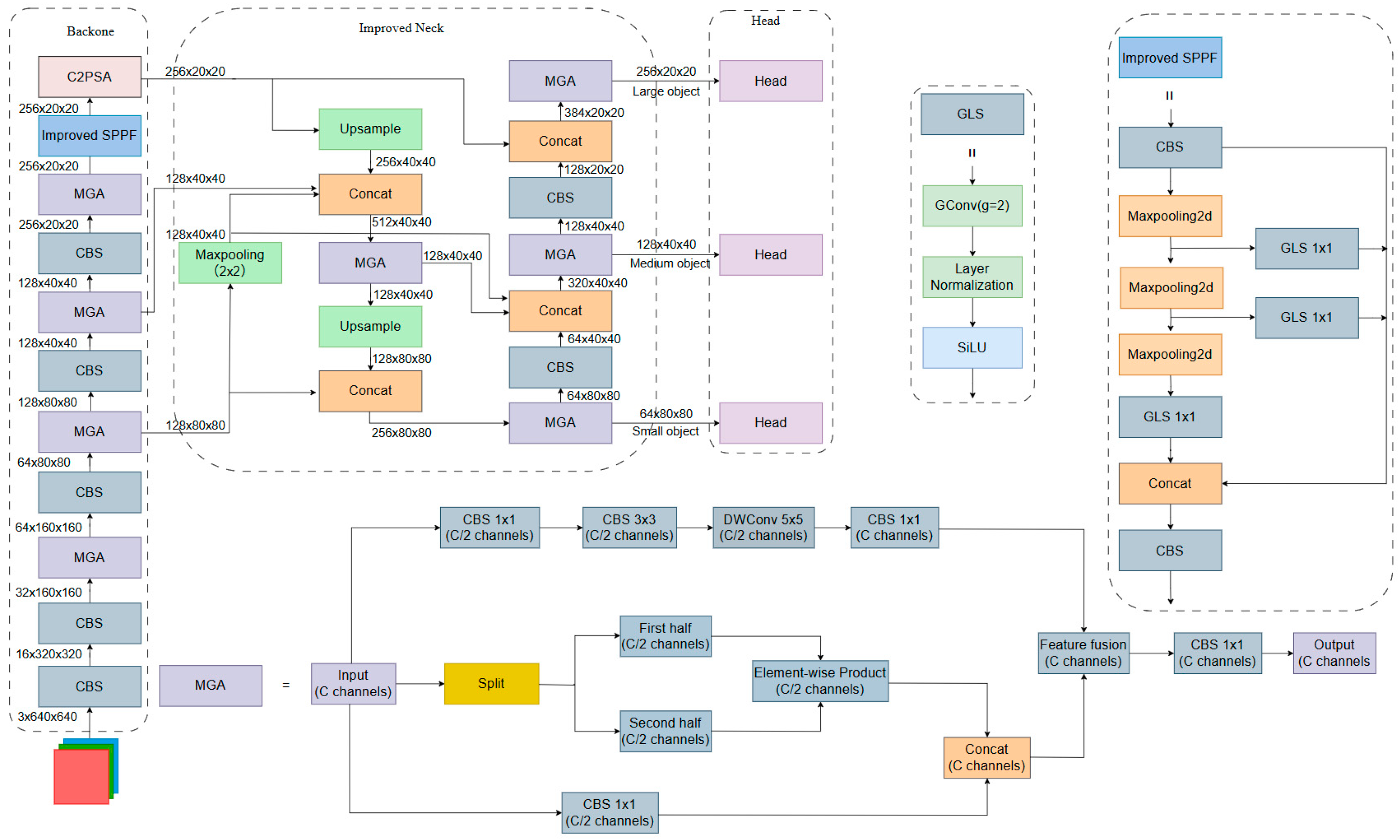
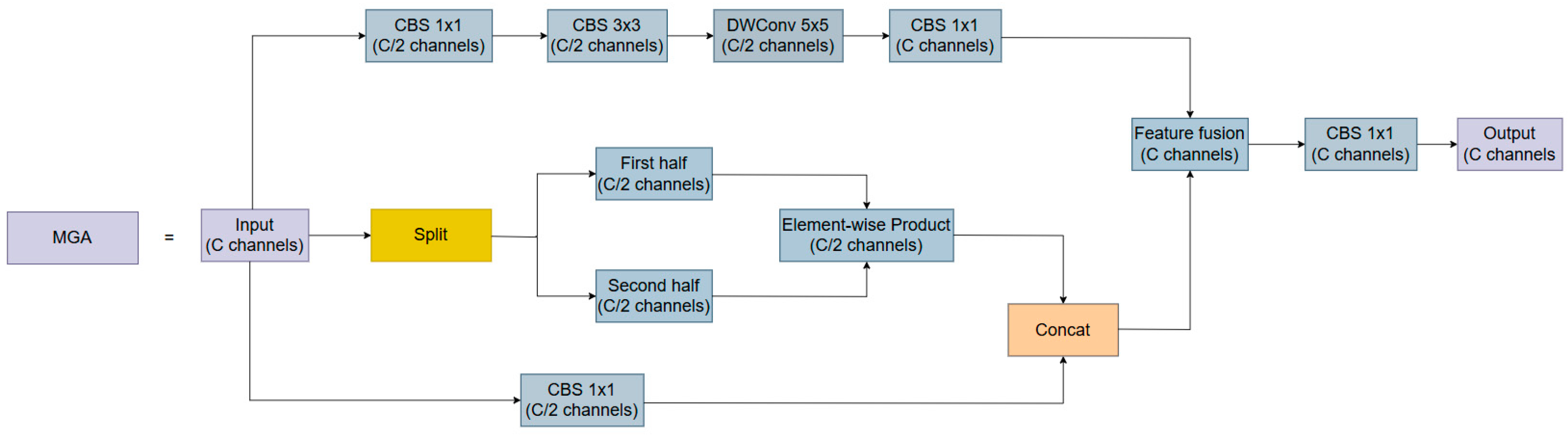
- To improve the performance of road sign detection algorithms in complex backgrounds for detecting multi-scale, low-resolution, and occluded small targets, a Multi-path Gated Aggregation module is designed. This module consists of a multi-scale feature extraction branch, a color feature extraction branch, and a detail feature extraction branch.
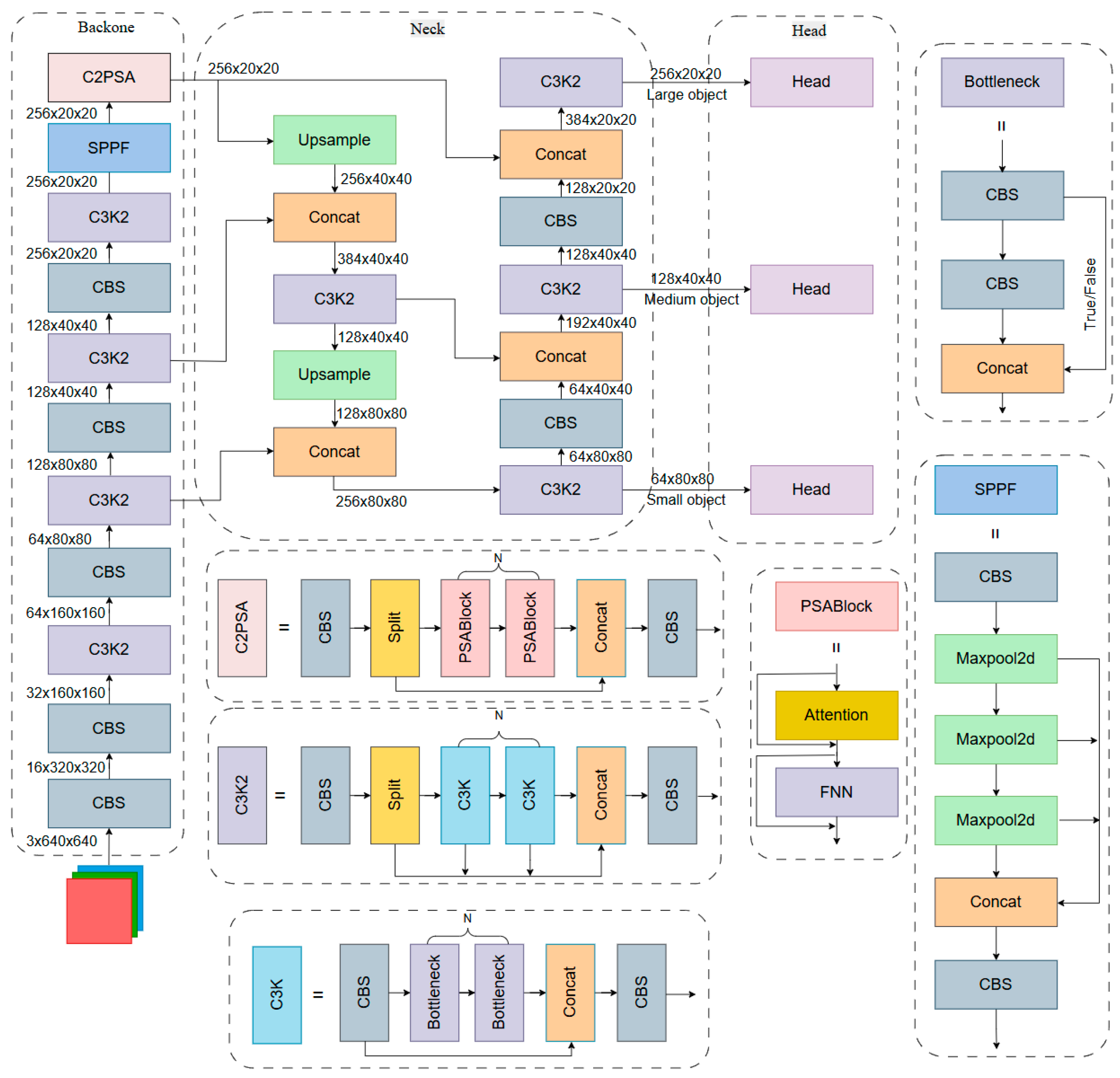
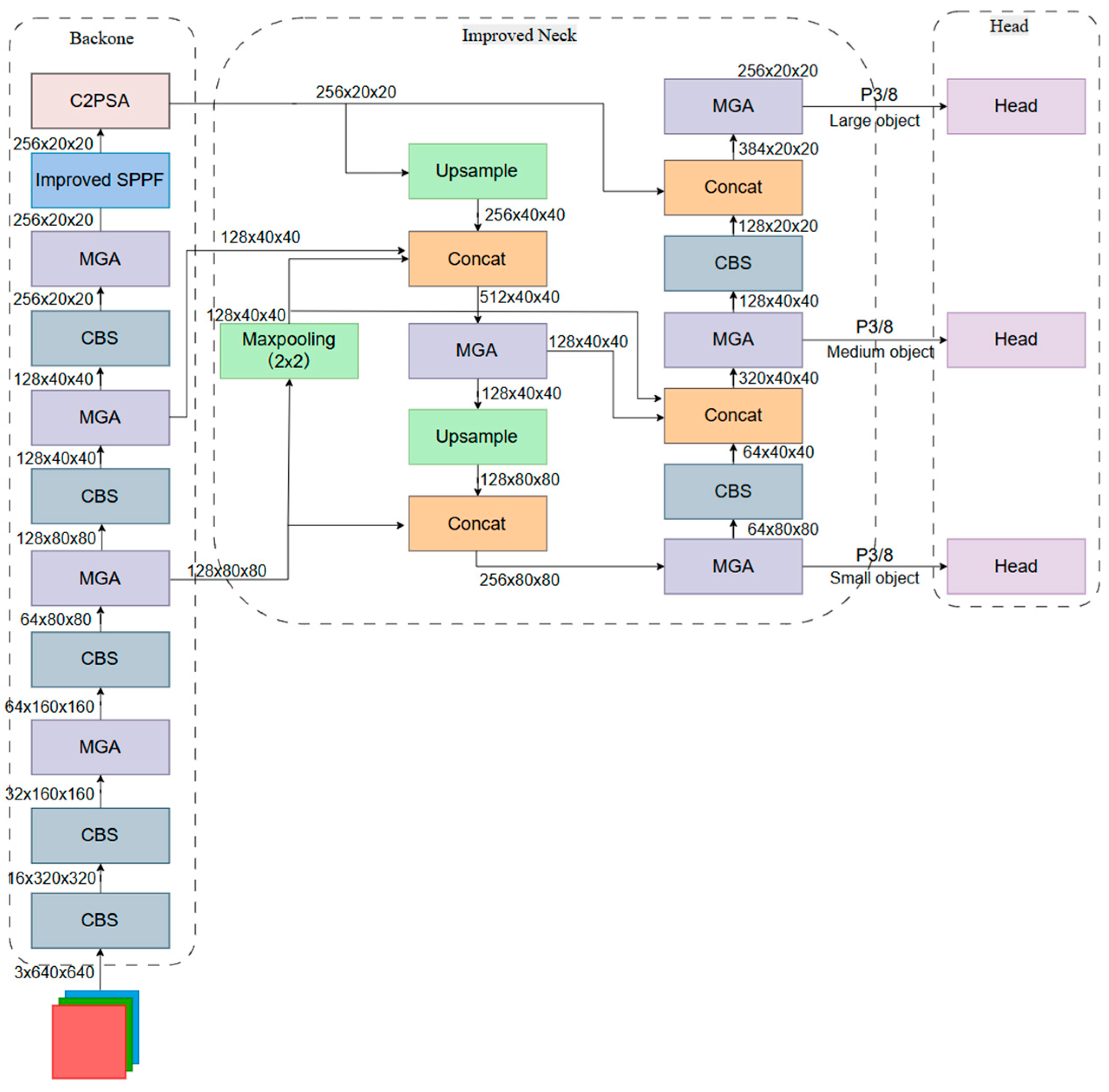
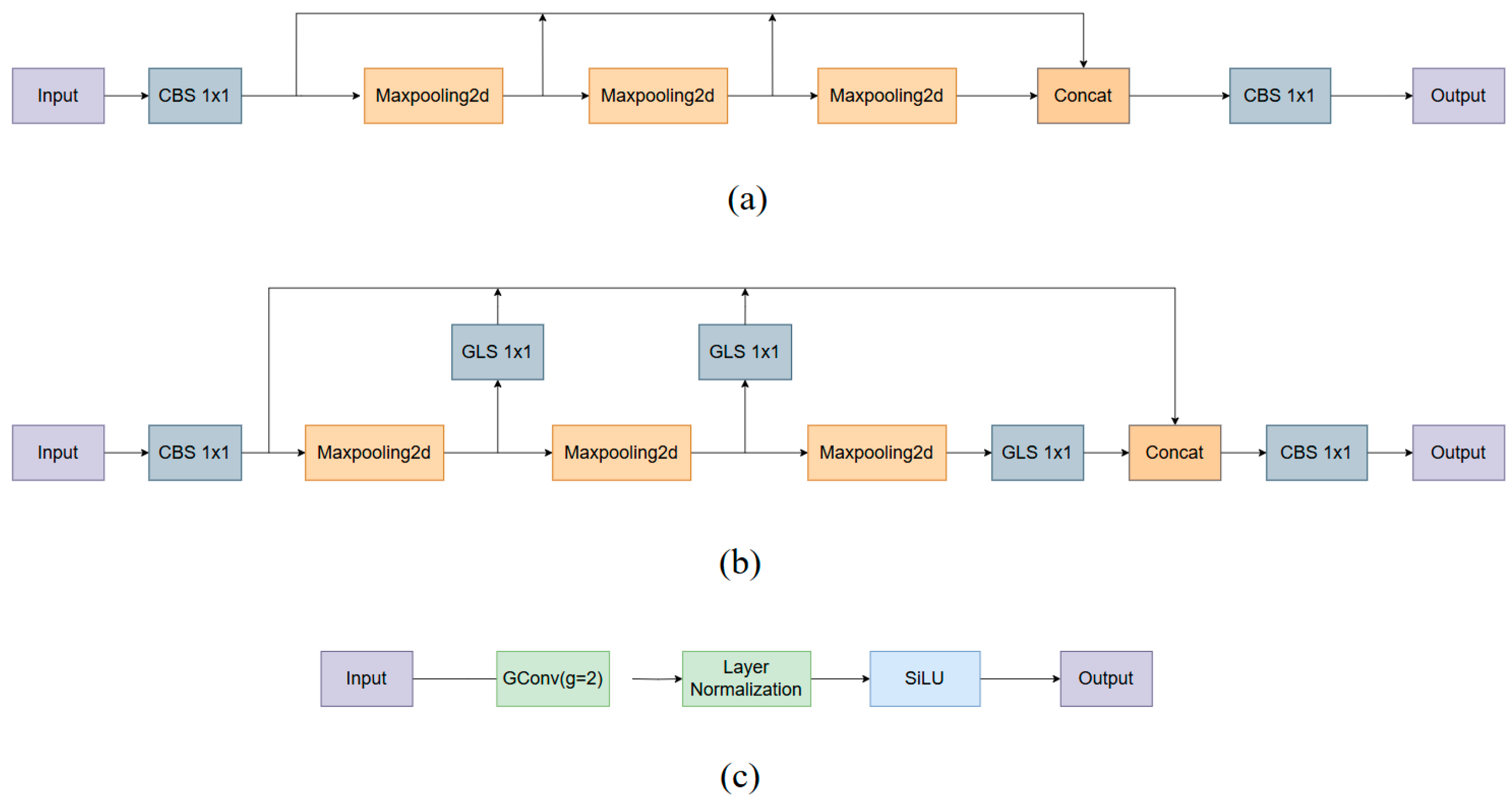
- In order to enhance the detection performance of the YOLO11n algorithm for small and blurry targets, high-resolution information from the shallow layers of the Backbone is integrated into the Neck network. Moreover, a Group Convolution-Layer Normalization-SiLU (GLS) structure is designed in the SPPF structure to achieve the fusion of information at different levels during SPPF information transmission.
- A modular design paradigm is proposed for the feature extraction from multi-scale, low-resolution, and small targets in complex backgrounds. The introduced channel interaction mechanism and GLS-enhanced SPPF structure provide reusable structural references and design insights for improving the robustness of target detection under occlusion, blurring, low-resolution, and multi-scale variation in complex scenes.
- It attains a high balance between detection accuracy and real-time performance, making it suitable for vehicle deployment. While maintaining a high frame rate of 134 FPS, this method significantly improves the detection accuracy of various road signs (especially for low-resolution, partially occluded, and small targets) and can meet the dual requirements of reliability and real-time performance of intelligent driving systems in real and complex scenes.
Abstract
1. Introduction
- To address the detection challenges of low-resolution and occluded targets in complex backgrounds, an MGA module is proposed. The module comprises two core components: multi-path feature extraction and channel semantic interaction. The multi-path feature extraction branch consists of three parallel paths, comprising a 1 × 1 convolutional layer, a 3 × 3 convolutional layer, and a 5 × 5 Depth-Wise Separable Convolution (DWConv) for context capture. These paths extract road sign features from small, medium, and large receptive fields. The channel semantic interaction branch first divides the input features into two paths along the channel dimension. The channel elements of the two paths are then multiplied in an element-wise manner to strengthen cross-channel semantic correlations. In parallel, a 1 × 1 convolution branch is employed to preserve detailed information. This design significantly enhances the model’s ability to detect low-resolution and occluded small traffic signs in complex scenarios, and provides a structural reference for addressing other challenging detection tasks.
- To address the challenges of small-scale object detection, an improved neck architecture is proposed based on YOLO11n. The improved neck structure introduces a feature fusion path based on max-pooling downsampling. A branch is extended from the high-resolution feature layer of the YOLO11n backbone. A max-pooling operation with a stride of 2 is applied to adjust the spatial resolution of the feature map. The resulting feature map is then introduced into the neck for subsequent feature fusion. The max-pooling operation preserves fine-grained detail information. After concatenation and fusion with the multi-scale features in the neck, the resulting features improve the detail representation capability of high-level semantic features without introducing additional parameters. This design thus mitigates the loss of small-scale traffic sign features in high-level feature maps. This neck network provides an effective design for multi-scale traffic sign feature fusion.
- To address the detection of long-range and blurry targets, an improved architecture based on SPPF is proposed. Following the max-pooling operation in the SPPF module, a Group Convolution-Layer Normalization-SiLU (GLS) module is introduced to alleviate the relative sparsity of traffic sign features. Its main objective is to enhance sparse representations within multi-scale feature layers via adjacent channel fusion, simultaneously preserving the distributional diversity of features across various channels. Ultimately, with the integration of the improved SPPF, the information flow becomes richer and smoother, effectively strengthening the model’s perception capability for distant imaging and blurred signs. This structure offers a valuable design reference for distant target detection tasks.
2. Proposed Methods
2.1. YOLO11n Algorithm Architecture
2.1.1. Introduction to the YOLO11n Algorithm
2.1.2. Analysis of the YOLO11n Algorithm
2.2. Improved YOLO11n Algorithm
2.2.1. The Multi-Path Gated Aggregation Module
2.2.2. Improved Neck Network
2.2.3. Improved SPPF Module
3. Construction of Datasets
4. Experiments
4.1. Dataset Processing
4.2. Experimental Environment
4.3. Evaluation Metrics
4.4. Comparative Experiments
4.5. Ablation Experiment
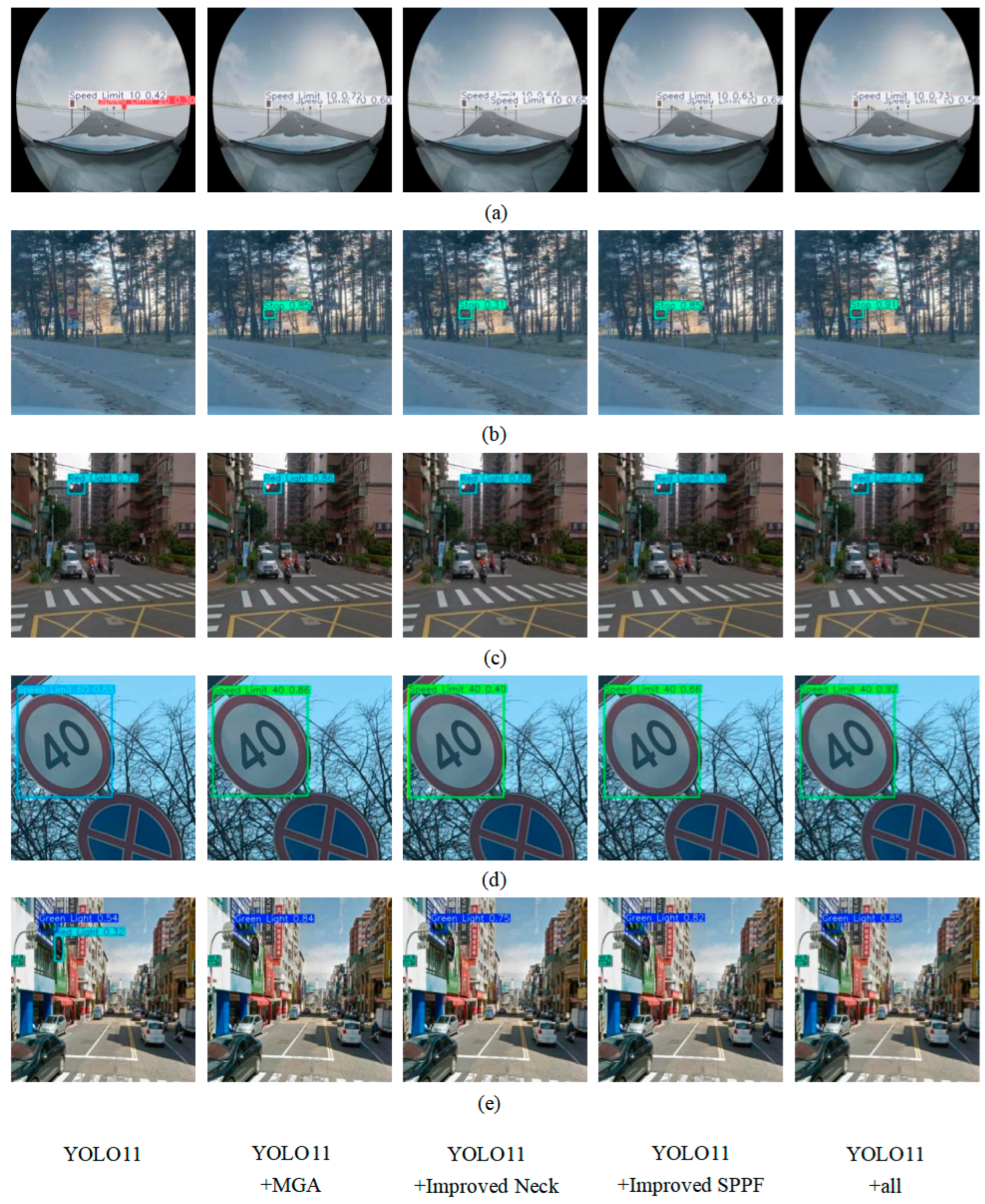
- (1)
- The Original YOLO11n network.
- (2)
- Scheme (1) combined with the MGA module.
- (3)
- Scheme (1) combined with the improved Neck network.
- (4)
- Scheme (1) combined with the improved SPPF module.
- (5)
- Scheme (1) combined with all improvements, including the MGA module, Neck network, and optimized SPPF module.
5. Conclusions
Author Contributions
Funding
Institutional Review Board Statement
Informed Consent Statement
Data Availability Statement
Conflicts of Interest
Abbreviations
| YOLO | You Only Look Once |
| MGA | Multi-path Gated Aggregation |
| SPPF | Spatial Pyramid Pooling—Fast |
| GLS | Group Convolution-Layer Normalization-SiLU |
| mAP | Mean Average Precision |
| FPS | Frames per second |
| RBF | Radial Basis Function |
| RANSAC | Random Sample Consensus |
| Faster R-CNN | Faster Region-based Convolutional Neural Network |
| CNN | Convolutional Neural Network |
| DWConv | Depth-Wise Separable Convolution |
| PAN | Path Aggregation Network |
| FPN | Feature Pyramid Network |
| Conv | Convolution |
| CBS | Convolution-Batch Normalization-SiLU |
| C3K2 | CSP Stage Block with 3 Convolutions and 2-input Bottleneck |
| C2f | CSP Stage Block with 2-flows |
| C2PSA | Cross Stage Partial with Pyramid Squeeze Attention |
| C3K | CSP Stage Block with 3 Convolutions |
| AP | Average precision |
| GFLOPS | Giga Floating-point Operations Per Second |
| FLOPS | Floating-point Operations Per Second |
| Params | Parameters |
References
- Pan, Y.; Yue, J. Road Crack Detection Algorithm Based on Improved YOLOv8. In Proceedings of the 2023 5th International Conference on Artificial Intelligence and Computer Applications (ICAICA), Dalian, China, 30 May–1 June 2023; pp. 28–32. [Google Scholar] [CrossRef]
- Zhan, B.; Temirgaziyeva, S. Development of Deep Convolutional Neural Network for Road Sign Detection. In Proceedings of the 2024 IEEE 4th International Conference on Smart Information Systems and Technologies (SIST), Astana, Kazakhstan, 15–17 May 2024; pp. 308–313. [Google Scholar] [CrossRef]
- Liang, T.; Bao, H.; Pan, W.; Pan, F. Traffic sign detection via improved sparse R-CNN for autonomous vehicles. J. Adv. Transp. 2022, 2022, 3825532. [Google Scholar] [CrossRef]
- Gao, X.; Chen, L.; Wang, K.; Xiong, X.; Wang, H.; Li, Y. Improved Traffic Sign Detection Algorithm Based on Faster R-CNN. Appl. Sci. 2022, 12, 8948. [Google Scholar] [CrossRef]
- Lü, H.; Lu, H. Research on traffic sign recognition technology based on YOLOv5 algorithm. J. Electron. Meas. Instrum. 2021, 35, 137–144. [Google Scholar]
- Zhang, S.; Wang, H.; Ran, X. Lightweight traffic sign detection method based on YOLOv5. Electron. Meas. Technol. 2022, 45, 129–135. [Google Scholar]
- Huang, Z.; Yu, Y.; Gu, J.; Liu, H. An efficient method for traffic sign recognition based on extreme learning machine. IEEE Trans. Cybern. 2017, 47, 920–933. [Google Scholar] [CrossRef]
- Sun, C.; Wen, M.; Zhang, K.; Chen, L.; Zhang, J. Traffic sign detection algorithm based on feature expression enhancement. Multimed. Tools Appl. 2021, 80, 33593–33614. [Google Scholar] [CrossRef]
- Huang, G.; Wang, Y.; Lan, Z.; Hao, S.; Song, G.; Huang, G. Glance and focus networks for dynamic visual recognition. IEEE Trans. Pattern Anal. Mach. Intell. 2023, 45, 4605–4621. [Google Scholar] [CrossRef]
- Zhu, M.; Zhang, H.; Fang, R. Research on vehicle detection method based on RCNN. Mech. Eng. 2018, 35, 880–885. [Google Scholar]
- Zheng, Z.; Wang, P.; Liu, W.; Li, J.; Ye, R.; Ren, D. Distance-IoU Loss: Faster and better learning for bounding box regression. In Proceedings of the AAAI Conference on Artificial Intelligence, Online, 7–12 February 2020; pp. 12993–13000. [Google Scholar]
- Meng, F.; Yu, C. Traffic sign recognition based on YOLOv5-EA. J. Liaoning Univ. Technol. 2022, 42, 303–310. [Google Scholar]
- Yang, F.; Wang, H.; Wei, H.; Yang, Y.; Wang, Y. Circular Road Sign Analysis and Visual Localization Approach Based on Monocular Vision. In Proceedings of the 2012 Third Global Congress on Intelligent Systems (GCIS), Wuhan, China, 6–8 November 2012; pp. 334–337. [Google Scholar] [CrossRef]
- Batoof, A.; Nisar, M.W.; Shah, J.H.; Khan, M.A.; Alhaisoni, M. iELMNet: Integrating novel improved extreme learning machine and convolutional neural network model for traffic sign detection. Big Data 2022, 28, 1288–1300. [Google Scholar] [CrossRef]
- Wang, J.; Chen, Y.; Dong, Z.; Wang, C.; Wang, Y.; Li, S. Improved YOLOv5 network for real-time multi-scale traffic sign detection. Neural Comput. Appl. 2023, 35, 7853–7865. [Google Scholar] [CrossRef]
- Chen, J.; Jia, K.; Chen, W.; Zhang, Z.; Sun, X. A real-time and high-precision method for small traffic-signs recognition. Neural Comput. Appl. 2022, 34, 2233–2245. [Google Scholar] [CrossRef]
- Liu, S.; Cai, T.; Tang, X.; Wang, H.; Xu, S. Visual recognition of traffic signs in natural scenes based on improved RetinaNet. Entropy 2022, 24, 112. [Google Scholar] [CrossRef] [PubMed]
- Rajendran, S.P.; Shine, L.; Pradeep, R.; Vijayaraghavan, S. Real-time traffic sign recognition using YOLOv3 based detector. In Proceedings of the 10th International Conference on Computing, Communication and Networking Technologies (ICCCNT), Kanpur, India, 6–8 July 2019; pp. 1–7. [Google Scholar] [CrossRef]
- Luo, X.; Li, Z.; Zhu, H. Traffic sign detection based on YOLOv4-Ghost. Comput. Digit. Eng. 2022, 50, 1292–1297. [Google Scholar]
- Shen, Q.; Li, Y.; Zhang, Y.; Zhang, L.; Liu, S.; Wu, J. CSW-YOLO: A traffic sign small target detection algorithm based on YOLO8. PLoS ONE 2025, 20, e0315334. [Google Scholar] [CrossRef]
- Qiu, J.; Zhang, W.; Xu, S.; Zhou, H. DP-YOLO: A lightweight traffic sign detection model for small object detection. Digit. Signal Process. 2025, 165, 105311. [Google Scholar] [CrossRef]
- Khanam, R.; Hussain, M. YOLOv11: An overview of the key architectural enhancements. arXiv 2024, arXiv:2410.17725. [Google Scholar] [CrossRef]
- Feng, Y.; Guo, Q.; Yan, J. UAV small object detection algorithm based on multi-scale attention mechanism. Acta Armamentarii 2025, 46, 14–23. [Google Scholar]
- Liu, S.; Qi, L.; Qin, H.; Shi, J.; Jia, J. Path aggregation network for instance segmentation. In Proceedings of the IEEE/CVF Conference on Computer Vision and Pattern Recognition (CVPR), Salt Lake City, UT, USA, 18–22 June 2018; pp. 8759–8768. [Google Scholar] [CrossRef]
- Xiong, G.; Chen, C.; Zhang, S. QMDF-YOLO11: Rice pest detection algorithm in complex scenes. Comput. Eng. Appl. 2025, 61, 113–123. [Google Scholar]
- Deng, Z.; Mei, X.; Qiu, Z.; Huang, X.; Qiu, Z. EMS-YOLO-Seg: An Efficient Instance Segmentation Method for Lithium Mineral Under a Microscope Based on YOLO11-Seg. Appl. Sci. 2025, 15, 13239. [Google Scholar] [CrossRef]
- Chen, X.; Tian, Y.; Li, M.; Lv, B.; Zhang, S. Automatic Detection of Foreign Object Intrusion along Railway Tracks Based on MACENet. PLoS ONE 2025, 20, e0329303. [Google Scholar] [CrossRef]
- Wang, A.; Chen, H.; Liu, L.; Chen, K.; Lin, Z.; Zhu, J.; Zeng, Z.; Li, G.; Kong, L. YOLOv10: Real-Time End-to-End Object Detection. arXiv 2024, arXiv:2405.14458. [Google Scholar]
- Szegedy, C.; Vanhoucke, V.; Ioffe, S.; Shlens, J.; Wojna, Z. Rethinking the Inception Architecture for Computer Vision. In Proceedings of the IEEE Conference on Computer Vision and Pattern Recognition (CVPR), Las Vegas, NV, USA, 27–30 June 2016; pp. 2818–2826. [Google Scholar]
- Han, K.; Wang, Y.; Tian, Q.; Guo, J.; Xu, C.; Xu, C. GhostNet: More Features from Cheap Operations. In Proceedings of the 2020 IEEE/CVF Conference on Computer Vision and Pattern Recognition (CVPR), Seattle, WA, USA, 13–19 June 2020; pp. 1580–1589. [Google Scholar] [CrossRef]
- Dauphin, Y.N.; Fan, A.; Auli, M.; Grangier, D. Language Modeling with Gated Convolutional Networks. In Proceedings of the 34th International Conference on Machine Learning (ICML), Sydney, Australia, 6–11 August 2017; pp. 933–941. [Google Scholar] [CrossRef]
- Zhong, S.; Chen, C.; Luo, W.; Chen, S. DDVC-YOLOv5: An Improved YOLOv5 Model for Road Defect Detection. IEEE Access 2024, 12, 134008–134019. [Google Scholar] [CrossRef]
- Lengyel, A.; Strafforello, O.; Bruintjes, R.-J.; Gielisse, A.; van Gemert, J. Color Equivariant Convolutional Networks. arXiv 2023, arXiv:2310.19368. [Google Scholar] [CrossRef]
- Zhang, J.; Zou, X.; Kuang, L.; Wang, J.; Sherratt, R.S.; Yu, X. CCTSDB 2021: A More Comprehensive Traffic Sign Detection Benchmark. Hum. Centric Comput. Inf. Sci. 2022, 12, 23. [Google Scholar] [CrossRef]
- Caron, N.; Massa, F.; Synnaeve, G.; Usunier, N.; Kirillov, A.; Zagoruyko, S. End-to-end object detection with transformers. In Proceedings of the European Conference on Computer Vision (ECCV), Glasgow, UK, 23–28 August 2020; pp. 213–229. [Google Scholar]
- Bansal, A.; Singh, J.; Verucchi, M.; Caccamo, M.; Sha, L. Risk Ranked Recall: Collision Safety Metric for Object Detection Systems in Autonomous Vehicles. In Proceedings of the 2021 10th Mediterranean Conference on Embedded Computing (MECO), Budva, Montenegro, 7–10 June 2021; pp. 1–4. [Google Scholar] [CrossRef]
- Ren, S.; He, K.; Girshick, R.; Sun, J. Faster R-CNN: Towards Real-Time Object Detection with Region Proposal Networks. IEEE Trans. Pattern Anal. Mach. Intell. 2017, 39, 1137–1149. [Google Scholar] [CrossRef]
- Sapkota, R.; Cheppally, R.H.; Sharda, A.; Karkee, M. YOLO26: Key Architectural Enhancements and Performance Benchmarking for Real-Time Object Detection. arXiv 2026, arXiv:2509.25164. [Google Scholar]
- Tian, Y.; Ye, Q.; Doermann, D. YOLOv12: Attention-Centric Real-Time Object Detectors. arXiv 2025, arXiv:2502.12524. [Google Scholar]
- Li, C.; Li, L.; Jiang, H.; Weng, K.; Geng, Y.; Li, L.; Ke, Z.; Li, Q.; Cheng, M.; Nie, W.; et al. YOLOv6: A Single-Stage Object Detection Framework for Industrial Applications. arXiv 2022, arXiv:2209.02976. [Google Scholar] [CrossRef]
- Zhao, Y.; Lv, W.; Xu, S.; Wei, J.; Wang, G.; Dang, Q.; Liu, Y.; Chen, J. DETRs Beat YOLOs on Real-time Object Detection. In Proceedings of the IEEE/CVF Conference on Computer Vision and Pattern Recognition (CVPR), Seattle, WA, USA, 17–21 June 2024; pp. 16965–16974. [Google Scholar] [CrossRef]
- Zhang, L.J.; Fang, J.J.; Liu, Y.X.; Le, H.F.; Rao, Z.Q.; Zhao, J.X. CR-YOLOv8: Multiscale Object Detection in Traffic Sign Images. IEEE Access 2024, 12, 219–228. [Google Scholar] [CrossRef]
- Wang, Z.; Luo, W.; Li, X.; Hao, W. Traffic sign detection based on improved YOLOv5-S. In Proceedings of the 2024 China Automation Congress (CAC), Qingdao, China, 1–3 November 2024; pp. 740–745. [Google Scholar] [CrossRef]



| Label | Number |
|---|---|
| Green Light | 774 |
| Red Light | 787 |
| Speed Limit 10 | 22 |
| Speed Limit 20 | 387 |
| Speed Limit 30 | 468 |
| Speed Limit 40 | 343 |
| Speed Limit 50 | 404 |
| Speed Limit 60 | 422 |
| Speed Limit 70 | 449 |
| Speed Limit 80 | 440 |
| Speed Limit 90 | 240 |
| Speed Limit 100 | 365 |
| Speed Limit 110 | 139 |
| Speed Limit 120 | 356 |
| Stop | 416 |
| Parameter | Value |
|---|---|
| Optimizer | SGD (momentum = 0.937, weight decay = 0.0005) |
| Batch_size | 16 |
| Iterations | 343,313 |
| Initial Learning Rate | 0.01 |
| Loss function | CloU |
| Experiment No. | Model | P (%) | R (%) | mAP@0.5 (%) | mAP@0.5–0.95 (%) | FPS | Params (M) |
|---|---|---|---|---|---|---|---|
| 1 | Faster R-CNN [37] | 84.40 | 87.60 | 86.35 | 70.74 | 22 | 41.81 |
| 2 | YOLO26n [38] | 96.07 | 90.44 | 95.95 | 82.63 | 113 | 2.38 |
| 3 | YOLO12n [39] | 95.60 | 88.91 | 95.50 | 82.46 | 153 | 2.56 |
| 4 | YOLO11n [22] | 96.24 | 88.77 | 95.54 | 83.17 | 193 | 2.58 |
| 5 | YOLO10n [28] | 92.64 | 88.07 | 94.59 | 82.05 | 221 | 2.26 |
| 6 | YOLO8n [1] | 94.77 | 91.14 | 95.78 | 83.13 | 200 | 3.00 |
| 7 | YOLO6n [40] | 94.76 | 86.61 | 94.07 | 81.70 | 211 | 4.23 |
| 8 | YOLO5n [6] | 95.24 | 91.79 | 96.18 | 83.31 | 202 | 2.50 |
| 9 | RT-DETR [41] | 93.41 | 92.28 | 94.76 | 81.95 | 38 | 32.01 |
| 10 | Improved YOLO8s [42] | 95.30 | 90.26 | 97.01 | 83.97 | 69 | 10.13 |
| 11 | Improved YOLO5s [43] | 96.54 | 91.52 | 96.55 | 82.83 | 82 | 11.23 |
| 12 | Ours | 96.13 | 92.94 | 96.96 | 83.94 | 134 | 4.35 |
| Experiment No. | Model | P (%) | R (%) | mAP@0.5 (%) | mAP@0.5–0.95 (%) | FPS | Params (M) |
|---|---|---|---|---|---|---|---|
| 1 | YOLO12n [39] | 84.81 | 68.45 | 75.40 | 47.91 | 153 | 2.56 |
| 2 | YOLO11n [22] | 88.42 | 72.53 | 79.87 | 51.62 | 193 | 2.58 |
| 3 | YOLO10n [28] | 88.32 | 71.65 | 80.70 | 51.42 | 221 | 2.26 |
| 4 | YOLO8n [1] | 86.00 | 72.12 | 79.41 | 50.53 | 200 | 3.00 |
| 5 | YOLO5n [6] | 80.80 | 73.90 | 80.31 | 50.73 | 202 | 2.50 |
| 6 | Faster R-CNN [37] | 60.73 | 49.86 | 51.93 | 39.25 | 22 | 41.81 |
| 7 | Ours | 87.17 | 75.05 | 81.28 | 52.29 | 134 | 4.35 |
| Network | MGA | Improved Neck | Improved SPPF | P (%) | R (%) | mAP@0.5 (%) | mAP@ 0.5–0.95 (%) | FPS |
|---|---|---|---|---|---|---|---|---|
| YOLO11n | 96.24 | 88.77 | 95.54 | 83.17 | 193 | |||
| √ | √ | 95.16 | 92.31 | 96.24 | 83.91 | 145 | ||
| √ | √ | 95.12 | 90.73 | 96.16 | 83.11 | 196 | ||
| √ | √ | 97.01 | 87.33 | 95.67 | 82.87 | 192 | ||
| √ | √ | √ | √ | 96.13 | 92.94 | 96.96 | 83.94 | 134 |
| Group | Params (M) | P (%) | R (%) | mAP@ 0.5 (%) | mAP@ 0.5–0.95 (%) | GFLOPS |
|---|---|---|---|---|---|---|
| 1 | 4.410 | 95.12 | 93.31 | 96.47 | 83.77 | 7.056 |
| 2 | 4.410 | 96.13 | 92.94 | 96.96 | 83.94 | 7.016 |
| 8 | 4.397 | 93.46 | 91.47 | 96.13 | 83.21 | 6.987 |
| 16 | 4.395 | 95.98 | 90.65 | 96.35 | 84.16 | 6.982 |
| 32 | 4.394 | 95.97 | 92.77 | 96.48 | 83.58 | 6.980 |
Disclaimer/Publisher’s Note: The statements, opinions and data contained in all publications are solely those of the individual author(s) and contributor(s) and not of MDPI and/or the editor(s). MDPI and/or the editor(s) disclaim responsibility for any injury to people or property resulting from any ideas, methods, instructions or products referred to in the content. |
© 2026 by the authors. Licensee MDPI, Basel, Switzerland. This article is an open access article distributed under the terms and conditions of the Creative Commons Attribution (CC BY) license.
Share and Cite
Fu, H.; Xiao, X.; Han, Y.; Dai, L.; Yao, L.; Xu, L. An Improved YOLO11n-Based Algorithm for Road Sign Detection. Sensors 2026, 26, 2543. https://doi.org/10.3390/s26082543
Fu H, Xiao X, Han Y, Dai L, Yao L, Xu L. An Improved YOLO11n-Based Algorithm for Road Sign Detection. Sensors. 2026; 26(8):2543. https://doi.org/10.3390/s26082543
Chicago/Turabian StyleFu, Haifeng, Xinlei Xiao, Yonghua Han, Le Dai, Lan Yao, and Lu Xu. 2026. "An Improved YOLO11n-Based Algorithm for Road Sign Detection" Sensors 26, no. 8: 2543. https://doi.org/10.3390/s26082543
APA StyleFu, H., Xiao, X., Han, Y., Dai, L., Yao, L., & Xu, L. (2026). An Improved YOLO11n-Based Algorithm for Road Sign Detection. Sensors, 26(8), 2543. https://doi.org/10.3390/s26082543