Article

VANET-GPSR+: A Lightweight Direction-Aware Routing Protocol for Vehicular Ad Hoc Networks

1
School of Information and Control, Shenyang Institute of Technology, Shenyang 113122, China
2
School of Computer Science and Engineering, Northeastern University, Shenyang 110819, China
*
Author to whom correspondence should be addressed.
Sensors 2026, 26(8), 2525; https://doi.org/10.3390/s26082525
Submission received: 24 March 2026 / Revised: 10 April 2026 / Accepted: 16 April 2026 / Published: 19 April 2026
(This article belongs to the Section Sensor Networks)

Abstract

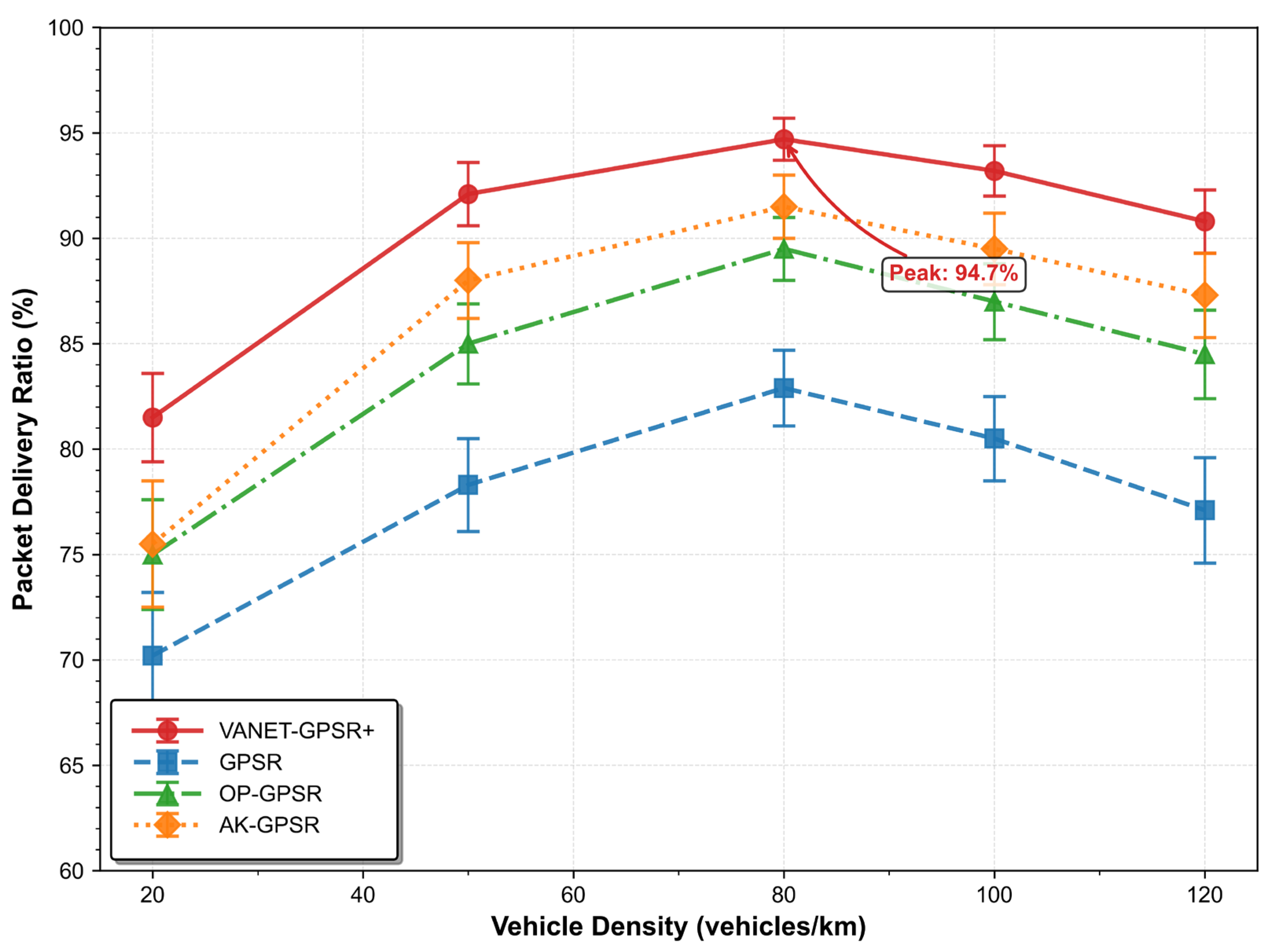
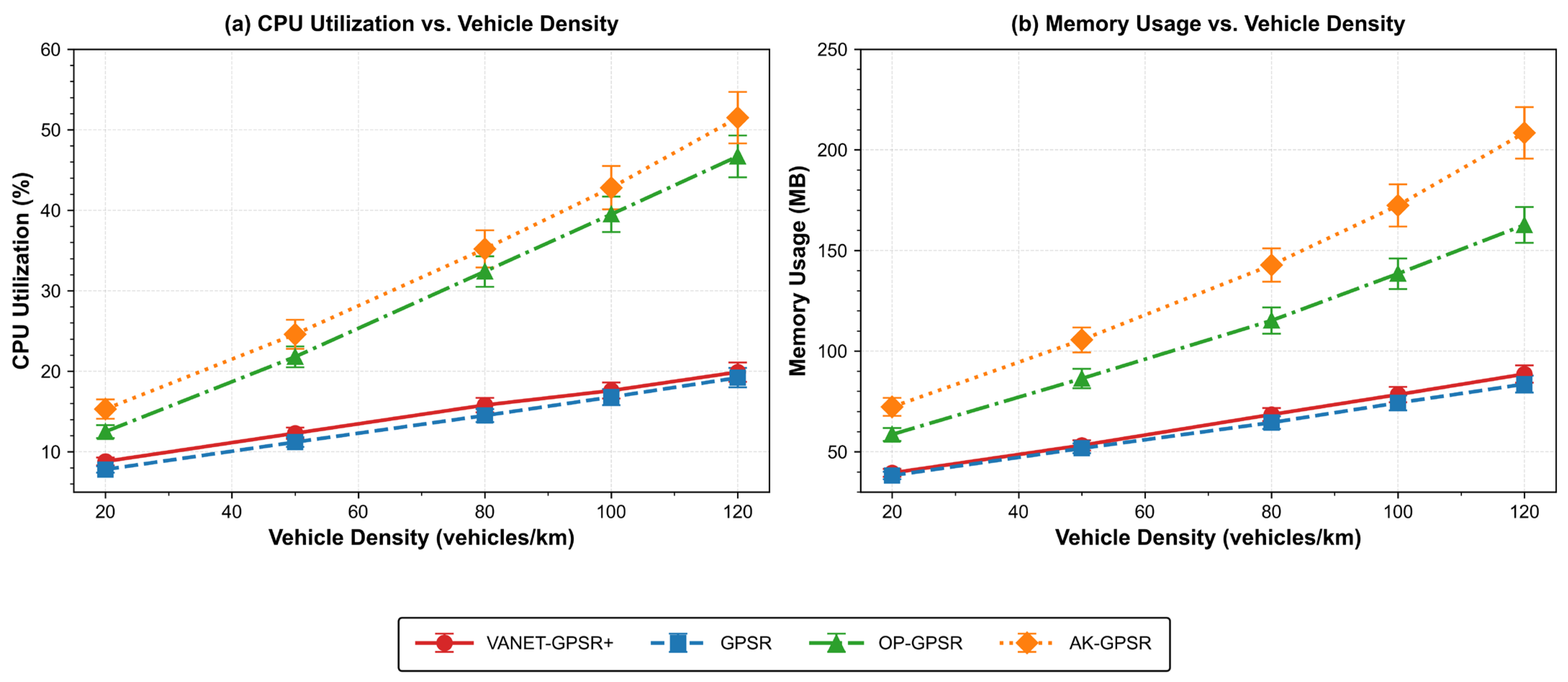
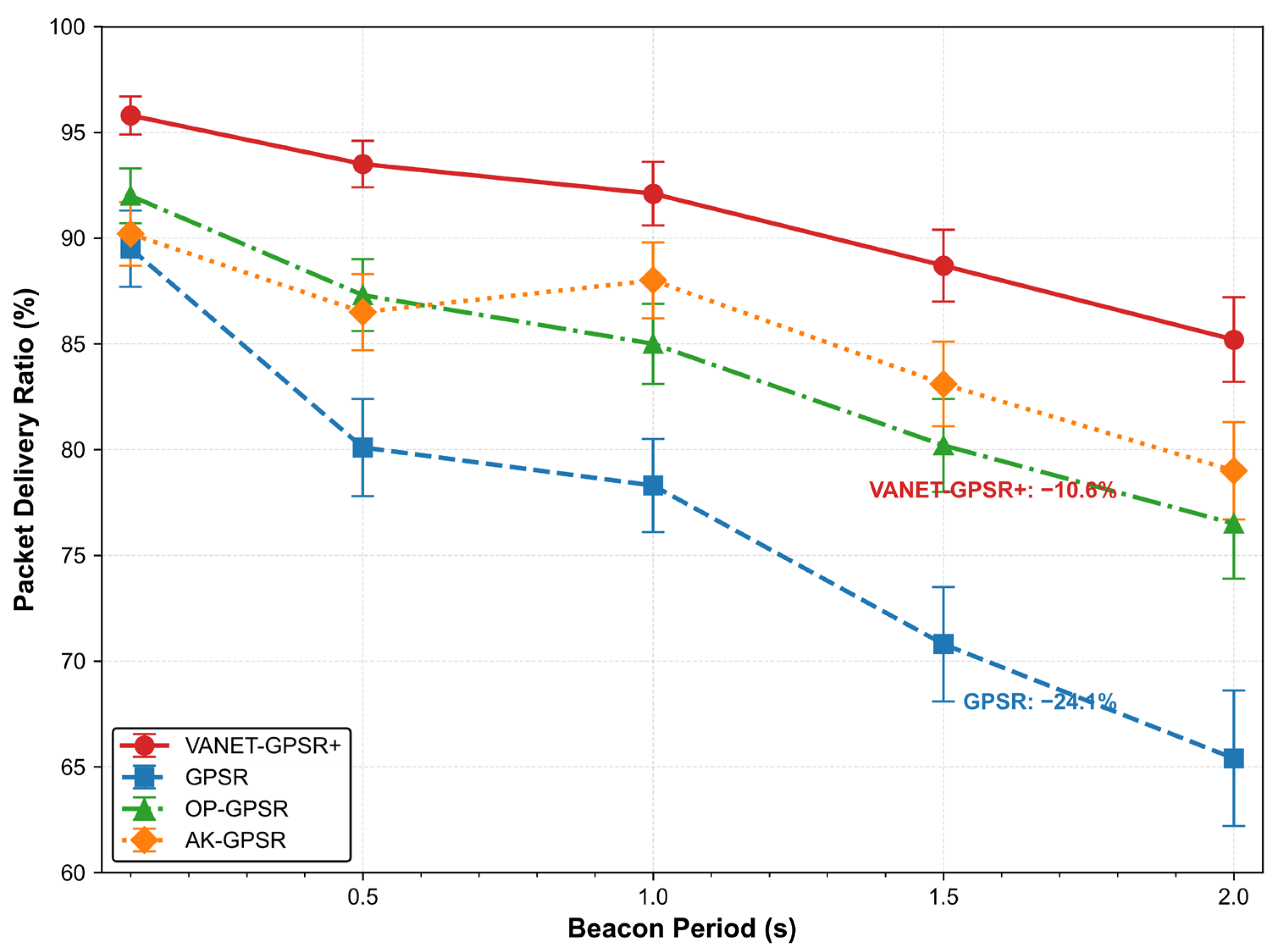
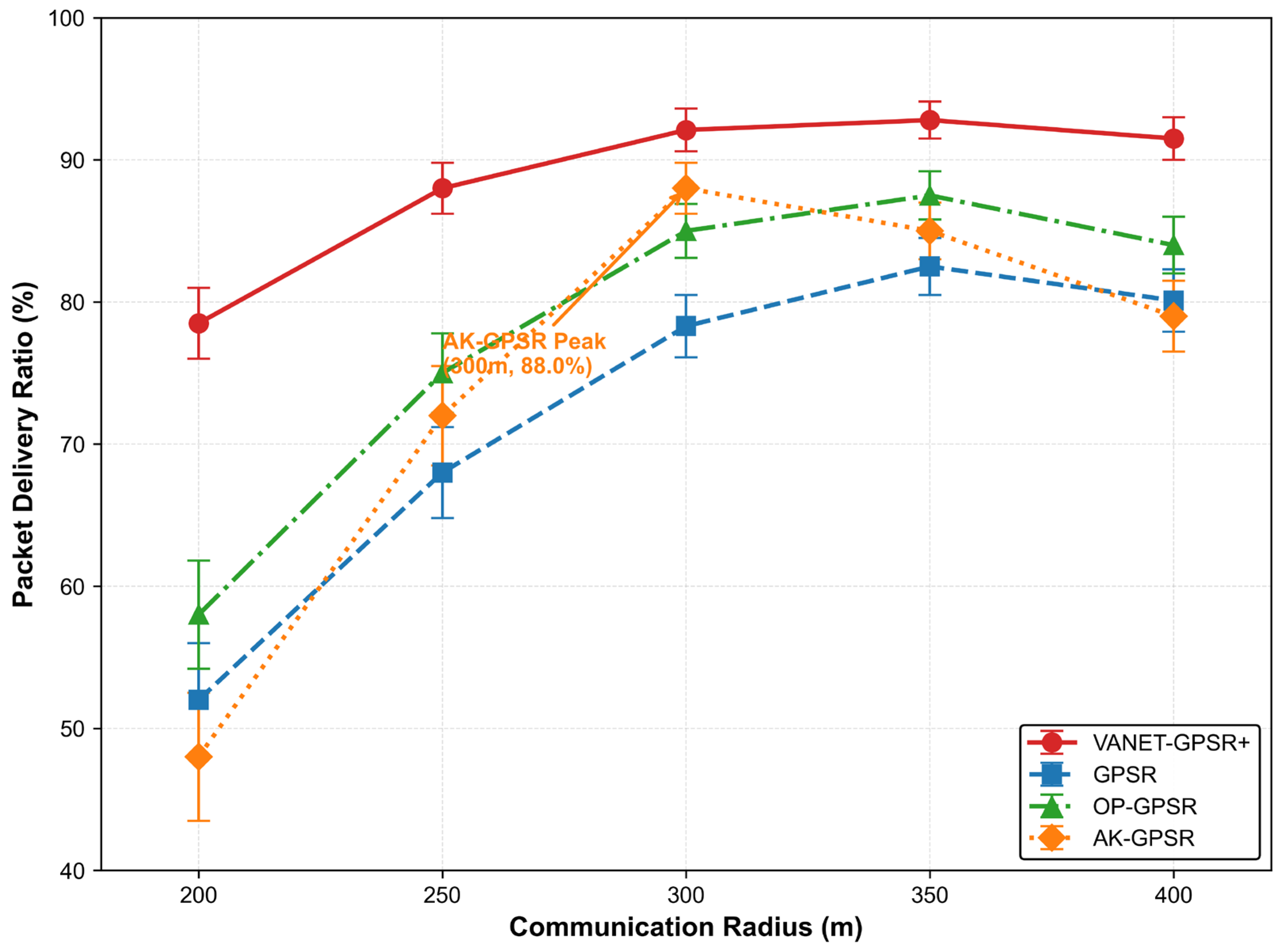
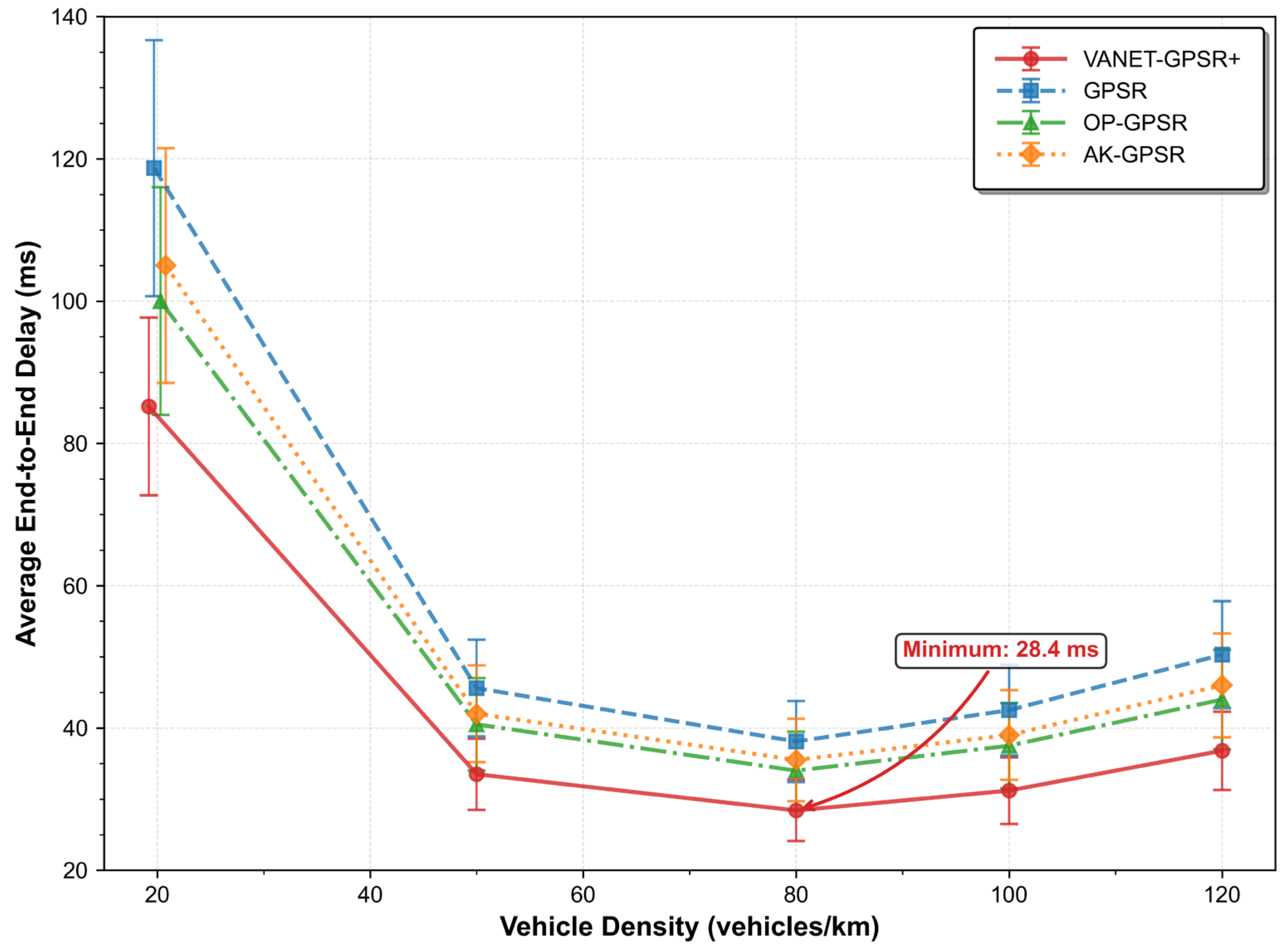
Vehicular Ad hoc Networks (VANETs) feature high node mobility and volatile topologies, rendering the conventional Greedy Perimeter Stateless Routing (GPSR) protocol prone to weak link stability and inefficient route discovery due to its lack of direction awareness. Existing direction-aware improvements typically rely on multi-criteria weighting or clustering, introducing heavy parameter fusion and computational overhead that conflict with the resource-constrained nature of onboard units. To overcome these limitations, this paper presents VANET-GPSR+, a lightweight enhanced routing protocol. Its key novelty is that it discards multi-parameter fusion and relies solely on movement direction, supported by a synergistic framework of three lightweight mechanisms: direction-aware neighbor classification to prioritize nodes with consistent trajectories, adaptive greedy forwarding region expansion in sparse and dynamic networks, and path deviation angle-based next-hop selection. This work builds a probabilistic link lifetime model that theoretically quantifies the stability gains of direction awareness—a novel theoretical foundation. Comprehensive urban and highway simulations show that VANET-GPSR+ improves the packet delivery ratio by 16.3% and reduces end-to-end delay by 27.5% compared with standard GPSR, and it outperforms both OP-GPSR and AK-GPSR. It introduces negligible CPU and memory overhead, with CPU usage over 50% lower than the two benchmark protocols at 80 vehicles/km, and demonstrates strong robustness against varying beacon intervals and communication radii. Retaining GPSR’s stateless and distributed traits, VANET-GPSR+ delivers substantial performance gains with minimal overhead, serving as an efficient routing solution for highly dynamic VANETs.
Keywords: vehicular ad hoc networks (VANETs); Greedy Perimeter Stateless Routing (GPSR); direction awareness; link stability; probability model; routing optimization vehicular ad hoc networks (VANETs); Greedy Perimeter Stateless Routing (GPSR); direction awareness; link stability; probability model; routing optimization