HBV-IoT: Hierarchical Blockchain-Based Vehicular IoT Network Model for Secured Traffic Monitoring and Control Management




Abstract
1. Introduction
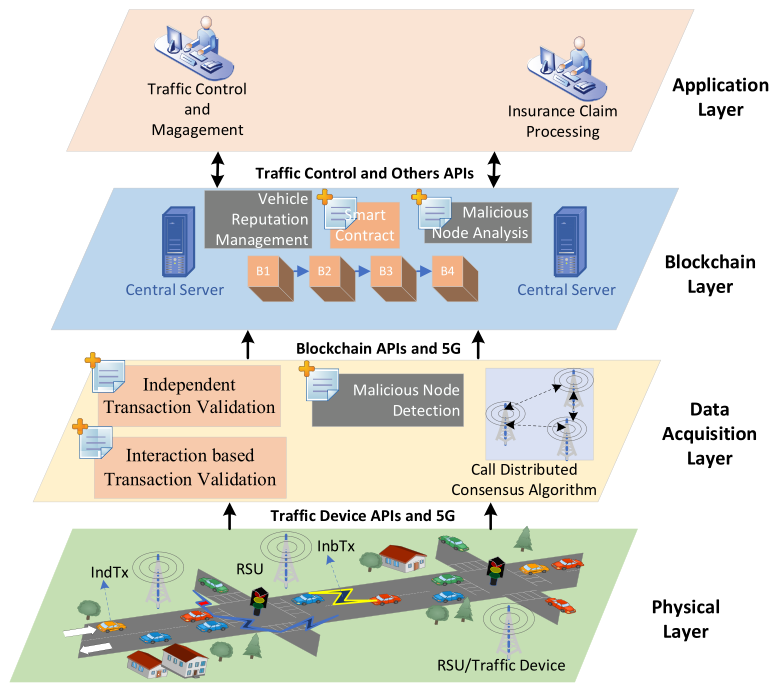
- A novel four-tier hierarchical blockchain architecture accommodating heterogeneous node capabilities while maintaining security guarantees is presented.
- Independent and interaction-based transaction types are presented to know the state of the vehicles and to enable cross-validation and fraud detection when two vehicles are in proximity to each other.
- Smart contracts are proposed to automate consensus, validation, and dispute resolution mechanisms for vehicle interactions.
- Distributed consensus algorithm and vehicle reputation management algorithm are presented for the traffic device to write transactions on the blockchain, and evaluate the trustworthiness of the vehicles, respectively.
- Security analysis of the HBV-IoT is presented to show its robustness against different types of attacks.
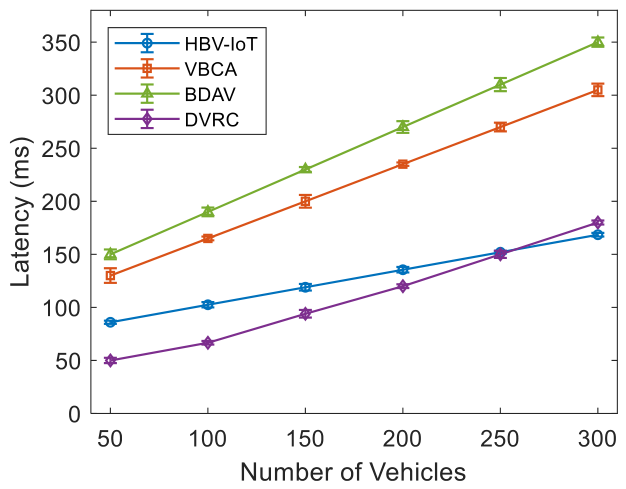
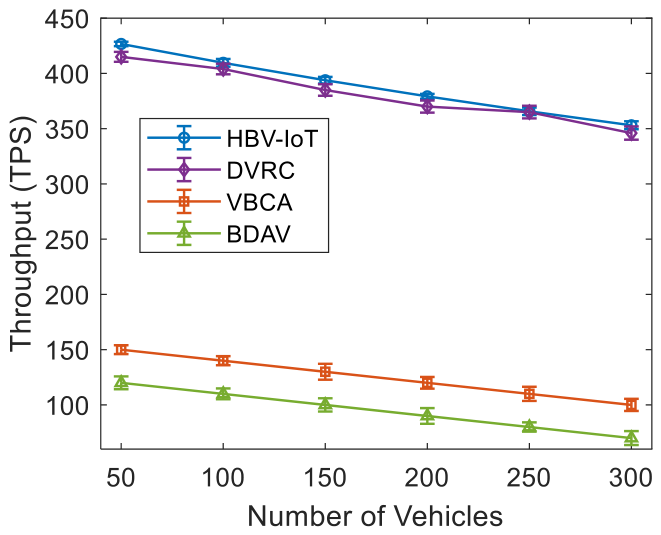
- Simulation results are compared with state-of-the-art approaches to demonstrate the effectiveness of the proposed scheme.
2. Related Work
2.1. Blockchain in Vehicular Networks
2.2. Hierarchical and Multi-Layer Blockchain Architectures
2.3. Blockchain-IoT Integration for Diverse Domains
2.4. Blockchain Security and IoT Vehicular Foundations
2.5. Positioning of the Proposed HBV-IoT Model
3. Propose HBV-IoT Model
3.1. System Architecture
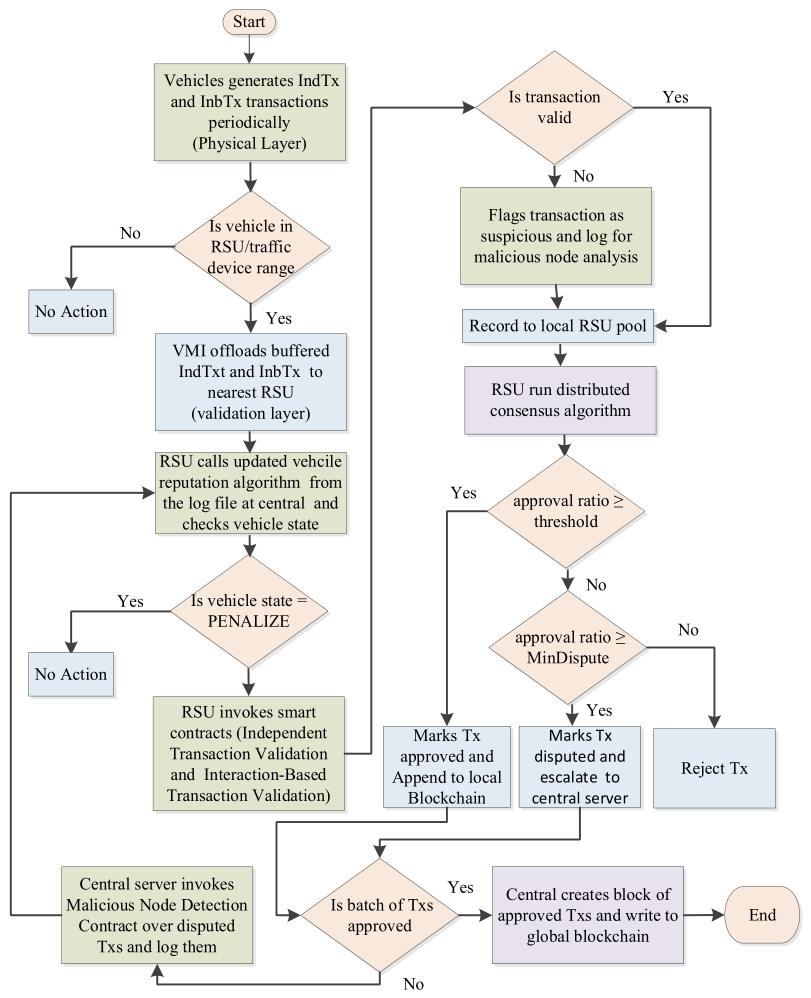
- Vehicle generates data
- VMI continuously collects sensor data.
- VMI periodically creates:
- ∘
- IndTx for periodic status.
- ∘
- InbTx for exchange corroborating data.
- Each Tx is signed with the vehicle’s private key.
- Tx is buffered locally until no RSU is in its proximity.
- Vehicle enters RSU range
- VMI offloads buffered IndTx and InbTx to the nearest RSU.
- RSU checks vehicle state
- The RSU queries the global blockchain for the vehicle’s current reputation and state: MONITOR, ISOLATE, or PENALIZE, which are set by the malicious-node detection contract at the central layer.
- ∘
- If the state is PENALIZE, RSU drops all transactions and the log event.
- ∘
- Else, the state is MONITOR or ISOLATE, the RSU continues with validation, but may treat the vehicle more cautiously.
- RSU invokes Smart Contract 1 (Independent Transaction Validation)For each IndTx:
- Call ValidateIndependentTransaction(IndTx).
- If valid, add to local RSU pool.
- Else, mark as rejected and log for central analysis.
- RSU invokes Smart Contract 2 (Interaction-Based Transaction Validation)For each InbTx pair from two vehicles:
- Call ValidateInteractionBasedTransaction(txA, txB).
- If approved, add canonical interaction record to local RSU pool.
- If approved with low confidence, it adds and flags it as suspicious.
- If rejected/flagged, store for malicious-node analysis.
- RSU: run distributed consensusRSU validators execute DistributedConsensus(TxBatch, validators) over the validated transactions pool.
- Validators (RSUs) vote Approved, Disputed, or Rejected.
- Append Approved to RSU’s local chain; forward Approved and Disputed to central servers.
- Central servers: commit and logCentral servers aggregate blocks from RSUs, finalize them into the global blockchain, and log validation outcomes, disputes, and rejections per vehicle.
- Central servers invoke Smart Contract 3 (malicious-node detection)Periodically call DetectMaliciousNodes(BatchOfTransactions) to identify compromised or malicious vehicles.
- RSUs receive updated statesRSUs regularly call the updated vehicle reputation algorithm, retrieve the state (MONITOR/ISOLATE/PENALIZE) from the central server, and apply it to steps 3–6, enforcing edge-level filtering and down-weighting for suspicious nodes.
- End of cycle; repeatVehicles continue generating transactions; the loop repeats with updated reputations and states.
3.2. Transaction Types and Structure
- Independent Transactions (IndTx)—Independent transactions represent vehicle state at specific time intervals, which consist of the following structure: Header: {TID, PTID, IK, TS, SIGN} and Payload: {LOC, SP, ACC, DIR, TEMP, HU, BET, EVT, CHECK}. They contain a header which includes transaction ID () denoting a unique 256-bit hash identifying the transaction, previous transaction ID () denoting the hash of the previous transaction, Identification Key () representing the vehicle’s unique identifier in the network, timestamp (TS) representing the precise time of transaction creation, and signature () representing the elliptic curve digital signature algorithm (ECDSA) signature using the vehicle’s private key. All are part of the header fields along with the data generated during the given timeframe. These types of transactions are generated by the VMI frequently at a periodic interval to store device related information such as location (LOC): GPS coordinates {latitude, longitude, altitude}; speed (SP); acceleration rate (ACC) of velocity change (m/s2); direction (DIR): heading angle (0–360 degrees); environmental data such as temperature (TEMP), humidity (HU), and weather conditions; vehicle status like battery level (BET), sensor health (SHE), system diagnostics, and events (EVT)—hard braking, collision warnings, and maintenance alerts; and checksum (CHECK) using CRC32 for data integrity verification, into the local blockchain network. These transactions are stored locally on the node until they come within range of a traffic device, which can offload them to the global blockchain network for transfer.
- Interaction-Based Transactions (InbTx): These transactions are event-based when two smart vehicle nodes come within range of each other. They enable cross-validation and fraud detection. This transaction is similar to an independent transaction, but it will also contain the signature of the other nodes participating in the interaction. The structure of InbTx can be given as Header: {TID, IK, , , SIGN, TS}; Dual Signatures: {, , , ; and Shared Data: {REL_P, REL_V, INT_D, MUT_A}. The signature of this block will have , Identification Key of the current vehicle (), Identification Key of the second vehicle (), Hashed Signature of data of the current vehicle () and Hashed Signature of data of the second vehicle () and timestamp (TS) representing the time of interaction detection. It also contains the Merkle hash of vehicle 1’s data () and Merkle hash of vehicle 2’s data (). The shared data between vehicles includes relative position (REL_P), relative velocity (REL_V), the duration of vehicles remaining in range (INT_D), and mutual awareness (MUT_A) to confirm that both vehicles detected the interaction. This transaction is generated in both smart vehicles and stored locally until they come within range of a traffic device, at which point it is offloaded to the global blockchain network. As the transaction is generated in both smart vehicles before being saved to the global network, validation is required to ensure the transactional data is identical across both nodes; only the data blocks that are consistent across both devices will be saved. In the validation mechanism, when vehicles generate interaction-based transactions, both transactions must contain identical data for cross-vehicle fields. Inconsistencies indicate tampering or compromised nodes and trigger an investigation. This introduces an additional level of authenticity and non-repudiation in the network, as any malicious user cannot make any malicious entry into the network, as it must be verified by data blocks generated by interacting vehicles.
3.3. Threat Model
- Double-Spending Attack: A malicious vehicle tries to use the same funds or credit twice by creating two different transactions that consume the same balance, often with identical or near-identical timestamps, so they appear concurrent. The goal is to have both transactions accepted before the system notices the conflict, effectively “spending” more than the true balance.
- Sybil Attack: An adversary creates numerous fake identities of the vehicles (several public keys/IDs) and introduces them into the system in such a way that one attacker can be represented as a great number of independent nodes. In so doing, the attacker tries to sway consensus votes, reputation scores, or validation results by acting upon a large portion of the apparent participants, although they are controlled by a single party.
- 51% Consensus Attack: The attacker targets validators (traffic devices/RSUs). When the attacker can breach or manage a majority of the validator power (e.g., over 50% of the RSUs or the effective reputation weight thereof), they will be able to collaborate to endorse fraudulent transactions, censor legitimate ones, or rewrite recent sections of the ledger. This is a collusion attack on the consensus process at an infrastructure level.
- Transaction Replay Attack: Attacker captures a legitimate transaction and replicates it several times. The attacker logs an authentic exchange because it passes through the network and subsequently repeats it (replays) several times without the awareness of the vehicle. Unless the system properly imposes the uniqueness of transaction IDs, timestamps, or sequence numbers, the same action (e.g., a payment, status report, or authorization) might be performed multiple times.
- Man-in-the-Middle (MITM) Attack: In a MITM attack, the adversary positions themselves between the vehicle and the traffic device/RSU, intercepting and possibly altering messages in transit. They might change sensor readings, locations, or control commands while still trying to pass signature or protocol checks, aiming to inject false data or hide true events without endpoints immediately realizing that messages have been tampered with.
3.4. Blockchain Smart Contracts and Algorithms
- A.
- Smart Contracts
- Smart Contract 1: Independent Transaction Validation
| Algorithm 1. Contract ValidateIndependentTransaction(transaction) |
| Input: transaction Output: ValidationResult {} Begin 1. Function Ver_S() { Use the vehicle’s public key to verify the ECDSA signature. If ( signature invalid) { Return {isValid: false, reason: “Invalid signature”} } End if }End function 2. Function Check_TC() { Verify timestamp is within ±5 s of the current time. Confirm the timestamp is after the previous transaction’s timestamp. If ( inconsistent) { Return {isValid: false, reason: “Invalid timestamp”} } End if }End function 3. Function Val_SD() { Check SP is within the vehicle’s physical capabilities (0–250 km/h) Verify ACC is within realistic bounds (−10 to +10 m/s2) Confirm that the GPS coordinates are within the network bounds. If (any violation) { Return {isValid: false, reason: “Implausible sensor data”} } End if }End function 4. Function Check_PT() { Retrieve PTID Verify it exists in the local or global blockchain. Confirm chronological order If (failed ) { Return {isValid: false, reason: “Previous transaction not found”} } End if }End function 5. Function Ver_DI() { Recalculate CRC32 checksum from payload Compare with the provided checksum. If (mismatch ) { Return {isValid: false, reason: “Data corruption detected”} } End if }End function 6. Function Rep_C() { Retrieve the vehicle’s current reputation score. If ( score < 30: Flag for manual review (suspicious vehicle) Continue processing, but mark with lower confidence } End if }End function 7. Function Store_ LB() { Add a validated transaction to the local blockchain. Update transaction index for quick retrieval If (all checks pass) { Return {isValid: true, reason: “Transaction validated”} } End if }End function End |
- 2.
- Smart Contract 2: Interaction-Based Transaction Validation
| Algorithm 2. Contract ValidateInteractionBasedTransaction(transaction1, transaction2) |
|
Input: txA, txB Output: ValidationResult {isValid: Boolean, matchScore: Float, action: String} Begin 1. Function Int_SV () { Verify txA signature using Vehicle A’s public key Verify txB signature using Vehicle B’s public key If (either fails) { Return {isValid: false, action: “Reject both transactions”} } End if } End function 2. Function Cros_VCC () { Extract shared data fields from both transactions {REL_P, REL_V, DUR, InterationType } Compare values with the tolerance threshold. Calculate consistency SCORE If () { Inconsistency detected between vehicles. Mark Vehicle with inconsistency count++ } End if }End function 3. Function Data_PC () { If ( ) { Flag as unlikely } End if If ( ) { Flag as too brief for interaction } End if If ( ) { Flag as exceeding range } End if Check against recent independent transactions Verify LOC consistency } End function 4. Function Time_S () { If () { Return {isValid: false, action: “Timestamp mismatch”} } End if }End function 5. Function Mer_HV () { Regenerate Merkle trees from vehicle data. Compare calculated hashes with provided hashes (HASH1, HASH2) If (mismatch ) { Possible data tampering detected Flag the vehicle for investigation } End if }End function 6. Function Con_D() { If () { Return {isValid: true, action: “Approve both transactions”, matchScore: Score} } End if If () { Return {isValid: true, action: “Approve with lower confidence”, matchScore: Score} } End if If () { Return {isValid: false, action: “Flag for central authority review”} } End if }End function 7. Function Rep_U() { For valid transactions Vehicle_A.reputation += 1 Vehicle_B.reputation += 1 End for For invalid transactions Vehicle_A.reputation −= 10 Vehicle_B.reputation −= 10 End for }End function End |
- 3.
- Smart Contract 3: Malicious-Node Detection
| Algorithm 3. Contract DetectMaliciousNodes() |
|
Input: Batch of Transactions Output: {SuspiciousVehicles: List, Actions: List} Begin 1. Function Ana_IP() { For each vehicle V InCount[V] = Count of inconsistent interaction transactions Ins_Rate[V] = InCount[V]/TotalInteractions[V] If ( ) { Mark V as potentially malicious } End if End for }End function 2. Function Loc_SD() { Compare GPS coordinates with cellular tower data If (vehicle reported at multiple locations simultaneously) { Flag as location spoofing } End if }End function 3. Function Rep_S() { Calculate Maliciousness Score Score = (InconsistencyRate × )+ (AnomalyRate × )+ (LocationSuspicion × ) where α + β + γ = 1 If () { MONITOR by increasing check frequency } elseif ) { ISOLATE the vehicle for some specified time } else { PENALIZE, that is long-term isolation and report to authorities } End if } End function 4. Function Take_A() { If (MONITOR) { Log increased surveillance } End if If (ISOLATE) { Revoke the vehicle’s consensus participation rights Prevent acceptance of transactions from this vehicle Set expiration: 24 hours } End if If (PENALIZE) { Broadcast a malicious node alert to all traffic devices Prevent any transaction acceptance Notify RTO and government authorities Trigger insurance policy review }End if }End function End |
- B.
- Algorithms
- (1)
- Distributed Consensus Algorithm
| Algorithm 4. DistributedConsensus(TxBatch, Validators) |
| Input: TxBatch // list of candidate transactions tx Validators // RSUs with reputation scores Output: Approved, Rejected, Disputed Begin Approved = 0 ; Rejected = 0 ; Disputed = 0 // Normalize reputations to weights totalRep = Σ v.reputation for v in Validators for each v in Validators v.weight = v.reputation / totalRep end for Threshold = 0.70 // approve if ≥ 70% weighted support MinDispute = 0.40 // dispute if in [40%, 70%) for each tx in TxBatch // send tx to all validators and collect votes Responses = getVotesFromValidators(tx, Validators, timeout) weightedApprove = 0 totalWeight = 0 for each (v, vote) in Responses totalWeight = totalWeight + v.weight end for if (vote == APPROVE) weightedApprove = weightedApprove + v.weight end if if (totalWeight == 0) Disputed = Disputed ∪ {tx} continue end if ratio = weightedApprove / totalWeight if ( ratio ≥ Threshold) { Approved = Approved ∪ {tx} appendToLocalBlockchain(tx) } elseif ( ratio ≥ MinDispute) { Disputed = Disputed ∪ {tx} escalateToCentralAuthority(tx) } else { Rejected = Rejected ∪ {tx} } end if end for return (Approved, Rejected, Disputed) End |
- (2)
- Vehicle Reputation Management
| Algorithm 5. UpdateVehicleReputation(vehicleID) |
| Input: vehicleID Output: NewRep // in [0, 100] Begin CurrentRep = getReputation(vehicleID) RecentTx = getLastNTransactions(vehicleID, N = 100) if ( size(RecentTx) > 0 ) { valid = count(tx.status == "APPROVED") rate = valid / size(RecentTx) if ( rate > 0.95 ) { ConsBonus = +5 } elseif (rate > 0.80) { ConsBonus = +2 } elseif ( rate < 0.50 ) { ConsPenalty = −15 } end if }else { ConsBonus = 0 ; ConsPenalty = 0 } end if InterTx = getInteractionTransactions(vehicleID) if ( size(InterTx) > 0 ) { matched = count(itx.matchStatus == "MATCHED_HIGH_CONF") mRate = matched / size(InterTx) if ( mRate > 0.90 ) { IntBonus = +3 } elseif ( mRate < 0.70 ) { IntPenalty = −8 } end if else { IntBonus = 0 ; IntPenalty = 0 } end if Viol = countTrafficViolations(vehicleID) Speed = countSpeedingIncidents(vehicleID) if ( Viol == 0 and Speed == 0 ) { CompBonus = +5 } else { CompPenalty = Viol*2 + Speed*1 } end if daysInact= daysSinceLastActivity(vehicleID) if ( daysInact > 30 ) { InactPenalty = floor(daysInact / 10) } else { InactPenalty = 0 } end if NewRep = CurrentRep NewRep = NewRep + ConsBonus - ConsPenalty NewRep = NewRep + IntBonus - IntPenalty NewRep = NewRep + CompBonus - CompPenalty NewRep = NewRep - InactPenalty NewRep = clamp(NewRep, 0, 100) setReputation(vehicleID, NewRep) return NewRep End |
4. Simulation Results and Performance Evaluation
4.1. Security Analysis
- Double-Spending Attack: In a double-spending attack, a compromised vehicle attempts to reuse the same credits or conflicting state in multiple transactions. HBV-IoT mitigates this in three ways:
- Smart Contract 1 also ensures: at RSUs, temporal consistency and chain linkage between (PTID), and (TID) by rejecting non-monotonic or duplicate transaction sequences for the same vehicle.
- The distributed consensus algorithm employs reputation-weighted voting, where reaching consensus in the presence of fraudulent transactions while including an arbitrary number of compromised RSUs requires a supermajority (≥70%) of weighted validator trust and is effectively impossible if most weight is honest.
- In the central layer, when conflicting transactions are seen over time (e.g., two transactions spending the same credit), they are considered as strong evidence for the raised maliciousness score of the vehicle using DetectMaliciousNodes, and therefore, move it into ISOLATE/PENALIZE.
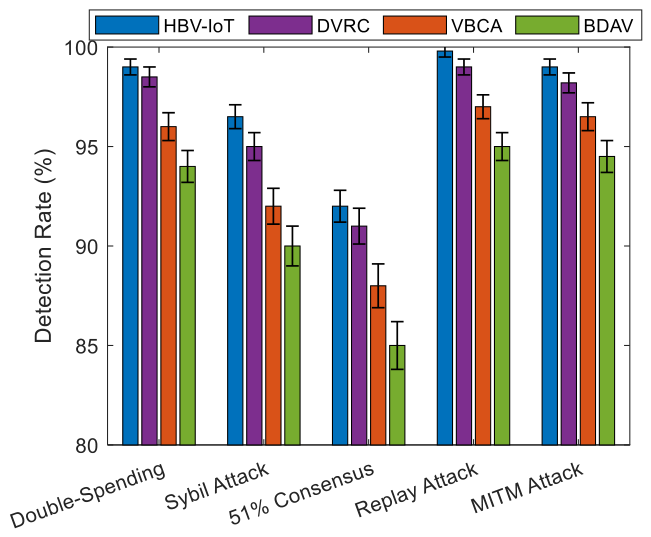
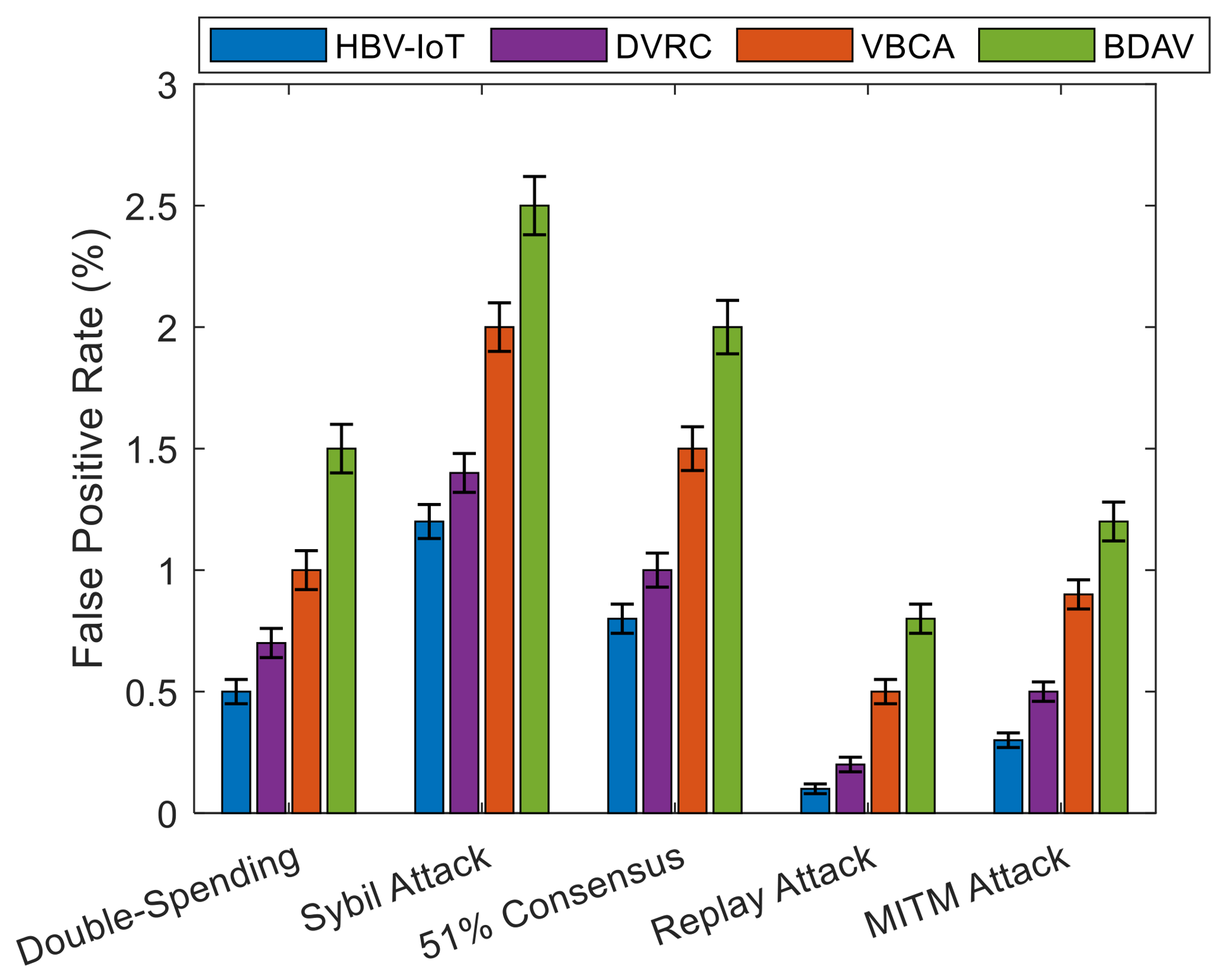
Simulation results show that HBV-IoT detects double-spending at about 99% while maintaining false positives around 0.5%, and requires, on average, three suspicious events to classify a malicious vehicle, outperforming the VBCA and BDAV baselines. - Sybil Attack: In Sybil attacks, an adversary forges many vehicle identities to influence consensus or reputations. HBV-IoT prevents Sybil impact as follows.
- Vehicle identities are bound to registration and long-term reputation; newly appearing identities start with moderate reputation and therefore low consensus weight, so they cannot immediately dominate RSU decisions.
- Interaction-based transactions rely on cross-vehicle corroboration and physical constraints (relative position, speed, duration); Sybil identities that do not correspond to real vehicles cannot consistently produce plausible, mutually consistent interaction data.
- The reputation update algorithm penalizes vehicles exhibiting repeated inconsistencies or anomalies, so clusters of Sybils with correlated misbehavior are gradually driven into low-reputation regions and eventually isolated.
HBV-IoT attains Sybil attack detection rates above 96% with lower false positives and shorter detection times than the considered baselines, due to its combination of behavior-driven reputation and interaction validation. - A 51% Consensus Attack: To mitigate 51% consensus attack, the traffic device validators run a reputation-weighted voting process to prevent low-reputation nodes from controlling decisions. High-reputation RSUs influence the decision more than low-reputation ones. These distributed traffic device validators are selected across geographic network regions to prevent collusion within a single region. In simulations, HBV-IoT detects validator-level attacks (modeled as “51% consensus” scenarios) with rates above 92%, and requires fewer suspicious validation outcomes to isolate colluding nodes than conventional schemes.
- Transaction Replay Attack: To prevent transaction replay attacks, each transaction contains a unique TID based on the content hash to prevent duplicates and also uses sequence numbers in the blockchain to prevent out-of-order insertion. Furthermore, the timestamp of each transaction is validated using the Time_S() contract function, and transactions older than 5 s are generally considered suspicious and are automatically rejected by the HBV-IoT model. It detects replay attacks at a rate near 99.8%, with almost zero false-positive rate and an average detection time of one suspicious event, significantly better than VBCA and BDAV.
- Man-in-the-Middle Attack: To prevent a man-in-the-middle attack, the proposed HBV-IoT model utilizes ECDSA digital signatures using Ver_S() contract function to verify data integrity. Mutual authentication between vehicles and traffic devices prevents an attacker from intercepting vehicle-to-traffic device communication and modifying data. Furthermore, hash verification using the Mer_HV() contract function detects any modification to the transaction, and such trisections are liable to rejection. This prevents a man-in-the-middle attack in the HBV-IoT. As a result, HBV-IoT achieves MITM detection rates around 99%, with low false positives (~0.3%) and rapid classification of compromised nodes.
4.2. Simulation Environment
4.3. Thresholds Selection and Sensitivity
4.4. Performance Results
4.5. Discussion
5. Conclusions and Future Work
Author Contributions
Funding
Institutional Review Board Statement
Informed Consent Statement
Data Availability Statement
Acknowledgments
Conflicts of Interest
References
- Taherpour, A.; Wang, X. A high-throughput and secure coded blockchain for IoT. IEEE Trans. Dependable Secur. Comput. 2025, 22, 3561–3579. [Google Scholar] [CrossRef]
- Liang, J.; Miao, C.; Chen, J.; Zhu, R.; Lu, K.; Jiao, L. Reputation Value-Based Converged Dual-Channel Digital Forensics for Blockchain-Enabled Smart Vehicles. IEEE Trans. Intell. Veh. 2025, 10, 2948–2962. [Google Scholar] [CrossRef]
- Xia, Z.; Man, J.; Gu, K.; Li, X.; Huang, L. Conditional Data-Sharing Privacy-Preserving Scheme in Blockchain-Based Social Internet of Vehicles. IEEE Trans. Sustain. Comput. 2025, 10, 378–395. [Google Scholar] [CrossRef]
- De Vincenzi, M.; Moore, J.; Smith, B.; Sarma, S.E.; Matteucci, I. Security Risks and Designs in the Connected Vehicle Ecosystem: In-Vehicle and Edge Platforms. IEEE Open J. Veh. Technol. 2025, 6, 442–454. [Google Scholar] [CrossRef]
- Zhang, J.; Xia, C.; Cui, J.; Zhong, H.; Wei, L.; Bolodurina, I.; He, D. Reputation System-Based Vehicle Violation Reporting Service with Invalid Signature Identification in VANETs. IEEE Trans. Intell. Transp. Syst. 2025, 26, 11534–11547. [Google Scholar] [CrossRef]
- Zhu, R.; Hu, S.; Helal, S.; Song, J.; Wang, J.; Chen, Y. BTDS: Blockchain-Enabled Trusted Vehicle Violation Detection by Self-Supervision. IEEE Internet Things J. 2025, 12, 20156–20173. [Google Scholar] [CrossRef]
- Yadav, S.; Singh, K.; Yadav, A.K.; Shariq, M.; Chaudhry, S.A.; Das, A.K.; Manjul, M. Efficient and Reliable Information Sharing for Internet of Vehicles Using Trust and Blockchain. IEEE Trans. Veh. Technol. 2025, 74, 16716–16728. [Google Scholar] [CrossRef]
- Kumar, S. A Review on Cyber-Physical Systems based on Blockchain: Possibilities and Challenges. In Proceedings of the IEEE 6th International Conference on Computing, Communication and Automation (ICCCA), Arad, Romania, 17–19 December 2021; pp. 691–696. [Google Scholar]
- Dorri, A.; Steger, M.; Kanhere, S.S.; Jurdak, R. Blockchain: A Distributed Solution to Automotive Security and Privacy. IEEE Commun. Mag. 2017, 55, 119–125. [Google Scholar] [CrossRef]
- Sehar, N.U.; Khalid, O.; Khan, I.A.; Rehman, F.; Fayyaz, M.A.; Ansari, A.R.; Nawaz, R. Blockchain-enabled data security in vehicular networks. Sci. Rep. 2023, 13, 4412. [Google Scholar] [CrossRef]
- Ren, Z.; Liu, S.; An, Y.; Li, Y.; Wu, N. A blockchain-based data storage architecture for Internet of Vehicles: Delay-aware consensus and data query algorithms. Veh. Commun. 2024, 47, 100772. [Google Scholar] [CrossRef]
- Zhang, L.; Hang, L.; Zu, K.; Wang, Y.; Yang, K. Dynamic Vehicle Reputation Consensus: Enhancing IoV Communication with a Blockchain Algorithm. IEEE Trans. Veh. Technol. 2025, 74, 4788–4806. [Google Scholar] [CrossRef]
- Wang, H.; Cheong, C.; Cao, Y.; Bouali, F.; Fu, C.; Li, Z. BTSR: Blockchain-based Trust Management Scheme for Social Routing in IoVs. IEEE Internet Things J. 2026, 1. [Google Scholar] [CrossRef]
- Zhang, Y.A.; Cheong, C.; Li, S.; Cao, Y.; Zhang, X.; Liu, D. False message detection in internet of vehicle through machine learning and vehicle consensus. Inf. Process. Manag. 2024, 61, 103827. [Google Scholar] [CrossRef]
- Tandon, R.; Verma, A.; Gupta, P.K. Blockchain enabled vehicular networks: A review. In Proceedings of the 2022 5th International Conference on Multimedia, Signal Processing and Communication Technologies (IMPACT), Aligarh, India, 26–27 November 2022; pp. 1–6. [Google Scholar] [CrossRef]
- Dwivedi, S.K.; Amin, R.; Das, A.K.; Leung, M.T.; Choo, K.K.R.; Vollala, S. Blockchain-based vehicular ad-hoc networks: A comprehensive survey. Ad. Hoc. Netw. 2022, 137, 102980. [Google Scholar] [CrossRef]
- AlHrazi, F.; Algabri, M.; Al-Khulaidi, A.A. Hierarchical Blockchain as Line Defense of Attacks to Messages Propagation in VANET. Sana’a Univ. J. Appl. Sci. Technol. 2023, 1. [Google Scholar] [CrossRef]
- Lai, J.; Zhang, X.; Liu, S.; Zhong, S.; Moshayedi, A.J. Blockchain-based VANET edge computing-assisted cross-vehicle enterprise authentication scheme. Comput. Commun. 2025, 231, 108040. [Google Scholar] [CrossRef]
- Badidi, E.; El Harrouss, O. Integrating edge computing and blockchain for safer and more intelligent transportation systems. Procedia Comput. Sci. 2024, 251, 273–280. [Google Scholar] [CrossRef]
- Zhang, D.; Yu, F.R.; Yang, R. Blockchain-Based Multi-Access Edge Computing for Future Vehicular Networks: A Deep Compressed Neural Network Approach. IEEE Trans. Intell. Transp. Syst. 2022, 23, 12161–12175. [Google Scholar] [CrossRef]
- Bai, P.; Kumar, S.; Aggarwal, G.; Mahmud, M.; Kaiwartya, O.; Lloret, J. Self-Sovereignty Identity Management Model for Smart Healthcare System. Sensors 2022, 22, 4714. [Google Scholar] [CrossRef]
- Bai, P.; Kumar, S.; Kumar, K.; Kaiwartya, O.; Mahmud, M.; Lloret, J. GDPR Compliant Data Storage and Sharing in Smart Healthcare System: A Blockchain-Based Solution. Electronics 2022, 11, 3311. [Google Scholar] [CrossRef]
- Bhawana Kumar, S.; Rathore, R.S.; Mahmud, M.; Kaiwartya, O.; Lloret, J. BEST—Blockchain-Enabled Secure and Trusted Public Emergency Services for Smart Cities Environment. Sensors 2022, 22, 5733. [Google Scholar] [CrossRef] [PubMed]
- Bai, P.; Kumar, S.; Kumar, K. Use of Blockchain Enabled IoT in Insurance: A Case Study of Calamity Based Crop Insurance. In Proceedings of the 2022 Third International Conference on Intelligent Computing Instrumentation and Control Technologies (ICICICT), Kannur, India, 11–12 August 2022; pp. 1135–1141. [Google Scholar]
- Miraz, M.H.; Ali, M. Blockchain Enabled Enhanced IoT Ecosystem Security. In International Conference for Emerging Technologies in Computing; Springer International Publishing: Cham, Switzerland, 2018; pp. 38–46. [Google Scholar]
- Rajawat, A.S.; Rawat, R.; Barhanpurkar, K.; Shaw, R.N.; Ghosh, A. Blockchain-based model for expanding IoT device data security. In Advances in Applications of Data-Driven Computing; Springer: Singapore, 2021; pp. 61–71. [Google Scholar]
- Wang, Z.; Cao, Y.; Zhou, H.; Jiang, K.; Song, Y.; Zhao, L. Reputation-Based Sensing Data Collection in Vehicular Crowdsensing: A Hybrid Incentive Approach. IEEE Trans. Mob. Comput. 2026, 1–18. [Google Scholar] [CrossRef]
- Hou, Y.; Cao, Y.; Xiong, H.; Kang, J.; Foh, C.H.; Dong, C. Heterogeneous broadcast signcryption scheme with equality test for IoVs. IEEE Trans. Veh. Technol. 2024, 73, 19550–19564. [Google Scholar] [CrossRef]
- He, Z.; Chen, F.; Yang, G.; Fu, Z.; Meng, H.; Mi, D.; Gao, Z.; Zhou, B.; Cao, Y.; Dianati, M. On the Positioning Technique for Electric Vehicle Wireless Charging in SAE J2954 Standard. In Proceedings of the 2025 IEEE 101st Vehicular Technology Conference (VTC2025-Spring), Oslo, Norway, 17–20 June 2025; pp. 1–6. [Google Scholar] [CrossRef]
- Hou, H.Y.; Cao, Y.; Xiong, H.; He, D.; Chi, C.-H.; Lam, K.-Y. Heterogeneous Parallel Key-Insulated Multi-Receiver Signcryption Scheme for IoV. IEEE Trans. Inf. Forensics Secur. 2025, 20, 5123–5137. [Google Scholar] [CrossRef]



| Methods | Ledger Layering | RSU Role | Interaction-Based Validation | Consensus Type | Attack Coverage | Storage/Growth Management | Scalability with Density |
|---|---|---|---|---|---|---|---|
| DVRC [12] | Single chain with a reputation score | Validators and reputation updaters | Indirect, via accumulated behavior | Reputation-aware BFT | No storage or replay | No | Degrades at high density |
| VBCA [10] | Single chain at RSUs | Validators/miners | Not explicit | Lightweight consortium/Raft-like consensus | Basic blockchain resilience | No | Degrades at high density |
| BDAV [11] | Single or dual chain | Data collectors and local storage nodes | Not explicit | Delay-aware consensus | Data integrity | Optimized placement | Degrades at high density |
| BTMR [14] | Single-layer | Collect trust evidence, maintain trust metrics | Indirect via multi-source trust scores | Lightweight consensus | Targets false information, malicious | Optimized trust storage, but it still grows with interactions | Degrades at high density |
| BECA [18] | Dual blockchain | Verifiers | Not explicit | Consortium-style consensus | Identity and auth-phase attacks | Sensitive vs public info separated across chains | Degrades at high density |
| Proposed HBV-IoT | Four-layer hierarchy (vehicle, RSU, central, application) | Independent and interaction validation, consensus | Explicit dual-signed interaction transactions | Reputation-weighted RSU consensus with periodic central malicious-node detection. | Combined replay, Sybil, double-spend, 51%, MITM via edge filtering and reputation loop | Local buffering/filtering, selective forwarding, and reduced duplicate interactions on the chain. | Maintains more stable latency and throughput at high density via hierarchy and edge filtering |
| Time-Difference | ||
|---|---|---|
| Threshold (s) | TPR (%) | FPR (%) |
| 1.0 | 99.9 | 1.92 |
| 1.5 | 98.7 | 0.4 |
| 2.0 | 91.7 | 0.0 |
| 2.5 | 73.8 | 0.0 |
| 3.0 | 49.9 | 0.0 |
| 3.5 | 26.7 | 0.0 |
| 4.0 | 8.3 | 0.0 |
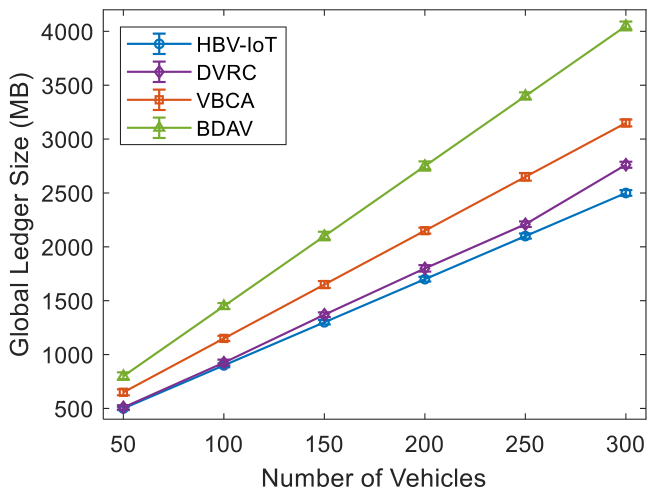
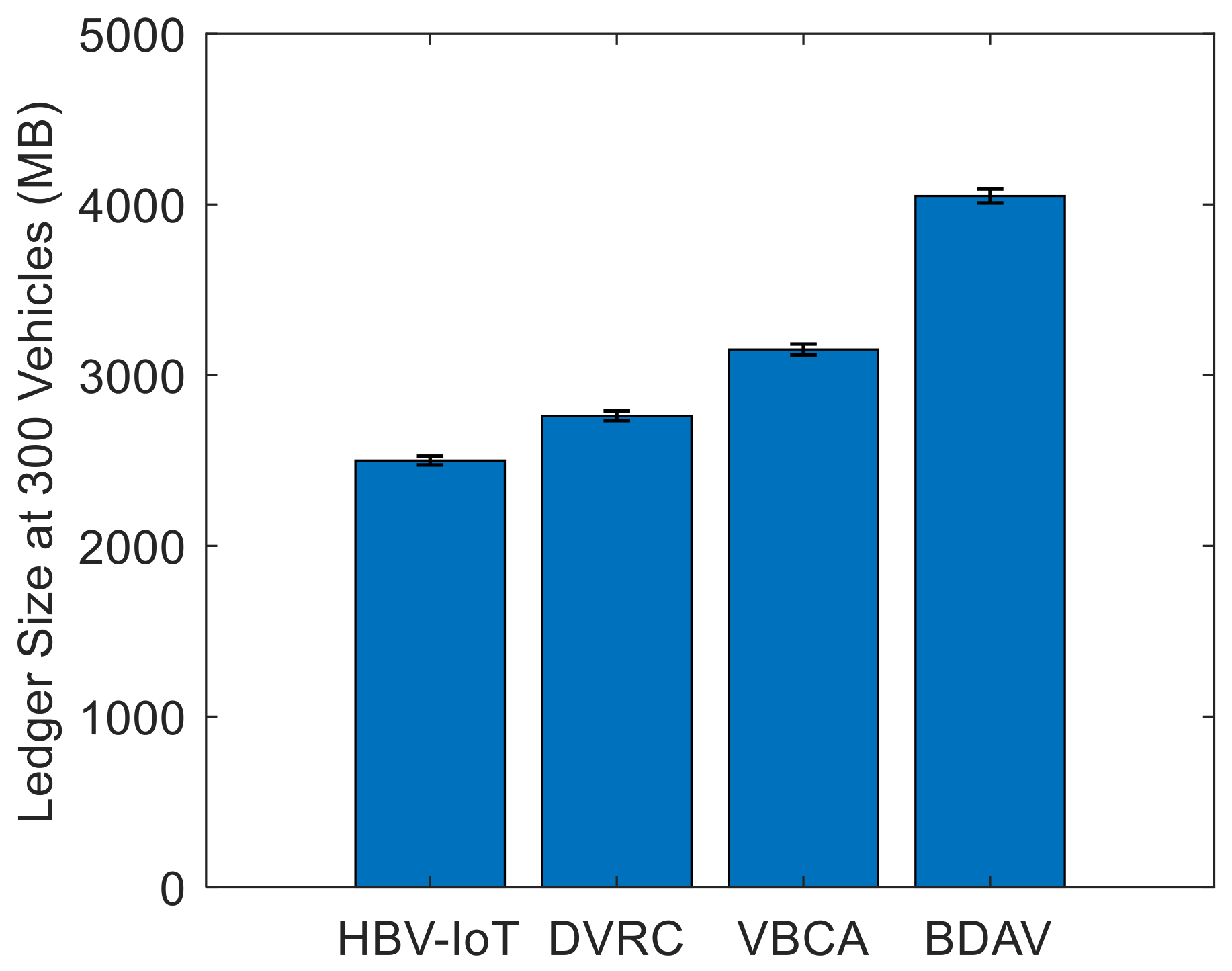
| Vehicles | HBV-IoT | Ledger Size in MB | % HBV-IoT Space Efficiency | ||||
|---|---|---|---|---|---|---|---|
| DVRC | VBCA | BDAV | DVRC | VBCA | BDAV | ||
| 50 | 500 | 510 | 650 | 800 | 1.96 | 23.07 | 37.50 |
| 100 | 900 | 925 | 1150 | 1450 | 2.70 | 21.73 | 37.93 |
| 150 | 1300 | 1370 | 1650 | 2100 | 5.10 | 21.21 | 38.09 |
| 200 | 1700 | 1800 | 2150 | 2750 | 5.55 | 20.93 | 38.18 |
| 250 | 2100 | 2210 | 2650 | 3400 | 4.97 | 20.75 | 38.23 |
| 300 | 2500 | 2762 | 3150 | 4050 | 9.48 | 20.63 | 38.27 |
Disclaimer/Publisher’s Note: The statements, opinions and data contained in all publications are solely those of the individual author(s) and contributor(s) and not of MDPI and/or the editor(s). MDPI and/or the editor(s) disclaim responsibility for any injury to people or property resulting from any ideas, methods, instructions or products referred to in the content. |
© 2026 by the authors. Licensee MDPI, Basel, Switzerland. This article is an open access article distributed under the terms and conditions of the Creative Commons Attribution (CC BY) license.
Share and Cite
Priya, S.; Kumar, S.; Anjani; Khasawneh, A.M.; Kaiwartya, O. HBV-IoT: Hierarchical Blockchain-Based Vehicular IoT Network Model for Secured Traffic Monitoring and Control Management. Sensors 2026, 26, 2511. https://doi.org/10.3390/s26082511
Priya S, Kumar S, Anjani, Khasawneh AM, Kaiwartya O. HBV-IoT: Hierarchical Blockchain-Based Vehicular IoT Network Model for Secured Traffic Monitoring and Control Management. Sensors. 2026; 26(8):2511. https://doi.org/10.3390/s26082511
Chicago/Turabian StylePriya, Shuchi, Sushil Kumar, Anjani, Ahmad M. Khasawneh, and Omprakash Kaiwartya. 2026. "HBV-IoT: Hierarchical Blockchain-Based Vehicular IoT Network Model for Secured Traffic Monitoring and Control Management" Sensors 26, no. 8: 2511. https://doi.org/10.3390/s26082511
APA StylePriya, S., Kumar, S., Anjani, Khasawneh, A. M., & Kaiwartya, O. (2026). HBV-IoT: Hierarchical Blockchain-Based Vehicular IoT Network Model for Secured Traffic Monitoring and Control Management. Sensors, 26(8), 2511. https://doi.org/10.3390/s26082511