Ubiquitous Non-Wearable Sensor for Human Sedentary Behavior Monitoring and Characterization




Highlights
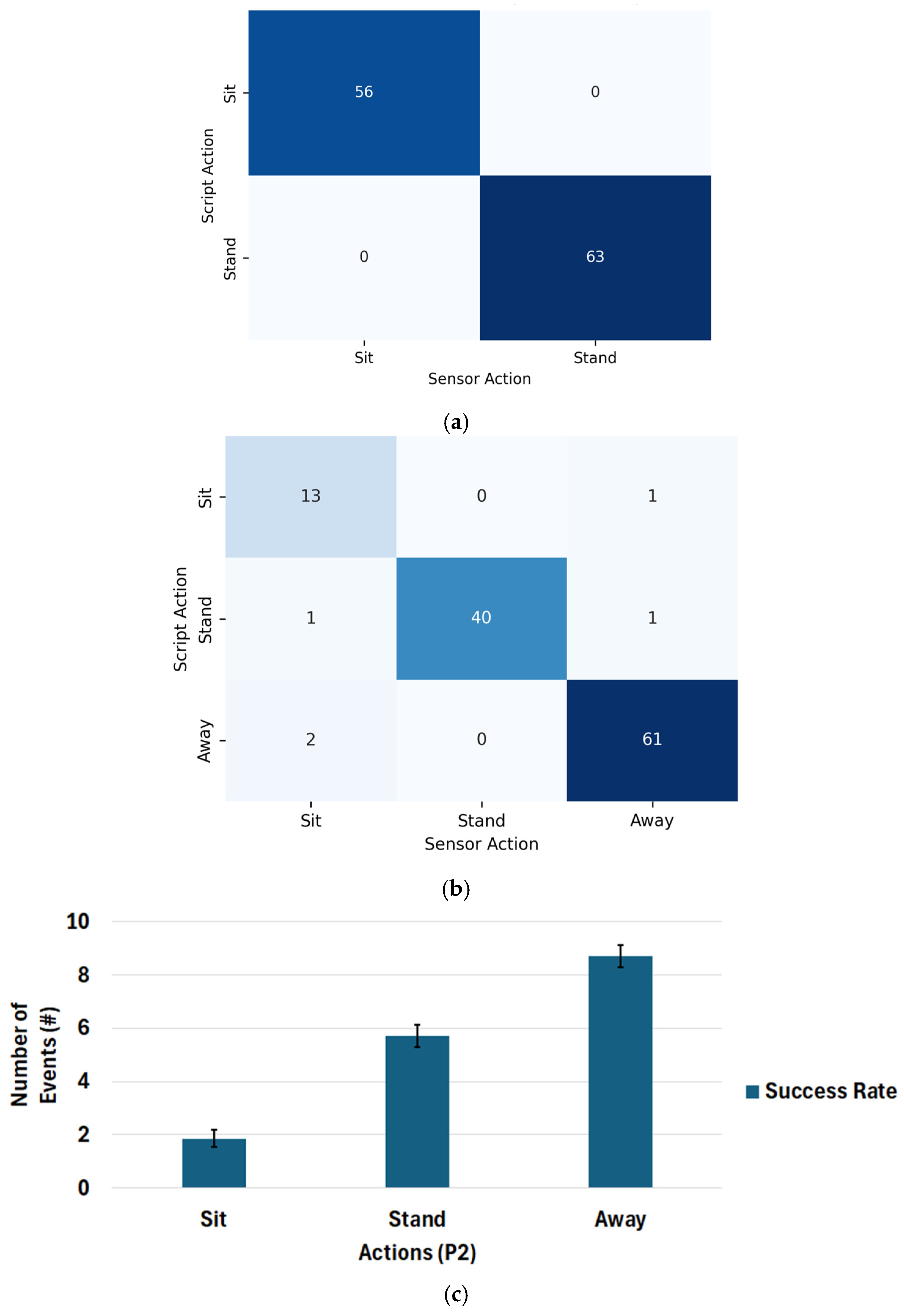
- The privacy-preserving sensor array accurately classified the number and the timeframe of sitting, standing, and away periods in a desk-based environment.
- Proposed architecture differentiates between sitting, standing at a desk and physical absence while achieving 100% sensitivity for desk-based exercise repetition tracking.
- A light-weight privacy-preserving sensor is capable of accurately detecting human behaviors and modifying movement prompt timing to reduce sedentary time and improve health.
- Real-time behavior recognition enables automated exercise logging, eliminating the human bias and burden inherent in self-reported compliance with exercise.
- The proposed sensor mechanism demonstrates the feasibility necessary to be integrated into a natural environment, as tested in an office.
Abstract
1. Introduction
- A sensor system that uses differential distance data to detect and quantify specific desk-based presence and physical activities. It demonstrates the ability to count repetitions during vertical-displacement exercises, such as desk squats, transforming the workstation into an active platform for monitoring “just-in-time” exercise interventions.
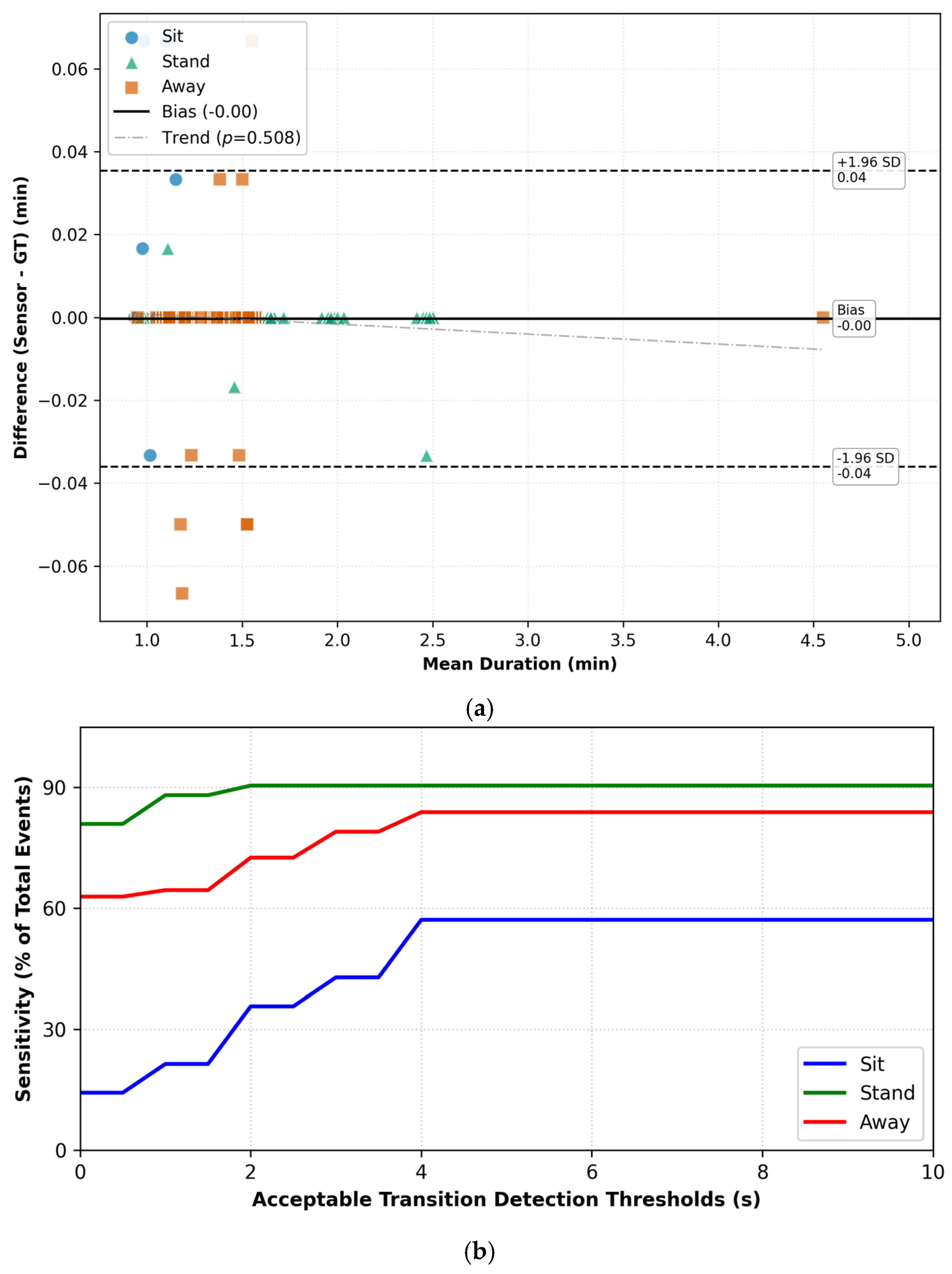
- The proposed sensor’s validity against a gold-standard video ground truth. The validation evaluates performance across a range of temporal resolutions, confirming detection accuracy for both metabolically meaningful sedentary bouts (exceeding 60 s) and rapid postural transitions typical during repeated exercises (<3 s).
- An in-depth analysis of the sensor’s performance of both typical office behaviors and active gesture recognition monitoring during exercise. The sensor accuracy and classification of standard desk-based behaviors of sit, stand, and away were potentially challenged by the higher variability of the participants performing these commonplace behaviors. Conversely, classification accuracy was higher for participants performing repeated exercises, which were putatively less variable.
2. Related Works
2.1. Sedentary Behavior Problem: Exertime/Barrier
2.2. Detecting Sedentary Behavior
2.3. Human–Computer Interface—Detecting User Behavior
2.3.1. Passive Sedentary Behavior vs. Gesture Recognition
2.3.2. Differences in Monitoring Techniques
- ◦
- Temporal scale and latency: Sedentary behavior methods emphasize longer windows, summarizing motion or posture over minutes to hours, while gesture recognition focuses on short, real-time windows for immediate interaction.
- ◦
- Feature patterns: Sedentary detection often relies on statistical and threshold-based movement summaries and relatively simple classifiers, whereas gesture recognition frequently uses rich spatio-temporal features and advanced models (e.g., deep networks) to capture fine movement dynamics.
- ◦
- Sensor choice: Wearables (IMUs, heart rate, pressure) and depth/smartphone sensors dominate sedentary sensing; gesture recognition spans vision, inertial, acoustic, radar, and light-based sensors, often fused for robustness [36].
3. Device Architecture and System Design
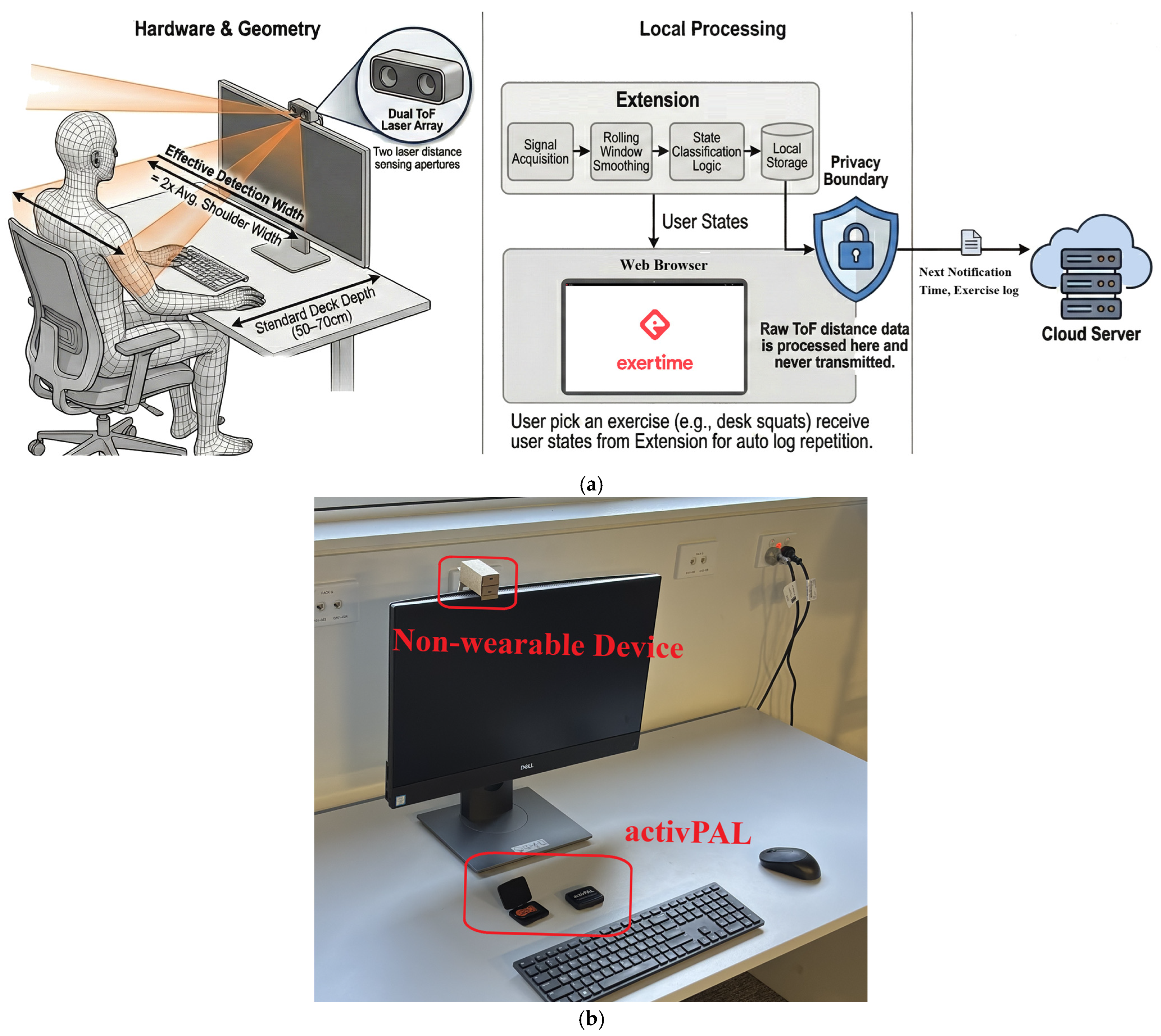
3.1. Privacy-Preserving Edge Architecture
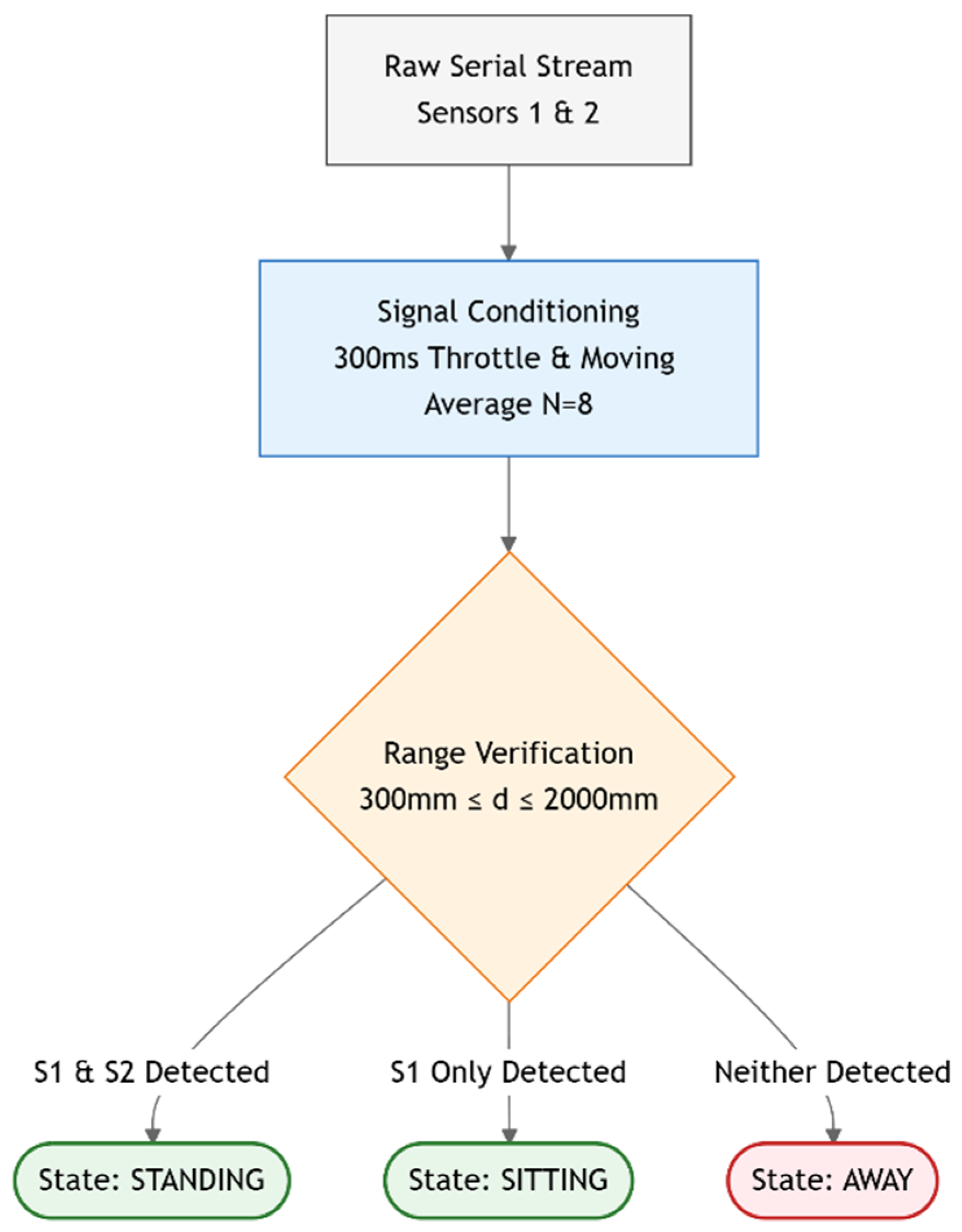
3.2. Differential Distance Classifier
4. Methods
4.1. Instrumentation and Data Acquisition
4.2. Experimental Protocol
- Protocol 1 measured static postural duration (sitting and standing) using bouts ranging from 60 to 150 s.
- Protocol 2 evaluated user presence (sitting and standing) versus absence (away) by incorporating desk-departure periods of 60 to 150 s.
- Protocol 3 validated the logging accuracy of a gamified health intervention; participants performed 10 desk-based squat cycles (20 discrete sitting-to-standing events) at a cadence of 6 s per cycle to test sensor performance during rapid movement.
4.3. Data Analysis
4.3.1. The Ground Truth
4.3.2. The Distance Time Series
4.3.3. Minimum Acceptable Transition Detection Thresholds
4.3.4. Detection Delay Error Metrics
4.3.5. Classification Metrics
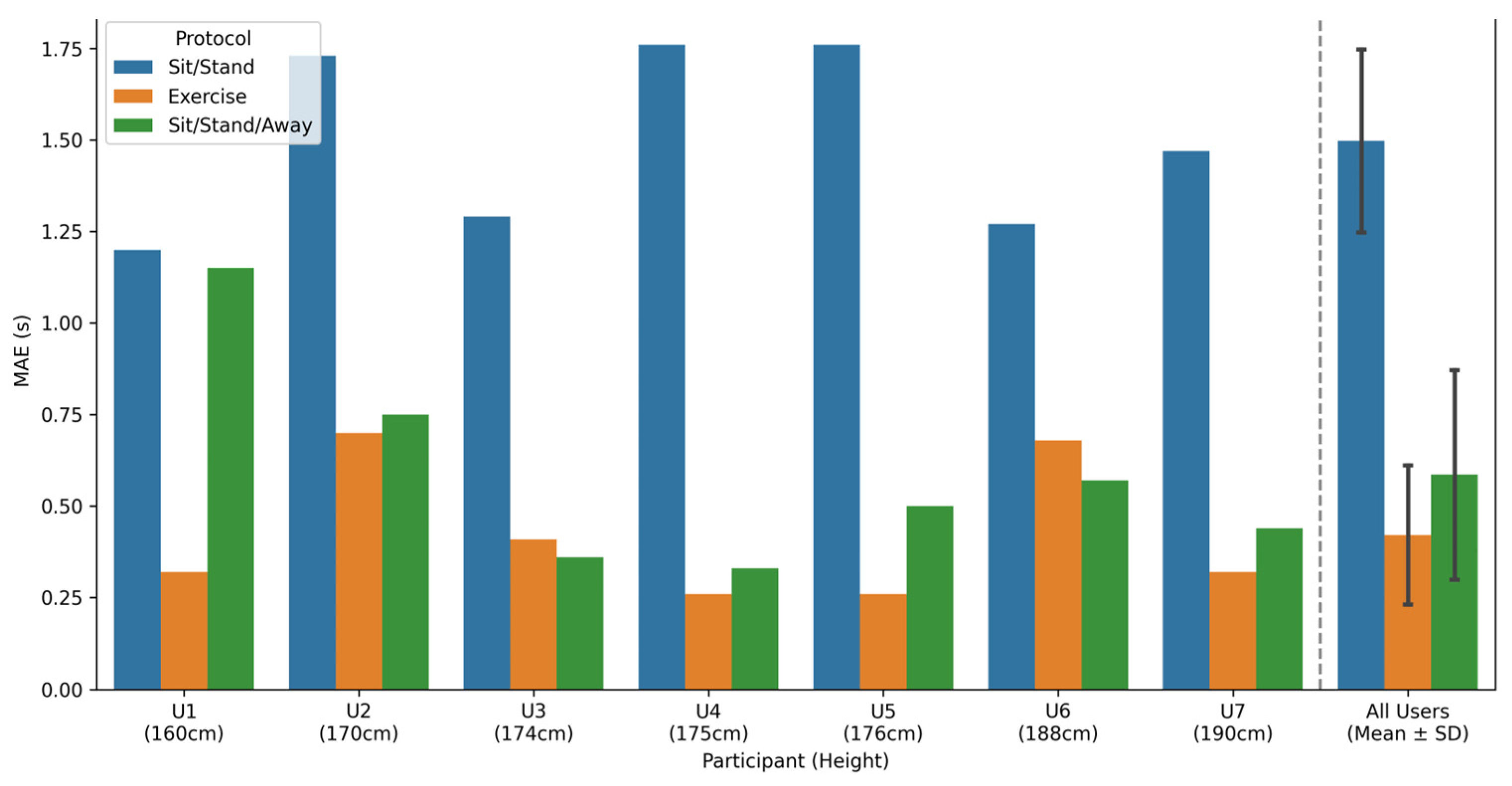
4.3.6. Individual User Variance
5. Results
5.1. Duration and Event Detection
5.1.1. Protocol 1 (Sit-Stand)
5.1.2. Protocol 2 (Sit-Stand-Away)
5.1.3. Protocol 3 (Exercise)
5.2. Classification Performance
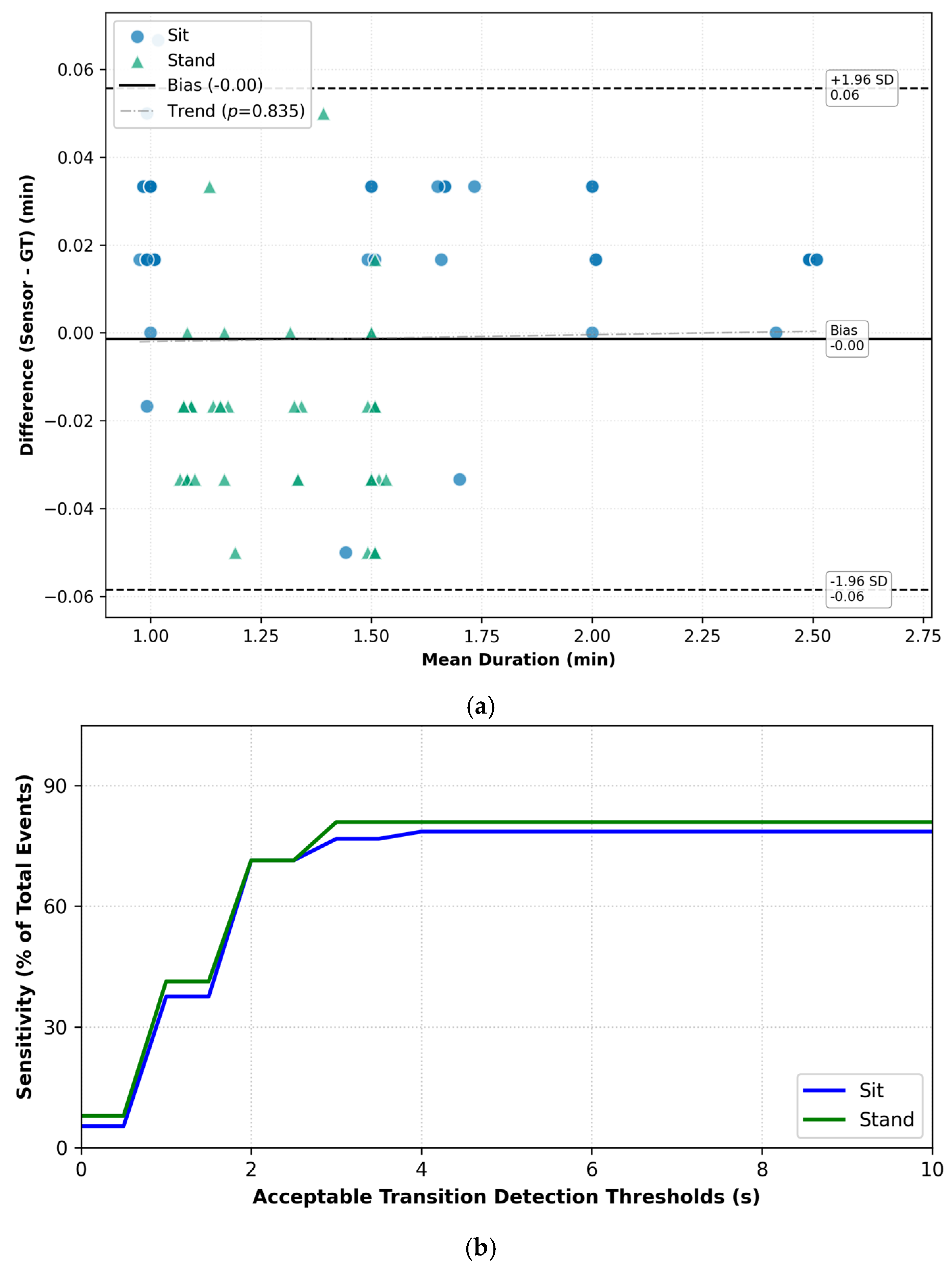
5.3. Agreement and Temporal Tolerance Analysis
5.4. Human Behavior Characteristics
5.5. Computational Load
6. Discussion
6.1. Principal Findings
6.1.1. Device Performance
6.1.2. Human Alertness and Intent
6.2. Methodological Implications: The Limits of Accelerometry
6.3. Observed Challenges
6.4. Transforming Interventions: From Passive Logging to Implicit Interaction
6.5. Limitations
6.6. Future Action Identification
7. Conclusions
Author Contributions
Funding
Institutional Review Board Statement
Informed Consent Statement
Data Availability Statement
Conflicts of Interest
Abbreviations
| AP3 | activPAL3 |
| HCI | Human–Computer Interaction |
| IMU | Inertial Measurement Unit |
| KNN | K-Nearest Neighbors |
| LoA | Limits of Agreement |
| MAE | Mean Absolute Error |
| MFCC | Mel-Frequency Cepstral Coefficients |
| RQA | Recurrence Quantification Analysis |
| SVM | Support Vector Machines |
| ToF | Time-of-Flight |
| P1 | Protocol 1 |
| P2 | Protocol 2 |
| P3 | Protocol 3 |
Appendix A
Experimental Protocols

| Order | Scripted Action | Scripted Duration (s) |
|---|---|---|
| 1 | Stand | 70 |
| 2 | Sit | 60 |
| 3 | Stand | 90 |
| 4 | Sit | 60 |
| 5 | Stand | 90 |
| 6 | Sit | 60 |
| 7 | Stand | 90 |
| 8 | Sit | 60 |
| 9 | Stand | 80 |
| 10 | Sit | 90 |
| 11 | Stand | 65 |
| 12 | Sit | 100 |
| 13 | Stand | 65 |
| 14 | Sit | 120 |
| 15 | Stand | 65 |
| 16 | Sit | 150 |
| 17 | Stand | 90 |
| Order | Scripted Action | Scripted Duration (s) |
|---|---|---|
| 1 | Away | 70 |
| 2 | Stand | 70 |
| 3 | Away | 90 |
| 4 | Sit | 70 |
| 5 | Away | 90 |
| 6 | Stand | 60 |
| 7 | Away | 90 |
| 8 | Sit | 60 |
| 9 | Away | 80 |
| 10 | Stand | 90 |
| 11 | Away | 65 |
| 12 | Stand | 100 |
| 13 | Away | 65 |
| 14 | Stand | 120 |
| 15 | Away | 65 |
| 16 | Stand | 150 |
| 17 | Away | 90 |
| Order | Scripted Action | Scripted Duration (s) |
|---|---|---|
| 1 | Stand | 3 |
| 2 | Sit | 3 |
| 3 | Stand | 3 |
| 4 | Sit | 3 |
| 5 | Stand | 3 |
| 6 | Sit | 3 |
| 7 | Stand | 3 |
| 8 | Sit | 3 |
| 9 | Stand | 3 |
| 10 | Sit | 3 |
| 11 | Stand | 3 |
| 12 | Sit | 3 |
| 13 | Stand | 3 |
| 14 | Sit | 3 |
| 15 | Stand | 3 |
| 16 | Sit | 3 |
| 17 | Stand | 3 |
| 18 | Sit | 3 |
| 19 | Stand | 3 |
| 20 | Sit | 3 |
References
- Clemes, S.A.; O’Connell, S.E.; Edwardson, C.L. Office Workers’ Objectively Measured Sedentary Behavior and Physical Activity during and Outside Working Hours. J. Occup. Environ. Med. 2014, 56, 298–303. [Google Scholar] [CrossRef]
- Chandrasekaran, B.; Ganesan, T.B. Sedentarism and Chronic Disease Risk in COVID 19 Lockdown—A Scoping Review. Scott. Med. J. 2021, 66, 3–10. [Google Scholar] [CrossRef]
- Liang, Z.; Zhang, M.; Wang, C.; Yuan, Y.; Liang, J. Association between Sedentary Behavior, Physical Activity, and Cardiovascular Disease-Related Outcomes in Adults—A Meta-Analysis and Systematic Review. Front. Public Health 2022, 10, 1018460. [Google Scholar] [CrossRef]
- Zhai, L.; Zhang, Y.; Zhang, D. Sedentary Behaviour and the Risk of Depression: A Meta-Analysis. Br. J. Sports Med. 2015, 49, 705–709. [Google Scholar] [CrossRef] [PubMed]
- Majumdar, P.; Biswas, A.; Sahu, S. COVID-19 Pandemic and Lockdown: Cause of Sleep Disruption, Depression, Somatic Pain, and Increased Screen Exposure of Office Workers and Students of India. Chronobiol. Int. 2020, 37, 1191–1200. [Google Scholar] [CrossRef] [PubMed]
- Bakker, E.A.; Hartman, Y.A.W.; Hopman, M.T.E.; Hopkins, N.D.; Graves, L.E.F.; Dunstan, D.W.; Healy, G.N.; Eijsvogels, T.M.H.; Thijssen, D.H.J. Validity and Reliability of Subjective Methods to Assess Sedentary Behaviour in Adults: A Systematic Review and Meta-Analysis. Int. J. Behav. Nutr. Phys. Act. 2020, 17, 75. [Google Scholar] [CrossRef] [PubMed]
- Chastin, S.F.M.; Dontje, M.L.; Skelton, D.A.; Čukić, I.; Shaw, R.J.; Gill, J.M.R.; Greig, C.A.; Gale, C.R.; Deary, I.J.; Der, G.; et al. Systematic Comparative Validation of Self-Report Measures of Sedentary Time against an Objective Measure of Postural Sitting (activPAL). Int. J. Behav. Nutr. Phys. Act. 2018, 15, 21. [Google Scholar] [CrossRef]
- Pedersen, S.J.; Kitic, C.M.; Bird, M.-L.; Mainsbridge, C.P.; Cooley, D. Is Self-Reporting Workplace Activity Worthwhile? Validity and Reliability of Occupational Sitting and Physical Activity Questionnaire in Desk-Based Workers. BMC Public Health 2016, 16, 836. [Google Scholar] [CrossRef]
- Craig, C.L.; Marshall, A.L.; Sjöström, M.; Bauman, A.E.; Booth, M.L.; Ainsworth, B.E.; Pratt, M.; Ekelund, U.; Yngve, A.; Sallis, J.F.; et al. International Physical Activity Questionnaire: 12-Country Reliability and Validity. Med. Sci. Sports Exerc. 2003, 35, 1381–1395. [Google Scholar] [CrossRef]
- Prati, A.; Shan, C.; Wang, K.I.-K. Sensors, Vision and Networks: From Video Surveillance to Activity Recognition and Health Monitoring. J. Ambient. Intell. Smart Environ. 2019, 11, 5–22. [Google Scholar] [CrossRef]
- Steeves, J.A.; Bowles, H.R.; Mcclain, J.J.; Dodd, K.W.; Brychta, R.J.; Wang, J.; Chen, K.Y. Ability of Thigh-Worn ActiGraph and activPAL Monitors to Classify Posture and Motion. Med. Sci. Sports Exerc. 2015, 47, 952–959. [Google Scholar] [CrossRef] [PubMed]
- Maiti, A.; Ye, A.; Schmidt, M.; Pedersen, S. A Privacy-Preserving Desk Sensor for Monitoring Healthy Movement Breaks in Smart Office Environments with the Internet of Things. Sensors 2023, 23, 2229. [Google Scholar] [CrossRef]
- Maiti, A.; Ward, V.; Hilliard, A.; Ye, A.; Pedersen, S.J. Design Principles of a Flat-Pack Electronic Sensor Kit with Intelligent User Interface Calibrations: A Case Study of Monitoring Sedentary Behavior in Workplace. Appl. Sci. 2025, 15, 5111. [Google Scholar] [CrossRef]
- Cooley, D.; Pedersen, S. A Pilot Study of Increasing Nonpurposeful Movement Breaks at Work as a Means of Reducing Prolonged Sitting. J. Environ. Public Health 2013, 2013, 128376. [Google Scholar] [CrossRef]
- Mainsbridge, C.P.; Cooley, P.D.; Fraser, S.P.; Pedersen, S.J. The Effect of an E-Health Intervention Designed to Reduce Prolonged Occupational Sitting on Mean Arterial Pressure. J. Occup. Environ. Med. 2014, 56, 1189–1194. [Google Scholar] [CrossRef]
- Mainsbridge, C.P.; Cooley, D.; Dawkins, S.; de Salas, K.; Tong, J.; Schmidt, M.W.; Pedersen, S.J. Taking a Stand for Office-Based Workers’ Mental Health: The Return of the Microbreak. Front. Public Health 2020, 8, 215. [Google Scholar] [CrossRef]
- Carter, S.E.; Draijer, R.; Maxwell, J.D.; Morris, A.S.; Pedersen, S.J.; Graves, L.E.F.; Thijssen, D.H.J.; Hopkins, N.D. Using an E-Health Intervention to Reduce Prolonged Sitting in UK Office Workers: A Randomised Acceptability and Feasibility Study. Int. J. Environ. Res. Public Health 2020, 17, 8942. [Google Scholar] [CrossRef]
- Oliver, H.; Thomas, O.; Neil, R.; Copeland, R.J.; Moll, T.; Chadd, K.; Jukes, M.J.; Quartermaine, A. A Longitudinal Study Combining the Double Diamond Framework and Behavior Change Wheel to Co-Create a Sedentary Behavior Intervention in Police Control Rooms. J. Public Health 2024, 46, 419–429. [Google Scholar] [CrossRef]
- Wu, C.; Wang, B.; Shen, G. Unobtrusive Monitoring of Sedentary Behaviors with Fusion of Bluetooth and Ballistocardiogram Signals. Methods 2022, 202, 152–163. [Google Scholar] [CrossRef] [PubMed]
- Shum, L.C.; Faieghi, R.; Borsook, T.; Faruk, T.; Kassam, S.; Nabavi, H.; Spasojevic, S.; Tung, J.; Khan, S.S.; Iaboni, A. Indoor Location Data for Tracking Human Behaviours: A Scoping Review. Sensors 2022, 22, 1220. [Google Scholar] [CrossRef]
- Biswas, S.; Harrington, B.; Hajiaghajani, F.; Wang, R. Contact-Less Indoor Activity Analysis Using First-Reflection Echolocation. In Proceedings of the 2016 IEEE International Conference on Communications (ICC), Kuala Lumpur, Malaysia, 22–27 May 2016; pp. 1–6. [Google Scholar] [CrossRef]
- Ryde, G.C.; Gilson, N.D.; Suppini, A.; Brown, W.J. Validation of a Novel, Objective Measure of Occupational Sitting. J. Occup. Health 2012, 54, 383–386. [Google Scholar] [CrossRef]
- Alemdar, H.; Ersoy, C. Wireless Sensor Networks for Healthcare: A Survey. Comput. Netw. 2010, 54, 2688–2710. [Google Scholar] [CrossRef]
- Zhou, Y.; Hua, Y.; Liu, J. Study Workplace Space Occupancy: A Review of Measures and Technologies. J. Facil. Manag. 2021, 20, 350–368. [Google Scholar] [CrossRef]
- Weizman, Y.; Tan, A.M.; Fuss, F.K. The Use of Wearable Devices to Measure Sedentary Behavior during COVID-19: Systematic Review and Future Recommendations. Sensors 2023, 23, 9449. [Google Scholar] [CrossRef] [PubMed]
- Chang, V.; Eniola, R.O.; Golightly, L.; Xu, Q.A. An Exploration into Human–Computer Interaction: Hand Gesture Recognition Management in a Challenging Environment. SN Comput. Sci. 2023, 4, 441. [Google Scholar] [CrossRef]
- Holtermann, A.; Schellewald, V.; Mathiassen, S.E.; Gupta, N.; Pinder, A.; Punakallio, A.; Veiersted, K.B.; Weber, B.; Takala, E.-P.; Draicchio, F.; et al. A Practical Guidance for Assessments of Sedentary Behavior at Work: A PEROSH Initiative. Appl. Ergon. 2017, 63, 41–52. [Google Scholar] [CrossRef]
- Kańtoch, E. Recognition of Sedentary Behavior by Machine Learning Analysis of Wearable Sensors during Activities of Daily Living for Telemedical Assessment of Cardiovascular Risk. Sensors 2018, 18, 3219. [Google Scholar] [CrossRef] [PubMed]
- Sinha, V.K.; Patro, K.K.; Pławiak, P.; Prakash, A.J. Smartphone-Based Human Sitting Behaviors Recognition Using Inertial Sensor. Sensors 2021, 21, 6652. [Google Scholar] [CrossRef]
- Matthews, C.E.; Saint-Maurice, P.; Freeman, J.R.; Hayes, H.A.; Shreves, A.H.; Doherty, A.; Hyde, E.T.; Ylarregui, K.; Jones, R.R.; Keadle, S.K. Performance Evaluation of Algorithms to Estimate Daily Sedentary Time Using Wrist-Worn Sensors in Free-Living Adults. J. Meas. Phys. Behav. 2025, 8, jmpb.2024-0051. [Google Scholar] [CrossRef] [PubMed]
- Boudet, G.; Chausse, P.; Thivel, D.; Rousset, S.; Mermillod, M.; Baker, J.S.; Parreira, L.M.; Esquirol, Y.; Duclos, M.; Dutheil, F. How to Measure Sedentary Behavior at Work? Front. Public Health 2019, 7, 167. [Google Scholar] [CrossRef]
- Zahra, R.; Shehzadi, A.; Sharif, M.I.; Karim, A.; Azam, S.; De Boer, F.; Jonkman, M.; Mehmood, M. Camera-Based Interactive Wall Display Using Hand Gesture Recognition. Intell. Syst. Appl. 2023, 19, 200262. [Google Scholar] [CrossRef]
- Sideridis, V.; Zacharakis, A.; Tzagkarakis, G.; Papadopouli, M. GestureKeeper: Gesture Recognition for Controlling Devices in IoT Environments. In Proceedings of the 2019 27th European Signal Processing Conference (EUSIPCO), A Coruña, Spain, 2–6 September 2019; pp. 1–5. [Google Scholar]
- Sun, Y.; Fei, T.; Li, X.; Warnecke, A.; Warsitz, E.; Pohl, N. Real-Time Radar-Based Gesture Detection and Recognition Built in an Edge-Computing Platform. IEEE Sens. J. 2020, 20, 10706–10716. [Google Scholar] [CrossRef]
- Yadav, S.; Jain, S. Gesture Recognition System for Human-Computer Interaction Using Computer Vision. In Proceedings of the 2024 11th International Conference on Reliability, Infocom Technologies and Optimization (Trends and Future Directions) (ICRITO), Noida, India, 14–15 March 2024; pp. 1–4. [Google Scholar]
- Meng, Z.; Zhang, M.; Guo, C.; Fan, Q.; Zhang, H.; Gao, N.; Zhang, Z. Recent Progress in Sensing and Computing Techniques for Human Activity Recognition and Motion Analysis. Electronics 2020, 9, 1357. [Google Scholar] [CrossRef]
- Hammad, A.S.; Tajammul, A.; Dergaa, I.; Al-Asmakh, M. Machine Learning Applications in the Analysis of Sedentary Behavior and Associated Health Risks. Front. Artif. Intell. 2025, 8, 1538807. [Google Scholar] [CrossRef] [PubMed]
- Buffey, A.J.; Herring, M.P.; Langley, C.K.; Donnelly, A.E.; Carson, B.P. The Acute Effects of Interrupting Prolonged Sitting Time in Adults with Standing and Light-Intensity Walking on Biomarkers of Cardiometabolic Health in Adults: A Systematic Review and Meta-Analysis. Sports Med 2022, 52, 1765–1787. [Google Scholar] [CrossRef]
- Harrington, D.M.; Welk, G.J.; Donnelly, A.E. Validation of MET Estimates and Step Measurement Using the ActivPAL Physical Activity Logger. J. Sports Sci. 2011, 29, 627–633. [Google Scholar] [CrossRef]
- Sokolova, M.; Lapalme, G. A Systematic Analysis of Performance Measures for Classification Tasks. Inf. Process. Manag. 2009, 45, 427–437. [Google Scholar] [CrossRef]



| Protocol | State | Mean Difference (min) [95% CI] | MAE (Sec ± SD) | Sensitivity (%) | δmin (s) | Count Bias |
|---|---|---|---|---|---|---|
| 1 | Sit | 0.02 [0.01, 0.03] | 1.57 ± 0.82 | 78.6 | 3 | 0 |
| Stand | −0.02 [−0.03, −0.01] | 1.51 ± 0.83 | 81.0 | 4 | 0 | |
| 2 | Sit | 0.01 [−0.04, 0.05] | 2.00 ± 1.60 | 71.4 | 4 | −1 |
| Stand | −0.00 [−0.01, 0.00] | 0.13 ± 0.41 | 90.5 | 2 | −2 | |
| Away | −0.00 [−0.01, 0.00] | 0.67 ± 1.26 | 87.3 | 4 | −3 | |
| 3 | Exercise | — | — | 100.0 | 2 | 0 |
| Class | Precision | Recall (Sensitivity) | Specificity | F1-Score |
|---|---|---|---|---|
| Sit (P1) | 100.00 | 100.00 | 100.00 | 100.00 |
| Stand (P1) | 100.00 | 100.00 | 100.00 | 100.00 |
| Sit (P2) | 81.25 | 92.86 | 97.14 | 86.67 |
| Stand (P2) | 100.00 | 95.24 | 100.00 | 97.56 |
| Away (P2) | 96.83 | 96.83 | 96.43 | 96.83 |
Disclaimer/Publisher’s Note: The statements, opinions and data contained in all publications are solely those of the individual author(s) and contributor(s) and not of MDPI and/or the editor(s). MDPI and/or the editor(s) disclaim responsibility for any injury to people or property resulting from any ideas, methods, instructions or products referred to in the content. |
© 2026 by the authors. Licensee MDPI, Basel, Switzerland. This article is an open access article distributed under the terms and conditions of the Creative Commons Attribution (CC BY) license.
Share and Cite
Ye, A.; Maiti, A.; Schmidt, M.; Pedersen, S.J. Ubiquitous Non-Wearable Sensor for Human Sedentary Behavior Monitoring and Characterization. Sensors 2026, 26, 2468. https://doi.org/10.3390/s26082468
Ye A, Maiti A, Schmidt M, Pedersen SJ. Ubiquitous Non-Wearable Sensor for Human Sedentary Behavior Monitoring and Characterization. Sensors. 2026; 26(8):2468. https://doi.org/10.3390/s26082468
Chicago/Turabian StyleYe, Anjia, Ananda Maiti, Matthew Schmidt, and Scott J. Pedersen. 2026. "Ubiquitous Non-Wearable Sensor for Human Sedentary Behavior Monitoring and Characterization" Sensors 26, no. 8: 2468. https://doi.org/10.3390/s26082468
APA StyleYe, A., Maiti, A., Schmidt, M., & Pedersen, S. J. (2026). Ubiquitous Non-Wearable Sensor for Human Sedentary Behavior Monitoring and Characterization. Sensors, 26(8), 2468. https://doi.org/10.3390/s26082468