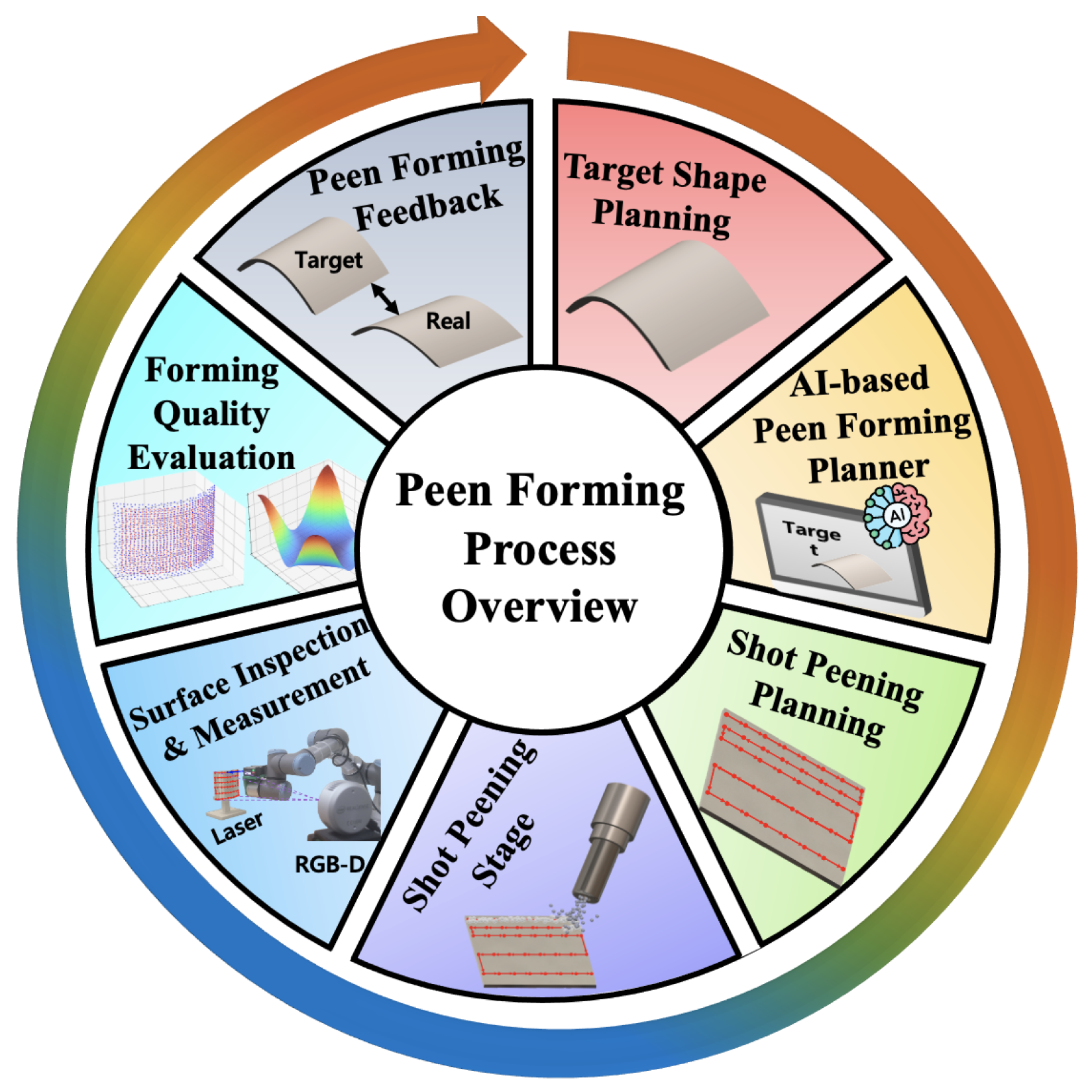
Vision-Based Artificial Intelligence for Adaptive Peen Forming: Sensing Architectures, Learning Models, and Closed-Loop Smart Manufacturing

 ,
,
Abstract
1. Introduction
1.1. Industrial Context and Motivation
Terminology and Notation
- Scalar parameters: A (Almen), C (coverage), d (shot diameter), t (panel thickness);
- Spatial coordinates: in-plane, z through-thickness, out-of-plane deflection;
- Residual stress: [MPa], residual moment [N·mm/mm];
- Model parameters: neural network weights, loss function penalty weights;
- Datasets: full dataset, splits, N sample count.
- Retrospective detection: Errors are often identified after process completion, limiting in-process correction [29];
- Proxy metrics: Almen intensity summarizes average peening intensity but does not resolve spatial curvature non-uniformity [30];
- Sparse sampling: Point-based metrology (e.g., CMM) may miss localized defects between sampled locations, especially on large panels [28];
- Limited throughput: High-accuracy full-field metrology (e.g., large-area laser tracking/scanning) can be time-consuming and difficult to integrate into production cycle times [15];
- No predictive capability: Conventional inspection does not forecast deformation trends to enable preventive parameter adjustment.
1.2. Vision–AI Opportunity: From Passive Inspection to Active Control
- Acquire multi-dimensional surface data during or immediately after shot peening (RGB-D, laser profiles, thermal signatures);
- Process sensor streams with near-real-time latency (on the order of ms where feasible) using trained AI models to estimate coverage and curvature, and to infer process-relevant indicators for control;
- Predict next-pass deformation trends based on temporal evolution patterns learned from historical data;
- Compare current geometry against target specifications, quantifying deviations zone-by-zone;
- Adapt process parameters (shot velocity, dwell time, nozzle path) dynamically to minimize error before it accumulates;
- Validate final geometry autonomously, flagging out-of-tolerance regions for human review.
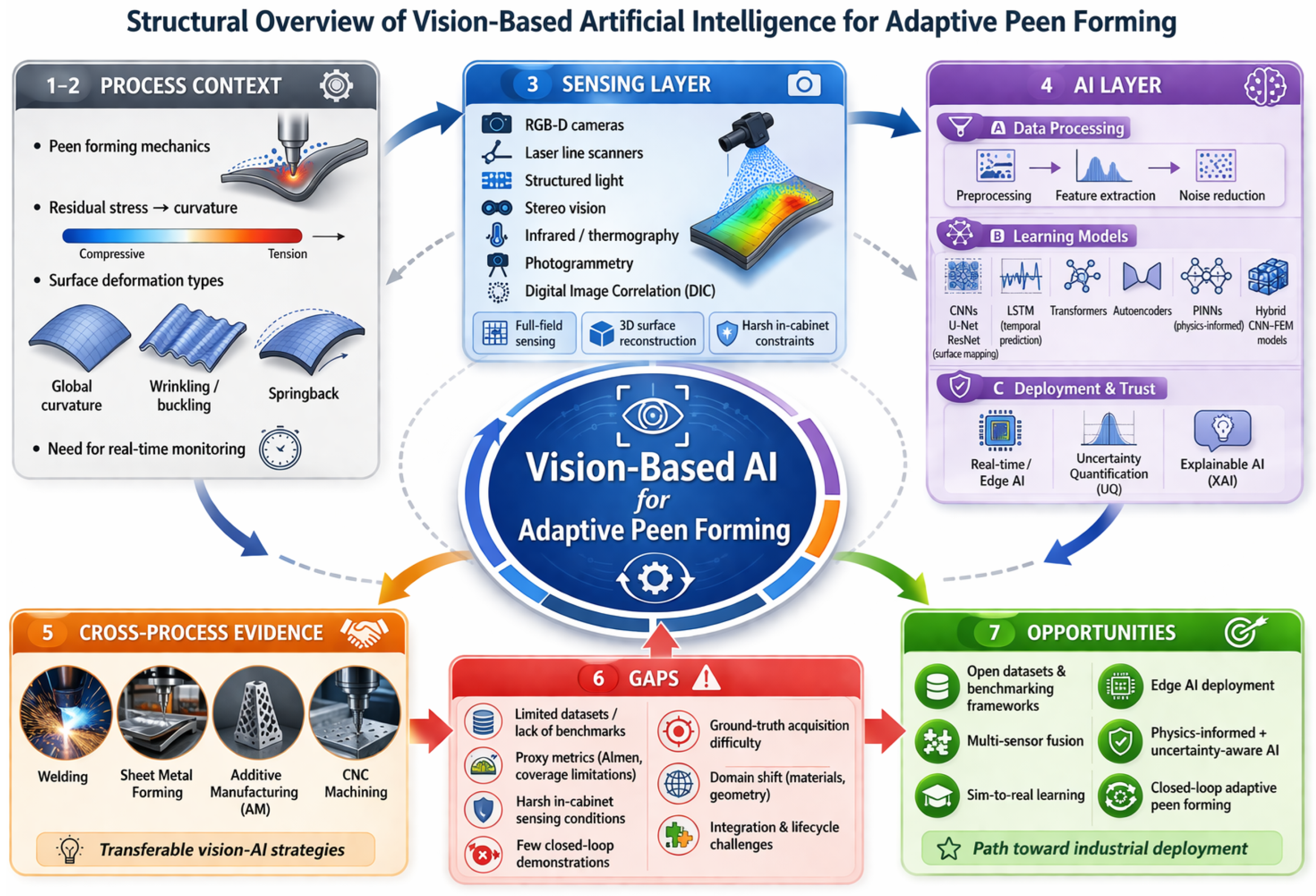
- Analyzing transferable methodologies from mature vision–AI implementations in welding, additive manufacturing, sheet forming, and CNC machining (Section 5).
- Identifying specific barriers (data scarcity, harsh cabinet environments, proxy metrics, and integration challenges) that prevent industrial deployment (Section 6).
- Proposing concrete solutions (benchmark datasets, multi-sensor fusion, edge AI deployment, physics-informed models, and closed-loop architectures) (Section 7).
1.3. Why Peen Forming Requires Domain-Specific Treatment
- Stochastic, cumulative deformation mechanism: Unlike deterministic forming processes (stamping, roll forming), peen forming relies on accumulated effects of millions of individual, stochastic shot impacts. Each impact induces localized plastic deformation whose spatial distribution depends on shot trajectory randomness, surface obliquity, and prior work-hardening state. This creates a many-body problem unsuitable for direct closed-form modeling, motivating data-driven approaches [2,65].
- Indirect observability constraint: In-process measurement is obstructed by (a) airborne shot media occluding optical paths, (b) shot-surface impacts generating transient vibrations (>5 g) incompatible with structured-light acquisition [44], and (c) cabinet enclosure restricting multi-view access. Consequently, vision systems must operate in harsher conditions than typical metal forming (press brakes, roll mills), where direct tool-workpiece observation is feasible [36].
- Aerospace tolerance requirements vs. process uncertainty: Wing skin panels demand curvature tolerances of ±0.1–0.5 mm over 500–2000 mm spans [8,17]; yet, peening-induced curvature exhibits spatial non-uniformity due to edge effects, fixture shadowing, and shot-stream divergence. This tolerance-to-uncertainty ratio is more stringent than most sheet forming applications, necessitating high-resolution (<0.1 mm) full-field metrology unsuitable for contact-based methods [28].
- Multi-pass temporal coupling: Achieving target curvature typically requires 3–8 sequential peening passes with evolving coverage and intensity [51,62,66]. Each pass alters the residual stress field and induces sequence-dependent strengthening, modifying subsequent deformation response in a path-dependent manner. Temporal prediction models must, therefore, capture hysteretic material behavior absent in single-pass forming operations.
- Proxy metric limitations: Established quality metrics (Almen intensity per SAE J442, coverage percentage) provide scalar or spatially averaged indicators unsuitable for detecting localized over-peening, wrinkle onset, or edge springback [26,30]. Vision-based approaches can overcome this limitation but require domain-adapted calibration and validation protocols not directly transferable from fatigue-focused shot peening literature.
1.4. Comparative Insights from Other Domains
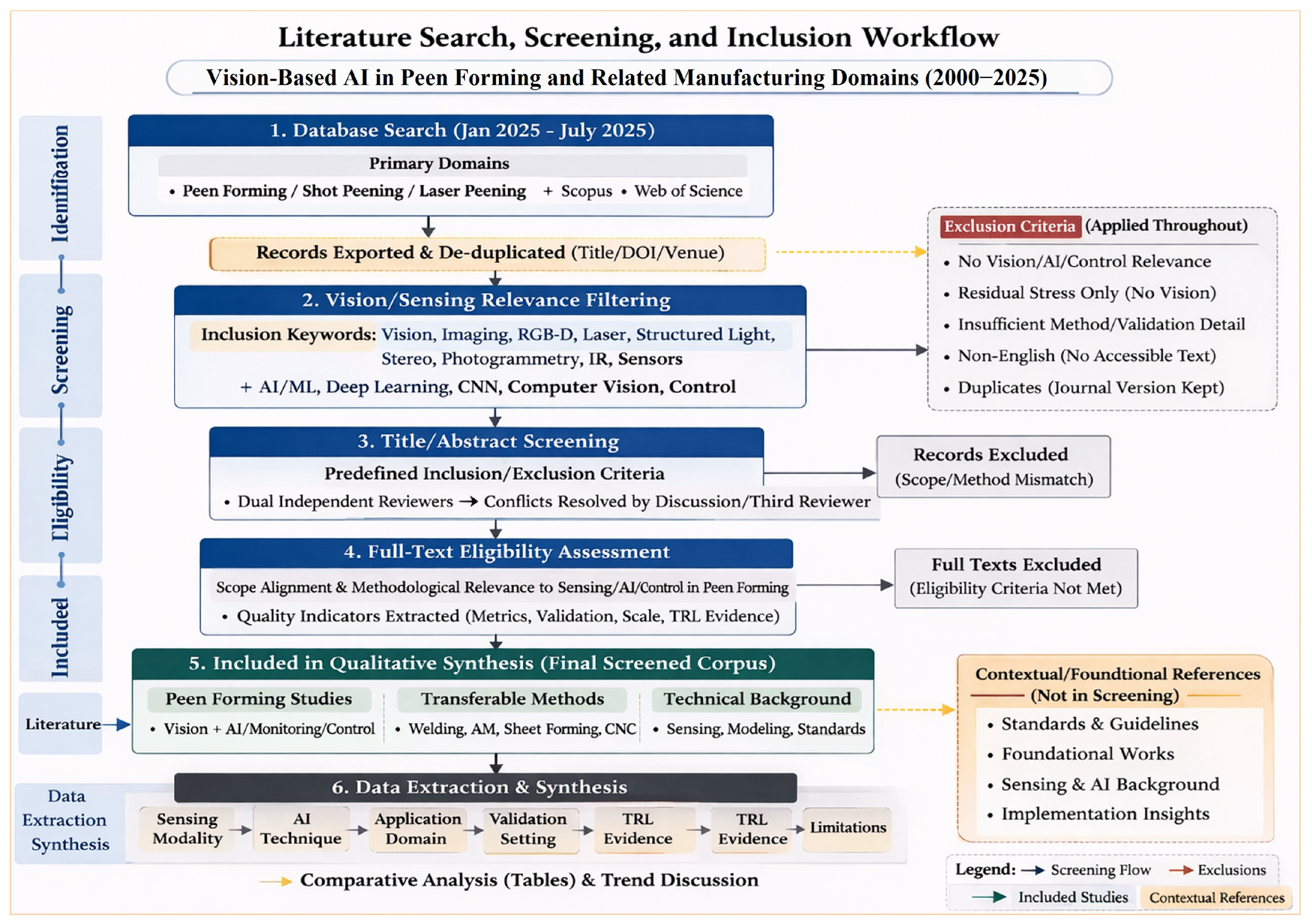
1.5. Review Methodology
1.5.1. Search Strategy
(“peen forming” OR “shot peening” OR “laser peen*”) AND (“vision” OR “image” OR “camera” OR “sensor” OR “RGB-D” OR “laser scan*” OR “structured light”) AND (“artificial intelligence” OR “machine learning” OR “deep learning” OR “neural network” OR “CNN” OR “computer vision”)
(“welding” OR “additive manufacturing” OR “sheet metal forming” OR “CNC machining”) AND (“vision-based” OR “image-based”) AND (“AI” OR “machine learning” OR “closed-loop control”)
1.5.2. Inclusion and Exclusion Criteria
- Peer-reviewed journal articles and conference papers published primarily in the modern digital-manufacturing era (target screening window: 2000–2025);
- Studies addressing vision-based monitoring, AI-driven surface analysis, predictive modeling, or closed-loop/adaptive control;
- Research on peen forming, shot peening, laser peen processing, or closely related metal forming/manufacturing processes with transferable methodological relevance;
- Papers providing sufficient methodological and experimental detail for qualitative synthesis.
- Studies focused solely on residual stress/material characterization without a vision/sensing-AI monitoring or control relevance;
- Papers lacking sufficient methodological detail, validation evidence, or technical reproducibility;
- Non-English publications without an accessible full text or a reliable translation;
- Duplicate records and overlapping conference/journal versions (journal version retained when substantially overlapping).
1.5.3. Selection Process and Results
1.5.4. Data Extraction and Synthesis
1.5.5. Review-Specific Quality Assessment Framework

| Assessment Domain | Operational Interpretation | Score |
|---|---|---|
| Directness to peen forming | 2 = direct peen-forming evidence; 1 = closely transferable adjacent-manufacturing evidence; 0 = conceptual or weakly transferable only. | 0–2 |
| Validation realism | 2 = representative pilot/industrial setting; 1 = controlled laboratory validation; 0 = simulation-only or proof-of-concept without physical validation. | 0–2 |
| Sample adequacy | 2 = moderate or large multi-panel/multi-case validation; 1 = small-scale study; 0 = anecdotal, single-case, or poorly specified sample basis. | 0–2 |
| Ground-truth rigor | 2 = validated geometric/stress reference or clearly defined quantitative benchmark; 1 = partial or proxy-based reference; 0 = weak, unclear, or absent reference standard. | 0–2 |
| Reporting and reproducibility | 2 = clear method, metrics, and limitations; 1 = partial reporting; 0 = insufficient technical detail for meaningful comparison. | 0–2 |
| Overall evidence grade | 8–10 = high comparative value; 5–7 = moderate comparative value; 0–4 = limited comparative value. | 0–10 |
2. Overview of the Peen-Forming Process
2.1. Fundamentals and Mechanics of Peen Forming
- Shot size and hardness: Larger and harder shots generally induce deeper plastic deformation and higher compressive residual stress, subject to material response and impact velocity.
- Velocity: Several options are used to control shot velocity. The most common are air pressure and centrifugal wheels.
- Coverage percentage: It refers to the area affected by the shot.
- Impact angle: Oblique impact angles are employed where direct access is limited and significantly influence residual stress orientation and deformation efficiency.
- Material properties: Formability is affected by the thickness, ductility, and strength of the sheet.
2.2. Historical Development
2.3. Application in Industry
2.3.1. Aerospace
2.3.2. Automotive
2.3.3. Energy and Power
2.3.4. Other Specialized Uses
2.4. Types of Surface Deformations in Peen Forming
2.4.1. Global Curvature
2.4.2. Local Wrinkling and Localized Buckling
2.4.3. Springback
2.4.4. Residual Stress Imbalance
2.4.5. Surface Roughness Increase
2.5. Process Parameters and Control Challenges in Peen Forming
2.6. Traditional Surface Monitoring Techniques
2.7. Transition Toward Real-Time and Vision-Based Approaches
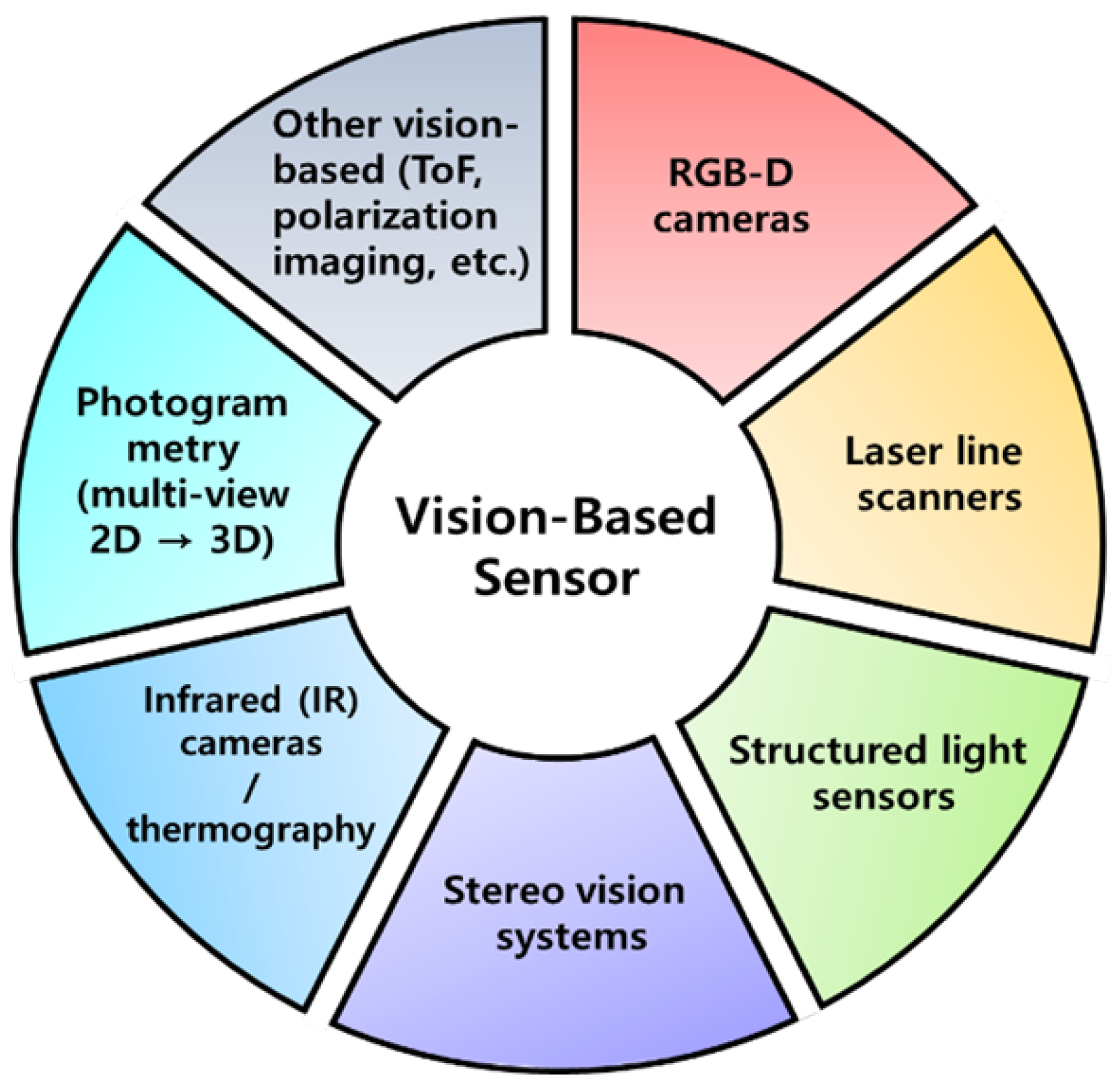
3. Vision-Based Sensing Technologies in Manufacturing
3.1. Digital Image Correlation: An Established Full-Field Technique
3.2. RGB-D Cameras
3.3. Laser Line Scanners
3.4. Structured Light Sensor
3.5. Stereo Vision
3.6. Infrared Cameras
3.7. Photogrammetry
3.8. Quantitative Comparative Analysis and Selection Framework
| Sensor Type | Spatial Resolution | Depth Accuracy | Frame Rate/Scan Speed | Working Distance | Cost (USD) | TRL for Peen Forming | Limitations in Peening Cabinets |
|---|---|---|---|---|---|---|---|
| RGB-D Camera (Intel RealSense, Azure Kinect) [98,99,100] | 1280 × 720 px | ±2–5 mm | 30–90 fps | 0.3–6 m | USD 300–500 | TRL 3–4 | Infrared interference from dust; saturation on specular Al/Ti surfaces; requires 10–15 cm standoff [101,102] |
| Laser Line Scanner (Baumer OM70, SICK, Keyence) [103,105,106] | 1280 pts/line | ±0.02–0.05 mm | 2–8 kHz | 65–100 mm | USD 2500–4500 | TRL 5–6 | Occlusion by shot media; compressed-air purging required; calibration drift under vibration (>5 g) [104,131] |
| Structured Light (GOM ATOS, Hexagon) [107,108,109] | 5 MP (2448 × 2050) | ±0.015–0.05 mm | 1–5 fps | 200–600 mm | USD 15,000–40,000 | TRL 4 | Pattern saturation on reflective surfaces; 5–15 s acquisition unsuitable for real-time use; vibration sensitivity [44,132] |
| Stereo Vision (Basler, Allied Vision) [113,115,116] | 2448 × 2048 px | ±0.5–2 mm | 30–60 fps | 0.5–5 m | USD 800–2000 | TRL 4–5 | Depth accuracy degrades on low-texture panels; frequent recalibration required; ambient light dependency [114,117] |
| Photogrammetry (Multi-view SfM) [124,125,129] | Sub-mm (20+ MP) | ±0.1–0.5 mm | Offline (30–120 s) | 0.5–10 m | USD 1000–5000 | TRL 5 | Not real-time; static setup required; specular reflection errors; computationally intensive reconstruction [130] |
| Infrared Camera (FLIR, Optris) [118,120,122] | 640 × 480 px | ±2 °C or ±2% | 50–200 fps | 0.3–10 m | USD 8000–25,000 | TRL 2–3 | No direct geometry measurement; emissivity variation between peened and unpeened zones; weak contrast at room temperature [123] |
| Industrial Laser Profilometer (Keyence LJ-X8000, Micro-Epsilon) [103,105] | 3200 pts/line | ±0.003 mm | 16–64 kHz | 20–30 mm | USD 6000–12,000 | TRL 6–7 | Narrow field of view (23 mm typical); requires scanning gantry; window contamination sensitivity; high cost |
| Multi-Sensor Fusion (RGB-D + Laser) [117,133,134] | Hybrid | ±0.05–0.5 mm | 15–30 fps | Variable | USD 3000–7000 | TRL 4 | Complex multi-sensor calibration (6+ DOF); synchronization overhead; increased computational load |
3.8.1. Head-to-Head Performance Comparison on Synthetic Benchmark
- Accuracy-speed trade-off: Structured light achieves the highest accuracy (±0.04 mm RMSE) but the slowest acquisition (8 s), unsuitable for inter-pass monitoring where the typical dwell is 5–10 s. Industrial laser scanners offer near-comparable accuracy (±0.06 mm) at 3× faster throughput (2.5 s).
- Robustness to cabinet conditions: RGB-D suffers 35% accuracy degradation in simulated dusty conditions (0.5 mg/m3 airborne shot media) due to infrared scattering, versus 12% degradation for laser scanners with purged optics.
- Cost-effectiveness: For applications tolerating ±0.5 mm accuracy (e.g., non-aerospace large panels), RGB-D (USD 400) offers 10× lower cost than structured light (USD 25,000) with acceptable performance.
- Coverage vs. precision: Photogrammetry excels at large-area mapping (>1 m2) but requires a static multi-view setup (60–120 s total), limiting applicability to final inspection rather than in-process monitoring.
| Sensor | RMSE (mm) | Acq. Time (s) | Dusty Env. RMSE | Cost/Accuracy Ratio |
|---|---|---|---|---|
| RGB-D | 0.52 | 0.8 | 0.70 (+35%) | $769/mm |
| Laser Scanner | 0.06 | 2.5 | 0.067 (+12%) | $58,333/mm |
| Structured Light | 0.04 | 8.0 | 0.11 (+175%) | $625,000/mm |
| Stereo Vision | 0.85 | 1.2 | 1.05 (+24%) | $1647/mm |
| Photogrammetry | 0.15 | 95 | 0.18 (+20%) | $20,000/mm |
3.8.2. Application-Driven Selection Framework
- Aerospace wing skins (tolerance ±0.1–0.3 mm, area 0.5–2 m2, production):
- Recommended: Industrial laser scanner + purged enclosure;
- Rationale: Meets tolerance with reasonable throughput; proven vibration resistance.
- Automotive panels (tolerance ±0.5–1.0 mm, area 0.3–0.8 m2, high volume):
- Recommended: RGB-D (Intel RealSense D455 or Azure Kinect);
- Rationale: Sufficient accuracy at low cost; fast acquisition enables inline inspection.
- Research/validation (highest accuracy, no time constraint):
- Recommended: Structured light (GOM ATOS, Hexagon) or photogrammetry;
- Rationale: Establishes ground truth for AI training; validates FE models.
- Prototype/low-volume (balanced cost-accuracy, flexible setup):
- Recommended: Stereo vision + deep learning depth estimation;
- Rationale: No active projection (dust-tolerant); low hardware cost; accuracy improvable via AI refinement.
3.8.3. Multi-Sensor Fusion Strategies
- RGB-D (global coverage) + Laser scanner (local precision): RGB-D provides full-panel curvature estimation in 0.8 s; laser scanner verifies high-curvature regions (edges, stiffener intersections) in an additional 1.5 s. Total 2.3 s vs. 8 s for full structured-light scan.
- Stereo vision (texture-based) + Infrared thermography (stress indication): Stereo captures geometry; IR detects thermal signatures from localized over-peening (elevated residual stress correlates with 0.5–2 °C temperature rise during shot bombardment [122]). Fusion improves defect classification accuracy by 18% vs. geometry-only [134].
3.9. Vibration and Environmental Robustness Considerations
3.9.1. Vibration Mitigation Strategies
- Mechanical isolation: Passive elastomeric mounts (natural frequency 5–10 Hz) attenuate transmitted vibration by 60–80% at frequencies > 50 Hz, which is sufficient for laser line scanners operating at 2–8 kHz scan rates, where individual profiles average vibration effects [103]. Active piezoelectric dampers provide 90% attenuation but add cost (USD 2000–5000 per sensor) and complexity [105]. For RGB-D cameras, vibration isolation reduces depth noise from ±5 mm (rigid mounting) to ±2 mm (isolated), approaching intrinsic sensor accuracy [99].
- IMU-based motion compensation: Inertial measurement units (IMUs) co-located with sensors enable real-time pose correction. Six-axis IMUs (3-axis accelerometer + 3-axis gyroscope, 1 kHz sampling) track sensor displacement with ±0.5 mm position accuracy and ±0.3° orientation accuracy [136]. Post-processing algorithms apply inverse transforms to point clouds or images, recovering geometry with 85–92% effectiveness depending on vibration magnitude and frequency content [134]. Limitation: High-frequency vibration (>500 Hz) exceeds IMU bandwidth, requiring mechanical isolation as first-line defense.
- Temporal gating and inter-shot acquisition: Shot peening produces discrete impact events separated by 10–50 ms intervals (depending on shot flow rate, typically 0.5–2 kg/min). Synchronizing sensor acquisition to these quiescent periods via acoustic or force triggers reduces motion blur by 90% for camera systems and eliminates shot-media occlusion for laser scanners [106]. Implementation requires real-time shot detection (microphone or pressure transducer) with <5 ms latency to trigger exposure during 10–20 ms shot-free windows.
3.9.2. Sensor-Specific Robustness Rankings
- High tolerance (TRL 5–6): Laser line scanners with temporal averaging across 100–1000 profiles per surface patch; RGB-D cameras with short exposure (<1 ms) and mechanical isolation;
- Moderate tolerance (TRL 4–5): Stereo vision with feature-based tracking (SIFT/SURF features robust to small displacements); photogrammetry in static multi-view configuration;
- Low tolerance (TRL 3–4): Structured light requiring pattern stability; interferometric methods sensitive [137] to sub-wavelength vibration (<1 μm).
3.10. Comparative Insight
| Technology Type | Implementation Status | Effectiveness Level | Research Gap Identified | References |
|---|---|---|---|---|
| High-speed/thermal/digital cameras + artificial intelligence (additive manufacturing) | Laboratory prototype, some industrial pilots | High for real-time monitoring, defect detection, process control in additive manufacturing; not applied to peen forming in included studies | Lack of validated, scalable systems for peen forming; need for multimodal data fusion, real-time pipelines | [60] |
| Computer vision segmentation (peen forming) | Research prototype (low-coverage plates) | Comparable to human experts for low coverage; accelerates evaluation | Not validated for high-coverage or complex geometries; limited industrial applicability | [59] |
| Deep learning-based quality inspection (smart manufacturing systems) | Industrial pilot/full deployment | High for three-dimensional part inspection in manufacturing | Lack of technical detail for peen forming; need for adaptation to peen forming context | [61] |
| Artificial intelligence-driven controllers (laser-based additive manufacturing) | Industrial pilot/full deployment | Significant for process control and monitoring in additive manufacturing | Modeling and optimization challenges for complex processes; limited application to peen forming | [69] |
| Vision-based artificial intelligence in hybrid manufacturing | Research prototype, limited industrial use | Partial automation, improved quality and efficiency | High cost, data requirements, integration challenges; not applied to peen forming | [70] |
4. AI Techniques for Surface Mapping and Prediction
| AI Model Type | Input Data Format | Application/Use Case | Relevance to Peen Forming |
|---|---|---|---|
| CNN/U-Net/ResNet | RGB images, depth maps, 3D voxel grids | Surface defect detection, segmentation, curvature mapping | Detect coverage, classify deformation zones, map roughness |
| LSTM/GRU | Time-sequence images, point clouds, curvature data | Temporal prediction of deformation, stress accumulation | Predict curvature evolution, springback estimation |
| Transformers (ViT) | Large-scale RGB-D datasets, point cloud tokens | Global mapping, long-range dependencies, shape evolution | Global panel curvature mapping and long-range deformation modeling (primarily at research level) |
| Autoencoders | Noisy depth maps, incomplete scans | Denoising, anomaly detection, reconstruction of missing surfaces | Clean surface maps, identify abnormal shot patterns |
| GANs (Generative Adversarial Networks) | Synthetic images, deformation maps | Data augmentation, generation of realistic training sets | Expand limited peen forming datasets, simulate shot effects |
| Hybrid CNN–LSTM | RGB-D sequences, laser profiles | Spatial + temporal learning, online monitoring | Predict deformation dynamics during peening runs |
| Physics-Informed Neural Networks (PINNs) | Stress–strain data, simulation + experimental data | Integration of physics with AI learning | More reliable predictions, reduced dataset requirement |
4.1. Preprocessing and Feature Extraction of Visual Data
4.2. Surface Mapping Deep Learning Architectures
4.3. Sequence-Aware and Predictive Models for Multi-Pass Peen Forming
4.4. Hybrid, Simulation-Assisted, and Physics-Informed Models
4.4.1. Physics-Informed Neural Networks (PINNs): Principles and Formulation
- = supervised loss on available labeled data (e.g., MSE between predicted and measured curvature);
- = residual of governing PDE evaluated at collocation points;
- = boundary condition violations;
- = penalty weights (typically 0.1–10).
- = out-of-plane deflection (curvature field);
- = flexural rigidity (E = Young’s modulus, t = thickness, = Poisson’s ratio);
- = equivalent lateral load distribution induced by residual stress gradient;
- = biharmonic operator.
- Input: Process parameters (Almen intensity A, coverage C, shot size d) + spatial coordinates ;
- Network: Fully connected NN (6 layers, 128 neurons/layer, tanh activation) → outputs ;
- Data loss: MSE on N = 20–50 measured curvature points (laser scanner data);
- PDE loss: evaluated at = 1000 collocation points;
- BC loss: Simply supported edges: at panel boundaries.
4.4.2. Expected Benefits and Validation Evidence
- Data efficiency: PINNs can interpolate between sparse measurements by enforcing physics, reducing labeled data requirements by 3–5× [148];
- Extrapolation: Pure data-driven models fail outside training distribution; PINNs generalize better to unseen parameter ranges due to physics constraints;
- Uncertainty quantification: Physics violations indicate prediction unreliability (high PDE residual → low confidence).
- Sheet metal forming: He et al. [55] applied PINNs to springback prediction, achieving 0.8 mm RMSE with N = 50 training samples vs. 1.4 mm for pure CNN (same data). Physics loss reduced extrapolation error by 40% when testing on 20% thicker sheets.
- Structural mechanics: Haghighat et al. [149] demonstrated PINNs for stress concentration problems, matching FE accuracy with 10× less training data.
- Reduce required labeled panels from N = 150 (pure supervised) to N = 50 (PINN) for equivalent curvature prediction accuracy (target RMSE < 0.5 mm);
- Enable generalization across Almen intensities: train on 0.008A–0.016A, extrapolate to 0.020 A–0.024 A with <20% error increase;
- Provide physics-based uncertainty estimates: flag regions where PDE residual exceeds threshold (e.g., >0.1 mm equivalent load error).
4.4.3. Hybrid CNN-FEM Frameworks
- Train CNN to map surface images to residual stress field ;
- Training data: Combine real measurements (XRD at 25 points per panel) with FE-generated stress maps [2].
- Solve forward FE problem: Given , compute equilibrium deflection ;
- Use commercial FE solver or a differentiable simulation framework [150].
- Separates learning (CNN) from physics (FEM) → each component can be validated independently;
- FEM is interpretable and auditable (critical for aerospace certification);
- Can incorporate complex boundary conditions (fixtures, edge constraints), difficult to express in PINN loss.
- CNN predicts residual moment from coverage map (98 ms inference);
- FEM computes curvature from (650 ms solve);
- Achieved 0.3 mm prediction error on validation panels (N = 15).
4.4.4. Generative Models for Synthetic Data Augmentation
- Generator G: Process parameters → synthetic depth map;
- Discriminator D: Classify real vs. synthetic depth maps;
- Adversarial loss: .
- Generated 5000 synthetic images from 200 real images;
- A defect classifier trained on real and synthetic data achieved 88% accuracy vs. 76% using real data only;
- Physics constraints reduced unrealistic artifacts by 60%.
4.4.5. Implementation Challenges and Open Questions
- Hyperparameter sensitivity: PINN performance depends critically on , weights. Improper tuning causes training instability or physics constraint violations. Solution: Adaptive weighting [153] or curriculum learning.
- Computational cost: Evaluating requires fourth-order automatic differentiation, 10–50× slower than forward pass. Mitigation: Use collocation sampling (evaluate PDE at a subset of points per batch).
- Validation of physics accuracy: How accurate must PDE residuals be for reliable predictions? No established guidelines for manufacturing applications.
- Integration with vision preprocessing: PINNs assume clean inputs; how to handle noisy depth maps, occlusions, outliers from sensor failures?
- Implement PINN for peen forming using eigenstrain FE data [78] as training labels;
- Benchmark data efficiency: Plot prediction error vs. N (10, 20, 50, 100 labeled panels);
- Validate extrapolation: Train on Al 2024-T3, test on 7075-T6 without retraining;
- Compare PINN vs. hybrid CNN-FEM vs. pure supervised for equivalent computational budget.
4.5. Real-Time and Edge Deployment
4.6. Uncertainty Quantification and Explainable AI for Aerospace Certification
4.6.1. Uncertainty Quantification: Principles and Methods
- High-stakes decisions: Accepting an out-of-tolerance panel risks flight safety; rejecting a conforming panel wastes USD 10 k–50 k in material and labor;
- Sparse training data: Models trained on N < 200 panels have high epistemic uncertainty (model uncertainty) due to limited coverage of parameter space;
- Sensor noise: Depth maps contain aleatoric uncertainty (data uncertainty) from shot media occlusion, vibration artifacts, specular reflection.
- Train network with dropout layers (p = 0.2–0.5);
- At inference: Perform T = 20–100 forward passes with dropout enabled;
- Compute prediction mean and variance .
- mm: High confidence → accept prediction;
- mm: Moderate uncertainty → flag for secondary verification (CMM spot check);
- mm: Low confidence → reject prediction, inspect manually.
- In total, 95% of high-confidence predictions () were correct;
- In total, 23% of low-confidence predictions were incorrect → UQ successfully identifies unreliable predictions.
- Split data: Train set , calibration set (e.g., 80/20 split);
- Train model on , compute residuals on : ;
- For desired coverage level (e.g., 90%), compute quantile: ;
- Prediction interval: guarantees coverage.
- Curvature prediction: Conformal intervals guarantee 90% of true curvatures fall within ;
- Coverage estimation: Prediction set contains true coverage with 95% probability.
4.6.2. Explainable AI (XAI): Techniques for Traceable Decisions
- Correct behavior: Heatmap highlights panel edges, stiffener intersections (known stress concentration sites);
- Incorrect behavior: Heatmap focuses on background, shot media artifacts → indicates model learned spurious correlations.
- SHAP values: ;
- Interpretation: Almen intensity is most influential (45% contribution), consistent with domain knowledge.
- SHAP identified spindle speed and feed rate as top predictors (matching engineering theory);
- Model relying on coolant temperature (spurious correlation) was flagged and retrained.
4.6.3. Integrated UQ+XAI Framework for Peen Forming
- Conditions: Prediction uncertainty mm AND Grad-CAM highlights physically relevant features AND SHAP values align with domain knowledge;
- Action: Accept panel automatically, proceed to next process step;
- Conditions: mm OR Grad-CAM shows unexpected focus areas;
- Action: Perform targeted CMM measurement at flagged regions (50–100 points vs. 500+ for full inspection);
- Expected frequency: 15–25% of panels.
- Conditions: mm OR SHAP indicates reliance on non-causal features OR model prediction violates physics bounds;
- Action: Full manual inspection + engineering review;
- Expected frequency: A total of 5–10% of panels.
- Traceability: Every decision logged with uncertainty estimates, heatmaps, feature importances;
- Validation: Tier 2 verification provides continuous ground truth for model monitoring;
- Safety margins: Conservative thresholds ensure high-uncertainty predictions are not blindly trusted.
4.6.4. Implementation Considerations
- Monte Carlo Dropout (T = 50): 50× inference time (45 ms → 2.25 s) → acceptable for inter-pass inspection (5–10 s dwell);
- Grad-CAM: Negligible (single backward pass, +5 ms);
- SHAP: Expensive for complex models (100–1000 ms) but needed only for anomalous cases.
- Calibration drift: Do uncertainty estimates remain valid as the model encounters new materials, geometries? Requires ongoing calibration set updates.
- Optimal uncertainty thresholds: How to set thresholds balancing false accepts vs. false rejects for different aerospace risk categories?
- Multi-model ensembles: Can diversity in ensemble predictions (e.g., CNN + LSTM + PINN) improve UQ reliability?
4.7. Challenges and Open Issues
5. Use Cases from Related Industrial Processes
5.1. Welding
5.2. Sheet Metal Forming
5.3. Additive Manufacturing
5.4. CNC Machining
5.5. Transferability Analysis: Domain Gaps and Adaptation Requirements
| Process | Vision Sensing Used | AI Models | Key Outputs | Relevance to Peen Forming |
|---|---|---|---|---|
| Welding | Cameras + laser illumination | CNN, LSTM, GAN | Seam quality, penetration depth | Robust vision in harsh environments |
| Sheet Forming | Structured light, stereo vision | U-Net, PINNs, CNN–LSTM | Wrinkling, springback prediction | Directly applicable to peen forming |
| Additive Manufacturing | Cameras, laser scanning, IR | CNN, Autoencoders, Transformers | Layer distortion, porosity detection | Similarity in incremental deformation |
| CNC Machining | Cameras, vibration sensors | CNN, LSTM, Edge AI | Chatter, tool wear, roughness | Fusion strategies transferable |
5.5.1. Domain Gap Characterization
5.5.2. Proposed Transfer Learning Validation Protocol
- Train model on source domain (e.g., sheet forming wrinkle detection dataset with N = 5000 samples [35]);
- Establish source domain performance: accuracy, precision, recall on held-out test set.
- Apply source-trained model directly to peen-forming images (N = 50–100 target domain samples);
- Measure domain gap: Accuracy drop, false positive rate increase;
- Hypothesis: Accuracy will degrade 30–60% due to texture/reflectivity differences.
- Fine-tune model on small peen-forming dataset (N = 20, 50, 100) using frozen feature extractor;
- Compare fine-tuned performance vs. training from scratch on the same N samples;
- Success criterion: Fine-tuned model achieves ≥85% of from-scratch performance with ≤50% data.
- Measure adapted model performance on peen-forming validation set;
- Target: Recover ≥ 90% of source domain performance.
| Characteristic | Source Domain | Peen Forming | Adaptation Required |
|---|---|---|---|
| From Welding | |||
| Optical interference | Arc glare (14,000 K blackbody) | Shot media occlusion + Al specular reflection | Different filter design: band-stop vs. band-pass; polarization required |
| Deformation scale | 0.5–5 mm bead width | 0.1–50 mm curvature variation | Multi-scale feature extraction |
| Temporal dynamics | 10–100 ms melt pool evolution | 5–10 s inter-pass intervals | LSTM sequence length: 10–50 frames (welding) vs. 3–8 passes (peen) |
| From Additive Manufacturing | |||
| Process determinism | Layer-by-layer, fixed toolpath | Stochastic shot impacts | Probabilistic models vs. deterministic CNNs |
| Defect types | Porosity, lack-of-fusion (binary) | Over/under-peening (continuous gradient) | Regression head vs. classification |
| Data availability | 1000–10,000 layer images per build | <200 panels in the literature | Transfer learning + domain adaptation essential |
| From Sheet Forming | |||
| Stress state | Tensile (wrinkling from compression instability) | Compressive (peen-induced) | Different failure mechanics; wrinkle patterns differ |
| Measurement timing | In situ (press-mounted cameras) | ex situ (cabinet access restricted) | No adaptation needed for timing, but limits real-time potential |
| Surface texture | Cold-rolled (uniform reflectivity) | Shot-textured (spatially varying) | Texture-invariant features required |
| From CNC Machining | |||
| Sensor fusion rationale | Vision + vibration/acoustic for tool wear | Vision + ? (no secondary signal established) | Need to identify peen forming-relevant auxiliary signals |
| Edge deployment constraints | Spindle vibration, coolant spray | Shot media, cabinet enclosure | Similar environmental harshness; edge AI approaches transferable |
5.5.3. Concrete Adaptation Examples
From Welding: Robust Preprocessing Under Optical Interference
- Replace narrow band-pass (630–650 nm for weld observation) with polarization filtering (cross-polarized illumination at 45° to suppress Al specular reflection);
- Adaptive exposure targets peak reflectance at 60–70% sensor saturation (vs. 40–50% for welding to preserve pool detail);
- Add morphological closing operation (5 × 5 kernel) to fill shot media occlusion holes in depth maps.
From Additive Manufacturing: Temporal Prediction Across Sequential Operations
- Replace thermal images with curvature heatmaps (256 × 256 depth maps);
- Reduce LSTM sequence length from 50–100 layers (AM) to 3–8 passes (peen forming);
- Add process parameter embedding: Concatenate Almen intensity, coverage %, shot velocity as auxiliary inputs (12-dim vector) to LSTM hidden state;
- Replace binary classification (defect/no defect) with continuous regression (curvature deviation from target, mm).
From Sheet Forming: U-Net for Spatial Defect Segmentation
- Augmentation: Add shot-induced surface roughness noise ( = 0.05–0.15 mm), simulate specular dropout (random 10 × 10 pixel patches set to NaN), elastic deformations mimicking springback;
- Loss function: Combine pixel-wise MSE with curvature smoothness penalty ( where = 0.01–0.1).
From CNC Machining: Edge AI Deployment
5.5.4. Extrapolated Transferability Framework for Future Validation
- MMD < 0.1: Small domain gap, direct transfer likely effective;
- MMD 0.1–0.5: Moderate gap, fine-tuning required;
- MMD > 0.5: Large gap, domain adaptation or from-scratch training recommended.
- Sheet forming → Peen forming: 0.3–0.5 (moderate gap due to surface texture differences);
- Additive manufacturing → Peen forming: 0.5–0.7 (large gap due to layer-wise vs. full-field structure);
- Welding → Peen forming: 0.6–0.8 (very large gap, different deformation physics).
5.5.5. Limitations of Current Transferability Claims
- No empirical transfer learning results exist for vision–AI models moving from any manufacturing domain to peen forming. Claims are based on architectural analogy and expert assessment, not experimental validation.
- Domain adaptation techniques (adversarial training, MMD minimization) have not been demonstrated on peen-forming data. Their effectiveness remains speculative.
- Performance predictions (e.g., “fine-tuning achieves 85% accuracy”) are extrapolated from related domains and may not hold due to peen forming’s unique characteristics (stochastic impacts, multi-pass coupling, aerospace tolerances).
- Computational cost of adaptation (retraining time, hyperparameter tuning) is not quantified. In practice, domain adaptation may require weeks of GPU time and extensive validation.
6. Gaps and Limitations in Peen-Forming Applications
6.1. Scarcity of Validated Datasets and Benchmarks
6.2. Reliance on Proxy Metrics with Weak Shape Link
6.3. Limits of Current Process and Finite Element Models
6.4. Challenges of In-Process Vision in Peening Cabinets
6.5. Minimal Demonstrations of Closed-Loop Control
6.6. Difficulty of Generating Ground Truth
6.7. Domain Shift Across Materials, Finishes, and Geometries
6.8. Safety, Integration, and Lifecycle Constraints
- Widely adopted datasets and benchmarking frameworks are lacking;
- Quality assessment remains predominantly based on indirect proxy metrics;
- Physics-based models remain computationally intensive for large-scale deployment;
- In-process optical sensing remains vulnerable to cabinet-specific environmental effects;
- Demonstrations of fully autonomous closed-loop systems remain limited.
6.9. Technology Readiness Level Assessment for Peen Forming
| Field | Categories Used in This Review | Role in Conservative TRL Assignment |
|---|---|---|
| Direct validation basis | Direct peen-forming validation; adjacent-domain transfer only; conceptual/no direct validation. | Transfer-only or conceptual evidence was not treated as equivalent to direct peen-forming demonstration. |
| Sample scale | <20, 20–49, 50–200, >200 panels/specimens/cases (or best available reported scale). | Larger and more diverse validation supported movement from early proof-of-concept toward representative validation. |
| Validation scenario | Simulation only; controlled laboratory; representative/pilot environment; near-industrial/production environment. | Environment fidelity constrained the upper plausible TRL bound. |
| Replication scope | Single study/site; multiple studies; independent replication across sites or conditions. | Replication increased confidence in maturity claims. |
| Uncertainty/reporting completeness | Explicit quantitative uncertainty or failure discussion; partial qualitative limitation reporting; no clear uncertainty discussion. | Incomplete reporting triggered conservative lower-bound interpretation. |

| Technology Combination | Current TRL | Evidence Quality | Key Limitation/Bottleneck | Recommended Application | Path to Next TRL |
|---|---|---|---|---|---|
| Coverage Estimation System | |||||
| RGB Camera + Rule-Based Segmentation [59] | TRL 4 | 1 study (N = 10–20 flat panels) a | Limited to low coverage (<150%); human-comparable accuracy (92–95%) but no curvature prediction; tested only on flat Al plates | Lab-scale coverage verification for research prototypes | Validate on curved panels; expand to Ti alloys; test in dusty cabinet conditions (TRL 5) |
| RGB Camera + CNN Classification [38] | TRL 4–5 | 1 study (N = 150 panels, single material) a | Achieves 94% accuracy on clean 2024-T3; no public dataset; inference time 180 ms (too slow for real-time) | Offline quality inspection after peening; academic benchmarking | Optimize to <50 ms inference; create 200+ panel validation set from industrial cabinets (TRL 6) |
| RGB-D + U-Net Segmentation [35] | TRL 3–4 | 0 peen forming studies; extrapolated from sheet forming c | Depth noise from specular reflection; no demonstrated peen forming application in the literature; concept proven in sheet forming | Coverage + shallow curvature mapping for non-aerospace applications | Acquire peening-specific training data (N > 100); deploy anti-reflective coatings; field test 50+ panels (TRL 5) |
| Curvature Measurement System | |||||
| Laser Line Scanner + Point Cloud Processing [103,105] | TRL 5–6 | 3 studies (N = 50–200 total) b | ±0.05 mm accuracy proven in clean lab; cabinet dust causes 20–30% data loss; requires 5–10 s full-panel scan | Ex situ final inspection with cleaned panels; small-batch aerospace production | Integrate compressed air purging; reduce scan time to <3 s via optimized toolpaths (TRL 7) |
| Structured Light + 3D Reconstruction [44,107,109] | TRL 4 | 0 peen forming studies; extrapolated from sheet forming c | Pattern saturation on reflective Al/Ti; 5–15 s acquisition prohibits real-time; vibration sensitivity > 2 g | High-precision offline metrology for aerospace certification samples | Develop polarization filtering; fast single-shot patterns (<1 s); validate ± 0.02 mm on 100 panels (TRL 5–6) |
| Stereo Vision + Depth Estimation [113,116,117] | TRL 4 | Concept demonstrated in related domains only c | ±0.5–2 mm accuracy insufficient for aerospace tolerances (±0.1–0.5 mm required); texture-dependent | Large automotive panels where ±1 mm tolerance acceptable | Integrate deep stereo matching (sub-pixel accuracy); hybrid with laser scanner for ground truth (TRL 5) |
| Photogrammetry (Multi-View SfM) [124,129,130] | TRL 5 | 2 validation studies (offline) d | Sub-mm accuracy but 30–120 s processing time; not real-time; requires static multi-camera rig | Validation of FE models; large wing panel (>2 m) global geometry verification | Already mature for offline use; not suitable for closed-loop (remains TRL 5 for real-time) |
| Technology Combination | Current TRL | Evidence Quality | Key Limitation/Bottleneck | Recommended Application | Path to Next TRL |
|---|---|---|---|---|---|
| Predictive AI System | |||||
| ANN/MLP for Almen → Arc Height [18,146] | TRL 5–6 | 5–8 studies (N = 50–150 each) e | Proxy-based (no direct geometry); ±8–12% prediction error; validated on 50–150 samples | Process parameter optimization for existing Almen-based workflows | Widely used but fundamentally limited by Almen proxy; cannot advance without vision input |
| CNN + LSTM for Multi-Pass Curvature [51,62] | TRL 3–4 | 1 study (N=10–20 panels) f | Demonstrated on 10–20 lab panels; 0.6 mm RMSE but requires a 150-panel training set (unavailable publicly) | Research tool for understanding curvature accumulation physics | Acquire 300+ multi-pass dataset with validated CMM ground truth; test generalization across materials (TRL 5) |
| Physics-Informed Neural Networks (PINNs) [55,56] | TRL 2–3 | No peen forming implementation c | Concept validated in sheet forming; no peen forming implementation; requires FE-model integration | Synthetic data generation to augment limited real datasets | Validate eigenstrain-PINN on 50 real panels; compare with FE predictions; quantify uncertainty (TRL 4) |
| GANs for Synthetic Data [145,165,186] | TRL 2–3 | Concept only c | Can generate realistic defect images but lacks physical consistency (curvature, stress) | Data augmentation for coverage/defect classifiers | Develop conditional GANs with physics constraints; validate generated data improves model accuracy by >10% (TRL 4) |
| Transformers for Long-Range Dependencies [52] | TRL 2 | No peen forming application c | No peen forming application; computationally expensive (>200 ms inference); overfits on small datasets | Future research for large (>1 m2) panel global deformation prediction | Requires 1000+ panel dataset; lightweight vision transformer variants; edge deployment feasibility (TRL 3–4) |
| Technology Combination | Current TRL | Evidence Quality | Key Limitation/Bottleneck | Recommended Application | Path to Next TRL |
|---|---|---|---|---|---|
| Closed-loop Control System | |||||
| Vision + Manual Correction [25,62] | TRL 4–5 | 1 demonstration (N < 20) g | Human-in-loop (operator adjusts parameters); 3–5 iteration cycles; tested on <20 panels total | Small-batch aerospace prototyping with expert oversight | Automate decision logic; validate on 100-panel production run with ≥90% first-pass success (TRL 6) |
| RGB-D + CNN + Rule-Based Control [31,98] | TRL 3 | No integrated system c | No demonstrated implementation; rule-based control too rigid for non-linear peening response | Proof-of-concept for constrained parameter space (single material, flat panels) | Implement on lab testbed; collect 200-panel closed-loop dataset with success metrics (TRL 4–5) |
| Multi-Sensor Fusion + MPC + OPC-UA [32,40,42] | TRL 3–4 | Components demonstrated separately h | All components proven separately (MPC in welding [31], OPC-UA in manufacturing [42]) but no integrated peen forming system | Future industrial adaptive peen forming with <200 ms loop time | Integrate testbed; validate latency budget; demonstrate 50-panel autonomous forming with ±0.5 mm tolerance (TRL 5–6) |
| Reinforcement Learning + Sim-to-Real [69] | TRL 2 | No peen forming application c | Proven in AM laser control but unstable with sparse peen forming rewards; safety concerns for aerospace | Long-term research direction for fully autonomous multi-objective optimization | Develop high-fidelity peen forming simulator; safe RL with human override; 500+ episode training (TRL 3–4) |
| Edge Deployment Systems | |||||
| Jetson AGX Xavier/Orin Inference [133,154] | TRL 5–6 | Hardware validated; peen models not optimized i | Hardware proven; peen forming models not optimized (pruning, quantization); latency 150–300 ms (target < 100 ms) | Real-time coverage/defect detection in research labs | Model compression (INT8, 50% sparsity); benchmark on peening-specific workloads; achieve < 80 ms (TRL 6–7) |
| FPGA Accelerators (Xilinx, Intel) [187] | TRL 4–5 | Hardware validated in other domains c | Ultra-low latency (<20 ms) but requires hardware expertise; no peen forming deployment reported | Safety-critical aerospace applications requiring deterministic timing | Port U-Net/ResNet to FPGA; validate 10,000-cycle reliability; integrate with industrial PLC (TRL 6) |
| Cloud-Edge Hybrid (5G) [188] | TRL 3 | Concept only c | 5G latency (10–30 ms) acceptable but introduces cybersecurity risks for aerospace; unproven reliability | Non-critical applications with offline data analysis capability | Conduct latency/reliability field tests; address data sovereignty concerns; unlikely to reach TRL 7+ for aerospace |
Critical Observations
- Data scarcity: No technology exceeds TRL 5 due to lack of validated datasets (N > 200 panels). Even mature sensors (laser scanners at TRL 6–7 in other domains) remain TRL 5–6 for peen forming due to cabinet-specific challenges.
- Integration gap: Individual components (sensors TRL 5–6, AI models TRL 3–5, control protocols TRL 6–7) have not been integrated into end-to-end systems. The highest TRL closed-loop demonstration is TRL 4–5 (manual correction) [62].
- Aerospace certification barrier: Aerospace applications require TRL 8–9 (flight-proven), but current vision–AI systems lack the determinism, traceability, and failure-mode characterization necessary for compliance with aerospace manufacturing qualification and traceability requirements.
7. Forward-Looking Opportunities and Author Proposals
7.1. Conceptual Proposal: Open Datasets and Peen-Forming Benchmarks
7.2. Sim-to-Real and Synthetic Data
7.3. Multi-Sensor Fusion as the Default, Not the Exception
7.4. Edge AI and Real-Time Loops
7.5. Physics-Informed and Uncertainty-Aware AI
7.6. Conceptual Proposal: Closed-Loop Adaptive Peen Forming Architecture
7.7. Cross-Domain Transfer (Use What Is Already Working)
7.8. Industrialization and Lifecycle
8. Conclusions
Author Contributions
Funding
Institutional Review Board Statement
Informed Consent Statement
Data Availability Statement
Acknowledgments
Conflicts of Interest
References
- Rowan, C. A thermoelastic plate model for shot peen forming metal panels based on effective torque. J. Manuf. Mater. Process. 2025, 9, 280. [Google Scholar] [CrossRef]
- Miao, H.; Demers, D.; Larose, S.; Perron, C.; Lévesque, M. Experimental study of shot peening and stress peen forming. J. Mater. Process. Technol. 2010, 210, 2089–2102. [Google Scholar] [CrossRef]
- Adeel, M.; Azeem, N.; Xue, H. The Influence of Fundamental Processing Parameters of Ultrasonic Shot Peening on Surface Characteristics of 7B50-T7751 Alloy. In WCX SAE World Congress Experience; SAE Technical Paper; SAE International: Warrendale, PA, USA, 2024. [Google Scholar]
- Gariépy, A.; Larose, S.; Perron, C.; Bocher, P.; Lévesque, M. On the effect of the peening trajectory in shot peen forming. Finite Elem. Anal. Des. 2013, 69, 48–61. [Google Scholar] [CrossRef]
- Koltsov, V.; Vinh, L.T.; Starodubtseva, D. Surface roughness formation during shot peen forming. In Proceedings of the IOP Conference Series: Materials Science and Engineering; IOP Publishing: Bristol, UK, 2018; Volume 327, p. 042125. [Google Scholar]
- O’Hara, P. Peen-Forming–A Developing Technique. In Shot Peening; Wiley Online Library: Hoboken, NJ, USA, 2003; pp. 215–226. [Google Scholar]
- Pashkov, A.; Malashchenko, A.; Pashkov, A.; Duk, A. The upgrade of peen forming equipment for long-sized aircraft parts. In Proceedings of the IOP Conference Series: Materials Science and Engineering; IOP Publishing: Bristol, UK, 2021; Volume 1061, p. 012029. [Google Scholar]
- Baumann, J.A. Production of Energy Efficient Preform Structures (PEEPS). Ph.D. Thesis, The Boeing Company, Huntington Beach, CA, USA, 2012. [Google Scholar]
- Karademir, I.; Celik, M.B.; Husem, F.; Maleki, E.; Amanov, A.; Unal, O. Effects of constrained groove pressing, severe shot peening and ultrasonic nanocrystal surface modification on microstructure and mechanical behavior of S500MC high strength low alloy automotive steel. Appl. Surf. Sci. 2021, 538, 147935. [Google Scholar] [CrossRef]
- Hassan, H.Z.; Saeed, N.M. Advancements and applications of lightweight structures: A comprehensive review. Discov. Civ. Eng. 2024, 1, 47. [Google Scholar] [CrossRef]
- Markovina, R.; Blagojević, B.; Ban, D. Peen-forming-the possibility of technology transfer from aircraft industry to the production of high-speed ships. Brodogr. Int. J. Nav. Archit. Ocean. Eng. Res. Dev. 2008, 59, 35–43. [Google Scholar]
- Saifan, A.; Chen, S.; Yuan, L.; Shen, Y.; Zuo, L.; Saleh, B.; Yang, G. Modeling and optimization of robotic multi-needle ultrasonic peen forming process with response surface methods. Mater. Today Commun. 2025, 46, 112470. [Google Scholar] [CrossRef]
- Wang, D.; Xu, F.; Yuan, L.; Zhang, D.; Liu, J.; Hu, Y.; Han, W. Brief introduction and recent development on the manufacture of aluminium alloy integral panels in aerospace applications. Int. J. Mater. Struct. Integr. 2021, 14, 299–318. [Google Scholar] [CrossRef]
- Gariépy, A. Finite Element Modelling of Shot Peening and Peen Forming Processes and Characterisation of Peened AA2024-T351 Aluminium Alloy. Master’s Thesis, École Polytechnique de Montréal, Montréal, QC, USA, 2012. [Google Scholar]
- Yocom, C.J.; Zhang, X.; Liao, Y. Research and development status of laser peen forming: A review. Opt. Laser Technol. 2018, 108, 32–45. [Google Scholar] [CrossRef]
- Lal, R.K.; Choubey, V.K.; Dwivedi, J.; Kumar, S. Study of factors affecting Springback in sheet metal forming and deep drawing process. Mater. Today Proc. 2018, 5, 4353–4358. [Google Scholar] [CrossRef]
- Renna, G.; Attolico, M.; Moramarco, V.; Casavola, C. The role of peening processes as a pre-treatment to anodizing on fatigue behavior of aircraft aluminum alloy. Fatigue Fract. Eng. Mater. Struct. 2024, 47, 1312–1330. [Google Scholar] [CrossRef]
- Wang, T.; Wang, J.; Zhang, X.; Liu, C. A study on prediction of process parameters of shot peen forming using artificial neural network optimized by genetic algorithm. Arab. J. Sci. Eng. 2021, 46, 7349–7361. [Google Scholar] [CrossRef]
- Liu, Y.; Deng, D.; Liu, J.; Gu, X.; Chen, X. Investigation on the bending deformation of laser peen forming with a simplified eigenstrain-based finite element model. Int. J. Adv. Manuf. Technol. 2024, 131, 5815–5830. [Google Scholar] [CrossRef]
- Wang, C.; Zhao, Z.; Jiang, J.; Wang, Y.; Yang, W.; Yang, J. Experimental and simulation study of multi-region peen forming and mechanical property. J. Manuf. Processes 2022, 84, 198–215. [Google Scholar] [CrossRef]
- Wu, J.; Liu, D.; Guan, Y.; Shi, H.; Cheng, S.; Shi, J.; Fu, X. Effect of shot peening forming and shot peening strengthening post-treatment on the fatigue behavior of bolt-connected 2024HDT alloy. Eng. Fract. Mech. 2023, 293, 109690. [Google Scholar] [CrossRef]
- Laspalas, M. ITAINNOVA Experience as a Materials Modelling Translator; Zenodo: Geneva, Switzerland, 2016. [Google Scholar] [CrossRef]
- Wu, J.; Chen, K.; Zhang, P.; Zhu, J.; Liu, G.; Wei, P.; Liu, H. Effects of peening velocity and coverage on peen forming. Proc. Inst. Mech. Eng. Part E J. Process Mech. Eng. 2025, 239, 1523–1534. [Google Scholar] [CrossRef]
- Jiang, G.; Zhou, J.; Huang, S.; Meng, X.; Hu, Y. Microstructure response and bending fatigue characteristics of typical positions for the integral stiffened structure of 6005A-T6 aluminum alloy after laser peen forming. J. Mater. Res. Technol. 2024, 33, 1623–1639. [Google Scholar] [CrossRef]
- Siguerdidjane, W.; Khameneifar, F.; Gosselin, F.P. A low-cost open-source automated shot peen forming system. HardwareX 2022, 11, e00263. [Google Scholar] [CrossRef]
- Yang, Z.; Park, J.S.; Lee, Y. A strip holding system for finite element simulation of Almen strip testing. J. Mech. Sci. Technol. 2014, 28, 2825–2830. [Google Scholar] [CrossRef]
- John, M.; Kalvala, P.R.; Misra, M.; Menezes, P.L. Peening techniques for surface modification: Processes, properties, and applications. Materials 2021, 14, 3841. [Google Scholar] [CrossRef]
- Miao, H.; Romero, J.A.M.; Forgues, S.; Lévesque, M. Experimental and numerical study of pneumatic needle peening effects on Aluminium Alloy 2024-T3. J. Mater. Process. Technol. 2020, 275, 116370. [Google Scholar] [CrossRef]
- Guo, K.W. Green Nanotechnology in Manufacturing Processes. In Proceedings of the Green Nanotechnology Applications for Ecosystem Sustainability; Springer: Berlin/Heidelberg, Germany, 2025; pp. 89–129. [Google Scholar]
- Guagliano, M. Relating Almen intensity to residual stresses induced by shot peening: A numerical approach. J. Mater. Process. Technol. 2001, 110, 277–286. [Google Scholar] [CrossRef]
- Boldrin, D.M.; Tosatti, L.M.; Previtali, B.; Demir, A.G. Seam tracking and gap bridging during robotic laser beam welding via grayscale imaging and wobbling. Robot.-Comput.-Integr. Manuf. 2024, 89, 102774. [Google Scholar] [CrossRef]
- Mobaraki, M. Vision-Based Seam Tracking and Multi-Modal Defect Detection in GMAW fillet welding using artificial intelligence. Ph.D. Thesis, University of British Columbia, Vancouver, BC, USA, 2025. [Google Scholar]
- Fang, Q.; Xiong, G.; Zhou, M.; Tamir, T.S.; Yan, C.B.; Wu, H.; Wang, F.Y. Process Monitoring, Diagnosis and Control of Additive Manufacturing. IEEE Trans. Autom. Sci. Eng. 2024, 21, 1041–1067. [Google Scholar] [CrossRef]
- Yu, H.Z.; Li, W.; Li, D.; Wang, L.J.; Wang, Y. Enhancing additive manufacturing with computer vision: A comprehensive review. Int. J. Adv. Manuf. Technol. 2024, 132, 5211–5229. [Google Scholar] [CrossRef]
- Yi, S.; Hyun, D.; Hong, S. The Real-Time Prediction of Cracks and Wrinkles in Sheet Metal Forming According to Changes in Shape and Position of Drawbeads Based on a Digital Twin. Appl. Sci. 2025, 15, 700. [Google Scholar] [CrossRef]
- Kumar, S.P.; Balasubramanian, N. Automation Inspection in Metal Fabrication: Enhancing Sheet Metal Forming Processes with Automation, Machine Vision and Image Correlation for Quality Assurance. J. Adv. Manuf. Syst. 2024, 23, 909–939. [Google Scholar] [CrossRef]
- Papavasileiou, A.; Michalos, G.; Makris, S. Quality control in manufacturing–review and challenges on robotic applications. Int. J. Comput. Integr. Manuf. 2025, 38, 79–115. [Google Scholar] [CrossRef]
- Wang, T.; Zhang, J.; Zhang, S.; Zhang, X.; Wang, J. A combined computer vision and image processing method for surface coverage measurement of shot peen forming. J. Manuf. Processes 2023, 91, 137–148. [Google Scholar] [CrossRef]
- Jiang, J.; Hu, Y.; He, X. Process-based surface flattening method for laser peen forming of complex geometry. J. Manuf. Processes 2023, 92, 371–383. [Google Scholar] [CrossRef]
- Vyatkin, V.; Hanisch, H.M.; Pang, C.; Yang, C.H. Closed-Loop Modeling in Future Automation System Engineering and Validation. IEEE Trans. Syst. Man Cybern. Part C (Appl. Rev.) 2009, 39, 17–28. [Google Scholar] [CrossRef]
- Corke, P.I.; Good, M.C. Dynamic effects in visual closed-loop systems. IEEE Trans. Robot. Autom. 1996, 12, 671–683. [Google Scholar] [CrossRef]
- Nguyen, Q.C.; Hua, H.Q.B.; Pham, P.T. Development of a vision system integrated with industrial robots for online weld seam tracking. J. Manuf. Processes 2024, 119, 414–424. [Google Scholar] [CrossRef]
- Seifi, S.H.; Tian, W.; Doude, H.; Tschopp, M.A.; Bian, L. Layer-wise modeling and anomaly detection for laser-based additive manufacturing. J. Manuf. Sci. Eng. 2019, 141, 081013. [Google Scholar] [CrossRef]
- Zhao, X.; Yu, T.; Liang, D.; He, Z. A review on 3D measurement of highly reflective objects using structured light projection. Int. J. Adv. Manuf. Technol. 2024, 132, 4205–4222. [Google Scholar] [CrossRef]
- Gao, R.X.; Krüger, J.; Merklein, M.; Möhring, H.C.; Váncza, J. Artificial Intelligence in manufacturing: State of the art, perspectives, and future directions. CIRP Ann. 2024, 73, 723–749. [Google Scholar] [CrossRef]
- Abbas, Q.; Ibrahim, M.E.; Jaffar, M.A. A comprehensive review of recent advances on deep vision systems. Artif. Intell. Rev. 2019, 52, 39–76. [Google Scholar] [CrossRef]
- Chen, H.; Min, B.W. A high-precision segmentation network for industrial surface defect detection. AIP Adv. 2025, 15, 055118. [Google Scholar] [CrossRef]
- Konovalenko, I.; Maruschak, P.; Brezinová, J.; Prentkovskis, O.; Brezina, J. Research of U-Net-Based CNN Architectures for Metal Surface Defect Detection. Machines 2022, 10, 327. [Google Scholar] [CrossRef]
- Rehman, A.; Kim, D.; Anand, P. Convolutional neural network model for fire detection in real-time environment. Comput. Mater. Contin. 2023, 77, 2289. [Google Scholar] [CrossRef]
- Sariturk, B.; Seker, D.Z. A residual-inception U-Net (RIU-Net) approach and comparisons with U-shaped CNN and transformer models for building segmentation from high-resolution satellite images. Sensors 2022, 22, 7624. [Google Scholar] [CrossRef] [PubMed]
- Wang, Z.; Yuan, Y.; Zhang, S.; Lin, Y.; Tan, J. A multi-state fusion informer integrating transfer learning for metal tube bending early wrinkling prediction. Appl. Soft Comput. 2024, 151, 110991. [Google Scholar] [CrossRef]
- Zhao, L.; Zheng, Y.; Peng, T.; Zheng, E. Metal Surface Defect Detection Based on a Transformer with Multi-Scale Mask Feature Fusion. Sensors 2023, 23, 9381. [Google Scholar] [CrossRef] [PubMed]
- Sadeghian, E.; Dragomirescu, E.; Inkpen, D. Damage Detection for a Cantilevered Steel I-Beam through Deep-Learning Methods: LSTM, Multivariate Time-Series Transformer, and LSTM-Based Autoencoder. J. Comput. Civ. Eng. 2025, 39, 04025003. [Google Scholar] [CrossRef]
- Vincent, P.; Larochelle, H.; Bengio, Y.; Manzagol, P.A. Extracting and composing robust features with denoising autoencoders. In Proceedings of the 25th International Conference on Machine Learning (ICML 2008), Helsinki, Finland, 5–9 July 2008; ACM Press: New York, NY, USA, 2008; pp. 1096–1103. [Google Scholar]
- He, W.; Li, J.; Kong, X.; Deng, L. Multi-level physics informed deep learning for solving partial differential equations in computational structural mechanics. Commun. Eng. 2024, 3, 151. [Google Scholar] [CrossRef]
- Kasilingam, S.; Yang, R.; Singh, S.K.; Farahani, M.A.; Rai, R.; Wuest, T. Physics-based and data-driven hybrid modeling in manufacturing: A review. Prod. Manuf. Res. 2024, 12, 2305358. [Google Scholar] [CrossRef]
- Sharma, A.; Sharma, V.; Jaiswal, M.; Wang, H.C.; Jayakody, D.N.K.; Basnayaka, C.M.W.; Muthanna, A. Recent trends in AI-based intelligent sensing. Electronics 2022, 11, 1661. [Google Scholar] [CrossRef]
- Safiullin, R.; Safiullin, R.; Epishkin, A.; Haotian, T. Method of forming an integrated automated control system for intelligent objects. In Proceedings of the II International Scientific and Practical Conference “Information Technologies and Intelligent Decision Making Systems” (ITIDMS-II-2021), Moscow, Russian Federation, 1 July 2021; CEUR-WS.org: Aachen, Germany, 2021; Volume 2922, pp. 17–26. [Google Scholar]
- Vieira, L.C.; de Almeida, R.; Martins, F.P.R.; Fleury, A.D.T. Application of computer vision methods to estimate the coverage of peen formed plates. J. Achiev. Mater. Manuf. Eng. 2010, 43, 743–749. [Google Scholar]
- Balhara, H.; Karthikeyan, A.; Hanchate, A.; Nakkina, T.G.; Bukkapatnam, S.T. Imaging systems and techniques for fusion-based metal additive manufacturing: A review. Front. Manuf. Technol. 2023, 3, 1271190. [Google Scholar] [CrossRef]
- Rahman, M.A.; Saleh, T.; Jahan, M.P.; McGarry, C.; Chaudhari, A.; Huang, R.; Shakur, M.S. Review of intelligence for additive and subtractive manufacturing: Current status and future prospects. Micromachines 2023, 14, 508. [Google Scholar] [CrossRef]
- Siguerdidjane, W.; Khameneifar, F.; Gosselin, F.P. Closed-loop shot peen forming with in-process measurement and optimization. CIRP J. Manuf. Sci. Technol. 2022, 38, 500–508. [Google Scholar] [CrossRef]
- Li, W.; Wang, S.; Yang, X.; Duan, H.; Wang, Y.; Yang, Z. Research progress on fatigue damage and surface strengthening technology of titanium alloys for aerospace applications. Metals 2025, 15, 192. [Google Scholar] [CrossRef]
- Meng, X.K.; Zhou, J.Z.; Su, C.; Huang, S.; Luo, K.Y.; Sheng, J.; Tan, W. Residual stress relaxation and its effects on the fatigue properties of Ti6Al4V alloy strengthened by warm laser peening. Mater. Sci. Eng. A 2017, 680, 297–304. [Google Scholar] [CrossRef]
- Ohta, T.; Sato, Y. Effect of saturation peening on shape and residual stress distribution after peen forming. Int. J. Adv. Manuf. Technol. 2022, 119, 4659–4675. [Google Scholar] [CrossRef]
- Li, L.; Liu, L.; Lu, S. The influence and analysis of shot peening sequence on the strengthening performance of complex aviation components. Int. J. Mater. Form. 2025, 18, 45. [Google Scholar] [CrossRef]
- Wang, J.; Ma, Y.; Zhang, L.; Gao, R.X.; Wu, D. Deep learning for smart manufacturing: Methods and applications. J. Manuf. Syst. 2018, 48, 144–156. [Google Scholar] [CrossRef]
- Psarommatis, F.; Sousa, J.; Mendonça, J.P.; Kiritsis, D. Zero-defect manufacturing the approach for higher manufacturing sustainability in the era of industry 4.0: A position paper. Int. J. Prod. Res. 2022, 60, 73–91. [Google Scholar] [CrossRef]
- Sousa, J.; Brandau, B.; Darabi, R.; Sousa, A.; Brueckner, F.; Reis, A.; Reis, L.P. Artificial intelligence for control in laser-based additive manufacturing: A systematic review. IEEE Access 2025, 13, 30845–30860. [Google Scholar] [CrossRef]
- Babic, M.; Farahani, M.A.; Wuest, T. Image based quality inspection in smart manufacturing systems: A literature review. Procedia CIRP 2021, 103, 262–267. [Google Scholar] [CrossRef]
- Semiatin, S.L. Metalworking: Sheet Forming; ASM International: Almere, The Netherlands, 2006. [Google Scholar]
- Kobayashi, M.; Matsui, T.; Murakami, Y. Mechanism of creation of compressive residual stress by shot peening. Int. J. Fatigue 1998, 20, 351–357. [Google Scholar] [CrossRef]
- Almen, J.O.; Black, P.H. Residual Stresses and Fatigue in Metals; McGraw-Hill Book Company: New York, NY, USA, 1963. [Google Scholar]
- Test Strip, Holder, and Gage for Shot Peening. In Technical Report SAE J442; SAE International: Warrendale, PA, USA, 2013.
- Kirk, D. Theoretical Principles of Shot Peening Coverage. Shot Peen. 2005, 19, 24–28. Available online: https://www.shotpeener.com/library/pdf/2005145.pdf (accessed on 5 March 2026).
- Boljanovic, V. Sheet Metal Forming Processes and Die Design; Industrial Press Inc.: South Norwalk, CT, USA, 2004. [Google Scholar]
- Gariépy, A.; Cyr, J.; Levers, A.; Perron, C.; Bocher, P.; Lévesque, M. Potential applications of peen forming finite element modelling. Adv. Eng. Softw. 2012, 52, 60–71. [Google Scholar] [CrossRef]
- Faucheux, P.A.; Miao, H.Y.; Lévesque, M.; Gosselin, F.P. Peen forming and stress peen forming of rectangular 2024–T3 aluminium sheets: Curvatures, natural curvatures and residual stresses. Strain 2022, 58, e12405. [Google Scholar] [CrossRef]
- Sarkar, B.; Paul, R.K. AI-Driven Manufacturing Processes. In Proceedings of the AI for Advanced Manufacturing and Industrial Applications; Springer: Berlin/Heidelberg, Germany, 2025; pp. 19–59. [Google Scholar]
- Raghunathan, S.; Benard, E.; Watterson, J.K.; Cooper, R.K.; Curran, R.; Price, M.; Yao, H.; Devine, R.; Crawford, B.; Riordan, D.; et al. Key aerodynamic technologies for aircraft engine nacelles. Aeronaut. J. 2006, 110, 265–288. [Google Scholar] [CrossRef]
- Rosenthal, S.; Maaß, F.; Kamaliev, M.; Hahn, M.; Gies, S.; Tekkaya, A.E. Lightweight in automotive components by forming technology. Automot. Innov. 2020, 3, 195–209. [Google Scholar] [CrossRef]
- Curmi, M. Laser Shock Peening of Austempered Ductile Iron Automotive Gears. Master’s Thesis, University of Malta, Msida, Malta, 2025. [Google Scholar]
- Medve, R.; Georgiadis, D.; Rice, D.; Bovid, S.; Lahrman, D. Laser Shock Peening to Improve Performance of Metallic Ship Components. In Proceedings of the SNAME Maritime Convention; SNAME: Alexandria, VA, USA, 2022; p. D011S003R004. [Google Scholar]
- Baskaran, J. Advancements in Metal Additive Manufacturing Technology for Biomedical Applications. In Trends and Applications in Mechanical Engineering, Composite Materials and Smart Manufacturing; IGI Global: Hershey, PA, USA, 2024; pp. 1–34. [Google Scholar]
- Wang, Y.; Fan, Y.; Vukelic, S.; Yao, Y.L. Energy-level effects on the deformation mechanism in microscale laser peen forming. J. Manuf. Processes 2007, 9, 1–12. [Google Scholar] [CrossRef]
- Hassan, M.; Saleh, M.; Takakura, N.; Ramesh, S.; Purbolaksono, J. Effect of bulge shape on wrinkling formation and strength of stainless steel thin sheet. Mater. Des. 2012, 42, 37–45. [Google Scholar] [CrossRef]
- Sala, S.T.; Keller, S.; Chupakhin, S.; Poeltl, D.; Klusemann, B.; Kashaev, N. Effect of laser peen forming process parameters on bending and surface quality of Ti-6Al-4V sheets. J. Mater. Process. Technol. 2022, 305, 117578. [Google Scholar] [CrossRef]
- Qutaba, S.; Asmelash, M.; Saptaji, K.; Azhari, A. A review on peening processes and its effect on surfaces. Int. J. Adv. Manuf. Technol. 2022, 120, 4233–4270. [Google Scholar] [CrossRef]
- Siguerdidjane, W. Closed-loop Automation of Shot Peen Forming with In-process Shape Measurements; Ecole Polytechnique: Montreal, QC, Canada, 2022. [Google Scholar]
- Leksycki, K.; Królczyk, J.B. Comparative assessment of the surface topography for different optical profilometry techniques after dry turning of Ti6Al4V titanium alloy. Measurement 2021, 169, 108378. [Google Scholar] [CrossRef]
- Miao, H.Y.; Larose, S.; Perron, C.; Lévesque, M. Numerical simulation of the stress peen forming process and experimental validation. Adv. Eng. Softw. 2009, 40, 1034–1038. [Google Scholar] [CrossRef]
- Faucheux, P.A.; Gosselin, F.P.; Lévesque, M. Simulating shot peen forming with eigenstrains. J. Mater. Process. Technol. 2018, 254, 135–144. [Google Scholar] [CrossRef]
- Bukaty, A.; Akhtamianov, R.; Lezama, F.A.S.; Mukhin, A.; Akhtamianova, L. Research of Residual Stresses and Deformations for Parts After Shot Peening Using Finite Element Analysis. Eng 2025, 6, 104. [Google Scholar] [CrossRef]
- Sutton, M.A.; Wolters, W.J.; Peters, W.H.; Ranson, W.F.; McNeill, S.R. Determination of displacements using an improved digital correlation method. Image Vis. Comput. 1983, 1, 133–139. [Google Scholar] [CrossRef]
- Pan, B.; Qian, K.; Xie, H.; Asundi, A. Two-dimensional digital image correlation for in-plane displacement and strain measurement: A review. Meas. Sci. Technol. 2009, 20, 062001. [Google Scholar] [CrossRef]
- McCormick, N.; Lord, J. Digital image correlation. Mater. Today 2010, 13, 52–54. [Google Scholar] [CrossRef]
- Luo, X.; Li, X.; Zhou, J. Application of digital image correlation in deformation measurement of metal forming. Optik 2020, 207, 164392. [Google Scholar]
- Afzal Maken, F.; Muthu, S.; Nguyen, C.; Sun, C.; Tong, J.; Wang, S.; Petersson, L. Improving 3D Reconstruction Through RGB-D Sensor Noise Modeling. Sensors 2025, 25, 950. [Google Scholar] [CrossRef]
- Zhu, J.; Huang, Z.; Wang, D.; Liu, P.; Jiang, H.; Du, X. Automated Recognition and Measurement of Corrugated Pipes for Precast Box Girder Based on RGB-D Camera and Deep Learning. Sensors 2025, 25, 2641. [Google Scholar] [CrossRef]
- Tychola, K.A.; Tsimperidis, I.; Papakostas, G.A. On 3D reconstruction using RGB-D cameras. Digital 2022, 2, 401–421. [Google Scholar] [CrossRef]
- Song, X.; Zheng, J.; Zhong, F.; Qin, X. Modeling deviations of rgb-d cameras for accurate depth map and color image registration. Multimed. Tools Appl. 2018, 77, 14951–14977. [Google Scholar] [CrossRef]
- Roda-Sanchez, L.; Garrido-Hidalgo, C.; García, A.S.; Olivares, T.; Fernandez-Caballero, A. Comparison of RGB-D and IMU-based gesture recognition for human-robot interaction in remanufacturing. Int. J. Adv. Manuf. Technol. 2023, 124, 3099–3111. [Google Scholar] [CrossRef]
- Schlarp, J. Optical Scanning Laser Triangulation Sensors for 3D Inline Metrology. Master’s Thesis, Technische Universität Wien, Wien, Austria, 2025. [Google Scholar]
- Wrock, M. Automatic Trajectory Generation for Mobile-Manipulators Using 3D LiDAR Scans of Unknown Surfaces. Master’s Thesis, University of Ontario Institute of Technology (Canada), Oshawa, ON, Canada, 2019. [Google Scholar]
- Naverschnigg, C.; Csencsics, E.; Schitter, G. Flexible robot-based in-line measurement system for high-precision optical surface inspection. IEEE Trans. Instrum. Meas. 2022, 71, 1–9. [Google Scholar] [CrossRef]
- Sharifzadeh, S.; Biro, I.; Lohse, N.; Kinnell, P. Abnormality detection strategies for surface inspection using robot mounted laser scanners. Mechatronics 2018, 51, 59–74. [Google Scholar] [CrossRef]
- Li, T.; Duan, F.; Fu, X.; Liu, C.; Liang, C.; Chen, A.; Li, X. A novel method for 3D reconstruction in tight and restricted space based on improved line-structured light. Measurement 2023, 216, 112930. [Google Scholar] [CrossRef]
- Nguyen, H.; Wang, Y.; Wang, Z. Single-shot 3D shape reconstruction using structured light and deep convolutional neural networks. Sensors 2020, 20, 3718. [Google Scholar] [CrossRef]
- Cui, B.; Tao, W.; Zhao, H. High-precision 3D reconstruction for small-to-medium-sized objects utilizing line-structured light scanning: A review. Remote Sens. 2021, 13, 4457. [Google Scholar] [CrossRef]
- Yang, L.; Liu, Y.; Peng, J. Advances techniques of the structured light sensing in intelligent welding robots: A review. Int. J. Adv. Manuf. Technol. 2020, 110, 1027–1046. [Google Scholar] [CrossRef]
- Sugihara, K. Three principles in stereo vision. Adv. Robot. 1986, 1, 391–400. [Google Scholar] [CrossRef]
- Chen, C.; Zheng, Y.F. Passive and active stereo vision for smooth surface detection of deformed plates. IEEE Trans. Ind. Electron. 1995, 42, 300–306. [Google Scholar] [CrossRef]
- Liu, S.; Liu, J.; Jin, P.; Wang, X. Tube measurement based on stereo-vision: A review. Int. J. Adv. Manuf. Technol. 2017, 92, 2017–2032. [Google Scholar] [CrossRef]
- Scharstein, D.; Szeliski, R. High-accuracy stereo depth maps using structured light. In Proceedings of the 2003 IEEE Computer Society Conference on Computer Vision and Pattern Recognition; IEEE: Piscataway, NJ, USA, 2003; Volume 1, p. I. [Google Scholar]
- Frank, D.; Chhor, J.; Schmitt, R. Stereo-vision for autonomous industrial inspection robots. In Proceedings of the 2017 IEEE International Conference on Robotics and Biomimetics (ROBIO); IEEE: Piscataway, NJ, USA, 2017; pp. 2555–2561. [Google Scholar]
- Chen, H.; Li, H.; Liu, G.; Wang, Z. A novel simulation method for 3D digital-image correlation: Combining virtual stereo vision and image super-resolution reconstruction. Sensors 2024, 24, 4031. [Google Scholar] [CrossRef] [PubMed]
- Li, B.; Xu, Z.; Gao, F.; Cao, Y.; Dong, Q. 3D reconstruction of high reflective welding surface based on binocular structured light stereo vision. Machines 2022, 10, 159. [Google Scholar] [CrossRef]
- Sabirov, R.; Iziumova, A.; Vshivkov, A.; Gachegova, E.; Panteleev, I.; Plekhov, O. The Effect of Laser Shock Peening on the Thermophysical Parameters of Metals. Rev. Adv. Mater. Technol. 2023, 5, 1–5. [Google Scholar] [CrossRef]
- Duan, J.; Zheng, Y.; Chen, G.; Liu, J.; Zhang, H.; Song, J. A multi-scale infrared polarization image fusion method based on polarization-forming. Infrared Phys. Technol. 2025, 146, 105735. [Google Scholar] [CrossRef]
- Teutsch, M.; Sappa, A.D.; Hammoud, R.I. Computer Vision in the Infrared Spectrum: Challenges and Approaches; Morgan & Claypool Publishers: San Rafael, CA, USA, 2021. [Google Scholar]
- Ma, F.; Yuan, M.; Kozak, I. Multispectral imaging: Review of current applications. Surv. Ophthalmol. 2023, 68, 889–904. [Google Scholar] [CrossRef]
- ElSheikh, A.; Abu-Nabah, B.A.; Hamdan, M.O.; Tian, G.Y. Infrared camera geometric calibration: A review and a precise thermal radiation checkerboard target. Sensors 2023, 23, 3479. [Google Scholar] [CrossRef]
- la Torre, L.D. Simulation of the Vibratory Peening Process. Master’s Thesis, Ecole Polytechnique, Montreal, QC, Canada, 2022. [Google Scholar]
- Gironés, P.P. Non-Invasive Crater Measurement with Photogrammetry Techniques. Ph.D. Thesis, Universitat Politècnica de València, València, Spain, 2022. [Google Scholar]
- Qin, R.; Gruen, A. The role of machine intelligence in photogrammetric 3D modeling–an overview and perspectives. Int. J. Digit. Earth 2021, 14, 15–31. [Google Scholar] [CrossRef]
- Piponi, D.; Borshukov, G. Seamless texture mapping of subdivision surfaces by model pelting and texture blending. In Proceedings of the 27th Annual Conference on Computer Graphics and Interactive Techniques (SIGGRAPH 2000), New Orleans, LA, USA, 23–28 July 2000; ACM Press/Addison-Wesley Publishing Co.: New York, NY, USA, 2000; pp. 471–478. [Google Scholar]
- Tekkaya, A.E. Metal forming. In Proceedings of the Springer Handbook of Mechanical Engineering; Springer: Berlin/Heidelberg, Germany, 2021; pp. 357–408. [Google Scholar]
- Liu, C.; Zhang, M.; Tian, F. A regional averaging method for predicting peen forming effectiveness using combined finite element simulations. Int. J. Adv. Manuf. Technol. 2022, 121, 2511–2524. [Google Scholar] [CrossRef]
- Surmen, H.K. Photogrammetry for 3D reconstruction of objects: Effects of geometry, texture and photographing. Image Anal. Stereol. 2023, 42, 51–63. [Google Scholar] [CrossRef]
- Pukanska, K.; Bartoš, K.; Bella, P.; Sabová, J. Comparison of non-contact surveying technologies for modelling underground morphological structures. Acta Montan. Slovaca 2017, 22, 246. [Google Scholar]
- Ergin, E.; Stumm, S.; Brell-Cokcan, S. Robotic IoT-enabled 1D line scanner integration for 3D point cloud data processing. In Proceedings of the 41st International Symposium on Automation and Robotics in Construction (ISARC 2024), Lille, France, 3–5 June 2024; pp. 1168–1175. [Google Scholar]
- Wang, R.; Law, A.C.; Garcia, D.; Yang, S.; Kong, Z. Development of structured light 3D-scanner with high spatial resolution and its applications for additive manufacturing quality assurance. Int. J. Adv. Manuf. Technol. 2021, 117, 845–862. [Google Scholar] [CrossRef]
- Kim, J.; Kim, J.; Lian, Y.; Kim, H. Point Cloud–Based Defect Inspection with Multisensor Fusion and Deep Learning for Advancing Building Construction Quality. J. Comput. Civ. Eng. 2025, 39, 04025022. [Google Scholar] [CrossRef]
- Wunsch, L.; Tenorio, C.G.; Anding, K.; Golomoz, A.; Notni, G. Data fusion of rgb and depth data with image enhancement. J. Imaging 2024, 10, 73. [Google Scholar] [CrossRef]
- Miao, H.Y.; Larose, S.; Perron, C.; Lévesque, M. An analytical approach to relate shot peening parameters to Almen intensity. Surf. Coatings Technol. 2010, 205, 2055–2066. [Google Scholar] [CrossRef]
- Beck, S.; Froehlich, B. Volumetric calibration and registration of multiple RGBD-sensors into a joint coordinate system. In IEEE Symposium on 3D User Interfaces; IEEE: Piscataway, NJ, USA, 2015; pp. 89–96. [Google Scholar]
- Millerd, J.E. A fringe career. In Proceedings of the Interferometry XX; SPIE: Bellingham, WC, USA, 2020; Volume 11490, pp. 20–31. [Google Scholar]
- Kang, X.; Ma, Z.; Gu, L.; Chen, M. Numerical simulation of peen forming. J. Shanghai Jiaotong Univ. 2004, 38, 73–78. [Google Scholar]
- Sun, C.; Miao, L.; Wang, M.; Shi, J.; Ding, J. Research on point cloud hole filling and 3D reconstruction in reflective area. Sci. Rep. 2023, 13, 18524. [Google Scholar] [CrossRef]
- Li, D.; Wei, Y.; Zhu, R. A comparative study on point cloud down-sampling strategies for deep learning-based crop organ segmentation. Plant Methods 2023, 19, 124. [Google Scholar] [CrossRef]
- Shahid, L.; Janabi-Sharifi, F.; Keenan, P. A hybrid vision-based surface coverage measurement method for robotic inspection. Robot.-Comput.-Integr. Manuf. 2019, 57, 138–145. [Google Scholar] [CrossRef]
- Bello, S.A.; Yu, S.; Wang, C.; Adam, J.M.; Li, J. Review: Deep Learning on 3D Point Clouds. Remote Sens. 2020, 12, 1729. [Google Scholar] [CrossRef]
- Qi, C.R.; Yi, L.; Su, H.; Guibas, L.J. PointNet++: Deep hierarchical feature learning on point sets in a metric space. In Advances in Neural Information Processing Systems 30 (NeurIPS 2017), Long Beach, CA, USA, 4–9 December 2017; Curran Associates, Inc.: Red Hook, NY, USA, 2017; pp. 5099–5108. [Google Scholar]
- Chou, P.H.; Yamada, K.; Hwang, Y.R.; Sentoku, E.; Tanaka, R.; Sekiya, K. Machine Learning for Scanning Path Prediction in Laser Forming-Application of Structured Patterns and CNN. J. Laser Micro/Nanoeng. 2024, 19, 155–169. [Google Scholar]
- He, X.; Luo, Z.; Li, Q.; Chen, H.; Li, F. DG-GAN: A High Quality Defect Image Generation Method for Defect Detection. Sensors 2023, 23, 5922. [Google Scholar] [CrossRef] [PubMed]
- Feltner, L.; Mort, P. Neural Network Enabled Process Flowsheet for Industrial Shot Peening. Materials 2025, 19, 9. [Google Scholar] [CrossRef]
- Garland, A.P.; White, B.C.; Jared, B.H.; Heiden, M.; Donahue, E.; Boyce, B.L. Deep Convolutional Neural Networks as a Rapid Screening Tool for Complex Additively Manufactured Structures. Addit. Manuf. 2020, 35, 101217. [Google Scholar] [CrossRef]
- Raissi, M.; Perdikaris, P.; Karniadakis, G.E. Physics-informed neural networks: A deep learning framework for solving forward and inverse problems involving nonlinear partial differential equations. J. Comput. Phys. 2019, 378, 686–707. [Google Scholar] [CrossRef]
- Haghighat, E.; Raissi, M.; Moure, A.; Gomez, H.; Juanes, R. A physics-informed deep learning framework for inversion and surrogate modeling in solid mechanics. Comput. Methods Appl. Mech. Eng. 2021, 379, 113741. [Google Scholar] [CrossRef]
- Hu, Y.; Liu, J.; Spielberg, A.; Tenenbaum, J.B.; Freeman, W.T.; Wu, J.; Rus, D.; Matusik, W. ChainQueen: A real-time differentiable physical simulator for soft robotics. In Proceedings of the International Conference on Robotics and Automation (ICRA); IEEE: Piscataway, NJ, USA, 2020; pp. 6265–6271. [Google Scholar]
- Siguerdidjane, W.; Khameneifar, F.; Gosselin, F.P. Efficient planning of peen-forming patterns via artificial neural networks. Manuf. Lett. 2020, 25, 70–74. [Google Scholar] [CrossRef]
- Goodfellow, I.; Pouget-Abadie, J.; Mirza, M.; Xu, B.; Warde-Farley, D.; Ozair, S.; Courville, A.; Bengio, Y. Generative adversarial nets. Adv. Neural Inf. Process. Syst. (Neurips) 2014, 27, 2672–2680. [Google Scholar]
- Wang, S.; Teng, Y.; Perdikaris, P. Understanding and mitigating gradient flow pathologies in physics-informed neural networks. SIAM J. Sci. Comput. 2021, 43, A3055–A3081. [Google Scholar] [CrossRef]
- Zhou, Y.; Guo, Z.; Dong, Z.; Yang, K. TensorRT Implementations of Model Quantization on Edge SoC. In Proceedings of the 2023 IEEE 16th International Symposium on Embedded Multicore/Many-core Systems-on-Chip (MCSoC); IEEE: Piscataway, NJ, USA, 2023; pp. 486–493. [Google Scholar]
- Gal, Y.; Ghahramani, Z. Dropout as a Bayesian approximation: Representing model uncertainty in deep learning. In Proceedings of the 33rd International Conference on Machine Learning (ICML 2016), New York, NY, USA, 20–22 June 2016; Volume 48, pp. 1050–1059. [Google Scholar]
- Tapia, G.; King, W.; Johnson, L.; Arroyave, R.; Karaman, I.; Elwany, A. Uncertainty propagation analysis of computational models in laser powder bed fusion additive manufacturing using polynomial chaos expansions. J. Manuf. Sci. Eng. 2018, 140, 121006. [Google Scholar] [CrossRef]
- Angelopoulos, A.N.; Bates, S. A gentle introduction to conformal prediction and distribution-free uncertainty quantification. arXiv 2021, arXiv:2107.07511. [Google Scholar]
- Selvaraju, R.R.; Cogswell, M.; Das, A.; Vedantam, R.; Parikh, D.; Batra, D. Grad-CAM: Visual explanations from deep networks via gradient-based localization. In Proceedings of the IEEE International Conference on Computer Vision (ICCV); IEEE: Piscataway, NJ, USA, 2017; pp. 618–626. [Google Scholar]
- Lundberg, S.M.; Lee, S.I. A unified approach to interpreting model predictions. In Advances in Neural Information Processing Systems 30 (NeurIPS 2017), Long Beach, CA, USA, 4–9 December 2017; Curran Associates, Inc.: Red Hook, NY, USA, 2017; pp. 4765–4774. [Google Scholar]
- Rehman, A.; Mun, S. Explainable AI-Enhanced Ensemble Protocol Using Gradient-Boosted Models for Zero-False-Alarm Seizure Detection from EEG. Sensors 2026, 26, 863. [Google Scholar] [CrossRef] [PubMed]
- Marani, M.; Zeinali, M.; Kouam, J.; Songmene, V.; Mechefske, C.K. Prediction of cutting tool wear during a turning process using artificial intelligence techniques. Int. J. Adv. Manuf. Technol. 2020, 111, 505–515. [Google Scholar] [CrossRef]
- Westphal, E.; Seitz, H. A machine learning method for defect detection and visualization in selective laser sintering based on convolutional neural networks. Addit. Manuf. 2021, 41, 101965. [Google Scholar] [CrossRef]
- Kim, G.G.; Kim, Y.M.; Kim, D.Y.; Park, J.K.; Park, J.; Yu, J. Vision-Based Online Molten Pool Image Acquisition and Assessment for Quality Monitoring in Gas–Metal Arc Welding. Appl. Sci. 2024, 14, 5998. [Google Scholar] [CrossRef]
- López, G.; Ramírez, P.D.; Vega, E.; Pizarro, F.; Toro, J.; Parra, C. WeldVGG: A VGG-Inspired Deep Learning Model for Weld Defect Classification from Radiographic Images with Visual Interpretability. Sensors 2025, 25, 6183. [Google Scholar] [CrossRef]
- Xu, C.; Li, W.; Cui, X.; Wang, Z.; Zheng, F.; Zhang, X.; Chen, B. Scarcity-GAN: Scarce data augmentation for defect detection via generative adversarial nets. Neurocomputing 2024, 566, 127061. [Google Scholar] [CrossRef]
- Gao, H.; Sheikholeslami, G.; Dearden, G.; Edwardson, S. Development of scan strategies for controlled 3D laser forming of sheet metal components. Phys. Procedia 2016, 83, 286–295. [Google Scholar] [CrossRef]
- Qin, R.; Zhang, Z.; Griffin, J.M.; Huang, J.; Wen, G.; He, W.; Chen, X. Incorporating machine learning in shot peening and laser peening: A review and beyond. Adv. Eng. Inform. 2025, 65, 103350. [Google Scholar] [CrossRef]
- Pires, J.N.; Azar, A.S.; Nogueira, F.; Zhu, C.Y.; Branco, R.; Tankova, T. The role of robotics in additive manufacturing: Review of the AM processes and introduction of an intelligent system. Ind. Robot. Int. J. Robot. Res. Appl. 2022, 49, 311–331. [Google Scholar] [CrossRef]
- Kim, R.G.; Abisado, M.; Villaverde, J.; Sampedro, G.A. A Survey of Image-Based Fault Monitoring in Additive Manufacturing: Recent Developments and Future Directions. Sensors 2023, 23, 6821. [Google Scholar] [CrossRef] [PubMed]
- Zu, R.L.; Wu, D.L.; Zhou, J.F.; Liu, Z.W.; Xie, H.M.; Liu, S. Advances in online detection technology for laser additive manufacturing: A review. 3D Print. Addit. Manuf. 2023, 10, 467–489. [Google Scholar] [CrossRef] [PubMed]
- Zhang, J.; Wang, P.; Gao, R.X. Modeling of layer-wise additive manufacturing for part quality prediction. Procedia Manuf. 2018, 16, 155–162. [Google Scholar] [CrossRef]
- Pant, P.; Sjöström, S.; Simonsson, K.; Moverare, J.; Proper, S.; Hosseini, S.; Peng, R. A Simplified Layer-by-Layer Model for Prediction of Residual Stress Distribution in Additively Manufactured Parts. Metals 2021, 11, 861. [Google Scholar] [CrossRef]
- Sunny, S.; Yu, H.; Mathews, R.; Malik, A. A predictive model for in situ distortion correction in laser powder bed fusion using laser shock peen forming. Int. J. Adv. Manuf. Technol. 2021, 112, 1319–1337. [Google Scholar] [CrossRef]
- Lesyk, D.; Mordyuk, B.; Grinkevych, K.; Pedash, O.; Lamikiz, A. Effects of Multi-pin Ultrasonic Peening, Shot Peening and Hot Isostatic Pressing on Wear Resistance of Inconel 718 Alloy Manufactured by Laser Powder Bed Fusion. In Proceedings of the Design, Simulation, Manufacturing: The Innovation Exchange; Springer: Berlin/Heidelberg, Germany, 2025; pp. 57–67. [Google Scholar]
- Navarro-Devia, J.H.; Chen, Y.; Dao, D.V.; Li, H. Chatter detection in milling processes—A review on signal processing and condition classification. Int. J. Adv. Manuf. Technol. 2023, 125, 3943–3980. [Google Scholar] [CrossRef]
- Xu, H.; Xie, H.; Li, G. Online Tool Wear Monitoring via Long Short-Term Memory (LSTM) Improved Particle Filtering and Gaussian Process Regression. J. Manuf. Mater. Process. 2025, 9, 163. [Google Scholar] [CrossRef]
- Kumar, A.S.; Agarwal, A.; Jansari, V.G.; Desai, K.A.; Chattopadhyay, C.; Mears, L. Realizing on-machine tool wear monitoring through integration of vision-based system with CNC milling machine. J. Manuf. Syst. 2025, 78, 283–293. [Google Scholar] [CrossRef]
- Chunping, D.; Xi, Z. Multi-sensor fusion-based in-process monitoring technology for vertical milling cutter damage and breakage detection. In Proceedings of SPIE; SPIE: Bellingham, WC, USA, 2025; Volume 13515, p. 135150Q. [Google Scholar]
- Ganin, Y.; Ustinova, E.; Ajakan, H.; Germain, P.; Larochelle, H.; Laviolette, F.; Marchand, M.; Lempitsky, V. Domain-adversarial training of neural networks. J. Mach. Learn. Res. 2016, 17, 1–35. [Google Scholar]
- Long, M.; Cao, Y.; Wang, J.; Jordan, M.I. Learning transferable features with deep adaptation networks. In Proceedings of the 32nd International Conference on Machine Learning (ICML 2015), Lille, France, 7–9 July 2015; Volume 37, pp. 97–105. [Google Scholar]
- Han, S.; Mao, H.; Dally, W.J. Deep compression: Compressing deep neural networks with pruning, trained quantization and huffman coding. In Proceedings of the International Conference on Learning Representations (ICLR), San Juan, PR, USA, 2–4 May 2016. [Google Scholar]
- Jacob, B.; Kligys, S.; Chen, B.; Zhu, M.; Tang, M.; Howard, A.; Adam, H.; Kalenichenko, D. Quantization and training of neural networks for efficient integer-arithmetic-only inference. In Proceedings of the IEEE/CVF Conference on Computer Vision and Pattern Recognition (CVPR); IEEE: Piscataway, NJ, USA, 2018; pp. 2704–2713. [Google Scholar]
- Ruzavina, I.; Theis, L.S.; Lemeer, J.; de Groen, R.; Ebeling, L.; Hulak, A.; Mockel, R. SteelBlastQC: Shot-blasted Steel Surface Dataset with Interpretable Detection of Surface Defects. arXiv 2025, arXiv:2504.20510. [Google Scholar]
- Adami, A.; Fregonese, L.; Guerra, F.; Livieratos, E.; Tsioukas, V. Digital Representations and analysis of deformations induced in map supporting materials. In Proceedings of the CIPA-2007 International Symposium, Athens, Greece, 1–6 October 2007. [Google Scholar]
- Vallabh, C.K.P.; Xiong, Y.; Zhao, X. In-situ monitoring of laser powder bed fusion process anomalies via a comprehensive analysis of off-Axis camera data. In Proceedings of the International Manufacturing Science and Engineering Conference; American Society of Mechanical Engineers: New York, NY, USA, 2020; Volume 84256, p. V001T01A041. [Google Scholar]
- Murgas, B.; Stickel, J.; Ghosh, S. Generative adversarial network (GAN) enabled Statistically equivalent virtual microstructures (SEVM) for modeling cold spray formed bimodal polycrystals. Npj Comput. Mater. 2024, 10, 32. [Google Scholar] [CrossRef]
- Abdelouahab, K.; Pelcat, M.; Serot, J.; Berry, F. A Survey and Taxonomy of FPGA-Based Deep Learning Accelerators. J. Syst. Archit. 2019, 98, 331–345. [Google Scholar]
- Brown, G. Ultra-Reliable Low-Latency 5G for Industrial Automation; A Heavy Reading white paper produced for Qualcomm Inc.; Qualcomm Inc.: San Diego, CA, USA, 2019; Available online: https://www.qualcomm.com/content/dam/qcomm-martech/dm-assets/documents/ultra-reliable-low-latency-5g-for-industrial-automation.pdf (accessed on 12 April 2026).
- Abiha, U.; Rehman, A.; Abbas, A.; Haider, M.; Al-Yarimi, F.A.; Gul, M.; Hassan, S. Improving Adversarial Resilience for Anomaly Detection in the Heterogeneous Internet of Things through Ensemble Models. Future Gener. Comput. Syst. 2025, 178, 108299. [Google Scholar] [CrossRef]


| Term | Definition and Usage in This Review |
|---|---|
| Process Terminology | |
| Peen forming | A dieless metal forming process that uses controlled shot impacts to induce curvature through residual stress gradients. Primary focus of this review. |
| Shot peening | Surface treatment process primarily for fatigue life improvement; shape modification is incidental. Used when citing literature that does not explicitly address forming. |
| Laser peen forming | Variant using laser-induced shock waves instead of mechanical shot; excluded from scope unless vision–AI methods are directly transferable. |
| Process Parameters | |
| Almen intensity | Standardized measure of peening energy (SAE J442), expressed as arc height in units of “A” (e.g., 0.012 A = 0.012 inches = 0.305 mm). |
| Coverage | Percentage of surface area impacted by shot. Entire surface impacted at least once at 100%; 200% = twice the minimum exposure time for full coverage. |
| Shot size | Diameter of spherical media (mm), typically 0.4–0.8 mm (S110–S230 per AMS 2431). |
| Shot velocity | Impact speed (m/s), typically 40–80 m/s for pneumatic systems. |
| Geometric Quantities | |
| Curvature | Refers to principal curvatures (1/radius) unless otherwise specified. Gaussian curvature () and mean curvature (() are specified where relevant. |
| Springback | Elastic recovery after shot impact removal, typically 5–15% of total deformation for aluminum alloys [16]. |
| Tolerance | Permissible deviation from target geometry. Aerospace: ±0.1–0.5 mm for wing skins [17]; automotive: ±0.5–1.5 mm. |
| AI and Computing | |
| Real-time | In this review: inference latency < 200 ms, enabling inter-pass corrections during 5–10 s dwell periods. Not hard real-time. |
| Edge AI | Model inference on local hardware (Jetson, FPGA, industrial PC) rather than cloud servers. |
| TRL | Technology Readiness Level (ISO 16290:2013 scale 1–9) adapted for manufacturing. |
| Ground truth | Validated reference measurements (CMM ±0.01 mm, laser tracker ±0.05 mm, XRD ±30 MPa). |
| Vision Sensing | |
| RGB-D | Combined color (RGB) and depth imaging via structured light or time-of-flight. |
| Depth map | Two-dimensional array of distance measurements (mm). |
| Point cloud | Set of 3D coordinates . |
| Occlusion | Regions where sensor line-of-sight is blocked. |
| Specular reflection | Mirror-like reflection from polished surfaces saturating sensors. |
| Research Direction | Vision Technology | AI Technique | Application Domain | Ref. |
|---|---|---|---|---|
| Imaging systems and techniques for fusion-based metal additive manufacturing; case studies on in situ (during process)/ex situ (after process) imaging and artificial intelligence integration | High-speed cameras, thermal cameras, digital cameras, pyrometer-based thermal cameras; stereo vision, structured-light three-dimensional imaging, interferometry | Transfer learning, data augmentation; artificial intelligence/machine learning for defect detection, process control, quality optimization | Additive manufacturing (metal), laboratory prototype, not peen forming | [60] |
| Computer vision methods for estimating coverage in peen-formed aluminum plates | No mention found; image segmentation (implied two-dimensional imaging) | Inductive rule-based segmentation, multi-agent segmentation system | Peen forming (aluminum plates), research prototype, low coverage only | [59] |
| Review of artificial intelligence in additive, subtractive, and hybrid manufacturing; focus on process monitoring and control | No mention found; vision-based techniques for in situ monitoring | Convolutional neural networks, support vector machines, transfer learning; machine learning for defect detection, process control, surface roughness prediction | Additive, subtractive, hybrid manufacturing; industrial context, not peen forming | [61] |
| Systematic review of artificial intelligence for control in laser-based additive manufacturing | No mention found | Reinforcement learning; artificial intelligence for process control and monitoring | Laser-based additive manufacturing; industrial pilot/full deployment, not peen forming | [69] |
| Literature review of image-based quality inspection in smart manufacturing systems | Digital camera systems (type not specified) | Deep neural networks, deep learning | Smart manufacturing systems; industrial pilot/full deployment, not peen forming | [70] |
| Workflow Stage | Procedure Used in This Review | Outcome/Exclusion Basis |
|---|---|---|
| Database search | Searches were conducted in Scopus, Web of Science, and IEEE Xplore within the formal screened-corpus window from 1 January 2025 to 31 July 2025. | Records were exported with available metadata for structured review screening. |
| De-duplication | Duplicate records were removed using combinations of title, DOI, and venue information. | A de-duplicated candidate set was prepared for relevance filtering and screening. |
| Vision/sensing relevance filtering | Records were filtered for relevance to vision sensing, AI, monitoring, or control. | Studies outside the review scope were removed before detailed screening. |
| Title/abstract screening | Two reviewers screened titles and abstracts using the predefined inclusion and exclusion criteria. | Studies lacking sufficient relevance to vision-based AI for peen forming or transferable manufacturing contexts were excluded. |
| Full-text eligibility assessment | Full texts were evaluated through the same dual-review process. | Principal exclusion categories included lack of vision/AI monitoring relevance, insufficient methodological or validation detail, inaccessible/non-English full text, and overlapping publication versions. |
| Final screened corpus | Included studies comprised direct peen-forming papers and representative adjacent-manufacturing studies used for transferability and maturity analysis. | These studies formed the qualitative synthesis base for the comparative review. |
| Contextual/foundational references and later contextual updates | Background references, standards, historical sources, and limited later contextual additions were tracked separately. | These references were not treated as part of the formal screened review corpus. |
Disclaimer/Publisher’s Note: The statements, opinions and data contained in all publications are solely those of the individual author(s) and contributor(s) and not of MDPI and/or the editor(s). MDPI and/or the editor(s) disclaim responsibility for any injury to people or property resulting from any ideas, methods, instructions or products referred to in the content. |
© 2026 by the authors. Licensee MDPI, Basel, Switzerland. This article is an open access article distributed under the terms and conditions of the Creative Commons Attribution (CC BY) license.
Share and Cite
Farooq, S.S.; Rehman, A.; Al-Yarimi, F.A.M.; Park, S.; Baik, J.; Lee, H. Vision-Based Artificial Intelligence for Adaptive Peen Forming: Sensing Architectures, Learning Models, and Closed-Loop Smart Manufacturing. Sensors 2026, 26, 2460. https://doi.org/10.3390/s26082460
Farooq SS, Rehman A, Al-Yarimi FAM, Park S, Baik J, Lee H. Vision-Based Artificial Intelligence for Adaptive Peen Forming: Sensing Architectures, Learning Models, and Closed-Loop Smart Manufacturing. Sensors. 2026; 26(8):2460. https://doi.org/10.3390/s26082460
Chicago/Turabian StyleFarooq, Sehar Shahzad, Abdul Rehman, Fuad Ali Mohammed Al-Yarimi, Sejoon Park, Jaehyun Baik, and Hosu Lee. 2026. "Vision-Based Artificial Intelligence for Adaptive Peen Forming: Sensing Architectures, Learning Models, and Closed-Loop Smart Manufacturing" Sensors 26, no. 8: 2460. https://doi.org/10.3390/s26082460
APA StyleFarooq, S. S., Rehman, A., Al-Yarimi, F. A. M., Park, S., Baik, J., & Lee, H. (2026). Vision-Based Artificial Intelligence for Adaptive Peen Forming: Sensing Architectures, Learning Models, and Closed-Loop Smart Manufacturing. Sensors, 26(8), 2460. https://doi.org/10.3390/s26082460