
Assessing the Resilience of sEMG Classifiers to Sensor Malfunction and Signal Saturation



Abstract
1. Introduction
2. Related Work
2.1. Sensing Modalities
2.1.1. Electromyography
2.1.2. Electroencephalography
2.1.3. Ultrasound
2.1.4. Force Myography
2.1.5. Others
2.2. Sensory Data Processing
2.2.1. Direct Recognition and Control
2.2.2. Classic Pattern Recognition
2.2.3. Deep Learning Models
2.3. Applications
2.3.1. Motor Function Replacement
2.3.2. Motor Function Rehabilitation
2.3.3. Gap Between Research and Application
2.4. Signal Distortions in sEMG: Saturation and Channel Dropout
2.4.1. Saturation (Clipping): Causes and Impact on Signal Fidelity
2.4.2. Channel Dropout (Electrode Disconnection): Mechanisms and Consequences
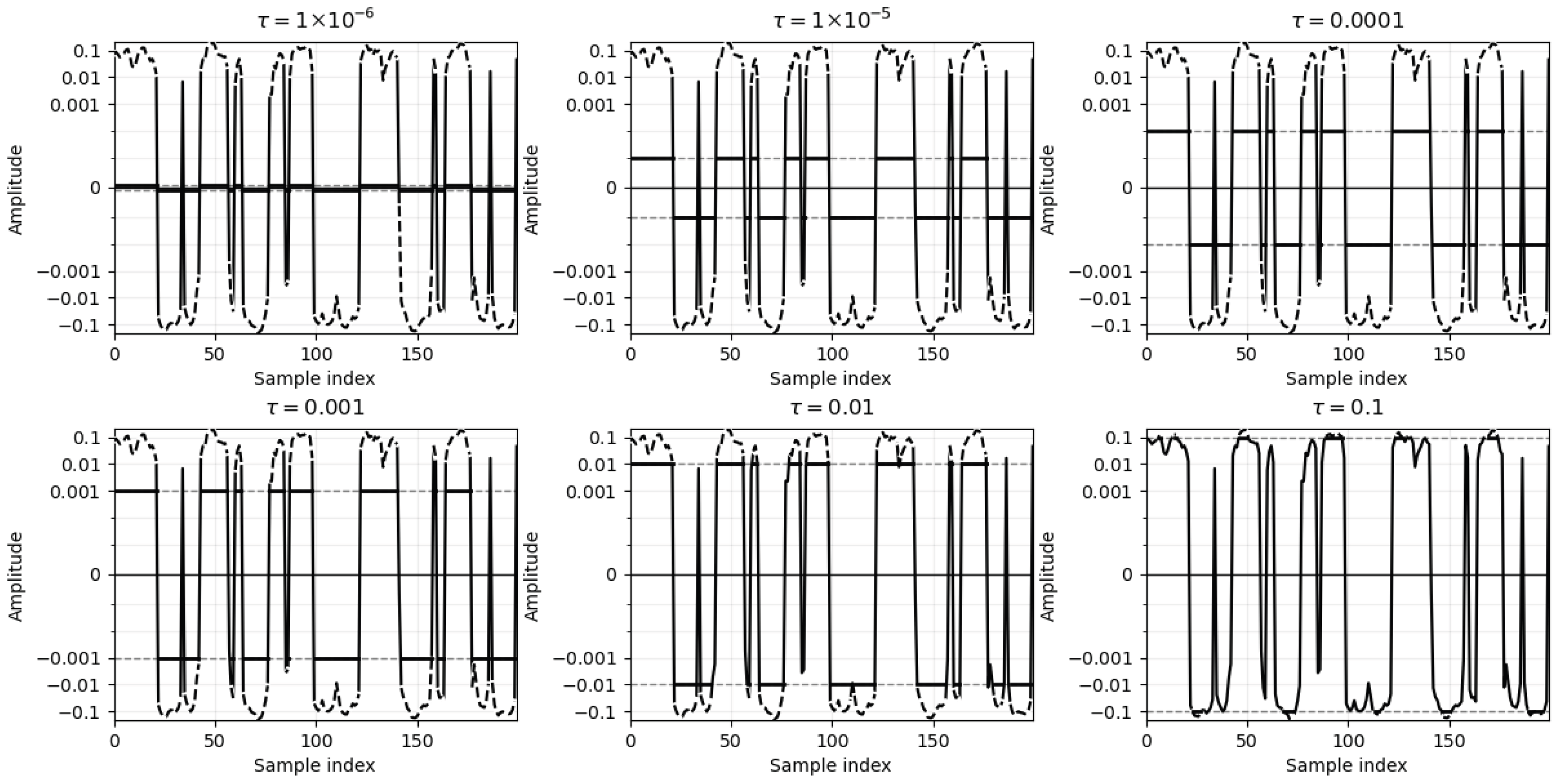
2.4.3. Illustrative Example of Saturation Distortion
3. Methodology
3.1. Data Preprocessing and Windowing
3.2. Handcrafted Time-Domain Features
3.3. Frequency-Domain Features
3.4. Intra-Session and Inter-Session Evaluation Protocols
3.5. Dataset and Experimental Protocol
3.5.1. Gesture Collection (3 Sessions)
3.5.2. Data Processing and Normalization
3.5.3. Classification and Evaluation Protocol
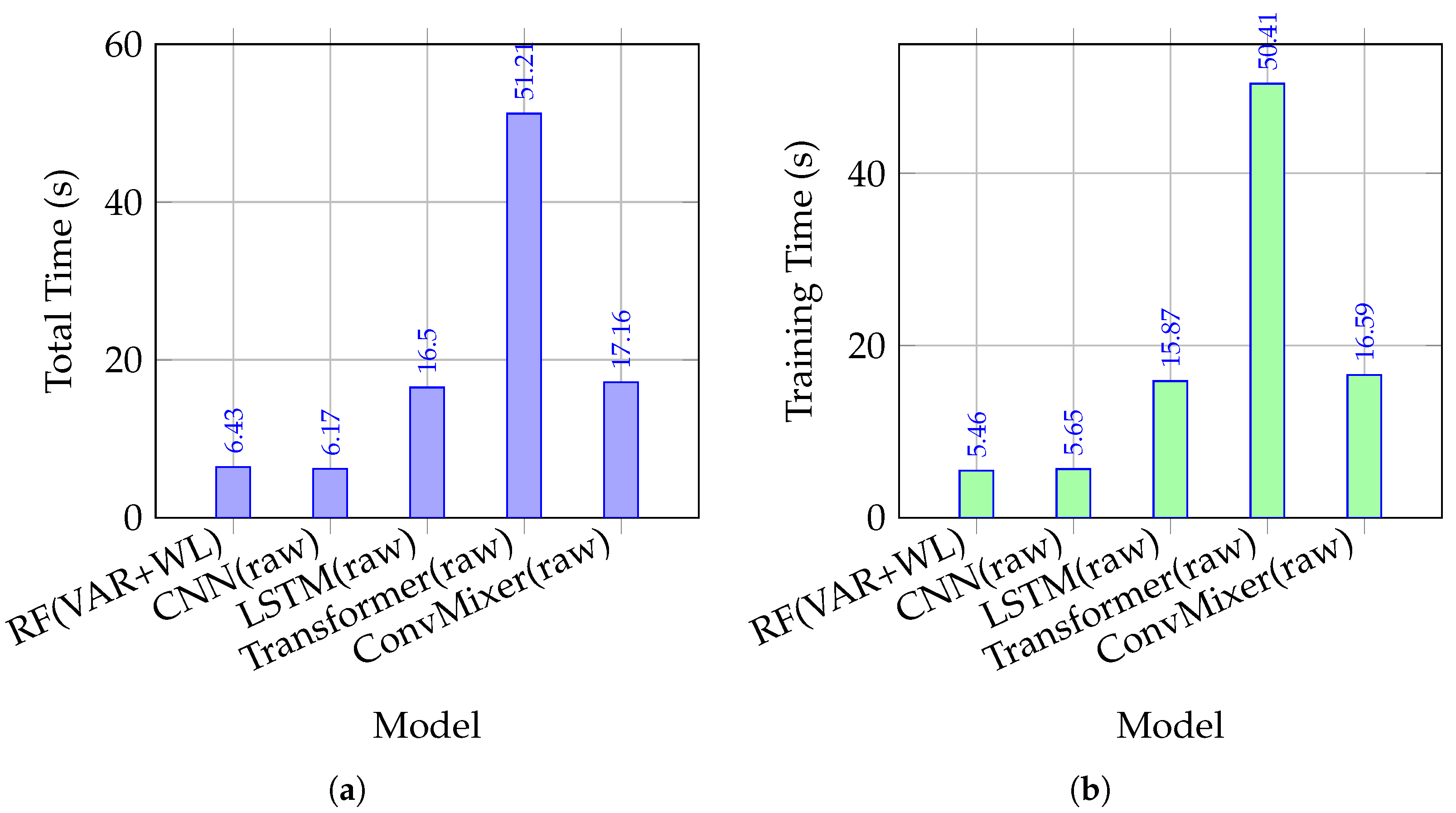
3.6. Training Efficiency for Real-Time Deployment
- Data I/O + Windowing: Loading files and generating 250 ms windows with 50 ms hop;
- Feature Computation: RMS/VAR/ZC/WL extraction and feature assembly for conventional pipelines;
- Model Training: Split-wise fitting (epoch-based optimization for deep models);
- Evaluation: Test-time inference and metric aggregation.
4. Experimental Results and Discussion
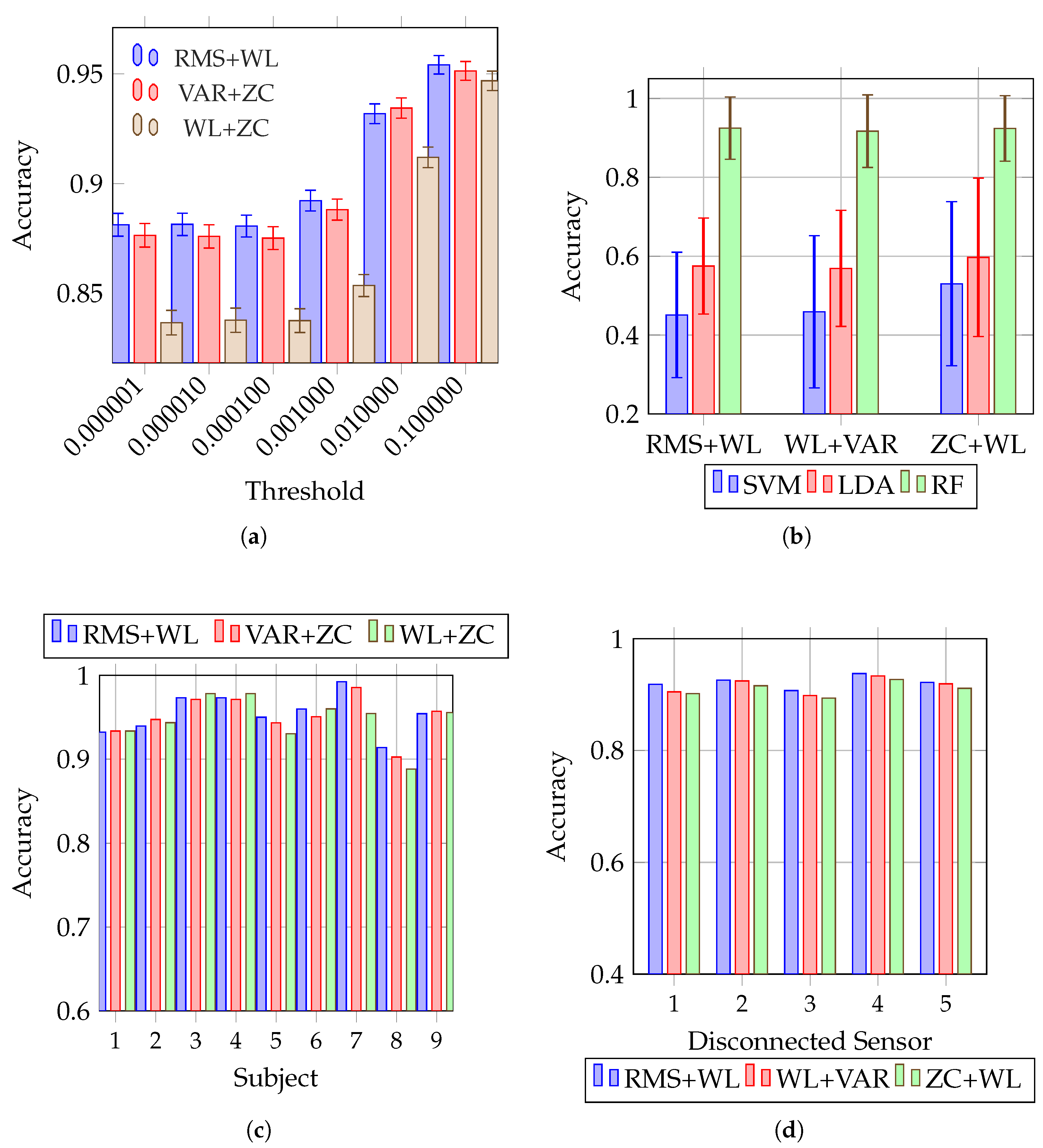
4.1. Robustness Under Saturation (Clipping)
4.2. Classifier Dependence Under Identical Features
4.3. Subject-Wise Consistency
4.4. Robustness Under Single-Channel Dropout
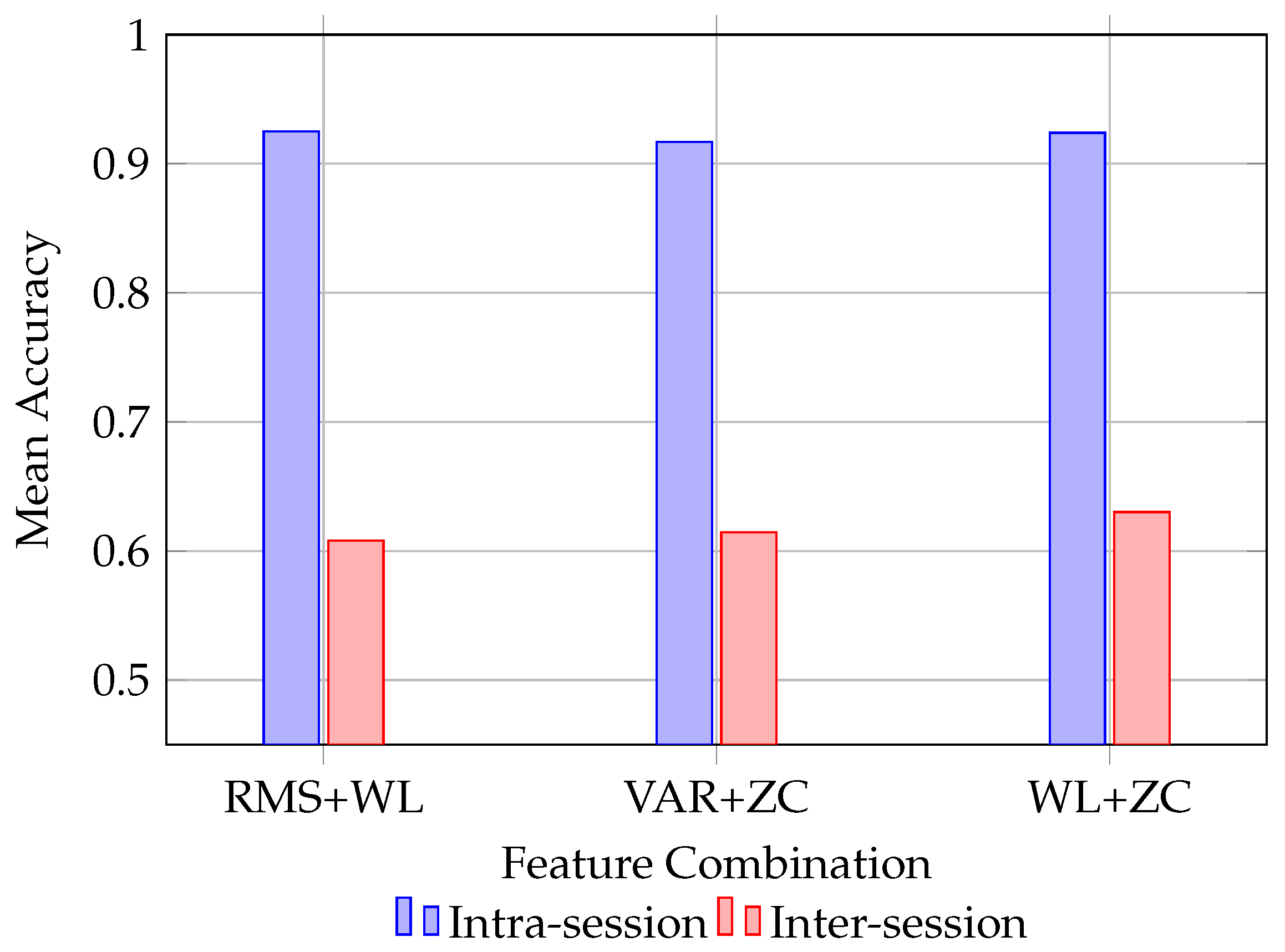
4.5. Comparison Between Intra-Session and Inter-Session Performance
4.6. Effect of Adding Frequency-Domain Information
4.7. Summary of Findings in the Context of Wearable Deployment
4.8. Limitations
5. Future Work
Author Contributions
Funding
Institutional Review Board Statement
Informed Consent Statement
Data Availability Statement
Conflicts of Interest
References
- Chowdhury, R.H.; Reaz, M.B.I.; Ali, M.A.B.M.; Bakar, A.A.A.; Chellappan, K.; Chang, T.G. Surface Electromyography Signal Processing and Classification Techniques. Sensors 2013, 13, 12431–12466. [Google Scholar] [CrossRef]
- Hudgins, B.; Parker, P.; Scott, R.N. A New Strategy for Multifunction Myoelectric Control. IEEE Trans. Biomed. Eng. 1993, 40, 82–94. [Google Scholar] [CrossRef] [PubMed]
- Englehart, K.; Hudgins, B. A Robust, Real-Time Control Scheme for Multifunction Myoelectric Control. IEEE Trans. Biomed. Eng. 2003, 50, 848–854. [Google Scholar] [CrossRef]
- Merletti, R.; Cerone, G.L. Tutorial. Surface EMG Detection, Conditioning and Pre-Processing: Best Practices. J. Electromyogr. Kinesiol. 2020, 54, 102440. [Google Scholar] [CrossRef]
- Hargrove, L.; Englehart, K.; Hudgins, B. A Training Strategy to Reduce Classification Degradation due to Electrode Displacements in Pattern Recognition Based Myoelectric Control. Biomed. Signal Process. Control 2008, 3, 175–180. [Google Scholar] [CrossRef]
- Ketykó, I.; Kovács, F.; Varga, Z. Domain Adaptation for sEMG-based Gesture Recognition with Recurrent Neural Networks. arXiv 2019, arXiv:1901.06958. [Google Scholar]
- Sultana, A.; Ahmed, F.; Alam, M.S. A Systematic Review on Surface Electromyography-Based Classification System for Identifying Hand and Finger Movements. Healthc. Anal. 2023, 3, 100126. [Google Scholar] [CrossRef]
- Pizzolato, S.; Tagliapietra, L.; Cognolato, M.; Reggiani, M.; Müller, H.; Atzori, M. Comparison of Six Electromyography Acquisition Setups on Hand Movement Classification Tasks. PLoS ONE 2017, 12, e0186132. [Google Scholar] [CrossRef] [PubMed]
- Du, Y.; Jin, W.; Wei, W.; Hu, Y.; Geng, W. Surface EMG-Based Inter-Session Gesture Recognition Enhanced by Deep Domain Adaptation. Sensors 2017, 17, 458. [Google Scholar] [CrossRef] [PubMed]
- Hellara, H.; Barioul, R.; Sahnoun, S.; Fakhfakh, A.; Kanoun, O. Comparative Study of sEMG Feature Evaluation Methods and Their Impact on Gesture Recognition Accuracy. Sensors 2024, 24, 3638. [Google Scholar] [CrossRef]
- Jiang, X.; Deng, Y.; Zhang, B.; Chen, S. Posture-Invariant Myoelectric Control with Self-Calibrating Models. Front. Neurorobot. 2024, 18, 1462023. [Google Scholar] [CrossRef] [PubMed]
- De Luca, C.J. The Use of Surface Electromyography in Biomechanics. J. Appl. Biomech. 1997, 13, 135–163. [Google Scholar] [CrossRef]
- Farina, D.; Jiang, N.; Rehbaum, H.; Holobar, A.; Graimann, B.; Dietl, H.; Aszmann, O.C. The extraction of neural information from the surface EMG for the control of upper-limb prostheses: Emerging avenues and challenges. IEEE Trans. Neural Syst. Rehabil. Eng. 2014, 22, 797–809. [Google Scholar] [CrossRef]
- Merletti, R.; Farina, D. (Eds.) Surface Electromyography: Physiology, Engineering, and Applications; Wiley-IEEE Press: Hoboken, NJ, USA, 2016. [Google Scholar]
- Arpaia, P.; De Luca, M.; Di Marino, L.; Duran, D.; Gargiulo, L.; Lanteri, P.; Moccaldi, N.; Nalin, M.; Picciafuoco, M.; Robbio, R.; et al. A Systematic Review of Techniques for Artifact Detection and Artifact Category Identification in Electroencephalography from Wearable Devices. Sensors 2025, 25, 5770. [Google Scholar] [CrossRef]
- Ronca, V.; Cecchetti, M.; Capotorto, R.; Di Flumeri, G.; Giorgi, A.; Germano, D.; Borghini, G.; Babiloni, F.; Aricò, P. Beyond the lab: Real-world benchmarking of wearable EEGs for passive BCIs. Brain Inform. 2025, 13, 3. [Google Scholar] [CrossRef]
- Lee, Y.; Gwon, D.; Kim, K.; Park, S.; Sohn, S.; Choi, M.; Choi, M.; Bae, J.-H.; Ahn, M. A comprehensive evaluation framework for consumer-grade EEG devices: Signal quality, robustness, and usability. Sci. Rep. 2026, 16, 8408. [Google Scholar] [CrossRef]
- Wang, X.; Li, M. Ultrasound and Unsupervised Segmentation-Based Gesture Recognition for Smart Device Unlocking. Sensors 2025, 25, 6408. [Google Scholar] [CrossRef] [PubMed]
- Patwardhan, S.; Rubin, N.; Alter, K.; Damiano, D.; Bulea, T. Sonomyography accurately captures joint kinematics during volitional and electrically stimulated motion in healthy adults and an individual with cerebral palsy. J. Neuroeng. Rehabil. 2025, 23, 15. [Google Scholar] [CrossRef] [PubMed]
- Rehman, M.U.; Shah, K.; Haq, I.U.; Iqbal, S.; Ismail, M.A. A Wearable Force Myography-Based Armband for Recognition of Upper Limb Gestures. Sensors 2023, 23, 9357. [Google Scholar] [CrossRef] [PubMed]
- Sherif, O.; Bassuoni, M.; Mehrez, O. A survey on the state of the art of force myography (FMG): Analysis and assessment. Med. Biol. Eng. Comput. 2024, 62, 1313–1332. [Google Scholar] [CrossRef] [PubMed]
- Scano, A.; Zanoletti, M.; Pirovano, I.; Spinelli, L.; Contini, D.; Torricelli, A.; Re, R. NIRS-EMG for Clinical Applications: A Systematic Review. Appl. Sci. 2019, 9, 2952. [Google Scholar] [CrossRef]
- Vásconez, J.P.; Barona López, L.I.; Valdivieso Caraguay, Á.L.; Benalcázar, M.E. Hand Gesture Recognition Using EMG-IMU Signals and Deep Q-Networks. Sensors 2022, 22, 9613. [Google Scholar] [CrossRef] [PubMed]
- Fratti, R.; Marini, N.; Atzori, M.; Müller, H.; Tiengo, C.; Bassetto, F. A Multi-Scale CNN for Transfer Learning in sEMG-Based Hand Gesture Recognition for Prosthetic Devices. Sensors 2024, 24, 7147. [Google Scholar] [CrossRef]
- Lee, D.; You, D.; Cho, G.; Lee, H.; Shin, E.; Choi, T.; Kim, S.; Lee, S.; Nam, W. EMG-based Hand Gesture Classifier Robust to Daily Variation: Recursive Domain Adversarial Neural Network with Data Synthesis. Biomed. Signal Process. Control 2024, 89, 105600. [Google Scholar] [CrossRef]
- Yang, Y.; Teo, H.H.; King, Y.J.; Zhang, Y.; Wang, G.; Qu, X. Calibration-free sEMG Intention Recognition via Self-supervised Pretraining and Adversarial Domain Alignment for Upper-limb Rehabilitation. Sci. Rep. 2025, 15, 44850. [Google Scholar] [CrossRef]
- Kalita, A.J.; Kakoty, N.M.; Vinjamuri, R.K.; Borah, S. Functional evaluation of a real-time EMG controlled prosthetic hand. Wearable Technol. 2025, 6, e18. [Google Scholar] [CrossRef] [PubMed]
- Unanyan, N.N.; Belov, A.A. Low-Price Prosthetic Hand Controlled by EMG Signals. Procedia Comput. Sci. 2021, 184, 291–298. [Google Scholar] [CrossRef]
- George, J.A.; Davis, T.S.; Brinton, M.R.; Clark, G.A. Intuitive Neuromyoelectric Control of a Dexterous Bionic Arm Using a Modified Kalman Filter. arXiv 2019, arXiv:1908.10522. [Google Scholar] [CrossRef]
- Rodríguez-Fernández, A.; Lobo-Prat, J.; Font-Llagunes, J.M. Systematic review on wearable lower-limb exoskeletons for gait training in neuromuscular impairments. J. Neuroeng. Rehabil. 2021, 18, 22. [Google Scholar] [CrossRef] [PubMed]
- Khan, M.A.; Fares, H.; Ghayvat, H.; Brunner, I.C.; Puthusserypady, S.; Razavi, B.; Lansberg, M.; Poon, A.; Meador, K.J. A systematic review on functional electrical stimulation systems for upper limb stroke rehabilitation. Front. Neurol. 2023, 14, 1272992. [Google Scholar] [CrossRef] [PubMed]
- Mashud, G.; Hasan, S.K.; Alam, N. Advances in Control Techniques for Rehabilitation Exoskeleton Robots: A Systematic Review. Actuators 2025, 14, 108. [Google Scholar] [CrossRef]
- Pei, Y.; Tobita, M.; Dirlikov, B.; Arnold, D.; Tefertiller, C.; Gorgey, A. Consumer views of functional electrical stimulation and robotic exoskeleton technologies. Artif. Organs 2025, 49, 729–748. [Google Scholar] [CrossRef] [PubMed]



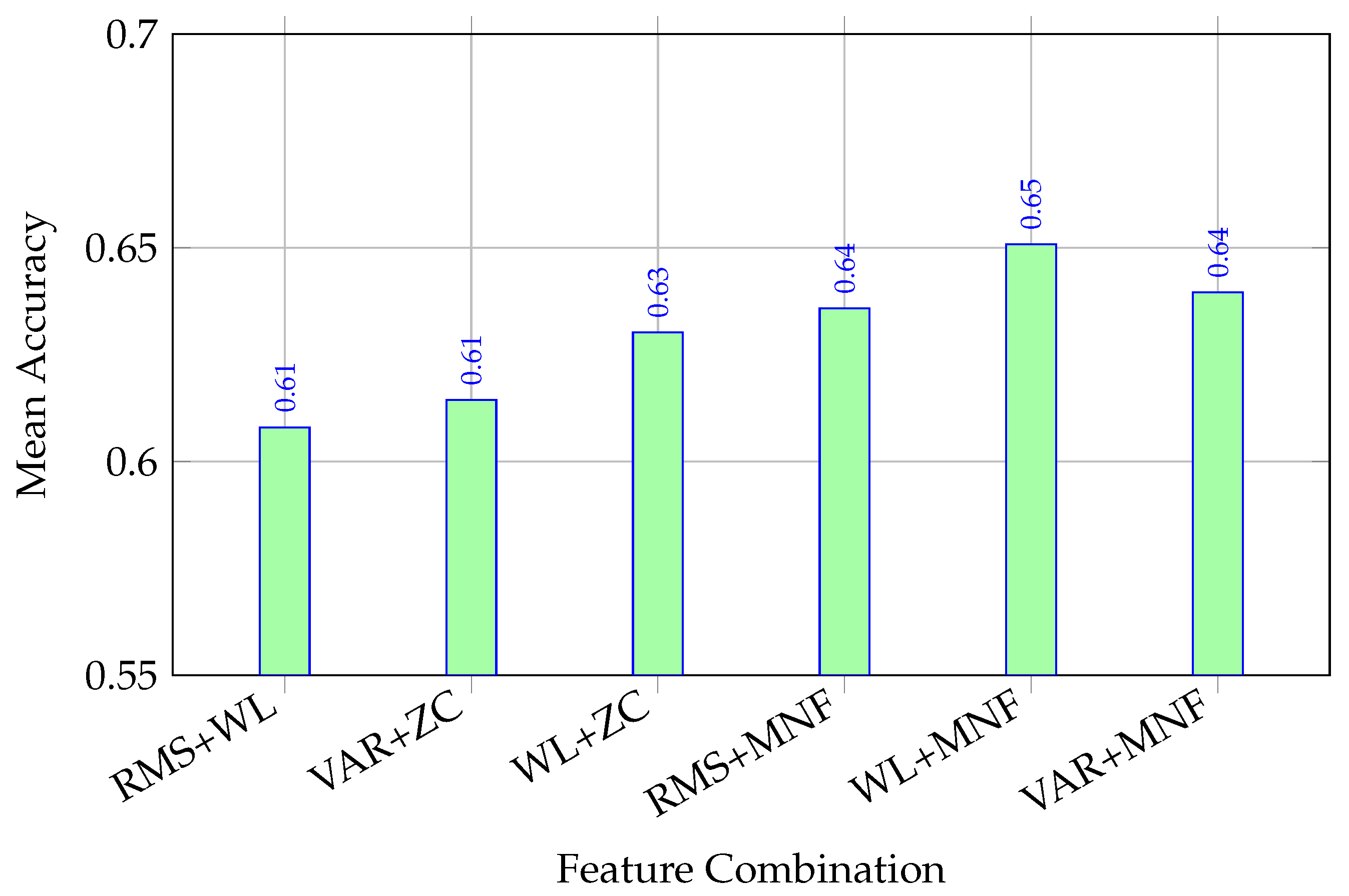
| Feature Pair | Intra-Session | Inter-Session | Feature Domain |
|---|---|---|---|
| RMS + WL | 0.9250 | 0.6080 | Time domain |
| VAR + ZC | 0.9170 | 0.6144 | Time domain |
| WL + ZC | 0.9240 | 0.6302 | Time domain |
| RMS + MNF | – | 0.6358 | Time + frequency |
| WL + MNF | – | 0.6508 | Time + frequency |
| VAR + MNF | – | 0.6396 | Time + frequency |
Disclaimer/Publisher’s Note: The statements, opinions and data contained in all publications are solely those of the individual author(s) and contributor(s) and not of MDPI and/or the editor(s). MDPI and/or the editor(s) disclaim responsibility for any injury to people or property resulting from any ideas, methods, instructions or products referred to in the content. |
© 2026 by the authors. Licensee MDPI, Basel, Switzerland. This article is an open access article distributed under the terms and conditions of the Creative Commons Attribution (CC BY) license.
Share and Cite
Zhang, C.; Zhou, D.; Fang, Y.; Gao, D.; Ju, Z. Assessing the Resilience of sEMG Classifiers to Sensor Malfunction and Signal Saturation. Sensors 2026, 26, 2386. https://doi.org/10.3390/s26082386
Zhang C, Zhou D, Fang Y, Gao D, Ju Z. Assessing the Resilience of sEMG Classifiers to Sensor Malfunction and Signal Saturation. Sensors. 2026; 26(8):2386. https://doi.org/10.3390/s26082386
Chicago/Turabian StyleZhang, Congyi, Dalin Zhou, Yinfeng Fang, Dongxu Gao, and Zhaojie Ju. 2026. "Assessing the Resilience of sEMG Classifiers to Sensor Malfunction and Signal Saturation" Sensors 26, no. 8: 2386. https://doi.org/10.3390/s26082386
APA StyleZhang, C., Zhou, D., Fang, Y., Gao, D., & Ju, Z. (2026). Assessing the Resilience of sEMG Classifiers to Sensor Malfunction and Signal Saturation. Sensors, 26(8), 2386. https://doi.org/10.3390/s26082386