Exploiting Phase Memory in Multicarrier Waveforms for Robust Underwater Acoustic Communication


Abstract
1. Introduction
- 1.
- A memory-based multicarrier modulation framework is proposed by integrating continuous phase modulation within the GFDM mapper and demapper.
- 2.
- An extensive performance evaluation is conducted across 23 rational modulation indices to identify configurations that outperform conventional memoryless GFDM.
- 3.
- The impacts of five different pulse-shaping filters are examined to determine their effectiveness within the proposed framework.
- 4.
- The influence of transmitter–receiver distance, ranging from 100 m to 1000 m, is analyzed to establish reliable operating conditions.
- 5.
- The effect of varying the number of sub-symbols per subcarrier is investigated to assess system robustness and capacity.
- 6.
- The sensitivity of the proposed system to roll-off factor variations is evaluated to identify conditions for high-fidelity underwater communication.
2. Transceiver Design
2.1. Transmitter Architecture
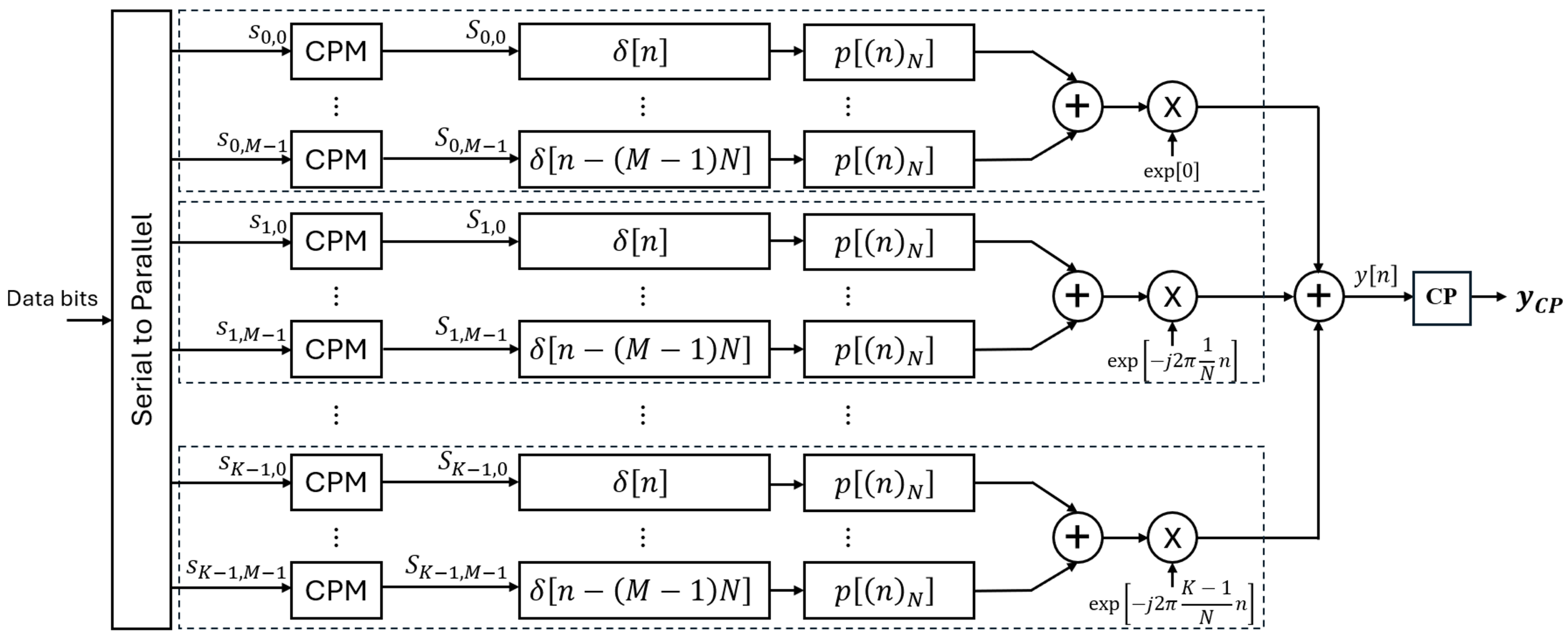
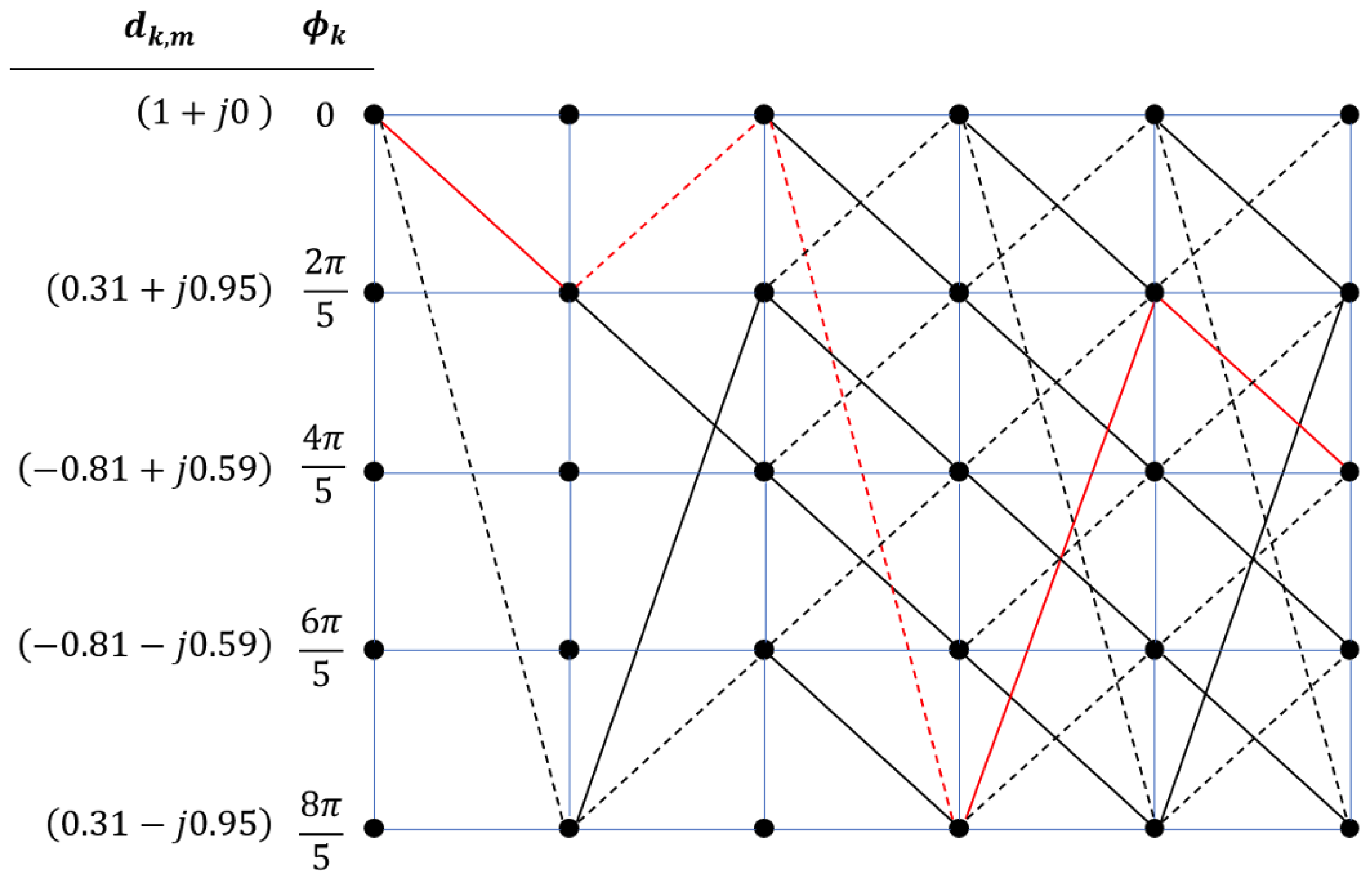
2.1.1. CPM Mapper
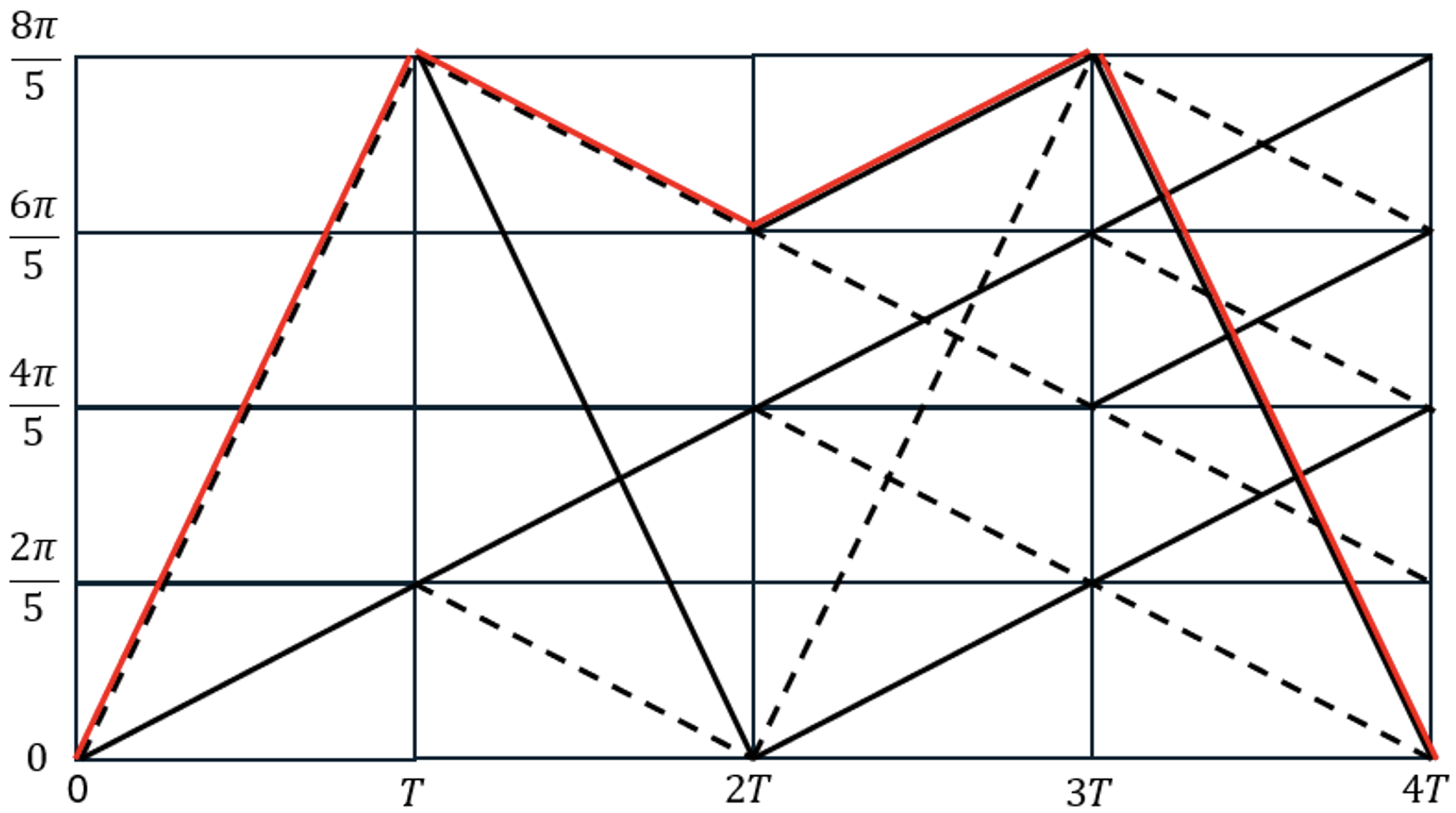
2.1.2. The Modulation Index (h)
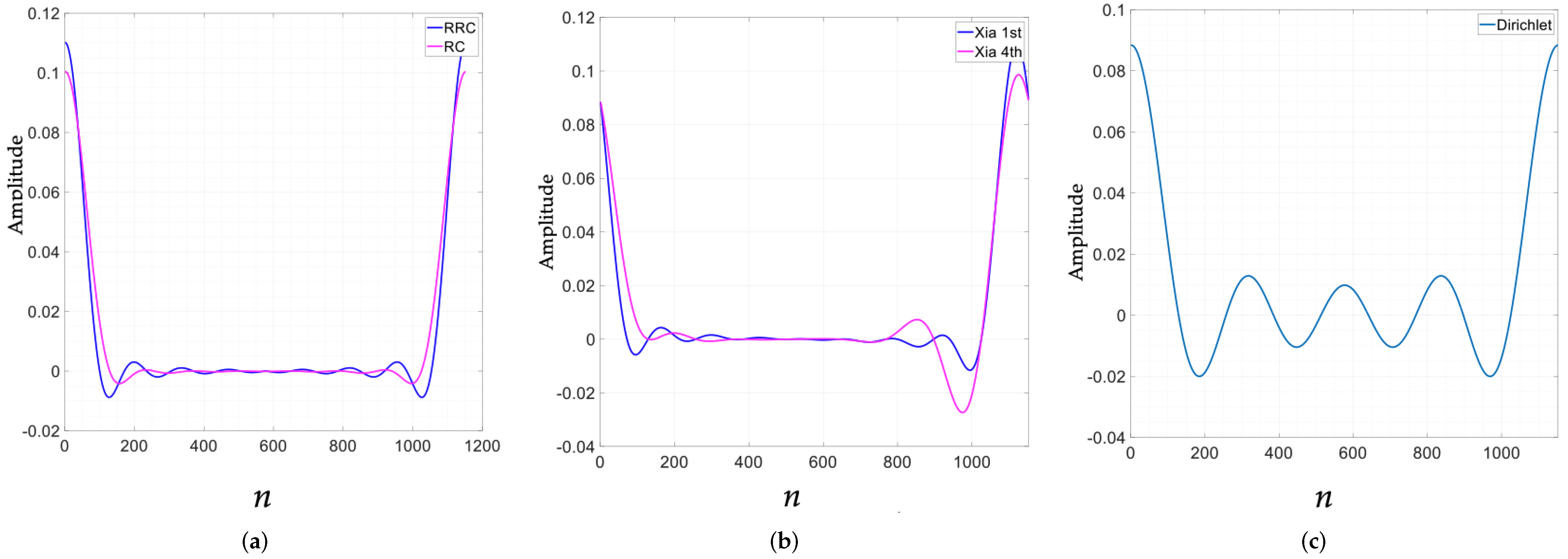
2.1.3. Pulse-Shaping Filters
- Root Raised Cosine;
- Raised Cosine;
- 1st Xia pulse;
- 4th Xia pulse; and
- Dirichlet pulse.
2.1.4. Transmitted GFDM Signal
| Algorithm 1 CPM-GFDM transmitter processing |
| Require: Number of subcarriers K, number of symbols M on each subcarrier, modulation order J, modulation index h, oversampling factor N, pulse-shaping filter |
| Ensure: Transmit block |
| 1: Partition input bit stream into groups of bits |
| 2: Map each group to a CPM input symbol |
| 3: for each subcarrier do |
| 4: for each sub-symbol do |
| 5: Update the CPM phase state: |
| 6: Form the CPM output symbol: |
| 7: end for |
| 8: end for |
| 9: Upsample the data symbols by factor N |
| 10: Arrange the symbols into the GFDM data vector |
| 11: Generate the GFDM block by circular pulse shaping and subcarrier modulation |
| 12: Append the cyclic prefix to form |
| 13: Transmit through the UWA channel |
2.2. Proposed Receiver System
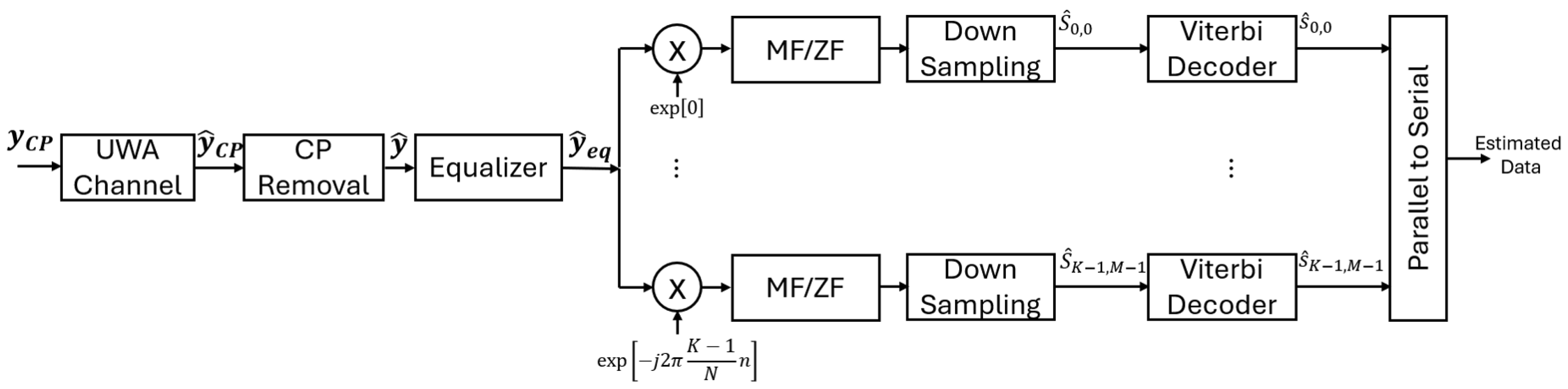
2.2.1. GFDM Demodulator
2.2.2. Viterbi Decoder
| Algorithm 2 CPM-GFDM receiver processing |
| Require: Received block , estimated channel matrix , GFDM modulation matrix , receiver type (MF or ZF), rational modulation index , decision depth w |
| Ensure: Estimated bit stream |
| 1: Remove the cyclic prefix from |
| 2: Equalize the received block: |
| 3: if matched-filter receiver is used then |
| 4: Compute |
| 5: else |
| 6: Compute |
| 7: end if |
| 8: Down-sample to obtain the CPM symbol-rate samples |
| 9: Construct the CPM trellis according to the rational modulation index and initialize the trellis states and path metrics |
| 10: for each symbol interval m do |
| 11: Represent the received sample at the current stage as |
| 12: For every admissible state transition, generate the corresponding candidate CPM sample |
| 13: Compute the squared Euclidean branch metric |
| 14: Add each branch metric to the accumulated path metric of its predecessor state |
| 15: When multiple paths arrive at the same state, retain only the survivor path with the minimum accumulated metric and discard the other contenders |
| 16: Store the survivor decisions for traceback and continue to the next trellis stage |
| 17: end for |
| 18: After the selected decision depth w (or at the end of the block), perform traceback through the survivor states to obtain the most likely CPM sequence |
| 19: Recover the detected CPM symbols and map and to form |
| 20: Output the estimated bit stream |
3. Numerical Results
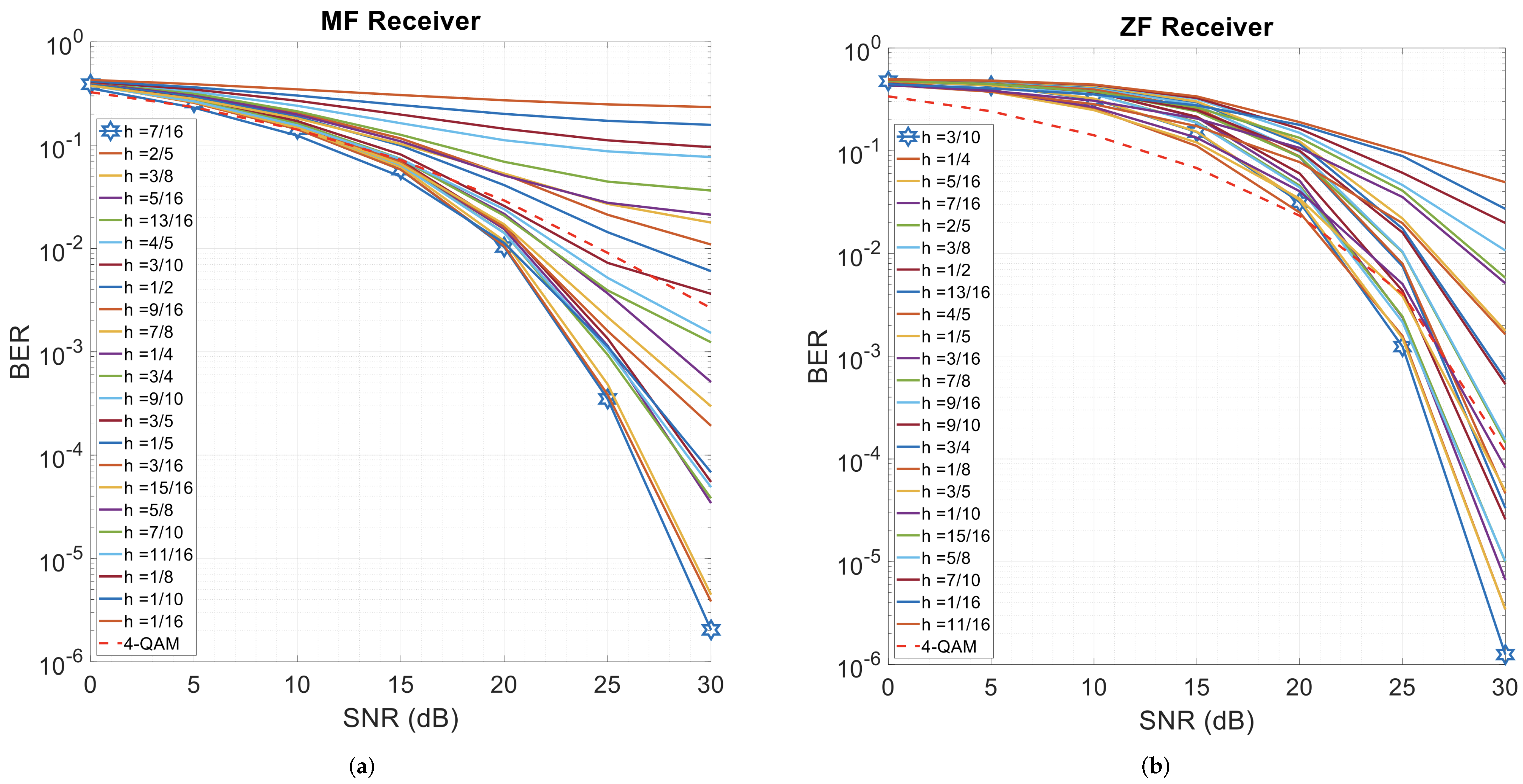
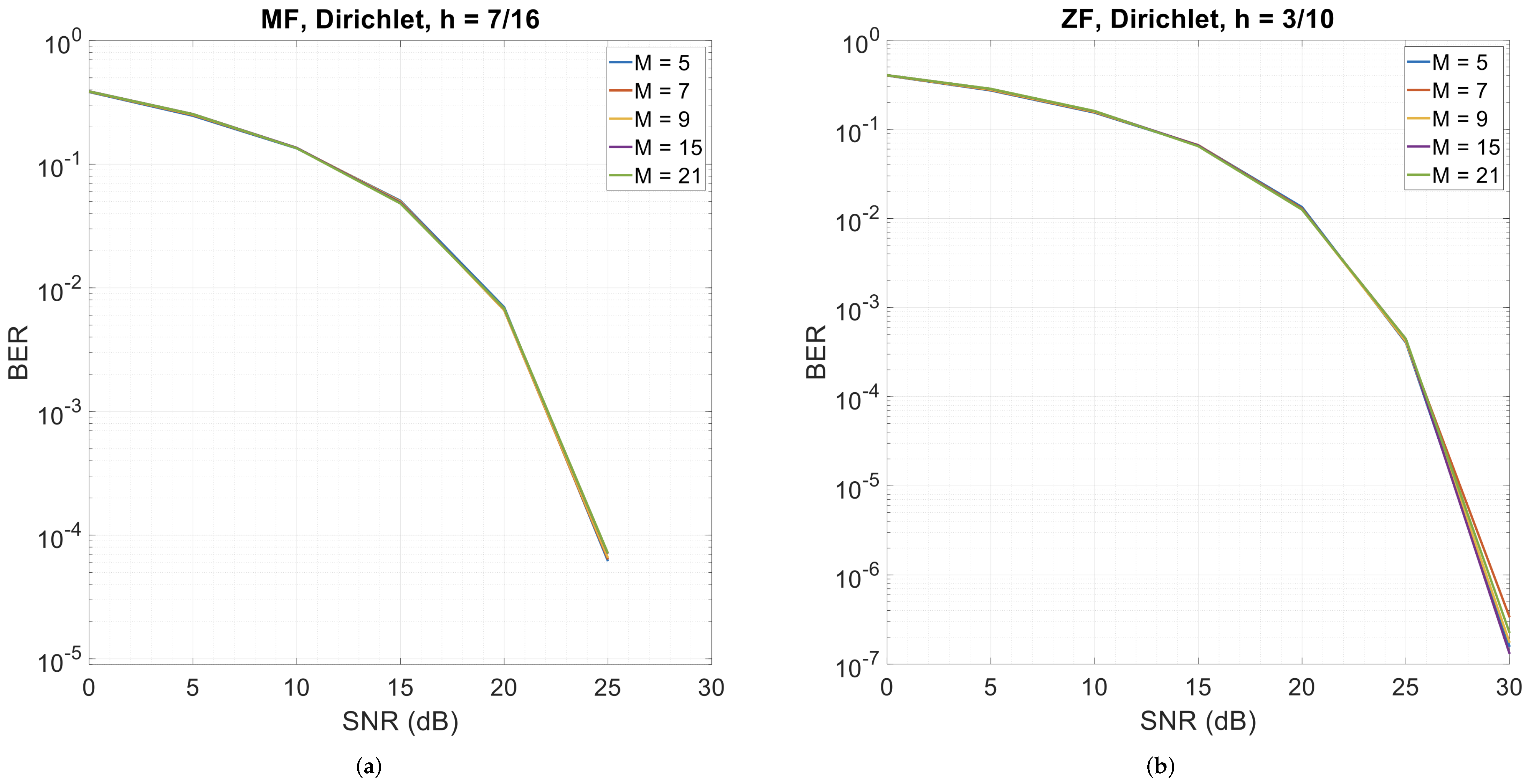
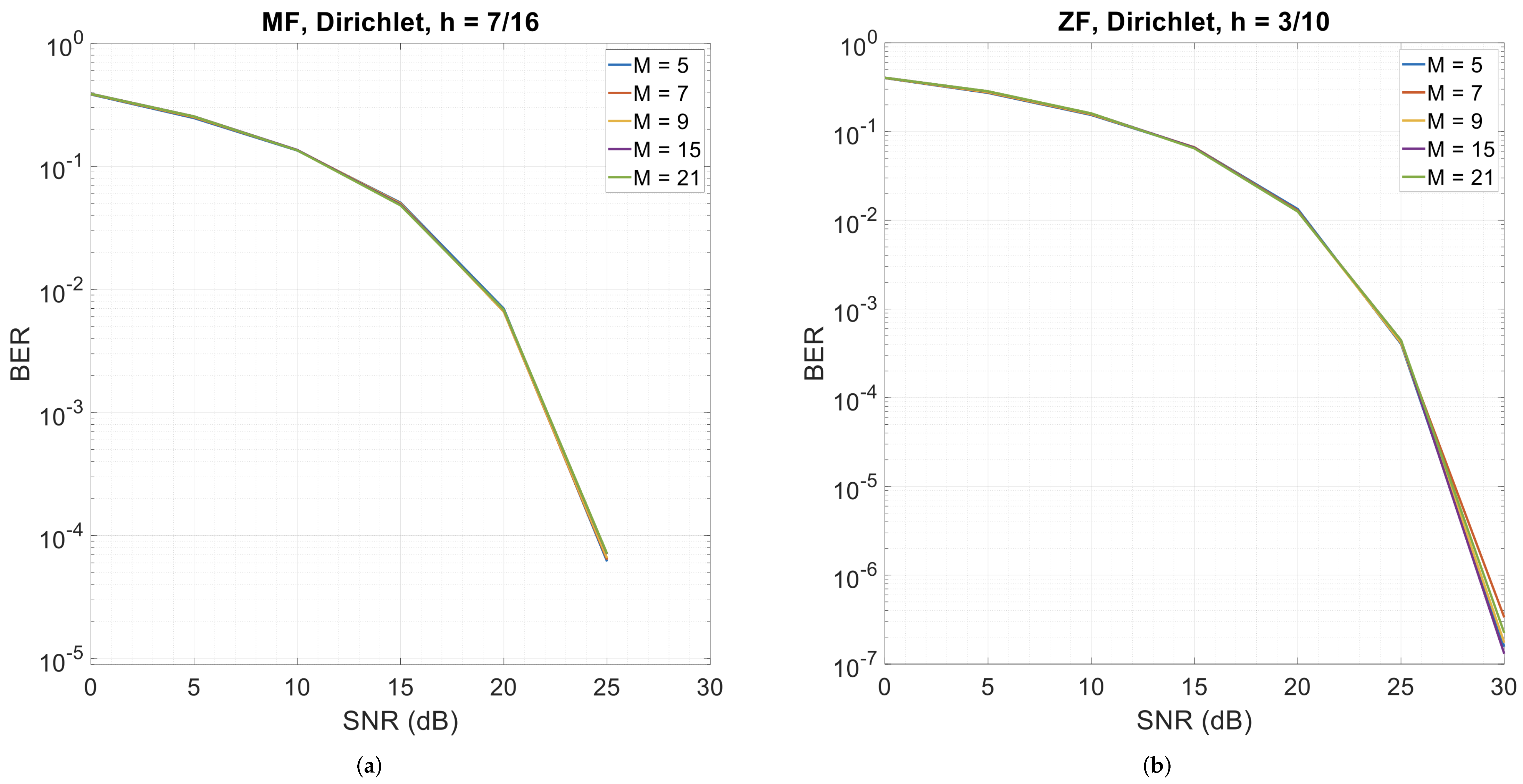
3.1. Error Performance with Different h Values
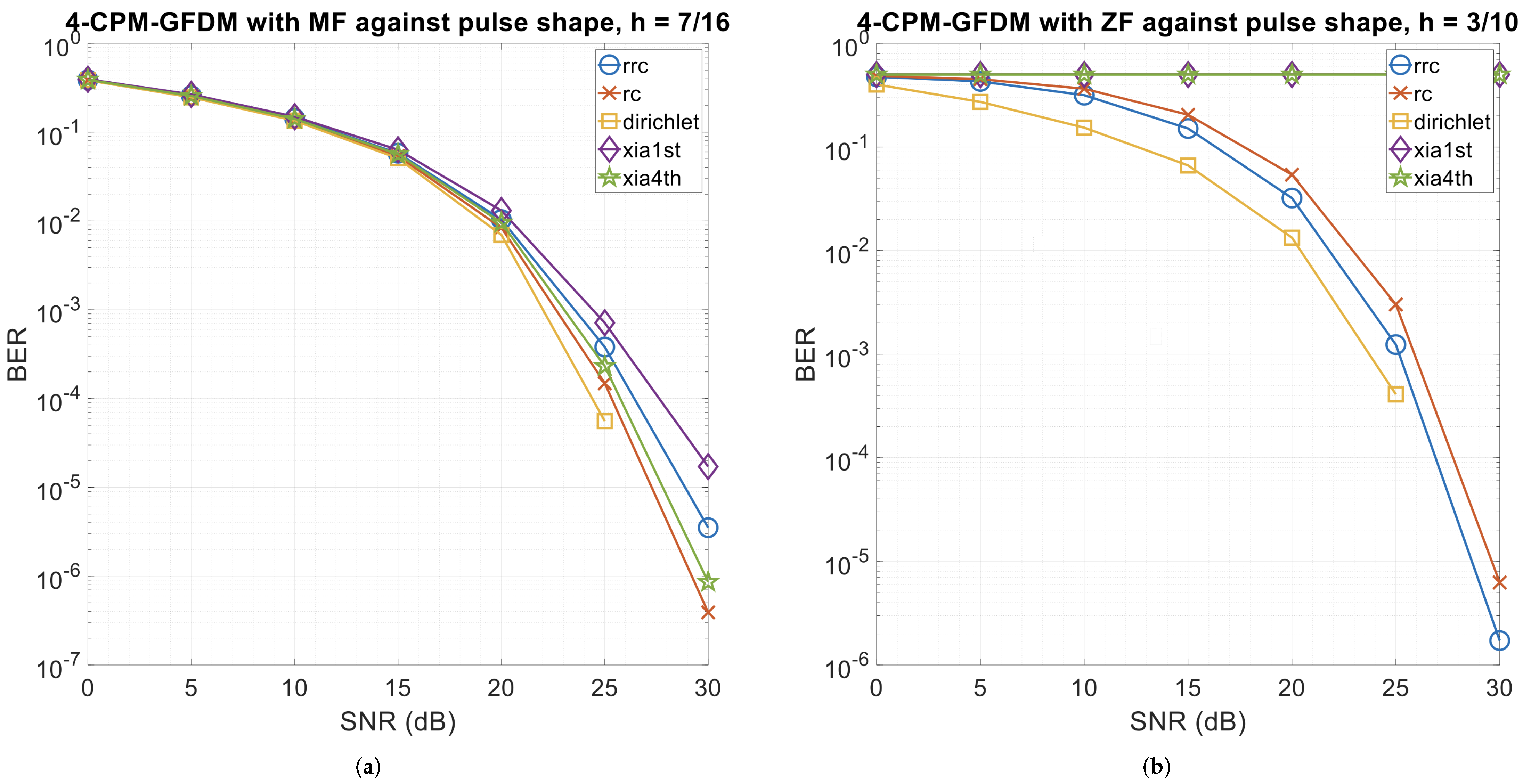
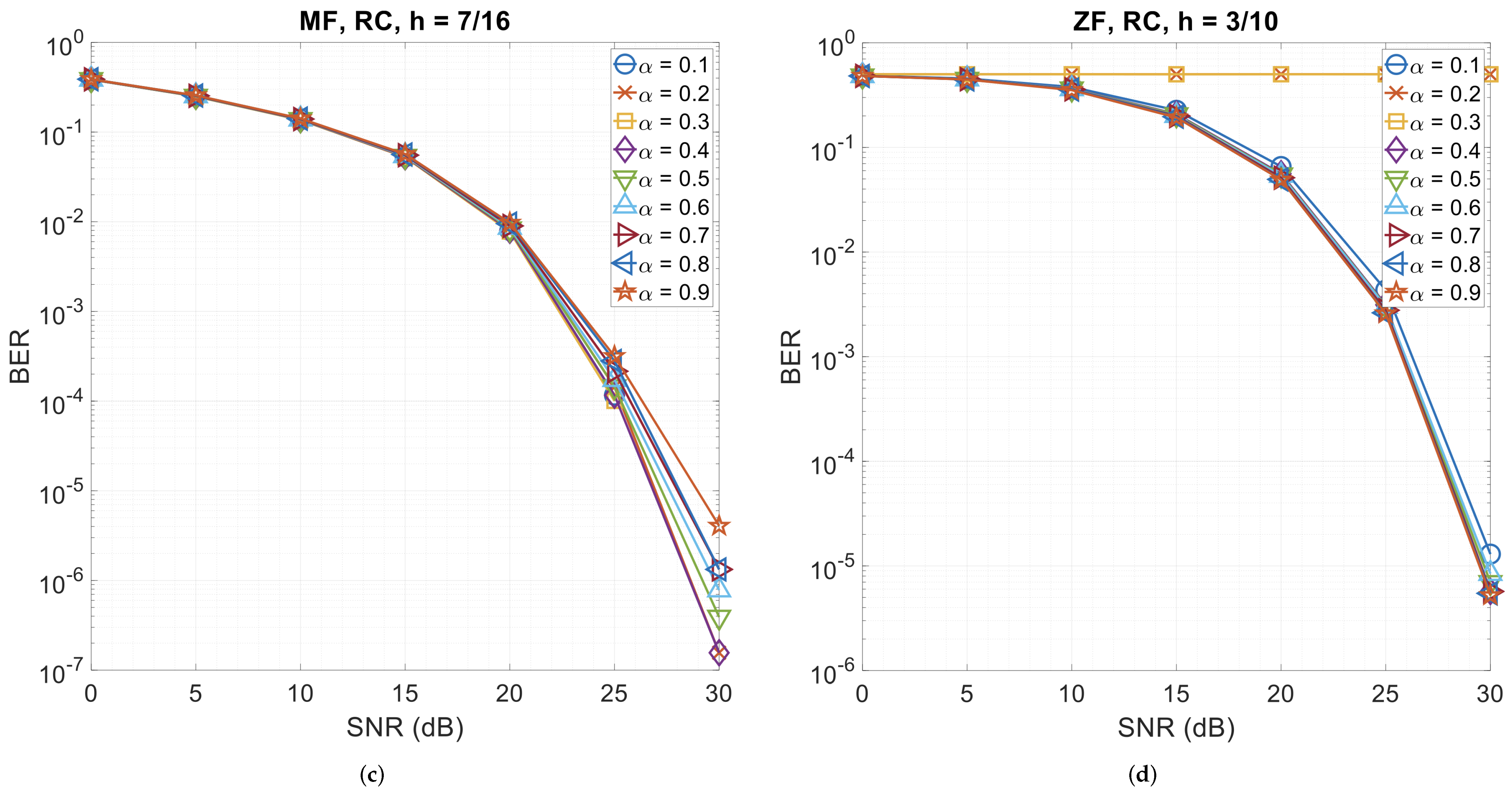
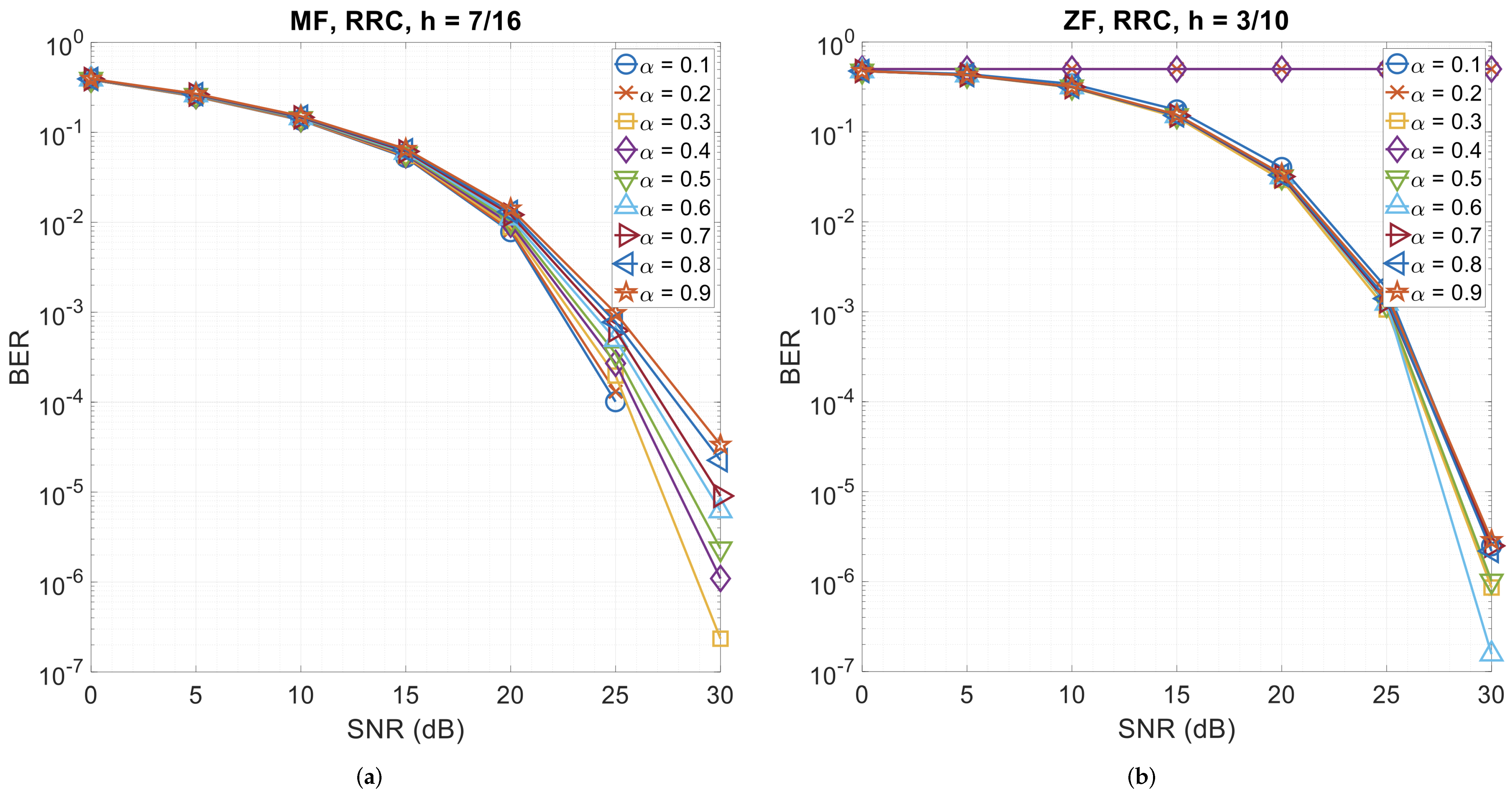
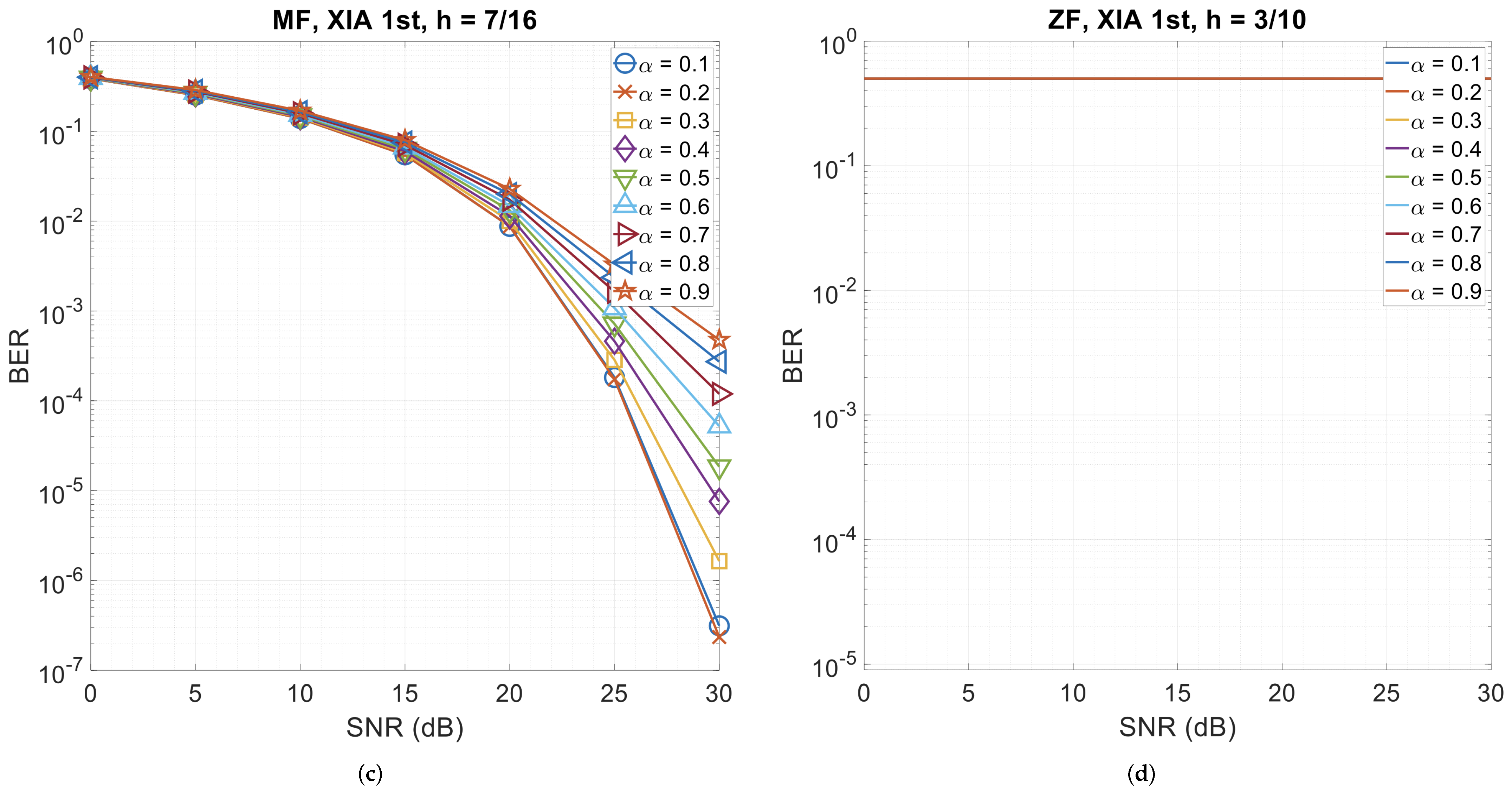
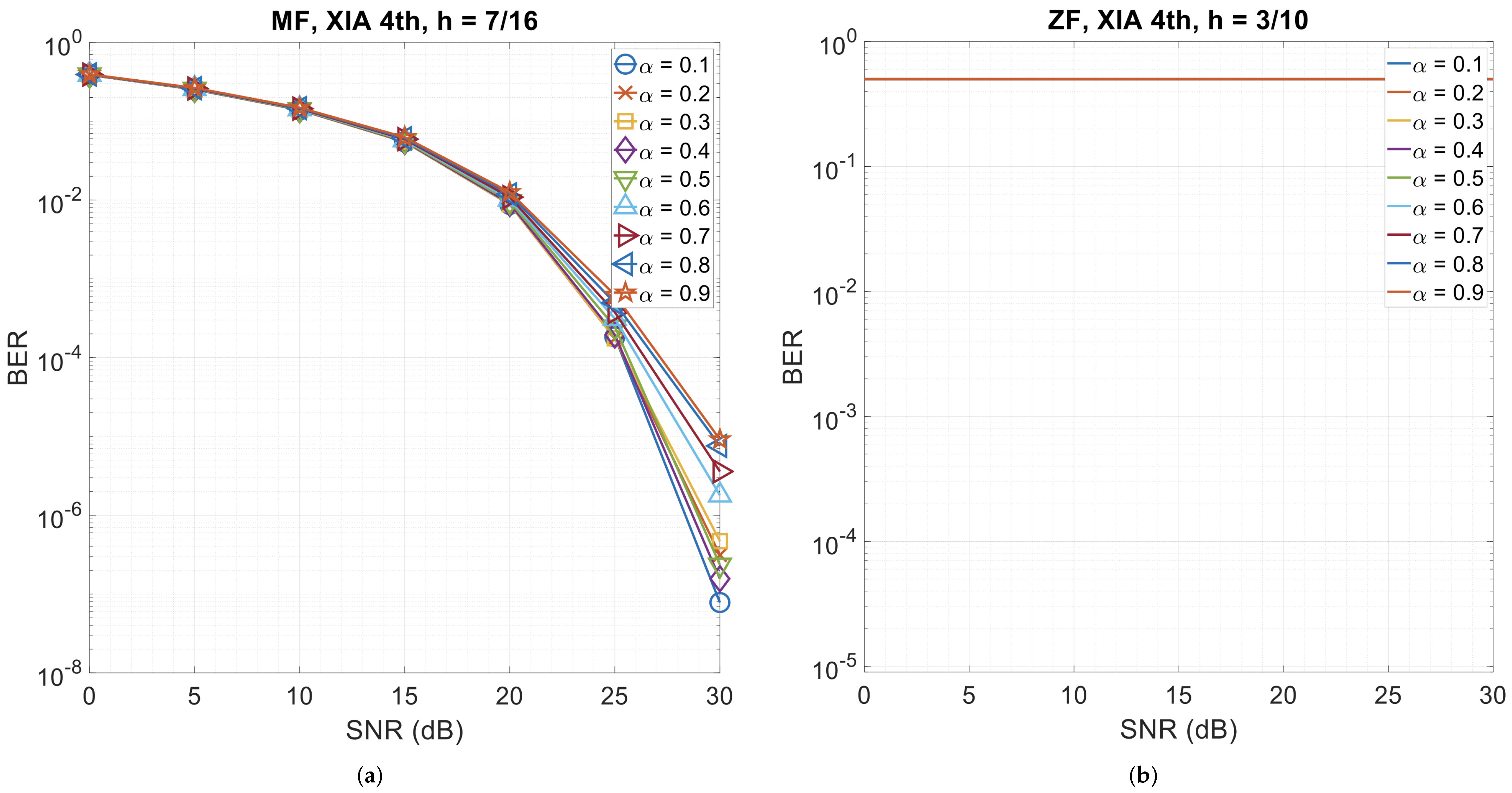
3.2. Error Performance with Different Pulses
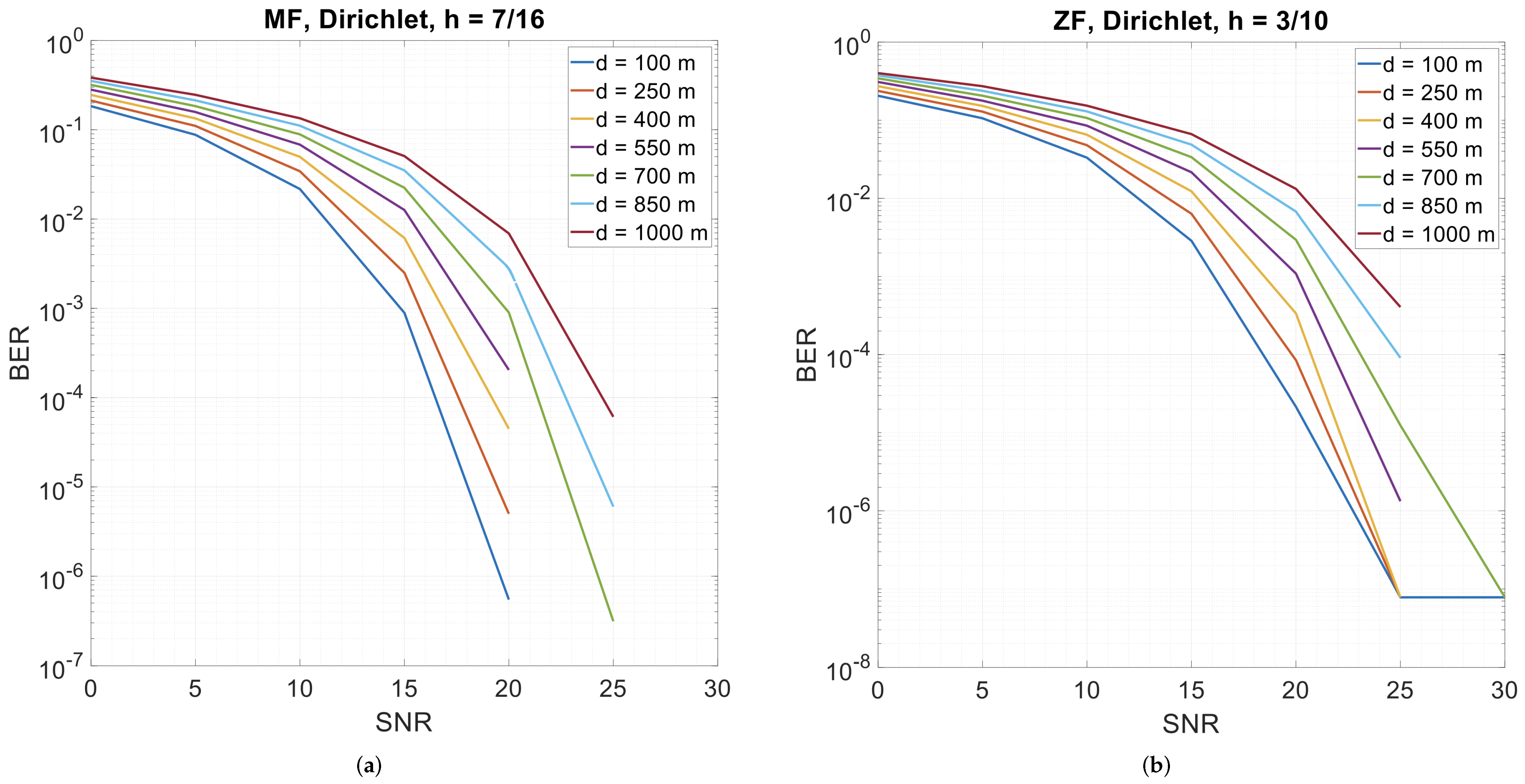
3.3. Error Performance with Different Distances
3.4. Error Performance with Different Numbers of Sub-Symbols per Subcarrier (M)
3.5. Error Performance with Different Roll-Off Factors
4. Discussion of Results
4.1. Impact of Phase Memory on Robustness
4.2. Effect of Modulation Index
4.3. Influence of Pulse-Shaping Filters
4.4. Receiver-Structure Trade-Offs
4.5. Impact of Doppler
4.6. Practical Implications for Underwater Systems
5. Complexity Analysis
6. Conclusions
Author Contributions
Funding
Institutional Review Board Statement
Informed Consent Statement
Data Availability Statement
Conflicts of Interest
References
- Feng, C.; Luo, Y.; Zhang, J.; Li, H. An OFDM-Based Frequency Domain Equalization Algorithm for Underwater Acoustic Communication with a High Channel Utilization Rate. J. Mar. Sci. Eng. 2023, 11, 415. [Google Scholar] [CrossRef]
- Zhai, Y.; Li, J.; Feng, H.; Hong, F. Application research of polar coded OFDM underwater acoustic communications. Eurasip J. Wirel. Commun. Netw. 2023, 2023, 26. [Google Scholar] [CrossRef]
- Cuji, D.A.; Stojanovic, M. Transmit Beamforming for Underwater Acoustic OFDM Systems. IEEE J. Ocean. Eng. 2024, 49, 145–162. [Google Scholar] [CrossRef]
- Alraie, H.; Ishii, K. Channel Estimation using Pilot-Assisted OFDM for Underwater Acoustic Communication. J. Robot. Netw. Artif. Life 2023, 10, 160–165. [Google Scholar] [CrossRef]
- 3GPP. NR; Physical Channels and Modulation. Technical Specification TS 38.211, Version 19.0.0, Release 19; 3rd Generation Partnership Project, 2025. Available online: https://www.3gpp.org/ftp/Specs/archive/38_series/38.211/ (accessed on 5 April 2026).
- Bölcskei, H. MIMO-OFDM Wireless Systems: Basics, Perspectives, and Challenges. IEEE Wirel. Commun. 2006, 13, 31–37. [Google Scholar] [CrossRef]
- Proakis, J.G.; Salehi, M. Digital Communications, 5th ed.; McGraw-Hill: Columbus, OH, USA, 2008. [Google Scholar]
- Telatar, E. Capacity of Multi-Antenna Gaussian Channels. Eur. Trans. Telecommun. 1999, 10, 585–595. [Google Scholar] [CrossRef]
- Bellanger, M.; Le Ruyet, D.; Roviras, D.; Terré, M.; Nossek, J.; Baltar, L.; Bai, Q.; Waldhauser, D.; Renfors, M.; Ihalainen, T. FBMC physical layer: A primer. Phydyas 2010, 25, 7–10. [Google Scholar]
- Schaich, F.; Wild, T. Waveform contenders for 5G—OFDM vs. FBMC vs. UFMC. In Proceedings of the 2014 6th International Symposium on Communications, Control and Signal Processing (ISCCSP); IEEE: Piscataway, NJ, USA, 2014; pp. 457–460. [Google Scholar] [CrossRef]
- Shawqi, F.S.; Audah, L.; Mostafa, S.A.; Gunasekaran, S.S.; Baz, A.; Hammoodi, A.T.; Alhakami, H.; Hassan, M.H.; Jubair, M.A.; Alhakami, W. A new SLM-UFMC model for universal filtered multi-carrier to reduce cubic metric and peak to average power ratio in 5G technology. Symmetry 2020, 12, 909. [Google Scholar] [CrossRef]
- Ahmed, M.A.; Baz, A.; Tsimenidis, C.C. Performance analysis of NOMA systems over Rayleigh fading channels with successive-interference cancellation. IET Commun. 2020, 14, 1065–1072. [Google Scholar] [CrossRef]
- Saito, Y.; Kishiyama, Y.; Benjebbour, A.; Nakamura, T.; Li, A.; Higuchi, K. Non-orthogonal multiple access (NOMA) for cellular future radio access. In Proceedings of the 2013 IEEE 77th Vehicular Technology Conference (VTC Spring); IEEE: Piscataway, NJ, USA, 2013; pp. 1–5. [Google Scholar] [CrossRef]
- Abdoli, J.; Jia, M.; Ma, J. Filtered OFDM: A new waveform for future wireless systems. In Proceedings of the 2015 IEEE 16th International Workshop on Signal Processing Advances in Wireless Communications (SPAWC); IEEE: Piscataway, NJ, USA, 2015; pp. 66–70. [Google Scholar] [CrossRef]
- Fettweis, G.; Krondorf, M.; Bittner, S. GFDM-Generalized Frequency Division Multiplexing. In Proceedings of the VTC Spring 2009—IEEE 69th Vehicular Technology Conference; IEEE: Piscataway, NJ, USA, 2009; pp. 1–4. [Google Scholar] [CrossRef]
- Hilario-Tacuri, A.; Soncco, L.; Donaires, D.; Borja, J. Analytical Performance Evaluation of GFDM in Underwater Acoustic Communication Systems. Rev. Fac. Ing. Univ. Antioq. 2021, 104, 20–32. [Google Scholar] [CrossRef]
- Murad, M.; Tasadduq, I.A.; Otero, P. Towards Multicarrier Waveforms Beyond OFDM: Performance Analysis of GFDM Modulation for Underwater Acoustic Channels. IEEE Access 2020, 8, 222782–222799. [Google Scholar] [CrossRef]
- Matthé, M.; Mendes, L.; Gaspar, I.; Michailow, N.; Zhang, D.; Fettweis, G. Precoded GFDM transceiver with low complexity time domain processing. EURASIP J. Wirel. Commun. Netw. 2016, 2016, 138. [Google Scholar] [CrossRef]
- Li, Y.; Niu, K.; Dong, C. Polar-Coded GFDM Systems. IEEE Access 2019, 7, 149299–149307. [Google Scholar] [CrossRef]
- Michailow, N.; Mendes, L.; Matthé, M.; Gaspar, I.; Festag, A.; Fettweis, G. Robust WHT-GFDM for the next generation of wireless networks. IEEE Commun. Lett. 2014, 19, 106–109. [Google Scholar] [CrossRef]
- Farhang, A.; Marchetti, N.; Doyle, L.E. Low-complexity modem design for GFDM. IEEE Trans. Signal Process. 2015, 64, 1507–1518. [Google Scholar] [CrossRef]
- Gaspar, I.; Michailow, N.; Navarro, A.; Ohlmer, E.; Krone, S.; Fettweis, G. Low Complexity GFDM Receiver Based on Sparse Frequency Domain Processing. In Proceedings of the 2013 IEEE 77th Vehicular Technology Conference (VTC Spring); IEEE: Piscataway, NJ, USA, 2013; pp. 1–6. [Google Scholar] [CrossRef]
- Chen, P.C.; Su, B.; Huang, Y. Matrix characterization for GFDM: Low complexity MMSE receivers and optimal filters. IEEE Trans. Signal Process. 2017, 65, 4940–4955. [Google Scholar] [CrossRef]
- Datta, R.; Michailow, N.; Lentmaier, M.; Fettweis, G. GFDM interference cancellation for flexible cognitive radio PHY design. In Proceedings of the 2012 IEEE Vehicular Technology Conference (VTC Fall); IEEE: Piscataway, NJ, USA, 2012; pp. 1–5. [Google Scholar] [CrossRef]
- Matthé, M.; Zhang, D.; Fettweis, G. Low-complexity iterative MMSE-PIC detection for MIMO-GFDM. IEEE Trans. Commun. 2017, 66, 1467–1480. [Google Scholar] [CrossRef]
- Cai, X.; Hu, L.; Xu, W.; Wang, L. Design of an OFDM-Based Differential Cyclic-Shifted DCSK System for Underwater Acoustic Communications. In Proceedings of the 2021 26th IEEE Asia-Pacific Conference on Communications (APCC); IEEE: Piscataway, NJ, USA, 2021; pp. 304–309. [Google Scholar] [CrossRef]
- Cai, X.; Xu, W.; Wang, L.; Kaddoum, G. Joint Energy and Correlation Detection Assisted Non-Coherent OFDM-DCSK System for Underwater Acoustic Communications. IEEE Trans. Commun. 2022, 70, 3742–3759. [Google Scholar] [CrossRef]
- Alraie, H.; Alahmad, R.; Ishii, K. Double the Data Rate in Underwater Acoustic Communication Using OFDM Based on Subcarrier Power Modulation. J. Mar. Sci. Technol. 2024, 29, 457–470. [Google Scholar] [CrossRef]
- Zhang, Y.; Zhang, S.; Wang, Y.; Liu, Q.; Li, X. Model-Driven Deep-Learning-Based Underwater Acoustic OTFS Channel Estimation. J. Mar. Sci. Eng. 2023, 11, 1537. [Google Scholar] [CrossRef]
- Liu, L.; Ma, C.; Duan, Y.; Liu, X.; Qing, X. Channel Estimation and Iterative Decoding for Underwater Acoustic OTFS Communication Systems. J. Mar. Sci. Eng. 2024, 12, 1559. [Google Scholar] [CrossRef]
- Murad, M.; Tasadduq, I.A.; Otero, P. Coded-GFDM for Reliable Communication in Underwater Acoustic Channels. Sensors 2022, 22, 2639. [Google Scholar] [CrossRef]
- Murad, M.; Tasadduq, I.A.; Alghamdi, M.J.; Otero, P.; Ángel Luque-Nieto, M. A Novel OFDM Approach Using Error Correcting Codes and Continuous Phase Modulation for Underwater Acoustic Communication. Appl. Sci. 2024, 14, 4921. [Google Scholar] [CrossRef]
- Huang, J.; Diamant, R. Adaptive Modulation for Long-Range Underwater Acoustic Communication. IEEE Trans. Wirel. Commun. 2020, 19, 6844–6857. [Google Scholar] [CrossRef]
- Huang, L.; Wang, Y.; Zhang, Q.; Han, J.; Tan, W.; Tian, Z. Machine Learning for Underwater Acoustic Communications. IEEE Wirel. Commun. 2022, 29, 102–108. [Google Scholar] [CrossRef]
- Zhang, Y.; Zhu, J.; Wang, H.; Shen, X.; Wang, B.; Dong, Y. Deep Reinforcement Learning-Based Adaptive Modulation for Underwater Acoustic Communication with Outdated Channel State Information. Remote Sens. 2022, 14, 3947. [Google Scholar] [CrossRef]
- Busacca, F.; Galluccio, L.; Palazzo, S.; Panebianco, A.; Qi, Z.; Pompili, D. Adaptive versus Predictive Techniques in Underwater Acoustic Communication Networks. Comput. Netw. 2024, 252, 110679. [Google Scholar] [CrossRef]
- Busacca, F.; Galluccio, L.; Panebianco, A.; Palazzo, S.; Raftopoulos, R.; Scuderi, D. MERMAID: A Multi-armEd Bandit Approach for OptiMal Carrier Selection in OFDM-Based Underwater Acoustic Networks. In Proceedings of the 2025 IEEE 36th International Symposium on Personal, Indoor and Mobile Radio Communications (PIMRC); IEEE: Piscataway, NJ, USA, 2025; pp. 1–6. [Google Scholar] [CrossRef]
- Aulin, T.; Sundberg, C.E. Bounds on the performance of binary CPFSK type of signaling with input data symbol pulse shaping. In Proceedings of the NTC’78; National Telecommunications Conference; IEEE: Piscataway, NJ, USA, 1978; Volume 1, pp. 6.5.1–6.5.5. [Google Scholar]
- Aulin, T.; Sundberg, C.E. Continuous phase modulation-Part I: Full Response Signaling. IEEE Trans. Commun. 1981, COM-29, 196–209. [Google Scholar] [CrossRef]
- Sun, Y. Optimal Parameter Design of Continuous Phase Modulation for Future GNSS Signals. IEEE Access 2021, 9, 58487–58502. [Google Scholar] [CrossRef]
- Aulin, T.; Rydbeck, N.; Sundberg, C.E. Continuous phase modulation-Part II: Partial response signaling. IEEE Trans. Commun. 1981, 29, 210–225. [Google Scholar] [CrossRef]
- Tasadduq, I.A. CPM-GFDM: A Novel Combination of Continuous Phase Modulation and Generalized Frequency Division Multiplexing for Wireless Communication. Appl. Sci. 2023, 13, 854. [Google Scholar] [CrossRef]
- Tasadduq, I.A.; Rao, R.K. OFDM-CPM signals. Electron. Lett. 2002, 38, 80–81. [Google Scholar] [CrossRef]
- Anderson, J.B.; Aulin, T.; Sundberg, C.E. Digital Phase Modulation; Plenum: New York, NY, USA, 1986. [Google Scholar]
- Matthé, M.; Michailow, N.; Gaspar, I.; Fettweis, G. Influence of pulse shaping on bit error rate performance and out of band radiation of Generalized Frequency Division Multiplexing. In Proceedings of the 2014 IEEE International Conference on Communications Workshops (ICC); IEEE: Piscataway, NJ, USA, 2014; pp. 43–48. [Google Scholar] [CrossRef]
- Michailow, N.; Matthe, M.; Gaspar, I.S.; Caldevilla, A.N.; Mendes, L.L.; Festag, A.; Fettweis, G. Generalized Frequency Division Multiplexing for 5th Generation Cellular Networks. Commun. IEEE Trans. 2014, 62, 3045–3061. [Google Scholar] [CrossRef]
- Alves, B.M.; Mendes, L.L.; Guimaraes, D.A.; Gaspar, I.S. Performance of GFDM over frequency-selective channels. In Proceedings of the International Workshop on Telecommunications; Instituto Nacional de Telecomunicações: Santa Rita do Sapucaí, Brazil, 2013; pp. 1–7. [Google Scholar]
- Das, S.; Tiwari, S. Discrete Fourier transform spreading-based generalised frequency division multiplexing. Electron. Lett. 2015, 51, 789–791. [Google Scholar] [CrossRef]
- Zhao, Q.; Stuber, G.L. Robust Time and Phase Synchronization for Continuous Phase Modulation. IEEE Trans. Commun. 2006, 54, 1857–1869. [Google Scholar] [CrossRef]
- Barbieri, A.; Colavolpe, G. Simplified Soft-Output Detection of CPM Signals over Coherent and Phase-Noise Channels. IEEE Trans. Wirel. Commun. 2007, 6, 2486–2496. [Google Scholar] [CrossRef]
- Wang, L.; Wen, H.; Wu, X.; Song, Q. Design and Implementation of a Low-Complexity Multi-h CPM Receiver with Linear Phase Approximation Synchronization Algorithm. Entropy 2023, 25, 1530. [Google Scholar] [CrossRef]
- Stojanovic, M.; Preisig, J. Underwater Acoustic Communication Channels: Propagation Models and Statistical Characterization. IEEE Commun. Mag. 2009, 47, 84–89. [Google Scholar] [CrossRef]
- Chitre, M.; Shahabudeen, S.; Stojanovic, M. Underwater acoustic communications and networking: Recent advances and future challenges. Mar. Technol. Soc. J. 2008, 42, 103–116. [Google Scholar] [CrossRef]
- Kaur, M.; Joshi, H.D. Performance of GFDM System with Channel Estimation Error over FTR mmWave Channels for 5G and Beyond Communication. Aeu-Int. J. Electron. Commun. 2023, 172, 154967. [Google Scholar] [CrossRef]
- Tian, T.; Yang, K.; Wu, F.Y.; Zhang, Y. Channel Estimation for Underwater Acoustic Communications in Impulsive Noise Environments: A Sparse, Robust, and Efficient Alternating Direction Method of Multipliers-Based Approach. Remote Sens. 2024, 16, 1380. [Google Scholar] [CrossRef]
- Feng, X.; Wang, J.; Sun, H.; Qi, J.; Qasem, Z.A.; Cui, Y. Channel Estimation for Underwater Acoustic OFDM Communications via Temporal Sparse Bayesian Learning. Signal Process. 2023, 207, 108951. [Google Scholar] [CrossRef]
- Tasadduq, I.A.; Rao, R.K. OFDM-CPM signals for wireless communications. Can. J. Electr. Comput. Eng. 2003, 28, 19–25. [Google Scholar] [CrossRef]
- Sklar, B. Digital Communications: Fundamentals and Applications, 2nd ed.; Prentice-Hall: Englewood Cliffs, NJ, USA, 2001. [Google Scholar]
- Haykin, S. Communication Systems; John Wiley & Sons: Hoboken, NJ, USA, 2008. [Google Scholar]
- Vodafone Chair Mobile Communications Systems. Vodafone Chair Mobile Communications Systems Testbed, 2018. TU Dresden GFDM Testbed Web Page. Available online: https://www.vodafone-chair.org/ (accessed on 1 June 2024).
- Ruiz-Vega, F.; Clemente, M.C.; Otero, P.; Paris, J.F. Ricean Shadowed Statistical Characterization of Shallow Water Acoustic Channels for Wireless Communications. In Proceedings of the International Conference, Sestri Levante, Italy, 21–23 June 2012. [Google Scholar]
- Kulhandjian, H.; Melodia, T. Modeling Underwater Acoustic Channels in Short-Range Shallow Water Environments. In Proceedings of the 9th ACM International Conference on Underwater Networks & Systems (WUWNet); ACM: New York, NY, USA, 2014; pp. 1–5. [Google Scholar] [CrossRef]
- Radosevic, A.; Proakis, J.G.; Stojanovic, M. Statistical Characterization and Capacity of Shallow Water Acoustic Channels. In Proceedings of the OCEANS 2009-EUROPE; IEEE: Piscataway, NJ, USA, 2009; pp. 1–8. [Google Scholar] [CrossRef]
- Panayirci, E.; Altabbaa, M.T.; Uysal, M.; Poor, H.V. Sparse Channel Estimation for OFDM-Based Underwater Acoustic Systems in Rician Fading With a New OMP-MAP Algorithm. IEEE Trans. Signal Process. 2019, 67, 1550–1565. [Google Scholar] [CrossRef]
- Aval, Y.M.; Wilson, S.K.; Stojanovic, M. On the Achievable Rate of a Class of Acoustic Channels and Practical Power Allocation Strategies for OFDM Systems. IEEE J. Ocean. Eng. 2015, 40, 785–795. [Google Scholar] [CrossRef]
- Pranitha, B.; Anjaneyulu, L. Performance Evaluation of a MIMO based Underwater Communication System under Fading Conditions. Eng. Technol. Appl. Sci. Res. 2019, 9, 4886–4892. [Google Scholar] [CrossRef]
- Ahmad, I.; Chang, K. Downlink Power Allocation Strategy for Next-Generation Underwater Acoustic Communications Networks. Electronics 2019, 8, 1297. [Google Scholar] [CrossRef]
- Qarabaqi, P.; Stojanovic, M. Statistical Characterization and Computationally Efficient Modeling of a Class of Underwater Acoustic Communication Channels. IEEE J. Ocean. Eng. 2013, 38, 701–717. [Google Scholar] [CrossRef]
- Li, B.; Tong, F.; Zheng, S.; Chen, D. Bit-error rate gradient descent Doppler estimation for underwater acoustic OFDM communication. Appl. Acoust. 2021, 171, 107557. [Google Scholar] [CrossRef]
- Xu, F.; Xu, R. CI/OFDM Underwater Acoustic Communication System. In Underwater Acoustics; IntechOpen: London, UK, 2012. [Google Scholar] [CrossRef]
- Barua, S.; Rong, Y.; Nordholm, S.; Chen, P. Real-Time Adaptive Modulation Schemes for Underwater Acoustic OFDM Communication. Sensors 2022, 22, 3436. [Google Scholar] [CrossRef] [PubMed]
- Rimoldi, B.E. A Decomposition Approach to CPM. IEEE Trans. Inf. Theory 1988, 34, 260–270. [Google Scholar] [CrossRef]
- Michailow, N.; Gaspar, I.; Krone, S.; Lentmaier, M.; Fettweis, G. Generalized frequency division multiplexing: Analysis of an alternative multi-carrier technique for next generation cellular systems. In Proceedings of the 2012 International Symposium on Wireless Communication Systems (ISWCS); IEEE: Piscataway, NJ, USA, 2012; pp. 171–175. [Google Scholar] [CrossRef]



| Pulse | Response |
|---|---|
| RC | |
| RRC | |
| 1st Xia | |
| 4th Xia |
| Parameter | Value |
|---|---|
| Subcarriers (K) | 128 |
| Sub-symbols in each subcarrier (M) | 5, 7, 9, 15, 21 |
| Subcarriers that are active () | 128 |
| Sub-symbols that are active () | 5, 7, 9, 15, 21 |
| Cyclic prefix (CP) | 32 |
| No. of bits per symbol | 2 |
| Transmitter–receiver distance | [100, 250, 400, 550, 700, 850, 1000] m |
| Roll-off () | 0.1, 0.2, 0.3, 0.4, 0.5, 0.6, 0.7, 0.8, 0.9 |
| Pulse shape | RRC, RC, XIA1, XIA4, Dirichlet |
| Mapper | CPM |
| Bandwidth | 10 kHz |
| a | 1 | 1 | 1 | 1 | 1 | 1 | 2 | 3 | 3 | 3 | 3 | |
| 2 | 4 | 5 | 8 | 10 | 16 | 5 | 4 | 5 | 8 | 10 | ||
| h | 0.5 | 0.25 | 0.2 | 0.125 | 0.1 | 0.0625 | 0.4 | 0.75 | 0.6 | 0.375 | 0.3 | |
| a | 3 | 4 | 5 | 5 | 7 | 7 | 7 | 9 | 9 | 11 | 13 | 15 |
| 16 | 5 | 8 | 16 | 8 | 10 | 16 | 10 | 16 | 16 | 16 | 16 | |
| h | 0.1875 | 0.8 | 0.625 | 0.3125 | 0.875 | 0.7 | 0.4375 | 0.9 | 0.5625 | 0.6875 | 0.8125 | 0.9375 |
Disclaimer/Publisher’s Note: The statements, opinions and data contained in all publications are solely those of the individual author(s) and contributor(s) and not of MDPI and/or the editor(s). MDPI and/or the editor(s) disclaim responsibility for any injury to people or property resulting from any ideas, methods, instructions or products referred to in the content. |
© 2026 by the authors. Licensee MDPI, Basel, Switzerland. This article is an open access article distributed under the terms and conditions of the Creative Commons Attribution (CC BY) license.
Share and Cite
Tasadduq, I.; Murad, M.; Felemban, E. Exploiting Phase Memory in Multicarrier Waveforms for Robust Underwater Acoustic Communication. Sensors 2026, 26, 2321. https://doi.org/10.3390/s26082321
Tasadduq I, Murad M, Felemban E. Exploiting Phase Memory in Multicarrier Waveforms for Robust Underwater Acoustic Communication. Sensors. 2026; 26(8):2321. https://doi.org/10.3390/s26082321
Chicago/Turabian StyleTasadduq, Imran, Mohsin Murad, and Emad Felemban. 2026. "Exploiting Phase Memory in Multicarrier Waveforms for Robust Underwater Acoustic Communication" Sensors 26, no. 8: 2321. https://doi.org/10.3390/s26082321
APA StyleTasadduq, I., Murad, M., & Felemban, E. (2026). Exploiting Phase Memory in Multicarrier Waveforms for Robust Underwater Acoustic Communication. Sensors, 26(8), 2321. https://doi.org/10.3390/s26082321