Electroencephalography-Based Brain–Computer Interface System Using Tongue Movement Imagery for Wheelchair Control

 ,
,  ,
,  ,
,  and
and 
Abstract
1. Introduction
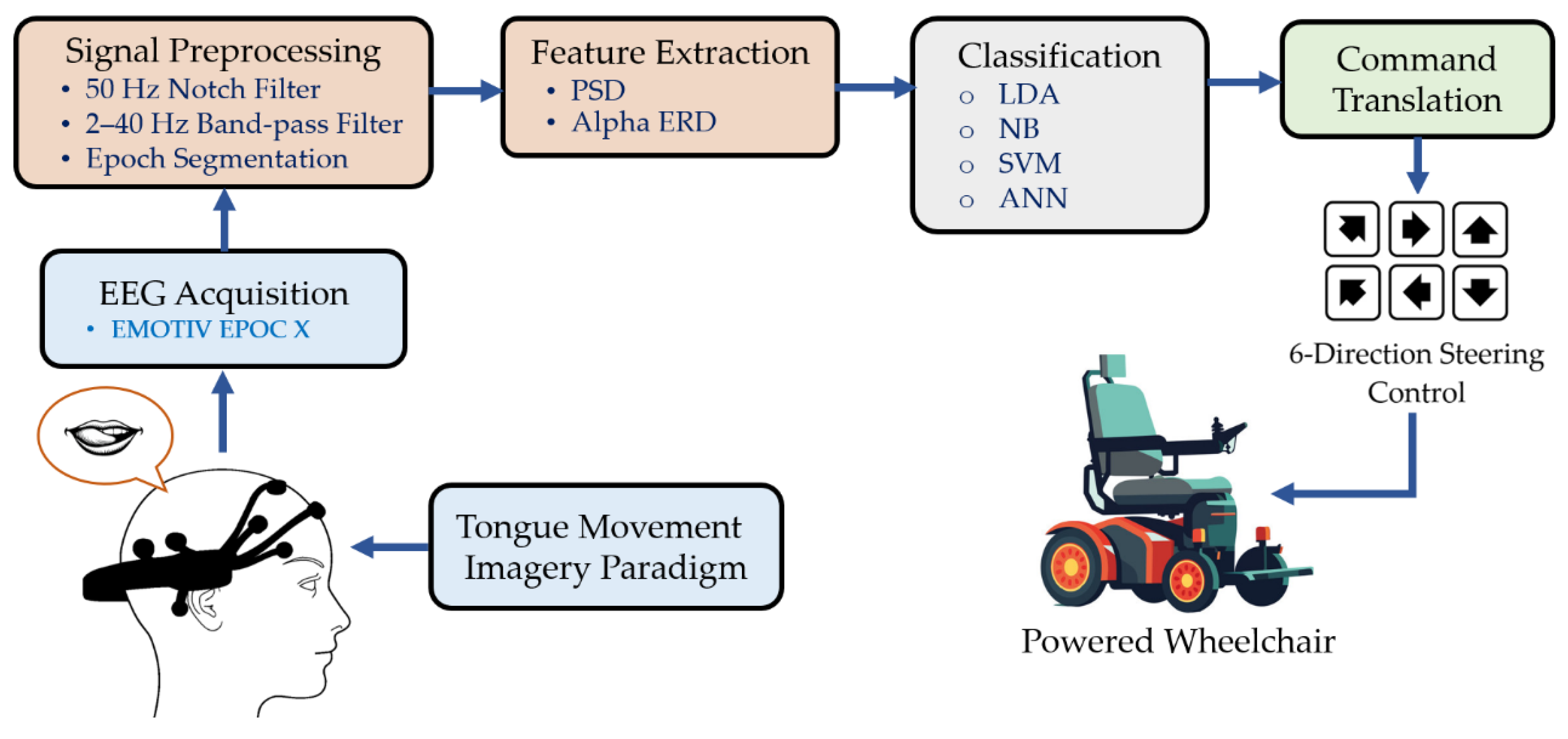
- Development of a six-command tongue MI paradigm for hands-free multi-directional wheelchair control.
- Identification and decoding of distinct cortical activation patterns associated with various tongue-imagery tasks using EEG signals from a low-cost EEG system.
- Extraction and analysis of tongue-related motor features to classify commands.
- Offline evaluation demonstrating the feasibility and reliability of tongue MI as an alternative control method.
- Provision of evidence supporting the potential integration of tongue MI-based BCI into future real-time assistive navigation systems.
2. Materials and Methods
2.1. Proposed Tongue Movement Imagery Paradigm
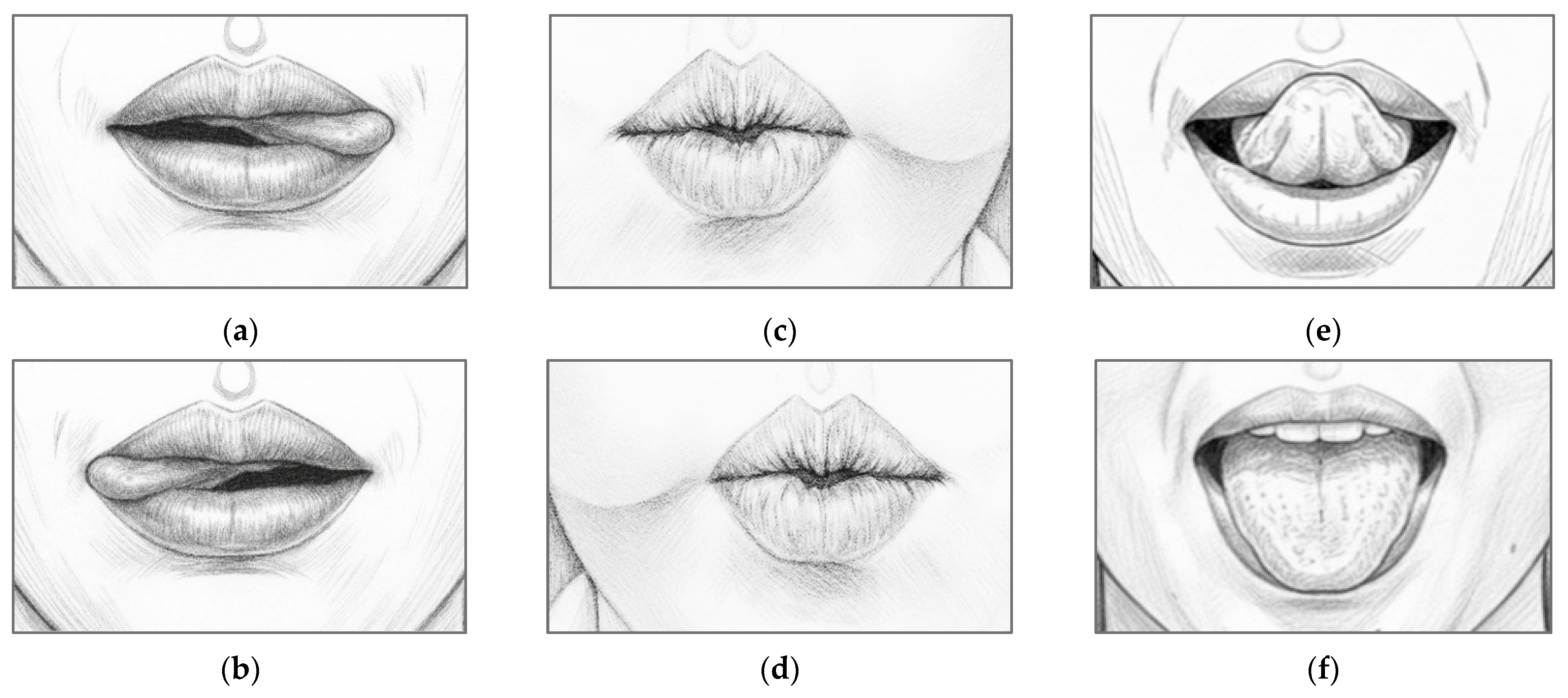
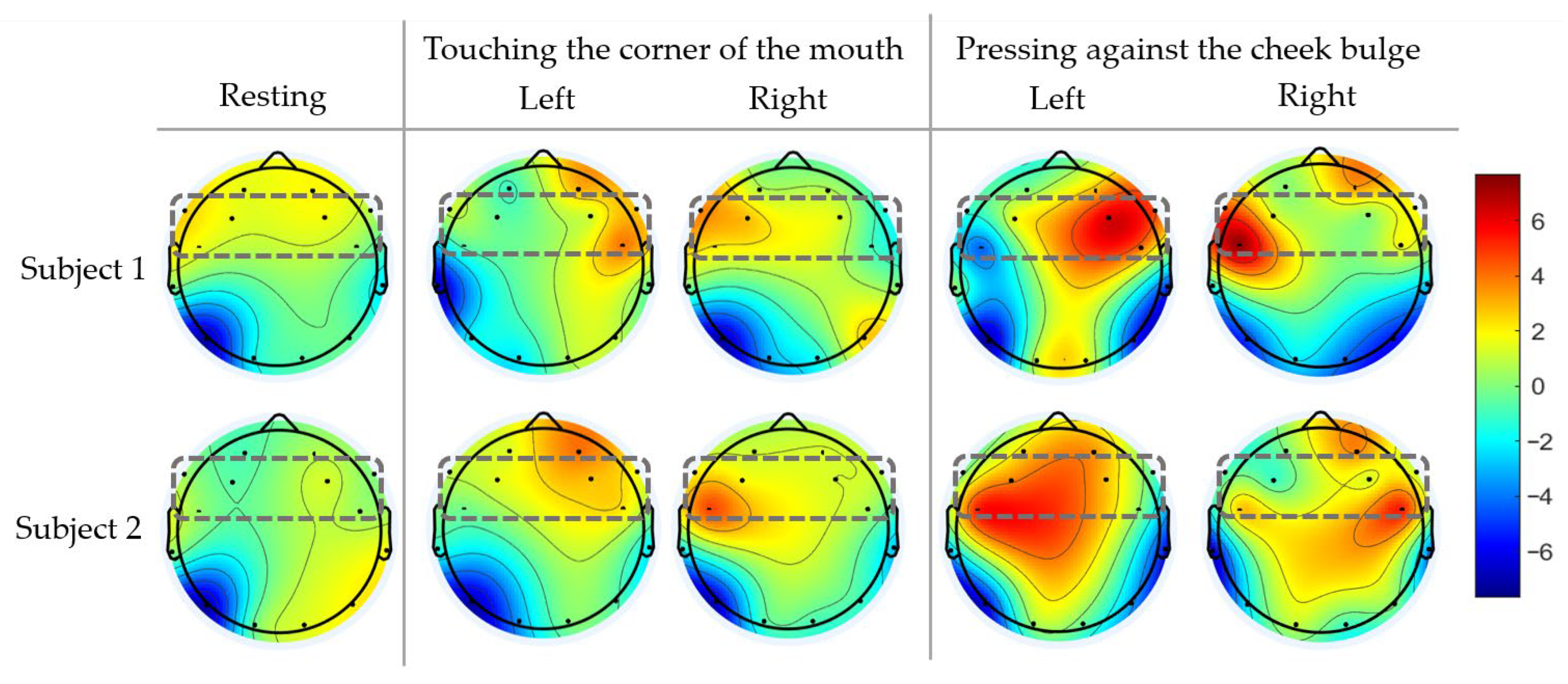
- Pattern 1 involves lateral tongue movements where participants imagine touching the corners of the mouth with the tongue tip (Figure 2a,b, corresponding to left-45° and right-45° turns).
- Pattern 2 also involves lateral gestures but requires imagining the tongue pressing against the inner cheek bulge (Figure 2c,d, corresponding to sharper left-90° and right-90° turns).
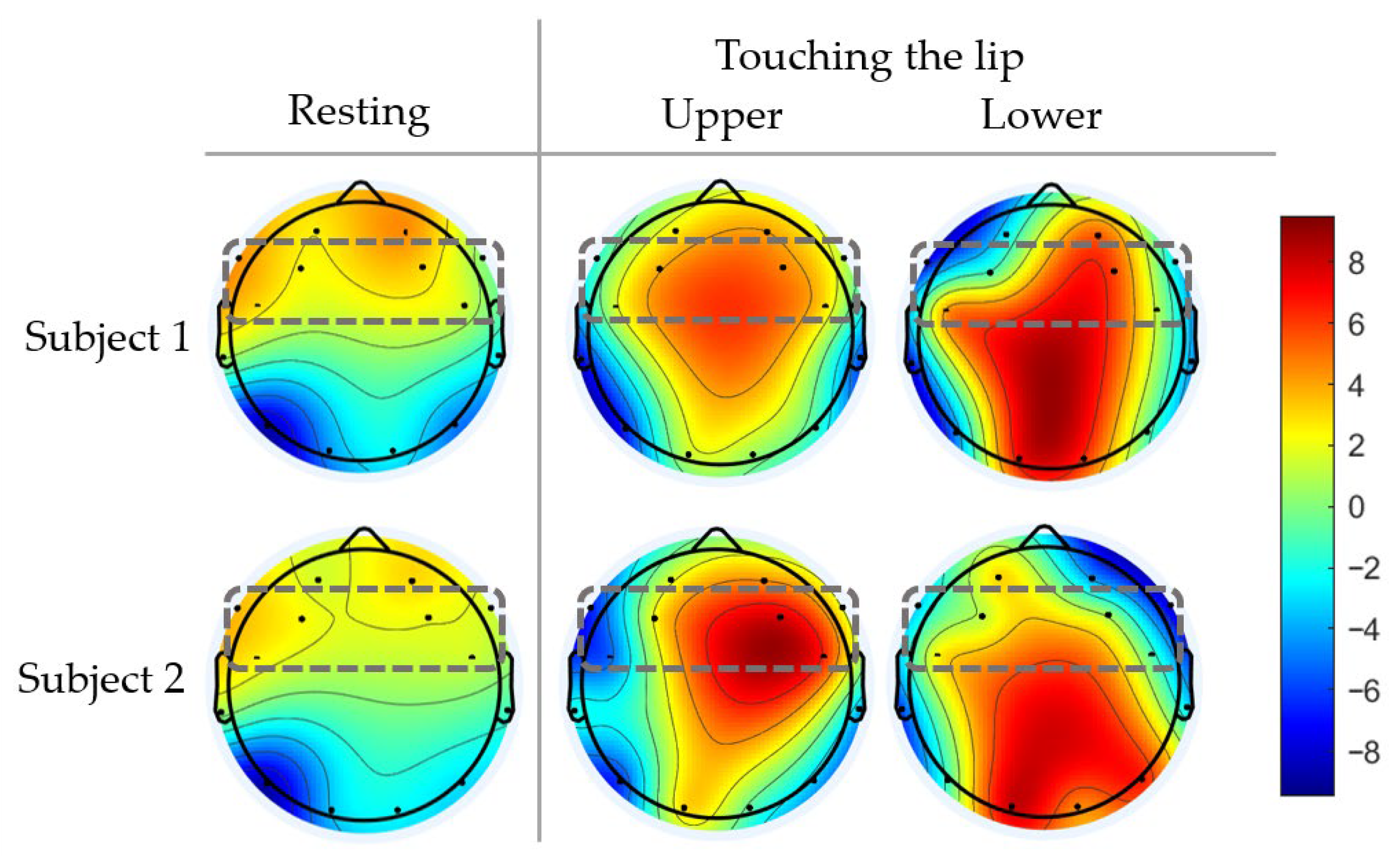
- Pattern 3 includes vertical tongue movements involving the imagination of touching the upper and lower lips with the tongue tip (Figure 2e,f, mapped to forward and backward commands, respectively).
2.2. Experimental Task
2.3. EEG Acquisition and Processing
2.4. Observations of EEG with Different Tasks
3. Proposed Algorithms
3.1. Feature Extraction
3.2. Classification Methods
- Linear discriminant analysis (LDA): A linear classifier that constructs decision boundaries by modeling the distribution of each class and maximizing the class separability.
- Naïve Bayes (NB): A probabilistic model based on Bayes’ theorem that assumes feature independence, offering fast computation and reasonable performance for biomedical data.
- Support vector machine (SVM): A margin-based classifier that constructs an optimal separating hyperplane using linear kernels by default in our setting.
- Artificial neural network (ANN): A shallow feedforward network with one hidden layer of 10 neurons, trained using scaled conjugate gradient backpropagation with Nguyen–Widrow weight initialization, a maximum of 1000 epochs, and early stopping after six consecutive validation failures (minimum gradient = 1 × 10⁻⁷).
4. Experimental Results
- (1)
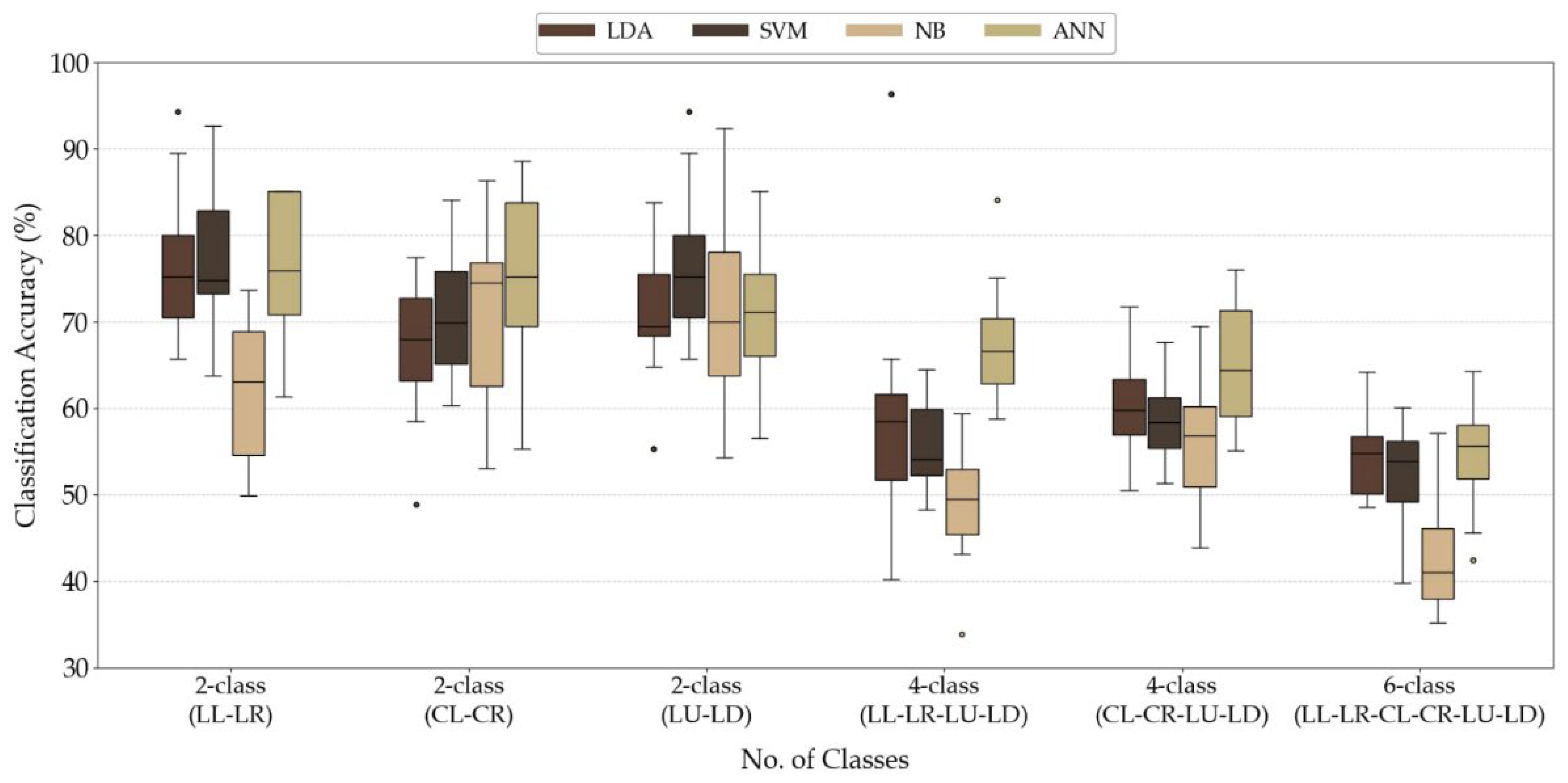
- Two-class system: Paired directional imagery tasks were grouped into binary comparisons: LL–LR, CL–CR, and LU–LD. Each comparison included two commands (360 samples per class), totaling 720 samples per pattern.
- (2)
- Four-class system: Two configurations were evaluated: LL–LR–LU–LD and CL–CR–LU–LD. Each configuration contained four commands with 360 samples per class (1440 samples total), maintaining class balance.
- (3)
- Six-class system: All tongue imagery tasks (LL, CL, LR, CR, LU, LD) were classified as separate commands, totaling 2160 samples, with 360 samples per class in a balanced distribution.
4.1. Multi-Class Tongue Motor Imagery Classification Using Alpha ERD
4.2. Performance Evaluation of Alpha ERD-Based Classifiers for Tongue Motor Imagery
5. Discussion
- The system was evaluated under offline conditions. Although real-time dynamics were not modeled, the observed performance trends provide meaningful insight into system behavior and feasibility.
- Stable EEG headset placement and low electrode impedance are critical for maintaining consistent signal quality and classification performance.
- User training and variability: Users require training to produce consistent tongue MI patterns. Inter-subject variability and potential fatigue effects indicate the need for adaptive calibration and performance monitoring.
- Classification accuracy decreases as the number of commands increases, mainly because of overlapping feature representations rather than classifier limitations. Although performance with multiple commands is still lower than artifact-based BCI systems, tongue motor imagery offers more stable and consistent control than traditional limb MI, especially in binary tasks.
- Hybrid control strategy: A hybrid approach is recommended to improve robustness, where tongue-based commands handle critical actions (e.g., stopping, turning) while additional decoding methods support higher-level navigation [51]. This balances accuracy and computational efficiency for real-time embedded applications.
- The study included only healthy young adults, limiting direct generalization to individuals with motor impairments. However, prior studies indicate that tongue motor function is relatively preserved in such populations, supporting the potential applicability of tongue-based control strategies [52,53].
- The use of alpha-band features alone is insufficient for reliable multi-class decoding as the achieved accuracies for four- and six-class tasks remain below the commonly accepted threshold for practical BCI applications [54]. This highlights the need for improved feature representations or complementary strategies to enhance performance while maintaining real-time feasibility.
6. Conclusions
Author Contributions
Funding
Institutional Review Board Statement
Informed Consent Statement
Data Availability Statement
Conflicts of Interest
Appendix A

| Scheme | Commands | Average Classification Accuracy (%) (Mean ± SD) | |||
|---|---|---|---|---|---|
| Classification Model | |||||
| LDA | SVM | NB | ANN | ||
| 2 | LL-LR | 72.7 ± 8.30 | 71.4 ± 7.14 | 71.0 ± 10.92 | 72.2 ± 6.46 |
| CL-CR | 61.9 ± 9.11 | 71.4 ± 7.91 | 70.4 ± 6.24 | 66.7 ± 6.88 | |
| LU-LD | 71.4 ± 9.96 | 73.2 ± 6.84 | 61.9 ± 10.40 | 72.2 ± 9.91 | |
| 4 | LL-LR-LU-LD | 61.9 ± 6.49 | 65.1 ± 5.88 | 58.1 ± 8.51 | 66.4 ± 7.01 |
| CL-CR-LU-LD | 58.2 ± 7.57 | 61.9 ± 8.75 | 58.1 ± 6.89 | 61.9 ± 6.46 | |
| 6 | LL-LR-CL-CR-LU-LD | 54.7 ± 8.70 | 52.8 ± 5.64 | 43.8 ± 5.06 | 54.2 ± 5.13 |
| Command Schemes | Mean Diff (%) | 95% CI | t(59) | p-Value | Cohen’s d |
|---|---|---|---|---|---|
| LL-LR | −4.75 | [−21.18, 11.68] | −0.92 | 0.425 | 0.425 |
| LU-LD | 3.58 | [−3.67, 10.82] | 1.57 | 0.214 | 0.785 |
| CL-CR | 1.18 | [−8.36, 10.71] | 0.39 | 0.721 | 0.196 |
| LL-LR-LU-LD | −6.98 | [−14.37, 0.42] | −3.00 | 0.058 | −1.50 |
| CL-CR-LU-LD | −5.17 | [−13.41, 3.06] | −2.00 | 0.139 | −1.00 |
| LL–LR–CL–CR–LU–LD | −1.92 | [−4.99, 1.14] | −2.00 | 0.140 | −0.999 |
References
- Zhang, J.; Li, J.; Huang, Z.; Huang, D.; Yu, H.; Li, Z. Recent progress in wearable brain–computer interface (BCI) devices based on electroencephalogram (EEG) for medical applications: A review. Health Data Sci. 2023, 3, 0096. [Google Scholar] [CrossRef]
- Bockbrader, M.A.; Francisco, G.; Lee, R.; Olson, J.; Solinsky, R.; Boninger, M.L. Brain computer interfaces in rehabilitation medicine. PMR 2018, 10, S233–S243. [Google Scholar] [CrossRef]
- Ortiz Daza, C.A.; Simanca, H.; Blanco Garrido, F.; Burgos, D. Motor imagery experiment using BCI: An educational technology approach. In Radical Solutions and Learning Analytics; Burgos, D., Ed.; Springer: Singapore, 2020; pp. 81–98. [Google Scholar] [CrossRef]
- Wang, L. Simulation of sports movement training based on machine learning and brain-computer interface. J. Intell. Fuzzy Syst. 2020, 40, 6409–6420. [Google Scholar] [CrossRef]
- Glavas, K.; Prapas, G.; Tzimourta, K.D.; Giannakeas, N.; Tsipouras, M.G. Evaluation of the user adaptation in a BCI game environment. Appl. Sci. 2022, 12, 12722. [Google Scholar] [CrossRef]
- Veena, N.; Anitha, N. A review of non-invasive BCI devices. Int. J. Biomed. Eng. Technol. 2020, 34, 205–233. [Google Scholar] [CrossRef]
- Paulmurugan, K.; Vijayaragavan, V.; Ghosh, S.; Padmanabhan, P.; Gulyás, B. Brain–computer interfacing using functional near-infrared spectroscopy (fNIRS). Biosensors 2021, 11, 389. [Google Scholar] [CrossRef]
- Bonilauri, A.; Sangiuliano Intra, F.; Pugnetti, L.; Baselli, G.; Baglio, F. A systematic review of cerebral functional near-infrared spectroscopy in chronic neurological diseases—Actual applications and future perspectives. Diagnostics 2020, 10, 581. [Google Scholar] [CrossRef]
- Lim, M.J.R.; Lo, J.Y.T.; Tan, Y.Y.; Lin, H.-Y.; Wang, Y.; Tan, D.; Wang, E.; Naing Ma, Y.Y.; Wei Ng, J.J.; Jefree, R.A.; et al. The state-of-the-art of invasive brain–computer interfaces in humans: A systematic review and individual patient meta-analysis. J. Neural Eng. 2025, 22, 026013. [Google Scholar] [CrossRef] [PubMed]
- Khan, S.; Kallis, L.; Mee, H.; El Hadwe, S.; Barone, D.; Hutchinson, P.; Kolias, A. Invasive brain–computer interface for communication: A scoping review. Brain Sci. 2025, 15, 336. [Google Scholar] [CrossRef] [PubMed]
- Hu, J.; Jiang, H.; Xiao, Z.; Chen, S.; Dustdar, S.; Liu, J.; Dustdar, S. HeadTrack: Real-time human–computer interaction via wireless earphones. IEEE J. Sel. Areas Commun. 2024, 42, 990–1002. [Google Scholar] [CrossRef]
- Hu, J.; Jiang, H.; Liu, D.; Xiao, Z.; Zhang, Q.; Liu, J. Combining IMU with acoustics for head motion tracking leveraging wireless earphone. IEEE Trans. Mob. Comput. 2024, 23, 6835–6847. [Google Scholar] [CrossRef]
- Chandler, J.A.; Van der Loos, K.I.; Boehnke, S.; Beaudry, J.S.; Buchman, D.Z.; Illes, J. Brain computer interfaces and communication disabilities: Ethical, legal, and social aspects of decoding speech from the brain. Front. Hum. Neurosci. 2022, 16, 841035. [Google Scholar] [CrossRef]
- Smith, E.M.; Huff, S.; Wescott, H.; Daniel, R.; Ebuenyi, I.D.; O’Donnell, J.; Maalim, M.; Zhang, W.; Khasnabis, C.; MacLachlan, M. Assistive technologies are central to the realization of the Convention on the Rights of Persons with Disabilities. Disabil. Rehabil. Assist. Technol. 2022, 19, 486–491. [Google Scholar] [CrossRef]
- Qi, H.; Ding, L.; Zheng, M.; Huang, L.; Gao, H.; Liu, G.; Deng, Z. Variable wheelbase control of wheeled mobile robots with worm-inspired creeping gait strategy. IEEE Trans. Robot. 2024, 40, 3271–3289. [Google Scholar] [CrossRef]
- Zhang, Y.; Wang, Y.; Su, C.; Miao, Y.; Wei, T.; Feng, Y.; Chen, F.; Ying, Z.; Wang, S.; Wang, X. Multi-sensor fusion-based intelligent auxiliary system of power wheelchairs for individuals with limbs disabilities: Design and implementation. Measurement 2026, 257, 118573. [Google Scholar] [CrossRef]
- Tian, J.; Zhou, Y.; Yin, L.; AlQahtani, S.A.; Tang, M.; Lu, S.; Wang, R.; Zheng, W. Control structures and algorithms for force feedback bilateral teleoperation systems: A comprehensive review. Comput. Model. Eng. Sci. 2025, 142, 973–1019. [Google Scholar] [CrossRef]
- Xu, G.; Liu, Y.; Yang, B.; Lu, S.; Liu, C.; Lyu, J.; Zheng, W. Learning-based prediction of soft-tissue motion for latency compensation in teleoperation. Comput. Model. Eng. Sci. 2026, 146, 34. [Google Scholar] [CrossRef]
- Padfield, N.; Camilleri, K.; Camilleri, T.; Fabri, S.; Bugeja, M. A comprehensive review of endogenous EEG-based BCIs for dynamic device control. Sensors 2022, 22, 5802. [Google Scholar] [CrossRef] [PubMed]
- Biswas, S.; Hairston, W.D.; Metcalfe, J.S.; Bhattacharya, S. EEG-based BCI for autonomous control: A review. In Proceedings of the SoutheastCon 2023, Orlando, FL, USA; IEEE: New York, NY, USA, 2023; pp. 827–832. [Google Scholar] [CrossRef]
- Bipul, M.R.S.; Rahman, M.A.; Hossain, M.F. Study on different brain activation rearrangement during cognitive workload from ERD/ERS and coherence analysis. Cogn. Neurodyn. 2023, 18, 1709–1732. [Google Scholar] [CrossRef]
- Pfurtscheller, G.; Neuper, C. Future prospects of ERD/ERS in the context of brain–computer interface (BCI) developments. Prog. Brain Res. 2006, 159, 433–437. [Google Scholar] [CrossRef]
- Xu, D.; Tang, F.; Li, Y.; Zhang, Q.; Feng, X. An analysis of deep learning models in SSVEP-based BCI: A survey. Brain Sci. 2023, 13, 483. [Google Scholar] [CrossRef]
- Ming, G.; Pei, W.; Gao, X.; Wang, Y. A high-performance SSVEP-based BCI using imperceptible flickers. J. Neural Eng. 2023, 20, 016042. [Google Scholar] [CrossRef]
- Azadi Moghadam, M.; Maleki, A. Fatigue factors and fatigue indices in SSVEP-based brain–computer interfaces: A systematic review and meta-analysis. Front. Hum. Neurosci. 2023, 17, 1248474. [Google Scholar] [CrossRef]
- Diez, P.; Orosco, L.; Garcés Correa, A.; Carmona, L. Assessment of visual fatigue in SSVEP-based brain–computer interface: A comprehensive study. Med. Biol. Eng. Comput. 2024, 62, 1475–1490. [Google Scholar] [CrossRef]
- Zapała, D.; Zabielska-Mendyk, E.; Augustynowicz, P.; Cudo, A.; Jaśkiewicz, M.; Szewczyk, M.; Kopiś, N.; Francuz, P. The effects of handedness on sensorimotor rhythm desynchronization and motor-imagery BCI control. Sci. Rep. 2020, 10, 2087. [Google Scholar] [CrossRef]
- Peng, M.; Lai, D.; Li, S.; Liu, Z.; Gao, D.; Qin, Y.; Liu, T. Effects of brain network segregation and integration on motor imagery sensorimotor rhythm. Brain-Appar. Commun. 2022, 2, 2147404. [Google Scholar] [CrossRef]
- Lazcano-Herrera, A.G.; Fuentes-Aguilar, R.Q.; Chairez, I.; Alonso-Valerdi, L.M.; Gonzalez-Mendoza, M.; Alfaro-Ponce, M. Review on BCI virtual rehabilitation and remote technology based on EEG for assistive devices. Appl. Sci. 2022, 12, 12253. [Google Scholar] [CrossRef]
- Choi, I.; Kwon, G.H.; Lee, S.; Nam, C.S. Functional electrical stimulation controlled by motor imagery brain–computer interface for rehabilitation. Brain Sci. 2020, 10, 512. [Google Scholar] [CrossRef] [PubMed]
- Moreno-Castelblanco, S.R.; Vélez-Guerrero, M.A.; Callejas-Cuervo, M. Artificial intelligence approaches for EEG signal acquisition and processing in lower-limb motor imagery: A systematic review. Sensors 2025, 25, 5030. [Google Scholar] [CrossRef] [PubMed]
- Gu, L.; Yu, Z.; Ma, T.; Wang, H.; Li, Z.; Fan, H. EEG-based classification of lower limb motor imagery with brain network analysis. Neuroscience 2020, 436, 93–109. [Google Scholar] [CrossRef]
- Giannopulu, I.; Mizutani, H. Neural kinesthetic contribution to motor imagery of body parts: Tongue, hands, and feet. Front. Hum. Neurosci. 2021, 15, 602723. [Google Scholar] [CrossRef]
- Aslan, S.G.; Yılmaz, B. Examining tongue movement intentions in EEG with machine and deep learning: An approach for dysphagia rehabilitation. In Proceedings of the 2024 32nd European Signal Processing Conference (EUSIPCO), Lyon, France; IEEE: New York, NY, USA, 2024; pp. 1388–1391. [Google Scholar] [CrossRef]
- Görür, K.; Bozkurt, M.R.; Bascil, M.S.; Temurtas, F. Tongue-operated biosignal over EEG and processing with decision tree and kNN. Acad. Platform J. Eng. Sci. 2021, 9, 112–125. [Google Scholar] [CrossRef]
- Kæseler, R.L.; Andreasen Struijk, L.N.S.; Jochumsen, M. Detection and classification of tongue movements from single-trial EEG. In Proceedings of the 2020 IEEE 20th International Conference on Bioinformatics and Bioengineering (BIBE), Cincinnati, OH, USA; IEEE: New York, NY, USA, 2020; pp. 376–379. [Google Scholar] [CrossRef]
- Kæseler, R.L.; Johansson, T.W.; Struijk, L.N.S.A.; Jochumsen, M. Feature and classification analysis for detection and classification of tongue movements from single-trial pre-movement EEG. IEEE Trans. Neural Syst. Rehabil. Eng. 2022, 30, 678–687. [Google Scholar] [CrossRef] [PubMed]
- Gulyás, D.; Jochumsen, M. Detection of movement-related brain activity associated with hand and tongue movements from single-trial around-ear EEG. Sensors 2024, 24, 6004. [Google Scholar] [CrossRef] [PubMed]
- La Touche, R.; Herranz-Gómez, A.; Destenay, L.; Gey-Seedorf, I.; Cuenca-Martínez, F.; Paris-Alemany, A.; Suso-Martí, L. Effect of brain training through visual mirror feedback, action observation and motor imagery on orofacial sensorimotor variables: A single-blind randomized controlled trial. J. Oral Rehabil. 2020, 47, 620–635. [Google Scholar] [CrossRef] [PubMed]
- Dos Santos, E.M.; Cassani, R.; Falk, T.H.; Fraga, F.J. Improved motor imagery brain–computer interface performance via adaptive modulation filtering and two-stage classification. Biomed. Signal Process. Control 2020, 57, 101812. [Google Scholar] [CrossRef]
- Gong, J.; Liu, H.; Duan, F.; Che, Y.; Yan, Z. Research on adaptive discriminating method of brain–computer interface for motor imagination. Brain Sci. 2025, 15, 412. [Google Scholar] [CrossRef]
- Aslan, S.G.; Yılmaz, B. Examining Tongue Movement Intentions in EEG-Based BCI with Machine and Deep Learning: An Approach for Dysphagia Rehabilitation. EuroBiotech J. 2024, 8, 176–183. [Google Scholar] [CrossRef]
- Neuper, C.; Wörtz, M.; Pfurtscheller, G. ERD/ERS Patterns Reflecting Sensorimotor Activation and Deactivation. Prog. Brain Res. 2006, 159, 211–222. [Google Scholar] [CrossRef]
- Tarara, P.; Przybył, I.; Schöning, J.; Gunia, A. Motor Imagery-Based Brain-Computer Interfaces: An Exploration of Multiclass Motor Imagery-Based Control for Emotiv EPOC X. Front. Neuroinform. 2025, 19, 1625279. [Google Scholar] [CrossRef]
- Chen, J.; Fan, F.; Wei, C.; Polat, K.; Alenezi, F. Decoding driving states based on normalized mutual information features and hyperparameter self-optimized Gaussian kernel-based radial basis function extreme learning machine. Chaos Solitons Fractals 2025, 199, 116751. [Google Scholar] [CrossRef]
- Delorme, A.; Makeig, S. EEGLAB: An open source toolbox for analysis of single-trial EEG dynamics including independent component analysis. J. Neurosci. Methods 2004, 134, 9–21. [Google Scholar] [CrossRef] [PubMed]
- Saichoo, T.; Siribunyaphat, N.; Bouyam, C.; Punsawad, Y. Development of a tongue motor imagery method for EEG-based brain–computer interface in wheelchair control. In Proceedings of the 16th Biomedical Engineering International Conference (BMEiCON), Chon Buri, Thailand, 21–24 November 2024; pp. 1–4. [Google Scholar] [CrossRef]
- Moaveninejad, S.; Tecchio, F.; Ferracuti, F.; Iarlori, S.; Monteriù, A.; Porcaro, C. Enhancing Brain-Computer Interfaces: Machine Learning Analysis of Alpha-Beta ERD and Fractal Dimension in Motor Imagery EEG. In Proceedings of the 2025 IEEE International Conference on Metrology for eXtended Reality, Artificial Intelligence and Neural Engineering (MetroXRAINE), Ancona, Italy, 22–24 October 2025; pp. 97–102. [Google Scholar] [CrossRef]
- Chen, J.; Cui, Y.; Wei, C.; Polat, K.; Alenezi, F. Advances in EEG-Based Emotion Recognition: Challenges, Methodologies, and Future Directions. Appl. Soft Comput. 2025, 180, 113478. [Google Scholar] [CrossRef]
- Chen, J.; Cui, Y.; Wei, C.; Polat, K.; Alenezi, F. Driver fatigue detection using EEG-based graph attention convolutional neural networks: An end-to-end learning approach with mutual information-driven connectivity. Appl. Soft Comput. 2026, 186, 114097. [Google Scholar] [CrossRef]
- Wei, C.; Alenezi, F.; Chen, J.; Wang, H.; Polat, K. Nonlinear Feature Decomposition and Deep Temporal–Spatial Learning for Single-Channel sEMG-Based Lower Limb Motion Recognition. IEEE Sens. J. 2026, 26, 4120–4126. [Google Scholar] [CrossRef]
- Li, N.; Ou, J.; He, H.; He, J.; Zhang, L.; Peng, Z.; Zhong, J.; Jiang, N. Exploration of a machine learning approach for diagnosing sarcopenia among Chinese community-dwelling older adults using sEMG-based data. J. Neuroeng. Rehabil. 2024, 21, 69. [Google Scholar] [CrossRef]
- Cai, L.; Yan, S.; Ouyang, C.; Zhang, T.; Zhu, J.; Chen, L.; Ma, X.; Liu, H. Muscle synergies in joystick manipulation. Front. Physiol. 2023, 14, 1282295. [Google Scholar] [CrossRef]
- Kübler, A.; Neumann, N.; Kaiser, J.; Kotchoubey, B.; Hinterberger, T.; Birbaumer, N.P. Brain-computer communication: Self-regulation of slow cortical potentials for verbal communication. Arch. Phys. Med. Rehabil. 2001, 82, 1533–1539. [Google Scholar] [CrossRef]


| Author | Paradigm | Method | Results | Contribution |
|---|---|---|---|---|
| Giannopulu and Mizutani [33] | MI: four-class MI with visual cues | Graph theory, LORETA, and coherence | Tongue MI shows strong connectivity changes (frontal/parietal networks) | Ear-EEG is a low-cost method for tongue/hand detection. |
| Görür et al. [35] | Voluntary tongue movement: touching left/right cheek walls for 6 s | Features: MAV and PSD Classifiers: DT and kNN | Maximum classification accuracy: 96.77% with kNN + MAV (frontal EEG) | Demonstrated a practical EEG-based tongue–machine interface. |
| Kæseler et al. [36] | Real tongue movement in four visually cued directions | LDA with 10-fold CV | Four-class: 43%, three-class: 55%, and two-class: 71% | Tongue-based BCI for assistive directional control. |
| Kæseler et al. [37] | Multi-direction tongue movements | LDA, SVM, RF, and MLP | Four-class: 62.6%, three-class: 75.6%, and two-class: 87.7% | Stimulus-independent pre-movement tongue BCI. |
| Gulyás and Jochumsen [38] | Tongue–palate movement + wrist extension | RF, SVM, kNN, and LDA | SVM: 82.5%, RF: 78.75%, LDA: 76.25%, and kNN: 67.5% | Ear-EEG is a low-cost solution for tongue/hand movement detection. |
| La Touche et al. [39] | Orofacial exercises with MI, AO, and VMF | RCT + repeated-measures ANOVA | AO + MI reduces pain sensitivity. AO shows the greatest increase in tongue strength | Demonstrates neural distinctiveness and MI feasibility for tongue BCIs. |
| dos Santos et al. [40] | MI of tongue, hands, and feet using visual arrows | Modulation filtering, CSP + Tikhonov, and LDA + Naïve Bayes | Classification accuracies between 77.16% and 90.27% | Validates MI/AO approaches in orofacial rehabilitation (TMD and dysphagia). |
| Gong et al. [41] | MI of tongue, left/right hand, and feet | PSD, DWT + WPD + CSP, and FBCSP + SVMICA preprocessing WPLI + graph theory | Performance strongly correlated with brain network metrics | Tongue MI as a predictor of MI-BCI usability based on brain connectivity. |
| Commands | Symbols | Actions | Output Commands |
|---|---|---|---|
| 1 | LL | Imagine the tongue tip touching the left corner of the mouth | Turn left 45° |
| 2 | LR | Imagine the tongue tip touching the right corner of the mouth | Turn right 45° |
| 3 | CL | Imagine the tongue tip pressing against the left cheek bulge | Turn left 90° |
| 4 | CR | Imagine the tongue tip pressing against the right cheek bulge | Turn right 90° |
| 5 | LU | Imagine the tongue tip touching the upper lip | Move forward |
| 6 | LD | Imagine the tongue tip touching the lower lip | Move backward |
| Scheme | Commands | Command | Average Classification Accuracy (%) (Mean ± SD) | |||
|---|---|---|---|---|---|---|
| Classification Model | ||||||
| LDA | SVM | NB | ANN | |||
| 2 | LL-LR | LL | 77.2 ± 6.76 | 77.4 ± 7.06 | 63.3 ± 7.35 | 77.6 ± 9.27 |
| LR | 75.1 ± 8.07 | 75.0 ± 6.77 | 60.6 ± 6.48 | 74.7 ± 6.63 | ||
| AVG | 76.2 ± 7.42 | 76.2 ± 8.34 | 61.9 ± 6.92 | 76.2 ± 7.94 | ||
| CL-CR | CL | 65.8 ± 5.47 | 70.6 ± 8.59 | 70.0 ± 8.16 | 75.1 ± 10.6 | |
| CR | 67.5 ± 8.17 | 72.3 ± 7.22 | 72.8 ± 10.8 | 77.2 ± 9.35 | ||
| AVG | 66.7 ± 6.84 | 71.4 ± 7.91 | 71.4 ± 9.50 | 76.2 ± 9.96 | ||
| LU-LD | LU | 74.5 ± 8.19 | 78.4 ± 7.30 | 73.9 ± 9.83 | 74.4 ± 6.15 | |
| LD | 68.2 ± 7.66 | 73.9 ± 8.32 | 68.9 ± 12.3 | 68.4 ± 9.35 | ||
| AVG | 71.4 ± 7.93 | 76.2 ± 7.81 | 71.4 ± 11.1 | 71.4 ± 7.75 | ||
| 4 | LL-LR-LU-LD | LL | 62.2 ± 10.4 | 59.4 ± 4.45 | 53.9 ± 5.74 | 70.6 ± 5.78 |
| LR | 60.0 ± 12.5 | 58.3 ± 4.88 | 50.0 ± 5.25 | 69.7 ± 6.10 | ||
| LU | 59.2 ± 12.5 | 57.4 ± 5.19 | 49.7 ± 5.33 | 68.8 ± 5.22 | ||
| LD | 51.1 ± 15.2 | 48.1 ± 6.56 | 41.5 ± 7.91 | 60.6 ± 9.54 | ||
| AVG | 58.1 ± 12.6 | 55.8 ± 5.27 | 48.8 ± 6.06 | 67.4 ± 6.66 | ||
| CL-CR-LU-LD | CL | 60.8 ± 4.61 | 58.7 ± 3.72 | 56.7 ± 4.27 | 66.7 ± 5.08 | |
| CR | 62.6 ± 5.44 | 60.0 ± 4.01 | 58.9 ± 6.23 | 66.7 ± 6.41 | ||
| LU | 63.3 ± 6.24 | 61.6 ± 4.87 | 57.8 ± 6.89 | 67.2 ± 6.03 | ||
| LD | 55.3 ± 8.23 | 52.5 ± 7.05 | 49.7 ± 10.8 | 60.2 ± 9.78 | ||
| AVG | 60. 5 ± 6.13 | 58.2 ± 4.91 | 55.8 ± 7.05 | 65.2 ± 6.83 | ||
| 6 | LL-LR-CL-CR-LU-LD | LL | 59.2 ± 3.78 | 56.9 ± 4.38 | 46.1 ± 6.94 | 58.6 ± 6.13 |
| LR | 56.7 ± 4.67 | 55.9 ± 6.02 | 43.6 ± 5.89 | 56.4 ± 4.51 | ||
| CL | 53.1 ± 3.56 | 51.6 ± 4.34 | 41.7 ± 4.67 | 53.8 ± 5.05 | ||
| CR | 55.3 ± 3.17 | 54.2 ± 4.85 | 42.2 ± 4.41 | 55.9 ± 5.07 | ||
| LU | 56.1 ± 4.35 | 54.8 ± 5.28 | 44.1 ± 5.12 | 55.8 ± 4.35 | ||
| LD | 47.8 ± 7.74 | 45.8 ± 8.66 | 35.3 ± 8.65 | 47.8 ± 8.74 | ||
| AVG | 54.7 ± 4.55 | 53.2 ± 5.59 | 42.2 ± 5.95 | 54.7 ± 5.64 | ||
| Comparison | Mean Diff (%) | 95% CI | t(59) | p-Value | Cohen’s d |
|---|---|---|---|---|---|
| LL-LR vs. CL-CR | 1.19 | [−2.51, 4.88] | 0.64 | 0.523 | 0.083 |
| LL-LR vs. LU-LD | 0.00 | [−3.29, 3.29] | 0.00 | 0.999 | 0.000 |
| CL-CR vs. LU-LD | −1.19 | [−4.97, 2.60] | −0.63 | 0.533 | −0.081 |
| LL-LR-LU-LD vs. CL-CR-LU-LD | −2.32 | [−4.76, 0.11] | −1.91 | 0.061 | −0.25 |
| Scheme | Commands | Classifier | ITR (Bits/min) |
|---|---|---|---|
| 2 | LL-LR | LDA/SVM/ANN | 6.92 |
| CL-CR | ANN | 6.92 | |
| LU-LD | SVM | 6.92 | |
| 4 | LL-LR-LU-LD | ANN | 5.82 |
| CL-CR-LU-LD | ANN | 4.38 | |
| 6 | LL-LR-CL-CR-LU-LD | LDA/ANN | 4.21 |
Disclaimer/Publisher’s Note: The statements, opinions and data contained in all publications are solely those of the individual author(s) and contributor(s) and not of MDPI and/or the editor(s). MDPI and/or the editor(s) disclaim responsibility for any injury to people or property resulting from any ideas, methods, instructions or products referred to in the content. |
© 2026 by the authors. Licensee MDPI, Basel, Switzerland. This article is an open access article distributed under the terms and conditions of the Creative Commons Attribution (CC BY) license.
Share and Cite
Saichoo, T.; Siribunyaphat, N.; Sahoh, B.; Efendi, M.A.; Punsawad, Y. Electroencephalography-Based Brain–Computer Interface System Using Tongue Movement Imagery for Wheelchair Control. Sensors 2026, 26, 2211. https://doi.org/10.3390/s26072211
Saichoo T, Siribunyaphat N, Sahoh B, Efendi MA, Punsawad Y. Electroencephalography-Based Brain–Computer Interface System Using Tongue Movement Imagery for Wheelchair Control. Sensors. 2026; 26(7):2211. https://doi.org/10.3390/s26072211
Chicago/Turabian StyleSaichoo, Theerat, Nannaphat Siribunyaphat, Bukhoree Sahoh, M. Arif Efendi, and Yunyong Punsawad. 2026. "Electroencephalography-Based Brain–Computer Interface System Using Tongue Movement Imagery for Wheelchair Control" Sensors 26, no. 7: 2211. https://doi.org/10.3390/s26072211
APA StyleSaichoo, T., Siribunyaphat, N., Sahoh, B., Efendi, M. A., & Punsawad, Y. (2026). Electroencephalography-Based Brain–Computer Interface System Using Tongue Movement Imagery for Wheelchair Control. Sensors, 26(7), 2211. https://doi.org/10.3390/s26072211