1. Introduction
With increasing interest in marine exploration, researchers have increasingly focused on Underwater Acoustic Communication Networks (UACNs) [
1,
2,
3]. Compared to terrestrial wireless communication, the underwater communication environment is much more challenging. Because of the distinctive physical properties of underwater acoustic channels, including extended propagation delays and restricted bandwidth, the transmission rate and signal quality of underwater acoustic communication networks are significantly degraded [
4]. Furthermore, replacing node batteries in underwater acoustic communication networks is extremely difficult, leading to a low energy consumption requirement. Therefore, the efficient and dependable allocation of underwater communication resources under strict energy limitations has emerged as a major research focus in the field of underwater acoustic communications.
Several media access control (MAC) approaches have been widely studied, including methods based on Frequency Division Media Access (FDMA), Time Division Media Access (TDMA)-like schemes, and hybrid MAC. However, FDMA methods have limitations including limited bandwidth, multipath fading, and frequency-selective fading. While FDMA divides the available bandwidth into sub-bands, this frequency-based access leads to inefficiencies, especially as the number of nodes increases, making spectrum management more complex and reducing efficiency [
5]. Although hybrid MAC protocols offer advantages in certain scenarios, they introduce additional communication overhead and greater system complexity. These drawbacks become more obvious in dynamic underwater environments, which reduce their practical applicability. In contrast, TDMA-like approaches use time division, which makes them effective in bandwidth-limited and dynamically changing underwater channels. Therefore, we choose an TDMA-like approach to optimize time-slot scheduling, thereby avoiding signal collisions, enhancing throughput [
6], and reducing transmission delays [
7]. M. Liu et al. [
8] introduced an MAC protocol that utilizes packet-level time-slot scheduling, employing both optimal and heuristic algorithms to determine the scheduling strategy. It used a backtracking algorithm and greedy strategies to reduce computational complexity and enhance transmission efficiency. Y. Wang et al. [
9] introduced a concurrent MAC protocol based on master–slave transmission.
With regard to power control, it improves performance—such as by maximizing network capacity [
10] and reducing energy consumption [
11]—by optimizing the transmission power of the nodes. H. Wang et al. [
12] developed an algorithm for joint power allocation across multiple nodes, utilizing a hierarchical game learning approach. By constructing a multi-agent Multi-Armed Bandit (MAB) game model and employing specific learning strategies, the algorithm enhances learning efficiency and adaptability effectively. For multi-user underwater acoustic communication systems, K. Gharsalli et al. [
13] introduced a power distribution technique based on non-cooperative game theory. By using an iterative water-filling algorithm and deriving the Nash equilibrium, the algorithm optimizes power allocation to maximize users’ transmission rates. However, most existing methods rely on simplified environmental models and fixed decision policies, which may be inadequate for adapting to the complexities and variations of underwater acoustic channels.
The complexity and variability of the underwater communication environment make it difficult for devices to obtain prior information. With the appearance of artificial intelligence, reinforcement learning (RL) [
14] has been a potential method for addressing challenges in underwater acoustic communication networks due to its ability to learn and adapt in unknown environments. In particular, Q-learning- and deep Q-learning network (DQN)-based algorithms, have been widely applied to tasks such as time-slot scheduling [
15,
16] and power allocation [
17,
18,
19]. However, since DQN is primarily designed for discrete action spaces, the agent may fail to learn optimal policies for continuous power allocation. Deep Deterministic Policy Gradient (DDPG) can generate a deterministic action through a deterministic network, making it more suitable than DQN for continuous power allocation. S. Han et al. [
20] proposed a hierarchical reinforcement learning framework combining DQN and DDPG to address the joint relay selection and power allocation problem in UACNs. However, this algorithm models underwater transmitting nodes as independent agents and does not fully take into account the interference of multiple underwater transmitting nodes. In response to this issue, our previous work [
21] proposed a power allocation method based on Multi-Agent Deep Deterministic Policy Gradient (MADDPG). Each transmitting node is modeled as an agent, and a centralized training with decentralized execution (CTDE) mechanism is introduced, enabling multiple transmitting nodes to learn collaboratively. This approach effectively mitigates inter-node interference and improves system performance.
Time-slot scheduling and power allocation can improve communication quality in underwater acoustic communication systems. However, the lack of coordination often limits the global optimization of network. Joint optimization of time slot and power allocation has become an effective approach to address the issues mentioned above. C. Wang et al. [
22] introduced a joint algorithm for power allocation and time-slot scheduling based on quasi-interference alignment. They reformulated the original optimization problem into two smaller tasks. The first subproblem minimizes receiving time through linear programming-based time-slot scheduling, while the second subproblem maximizes throughput by adjusting signal block power via nonlinear optimization and the subgradient method. T. Zhang et al. [
23] proposes a joint time-slot scheduling and power allocation algorithm based on deep multi-agent reinforcement learning (ICRL-JSA). In each time slot, each transmitting node simultaneously makes time-slot scheduling and power allocation decisions, which maximizes network throughput and maintains communication fairness. Dai et al. [
24] proposed a joint optimization framework aimed at minimizing the total energy consumption in UAV-assisted computation offloading scenarios in marine networks. They developed a hierarchical joint optimization algorithm that combines an outer one-dimensional search with inner convex optimization for solution derivation. In [
25], an alternating optimization framework was introduced to solve the scheduling and power allocation problems under fixed power or fixed time slot constraints. The scheduling problem was addressed using the weighted Kuhn–Munkres algorithm, while the power allocation was solved through continuous convex approximation and fractional programming iterations. Furthermore, a distributed implementation that uses a multi-leader multi-follower Stackelberg game is proposed to reduce the complexity.
Although previous research has demonstrated that joint optimization of time-slot and power allocation can enhance the performance of underwater acoustic communication networks, several limitations still exists. Traditional decomposition or alternating optimization methods often rely on strong modeling assumptions and centralized control methods. These methods are difficult to adapt to dynamic, time-varying acoustic channels. While some learning-based approaches use multi-agent mechanisms, decision-making remains largely independent for each node, with node collaboration relying heavily on rewards or indirect constraints. This approach does not effectively address the collisions causing by concurrent transmissions, which results in increased interference. Furthermore, in an end-to-end joint optimization approach, both discrete time-slot scheduling and continuous power control are learned within a single joint action space. This results in a rapid increase in the dimensionality of the action space, and the problem becomes more severe as the number of nodes grows. Therefore, it is necessary to develop a framework that can schedule nodes for concurrent transmissions while jointly optimizing the transmit power of the scheduled nodes. The framework should enable coordinated optimization among nodes while reducing the complexity of the action space, thereby improving training stability and accelerating convergence.
To address these challenges, this paper investigates the joint optimization of time-slot scheduling and power allocation in underwater acoustic communication networks and proposes a novel framework using deep reinforcement learning. The original mixed-integer nonconvex optimization problem is reformulated into two sub-objectives corresponding to time-slot scheduling and power allocation. During the time-slot scheduling, concurrent transmissions from multiple nodes within the same time slot may lead to collisions in underwater acoustic networks. To address this issue, a DQN-based approach is adopted to select the nodes that are allowed to transmit simultaneously in each time slot. This global decision process determines the time slot allocation for each node. As a result, the time-slot scheduling is made from a global perspective rather than considering nodes as independent agents, which allows better coordination among nodes. After that, power allocation is carried out for the selected nodes. To address the interference and the limited energy, a MADDPG-based power control is developed. Under a centralized training and decentralized execution framework, the transmit power of the scheduled nodes is determined through coordinated decisions. With global feedback from the shared critic network, each node learns and improves its power control policy within this framework. It should be noted that, within each time slot, the time-slot scheduling and power allocation are optimized in an iterative manner until the joint optimization of slot allocation and power allocation is achieved. The proposed method achieves an optimization of discrete decisions and continuous resource allocation, thereby improving system performance. The simulation results demonstrate that the proposed algorithm achieves a significant improvement in channel capacity and other performances compared with TDMA, slotted ALOHA, and baseline algorithms. The key contributions of this paper include the following:
We introduce a novel framework based on reinforcement learning for joint time slot and power optimization in underwater acoustic communication networks. Instead of regarding the optimization as a single and complex task, two sub-objectives corresponding to time-slot scheduling and power allocation are considered. These two sub-objectives are optimized in an iterative manner, allowing the system to converge to the optimal solution. The proposed design significantly reduces the complexity of the original mixed-integer optimization problem. It also enables more efficient optimization and provides better scalability as the network nodes number grows.
Two MDP models are designed for solving the time-slot scheduling and power allocation. The time-slot scheduling is modeled as a discrete MDP solved by DQN, while the power allocation is formulated as a continuous MDP handled by MADDPG. The MDP models introduced in this work are particularly effective for scenarios involving both discrete and continuous action spaces. They also allow additional performance metrics to be incorporated into the state and reward design.
2. System Model
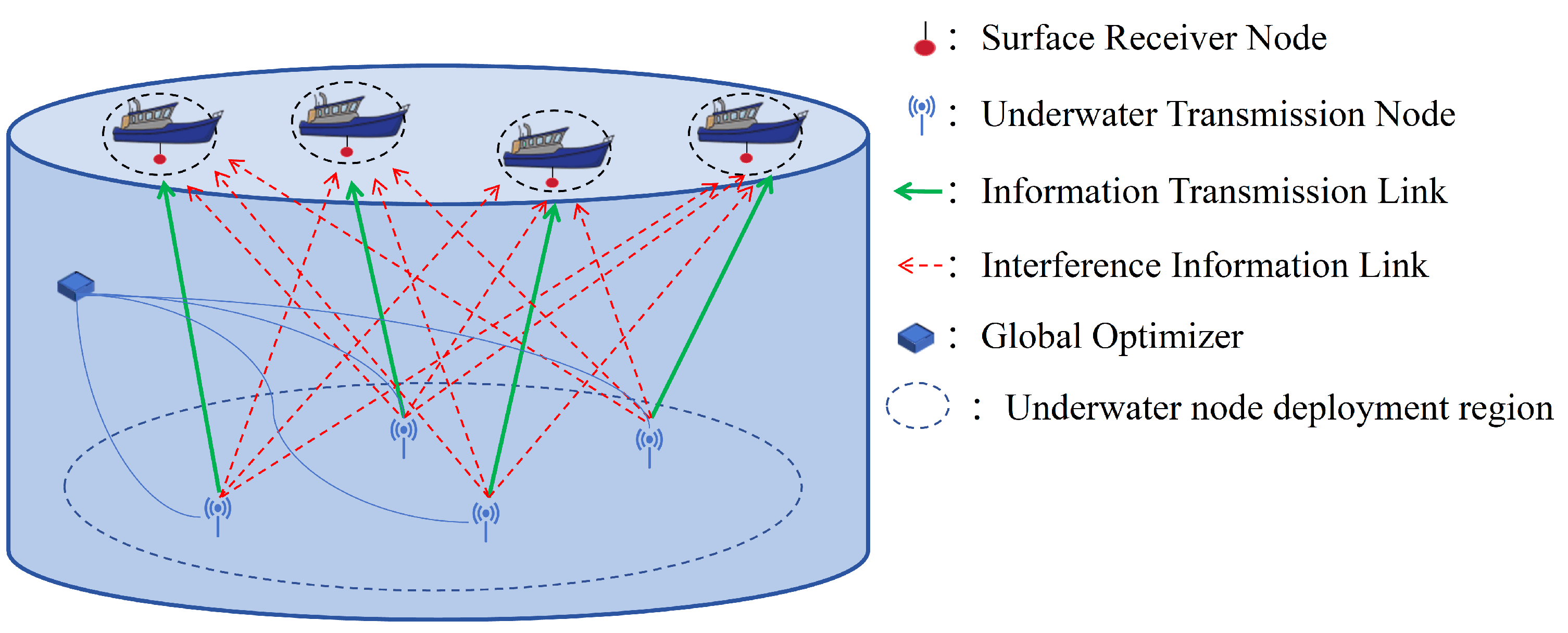
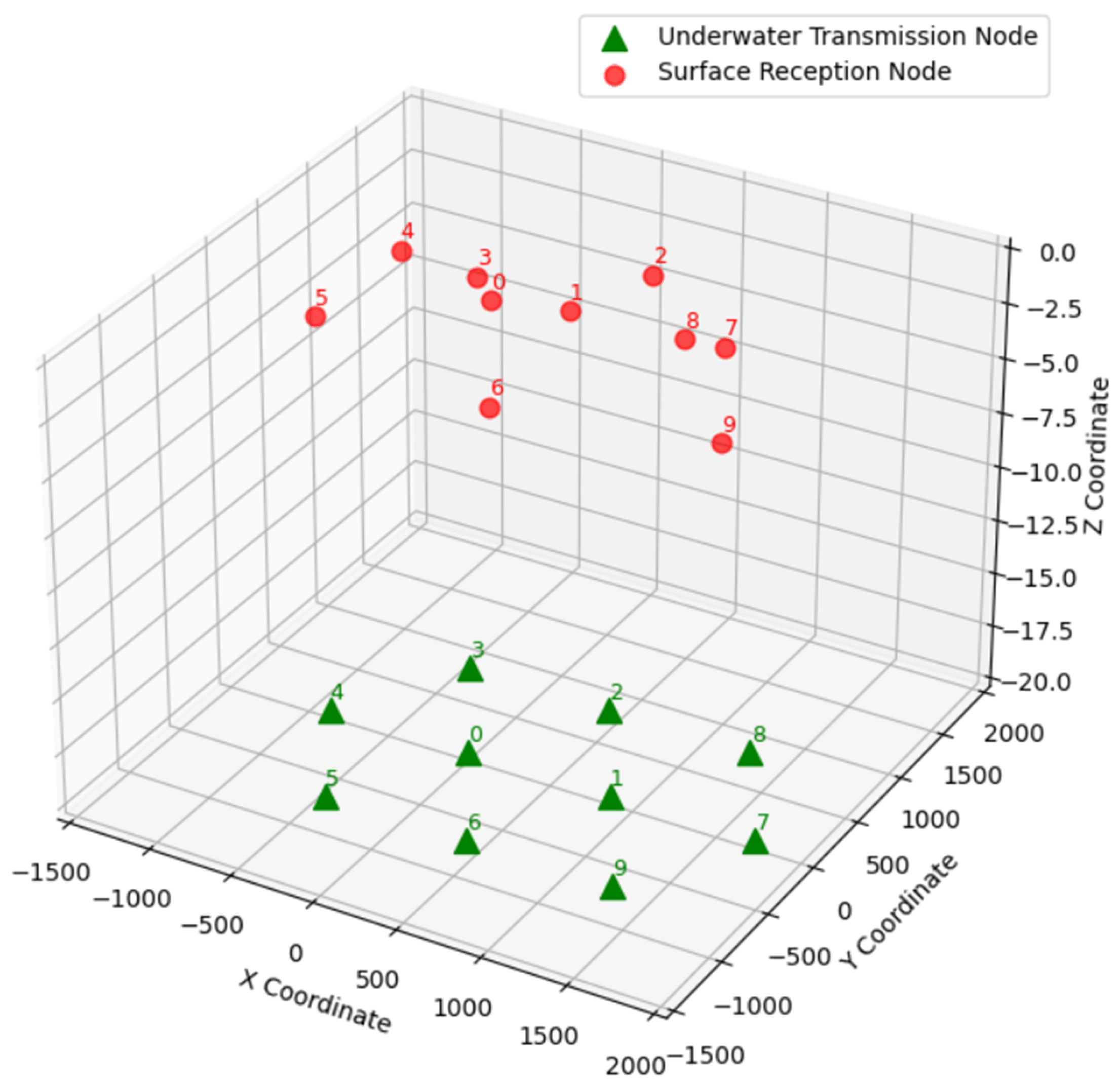
The UACN model analyzed in this paper is illustrated in
Figure 1, and includes transmitting nodes
underwater, receiving nodes
on the water’s surface, and a global optimizer. Therefore, there are a total of
links in the system. We assume in this paper that
, and each time slot lasts for
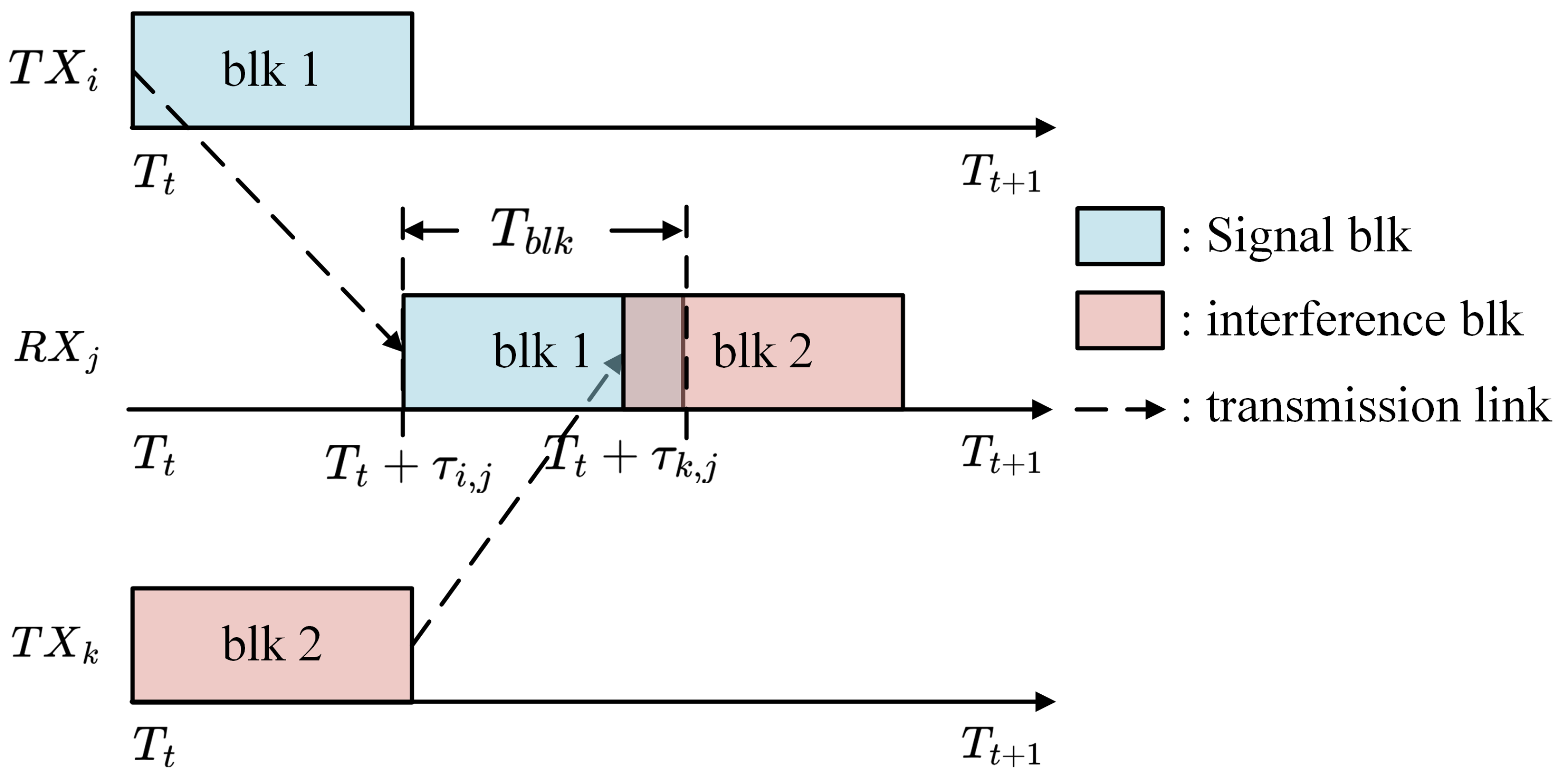
. When a transmission occurs from a transmitting node to its corresponding receiving node, other transmitting nodes’ signals in the same time slot are considered to be interference. When the propagation delay between the signal arrivals from the sender node and the interfering node at the receiving node is smaller than the packet duration, a collision will occur, leading to a reception failure.
At the time slot
t, the arrival time of the signal transmitted by the transmitting node
to the receiving node
is given by
where
is the transmission start times of the signals sent by each node at the time slot
t.
denotes the signal’s propagation delay between node
i and node
j, which is affected by the distance between the nodes and the acoustic properties of the underwater medium. Similarly, for the signal from the interfering node
to the receiving node
j, the arrival time is defined as
where
is the signal’s propagation delay between node
k and node
j. If the time difference between the arrival times of
and
is smaller than the packet duration, a collision will occur. The condition is
where
represents the packet duration.
We define a collision function
, which indicates whether a collision occurs when node
i transmits signals to node
j. It is defined as
where the
equals to 1 when a collision occurs. Otherwise, it takes the value 0. Therefore, the occurrence of collisions can be illustrated in
Figure 2.
The packet duration is equal to the packet length divided by the transmission rate. In an underwater environment, the bandwidth affects the transmission rate. A larger bandwidth enables a higher data rate and thus shortens the packet duration. Receiver processing delay can also increase the packet duration. In addition, multipath delay spread may extend the effective signal propagation time, especially in complex underwater environments, leading to longer reception and decoding time.
To ensure that a packet can be fully transmitted within a single time slot, the time slot duration is defined as [
23]
where
denotes the maximum transmission delay of the node and
represents the guard time, which is introduced to account for any potential delays and other necessary time requirements.
At the time slot
t, the channel gain between the node
and the node
is given by [
26]
where
denotes the normalization coefficient and
k represents the route loss exponent. Although the path loss exponent may vary under different environmental and geometric conditions, we chose
[
18] to maintain consistency and simplify the modeling.
is the Euclidean distance between the transmitting node
and the receiving node
at time slot
t, which is calculated as
The
is the absorption coefficient. According to the Thorp’s empirical formula, the
is expressed by
At time slot
t, the signal-to-interference-plus-noise ratio (SINR) at the link
can be expressed by
where
represents the channel gain from the transmitting node
i to the receiving node
j,
is the transmission power of node
i, and
denotes the time slot allocation result for node
i, taking values of 0 or 1, where 1 represents that the node transmits information in time slot
t.
represents environmental noise. The channel capacity at the receiving node
j at time slot
t is given by
The total channel capacity of the underwater acoustic communication network is to be
Although the physical layer processes, such as modulation and decoding, are crucial to the system performance, they are not the primary focus of this study. To concentrate exclusively on the MAC layer performance, it is assumed that the physical channels are free from errors. This is made possible by employing robust forward error correction coding and equalization techniques.
4. Joint Optimization for Time Slot and Power Allocation
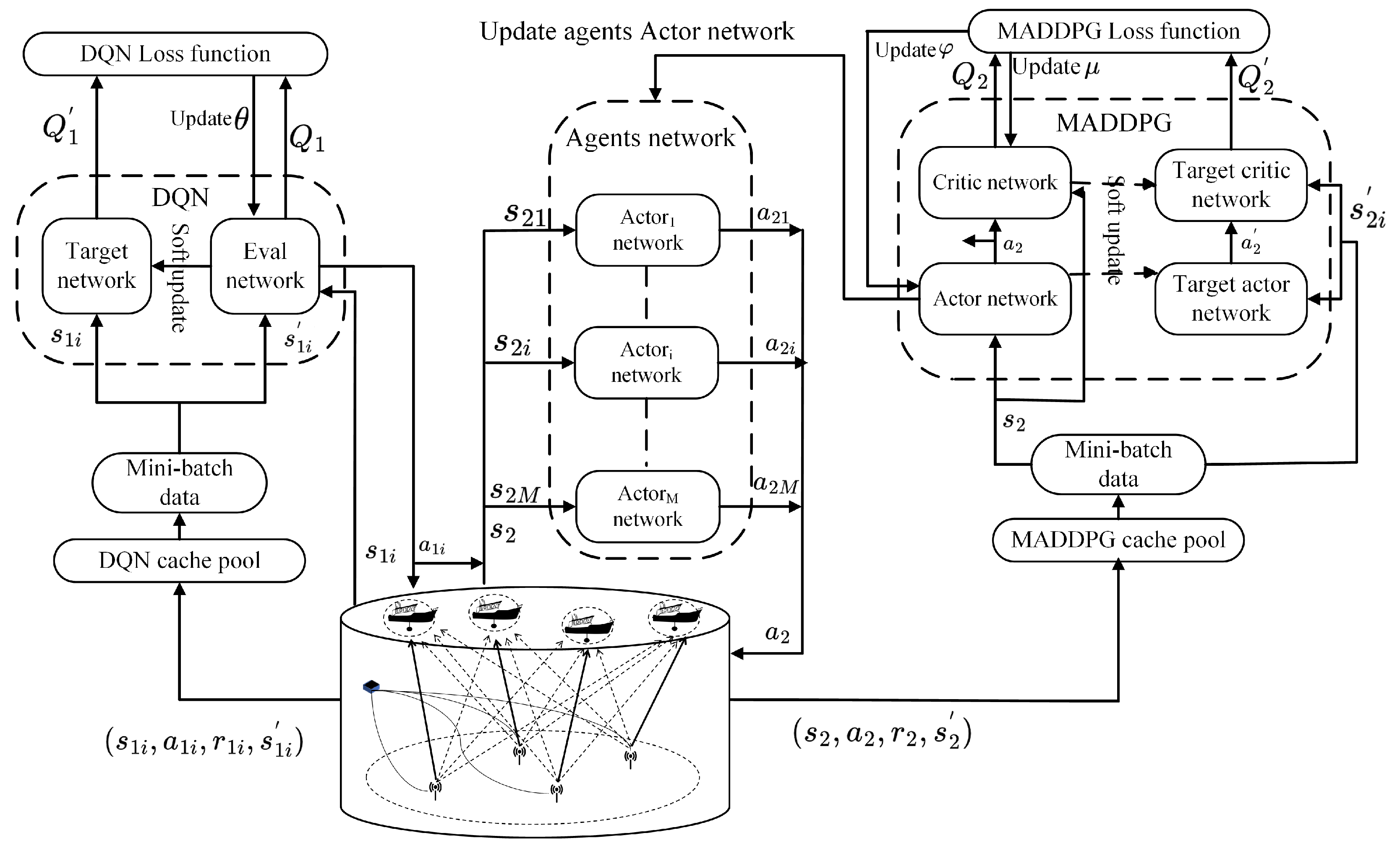
To address the challenges of optimizing both time slot allocation and power allocation, we propose a joint optimization framework combining the DQN and the MADDPG to allocate both time slot and power, as shown in
Figure 3. Time slot allocation involves a discrete action space, which is efficiently handled by DQN, a method well-suited for discrete decision-making tasks. Power allocation, on the other hand, requires the adjustment of continuous values, making MADDPG an appropriate choice due to its ability to optimize continuous action spaces through an actor–critic approach. By integrating these two algorithms into a unified framework, we enable coordinated optimization for time slot and power allocation. This hierarchical structure not only simplifies the learning process by allowing each algorithm to specialize in its respective task but also ensures more efficient and stable learning, leading to improved performance in complex multi-agent environments.
The DQN is performed using a centralized strategy with a global optimizer that includes an evaluation network and a target network. Each transmitting node gathers local state information and transmits it to the global optimizer. The optimizer then determines the optimal actions based on the global state information and then sends the decisions to the transmitting nodes for execution. For power allocation, the MADDPG adopts centralized training and distributed execution. The global optimizer contains the actor, target actor, critic, and target critic networks, and each agent maintains its own independent actor network. During training, the global optimizer updates the actor and critic networks using global information given from all agents. In the execution part, each agent selects actions independently using its local actor network based on its own observations.
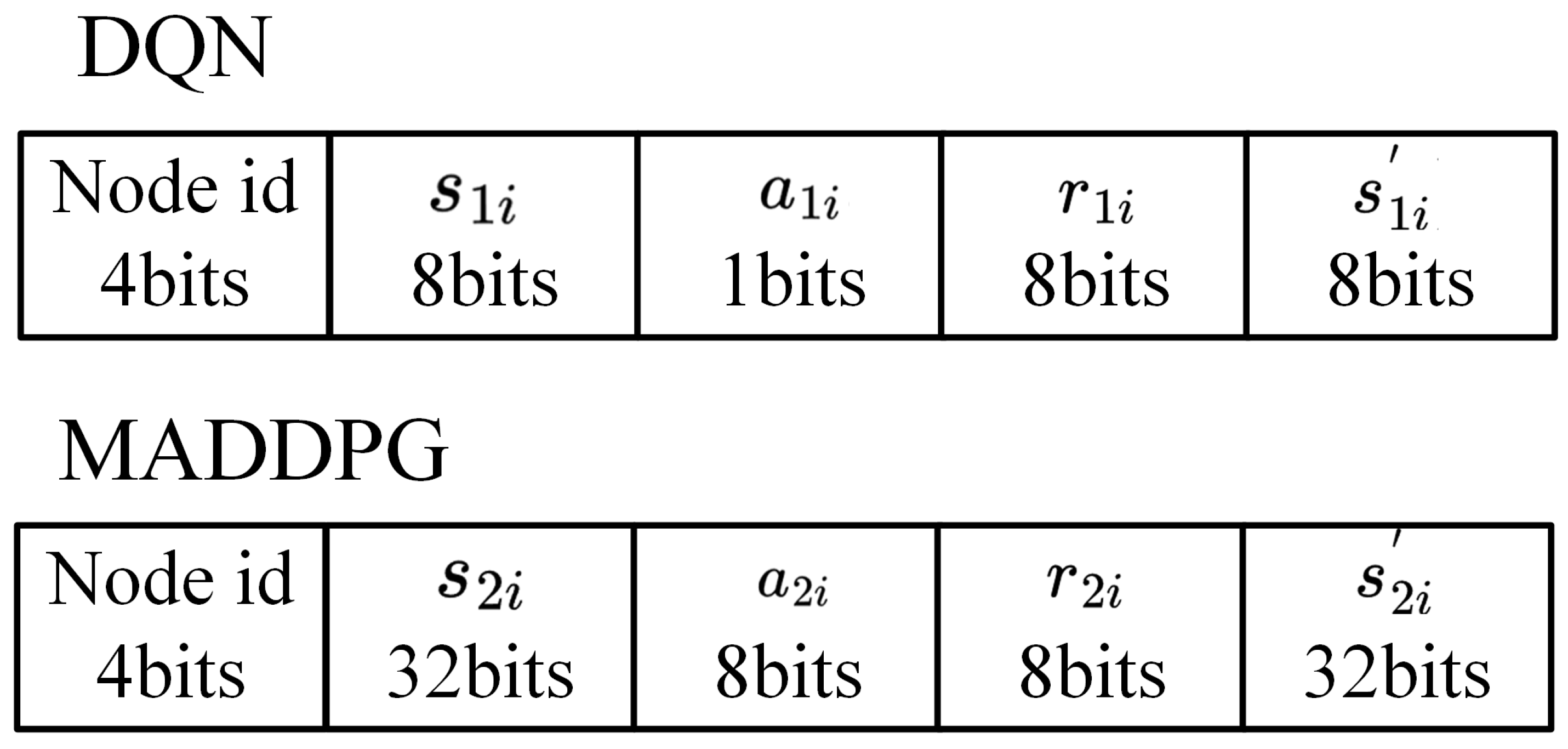
In our framework, the global optimizer performs two roles. First, in the Centralized DQN, it serves as the global scheduler which makes slot allocation decisions based on global network information. The optimizer collects data from all nodes and broadcasts the time slot schedule decisions to each node. Once the global optimizer completes the slot allocation decision, it broadcasts the time slot schedule to each node, occurring once per second. Second, during the Centralized Training in MADDPG, the global optimizer coordinates policy updates for individual agents by gathering local information from all agents to optimize the global policy. This policy update broadcast also happens once per second, after the completion of the power allocation decision. The broadcast frame format for each node is shown in
Figure 4.
Therefore, the total data size for the broadcast can be computed by bits, where N is the number of nodes. As the number of nodes increases, the total data size increases linearly. When the number of nodes is small, the global optimizer can efficiently manage the computational and communication load. However, as the network size grows, the broadcast burden on the global optimizer increases significantly. To address this challenge, a periodic update approach can be implemented, where the policy is updated at fixed time intervals rather than requiring a global synchronization update each time. This method can reduce the burden on the global optimizer and enhance the system’s processing capacity in larger networks.
At time slot
t, the transmitting node
i sends its local state
to the DQN network in the global optimizer. Based on this state, the global optimizer selects a time slot allocation action
using the
strategy of the current DQN network. After all transmitting nodes execute the time slot allocation actions, the state
transitions to the next state
. Each transmitting node receives the reward
based on Equation (
16), and the experience
is stored in the experience replay pool
. The global optimizer trains the DQN network by sampling mini-batches of data randomly from the
. Mean squared error (MSE) is used as the loss function to assess the variance between the estimated and actual network output
value and the target Q-value
, which is
where
denotes the
value calculated by the DQN target network, which is
where
is the reward obtained at the current time, and
is the discount factor used to adjust the weight of future rewards.
and
represent the state and action at the next time step.
is the target network weights. The DQN weights
in the estimated network are updated by
where
is the learning rate, which determines the step size for each update. The loss function’s gradient
represents the gradient of the loss function
with respect to
. The parameters of the target network are periodically updated using a soft update by
where
is an update factor, and
.
After time slot allocation, each transmitting node i, which we defined as agent i in this part, selects the power action based on its local observation . The joint action is then executed by each agent. Thereafter, the global state moves to the next state . The receiving nodes feed back the reward for each agent. The sample is then stored in a shared replay buffer . Subsequently, the global optimizer trains the MADDPG network by sampling mini-batches of data randomly from the experience replay pool .
In the training process of MADDPG, mean squared error (MSE) is used as the loss function to quantify the discrepancy between the estimated network output
and its target
from the critic network, which is
where
is the target value computed by the target critic network as
where
is next joint action. The target actor and critic network weights The critic network parameters
in the estimated network are updated by
where
is the learning rate of the critic network.
The actor network
is trained to maximize the expected return estimated by the critic. The policy gradient is computed by
the actor parameters are adjusted by ascending the gradient, which is
where
is the learning rate of the actor network.
The target actor and critic network weights are updated gradually using a soft update technique, driven by a small factor
where
. Each agent receives the actor network parameters from the global optimizer upon the completion of the centralized training, and each agent updates its own actor network parameters. The distribution of power is then carried out by each agency.
We conclude the joint optimization in Algorithm 1. To implement Algorithm 1 in a real-world system, a two-layer control structure combined with closed-loop training and update mechanisms could theoretically be employed. This approach is inspired by the framework outlined in [
27], where the reinforcement learning module is deployed on actual underwater communication devices. In that work, the researchers used the UNETStack software along with COTS hardware, such as Raspberry Pi, USB sound cards, and transducers, to build a low-cost, software-programmable transceiver link. The reinforcement learning decision-making was embedded into the communication stack, utilizing closed-loop feedback through transmission/reception notifications, ACK/timeouts, error frames, and measurable link quality indicators for online inference and periodic updates.
| Algorithm 1: Joint Time Slot and Power Allocation Algorithm |
- 1:
Initialize parameters , , , , , . Experience replay pool , . Target network parameter update cycle ; - 2:
for each episode do - 3:
Initialize the environment and state space , ; - 4:
for to T do - 5:
for to M do - 6:
Input state to DQN and choose time slot allocation action with -greedy; - 7:
Compute reward by ( 16); - 8:
obtain next state ; - 9:
Store experience into ; - 10:
end for - 11:
Select a minibatch of samples from ; - 12:
Update DQN evaluation network by ( 23); - 13:
for to M do - 14:
Input state to , which outputs power allocation action ; - 15:
Compute reward by ( 19); - 16:
obtain next state ; - 17:
Store experience into ; - 18:
end for - 19:
Select a minibatch of samples from ; - 20:
Update the Critic network parameters as described in ( 27); - 21:
Update the Actor network parameters as described in ( 29); - 22:
Broadcast network parameter to agent; - 23:
if then - 24:
Update the DQN target network parameter by ( 24); - 25:
Update MADDPG target network parameters by ( 30) and ( 31); - 26:
end if - 27:
end for - 28:
end for
|
Based on this framework, Algorithm 1 in our paper could be implemented in a real system through a two-layer control structure combined with closed-loop training and updates. The gateway collects the network states and runs DQN to output the set of concurrently transmitting nodes for each time slot, which are then scheduled by broadcasting control frames. The scheduled nodes execute only the MADDPG actor network locally to determine transmission power, and the transmission parameters are set via the power control interface provided by the protocol stack. The receiver utilizes SINR and other link quality indicators from the protocol stack, which can serve as metadata for reception notifications or be used for ACK feedback, thus providing real-time feedback to the gateway for reward calculation and policy updates. During the training phase, the gateway receives the state, action, reward, and next state at each time step, and then store these information in the experience replay pool. Periodically, DQN is trained in small batches. The parameters of the target network are softly updated to gradually match the parameters of the current network. In the MADDPG centralized training framework, the critic and actor networks are updated, and the updated actor parameters are then sent to the underwater nodes. This procedure enables lightweight online execution and stable learning updates, even in bandwidth- and computationally constrained underwater terminal environments.