Frequency-Dependent Whole-Brain Reconfiguration Following Left DLPFC rTMS in Older Adults: A 106-Channel fNIRS Study

 , ,
, ,
Abstract
1. Introduction
2. Methods
2.1. Participants
2.2. Experimental Design and Procedure
2.3. rTMS Protocol
2.4. fNIRS Data Acquisition
2.5. fNIRS Data Preprocessing
2.6. Functional Connectivity Analysis
2.7. Statistical Analysis
3. Results
3.1. Channel-Level Functional Connectivity Networks
3.1.1. Pre- vs. Post-10 Hz rTMS
3.1.2. Pre- vs. Post-1 Hz rTMS
3.1.3. Comparison of Different Intervention Effects at the Channel Level
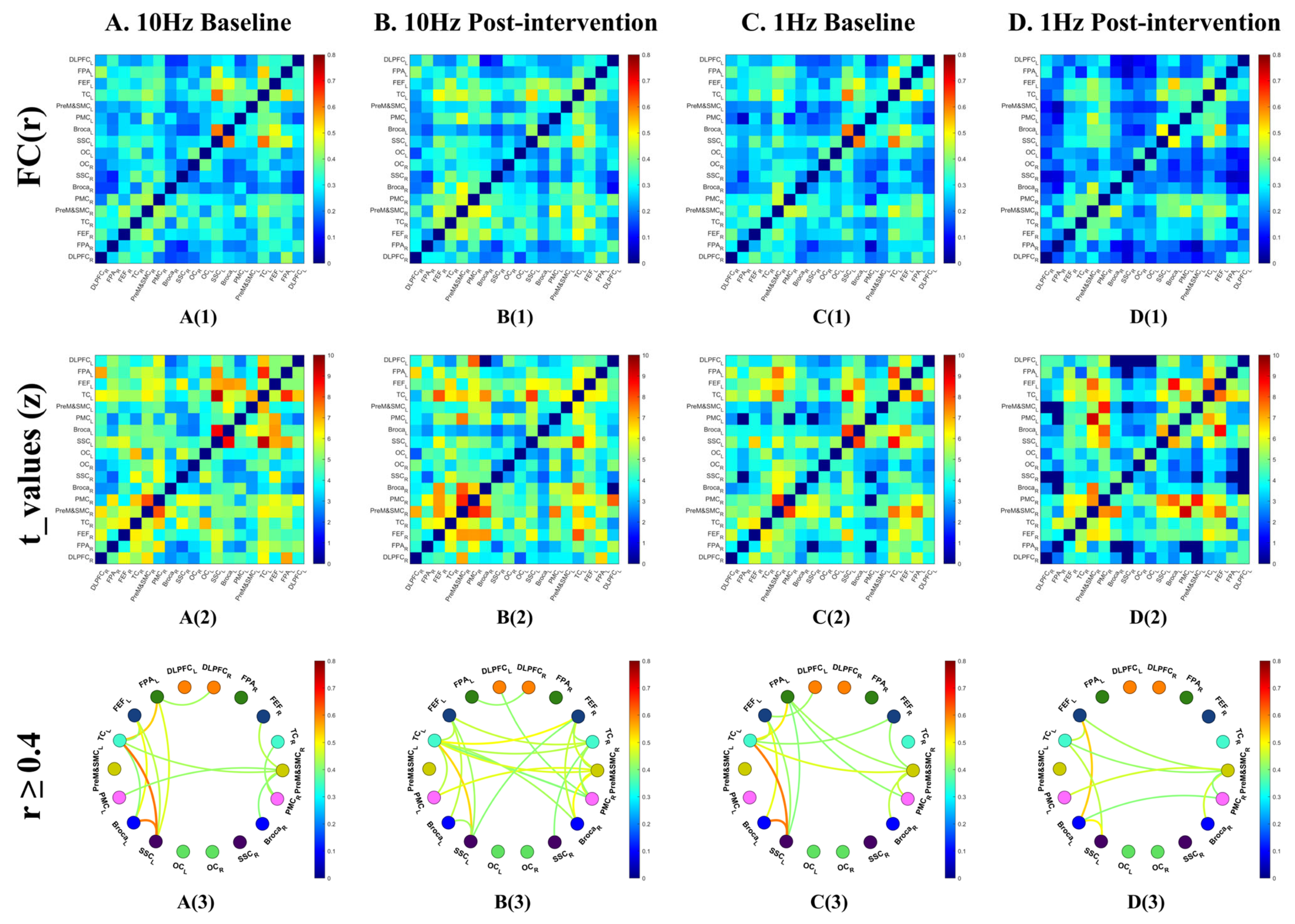
3.2. ROI-Level Functional Connectivity Networks
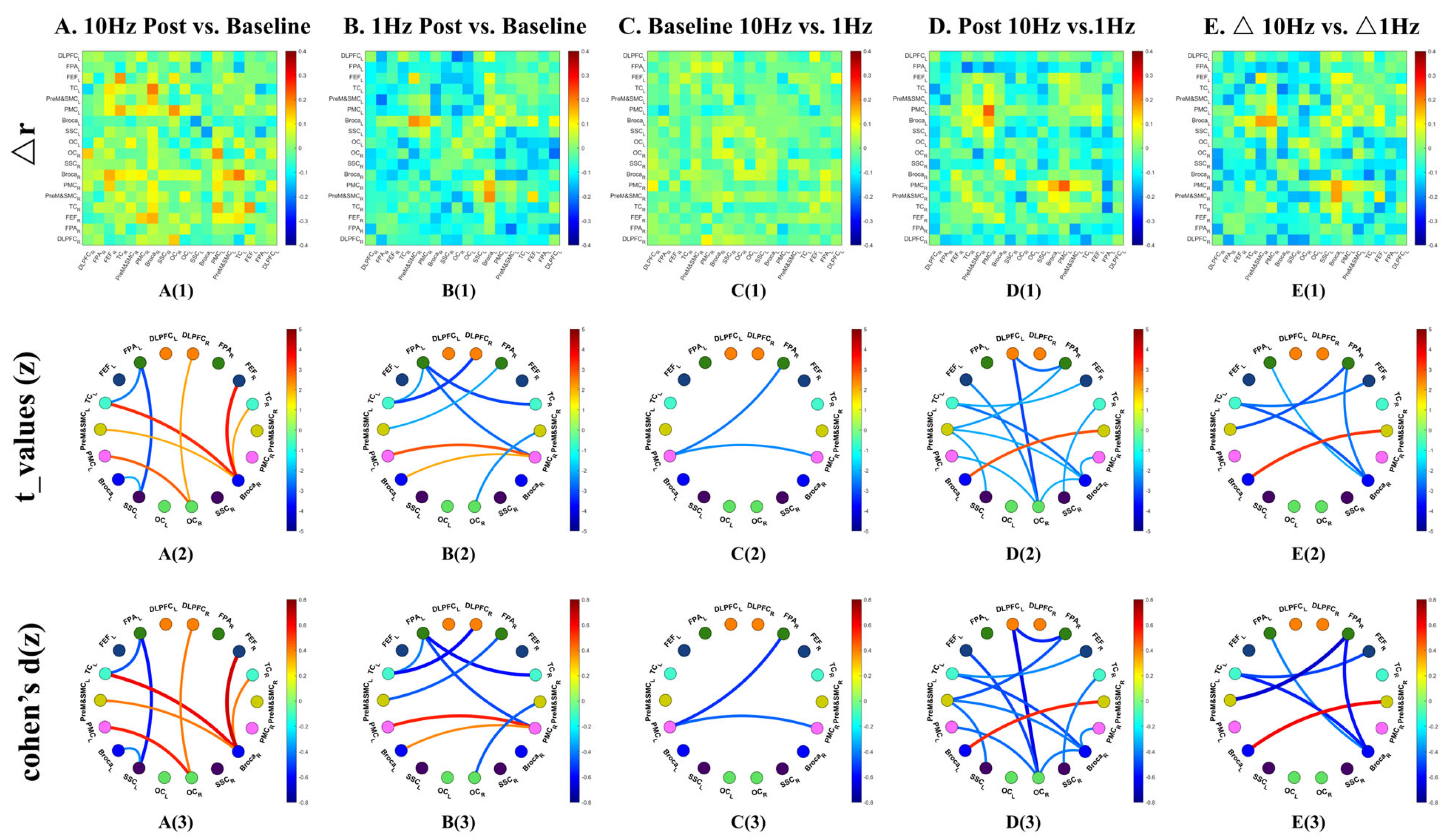
3.2.1. Pre- vs. Post-10 Hz rTMS
3.2.2. Pre- vs. Post-1 Hz rTMS
3.2.3. Comparison of Different Intervention Effects at the ROI Level
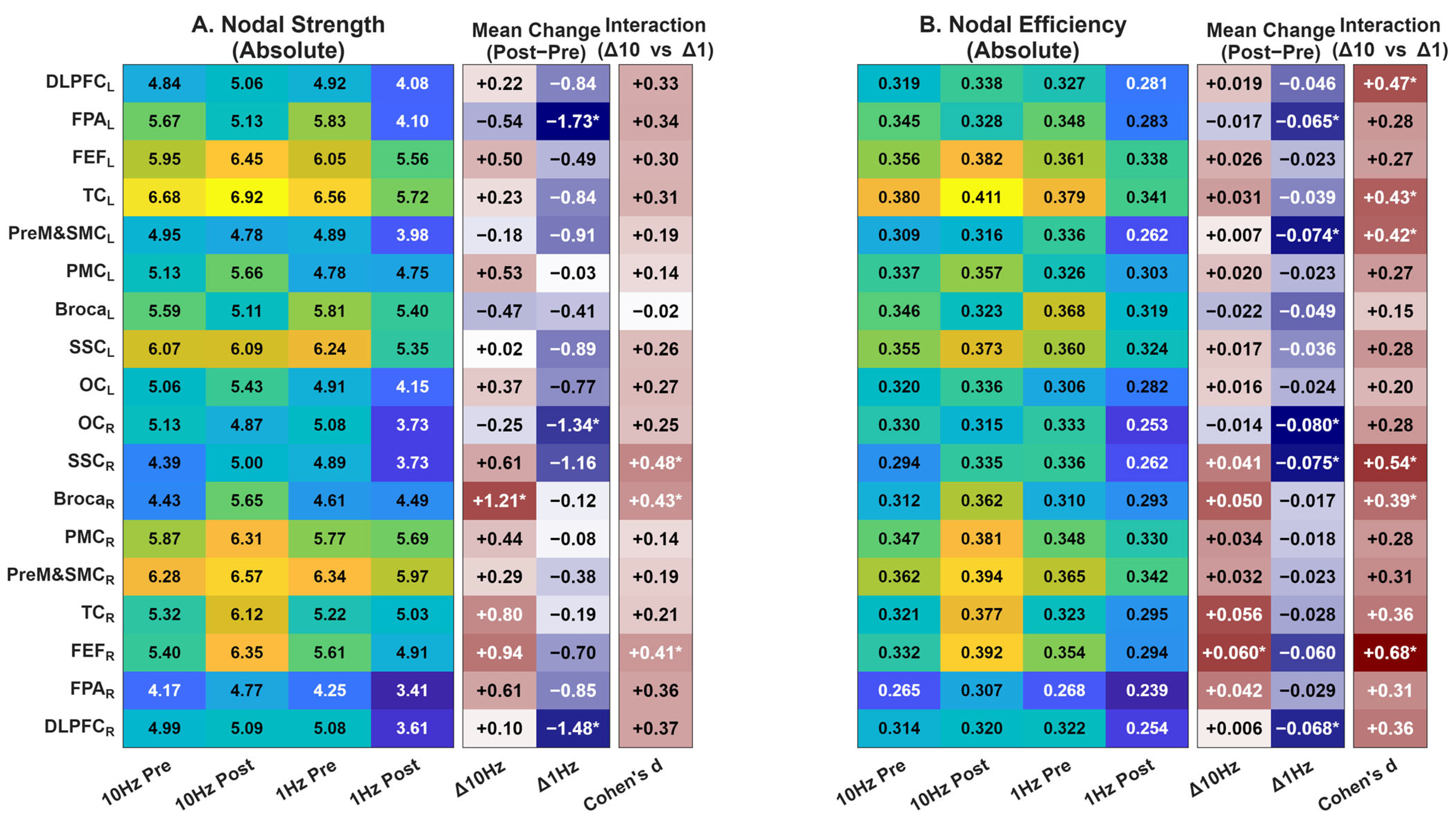
3.3. Network-Level Topology and Spatial Summaries
4. Discussion
4.1. Validation of the Excitatory-Inhibitory Dichotomous Model
4.2. Beyond the Dichotomy: Explaining the Paradoxical Effects
4.3. Implications in the Context of Healthy Aging
4.4. Potential Implications
4.5. Limitations
5. Conclusions
Author Contributions
Funding
Institutional Review Board Statement
Informed Consent Statement
Data Availability Statement
Conflicts of Interest
References
- Damoiseaux, J.S. Effects of aging on functional and structural brain connectivity. NeuroImage 2017, 160, 32–40. [Google Scholar] [CrossRef] [PubMed]
- Verstraelen, S.; Cuypers, K.; Maes, C.; Hehl, M.; Van Malderen, S.; Levin, O.; Mikkelsen, M.; Meesen, R.; Swinnen, S.P. Neurophysiological modulations in the (pre)motor-motor network underlying age-related increases in reaction time and the role of GABA levels—A bimodal TMS-MRS study. NeuroImage 2021, 243, 118500. [Google Scholar] [CrossRef] [PubMed]
- Grady, C. The cognitive neuroscience of ageing. Nat. Rev. Neurosci. 2012, 13, 491–505. [Google Scholar] [CrossRef] [PubMed]
- Cabeza, R. Hemispheric asymmetry reduction in older adults: The HAROLD model. Psychol. Aging 2002, 17, 85–100. [Google Scholar] [CrossRef]
- Cabeza, R.; Albert, M.; Belleville, S.; Craik, F.I.M.; Duarte, A.; Grady, C.L.; Lindenberger, U.; Nyberg, L.; Park, D.C.; Reuter-Lorenz, P.A.; et al. Maintenance, reserve and compensation: The cognitive neuroscience of healthy ageing. Nat. Rev. Neurosci. 2018, 19, 701–710. [Google Scholar] [CrossRef]
- Liu, Y.; Hsu, C.-C.H.; Huang, C.C.; Zhang, Y.; Zhao, J.; Tsai, S.; Chen, L.; Lin, C.-P.; Lo, C.Y.Z. Connectivity-Based Topographical Changes of the Corpus Callosum During Aging. Front. Aging Neurosci. 2021, 13, 753236. [Google Scholar] [CrossRef]
- Belov, V.; Erlandsson, S.; Magnusson, M.; Wårdell, K.; Zsigmond, P. Subject-specific whole-brain parcellations of nodes and boundaries are modulated differently under 10 Hz rTMS. Sci. Rep. 2023, 13, 12615. [Google Scholar] [CrossRef]
- Finc, K.; Bonna, K.; Lewandowska, M.; Wolak, T.; Nikadon, J.; Dreszer, J.; Duch, W.; Kühn, S. Dynamic reconfiguration of functional brain networks during working memory training. Nat. Commun. 2020, 11, 2435. [Google Scholar] [CrossRef]
- Huang, Y.Z.; Edwards, M.J.; Rounis, E.; Bhatia, K.P.; Rothwell, J.C. Theta Burst Stimulation of the Human Motor Cortex. Neuron 2005, 45, 201–206. [Google Scholar] [CrossRef]
- Jargow, J.; Wilf, M.; Lavidor, M. Low-Frequency TMS Results in Condition-Related Dynamic Activation Changes of Stimulated and Contralateral Inferior Parietal Lobule. Front. Hum. Neurosci. 2021, 15, 684367. [Google Scholar] [CrossRef]
- Singh, A.; Erwin-Grabner, T.; Sutcliffe, G.; Paulus, W.; Dechent, P.; Antal, A.; Goya-Maldonado, R. Personalized repetitive transcranial magnetic stimulation temporarily alters default mode network in healthy subjects. Sci. Rep. 2019, 9, 5631. [Google Scholar] [CrossRef] [PubMed]
- Verstraelen, S.; van Dun, K.; Hehl, M.; Levin, O.; Meesen, R.; Swinnen, S.P.; Cuypers, K. Induced Suppression of the Left Dorsolateral Prefrontal Cortex Favorably Changes Interhemispheric Communication During Bimanual Coordination in Older Adults–A Neuronavigated rTMS Study. Front. Aging Neurosci. 2020, 12, 149. [Google Scholar] [CrossRef] [PubMed]
- Chervyakov, A.V.; Chernyavskaya, P.O.; Sinitsyn, D.O.; Piradov, M.A. Possible Mechanisms Underlying the Therapeutic Effects of Transcranial Magnetic Stimulation. Front. Hum. Neurosci. 2015, 9, 303. [Google Scholar] [CrossRef] [PubMed]
- Eldaief, M.C.; Halko, M.A.; Buckner, R.L.; Pascual-Leone, A. Transcranial magnetic stimulation modulates the brain’s intrinsic activity in a frequency-dependent manner. Proc. Natl. Acad. Sci. USA 2011, 108, 21229–21234. [Google Scholar] [CrossRef]
- Fitzgerald, P.B.; Fountain, S.; Daskalakis, Z.J. A comprehensive review of the effects of rTMS on motor cortical excitability and inhibition. Clin. Neurophysiol. 2006, 117, 2584–2596. [Google Scholar] [CrossRef]
- Hanlon, C.A.; Dowdle, L.T.; Henderson, J.S. Modulating Neural Circuits with Transcranial Magnetic Stimulation: Implications for Addiction Treatment Development. Pharmacol. Rev. 2018, 70, 661–683. [Google Scholar] [CrossRef]
- Cocchi, L.; Sale, M.V.; Gollo, L.L.; Bell, P.T.; Nguyen, V.T.; Zalesky, A.; Breakspear, M.; Mattingley, J.B. Dissociable effects of local inhibitory and excitatory theta-burst stimulation on large-scale brain dynamics. J. Neurophysiol. 2015, 113, 3375–3385. [Google Scholar] [CrossRef]
- Hussain, S.J.; Freedberg, M.V. Debunking the Myth of Excitatory and Inhibitory Repetitive Transcranial Magnetic Stimulation in Cognitive Neuroscience Research. J. Cogn. Neurosci. 2025, 37, 1009–1022. [Google Scholar] [CrossRef]
- Siebner, H.R.; Lang, N.; Rizzo, V.; Nitsche, M.A.; Paulus, W.; Lemon, R.N.; Rothwell, J.C. Preconditioning of Low-Frequency Repetitive Transcranial Magnetic Stimulation with Transcranial Direct Current Stimulation: Evidence for Homeostatic Plasticity in the Human Motor Cortex. J. Neurosci. 2004, 24, 3379–3385. [Google Scholar] [CrossRef]
- Sporns, O. Network attributes for segregation and integration in the human brain. Curr. Opin. Neurobiol. 2013, 23, 162–171. [Google Scholar] [CrossRef]
- Ferreira, L.K.; Busatto, G.F. Aging Effects on Whole-Brain Functional Connectivity in Adults Free of Cognitive and Psychiatric Disorders. Cereb. Cortex 2016, 26, 3851–3865. [Google Scholar] [CrossRef]
- Xia, A.W.L.; Han, J.; Wang, Z.; Chen, R. Investigating the hemodynamic response to iTBS of the left DLPFC: A concurrent iTBS/fNIRS study. Brain Stimul. 2025, 18, 235–245. [Google Scholar] [PubMed]
- Curtin, A.; Tong, S.; Sun, J.; Wang, J.; Onaral, B.; Ayaz, H. A Systematic Review of Integrated Functional Near-Infrared Spectroscopy (fNIRS) and Transcranial Magnetic Stimulation (TMS) Studies. Front. Neurosci. 2019, 13, 84. [Google Scholar] [CrossRef] [PubMed]
- Huppert, T.J.; Diamond, S.G.; Franceschini, M.A.; Boas, D.A. HomER: A review of time-series analysis methods for near-infrared spectroscopy of the brain. Appl. Opt. 2009, 48, D280–D298. [Google Scholar] [PubMed]
- Brigadoi, S.; Ceccherini, L.; Cutini, S.; Scarpa, F.; Scatturin, P.; Selb, J.; Gagnon, L.; Boas, D.A.; Cooper, R.J. Motion artifacts in functional near-infrared spectroscopy: A comparison of motion correction techniques applied to real cognitive data. NeuroImage 2014, 85, 181–191. [Google Scholar] [CrossRef]
- Chen, D.; Chen, Y.; Yan, M.; Li, Y.; Li, S.; Zhang, X. High-frequency repetitive transcranial magnetic stimulation upregulates BDNF expression and promotes synaptogenesis in mouse models of Parkinson’s disease. Neuroscience 2025, 579, 129–143. [Google Scholar]
- Sumi, T.; Harada, K. Mechanism underlying hippocampal long-term potentiation and depression based on competition between endocytosis and exocytosis of AMPA receptors. Sci. Rep. 2020, 10, 14711. [Google Scholar] [CrossRef]
- Chen, R.; Classen, J.; Gerloff, C.; Celnik, P.; Wassermann, E.M.; Hallett, M.; Cohen, L.G. Depression of motor cortex excitability by low-frequency transcranial magnetic stimulation. Neurology 1997, 48, 1398–1403. [Google Scholar] [CrossRef]
- Yuanjun, X.; Guan, M.; Wang, Y.; Xu, Z.; Liu, R.; Wang, J.; Zhang, T.; Li, J.; Wang, H.; Li, J.; et al. Targeting auditory verbal hallucinations in schizophrenia: Effective connectivity changes induced by low-frequency rTMS. Transl. Psychiatry 2024, 14, 393. [Google Scholar] [CrossRef]
- Zhang, L.; Xing, Y.; Li, C.; Wang, Y.; Liu, R.; Wang, J.; Zhang, T.; Li, J.; Wang, H.; Li, J.; et al. Low-frequency rTMS modulates small-world network properties in an AVH-related brain network in schizophrenia. Front. Psychiatry 2025, 16, 1578072. [Google Scholar] [CrossRef]
- Addicott, M.A.; Hong, L.E.; Peciña, M.; Sitaram, R.; Gollub, R.L.; Averill, C.L.; Furst, A.J.; Gueorguieva, R.; Pridgen, B.; Cutter, G.R.; et al. Low- and High-Frequency Repetitive Transcranial Magnetic Stimulation Effects on Resting-State Functional Connectivity Between the Postcentral Gyrus and the Insula. Brain Connect. 2019, 9, 322–328. [Google Scholar] [CrossRef]
- Beynel, L.; Deng, L.; Crowell, C.A.; Dannhauer, M.; Palmer, H.; Szabo, C.; Luber, B.; Lisanby, S.H.; Peterchev, A.V. Effects of repetitive transcranial magnetic stimulation on resting-state connectivity: A systematic review. NeuroImage 2020, 211, 116596. [Google Scholar] [CrossRef] [PubMed]
- Liston, C.; Chen, A.C.; Zebley, B.D.; Drysdale, A.T.; Gordon, R.; Leuchter, B.; Voss, H.U.; Casey, B.J.; Etkin, A.; Dubin, M.J. Default Mode Network Mechanisms of Transcranial Magnetic Stimulation in Depression. Biol. Psychiatry 2014, 76, 517–526. [Google Scholar] [CrossRef] [PubMed]
- Schiena, G.; Maggioni, E.; Pozzoli, S.; Brambilla, P. Connectivity changes in major depressive disorder after rTMS: A review of functional and structural connectivity data. Epidemiol. Psychiatr. Sci. 2021, 30, e59. [Google Scholar] [CrossRef]
- Belov, V.; Erlandsson, S.; Magnusson, M.; Wårdell, K.; Zsigmond, P. High frequency rTMS modulates functional connectivity nodes and boundaries differently in the human brain. bioRxiv 2021. [Google Scholar] [CrossRef]
- Rubinov, M.; Sporns, O. Complex network measures of brain connectivity: Uses and interpretations. NeuroImage 2010, 52, 1059–1069. [Google Scholar] [CrossRef]
- Xie, Y.; Guan, M.; Wang, Y.; Xu, Z.; Liu, R.; Wang, J.; Zhang, T.; Li, J.; Wang, H.; Li, J.; et al. Low-frequency rTMS induces modifications in cortical structural connectivity-functional connectivity coupling in schizophrenia patients with auditory verbal hallucinations. Hum. Brain Mapp. 2024, 45, e26614. [Google Scholar] [CrossRef]
- Moretti, J.; Rodger, J.; Brizuela, D.; O’Connor, D.; Rodger, J. Low intensity repetitive transcranial magnetic stimulation modulates brain-wide functional connectivity to promote anti-correlated c-Fos expression. Sci. Rep. 2022, 12, 20571. [Google Scholar] [CrossRef]
- Heise, K.; Zimerman, M.; Hoppe, J.; Gerloff, C.; Wegscheider, K.; Hummel, F.C. The Aging Motor System as a Model for Plastic Changes of GABA-Mediated Intracortical Inhibition and Their Behavioral Relevance. J. Neurosci. 2013, 33, 9039–9049. [Google Scholar] [CrossRef]
- Hermans, L.; Levin, O.; Maes, C.; van Ruitenbeek, P.; Heise, K.; Edden, R.A.E.; Cuypers, K. Brain GABA Levels Are Associated with Inhibitory Control Deficits in Older Adults. J. Neurosci. 2018, 38, 7844–7851. [Google Scholar] [CrossRef]
- Zuppichini, M.D.; Mikkelsen, M.; Harris, A.D.; Edden, R.A.E.; Puts, N.A. GABA levels decline with age: A longitudinal study. Imaging Neurosci. 2024, 2, imag-2-00224. [Google Scholar] [CrossRef]
- Anil, S.; Katsoulas, A.; Pleiter, T.; Bruggeman, A.; Wiersma, D.; van der Gaag, M.; Veling, W.; Goutier, W. Repetitive transcranial magnetic stimulation (rTMS) triggers dose-dependent homeostatic rewiring in recurrent neuronal networks. bioRxiv 2023. [Google Scholar] [CrossRef] [PubMed]
- Battelli, L.; Grossman, E.D.; Plow, E.B.; Sattler, C.; Soto, D. Local Immediate versus Long-Range Delayed Changes in Functional Connectivity Following rTMS on the Visual Attention Network. Brain Stimul. 2017, 10, 263–269. [Google Scholar] [CrossRef] [PubMed]
- Liu, M.; Zhang, H.; Li, B.; Wang, T.; Li, C.; Liu, Y.; Wang, Y.; Wang, L.; Zhou, Y. High-Frequency rTMS Improves Visual Working Memory in Patients With aMCI: A Cognitive Neural Mechanism Study. CNS Neurosci. Ther. 2025, 31, e70301. [Google Scholar] [CrossRef] [PubMed]
- Talelli, P.; Waddingham, W.; Ewas, A.; Rothwell, J.C.; Ward, N.S. The effect of age on task-related modulation of interhemispheric balance. Exp. Brain Res. 2008, 186, 59–66. [Google Scholar] [CrossRef]
- Egger, S.; Wenderoth, N.; Luft, A.R.; Taubert, M. Repetitive Magnetic Stimuli Over the Motor Cortex Impair Consolidation of a Balance Task by Suppressing Up-Regulation of Intracortical Inhibition. Eur. J. Neurosci. 2025, 61, e70161. [Google Scholar] [CrossRef]
- Herwig, U.; Satrapi, P.; Schönfeldt-Lecuona, C. Using the International 10-20 EEG System for Positioning of Transcranial Magnetic Stimulation. Brain Topogr. 2003, 16, 95–99. [Google Scholar] [CrossRef]
- Mir-Moghtadaei, A.; Caballero, R.; Fried, P.; Fox, M.D.; Lee, K.; Giacobbe, P.; Daskalakis, Z.J.; Blumberger, D.M.; Downar, J. Concordance Between BeamF3 and MRI-neuronavigated Target Sites for Repetitive Transcranial Magnetic Stimulation of the Left Dorsolateral Prefrontal Cortex. Brain Stimul. 2015, 8, 965–973. [Google Scholar] [CrossRef]




| Network Metric | 10 Hz Pre | 10 Hz Post | 1 Hz Pre | 1 Hz Post | F (Cond × Time) | p | ηp2 |
|---|---|---|---|---|---|---|---|
| Global Efficiency | 0.365 ± 0.143 | 0.381 ± 0.147 | 0.369 ± 0.136 | 0.332 ± 0.098 | 4.473 | 0.043 * | 0.134 |
| Local Efficiency | 0.330 ± 0.144 | 0.353 ± 0.154 | 0.337 ± 0.141 | 0.294 ± 0.102 † | 7.098 | 0.012 * | 0.197 |
| Clustering Coefficient | 0.315 ± 0.151 | 0.337 ± 0.164 | 0.321 ± 0.150 | 0.277 ± 0.108 † | 6.140 | 0.019 * | 0.175 |
| Small-worldness (σ) | 0.963 ± 0.186 | 0.980 ± 0.128 | 0.981 ± 0.213 | 0.914 ± 0.112 | 1.698 | 0.203 | 0.055 |
| Modularity (Q) | 0.119 ± 0.095 | 0.117 ± 0.098 | 0.114 ± 0.086 | 0.134 ± 0.082 | 1.001 | 0.325 | 0.033 |
| Participation Coefficient | 0.419 ± 0.106 | 0.415 ± 0.093 | 0.451 ± 0.097 | 0.434 ± 0.087 | 0.217 | 0.645 | 0.007 |
| Mean Node Strength | 5.329 ± 2.719 | 5.631 ± 2.933 | 5.380 ± 2.681 | 4.647 ± 1.896 | 4.273 | 0.048 * | 0.128 |
| Connection Spatial Range | N_edges | 10 Hz Δ (Post − Pre) | 1 Hz Δ (Post − Pre) | t (Δ10 vs. Δ1) | p | Cohen’s d |
|---|---|---|---|---|---|---|
| Intra-ROI (Short) | 270 | +0.024 | −0.071 | −4.17 | <0.001 | −0.761 |
| Intra-hemi (Med) | 2180 | +0.013 | −0.062 | −3.11 | 0.004 | −0.567 |
| Inter-hemi homolo (Long 1) | 320 | +0.004 | −0.054 | −2.18 | 0.038 | −0.398 |
| Inter-hemi heterolo (Long 2) | 2180 | +0.010 | −0.055 | −2.64 | 0.013 | −0.481 |
Disclaimer/Publisher’s Note: The statements, opinions and data contained in all publications are solely those of the individual author(s) and contributor(s) and not of MDPI and/or the editor(s). MDPI and/or the editor(s) disclaim responsibility for any injury to people or property resulting from any ideas, methods, instructions or products referred to in the content. |
© 2026 by the authors. Licensee MDPI, Basel, Switzerland. This article is an open access article distributed under the terms and conditions of the Creative Commons Attribution (CC BY) license.
Share and Cite
Wang, Y.; Li, Y.; Wang, H.; Wang, C.; Xiu, A.; Wang, J.; Zhang, S.; Qiao, C.; Jiang, T.; Qie, S. Frequency-Dependent Whole-Brain Reconfiguration Following Left DLPFC rTMS in Older Adults: A 106-Channel fNIRS Study. Sensors 2026, 26, 2182. https://doi.org/10.3390/s26072182
Wang Y, Li Y, Wang H, Wang C, Xiu A, Wang J, Zhang S, Qiao C, Jiang T, Qie S. Frequency-Dependent Whole-Brain Reconfiguration Following Left DLPFC rTMS in Older Adults: A 106-Channel fNIRS Study. Sensors. 2026; 26(7):2182. https://doi.org/10.3390/s26072182
Chicago/Turabian StyleWang, Yingpeng, Yingqi Li, Hujun Wang, Congxiao Wang, Anda Xiu, Jingxuan Wang, Shaoting Zhang, Chenye Qiao, Tingyu Jiang, and Shuyan Qie. 2026. "Frequency-Dependent Whole-Brain Reconfiguration Following Left DLPFC rTMS in Older Adults: A 106-Channel fNIRS Study" Sensors 26, no. 7: 2182. https://doi.org/10.3390/s26072182
APA StyleWang, Y., Li, Y., Wang, H., Wang, C., Xiu, A., Wang, J., Zhang, S., Qiao, C., Jiang, T., & Qie, S. (2026). Frequency-Dependent Whole-Brain Reconfiguration Following Left DLPFC rTMS in Older Adults: A 106-Channel fNIRS Study. Sensors, 26(7), 2182. https://doi.org/10.3390/s26072182