Sensor-Based Technologies for the Detection of Unwanted Loneliness in Older Adults: A Systematic Review

 , , , ,
  and
and 
Highlights
- Passive sensor technologies combined with artificial intelligence and multimodal data fusion have great potential for detecting behavioral markers associated with unwanted loneliness and social isolation in older adults.
- Artificial intelligence models based on multimodal fusion achieve greater accuracy than unimodal approaches in predicting states of loneliness and isolation in older adults.
- These technologies enable objective assessment, complementing traditional self-reporting tools.
- Their implementation in real-world settings requires addressing challenges of user acceptance and validation in different samples.
Abstract
1. Introduction
2. Materials and Methods
2.1. Study Design
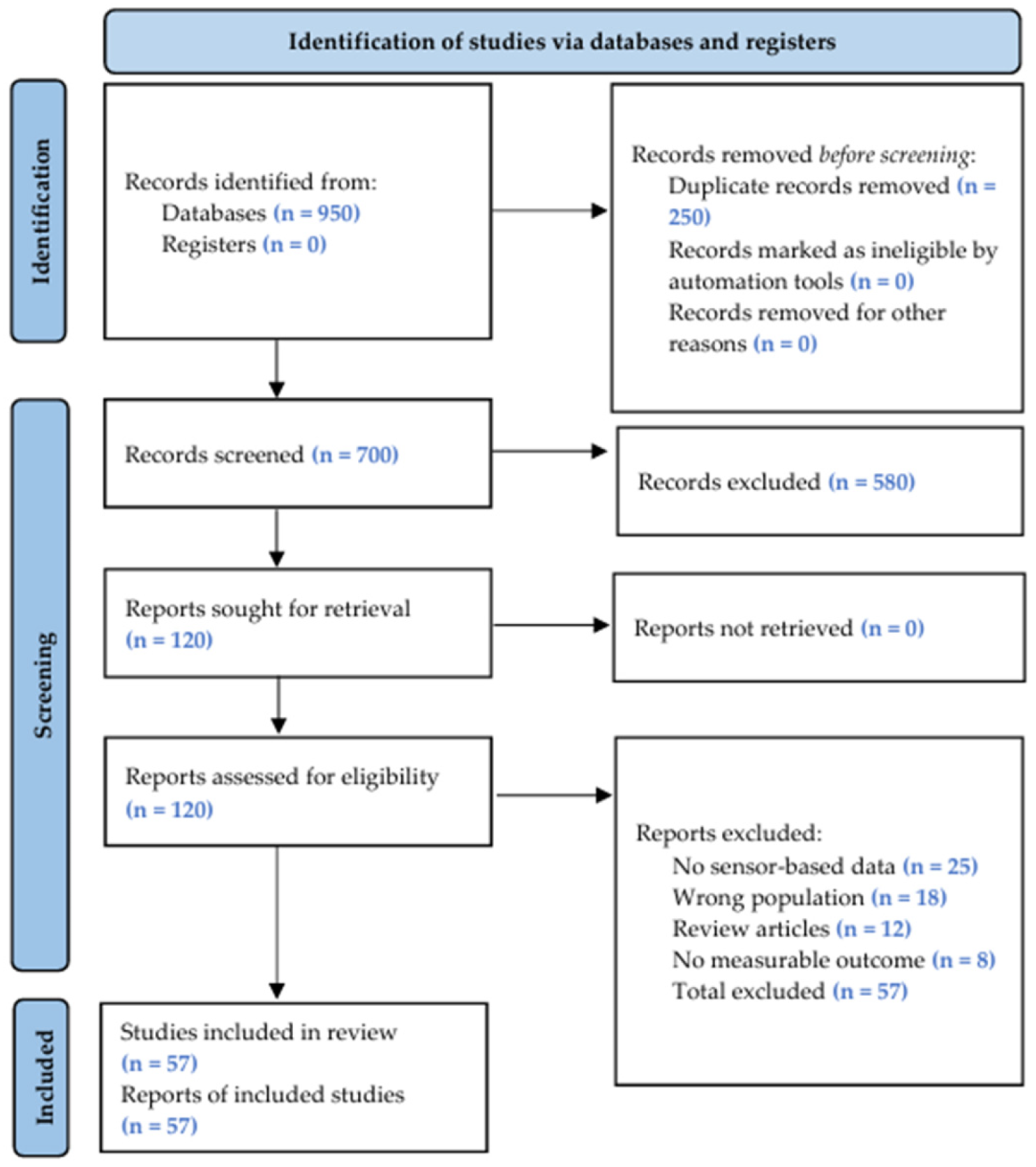
2.2. Study Selection Process
2.3. Search Strategy and Information Sources
2.4. Data Extraction and Synthesis
2.5. Risk of Bias Assessment
2.6. Eligibility Criteria and Study Selection
3. Results
3.1. Sensors and Monitoring Platforms
3.2. Sensor-Derived Behavioral Markers and Predictive Models for Loneliness and Social Isolation
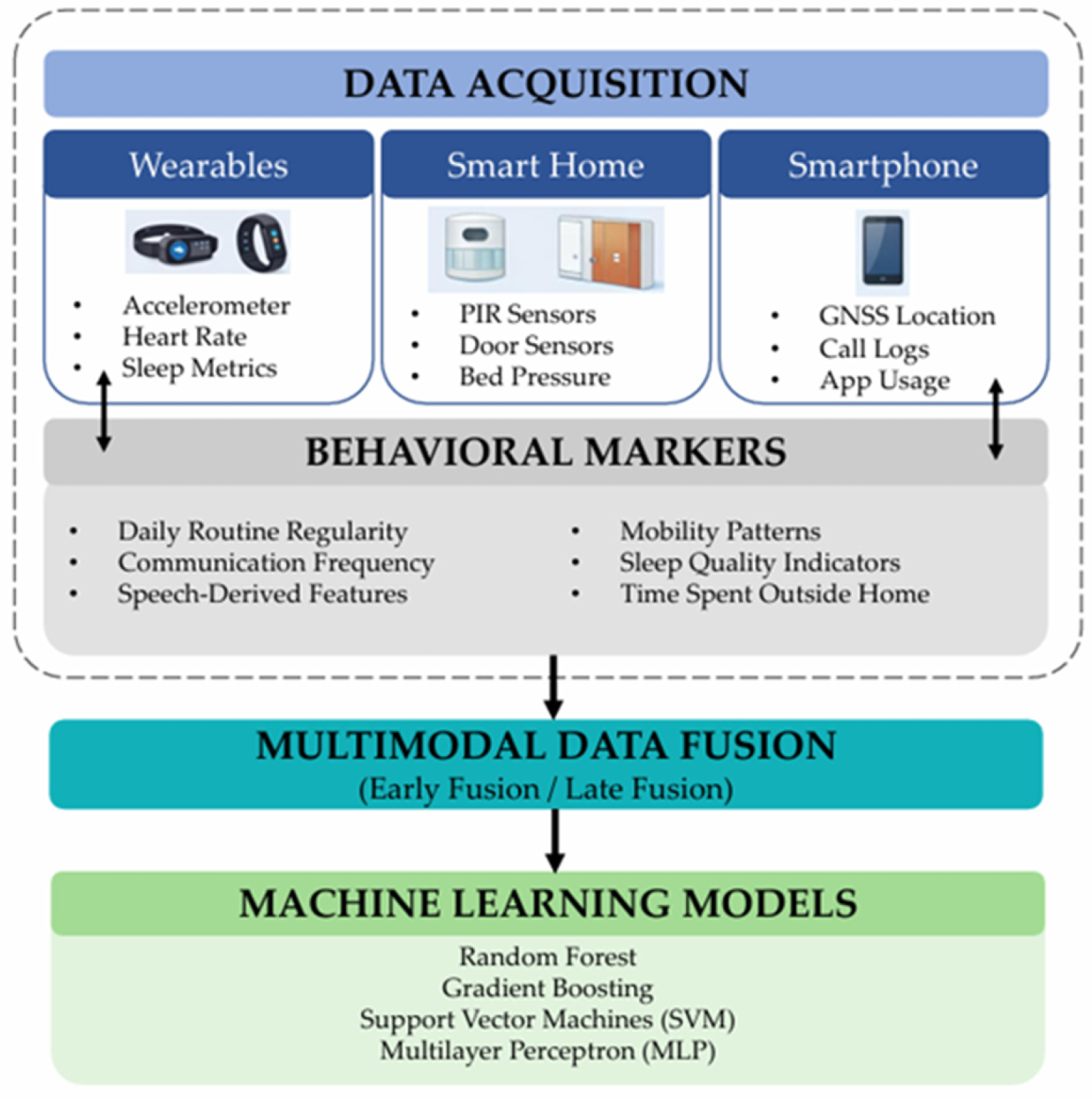
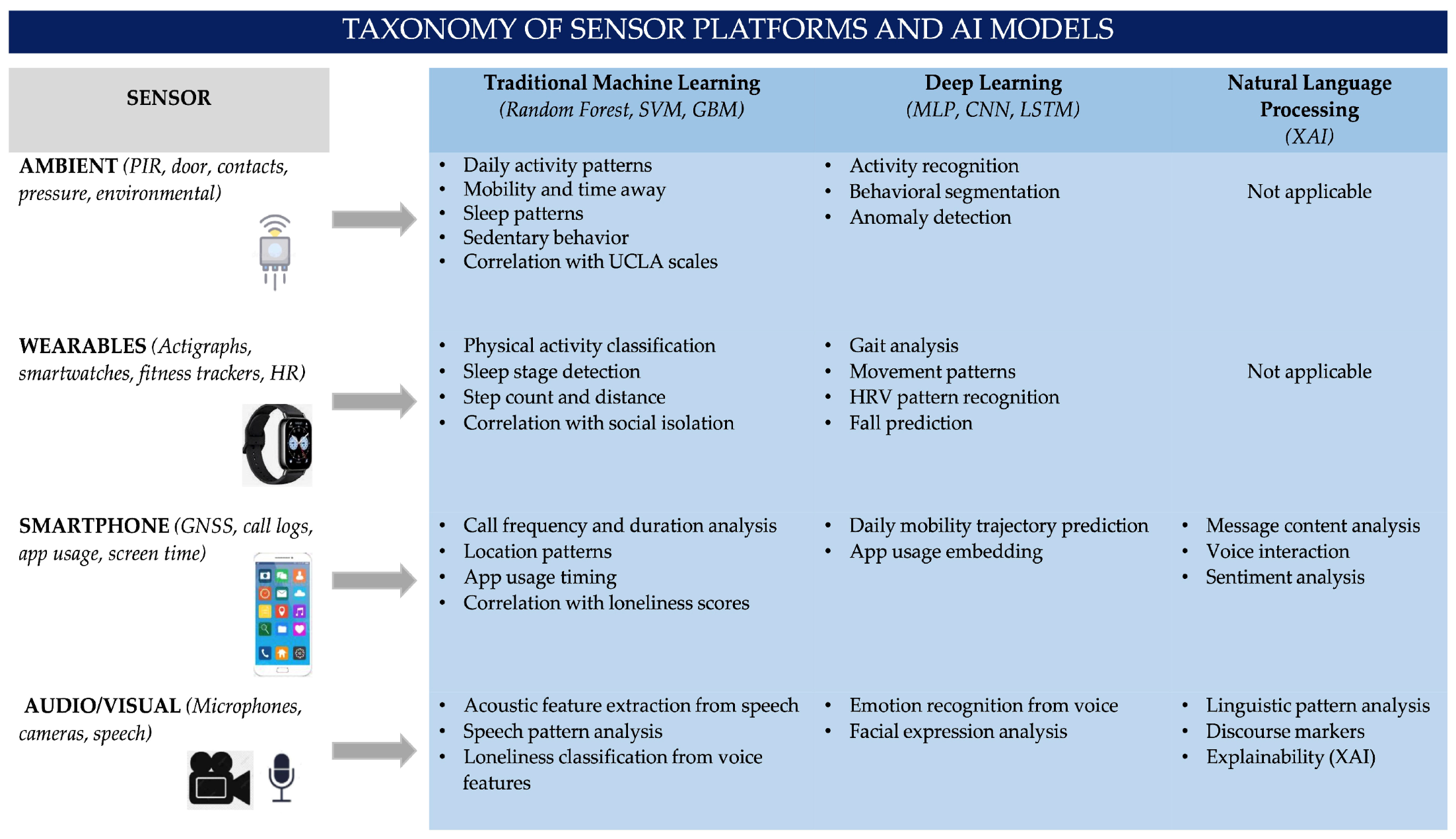
3.3. Multimodal Data Fusion and Artificial Intelligence Approaches
- Traditional machine learning: Algorithms such as Random Forest, Gradient Boosting, and Support Vector Machines are most commonly used due to their interpretability and good performance with tabular data extracted from sensors [39,57,59,60]. These models require manual feature engineering but offer better transparency for clinical applications [58].
- Deep learning: Although less frequent, deep learning approaches including multilayer perceptrons and convolutional neural networks have been applied to raw sensor data, particularly for activity recognition and speech analysis [58,61]. These methods can automatically learn features but require larger datasets and raise concerns about interpretability (‘black box’ issue).
- Natural Language Processing: Specific to audio-based sensing, NLP techniques including explainable AI (XAI) have been used to analyze linguistic traits in interviews and speech patterns associated with loneliness [57,58]. These approaches offer unique insights into subjective experiences but require careful validation across languages and cultures.
3.4. Digital Phenotyping Applications in Older Adult Populations
3.5. Inferring Social and Contextual Behavior from Sensor Data
3.6. Summary of Evidence Levels
4. Discussion
4.1. Synthesis of Principal Findings
4.2. The Role of Sensor Technologies and AI in Loneliness Detection
4.3. Advantages and Current Limitations of Passive Sensing
4.4. Ethical, Privacy, and User Acceptance Considerations
4.5. Future Research Directions
4.6. Limitations of This Review
Supplementary Materials
Author Contributions
Funding
Institutional Review Board Statement
Informed Consent Statement
Data Availability Statement
Conflicts of Interest
Abbreviations
| AAL | Ambient Assisted Living |
| AI | Artificial Intelligence |
| AUC | Area Under the Curve |
| BLE | Bluetooth Low Energy |
| ECG | Electrocardiogram |
| EDA | Electrodermal Activity |
| EEG | Electroencephalography |
| EMA | Ecological Momentary Assessment |
| GBM | Gradient Boosting Machine |
| GNSS | Global Navigation Satellite System |
| HR | Heart Rate |
| HRV | Heart Rate Variability |
| IoT | Internet of Things |
| ML | Machine Learning |
| MLP | Multilayer Perceptron |
| MCI | Mild Cognitive Impairment |
| NLP | Natural Language Processing |
| NMAE | Normalized Mean Absolute Error |
| NRMSE | Normalized Root Mean Square Error |
| PA | Physical Activity |
| PIR | Passive Infrared |
| PRISMA | Preferred Reporting Items for Systematic Reviews and Meta-Analyses |
| RF | Random Forest |
| RFID | Radio-Frequency Identification |
| SESLA | Social and Emotional Loneliness Scale for Adults |
| UCLA | University of California, Los Ángeles Loneliness Scale |
| XAI | Explainable Artificial Intelligence |
Appendix A

| Database | Search String |
|---|---|
| PubMed | (loneliness OR “social isolation” OR “social behavior” OR “social interaction”) AND (“older adults” OR elderly OR aging OR aged) AND (sensor* OR wearable* OR “smart home” OR “ambient assisted living” OR “passive sensing” OR monitoring) |
| Scopus | TITLE-ABS-KEY ((loneliness OR “social isolation”) AND (“older adults” OR elderly) AND (sensor* OR wearable* OR “smart home”)) |
| Web of Science | TS = (loneliness OR “social isolation”) AND TS = (“older adults” OR elderly) AND TS = (sensor* OR wearable* OR “smart home”) |
| IEE Xplore | (“All Metadata”:loneliness OR “All Metadata”:”social isolation”) AND (“All Metadata”:”older adults” OR “All Metadata”:elderly) AND (“All Metadata”:sensor* OR “All Metadata”:wearable*) |
References
- Puyané, M.; Chabrera, C.; Camón, E.; Cabrera, E. Uncovering the Impact of Loneliness in Ageing Populations: A Comprehensive Scoping Review. BMC Geriatr. 2025, 25, 244. [Google Scholar] [CrossRef]
- Lapane, K.L.; Lim, E.; McPhillips, E.; Barooah, A.; Yuan, Y.; Dube, C.E. Health Effects of Loneliness and Social Isolation in Older Adults Living in Congregate Long Term Care Settings: A Systematic Review of Quantitative and Qualitative Evidence. Arch. Gerontol. Geriatr. 2022, 102, 104728. [Google Scholar] [CrossRef]
- Courtin, E.; Knapp, M. Social Isolation, Loneliness and Health in Old Age: A Scoping Review. Health Soc. Care Community 2017, 25, 799–812. [Google Scholar] [CrossRef] [PubMed]
- Perissinotto, C.; Holt-Lunstad, J.; Periyakoil, V.S.; Covinsky, K. A Practical Approach to Assessing and Mitigating Loneliness and Isolation in Older Adults. J. Am. Geriatr. Soc. 2019, 67, 657–662. [Google Scholar] [CrossRef] [PubMed]
- Berg-Weger, M.; Morley, J.E. Loneliness in Old Age: An Unaddressed Health Problem. J. Nutr. Health Aging 2020, 24, 243–245. [Google Scholar] [CrossRef] [PubMed]
- Wu, B. Social Isolation and Loneliness among Older Adults in the Context of COVID-19: A Global Challenge. Glob. Health Res. Policy 2020, 5, 27. [Google Scholar] [CrossRef]
- Kobayashi, L.C.; Steptoe, A. Social Isolation, Loneliness, and Health Behaviors at Older Ages: Longitudinal Cohort Study. Ann. Behav. Med. 2018, 52, 582–593. [Google Scholar] [CrossRef]
- Sepúlveda-Loyola, W.; Rodríguez-Sánchez, I.; Pérez-Rodríguez, P.; Ganz, F.; Torralba, R.; Oliveira, D.V.; Rodríguez-Mañas, L. Impact of Social Isolation Due to COVID-19 on Health in Older People: Mental and Physical Effects and Recommendations. J. Nutr. Health Aging 2020, 24, 938–947. [Google Scholar] [CrossRef]
- Nakagomi, A.; Tsuji, T.; Saito, M.; Ide, K.; Kondo, K.; Shiba, K. Social Isolation and Subsequent Health and Well-Being in Older Adults: A Longitudinal Outcome-Wide Analysis. Soc. Sci. Med. 2023, 327, 115937. [Google Scholar] [CrossRef]
- Gerst-Emerson, K.; Jayawardhana, J. Loneliness as a Public Health Issue: The Impact of Loneliness on Health Care Utilization Among Older Adults. Am. J. Public Health 2015, 105, 1013–1019. [Google Scholar] [CrossRef]
- Czaja, S.J.; Moxley, J.H.; Rogers, W.A. Social Support, Isolation, Loneliness, and Health Among Older Adults in the PRISM Randomized Controlled Trial. Front. Psychol. 2021, 12, 728658. [Google Scholar] [CrossRef] [PubMed]
- Maes, M.; Qualter, P.; Lodder, G.M.A.; Mund, M. How (Not) to Measure Loneliness: A Review of the Eight Most Commonly Used Scales. Int. J. Environ. Res. Public Health 2022, 19, 10816. [Google Scholar] [CrossRef] [PubMed]
- Mund, M.; Maes, M.; Drewke, P.M.; Gutzeit, A.; Jaki, I.; Qualter, P. Would the Real Loneliness Please Stand Up? The Validity of Loneliness Scores and the Reliability of Single-Item Scores. Assessment 2023, 30, 1226–1248. [Google Scholar] [CrossRef] [PubMed]
- Reinwarth, A.C.; Ernst, M.; Krakau, L.; Brähler, E.; Beutel, M.E. Screening for Loneliness in Representative Population Samples: Validation of a Single-Item Measure. PLoS ONE 2023, 18, e0279701. [Google Scholar] [CrossRef]
- Gosling, C.J.; Colle, R.; Cartigny, A.; Jollant, F.; Corruble, E.; Frajerman, A. Measuring Loneliness: A Head-to-Head Psychometric Comparison of the 3- and 20-Item UCLA Loneliness Scales. Psychol. Med. 2024, 54, 3821–3827. [Google Scholar] [CrossRef]
- Deol, E.S.; Yamashita, K.; Elliott, S.; Malmstorm, T.K.; Morley, J.E. Validation of the ALONE Scale: A Clinical Measure of Loneliness. J. Nutr. Health Aging 2022, 26, 421–424. [Google Scholar] [CrossRef]
- Austin, J.; Dodge, H.H.; Riley, T.; Jacobs, P.G.; Thielke, S.; Kaye, J. A Smart-Home System to Unobtrusively and Continuously Assess Loneliness in Older Adults. IEEE J. Transl. Eng. Health Med. 2016, 4, 2800311. [Google Scholar] [CrossRef]
- Bugallo-Carrera, C.; Dosil-Díaz, C.; Anido-Rifón, L.; Pacheco-Lorenzo, M.; Fernández-Iglesias, M.J.; Gandoy-Crego, M. A Systematic Review Evaluating Loneliness Assessment Instruments in Older Adults. Front. Psychol. 2023, 14, 1101462. [Google Scholar] [CrossRef]
- Hughes, M.E.; Waite, L.J.; Hawkley, L.C.; Cacioppo, J.T. A Short Scale for Measuring Loneliness in Large Surveys: Results from Two Population-Based Studies. Res. Aging 2004, 26, 655–672. [Google Scholar] [CrossRef]
- De Jong Gierveld, J.; Van Tilburg, T. The De Jong Gierveld Short Scales for Emotional and Social Loneliness: Tested on Data from 7 Countries in the UN Generations and Gender Surveys. Eur. J. Ageing 2010, 7, 121–130. [Google Scholar] [CrossRef]
- Qirtas, M.M.; Zafeiridi, E.; Pesch, D.; White, E.B. Loneliness and Social Isolation Detection Using Passive Sensing Techniques: Scoping Review. JMIR Mhealth Uhealth 2022, 10, e34638. [Google Scholar] [CrossRef]
- Zhou, Y.; Ratcliffe, J.; Molteni, E.; Patel, A.; Liu, J.; Mexia, N.; Rees, J.; Matcham, F.; Antonelli, M.; Tinker, A.; et al. Smart Textile Systems for Loneliness Monitoring in Older People Care: A Review of Sensing and Design Innovations. Adv. Electron. Mater. 2025, 11, e00300. [Google Scholar] [CrossRef]
- Mohr, D.C.; Zhang, M.; Schueller, S.M. Personal Sensing: Understanding Mental Health Using Ubiquitous Sensors and Machine Learning. Annu. Rev. Clin. Psychol. 2017, 13, 23–47. [Google Scholar] [CrossRef] [PubMed]
- Garcia-Ceja, E.; Riegler, M.; Nordgreen, T.; Jakobsen, P.; Oedegaard, K.J.; Tørresen, J. Mental Health Monitoring with Multimodal Sensing and Machine Learning: A Survey. Pervasive Mob. Comput. 2018, 51, 1–26. [Google Scholar] [CrossRef]
- Muzammal, M.; Talat, R.; Sodhro, A.H.; Pirbhulal, S. A Multi-Sensor Data Fusion Enabled Ensemble Approach for Medical Data from Body Sensor Networks. Inf. Fusion 2020, 53, 155–164. [Google Scholar] [CrossRef]
- Cook, D.J.; Schmitter-Edgecombe, M. Fusing Ambient and Mobile Sensor Features into a Behaviorome for Predicting Clinical Health Scores. IEEE Access 2021, 9, 65033–65043. [Google Scholar] [CrossRef]
- Prabhu, D.; Kholghi, M.; Sandhu, M.; Lu, W.; Packer, K.; Higgins, L.; Silvera-Tawil, D. Sensor-Based Assessment of Social Isolation and Loneliness in Older Adults: A Survey. Sensors 2022, 22, 9944. [Google Scholar] [CrossRef]
- Khan, S.S.; Gu, T.; Spinelli, L.; Wang, R.H. Sensor-Based Assessment of Social Isolation in Community-Dwelling Older Adults: A Scoping Review. BioMed. Eng. OnLine 2023, 22, 18. [Google Scholar] [CrossRef]
- Page, M.J.; Moher, D.; Bossuyt, P.M.; Boutron, I.; Hoffmann, T.C.; Mulrow, C.D.; Shamseer, L.; Tetzlaff, J.M.; Akl, E.A.; Brennan, S.E.; et al. PRISMA 2020 Explanation and Elaboration: Updated Guidance and Exemplars for Reporting Systematic Reviews. BMJ 2021, 372, n160. [Google Scholar] [CrossRef]
- Goonawardene, N.; Toh, X.; Tan, H.-P. Sensor-Driven Detection of Social Isolation in Community-Dwelling Elderly. In Human Aspects of IT for the Aged Population. Applications, Services and Contexts; Zhou, J., Salvendy, G., Eds.; Lecture Notes in Computer Science, Vol. 10298; Springer International Publishing: Cham, Switzerland, 2017; pp. 378–392. [Google Scholar]
- Probst, F.; Ratcliffe, J.; Molteni, E.; Mexia, N.; Rees, J.; Matcham, F.; Antonelli, M.; Tinker, A.; Shi, Y.; Ourselin, S.; et al. A Scoping Review on Human-Centered Design Approaches and Considerations in the Design of Technologies for Loneliness and Social Isolation in Older Adults. Des. Sci. 2024, 10, e39. [Google Scholar] [CrossRef]
- Cho, E.; Cho, H.; Demiris, G.; Harrison, S.; Ji, X.; Yuh, A.; Sokolsky, O.; Lee, I. Older Adults’ Perceptions and Attitudes Toward Passive Sensors to Measure Loneliness: A Qualitative Study. Sage Open Aging 2025, 11, 30495334251325607. [Google Scholar] [CrossRef]
- Yu, K.; Wu, C.; Barnes, L.L.; Silbert, L.C.; Beattie, Z.; Croff, R.; Miller, L.; Dodge, H.H.; Kaye, J.A. Life-Space Mobility Is Related to Loneliness Among Living-Alone Older Adults: Longitudinal Analysis with Motion Sensor Data. J. Am. Geriatr. Soc. 2025, 73, 1125–1134. [Google Scholar] [CrossRef] [PubMed]
- Bouaziz, G.; Brulin, D.; Campo, E. Technological Solutions for Social Isolation Monitoring of the Elderly: A Survey of Selected Projects from Academia and Industry. Sensors 2022, 22, 8802. [Google Scholar] [CrossRef]
- Ji, X.; Yuh, A.; Erdélyi, V.; Mizumoto, T.; Choi, H.; Harrison, S.L.; Cho, E.; Weimer, J.; Nagahara, H.; Higashino, T.; et al. Exploring Effective Sensing Indicators of Loneliness for Elderly Community in US and Japan. In Proceedings of the Extended Abstracts of the CHI Conference on Human Factors in Computing Systems; ACM: New York, NY, USA, 2024; pp. 1–9. [Google Scholar]
- Dayyani, F.; Chu, C.H.; Abedi, A.; Khan, S.S. Correlations between Social Isolation and Functional Decline in Older Adults after Lower Limb Fractures Using Multimodal Sensors: A Pilot Study. Algorithms 2024, 17, 383. [Google Scholar] [CrossRef]
- Site, A.; Lohan, E.S.; Jolanki, O.; Valkama, O.; Hernandez, R.R.; Latikka, R.; Alekseeva, D.; Vasudevan, S.; Afolaranmi, S.; Ometov, A.; et al. Managing Perceived Loneliness and Social-Isolation Levels for Older Adults: A Survey with Focus on Wearables-Based Solutions. Sensors 2022, 22, 1108. [Google Scholar] [CrossRef] [PubMed]
- Rees, J.; Ratcliffe, J.; Liu, W.; Zhou, Y.; Ourselin, S.; Antonelli, M.; Patel, A.; Shi, Y.; Liu, J.; Tinker, A.; et al. Understanding the Thoughts and Preferences for Technologies Designed to Detect Feelings of Loneliness: Interview Study Among Older Adults. JMIR Hum. Factors 2025, 12, e73694. [Google Scholar] [CrossRef]
- Kang, B.; Park, M.K.; Kim, J.I.; Yoon, S.; Heo, S.-J.; Kang, C.; Lee, S.; Choi, Y.; Hong, D. Exploring Factors Related to Social Isolation Among Older Adults in the Predementia Stage Using Ecological Momentary Assessments and Actigraphy: Machine Learning Approach. J. Med. Internet Res. 2025, 27, e69379. [Google Scholar] [CrossRef]
- Schrempft, S.; Jackowska, M.; Hamer, M.; Steptoe, A. Associations between Social Isolation, Loneliness, and Objective Physical Activity in Older Men and Women. BMC Public Health 2019, 19, 74. [Google Scholar] [CrossRef]
- Osa Sanchez, A.; Jossa-Bastidas, O.; Mendez-Zorrilla, A.; Oleagordia-Ruiz, I.; Garcia-Zapirain, B. Multisource Data for Monitoring and Intervention of Loneliness in the Elderly. Int. J. Integr. Care 2025, 25, 08. [Google Scholar] [CrossRef]
- Jossa, O.; Osa, A.; Miranda, A.; Oleagordia, I.; Gomez, C.; Mendez, A.; Garcia-Zapirain Soto, B. Big Data and IoT System Using a Serverless Architecture for Monitoring and Intervention of Loneliness in the Elderly. Int. J. Integr. Care 2023, 23, 698. [Google Scholar] [CrossRef]
- Gao, H.; Wang, X.; Jiang, Y.; Chen, F.; Moriyama, M.; Zhou, X. Psychometric Properties of the Social Isolation Scale for Older Adults in Geriatric Long-Term Care Facilities. Geriatr. Nurs. 2025, 65, 103486. [Google Scholar] [CrossRef] [PubMed]
- Abedi, A.; Chu, C.H.; Khan, S.S. Multimodal Sensor Dataset for Monitoring Older Adults Post Lower Limb Fractures in Community Settings. Sci. Data 2025, 12, 733. [Google Scholar] [CrossRef] [PubMed]
- Lee, K.; Marchal, N.; Robinson, E.L.; Powell, K.R. Behavioral Markers in Older Adults During COVID-19 Confinement: Secondary Analysis of In-Home Sensor Data. JMIR Mhealth Uhealth 2025, 13, e56678. [Google Scholar] [CrossRef] [PubMed]
- Jesús-Azabal, M.; Mariano, L.; Galán-Jiménez, J.; García-Alonso, J. Evaluating Technical Viability of a Loneliness Detector System for Older Adults from Rural Areas. Gerontechnology 2022, 21, 1. [Google Scholar] [CrossRef]
- Probst, F.; Rees, J.; Aslam, Z.; Mexia, N.; Molteni, E.; Matcham, F.; Antonelli, M.; Tinker, A.; Shi, Y.; Ourselin, S.; et al. Evaluating a Smart Textile Loneliness Monitoring System for Older People: Co-Design and Qualitative Focus Group Study. JMIR Aging 2024, 7, e57622. [Google Scholar] [CrossRef]
- Rees, J.; Matcham, F.; Probst, F.; Ourselin, S.; Shi, Y.; Antonelli, M.; Tinker, A.; Liu, W. Wearables, Sensors and the Future of Technology to Detect and Infer Loneliness in Older Adults. Gerontechnology 2023, 22, 1–4. [Google Scholar] [CrossRef]
- Rees, J.; Liu, W.; Canson, J.; Crosby, L.; Tinker, A.; Probst, F.; Ourselin, S.; Antonelli, M.; Molteni, E.; Mexia, N.; et al. Qualitative Exploration of the Lived Experiences of Loneliness in Later Life to Inform Technology Development. Int. J. Qual. Stud. Health Well-Being 2024, 19, 2398259. [Google Scholar] [CrossRef]
- Wang, Q.; Zhang, S.; Wang, Y.; Zhao, D.; Zhou, C. Dual Sensory Impairment as a Predictor of Loneliness and Isolation in Older Adults: National Cohort Study. JMIR Public Health Surveill. 2022, 8, e39314. [Google Scholar] [CrossRef]
- Takemoto, A.; Iwamoto, M.; Yaegashi, H.; Yun, S.; Takashima, R. Virtual Avatar Communication Task Eliciting Pseudo-Social Isolation and Detecting Social Isolation Using Non-Verbal Signal Monitoring in Older Adults. Front. Psychol. 2025, 16, 1507178. [Google Scholar] [CrossRef]
- Yamada, Y.; Shinkawa, K.; Nemoto, M.; Arai, T. Automatic Assessment of Loneliness in Older Adults Using Speech Analysis on Responses to Daily Life Questions. Front. Psychiatry 2021, 12, 712251. [Google Scholar] [CrossRef]
- Badal, V.D.; Nebeker, C.; Shinkawa, K.; Yamada, Y.; Rentscher, K.E.; Kim, H.-C.; Lee, E.E. Do Words Matter? Detecting Social Isolation and Loneliness in Older Adults Using Natural Language Processing. Front. Psychiatry 2021, 12, 728732. [Google Scholar] [CrossRef] [PubMed]
- Ji, X.; Li, X.; Yuh, A.; Kendell, C.; Watson, A.; Weimer, J.; Nagahara, H.; Higashino, T.; Mizumoto, T.; Erdelyi, V.; et al. Short: Integrated Sensing Platform for Detecting Social Isolation and Loneliness In the Elderly Community. In Proceedings of the 8th ACM/IEEE International Conference on Connected Health: Applications, Systems and Engineering Technologies; ACM: New York, NY, USA, 2023; pp. 148–152. [Google Scholar]
- Lee, K.; Lee, T.C.; Yefimova, M.; Kumar, S.; Puga, F.; Azuero, A.; Kamal, A.; Bakitas, M.A.; Wright, A.A.; Demiris, G.; et al. Using Digital Phenotyping to Understand Health-Related Outcomes: A Scoping Review. Int. J. Med. Inform. 2023, 174, 105061. [Google Scholar] [CrossRef] [PubMed]
- Schutz, N.; Botros, A.; Hassen, S.B.; Saner, H.; Buluschek, P.; Urwyler, P.; Pais, B.; Santschi, V.; Gatica-Perez, D.; Muri, R.M.; et al. A Sensor-Driven Visit Detection System in Older Adults’ Homes: Towards Digital Late-Life Depression Marker Extraction. IEEE J. Biomed. Health Inform. 2022, 26, 1560–1569. [Google Scholar] [CrossRef] [PubMed]
- Badal, V.D.; Graham, S.A.; Depp, C.A.; Shinkawa, K.; Yamada, Y.; Palinkas, L.A.; Kim, H.-C.; Jeste, D.V.; Lee, E.E. Prediction of Loneliness in Older Adults Using Natural Language Processing: Exploring Sex Differences in Speech. Am. J. Geriatr. Psychiatry 2021, 29, 853–866. [Google Scholar] [CrossRef]
- Wang, N.; Goel, S.; Ibrahim, S.; Badal, V.D.; Depp, C.; Bilal, E.; Subbalakshmi, K.; Lee, E. Decoding Loneliness: Can Explainable AI Help in Understanding Language Differences in Lonely Older Adults? Psychiatry Res. 2024, 339, 116078. [Google Scholar] [CrossRef]
- Sanchez, W.; Martinez, A.; Campos, W.; Estrada, H.; Pelechano, V. Inferring Loneliness Levels in Older Adults from Smartphones. J. Ambient Intell. Smart Environ. 2015, 7, 85–98. [Google Scholar] [CrossRef]
- Lin, Y.; Li, C.; Wang, X.; Li, H. Development of a Machine Learning-Based Risk Assessment Model for Loneliness among Elderly Chinese: A Cross-Sectional Study Based on Chinese Longitudinal Healthy Longevity Survey. BMC Geriatr. 2024, 24, 939. [Google Scholar] [CrossRef]
- Carrasco, P.M.; Crespo, D.P.; García, A.I.R.; Ibáñez, M.L.; Rubio, B.M.; Montenegro-Peña, M. Predictive Factors and Risk and Protection Groups for Loneliness in Older Adults: A Population-Based Study. BMC Psychol. 2024, 12, 238. [Google Scholar] [CrossRef]
- Sheikh, M.; Qassem, M.; Kyriacou, P.A. Wearable, Environmental, and Smartphone-Based Passive Sensing for Mental Health Monitoring. Front. Digit. Health 2021, 3, 662811. [Google Scholar] [CrossRef]
- Robie, A.A.; Seagraves, K.M.; Egnor, S.E.R.; Branson, K. Machine Vision Methods for Analyzing Social Interactions. J. Exp. Biol. 2017, 220, 25–34. [Google Scholar] [CrossRef]
- Hackett, K.; Xu, S.; McKniff, M.; Paglia, L.; Barnett, I.; Giovannetti, T. Mobility-Based Smartphone Digital Phenotypes for Unobtrusively Capturing Everyday Cognition, Mood, and Community Life-Space in Older Adults: Feasibility, Acceptability, and Preliminary Validity Study. JMIR Hum. Factors 2024, 11, e59974. [Google Scholar] [CrossRef]
- Virginia Anikwe, C.; Friday Nweke, H.; Chukwu Ikegwu, A.; Adolphus Egwuonwu, C.; Uchenna Onu, F.; Rita Alo, U.; Wah Teh, Y. Mobile and Wearable Sensors for Data-Driven Health Monitoring System: State-of-the-Art and Future Prospect. Expert Syst. Appl. 2022, 202, 117362. [Google Scholar] [CrossRef]
- Torrado, J.C.; Husebo, B.S.; Allore, H.G.; Erdal, A.; Fæø, S.E.; Reithe, H.; Førsund, E.; Tzoulis, C.; Patrascu, M. Digital Phenotyping by Wearable-Driven Artificial Intelligence in Older Adults and People with Parkinson’s Disease: Protocol of the Mixed Method, Cyclic ActiveAgeing Study. PLoS ONE 2022, 17, e0275747. [Google Scholar] [CrossRef]
- Rawtaer, I.; Jabbar, K.B.A.; Subagdja, B.; Saffari, E.; Tan, A.H. 299. Sensors in-home for elder wellbeing (sinew): Digital phenotyping and artificial intelligence for early detection of dementia. Int. J. Neuropsychopharmacol. 2025, 28, ii67–ii68. [Google Scholar] [CrossRef]
- Daniels, K.; Vonck, S.; Robijns, J.; Spooren, A.; Hansen, D.; Bonnechère, B. Characterising Physical Activity Patterns in Community-Dwelling Older Adults Using Digital Phenotyping: A 2-Week Observational Study Protocol. BMJ Open 2025, 15, e095769. [Google Scholar] [CrossRef] [PubMed]
- Daniels, K.; Quadflieg, K.; Robijns, J.; De Vry, J.; Van Alphen, H.; Van Beers, R.; Sourbron, B.; Vanbuel, A.; Meekers, S.; Mattheeussen, M.; et al. From Steps to Context: Optimizing Digital Phenotyping for Physical Activity Monitoring in Older Adults by Integrating Wearable Data and Ecological Momentary Assessment. Sensors 2025, 25, 858. [Google Scholar] [CrossRef] [PubMed]
- Hackett, K.; Xu, S.; McKniff, M.; Pinsky, E.; Holmqvist, S.; Vallecorsa, G.; Barnett, I.; Giovannetti, T. 3 Smartphone Digital Phenotyping for Unobtrusive and Continuous Assessment of Everyday Cognition and Movement Trajectories in Older Adults. J. Int. Neuropsychol. Soc. 2023, 29, 207–208. [Google Scholar] [CrossRef]
- Hackett, K.; Giovannetti, T. Capturing Cognitive Aging in Vivo: Application of a Neuropsychological Framework for Emerging Digital Tools. JMIR Aging 2022, 5, e38130. [Google Scholar] [CrossRef]
- Fan, L.-J.; Wang, F.-Y.; Zhao, J.-H.; Zhang, J.-J.; Li, Y.-A.; Tang, J.; Lin, T.; Wei, Q. From Physical Activity Patterns to Cognitive Status: Development and Validation of Novel Digital Biomarkers for Cognitive Assessment in Older Adults. Int. J. Behav. Nutr. Phys. Act. 2025, 22, 11. [Google Scholar] [CrossRef]
- Marino, F.R.; Wu, H.-T.; Etzkorn, L.; Rooney, M.R.; Soliman, E.Z.; Deal, J.A.; Crainiceanu, C.; Spira, A.P.; Wanigatunga, A.A.; Schrack, J.A.; et al. Associations of Physical Activity and Heart Rate Variability from a Two-Week ECG Monitor with Cognitive Function and Dementia: The ARIC Neurocognitive Study. Sensors 2024, 24, 4060. [Google Scholar] [CrossRef]
- Aledavood, T.; Luong, N.; Baryshnikov, I.; Darst, R.; Heikkilä, R.; Holmén, J.; Ikäheimonen, A.; Martikkala, A.; Riihimäki, K.; Saleva, O.; et al. Multimodal Digital Phenotyping Study in Patients with Major Depressive Episodes and Healthy Controls (Mobile Monitoring of Mood): Observational Longitudinal Study. JMIR Ment. Health 2025, 12, e63622. [Google Scholar] [CrossRef] [PubMed]
- Price, G.D.; Heinz, M.V.; Song, S.H.; Nemesure, M.D.; Jacobson, N.C. Using Digital Phenotyping to Capture Depression Symptom Variability: Detecting Naturalistic Variability in Depression Symptoms across One Year Using Passively Collected Wearable Movement and Sleep Data. Transl. Psychiatry 2023, 13, 381. [Google Scholar] [CrossRef] [PubMed]
- Sun, S.; Folarin, A.A.; Zhang, Y.; Cummins, N.; Garcia-Dias, R.; Stewart, C.; Ranjan, Y.; Rashid, Z.; Conde, P.; Laiou, P.; et al. Challenges in Using mHealth Data from Smartphones and Wearable Devices to Predict Depression Symptom Severity: Retrospective Analysis. J. Med. Internet Res. 2023, 25, e45233. [Google Scholar] [CrossRef] [PubMed]
- Lekkas, D.; Gyorda, J.A.; Price, G.D.; Jacobson, N.C. Depression Deconstructed: Wearables and Passive Digital Phenotyping for Analyzing Individual Symptoms. Behav. Res. Ther. 2023, 168, 104382. [Google Scholar] [CrossRef]
- Baig, M.M.; Afifi, S.; GholamHosseini, H.; Mirza, F. A Systematic Review of Wearable Sensors and IoT-Based Monitoring Applications for Older Adults—A Focus on Ageing Population and Independent Living. J. Med. Syst. 2019, 43, 233. [Google Scholar] [CrossRef]
- Stavropoulos, T.G.; Papastergiou, A.; Mpaltadoros, L.; Nikolopoulos, S.; Kompatsiaris, I. IoT Wearable Sensors and Devices in Elderly Care: A Literature Review. Sensors 2020, 20, 2826. [Google Scholar] [CrossRef]
- Orlandini, R.; Lušić Kalcina, L.; Antičević, V. Understanding Loneliness in Older Adults During the Pandemic: Predictors and Questionnaire Validation. Diseases 2025, 13, 45. [Google Scholar] [CrossRef]
- Cho, E.; Demiris, G.; Cho, H.; Lee, I.; Yuh, A.; Ji, X.; Harrison, S.L.; Sokolsky, O. Perceptions and attitudes toward loneliness detection using passive sensing technologies in older adults. Sage Open Aging 2024, 11, 782. [Google Scholar] [CrossRef]
- Wilkowska, W.; Offermann, J.; Spinsante, S.; Poli, A.; Ziefle, M. Analyzing Technology Acceptance and Perception of Privacy in Ambient Assisted Living for Using Sensor-Based Technologies. PLoS ONE 2022, 17, e0269642. [Google Scholar] [CrossRef]
- Yusif, S.; Soar, J.; Hafeez-Baig, A. Older People, Assistive Technologies, and the Barriers to Adoption: A Systematic Review. Int. J. Med. Inform. 2016, 94, 112–116. [Google Scholar] [CrossRef]
- Mujirishvili, T.; Maidhof, C.; Florez-Revuelta, F.; Ziefle, M.; Richart-Martinez, M.; Cabrero-García, J. Acceptance and Privacy Perceptions Toward Video-Based Active and Assisted Living Technologies: Scoping Review. J. Med. Internet Res. 2023, 25, e45297. [Google Scholar] [CrossRef]
- Pirzada, P.; Wilde, A.; Doherty, G.H.; Harris-Birtill, D. Ethics and Acceptance of Smart Homes for Older Adults. Inform. Health Soc. Care 2022, 47, 10–37. [Google Scholar] [CrossRef]
- Percy Campbell, J.; Buchan, J.; Chu, C.H.; Bianchi, A.; Hoey, J.; Khan, S.S. User Perception of Smart Home Surveillance Among Adults Aged 50 Years and Older: Scoping Review. JMIR Mhealth Uhealth 2024, 12, e48526. [Google Scholar] [CrossRef]
- Read, E.A.; Gagnon, D.A.; Donelle, L.; Ledoux, K.; Warner, G.; Hiebert, B.; Sharma, R. Stakeholder Perspectives on In-Home Passive Remote Monitoring to Support Aging in Place in the Province of New Brunswick, Canada: Rapid Qualitative Investigation. JMIR Aging 2022, 5, e31486. [Google Scholar] [CrossRef] [PubMed]
- Miller, L.M.; Kaye, J.; Lindauer, A.; Au-Yeung, W.-T.M.; Rodrigues, N.K.; Czaja, S.J. Remote Passive Sensing of Older Adults’ Activities and Function: User-Centered Design Considerations for Behavioral Interventions Conducted in the Home Setting. J. Med. Internet Res. 2024, 26, e54709. [Google Scholar] [CrossRef]
- Berridge, C. Active Subjects of Passive Monitoring: Responses to a Passive Monitoring System in Low-Income Independent Living. Ageing Soc. 2017, 37, 537–560. [Google Scholar] [CrossRef] [PubMed]
- Sharma, J.; Gillani, N.; Saied, I.; Alzaabi, A.; Arslan, T. Patient and Public Involvement in the Co-Design and Assessment of Unobtrusive Sensing Technologies for Care at Home: A User-Centric Design Approach. BMC Geriatr. 2025, 25, 48. [Google Scholar] [CrossRef] [PubMed]
- Zieni, B.; Ritchie, M.A.; Mandalari, A.M.; Boem, F. An Interdisciplinary Overview on Ambient Assisted Living Systems for Health Monitoring at Home: Trade-Offs and Challenges. Sensors 2025, 25, 853. [Google Scholar] [CrossRef]


| Criterion | Inclusion Criteria | Exclusion Criteria |
|---|---|---|
| Population | Older adults (≥60 years) | Studies focused on younger adults, caregivers, or the general population without age-specific analysis |
| Technology | Passive sensing technologies (e.g., wearables, environmental sensors, smartphones) | Active sensing requiring user interaction, questionnaire-only studies, or non-sensor-based methods |
| Outcome | Detection, prediction, or correlation with loneliness or social isolation | Studies not reporting loneliness or social isolation as an outcome |
| Study type | Primary research reporting quantitative or qualitative results on validity, feasibility, accuracy, or usefulness | Systematic reviews, opinion articles, editorials, conference abstracts, or studies without validation results |
| Language | Publications in English | Non-English publications |
| Publication date | January 2017–February 2025 | Publications before January 2017 |
| Sensor Type/Platform | Main Measured Variables | Variables Related to Loneliness/Isolation | References |
|---|---|---|---|
| Motion sensors (PIR, infrared) | Mobility, presence in rooms, daily activity | Time spent in each room, activity/inactivity patterns, mobility | [17,21,27,28,30,32,33,34] |
| Door contact sensors | Home entrances/exits, room usage | Frequency of outings, time spent outside the home, interior door usage | [17,21,27,30,32,33,34] |
| Pressure sensors (bed/chair, smart mattress) | Bed/chair presence, sleep parameters | Bedtime, naps, sleep efficiency, sedentary time | [28,32,33,35,36] |
| Environmental sensors (light, electricity, water, temperature, humidity, air quality) | Appliance usage, thermal comfort, home routines | TV hours, kitchen/bathroom use, shower events, heating patterns | [17,21,27,30,32,33,34,35] |
| Actigraphs/portable accelerometers | Physical activity, movement patterns | Daily activity level, sedentary time, movement changes | [28,32,37,38,39,40] |
| Smartwatches and fitness trackers | Activity, sleep, vital signs | Daily steps, sleep, heart rate, physiological variability | [28,31,32,36,37,38,39,41,42] |
| Smartphone (sensors and usage logs) | Communication, mobility, app usage | Number/duration of calls, messages, social app usage, GNSS | [28,32,37,38,43,44,45] |
| Proximity sensors (BLE, RFID, tags) | Proximity to objects or people | Being at home vs. away, movement within the home, social encounters | [32,46] |
| Specific physiological sensors | Biological indicators (HR, temperature, EDA, EEG, ECG) | Heart rate, conductance, temperature, stress associated with loneliness | [28,32,37,38,47,48,49] |
| Smart textile sensors (clothing/furniture) | Body activity, posture, comfort | Movement, posture, social interaction, continuous monitoring | [22,32,38,47,50] |
| Audio and video sensors (NLP, cameras) | Verbal interactions, facial expression, language | Voice analysis, speech patterns, non-verbal expressions | [51,52,53] |
| Sensor Category | Strengths | Limitations |
|---|---|---|
| Motion Sensors (PIR, Infrared) | Fully passive and unobtrusive; enable long-term monitoring; no user burden; capture indoor movement dynamics | Limited to indoor spaces; cannot identify individuals; limited sensitivity to subtle behavioral changes |
| Door Contact Sensors | Simple and reliable; generate clear binary event data; detect home exits and entries | Only capture door events; miss detailed activity outside the home; limited insight into social interactions |
| Pressure Sensors (Bed/Chair Sensors) | Passive monitoring of sleep and rest; no wearable required; capture nocturnal behavior | Restricted to specific furniture; cannot detect sleep stages; performance affected by multiple occupants |
| Environmental Sensors (Multi-Sensor Home Systems) | Capture contextual home activity; support long-term deployment; provide behavioral context for ADLs | Provide indirect measures requiring interpretation; sensitive to environmental changes; installation infrastructure required |
| Wearable Sensors | Continuous physiological and activity monitoring; high temporal resolution; capture indoor and outdoor movement; commercially available | Require charging and maintenance; adherence may decrease; potential discomfort or abandonment |
| Smartphone-Based Sensing | Leverages existing personal devices; captures communication and mobility data; supports multimodal analytics | Privacy concerns; battery consumption; digital divide among older adults; platform heterogeneity |
| Physiological Sensors (ECG, EDA, EEG) | Capture objective stress-related biomarkers; high measurement precision; potential emotional correlates | Require contact-based setup; typically limited to controlled or laboratory environments; complex signal processing |
| Audio and Video Sensors | Direct assessment of social interaction; enable linguistic, paralinguistic, and behavioral analysis; rich contextual information | Highly intrusive; strong privacy and ethical concerns; computationally intensive; language-dependent |
| Instrument/Scale | Sensor/Features | Model | n | Population | Setting | Validation | Metric | References |
|---|---|---|---|---|---|---|---|---|
| UCLA 3-item | PIR, door contacts, PC/phone use | Multiple linear regression | 30 | Community, homes | Home | Hold-out | R2 = 0.35 | [17] |
| EMA + validated scales | Sleep, physical activity, health, EMA | Gradient Boosting | 78 | Community, predementia | Community | Cross-validation | AUC = 0.887 | [39] |
| UCLA (4 factors) | Call logs, GPS location | Multiple classifiers | 52 | Community | Community | Not specified | Accuracy, sensitivity, specificity by factor | [59] |
| UCLA | Linguistic traits (interviews) | Explainable AI (XAI) | 84 | Older adults | Laboratory | Hold-out | Accuracy = 0.889; AUC = 0.80; F1 = 0.80 | [58] |
| UCLA (qual + quant) | Linguistic traits (interviews) | ML models | 104 | Community | Laboratory | Cross-validation | Precision = 94%/76%; Sensitivity = 0.90/0.57; Specificity = 1.00/0.899 | [57] |
| Loneliness scale | Sociodemographic, functional health | Gradient Boosted Trees | 4621 | Population-based, China | Population-based | Cross-validation | AUC = 0.84 | [60] |
| Loneliness scale | Psychosocial predictors, health | MLP vs. Logistic Regression | 1541 | Population-based, Spain | Population-based | Not specified | Accuracy = 92.3%; R2 Nagelkerke = 0.396 | [61] |
| UCLA | Speech analysis | SVM, Random Forest | 96 | Community | Laboratory | Cross-validation | Accuracy = 76.5% | [59] |
| Instrument/Scale | Sensor/Features | Model | n | Population | Setting | Validation | Metric | References |
|---|---|---|---|---|---|---|---|---|
| EMA (ecological momentary assessment) | Actigraphy (daily physical activity) | Random Forest | 78 | Community, predementia | Community | 10-fold CV | AUC = 0.935; Accuracy = 0.849; F1 = 0.824 | [39] |
| Not applicable (descriptive) | Multimodal: wearables, home sensors | Descriptive | 20 | Community, post-fracture | Home | Not applicable | Feasibility outcomes | [44] |
| Not applicable (descriptive) | PIR sensors, door contacts | Descriptive analysis | 60 | Community, COVID-19 | Home | Not applicable | Behavioral changes | [45] |
| Experimental task | Non-verbal signals (avatar) | ML models | 40 | Older adults | Laboratory | Cross-validation | To be determined | [51] |
| Functional decline scales | Multimodal: wearables, sensors | Correlation analysis | 15 | Community, post-fracture | Home | Not applicable | Preliminary correlations | [36] |
| Aging Dimension | Sensors/Systems | Extracted Variables | Relevant Findings | References |
|---|---|---|---|---|
| Physical activity and mobility/life-space | Smartphone (GNSS, accelerometer), wrist wearables, ECG patches with accelerometer, home motion sensors | Time at home, distance traveled, radius of gyration, number of significant locations, circadian routine, PA intensity, steps/day, temporal PA patterns | Higher activity and spatial diversity are associated with better cognition, less functional decline, less depression, and greater community engagement; low PA is linked to higher risk of MCI/dementia and worse executive function | [64,68,72,73] |
| Cognition and dementia risk | Smartphone (GNSS, app usage, keystrokes), wearables, multisensory home systems (PIR, doors, bed, medication, beacons) | Mobility phenotypes, regularity of habits, typing speed and variability, time of first/last phone interaction, high-resolution PA metrics | Combinations of digital traits (mobility, PA, device usage, home patterns) discriminate between normal aging and early MCI/dementia with good ML model performance | [64,71,72,73] |
| Mood/depressive symptoms | Smartphone (GNSS, calls/app usage), activity and sleep wearables, bed sensors | Sleep fragmentation and efficiency, activity variability, daily mobility, volume and temporal pattern of calls/screen usage | Lower mobility, more irregular sleep, and certain phone usage patterns are associated with greater severity and variability of depressive symptoms over time | [64,74,75,76,77] |
| Sleep | Wearables (actigraphy, fitness bands), bed sensors, ECG patches | Sleep duration, nocturnal awakenings, efficiency, night-to-night variability, circadian activity rhythms | Sleep metrics are related to daily mood fluctuations and variability of depressive symptoms; some sleep traits contribute to prediction models of cognitive decline and social isolation | [44,71,74,75,76] |
| Social isolation and community life | Home motion and door sensors, proximity beacons, smartphone (GNSS, communication logs) | Time away from home, frequency of outings, room presence patterns, call frequency/duration, sociability indicators | Patterns of lower community mobility, fewer visits to places, and less social interaction are associated with social isolation, worse functional status, and greater psychosocial vulnerability | [44,64,67,78,79] |
| Topic | Key Findings | References |
|---|---|---|
| Privacy and data misuse | Older adults often fear misuse by third parties, surveillance, and data leaks. | [32,81,82,83,84,85,86] |
| Ethics of emotional monitoring | Skepticism about sensors’ ability to “read” emotions like loneliness; concerns about stigma or misinterpretation. | [21,27,32,81] |
| Conditional acceptance | Many value potential benefits (safety, loneliness detection, aging in place) but only accept systems that are discreet, transparent, and controllable. | [32,81,84,85,87,88] |
| Autonomy and control | Passive monitoring may threaten perceived autonomy; residents may resist or stop using systems that interfere with their routine or values. | [89,90] |
| Design preferences | Non-invasive/ambient sensors preferred over video, integrated into familiar objects, with customizable alerts and clear data-sharing rules. | [82,88,90,91] |
| Trust and aesthetics | Trust in information handling and system reliability, along with non-stigmatizing and aesthetically pleasing design, promote acceptance. | [50,85,88] |
| Research Direction | Key Priorities and Short-Term vs. Long-Term Goals |
|---|---|
| Longitudinal and Diverse Cohorts | Short-term: Conduct multi-site studies with larger, more diverse samples (including rural, low-income, and ethnic minority populations). Long-term: Establish long-term cohorts (>5 years) to assess the stability, predictive validity, and causal relationships of digital behavioral markers with loneliness and health outcomes. |
| Standardization and Benchmarking | Short-term: Develop community-agreed reporting standards for sensor-based loneliness studies (sample, sensors, features, models, validation). Long-term: Create open-source benchmark datasets to allow direct, fair comparison between unimodal and multimodal approaches, and between different AI models. |
| Implementation Science and Real-World Integration | Short-term: Conduct pragmatic trials to evaluate the integration of simple sensor systems into existing social care workflows. Assess cost-effectiveness, user burden, and technical reliability. Long-term: Develop interoperable platforms that can feed data into electronic health records and trigger timely, ethical interventions. |
| Ethics, Privacy, and User-Centered Design | Short-term: Operationalize concepts like “functional privacy” and “perceived invasiveness” through co-design studies with older adults, caregivers, and practitioners. Long-term: Develop and validate privacy-preserving technologies (e.g., edge computing, federated learning) that are transparent and give users meaningful control over their data. |
| Clinical Translation and Risk Management | Short-term: Quantify the clinical risks of false positives (unnecessary anxiety, intervention) and false negatives (missed support) in pilot implementation studies. Long-term: Establish clear clinical guidelines on how to interpret and act upon alerts generated by these systems, ensuring they augment, not replace, human care. |
Disclaimer/Publisher’s Note: The statements, opinions and data contained in all publications are solely those of the individual author(s) and contributor(s) and not of MDPI and/or the editor(s). MDPI and/or the editor(s) disclaim responsibility for any injury to people or property resulting from any ideas, methods, instructions or products referred to in the content. |
© 2026 by the authors. Licensee MDPI, Basel, Switzerland. This article is an open access article distributed under the terms and conditions of the Creative Commons Attribution (CC BY) license.
Share and Cite
Párraga Vico, M.M.; Morcillo Martínez, J.M.; Gaitán-Guerrero, J.F.; Herreros Bódalo, J.L.; Espinilla Estévez, M.; Cuevas Martínez, J.C. Sensor-Based Technologies for the Detection of Unwanted Loneliness in Older Adults: A Systematic Review. Sensors 2026, 26, 2028. https://doi.org/10.3390/s26072028
Párraga Vico MM, Morcillo Martínez JM, Gaitán-Guerrero JF, Herreros Bódalo JL, Espinilla Estévez M, Cuevas Martínez JC. Sensor-Based Technologies for the Detection of Unwanted Loneliness in Older Adults: A Systematic Review. Sensors. 2026; 26(7):2028. https://doi.org/10.3390/s26072028
Chicago/Turabian StylePárraga Vico, María Mercedes, Juana María Morcillo Martínez, Juan F. Gaitán-Guerrero, Juan Luis Herreros Bódalo, Macarena Espinilla Estévez, and Juan Carlos Cuevas Martínez. 2026. "Sensor-Based Technologies for the Detection of Unwanted Loneliness in Older Adults: A Systematic Review" Sensors 26, no. 7: 2028. https://doi.org/10.3390/s26072028
APA StylePárraga Vico, M. M., Morcillo Martínez, J. M., Gaitán-Guerrero, J. F., Herreros Bódalo, J. L., Espinilla Estévez, M., & Cuevas Martínez, J. C. (2026). Sensor-Based Technologies for the Detection of Unwanted Loneliness in Older Adults: A Systematic Review. Sensors, 26(7), 2028. https://doi.org/10.3390/s26072028