Consensus Control of Saturated Multi-Agent Systems with Heterogeneous Asymmetric Saturation Constraints Under Flexible Topologies



Abstract
1. Introduction
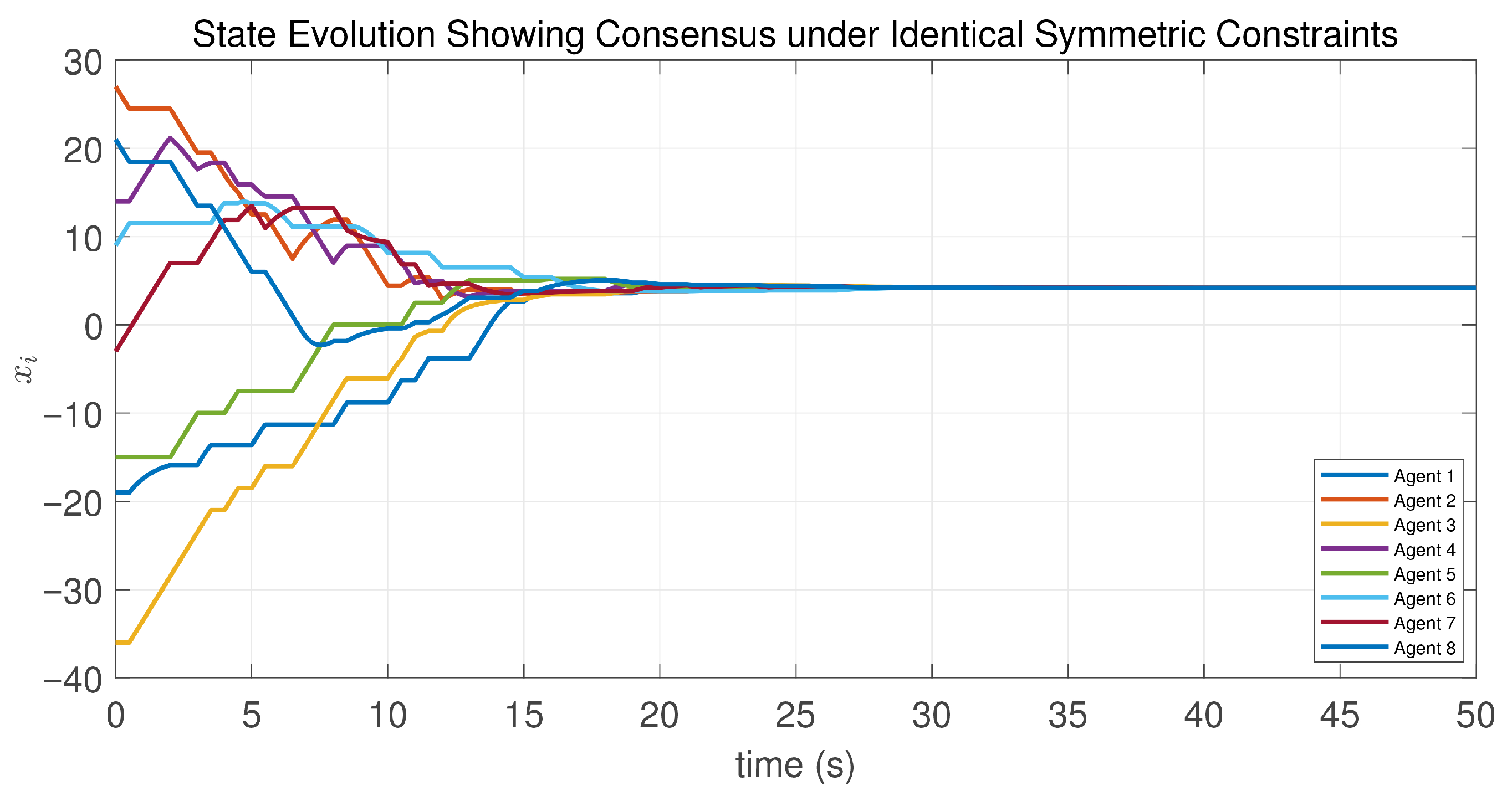
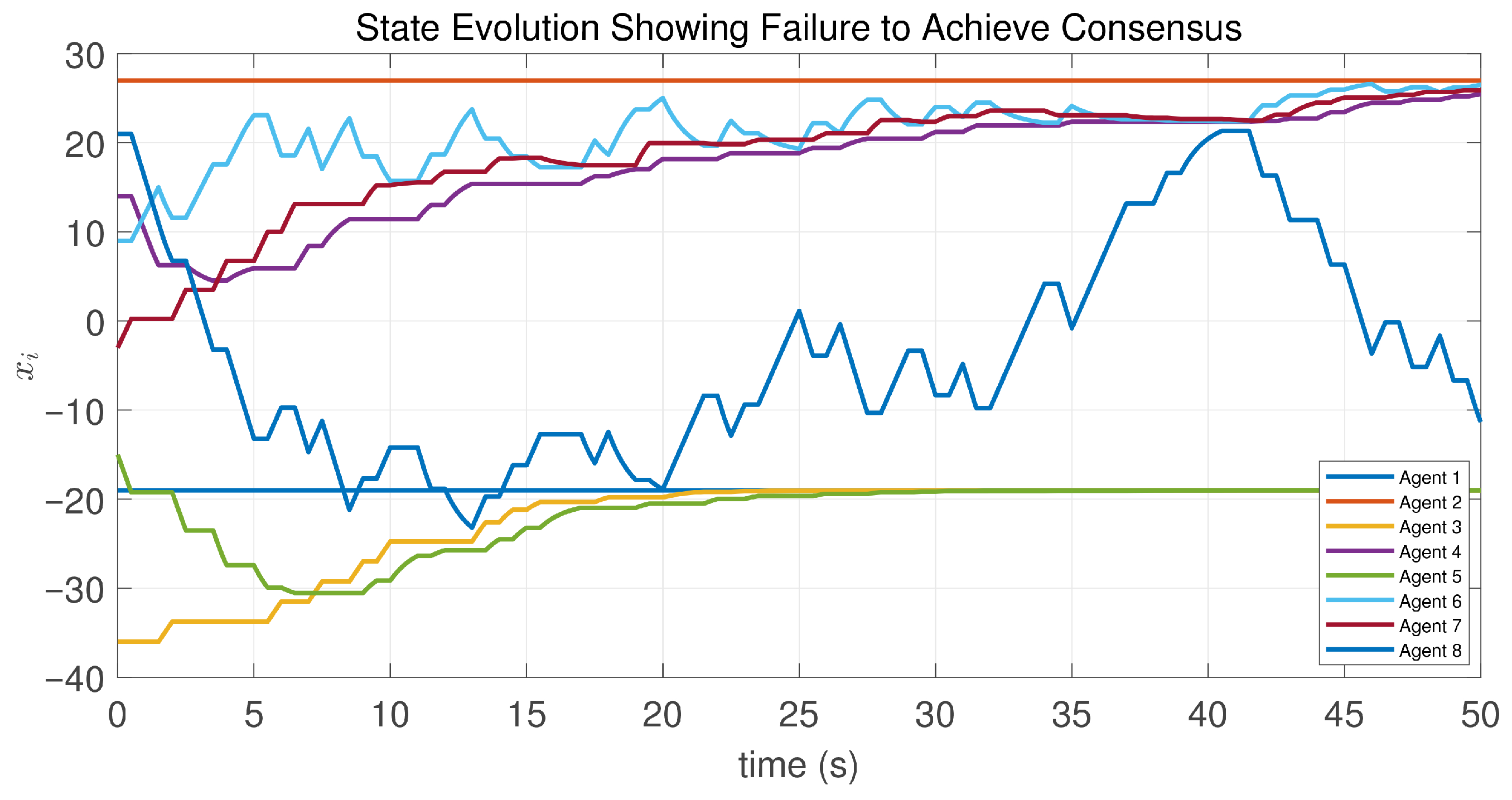
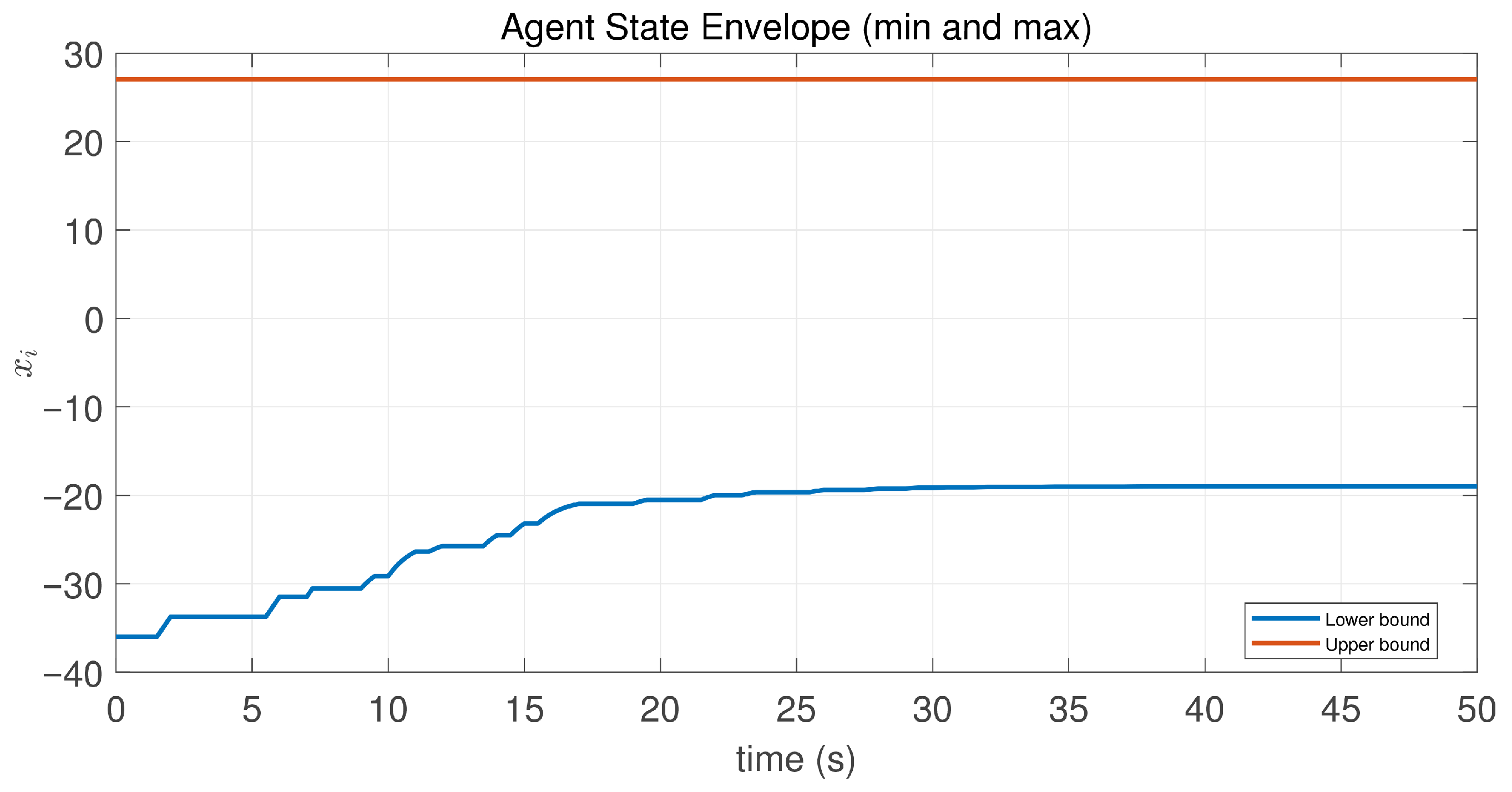
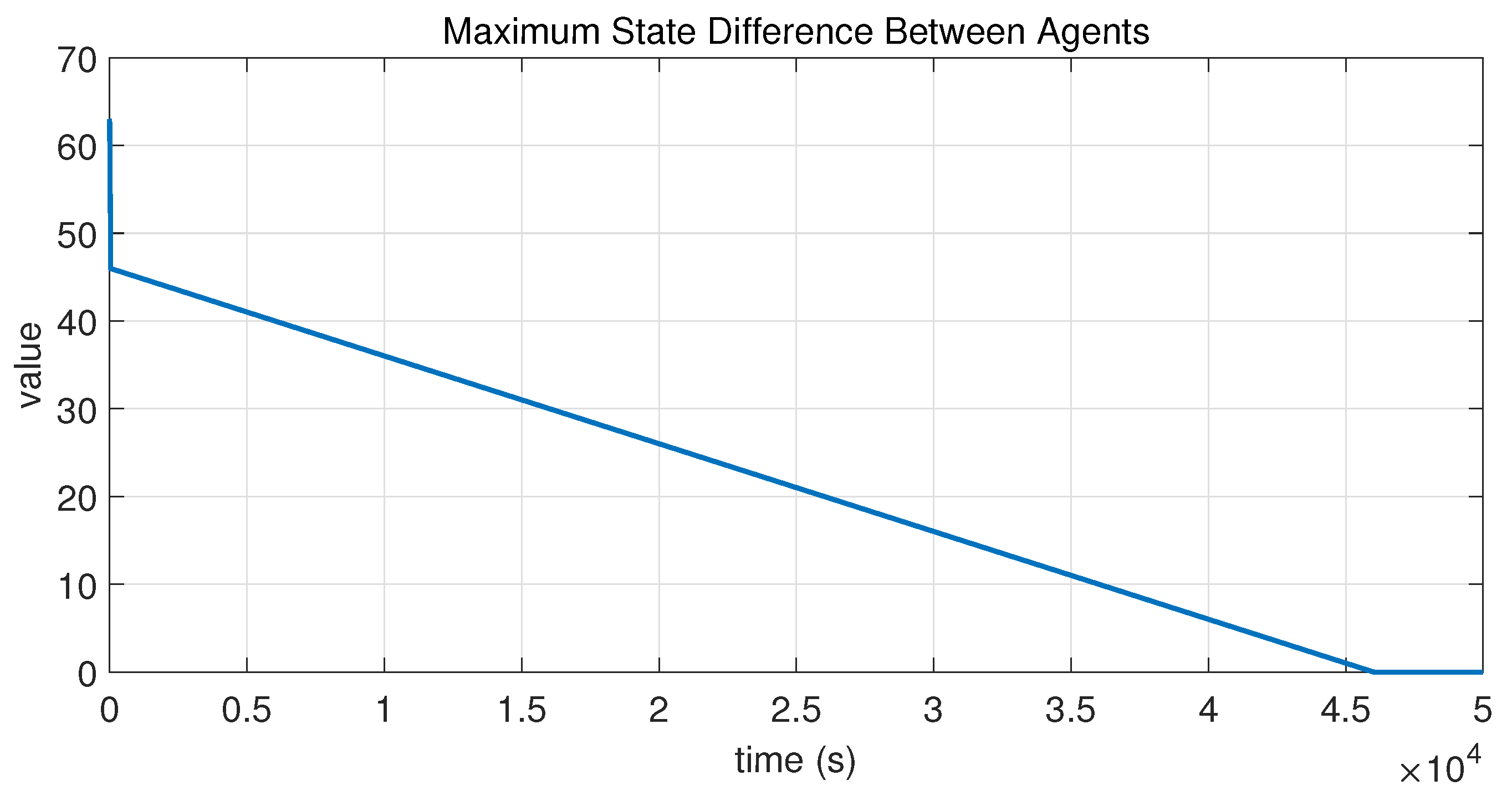
- This paper proposes a new method for solving the consensus control problem in saturated multi-agent systems subject to heterogeneous asymmetric saturation constraints. Furthermore, the effect of input saturation on consensus is investigated. By employing asymptotic stability theory and the comparison principle, we prove that consensus under conventional protocols is robust to arbitrary saturation levels.
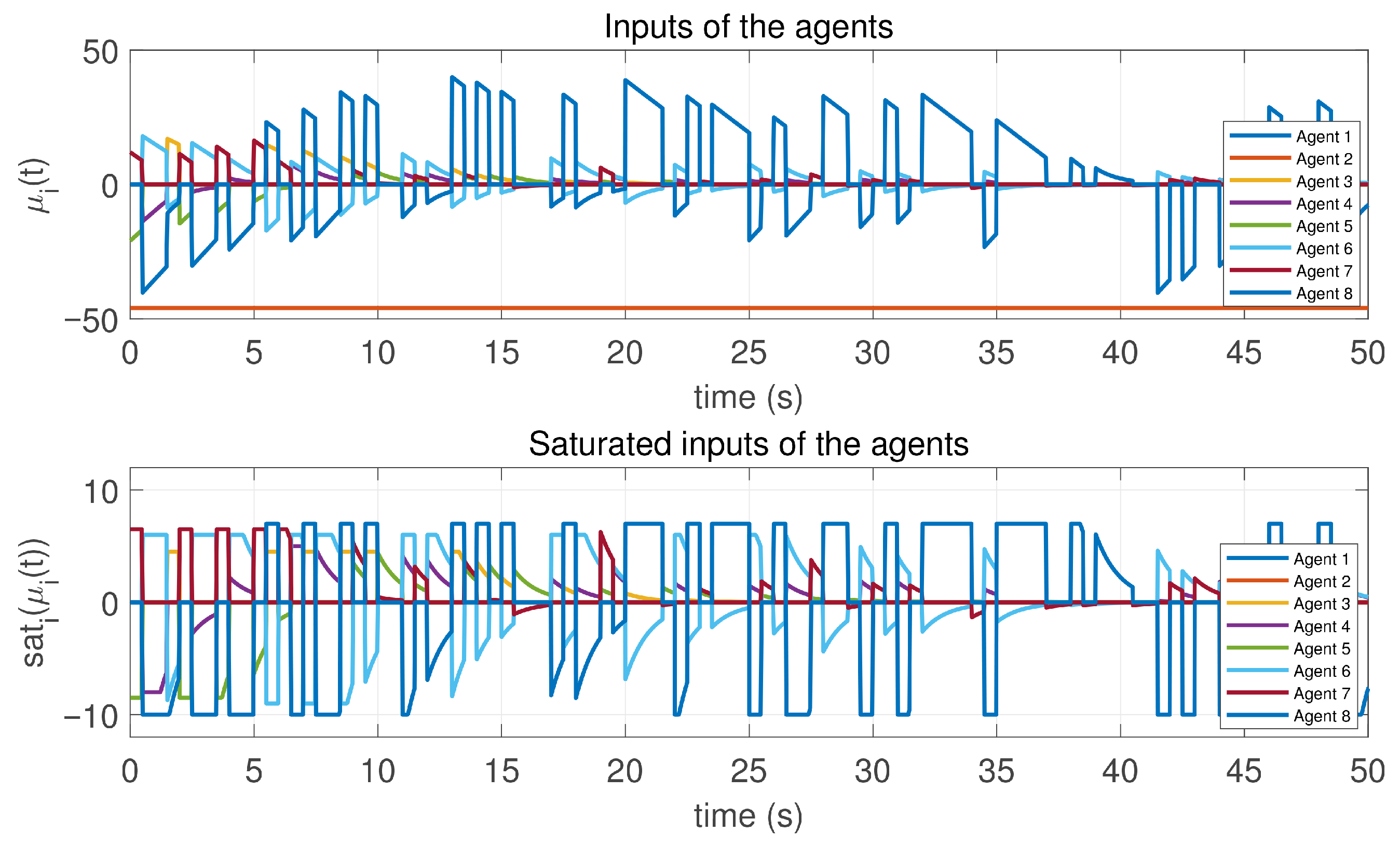
- A sufficient and necessary condition on the saturation levels is established to ensure global asymptotic consensus. The proposed saturated controller is fully distributed, requiring neither knowledge of neighbors’ saturation levels nor of the global network topology, only the information of the relative state between agents.
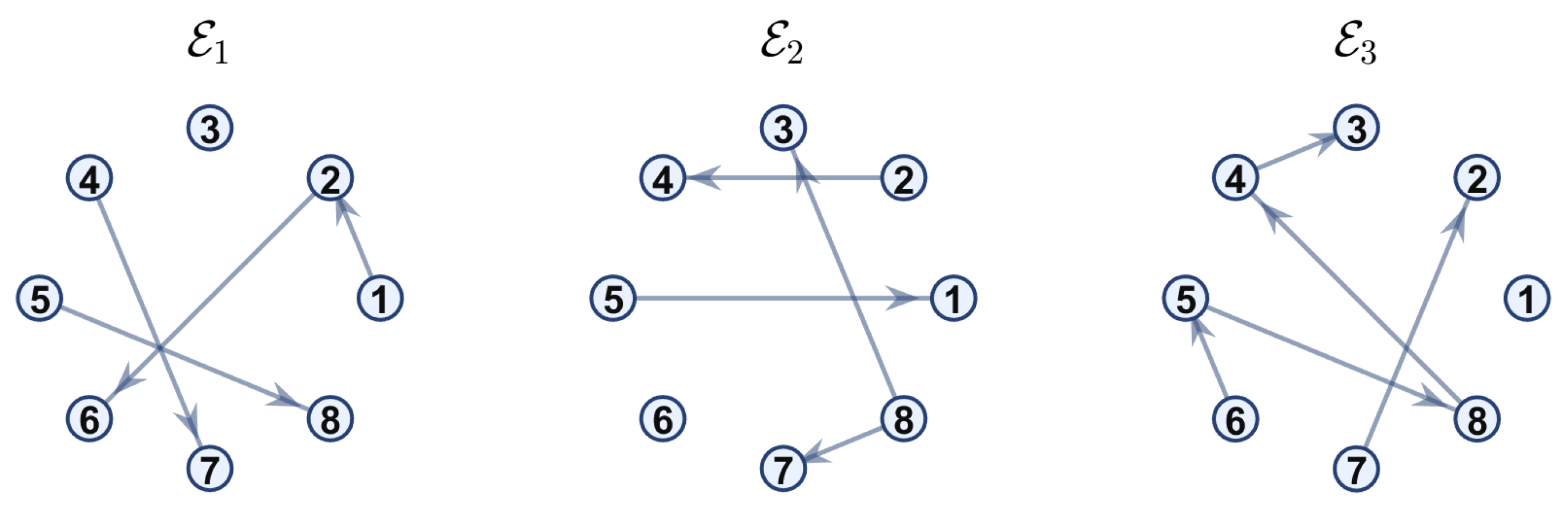
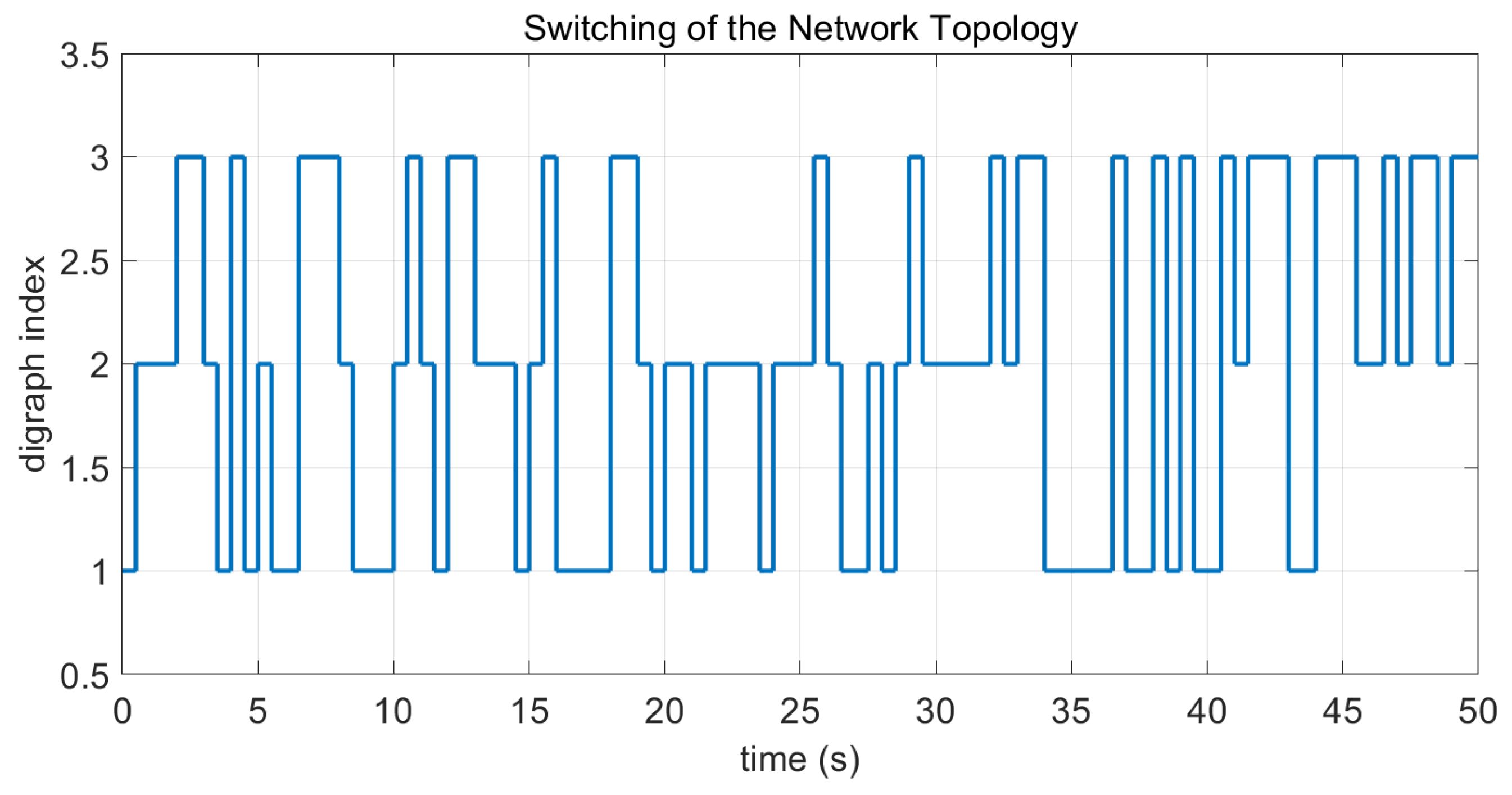
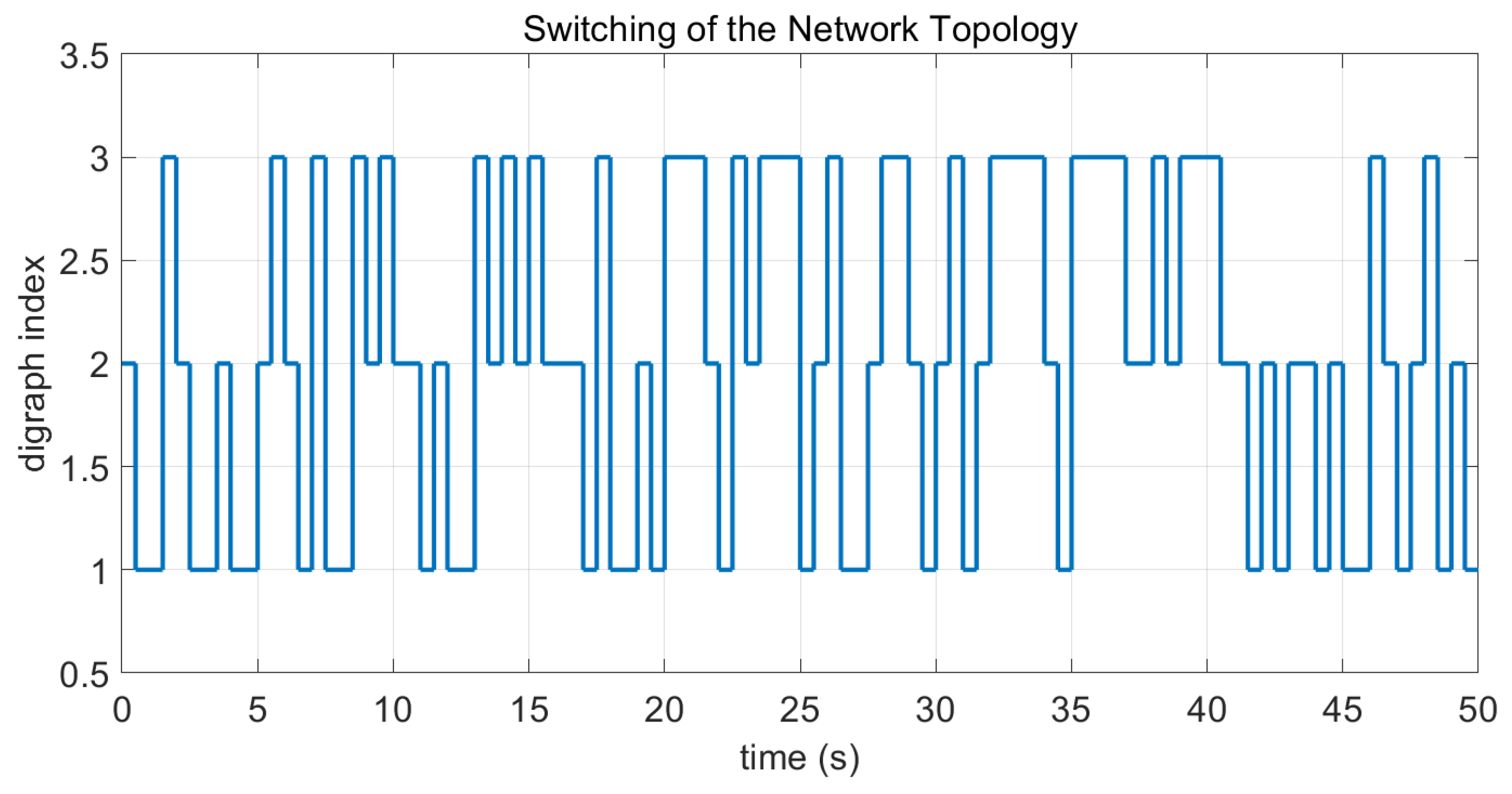
- The network topology is allowed to be time-varying and may be disconnected at any time instant, provided that a uniformly quasi-strongly connected assumption is satisfied. Thereby, this paper extends the result of [11] from fixed to switching topologies and generalizes that of [24] from uniform joint strong connectivity to its quasi-strong counterpart, which enhances the flexibility of the network.
2. Problem Statement and Main Results
3. Proof of the Main Results
3.1. Necessary Propositions
3.2. Proof of Theorem 1
3.2.1. Sufficiency
3.2.2. Necessity
- Construct a topology that is UQSC and satisfies the following conditions:
- (i)
- Agent 1 is the leader, i.e., there does not exists an edge ;
- (ii)
- For all , the edge exists;
- (iii)
- Agent 1 is the only neighbor of agent 2.
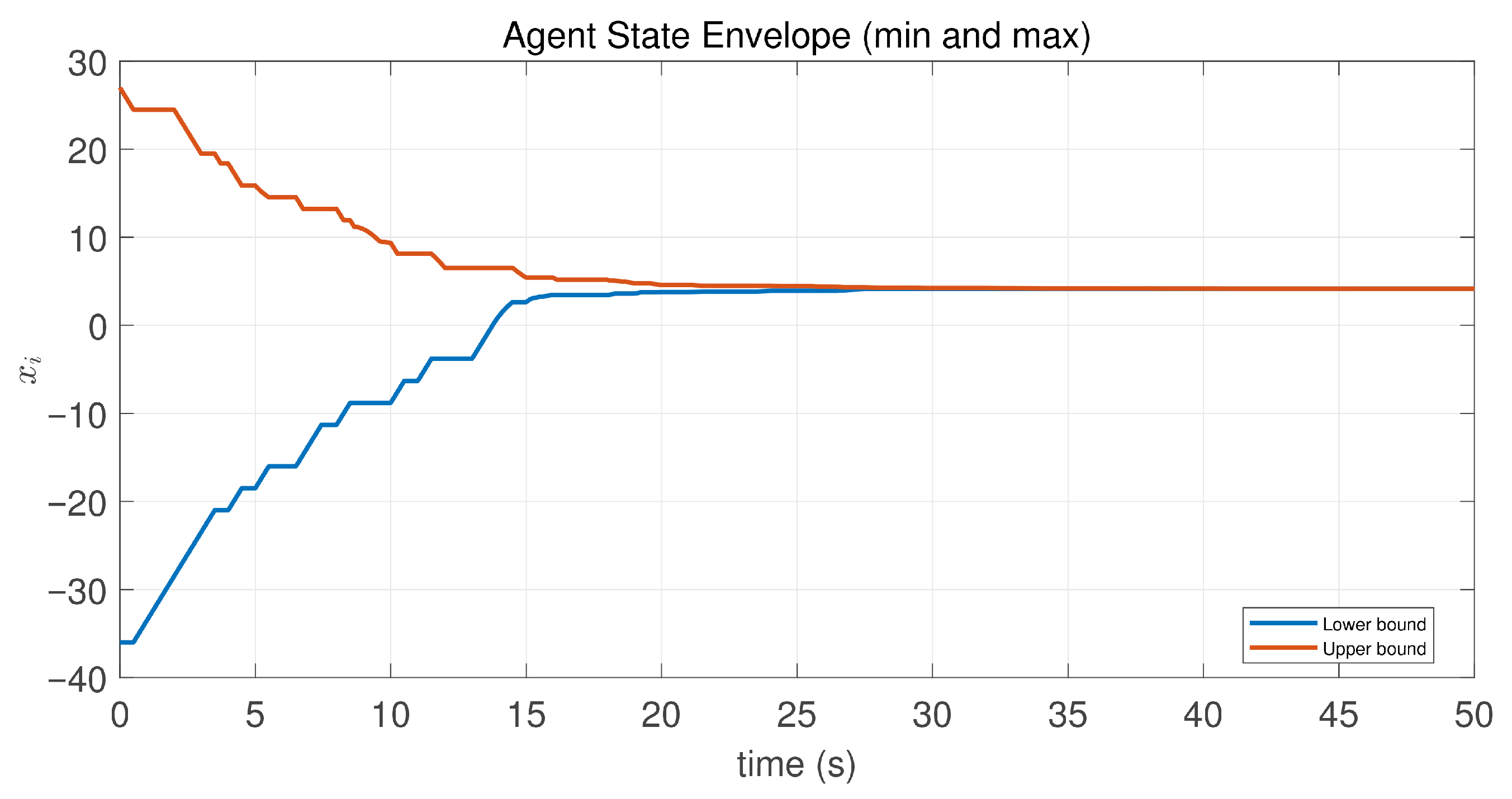
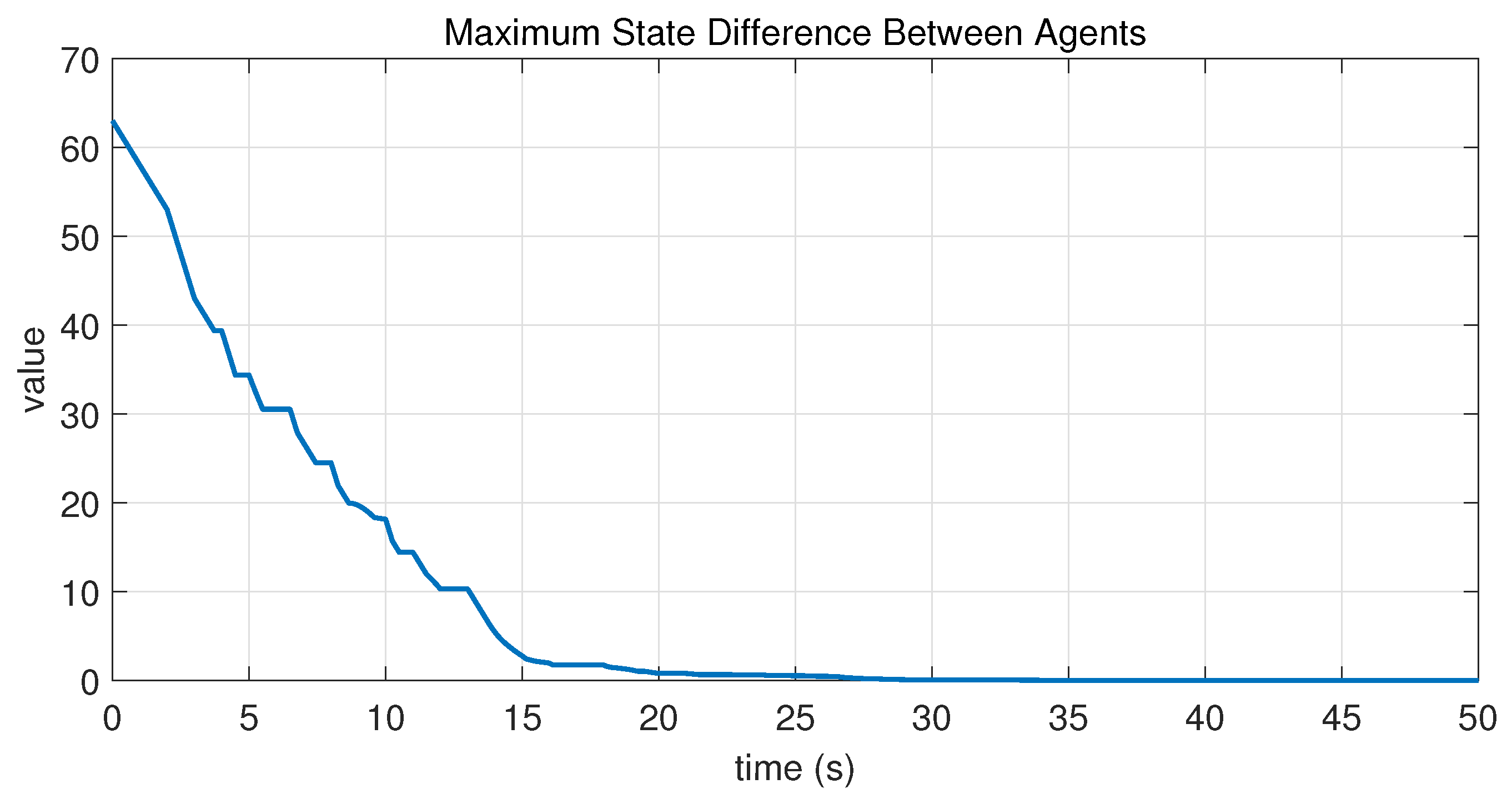
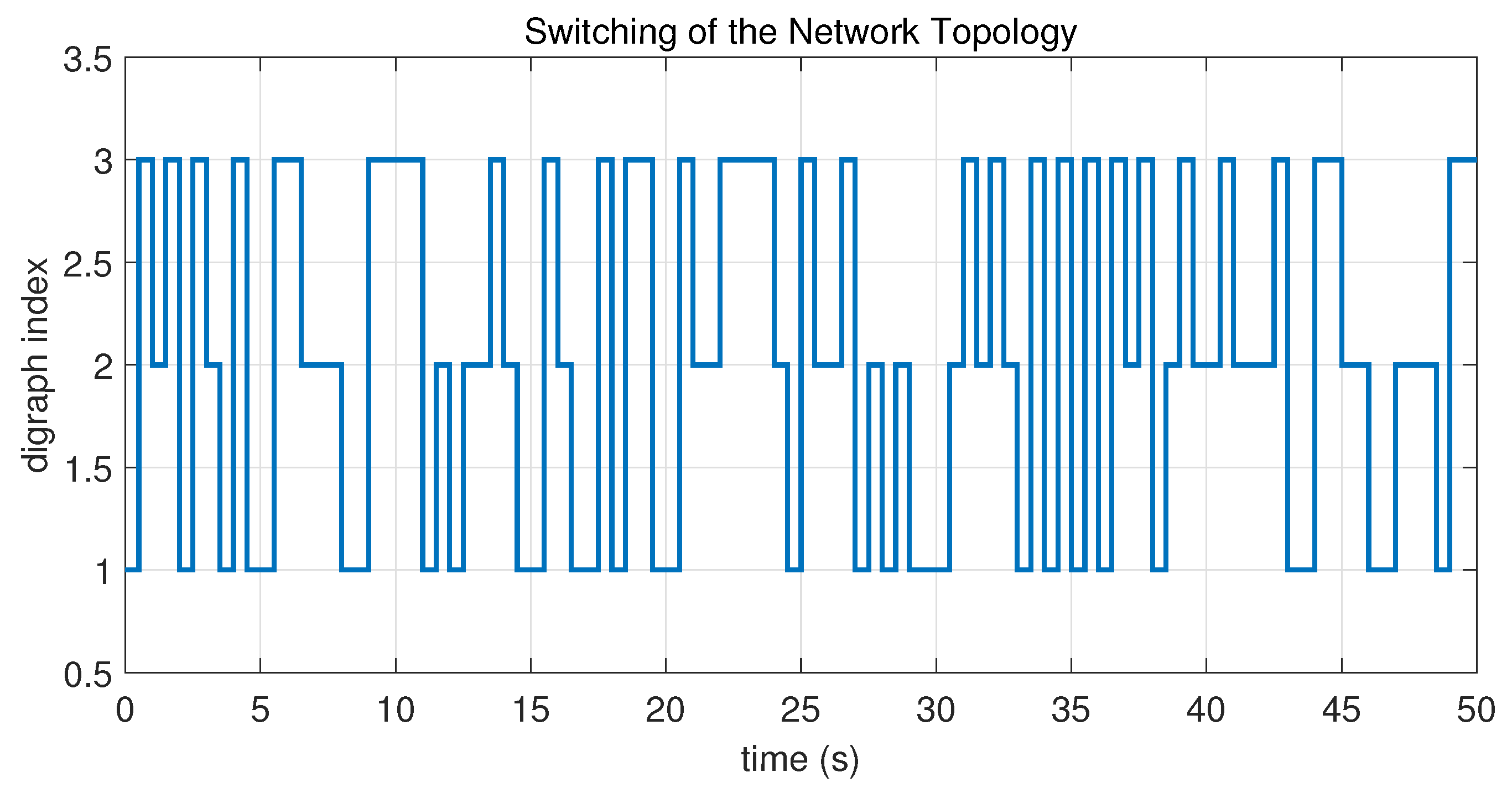
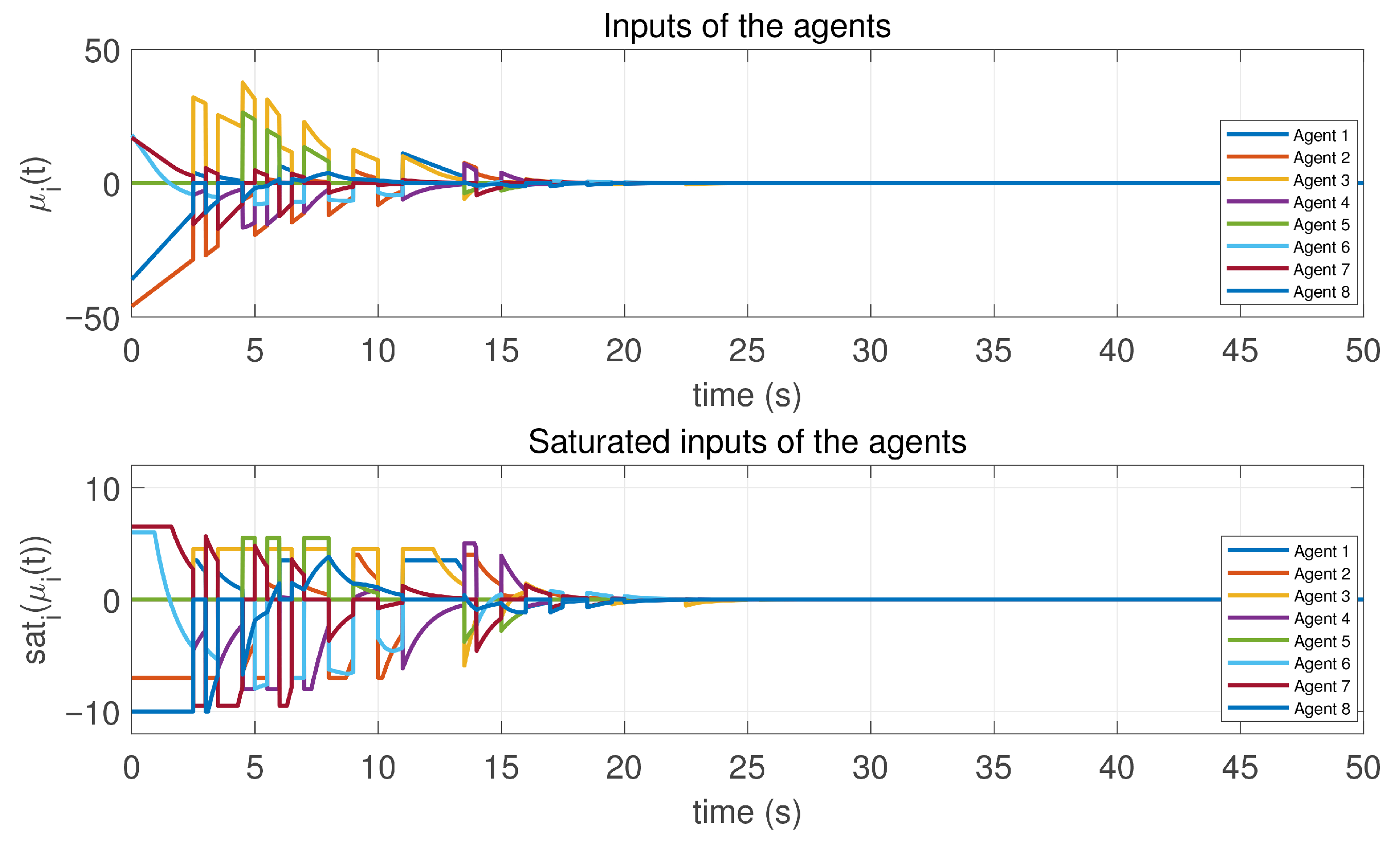
4. Numerical Examples
5. Conclusions
Author Contributions
Funding
Institutional Review Board Statement
Informed Consent Statement
Data Availability Statement
Conflicts of Interest
Abbreviations
| QSC | Quasi-Strongly Connected |
| UQSC | Uniformly Quasi-Strongly Connected |
| Id | Identity Function |
| Vertex Set | |
| Edge Set |
References
- Testa, A.; Carnevale, G.; Notarstefano, G. A tutorial on distributed optimization for cooperative robotics: From setups and algorithms to toolboxes and research directions. Proc. IEEE 2025, 113, 40–65. [Google Scholar] [CrossRef]
- Qin, Z.; Liu, T.; Liu, T.; Jiang, Z.-P.; Chai, T. Distributed feedback optimization of nonlinear uncertain systems subject to inequality constraints. IEEE Trans. Autom. Control 2024, 69, 3989–3996. [Google Scholar] [CrossRef]
- Al-Tawaha, A.; Cibaku, E.; Park, S.W.; Lavaei, J.; Jin, M. Distributed Optimization and Distributed Learning: A Paradigm Shift for Power Systems. IEEE Syst. J. 2025, 19, 1038–1051. [Google Scholar] [CrossRef]
- Liu, T.; Qin, Z.; Hong, Y.; Jiang, Z.-P. Distributed optimization of nonlinear multiagent systems: A small-gain approach. IEEE Trans. Autom. Control 2021, 67, 676–691. [Google Scholar] [CrossRef]
- Zheng, S.; Liu, S.; Wang, L. Event-triggered distributed optimization for model-free multi-agent systems. Front. Inf. Technol. Electron. Eng. 2024, 25, 214–224. [Google Scholar] [CrossRef]
- Aranda, M.; Cuiral-Zueco, I.; López-Nicolás, G. Distributed Control of Flexible Chained Multiagent Formations. IEEE Control Syst. Lett. 2025, 9, 2018–2023. [Google Scholar] [CrossRef]
- Jin, Z.; Li, H.; Qin, Z.; Wang, Z. Gradient-free cooperative source-seeking of quadrotor under disturbances and communication constraints. IEEE Trans. Ind. Electron. 2025, 72, 1969–1979. [Google Scholar] [CrossRef]
- Xu, J.; Wang, Z.; Jin, Z. Robust Formation Control for PWM-Controlled Mobile Autonomous Multiagent Systems. IEEE Trans. Control Netw. Syst. 2023, 11, 731–742. [Google Scholar] [CrossRef]
- Jafarian, M.; Vos, E.; De Persis, C.; van der Schaf, A.J.; Scherpen, J.M.A. Formation control of a multi-agent system subject to coulomb friction. Automatica 2015, 61, 253–262. [Google Scholar] [CrossRef]
- Wang, Z.; Liu, T.; Jiang, Z.P. Cooperative formation control under switching topology: An experimental case study in multirotors. IEEE Trans. Cybern. 2021, 51, 6141–6153. [Google Scholar] [CrossRef]
- Fu, J.; Wen, G.; Huang, T.; Duan, Z. Consensus of multi-agent systems with heterogeneous input saturation levels. IEEE Trans. Circuits Syst. II Express Briefs 2019, 66, 1053–1057. [Google Scholar] [CrossRef]
- Iervolino, R.; Manfredi, S. Global stability of multi-agent systems with heterogeneous transmission and perception functions. Automatica 2024, 162, 111510. [Google Scholar] [CrossRef]
- Liu, F.; Zhang, K.; Wu, Y.; Xue, X. Interval-constraint multiagent systems: Global attractivity and structural stability of equilibria. Automatica 2026, 183, 112566. [Google Scholar] [CrossRef]
- Zhu, Z.; Cheng, B.; Zhang, P. Distributed Adaptive Consensus of Physically Interconnected Multi-Agent Networks with Uncertainties. IEEE Trans. Autom. Sci. Eng. 2025, 22, 19538–19545. [Google Scholar] [CrossRef]
- Zhang, X.R.; Zhao, Z.L.; Liu, T. Finite-time consensus for high-order multi-agent systems under directed communication topologies. IEEE Trans. Autom. Control 2025, 70, 8430–8437. [Google Scholar] [CrossRef]
- Qi, D.; Hu, J.; Liang, X.; Zhang, J.; Zhang, Z. Research on consensus of multi-agent systems with and without input saturation constraints. J. Syst. Eng. Electron. 2021, 32, 947–955. [Google Scholar] [CrossRef]
- Wang, Z.; Jin, Z.; Li, H. Semi-global asymptotic state agreement of nonlinear multi-agent systems with communication delays under directed switching topologies. Nonlinear Anal. Hybrid Syst. 2024, 52, 101458. [Google Scholar] [CrossRef]
- Su, S.; Lin, Z. Distributed consensus control of multi-agent systems with higher order agent dynamics and dynamically changing directed interaction topologies. IEEE Trans. Autom. Control 2015, 61, 515–519. [Google Scholar] [CrossRef]
- Zheng, Y.; Wang, L. Consensus of switched multiagent systems. IEEE Trans. Circuits Syst. II Express Briefs 2015, 63, 314–318. [Google Scholar] [CrossRef]
- Jadbabaie, A.; Lin, J.; Morse, A.S. Coordination of groups of mobile autonomous agents using nearest neighbor rules. IEEE Trans. Autom. Control 2003, 48, 988–1001. [Google Scholar] [CrossRef]
- Ren, W.; Beard, R.W. Distributed Consensus in Multi-Vehicle Cooperative Control: Theory and Applications; Springer: London, UK, 2008. [Google Scholar]
- Turan, M.S.; Xu, L.; Ferrari-Trecate, G. On consensusability of linear interconnected multiagent systems and simultaneous stabilization. IEEE Trans. Control Netw. Syst. 2022, 9, 403–414. [Google Scholar] [CrossRef]
- Shi, G.; Hong, Y. Global target aggregation and state agreement of nonlinear multi-agent systems with switching topologies. Automatica 2009, 45, 1165–1175. [Google Scholar] [CrossRef]
- Zou, Y.; Zuo, Z.; Xia, K.; Ding, Z. Consensus of saturated multiagent systems: Tolerance to nonidentical asymmetric saturation levels. IEEE Trans. Autom. Control 2024, 69, 1804–1811. [Google Scholar] [CrossRef]
- Zou, Y.; Zuo, Z.; Xia, K.; Zhang, S.; Wu, Y.; Li, D.; Zuo, Z. Consensus robustness of multi-agent systems against heterogeneous asymmetric input saturations and asynchronous time-varying communication delays. Inf. Sci. 2023, 647, 119483. [Google Scholar] [CrossRef]
- Yang, T.; Meng, Z.; Dimarogonas, D.V.; Johansson, K.H. Periodic behaviors for discrete-time second-order multiagent systems with input saturation constraints. IEEE Trans. Circuits Syst. II Express Briefs 2016, 63, 663–667. [Google Scholar] [CrossRef]
- Lyu, J.; Qin, J.; Gao, D.; Liu, Q. Consensus for constrained multi-agent systems with input saturation. Int. J. Robust Nonlinear Control 2016, 26, 2977–2993. [Google Scholar] [CrossRef]
- Li, Y.; Xiang, J.; Wei, W. Consensus problems for linear time-invariant multi-agent systems with saturation constraints. IET Control Theory Appl. 2011, 5, 823–829. [Google Scholar] [CrossRef]
- Lu, M.; Wu, J.; Zhan, X.; Han, T.; Yan, H. Consensus of second-order heterogeneous multi-agent systems with and without input saturation. ISA Trans. 2022, 126, 14–20. [Google Scholar] [CrossRef]
- Ji, J.; Zhang, Z.; Zuo, Z.; Wang, Y. Event-triggered global consensus of second-order multi-agent systems with asymmetric input saturation. Neurocomputing 2024, 574, 127287. [Google Scholar] [CrossRef]
- Yin, Y.; Wang, F.; Liu, Z.; Chen, Z. Fault-tolerant consensus for switched multi-agent systems with input saturation. Int. J. Robust Nonlinear Control 2021, 31, 5047–5068. [Google Scholar] [CrossRef]
- Wang, X.; Yu, D.; Li, X. Impulsive Consensus of MASs with Input Saturation and DoS Attacks. IEEE/CAA J. Autom. Sin. 2025, 12, 414–424. [Google Scholar] [CrossRef]
- Wen, X.; Zou, W.; Xiang, Z. Finite-time consensus for high-order disturbed multi-agent systems with bounded control input. IEEE Syst. J. 2023, 17, 6380–6389. [Google Scholar]
- Xu, C.; Zeng, W.; Liu, C.; Yan, H. Event-triggered semi-global output consensus of discrete-time multi-agent systems with input saturation and external disturbances. IEEE Trans. Circuits Syst. II Express Briefs 2023, 70, 4469–4473. [Google Scholar] [CrossRef]
- Yan, C.; Yan, L.; Lv, Y.; Xia, Y. Fully distributed event-triggered anti-windup consensus of heterogeneous systems with input saturation and an active Leader. IEEE Trans. Neural Netw. Learn. Syst. 2024, 35, 12993–13004. [Google Scholar] [CrossRef]
- Zhu, G.; Zhang, X.; Zhang, X.; Su, C.-Y. Fixed-time adaptive consistent control of higher-order nonlinear multi-agent systems with full state constraints and input saturation. Neurocomputing 2025, 639, 130180. [Google Scholar] [CrossRef]
- Butler, E.; Xie, Y.; Lin, Z. Global consensus of discrete-time multi-agent systems with intermittent communication and bounded controls. Encycl. Syst. Control Eng. 2026, 3, 178–187. [Google Scholar]
- Yi, X.; Yang, T.; Wu, J.; Johansson, H. Distributed event-triggered control for global consensus of multi-agent systems with input saturation. Automatica 2019, 100, 1–9. [Google Scholar] [CrossRef]
- Yanumula, V.K.; Kar, I.; Majhi, S. Consensus of second-order multi-agents with actuator saturation and asynchronous time-delays. IET Control Theory Appl. 2017, 11, 3201–3210. [Google Scholar] [CrossRef]
- Wang, X.; Su, H.; Wang, X.; Chen, G. Fully distributed event-triggered semi-global consensus of multi-agent systems with input saturation. IEEE Trans. Ind. Electron. 2016, 64, 5055–5064. [Google Scholar] [CrossRef]
- Liu, T.; Jiang, Z.P. Distributed nonlinear control of mobile autonomous multi-agents. Automatica 2014, 50, 1075–1086. [Google Scholar] [CrossRef]
- Khalil, H.K.; Grizzle, J.W. Nonlinear Systems; Prentice Hall: Upper Saddle River, NJ, USA, 2002. [Google Scholar]
- Lin, Z.; Francis, B.; Maggiore, M. State agreement for continuous-time coupled nonlinear systems. SIAM J. Control Optim. 2007, 46, 288–307. [Google Scholar] [CrossRef]
- Liu, G.; Liang, H.; Wang, R.; Sui, Z.; Sun, Q. Adaptive event-triggered output feedback control for nonlinear multi-agent systems using output information only. IEEE Trans. Syst. Man Cybern. Syst. 2025, 55, 7639–7650. [Google Scholar] [CrossRef]
- Liu, G.; Sun, Q.; Su, H.; Wang, M. Adaptive cooperative fault-tolerant control for output-constrained nonlinear multi-agent systems under stochastic FDI attacks. IEEE Trans. Circuits Syst. Regul. Pap. 2025, 72, 6025–6036. [Google Scholar] [CrossRef]



| Results | Graph | Constraint Type I | Constraint Type II |
|---|---|---|---|
| [11] | fixed topology | heterogeneous | asymmetric |
| [35] | fixed topology | heterogeneous | symmetric |
| [33] | fixed undirected topology | homogeneous | symmetric |
| Our Result | directed switching topology | heterogeneous | asymmetric |
Disclaimer/Publisher’s Note: The statements, opinions and data contained in all publications are solely those of the individual author(s) and contributor(s) and not of MDPI and/or the editor(s). MDPI and/or the editor(s) disclaim responsibility for any injury to people or property resulting from any ideas, methods, instructions or products referred to in the content. |
© 2026 by the authors. Licensee MDPI, Basel, Switzerland. This article is an open access article distributed under the terms and conditions of the Creative Commons Attribution (CC BY) license.
Share and Cite
Wang, Z.; Yang, J.; Yang, H.; Jin, Z. Consensus Control of Saturated Multi-Agent Systems with Heterogeneous Asymmetric Saturation Constraints Under Flexible Topologies. Sensors 2026, 26, 1923. https://doi.org/10.3390/s26061923
Wang Z, Yang J, Yang H, Jin Z. Consensus Control of Saturated Multi-Agent Systems with Heterogeneous Asymmetric Saturation Constraints Under Flexible Topologies. Sensors. 2026; 26(6):1923. https://doi.org/10.3390/s26061923
Chicago/Turabian StyleWang, Zhanxiu, Jikun Yang, Hao Yang, and Zhenghong Jin. 2026. "Consensus Control of Saturated Multi-Agent Systems with Heterogeneous Asymmetric Saturation Constraints Under Flexible Topologies" Sensors 26, no. 6: 1923. https://doi.org/10.3390/s26061923
APA StyleWang, Z., Yang, J., Yang, H., & Jin, Z. (2026). Consensus Control of Saturated Multi-Agent Systems with Heterogeneous Asymmetric Saturation Constraints Under Flexible Topologies. Sensors, 26(6), 1923. https://doi.org/10.3390/s26061923