Hierarchical Multi-Scale Feature Fusion Network with Implicit Neural Representation and Mamba for Cross-Modality MRI Synthesis



Abstract
1. Introduction
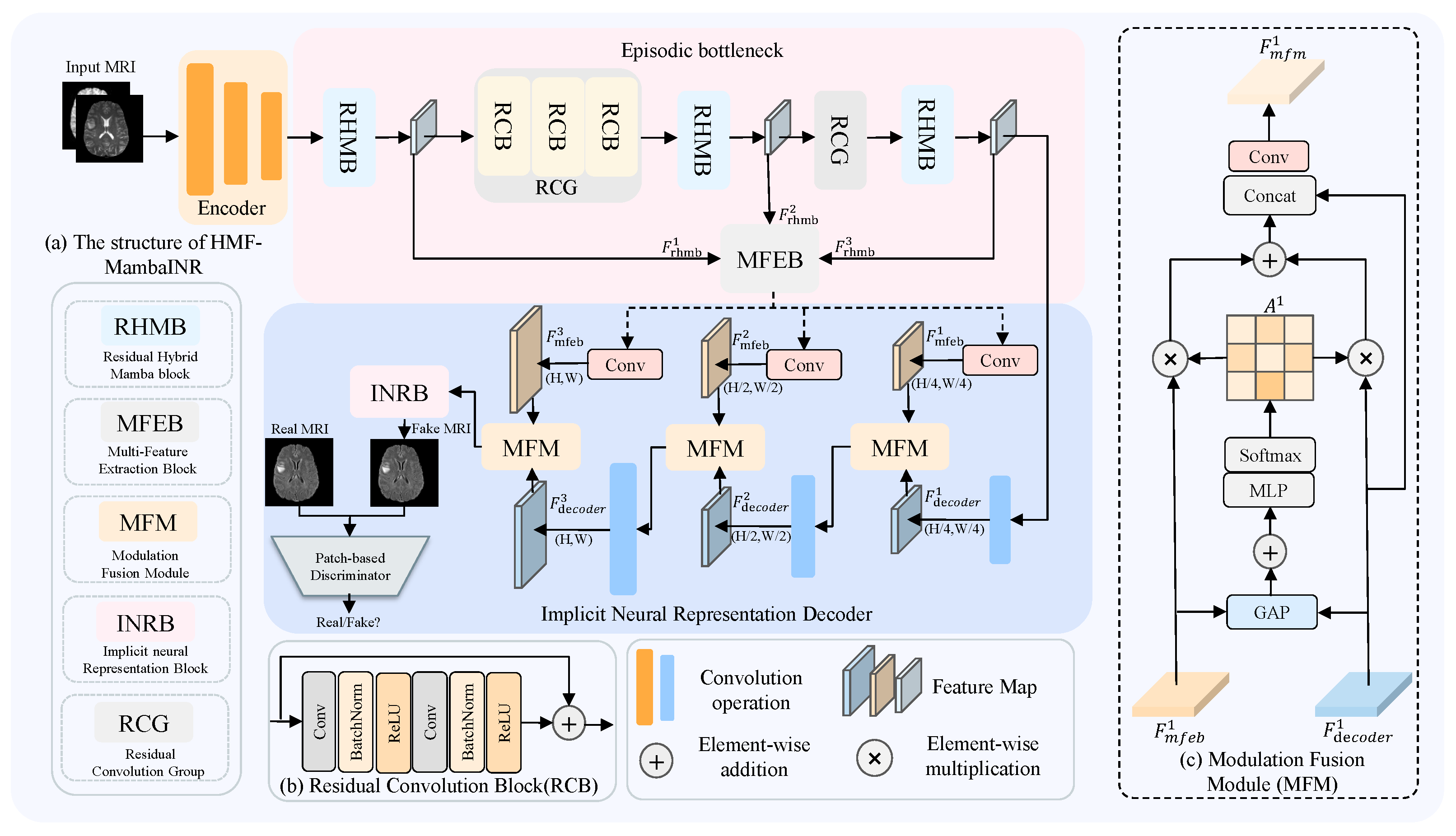
- We propose a novel cross-modality MRI synthesis model (HMF-MambaINR) based on Mamba and INR to synthesize missing target domain images.
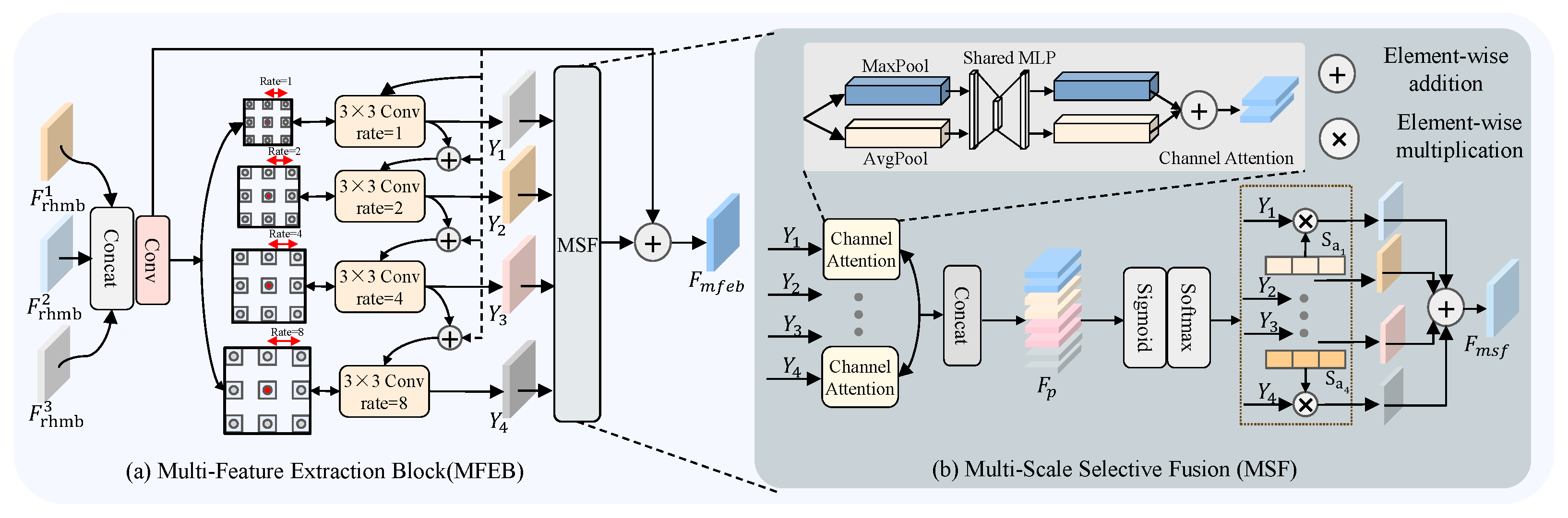
- We design an innovative MFEB, which captures multi-scale features through multi-scale receptive fields and adaptively adjusts the weights of features at each scale based on their content, learning and understanding the complementary information between multiple features.
- We introduce the MFM, which effectively facilitates multi-scale feature integration, alleviates feature sparsity issues encountered during the decoding stages, and thereby enhances the overall network performance.
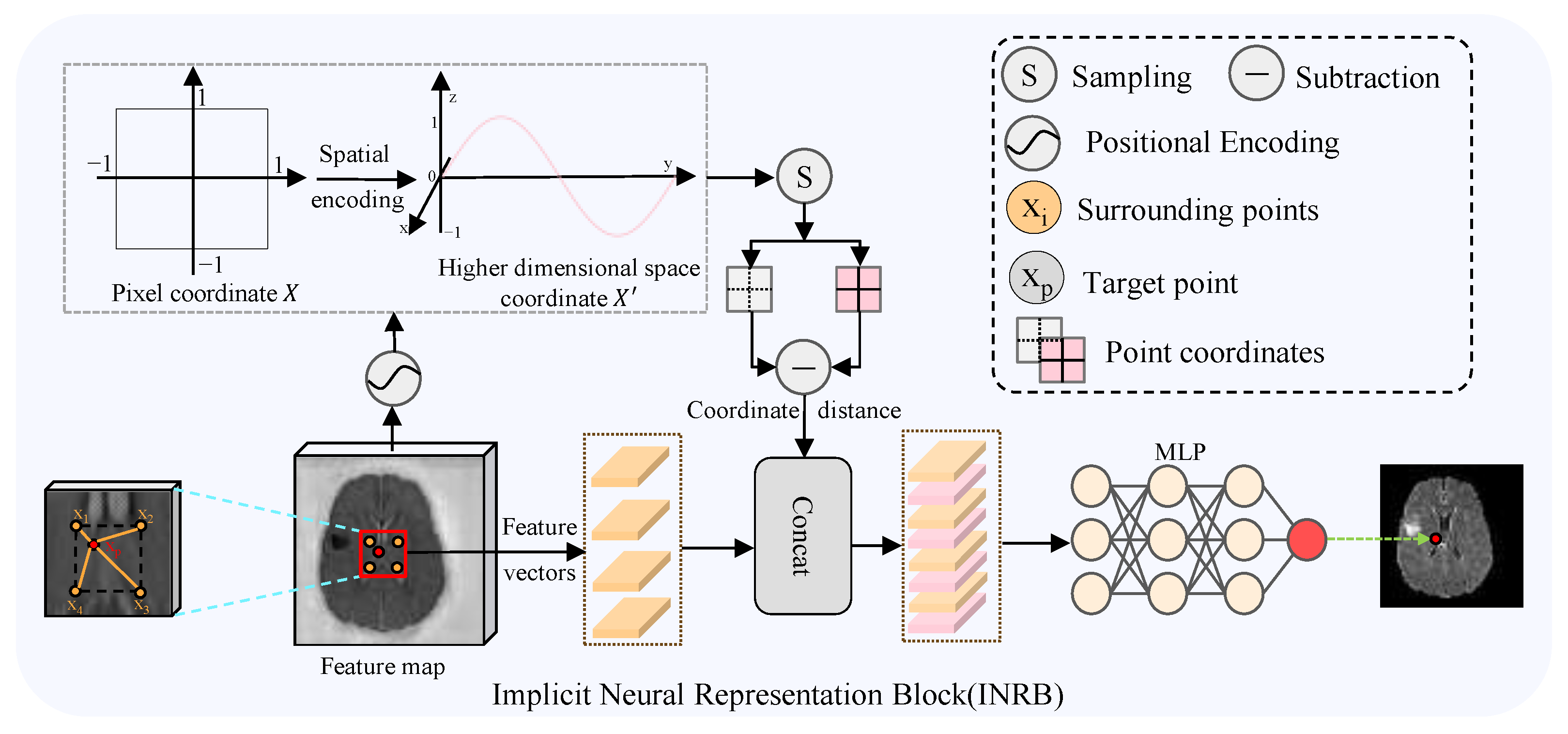
- We incorporate INR to model the continuous mapping between multi-modal feature and the image space, significantly enhancing the model’s representational capacity and its ability to synthesize fine-grained anatomical structures.
2. Related Works
2.1. Medical Image Synthesis
2.2. Transformers and SSM Models in Medical Imaging
2.3. Implicit Neural Representation
3. Methodology
3.1. Overview
3.2. Residual Hybrid Mamba Block
3.3. Multi-Feature Extraction Block
3.4. Modulation Fusion Module
3.5. Implicit Neural Representation Block
3.6. Loss Function
4. Experiments
4.1. Dataset
4.2. Comparison Methods
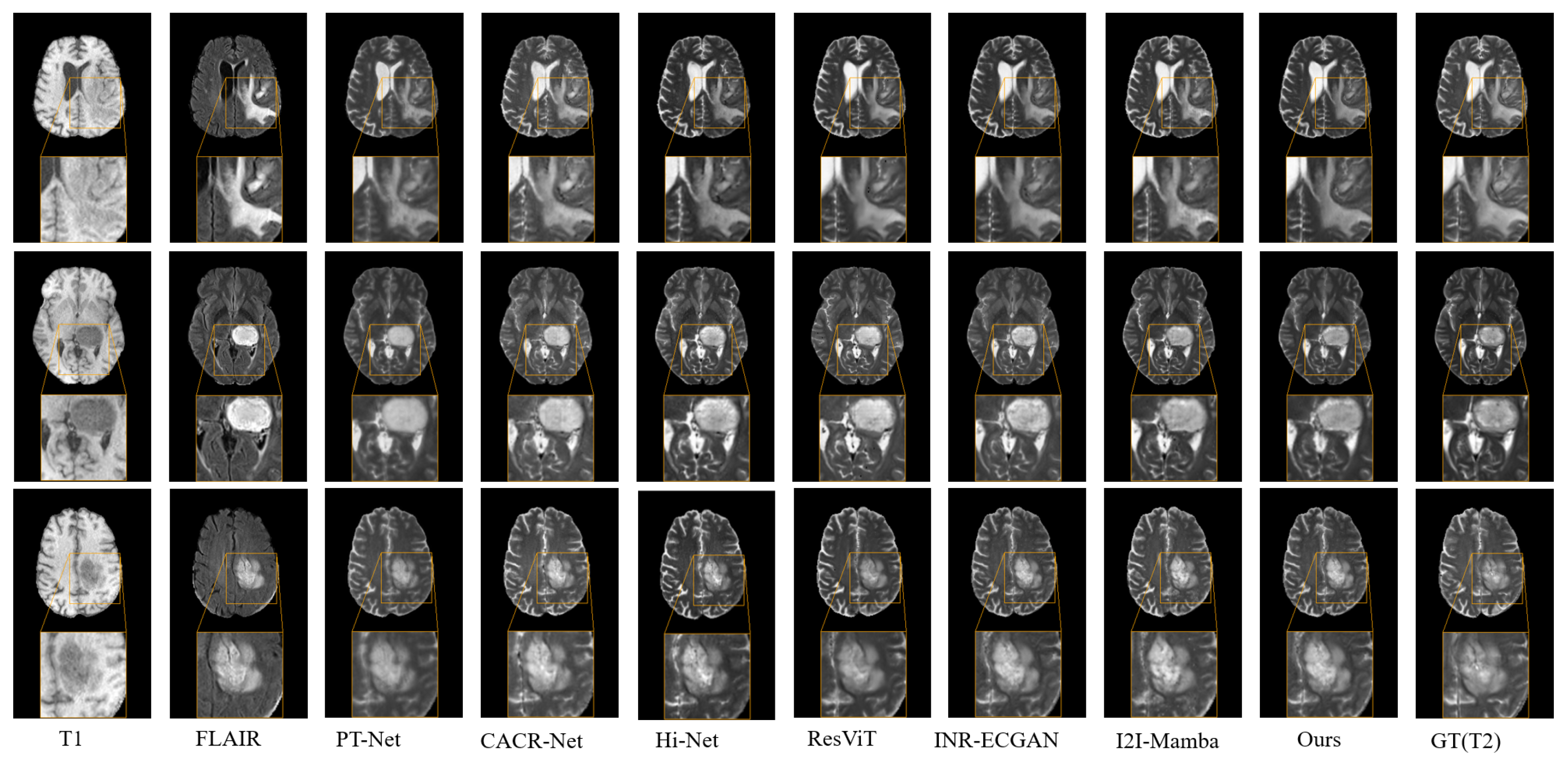
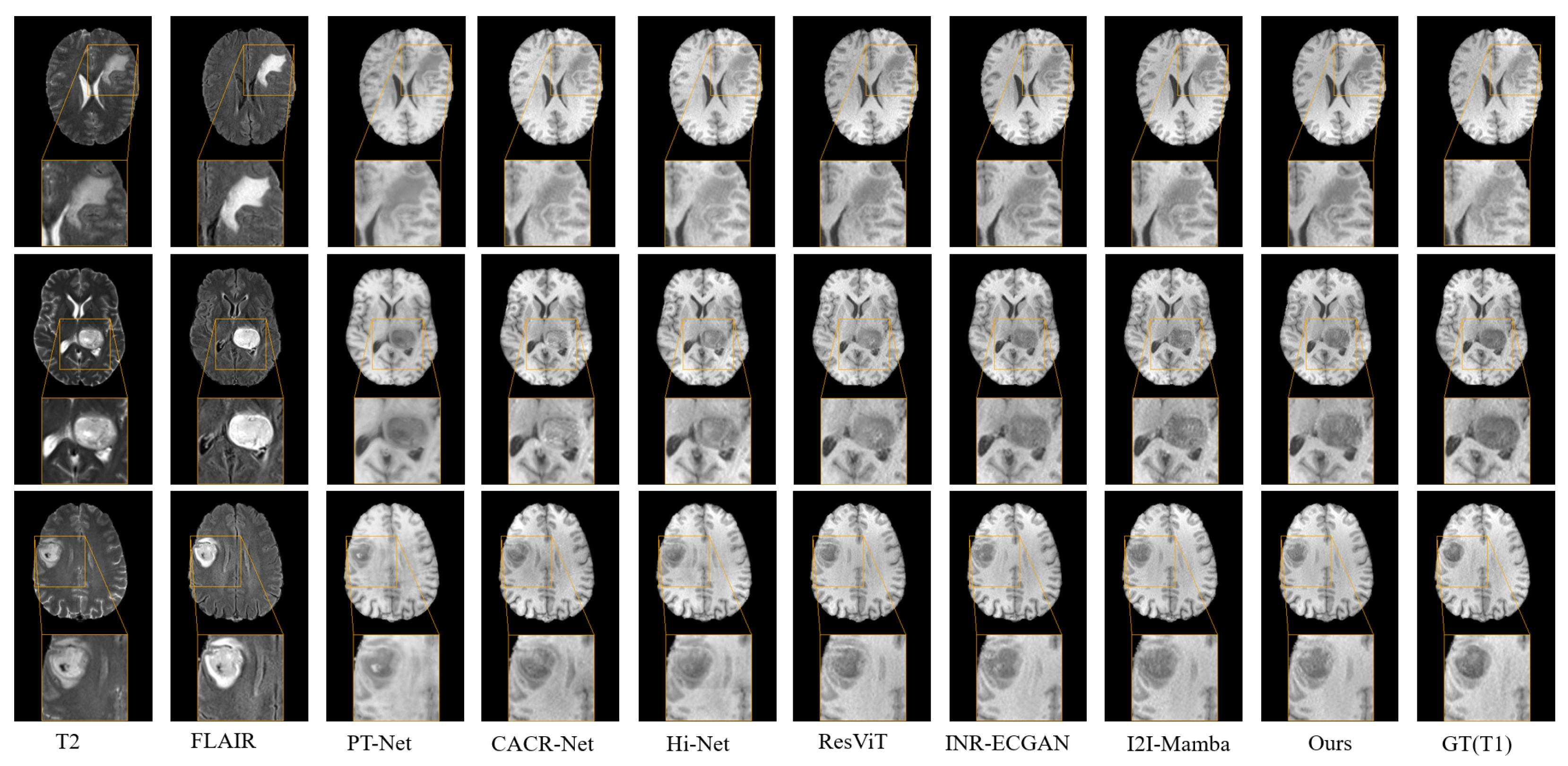
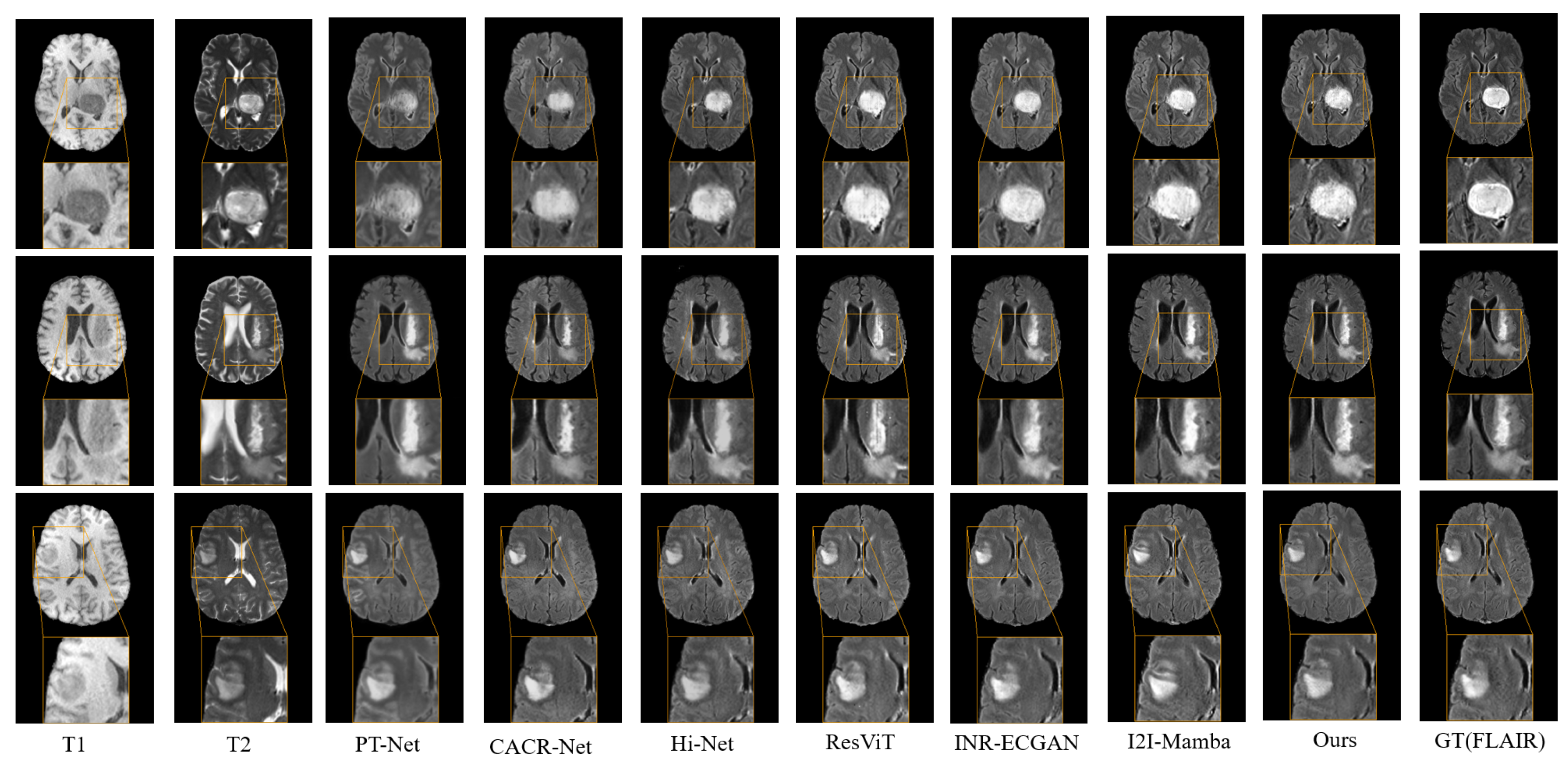
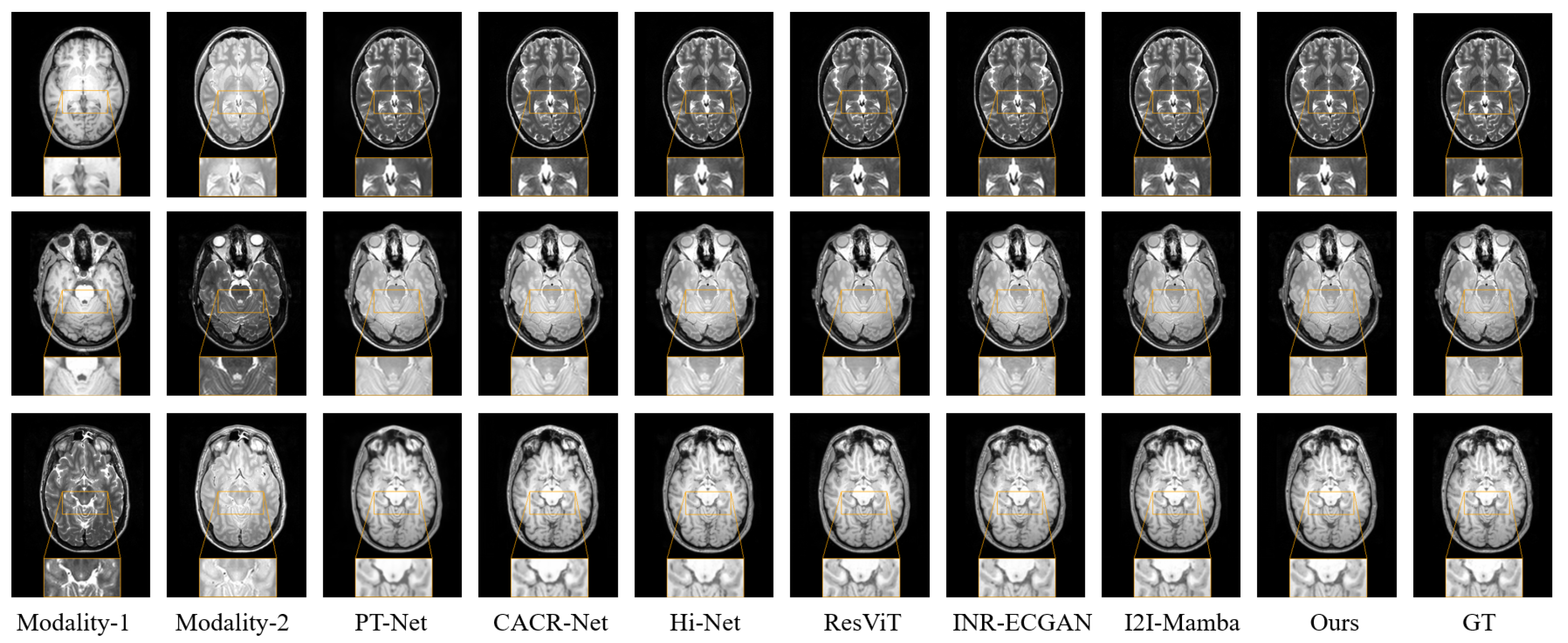
4.3. Experimental Results
4.4. Model Complexity
4.5. Radiology Evaluation and Error Analysis
4.6. Ablation Study
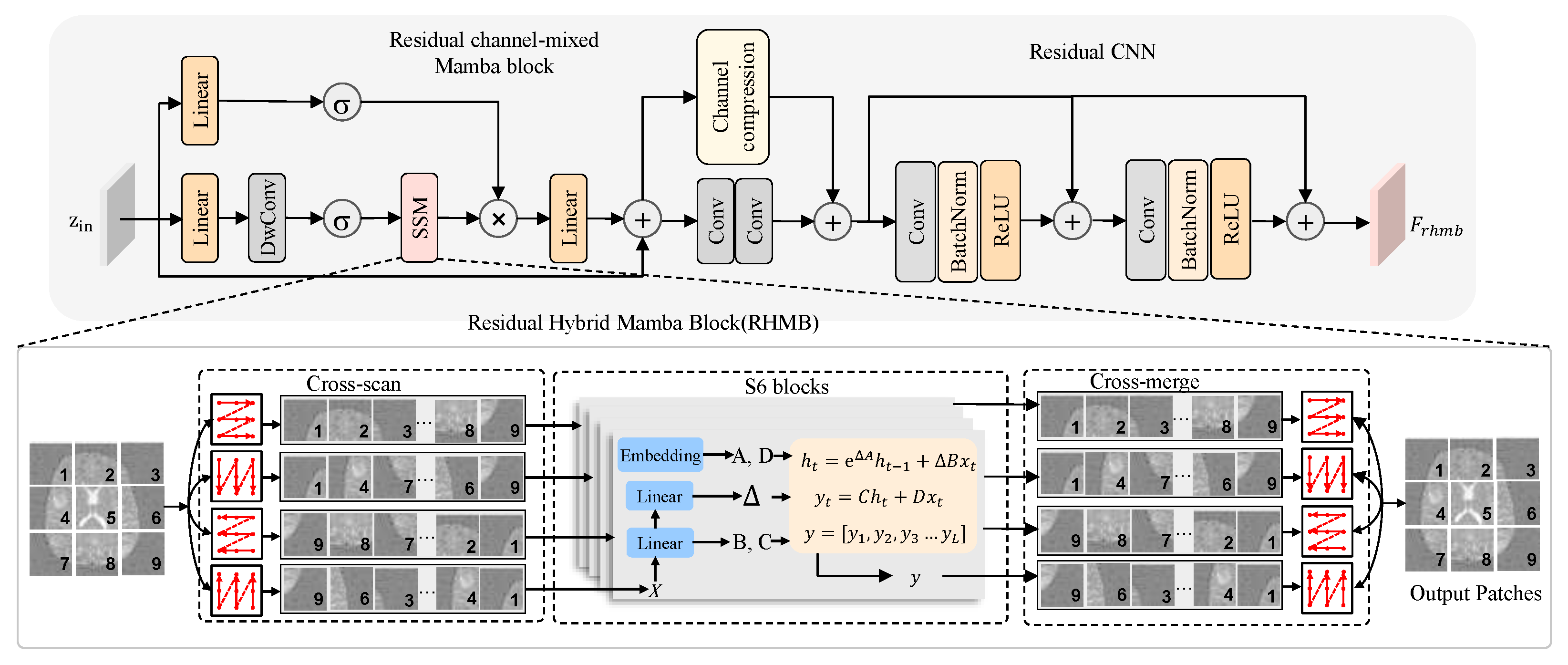
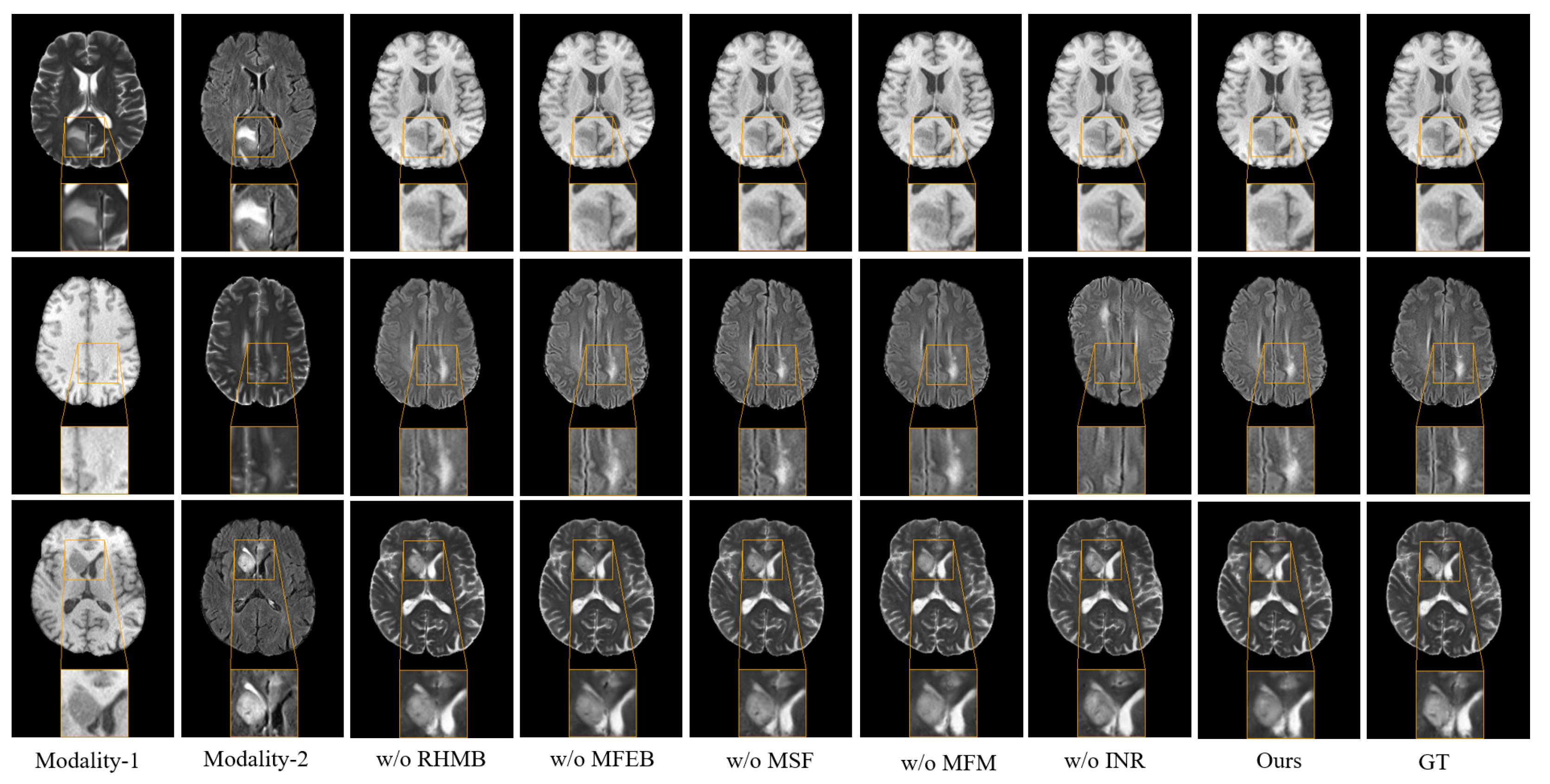
- The Role of the RHMB Module. To assess the effectiveness of the RHMB module in extracting deep semantic features and local texture information from images, as well as its contribution to enhancing the quality of synthesized images for missing modalities, ablation experiments were designed. Specifically, a variant model, named w/o RHMB, was created by replacing the RHMB module with a convolutional layer of comparable parameter count. This model performed only basic convolution operations on the features, lacking the context-enhancing mechanism. The experimental results indicated a significant degradation in the structural integrity and detail representation of the synthesized images when the RHMB module was removed, demonstrating the importance and effectiveness of RHMB in multi-modal medical image synthesis tasks.
- The Impact of the MFEB Module. To assess the contribution of the MFEB to the overall model performance, we performed an ablation analysis by retaining only the connection and convolution operations in the MFEB module, referred to as w/o MFEB. The experiment was designed to quantify the effect of multi-stage and multi-scale feature extraction on the quality of modality synthesis. As reported in the results Table 6, eliminating the MFEB module led to a significant performance drop. This finding highlighted the critical importance of jointly leveraging complementary features extracted across different stages and scales—particularly those closely aligned with the target modality—in improving the fidelity and perceptual quality of the synthesized images.
- The Impact of the MSF Module. To validate the performance impact of the multi-scale feature fusion module in the MFEB module, relevant ablation experiments were designed. Specifically, a baseline model was constructed without the MSF module, named w/o MSF, and was replaced with standard convolution operations for comparison. Experimental evidence supported the conclusion that after removing the MSF module, the model performed poorly in the multimodal feature fusion task, highlighting the key role of this module in improving the quality of image synthesis.
- The Impact of the MFM Module. In order to better study the effectiveness of the MFM module in enhancing the feature representation capability of the network, we constructed a variant model, named w/o MFM, in which the MFM module was replaced by a feature addition module. As shown in Table 6 and Figure 10, the MFM module was able to effectively alleviate the feature sparsity problem in the encoding process and significantly enhanced the overall performance of the model.
- The Importance of the INR Module. To explore the contribution of INRB to image synthesis tasks, corresponding ablation experiments were conducted. Specifically, the INR module in the original model was replaced with a parameter-matched standard MLP layer without coordinate embedding to form a comparison model, named w/o INR. This experiment was designed to analyze the specific contributions of continuous implicit representations in preserving image details, structural restoration, and texture reconstruction. The experimental results confirmed that the INR decoder significantly enhanced the continuity and detail retention of the synthesized images, thereby verifying the effectiveness and potential of modeling medical images using continuous functions.
5. Discussion
6. Conclusions
7. Limitations and Future Work
Author Contributions
Funding
Data Availability Statement
Conflicts of Interest
References
- Zhou, T.; Liu, M.; Fu, H.; Wang, J.; Shen, J.; Shao, L.; Shen, D. Deep multi-modal latent representation learning for automated dementia diagnosis. In Proceedings of the International Conference on Medical Image Computing and Computer-Assisted Intervention; Springer: Berlin/Heidelberg, Germany, 2019; pp. 629–638. [Google Scholar]
- Fan, J.; Cao, X.; Wang, Q.; Yap, P.T.; Shen, D. Adversarial learning for mono-or multi-modal registration. Med. Image Anal. 2019, 58, 101545. [Google Scholar] [CrossRef] [PubMed]
- Zhang, P.; Li, T.; Wang, G.; Wang, D.; Lai, P.; Zhang, F. A multi-source information fusion model for outlier detection. Inf. Fusion 2023, 93, 192–208. [Google Scholar] [CrossRef]
- Sevetlidis, V.; Giuffrida, M.V.; Tsaftaris, S.A. Whole image synthesis using a deep encoder-decoder network. In Proceedings of the Simulation and Synthesis in Medical Imaging: First International Workshop, SASHIMI 2016, Held in Conjunction with MICCAI 2016, Athens, Greece, October 21, 2016, Proceedings 1; Springer: Berlin/Heidelberg, Germany, 2016; pp. 127–137. [Google Scholar]
- Chartsias, A.; Joyce, T.; Giuffrida, M.V.; Tsaftaris, S.A. Multimodal MR synthesis via modality-invariant latent representation. IEEE Trans. Med Imaging 2017, 37, 803–814. [Google Scholar] [CrossRef]
- Dar, S.U.; Yurt, M.; Karacan, L.; Erdem, A.; Erdem, E.; Cukur, T. Image synthesis in multi-contrast MRI with conditional generative adversarial networks. IEEE Trans. Med. Imaging 2019, 38, 2375–2388. [Google Scholar] [CrossRef]
- Fu, Y.; Wu, X.J.; Durrani, T. Image fusion based on generative adversarial network consistent with perception. Inf. Fusion 2021, 72, 110–125. [Google Scholar] [CrossRef]
- Kodali, N.; Abernethy, J.; Hays, J.; Kira, Z. On convergence and stability of gans. arXiv 2017, arXiv:1705.07215. [Google Scholar] [CrossRef]
- Dosovitskiy, A.; Beyer, L.; Kolesnikov, A.; Weissenborn, D.; Zhai, X.; Unterthiner, T.; Dehghani, M.; Minderer, M.; Heigold, G.; Gelly, S.; et al. An image is worth 16x16 words: Transformers for image recognition at scale. arXiv 2020, arXiv:2010.11929. [Google Scholar]
- Dalmaz, O.; Yurt, M.; Çukur, T. ResViT: Residual vision transformers for multimodal medical image synthesis. IEEE Trans. Med. Imaging 2022, 41, 2598–2614. [Google Scholar] [CrossRef]
- Zhu, L.; Liao, B.; Zhang, Q.; Wang, X.; Liu, W.; Wang, X. Vision Mamba: Efficient Visual Representation Learning with Bidirectional State Space Model. arXiv 2024, arXiv:2401.09417. [Google Scholar] [CrossRef]
- Peng, S.; Zhu, X.; Deng, H.; Lei, Z.; Deng, L.J. Fusionmamba: Efficient image fusion with state space model. arXiv 2024, arXiv:2404.07932. [Google Scholar] [CrossRef]
- Li, Z.; Pan, H.; Zhang, K.; Wang, Y.; Yu, F. Mambadfuse: A mamba-based dual-phase model for multi-modality image fusion. arXiv 2024, arXiv:2404.08406. [Google Scholar]
- Atli, O.F.; Kabas, B.; Arslan, F.; Demirtas, A.C.; Yurt, M.; Dalmaz, O.; Cukur, T. I2I-Mamba: Multi-modal medical image synthesis via selective state space modeling. arXiv 2024, arXiv:2405.14022. [Google Scholar]
- Tang, H.; Li, Z.; Zhang, D.; He, S.; Tang, J. Divide-and-conquer: Confluent triple-flow network for RGB-T salient object detection. IEEE Trans. Pattern Anal. Mach. Intell. 2024, 47, 1958–1974. [Google Scholar] [CrossRef]
- Samarasinghe, D.; Wickramasinghe, D.; Wijerathne, T.; Meedeniya, D.; Yogarajah, P. Brain Tumour Segmentation and Edge Detection Using Self-Supervised Learning. Int. J. Online Biomed. Eng. 2025, 21, 127–141. [Google Scholar] [CrossRef]
- Li, S.; Hui, C.; Zhang, W.; Liang, R.; Song, C.; Jiang, F.; Zhu, H.; Li, Z.; Huang, H.; Li, X. MS-IQA: A Multi-scale Feature Fusion Network for PET/CT Image Quality Assessment. In Proceedings of the International Conference on Medical Image Computing and Computer-Assisted Intervention; Springer: Berlin/Heidelberg, Germany, 2025; pp. 402–412. [Google Scholar]
- Lyu, J.; Chen, X.; Hossain, M.S.; Al-Hazzaa, S.A.; Wang, C. Dual-MFNet: AI-Driven Dual-Scale Multimodal Fusion with State Space Networks for Personalized MRI Synthesis. IEEE J. Biomed. Health Inform. 2025, 30, 732–745. [Google Scholar] [CrossRef] [PubMed]
- Chen, Y.; Liu, S.; Wang, X. Learning continuous image representation with local implicit image function. In Proceedings of the IEEE/CVF Conference on Computer Vision and Pattern Recognition, Nashville, TN, USA, 20–25 June 2021; pp. 8628–8638. [Google Scholar]
- Cao, J.; Wang, Q.; Xian, Y.; Li, Y.; Ni, B.; Pi, Z.; Zhang, K.; Zhang, Y.; Timofte, R.; Van Gool, L. Ciaosr: Continuous implicit attention-in-attention network for arbitrary-scale image super-resolution. In Proceedings of the IEEE/CVF Conference on Computer Vision and Pattern Recognition, Vancouver, BC, Canada, 17–24 June 2023; pp. 1796–1807. [Google Scholar]
- Chen, X.; Pan, J.; Dong, J. Bidirectional multi-scale implicit neural representations for image deraining. In Proceedings of the IEEE/CVF Conference on Computer Vision and Pattern Recognition, Seattle, WA, USA, 16–22 June 2024; pp. 25627–25636. [Google Scholar]
- Nie, D.; Trullo, R.; Lian, J.; Petitjean, C.; Ruan, S.; Wang, Q.; Shen, D. Medical image synthesis with context-aware generative adversarial networks. In Proceedings of the Medical Image Computing and Computer Assisted Intervention- MICCAI 2017: 20th International Conference, Quebec City, QC, Canada, 11–13 September 2017, Proceedings, Part III 20; Springer: Berlin/Heidelberg, Germany, 2017; pp. 417–425. [Google Scholar]
- Wei, W.; Poirion, E.; Bodini, B.; Durrleman, S.; Colliot, O.; Stankoff, B.; Ayache, N. FLAIR MR image synthesis by using 3D fully convolutional networks for multiple sclerosis. In Proceedings of the ISMRM-ESMRMB 2018-Joint Annual Meeting, Paris, France, 16–21 June 2018; pp. 1–6. [Google Scholar]
- Zhou, T.; Fu, H.; Chen, G.; Shen, J.; Shao, L. Hi-net: Hybrid-fusion network for multi-modal MR image synthesis. IEEE Trans. Med. Imaging 2020, 39, 2772–2781. [Google Scholar] [CrossRef] [PubMed]
- Peng, B.; Liu, B.; Bin, Y.; Shen, L.; Lei, J. Multi-modality mr image synthesis via confidence-guided aggregation and cross-modality refinement. IEEE J. Biomed. Health Informatics 2021, 26, 27–35. [Google Scholar] [CrossRef]
- Li, Y.; Zhou, T.; He, K.; Zhou, Y.; Shen, D. Multi-scale transformer network with edge-aware pre-training for cross-modality MR image synthesis. IEEE Trans. Med. Imaging 2023, 42, 3395–3407. [Google Scholar] [CrossRef]
- Yan, S.; Wang, C.; Chen, W.; Lyu, J. Swin transformer-based GAN for multi-modal medical image translation. Front. Oncol. 2022, 12, 942511. [Google Scholar] [CrossRef]
- Liu, J.; Pasumarthi, S.; Duffy, B.; Gong, E.; Datta, K.; Zaharchuk, G. One model to synthesize them all: Multi-contrast multi-scale transformer for missing data imputation. IEEE Trans. Med. Imaging 2023, 42, 2577–2591. [Google Scholar] [CrossRef]
- Zhang, Y.; Peng, C.; Wang, Q.; Song, D.; Li, K.; Zhou, S.K. Unified multi-modal image synthesis for missing modality imputation. IEEE Trans. Med. Imaging 2024, 44, 4–18. [Google Scholar] [CrossRef]
- Xu, S.; Liu, X.; Lei, H.; Hui, B. DPM-UNet: A Mamba-Based Network with Dynamic Perception Feature Enhancement for Medical Image Segmentation. Sensors 2025, 25, 7053. [Google Scholar] [CrossRef]
- Lu, F.; Xu, J.; Sun, Q.; Lou, Q. An Efficient Vision Mamba–Transformer Hybrid Architecture for Abdominal Multi-Organ Image Segmentation. Sensors 2025, 25, 6785. [Google Scholar] [CrossRef] [PubMed]
- Yue, Y.; Li, Z. Medmamba: Vision mamba for medical image classification. arXiv 2024, arXiv:2403.03849. [Google Scholar] [CrossRef]
- Ma, J.; Li, F.; Wang, B. U-mamba: Enhancing long-range dependency for biomedical image segmentation. arXiv 2024, arXiv:2401.04722. [Google Scholar]
- Xing, Z.; Ye, T.; Yang, Y.; Liu, G.; Zhu, L. Segmamba: Long-range sequential modeling mamba for 3d medical image segmentation. In Proceedings of the International Conference on Medical Image Computing and Computer-Assisted Intervention; Springer: Berlin/Heidelberg, Germany, 2024; pp. 578–588. [Google Scholar]
- Chen, Z.; Zhang, H. Learning implicit fields for generative shape modeling. In Proceedings of the IEEE/CVF Conference on Computer Vision and Pattern Recognition, Long Beach, CA, USA, 15–20 June 2019; pp. 5939–5948. [Google Scholar]
- Li, G.; Lv, J.; Tian, Y.; Dou, Q.; Wang, C.; Xu, C.; Qin, J. Transformer-empowered multi-scale contextual matching and aggregation for multi-contrast MRI super-resolution. In Proceedings of the IEEE/CVF Conference on Computer Vision and Pattern Recognition, New Orleans, LA, USA, 18–24 June 2022; pp. 20636–20645. [Google Scholar]
- Gu, J.; Tian, F.; Oh, I.S. Retinal vessel segmentation based on self-distillation and implicit neural representation. Appl. Intell. 2023, 53, 15027–15044. [Google Scholar] [CrossRef]
- Wei, X.; Cao, J.; Jin, Y.; Lu, M.; Wang, G.; Zhang, S. I-medsam: Implicit medical image segmentation with segment anything. In Proceedings of the European Conference on Computer Vision; Springer: Berlin/Heidelberg, Germany, 2024; pp. 90–107. [Google Scholar]
- Feng, C.; Liu, Y.; Wang, N.; Chen, Z.; Wei, X.; Liu, H. INR-ECGAN: An Enhanced Conditional GAN with Implicit Neural Representation for SAR-to-Optical Image Translation. In Proceedings of the 2024 China Automation Congress (CAC), Qingdao, China, 1–3 November 2024; pp. 4358–4363. [Google Scholar] [CrossRef]
- Isola, P.; Zhu, J.Y.; Zhou, T.; Efros, A.A. Image-to-image translation with conditional adversarial networks. In Proceedings of the IEEE Conference on Computer Vision and Pattern Recognition, Honolulu, HI, USA, 21–26 July 2017; pp. 1125–1134. [Google Scholar]
- Menze, B.H.; Jakab, A.; Bauer, S.; Kalpathy-Cramer, J.; Farahani, K.; Kirby, J.; Burren, Y.; Porz, N.; Slotboom, J.; Wiest, R.; et al. The multimodal brain tumor image segmentation benchmark (BRATS). IEEE Trans. Med. Imaging 2014, 34, 1993–2024. [Google Scholar] [CrossRef]
- Bakas, S.; Akbari, H.; Sotiras, A.; Bilello, M.; Rozycki, M.; Kirby, J.S.; Freymann, J.B.; Farahani, K.; Davatzikos, C. Advancing the cancer genome atlas glioma MRI collections with expert segmentation labels and radiomic features. Sci. Data 2017, 4, 170117. [Google Scholar] [CrossRef]
- Bakas, S.; Reyes, M.; Jakab, A.; Bauer, S.; Rempfler, M.; Crimi, A.; Shinohara, R.T.; Berger, C.; Ha, S.M.; Rozycki, M.; et al. Identifying the best machine learning algorithms for brain tumor segmentation, progression assessment, and overall survival prediction in the BRATS challenge. arXiv 2018, arXiv:1811.02629. [Google Scholar] [CrossRef]
- Brain Development. IXI Dataset. Available online: https://brain-development.org/ixi-dataset/ (accessed on 20 May 2025).
- Zhang, X.; He, X.; Guo, J.; Ettehadi, N.; Aw, N.; Semanek, D.; Posner, J.; Laine, A.; Wang, Y. PTNet: A High-Resolution Infant MRI Synthesizer Based on Transformer. arXiv 2021, arXiv:2105.13993. [Google Scholar] [CrossRef]
- Ho, J.; Jain, A.; Abbeel, P. Denoising diffusion probabilistic models. Adv. Neural Inf. Process. Syst. 2020, 33, 6840–6851. [Google Scholar]




| Method | , → | , → | , → | ||||||
|---|---|---|---|---|---|---|---|---|---|
| PSNR ↑ | SSIM ↑ | NMSE ↓ | PSNR ↑ | SSIM ↑ | NMSE ↓ | PSNR ↑ | SSIM ↑ | NMSE ↓ | |
| PT-Net | |||||||||
| CACR-Net | |||||||||
| Hi-Net | |||||||||
| ResViT | |||||||||
| INR-ECGAN | |||||||||
| I2I-Mamba | |||||||||
| Ours | |||||||||
| Method | , PD → | , → PD | , PD → | ||||||
|---|---|---|---|---|---|---|---|---|---|
| PSNR ↑ | SSIM ↑ | NMSE ↑ | PSNR ↑ | SSIM ↑ | NMSE ↓ | PSNR ↑ | SSIM | NMSE ↑ | |
| PT-Net | 28.14 ± 1.758 | 0.927 ± 0.016 | 0.032 ± 0.012 | 28.88 ± 1.919 | 0.934 ± 0.016 | 0.013 ± 0.008 | 27.33 ± 2.026 | 0.883 ± 0.032 | 0.029 ± 0.014 |
| CACR-Net | 28.04 ± 1.745 | 0.926 ± 0.015 | 0.028 ± 0.011 | 29.18 ± 1.966 | 0.939 ± 0.014 | 0.013 ± 0.007 | 27.83 ± 1.918 | 0.882 ± 0.033 | 0.029 ± 0.015 |
| Hi-Net | 27.76 ± 1.727 | 0.928 ± 0.014 | 0.036 ± 0.014 | 28.41 ± 1.784 | 0.940 ± 0.013 | 0.016 ± 0.009 | 27.45 ± 1.785 | 0.879 ± 0.033 | 0.030 ± 0.014 |
| ResViT | 29.35 ± 1.634 | 0.930 ± 0.014 | 0.025 ± 0.008 | 29.85 ± 1.736 | 0.940 ± 0.013 | 0.013 ± 0.005 | 27.77 ± 2.113 | 0.890 ± 0.025 | 0.026 ± 0.013 |
| INR-ECGAN | 28.39 ± 1.700 | 0.927 ± 0.014 | 0.026 ± 0.011 | 29.41 ± 1.750 | 0.937 ± 0.013 | 0.012 ± 0.007 | 27.71 ± 2.104 | 0.882 ± 0.030 | 0.027 ± 0.017 |
| I2I-Mamba | 29.25 ± 1.580 | 0.928 ± 0.014 | 0.027 ± 0.010 | 29.79 ± 1.823 | 0.936 ± 0.014 | 0.012 ± 0.007 | 27.98 ± 2.010 | 0.892 ± 0.027 | 0.026 ± 0.012 |
| Ours | 29.62 ± 1.625 | 0.934 ± 0.015 | 0.023 ± 0.008 | 30.10 ± 1.868 | 0.943 ± 0.014 | 0.010 ± 0.006 | 28.47 ± 2.056 | 0.898 ± 0.023 | 0.025 ± 0.013 |
| PT-Net | CACR-Net | Hi-Net | ResViT | INR-ECGAN | I2I-Mamba | Ours | |
|---|---|---|---|---|---|---|---|
| FLOPs (G) | 19.28 | 12.44 | 8.33 | 139.12 | 111.23 | 89.58 | 105.84 |
| Params (M) | 28.14 | 6.79 | 4.26 | 123.4 | 96.63 | 103.8 | 107.21 |
| Inference times (ms) | 52.23 | 45.57 | 49.35 | 58.49 | 127.83 | 56.54 | 220.21 |
| Ratings (Mean ± Standard Deviation) | |||||||
|---|---|---|---|---|---|---|---|
| PT-Net | CACR-Net | Hi-Net | ResViT | INR-ECGAN | I2I-Mamba | Ours | |
| Image Quality | 4.22 ± 0.12 | 3.86 ± 0.14 | 3.94 ± 0.06 | 4.38 ± 0.11 | 4.36 ± 0.12 | 4.45 ± 0.12 | 4.75 ± 0.10 |
| Image Contrast | 4.11 ± 0.07 | 3.72 ± 0.16 | 3.74 ± 0.15 | 4.25 ± 0.07 | 4.20 ± 0.08 | 4.21 ± 0.07 | 4.53 ± 0.06 |
| Structural Contours | 2.37 ± 0.09 | 2.18 ± 0.17 | 2.24 ± 0.11 | 2.41 ± 0.06 | 2.43 ± 0.08 | 2.52 ± 0.07 | 2.65 ± 0.04 |
| Dataset | PSNR ↑ | SSIM ↑ | NMSE ↓ |
|---|---|---|---|
| T1, Flair → T2 | |||
| Motion artifacts | |||
| Normal | |||
| T2, Flair → T1 | |||
| Motion artifacts | |||
| Normal | |||
| T1, T2 → Flair | |||
| Motion artifacts | |||
| Normal | |||
| Method | , Flair → | , Flair → | , → Flair | ||||||
|---|---|---|---|---|---|---|---|---|---|
| PSNR ↑ | SSIM ↑ | NMSE ↓ | PSNR ↑ | SSIM ↑ | NMSE ↓ | PSNR ↑ | SSIM ↑ | NMSE ↓ | |
| w/o RHMB | 26.34 ± 1.718 | 0.883 ± 0.035 | 0.068 ± 0.035 | 25.82 ± 1.724 | 0.867 ± 0.034 | 0.033 ± 0.017 | 23.87 ± 2.512 | 0.801 ± 0.035 | 0.082 ± 0.051 |
| w/o MFEB | 26.50 ± 1.873 | 0.886 ± 0.029 | 0.061 ± 0.027 | 26.02 ± 1.814 | 0.871 ± 0.030 | 0.028 ± 0.014 | 24.01 ± 2.544 | 0.809 ± 0.043 | 0.079 ± 0.044 |
| w/o MSF | 26.62 ± 1.951 | 0.890 ± 0.031 | 0.058 ± 0.026 | 26.11 ± 1.807 | 0.874 ± 0.028 | 0.025 ± 0.013 | 24.13 ± 2.514 | 0.813 ± 0.037 | 0.077 ± 0.041 |
| w/o MFM | 26.70 ± 1.946 | 0.892 ± 0.030 | 0.059 ± 0.029 | 26.15 ± 1.839 | 0.873 ± 0.027 | 0.027 ± 0.013 | 24.18 ± 2.730 | 0.811 ± 0.038 | 0.075 ± 0.042 |
| w/o INR | 26.46 ± 1.731 | 0.889 ± 0.029 | 0.065 ± 0.023 | 26.13 ± 1.844 | 0.877 ± 0.026 | 0.024 ± 0.014 | 24.18 ± 2.597 | 0.815 ± 0.037 | 0.081 ± 0.060 |
| Ours | 26.83 ± 1.660 | 0.901 ± 0.032 | 0.052 ± 0.029 | 26.33 ± 1.811 | 0.881 ± 0.028 | 0.022 ± 0.013 | 24.34 ± 2.509 | 0.818 ± 0.036 | 0.070 ± 0.041 |
Disclaimer/Publisher’s Note: The statements, opinions and data contained in all publications are solely those of the individual author(s) and contributor(s) and not of MDPI and/or the editor(s). MDPI and/or the editor(s) disclaim responsibility for any injury to people or property resulting from any ideas, methods, instructions or products referred to in the content. |
© 2026 by the authors. Licensee MDPI, Basel, Switzerland. This article is an open access article distributed under the terms and conditions of the Creative Commons Attribution (CC BY) license.
Share and Cite
Luo, Z.; Lyu, J. Hierarchical Multi-Scale Feature Fusion Network with Implicit Neural Representation and Mamba for Cross-Modality MRI Synthesis. Sensors 2026, 26, 1901. https://doi.org/10.3390/s26061901
Luo Z, Lyu J. Hierarchical Multi-Scale Feature Fusion Network with Implicit Neural Representation and Mamba for Cross-Modality MRI Synthesis. Sensors. 2026; 26(6):1901. https://doi.org/10.3390/s26061901
Chicago/Turabian StyleLuo, Zhihao, and Jun Lyu. 2026. "Hierarchical Multi-Scale Feature Fusion Network with Implicit Neural Representation and Mamba for Cross-Modality MRI Synthesis" Sensors 26, no. 6: 1901. https://doi.org/10.3390/s26061901
APA StyleLuo, Z., & Lyu, J. (2026). Hierarchical Multi-Scale Feature Fusion Network with Implicit Neural Representation and Mamba for Cross-Modality MRI Synthesis. Sensors, 26(6), 1901. https://doi.org/10.3390/s26061901