High-Precision Aeromagnetic Compensation Method Under the Influence of the Geomagnetic Field



Abstract
1. Introduction
2. Analysis and Methods
2.1. Component Analysis and Model
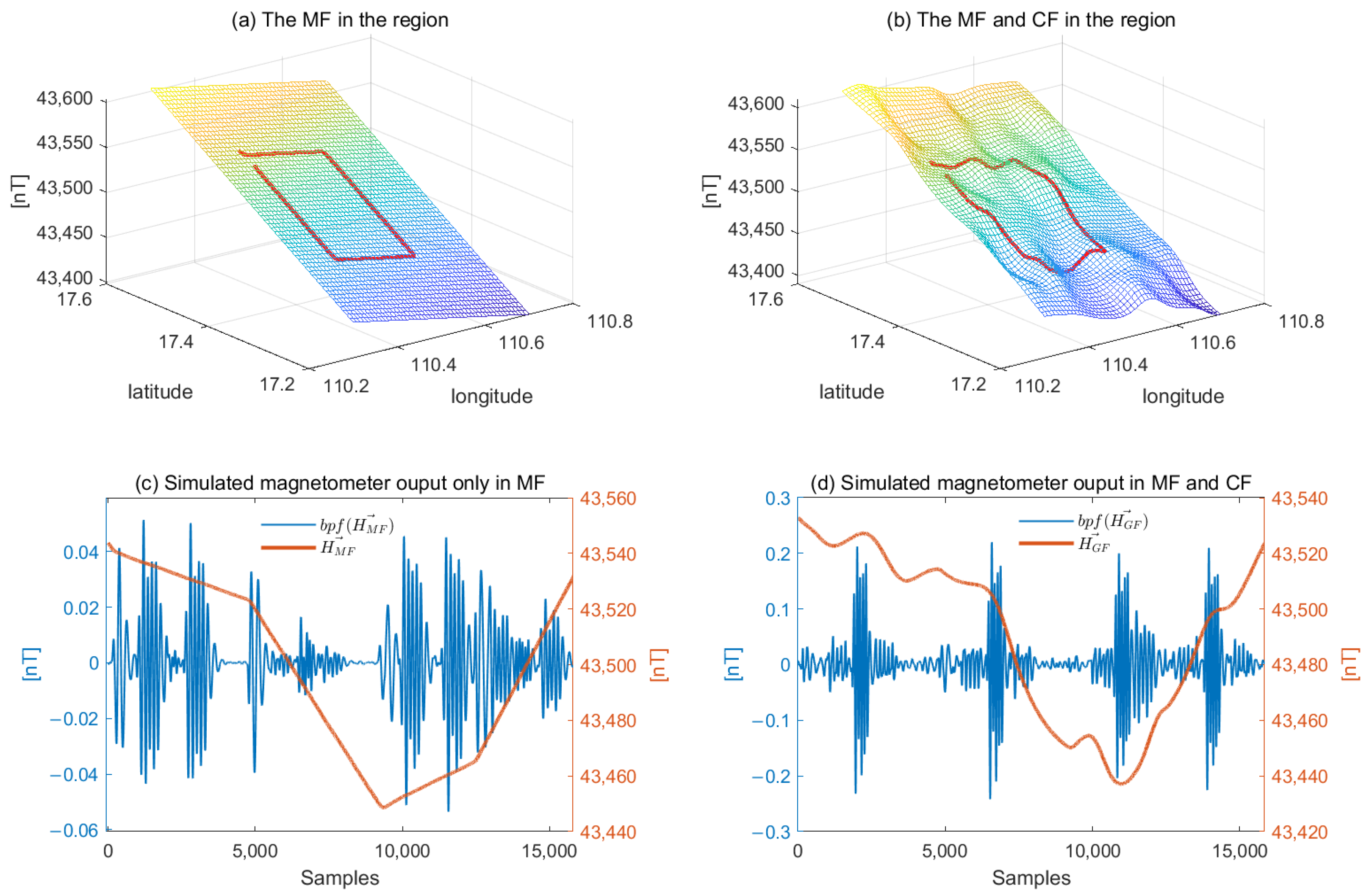
2.2. Representation of the Geomagnetic Field
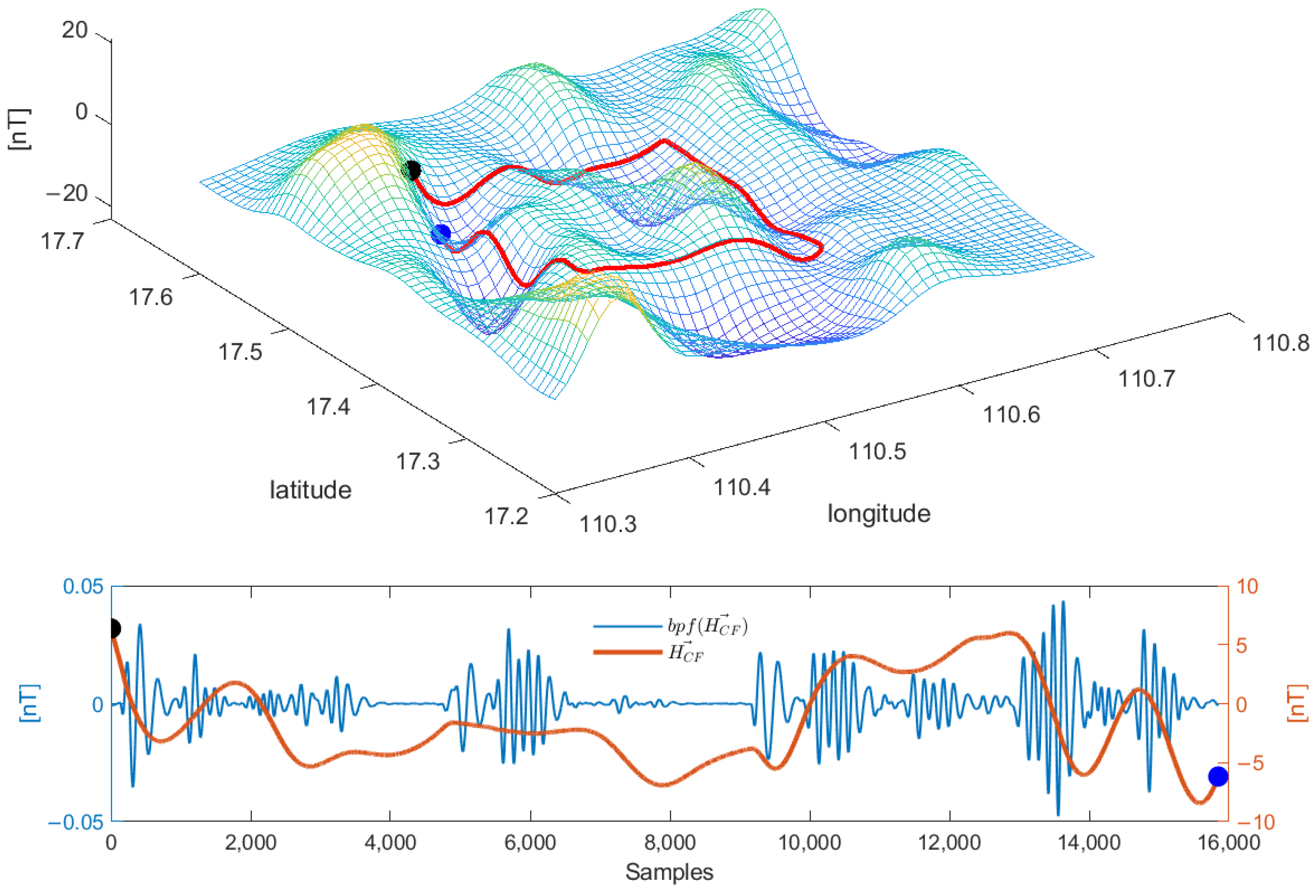
2.3. Model for Crustal Field
2.3.1. Analysis
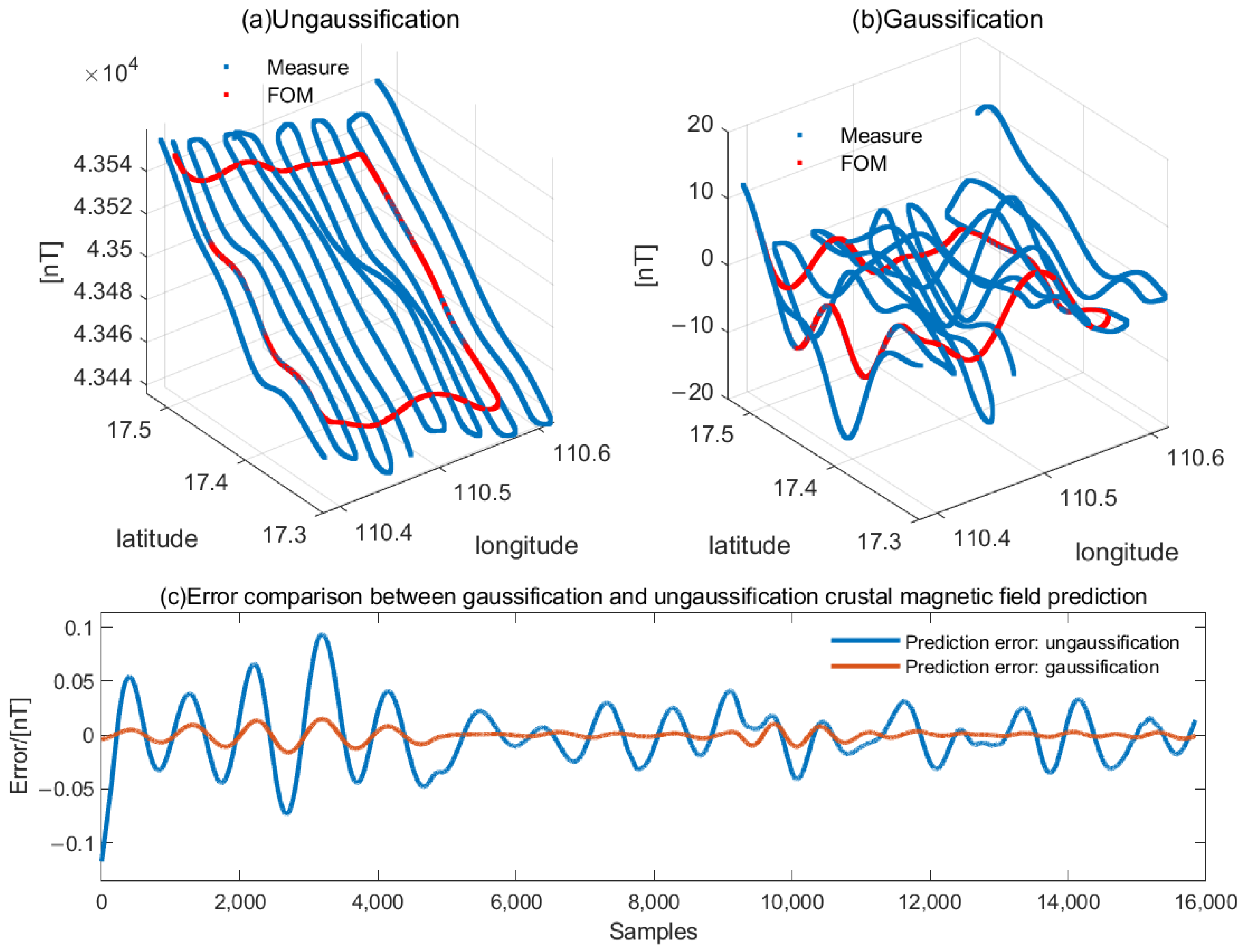
2.3.2. Gaussification of the Crustal Field
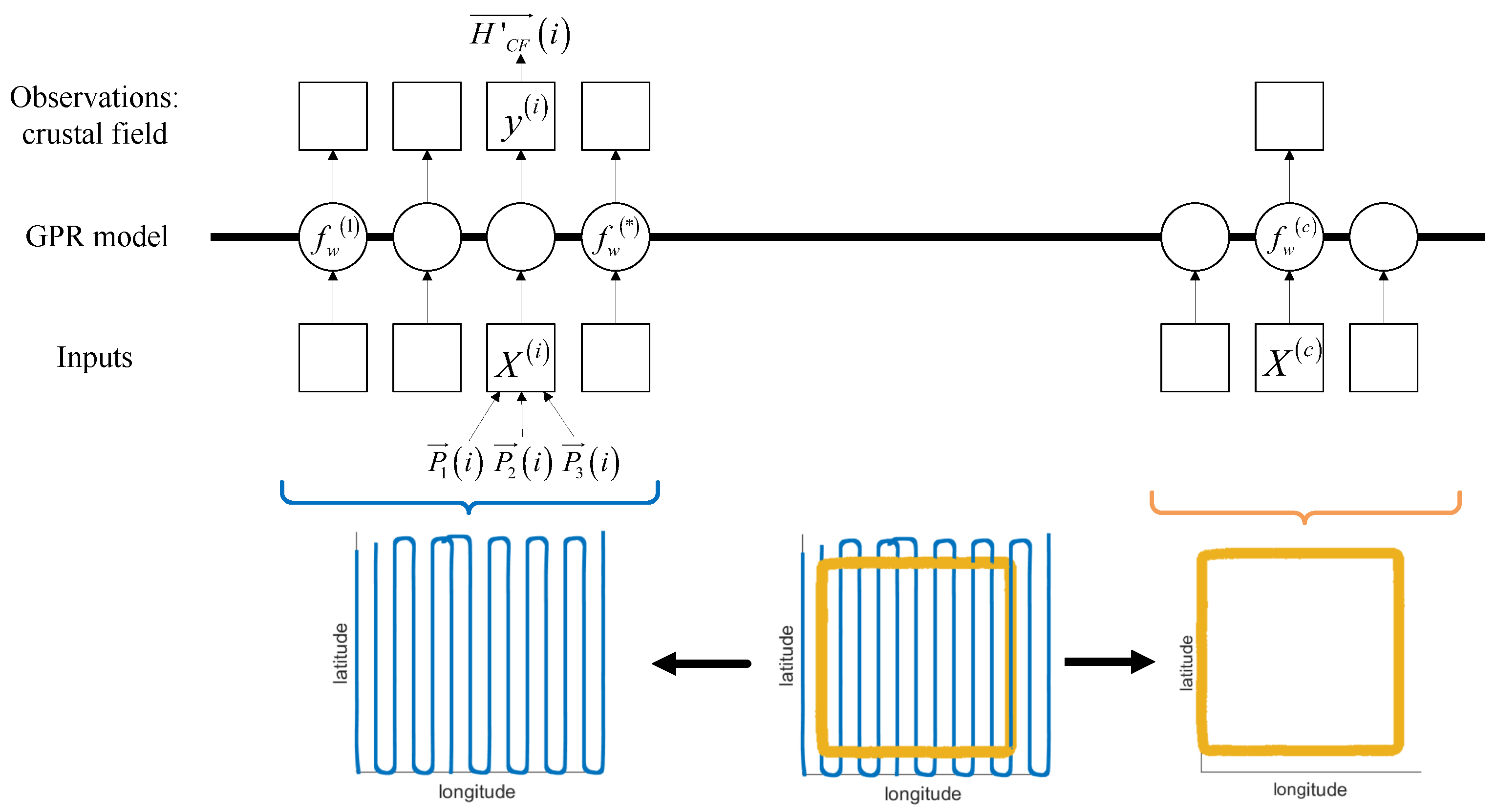
2.3.3. Prediction of Crustal Field
2.4. GF-Based Aeromagnetic Compensation Method
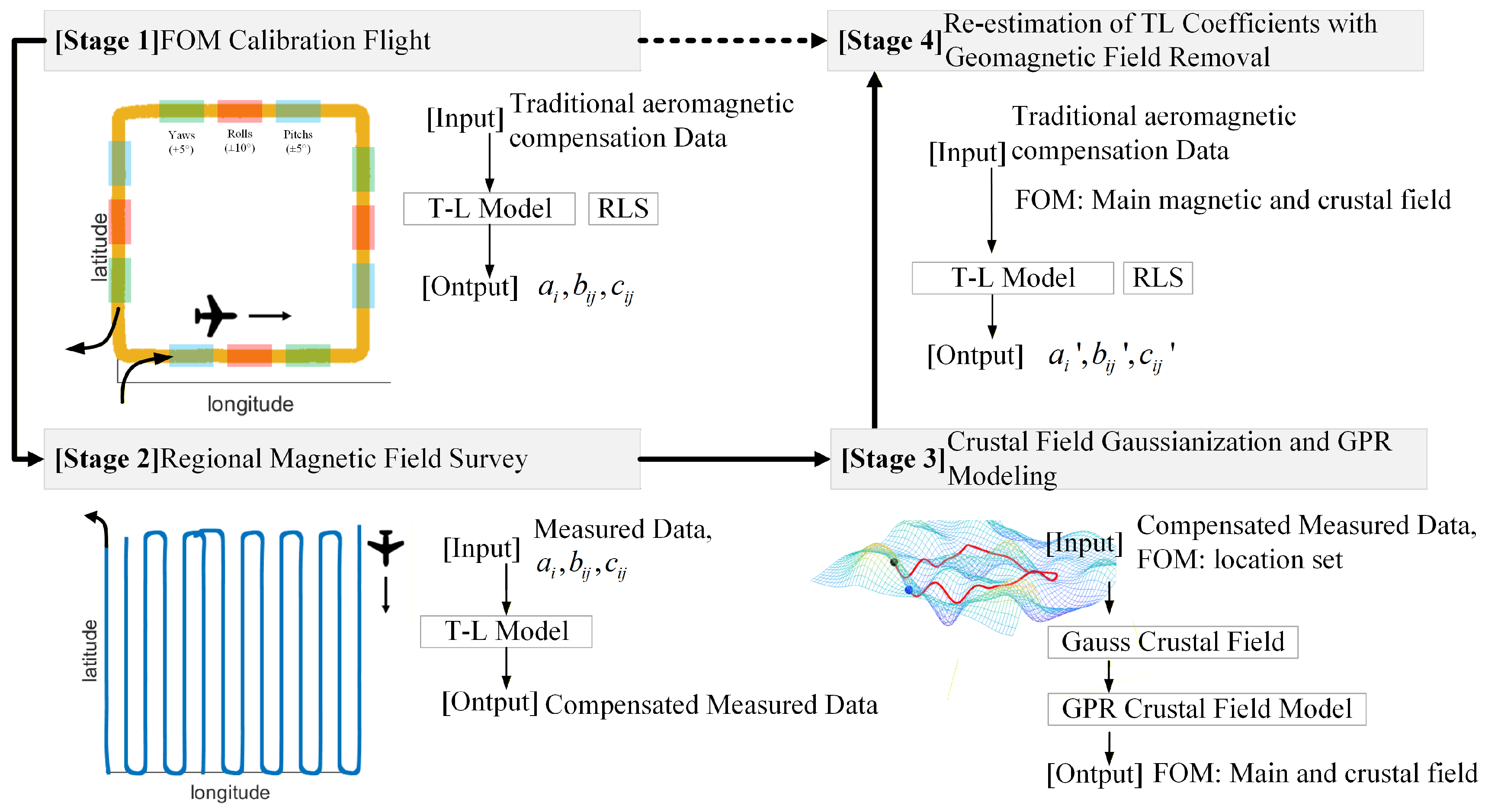
- Stage 1: FOM Calibration Flight
- Inputs: Raw scalar magnetometer data , vector magnetometer data (X, Y, Z) for attitude determination, GPS position data (longitude , latitude , altitude ).
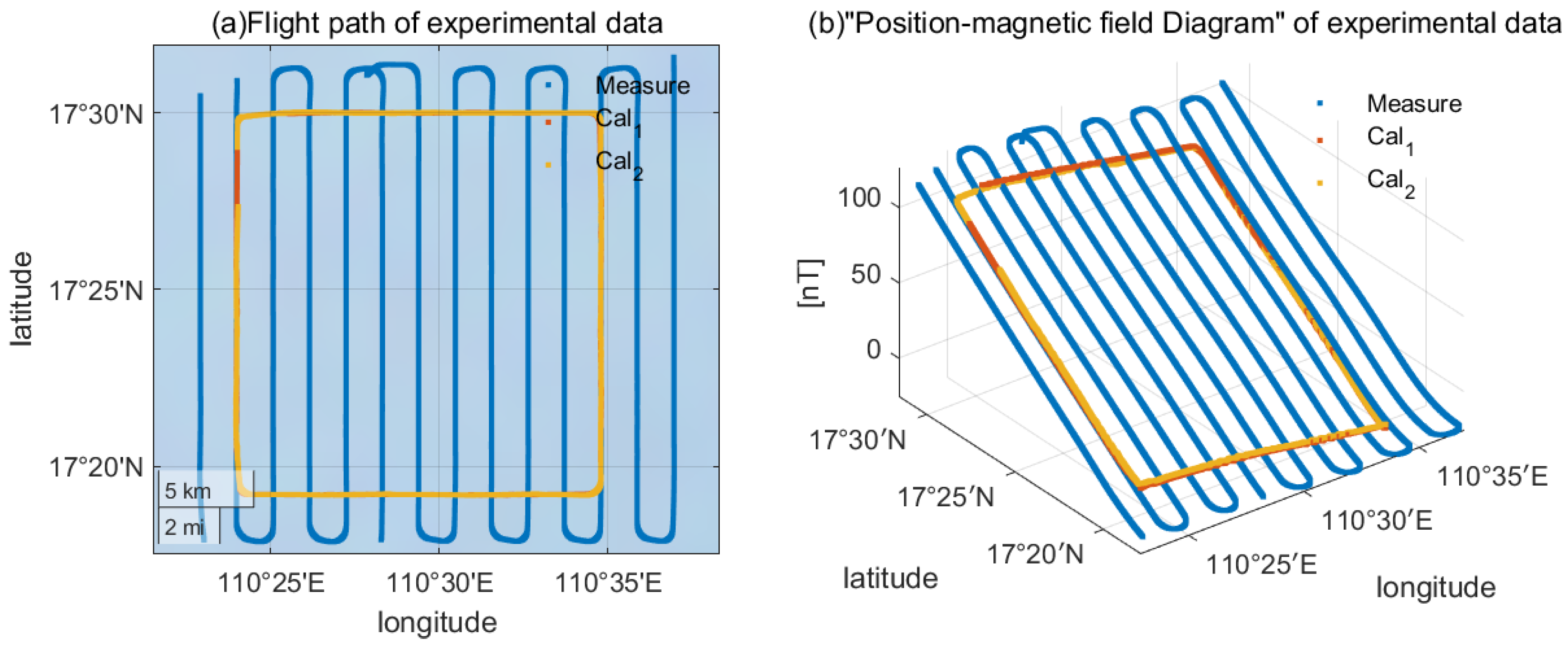
- Operational Details: The aircraft performs Figure of Merit (FOM) calibration maneuvers at a constant altitude of 3000 m (controlled within m). The maneuvers consist of four orthogonal headings (north, east, south, west), with three sets of maneuvers (pitches, rolls, and yaws) performed in each heading. Each maneuver is executed with an amplitude of approximately and a period of 6–10 s to ensure sufficient excitation of the magnetic interference terms.
- Key Thresholds: Maneuver quality is monitored in real-time to ensure that the direction cosines and their rates of change cover a sufficient dynamic range. A minimum of 10 complete oscillation cycles per maneuver type is required to ensure reliable coefficient estimation.
- Outputs: Preliminary Tolles–Lawson coefficients estimated using recursive least squares (RLS) algorithm.
- Stage 2: Regional Magnetic Field Survey
- Inputs: Raw scalar magnetometer data , vector magnetometer data, GPS position data from survey flights; preliminary TL coefficients from Stage 1.
- Operational Details: The same platform conducts survey flights along parallel lines (spaced approximately 2 km apart) at the same altitude as the FOM flight (3000 m ± 10 m). The survey lines are designed to intersect the FOM calibration area, ensuring spatial overlap for accurate geomagnetic field characterization. A ground-based base station magnetometer monitors diurnal variations, which are subtracted from the airborne data during preprocessing.
- Key Thresholds: The spatial coverage must include at least 10–15 survey lines crossing the calibration area to provide sufficient training data for subsequent GPR modeling.
- Outputs: Platform-compensated magnetic field data , where is computed using the preliminary coefficients.
- Stage 3: Crustal Field Gaussianization and GPR Modeling
- Inputs: Platform-compensated magnetic field data from Stage 2; GPS position data; IGRF model reference.
- Operational Details:
- -
- Main Field Optimization: The coefficients for the main magnetic field model (Equation (7)) are optimized using the multi-objective goal attainment method described in Section 2.3.2. The optimization targets zero skewness and zero excess kurtosis for the residual crustal field, with equal weights .
- -
- GPR Hyperparameter Optimization: The Gaussianized crustal field data is used to train a GPR model with zero mean function and squared exponential covariance function (Equation with ARD). Hyperparameters are optimized by maximizing the log marginal likelihood using the L-BFGS algorithm with 10 random restarts to avoid local minima.
- Key Thresholds: The optimization convergence tolerance is set to for both the main field optimization and GPR hyperparameter optimization. The GPR model’s predictive performance is validated using 20% of the survey data held out as a test set; the root mean square error (RMSE) on the test set must be below 0.01 nT to accept the model.
- Outputs: Optimized main field coefficients ; trained GPR model for predicting the crustal field at any spatial position within the calibration area.
- Stage 4: Re-Estimation of TL Coefficients with Geomagnetic Field Removal
- Inputs: Raw FOM flight data from Stage 1 (raw scalar and vector magnetometer data); optimized main field coefficients ; trained GPR model .
- Operational Details: For each time instant during the FOM flight, the main magnetic field is computed using the optimized coefficients and the aircraft’s GPS position. The crustal field is predicted using the GPR model at the same spatial coordinates. These geomagnetic components are subtracted from the raw scalar magnetometer data:The residual signal should ideally contain only the platform-induced interference and negligible noise. The TL coefficients are then re-estimated using the same RLS algorithm applied to this cleaned dataset.
- Key Thresholds: The improvement ratio (IR) of the re-estimated coefficients is computed on a validation dataset. The final coefficients are accepted only if the IR exceeds that of the preliminary coefficients by at least 20%.
- Outputs: Final high-precision Tolles–Lawson coefficients for operational survey flights.
3. Field Experiment
4. Conclusions
Author Contributions
Funding
Informed Consent Statement
Data Availability Statement
Conflicts of Interest
References
- Hood, P. History of aeromagnetic surveying in Canada. Lead. Edge 2007, 26, 1384–1392. [Google Scholar] [CrossRef] [Scilit]
- Qiao, Z.; Li, Y.; Meng, Z.; Han, Q. Dual-Channel Aeromagnetic Compensation Method for Continuous and Intermittent OBE Interference. IEEE Trans. Instrum. Meas. 2025, 74, 1–12. [Google Scholar] [CrossRef] [Scilit]
- Bi, F.; Yu, P.; Jiao, J.; Zhou, L.; Zeng, X.; Zhou, S. An Adaptive Modeling-Based Aeromagnetic Maneuver Noise Suppression Method and Its Application in Mine Detection. Remote Sens. 2023, 15, 4590. [Google Scholar] [CrossRef] [Scilit]
- Noriega, G.; Marszalkowski, A. Adaptive techniques and other recent developments in aeromagnetic compensation. First Break 2017, 35, 31–38. [Google Scholar] [CrossRef] [Scilit]
- Zheng, Y.; Li, S.; Xing, K.; Zhang, X. Unmanned Aerial Vehicles for Magnetic Surveys: A Review on Platform Selection and Interference Suppression. Drones 2021, 5, 93. [Google Scholar] [CrossRef] [Scilit]
- Hardwick, C. Important Design Considerations for Inboard Airborne Magnetic Gradiometers. Explor. Geophys. 1984, 15, 266. [Google Scholar] [CrossRef] [Scilit]
- Tuck, L.; Samson, C.; Polowick, C.; Laliberte, J. Real-time compensation of magnetic data acquired by a single-rotor unmanned aircraft system. Geophys. Prospect. 2019, 67, 1637–1651. [Google Scholar] [CrossRef] [Scilit]
- Dou, Z.; Han, Q.; Niu, X.; Peng, X.; Guo, H. An Aeromagnetic Compensation Coefficient-Estimating Method Robust to Geomagnetic Gradient. IEEE Geosci. Remote Sens. Lett. 2016, 13, 611–615. [Google Scholar] [CrossRef] [Scilit]
- Peng, D.; Lin, C.; Bin, T.; Jian, Z. Application of adaptive filtering algorithm based on wavelet transformation in aeromagnetic survey. In Proceedings of the 2010 3rd International Conference on Computer Science and Information Technology, Chengdu, China, 9–11 July 2010; Volume 2, pp. 492–496. [Google Scholar] [CrossRef] [Scilit]
- Groom, R.W.; Jia, R.; Lo, B. Magnetic Compensation of Magnetic Noises Related to Aircraft’s Maneuvers in Airborne Survey. In Symposium on the Application of Geophysics to Engineering and Environmental Problems; Environmental and Engineering Geophysical Society: Denver, CO, USA, 2004; pp. 101–108. [Google Scholar] [CrossRef] [Scilit]
- Qin, N. Research on Aeromagnetic Data Rocessing Based on Sparse Representation. Ph.D. Thesis, Harbin Institute of Technology, Harbin, China, 2016. [Google Scholar]
- Feng, Y.; Zhang, Q.; Zheng, Y.; Qu, X.; Wu, F.; Fang, G. An Improved Aeromagnetic Compensation Method Robust to Geomagnetic Gradient. Appl. Sci. 2022, 12, 1490. [Google Scholar] [CrossRef] [Scilit]
- Erwan, T.; Finlay, C.; Beggan, C.; Alken, P.; Aubert, J.; Barrois, O.; Bertrand, F.; Bondar, T.; Boness, A.; Brocco, L.; et al. International Geomagnetic Reference Field: The 12th generation. Earth Planets Space 2015, 67, 79. [Google Scholar] [CrossRef] [Scilit]
- Canciani, A.J. Magnetic Navigation on an F-16 Aircraft Using Online Calibration. IEEE Trans. Aerosp. Electron. Syst. 2022, 58, 420–434. [Google Scholar] [CrossRef] [Scilit]
- Wang, Y.; Han, Q.; Zhan, D.; Li, Q. A Self-Supervised Method of Suppressing Interference Affected by the Varied Ambient Magnetic Field in Magnetic Anomaly Detection. Remote Sens. 2025, 17, 479. [Google Scholar] [CrossRef] [Scilit]
- Xu, Y.; Liu, Z.; Zhang, Q.; Liu, X.; Huang, B.; Pan, M.; Hu, J.; Chen, D.; Ying, T.; Qiu, X. Modified Evolutionary Aeromagnetic Compensation Method Considering Geomagnetic Variations. IEEE Trans. Instrum. Meas. 2025, 74, 1–8. [Google Scholar] [CrossRef] [Scilit]
- Merrill, R.T.; Mcelhinny, M.W.; Mcfadden, P.L. The Magnetic Field of the Earth: Paleomagnetism, the Core, and the Deep Mantle. Eos Trans. Am. Geophys. Union 1997, 50, 70. [Google Scholar] [CrossRef] [Scilit]
- Tolles, W.E. Magnetic Field Compensation System. U.S. Patent No. 2,706,801, 19 April 1955. [Google Scholar]
- Han, Q.; Dou, Z.; Tong, X.; Peng, X.; Guo, H. A Modified Tolles–Lawson Model Robust to the Errors of the Three-Axis Strapdown Magnetometer. IEEE Geosci. Remote Sens. Lett. 2017, 14, 334–338. [Google Scholar] [CrossRef] [Scilit]
- Li, Y.; Han, Q.; Li, Q.; Tong, X. On the Correction of the Positional Error Caused by the Coordinate Origin in Tolley–Lawson Model. IEEE Geosci. Remote Sens. Lett. 2022, 19, 1–5. [Google Scholar] [CrossRef] [Scilit]
- Tseng, C.H.; T.W., L.U. Minimax multiobjective optimization in structural design. Int. J. Numer. Methods Eng. 2010, 30, 1213–1228. [Google Scholar] [CrossRef] [Scilit]
- Zadeh, L. Optimality and non-scalar-valued performance criteria. IEEE Trans. Autom. Control 1963, 8, 59–60. [Google Scholar] [CrossRef] [Scilit]
- McGregor, D.D. High-sensitivity helium resonance magnetometers. Rev. Sci. Instruments 1987, 58, 1067–1076. [Google Scholar] [CrossRef] [Scilit]
- Feng, Y.; Pan, J.J.; An, Z.C.; Sun, H.; Mao, F. Calculation and analysis of geomagnetic field horizontal gradients in China. Chin. J. Geophys. 2010, 53, 2899–2906. [Google Scholar]
- Noriega, G. Performance measures in aeromagnetic compensation. Lead. Edge 2011, 30, 1122–1127. [Google Scholar] [CrossRef] [Scilit]
- Noriega, G. Model stability and robustness in aeromagnetic compensation. First Break 2013, 31, 73–79. [Google Scholar] [CrossRef] [Scilit]



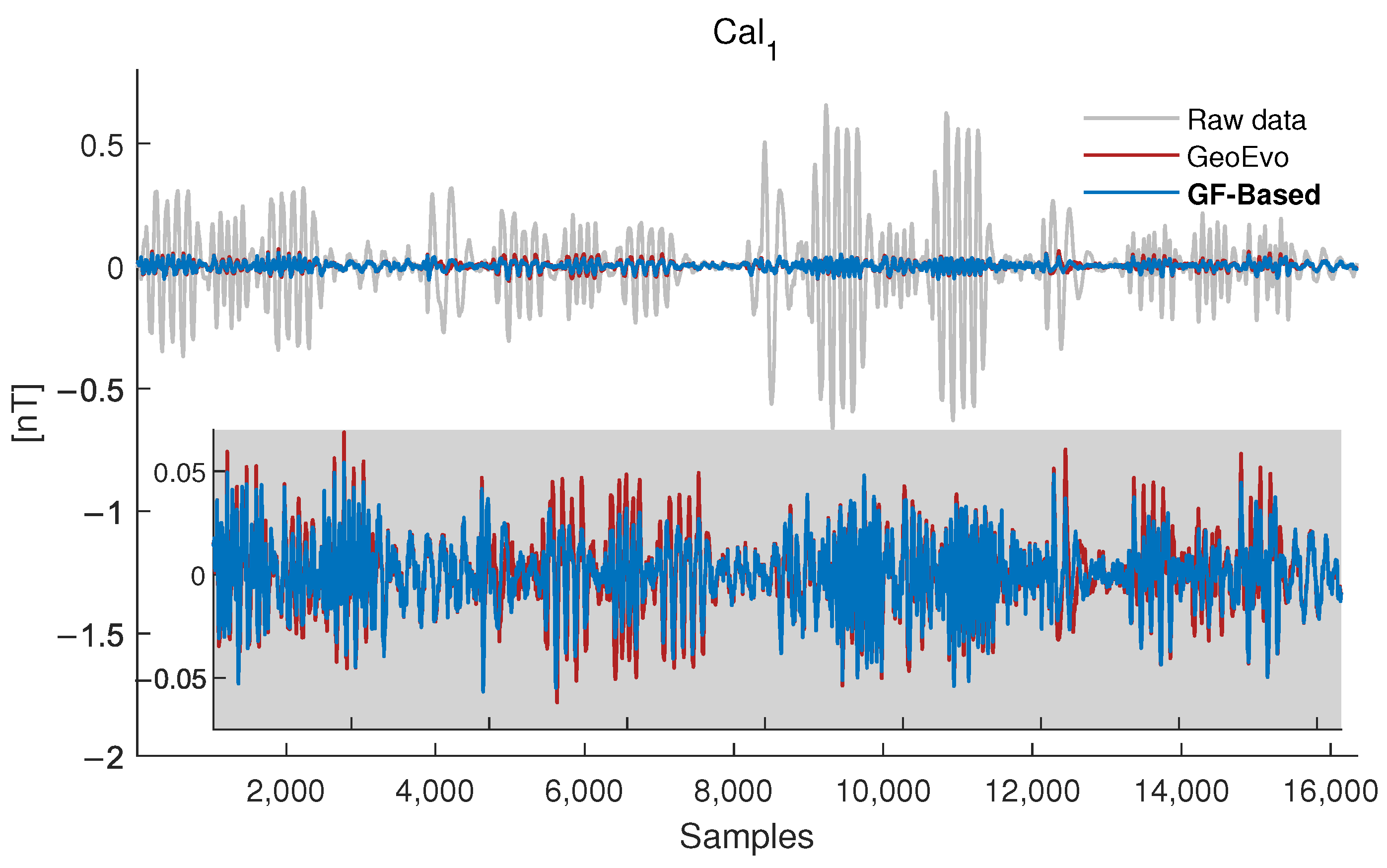
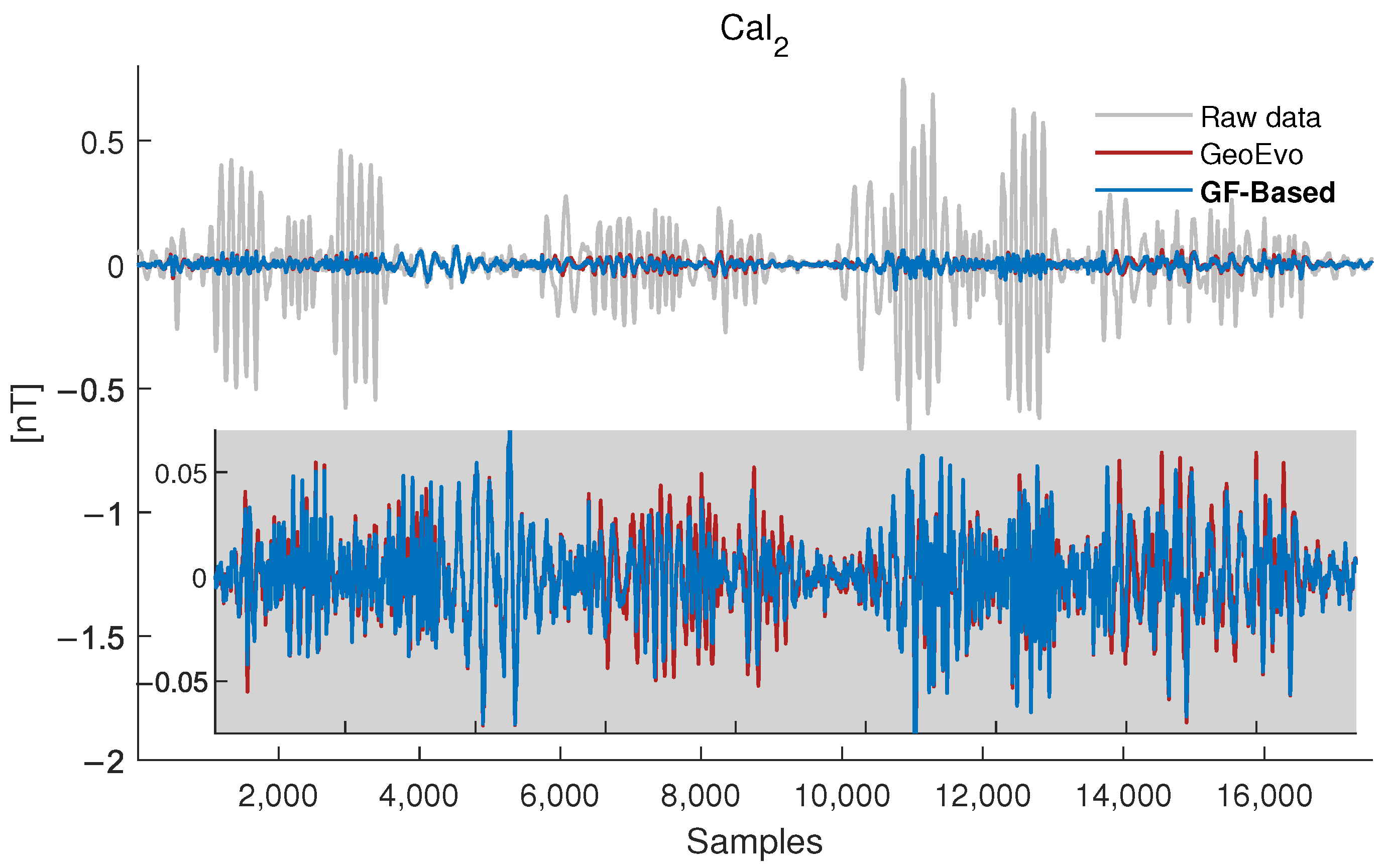
| Dataset | TL | TLG | TL-IGRF | TLG-C | GeoEvo | GF-Based |
|---|---|---|---|---|---|---|
| 4.8870 | 8.0132 | 8.1089 | 8.7238 | 9.0789 | 10.9776 | |
| 4.1675 | 7.0014 | 6.9156 | 7.7111 | 8.4103 | 9.5352 |
| Dataset | TLG-C | GeoEvo | GF-Based |
|---|---|---|---|
| 1.0156 | 1.0203 | 1.0214 | |
| 1.0398 | 1.0114 | 1.0211 |
Disclaimer/Publisher’s Note: The statements, opinions and data contained in all publications are solely those of the individual author(s) and contributor(s) and not of MDPI and/or the editor(s). MDPI and/or the editor(s) disclaim responsibility for any injury to people or property resulting from any ideas, methods, instructions or products referred to in the content. |
© 2026 by the authors. Licensee MDPI, Basel, Switzerland. This article is an open access article distributed under the terms and conditions of the Creative Commons Attribution (CC BY) license.
Share and Cite
Li, Y.; Wang, G.; Han, Q.; Li, Q. High-Precision Aeromagnetic Compensation Method Under the Influence of the Geomagnetic Field. Sensors 2026, 26, 1867. https://doi.org/10.3390/s26061867
Li Y, Wang G, Han Q, Li Q. High-Precision Aeromagnetic Compensation Method Under the Influence of the Geomagnetic Field. Sensors. 2026; 26(6):1867. https://doi.org/10.3390/s26061867
Chicago/Turabian StyleLi, You, Guochao Wang, Qi Han, and Qiong Li. 2026. "High-Precision Aeromagnetic Compensation Method Under the Influence of the Geomagnetic Field" Sensors 26, no. 6: 1867. https://doi.org/10.3390/s26061867
APA StyleLi, Y., Wang, G., Han, Q., & Li, Q. (2026). High-Precision Aeromagnetic Compensation Method Under the Influence of the Geomagnetic Field. Sensors, 26(6), 1867. https://doi.org/10.3390/s26061867