An Improved Robust ESKF Fusion Positioning Method with a Novel UWB-VIO Initialization
 ,
,
Highlights
- A direction-consistent constrained initialization model is proposed to jointly optimize scale and heading, achieving consistent alignment between VIO and UWB coordinate frames without external calibration.
- An improved residual-weighted robust ESKF fusion method adaptively suppresses UWB multipath and NLOS-induced outliers, effectively reducing VIO drift and enhancing localization robustness.
- The proposed UWB–VIO framework enables high-precision and stable localization for mobile robots in complex indoor environments with illumination variations and feature sparsity.
- The findings provide a practical and robust localization solution for autonomous navigation and mapping in GNSS-denied scenarios.
Abstract
1. Introduction
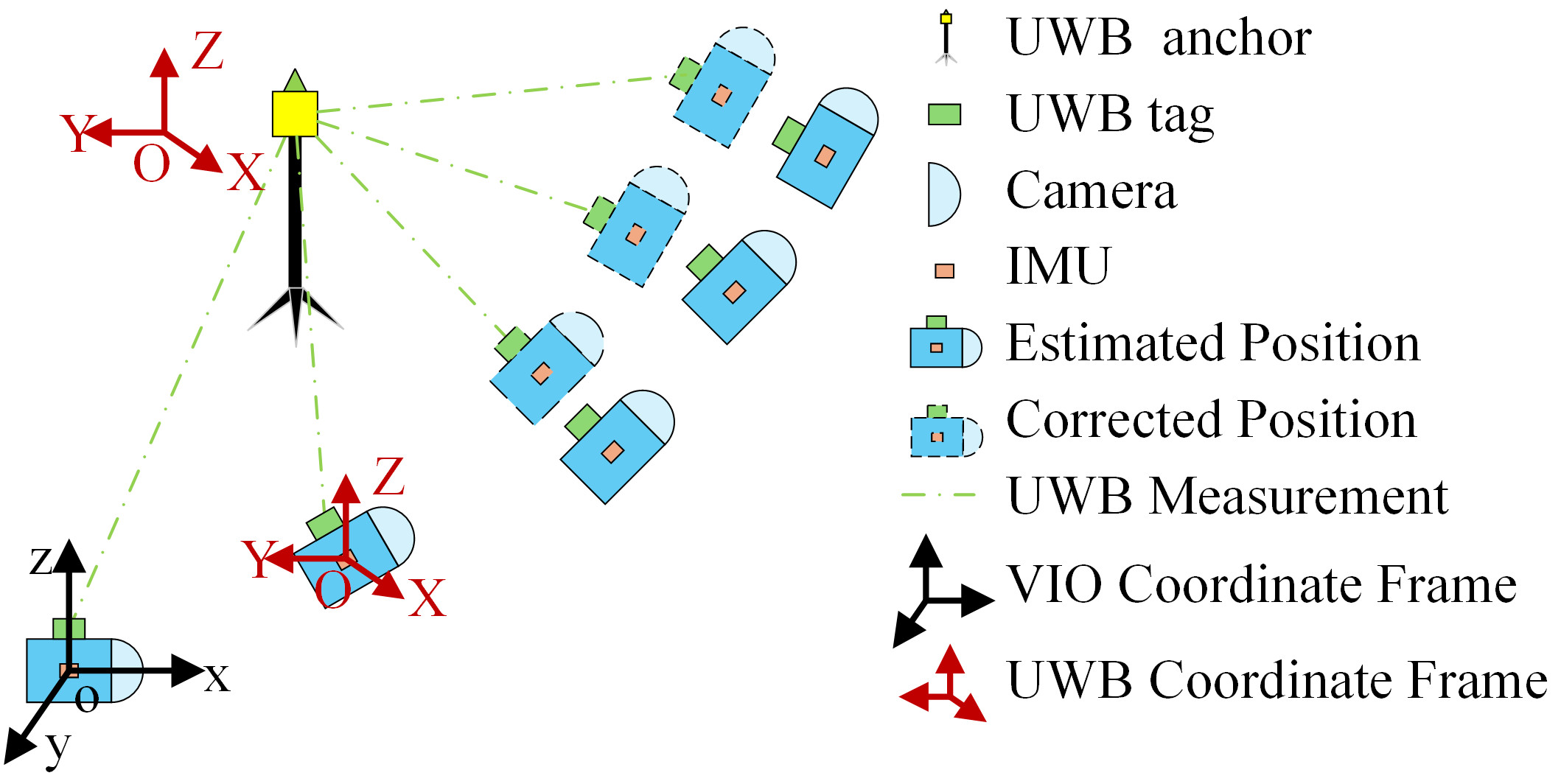
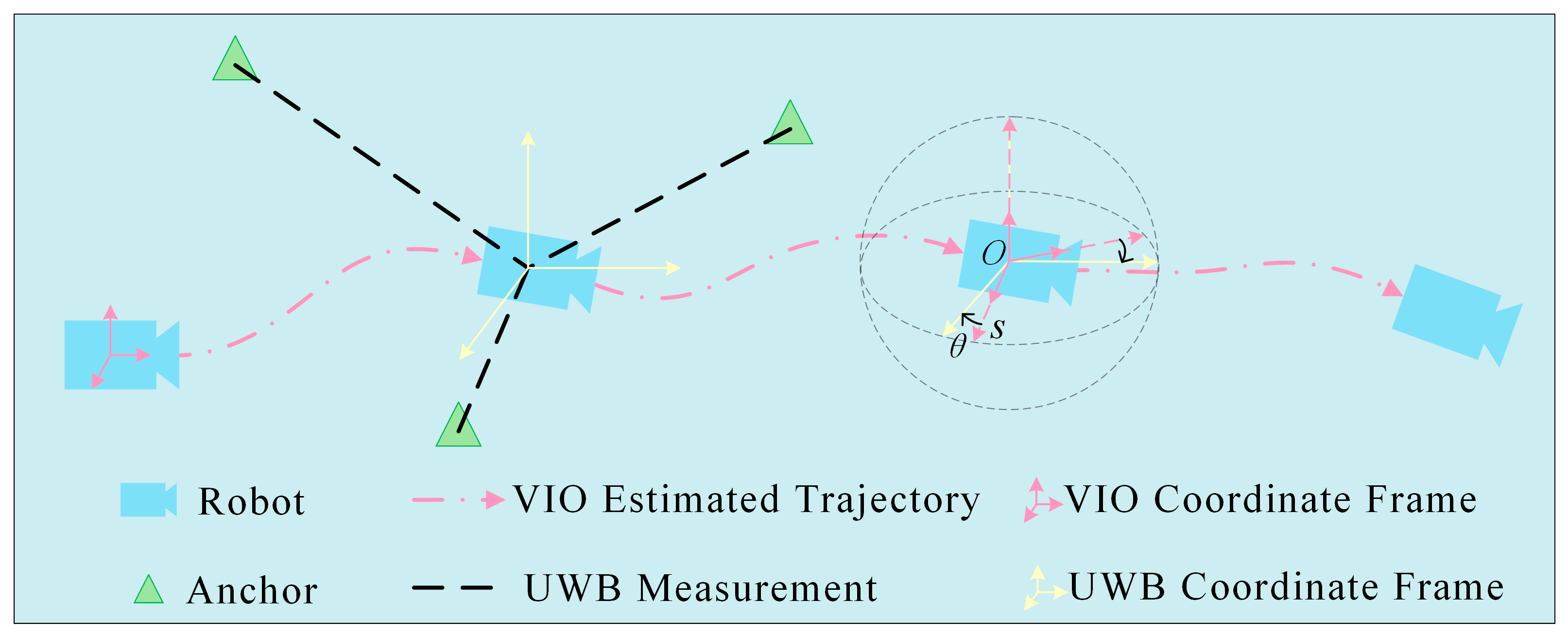
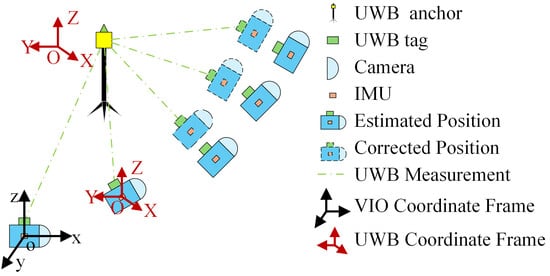
- A UWB–VIO joint initialization method based on multi-anchor direction-consistency constraints is proposed. This method simultaneously estimates the scale factor and yaw angle within a unified optimization framework, thereby eliminating the dependence on external coordinate alignment procedures required by traditional approaches.
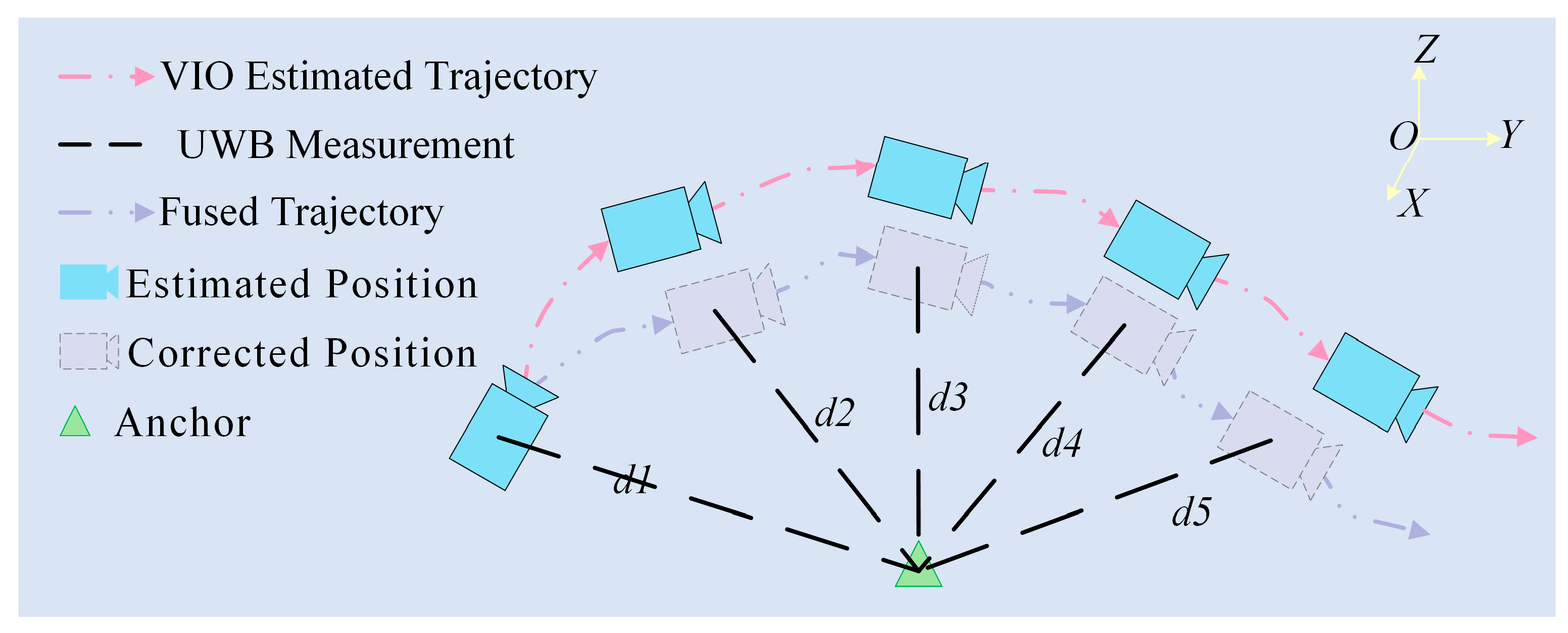
- An improved residual-weighted Robust ESKF fusion framework is developed, which dynamically adjusts the observation noise covariance during the filtering update stage to enhance system robustness in complex indoor environments.
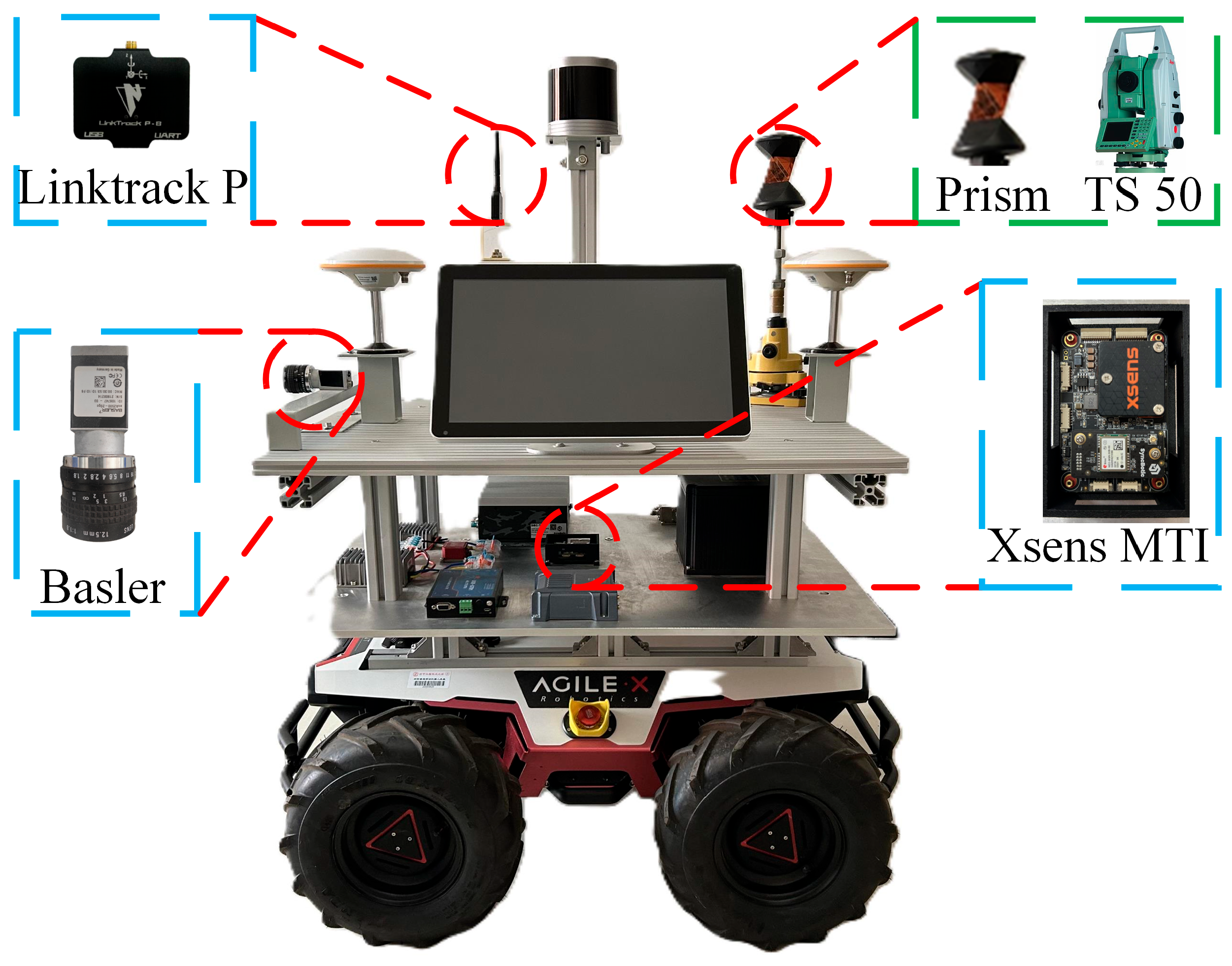
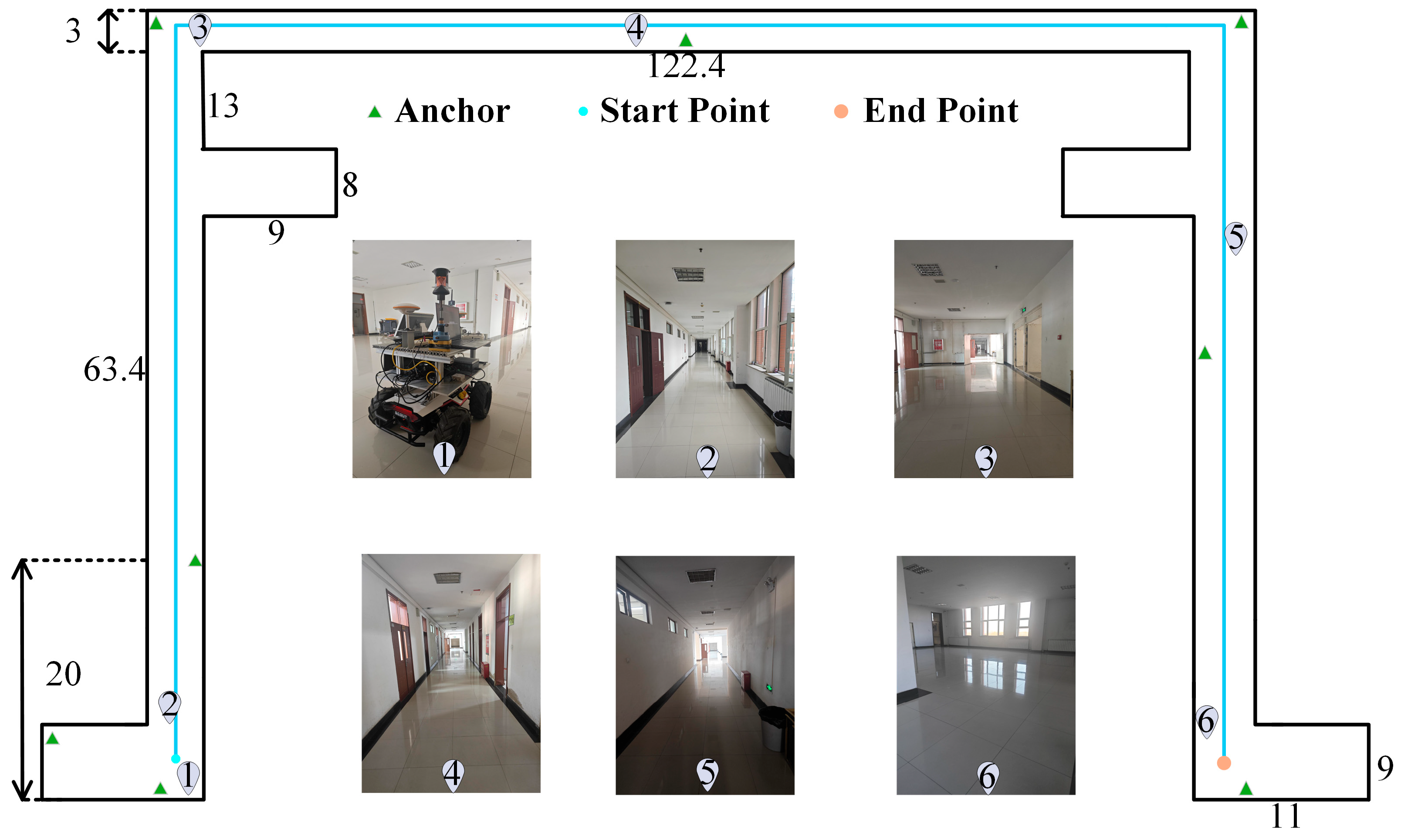
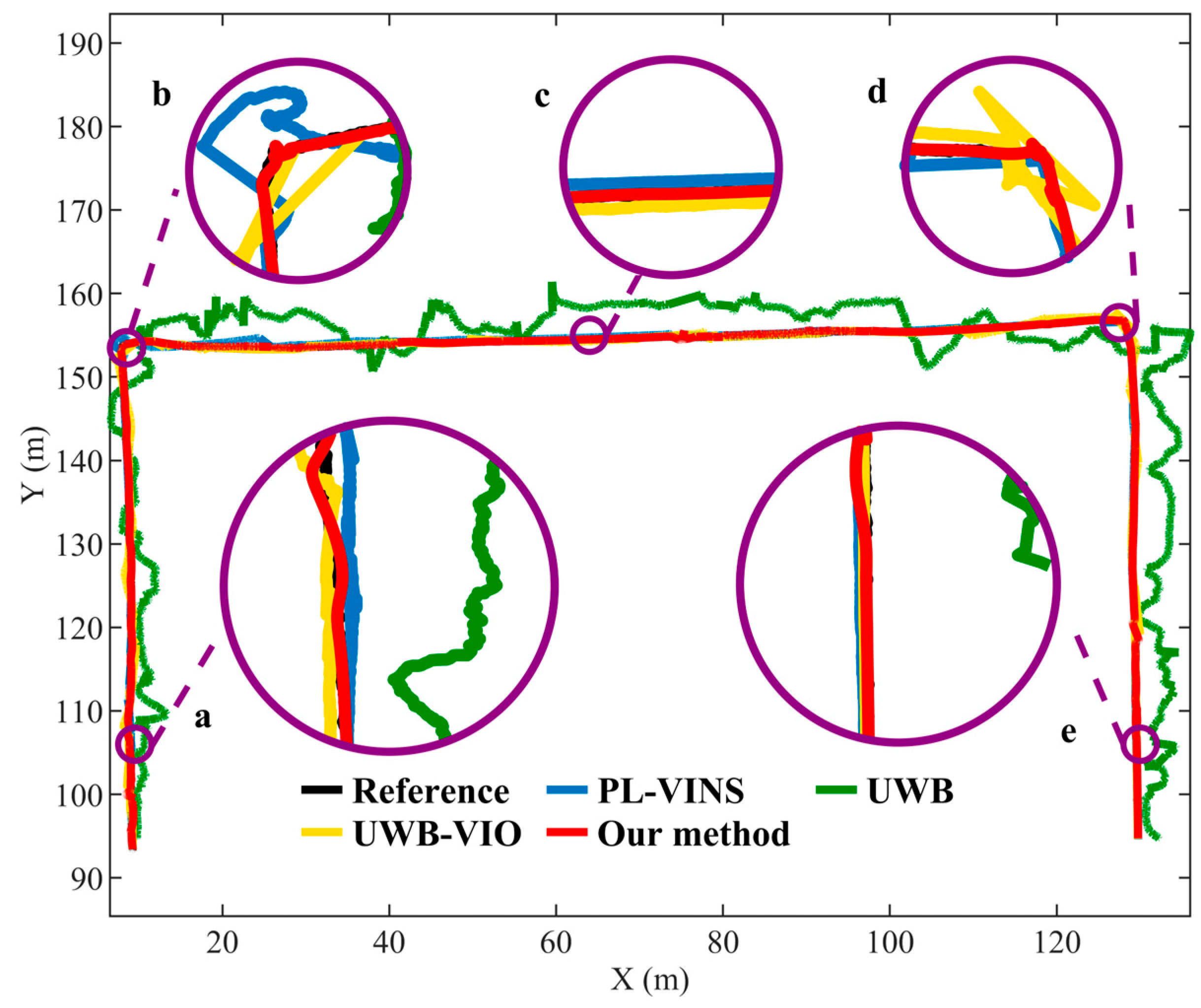
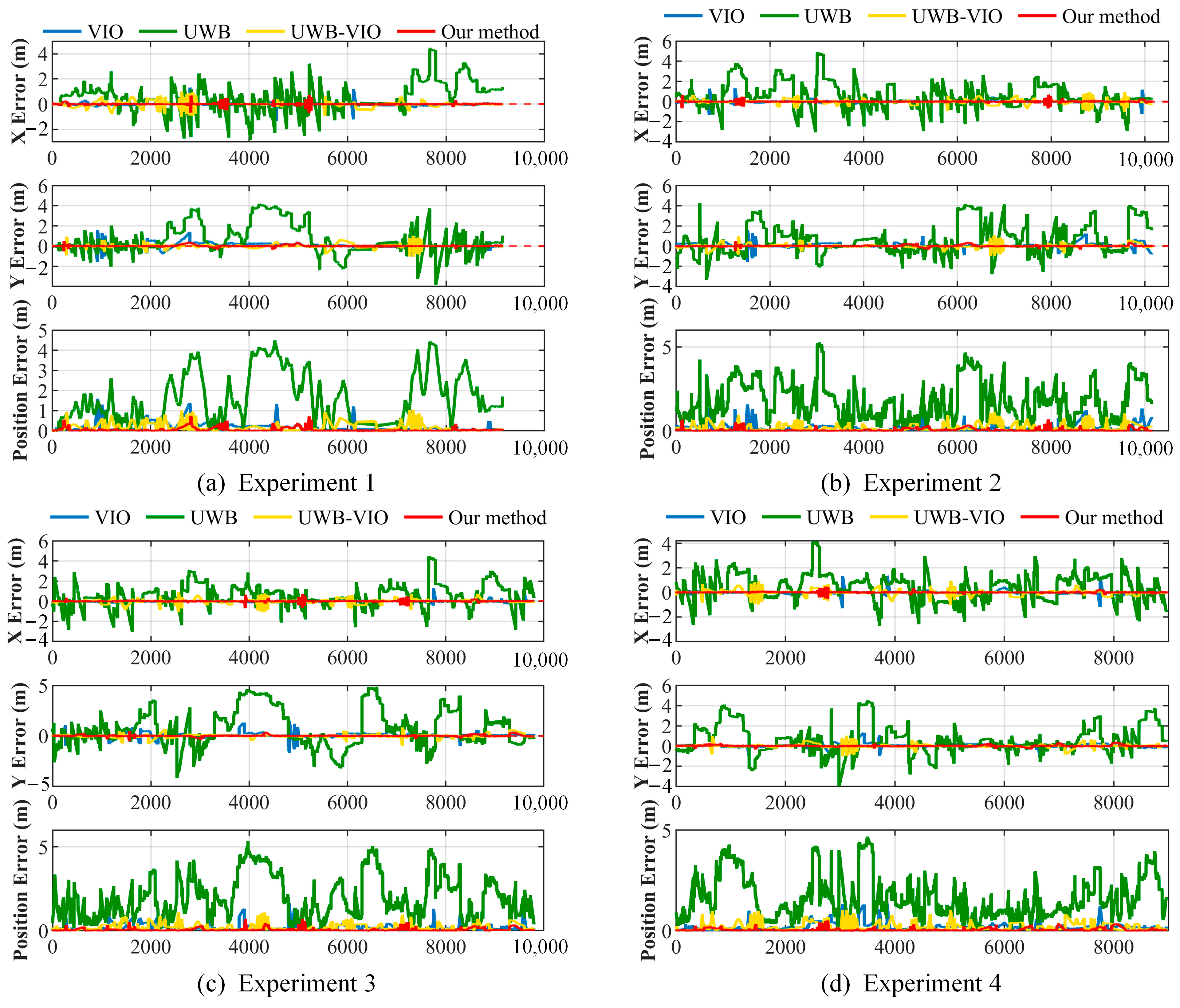
- A field-validated robotic experimental platform is designed and implemented. Multiple comparative experiments were conducted in narrow-corridor environments where both UWB and visual sensors were subject to interference. The results demonstrate that the proposed method significantly outperforms existing approaches across root-mean-square position error, mean error, and maximum error.
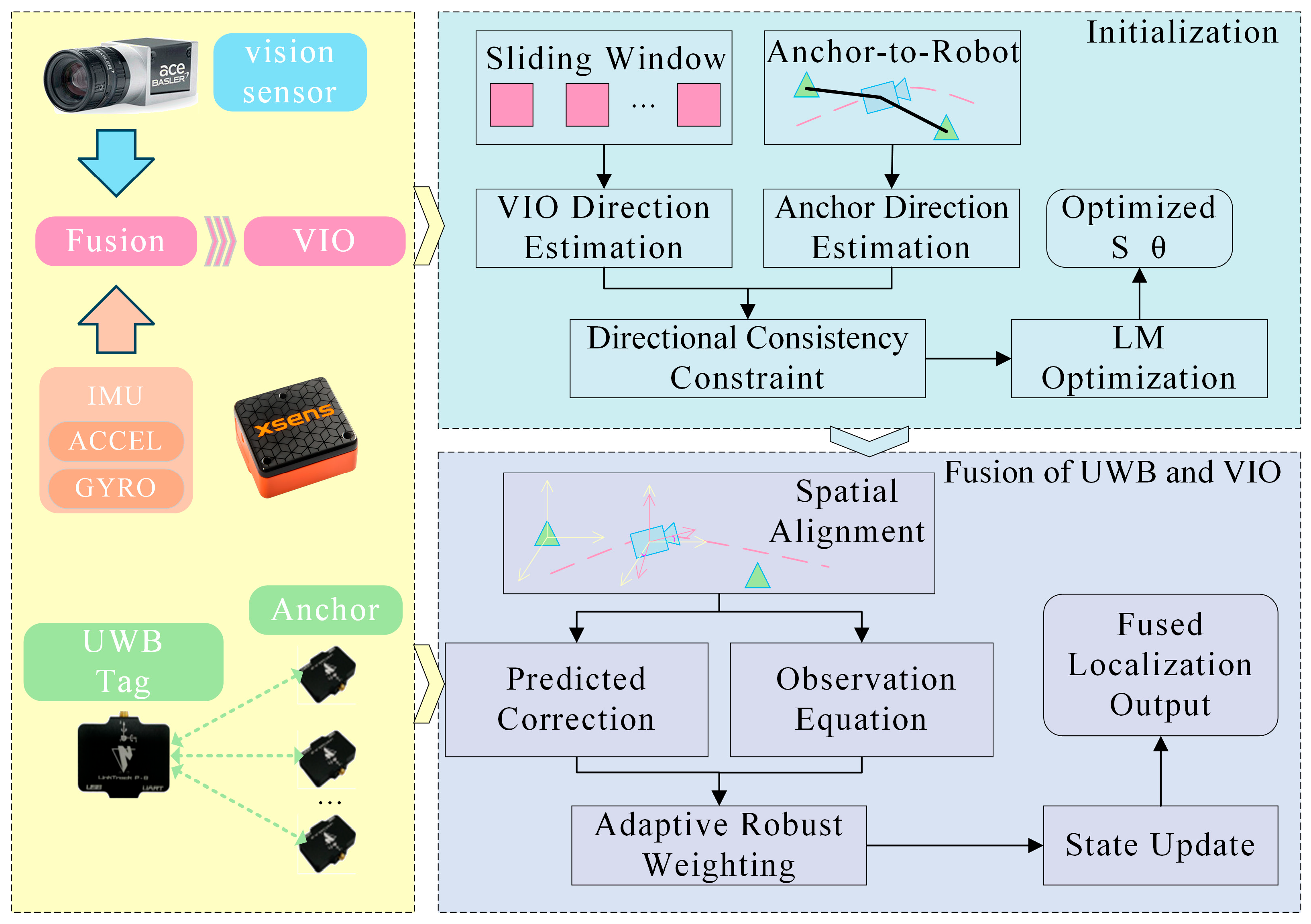
2. Framework of UWB-Assisted VIO Initialization and Improved Robust ESKF-Based Fusion Localization System
3. Joint Estimation of Directional Consistency for UWB–VIO Initialization
3.1. Sliding-Window Trajectory Direction Extraction
3.2. Multi-Anchor Direction Consistency Constraint
4. Improved Robust ESKF-Based UWB-VIO Fusion Positioning
| Algorithm 1. Proposed UWB–VIO Fusion Framework |
| Input: Visual measurements, IMU measurements, UWB ranging data Output: Globally consistent position and orientation estimates //Stage I: UWB–VIO Joint Initialization 1: Acquire visual and IMU data 2: Perform visual–inertial estimation to obtain a preliminary trajectory 3: Apply a sliding-window mechanism to extract the smoothed VIO direction 4: Compute UWB direction vectors 5: Construct direction-consistency constraints between UWB and VIO 6: Jointly optimize scale factor and yaw angle 7: Align UWB and VIO coordinate frames //Stage II: Robust ESKF-Based Fusion 8: Initialize state vector in the ESKF framework 9: while the system is running do 10: Propagate state using IMU measurements 11: Update state using VIO observations 12: Update state using UWB measurements 13: Apply residual-based robust weighting to suppress abnormal UWB measurements 14: Output fused pose and velocity estimates 15: end while |
5. Experiments and Results Analysis
5.1. Experimental Environment and Equipment
5.2. Experimental Protocol and Results Analysis
5.3. Real-Time Performance Analysis
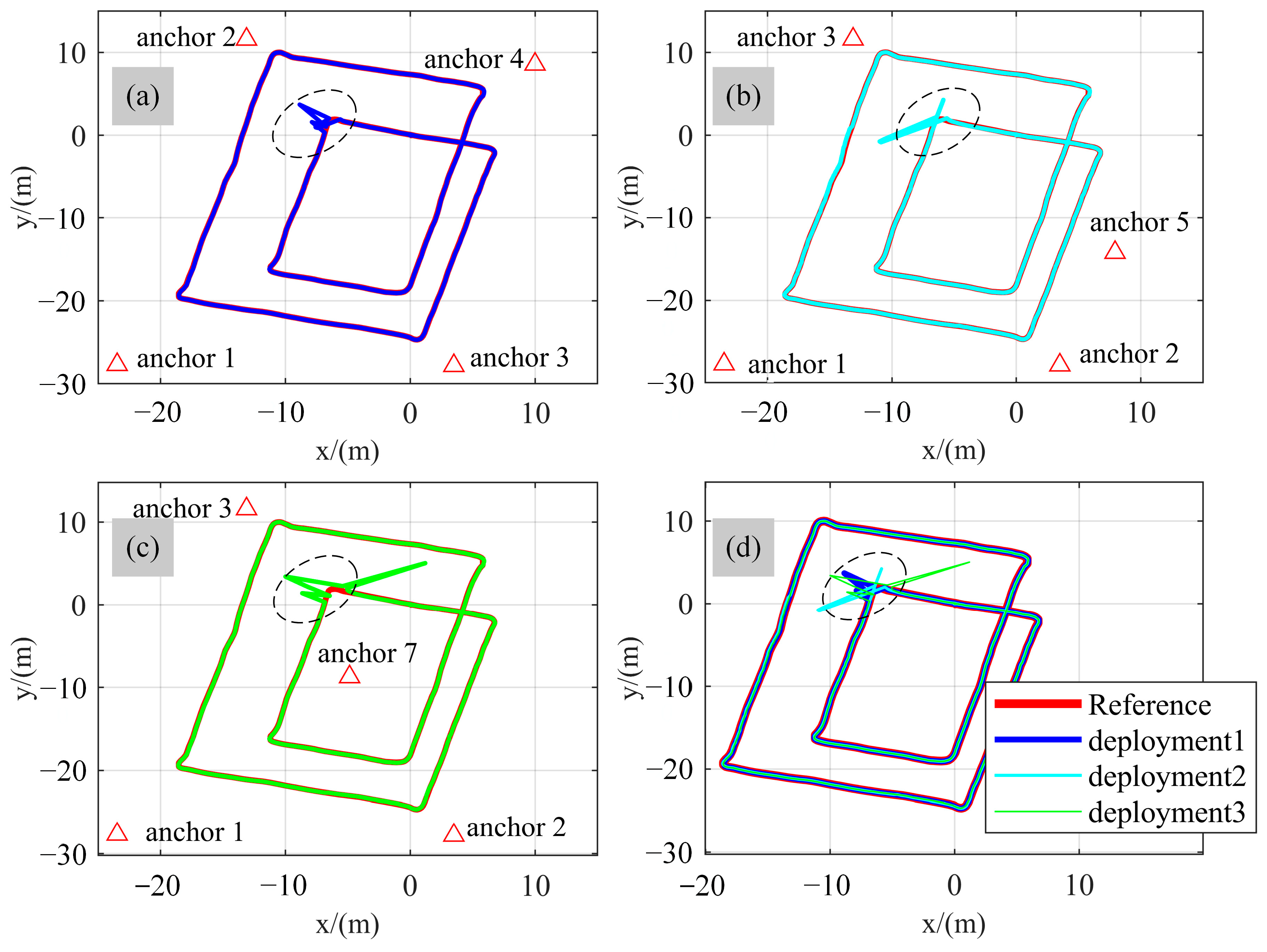
5.4. Influence of UWB Anchor Deployment Geometry
5.5. Discussion
6. Conclusions
Author Contributions
Funding
Data Availability Statement
Acknowledgments
Conflicts of Interest
References
- Liu, L.; Wang, X.; Yang, X.; Liu, H.; Li, J.; Wang, P. Path planning techniques for mobile robots: Review and prospect. Expert Syst. Appl. 2023, 227, 120254. [Google Scholar] [CrossRef]
- Wang, H.; Wang, C.; Xie, L. Intensity-SLAM: Intensity assisted localization and mapping for large scale environment. IEEE Robot. Autom. Lett. 2021, 6, 1715–1721. [Google Scholar] [CrossRef]
- Wang, X.; Ma, J.; Miao, Y.; Liu, X.; Zhu, D.; Deng, R.H. Fast and secure location-based services in smart cities on outsourced data. IEEE Internet Things J. 2021, 8, 17639–17654. [Google Scholar] [CrossRef]
- Wu, L.; Guo, S.; Han, L.; Baris, C.A. Indoor positioning method for pedestrian dead reckoning based on multi-source sensors. Measurement 2024, 229, 114416. [Google Scholar] [CrossRef]
- Zhao, H.; Liu, J.; Chen, X.; Cao, H.; Wang, C.; Li, J.; Shen, C.; Tang, J. Information monitoring and adaptive information fusion of multi-source fusion navigation systems in complex environments. IEEE Internet Things J. 2024, 14, 25047–25056. [Google Scholar] [CrossRef]
- Niu, X.; Liu, T.; Kuang, J.; Li, Y. A novel position and orientation system for pedestrian indoor mobile mapping system. IEEE Sens. J. 2020, 21, 2104–2114. [Google Scholar] [CrossRef]
- He, G.; Yuan, X.; Zhuang, Y.; Hu, H. An integrated GNSS/LiDAR-SLAM pose estimation framework for large-scale map building in partially GNSS-denied environments. IEEE Trans. Instrum. Meas. 2020, 70, 1–9. [Google Scholar] [CrossRef]
- Kang, J. Monocular Visual/IMU/GNSS Integration System Using Deep Learning-Based Optical Flow for Intelligent Vehicle Localization. Sensors 2025, 25, 6050. [Google Scholar] [CrossRef]
- Zhang, H.; Qian, C.; Li, W.; Li, B.; Liu, H. Tightly coupled integration of vector HD map, LiDAR, GNSS, and INS for precise vehicle navigation in GNSS-challenging environment. Geo-Spat. Inf. Sci. 2025, 28, 1341–1358. [Google Scholar] [CrossRef]
- Cao, S.; Lu, X.; Shen, S. GVINS: Tightly coupled GNSS-visual-inertial fusion for smooth and consistent state estimation. IEEE Trans. Robot. 2022, 38, 2004–2021. [Google Scholar] [CrossRef]
- Kuang, Y.; Hu, T.; Ouyang, M.; Yang, Y.; Zhang, X. Tightly Coupled LIDAR/IMU/UWB Fusion via Resilient Factor Graph for Quadruped Robot Positioning. Remote Sens. 2024, 16, 4171. [Google Scholar] [CrossRef]
- Zhou, Z.; Jiang, W.; Guo, C.; Liu, Y.; Zhou, X. A Lightweight LiDAR–Visual Odometry Based on Centroid Distance in a Similar Indoor Environment. Remote Sens. 2025, 17, 2850. [Google Scholar] [CrossRef]
- Zhang, H.; Qian, C.; Li, W.; Li, B.; Liu, H. A LiDAR–INS-Aided Geometry-Based Cycle Slip Resolution for Intelligent Vehicle in Urban Environment with Long-Term Satellite Signal Loss. GPS Solut. 2024, 28, 61. [Google Scholar] [CrossRef]
- Guo, M.; Liu, Y.; Yang, Y.; He, X.; Zhang, W. VOX-LIO: An Effective and Robust LiDAR-Inertial Odometry System Based on Surfel Voxels. Remote Sens. 2025, 17, 2214. [Google Scholar] [CrossRef]
- Sen, P.; Jiang, X.; Wu, Q.; Talasila, M.; Hsu, W.L.; Borcea, C. On-device indoor place prediction using WiFi-RTT and inertial sensors. Pervasive Mob. Comput. 2025, 114, 102118. [Google Scholar] [CrossRef]
- Yao, H.; Liang, X.; Chen, R.; Wang, X.; Qi, H.; Chen, L.; Wang, Y. A benchmark of absolute and relative positioning solutions in GNSS-denied environments. IEEE Internet Things J. 2023, 11, 4243–4273. [Google Scholar] [CrossRef]
- Wen, C.; Tan, J.; Li, F.; Wu, C.; Lin, Y.; Wang, Z.; Wang, C. Cooperative indoor 3D mapping and modeling using LiDAR data. Inf. Sci. 2021, 574, 192–209. [Google Scholar] [CrossRef]
- Pan, Y.; Xiao, P.; He, Y.; Shao, Z.; Li, Z. MULLS: Versatile LiDAR SLAM via multi-metric linear least square. In Proceedings of the 2021 IEEE International Conference on Robotics and Automation (ICRA), Xi’an, China, 30 May–5 June 2021; IEEE: Piscataway, NJ, USA, 2021; pp. 11633–11640. [Google Scholar] [CrossRef]
- Koide, K.; Yokozuka, M.; Oishi, S.; Banno, A. Globally consistent and tightly coupled 3D LiDAR–inertial mapping. In Proceedings of the 2022 International Conference on Robotics and Automation (ICRA), Philadelphia, PA, USA, 23–27 May 2022; IEEE: Piscataway, NJ, USA, 2022; pp. 5622–5628. [Google Scholar] [CrossRef]
- Li, J.; Yang, G.; Cai, Q.; Zhang, L. Cooperative navigation for UAVs in GNSS-denied areas based on optimized belief propagation. Measurement 2022, 192, 110797. [Google Scholar] [CrossRef]
- Shahraki, M.; Elamin, A.; El-Rabbany, A. MA-EVIO: A Motion-Aware Approach to Event-Based Visual–Inertial Odometry. Sensors 2025, 25, 7381. [Google Scholar] [CrossRef]
- Yang, J.; Xu, X.; Xu, Z.; Wu, Z.; Chu, W. RWKV-VIO: An Efficient and Low-Drift Visual–Inertial Odometry Using an End-to-End Deep Network. Sensors 2025, 25, 5737. [Google Scholar] [CrossRef]
- Yang, B.; Li, J.; Zhang, H. UVIP: Robust UWB-aided visual–inertial positioning system for complex indoor environments. In Proceedings of the 2021 IEEE International Conference on Robotics and Automation (ICRA), Xi’an, China, 30 May–5 June 2021; IEEE: Piscataway, NJ, USA, 2021; pp. 5454–5460. [Google Scholar] [CrossRef]
- Nguyen, T.H.; Nguyen, T.M.; Xie, L. Range-focused fusion of camera–IMU–UWB for accurate and drift-reduced localization. IEEE Robot. Autom. Lett. 2021, 6, 1678–1685. [Google Scholar] [CrossRef]
- Kao, P.Y.; Chang, H.J.; Tseng, K.W.; Chen, T.; Luo, H.-L.; Hung, Y.-P. VIUNet: Deep visual–inertial–UWB fusion for indoor UAV localization. IEEE Access 2023, 11, 61525–61534. [Google Scholar] [CrossRef]
- Nguyen, T.H.; Xie, L. Estimating odometry scale and UWB anchor location based on semidefinite programming optimization. IEEE Robot. Autom. Lett. 2022, 7, 7359–7366. [Google Scholar] [CrossRef]
- Jia, S.; Jiao, Y.; Zhang, Z.; Xiong, R.; Wang, Y. FEJ-VIRO: A consistent first-estimate Jacobian visual–inertial–ranging odometry. In Proceedings of the IEEE/RSJ International Conference on Intelligent Robots and Systems (IROS), Kyoto, Japan, 23–27 October 2022; IEEE/RSJ: Piscataway, NJ, USA, 2022; pp. 1336–1343. [Google Scholar] [CrossRef]
- Zhang, B.; Yang, G.; Wang, J.; Lu, G. Enhancing Anchor Location Estimation Algorithm via Multi-Source Observations and Adaptive Optimization for UVIO. Sensors 2026, 26, 19. [Google Scholar] [CrossRef] [PubMed]
- Nguyen, T.H.; Nguyen, T.M.; Xie, L. Tightly coupled single-anchor ultra-wideband-aided monocular visual odometry system. In Proceedings of the 2020 IEEE International Conference on Robotics and Automation (ICRA), Paris, France, 31 May–31 August 2020; IEEE: Piscataway, NJ, USA, 2020; pp. 665–671. [Google Scholar] [CrossRef]
- Zhao, J.; Deng, Z.; Hu, E.; Su, W.; Lou, B.; Liu, Y. An Indoor UAV Localization Framework with ESKF Tightly-Coupled Fusion and Multi-Epoch UWB Outlier Rejection. Sensors 2025, 25, 7673. [Google Scholar] [CrossRef]
- Wang, R.; Deng, Z. Rapid Initialization Method of Unmanned Aerial Vehicle Swarm Based on VIO-UWB in Satellite Denial Environment. Drones 2024, 8, 339. [Google Scholar] [CrossRef]
- Wang, J.; Gu, P.; Wang, L.; Meng, Z. RVIO: An effective localization algorithm for range-aided visual–inertial odometry system. IEEE Trans. Intell. Transp. Syst. 2023, 25, 1476–1490. [Google Scholar] [CrossRef]
- Li, X.; Liu, C.; Yan, X. Robust Visual-Inertial Odometry with Learning-Based Line Features in a Illumination-Changing Environment. Sensors 2025, 25, 5029. [Google Scholar] [CrossRef]
- Li, S.; Wang, L.; Yu, B.; Liang, X.; Du, S.; Li, Y.; Yang, Z. An Integrated Algorithm Fusing UWB Ranging Positioning and Visual–Inertial Information for Unmanned Vehicles. Remote Sens. 2024, 16, 4530. [Google Scholar] [CrossRef]
- Jung, K.; Shin, S.; Myung, H. U-VIO: Tightly coupled UWB visual–inertial odometry for robust localization. In Robot Intelligence Technology and Applications 6; Lecture Notes in Networks and Systems; Springer: Cham, Switzerland, 2022; Volume 429, pp. 272–283. [Google Scholar] [CrossRef]
- Gan, M.; Chen, C.L.P.; Chen, G.-Y.; Chen, L. On some separated algorithms for separable nonlinear least squares problems. IEEE Trans. Cybern. 2018, 48, 2866–2874. [Google Scholar] [CrossRef]
- Xu, B.; Guo, Y. A novel DVL calibration method based on robust invariant extended Kalman filter. IEEE Trans. Veh. Technol. 2022, 71, 9422–9434. [Google Scholar] [CrossRef]
- Fang, H.; Haile, M.A.; Wang, Y. Robust extended Kalman filtering for systems with measurement outliers. IEEE Trans. Control Syst. Technol. 2022, 30, 795–802. [Google Scholar] [CrossRef]
- Tao, Y.; Yau, S.S.-T. Outlier-robust iterative extended Kalman filtering. IEEE Signal Process. Lett. 2023, 30, 743–747. [Google Scholar] [CrossRef]
- Xu, W.; Zhang, F. FAST-LIO: A fast, robust LiDAR–inertial odometry package by tightly coupled iterated Kalman filter. IEEE Robot. Autom. Lett. 2021, 6, 3317–3324. [Google Scholar] [CrossRef]
- Wang, C.; Han, H.; Wang, J.; Yu, H.; Yang, D. A robust extended Kalman filter applied to ultrawideband positioning. Math. Probl. Eng. 2020, 2020, 1809262. [Google Scholar] [CrossRef]
- Ghobadi, M.; Singla, P.; Esfahani, E. Robust attitude estimation from uncertain observations of inertial sensors using covariance-inflated multiplicative extended Kalman filter. IEEE Trans. Instrum. Meas. 2018, 67, 209–217. [Google Scholar] [CrossRef]
- Fu, Q.; Wang, J.; Yu, H.; Ali, I.; Guo, F.; He, Y.; Zhang, H. PL-VINS: Real-Time Monocular Visual-Inertial SLAM with Point and Line Features. arXiv 2020, arXiv:2009.07462. [Google Scholar] [CrossRef]
- Zhu, Y.; Jin, R.; Lou, T.; Zhao, L. PLD-VINS: RGB-D visual–inertial SLAM with point and line features. Aerosp. Sci. Technol. 2021, 119, 107185. [Google Scholar] [CrossRef]
- Gustafsson, F.; Gunnarsson, F. Mobile Positioning Using Wireless Networks: Possibilities and Fundamental Limitations Based on Available Wireless Network Measurements. IEEE Signal Process. Mag. 2005, 22, 41–53. [Google Scholar] [CrossRef]



| Methods | X RMSE (m) | Y RMSE (m) | Position RMSE (m) | Position MAE (m) | Max Error (m) | Min Error (m) |
|---|---|---|---|---|---|---|
| VIO | 0.137 | 0.258 | 0.293 | 0.183 | 1.588 | 0.014 |
| UWB | 1.365 | 1.715 | 2.192 | 1.884 | 4.486 | 0.188 |
| UWB–VIO | 0.209 | 0.186 | 0.279 | 0.196 | 1.038 | 0.017 |
| Our method | 0.072 | 0.077 | 0.105 | 0.057 | 0.740 | 0.015 |
| Methods | X RMSE (m) | Y RMSE (m) | Position RMSE (m) | Position MAE (m) | Max Error (m) | Min Error (m) |
|---|---|---|---|---|---|---|
| VIO | 0.371 | 0.456 | 0.588 | 0.443 | 1.588 | 0.017 |
| UWB | 0.525 | 0.596 | 0.816 | 0.659 | 2.884 | 0.188 |
| UWB–VIO | 0.321 | 0.459 | 0.558 | 0.482 | 1.038 | 0.164 |
| Our method | 0.221 | 0.240 | 0.326 | 0.291 | 0.700 | 0.015 |
| Metric | Value |
|---|---|
| Processor | Intel Core i5-1135G7 (4 cores, 2.40 GHz) |
| Memory | 16 GB RAM |
| Fusion update rate | 5 Hz |
| Avg. processing latency | 6.3 ms |
| Max. processing latency | 9.8 ms |
| Initialization time | 48 ms |
| CPU usage | 28% |
| Deployment Configurations | RMS/m | Average/m | Max/m | |||
|---|---|---|---|---|---|---|
| x | y | x | y | x | y | |
| Deployment 1 | 0.096 | 0.103 | 0.031 | 0.025 | 2.224 | 2.256 |
| Deployment 2 | 0.159 | 0.221 | 0.037 | 0.036 | 2.773 | 4.919 |
| Deployment 3 | 0.116 | 0.239 | 0.031 | 0.034 | 3.188 | 7.569 |
Disclaimer/Publisher’s Note: The statements, opinions and data contained in all publications are solely those of the individual author(s) and contributor(s) and not of MDPI and/or the editor(s). MDPI and/or the editor(s) disclaim responsibility for any injury to people or property resulting from any ideas, methods, instructions or products referred to in the content. |
© 2026 by the authors. Licensee MDPI, Basel, Switzerland. This article is an open access article distributed under the terms and conditions of the Creative Commons Attribution (CC BY) license.
Share and Cite
Wang, C.; Li, B.; Duan, Y.; Sui, X.; Shi, Z.; Gao, S.; Zhang, Z.; Chen, J. An Improved Robust ESKF Fusion Positioning Method with a Novel UWB-VIO Initialization. Sensors 2026, 26, 1804. https://doi.org/10.3390/s26061804
Wang C, Li B, Duan Y, Sui X, Shi Z, Gao S, Zhang Z, Chen J. An Improved Robust ESKF Fusion Positioning Method with a Novel UWB-VIO Initialization. Sensors. 2026; 26(6):1804. https://doi.org/10.3390/s26061804
Chicago/Turabian StyleWang, Changqiang, Biao Li, Yuzuo Duan, Xin Sui, Zhengxu Shi, Song Gao, Zhe Zhang, and Ji Chen. 2026. "An Improved Robust ESKF Fusion Positioning Method with a Novel UWB-VIO Initialization" Sensors 26, no. 6: 1804. https://doi.org/10.3390/s26061804
APA StyleWang, C., Li, B., Duan, Y., Sui, X., Shi, Z., Gao, S., Zhang, Z., & Chen, J. (2026). An Improved Robust ESKF Fusion Positioning Method with a Novel UWB-VIO Initialization. Sensors, 26(6), 1804. https://doi.org/10.3390/s26061804