The Heart’s Electromagnetic Field in Emotions, Empathy and Human Connection: Biosensor-Derived Insights into Heart–Brain Axis Mechanisms and a Basis for Novel BioMagnetoTherapies


Abstract
1. Introduction
1.1. Heart–Brain Axis Mechanisms
1.2. Electromagnetic Fields as an Emerging, Measurable Component of the Heart–Brain Axis
2. The Heart’s Electromagnetic Field (HEMF)
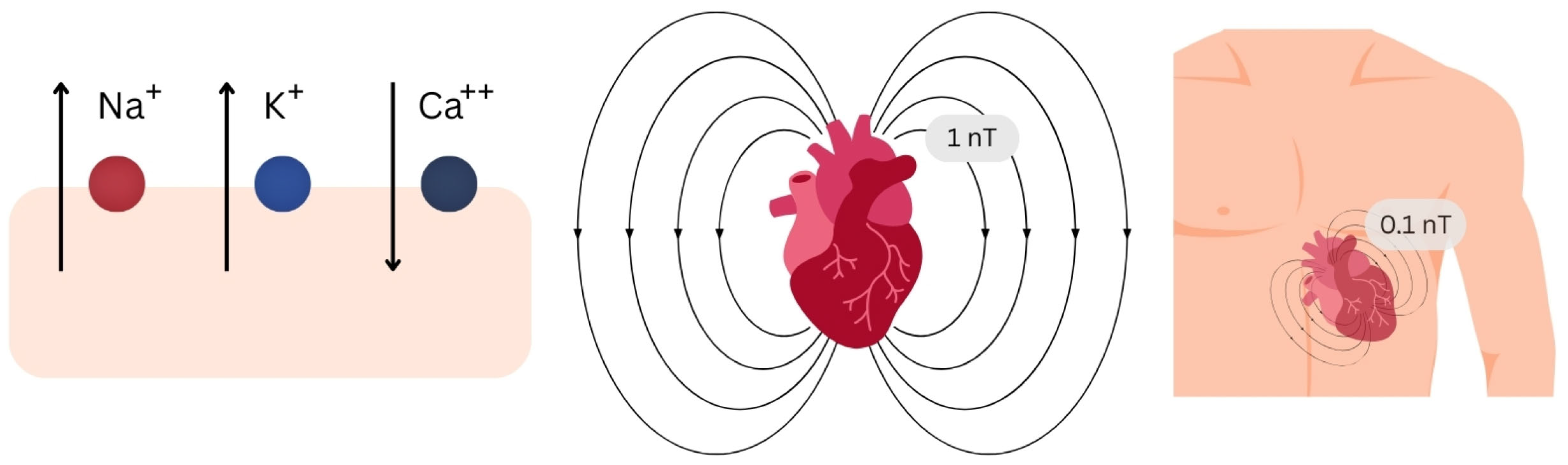
2.1. Biophysical Basis of the Heart’s Electromagnetic Signal
2.2. Proposed Mechanisms for Magnetic Field Interactions with Biological Systems
2.2.1. Radical Pairs
2.2.2. Stochastic Resonance
2.3. Measurement Techniques for Cardiac Electromagnetic Signals

| Measurement Technique | Advantages | Typical Sensitivity | Detection Range | Commercial Status | Limitations | References |
|---|---|---|---|---|---|---|
| Magnetoelectric sensors | Highly sensitive, low power, promising for portable MCG technologies | 1 pT/√Hz to 1 nT/√Hz | 1 Hz to several KHz | Primarily academic/prototype stage; not clinically routine | Temperature sensitivity, require shielding, experimental | [25,26,51] |
| SERF atomic magnetometers | Ultra-sensitive, room-temperature, promising for miniaturization | 1–10 fT/√Hz | DC to 102 Hz | Commercial research-grade sensors available; not clinically routine | Require shielding, complex, bulky & expensive, not clinically routine | [25,26,52] |
| Magnetoresistive sensors (GMR, TMR) | Compact, can detect P-wave and QRS after averaging | 100–300 pT/√Hz at 1 Hz | DC to 100 kHz | Commercially available sensors; emerging biomagnetic applications | Sensitive to interference, expensive | [23,25,26,53] |
| Optically pumped magnetometers | Room-temperature operation, promising for wearable MCG | 5–25 fT/√Hz | DC to 100–200 Hz; extendable to 2 kHz | Commercial research systems available; emerging clinical translation | Highly noise-sensitive | [25,26,54] |
| SQUIDs | Ultrasensitive (femtoteslaresolution), high diagnostic accuracy | 0.3–5 fT/√Hz | DC to 100 kHz | Established commercial clinical/research systems (mature platform) | Require cryogenic cooling and shielded rooms | [21,22,23,25,26,55] |
| Proton precession magnetometers | Portable, useful in MRI enhancement | 0.1 nT | 0.1–4 Hz | Fully commercial (geophysics/industrial); not used clinically for MCG | Calibration issues and noise | [25,26,56] |
| Fluxgate magnetometers | Highly sensitive and stable, feasible for MCG | 0.05–0.1 nT/√Hz | DC to 1 kHz | Mature/established commercial technology (geophysical applications) | Bulky and power-demanding | [25,26,57] |
| Hall effect sensors | Small and robust | 56–800 pT/√Hz | 0.4–4 mT | Fully commercial, mass-market semiconductor technology | Limited sensitivity; require shielding | [25,26,58] |
| Search coil magnetometers | Cost-effective | 0.05–2 pT/√Hz | 1 Hz to 10 kHz | Commercial as instrumentation sensors; research use in biomagnetics | Noisy and temperature-sensitive | [25,26,59] |
| Induction coil magnetometers | Simple, effective near the chest | 0.1–0.3 pT/√Hz | Hz to 10 kHz | Commercial instrumentation components; not mainstream clinical MCG | Prone to noise | [23,25,26,27,60] |
2.4. Artificial Intelligence in Magnetocardiography
| Study | Model | Input | Task | Dataset (n) | Performance | Limitations |
|---|---|---|---|---|---|---|
| Fenici et al. [69] | Classical ML classifiers | Handcrafted multichannel MCG features | IHD diagnosis | 147 | Sens 75%, Spec 85%, Acc 80% | Handcrafted features; small dataset |
| Tantimongcolwat et al. [70] | BNN; DK-SOM | Handcrafted features | IHD detection | 125 | DK-SOM:Sens 86.2%, Spec. 72.7% BNN: Sens 89.7%, Spec 54.5% | Small dataset; engineered inputs |
| Huang et al. [71] | Multiple MLP models (M1–M11) | 10 predefined MCG parameters | CAD/IHD classification | 209 | Acc 71.2–90.5% (M10): Sens 89.5%, Spec 89.8% (M11): Sens 90%, Spec 91.4% | Handcrafted features |
| Tao et al. [72] | SVM-XGBoost | 164 T-wave features | IHD detection | 574 | Acc 94.03% Prec 86.56% AUC = 0.98 | Limited validation detail |
| Han et al. [73] | SVM | Handcrafted features | CAD severity | N/A | Sens 67.0% Spec 88.8% AUC 0.876 | Limited validation scale |
| Tao et al. [74] | Multi-task DL | Averaged MCG cycles; spatio-temporal maps | IHD diagnosis + localization | 2.158 | (IHD): Sens 83.8%, Spec 85.6%, Acc 84.7% (Localization): Acc 65.3–78.4% | No ECG comparison; limited external validation |
| Kranz et al. [75] | Self-supervised contrastive encoder MCG2Vec | Raw 64-channel 10 s MCG signals | CAD, LVEF, AF prediction | 1732 | CAD AUC 0.89; LVEF AUC 0.81; AF AUC 0.77 | Single-center; no external validation; no calibration metrics |
| Tu et al. [76] | Random Forest; CatBoost; SVM; XGBoost | OPM-MCG repolarization + morphology | CAD diagnosis | 1513 | Heart models: AUC 0.84–0.88 Clinical: AUC 0.62–0.75 Combined: AUC 0.75–0.9 | Single-center; default hyperparameters; no external validation |
| Wang et al. [77] | DCBAM | Hilbert-encoded 36-channel MCG images | CAD classification) | N/A | Acc 93.57%; Sens 92.56%; Spec 94.68%; F1 93.60%; | No broad external validation; preprocessing dependence |
2.5. Interactions with External Fields and Physiological Implications
2.5.1. Strong Static and Clinical Fields
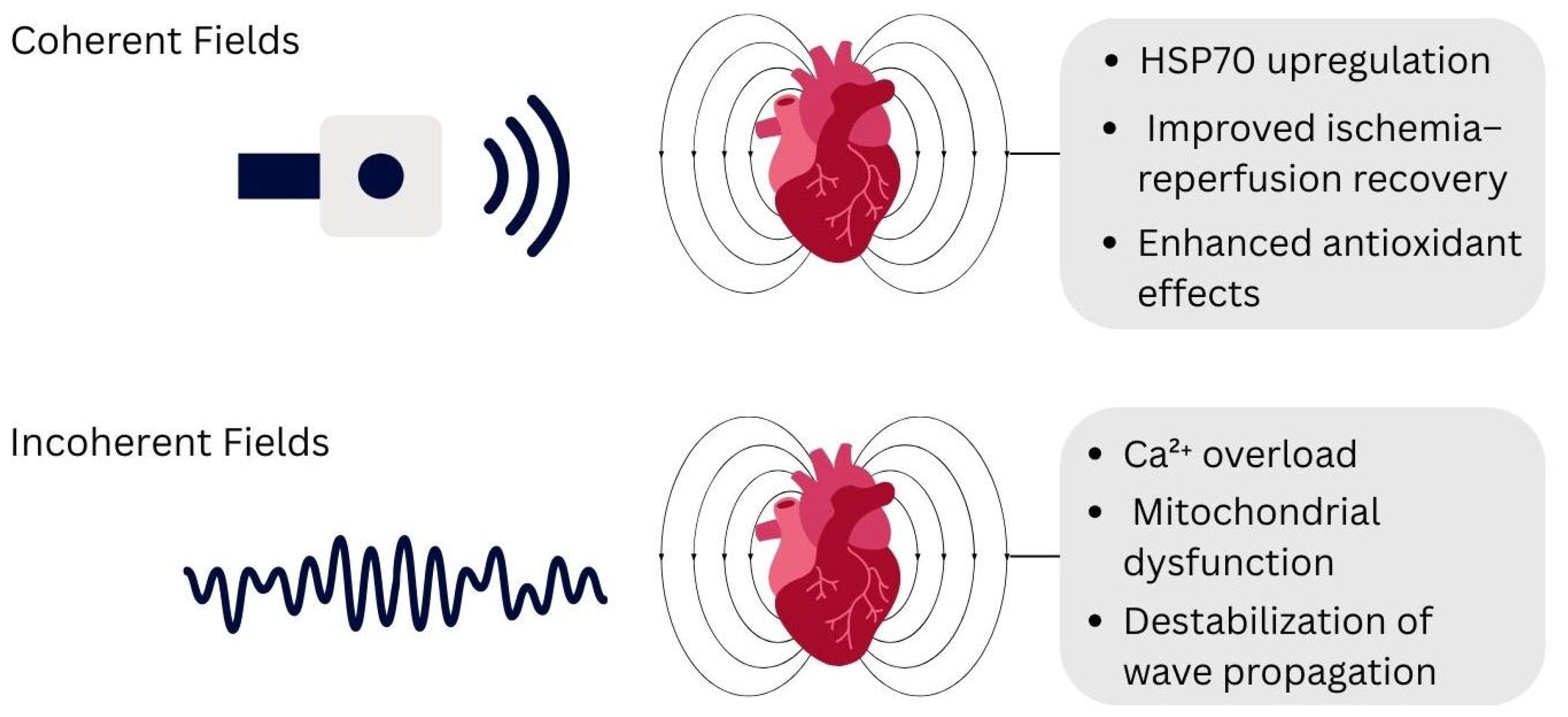
2.5.2. Artificial EMFs
2.6. Geomagnetic Interactions
2.7. Interpersonal and Geomagnetic Coupling
3. Magnetic Field Dynamics in Emotional States and Human Connection
4. Empathy
5. Magnetic Technologies in Sensor-Guided Therapeutic Interventions—BioMagnetoTherapies
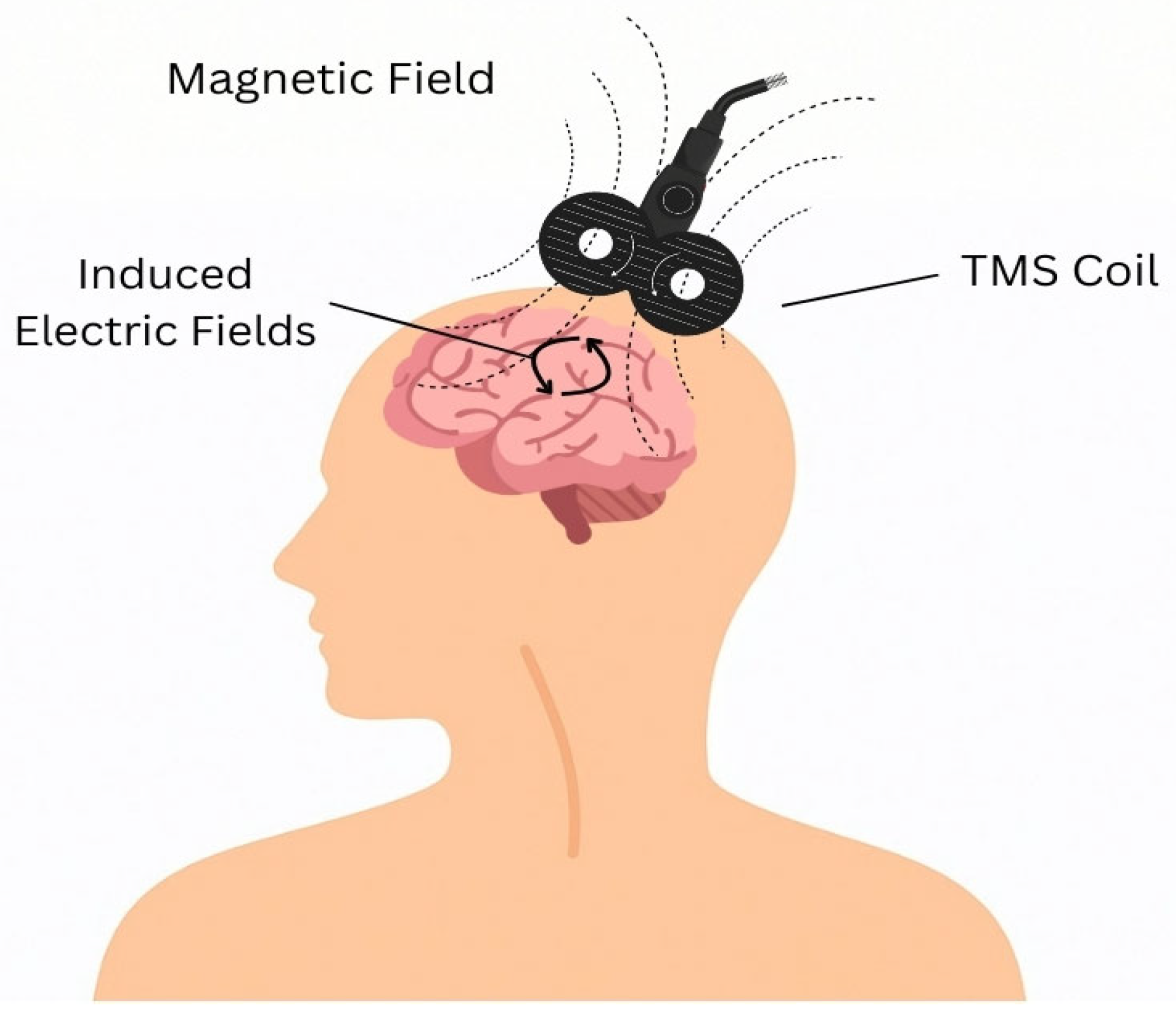
5.1. Transcranial Magnetic Stimulation
5.2. Magnetic Seizure Therapy
5.3. Low-Field and Static Magnetic Fields
5.4. Pulsed Electromagnetic Field Therapy
5.5. Magnetic-Based Therapies
6. Conclusions
7. Future Perspectives
8. Discussion
Author Contributions
Funding
Institutional Review Board Statement
Informed Consent Statement
Data Availability Statement
Conflicts of Interest
Abbreviations
| AI | Artificial Intelligence |
| HBA | Heart–brain axis |
| HRV | Heart rate variability |
| HPA | Hypothalamic pituitary axis |
| HSP70 | Heat shock protein 70 |
| HEMF | Heart’s electromagnetic field |
| ANS | Autonomic nervous system |
| EMF | Electromagnetic field |
| MRI | Magnetic Resonance Imaging |
| ELFs | Extremely low frequency fields |
| RPM | Radical Pair Mechanism |
| SR | Stochastic Resonance |
| MCG | Magnetocardiography |
| MS | Multiple Sclerosis |
| GCNs | Graph convolutional networks |
| SQUIDs | Superconducting Quantum Interference Devices |
| SOT | SQUID on tip |
| RAS | Renin angiotensin system |
| ECG | Electrocardiogram |
| EEG | Electroencephalogram |
| BMT | BioMagnetoTherapies |
| TMS | Transcranial magnetic stimulation |
| TMR | Tunneling magnetoresistance |
| dTMS | Deep transcranial magnetic stimulation |
| OCD | Obsessive–compulsive disorder |
| OPMs | Optically pumped magnetometers |
| MDD | Major depressive disorder |
| TRD | Treatment-resistant depression |
| Y-BOCS | Yale-brown obsessive-compulsive score |
| ECT | Electroconvulsive therapy |
| LFMS | Low-frequency magnetic stimulation |
| SMFs | Static magnetic fields |
| EGFR | Epidermal growth factor receptor |
| PEMF | Pulsed electromagnetic field |
| BBB | Blood–brain barrier |
| PTSD | Post-traumatic stress disorder |
| RMN | Remote magnetic navigation |
References
- Anagnostouli, M.; Markoglou, N.; Chrousos, G. Psycho-neuro-endocrino-immunologic issues in multiple sclerosis: A critical review of clinical and therapeutic implications. Hormones 2020, 19, 485–496. [Google Scholar] [CrossRef]
- Palantzas, A.; Anagnostouli, M. The Heart–Brain Axis in the Artificial Intelligence Era: Integrating Old and New Insights Towards New Targeting and Innovative Neuro- and Cardio-Therapeutics. Int. J. Mol. Sci. 2025, 26, 8217. [Google Scholar] [CrossRef] [PubMed]
- Genau, M.C.; Perreault, P.E.; Romito, E.; Doviak, H.; Logdon, C.B.; Ruble, S.; Spinale, F.G. Institution of localized high-frequency electrical stimulation targeting early myocardial infarction: Effects on left ventricle function and geometry. J. Thorac. Cardiovasc. Surg. 2018, 156, 568–575. [Google Scholar] [CrossRef] [PubMed]
- Dolphin, H.; Dukelow, T.; Finucane, C.; Commins, S.; McElwaine, P.; Kennelly, S.P. “The Wandering Nerve Linking Heart and Mind”—The Complementary Role of Transcutaneous Vagus Nerve Stimulation in Modulating Neuro-Cardiovascular and Cognitive Performance. Front. Neurosci. 2022, 16, 897303. [Google Scholar] [CrossRef]
- Xiao, W.; Sun, C.; Shen, L.; Feng, Y.; Liu, M.; Wu, Y.; Liu, X.; Wu, T.; Peng, X.; Guo, H. A movable unshielded magnetocardiography system. Sci. Adv. 2023, 9, eadg1746. [Google Scholar] [CrossRef]
- Di Passa, A.-M.; Dabir, M.; Fein, A.; Khoshroo, S.; McIntyre-Wood, C.; Marsden, E.; MacKillop, E.; De Jesus, J.; MacKillop, J.; Duarte, D. Clinical Efficacy of Deep Transcranial Magnetic Stimulation in Psychiatric and Cognitive Disorders: Protocol for a Systematic Review. JMIR Res. Protoc. 2023, 12, e45213. [Google Scholar] [CrossRef]
- Wang, S.; Pei, G.; Shen, J.; Fang, Z.; Chen, T.; Wang, L.; Cheng, H.; Li, H.; Pei, H.; Feng, Q.; et al. Pulsed electromagnetic fields treatment ameliorates cardiac function after myocardial infarction in mice and pigs. J. Adv. Res. 2025, 80, S2090123225002632. [Google Scholar] [CrossRef]
- Peng, L.; Fu, C.; Liang, Z.; Zhang, Q.; Xiong, F.; Chen, L.; He, C.; Wei, Q. Pulsed Electromagnetic Fields Increase Angiogenesis and Improve Cardiac Function After Myocardial Ischemia in Mice. Circ. J. 2020, 84, 186–193. [Google Scholar] [CrossRef]
- Ma, F.; Li, W.; Li, X.; Tran, B.H.; Suguro, R.; Guan, R.; Hou, C.; Wang, H.; Zhang, A.; Zhu, Y.; et al. Novel protective effects of pulsed electromagnetic field ischemia/reperfusion injury rats. Biosci. Rep. 2016, 36, e00420. [Google Scholar] [CrossRef]
- Capone, F.; Salati, S.; Vincenzi, F.; Liberti, M.; Aicardi, G.; Apollonio, F.; Varani, K.; Cadossi, R.; Di Lazzaro, V. Pulsed Electromagnetic Fields: A Novel Attractive Therapeutic Opportunity for Neuroprotection After Acute Cerebral Ischemia. Neuromodulation Technol. Neural Interface 2022, 25, 1240–1247. [Google Scholar] [CrossRef]
- Makovac, E.; Thayer, J.F.; Ottaviani, C. A meta-analysis of non-invasive brain stimulation and autonomic functioning: Implications for brain-heart pathways to cardiovascular disease. Neurosci. Biobehav. Rev. 2017, 74, 330–341. [Google Scholar] [CrossRef] [PubMed]
- Lee, H.; Lee, J.H.; Hwang, M.-H.; Kang, N. Repetitive transcranial magnetic stimulation improves cardiovascular autonomic nervous system control: A meta-analysis. J. Affect. Disord. 2023, 339, 443–453. [Google Scholar] [CrossRef] [PubMed]
- Iseger, T.A.; Padberg, F.; Kenemans, J.L.; Van Dijk, H.; Arns, M. Neuro-Cardiac-Guided TMS (NCG TMS): A replication and extension study. Biol. Psychol. 2021, 162, 108097. [Google Scholar] [CrossRef] [PubMed]
- Dijkstra, E.; Van Dijk, H.; Vila-Rodriguez, F.; Zwienenberg, L.; Rouwhorst, R.; Coetzee, J.P.; Blumberger, D.M.; Downar, J.; Williams, N.; Sack, A.T.; et al. Transcranial Magnetic Stimulation–Induced Heart-Brain Coupling: Implications for Site Selection and Frontal Thresholding—Preliminary Findings. Biol. Psychiatry Glob. Open Sci. 2023, 3, 939–947. [Google Scholar] [CrossRef]
- Dias, I.A.; Hazime, F.A.; Lopes, D.A.; Silva, C.S.D.; Baptista, A.F.; Silva, B.A.K.D. Effects of transcranial direct current stimulation on heart rate variability: A systematic review protocol. JBI Database Syst. Rev. Implement. Rep. 2019, 18, 1313–1319, Publish Ahead of Print. [Google Scholar] [CrossRef]
- Yan, Y.; Wang, T.; Zhang, R.; Liu, Y.; Hu, W.; Sitti, M. Magnetically assisted soft milli-tools for occluded lumen morphology detection. Sci. Adv. 2023, 9, eadi3979. [Google Scholar] [CrossRef]
- Zhang, M.; Yang, L.; Yang, H.; Su, L.; Xue, J.; Wang, Q.; Hao, B.; Jiang, Y.; Chan, K.F.; Sung, J.J.Y.; et al. A magnetically actuated microcatheter with soft rotatable tip for enhanced endovascular access and treatment efficiency. Sci. Adv. 2025, 11, eadv1682. [Google Scholar] [CrossRef]
- Thielen, B.; Xu, H.; Fujii, T.; Rangwala, S.D.; Jiang, W.; Lin, M.; Kammen, A.; Liu, C.; Selvan, P.; Song, D.; et al. Making a case for endovascular approaches for neural recording and stimulation. J. Neural Eng. 2023, 20, 011001. [Google Scholar] [CrossRef]
- Lee, D. Reinterpreting the Body: A Resonant Electromagnetic Model of the Heart–Brain Axis Matrix and Geomagnetic Synchronization. ÆPTIC J. Plasma Bioelectrics Evol. Sci. 2025, 1, 16–27. [Google Scholar] [CrossRef]
- Burleson, K.O.; Schwartz, G.E. Cardiac torsion and electromagnetic fields: The cardiac bioinformation hypothesis. Med. Hypotheses 2005, 64, 1109–1116. [Google Scholar] [CrossRef]
- McCraty, R.; Al Abdulgader, A. Consciousness, The Human Heart and The Global Energetic Field Environment. Cardiol. Vasc. Res. 2021, 5, 1–19. [Google Scholar] [CrossRef]
- Hart, R.A.; Gandhi, O.P. Comparison of cardiac-induced endogenous fields and power frequency induced exogenous fields in an anatomical model of the human body. Phys. Med. Biol. 1998, 43, 3083–3099. [Google Scholar] [CrossRef]
- Mayrovitz, H. Electromagnetic Fields in Relation to Cardiac and Vascular Function. In Pulsed Electromagnetic Fields for Clinical Applications, 1st ed.; Markov, M.S., Ryaby, J.T., Waldorff, E.I., Eds.; CRC Press: Boca Raton, FL, USA, 2020; pp. 105–135. [Google Scholar] [CrossRef]
- Elhalel, G.; Price, C.; Fixler, D.; Shainberg, A. Cardioprotection from stress conditions by weak magnetic fields in the Schumann Resonance band. Sci. Rep. 2019, 9, 1645. [Google Scholar] [CrossRef] [PubMed]
- Soltani, D.; Samimi, S.; Vasheghani-Farahani, A.; Shariatpanahi, S.P.; Abdolmaleki, P.; Madjid Ansari, A. Electromagnetic field therapy in cardiovascular diseases: A review of patents, clinically effective devices, and mechanism of therapeutic effects. Trends Cardiovasc. Med. 2023, 33, 72–78. [Google Scholar] [CrossRef] [PubMed]
- Elfouly, T.; Alouani, A. Harnessing the Heart’s Magnetic Field for Advanced Diagnostic Techniques. Sensors 2024, 24, 6017. [Google Scholar] [CrossRef]
- Baule, G.M.; McFee, R. The magnetic heart vector. Am. Heart J. 1970, 79, 223–236. [Google Scholar] [CrossRef] [PubMed]
- Tenforde, T.S. Magnetically induced electric fields and currents in the circulatory system. Prog. Biophys. Mol. Biol. 2005, 87, 279–288. [Google Scholar] [CrossRef]
- Borjanovic, S.S.; Jankovic, S.M.; Pejovic, Z. ECG Changes in Humans Exposed to 50 Hz Magnetic Fields. J. Occup. Health 2005, 47, 391–396. [Google Scholar] [CrossRef]
- Yu, K.; Wang, J.; Deng, B.; Wei, X. Synchronization of neuron population subject to steady DC electric field induced by magnetic stimulation. Cogn. Neurodynamics 2013, 7, 237–252. [Google Scholar] [CrossRef][Green Version]
- Wischnewski, M.; Tran, H.; Zhao, Z.; Shirinpour, S.; Haigh, Z.J.; Rotteveel, J.; Perera, N.D.; Alekseichuk, I.; Zimmermann, J.; Opitz, A. Induced neural phase precession through exogenous electric fields. Nat. Commun. 2024, 15, 1687. [Google Scholar] [CrossRef]
- Betti, M.; Picchi, M.P.C.; Saettoni, M.; Greco, A. Ion Cyclotron Resonance: Results and Prospects for Psychiatry. J. Psychiatry Treat. Res. 2019, 1, 16–24. [Google Scholar] [CrossRef]
- Zadeh-Haghighi, H.; Rishabh, R.; Simon, C. Hypomagnetic field effects as a potential avenue for testing the radical pair mechanism in biology. arXiv 2023, arXiv:2208.10465. [Google Scholar] [CrossRef]
- Zadeh-Haghighi, H.; Simon, C. Magnetic field effects in biology from the perspective of the radical pair mechanism. J. R. Soc. Interface 2022, 19, 20220325. [Google Scholar] [CrossRef] [PubMed]
- Hore, P.J.; Mouritsen, H. The Radical-Pair Mechanism of Magnetoreception. Annu. Rev. Biophys. 2016, 45, 299–344. [Google Scholar] [CrossRef]
- Ramsay, J.; Kattnig, D.R. Radical triads, not pairs, may explain effects of hypomagnetic fields on neurogenesis. PLoS Comput. Biol. 2022, 18, e1010519. [Google Scholar] [CrossRef]
- Moss, F.; Ward, L.M.; Sannita, W.G. Stochastic resonance and sensory information processing: A tutorial and review of application. Clin. Neurophysiol. 2004, 115, 267–281. [Google Scholar] [CrossRef]
- McDonnell, M.D.; Abbott, D. What Is Stochastic Resonance? Definitions, Misconceptions, Debates, and Its Relevance to Biology. PLoS Comput. Biol. 2009, 5, e1000348. [Google Scholar] [CrossRef]
- Nobukawa, S.; Nishimura, H. Synchronization of Chaos in Neural Systems. Front. Appl. Math. Stat. 2020, 6, 19. [Google Scholar] [CrossRef]
- Fu, Y.-X.; Kang, Y.-M.; Xie, Y. Subcritical Hopf Bifurcation and Stochastic Resonance of Electrical Activities in Neuron under Electromagnetic Induction. Front. Comput. Neurosci. 2018, 12, 6. [Google Scholar] [CrossRef]
- Garcés, P.; López-Sanz, D.; Maestú, F.; Pereda, E. Choice of Magnetometers and Gradiometers after Signal Space Separation. Sensors 2017, 17, 2926. [Google Scholar] [CrossRef]
- Vasyukov, D.; Anahory, Y.; Embon, L.; Halbertal, D.; Cuppens, J.; Neeman, L.; Finkler, A.; Segev, Y.; Myasoedov, Y.; Rappaport, M.L.; et al. A scanning superconducting quantum interference device with single electron spin sensitivity. Nat. Nanotechnol. 2013, 8, 639–644. [Google Scholar] [CrossRef] [PubMed]
- Clarke, J.; Lee, Y.-H.; Schneiderman, J. Focus on SQUIDs in Biomagnetism. Supercond. Sci. Technol. 2018, 31, 080201. [Google Scholar] [CrossRef]
- Savukov, I.; Kim, Y.J.; Shah, V.; Boshier, M.G. High-sensitivity operation of single-beam optically pumped magnetometer in a kHz frequency range. Meas. Sci. Technol. 2017, 28, 035104. [Google Scholar] [CrossRef]
- Coussens, T.; Gialopsou, A.; Abel, C.; Bason, M.G.; James, T.M.; Evans, W.; Woodley, M.T.M.; Nicolau, D.; Page, L.; Orucevic, F.; et al. A modular optically pumped magnetometer system. Quantum Sci. Technol. 2024, 9, 035045. [Google Scholar] [CrossRef]
- Cheng, H.; He, K.; Li, C.; Ma, X.; Zheng, F.; Xu, W.; Liao, P.; Yang, R.; Li, D.; Qin, L.; et al. Wireless optically pumped magnetometer MEG. NeuroImage 2024, 300, 120864. [Google Scholar] [CrossRef]
- Zhang, R.; Xiao, W.; Ding, Y.; Feng, Y.; Peng, X.; Shen, L.; Sun, C.; Wu, T.; Wu, Y.; Yang, Y.; et al. Recording brain activities in unshielded Earth’s field with optically pumped atomic magnetometers. Sci. Adv. 2020, 6, eaba8792. [Google Scholar] [CrossRef]
- Nakano, T.; Fujiwara, K.; Oogane, M. Tunnel-magnetoresistance sensors with sub-pT detectivity for detecting bio-magnetic fields. Appl. Phys. Lett. 2025, 126, 160503. [Google Scholar] [CrossRef]
- Luo, J.; Xu, Z.; Jin, Z.; Wang, M.; Cai, X.; Chen, J. Development and Comprehensive Evaluation of TMR Sensor-Based Magnetrodes. ACS Appl. Mater. Interfaces 2024, 16, 31677–31686. [Google Scholar] [CrossRef]
- Oogane, M.; Fujiwara, K.; Kanno, A.; Nakano, T.; Wagatsuma, H.; Arimoto, T.; Mizukami, S.; Kumagai, S.; Matsuzaki, H.; Nakasato, N.; et al. Sub-pT magnetic field detection by tunnel magneto-resistive sensors. Appl. Phys. Express 2021, 14, 123002. [Google Scholar] [CrossRef]
- Bichurin, M.; Petrov, R.; Sokolov, O.; Leontiev, V.; Kuts, V.; Kiselev, D.; Wang, Y. Magnetoelectric Magnetic Field Sensors: A Review. Sensors 2021, 21, 6232. [Google Scholar] [CrossRef]
- Shah, V.K.; Wakai, R.T. A compact, high performance atomic magnetometer for biomedical applications. Phys. Med. Biol. 2013, 58, 8153–8161. [Google Scholar] [CrossRef]
- Xu, Y.; Jin, Z.; Chen, J. High-Precision Tunneling Magnetoresistance (TMR) Current Sensor for Weak Current Measurement in Smart Grid Applications. Micromachines 2025, 16, 136. [Google Scholar] [CrossRef]
- Iivanainen, J.; Carter, T.R.; Dhombridge, J.E.; Read, T.S.; Campbell, K.; Abate, Q.; Ridley, D.M.; Borna, A.; Schwindt, P.D.D. Four-channel optically pumped magnetometer for a magnetoencephalography sensor array. Opt. Express 2024, 32, 18334. [Google Scholar] [CrossRef] [PubMed]
- Robbes, D. Highly sensitive magnetometers—A review. Sens. Actuators A Phys. 2006, 129, 86–93. [Google Scholar] [CrossRef]
- Zhan, X.; Yang, H.; Zhang, B.; Liu, J.; Zhang, Y.; Li, F. Application of Comprehensive Geophysical Methods in the Exploration of Fire Area No. 1 in the Miaoergou Coal Field, Xinjiang. Appl. Sci. 2025, 15, 11164. [Google Scholar] [CrossRef]
- Wei, S.; Liao, X.; Zhang, H.; Pang, J.; Zhou, Y. Recent Progress of Fluxgate Magnetic Sensors: Basic Research and Application. Sensors 2021, 21, 1500. [Google Scholar] [CrossRef]
- Lahav, D.; Schultz, M.; Amrusi, S.; Grosz, A.; Klein, L. Planar Hall Effect Magnetic Sensors with Extended Field Range. Sensors 2024, 24, 4384. [Google Scholar] [CrossRef]
- Le Contel, O.; Leroy, P.; Roux, A.; Coillot, C.; Alison, D.; Bouabdellah, A.; Mirioni, L.; Meslier, L.; Galic, A.; Vassal, M.C.; et al. The Search-Coil Magnetometer for MMS. Space Sci. Rev. 2016, 199, 257–282. [Google Scholar] [CrossRef]
- Hospodarsky, G.B. Spaced-based search coil magnetometers. J. Geophys. Res. Space Phys. 2016, 121, 12068–12079. [Google Scholar] [CrossRef]
- Alabdulgade, A.; Maccraty, R.; Atkinson, M.; Vainoras, A.; Berškienė, K.; Mauricienė, V.; Daunoravičienė, A.; Navickas, Z.; Šmidtaitė, R.; Landauskas, M. Human heart rhythm sensitivity to earth local magnetic field fluctuations. J. Vibroengineering 2015, 17, 3271–3278. [Google Scholar]
- Timofejeva, I.; McCraty, R.; Atkinson, M.; Alabdulgader, A.A.; Vainoras, A.; Landauskas, M.; Šiaučiūnaitė, V.; Ragulskis, M. Global Study of Human Heart Rhythm Synchronization with the Earth’s Time Varying Magnetic Field. Appl. Sci. 2021, 11, 2935. [Google Scholar] [CrossRef]
- Zrenner, C.; Belardinelli, P.; Müller-Dahlhaus, F.; Ziemann, U. Closed-Loop Neuroscience and Non-Invasive Brain Stimulation: A Tale of Two Loops. Front. Cell. Neurosci. 2016, 10, 92. [Google Scholar] [CrossRef] [PubMed]
- Kassiri, H.; Tonekaboni, S.; Salam, M.T.; Soltani, N.; Abdelhalim, K.; Velazquez, J.L.P.; Genov, R. Closed-Loop Neurostimulators: A Survey and A Seizure-Predicting Design Example for Intractable Epilepsy Treatment. IEEE Trans. Biomed. Circuits Syst. 2017, 11, 1026–1040. [Google Scholar] [CrossRef] [PubMed]
- Zanos, S. Closed-Loop Neuromodulation in Physiological and Translational Research. Cold Spring Harb. Perspect. Med. 2019, 9, a034314. [Google Scholar] [CrossRef]
- Alrashdan, F.; Yang, K.; Robinson, J.T. Magnetoelectrics for Implantable Bioelectronics: Progress to Date. Acc. Chem. Res. 2024, 57, 2953–2962. [Google Scholar] [CrossRef]
- Singer, A.; Dutta, S.; Lewis, E.; Chen, Z.; Chen, J.C.; Verma, N.; Avants, B.; Feldman, A.K.; O’Malley, J.; Beierlein, M.; et al. Magnetoelectric Materials for Miniature, Wireless Neural Stimulation at Therapeutic Frequencies. Neuron 2020, 107, 631–643.e5. [Google Scholar] [CrossRef]
- Zuo, S.; Heidari, H.; Farina, D.; Nazarpour, K. Miniaturized Magnetic Sensors for Implantable Magnetomyography. Adv. Mater. Technol. 2020, 5, 2000185. [Google Scholar] [CrossRef]
- Fenici, R.; Brisinda, D.; Meloni, A.M.; Sternickel, K.; Fenici, P. Clinical Validation of Machine Learning for Automatic Analysis of Multichannel Magnetocardiography. In Functional Imaging and Modeling of the Heart; Frangi, A.F., Radeva, P.I., Santos, A., Hernandez, M., Eds.; Springer: Berlin/Heidelberg, Germany, 2005; Volume 3504, pp. 143–152. [Google Scholar] [CrossRef]
- Tantimongcolwat, T.; Naenna, T.; Isarankura-Na-Ayudhya, C.; Embrechts, M.J.; Prachayasittikul, V. Identification of ischemic heart disease via machine learning analysis on magnetocardiograms. Comput. Biol. Med. 2008, 38, 817–825. [Google Scholar] [CrossRef]
- Huang, X.; Chen, P.; Tang, F.; Hua, N. Detection of coronary artery disease in patients with chest pain: A machine learning model based on magnetocardiography parameters. Clin. Hemorheol. Microcirc. 2021, 78, 227–236. [Google Scholar] [CrossRef]
- Tao, R.; Zhang, S.; Huang, X.; Tao, M.; Ma, J.; Ma, S.; Zhang, C.; Zhang, T.; Tang, F.; Lu, J.; et al. Magnetocardiography-Based Ischemic Heart Disease Detection and Localization Using Machine Learning Methods. IEEE Trans. Biomed. Eng. 2019, 66, 1658–1667. [Google Scholar] [CrossRef]
- Han, X.; Pang, J.; Xu, D.; Wang, R.; Xie, F.; Yang, Y.; Sun, J.; Li, Y.; Li, R.; Yin, X.; et al. Magnetocardiography-based coronary artery disease severity assessment and localization using spatiotemporal features. Physiol. Meas. 2023, 44, 125002. [Google Scholar] [CrossRef] [PubMed]
- Tao, R.; Zhang, S.; Zhang, R.; Shen, C.; Ma, J.; Cui, J.; Chen, Y.; Wang, B.; Li, H.; Xie, X.; et al. AI-enabled diagnosis and localization of myocardial ischemia and coronary artery stenosis from magnetocardiographic recordings. Sci. Rep. 2025, 15, 6094. [Google Scholar] [CrossRef] [PubMed]
- Kranz, D.D.; Kahriman, O.; Dischl, D.; Treskatsch, S.; Sander, A.; Brachmann, J.; Park, J.-W.; Wessel, N. Deep learning enhanced magnetocardiography enables multi-task detection of coronary, ventricular, and rhythm disorders. medRxiv 2025. 2025.11.30.25341301. [Google Scholar] [CrossRef]
- Tu, C.; Yang, S.; Wang, Z.; Liu, L.; Ma, Z.; Zhang, H.; Feng, L.; Cai, B.; Zhang, H.; Ding, M.; et al. Machine learning in diagnosing coronary artery disease via optical pumped magnetometer magnetocardiography: A prospective cohort study. Physiol. Meas. 2025, 46, 085003. [Google Scholar] [CrossRef] [PubMed]
- Wang, R.; Pang, J.; Han, X.; Xiang, M.; Ning, X. Automated magnetocardiography classification using a deformable convolutional block attention module. Biomed. Signal Process. Control 2025, 105, 107602. [Google Scholar] [CrossRef]
- Wang, R.; Liu, Z.; Pang, J.; Sun, J.; Xiang, M.; Ning, X. SkipDAEformer: A High-Precision Representation Learning Method for Removing Random Mixed Noise in MCG Signals. IEEE J. Biomed. Health Inform. 2025, 29, 8086–8099. [Google Scholar] [CrossRef]
- DiCarlo, A.L.; Farrell, J.M.; Litovitz, T.A. Myocardial Protection Conferred by Electromagnetic Fields. Circulation 1999, 99, 813–816. [Google Scholar] [CrossRef][Green Version]
- George, I.; Geddis, M.S.; Lill, Z.; Lin, H.; Gomez, T.; Blank, M.; Oz, M.C.; Goodman, R. Myocardial function improved by electromagnetic field induction of stress protein hsp70. J. Cell. Physiol. 2008, 216, 816–823. [Google Scholar] [CrossRef]
- Qin, C.; Evans, J.M.; Yamanashi, W.S.; Scherlag, B.J.; Foreman, R.D. Effects on Rats of Low Intensity and Frequency Electromagnetic Field Stimulation on Thoracic Spinal Neurons Receiving Noxious Cardiac and Esophageal Inputs. Neuromodulation Technol. Neural Interface 2005, 8, 79–87. [Google Scholar] [CrossRef]
- Biały, D.; Wawrzyńska, M.; Bil-Lula, I.; Krzywonos-Zawadzka, A.; Sapa-Wojciechowska, A.; Arkowski, J.; Woźniak, M.; Sawicki, G. Low frequency electromagnetic field decreases ischemia–reperfusion injury of human cardiomyocytes and supports their metabolic function. Exp. Biol. Med. 2018, 243, 809–816. [Google Scholar] [CrossRef]
- Jaruševičius, G.; Rugelis, T.; McCraty, R.; Landauskas, M.; Berškienė, K.; Vainoras, A. Correlation between Changes in Local Earth’s Magnetic Field and Cases of Acute Myocardial Infarction. Int. J. Environ. Res. Public Health 2018, 15, 399. [Google Scholar] [CrossRef]
- Ziubryte, G.; Siauciunaite, V.; Jarusevicius, G.; McCraty, R. Local earth magnetic field and ischemic heart disease: Peculiarities of interconnection. Cardiovasc. Disord. Med. 2018, 3, 1–3. [Google Scholar] [CrossRef]
- Vanagaitė, G.; Jakuškaitė, G.; Žiubrytė, G.; Landauskas, M.; Vainoras, A.; McCraty, R.; Jaruševičius, G. Correlation between ST-elevation myocardial infarction, non-ST-elevation myocardial infarction and the local Earth’s magnetic field changes. J. Complex. Health Sci. 2022, 5, 15–21. [Google Scholar] [CrossRef]
- Stoupel, E. Brief Review Cardiac Arrhythmia and Geomagnetic Activity. Indian Pacing Electrophysiol. J. 2006, 6, 49–53. [Google Scholar] [PubMed]
- McDonnell, A. The Sixth Sense-Emotional Contagion; Review of Biophysical Mechanisms Influencing Information Transfer in Groups. J. Behav. Brain Sci. 2014, 4, 342–374. [Google Scholar] [CrossRef]
- Kuman, M. The Key to Health and Happiness–Measurements show that not only is it Important What You Eat and Drink, it is Equally Important What You Think. Curr. Trends Biomed. Eng. Biosci. 2019, 18, 555980. [Google Scholar] [CrossRef]
- Pitkänen, M. Emotions as Sensory Percepts About the State of Magnetic Body? J. Conscious. Explor. Res. 2018, Preprint. [Google Scholar] [CrossRef]
- McCraty, R.; Deyhle, A.; Childre, D. The Global Coherence Initiative: Creating a Coherent Planetary Standing Wave. Glob. Adv. Health Med. 2012, 1, 64–77. [Google Scholar] [CrossRef]
- Morris, S.M. Achieving collective coherence: Group effects on heart rate variability coherence and heart rhythm synchronization. Altern. Ther. Health Med. 2010, 16, 62–72. [Google Scholar]
- McCraty, R.; Atkinson, M.; Stolc, V.; Alabdulgader, A.; Vainoras, A.; Ragulskis, M. Synchronization of Human Autonomic Nervous System Rhythms with Geomagnetic Activity in Human Subjects. Int. J. Environ. Res. Public Health 2017, 14, 770. [Google Scholar] [CrossRef]
- Timofejeva, I.; McCraty, R.; Atkinson, M.; Joffe, R.; Vainoras, A.; Alabdulgader, A.; Ragulskis, M. Identification of a Group’s Physiological Synchronization with Earth’s Magnetic Field. Int. J. Environ. Res. Public Health 2017, 14, 998. [Google Scholar] [CrossRef] [PubMed]
- Del Seppia, C.; Mezzasalma, L.; Messerotti, M.; Cordelli, A.; Ghione, S. Simulation of the geomagnetic field experienced by the International Space Station in its revolution around the Earth: Effects on psychophysiological responses to affective picture viewing. Neurosci. Lett. 2006, 400, 197–202. [Google Scholar] [CrossRef] [PubMed]
- Marino, A.A.; Nilsen, E.; Chesson, A.L.; Frilot, C. Effect of low-frequency magnetic fields on brain electrical activity in human subjects. Clin. Neurophysiol. 2004, 115, 1195–1201. [Google Scholar] [CrossRef] [PubMed]
- Saroka, K.S. Detection of the Electromagnetic Equivalents of the Emotional Characteristics of Words: Implications for the Electronic-Listening Generation. Open Behav. Sci. J. 2011, 5, 24–27. [Google Scholar] [CrossRef]
- Kim, S.-Y.K.; Lim, W. Characterization of Weak Collective Neural Coherence. J. Korean Phys. Soc. 2010, 57, 1290–1294. [Google Scholar] [CrossRef]
- McFadden, J. The conscious electromagnetic information field theory: The hard problem made easy? J. Conscious. Stud. 2002, 9, 45–60. Available online: https://philarchive.org/archive/MCFTCE (accessed on 2 February 2025).
- Pockett, S. The electromagnetic field theory of consciousness a testable hypothesis about the characteristics of conscious as opposed to non-conscious fields. J. Conscious. Stud. 2012, 19, 191–223. [Google Scholar]
- Levkovitz, Y.; Rabany, L.; Harel, E.V.; Zangen, A. Deep transcranial magnetic stimulation add-on for treatment of negative symptoms and cognitive deficits of schizophrenia: A feasibility study. Int. J. Neuropsychopharmacol. 2011, 14, 991–996. [Google Scholar] [CrossRef]
- Tendler, A.; Barnea Ygael, N.; Roth, Y.; Zangen, A. Deep transcranial magnetic stimulation (dTMS)—Beyond depression. Expert Rev. Med. Devices 2016, 13, 987–1000. [Google Scholar] [CrossRef]
- Lusicic, A.; Schruers, K.R.; Pallanti, S.; Castle, D.J. Transcranial magnetic stimulation in the treatment of obsessivendash;compulsive disorder: Current perspectives. Neuropsychiatr. Dis. Treat. 2018, 14, 1721–1736. [Google Scholar] [CrossRef]
- Tendler, A.; Gersner, R.; Roth, Y.; Stein, A.; Harmelech, T.; Hanlon, C.A. Deep TMS: A comprehensive summary of adverse events from five multicenter trials. Brain Stimul. 2023, 16, 1123–1125. [Google Scholar] [CrossRef]
- Kaster, T.S.; Daskalakis, Z.J.; Noda, Y.; Knyahnytska, Y.; Downar, J.; Rajji, T.K.; Levkovitz, Y.; Zangen, A.; Butters, M.A.; Mulsant, B.H.; et al. Efficacy, tolerability, and cognitive effects of deep transcranial magnetic stimulation for late-life depression: A prospective randomized controlled trial. Neuropsychopharmacology 2018, 43, 2231–2238. [Google Scholar] [CrossRef] [PubMed]
- Levkovitz, Y.; Isserles, M.; Padberg, F.; Lisanby, S.H.; Bystritsky, A.; Xia, G.; Tendler, A.; Daskalakis, Z.J.; Winston, J.L.; Dannon, P.; et al. Efficacy and safety of deep transcranial magnetic stimulation for major depression: A prospective multicenter randomized controlled trial. World Psychiatry 2015, 14, 64–73. [Google Scholar] [CrossRef] [PubMed]
- Lan, X.-J.; Yang, X.-H.; Mo, Y.; Deng, C.-J.; Huang, X.-B.; Cai, D.-B.; Zheng, W. Deep transcranial magnetic stimulation for treatment-resistant depression: A systematic review and meta-analysis of randomized controlled studies. Asian J. Psychiatry 2024, 96, 104032. [Google Scholar] [CrossRef] [PubMed]
- Tastevin, M.; Richieri, R.; Boyer, L.; Fond, G.; Lançon, C.; Guedj, E. Brain PET metabolic substrate of TMS response in pharmaco-resistant depression. Brain Stimul. 2020, 13, 683–685. [Google Scholar] [CrossRef]
- Cole, E.J.; Phillips, A.L.; Bentzley, B.S.; Stimpson, K.H.; Nejad, R.; Barmak, F.; Veerapal, C.; Khan, N.; Cherian, K.; Felber, E.; et al. Stanford Neuromodulation Therapy (SNT): A Double-Blind Randomized Controlled Trial. Am. J. Psychiatry 2022, 179, 132–141. [Google Scholar] [CrossRef]
- Caulfield, K.A. Is accelerated, high-dose theta burst stimulation a panacea for treatment-resistant depression? J. Neurophysiol. 2020, 123, 1–3. [Google Scholar] [CrossRef]
- Cole, E.J.; Stimpson, K.H.; Bentzley, B.S.; Gulser, M.; Cherian, K.; Tischler, C.; Nejad, R.; Pankow, H.; Choi, E.; Aaron, H.; et al. Stanford Accelerated Intelligent Neuromodulation Therapy for Treatment-Resistant Depression. Am. J. Psychiatry 2020, 177, 716–726. [Google Scholar] [CrossRef]
- Yu, F.; Tang, X.; Hu, R.; Liang, S.; Wang, W.; Tian, S.; Wu, Y.; Yuan, T.-F.; Zhu, Y. The After-Effect of Accelerated Intermittent Theta Burst Stimulation at Different Session Intervals. Front. Neurosci. 2020, 14, 576. [Google Scholar] [CrossRef]
- Shanok, N.A.; Rodriguez, S.; Muzac, S.; Huertas Del Pino, C.; Brown, L.; Rodriguez, R. Deep transcranial magnetic stimulation alters resting-state neurophysiological traits in major depressive disorder. J. Affect. Disord. 2023, 337, 104–111. [Google Scholar] [CrossRef]
- Carmi, L.; Tendler, A.; Bystritsky, A.; Hollander, E.; Blumberger, D.M.; Daskalakis, J.; Ward, H.; Lapidus, K.; Goodman, W.; Casuto, L.; et al. Efficacy and Safety of Deep Transcranial Magnetic Stimulation for Obsessive-Compulsive Disorder: A Prospective Multicenter Randomized Double-Blind Placebo-Controlled Trial. Am. J. Psychiatry 2019, 176, 931–938. [Google Scholar] [CrossRef] [PubMed]
- Carmi, L.; Alyagon, U.; Barnea-Ygael, N.; Zohar, J.; Dar, R.; Zangen, A. Clinical and electrophysiological outcomes of deep TMS over the medial prefrontal and anterior cingulate cortices in OCD patients. Brain Stimul. 2018, 11, 158–165. [Google Scholar] [CrossRef] [PubMed]
- Calabrò, R.S.; Billeri, L.; Manuli, A.; Iacono, A.; Naro, A. Applications of transcranial magnetic stimulation in migraine: Evidence from a scoping review. J. Integr. Neurosci. 2022, 21, 110. [Google Scholar] [CrossRef] [PubMed]
- Sy, A.; Thebault, S.; Aviv, R.I.; Auriat, A.M. An Overview of Transcranial Magnetic Stimulation and Its Application in Multiple Sclerosis. Appl. Sci. 2023, 13, 12679. [Google Scholar] [CrossRef]
- Abualait, T.; Mukhtar, S.; Murtaza, G.; Al-Hussain, F.; Ali, E.N.; Bashir, S. Exploring the therapeutic and rehabilitative role of transcranial magnetic stimulation in multiple sclerosis. Eur. Rev. Med. Pharmacol. Sci. 2025, 29, 493–506. [Google Scholar] [CrossRef]
- Snow, N.J.; Wadden, K.P.; Chaves, A.R.; Ploughman, M. Transcranial Magnetic Stimulation as a Potential Biomarker in Multiple Sclerosis: A Systematic Review with Recommendations for Future Research. Neural Plast. 2019, 2019, 6430596. [Google Scholar] [CrossRef]
- Cole, E.; O’Sullivan, S.J.; Tik, M.; Williams, N.R. Accelerated Theta Burst Stimulation: Safety, Efficacy, and Future Advancements. Biol. Psychiatry 2024, 95, 523–535. [Google Scholar] [CrossRef]
- Lan, L.; Zhang, X.; Li, X.; Rong, X.; Peng, Y. The efficacy of transcranial magnetic stimulation on migraine: A meta-analysis of randomized controlled trails. J. Headache Pain 2017, 18, 86. [Google Scholar] [CrossRef]
- Bhola, R.; Kinsella, E.; Giffin, N.; Lipscombe, S.; Ahmed, F.; Weatherall, M.; Goadsby, P.J. Single-pulse transcranial magnetic stimulation (sTMS) for the acute treatment of migraine: Evaluation of outcome data for the UK post market pilot program. J. Headache Pain 2015, 16, 51. [Google Scholar] [CrossRef]
- Lloyd, J.O.; Hill, B.; Murphy, M.; Al-Kaisy, A.; Andreou, A.P.; Lambru, G. Single-Pulse Transcranial Magnetic Stimulation for the preventive treatment of difficult-to-treat migraine: A 12-month prospective analysis. J. Headache Pain 2022, 23, 63. [Google Scholar] [CrossRef]
- Del Mauro, L.; Vergallito, A.; Devoto, F.; Locatelli, G.; Hassan, G.; Romero Lauro, L.J. Beyond the Surface: Deep TMS Efficacy in Reducing Craving in Addictive Disorders. A Systematic Review and Meta-analysis. Psychiatry Clin. Psychol. 2024, 10, 1005–1014. [Google Scholar] [CrossRef]
- Harel, M.; Perini, I.; Kämpe, R.; Alyagon, U.; Shalev, H.; Besser, I.; Sommer, W.H.; Heilig, M.; Zangen, A. Repetitive Transcranial Magnetic Stimulation in Alcohol Dependence: A Randomized, Double-Blind, Sham-Controlled Proof-of-Concept Trial Targeting the Medial Prefrontal and Anterior Cingulate Cortices. Biol. Psychiatry 2022, 91, 1061–1069. [Google Scholar] [CrossRef] [PubMed]
- Kedzior, K.K.; Gerkensmeier, I.; Schuchinsky, M. Can deep transcranial magnetic stimulation (DTMS) be used to treat substance use disorders (SUD)? A systematic review. BMC Psychiatry 2018, 18, 137. [Google Scholar] [CrossRef] [PubMed]
- Aghamoosa, S.; Nolin, S.A.; Chen, A.A.; Caulfield, K.A.; Lopez, J.; Rbeiz, K.; Fleischmann, H.H.; Horn, O.; Madden, K.; Antonucci, M.; et al. Accelerated iTBS-Induced changes in resting-state functional connectivity correspond with cognitive improvement in amnestic MCI. Brain Stimul. 2025, 18, 957–964. [Google Scholar] [CrossRef]
- Ferrulli, A.; Macrì, C.; Terruzzi, I.; Massarini, S.; Ambrogi, F.; Adamo, M.; Milani, V.; Luzi, L. Weight loss induced by deep transcranial magnetic stimulation in obesity: A randomized, double-blind, sham-controlled study. Diabetes Obes. Metab. 2019, 21, 1849–1860. [Google Scholar] [CrossRef]
- Hanlon, C.A.; Lench, D.H.; Pell, G.; Roth, Y.; Zangen, A.; Tendler, A. Bilateral deep transcranial magnetic stimulation of motor and prefrontal cortices in Parkinson’s disease: A comprehensive review. Front. Hum. Neurosci. 2024, 17, 1336027. [Google Scholar] [CrossRef]
- Morriss, R.; Briley, P.M.; Webster, L.; Abdelghani, M.; Barber, S.; Bates, P.; Brookes, C.; Hall, B.; Ingram, L.; Kurkar, M.; et al. Connectivity-guided intermittent theta burst versus repetitive transcranial magnetic stimulation for treatment-resistant depression: A randomized controlled trial. Nat. Med. 2024, 30, 403–413. [Google Scholar] [CrossRef]
- Alario, A.A.; Pace, B.D.; Niciu, M.J.; Trapp, N.T. Transcranial magnetic stimulation induces heart rate decelerations independent of treatment outcome. Brain Stimul. 2023, 16, 1044–1046. [Google Scholar] [CrossRef]
- Jia, K.; Jin, Q.; Liu, A.; Wu, L. Remote magnetic navigation versus manual control navigation for atrial fibrillation ablation: A systematic review and meta-analysis. J. Electrocardiol. 2019, 55, 78–86. [Google Scholar] [CrossRef]
- Kosel, M.; Frick, C.; Lisanby, S.H.; Fisch, H.-U.; Schlaepfer, T.E. Magnetic Seizure Therapy Improves Mood in Refractory Major Depression. Neuropsychopharmacology 2003, 28, 2045–2048. [Google Scholar] [CrossRef][Green Version]
- McClintock, S.M.; Tirmizi, O.; Chansard, M.; Husain, M.M. A systematic review of the neurocognitive effects of magnetic seizure therapy. Int. Rev. Psychiatry 2011, 23, 413–423. [Google Scholar] [CrossRef] [PubMed]
- Tang, V.M.; Blumberger, D.M.; McClintock, S.M.; Kaster, T.S.; Rajji, T.K.; Downar, J.; Fitzgerald, P.B.; Daskalakis, Z.J. Magnetic Seizure Therapy in Treatment-Resistant Schizophrenia: A Pilot Study. Front. Psychiatry 2018, 8, 310. [Google Scholar] [CrossRef] [PubMed]
- Kayser, S.; Bewernick, B.H.; Matusch, A.; Hurlemann, R.; Soehle, M.; Schlaepfer, T.E. Magnetic seizure therapy in treatment-resistant depression: Clinical, neuropsychological and metabolic effects. Psychol. Med. 2015, 45, 1073–1092. [Google Scholar] [CrossRef] [PubMed]
- Jiang, J.; Zhang, C.; Li, C.; Chen, Z.; Cao, X.; Wang, H.; Li, W.; Wang, J. Magnetic seizure therapy for treatment-resistant depression: A Cochrane Review. BJPsych Adv. 2023, 29, 76. [Google Scholar] [CrossRef]
- Prillo, J.; Zapf, L.; Espinola, C.W.; Daskalakis, Z.J.; Blumberger, D.M. Magnetic Seizure Therapy in Refractory Psychiatric Disorders: A Systematic Review and Meta-Analysis: La thérapie par convulsions magnétiques pour la priseen charge des troubles psychiatriquesréfractaires: Revue systématique et méta-analyse. Can. J. Psychiatry 2025, 70, 732–749. [Google Scholar] [CrossRef]
- Daskalakis, Z.J.; Tamminga, C.; Throop, A.; Palmer, L.; Dimitrova, J.; Farzan, F.; Thorpe, K.E.; McClintock, S.M.; Blumberger, D.M. Confirmatory Efficacy and Safety Trial of Magnetic Seizure Therapy for Depression (CREST-MST): Study protocol for a randomized non-inferiority trial of magnetic seizure therapy versus electroconvulsive therapy. Trials 2021, 22, 786. [Google Scholar] [CrossRef]
- Weissman, C.R.; Blumberger, D.M.; Dimitrova, J.; Throop, A.; Voineskos, D.; Downar, J.; Mulsant, B.H.; Rajji, T.K.; Fitzgerald, P.B.; Daskalakis, Z.J. Magnetic Seizure Therapy for Suicidality in Treatment-Resistant Depression. JAMA Netw. Open 2020, 3, e207434. [Google Scholar] [CrossRef]
- Liu, Y.; Tang, Q.; Tao, Q.; Dong, H.; Shi, Z.; Zhou, L. Low-frequency magnetic field therapy for glioblastoma: Current advances, mechanisms, challenges and future perspectives. J. Adv. Res. 2025, 69, 531–543. [Google Scholar] [CrossRef]
- Sun, Z.; Zhu, K.; Zhao, W.; Fei, X.; Shi, L.; Zhang, Y. Potential mechanisms and clinical applications of static magnetic field therapy in glioma. Front. Neurol. 2025, 16, 1594874. [Google Scholar] [CrossRef]
- Moretti, J.; Rodger, J. A little goes a long way: Neurobiological effects of low intensity rTMS and implications for mechanisms of rTMS. Curr. Res. Neurobiol. 2022, 3, 100033. [Google Scholar] [CrossRef]
- Shafi, M.; Stern, A.P.; Pascual-Leone, A. Adding Low-Field Magnetic Stimulation to Noninvasive Electromagnetic Neuromodulatory Therapies. Biol. Psychiatry 2014, 76, 170–171. [Google Scholar] [CrossRef] [PubMed][Green Version]
- Rohan, M.; Parow, A.; Stoll, A.L.; Demopulos, C.; Friedman, S.; Dager, S.; Hennen, J.; Cohen, B.M.; Renshaw, P.F. Low-Field Magnetic Stimulation in Bipolar Depression Using an MRI-Based Stimulator. Am. J. Psychiatry 2004, 161, 93–98. [Google Scholar] [CrossRef] [PubMed]
- Sekar, S.; Zhang, Y.; MiranzadehMahabadi, H.; Buettner, B.; Taghibiglou, C. Low-Field Magnetic Stimulation Alleviates MPTP-Induced Alterations in Motor Function and Dopaminergic Neurons in Male Mice. Int. J. Mol. Sci. 2023, 24, 10328. [Google Scholar] [CrossRef] [PubMed]
- Dufor, T.; Lohof, A.M.; Sherrard, R.M. Magnetic Stimulation as a Therapeutic Approach for Brain Modulation and Repair: Underlying Molecular and Cellular Mechanisms. Int. J. Mol. Sci. 2023, 24, 16456. [Google Scholar] [CrossRef]
- Fujino, J.; Tei, S.; Itahashi, T.; Aoki, Y.Y.; Ohta, H.; Izuno, T.; Nakamura, H.; Shimizu, M.; Hashimoto, R.; Takahashi, H.; et al. A single session of navigation-guided repetitive transcranial magnetic stimulation over the right anterior temporoparietal junction in autism spectrum disorder. Brain Stimul. 2021, 14, 682–684. [Google Scholar] [CrossRef]
- Kosari, E.; Vafai, K. Thermal tissue damage analysis for magnetothermal neuromodulation and lesion size minimization. Brain Multiphysics 2020, 1, 100014. [Google Scholar] [CrossRef]
- Garg, J.; Gupta, R.; Chaudhary, R.; Gupta, R.; Patel, R.N.; Turagam, M.; Gupta, H.B.; Neki, N.S. Magnetic Versus Manual Catheter Navigation for Ablation of Ventricular Tachycardia: A Systemic Review and Meta-Analysis. Asian J. Med. Res. 2019, 8, ME01–ME06. [Google Scholar] [CrossRef]
- Li, X.; Jin, Q.; Zhang, N.; Ling, T.; Lin, C.; Jia, K.; Bao, Y.; Xie, Y.; Wei, Y.; Chen, K.; et al. Procedural outcomes and learning curve of cardiac arrhythmias catheter ablation using remote magnetic navigation: Experience from a large-scale single-center study. Clin. Cardiol. 2020, 43, 968–975. [Google Scholar] [CrossRef]
- Schlögl, S.; Schlögl, K.S.; Haarmann, H.; Bengel, P.; Bergau, L.; Rasenack, E.; Hasenfuss, G.; Zabel, M. Remote magnetic navigation versus manual catheter ablation of atrial fibrillation: A single center long-term comparison. Pacing Clin. Electrophysiol. 2022, 45, 14–22. [Google Scholar] [CrossRef]
- Bennett, R.G.; Campbell, T.; Sood, A.; Bhaskaran, A.; De Silva, K.; Davis, L.; Qian, P.; Sivagangabalan, G.; Cooper, M.J.; Chow, C.K.; et al. Remote magnetic navigation compared to contemporary manual techniques for the catheter ablation of ventricular arrhythmias in structural heart disease. Heliyon 2021, 7, e08538. [Google Scholar] [CrossRef]
- Signorelli, L.; Hescham, S.-A.; Pralle, A.; Gregurec, D. Magnetic nanomaterials for wireless thermal and mechanical neuromodulation. iScience 2022, 25, 105401. [Google Scholar] [CrossRef] [PubMed]
- Nijsink, H.; Overduin, C.G.; Willems, L.H.; Warlé, M.C.; Fütterer, J.J. Current State of MRI -Guided Endovascular Arterial Interventions: A Systematic Review of Preclinical and Clinical Studies. J. Magn. Reson. Imaging 2022, 56, 1322–1342. [Google Scholar] [CrossRef]
- Dreyfus, R.; Boehler, Q.; Lyttle, S.; Gruber, P.; Lussi, J.; Chautems, C.; Gervasoni, S.; Berberat, J.; Seibold, D.; Ochsenbein-Kölble, N.; et al. Dexterous helical magnetic robot for improved endovascular access. Sci. Robot. 2024, 9, eadh0298. [Google Scholar] [CrossRef]
- Santiago-Dieppa, D.R.; Friend, J. Endovascular Microrobotics for Neurointervention. Annu. Rev. Control. Robot. Auton. Syst. 2024, 7, 385–408. [Google Scholar] [CrossRef]
- Liu, X.; Wang, L.; Xiang, Y.; Liao, F.; Li, N.; Li, J.; Wang, J.; Wu, Q.; Zhou, C.; Yang, Y.; et al. Magnetic soft microfiberbots for robotic embolization. Sci. Robot. 2024, 9, eadh2479. [Google Scholar] [CrossRef] [PubMed]
- Zhang, S.; Yang, W.; Ge, J. Endovascular embolization by a magnetic microfiberbot. Natl. Sci. Rev. 2024, 11, nwae117. [Google Scholar] [CrossRef]
- Peng, Q.; Wang, S.; Han, J.; Huang, C.; Yu, H.; Li, D.; Qiu, M.; Cheng, S.; Wu, C.; Cai, M.; et al. Thermal and Magnetic Dual-Responsive Catheter-Assisted Shape Memory Microrobots for Multistage Vascular Embolization. Research 2024, 7, 0339. [Google Scholar] [CrossRef]
- Rouwhorst, R.; Van Oostrom, I.; Dijkstra, E.; Zwienenberg, L.; Van Dijk, H.; Arns, M. Vasovagal syncope as a specific side effect of DLPFC-rTMS: A frontal-vagal dose-finding study. Brain Stimul. 2022, 15, 1233–1235. [Google Scholar] [CrossRef]


Disclaimer/Publisher’s Note: The statements, opinions and data contained in all publications are solely those of the individual author(s) and contributor(s) and not of MDPI and/or the editor(s). MDPI and/or the editor(s) disclaim responsibility for any injury to people or property resulting from any ideas, methods, instructions or products referred to in the content. |
© 2026 by the authors. Licensee MDPI, Basel, Switzerland. This article is an open access article distributed under the terms and conditions of the Creative Commons Attribution (CC BY) license.
Share and Cite
Palantzas, A.; Anagnostouli, M. The Heart’s Electromagnetic Field in Emotions, Empathy and Human Connection: Biosensor-Derived Insights into Heart–Brain Axis Mechanisms and a Basis for Novel BioMagnetoTherapies. Sensors 2026, 26, 1738. https://doi.org/10.3390/s26051738
Palantzas A, Anagnostouli M. The Heart’s Electromagnetic Field in Emotions, Empathy and Human Connection: Biosensor-Derived Insights into Heart–Brain Axis Mechanisms and a Basis for Novel BioMagnetoTherapies. Sensors. 2026; 26(5):1738. https://doi.org/10.3390/s26051738
Chicago/Turabian StylePalantzas, Andreas, and Maria Anagnostouli. 2026. "The Heart’s Electromagnetic Field in Emotions, Empathy and Human Connection: Biosensor-Derived Insights into Heart–Brain Axis Mechanisms and a Basis for Novel BioMagnetoTherapies" Sensors 26, no. 5: 1738. https://doi.org/10.3390/s26051738
APA StylePalantzas, A., & Anagnostouli, M. (2026). The Heart’s Electromagnetic Field in Emotions, Empathy and Human Connection: Biosensor-Derived Insights into Heart–Brain Axis Mechanisms and a Basis for Novel BioMagnetoTherapies. Sensors, 26(5), 1738. https://doi.org/10.3390/s26051738