Two-Stage Microseismic P-Wave Arrival Picking via STA/LTA-Guided Lightweight U-Net

Abstract
1. Introduction
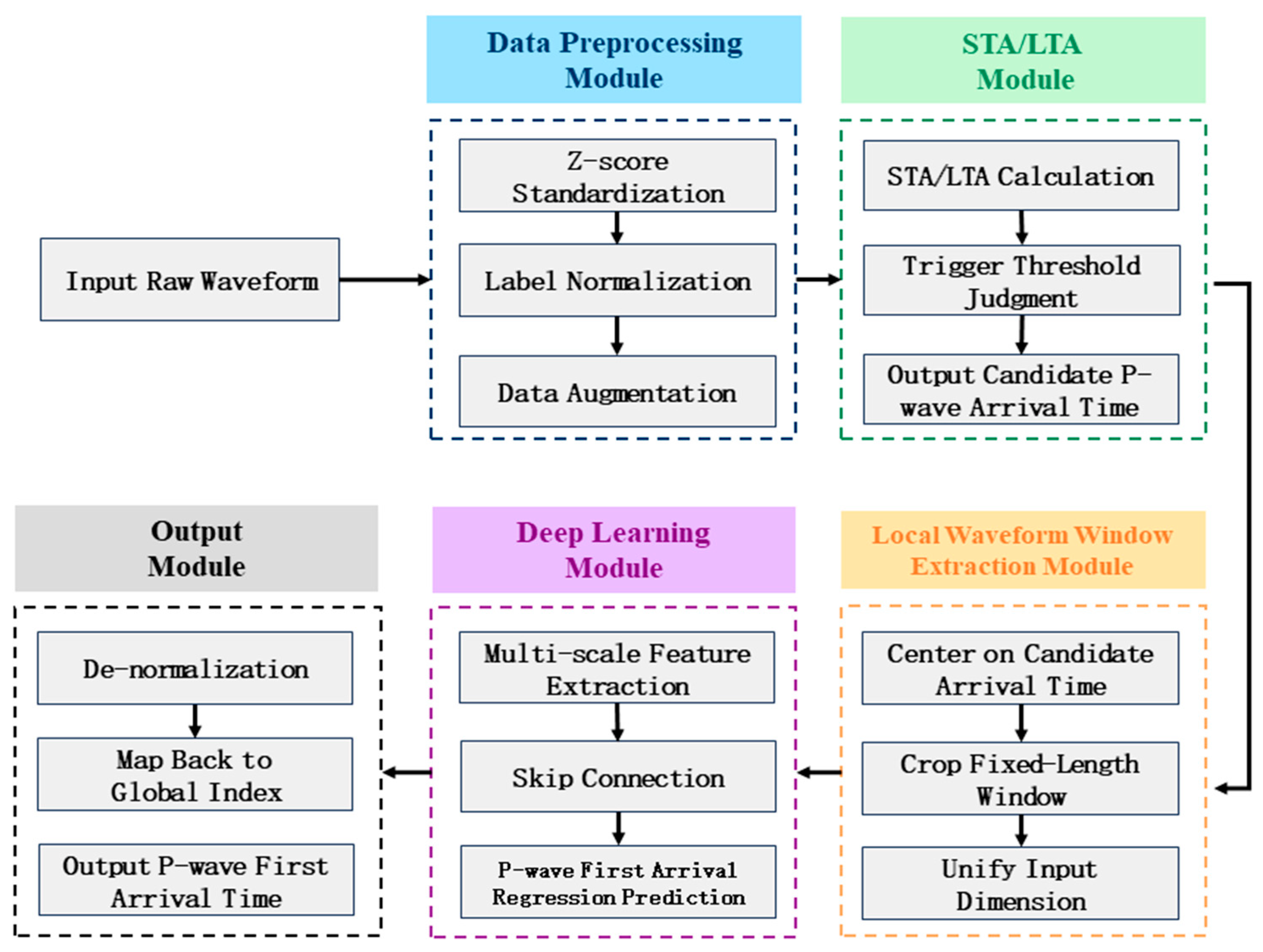
- A synergistic two-stage picking methodology is proposed that integrates conventional energy-ratio triggering with deep learning models, effectively balancing real-time performance with picking precision.
- An efficient local window extraction mechanism is designed to reduce computational redundancy while enhancing the model’s capacity to capture fine-grained waveform variations via a focusing strategy.
- Comprehensive experiments on real-world microseismic data and independent test sets demonstrate that the proposed method significantly outperforms conventional algorithms in accuracy and robustness, exhibiting strong generalization capability suitable for industrial deployment.
2. Methodology
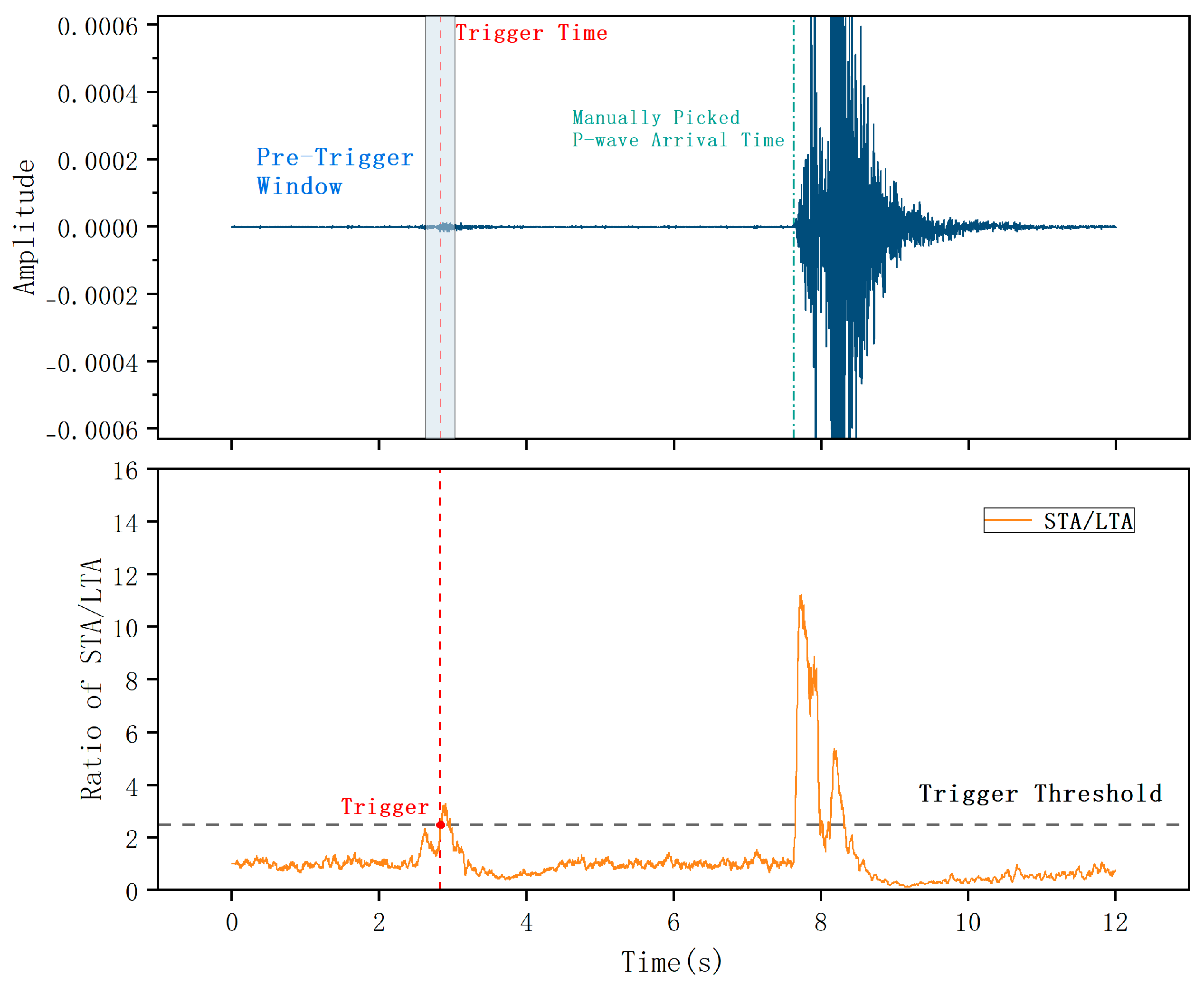
2.1. STA/LTA Detection and Local Window Extraction
2.2. U-Net-Based Fine Regression Refinement
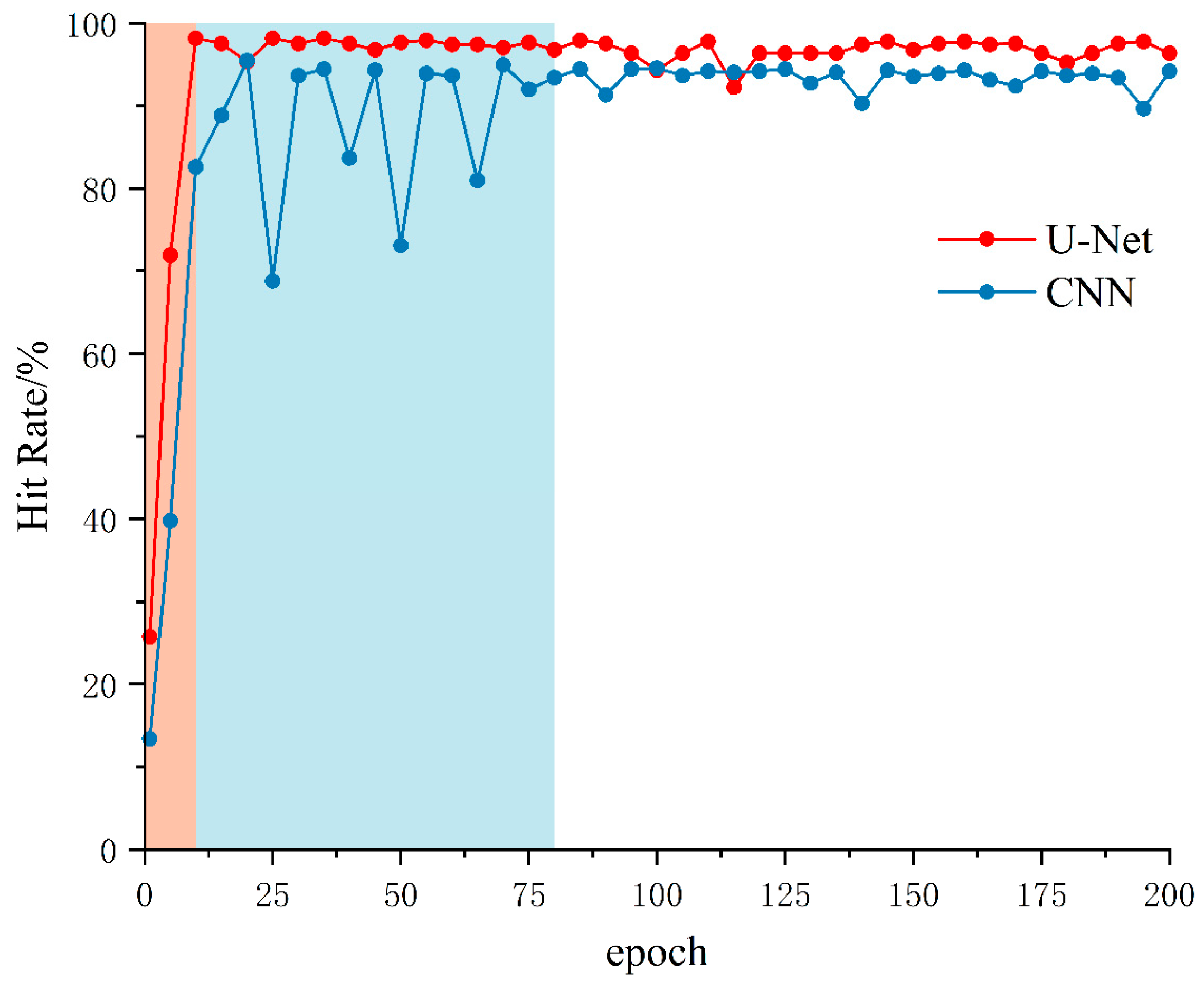
3. Experimental Setup and Model Training
3.1. Experimental Data and Preprocessing
- (1)
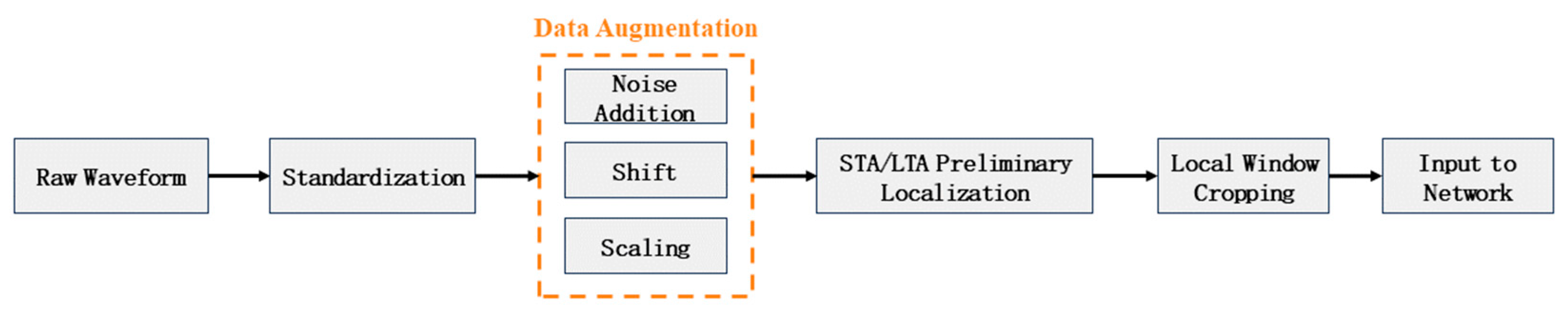
- Data Standardization: Each waveform signal was standardized to zero mean and unit variance (Z-score normalization). This process eliminates the influence of amplitude discrepancies across different sensors and ensures consistent input feature distributions for the neural network.
- (2)
- Label Normalization: The manually annotated P-wave arrival indices were mapped to the normalized interval [0, 1]. This scaling aligns the target values with the output range of the U-Net regression model, facilitating the efficient learning of temporal offset relationships.
- (3)
- Data Augmentation: To improve model robustness against varying noise conditions and enhance adaptability to anomalous samples, multiple data augmentation strategies were implemented to simulate complex field environments. These included:
- Noise Injection: Gaussian white noise with zero mean and a variance of 0.01 was superimposed on the waveforms to simulate inherent environmental background noise.
- Temporal Shifting: The entire waveform was randomly shifted within a range of ±10 sampling points to augment the model’s tolerance to minor temporal deviations in signal alignment.
- Amplitude Scaling: Waveform amplitudes were randomly scaled by factors ranging from 0.9 to 1.1 to accommodate natural amplitude variations observed across different seismic events.
3.2. Baseline Models and Experimental Results
4. Model Validation and Result Analysis
4.1. Sensitivity Analysis of STA/LTA Trigger Point Offset
4.1.1. Experimental Setup
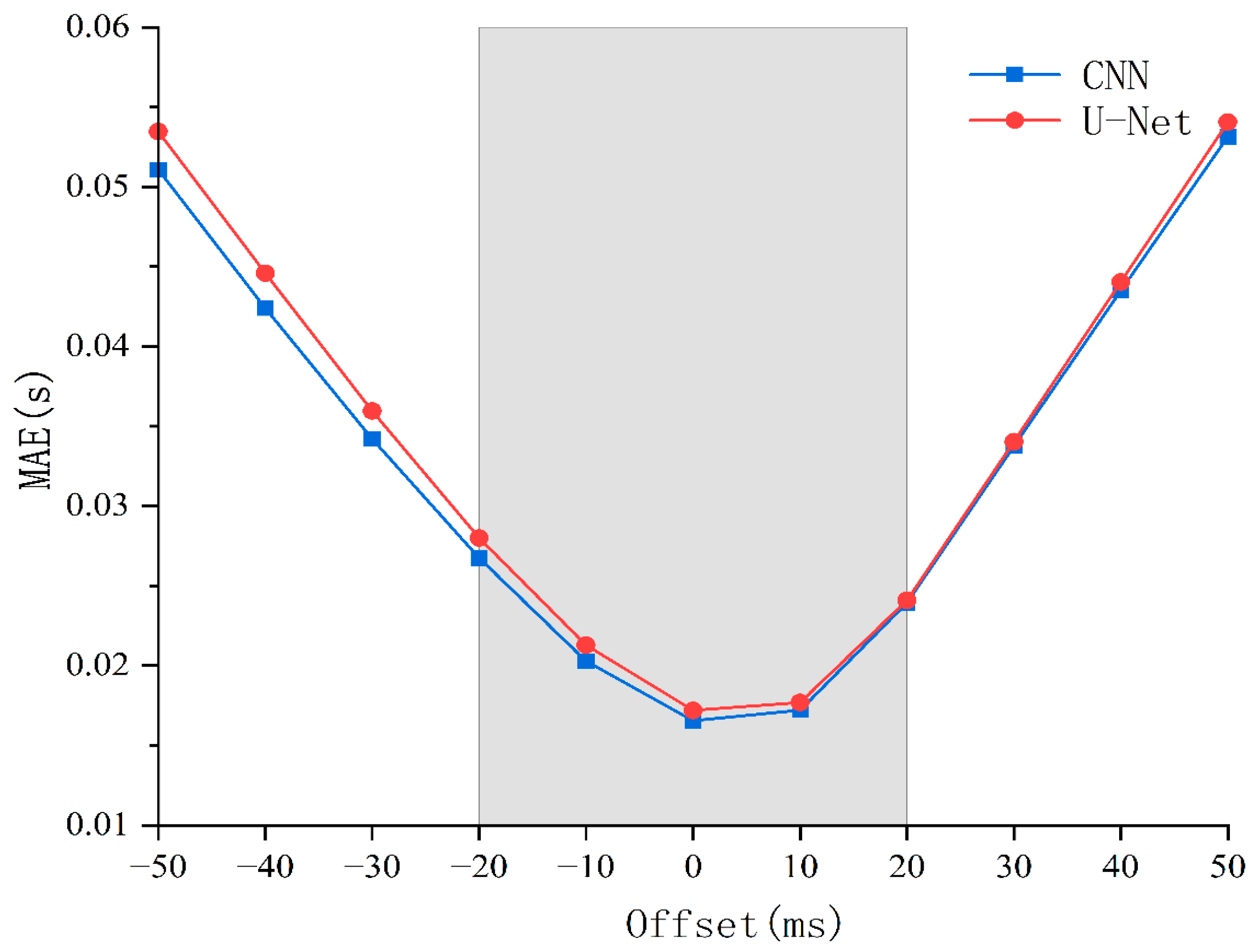
4.1.2. Experimental Results
4.1.3. Sensitivity Analysis and Error Comparison
4.1.4. Error Comparison Within and Beyond ±20 ms Range
4.1.5. Analysis and Summary
4.2. Performance Comparison and Generalization Evaluation
4.2.1. Experimental Objectives and Data Sources
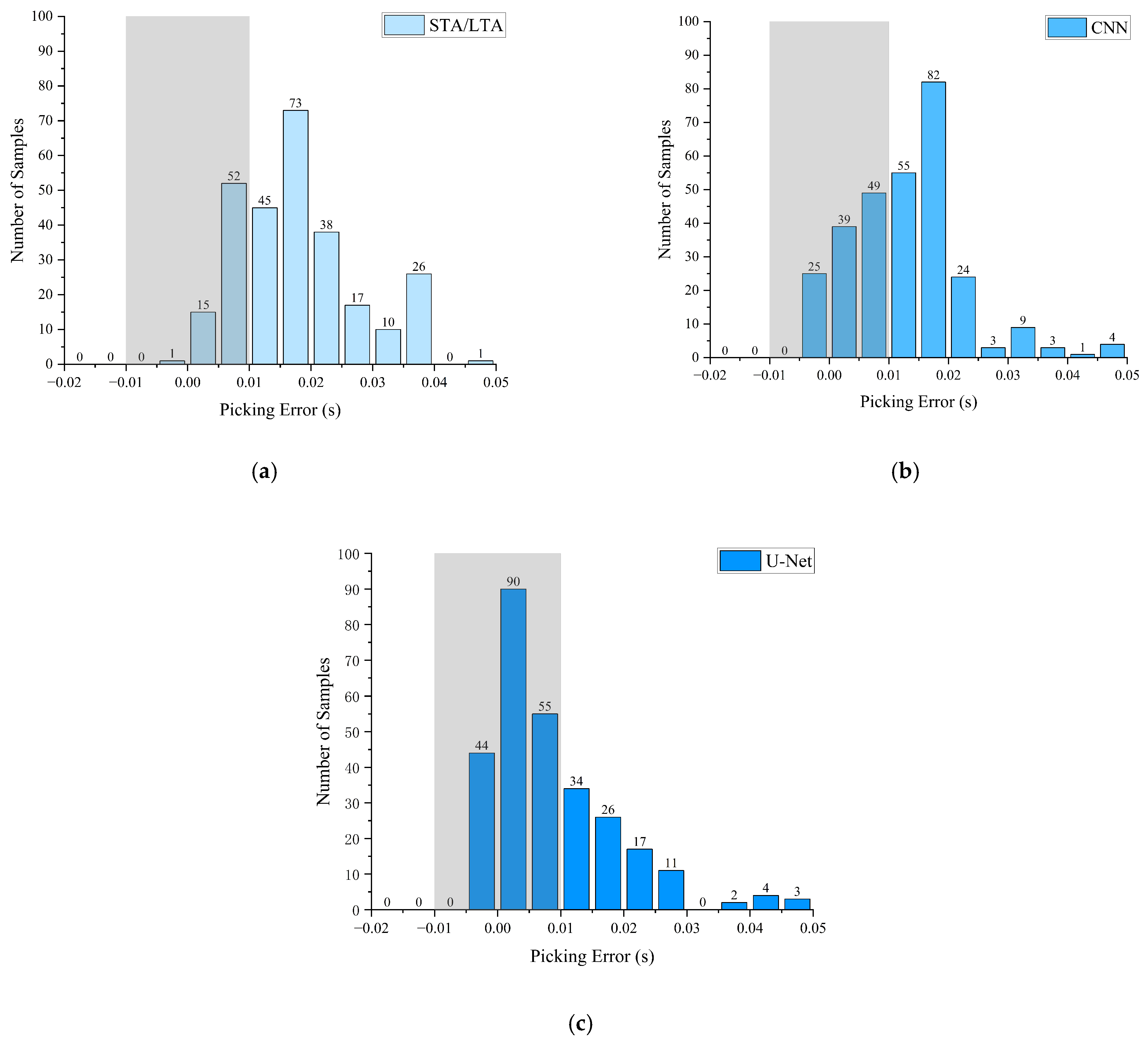
4.2.2. Overall Performance Comparison
4.2.3. Anomalous Sample Analysis
4.2.4. Performance Evaluation After Exclusion
4.2.5. Comprehensive Analysis
5. Conclusions
Author Contributions
Funding
Institutional Review Board Statement
Informed Consent Statement
Data Availability Statement
Conflicts of Interest
References
- Li, N.; Wang, E.; Ge, M. Microseismic monitoring technique and its applications at coal mines: Present status and future prospects. J. China Coal Soc. 2017, 42, 83–96. [Google Scholar]
- Ou’yang, Z.; Kong, L.; Qi, Q.; Zhang, H.; Li, S.; Zhao, S. Self-shocking microseismic monitoring technology and its application in prediction of dynamic pressure in shallow coal seam. J. China Coal Soc. 2018, 43, 44–51. [Google Scholar]
- Xia, Y.; Lan, H.; Wei, X. Study of comprehensive evaluation technology for rock burst hazard based on mi-croseismic and underground sound monitoring. J. China Coal Soc. 2011, 36, 358–364. [Google Scholar]
- Fu, J.; Wang, X.; Li, Z.; Tan, Q.; Wang, J. Automatic picking up earthquake’s P waves using signal-to-noise ratio under a strong noise environment. Chin. J. Geophys. 2019, 62, 1405–1412. [Google Scholar]
- Liu, J.; Wang, Y.; Yao, Z. On micro-seismic first arrival identification: A case study. Acta Geophys. Sin. 2013, 56, 1660–1666. [Google Scholar]
- Wu, Z.; Luo, X.; Li, S. United wavelet transform and polarization analysis automatically identify micro seismic P-arrival. Prog. Geophys. 2012, 27, 131–136. [Google Scholar]
- He, X.; She, T.; Gao, F. A new method for picking up arrival times of seismic P and S waves automatically. Chin. J. Geophys. 2016, 59, 2519–2527. [Google Scholar]
- Zhao, Y.; Wang, J.; Pan, Y.; Wang, X.; Zhao, W.; Fan, Y. Study on determining arrival times of micro-seismic P-wave based on quality optimization and normalized STA/LTA method. Chin. J. Rock Mech. Eng. 2022, 41, 1610–1625. [Google Scholar]
- Liu, H.; Zhang, J. STA/LTA algorithm analysis and improvement of microseismic signal automatic detection. Prog. Geophys. 2014, 29, 1708–1714. [Google Scholar]
- Liu, X.; Zhao, J.; Wang, Y.; Peng, P. Automatic picking of microseismic events P-wave arrivals based on improved method of STA/LTA. J. Northeast. Univ. (Nat. Sci.) 2017, 38, 740–745. [Google Scholar]
- Qiu, L.; Li, C. STA/LTA method for picking up the first arrival of natural seismic waves and its improvement analysis. Prog. Geophys. 2023, 38, 1497–1506. [Google Scholar]
- Zhang, H.; Thurber, C.; Rowe, C. Automatic P-wave arrival detection and picking with multiscale wavelet analysis for single-component recordings. Bull. Seismol. Soc. Am. 2003, 93, 1904–1912. [Google Scholar]
- Shang, X.; Li, X.; Weng, L. Enhancing seismic P phase arrival picking based on wavelet denoising and kurtosis picker. J. Seismol. 2018, 22, 21–33. [Google Scholar] [CrossRef]
- Akram, J.; Eaton, D.W. A review and appraisal of arrival-time picking methods for downhole microseismic data. Geophysics 2016, 81, KS71–KS91. [Google Scholar] [CrossRef]
- Yao, Y.; Liu, L.; Sheng, M.; Xu, H. Unbiased picking onset time of P and S phases by normal time-frequency transform method under a strong noise environment. Chin. J. Geophys. 2022, 65, 227–243. [Google Scholar]
- Fang, Z.; Cheng, H.; Wang, X.; Luo, C. Research on STA/LTA Microseismic Arrival Time-Picking Method Based on Variational Mode Decomposition. Appl. Sci. 2025, 15, 13220. [Google Scholar]
- Zheng, Z.; Lin, B.; Yu, W.; Jin, X.; Wang, S.; Li, S.; Zhou, S.; Ding, B.; Wei, Y.; Zhou, Y.; et al. Research on the application of transformer model and transfer learning in earthquake P-wave and noise discrimination. Chin. J. Geophys. 2024, 67, 4189–4203. [Google Scholar]
- Zhao, M.; Chen, S.; Fang, L.; Yuen, D.A. Earthquake phase arrival auto-picking based on U-shaped convolutional neural network. Chin. J. Geophys. 2019, 62, 3034–3042. [Google Scholar]
- Ji, N.; Li, G.; Zhang, L.; Luo, Y.; Huang, J. A picking method of direct seismic P-wave arrival time based on PPNet. China Earthq. Eng. J. 2024, 46, 714–723. [Google Scholar]
- Liu, Z.; Wang, J.; Wang, G. Research on First-arrival picking of seismic P-wave based on UNet++. J. Taiyuan Univ. Technol. 2023, 54, 65–72. [Google Scholar]
- Li, H.; Li, X.; Tan, X.; Zhang, Y.; Liu, T. An accurate seismic detection method based on improved STA/LTA. Sci. Technol. Eng. 2024, 24, 10165–10173. [Google Scholar]
- Wang, C.; Liu, H. Reasearch on the first-break picking of microseismic signals based on energy characteristics. Chin. J. Eng. Geophys. 2020, 17, 272–282. [Google Scholar]
- Jiang, C.; Wu, J.; Fang, L. Earthquake detection and automatic phase picking. Acta Seismol. Sin. 2018, 40, 45–57. [Google Scholar]
- Gu, X.; Zhang, C.; Guo, W.; Zhang, Y.; Gong, X.; Wang, C.; Zhao, X.; Zhang, L. Characteristics and recognition of typical microseismic signals in rock burst mines. J. China Coal Soc. 2024, 49, 694–713. [Google Scholar]



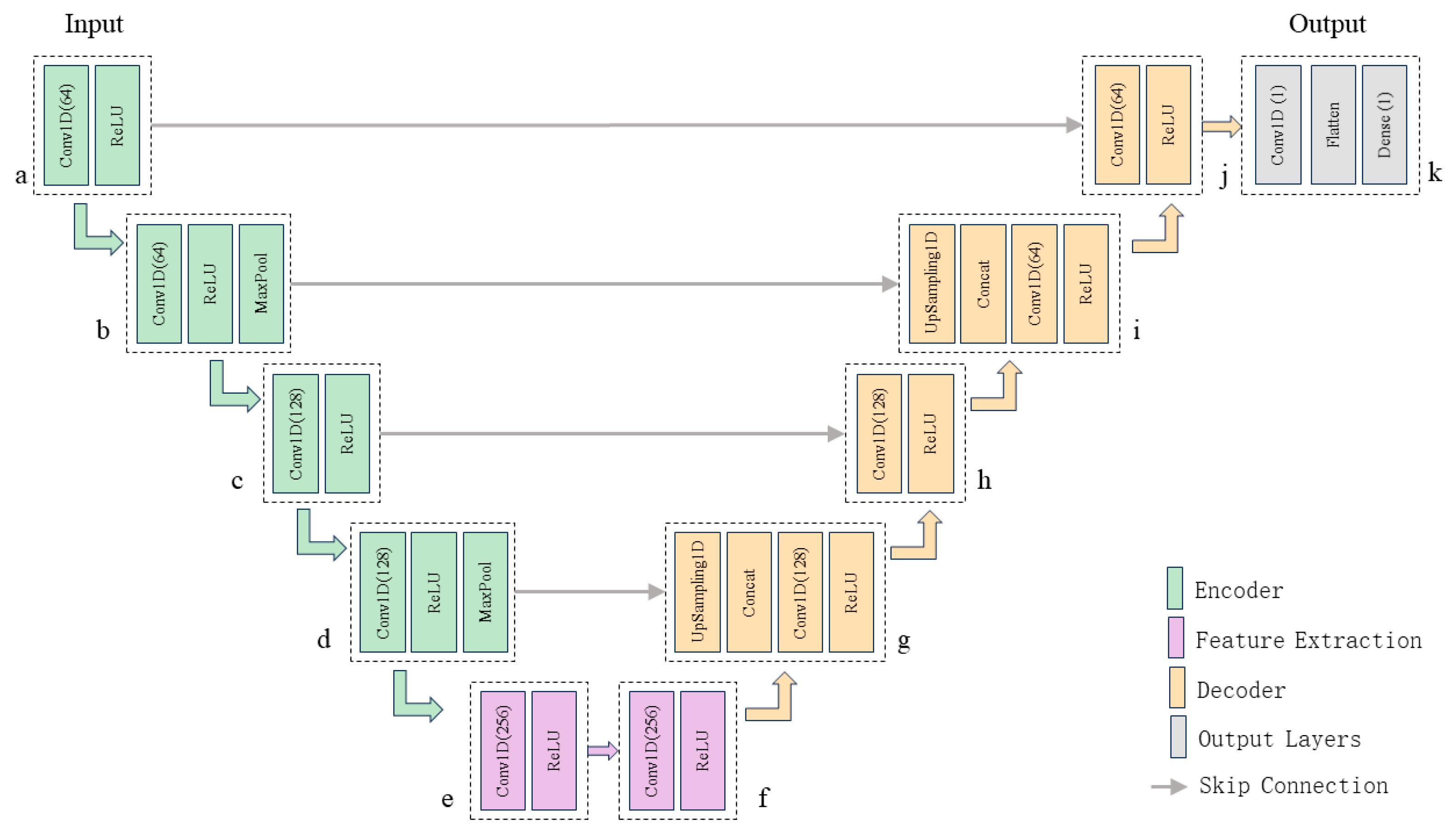
| Module | Operation | Parameters | Input Dimension | Output Dimension |
|---|---|---|---|---|
| a | Conv1D | filters = 64, k = 3 | (200,1) | (200,64) |
| ReLU | — | (200,64) | (200,64) | |
| b | Conv1D | filters = 64, k = 3 | (200,64) | (200,64) |
| ReLU | — | (200,64) | (200,64) | |
| MaxPool1D | pool = 2 | (200,64) | (100,64) | |
| c | Conv1D | filters = 128, k = 3 | (100,64) | (100,128) |
| ReLU | — | (100,128) | (100,128) | |
| d | Conv1D | filters = 128, k = 3 | (100,128) | (100,128) |
| ReLU | — | (100,128) | (100,128) | |
| MaxPool1D | pool = 2 | (100,128) | (50,128) | |
| e | Conv1D | filters = 256, k = 3 | (50,128) | (50,256) |
| ReLU | — | (50,256) | (50,256) | |
| f | Conv1D | filters = 256, k = 3 | (50,256) | (50,256) |
| ReLU | — | (50,256) | (50,256) | |
| g | UpSampling1D | size = 2 | (50,256) | (100,256) |
| Concat | — | (100,256) + (100,128) | (100,384) | |
| Conv1D | filters = 128, k = 3 | (100,384) | (100,128) | |
| ReLU | — | (100,128) | (100,128) | |
| h | Conv1D | filters = 128, k = 3 | (100,128) | (100,128) |
| ReLU | — | (100,128) | (100,128) | |
| i | UpSampling1D | size = 2 | (100,128) | (200,128) |
| Concat | — | (200,128) + (200,64) | (200,192) | |
| Conv1D | filters = 64, k = 3 | (200,192) | (200,64) | |
| ReLU | — | (200,64) | (200,64) | |
| j | Conv1D | filters = 64, k = 3 | (200,64) | (200,64) |
| ReLU | — | (200,64) | (200,64) | |
| k | Conv1D | filters = 1, k = 1 | (200,64) | (200,1) |
| Flatten | — | (200,1) | (200,) | |
| Dense | units = 1 | (200,) | (1,) |
| Offset (ms) | MAE(s) | Mean Sample Error (pts) | Sample Size | ||
|---|---|---|---|---|---|
| CNN | U-Net | CNN | U-Net | ||
| −50 | 0.05313 | 0.05406 | 26.56 | 27.03 | 300 |
| −40 | 0.04627 | 0.04733 | 23.14 | 23.67 | 300 |
| −30 | 0.03456 | 0.03529 | 17.28 | 17.64 | 300 |
| −20 | 0.02312 | 0.02402 | 11.56 | 12.01 | 300 |
| −10 | 0.01844 | 0.01985 | 9.22 | 9.93 | 300 |
| 0 | 0.01655 | 0.01720 | 8.27 | 8.60 | 300 |
| 10 | 0.01974 | 0.02012 | 9.87 | 10.06 | 300 |
| 20 | 0.02380 | 0.02445 | 11.90 | 12.23 | 300 |
| 30 | 0.03302 | 0.03471 | 16.51 | 17.35 | 300 |
| 40 | 0.04692 | 0.04780 | 23.46 | 23.90 | 300 |
| 50 | 0.05300 | 0.05391 | 26.50 | 26.96 | 300 |
| Model | |Δt| ≤ 20 ms MAE (s) | |Δt| > 20 ms MAE (s) | Improvement |
|---|---|---|---|
| CNN | 0.02095 | 0.04500 | 53.4% |
| U-Net | 0.02166 | 0.04585 | 52.8% |
| Model | MAE | Hit Rate (%) | ||
|---|---|---|---|---|
| 0.01 s | 0.02 s | 0.03 s | ||
| STA/LTA | 0.0545 | 22.67 | 58.33 | 80.33 |
| CNN | 0.0450 | 37.67 | 81.33 | 92.33 |
| U-Net | 0.0470 | 63.00 | 82.33 | 92.33 |
| Model | MAE | Hit Rate (%) | ||
|---|---|---|---|---|
| 0.01 s | 0.02 s | 0.03 s | ||
| STA/LTA | 0.0226 | 22.74 | 58.53 | 80.60 |
| CNN | 0.0149 | 37.79 | 81.61 | 92.64 |
| U-Net | 0.0130 | 63.21 | 82.61 | 92.64 |
Disclaimer/Publisher’s Note: The statements, opinions and data contained in all publications are solely those of the individual author(s) and contributor(s) and not of MDPI and/or the editor(s). MDPI and/or the editor(s) disclaim responsibility for any injury to people or property resulting from any ideas, methods, instructions or products referred to in the content. |
© 2026 by the authors. Licensee MDPI, Basel, Switzerland. This article is an open access article distributed under the terms and conditions of the Creative Commons Attribution (CC BY) license.
Share and Cite
Jin, J.; Wang, G.; Qiu, Y.; Gong, S.; Ren, B. Two-Stage Microseismic P-Wave Arrival Picking via STA/LTA-Guided Lightweight U-Net. Sensors 2026, 26, 1693. https://doi.org/10.3390/s26051693
Jin J, Wang G, Qiu Y, Gong S, Ren B. Two-Stage Microseismic P-Wave Arrival Picking via STA/LTA-Guided Lightweight U-Net. Sensors. 2026; 26(5):1693. https://doi.org/10.3390/s26051693
Chicago/Turabian StyleJin, Jiancheng, Gang Wang, Yuanhang Qiu, Siyuan Gong, and Bo Ren. 2026. "Two-Stage Microseismic P-Wave Arrival Picking via STA/LTA-Guided Lightweight U-Net" Sensors 26, no. 5: 1693. https://doi.org/10.3390/s26051693
APA StyleJin, J., Wang, G., Qiu, Y., Gong, S., & Ren, B. (2026). Two-Stage Microseismic P-Wave Arrival Picking via STA/LTA-Guided Lightweight U-Net. Sensors, 26(5), 1693. https://doi.org/10.3390/s26051693