RUL Prediction Based on xLSTM–Transformer Neural Network for Rolling Element Bearings Under Different Working Conditions


Abstract
1. Introduction
2. Methods
2.1. ISOMAP
- (1)
- Construct an adjacency graph G for all data points in the high-dimensional space, where the distance between nodes is defined by the Euclidean metric. Adjacency is defined as an ε-neighborhood or a k-nearest neighbor criterion.
- (2)
- The Dijkstra or Floyd–Warshall algorithm is employed to compute the shortest path between any pair of nodes, and , on the graph G. The shortest path is represented as the geodesic distance on the manifold. Consequently, the shortest path matrix of the graph is obtained as .
- (3)
- The matrix is used as the input to the classical MDS algorithm, as described below: Compute the squared distance matrix . Next, double centering is applied: , where , select the d largest eigenvalues of and their corresponding eigenvectors to form the matrix. The low-dimensional embedding coordinates are given by .
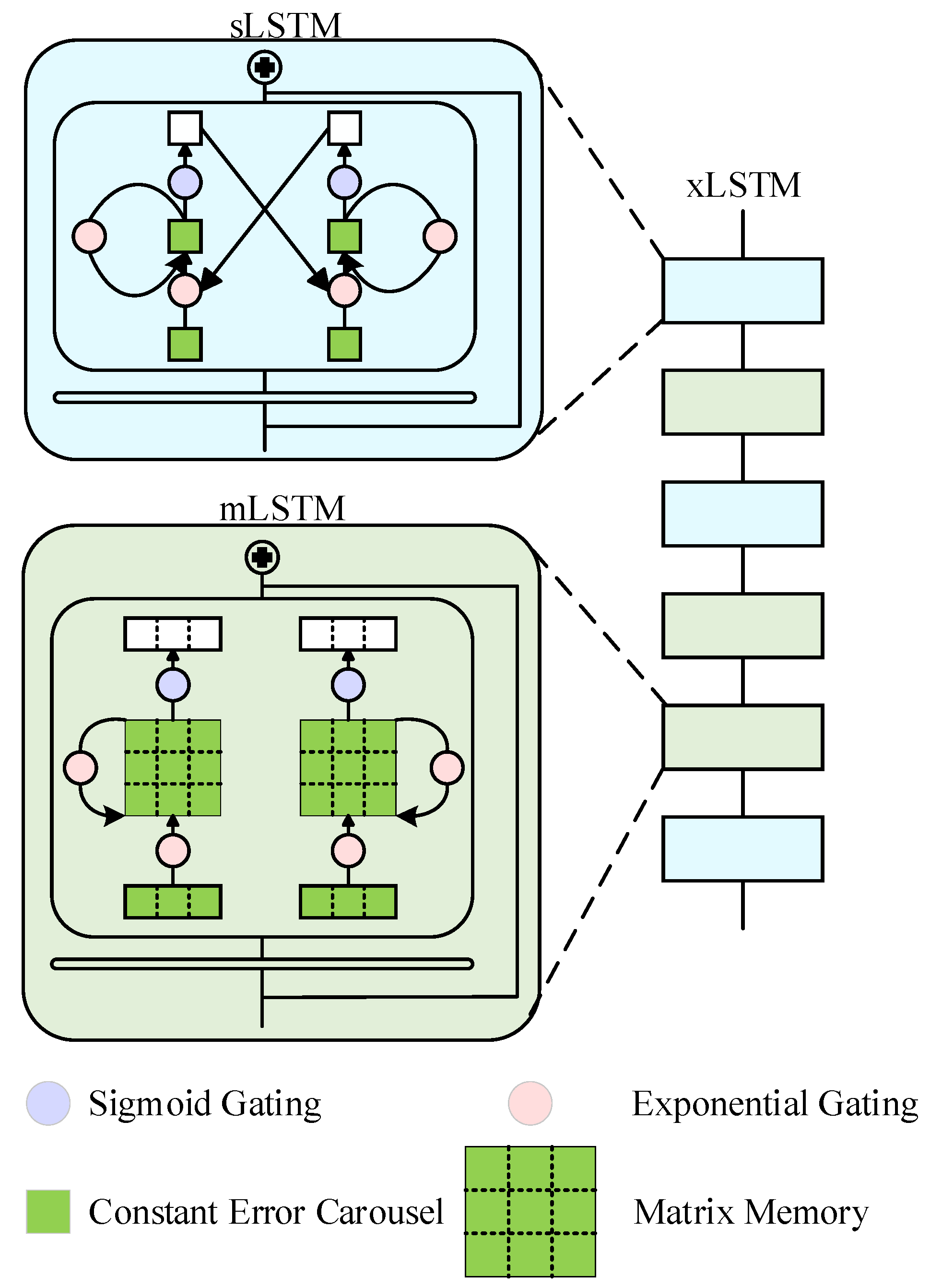
2.2. xLSTM
2.2.1. sLSTM
2.2.2. mLSTM
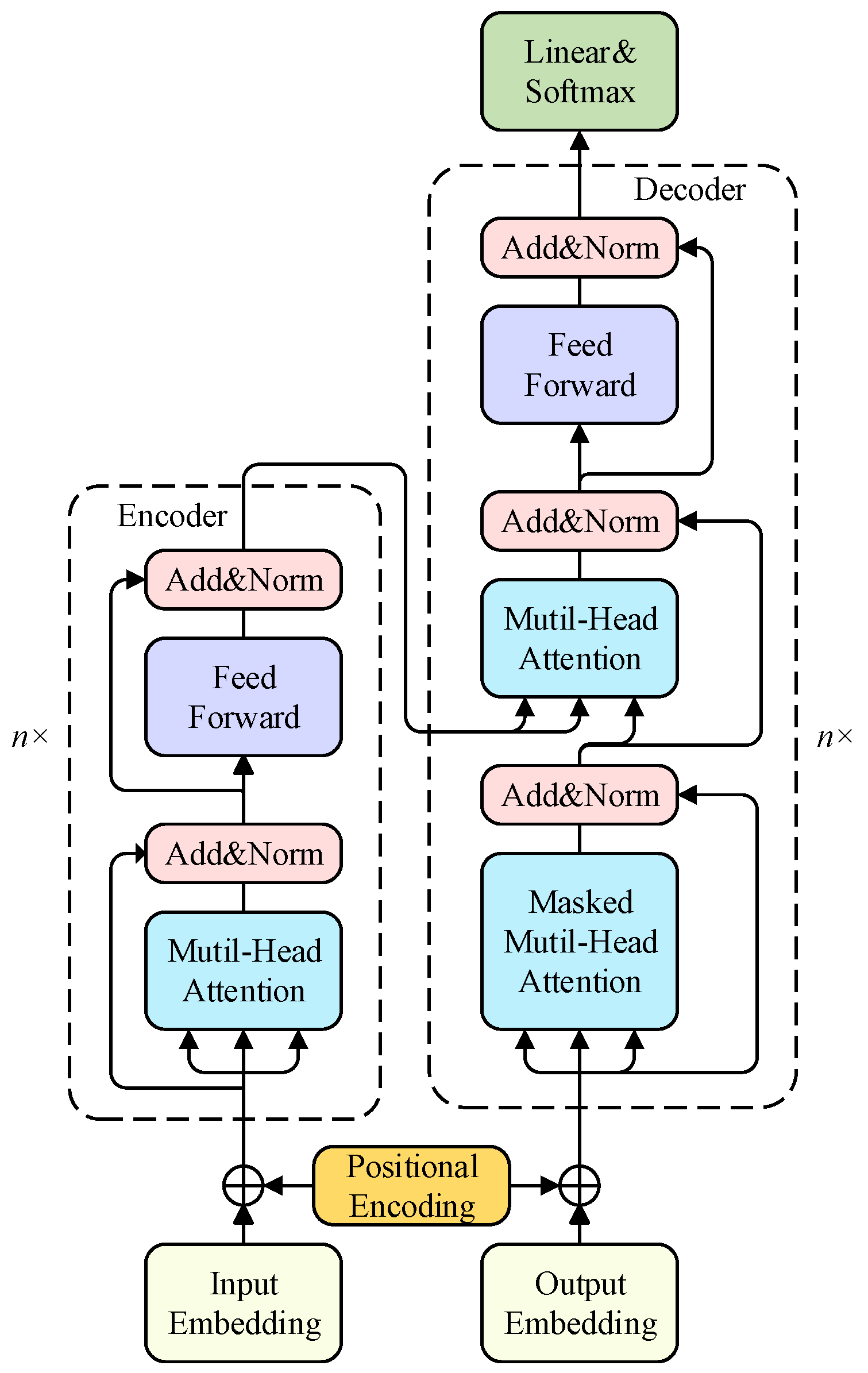
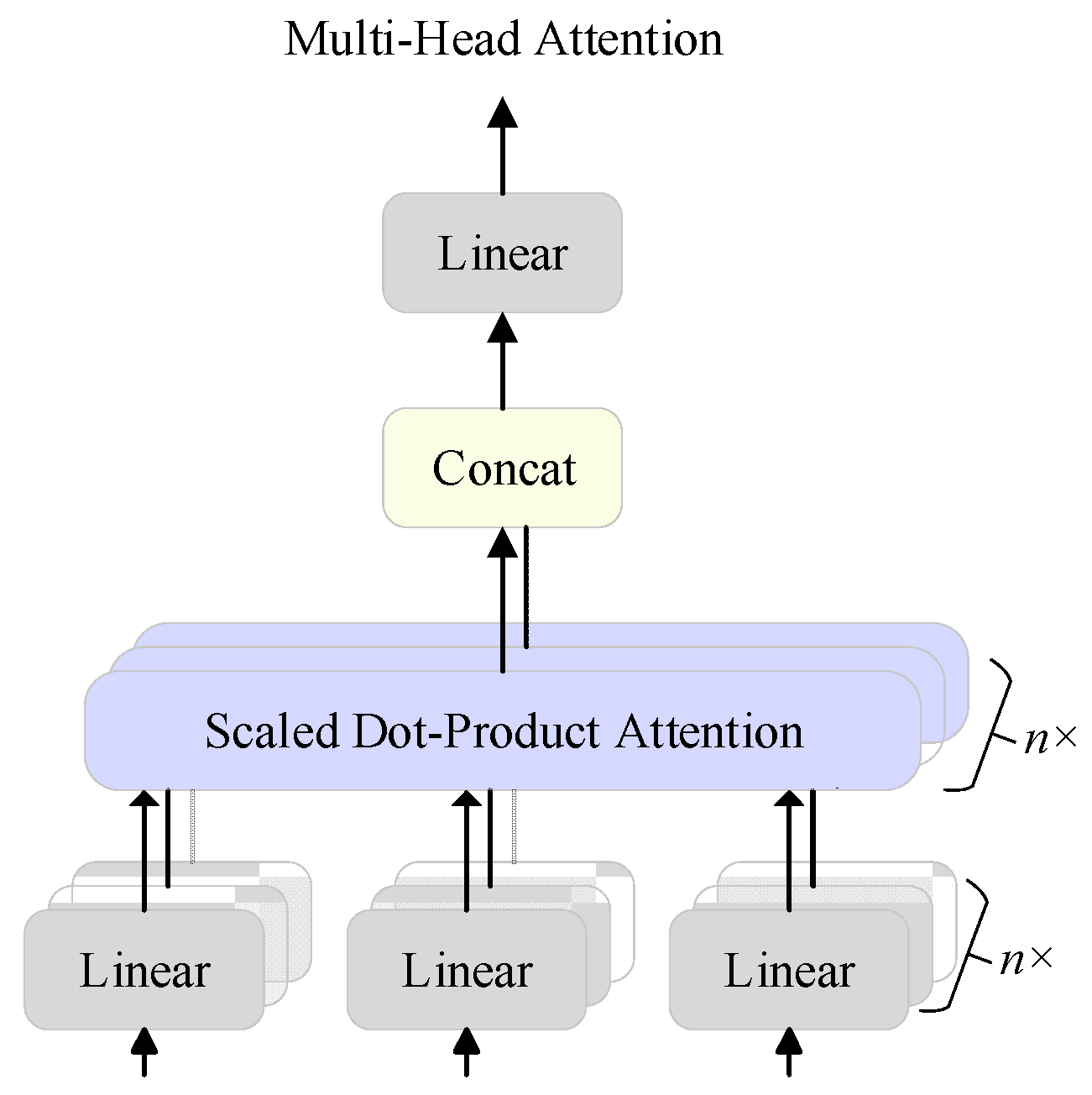
2.3. Transformer
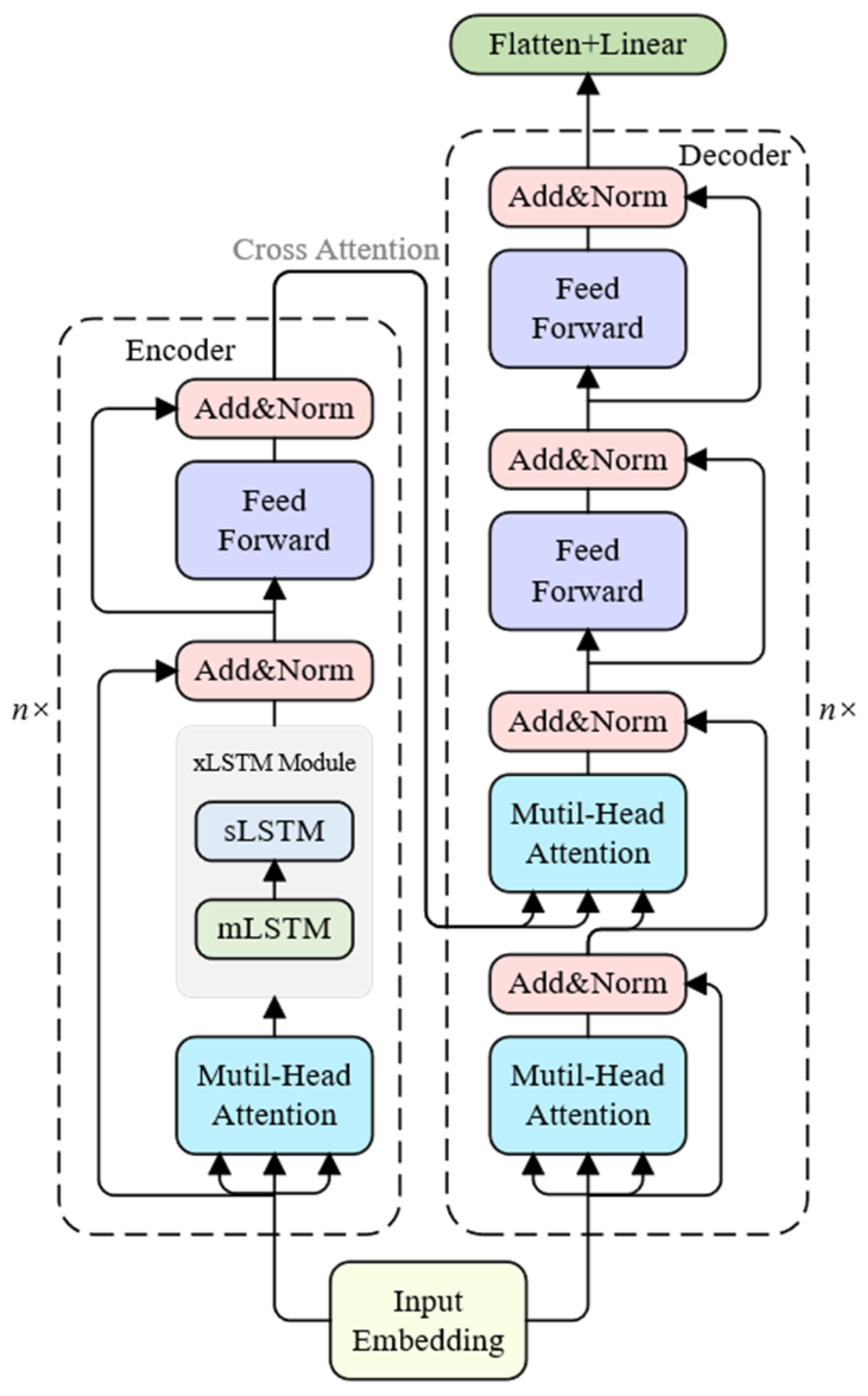
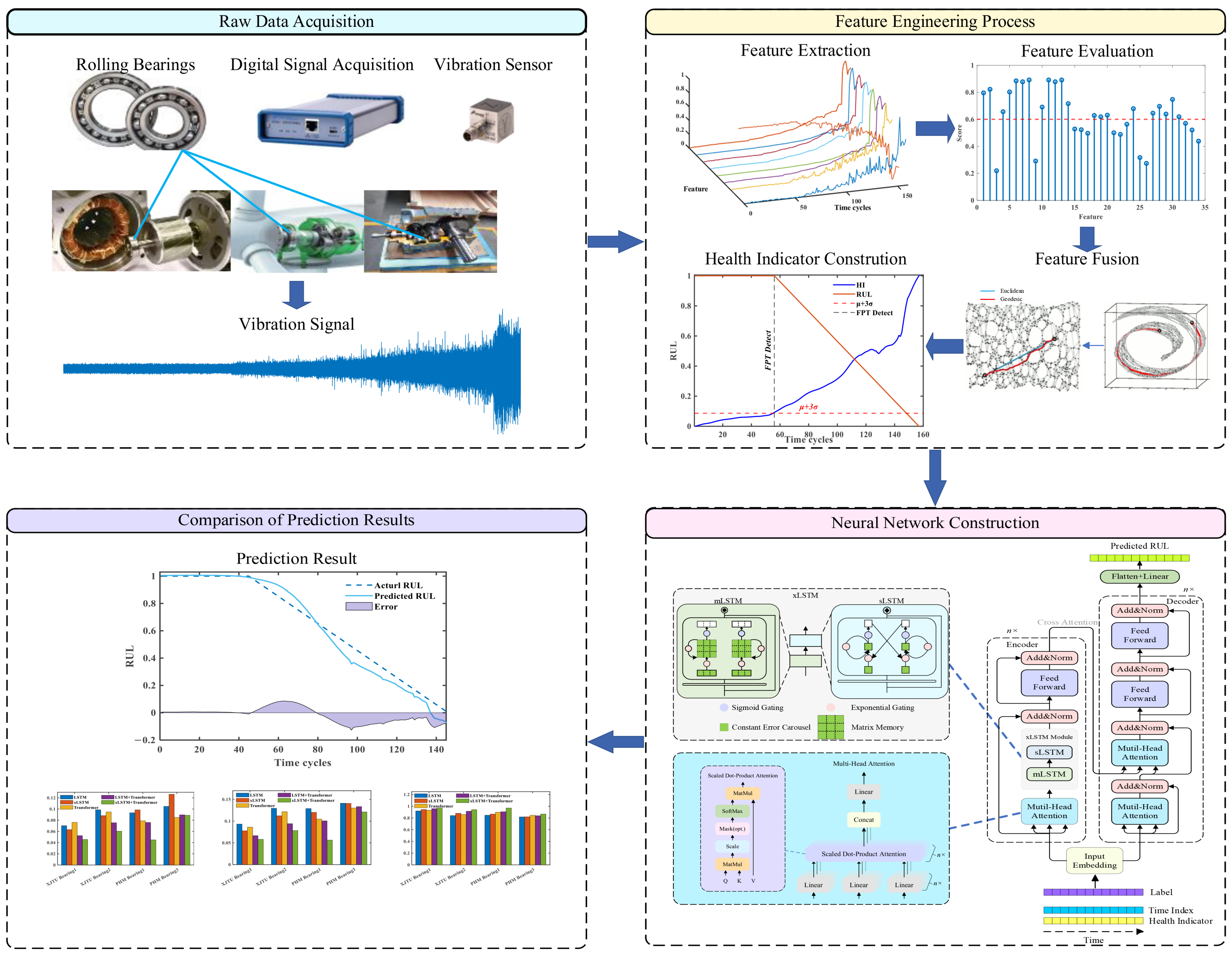
2.4. The Structure of the Proposed xLSTM-Transformer
- Up-projection: The attention output is first mapped into a high-dimensional feature space via a linear projection layer, where p denotes the expansion factor.
- Nonlinear processing: The exponential gating mechanism of the xLSTM is utilized to perform nonlinear degradation modeling on these high-dimensional features.
- Down-projection: The processed features are then projected back to the original dimension D through a second linear layer.
3. Experimental Validation
3.1. Dataset Description
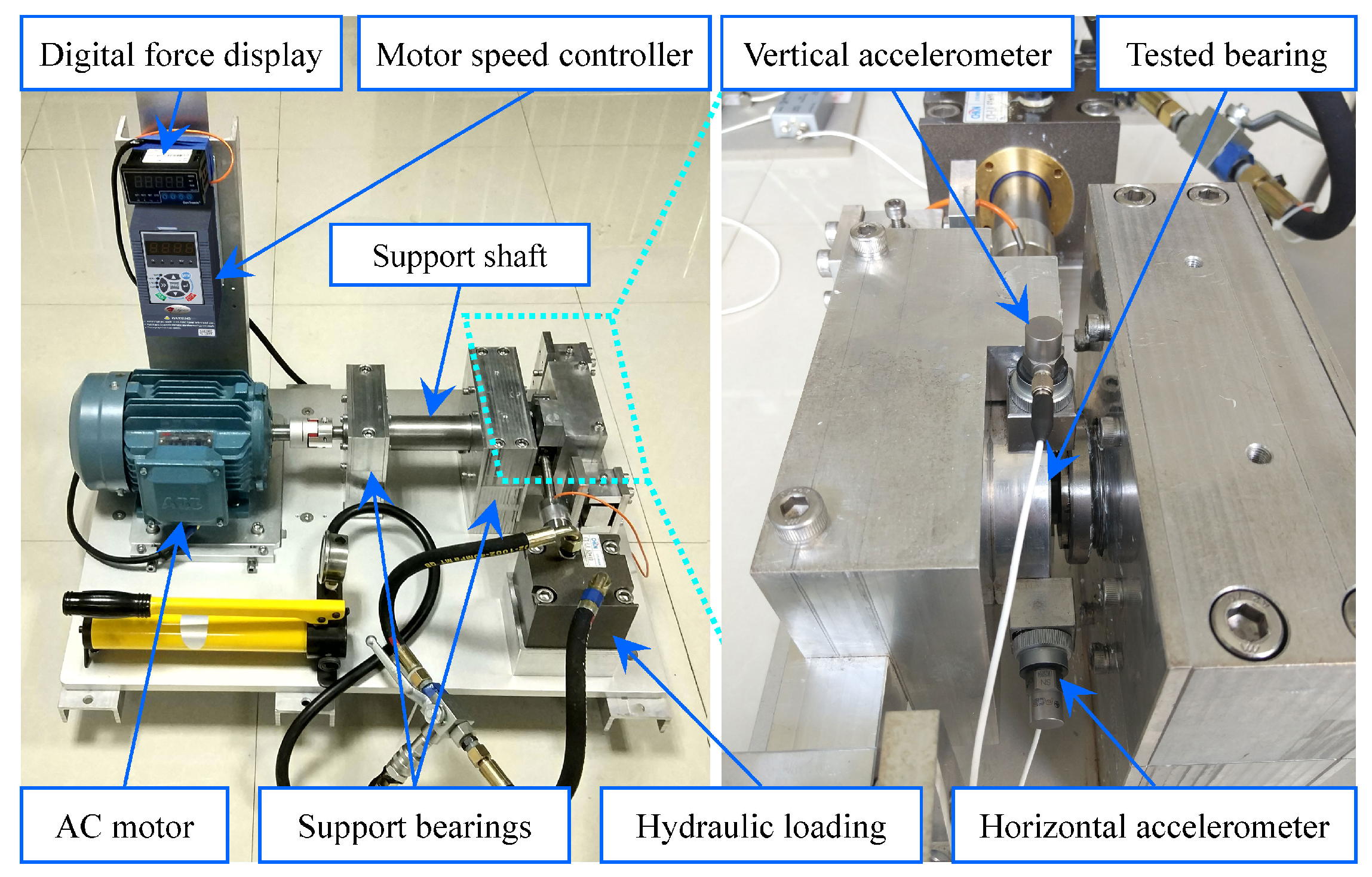
3.1.1. XJTU-SY Dataset
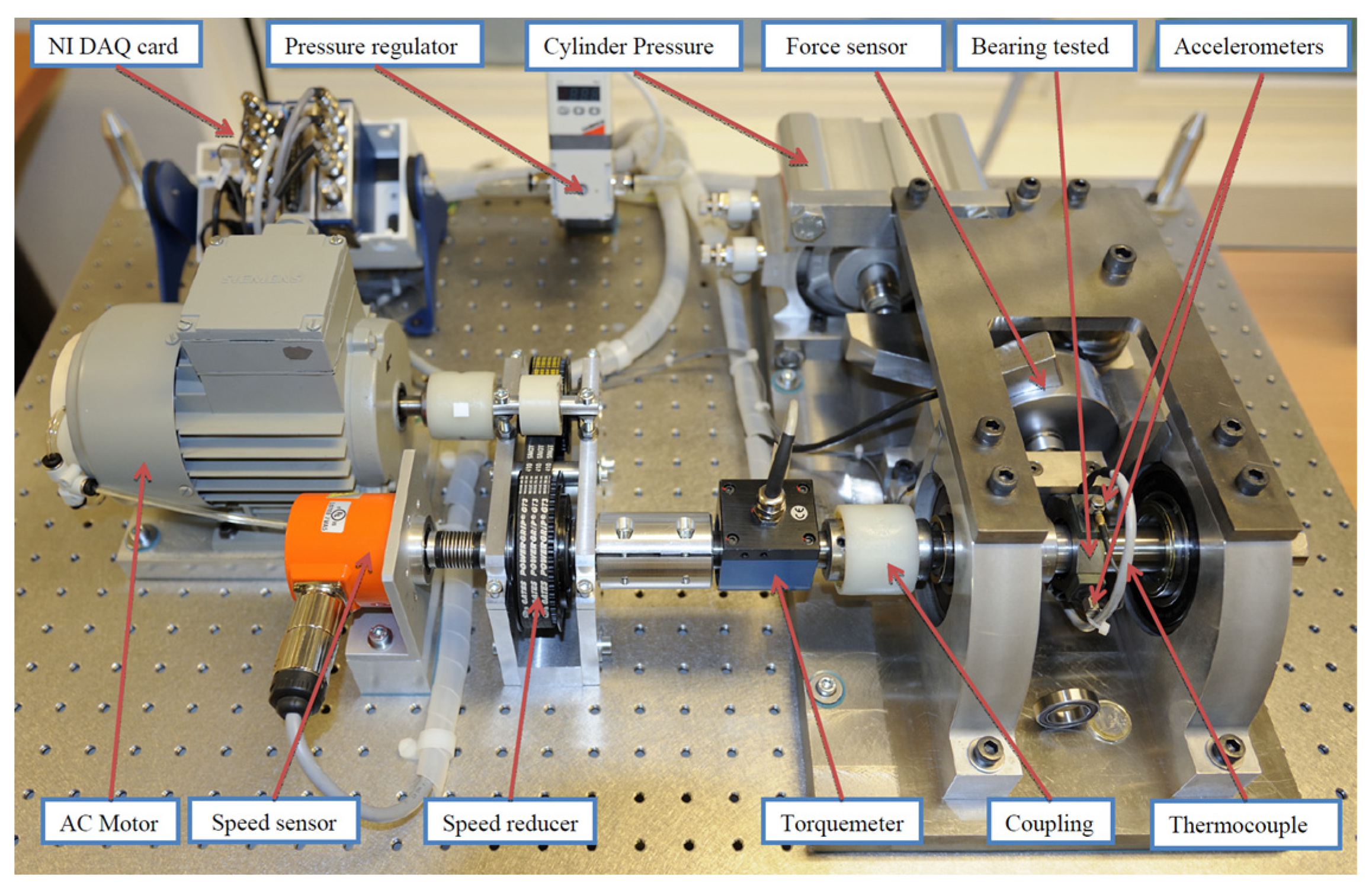
3.1.2. PHM2012 Dataset
3.2. Health Index Construction
3.2.1. Feature Extraction
3.2.2. Feature Selection and Fusion
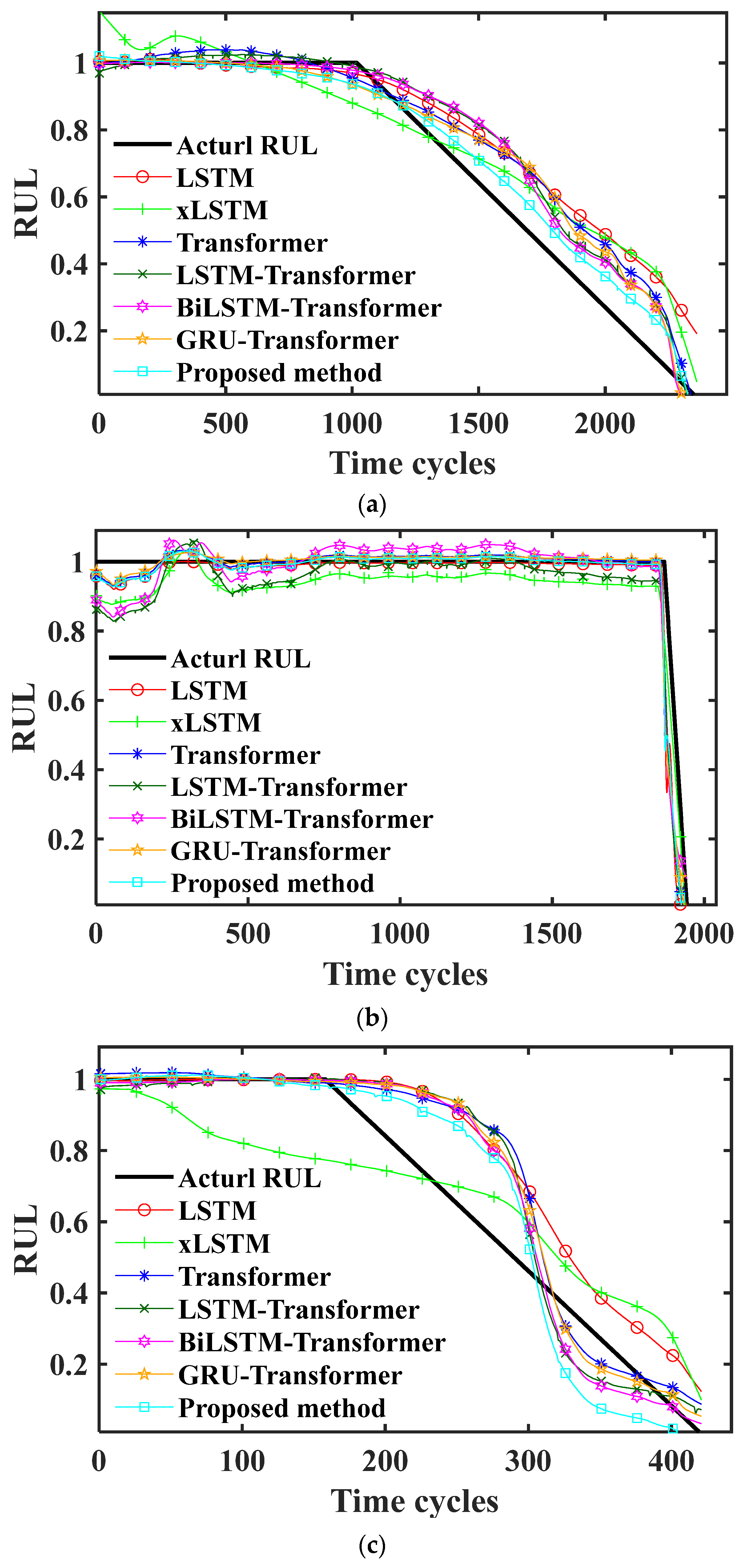
3.3. Bearing RUL Prediction Results
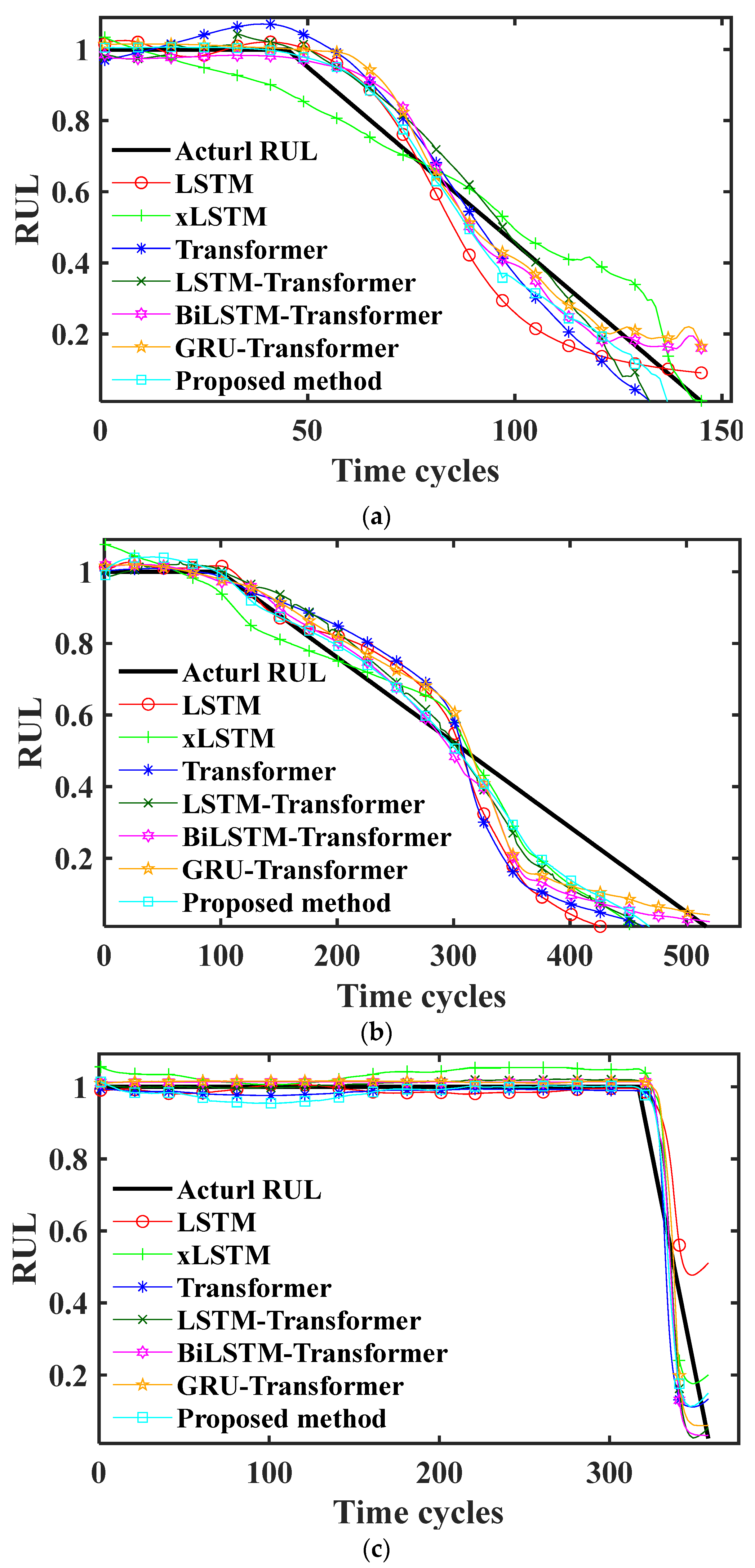
3.3.1. Case 1: Validation on the XJTU-SY Dataset
3.3.2. Case 2: Validation on the PHM2012 Dataset
3.3.3. Discussion
4. Conclusions
Author Contributions
Funding
Data Availability Statement
Conflicts of Interest
References
- Peng, B.; Bi, Y.; Xue, B.; Zhang, M.; Wan, S. A Survey on Fault Diagnosis of Rolling Bearings. Algorithms 2022, 15, 347. [Google Scholar] [CrossRef]
- He, J.; Somogyi, C.; Strandt, A.; Demerdash, N.A.O. Diagnosis of Stator Winding Short-Circuit Faults in an Interior Permanent Magnet Synchronous Machine. In Proceedings of the 2014 IEEE Energy Conversion Congress and Exposition (ECCE), Pittsburgh, PA, USA, 14–18 September 2014; IEEE: New York, NY, USA, 2014. [Google Scholar]
- Ji, M.; Smith, A.; Soghrati, S. A Micromechanical Finite Element Model for Predicting the Fatigue Life of Heterogenous Adhesives. Comput. Mech. 2022, 69, 997–1020. [Google Scholar] [CrossRef]
- Wang, H.; Liu, X.; Wang, X.; Wang, Y. Numerical Method for Estimating Fatigue Crack Initiation Size Using Elastic–Plastic Fracture Mechanics Method. Appl. Math. Model. 2019, 73, 365–377. [Google Scholar] [CrossRef]
- Yang, B.; Liu, R.; Zio, E. Remaining Useful Life Prediction Based on a Double-Convolutional Neural Network Architecture. IEEE Trans. Ind. Electron. 2019, 66, 9521–9530. [Google Scholar] [CrossRef]
- Qiu, H.; Niu, Y.; Shang, J.; Gao, L.; Xu, D. A Piecewise Method for Bearing Remaining Useful Life Estimation Using Temporal Convolutional Networks. J. Manuf. Syst. 2023, 68, 227–241. [Google Scholar] [CrossRef]
- Guo, L.; Li, N.; Jia, F.; Lei, Y.; Lin, J. A Recurrent Neural Network Based Health Indicator for Remaining Useful Life Prediction of Bearings. Neurocomputing 2017, 240, 98–109. [Google Scholar] [CrossRef]
- Ma, M.; Mao, Z. Deep Convolution-Based LSTM Network for Remaining Useful Life Prediction. IEEE Trans. Ind. Inform. 2020, 17, 1658–1667. [Google Scholar] [CrossRef]
- Li, J.; Li, X.; He, D. A Directed Acyclic Graph Network Combined with CNN and LSTM for Remaining Useful Life Prediction. IEEE Access 2019, 7, 75464–75475. [Google Scholar] [CrossRef]
- Zhang, H.; Zhang, Q.; Shao, S.; Niu, T.; Yang, X. Attention-Based LSTM Network for Rotatory Machine Remaining Useful Life Prediction. IEEE Access 2020, 8, 132188–132199. [Google Scholar] [CrossRef]
- Zhou, J.; Qin, Y.; Chen, D.; Liu, F.; Qi, Q. Remaining Useful Life Prediction of Bearings by a New Reinforced Memory GRU Network. Adv. Eng. Inform. 2022, 53, 101682. [Google Scholar] [CrossRef]
- Jiang, L.; Zhang, X.; Cao, H.; Zhang, Y. A Transformer-Based Framework with Historical Data Fusion for RUL Prediction. Meas. Sci. Technol. 2025, 36, 106103. [Google Scholar] [CrossRef]
- Lei, W.; Dong, X.; Cui, F.; Huang, G. A Remaining Useful Life Prediction Method for Rolling Bearings Based on Hierarchical Clustering and Transformer–GRU. Appl. Sci. 2025, 15, 5369. [Google Scholar] [CrossRef]
- Ali, A.R.; Kamal, H. Hybrid HHO–WHO Optimized Transformer-GRU Model for Advanced Failure Prediction in Industrial Machinery and Engines. Sensors 2026, 26, 534. [Google Scholar] [CrossRef] [PubMed]
- Jin, C.; Li, B.; Yang, Y.; Yuan, X.; Tu, R.; Qiu, L.; Chen, X. Remaining Useful Life Prediction of Rolling Bearings Based on Empirical Mode Decomposition and Transformer Bi-LSTM Network. Appl. Sci. 2025, 15, 9529. [Google Scholar] [CrossRef]
- Tenenbaum, J.B.; Silva, V.D.; Langford, J.C. A Global Geometric Framework for Nonlinear Dimensionality Reduction. Science 2000, 290, 2319–2323. [Google Scholar] [CrossRef] [PubMed]
- Beck, M.; Poppel, K.; Spanring, M.; Auer, A.; Prudnikova, O.; Kopp, M.; Klambauer, G.; Brandstetter, J.; Hochreiter, S. Xlstm: Extended Long Short-Term Memory. In Advances in Neural Information Processing Systems 37, Proceedings of the 38th Conference on Neural Information Processing Systems, Vancouver, BC, Canada, 9–15 December 2024; Curran Associates, Inc.: New York, NY, USA, 2024; Volume 37, pp. 107547–107603. [Google Scholar]
- Vaswani, A.; Shazeer, N.; Parmar, N.; Uszkoreit, J.; Jones, L.; Gomze, A.N.; Kaiser, L. Attention Is All You Need. In Advances in Neural Information Processing Systems 30, Proceedings of the 31st Annual Conference on Neural Information Processing Systems, Long Beach, CA, USA, 4–9 December 2017; Neural Information Processing Systems Foundation, Inc.: San Diego, CA, USA, 2017; Volume 30. [Google Scholar]
- Wang, B.; Lei, Y.; Li, N.; Li, N. A Hybrid Prognostics Approach for Estimating Remaining Useful Life of Rolling Element Bearings. IEEE Trans. Reliab. 2020, 69, 401–412. [Google Scholar] [CrossRef]
- Nectoux, P.; Gouriveau, R.; Medjaher, K.; Ramasso, E.; Morello, B.; Zerhouni, N.; Varnier, C. PRONOSTIA: An Experimental Platform for Bearings Accelerated Life Test. In Proceedings of the IEEE International Conference on Prognostics and Health Management, Denver, CO, USA, 18–21 June 2012. [Google Scholar]
- Zhang, B.; Zhang, L.; Xu, J. Degradation Feature Selection for Remaining Useful Life Prediction of Rolling Element Bearings. Qual. Reliab. Eng. Int. 2015, 32, 547–554. [Google Scholar] [CrossRef]



| Condition | Speed/rpm | Load (kN) | Train Set | Test Set |
|---|---|---|---|---|
| 1 | 2100 | 12 | Bearing1_1, Bearing1_2 Bearing1_4, Bearing1_5 | Bearing1_3 |
| 2 | 2250 | 11 | Bearing2_1, Bearing2_2 Bearing2_4, Bearing2_5 | Bearing2_3 |
| 3 | 2400 | 10 | Bearing3_1, Bearing3_2 Bearing3_4, Bearing3_5 | Bearing3_3 |
| Condition | Speed/rpm | Load (kN) | Train Set | Test Set |
|---|---|---|---|---|
| 1 | 2100 | 12 | Bearing1_1, Bearing1_2 | Bearing1_3 |
| 2 | 2250 | 11 | Bearing2_1, Bearing2_2 | Bearing2_3 |
| 3 | 2400 | 10 | Bearing3_1, Bearing3_2 | Bearing3_3 |
| Parameter | Value | Parameter | Value |
|---|---|---|---|
| Learning Rate | 0.001 | Sequences Length | 10 |
| Batch size | 32 or 64 | Hidden dimensions | 16–32 |
| Training Epochs | 50 | Dropout Rate | 0.1 |
| Optimizer | Adam | Loss Function | MSE |
| Condition | 1 | 2 | 3 | ||||||
|---|---|---|---|---|---|---|---|---|---|
| Evaluation Metrics | RMSE | R2 | Score | RMSE | R2 | Score | RMSE | R2 | Score |
| LSTM | 0.0982 | 0.9121 | 0.8531 | 0.1284 | 0.8441 | 4.2450 | 0.0819 | 0.8053 | 1.1687 |
| xLSTM | 0.0778 | 0.9449 | 0.8707 | 0.1123 | 0.8806 | 3.6941 | 0.0611 | 0.8915 | 1.6017 |
| Transformer | 0.0885 | 0.9287 | 0.9666 | 0.1110 | 0.8833 | 4.5334 | 0.0742 | 0.8401 | 0.9482 |
| LSTM–Transformer | 0.0666 | 0.9596 | 0.6788 | 0.0942 | 0.9160 | 3.2863 | 0.0574 | 0.9045 | 0.8114 |
| BiLSTM–Transformer | 0.0651 | 0.9614 | 0.6835 | 0.0914 | 0.9205 | 2.7122 | 0.0615 | 0.8903 | 0.9686 |
| GRU–Transformer | 0.0686 | 0.9572 | 0.6978 | 0.0888 | 0.9255 | 3.0362 | 0.0593 | 0.8979 | 1.0050 |
| Proposed method | 0.0583 | 0.9691 | 0.5572 | 0.0784 | 0.9418 | 2.5777 | 0.0532 | 0.9179 | 0.8410 |
| Condition | 1 | 2 | 3 | ||||||
|---|---|---|---|---|---|---|---|---|---|
| Evaluation Metrics | RMSE | R2 | Score | RMSE | R2 | Score | RMSE | R2 | Score |
| LSTM | 0.1275 | 0.8502 | 21.9981 | 0.0725 | 0.5705 | 6.1899 | 0.1426 | 0.8154 | 4.4517 |
| xLSTM | 0.1202 | 0.8670 | 22.4332 | 0.0693 | 0.6082 | 9.3849 | 0.1408 | 0.8202 | 4.7340 |
| Transformer | 0.1138 | 0.8807 | 18.6070 | 0.0675 | 0.6281 | 4.5328 | 0.1376 | 0.8284 | 3.6868 |
| LSTM–Transformer | 0.1007 | 0.9067 | 17.9940 | 0.0856 | 0.4021 | 8.0399 | 0.1335 | 0.8384 | 3.6223 |
| BiLSTM–Transformer | 0.0961 | 0.9150 | 15.8698 | 0.0803 | 0.4738 | 8.2596 | 0.1247 | 0.8589 | 3.3644 |
| GRU–Transformer | 0.0980 | 0.9117 | 16.3259 | 0.0652 | 0.6531 | 4.1951 | 0.1259 | 0.8563 | 3.3398 |
| Proposed method | 0.0565 | 0.9706 | 10.1616 | 0.0651 | 0.6539 | 4.1367 | 0.1211 | 0.8671 | 3.4079 |
Disclaimer/Publisher’s Note: The statements, opinions and data contained in all publications are solely those of the individual author(s) and contributor(s) and not of MDPI and/or the editor(s). MDPI and/or the editor(s) disclaim responsibility for any injury to people or property resulting from any ideas, methods, instructions or products referred to in the content. |
© 2026 by the authors. Licensee MDPI, Basel, Switzerland. This article is an open access article distributed under the terms and conditions of the Creative Commons Attribution (CC BY) license.
Share and Cite
Jiang, R.; Li, Z.; Lu, H.; Mo, W.; Huang, W.; Xu, M. RUL Prediction Based on xLSTM–Transformer Neural Network for Rolling Element Bearings Under Different Working Conditions. Sensors 2026, 26, 1578. https://doi.org/10.3390/s26051578
Jiang R, Li Z, Lu H, Mo W, Huang W, Xu M. RUL Prediction Based on xLSTM–Transformer Neural Network for Rolling Element Bearings Under Different Working Conditions. Sensors. 2026; 26(5):1578. https://doi.org/10.3390/s26051578
Chicago/Turabian StyleJiang, Runzhong, Ziqi Li, Haiyu Lu, Weizhong Mo, Wei Huang, and Minmin Xu. 2026. "RUL Prediction Based on xLSTM–Transformer Neural Network for Rolling Element Bearings Under Different Working Conditions" Sensors 26, no. 5: 1578. https://doi.org/10.3390/s26051578
APA StyleJiang, R., Li, Z., Lu, H., Mo, W., Huang, W., & Xu, M. (2026). RUL Prediction Based on xLSTM–Transformer Neural Network for Rolling Element Bearings Under Different Working Conditions. Sensors, 26(5), 1578. https://doi.org/10.3390/s26051578