A Hybrid Intelligent Fault Diagnosis Framework for Rolling Bearings and Gears Based on BAYES-ICEEMDAN-SNR Feature Enhancement and ITOC-LSSVM


Highlights
- An enhanced ICEEMDAN method integrating Bayesian optimization and adaptive signal-to-noise ratio (BAYES-ICEEMDAN-SNR) is proposed, which significantly improves the stability of vibration signal decomposition and the robustness of feature extraction.
- An improved Tornado Optimizer with Coriolis force (ITOC) is designed by incorporating Chebyshev chaotic mapping, Cauchy mutation, and dynamic opposition-based learning strategies, effectively enhancing global search capability and convergence accuracy.
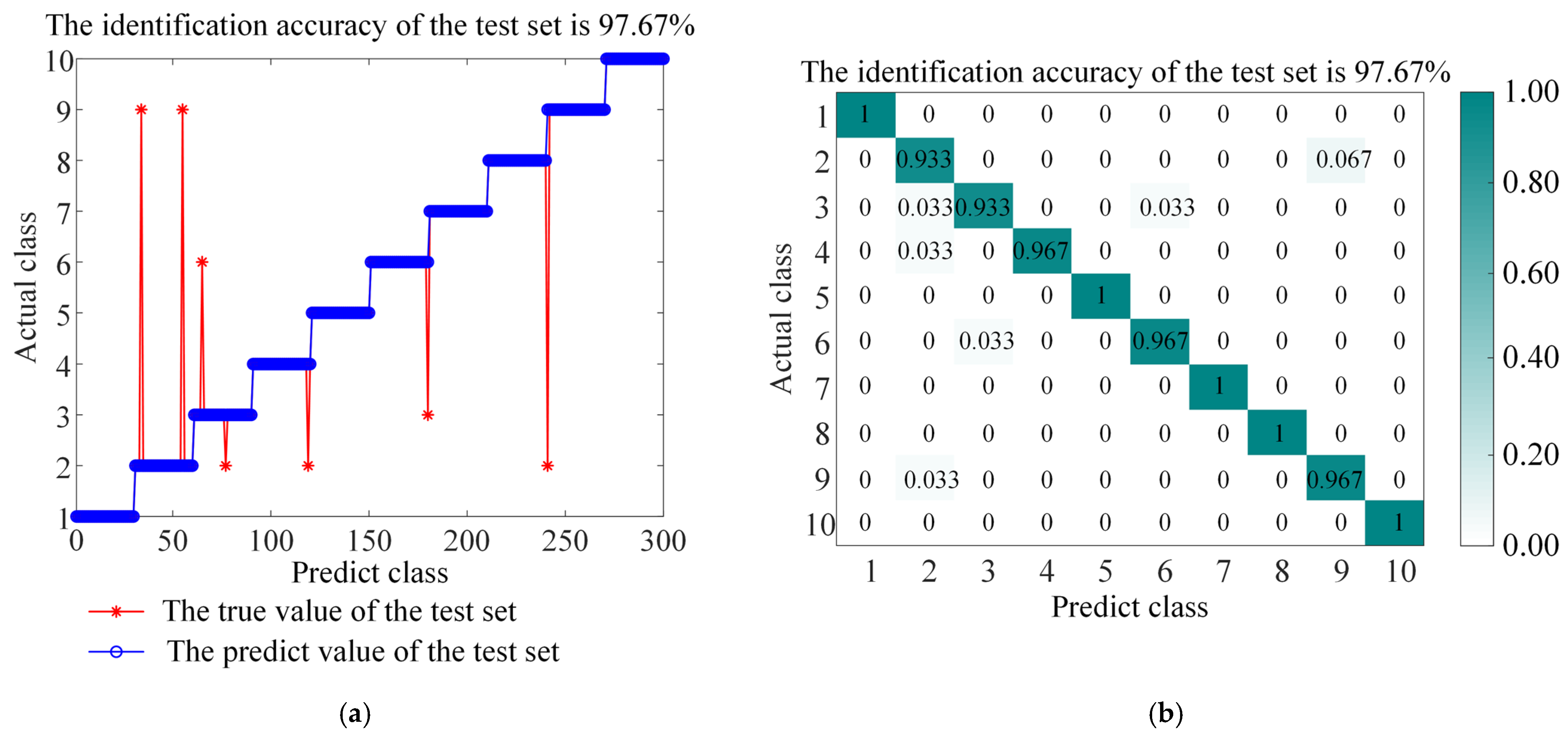
- The constructed ITOC-LSSVM fault diagnosis model achieves a classification accuracy of 97.67% on the Case Western Reserve University bearing dataset, outperforming several comparative methods.
- This method provides an efficient and adaptive solution for intelligent fault diagnosis of rolling bearings under strong noise environments, demonstrating considerable potential for engineering applications.
Abstract
1. Introduction
- An improved ICEEMDAN method based on Bayesian optimization and adaptive SNR adjustment (BAYES-ICEEMDAN-SNR) is proposed, which can adaptively determine the noise parameters and dynamically adjust the decomposition strategy to improve the robustness of feature extraction under strong noise.
- An Improved Tornado Optimizer with Coriolis force (ITOC) is designed, which introduces Chebyshev chaotic map, Cauchy mutation and dynamic reverse learning mechanism to enhance the global search ability and convergence accuracy.
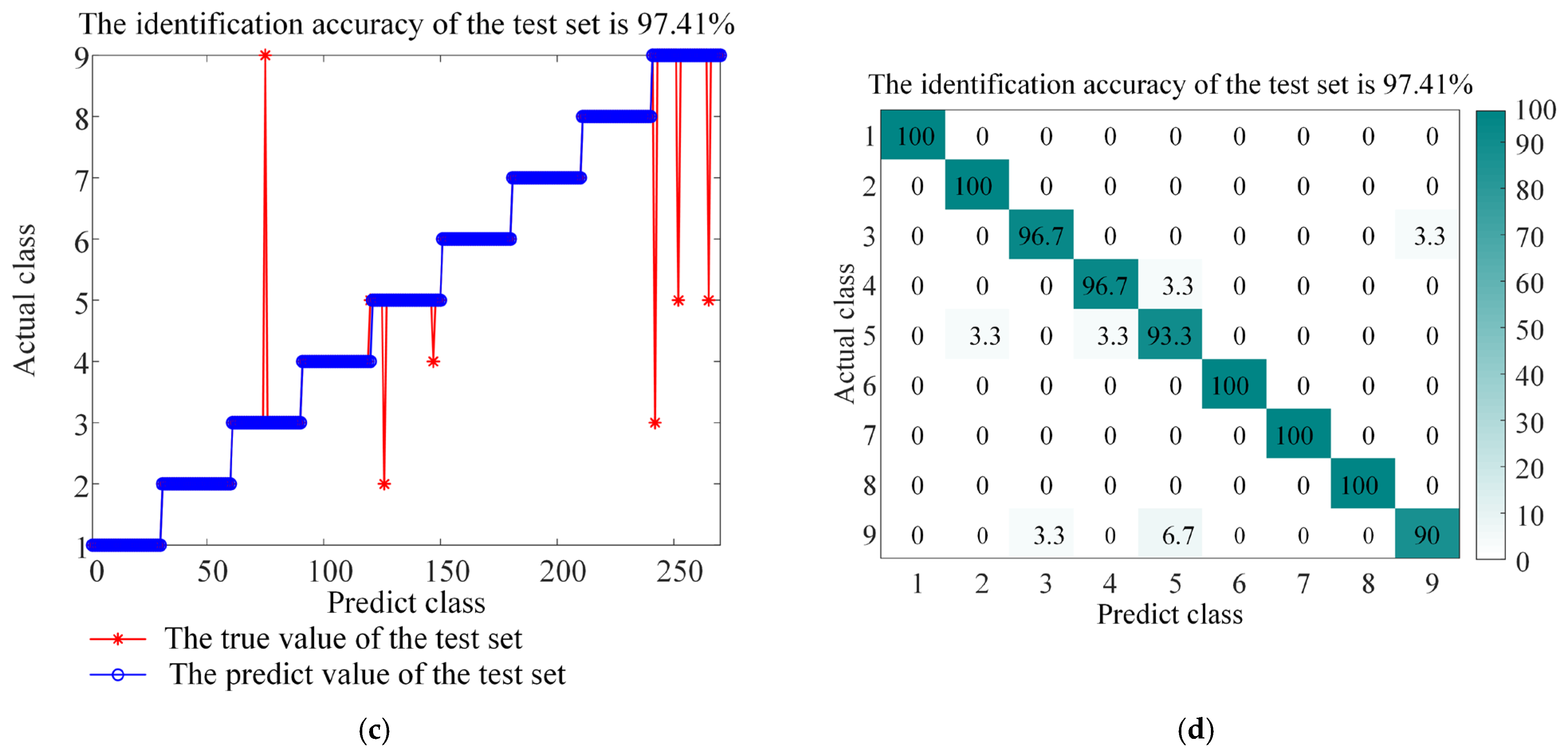
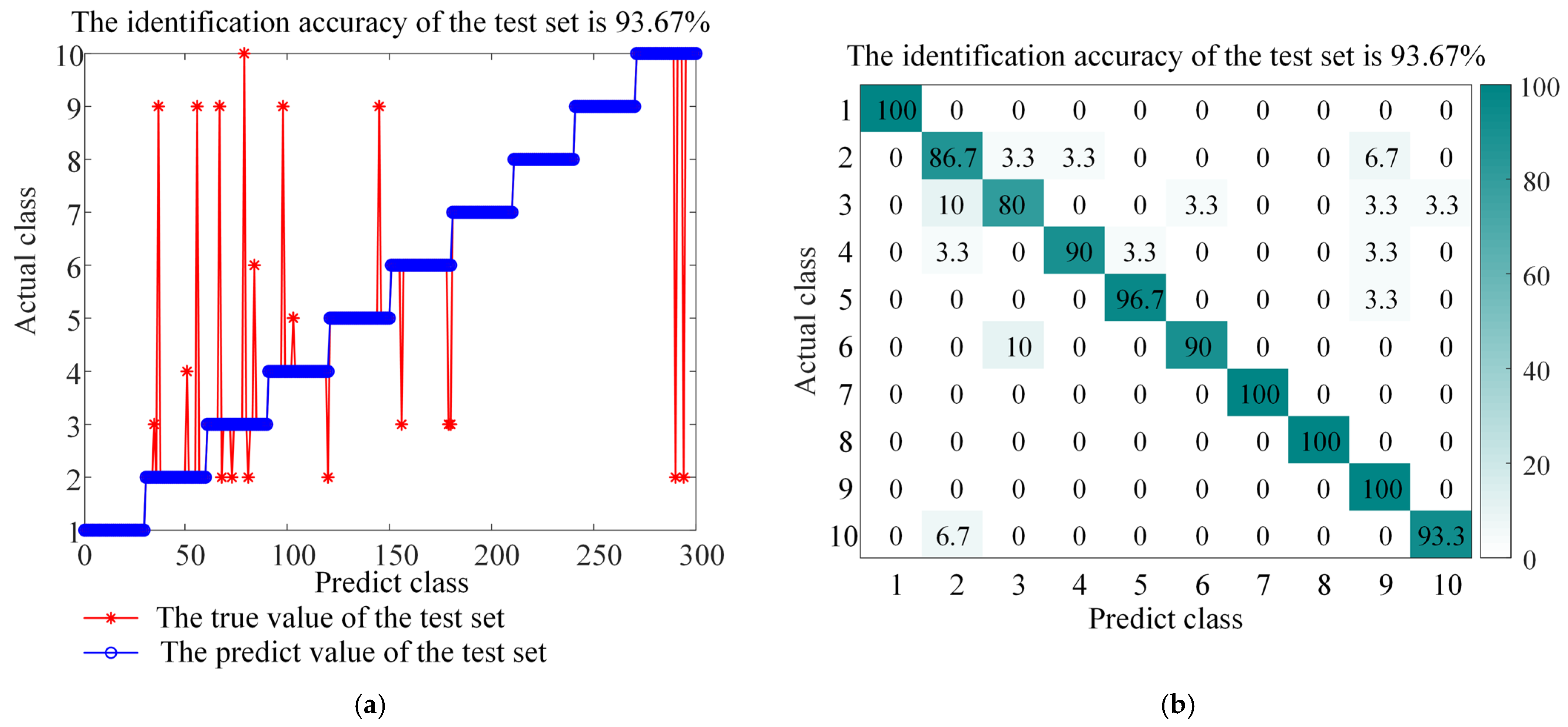
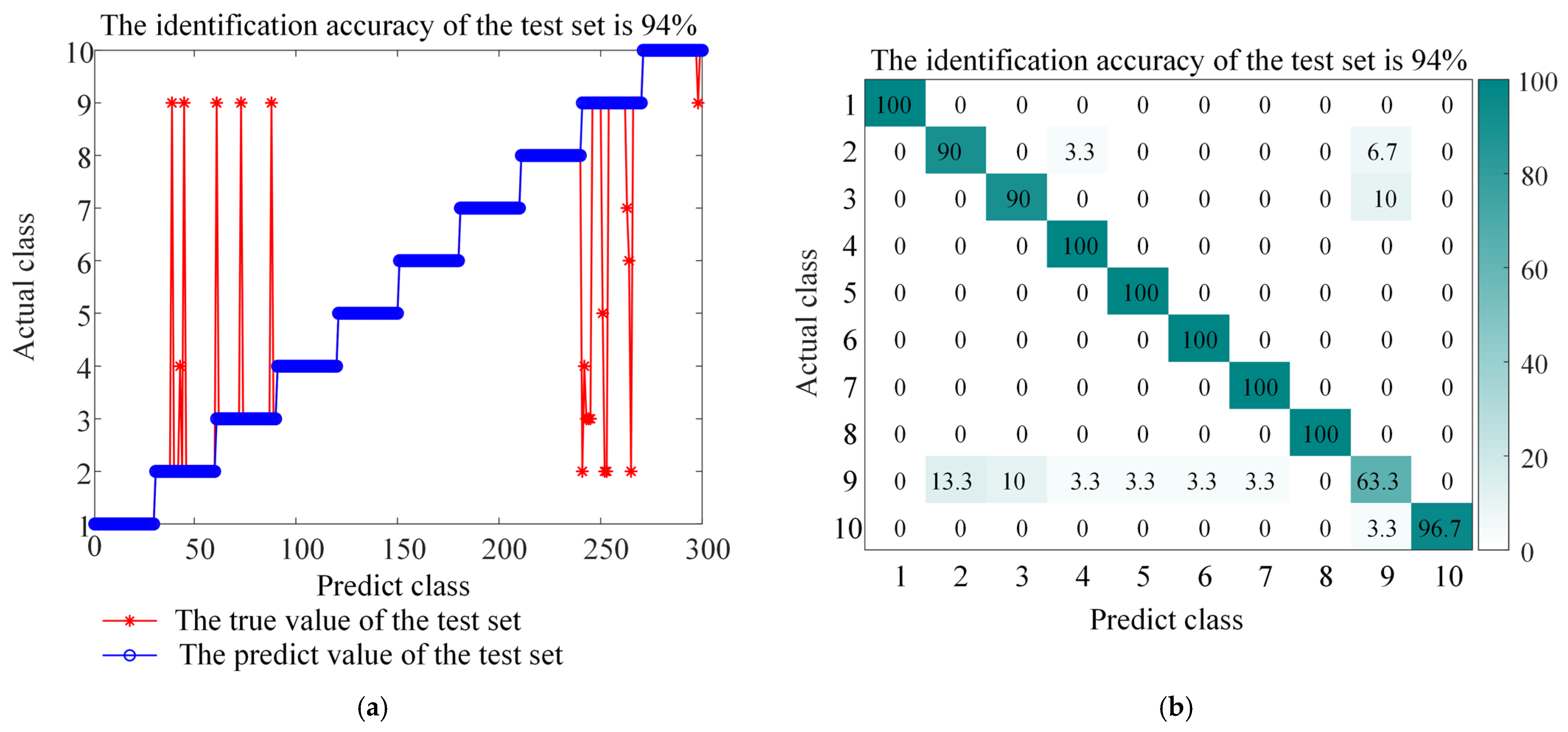
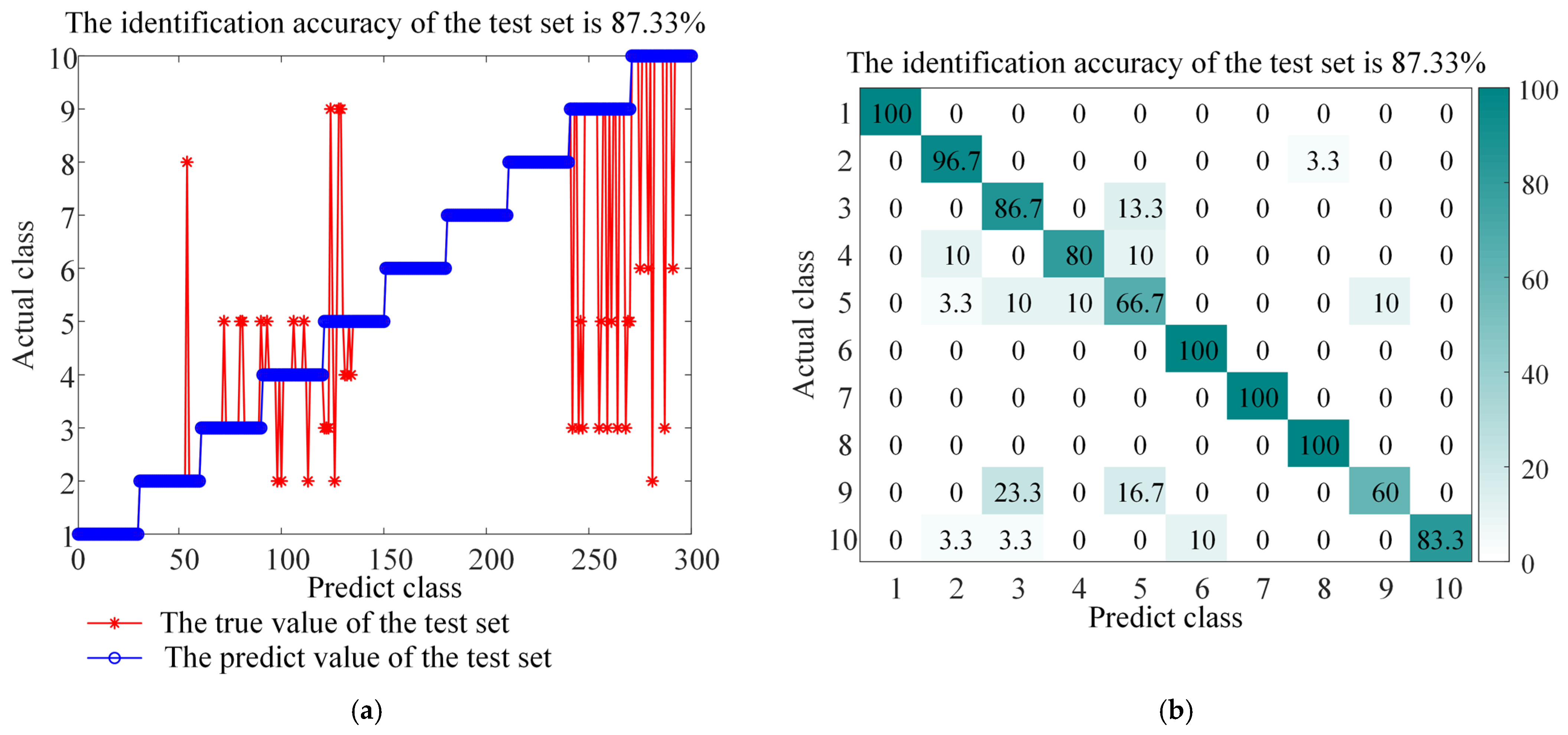
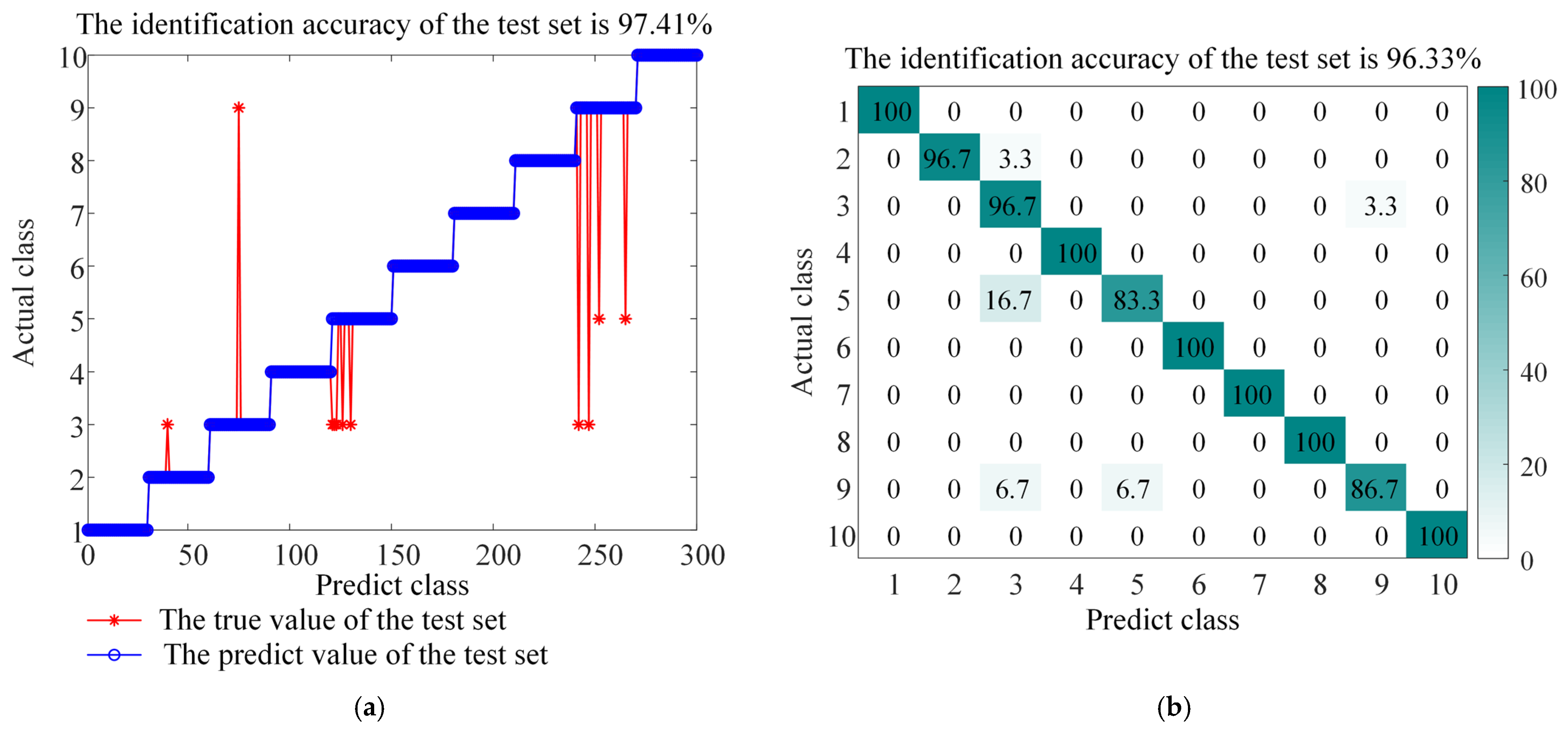
- An end-to-end fault diagnosis framework is constructed, and the above improved method is applied to the parameter optimization of LSSVM. The classification accuracy of 97.67% is achieved on the CWRU bearing dataset and 97.41% on the HUST gear dataset, which are better than those of many comparison methods.
- Experiments verify the adaptability and stability of the proposed method in a strong noise environment and provide a feasible scheme for intelligent fault diagnosis in industrial scenes.
2. Materials and Methods
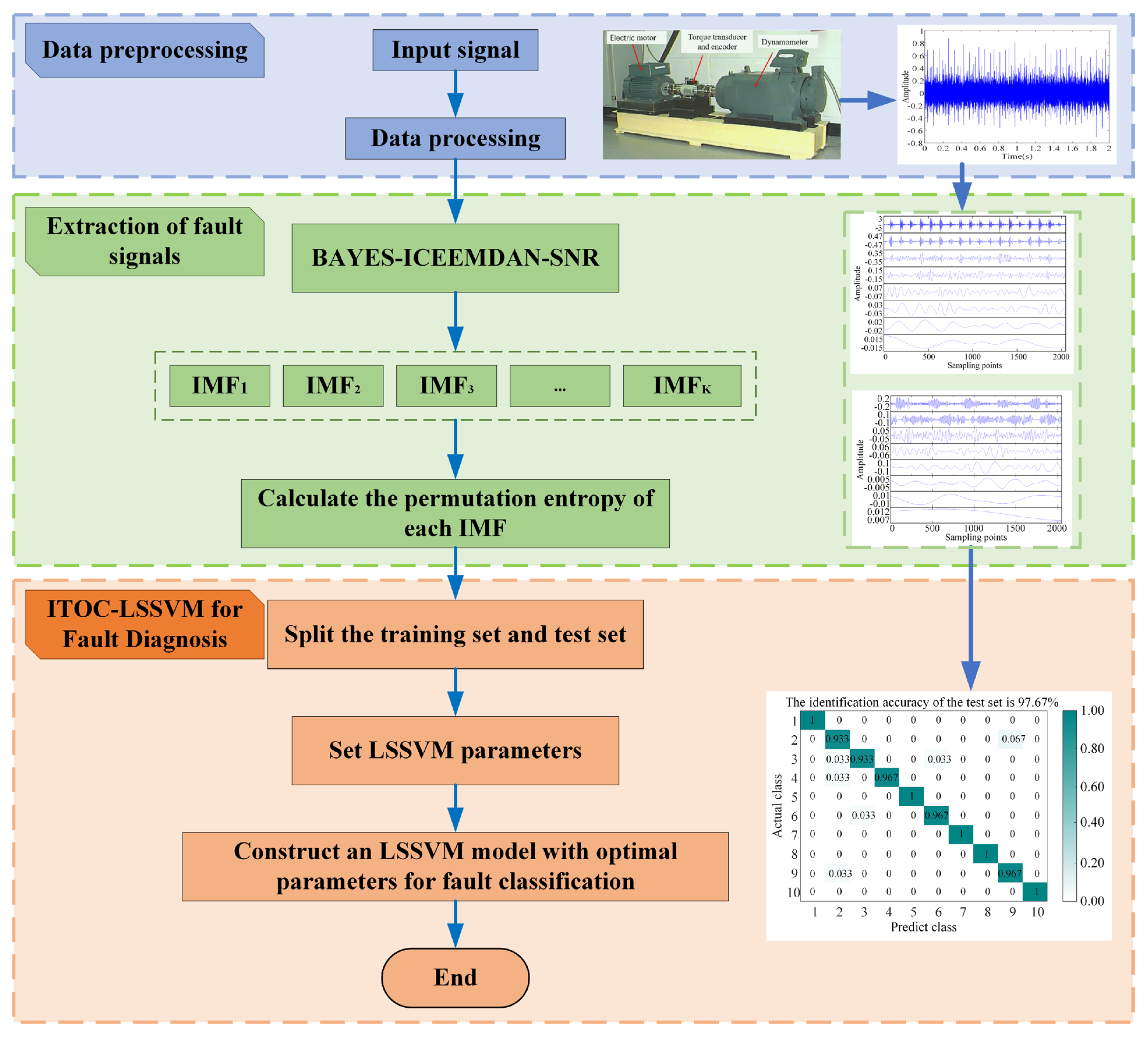
2.1. Integrated Diagnostic Framework
- Adaptive Preprocessing: raw signals are decomposed via BAYES-ICEEMDAN-SNR to extract IMFs.
- Feature Quantization: permutation entropy (PE) is calculated for the first eight IMFs to construct robust feature vectors.
- Autonomous Classification: the ITOC algorithm fine-tunes LSSVM hyperparameters to perform final fault identification.
2.2. BAYES-ICEEMDAN-SNR
2.2.1. Improved Complete Ensemble Empirical Mode Decomposition with Adaptive Noise
- (1)
- Gaussian white noise is added to the original vibration signal to obtain
- (2)
- White noise is further added to the residual , resulting in the residual expression after the addition of white noise:
- (3)
- According to Formula (5), the IMF component is calculated.
- (4)
- The above steps are repeated until the residual R can no longer undergo EMD decomposition, resulting in the signal :
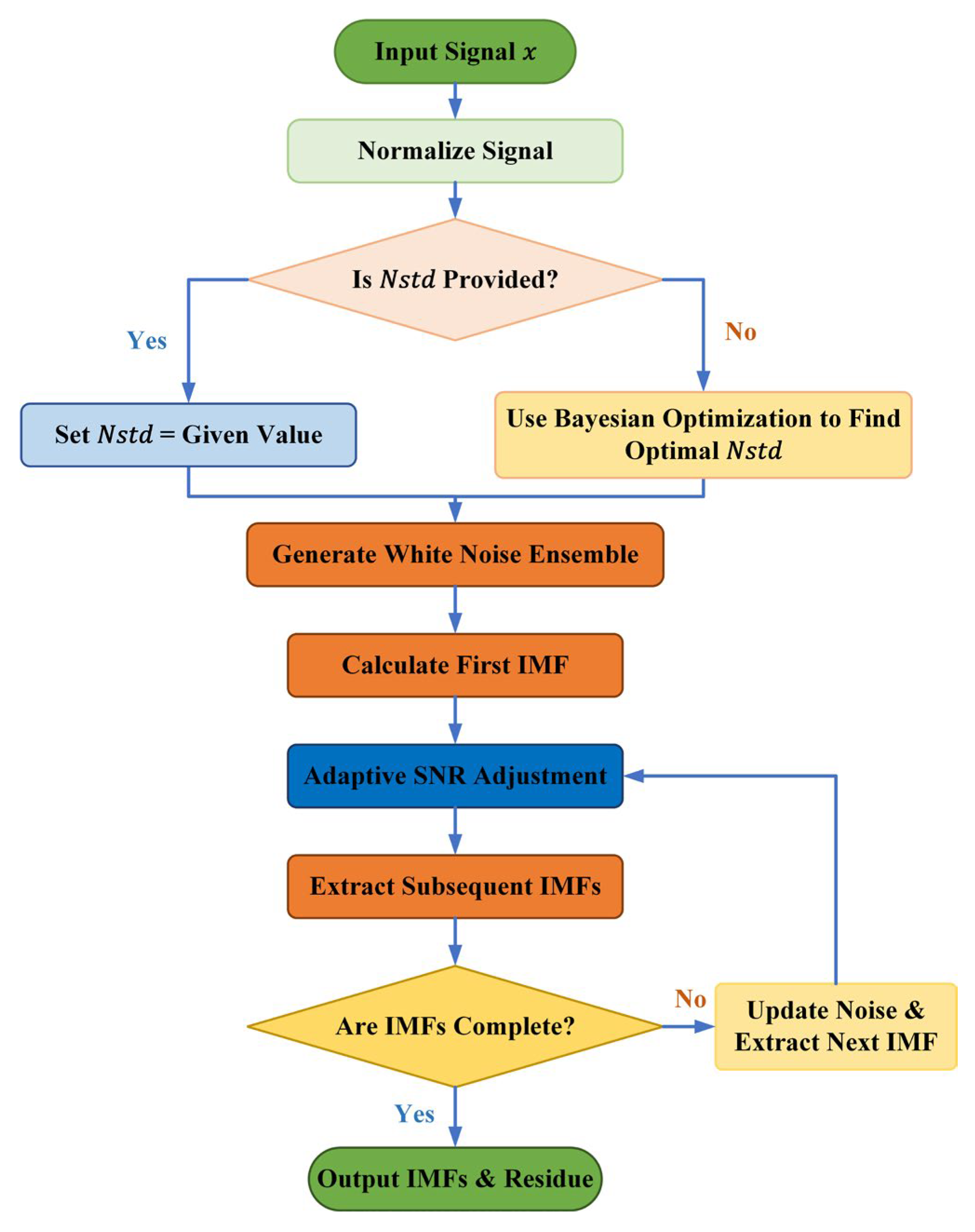
2.2.2. BAYES-ICEEMDAN-SNR Algorithm Principle
- (1)
- Bayesian Optimization (BO)
- (2)
- Adaptive Signal-to-Noise Ratio Optimization Strategy
- (a)
- At the start of each iteration to extract an Intrinsic Mode Function (IMF), the signal-to-noise ratio (SNR) estimate of the current residual signal is calculated. To balance efficiency and practicality, a variance-based approximate estimation is used:
- (b)
- Design a monotonically decreasing mapping function to convert the estimated SNR value into a suggested noise strength coefficient for that iteration step. This function ensures that a low SNR corresponds to a higher noise enhancement coefficient, while a high SNR corresponds to a lower coefficient. A piecewise linear implementation can be defined as follows:
- (c)
- The generated baseline white noise is normalized by its standard deviation, and then multiplied by the dynamic coefficient obtained from the mapping function and the globally optimized baseline strength (from the Bayesian optimization output in Section 2.1), forming the actual injected noise for that iteration step.
- (d)
- The dynamically adjusted noise is added to the current residual signal, and the EMD decomposition is performed to extract the next IMF and update the residual signal. Steps (1) to (4) are repeated until the decomposition stopping criteria are met.
2.2.3. BAYES-ICEEMDAN-SNR Procedure
2.3. Permutation Entropy (PE)
- (1)
- In a time series of length , denoted as , , , …, , an embedding dimension and a time delay are specified. The original sequence is reconstructed, and each subsequence is represented as .
- (2)
- For each subsequence , perform an increasing order sorting within it, i.e., if two values are equal, sort them according to their indices I. This way, each M-dimensional subsequence is mapped to one of possible permutations.
- (3)
- After the above step, represent the continuous M-dimensional subsequences by a symbol sequence, where the number of symbols is G. The probability distribution of all symbols is represented as P, and the entropy is calculated as H. The permutation entropy of the time series U is then given by:
2.4. Improved Tornado Optimizer with Coriolis Force with Coriolis Force (ITOC)
2.4.1. Tornado Optimizer with Coriolis Force with Coriolis Force (TOC)
- (1)
- Population Initialization and Classification
- Tornadoes (): Typically set to 1, representing the current best solution found.
- Thunderstorms (): A portion of the relatively better individuals, which are potential excellent solutions.
- Windstorms (): The remaining ordinary individuals in the population, which are the main force for exploring the search space.
- (2)
- Evolution and Movement of Windstorms
- Speed Update of Windstorms
- 2
- Windstorm Position Update
- (a)
- Evolving into a Tornado:
- (b)
- Evolving into a Thunderstorm
- (3)
- Evolution of Thunderstorms
- (4)
- Random Formation of Windstorms
2.4.2. Improvements to the Tornado Optimizer with Coriolis Force with Coriolis Force
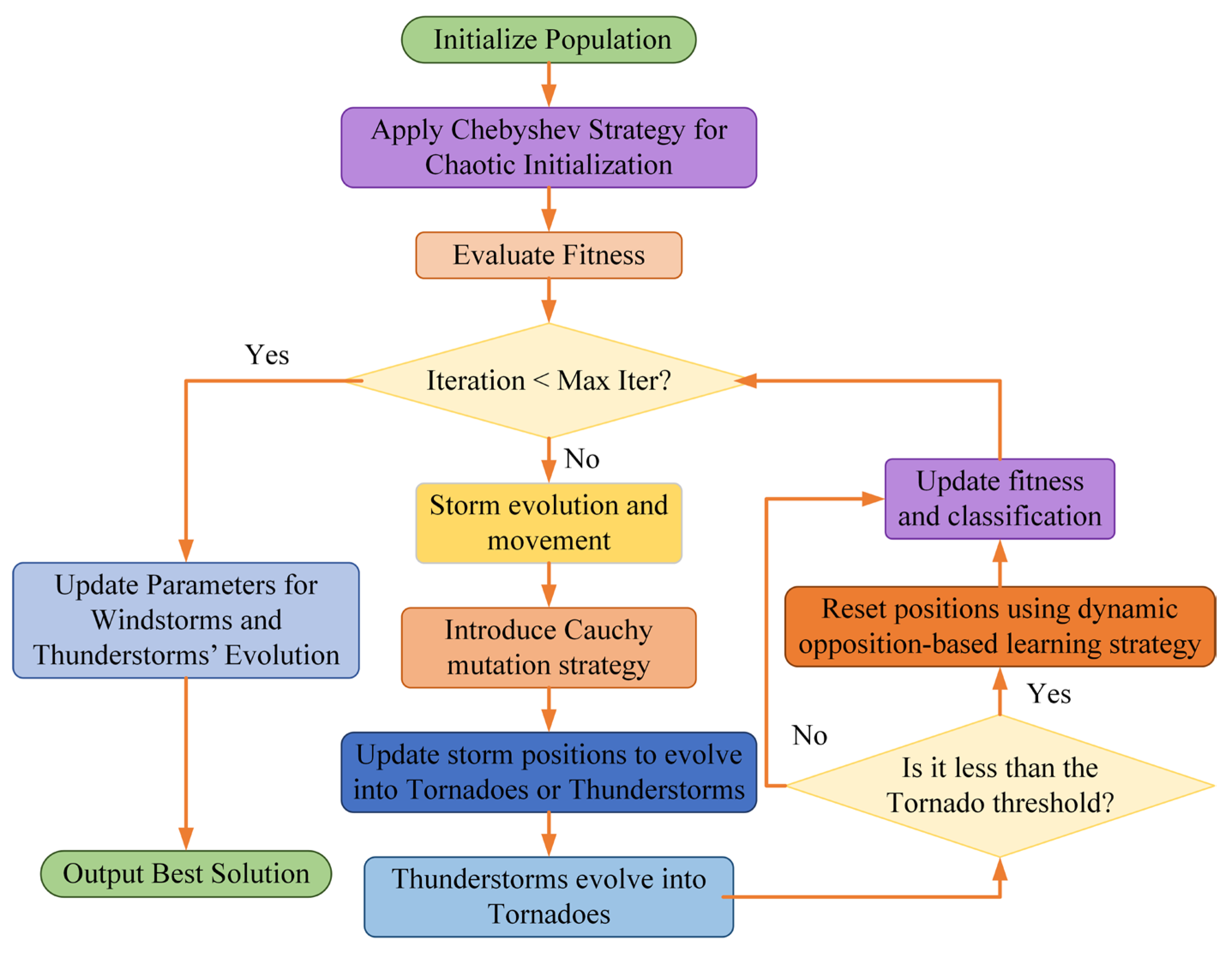
- (1)
- Chebyshev Chaotic Mapping Strategy
- (2)
- Cauchy Mutation Strategy
- 1
- Evolving into a Tornado:
- 2
- Evolving into a Thunderstorm:
- (3)
- Dynamic Reverse Learning Strategy
2.4.3. Improvements to the Tornado Optimizer with Coriolis Force: Algorithm Flow
2.5. Least Squares Support Vector Machine (LSSVM)
3. Experimental Verification
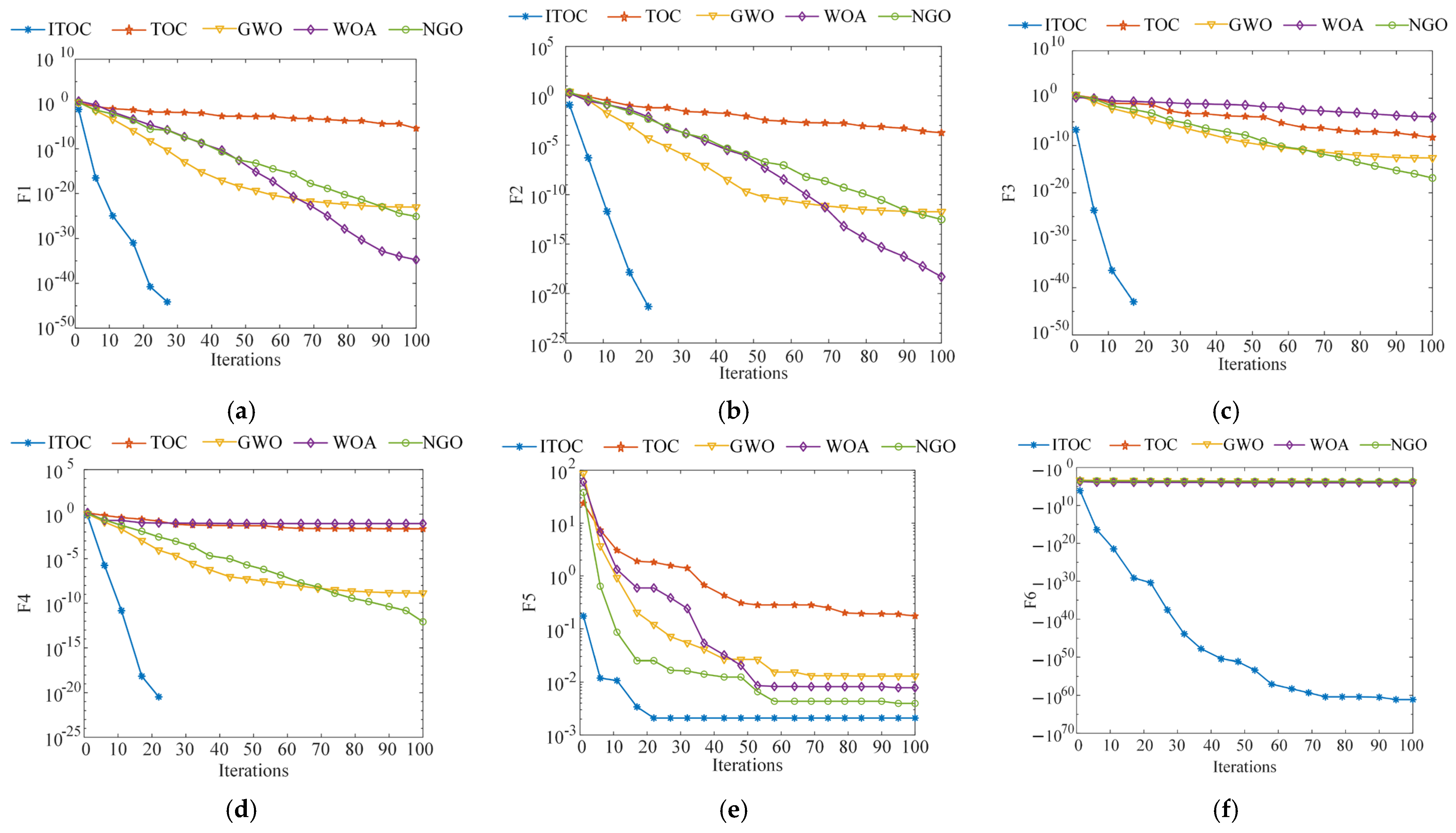
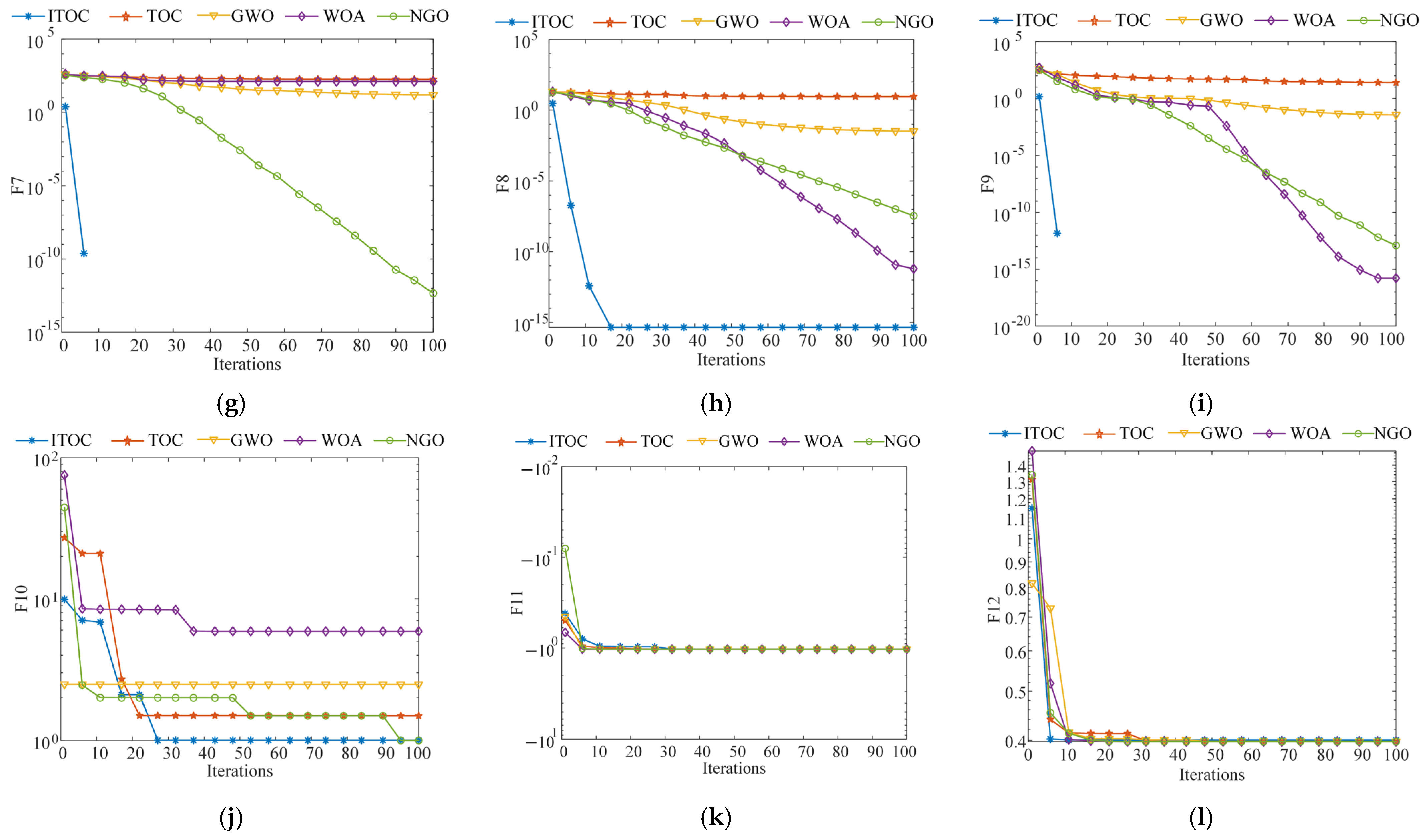
3.1. Improving the Performance Verification of the Tornado Algorithm
3.2. Validation of CWRU Bearing Experimental Signals
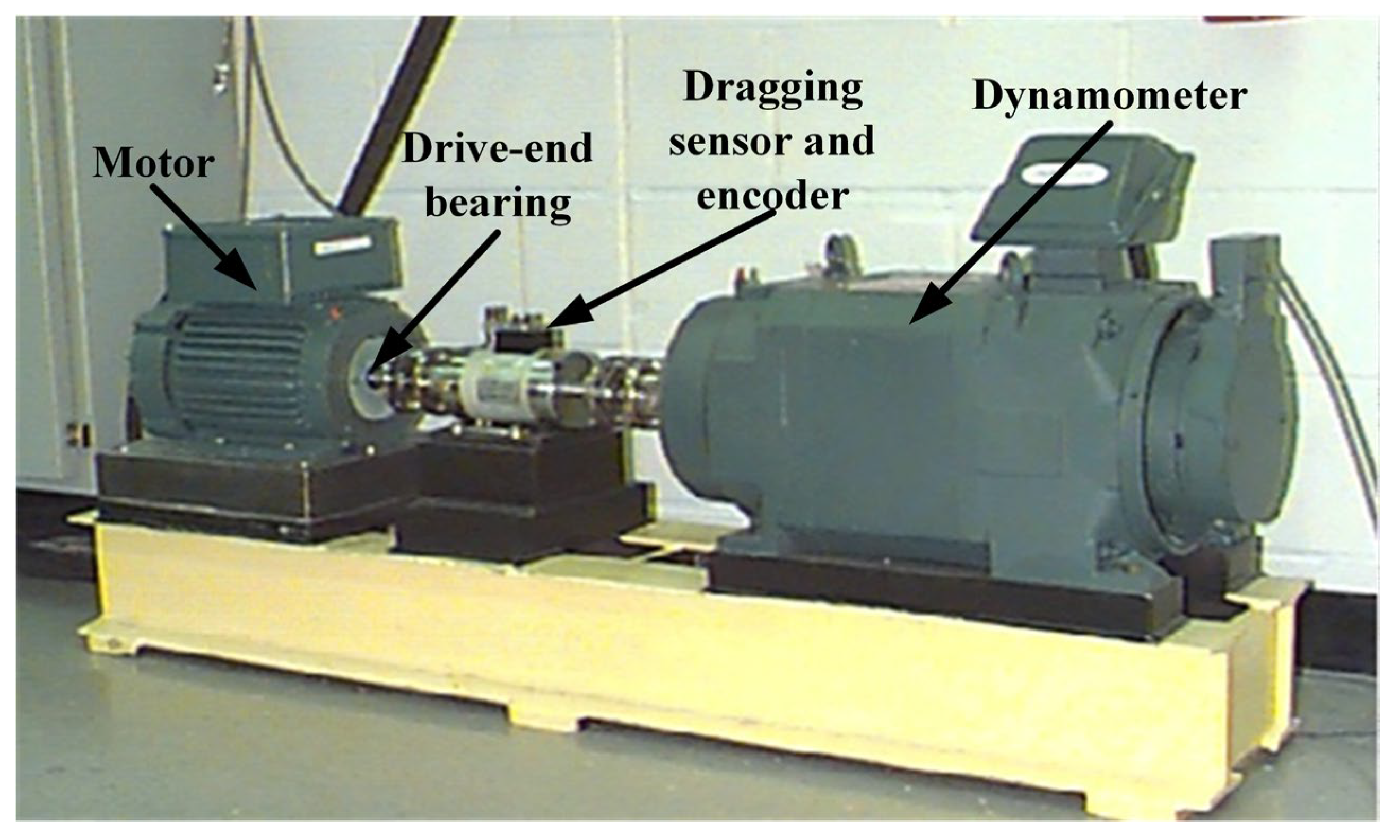
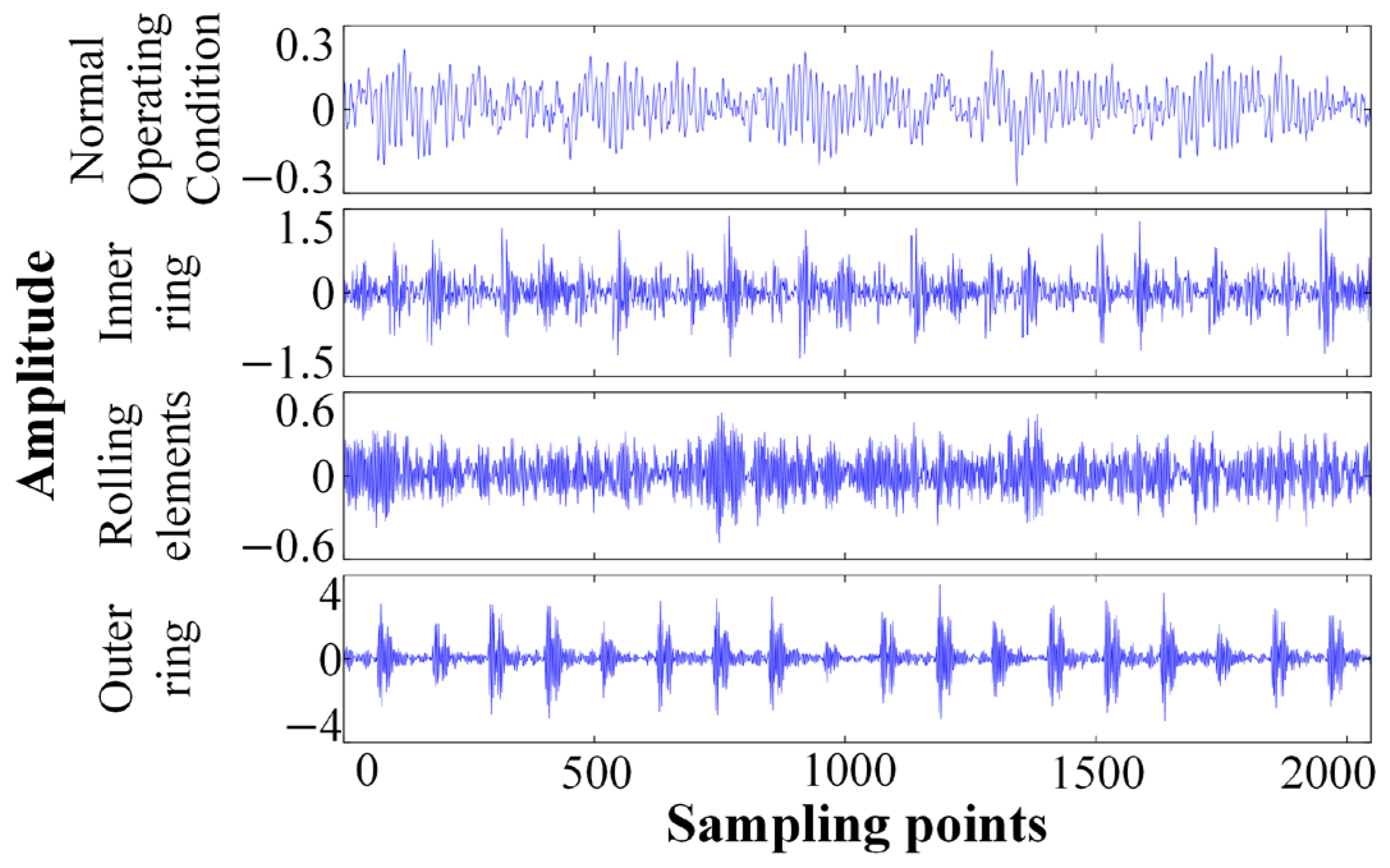
3.2.1. Bearing Experimental Parameters and Vibration Signal Data Preprocessing
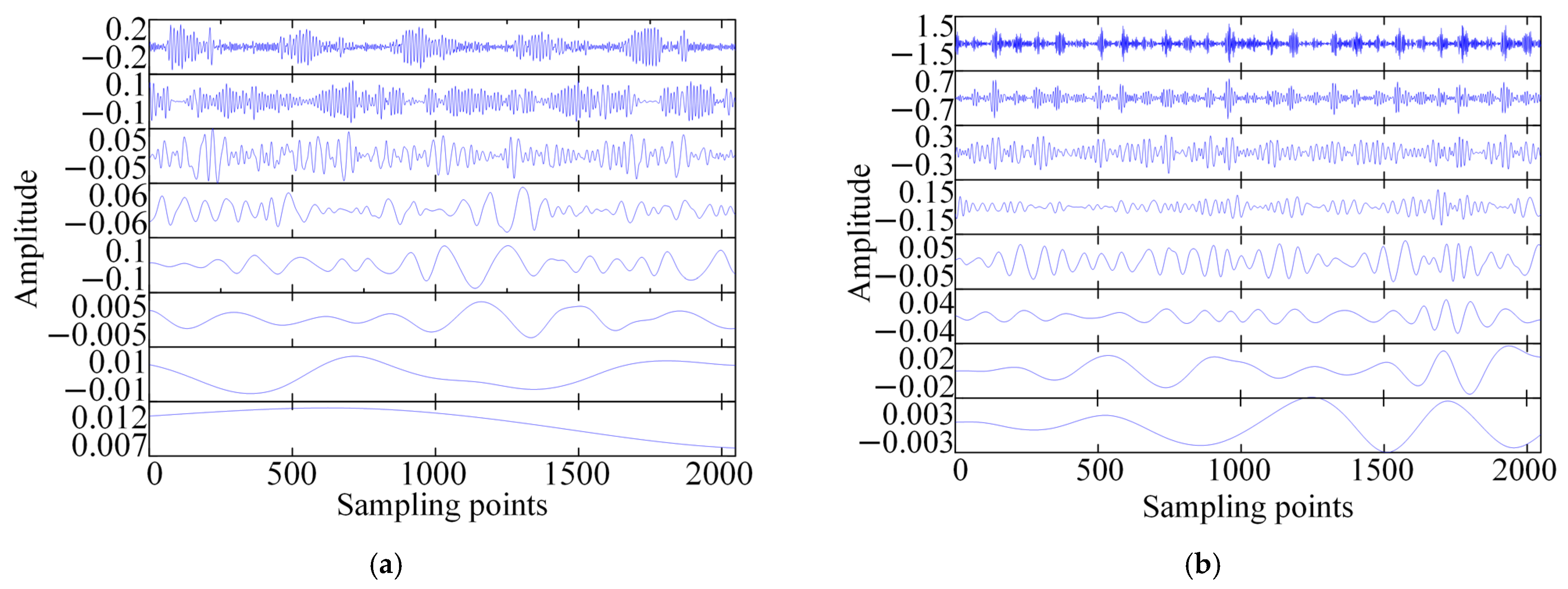
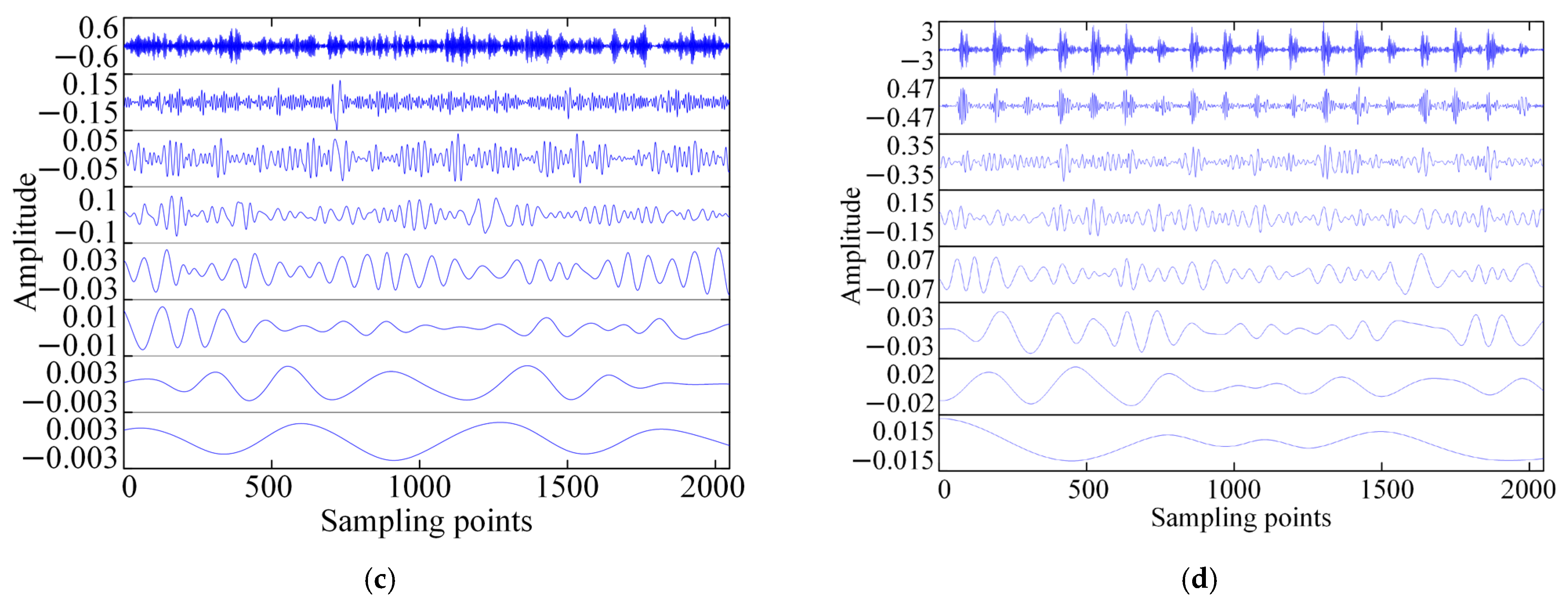
3.2.2. Bearing Fault Feature Extraction
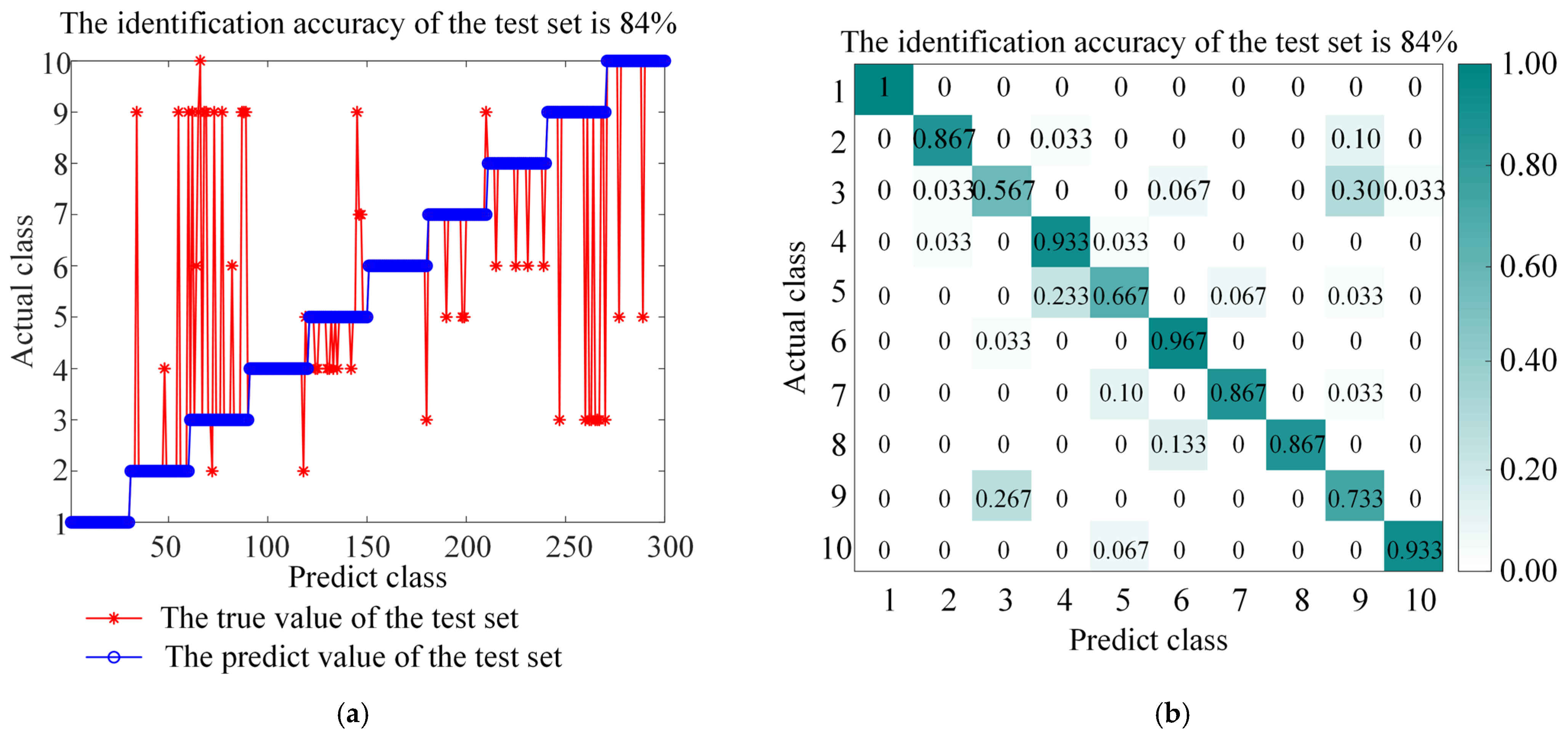
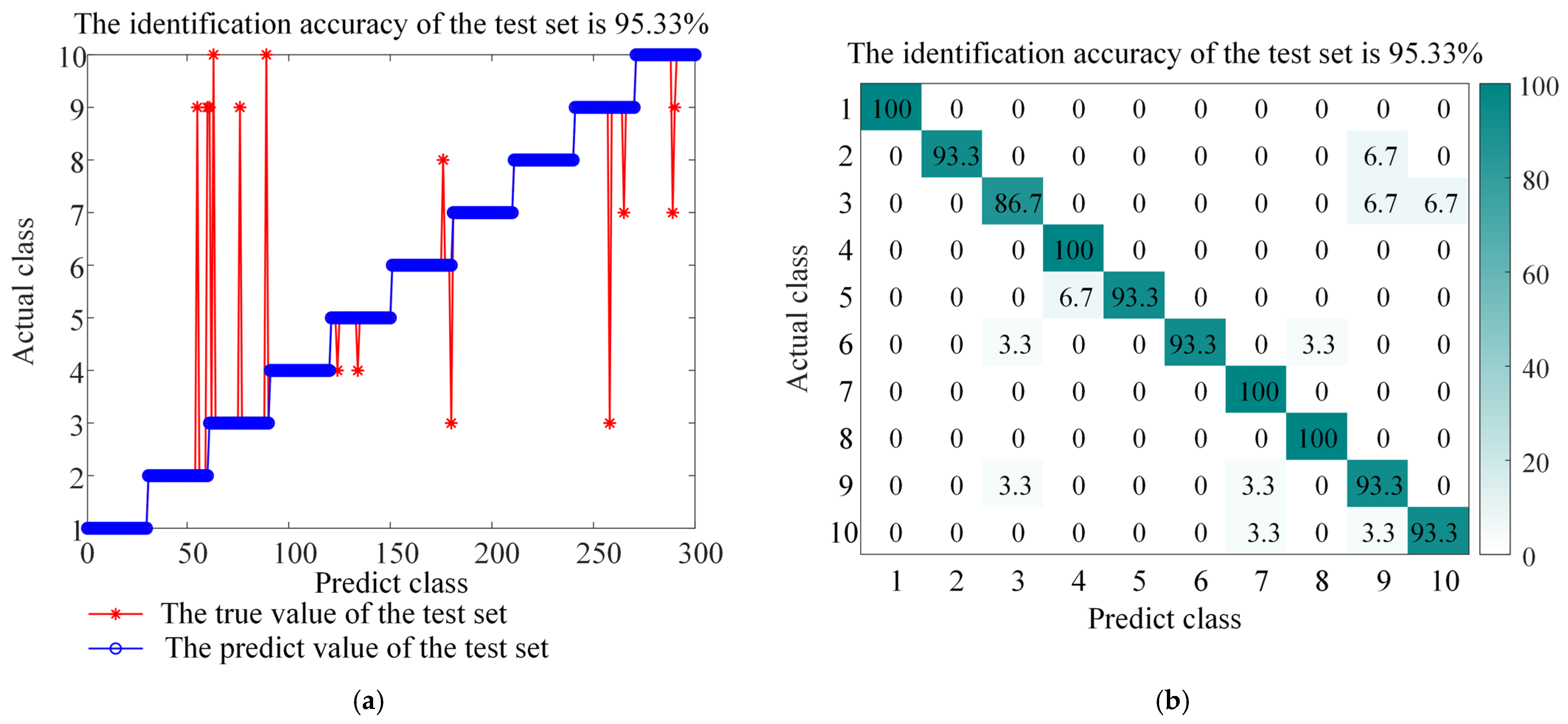
3.2.3. Bearing Fault Identification
3.3. Gear Fault Diagnosis Test Verification
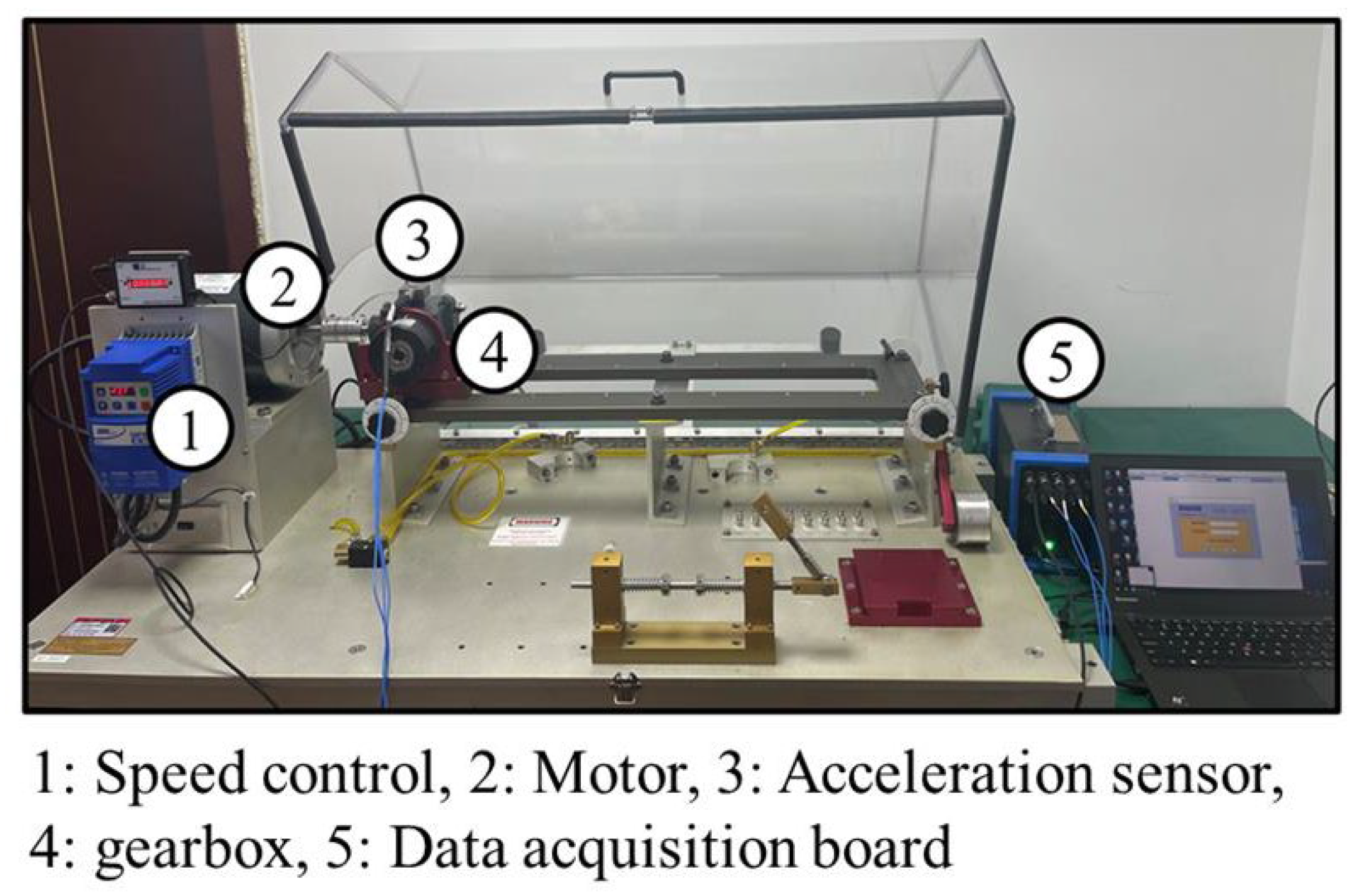
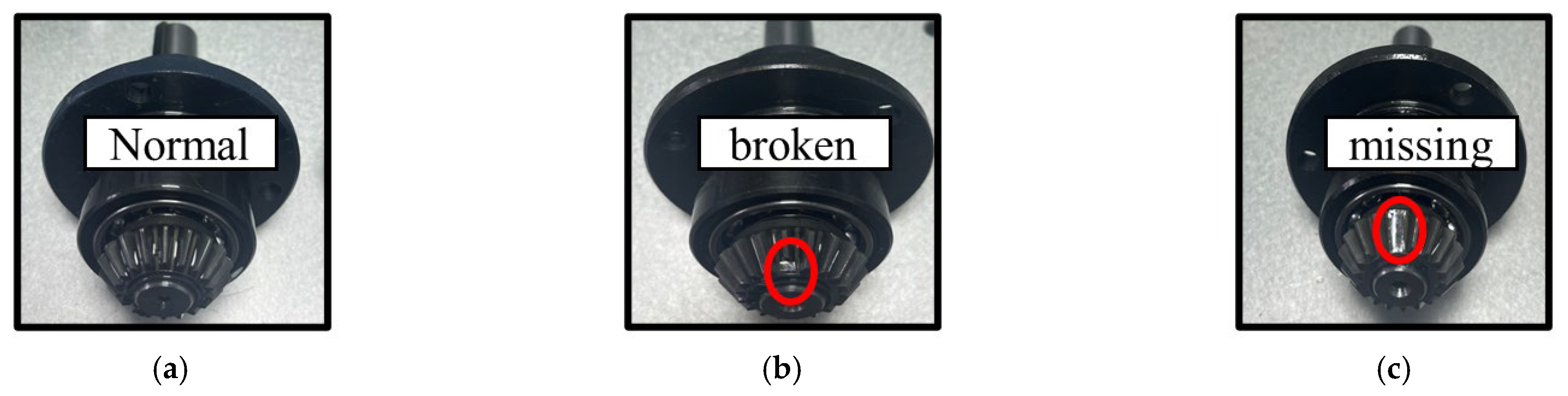
3.3.1. Test Data Description and Pretreatment
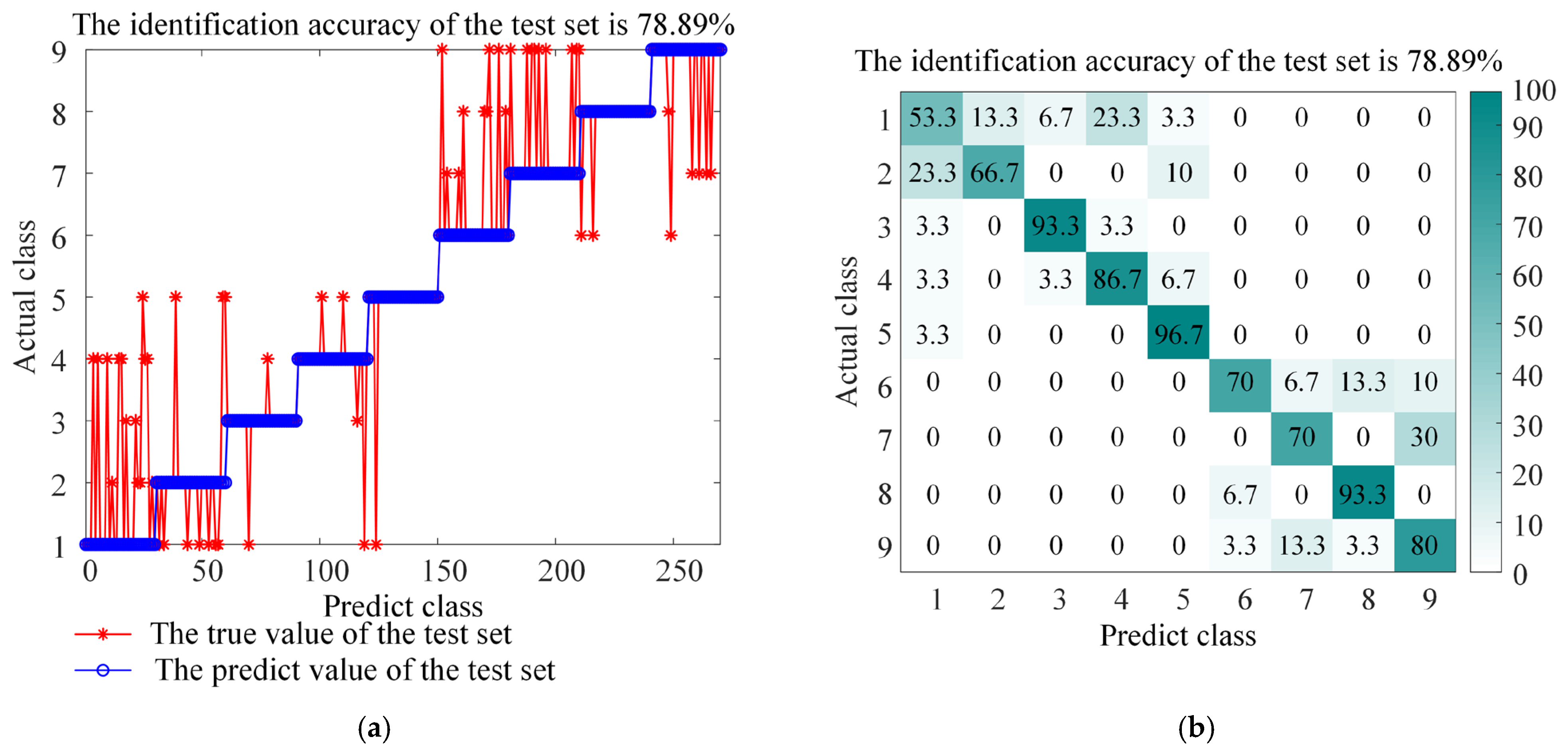
3.3.2. Fault Feature Extraction and Recognition
3.3.3. Result Analysis and Conclusion
3.4. Ablation Experiment
- (1)
- BAYES-EEMD-SNR-ITOC-LSSVM: the core decomposition method is replaced by ensemble empirical mode decomposition (EEMD) to evaluate the advantages of ICEEMDAN in suppressing mode aliasing and reducing reconstruction error.
- (2)
- BAYES-EMD-SNR-ITOC-LSSVM: the core decomposition method is replaced by the basic empirical mode decomposition (EMD) to verify the necessity of introducing the noise-assisted integrated decomposition strategy.
- (3)
- BAYES-ICEEMDAN-ITOC-LSSVM: remove the adaptive signal-to-noise ratio (SNR) adjustment module and adopt a fixed noise injection strategy to evaluate the impact of the dynamic SNR mechanism on the robustness of feature extraction in a strong noise environment.
- (4)
- BAYES-ICEEMDAN-SNR-LSSVM: remove the improved Tornado Optimizer with Coriolis force (ITOC) and determine the LSSVM parameters by default or grid search to measure the value of ITOC in optimizing the classifier super parameters and avoiding local optimization.
- (5)
- ICEEMDAN-SNR-ITOC-LSSVM: remove the Bayesian optimization module and set the noise parameters of ICEEMDAN with empirical values to verify the role of Bayesian optimization in adaptively determining the optimal noise parameters and improving the decomposition quality.
3.5. Discussion
4. Conclusions
- (1)
- By introducing Bayesian optimization and an adaptive signal-to-noise ratio adjustment mechanism, the ICEEMDAN algorithm has been significantly improved, effectively overcoming the dependence of the original algorithm on the empirical setting of noise parameters. Bayesian optimization enables adaptive global optimization of the noise standard deviation, significantly enhancing the stability and adaptability of the decomposition process. This algorithm combines real-time dynamic assessment based on signal-to-noise ratio and noise intensity adjustment, enabling adaptive adjustment of the decomposition strategy according to different signal qualities, enhancing the ability to extract fault features while suppressing over-decomposition and mode aliasing. The improved BAYES-ICEEMDAN-SNR further improves the decomposition quality and feature representation robustness of non-stationary and nonlinear vibration signals.
- (2)
- The improved tornado optimization algorithm exhibits excellent global optimization performance. By incorporating Chebyshev chaotic mapping initialization, Cauchy mutation strategy, and a dynamic reverse learning mechanism, ITOC effectively enhances population diversity, global search capability, and the ability to escape from local optima, overcoming the shortcomings of the original TOC algorithm, which is prone to premature convergence and easily trapped in local optima. Simulation results on 12 standard test functions indicate that ITOC outperforms the original TOC algorithm and comparison algorithms such as GWO, WOA, and NGO in terms of convergence speed, solution accuracy, and stability.
- (3)
- The LSSVM diagnostic model jointly optimized by BAYES-ICEEMDAN-SNR and ITOC has high recognition accuracy and engineering practicability. The permutation entropy features extracted by the improved BAYES-ICEEMDAN-SNR algorithm can more comprehensively characterize different fault states; the ITOC algorithm adaptively optimizes the key parameters of LSSVM to construct a high-performance fault classifier. The verification on the bearing dataset of Case Western Reserve University and the gear dataset of Huazhong University of Science and Technology shows that the overall fault diagnosis accuracy of this method reaches over 97%, significantly higher than that of the mainstream diagnostic models such as standard LSSVM. These experimental results prove the effectiveness of this method in extracting fault features and achieving accurate classification in noisy environments, and it has a good engineering application prospect.
- (1)
- Higher computational burden: The integration of Bayesian optimization with the ITOC algorithm increases the complexity of the hyperparameter tuning stage. Although this ensures higher accuracy, the computational cost of the offline training phase is higher than that of non-optimized models.
- (2)
- Generalization ability under dynamic conditions: The current verification is mainly based on stable operation conditions. The performance and reliability of this framework in strong non-stationary environments (such as rapid load fluctuations or time-varying rotational speeds) still need to be comprehensively evaluated.
- (3)
- Empirical feature selection: The selection of the first eight IMFs for the calculation of permutation entropy relies on prior knowledge of the bearing fault characteristics. Developing an automated, data-driven criterion for the optimal selection of IMF will enhance the adaptability and universality of the diagnostic process.
Author Contributions
Funding
Data Availability Statement
Conflicts of Interest
References
- Li, Y.; Liu, X.; Hu, J.; Liang, P.; Wang, B.; Yuan, X.; Zhang, L. Graph Optimization Algorithm Enhanced by Dual-Scale Spectral Features with Contrastive Learning for Robust Bearing Fault Diagnosis. Knowl. Based Syst. 2025, 315, 113275. [Google Scholar] [CrossRef]
- Zhao, H.; Huang, X.; Xiao, Z.; Shi, H.; Li, C.; Tai, Y. Week-Ahead Hourly Solar Irradiation Forecasting Method Based on ICEEMDAN and TimesNet Networks. Renew. Energy 2024, 220, 119706. [Google Scholar] [CrossRef]
- Xiao, M.; Wang, Z.; Zhao, Y.; Geng, G.; Dustdar, S.; Donta, P.K.; Ji, G. A New Fault Feature Extraction Method of Rolling Bearings Based on the Improved Self-Selection ICEEMDAN-Permutation Entropy. ISA Trans. 2023, 143, 536–547. [Google Scholar] [CrossRef]
- Yuvaraju, B.A.G.; Srinivas, J.; Ioannou, I.; Guruguntla, V.; Ghantasala, G.S.P. Advanced Chatter Detection in Internal Turning for Industry 4.0: Adaptive Threshold Wavelet De-Noising with Enhanced ICEEMDAN–Hilbert Fusion Using Adaptive Probabilistic Neural Network. J. Manuf. Process. 2025, 149, 1078–1105. [Google Scholar] [CrossRef]
- Xiang, G.; Sun, A.; Liu, Y.; Gao, L. An Improved Denoising Method for φ-OTDR Signal Based on the Combination of Temporal Local GMCC and ICEEMDAN-WT. Opt. Fiber Technol. 2024, 87, 103949. [Google Scholar] [CrossRef]
- Zhang, T.; Gu, Y.; Zhang, Q.; Wei, Y.; Wang, L.; Li, C.; Wang, W.; Lv, J.; Feng, Y. Performance Improvement of Quartz-Enhanced Photoacoustic Spectroscopy Gas System Using ICEEMDAN-PE-WTD. Infrared Phys. Technol. 2025, 145, 105650. [Google Scholar] [CrossRef]
- Zhong, J.; Cai, Y.; Wang, K.; Chen, Y.; Wei, X.; Su, H.; Zheng, X.; Liang, K. Two-Stage Hybrid Energy Storage Configuration Method for Distribution Networks Based on ICEEMDAN and Multi-Objective Optimization. J. Energy Storage 2025, 127, 116782. [Google Scholar] [CrossRef]
- Guo, H.; Zhao, X. An Interpretable Fault Diagnosis Method for Marine Rotating Machinery under Strong Noise Based on Constrained Penalty Leech Algorithm Optimized ICEEMDAN. Ocean Eng. 2026, 344, 123685. [Google Scholar] [CrossRef]
- Song, Z.; Guo, X.; Zhang, W.; Deng, Y.; Li, Z.; Fan, G.; Kang, R.; Wang, X. Atomic-Scale Surface Integrity Prediction of Chemical Mechanical Polishing Polycrystalline Diamond: Insights from ReaxFF MD and CPO-GMM-LSSVM Model. Diam. Relat. Mater. 2025, 160, 113010. [Google Scholar] [CrossRef]
- Yang, J.; Guan, H.; Ma, X.; Zhang, Y.; Lu, Y. Rapid Detection of Corn Moisture Content Based on Improved ICEEMDAN Algorithm Combined with TCN-BiGRU Model. Food Chem. 2025, 465, 142133. [Google Scholar] [CrossRef]
- Yang, J.; Peng, L.; Luo, L.; Li, W.; Chen, Y. Wind Power Forecasting Using Hybrid ICEEMDAN-KPCA and IWOA-BiLSTM Models. Int. J. Electr. Power Energy Syst. 2025, 173, 111445. [Google Scholar] [CrossRef]
- Zhou, M.; Yu, J.; Wang, M.; Quan, W.; Bian, C. Research on the Combined Forecasting Model of Cooling Load Based on IVMD-WOA-LSSVM. Energy Build. 2024, 317, 114339. [Google Scholar] [CrossRef]
- Zhu, Z.; Liu, H.; Lei, W.; Xue, Y.; Xiao, C. Optimising Wellbore Annular Leakage Detection and Diagnosis Model: A Signal Feature Enhancement and Hybrid Intelligent Optimised LSSVM Approach. Mech. Syst. Signal Process. 2025, 228, 112451. [Google Scholar] [CrossRef]
- Zhao, Y.; Jiang, A.; Jiang, W.; Zhang, Y.; Zhang, S. Hydraulic Pump Fault Diagnosis by Modified Slime Mold Algorithm Optimized Support Vector Machine. Measurement 2025, 254, 117878. [Google Scholar] [CrossRef]
- Xia, Y.; Zhao, H.; Feng, X. Prediction of Grease Performance and Optimal Additive Ratio Based on the SSA-GDA-LSSVM Model. Tribol. Int. 2025, 202, 110366. [Google Scholar] [CrossRef]
- Wang, W.; Wang, H.; Li, X.; Qi, Y.; Cui, X.; Bai, C. Prediction Model of Coal Spontaneous Combustion Oxidation State Based on MICPO-LSSVM. Fuel 2026, 407, 137366. [Google Scholar] [CrossRef]
- Liu, J.; Song, Y.; Yu, X. Risk Assessment Study of Hydrogen Energy Storage System Based on KPCA-TSO-LSSVM. Int. J. Hydrogen Energy 2024, 79, 931–942. [Google Scholar] [CrossRef]
- Wang, H.; Chen, X.; Xia, J.; Zhao, H.; Maddaiah, P.N. Newton-Raphson-Based Optimizer Combined with LSSVM: Temperature Compensation Applied to Small-Range Electronic Pressure Scanners. Flow Meas. Instrum. 2026, 107, 103127. [Google Scholar] [CrossRef]
- Han, A.; Uranghai, X.; Mei, L.; Dong, Y.; Yan, G.; Huang, A.; Bao, Y.; Qing, S.; Jukov, A.; Mandakh, U.; et al. Inversion of low heavy metal content in Soil-Scutellaria baicalensis systems using optimized spectral indices and LSSVM. Int. J. Appl. Earth Obs. Geoinf. 2026, 146, 105084. [Google Scholar] [CrossRef]
- Meng, S.; Shi, Z.; Gutierrez, M. Interpretable CEEMDAN-SMA-LSSVM Hybrid Model for Predicting Shield Tunnel-Induced Settlement. J. Rock Mech. Geotech. Eng. 2025, 17, 6179–6194. [Google Scholar] [CrossRef]
- Wang, W.; Zhang, X.; Tian, W.; Li, Z.; Zhang, R. Development and Evaluation of a Novel DTIB-LSSVM Model for Efficient and Accurate Runoff Forecasting. Results Eng. 2025, 28, 108466. [Google Scholar] [CrossRef]
- Huang, K.; Li, W.; Gao, F. Barabási-Albert Model-Enhanced Genetic Algorithm for Optimizing LGBM in Ship Power Grid Fault Diagnosis. Measurement 2025, 249, 116954. [Google Scholar] [CrossRef]
- Zhu, Q.; Liu, X.; Pei, S.; Chai, S.; Chai, R.; Cui, L. An Optimization Method of Low Orbit Constellation Satellite Fault Diagnosis Based on Improved Artificial Bee Colony Algorithm. IFAC-Pap. 2025, 59, 1083–1087. [Google Scholar] [CrossRef]
- Wang, S.; Yi, S.; Zhao, B.; Li, Y.; Zhang, D.; Chen, T.; Sun, W. Metaheuristic-Optimized LSSVM Integrated with Multi-Modal Sensing for Intelligent Nutrient Monitoring in Saline-Alkali Soils. J. Environ. Chem. Eng. 2025, 13, 120088. [Google Scholar] [CrossRef]
- Farokhzadeh, B.; Choobeh, S.; Imani, R. Robust Monthly Precipitation Forecasts Using VMD-Decomposed Hybrid LSSVM–BiLSTM Model Optimized by Harris Hawks Algorithm. Phys. Chem. Earth Parts A/B/C 2026, 142, 104257. [Google Scholar] [CrossRef]
- Quan, R.; Liang, W.; Wang, J.; Li, X.; Chang, Y. An Enhanced Fault Diagnosis Method for Fuel Cell System Using a Kernel Extreme Learning Machine Optimized with Improved Sparrow Search Algorithm. Int. J. Hydrogen Energy 2024, 50, 1184–1196. [Google Scholar] [CrossRef]
- Dong, Z.; Ding, Y.; Liu, W.; Hu, Z.; Lu, S.; Liu, Y. Maneuverability Parameter Identification of a Water-Jet USV Based on Truncated Weighted LSSVM Integrated with Adaptive Mutation PSO Algorithm. Ocean Eng. 2025, 321, 120474. [Google Scholar] [CrossRef]
- Huang, K.; Li, W.; Fang, H.; Wu, X.; Wang, L.; Peng, H. IPORF: A Combined Improved Parrot Optimizer Algorithm and Random Forest for Fault Diagnosis in AUV. Ocean Eng. 2024, 313, 119665. [Google Scholar] [CrossRef]
- Hajji, M.; Hichri, A.; Yahyaoui, Z.; Mansouri, M.; Bouazzi, Y.; Rajhi, W.; Ahmad, A. Reducing Neural Network Complexity via Optimization Algorithms for Fault Diagnosis in Renewable Energy Systems. Ain Shams Eng. J. 2024, 15, 103086. [Google Scholar] [CrossRef]
- Dao, F.; Zeng, Y.; Qian, J. Fault Diagnosis of Hydro-Turbine via the Incorporation of Bayesian Algorithm Optimized CNN-LSTM Neural Network. Energy 2024, 290, 130326. [Google Scholar] [CrossRef]
- Chen, Y.; Wang, J.; Chen, W.; Dao, F.; Zeng, Y.; Lv, S. Fault Diagnosis in Hydropower Units Based on Chaotic Kepler Optimization Algorithm-Enhanced BiLSTM Model. Energy Rep. 2024, 12, 5163–5176. [Google Scholar] [CrossRef]
- Ji, C.; Zhang, C.; Suo, L.; Liu, Q.; Peng, T. Swarm Intelligence Based Deep Learning Model via Improved Whale Optimization Algorithm and Bi-Directional Long Short-Term Memory for Fault Diagnosis of Chemical Processes. ISA Trans. 2024, 147, 227–238. [Google Scholar] [CrossRef] [PubMed]
- Torres, M.E.; Colominas, M.A.; Schlotthauer, G.; Flandrin, P. A complete ensemble empirical mode decomposition with adaptive noise. In Proceedings of the 2011 IEEE International Conference on Acoustics, Speech and Signal Processing (ICASSP), Prague, Czech Republic, 22–27 May 2011; pp. 4144–4147. [Google Scholar]
- Braik, M.; Al-Hiary, H.; Alzoubi, H.; Hammouri, A.; Azmi Al-Betar, M.; Awadallah, M.A. Tornado Optimizer with Coriolis force with Coriolis Force: A Novel Bio-Inspired Meta-Heuristic Algorithm for Solving Engineering Problems. Artif. Intell. Rev. 2025, 58, 123. [Google Scholar] [CrossRef]
- Kocarev, L.; Jakimovski, G. Chaos and cryptography: From chaotic maps to encryption algorithms. IEEE Trans. Circuits Syst. I 2001, 48, 163–169. [Google Scholar]
- Yao, X.; Liu, Y. Fast Evolutionary Programming. Evol. Program. 1996, 3, 451–460. [Google Scholar]
- Rahnamayan, S.; Tizhoosh, H.R.; Salama, M.M. Opposition-based differential evolution. IEEE Trans. Evol. Comput. 2008, 12, 64–79. [Google Scholar] [CrossRef]
- Smith, W.A.; Randall, R.B. Rolling element bearing diagnostics using the Case Western Reserve University data: Abenchmark study. Mech. Syst. Signal Process. 2015, 64–65, 100–131. [Google Scholar] [CrossRef]
- Zhao, C.; Zio, E.; Shen, W. Domain generalization for cross-domain fault diagnosis: An application-oriented perspective and a benchmark study. Reliab. Eng. Syst. Saf. 2024, 245, 109964. [Google Scholar] [CrossRef]



| Function | Function Name | Search Range | Theoretical Optimum |
|---|---|---|---|
| F1 | Sphere | [−100, 100] n | 0 |
| F2 | Schwefel 2.22 | [−10, 10] n | 0 |
| F3 | Schwefel 1.2 | [−100, 100] n | 0 |
| F4 | Schwefel 2.21 | [−100, 100] n | 0 |
| F5 | Quartic | [−1.28, 1.28] n | 0 |
| F6 | Schwefel | [−500, 500] n | −12,569.5 |
| F7 | Rastrigin | [−5.12, 5.12] n | 0 |
| F8 | Ackley | [−32, 32] n | 0 |
| F9 | Griewank | [−600, 600] n | 0 |
| F10 | Shekel’s Foxholes | [−65.536, 65.536] n | 1 |
| F11 | Three-Hump Camel | [−5, 5] n | −1.0316 |
| F12 | Branin | [−5, 10] × [0, 15] | 0.398 |
| Function | Algorithm | Avg | Std | Function | Algorithm | Avg | Std | Function | Algorithm | Avg | Std |
|---|---|---|---|---|---|---|---|---|---|---|---|
| F1 | ITOC | 0 | 0 | F2 | ITOC | 0 | 0 | F3 | ITOC | 0 | 0 |
| TOC | 6.4 × 10⁻¹¹ | 8.05 × 10⁻¹¹ | TOC | 0.0019 | 0.0023 | TOC | 5.05 × 10⁻⁹ | 7.14 × 10⁻⁹ | |||
| GWO | 3.1 × 10⁻²³ | 1.13 × 10⁻³⁴ | GWO | 3.79 × 10⁻¹³ | 2.67 × 10⁻¹⁹ | GWO | 2.46 × 10⁻¹³ | 0.00017 | |||
| WOA | 1.07 × 10⁻³⁴ | 3.74 × 10⁻²⁷ | WOA | 2.65 × 10⁻¹⁹ | 1.15 × 10⁻¹³ | WOA | 0.000120 | 5.01 × 10⁻¹⁸ | |||
| NGO | 6.02 × 10⁻²⁷ | 3.74 × 10⁻²⁷ | NGO | 3.46 × 10⁻¹³ | 1.15 × 10⁻¹³ | NGO | 1.39 × 10⁻¹⁷ | 5.01 × 10⁻¹⁸ | |||
| F4 | ITOC | 0 | 0 | F5 | ITOC | 0.002090 | 0.001964 | F6 | ITOC | −1.3 × 1061 | 1.84 × 1061 |
| TOC | 0.02259 | 0.03182 | TOC | 0.175270 | 0.068869 | TOC | −6695.97 | 178.335 | |||
| GWO | 1.38 × 10⁻⁹ | 0.12584 | GWO | 0.012965 | 2.41 × 10⁻³ | GWO | −6074.69 | 901.897 | |||
| WOA | 0.08907 | 1.61 × 10⁻¹³ | WOA | 0.007828 | 0.009914 | WOA | −10, 474.2 | 2849.55 | |||
| NGO | 8.55 × 10⁻¹³ | 1.61 × 10⁻¹³ | NGO | 0.003960 | 0.002343 | NGO | −4668.43 | 174.470 | |||
| F7 | ITOC | 0 | 0 | F8 | ITOC | 0 | 0 | F9 | ITOC | 0 | 0 |
| TOC | 179.6657 | 32.59126 | TOC | 0.0105 | 0.0149 | TOC | 24.4656 | 4.93554 | |||
| GWO | 15.46264 | 2.191846 | GWO | 0.2078 | 0.0093 | GWO | 0.036864 | 0.00159 | |||
| WOA | 128.1135 | 181.1798 | WOA | 3.33 × 10⁻¹⁶ | 1.57 × 10⁻¹⁶ | WOA | 1.67 × 10⁻¹⁶ | 2.36 × 10⁻¹⁶ | |||
| NGO | 4.55 × 10⁻¹³ | 4.82 × 10⁻¹³ | NGO | 327.9205 | 60.9416 | NGO | 1.24 × 10⁻¹³ | 6.85 × 10⁻¹⁴ | |||
| F10 | ITOC | 1.001315 | 0.004389 | F11 | ITOC | −1.03093 | 0.000405 | F12 | ITOC | 0.400634 | 0.00382 |
| TOC | 1.495017 | 0.702883 | TOC | −1.03163 | 7.57 × 10⁻¹⁴ | TOC | 0.397887 | 0 | |||
| GWO | 2.487068 | 0.700088 | GWO | −1.03163 | 9.82 × 10⁻⁷ | GWO | 0.397902 | 1.81 × 10⁻⁵ | |||
| WOA | 5.880597 | 6.905014 | WOA | −1.03163 | 7.73 × 10⁻⁷ | WOA | 0.397890 | 2.1 × 10⁻⁶ | |||
| NGO | 0.998003 | 9.33 × 10⁻⁸ | NGO | −1.03163 | 7.8 × 10⁻¹³ | NGO | 0.397887 | 1.45 × 10⁻¹¹ |
| Pitch Diameter D/mm | Ball Diameter d/mm | Number of Balls z | Contact Angle /(°) |
|---|---|---|---|
| 39.04 | 7.94 | 9 | 0 |
| Parameter | Set Value |
|---|---|
| Nstd | 0.1 |
| NR | 80 |
| MaxIter | 8 |
| SNRFlag | 1 |
| M | 1 |
| T | 3 |
| Classification Model | Accuracy |
|---|---|
| TRP-SVD-SVM | 92.71% |
| RP-SVD-SVM | 73.00% |
| WEST-ICNN-IHBA-LSSVM | 95.53% |
| EMD-INGO-LSSVM | 94.04% |
| LSSVM | 84% |
| ITOC-LSSVM | 97.67% |
| Operating Condition | Rotating Speed/Hz | Load/Nm |
|---|---|---|
| 1 | 20 | 0.113 |
| 2 | 25 | 0.226 |
| 3 | 30 | 0.339 |
| 4 | 35 | 0.452 |
Disclaimer/Publisher’s Note: The statements, opinions and data contained in all publications are solely those of the individual author(s) and contributor(s) and not of MDPI and/or the editor(s). MDPI and/or the editor(s) disclaim responsibility for any injury to people or property resulting from any ideas, methods, instructions or products referred to in the content. |
© 2026 by the authors. Licensee MDPI, Basel, Switzerland. This article is an open access article distributed under the terms and conditions of the Creative Commons Attribution (CC BY) license.
Share and Cite
He, X.; Ge, X.; Wu, Z.; Zhang, Q.; Yang, Y.; Cao, Y. A Hybrid Intelligent Fault Diagnosis Framework for Rolling Bearings and Gears Based on BAYES-ICEEMDAN-SNR Feature Enhancement and ITOC-LSSVM. Sensors 2026, 26, 1543. https://doi.org/10.3390/s26051543
He X, Ge X, Wu Z, Zhang Q, Yang Y, Cao Y. A Hybrid Intelligent Fault Diagnosis Framework for Rolling Bearings and Gears Based on BAYES-ICEEMDAN-SNR Feature Enhancement and ITOC-LSSVM. Sensors. 2026; 26(5):1543. https://doi.org/10.3390/s26051543
Chicago/Turabian StyleHe, Xiaoxu, Xingwei Ge, Zhe Wu, Qiang Zhang, Yiying Yang, and Yachao Cao. 2026. "A Hybrid Intelligent Fault Diagnosis Framework for Rolling Bearings and Gears Based on BAYES-ICEEMDAN-SNR Feature Enhancement and ITOC-LSSVM" Sensors 26, no. 5: 1543. https://doi.org/10.3390/s26051543
APA StyleHe, X., Ge, X., Wu, Z., Zhang, Q., Yang, Y., & Cao, Y. (2026). A Hybrid Intelligent Fault Diagnosis Framework for Rolling Bearings and Gears Based on BAYES-ICEEMDAN-SNR Feature Enhancement and ITOC-LSSVM. Sensors, 26(5), 1543. https://doi.org/10.3390/s26051543