Formation Control for UAVs Considering Safety Constraints Based on Control Barrier Functions with Switched Trajectories and Switching Communication Topologies


Abstract
1. Introduction
2. Problem Formulation
2.1. Preliminary Knowledge
2.2. Formation Problem
3. Control Protocol Design
- where
4. Safety Constraints
4.1. Control Barrier Functions
4.2. Safety Constraints
5. Simulation
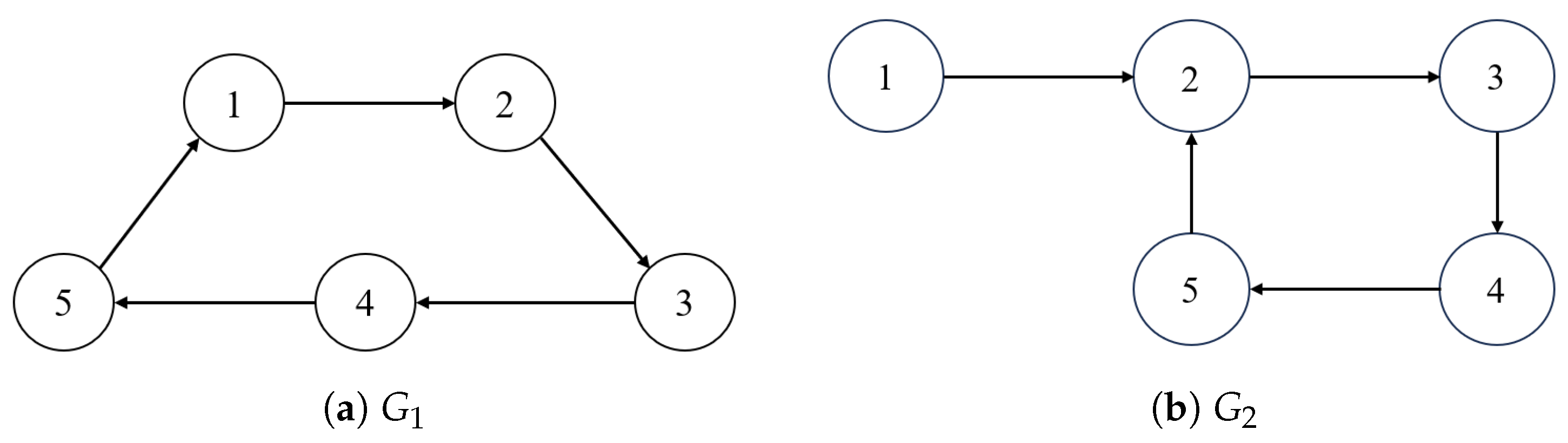
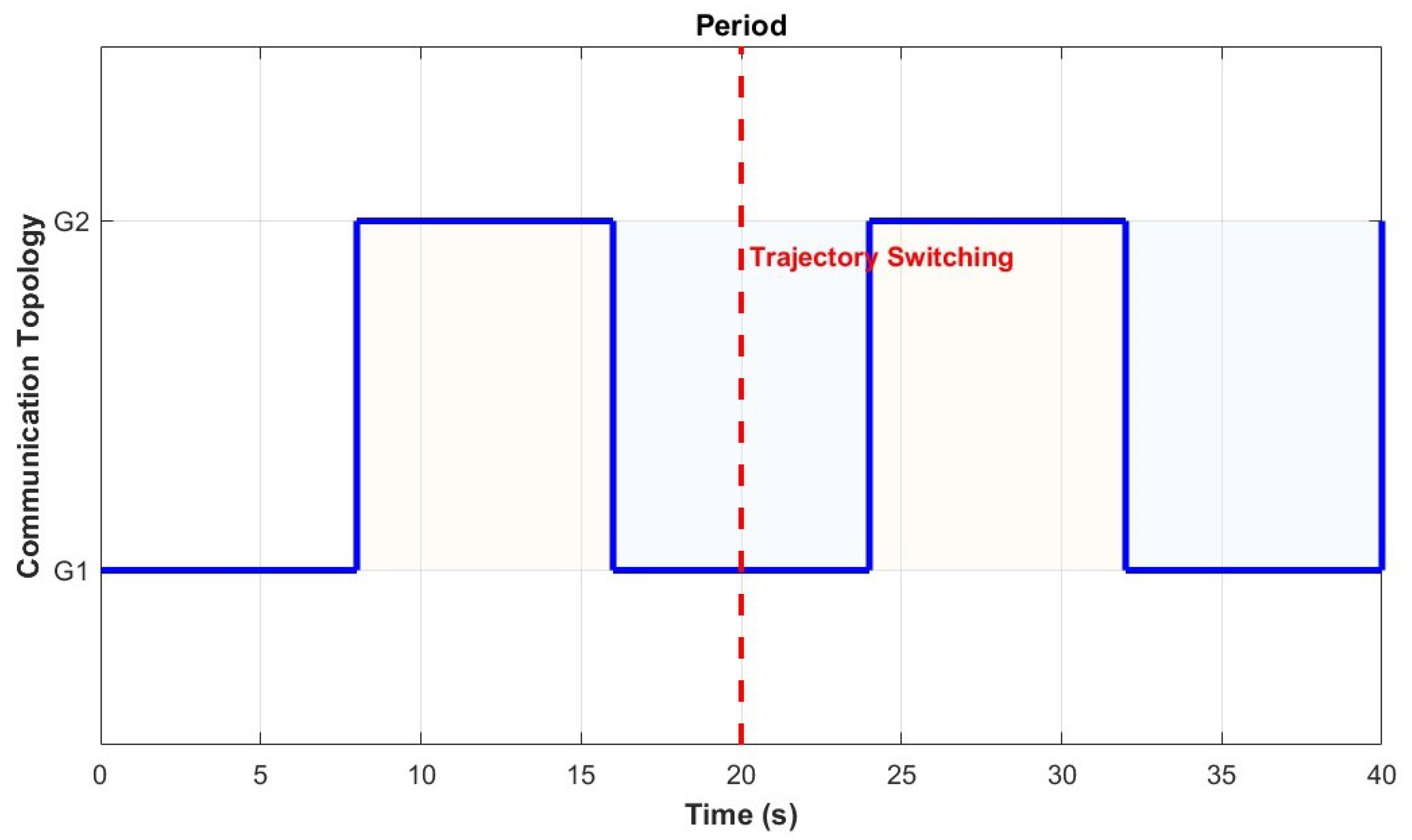
5.1. Formation Setting
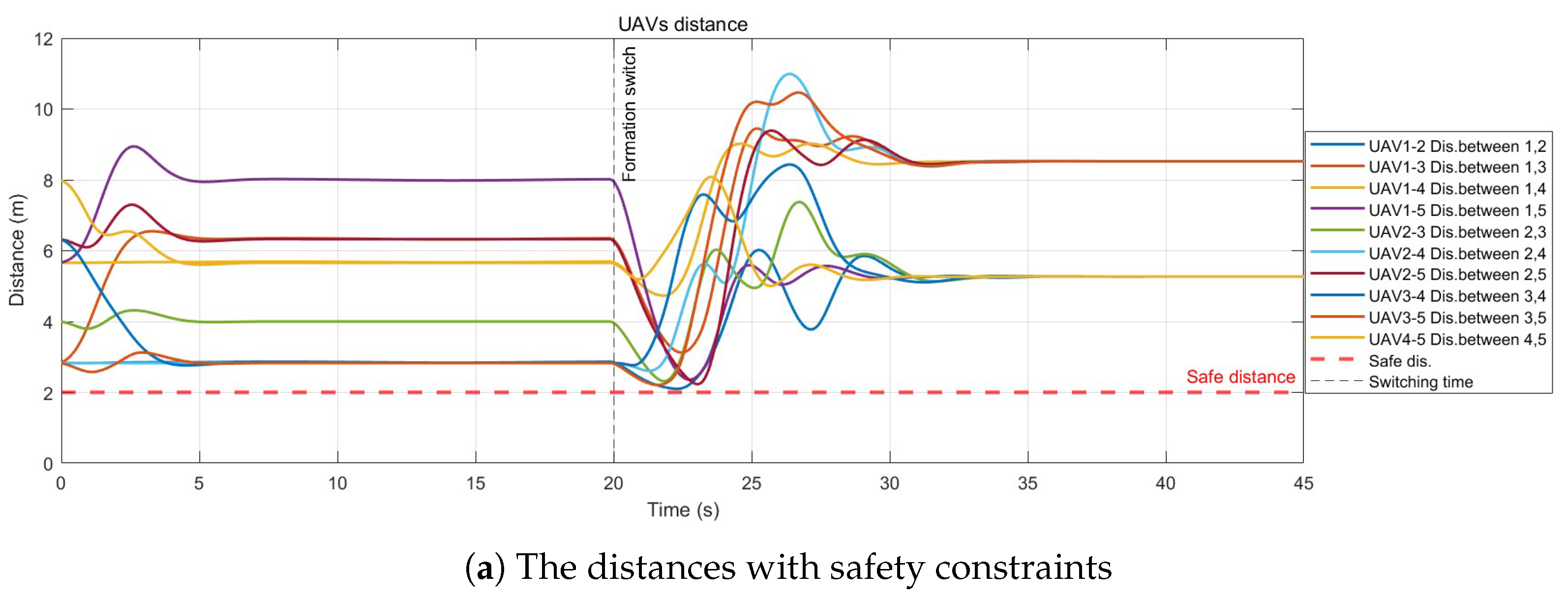
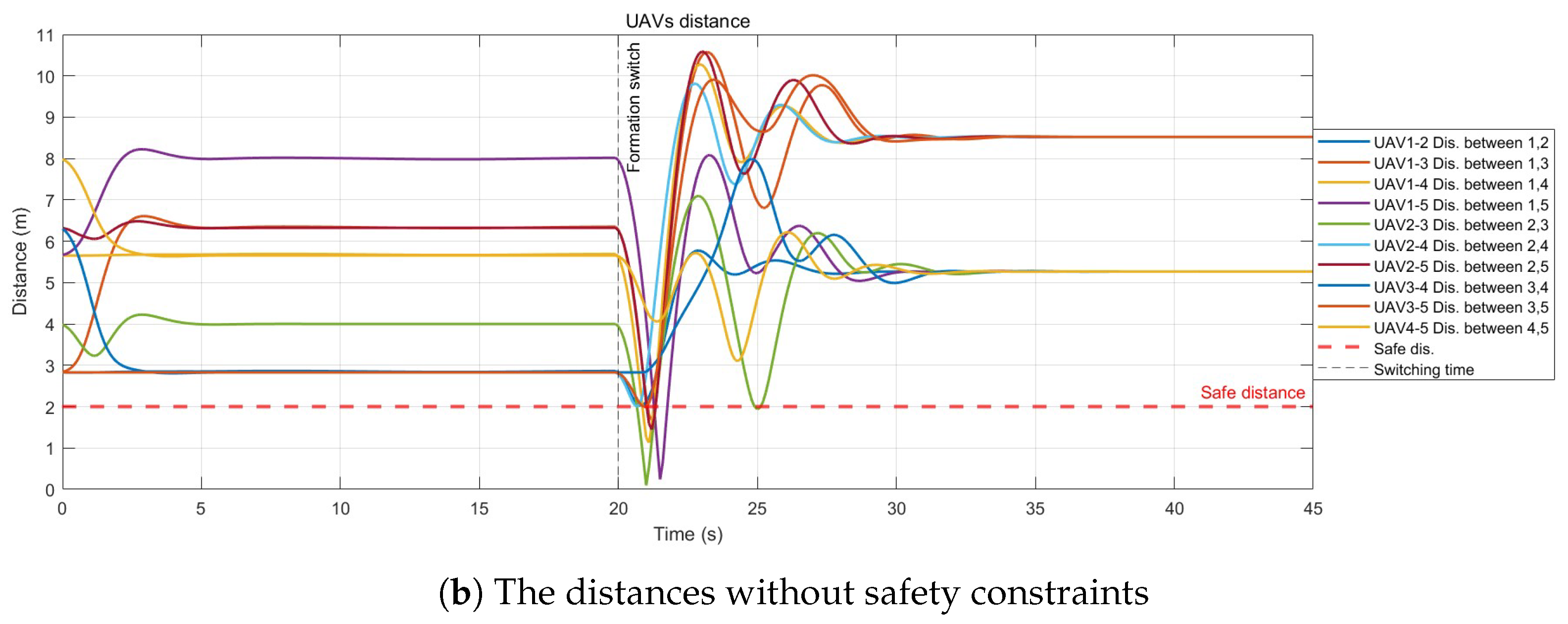
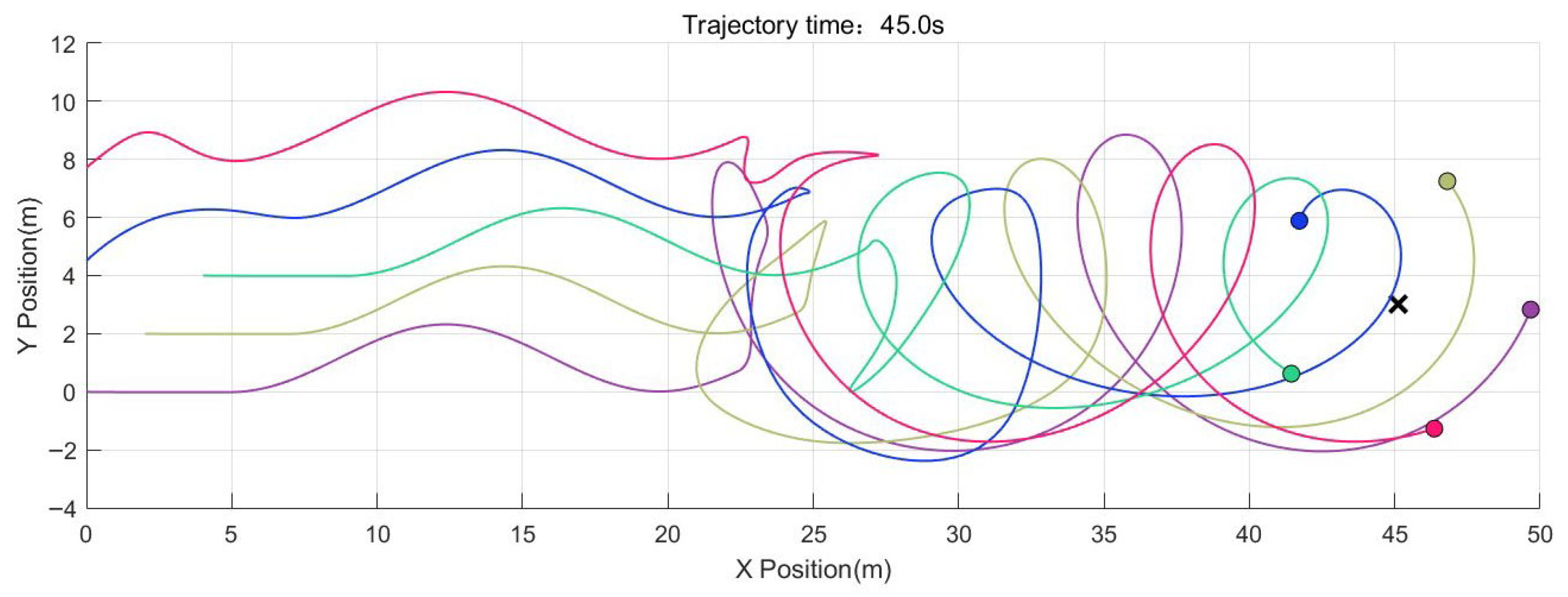
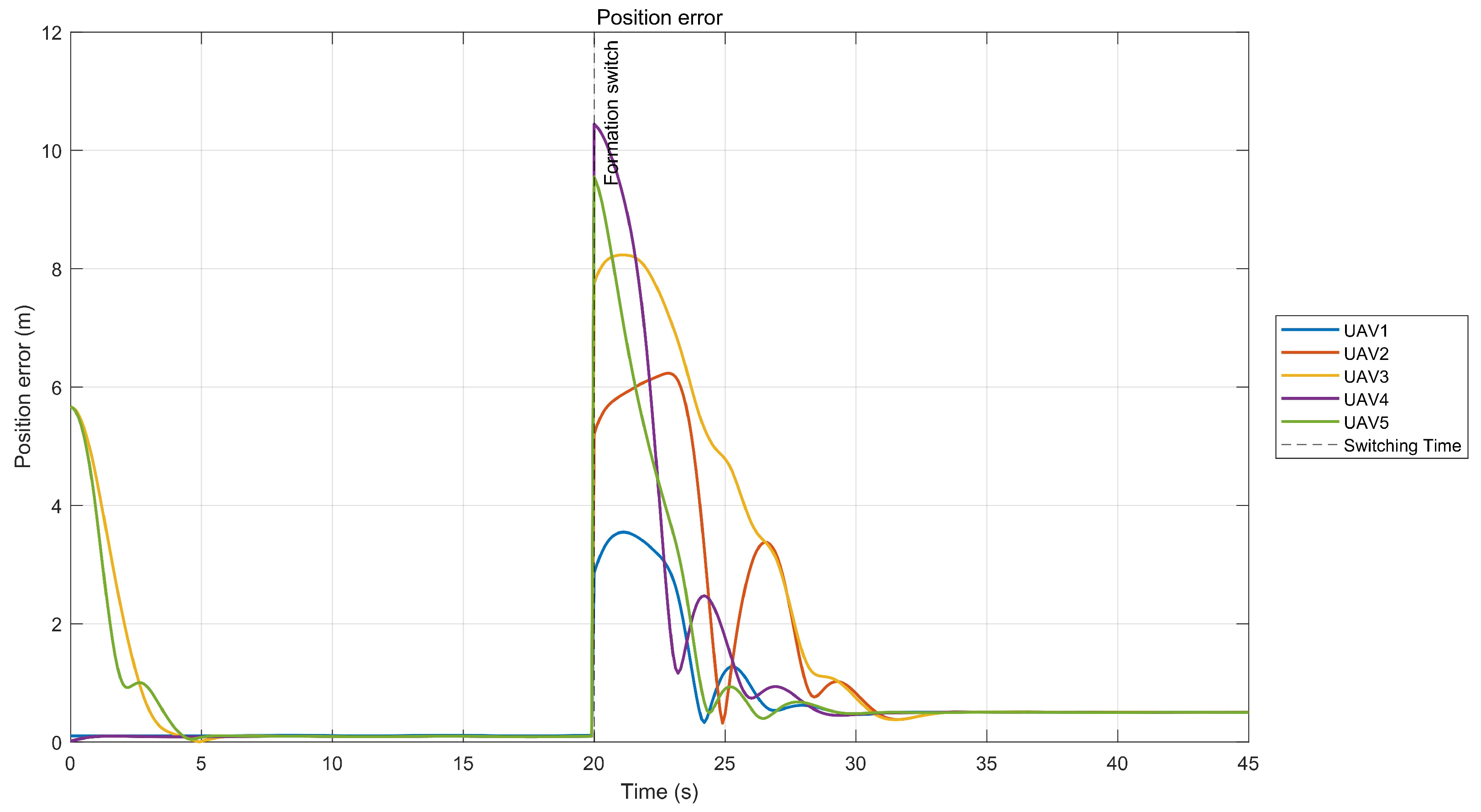
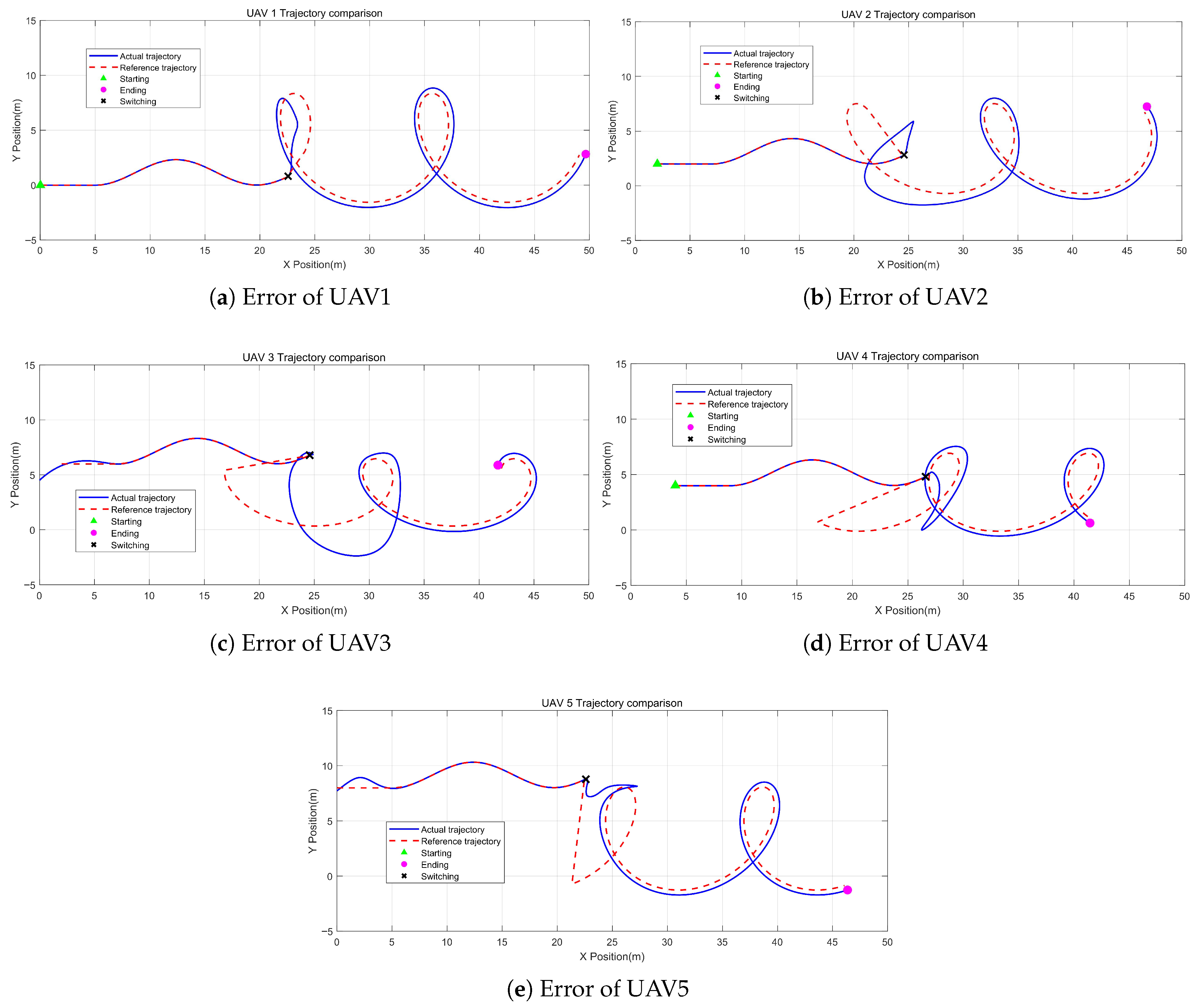
5.2. Simulation Results
6. Conclusions
Author Contributions
Funding
Institutional Review Board Statement
Informed Consent Statement
Data Availability Statement
Acknowledgments
Conflicts of Interest
Appendix A
References
- Liu, C.; Liang, G.; Wang, H.; Li, W. The Application of Ant Algorithm to Path Planning to Reconnaissance UAV. J. Fire Control Command Control 2005, 30, 22–24. [Google Scholar]
- Pack, D.J.; DeLima, P.; Toussaint, G.J.; York, G. Cooperative control of UAVs for localization of intermittently emitting mobile targets. IEEE Trans. Syst. Man Cybern. Part B (Cybern.) 2009, 39, 959–970. [Google Scholar] [CrossRef] [PubMed]
- Sivakumar, A.; Tan, C.K.Y. UAV swarm coordination using cooperative control for establishing a wireless communications backbone. In Proceedings of the 9th International Conference on Autonomous Agents and Multiagent Systems; ACM: Richland, SC, USA, 2010; Volume 3, pp. 1157–1164. [Google Scholar]
- Wang, X.; Yadav, V.; Balakrishnan, S. Cooperative UAV formation flying with obstacle/collision avoidance. IEEE Trans. Control Syst. Technol. 2007, 15, 672–679. [Google Scholar] [CrossRef]
- Sharma, R.; Ghose, D. Collision avoidance between UAV clusters using swarm intelligence techniques. Int. J. Syst. Sci. 2009, 40, 521–538. [Google Scholar] [CrossRef]
- Li, N.H.; Liu, H.H. Formation UAV flight control using virtual structure and motion synchronization. In Proceedings of the 2008 American Control Conference, Seattle, WA, USA, 1–13 June 2008; IEEE: New York, NY, USA, 2008; pp. 1782–1787. [Google Scholar]
- Xue, Z.; Zeng, J. Circle formation control of large-scale intelligent swarm systems in a distributed fashion. In Proceedings of the International Symposium on Neural Networks, Wuhan, China, 26–29 May 2009; Springer: Berlin/Heidelberg, Germany, 2009; pp. 1105–1115. [Google Scholar]
- Liu, Y.; Geng, Z. Finite-time formation control for linear multi-agent systems: A motion planning approach. Syst. Control Lett. 2015, 85, 54–60. [Google Scholar] [CrossRef]
- Atrianfar, H.; Haeri, M. Flocking of multi-agent dynamic systems with virtual leader having the reduced number of informed agents. Trans. Inst. Meas. Control 2013, 35, 1104–1115. [Google Scholar] [CrossRef]
- Ren, W. Consensus strategies for cooperative control of vehicle formations. IET Control Theory Appl. 2007, 1, 505–512. [Google Scholar] [CrossRef]
- Ren, W.; Sorensen, N. Distributed coordination architecture for multi-robot formation control. Robot. Auton. Syst. 2008, 56, 324–333. [Google Scholar] [CrossRef]
- Xie, G.; Wang, L. Moving formation convergence of a group of mobile robots via decentralised information feedback. Int. J. Syst. Sci. 2009, 40, 1019–1027. [Google Scholar] [CrossRef]
- Turpin, M.; Michael, N.; Kumar, V. Decentralized formation control with variable shapes for aerial robots. In Proceedings of the 2012 IEEE International Conference on Robotics and Automation, St. Paul, MN, USA, 14–18 May 2012; IEEE: New York, NY, USA, 2012; pp. 23–30. [Google Scholar]
- Nian, X.H.; Su, S.J.; Pan, H. Consensus tracking protocol and formation control of multi-agent systems with switching topology. J. Cent. South Univ. Technol. 2011, 18, 1178–1183. [Google Scholar] [CrossRef]
- Dong, X.; Shi, Z.; Lu, G.; Zhong, Y. Time-varying formation control for high-order linear swarm systems with switching interaction topologies. IET Control Theory Appl. 2014, 8, 2162–2170. [Google Scholar] [CrossRef]
- Dong, X.; Shi, Z.; Lu, G.; Zhong, Y. Time-varying output formation control for high-order linear time-invariant swarm systems. Inf. Sci. 2015, 298, 36–52. [Google Scholar] [CrossRef]
- Dong, X.; Hu, G. Time-varying output formation for linear multiagent systems via dynamic output feedback control. IEEE Trans. Control Netw. Syst. 2015, 4, 236–245. [Google Scholar] [CrossRef]
- Dong, X.; Yu, B.; Shi, Z.; Zhong, Y. Time-varying formation control for unmanned aerial vehicles: Theories and applications. IEEE Trans. Control Syst. Technol. 2014, 23, 340–348. [Google Scholar] [CrossRef]
- Dong, X.; Zhou, Y.; Ren, Z.; Zhong, Y. Time-varying formation control for unmanned aerial vehicles with switching interaction topologies. Control Eng. Pract. 2016, 46, 26–36. [Google Scholar] [CrossRef]
- Zhang, D.; Yuan, Q.; Meng, L.; Xia, R.; Liu, W.; Qin, C. Reinforcement learning for single-agent to multi-agent systems: From basic theory to industrial application progress, a survey. Artif. Intell. Rev. 2025, 59, 46. [Google Scholar] [CrossRef]
- Tian, Z.; Chen, R.; Hu, X.; Li, L.; Zhang, R.; Wu, F.; Peng, S.; Guo, J.; Du, Z.; Guo, Q.; et al. Decompose a task into generalizable subtasks in multi-agent reinforcement learning. Adv. Neural Inf. Process. Syst. 2023, 36, 78514–78532. [Google Scholar]
- Peng, K.; Qi, H.; Ma, T. Graph based multi-agent reinforcement learning with evolutionary population for cooperation. Neural Netw. 2025, 196, 108437. [Google Scholar] [CrossRef]
- Yang, L.; Zhao, J.; Chi, P.; Wang, Y. Human feedback reinforcement learning for multiple agent systems online safe consensus control. Neurocomputing 2026, 671, 132618. [Google Scholar] [CrossRef]
- Aina, K.O.; Ha, S. Deep reinforcement learning for multi-agent coordination. Artif. Life Robot. 2025, 1–11. [Google Scholar] [CrossRef]
- Xiao, W.; Belta, C.A.; Cassandras, C.G. Sufficient conditions for feasibility of optimal control problems using control barrier functions. Automatica 2022, 135, 109960. [Google Scholar] [CrossRef]
- Marvi, Z.; Kiumarsi, B. Robust satisficing cooperative control barrier functions for multirobots systems using information-gap theory. Int. J. Robust Nonlinear Control 2022, 32, 1721–1737. [Google Scholar] [CrossRef]
- Capelli, B.; Fouad, H.; Beltrame, G.; Sabattini, L. Decentralized connectivity maintenance with time delays using control barrier functions. In Proceedings of the 2021 IEEE International Conference on Robotics and Automation (ICRA), Xi’an, China, 30 May–5 June 2021; IEEE: New York, NY, USA, 2021; pp. 1586–1592. [Google Scholar]
- Zeng, J.; Zhang, B.; Sreenath, K. Safety-critical model predictive control with discrete-time control barrier function. In Proceedings of the 2021 American Control Conference (ACC), New Orleans, LA, USA, 25–28 May 2021; IEEE: New York, NY, USA, 2021; pp. 3882–3889. [Google Scholar]
- Marvi, Z.; Kiumarsi, B. Safe reinforcement learning: A control barrier function optimization approach. Int. J. Robust Nonlinear Control 2021, 31, 1923–1940. [Google Scholar] [CrossRef]
- Singletary, A.; Klingebiel, K.; Bourne, J.; Browning, A.; Tokumaru, P.; Ames, A. Comparative analysis of control barrier functions and artificial potential fields for obstacle avoidance. In Proceedings of the 2021 IEEE/RSJ International Conference on Intelligent Robots and Systems (IROS), Prague, Czech Republic, 27 September–1 October 2021; IEEE: New York, NY, USA, 2021; pp. 8129–8136. [Google Scholar]
- Wu, G.; Sreenath, K. Safety-critical control of a 3d quadrotor with range-limited sensing. In Proceedings of the Dynamic Systems and Control Conference, Minneapolis, MN, USA, 12–14 October 2016; American Society of Mechanical Engineers: New York, NY, USA, 2016; Volume 50695, p. V001T05A006. [Google Scholar]
- Funada, R.; Santos, M.; Gencho, T.; Yamauchi, J.; Fujita, M.; Egerstedt, M. Visual coverage maintenance for quadcopters using nonsmooth barrier functions. In Proceedings of the 2020 IEEE International Conference on Robotics and Automation (ICRA), Paris, France, 31 May–31 August 2020; IEEE: New York, NY, USA, 2020; pp. 3255–3261. [Google Scholar]
- Dan, H.; Yamauchi, J.; Hatanaka, T.; Fujita, M. Control barrier function-based persistent coverage with performance guarantee and application to object search scenario. In Proceedings of the 2020 IEEE Conference on Control Technology and Applications (CCTA), Montreal, QC, Canada, 24–26 August 2020; IEEE: New York, NY, USA, 2020; pp. 640–647. [Google Scholar]
- Capelli, B.; Sabattini, L. Connectivity maintenance: Global and optimized approach through control barrier functions. In Proceedings of the 2020 IEEE International Conference on Robotics and Automation (ICRA), Paris, France, 31 May–31 August 2020; IEEE: New York, NY, USA, 2020; pp. 5590–5596. [Google Scholar]
- Hegde, A.; Aloor, J.J.; Ghose, D. Bounded distance control for Multi-UAV formation safety and preservation in target-tracking applications. Proc. Inst. Mech. Eng. Part G J. Aerosp. Eng. 2023, 237, 1403–1416. [Google Scholar] [CrossRef]
- Zhou, H.; Zheng, Z.; Guan, Z.; Ma, Y. Control barrier function based nonlinear controller for automatic carrier landing. In Proceedings of the 2020 16th International Conference on Control, Automation, Robotics and Vision (ICARCV), Shenzhen, China, 13–15 December 2020; IEEE: New York, NY, USA, 2020; pp. 584–589. [Google Scholar]
- Hirshberg, T.; Vemprala, S.; Kapoor, A. Safety considerations in deep control policies with safety barrier certificates under uncertainty. In Proceedings of the 2020 IEEE/RSJ International Conference on Intelligent Robots and Systems (IROS), Las Vegas, NV, USA, 25–29 October 2020; IEEE: New York, NY, USA, 2020; pp. 6245–6251. [Google Scholar]
- Ren, W.; Beard, R.W. Consensus seeking in multiagent systems under dynamically changing interaction topologies. IEEE Trans. Autom. Control 2005, 50, 655–661. [Google Scholar] [CrossRef]
- Zahreddine, Z. On the stability of a system of differential equations with complex coefficients. Indian J. Pure Appl. Math. 1988, 19, 963. [Google Scholar]
- Branicky, M.S. Multiple Lyapunov functions and other analysis tools for switched and hybrid systems. IEEE Trans. Autom. Control 2002, 43, 475–482. [Google Scholar] [CrossRef]
- Ames, A.D.; Coogan, S.; Egerstedt, M.; Notomista, G.; Sreenath, K.; Tabuada, P. Control barrier functions: Theory and applications. In Proceedings of the 2019 18th European Control Conference (ECC), Naples, Italy, 25–28 June 2019; IEEE: New York, NY, USA, 2019; pp. 3420–3431. [Google Scholar]


Disclaimer/Publisher’s Note: The statements, opinions and data contained in all publications are solely those of the individual author(s) and contributor(s) and not of MDPI and/or the editor(s). MDPI and/or the editor(s) disclaim responsibility for any injury to people or property resulting from any ideas, methods, instructions or products referred to in the content. |
© 2026 by the authors. Licensee MDPI, Basel, Switzerland. This article is an open access article distributed under the terms and conditions of the Creative Commons Attribution (CC BY) license.
Share and Cite
Wei, Z.; Zhang, X.; Song, Y.; Guo, R. Formation Control for UAVs Considering Safety Constraints Based on Control Barrier Functions with Switched Trajectories and Switching Communication Topologies. Sensors 2026, 26, 1477. https://doi.org/10.3390/s26051477
Wei Z, Zhang X, Song Y, Guo R. Formation Control for UAVs Considering Safety Constraints Based on Control Barrier Functions with Switched Trajectories and Switching Communication Topologies. Sensors. 2026; 26(5):1477. https://doi.org/10.3390/s26051477
Chicago/Turabian StyleWei, Zerui, Xiaoyu Zhang, Yang Song, and Rong Guo. 2026. "Formation Control for UAVs Considering Safety Constraints Based on Control Barrier Functions with Switched Trajectories and Switching Communication Topologies" Sensors 26, no. 5: 1477. https://doi.org/10.3390/s26051477
APA StyleWei, Z., Zhang, X., Song, Y., & Guo, R. (2026). Formation Control for UAVs Considering Safety Constraints Based on Control Barrier Functions with Switched Trajectories and Switching Communication Topologies. Sensors, 26(5), 1477. https://doi.org/10.3390/s26051477