Continuous Accelerometry-Based Tremor Detection During Daily Living


Highlights
- Detects tremors on a second scale, whereas the currently known industry standard detects tremors on a minute scale.
- Distinguishes between voluntary physical activity and tremor.
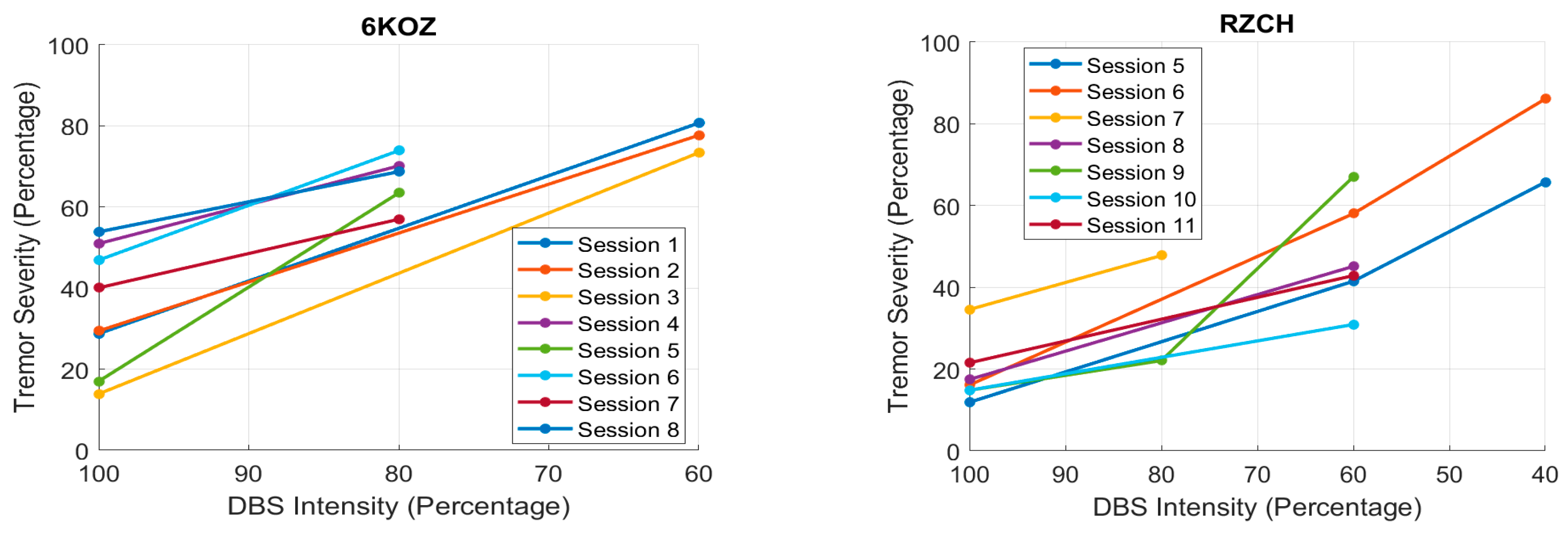
- The output was highly correlated with the DBS intensity, such that detected tremor decreased as DBS intensity increased.
- Results from pilot testing our algorithm demonstrate the feasibility of practically implementing continuous tremor detection for Parkinson’s patients with deep brain stimulation (DBS) using a commercially available, convenient, wrist-worn watch.
- Continuous tremor estimates on a seconds resolution will enable adaptation of brain stimulation based on the patient’s current tremor state.
Abstract
1. Introduction
2. Materials and Methods
2.1. Experimental Protocol
2.2. Tremor Detection Algorithm
3. Results
3.1. Short-Time Fourier Transform vs. Continuous Wavelet Transform
3.2. Implanted vs. Wrist-Worn Accelerometry for Tremor Detection
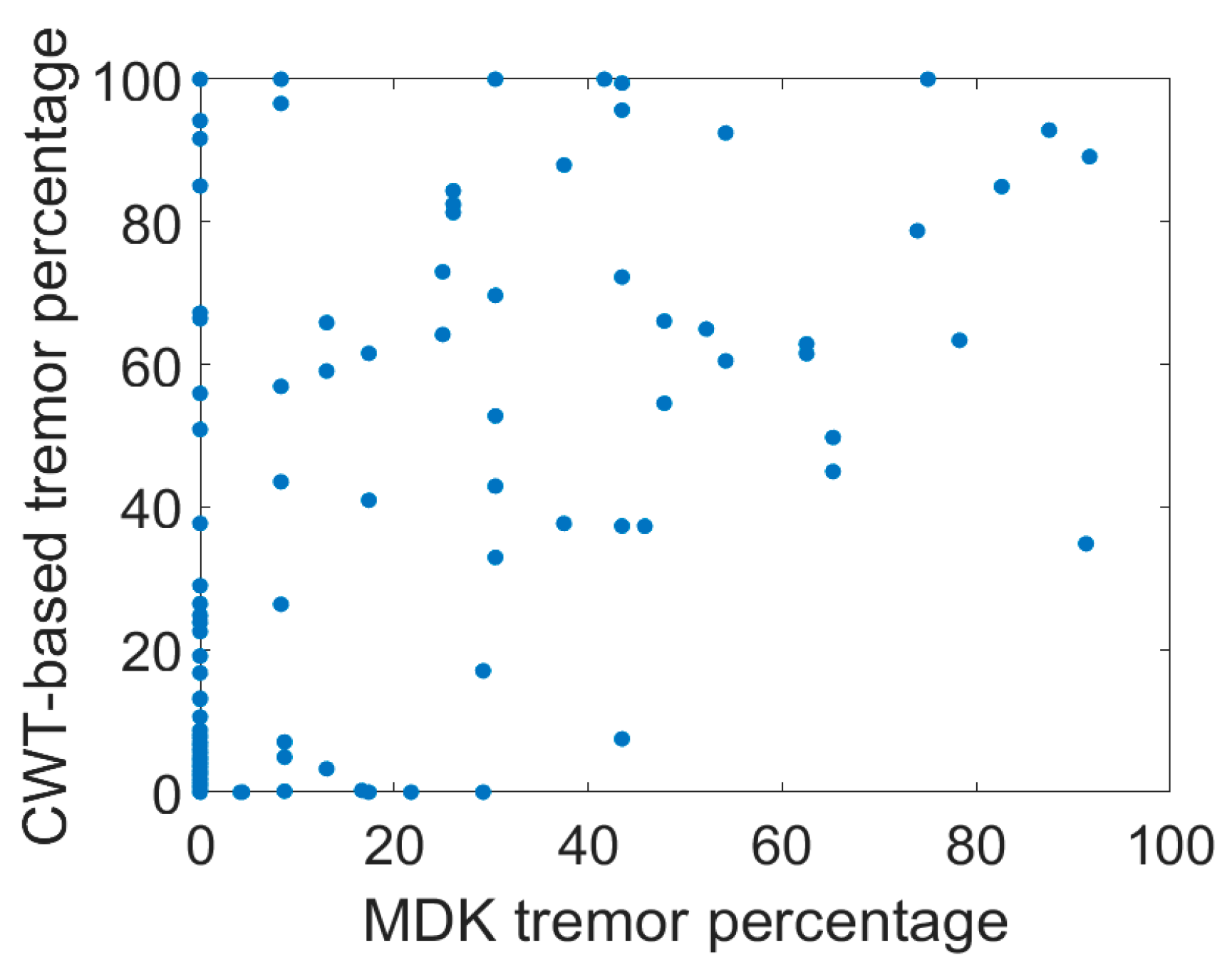
3.3. Comparison of CWT-Based Tremor Metric with MDK Tremor Metric
3.4. Tremor Detection Correlates with DBS Intensity (Increased Tremor Detection with Decreasing DBS Intensity)
4. Discussion
5. Conclusions
Author Contributions
Funding
Institutional Review Board Statement
Informed Consent Statement
Data Availability Statement
Acknowledgments
Conflicts of Interest
Abbreviations
| CWT | Continuous wavelet transform |
| STFT | Short-time Fourier transform |
| MDK | Movement disorders kit |
| DBS | Deep brain stimulation |
References
- Sveinbjornsdottir, S. The clinical symptoms of Parkinson’s disease. J. Neurochem. 2016, 139, 318–324. [Google Scholar] [CrossRef]
- Dirkx, M.F.; Bologna, M. The pathophysiology of Parkinson’s disease tremor. J. Neurol. Sci. 2022, 435, 120196. [Google Scholar] [CrossRef]
- Sharma, S.; Moon, C.S.; Khogali, A.; Haidous, A.; Chabenne, A.; Ojo, C.; Jelebinkov, M.; Kurdi, Y.; Ebadi, M. Biomarkers in Parkinson’s disease (recent update). Neurochem. Int. 2013, 63, 201–229. [Google Scholar] [CrossRef] [PubMed]
- Halpern, C.; Hurtig, H.; Jaggi, J.; Grossman, M.; Won, M.; Baltuch, G. Deep brain stimulation in neurologic disorders. Park. Relat. Disord. 2007, 13, 1–16. [Google Scholar] [CrossRef] [PubMed]
- Fang, J.Y.; Tolleson, C. The role of deep brain stimulation in Parkinson’s disease: An overview and update on new developments. Neuropsychiatr. Dis. Treat. 2017, 13, 723–732. [Google Scholar] [CrossRef]
- Volkmann, J. Deep brain stimulation for the treatment of Parkinson’s disease. J. Clin. Neurophysiol. 2004, 21, 6–17. [Google Scholar] [CrossRef] [PubMed]
- Deuschl, G.; Schade-Brittinger, C.; Krack, P.; Volkmann, J.; Schäfer, H.; Bötzel, K.; Daniels, C.; Deutschländer, A.; Dillmann, U.; Eisner, W.; et al. A randomized trial of deep-brain stimulation for Parkinson’s disease. N. Engl. J. Med. 2006, 355, 896–908. [Google Scholar] [CrossRef]
- Hariz, M.; Blomstedt, P. Deep brain stimulation for Parkinson’s disease. J. Intern. Med. 2022, 292, 764–778. [Google Scholar] [CrossRef]
- Hartmann, C.J.; Fliegen, S.; Groiss, S.J.; Wojtecki, L.; Schnitzler, A. An update on best practice of deep brain stimulation in Parkinson’s disease. Ther. Adv. Neurol. Disord. 2019, 12, 1756286419838096. [Google Scholar] [CrossRef]
- Bronstein, J.M.; Tagliati, M.; Alterman, R.L.; Lozano, A.M.; Volkmann, J.; Stefani, A.; Horak, F.B.; Okun, M.S.; Foote, K.D.; Krack, P.; et al. Deep brain stimulation for Parkinson disease: An expert consensus and review of key issues. Arch. Neurol. 2011, 68, 165. [Google Scholar] [CrossRef]
- Habets, J.G.V.; Heijmans, M.; Kuijf, M.L.; Janssen, M.L.; Temel, Y.; Kubben, P.L. An update on adaptive deep brain stimulation in Parkinson’s disease. Mov. Disord. 2018, 33, 1834–1843. [Google Scholar] [CrossRef]
- Hoang, K.B.; Cassar, I.R.; Grill, W.M.; Turner, D.A. Biomarkers and stimulation algorithms for adaptive brain stimulation. Front. Neurosci. 2017, 11, 564. [Google Scholar] [CrossRef]
- Schmidt, S.L.; Chowdhury, A.H.; Mitchell, K.T.; Peters, J.J.; Gao, Q.; Lee, H.-J.; Genty, K.; Chow, S.-C.; Grill, W.M.; Pajic, M.; et al. At home adaptive dual target deep brain stimulation in Parkinson’s disease with proportional control. Brain 2024, 147, 911–922. [Google Scholar] [CrossRef] [PubMed]
- Elble, R.J.; Pullman, S.L.; Matsumoto, J.Y.; Raethjen, J.; Deuschl, G.; Tintner, R. Tremor amplitude is logarithmically related to 4- and 5-point tremor rating scales. Brain 2006, 129, 2660–2666. [Google Scholar] [CrossRef]
- van der Linden, C.; Berger, T.; Brandt, G.A.; Strelow, J.N.; Jergas, H.; Baldermann, J.C.; Visser-Vandewalle, V.; Fink, G.R.; Barbe, M.T.; Petry-Schmelzer, J.N.; et al. Accelerometric classification of resting and postural tremor amplitude. Sensors 2023, 23, 8621. [Google Scholar] [CrossRef]
- Goetz, C.G.; Tilley, B.C.; Shaftman, S.R.; Stebbins, G.T.; Fahn, S.; Martinez-Martin, P.; Poewe, W.; Sampaio, C.; Stern, M.B.; Dodel, R.; et al. Movement Disorder Society-sponsored revision of the Unified Parkinson’s Disease Rating Scale (MDS-UPDRS): Scale presentation and clinimetric testing results. Mov. Disord. 2008, 23, 2129–2170. [Google Scholar] [CrossRef]
- Bronte-Stewart, H.; Martijn, B.; Ostrem, J.; Little, S.; Almeida, L.; Zamora, A.R.; Fasano, A.; Hassell, T.; Mitchell, K.; Moro, E.; et al. Chronic adaptive DBS provides similar “on” time with trend of improvement compared to continuous DBS in Parkinson’s disease and 98% of participants chose to remain on aDBS (S2.008). In Neurology; Lippincott Williams & Wilkins Hagerstown: Hagerstown, MD, USA, 2024; Volume 102, p. 2824. [Google Scholar]
- Louie, K.H.; Balakid, J.P.; Bath, J.E.; Song, S.; Azgomi, H.F.; Marks, J.H.; Choi, J.T.; Starr, P.A.; Wang, D.D. Adaptive deep brain stimulation timed to gait phase improves walking in Parkinson’s disease. medRxiv 2025. [Google Scholar] [CrossRef]
- Kumaravelu, K.; Schmidt, S.L.; Zhao, Y.; Vittert, A.; Swan, B.D.; Oza, C.S.; Peters, J.J.; Mitchell, K.T.; Turner, D.A.; Grill, W.M. Analyses of biomarkers for tremor using local field potentials recorded from deep brain stimulation electrodes in the thalamus. Brain Stimul. 2025, 18, 1479–1489. [Google Scholar] [CrossRef] [PubMed]
- He, S.; Baig, F.; Mostofi, A.; Pogosyan, A.; Debarros, J.; Green, A.L.; Aziz, T.Z.; Pereira, E.; Brown, P.; Tan, H. Closed-loop deep brain stimulation for essential tremor based on thalamic local field potentials. Mov. Disord. 2021, 36, 863–873. [Google Scholar] [CrossRef] [PubMed]
- Thomsen, B.L.C.; Teodoro, T.; Edwards, M.J. Biomarkers in functional movement disorders: A systematic review. J. Neurol. Neurosurg. Psychiatry 2020, 91, 1261–1269. [Google Scholar] [CrossRef]
- van der Stouwe, A.M.M.; Elting, J.; van der Hoeven, J.; van Laar, T.; Leenders, K.; Maurits, N.; Tijssen, M. How typical are “typical” tremor characteristics? Sensitivity and specificity of five tremor phenomena. Park. Relat. Disord. 2016, 30, 23–28. [Google Scholar] [CrossRef]
- Piboolnurak, P.; Rothey, N.; Ahmed, A.; Ford, B.; Yu, Q.; Xu, D.; Pullman, S.L. Psychogenic tremor disorders identified using tree-based statistical algorithms and quantitative tremor analysis. Mov. Disord. 2005, 20, 1543–1549. [Google Scholar] [CrossRef]
- Yao, L.; Brown, P.; Shoaran, M. Resting Tremor Detection in Parkinson’s Disease with Machine Learning and Kalman Filtering. In Proceedings of the 2018 IEEE Biomedical Circuits and Systems Conference (BioCAS), Cleveland, OH, USA, 17–19 October 2018; pp. 1–4. [Google Scholar] [CrossRef]
- Fraiwan, L.; Khnouf, R.; Mashagbeh, A.R. Parkinson’s disease hand tremor detection system for mobile application. J. Med. Eng. Technol. 2016, 40, 127–134. [Google Scholar] [CrossRef]
- Bloem, B.R.; Post, E.; Hall, D.A. An apple a day to keep the Parkinson’s disease doctor away? Ann. Neurol. 2023, 93, 681–685. [Google Scholar] [CrossRef]
- MATLAB Hep Center. Islocalmax Documentation. 2025. Available online: https://www.mathworks.com/help/matlab/ref/islocalmax.html (accessed on 1 November 2025).
- Powers, R.; Etezadi-Amoli, M.; Arnold, E.M.; Kianian, S.; Mance, I.; Gibiansky, M.; Trietsch, D.; Alvarado, A.S.; Kretlow, J.D.; Herrington, T.M.; et al. Smartwatch inertial sensors continuously monitor real-world motor fluctuations in Parkinson’s disease. Sci. Transl. Med. 2021, 13, eabd7865. [Google Scholar] [CrossRef]
- Mailankody, P.; Netravathi, M.; Pal, P.K. Review of tremor in Parkinson’s disease and atypical parkinsonian disorders. Neurol. India 2017, 65, 1083–1090. [Google Scholar]
- Boby, F.Y. Unsupervised Classification of Physical Activity From Implanted Accelerometer in Deep Brain Stimulation Patients. Master’s Thesis, California State University, Los Angeles, CA, USA, 2023. [Google Scholar]
- Bakdash, J.Z.; Marusich, L.R. Repeated Measures Correlation. Front. Psychol. 2017, 8, 456. [Google Scholar] [CrossRef] [PubMed]
- Zach, H.; Dirkx, M.; Bloem, B.R.; Helmich, R.C. The clinical evaluation of Parkinson’s tremor. J. Park. Dis. 2015, 5, 471–474. [Google Scholar] [CrossRef]
- Uchida, K.; Hirayama, M.; Yamashita, F.; Hori, N.; Nakamura, T.; Sobue, G. Tremor is attenuated during walking in essential tremor with resting tremor but not parkinsonian tremor. J. Clin. Neurosci. 2011, 18, 1224–1228. [Google Scholar] [CrossRef] [PubMed]
- Tatum, W.O.; DiCiaccio, B.; Kipta, J.A.; Yelvington, K.H.; Stein, M.A. The Texting Rhythm: A Novel EEG Waveform Using Smartphones. J. Clin. Neurophysiol. 2016, 33, 359–366. [Google Scholar] [CrossRef]
- Hanrahan, B.; Tatum, W.O. Teaching NeuroImages: Texting rhythm. Neurology 2020, 95, e3454–e3455. [Google Scholar] [CrossRef]
- Lachenmayer, M.L.; Mürset, M.; Antih, N.; Debove, I.; Muellner, J.; Bompart, M.; Schlaeppi, J.-A.; Nowacki, A.; You, H.; Michelis, J.P.; et al. Subthalamic and pallidal deep brain stimulation for Parkinson’s disease—Meta-analysis of outcomes. npj Park. Dis. 2021, 7, 77. [Google Scholar] [CrossRef]
- Fan, S.; Liu, D.; Shi, L.; Meng, F.; Fang, H.; Liu, H.; Zhang, H.; Yang, A.; Zhang, J. Differential effects of subthalamic nucleus and Globus pallidus internus deep brain stimulation on motor subtypes in Parkinson’s disease. World Neurosurg. 2022, 164, e245–e255. [Google Scholar] [CrossRef] [PubMed]
- Zhang, J.; Li, J.; Chen, F.; Liu, X.; Jiang, C.; Hu, X.; Ma, L.; Xu, Z. STN versus GPi deep brain stimulation for dyskinesia improvement in advanced Parkinson’s disease: A meta-analysis of randomized controlled trials. Clin. Neurol. Neurosurg. 2021, 201, 106450. [Google Scholar] [CrossRef] [PubMed]
- Jankovic, J. How Do I Examine for Re-Emergent Tremor? Mov. Disord. Clin. Pract. 2016, 3, 216–217. [Google Scholar] [CrossRef] [PubMed]



| Participant ID | Age | Sex | Yrs Since Diagnosis | OFF UPDRS Tremor Score 1 | ON UPDRS Tremor Score |
|---|---|---|---|---|---|
| AC27 | 66 | F | 22 | 0 | 0 |
| E395 | 65 | M | 15 | 3 | 0 |
| NU5U | 60 | F | 14 | 5 | 4 |
| RZCH | 69 | M | 12 | 7 | 6 |
| 6KOZ | 70 | M | 14 | 5 | 4 |
| our CWT-based algorithm | |||
| Detected | Not Detected | ||
| MDK algorithm | Detected | 38 | 4 |
| Not Detected | 29 | 81 | |
Disclaimer/Publisher’s Note: The statements, opinions and data contained in all publications are solely those of the individual author(s) and contributor(s) and not of MDPI and/or the editor(s). MDPI and/or the editor(s) disclaim responsibility for any injury to people or property resulting from any ideas, methods, instructions or products referred to in the content. |
© 2026 by the authors. Licensee MDPI, Basel, Switzerland. This article is an open access article distributed under the terms and conditions of the Creative Commons Attribution (CC BY) license.
Share and Cite
Martinez, L.; Martinez, O.; Schmidt, S.L.; Rodriguez Capilla, R.; Gardea, H.; Gholian, A.; Turner, D.A.; Won, D.S. Continuous Accelerometry-Based Tremor Detection During Daily Living. Sensors 2026, 26, 1459. https://doi.org/10.3390/s26051459
Martinez L, Martinez O, Schmidt SL, Rodriguez Capilla R, Gardea H, Gholian A, Turner DA, Won DS. Continuous Accelerometry-Based Tremor Detection During Daily Living. Sensors. 2026; 26(5):1459. https://doi.org/10.3390/s26051459
Chicago/Turabian StyleMartinez, Luis, Orlando Martinez, Stephen L. Schmidt, Rocio Rodriguez Capilla, Hector Gardea, Arabo Gholian, Dennis A. Turner, and Deborah Soonmee Won. 2026. "Continuous Accelerometry-Based Tremor Detection During Daily Living" Sensors 26, no. 5: 1459. https://doi.org/10.3390/s26051459
APA StyleMartinez, L., Martinez, O., Schmidt, S. L., Rodriguez Capilla, R., Gardea, H., Gholian, A., Turner, D. A., & Won, D. S. (2026). Continuous Accelerometry-Based Tremor Detection During Daily Living. Sensors, 26(5), 1459. https://doi.org/10.3390/s26051459