Design and Error Analysis of an Optical Measurement System for the Wavefront of Large-Aperture Segmented Mirror
Abstract
1. Introduction
- This paper investigates wavefront measurement methods for tilting mirrors based on photogrammetric principles, designing an optical imaging-based wavefront measurement system for in-orbit deployed tilting mirrors;
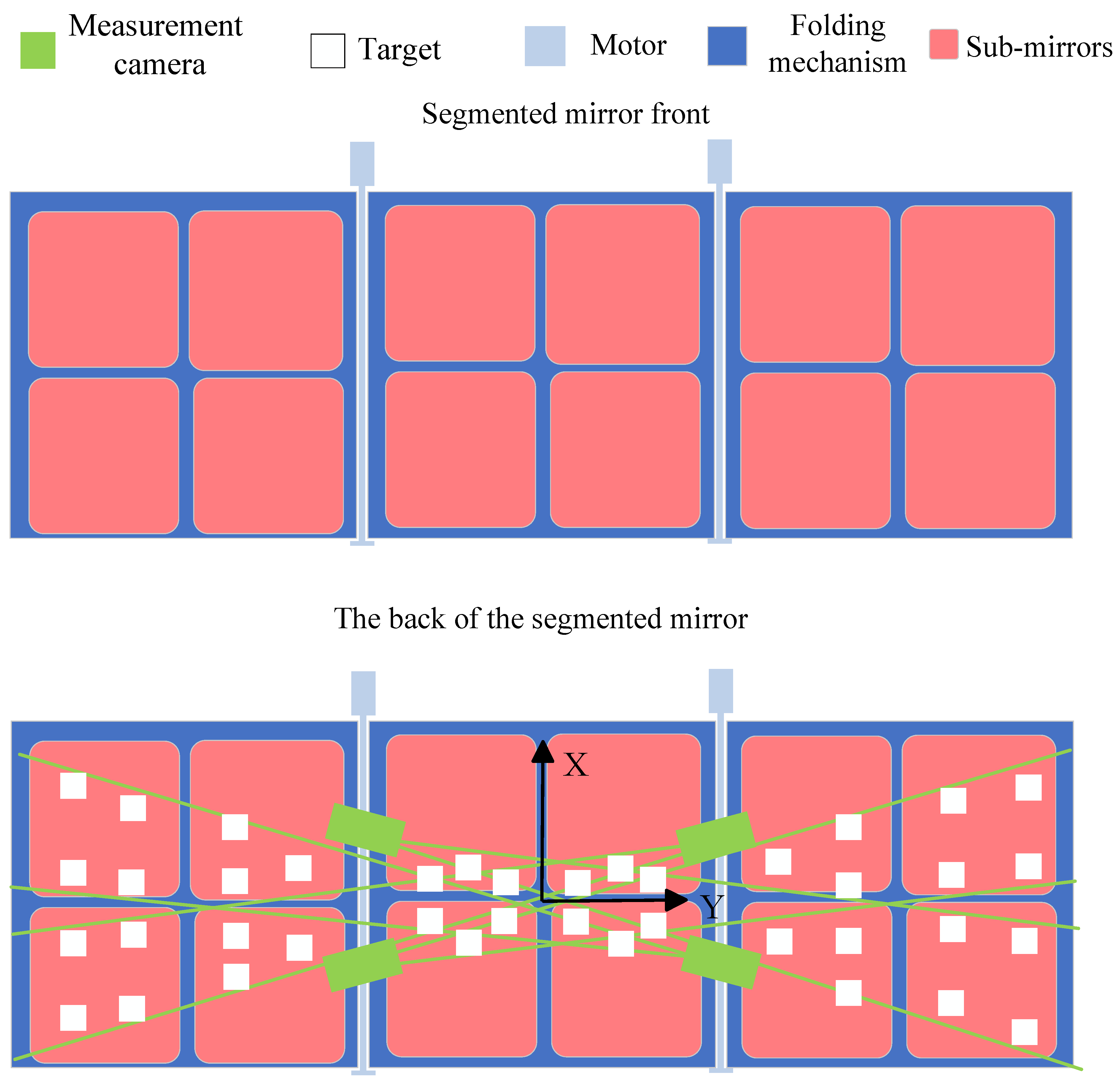
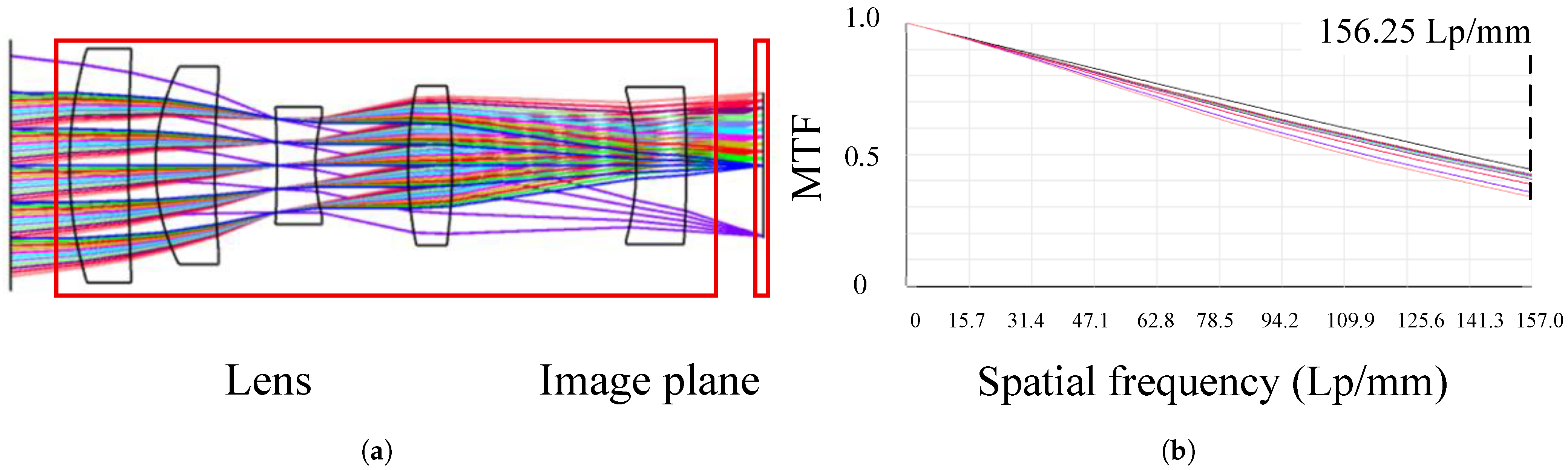
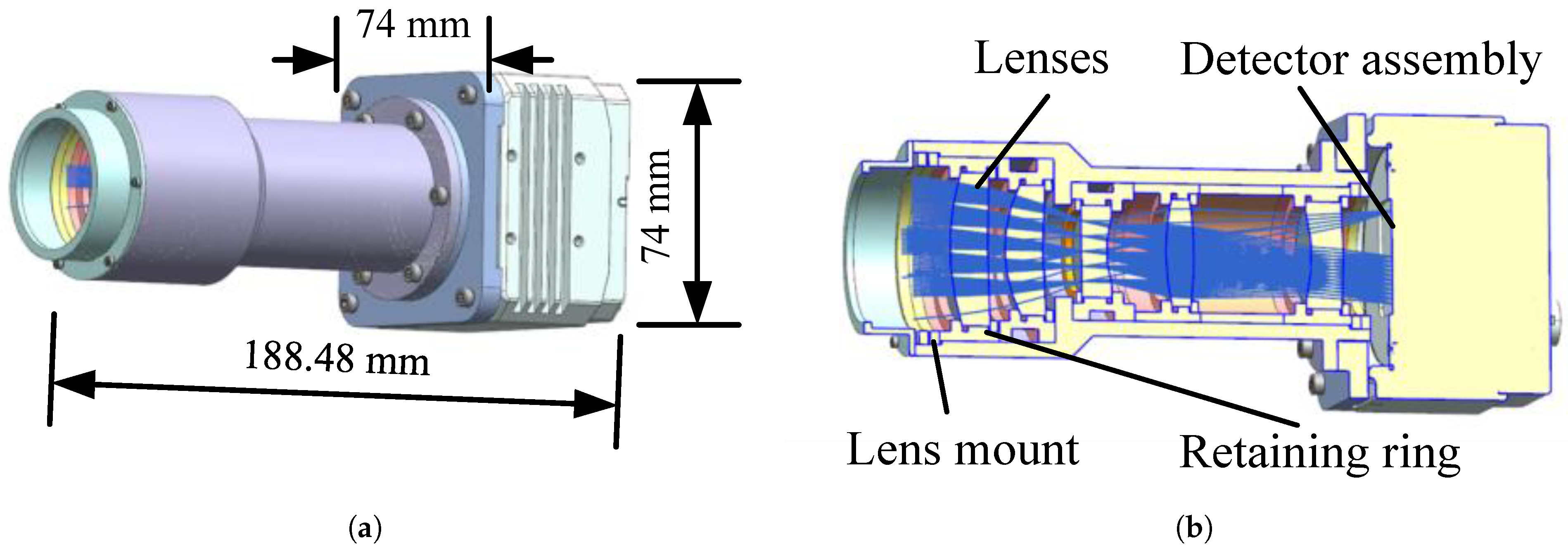
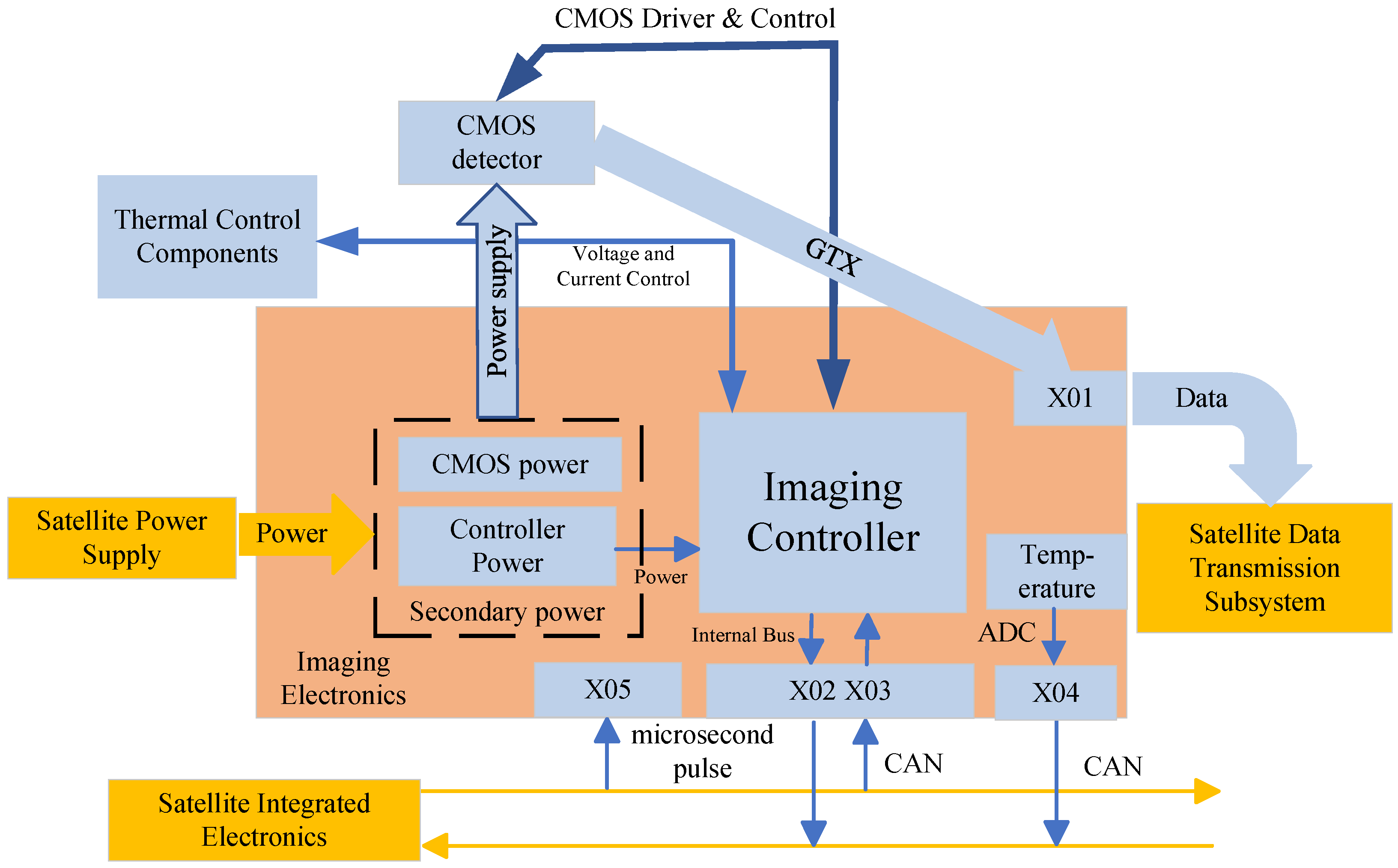
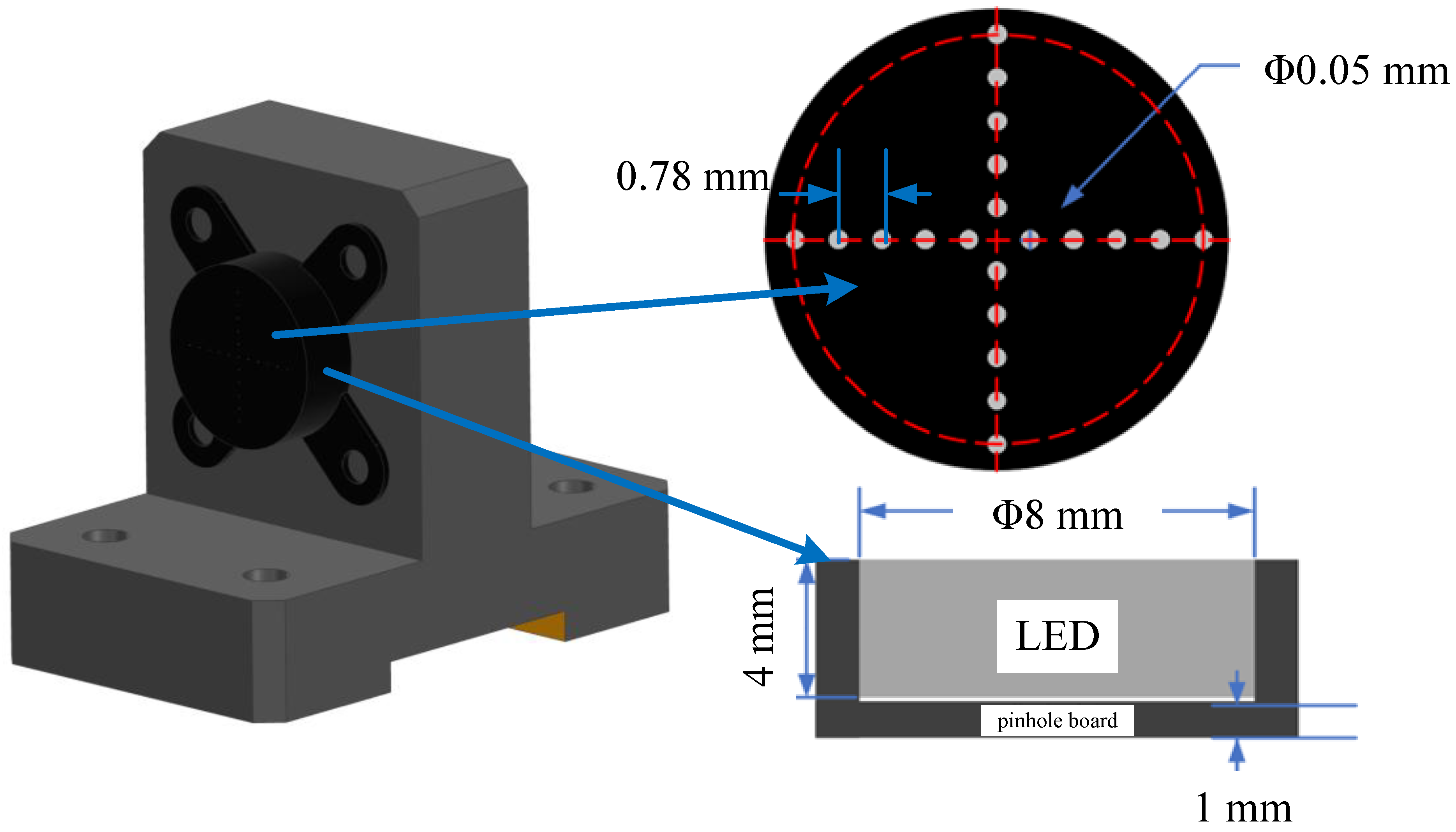
- Considering the in-orbit operational environment of the wavefront measurement system, this paper conducts optical design, structural design and simulation analysis, thermal control design, and electronics design for the optical measurement camera, followed by camera integration testing and calibration; To address the in-orbit illumination environment, an active target is designed to ensure normal camera imaging under low-illumination conditions;
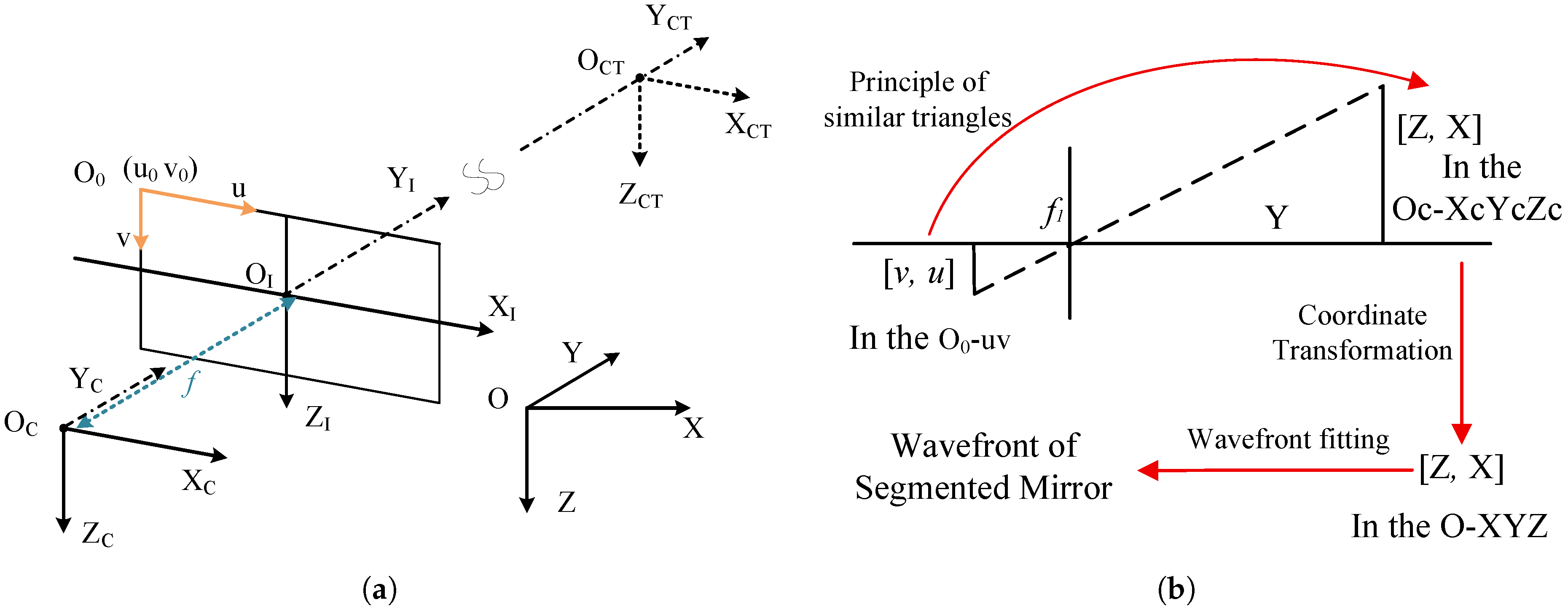
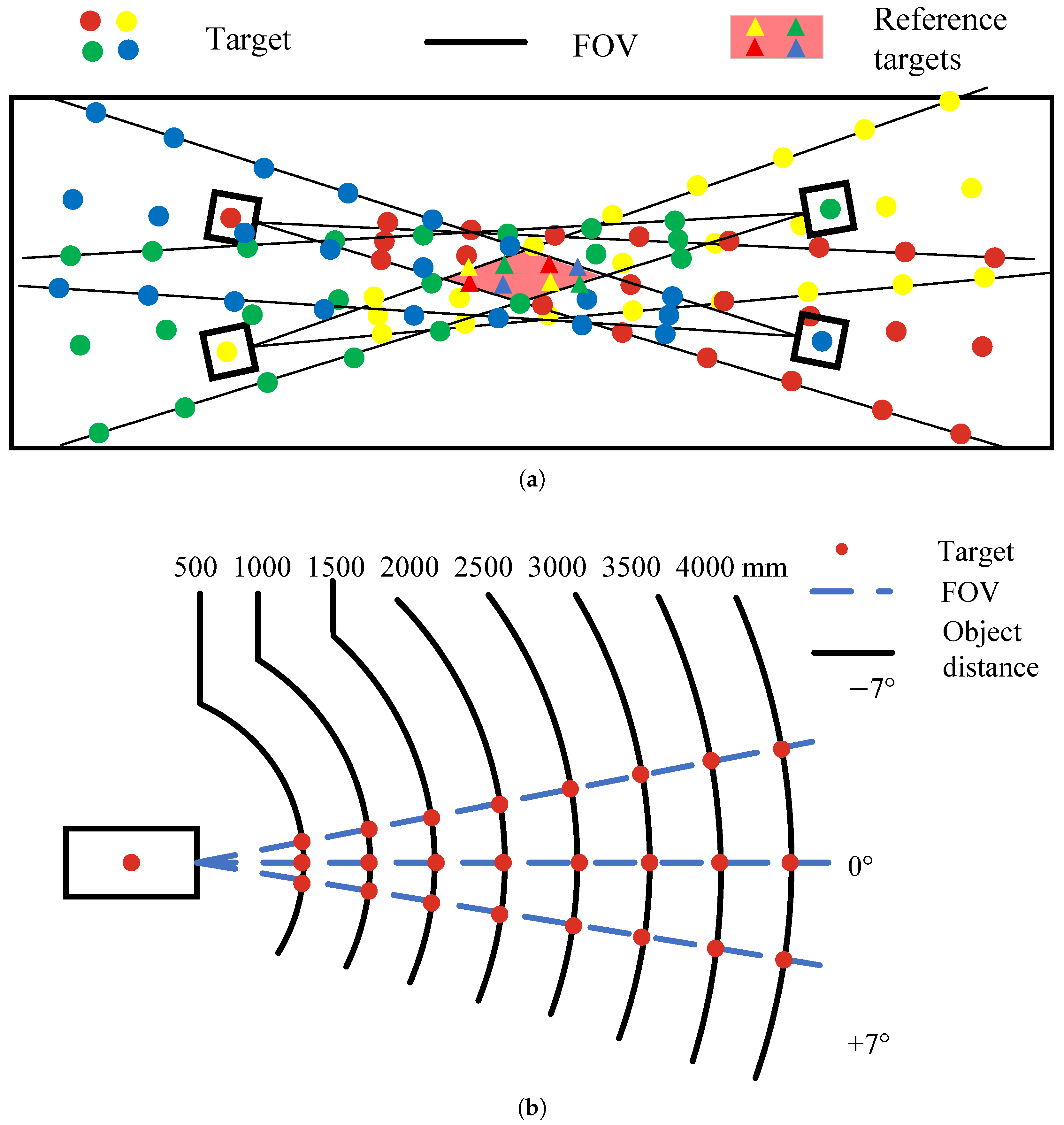
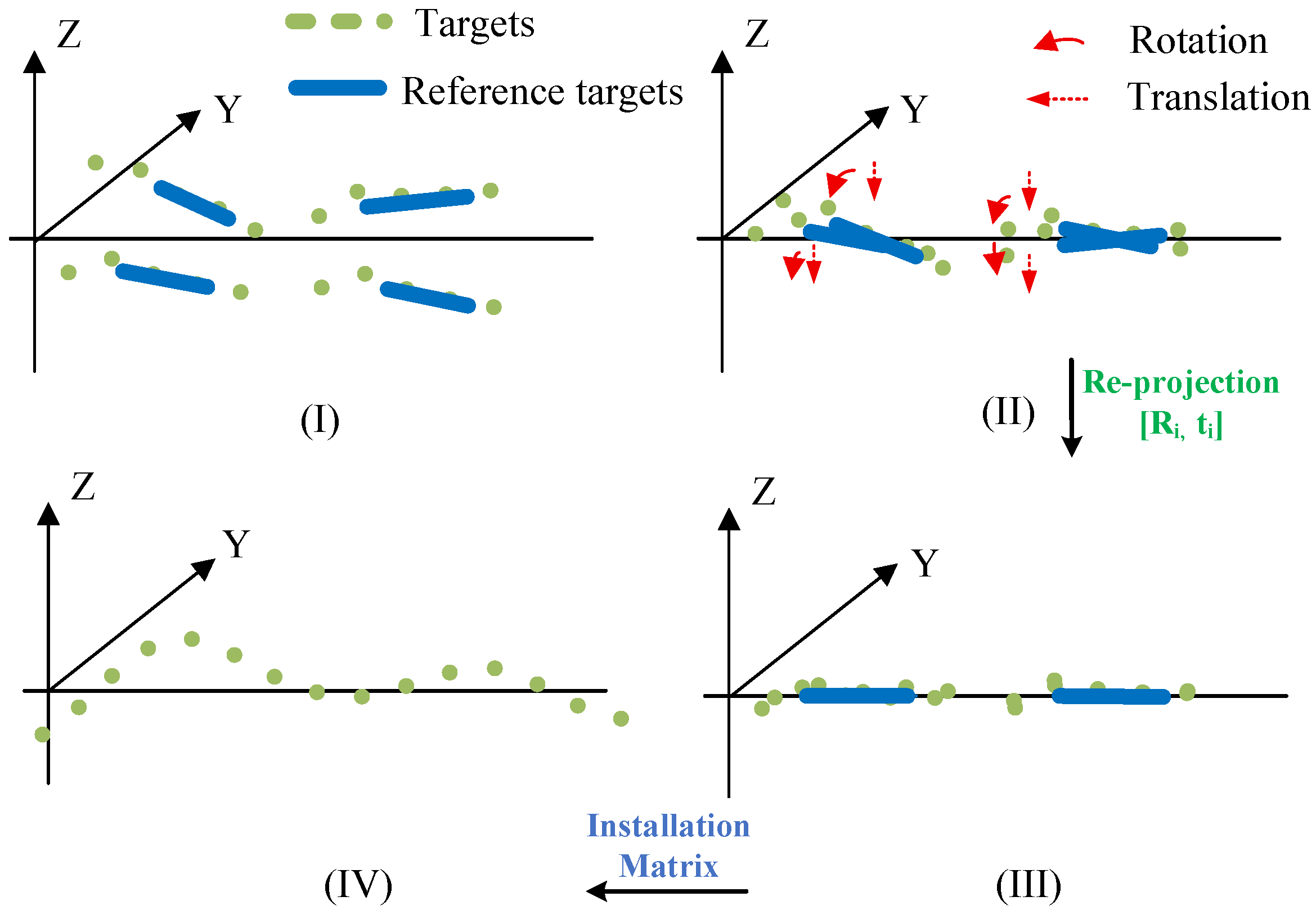
- Considering the distribution of the measurement camera and target, along with the characteristics of the rectangular mirror, a coordinate transformation and wavefront fitting algorithm are proposed. The wavefront measurement accuracy of the system is analyzed through finite element simulation and Monte Carlo analysis.
2. Measurement Principle
3. Measurement System Design
3.1. Overall Design
3.2. Optical Design
3.3. Camera Structural Design and Finite Element Analysis
3.4. Camera Imaging Electronics and Controllers
3.5. Thermal Control Design
- Thermal isolation between the camera and mounting platform;
- The camera’s light-transmitting aperture faces a cold black space long-term, maintaining a stable thermal environment. The camera employs a combination of active and passive thermal control to maintain temperature levels, temperature gradients, and thermal stability;
- Clear interface configuration between imaging electronics and camera lens components; imaging electronics utilize independent cooling with corresponding thermal compensation;
- Internal thermal conduction design within imaging electronics to transfer heat from CMOS and high-power components to the imaging electronics heat sink.
- Thermal isolation between the camera and mounting platform. Thermal pads made of 7 mm-thick polyimide are used between the camera mounting bracket and the platform;
- Thermal insulation between the camera and the external environment. The camera’s outer surface is covered with multi-layer thermal insulation components to insulate it from the external environment. The multi-layer components consist of 20 units, each with a film-mesh structure. The multi-layer film is made of silver-plated F46 film;
- Heat dissipation design for imaging electronics components. Based on the folding mechanism coordinate system and camera mounting orientation, where +Y and −Y represent the camera’s optical axis direction, the ±X surfaces of the imaging electronics components can serve as heat dissipation surfaces;
- Internal thermal conduction design for the focal plane electronics box Thermal management measures are implemented for the CMOS and high-power components, directing heat transfer to the ±X surfaces of the electronics components.
- Calculation of active thermal control power consumption for the camera lens section. With a camera aperture diameter of 50 mm, an equivalent emissivity of 0.9, and an equivalent temperature of −10 °C, the long-term active thermal control power requirement for the camera lens section is approximately 0.3 W, calculated using the Stefan-Boltzmann law;
- Thermal resistance calculation between the camera mount and installation platform. The total contact area between the camera mount and the folding mechanism platform is approximately 714 mm2. With the camera mount and thermal pad installed normally, using a heat transfer coefficient of 400 W/m2/°C, the thermal resistance R1 between the camera mount and thermal pad is calculated as 3.50 °C/W. Similarly, the thermal resistance R2 between the installation platform and thermal pad is also 3.50 °C/W. The total area of the polyimide thermal pad is approximately 714 mm2, with a thickness of 0.7 mm. Using a polyimide thermal conductivity of 0.3 W/m/°C, the thermal resistance R3 of the polyimide thermal pad is calculated as 3.26 °C/W. In summary, the total thermal resistance R between the camera mount and folding mechanism is R = R1 + R2 + R3 = 10.26 °C/W. When the mounting interface temperature is −10 °C, the heat leakage from the camera mount is approximately 2.9 W;
- The long-term power consumption requirement for the camera’s active thermal control is 0.3 + 2.9 W;
- The camera’s active thermal control is designed with three heating zones. Each heating zone is controlled by one main and one backup heating circuit. The heaters are cold-backed up, and the temperature sensing elements are hot-backed up. The active temperature control element uses an MF501 thermistor (Murata Manufacturing Co., Ltd., Nagaokakyo, Kyoto, Japan), with temperature control accuracy better than 0.2 °C and interchangeability accuracy better than 0.5 °C. The camera heating zone design is shown in Table 7. The design power for each section is to be determined, with a total power of approximately 3.2 W;
3.6. Design of Target
3.7. Measurement and Wavefront Fitting Algorithm Design
3.7.1. Target Center Calculation
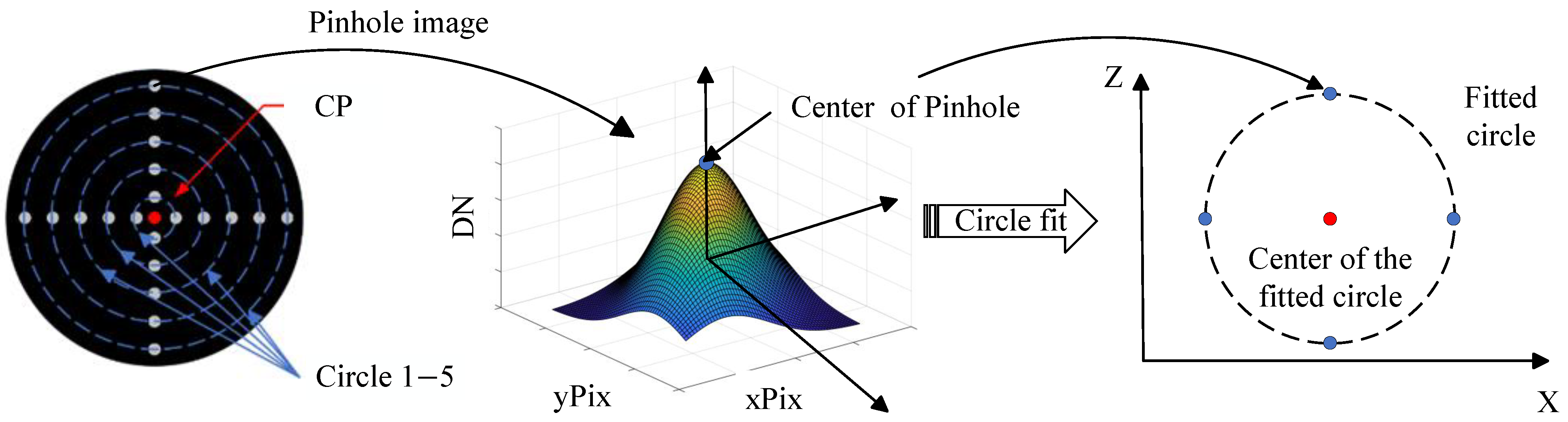
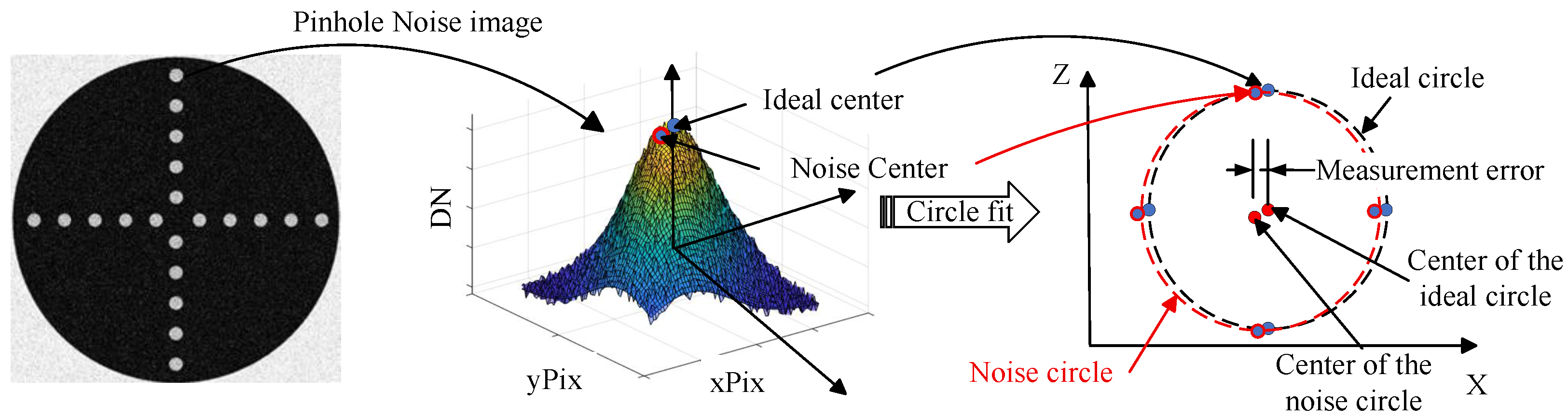
- Extract the grayscale values of the pinhole image to form the point spread function (PSF). Fit the PSF to a two-dimensional Gaussian surface using the least squares method as Equation (1). Determine the position of the Gaussian surface’s peak, which corresponds to the coordinates of the pinhole center point within the image coordinate system.In the equation, A represents the amplitude of the height surface, denotes the standard deviation of the Gaussian surface, c signifies the offset of the Gaussian surface, and indicates the coordinates of the pinhole center point in the image coordinate system; and denote the pixel position and grayscale value of the pinhole image, respectively:
- Calculate the center coordinates of the four pinhole images on each ring using the same procedure, and fit the center positions as shown in the upper left image;
- Repeat Step 1 to determine the positions of the four blue points shown in the upper right image;
- Fit the center positions based on the four blue points;
- After fitting and calculating the positions of the five centers, take the average as the CP position in the image coordinate system.
3.7.2. Common Reference Transformation of Target
3.7.3. Wavefront Fitting
4. Measurement Error Analysis
4.1. Focus Error
4.2. Distortion
4.3. Noise of Image
4.4. Folding Mechanism Deployment Error
4.5. Deformation Error of Folding Mechanism
4.6. Target Installation Error
4.7. Target Thermal Deformation Error
4.8. Camera Installation Error
4.9. Camera Thermal Deformation Error
5. Experimental and Simulation Analysis
5.1. Measurement Camera Imaging Experimental
5.2. Wavefront Fitting Deviation Analysis
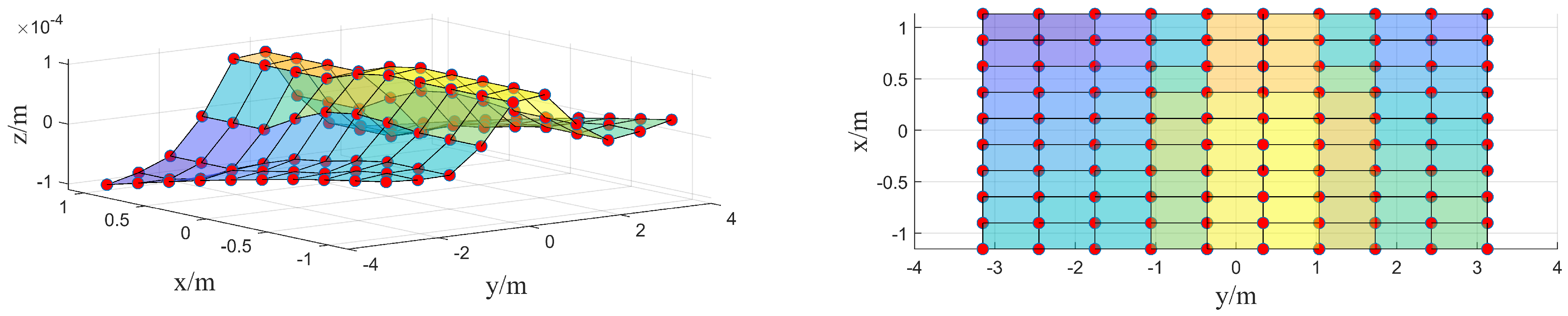
- Establish a finite element model of the folding mechanism to calculate its deformation under different temperature conditions. The global coordinate system of the finite model serves as the reference coordinate system for the folding mechanism;
- Set measurement points at the camera installation location within the finite element model. Output the positions of nodes at the camera installation location in the reference coordinate system under various temperature conditions;
- Set measurement points at the target installation position within the finite element model and output the node positions at the target installation location in the reference coordinate system under different temperature conditions;
- Establish the coordinate systems for each of the four cameras based on the deformed positions of the nodes at the camera installation locations;
- Map the target positions in the reference coordinate system to the coordinate systems of the four cameras;
- Superimpose the target’s X- and Z-axis position error analysis results from Table 12 onto the target position within the camera coordinate systems. Since the target’s Y-axis position is unmeasurable for the measurement camera in this study, directly superimpose the thermal deformation of the target’s Y-axis onto its position within the camera coordinate systems;
- Perform a common reference transformation on the target positions in the four camera coordinate systems to obtain the target position in the reference coordinate system;
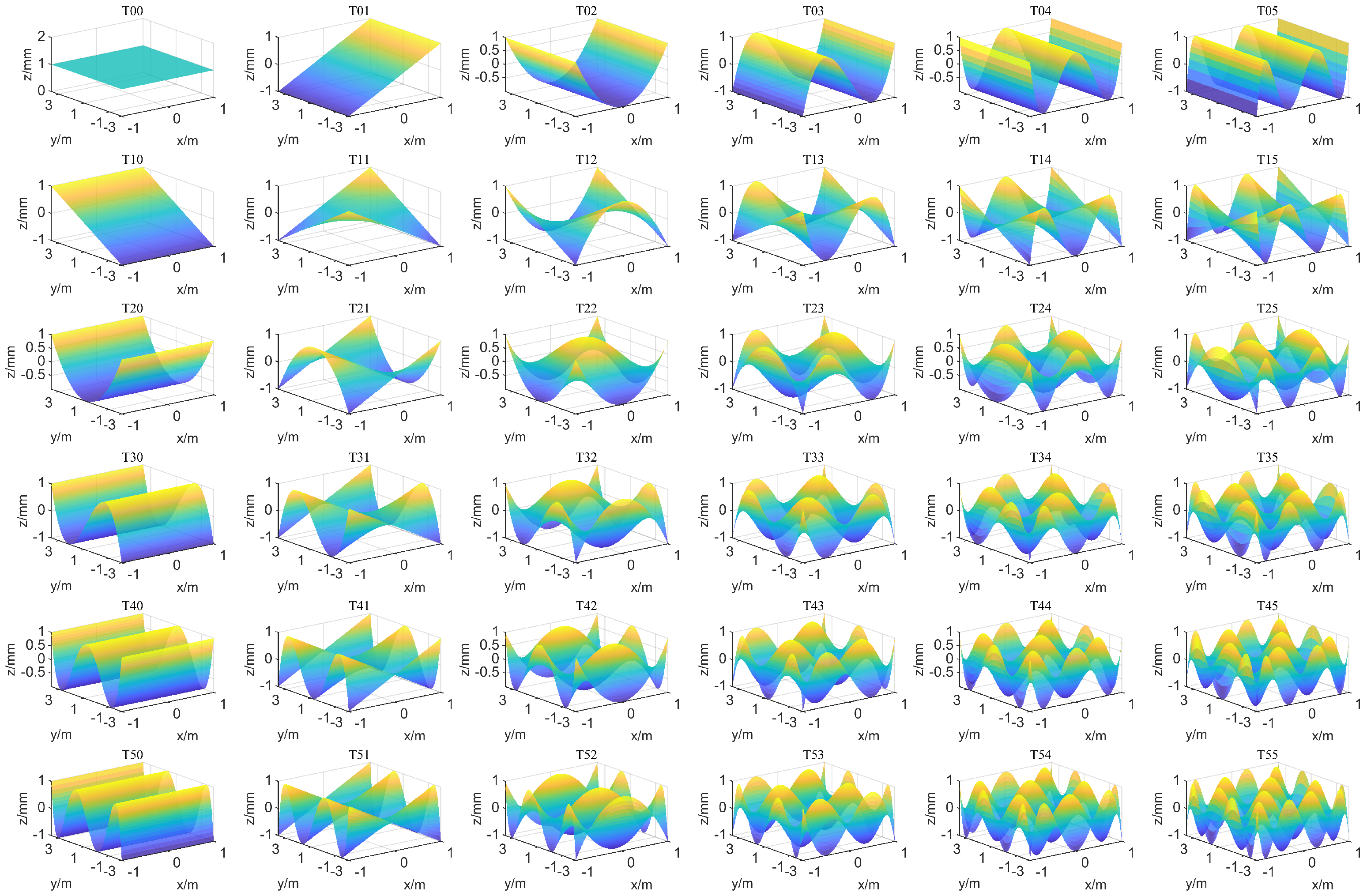
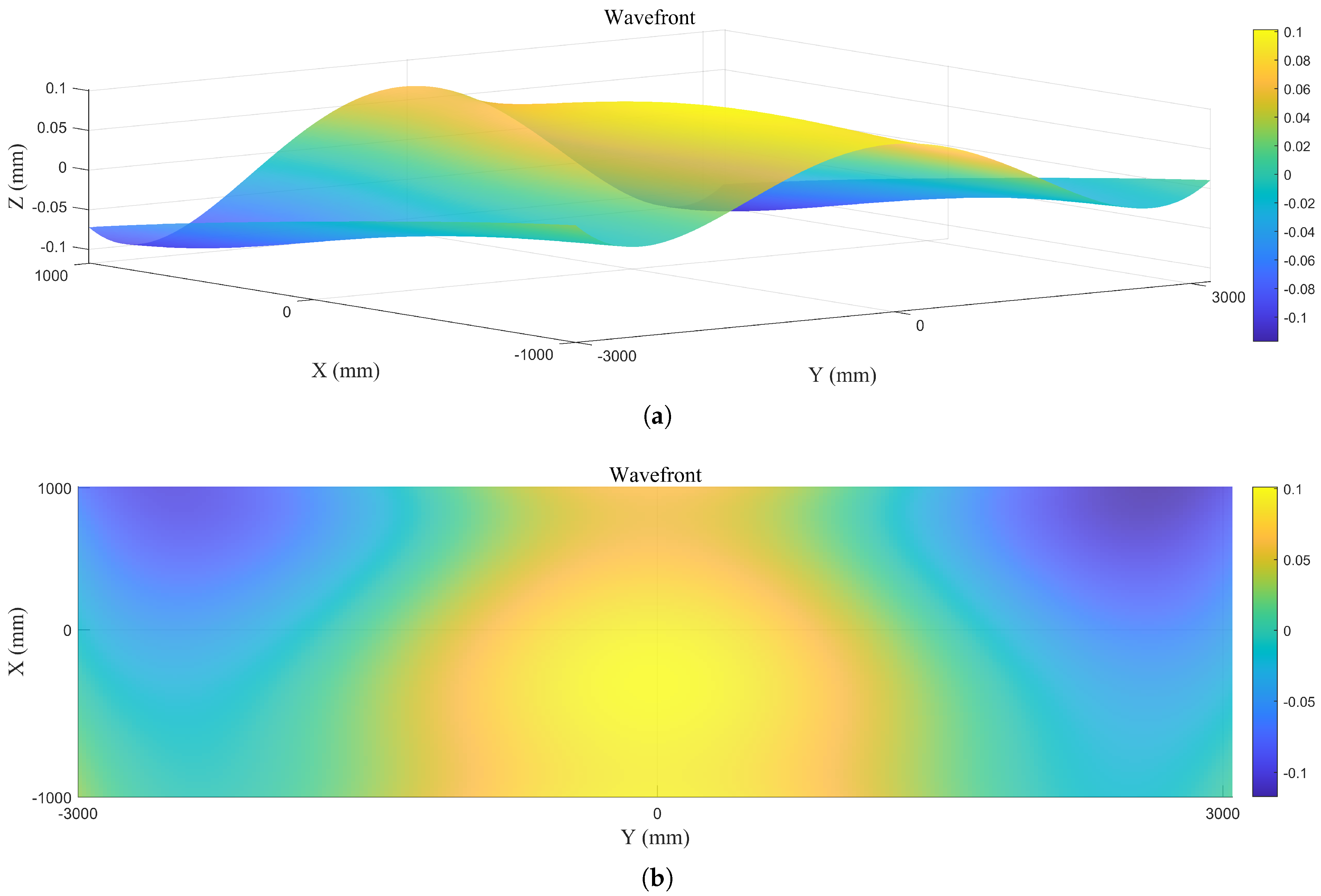
- Fit the surface deformation of the folding mechanism using Chebyshev and Zernike polynomials, respectively;
- Compare the finite element analysis results with the fitted deformation to obtain the fitting deviation;
- For finite element analysis results under different temperature conditions, repeat steps 6–9 to perform 10,000 Monte Carlo analyses;
6. Discussion
7. Conclusions
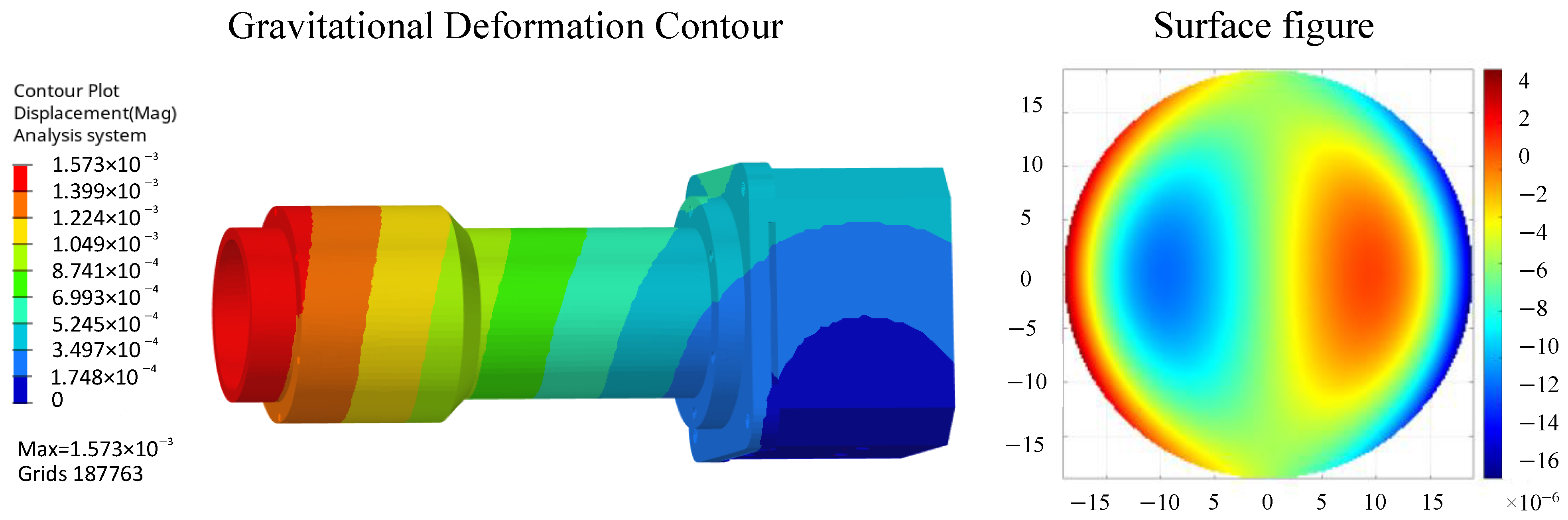
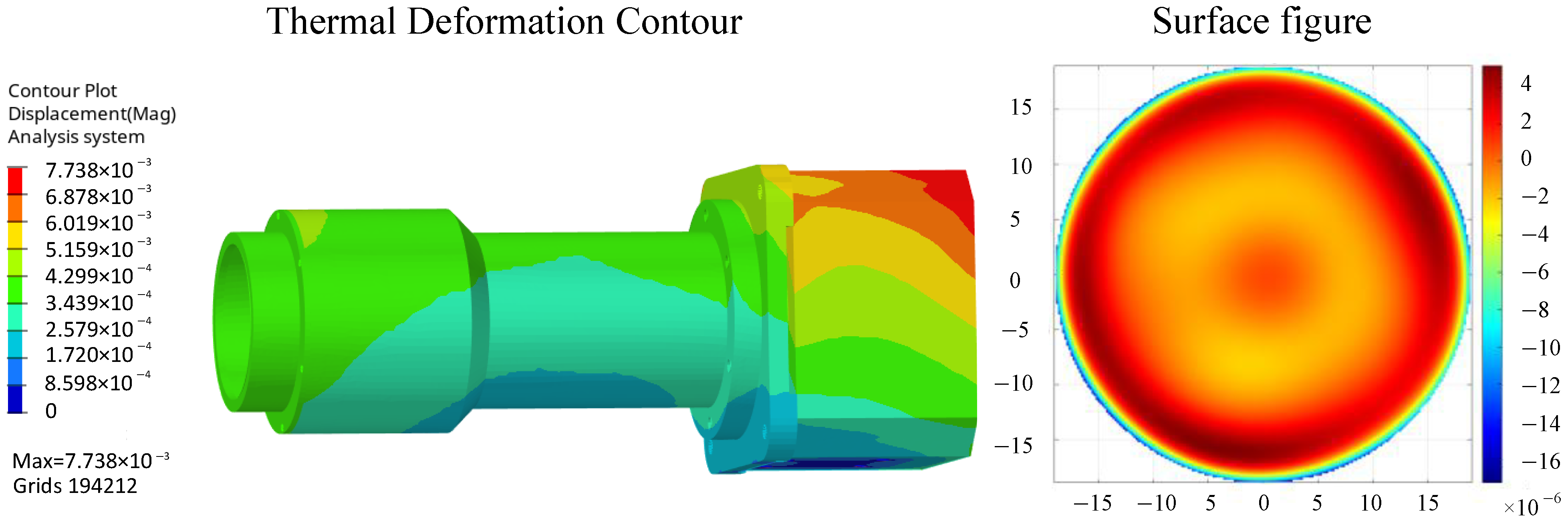
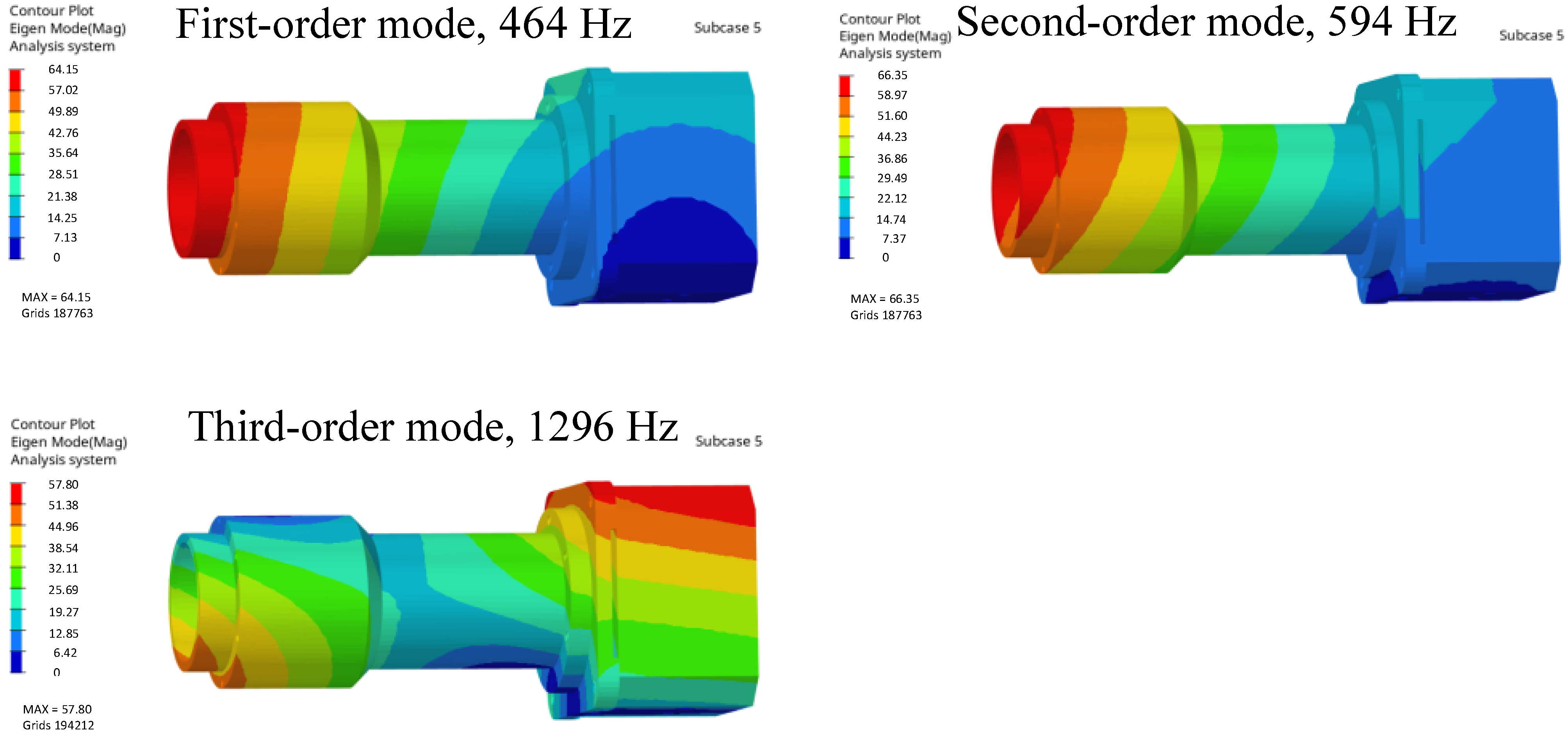
- Under conditions of gravity and a 4 °C temperature increase, the RMS surface profile of the mirror aperture achieves better than . The measurement camera structure designed in this paper operates at a fundamental frequency of 464.1 Hz, meeting the requirements for its use in space environments;
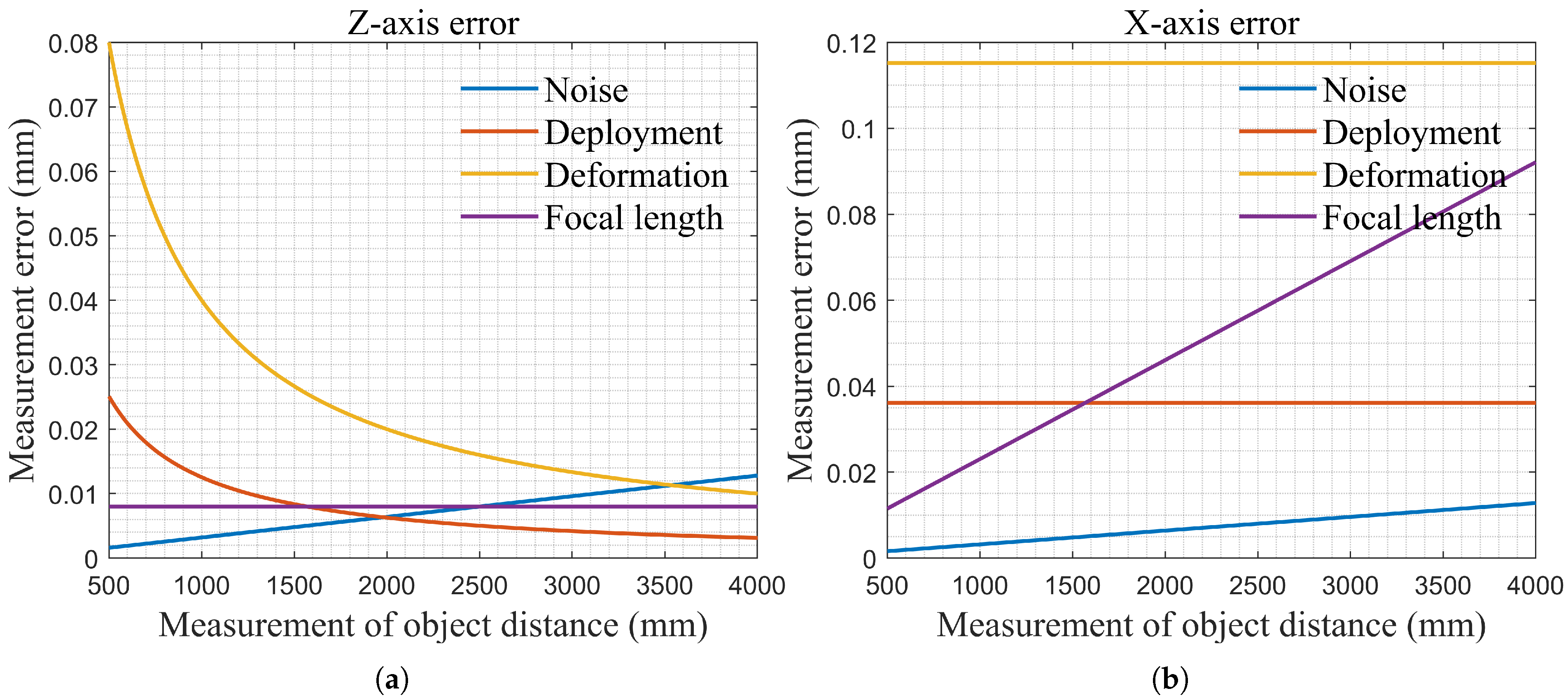
- Based on imaging models and error theory, this study analyzes the impact of signal-to-noise ratio on target center calculation errors, along with the impact of object-to-camera distance errors caused by folding mechanism deployment and thermal deformation, and the focal length error of the measurement camera on the final target position measurement accuracy. The error analysis results indicate measurement accuracies of ±0.0853 mm in the Z-direction and ±0.1525 mm in the X-direction, laying the foundation for subsequent wavefront fitting accuracy analysis;
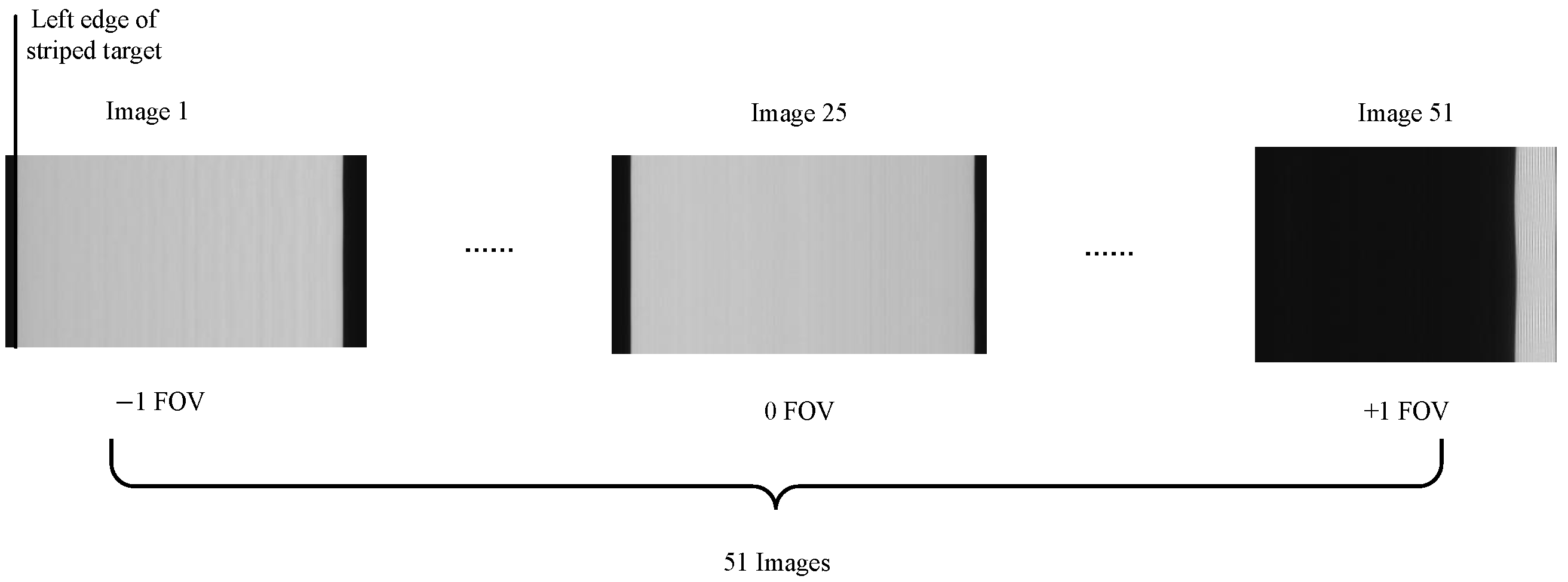
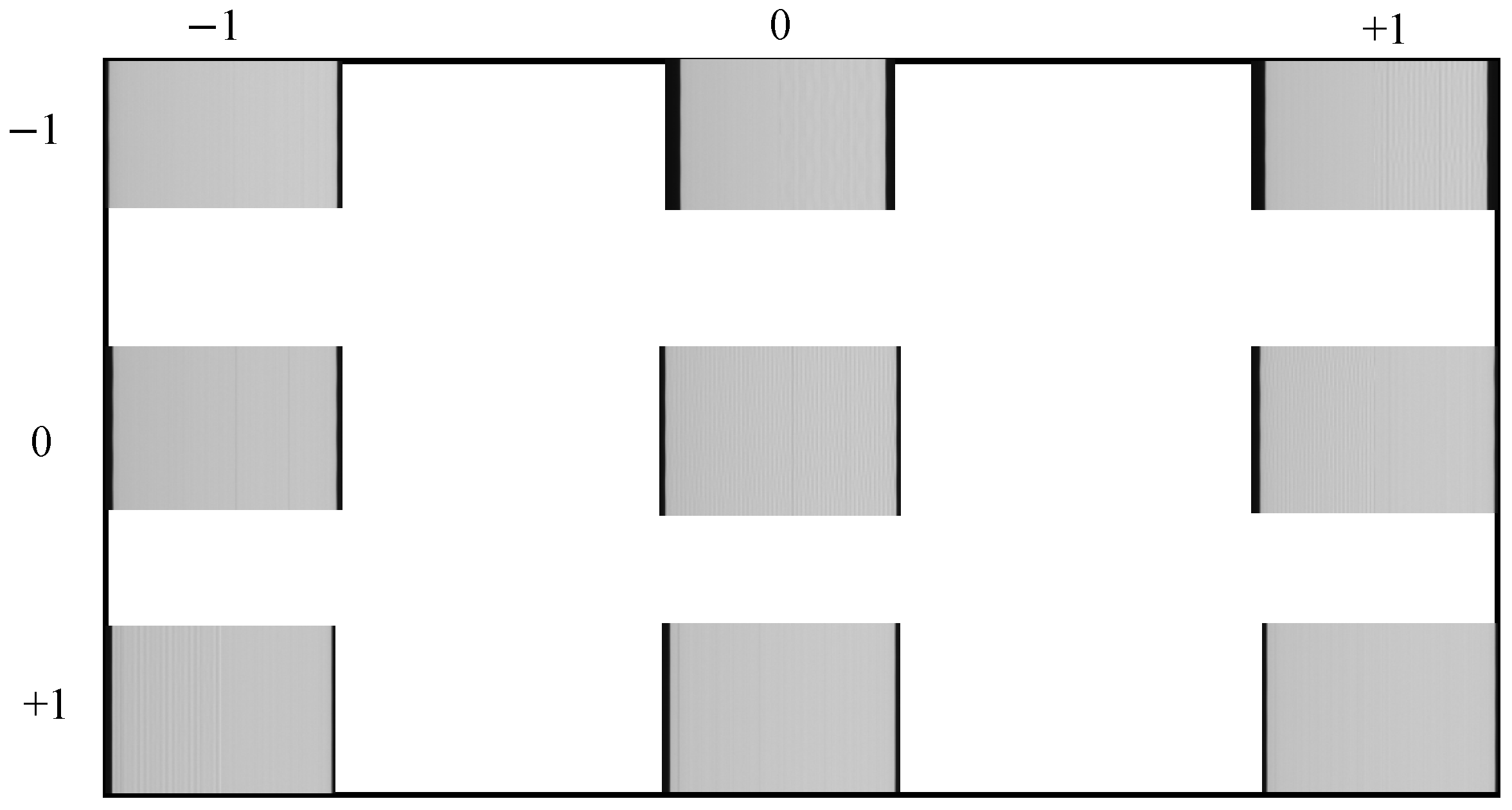
- A prototype measurement camera was constructed and underwent focal length calibration tests and MTF testing using a stripe target, parallel light tube, and precision turntable. The camera’s focal length was determined to be 101.356 mm, with MTF values exceeding 0.11 across all nine FOVs. Based on the GMAX3265 calibration results for dimensions and focal length, the camera’s FOV was determined to be 16° × 12°. Considering the distribution pattern of the test targets, the measurement system’s range was established as ±4.85 mm. These results confirm that the measurement camera’s focal length, MTF, and measurement range all meet the design specifications;
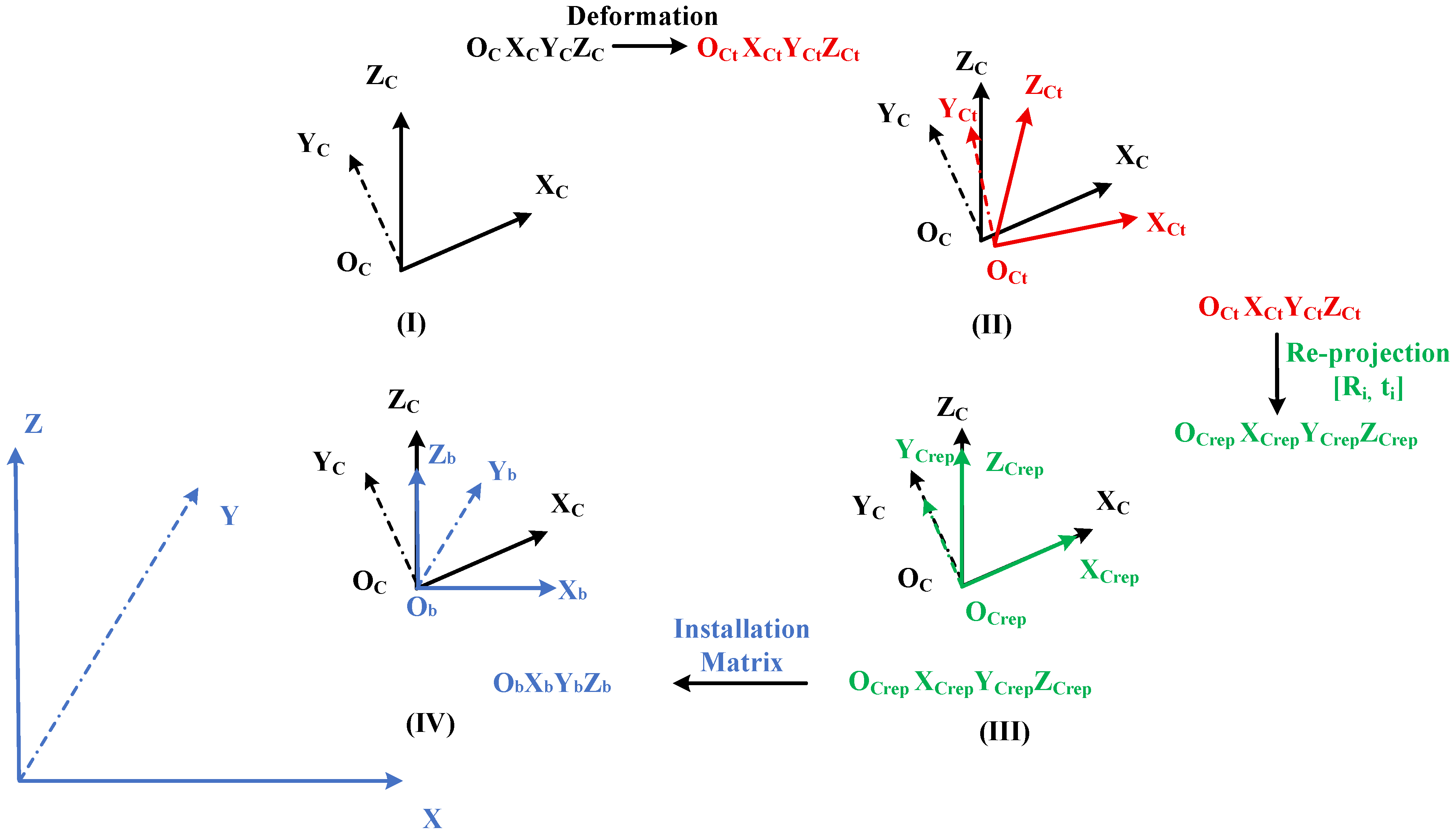
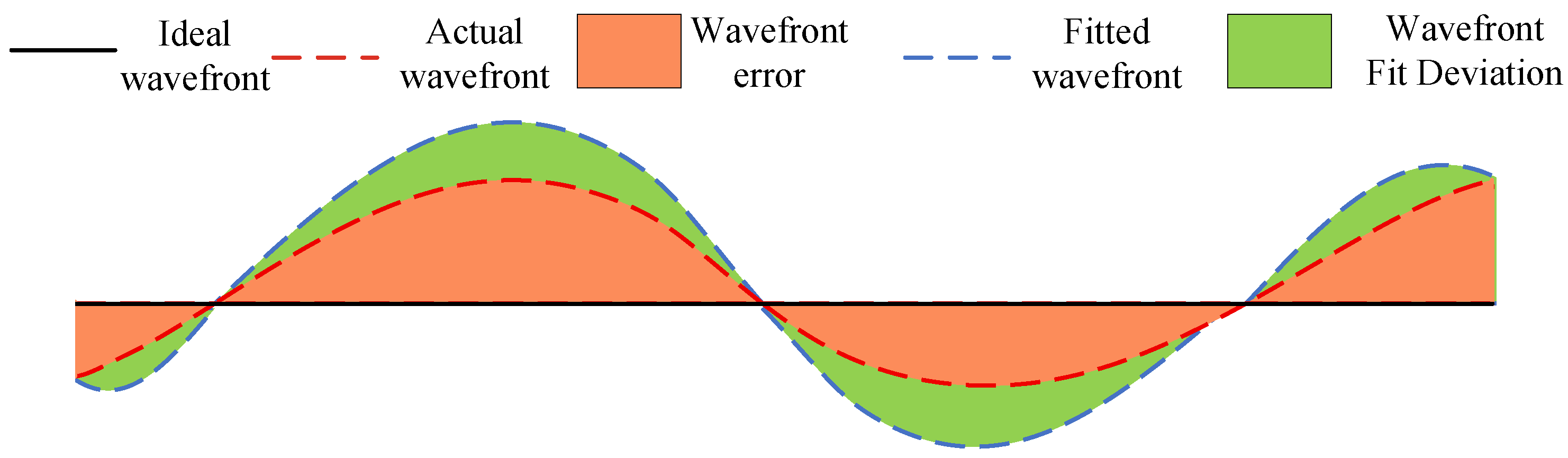
- A target common-reference transformation algorithm was designed. Considering the transformation of the cameras’ own mounting positions, it uses a common target as the reference to transform the target position measurement results from the four cameras in their respective coordinate systems to a single common reference coordinate system. Based on the rectangular aperture of the stitching mirror, Chebyshev polynomials were selected for wavefront fitting. Finite element analysis validated the effectiveness of the target common-reference transformation algorithm and wavefront fitting algorithm using RMS and PV fitting deviations as evaluation criteria, with comparisons against Zernike polynomials. Under various operating conditions, the Chebyshev polynomial achieved maximum wavefront fitting deviations of 0.397 mm (PV) and 0.073 mm (RMS), meeting the wavefront measurement accuracy requirements for the coarse calibration stage. Meet the accuracy requirements for wavefront measurement during the coarse alignment phase of the mirror assembly (RMS < 0.1 mm, PV < 0.45 mm). The Chebyshev polynomial demonstrated superior fitting accuracy compared to the Zernike polynomial, proving more suitable for wavefront fitting in rectangular apertures.
Author Contributions
Funding
Data Availability Statement
Acknowledgments
Conflicts of Interest
References
- Zhan, H. The wide-field multiband imaging and slitless spectroscopy survey to be carried out by the Survey Space Telescope of China Manned Space Program. Chin. Sci. Bull. 2021, 66, 1290–1298. [Google Scholar] [CrossRef]
- Pilbratt, G.L. Herschel mission overview and key programmes. In Proceedings of the Space Telescopes and Instrumentation 2008: Optical, Infrared, and Millimeter; de Graauw, M.W.M., MacEwen, H.A., Eds.; International Society for Optics and Photonics; SPIE: Bellingham, WA, USA, 2008; Volume 7010, p. 701002. [Google Scholar] [CrossRef]
- Liu, Y.; Zhang, H.; Liu, L.; Yang, X.; Huang, J.; Liu, X.; Chen, Z.; Zhengren, H. Preparation and environmental simulation tests of large-size silicon carbide brazed reflection mirrors. Opto-Electron. Eng. 2020, 47, 200088. [Google Scholar] [CrossRef]
- Khorin, P.; Dzyuba, A.; Khonina, S. Optical wavefront aberration: Detection, recognition, and compensation techniques—A comprehensive review. Opt. Laser Technol. 2025, 191, 113342. [Google Scholar] [CrossRef]
- Li, H. Research on the High Precision Segmented Calibration Mechanism of Space Primary Mirror. Ph.D. Thesis, University of Electronic Science and Technology of China, Chengdu, China, 2024. [Google Scholar]
- Xu, G. Research on Large Caliber Mirror Surface Shape Detection Based on Stripe Reflection Method. Master’s Thesis, Soochow University, Suzhou, China, 2020. [Google Scholar]
- Acton, D.; Knight, S.; Carrasquilla, M.; Weiser, N.; Masciarelli, M.; Jurczyk, S.; Rapp, G.; Mueckay, J.; Wolf, E.; Murphy, J.; et al. Phasing the Webb telescope. Space Telesc. Instrum. Opt. Infrared, Millim. Wave 2022, 8, 28. [Google Scholar] [CrossRef]
- Acton, D.S.; Knight, J.S.; Contos, A.; Grimaldi, S.; Terry, J.; Lightsey, P.; Barto, A.; League, B.; Dean, B.; Smith, J.S. Wavefront sensing and controls for the James Webb Space Telescope. Space Telesc. Instrum. Opt. Infrared, Millim. Wave 2012, 8442, 84422H. [Google Scholar]
- Dean, B.H.; Bowers, C.W. Diversity selection for phase-diverse phase retrieval. J. Opt. Soc. Am. A 2003, 20, 1490–1504. [Google Scholar] [CrossRef] [PubMed]
- Wasmeier, M.; Hackl, J.; Leveque, S. Inductive sensors based on embedded coil technology for nanometric inter-segment position sensing of the E-ELT. In Proceedings of the Ground-Based and Airborne Telescopes V; Stepp, L.M., Gilmozzi, R., Hall, H.J., Eds.; International Society for Optics and Photonics; SPIE: Bellingham, WA, USA, 2014; Volme 9145, p. 91451R. [Google Scholar] [CrossRef]
- Rozière, D.; Luong, B.; Fuchs, B.; Périn, A.; Néel, C.; Lévèque, S. Inductive edge sensors: An innovative solution for ELT segmented mirror alignment monitoring. In Proceedings of the Ground-Based and Airborne Telescopes II; Stepp, L.M., Gilmozzi, R., Eds.; International Society for Optics and Photonics; SPIE: Bellingham, WA, USA, 2008; Volume 7012, p. 701217. [Google Scholar] [CrossRef]
- Wang, X.; Shi, F.; Sigrist, N.; Seo, B.J.; Tang, H.; Bikkannavar, S.; Basinger, S.; Lay, O. Experimental validation of Advanced Dispersed Fringe Sensing (ADFS) algorithm using Advanced Wavefront Sensing and Correction Testbed (AWCT). In Proceedings of the Advances in Optical and Mechanical Technologies for Telescopes and Instrumentation; Navarro, R., Cunningham, C.R., Barto, A.A., Eds.; International Society for Optics and Photonics; SPIE: Bellingham, WA, USA, 2014; Volume 9151, p. 91513N. [Google Scholar] [CrossRef]
- Chunyue, Z. Improving the Performance of Co-Phasing Error Detection Based on Dispersed Fringe Sensor. Master’s Thesis, University of Chinese Academy of Sciences, Changchun Institute of Optics, Fine Mechanics and Physics Chinese Academy of Sciences, Changchun, China, 2018. [Google Scholar]
- Chanan, G.A.; Nelson, J.E.; Mast, T.S.; Wizinowich, P.L.; Schaefer, B.A. W.M. Keck Telescope phasing camera system. In Proceedings of the Instrumentation in Astronomy VIII; Crawford, D.L., Craine, E.R., Eds.; International Society for Optics and Photonics; SPIE: Bellingham, WA, USA, 1994; Volume 2198, pp. 1139–1150. [Google Scholar] [CrossRef]
- Troy, M.; Chanan, G.; Roberts, J. Shack-Hartmann phasing of segmented telescopes: Systematic effects from lenslet arrays. In Proceedings of the Ground-based and Airborne Telescopes III; Stepp, L.M., Gilmozzi, R., Hall, H.J., Eds.; International Society for Optics and Photonics; SPIE: Bellingham, WA, USA, 2010; Volume 7733, p. 77332C. [Google Scholar] [CrossRef]
- Xupeng, L.; Jinfeng, S.; Wei, W.; Yongjie, W.; Xuewu, F. Review on Splicing Structure Technology of Large Aperture Space Primary Mirror. Laser Optoelectron. Prog. 2018, 55, 28–40. [Google Scholar] [CrossRef]
- Haodong, X.J. Overview of Development of Flatness Measurement Technology for Large Spaceborne Radar Antennas. Meas. Control Technol. 2025, 44, 1–13. [Google Scholar] [CrossRef]
- Weifeng, Z. Design and Thermal Deformation Analysis of Space Antenna Deployment Mechanism. Master’s Thesis, Chang’an University, Xi’an, China, 2020. [Google Scholar]
- Cao, H. Research on the Technologies of Active Optics for Large-Aperture Segmented Optical/Infrared Telescope. Ph.D. Thesis, University of Chinese Academy of Sciences, Changchun Institute of Optics, Fine Mechanics and Physics Chinese Academy of Sciences, Changchun, China, 2020. [Google Scholar]
- Bennett, J.; Mattsson, L. Introduction to Surface Roughness and Scattering; Optical Society of America: Washington, DC, USA, 1999. [Google Scholar]
- Xin, H. Research on Spatial Filtering Velocimetry Based on Image Sensors. Ph.D. Thesis, National University of Defense Technology, Changsha, China, 2015. [Google Scholar]
- Chen, Q. Design of Freeform Optical Imaging Systems. Master’s Thesis, Xi’an Technological University, Xi’an, China, 2025. [Google Scholar]
- Zhang, Z. Flexible camera calibration by viewing a plane from unknown orientations. In Proceedings of the Seventh IEEE International Conference on Computer Vision, Kerkyra, Greece, 20–27 September 1999; Volume 1, pp. 666–673. [Google Scholar] [CrossRef]
- Zhang, Z. A flexible new technique for camera calibration. IEEE Trans. Pattern Anal. Mach. Intell. 2000, 22, 1330–1334. [Google Scholar] [CrossRef]
- Wang, T.; Han, X.; Li, Y.; Liu, K. Reconstruction of Wavefronts with Arbitrary Aperture Using Multi-Directional Difference Zernike Polynomial Fitting. Acta Opt. Sin. 2025, 45, 213–226. [Google Scholar]
- Yuan, Z. Research on Technologies of Thermal Control for Space Telescope Based on Structural-Thermal-Optical Integrated Analysis. Ph.D. Thesis, University of Chinese Academy of Sciences, Changchun Institute of Optics, Fine Mechanics and Physics Chinese Academy of Sciences, Changchun, China, 2023. [Google Scholar]
- Yu, K. The Research on the Application of Chebyshev Polynomial in Computer-Aided Alignment of the Cylindrial System. Master’s Thesis, Soochow University, Suzhou, China, 2018. [Google Scholar]
- Yang, W.; Gao, D.; Luo, Z.; Qian, W. Internal Reference Calibration of Telephoto Camera Based on Parallel Optical Tube and Two Dimensional Rotating Platform. Flight Control Detect. 2021, 4, 25–31. [Google Scholar] [CrossRef]



| Temperature | 10 | 11 | 12 | 13 | 14 | 15 | 16 | 17 | 18 | 19 |
| PV | 2.998 | 2.954 | 2.822 | 2.791 | 2.359 | 2.314 | 2.288 | 2.094 | 2.069 | 2.034 |
| Temperature | 21 | 22 | 23 | 24 | 25 | 26 | 27 | 28 | 29 | 30 |
| PV | 3.404 | 3.426 | 3.431 | 3.437 | 3.556 | 3.627 | 3.658 | 3.739 | 3.775 | 3.785 |
| Item | Performance |
|---|---|
| Number of Targets | 96 |
| Number of Cameras | 4 |
| Wavefront measurement range | mm |
| Wavefront measurement accuracy | Deviation RMS < 0.1 mm, PV < 0.45 mm |
| Materials | Modulus of Elasticity (MPa) | Poisson Ratio | Density | Linear Coefficient of Thermal Expansion (K−1) | Application Components |
|---|---|---|---|---|---|
| TC4 | 109,000 | 0.29 | 4.4 | Supporting frame | |
| T700 | 60,000 | 0.28 | 1.6 | Lens hood |
| Components | Mass (kg) |
|---|---|
| Structural components | 0.70 |
| Optical components | 0.085 |
| Detector assembly | 0.4 |
| Cables, screws, adhesives, etc. | 0.1 |
| Total mass | 1.235 |
| Conditions | PV (nm) | RMS (nm) |
|---|---|---|
| Gravity | 0.044 | 0.007 |
| Thermal | 22.557 | 3.244 |
| Item | Performance |
|---|---|
| CMOS pixel size | 3.2 m |
| Image dimensions | 9216 × 7168 |
| Quantitative digit | 12 bit |
| Power consumption | 5 w |
| Heating Zone Position | Temperature Control Target (°C) |
|---|---|
| Backend Lens Element | 21 |
| Front Lens Element | 20 |
| Electronics Assembly | 19 |
| Materials | Modulus of Elasticity (MPa) | Poisson Ratio | Density (g/cm3) | Linear Coefficient of Thermal Expansion (K−1) | Application Components |
|---|---|---|---|---|---|
| 4J32 | 140,000 | 0.29 | 8.1 | Pinhole board | |
| T700 | 60,000 | 0.28 | 1.6 | Base of target |
| Chebyshev Polynomial | Corresponding Aberration | |
|---|---|---|
| 00 | 1 | Piston |
| 10 | x | X-Slant |
| 01 | y | Y-Slant |
| 20 | X-defocus | |
| 11 | ||
| 02 | Y-defocus | |
| 30 | X-coma | |
| 21 | ||
| 12 | ||
| 03 | Y- coma | |
| 40 | X-Spherical aberration | |
| 31 | ||
| 22 | ||
| 13 | ||
| 04 | Y-Spherical aberration |
| SNR (dB) | Center Error (Pixel) |
|---|---|
| 20 | |
| 22 | |
| 24 | |
| 26 | |
| 28 | |
| 30 | |
| 32 | |
| 34 | |
| 36 | |
| 38 | |
| 40 |
| Temperatures (°C) | Changes in Focal Length (mm) |
|---|---|
| 24 | +0.016 |
| 22.5 | +0.010 |
| 17.4 | −0.010 |
| 16 | −0.015 |
| Item | Error Value | Maximum Measurement Error Z (mm) | Maximum Measurement Error X (mm) | Error Type |
|---|---|---|---|---|
| Focus error | mm | 0 | 0 | Calibratable |
| Distortion | px | 0 | 0 | Calibratable |
| Noise of image | px | Random | ||
| Deployment error of folding mechanism | mm | Random | ||
| Deformation error of folding mechanism | mm | Random | ||
| Target installation error | 0 | 0 | Calibratable | |
| Target deformation error | mm | Random | ||
| Camera installation error | 0 | 0 | Calibratable | |
| Camera thermal deformation error | mm | Random | ||
| Total |
| FOV | −1 | 0 | +1 |
|---|---|---|---|
| −1 | 0.118 | 0.126 | 0.114 |
| 0 | 0.128 | 0.131 | 0.123 |
| +1 | 0.115 | 0.122 | 0.112 |
| Temperature | Average of RMS (mm) | Average of PV (mm) | Maximum of RMS (mm) | Maximum of PV (mm) | ||||
|---|---|---|---|---|---|---|---|---|
| °C | Chebyshev | Zernike | Chebyshev | Zernike | Chebyshev | Zernike | Chebyshev | Zernike |
| 1 | 0.044 | 0.061 | 0.250 | 0.324 | 0.069 | 0.084 | 0.364 | 0.437 |
| 2 | 0.043 | 0.061 | 0.243 | 0.317 | 0.068 | 0.084 | 0.348 | 0.427 |
| 3 | 0.042 | 0.059 | 0.239 | 0.307 | 0.072 | 0.083 | 0.360 | 0.421 |
| 4 | 0.042 | 0.059 | 0.240 | 0.305 | 0.073 | 0.089 | 0.353 | 0.443 |
| 5 | 0.044 | 0.060 | 0.251 | 0.308 | 0.072 | 0.086 | 0.361 | 0.423 |
| 6 | 0.046 | 0.060 | 0.258 | 0.307 | 0.073 | 0.085 | 0.377 | 0.427 |
| 7 | 0.047 | 0.060 | 0.259 | 0.308 | 0.070 | 0.079 | 0.379 | 0.429 |
| 8 | 0.047 | 0.061 | 0.260 | 0.314 | 0.073 | 0.088 | 0.380 | 0.427 |
| 9 | 0.046 | 0.060 | 0.255 | 0.316 | 0.072 | 0.083 | 0.397 | 0.436 |
| 10 | 0.045 | 0.061 | 0.253 | 0.324 | 0.073 | 0.086 | 0.367 | 0.446 |
| 11 | 0.031 | 0.044 | 0.174 | 0.234 | 0.050 | 0.073 | 0.256 | 0.401 |
| 12 | 0.030 | 0.048 | 0.171 | 0.259 | 0.051 | 0.074 | 0.264 | 0.423 |
| 13 | 0.030 | 0.043 | 0.168 | 0.232 | 0.050 | 0.070 | 0.277 | 0.371 |
| 14 | 0.030 | 0.041 | 0.170 | 0.217 | 0.053 | 0.067 | 0.254 | 0.388 |
| 15 | 0.030 | 0.039 | 0.172 | 0.205 | 0.054 | 0.068 | 0.263 | 0.354 |
| 16 | 0.031 | 0.036 | 0.177 | 0.182 | 0.050 | 0.059 | 0.271 | 0.351 |
| 17 | 0.032 | 0.036 | 0.180 | 0.174 | 0.056 | 0.065 | 0.294 | 0.302 |
| 18 | 0.031 | 0.038 | 0.178 | 0.191 | 0.052 | 0.064 | 0.295 | 0.324 |
| 19 | 0.032 | 0.035 | 0.183 | 0.173 | 0.055 | 0.061 | 0.284 | 0.289 |
| 20 | 0.032 | 0.038 | 0.179 | 0.192 | 0.053 | 0.067 | 0.284 | 0.331 |
| Temperature | Average of RMS (mm) | Average of PV (mm) | Maximum of RMS (mm) | Maximum of PV (mm) | ||||
|---|---|---|---|---|---|---|---|---|
| °C | Chebyshev | Zernike | Chebyshev | Zernike | Chebyshev | Zernike | Chebyshev | Zernike |
| 10 | 0.035 | 0.057 | 0.195 | 0.312 | 0.045 | 0.066 | 0.248 | 0.334 |
| 11 | 0.034 | 0.056 | 0.189 | 0.302 | 0.042 | 0.064 | 0.234 | 0.333 |
| 12 | 0.033 | 0.055 | 0.185 | 0.292 | 0.043 | 0.064 | 0.240 | 0.320 |
| 13 | 0.033 | 0.055 | 0.187 | 0.293 | 0.042 | 0.064 | 0.236 | 0.330 |
| 14 | 0.036 | 0.056 | 0.198 | 0.296 | 0.045 | 0.066 | 0.246 | 0.325 |
| 15 | 0.039 | 0.056 | 0.204 | 0.297 | 0.048 | 0.064 | 0.253 | 0.325 |
| 16 | 0.040 | 0.056 | 0.207 | 0.299 | 0.047 | 0.064 | 0.263 | 0.330 |
| 17 | 0.039 | 0.056 | 0.211 | 0.303 | 0.049 | 0.067 | 0.256 | 0.333 |
| 18 | 0.038 | 0.056 | 0.205 | 0.306 | 0.046 | 0.065 | 0.250 | 0.337 |
| 19 | 0.037 | 0.058 | 0.202 | 0.311 | 0.046 | 0.066 | 0.246 | 0.343 |
| 21 | 0.016 | 0.039 | 0.093 | 0.208 | 0.026 | 0.048 | 0.139 | 0.246 |
| 22 | 0.015 | 0.043 | 0.087 | 0.236 | 0.023 | 0.053 | 0.133 | 0.283 |
| 23 | 0.014 | 0.037 | 0.083 | 0.204 | 0.023 | 0.046 | 0.124 | 0.248 |
| 24 | 0.014 | 0.035 | 0.082 | 0.188 | 0.023 | 0.043 | 0.127 | 0.225 |
| 25 | 0.014 | 0.033 | 0.084 | 0.177 | 0.025 | 0.043 | 0.137 | 0.226 |
| 26 | 0.017 | 0.029 | 0.096 | 0.151 | 0.029 | 0.038 | 0.143 | 0.180 |
| 27 | 0.019 | 0.028 | 0.106 | 0.146 | 0.029 | 0.037 | 0.147 | 0.173 |
| 28 | 0.018 | 0.032 | 0.103 | 0.167 | 0.028 | 0.043 | 0.146 | 0.194 |
| 29 | 0.019 | 0.028 | 0.106 | 0.147 | 0.031 | 0.035 | 0.149 | 0.178 |
| 30 | 0.018 | 0.031 | 0.103 | 0.163 | 0.027 | 0.042 | 0.142 | 0.194 |
| System | Measurement Range | Measurement Accuracy | Sensor Type |
|---|---|---|---|
| Ref. [9] | ±500 m | 256 nm RMS | Dispersed Hartmann Sensors and Dispersed Fringe Sensing |
| Ref. [14] | ±30 m | 50 nm RMS | Shack–Hartmann |
| Ref. [15] | ±30 m | 30 nm RMS | Shack–Hartmann |
| Ref. [12] | ±100 m | 100 nm RMS | Dispersed Fringe Sensing |
| Ref. [11] | 400 m | 1 nm, temperature drift is 1.32 nm/°C | Inductive Edge Sensors |
| This paper | ±4 mm | 0.1 mm RMS | Photogrammetry |
Disclaimer/Publisher’s Note: The statements, opinions and data contained in all publications are solely those of the individual author(s) and contributor(s) and not of MDPI and/or the editor(s). MDPI and/or the editor(s) disclaim responsibility for any injury to people or property resulting from any ideas, methods, instructions or products referred to in the content. |
© 2026 by the authors. Licensee MDPI, Basel, Switzerland. This article is an open access article distributed under the terms and conditions of the Creative Commons Attribution (CC BY) license.
Share and Cite
He, Y.; Zhao, H.; Peng, L.; Sui, X.; Chen, C.; Peng, Y. Design and Error Analysis of an Optical Measurement System for the Wavefront of Large-Aperture Segmented Mirror. Sensors 2026, 26, 1450. https://doi.org/10.3390/s26051450
He Y, Zhao H, Peng L, Sui X, Chen C, Peng Y. Design and Error Analysis of an Optical Measurement System for the Wavefront of Large-Aperture Segmented Mirror. Sensors. 2026; 26(5):1450. https://doi.org/10.3390/s26051450
Chicago/Turabian StyleHe, Yukun, Hongbo Zhao, Lanxin Peng, Xiaodong Sui, Changzheng Chen, and Yueyang Peng. 2026. "Design and Error Analysis of an Optical Measurement System for the Wavefront of Large-Aperture Segmented Mirror" Sensors 26, no. 5: 1450. https://doi.org/10.3390/s26051450
APA StyleHe, Y., Zhao, H., Peng, L., Sui, X., Chen, C., & Peng, Y. (2026). Design and Error Analysis of an Optical Measurement System for the Wavefront of Large-Aperture Segmented Mirror. Sensors, 26(5), 1450. https://doi.org/10.3390/s26051450