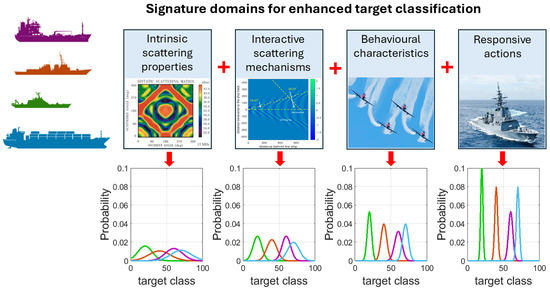
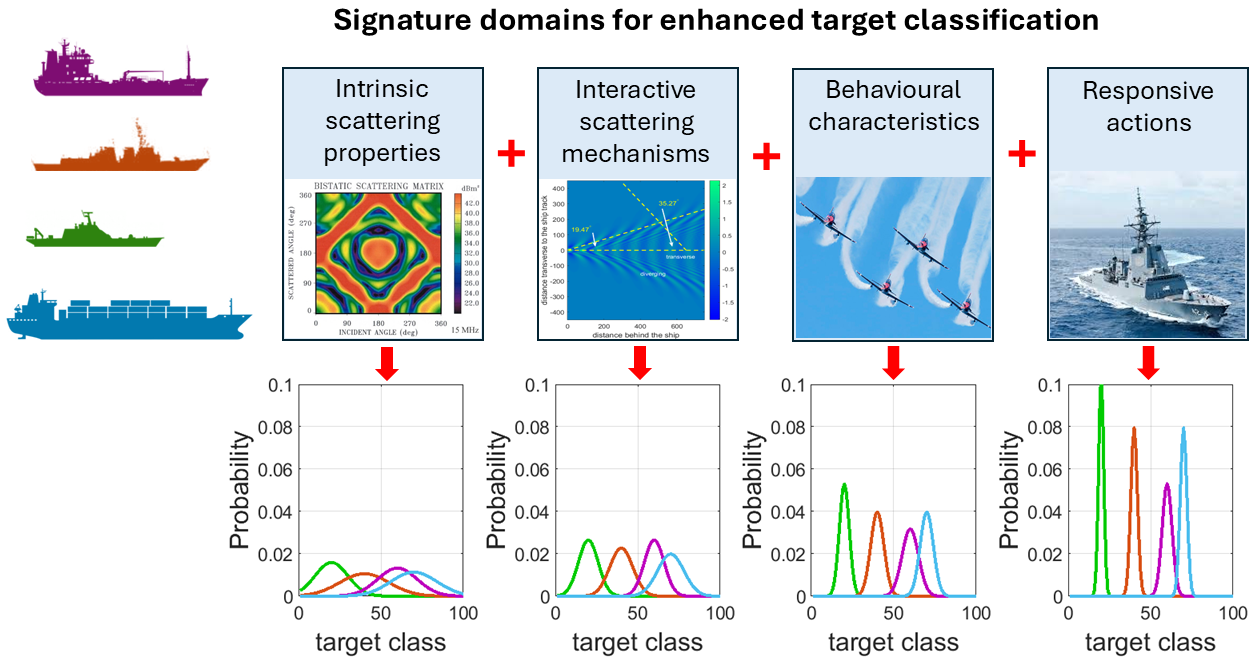
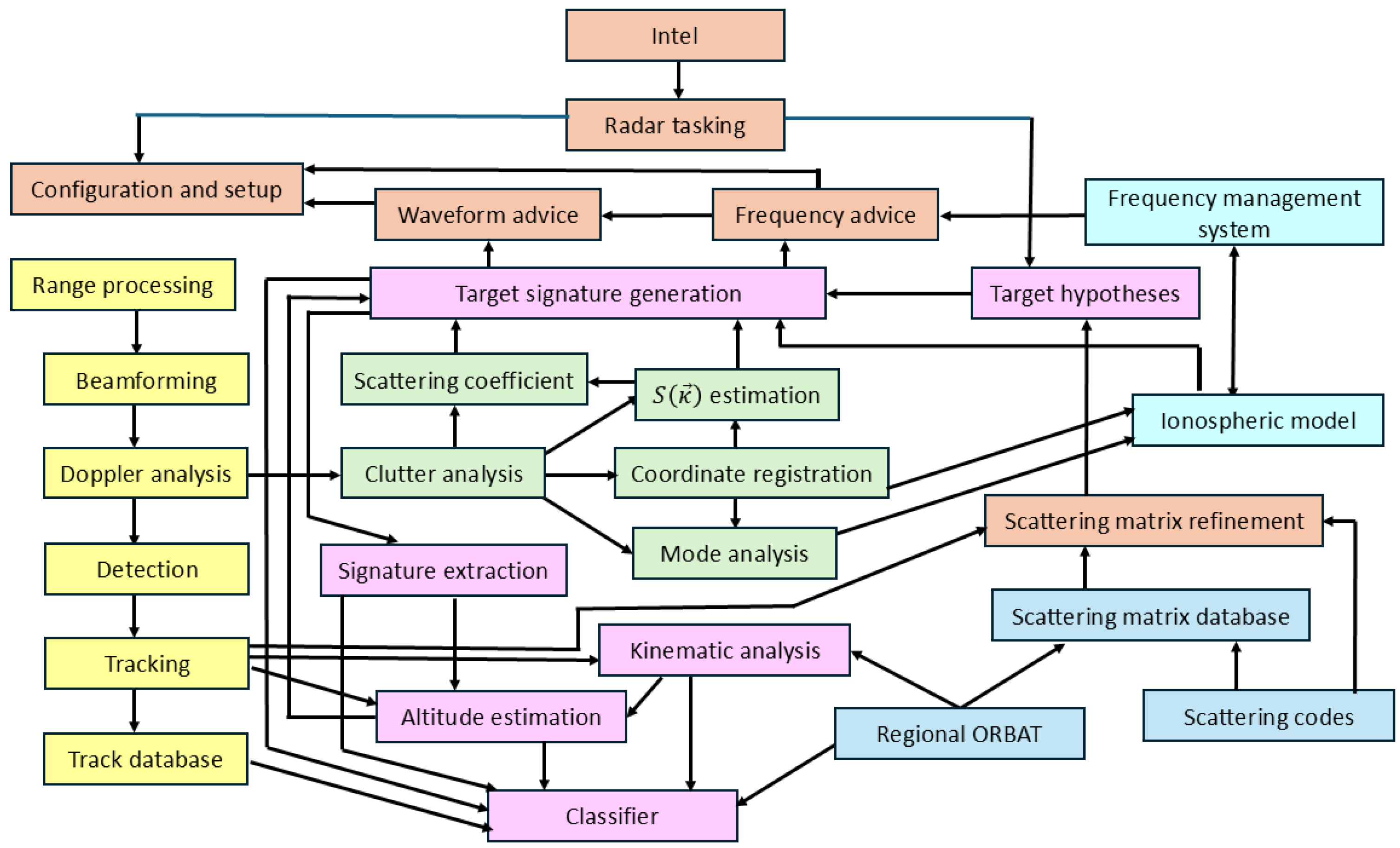
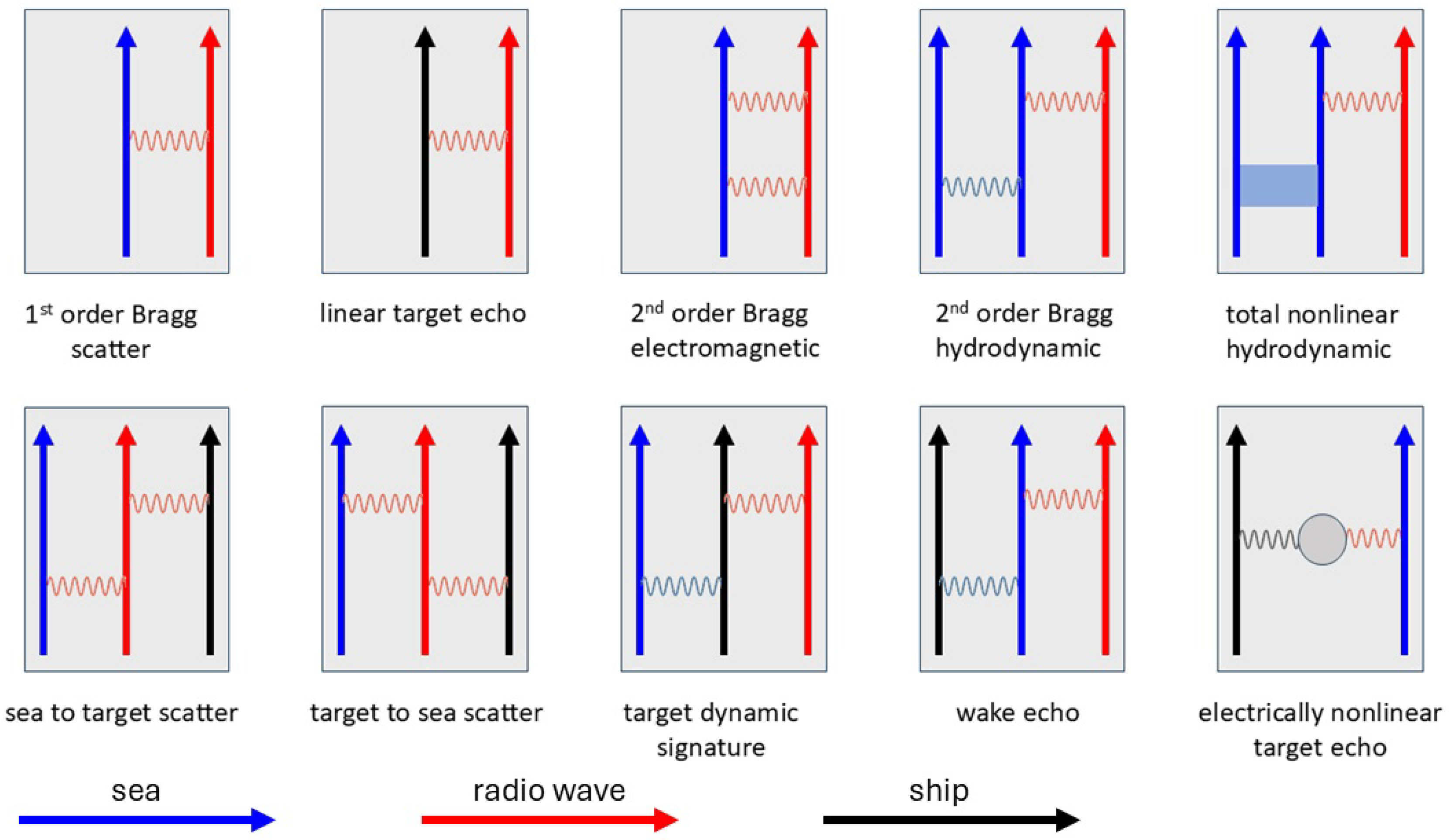
4.1. Intrinsic Signatures
- A.
Time-invariant scatterers
Our primary concern in this paper is the characterization of discrete targets at far-field distances. In free space, the electromagnetic field of the radar signal is then essentially transverse, so a wave propagating in the z-direction can be written
where the envelope field components
and
are complex numbers whose relative phase
determines the polarization state of the field. The
column vector on the right is the Jones vector, a representation of the field that is well suited to following the evolution of a radar signal as it propagates, scatters, and is received by an antenna. Without compromising generality, we can select the usual H-V polarization basis for illustration.
When a radar signal scatters from a discrete target, it is often convenient to focus not on the intricacies of the currents driven in the target but on the transformation of the Jones vector of the incident field into that of the scattered field,
where the operator
has an obvious representation as a matrix
. This formalism is very widely used in radar, but the phenomenology is not always as simple as the equation implies. Close to the target, the scattered field is unlikely to be well modeled as a plane wave, while, further away, it may have undergone transformations in the propagation medium. This applies especially for HF radar, both skywave and surface wave, and is one of the reasons that we go to the trouble of factorizing the radar observation explicitly in the radar process model. Even so, it is extremely convenient to retain the scattering matrix construct representation, so long as we employ it within its domain of validity. The scattering matrix is the natural generator of the standard descriptions of radar scattering in terms of radar cross-section elements
,
where
As we shall see later, it is important to note that radar cross section thus defined leads, in many practical applications, to a second-order statistic of the scattered field and hence does not always convey all the information that could be exploited for target characterization. It is perhaps worth pointing out that there are other mathematical representations of the scattering operator
, some of which, such as the lexicographic and Pauli target vectors,
are often better suited for the mathematical operations carried out in modern signal processing algorithms. We will not pursue this here.
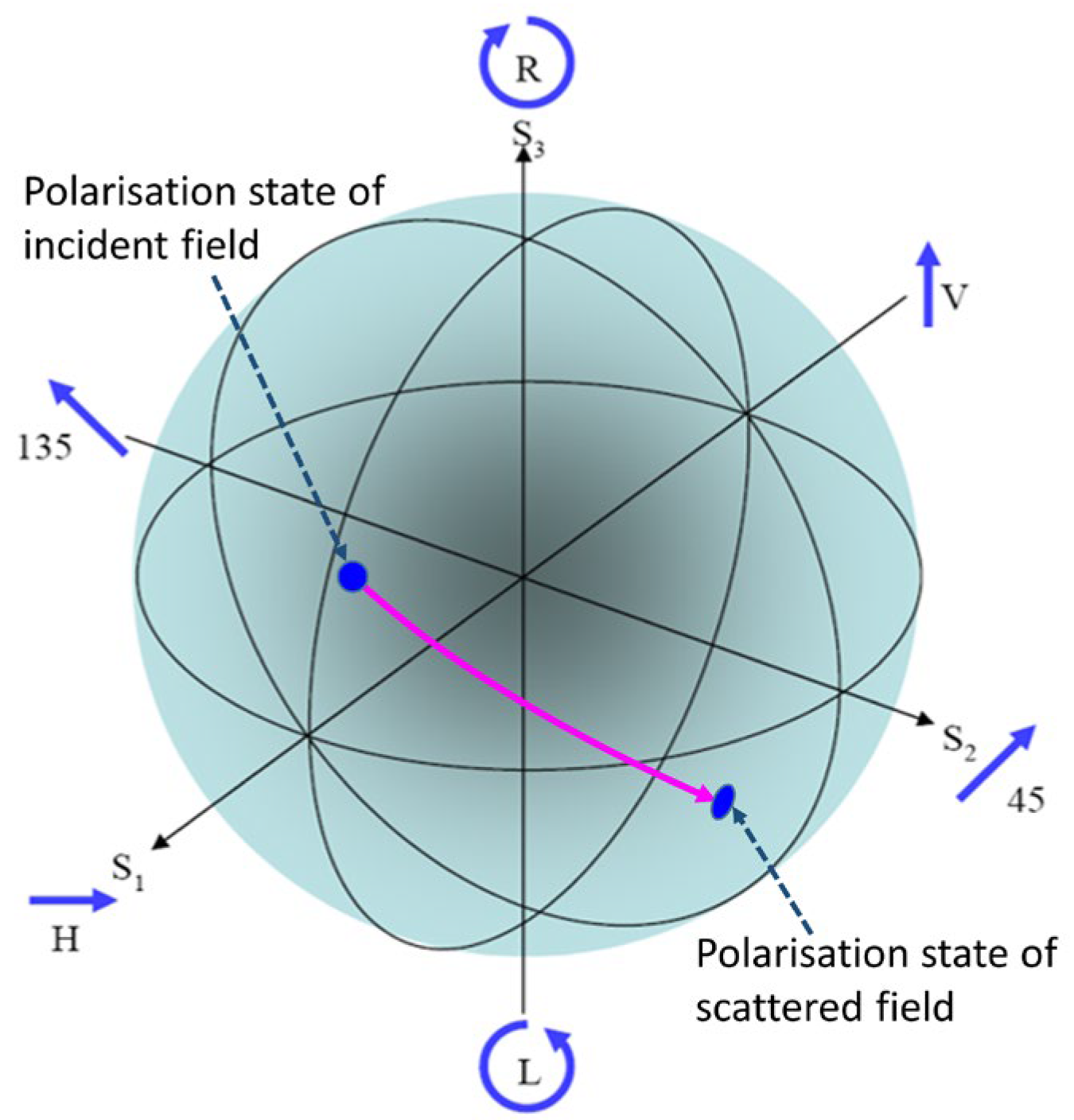
In addition to any changes scattering makes to the amplitude, phase, and frequency of the incident signal, it may change the polarization state. For deterministic signals, this change has a familiar and highly useful geometric representation in the form of a mapping on the Poincare sphere, shown in
Figure 5.
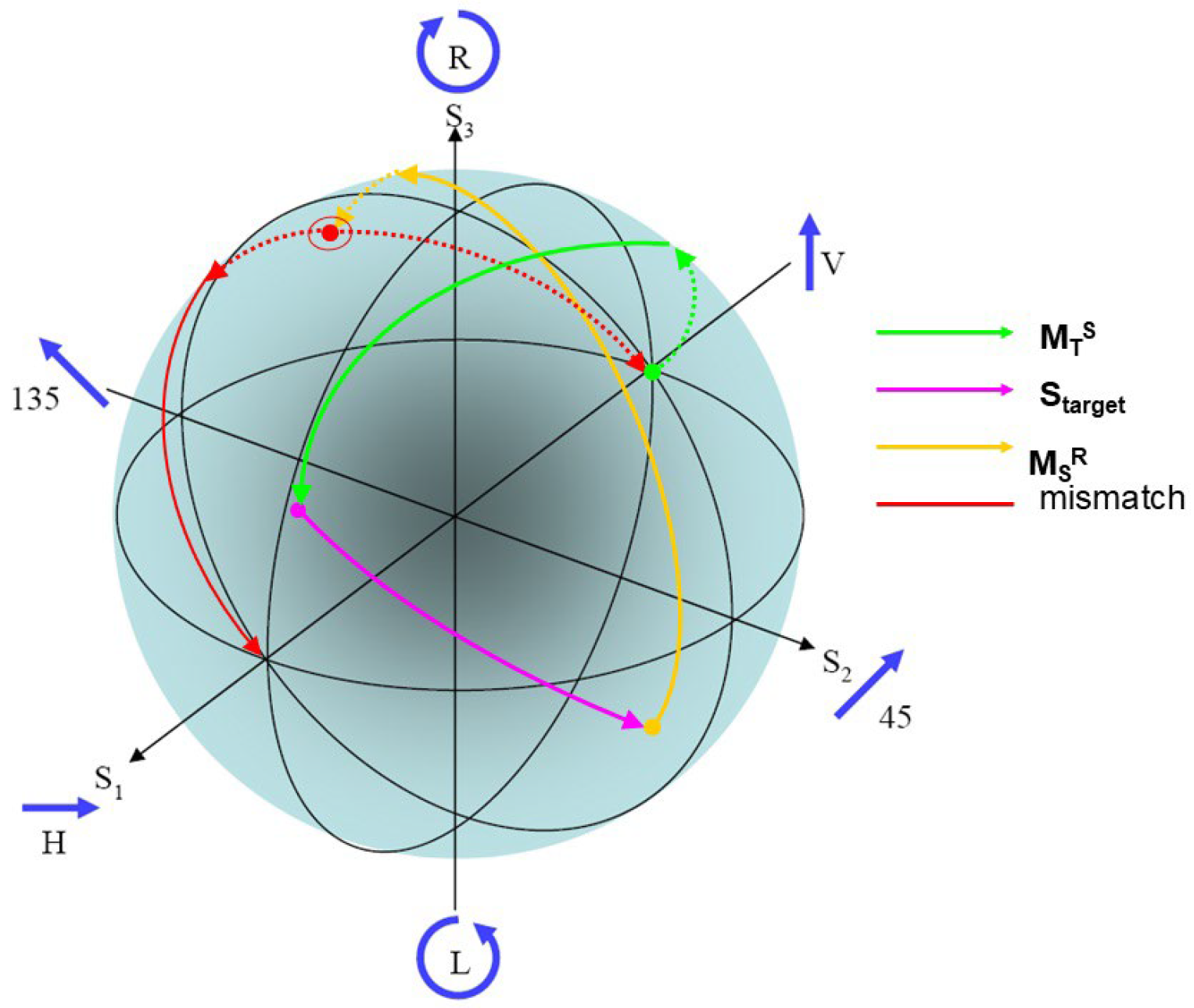
The Poincare sphere is useful for more than just representing the action of the scattering matrix; it can serve as a record of the entire radar process. As marked in
Figure 6, starting with the Jones vector of the field radiated from the transmitting antenna, we can model its transformation
en route to the target by a mapping to the state of the field actually incident on the target route (the
operator in the process model), followed by the action of the scattering matrix to yield the scattered field, and then the transformation experienced en route to the receiving site (the
operator in the process model) where it may well fail to match the optimum polarization state of the receiving antenna. A little thought leads us to the realization that even the HF surface wave radar process cannot always be projected into the subspace of transverse magnetic or TM fields (approximately vertically polarized) without rejecting multiple scattering mechanisms that can contribute appreciably under some circumstances. Scattering from cruise missiles provides one example.
And there is another consideration. The Poincare sphere provides a full representation of the signal state space for pure states of the field, but we can draw an analogy with optics by recognizing that states corresponding to partially polarized fields can also be represented by extending the state space from the two-dimensional surface into its interior, the three-dimensional unit ball, . This holds particular relevance to HF skywave radar, as experiments have shown that skywave propagation depolarizes propagating fields as well as repolarizing them. Exploiting polarization to the maximum extent in skywave radar demands proper consideration of this and the use of techniques to monitor the degree of polarization.
Keeping these considerations in mind, we can see several ways to characterize a target with a view, to discriminate it from other scatters of different form (classification), or to associate it with a known class (recognition), based only on measurements of one or more elements of its scattering matrix.
First, we may base our decision on the magnitude of a single element of the scattering matrix, as may well be the only option for radars with propagation essentially limited to a single polarization state, such as HF surface wave radar. To assess the power of this approach, we need to familiarize ourselves with representative magnitudes of the matrix elements for the classes of targets likely to be encountered. There are countless possibilities, but we can make some initial observations by considering just two different vessels and restricting our comparisons to the case of HFSWR, where the V-V element dominates.
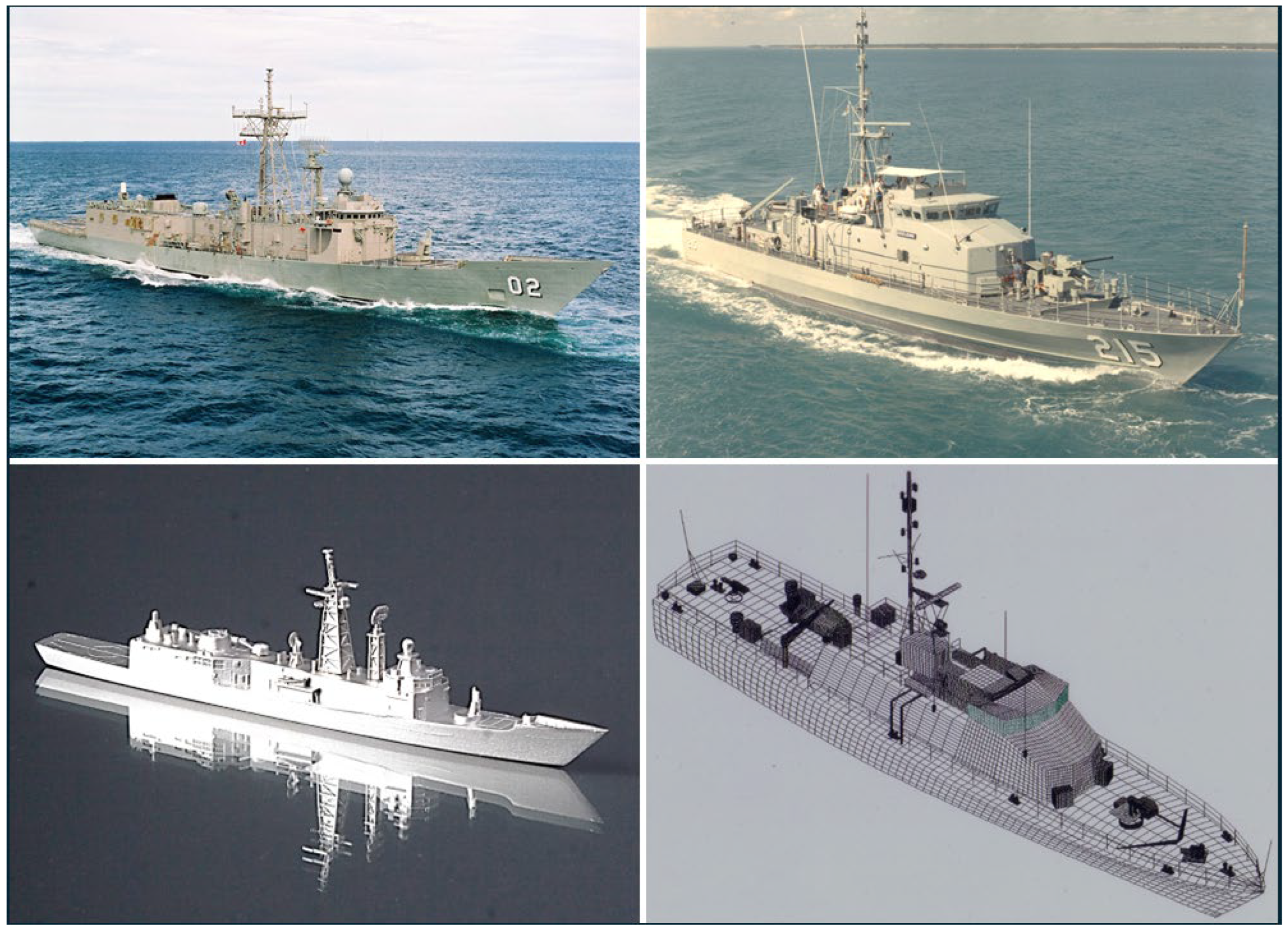
We have chosen the Oliver Hazard Perry FFG 7 frigate (~4000 t, 124 m) and the Fremantle Class Patrol Boat (220 t, 42 m) to represent two well-populated classes that are not ridiculously incommensurate but nevertheless might be thought to be easily distinguishable, a conjecture we will now explore.
Figure 7 presents images of the two vessels, along with the sources of our scattering matrix data-scale model measurements in an anechoic chamber for the FFG and computational modeling (NEC 4) for the FCPB.
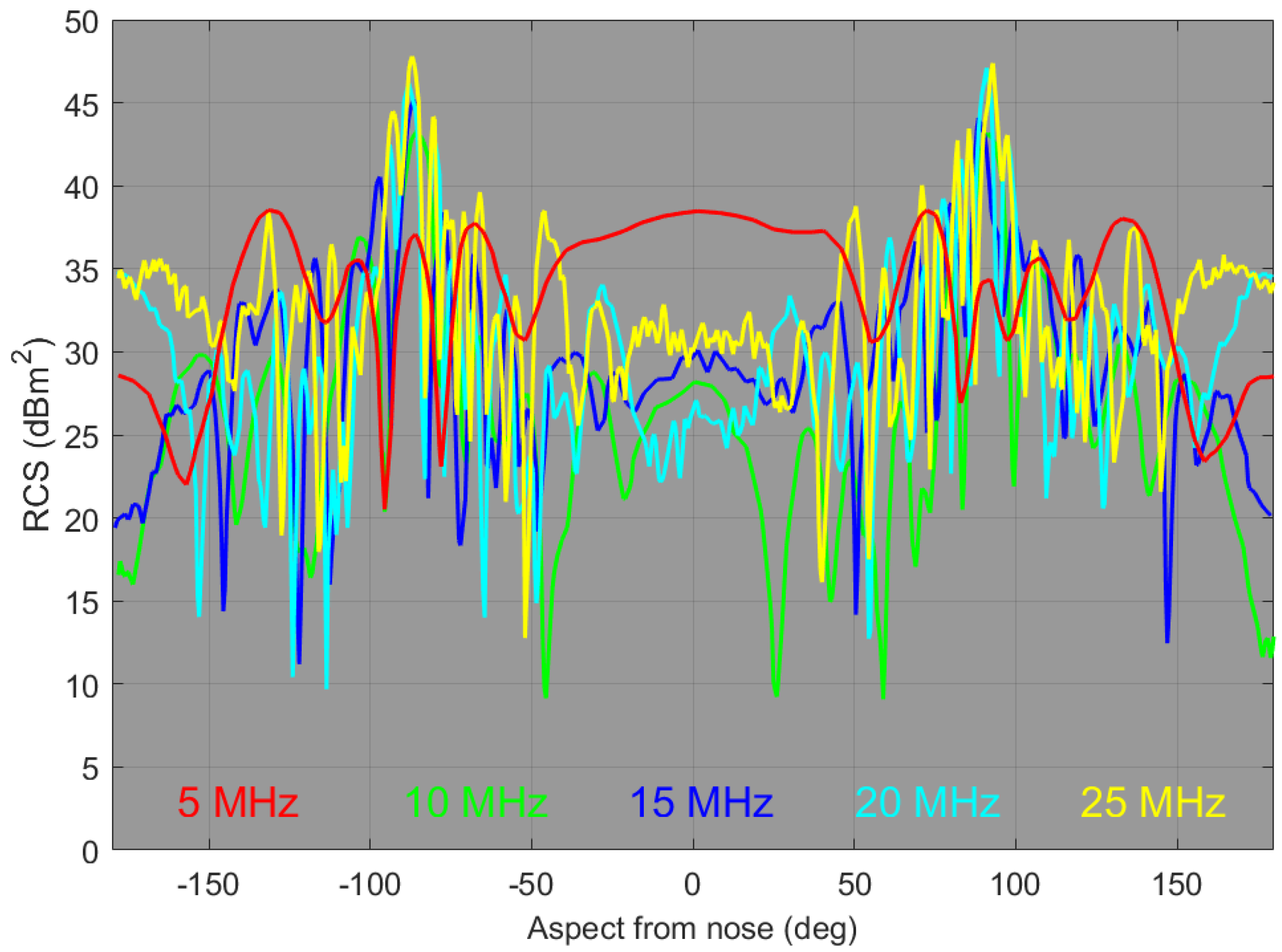
The V-V radar cross-section element for the FFG is plotted as a function of aspect in
Figure 8, with curves for five frequencies overlaid.
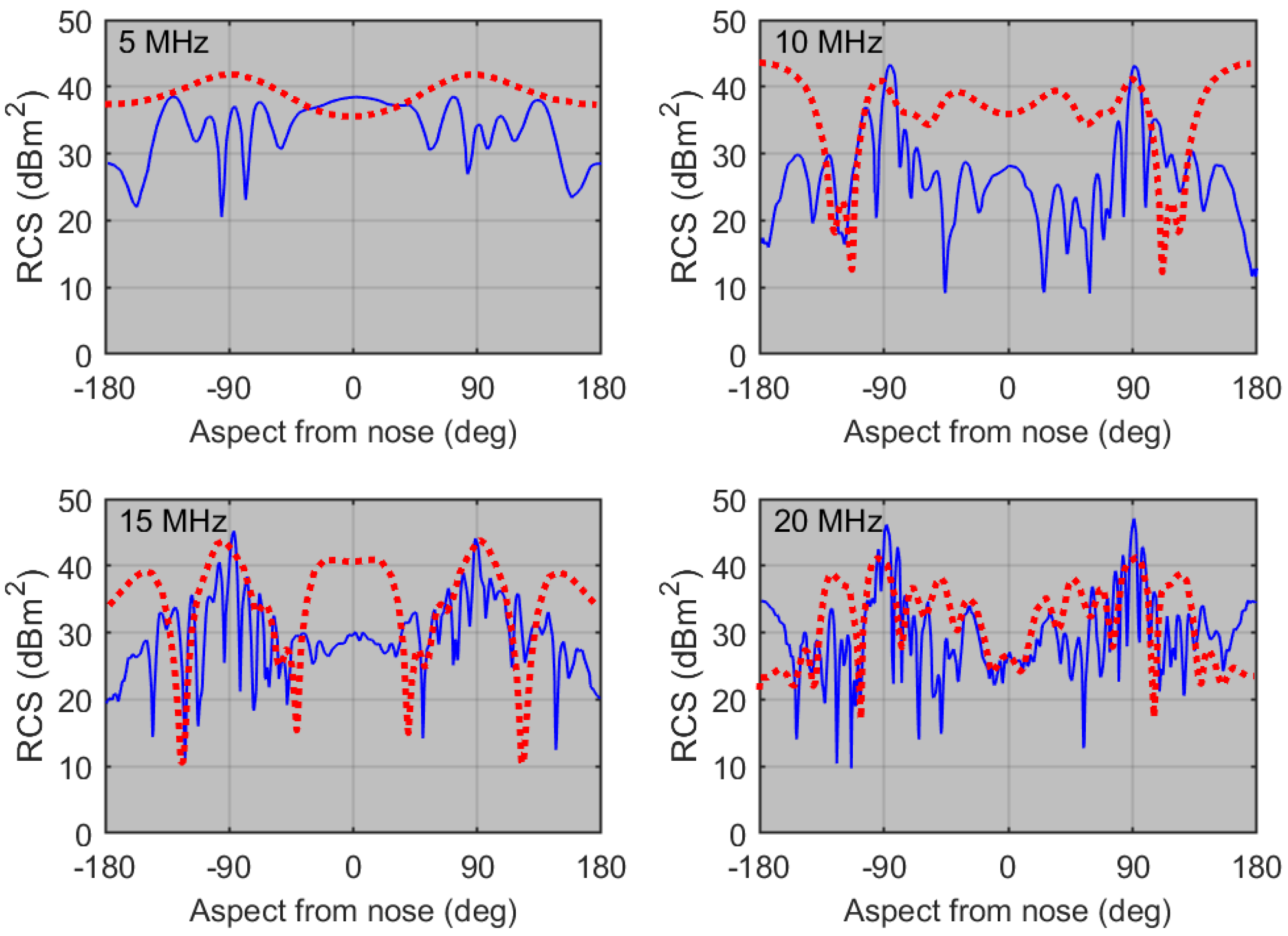
The point we make here is that, over most of the aspect domain, the RCS fluctuates rapidly, except at the low end of the HF band. Moreover, the frequency dependence offers little prospect for classification from the technique of ranking the responses, even if the respective propagation losses can be determined. However, it is instructive to compare the RCS elements for the two vessels, which we do in
Figure 9.
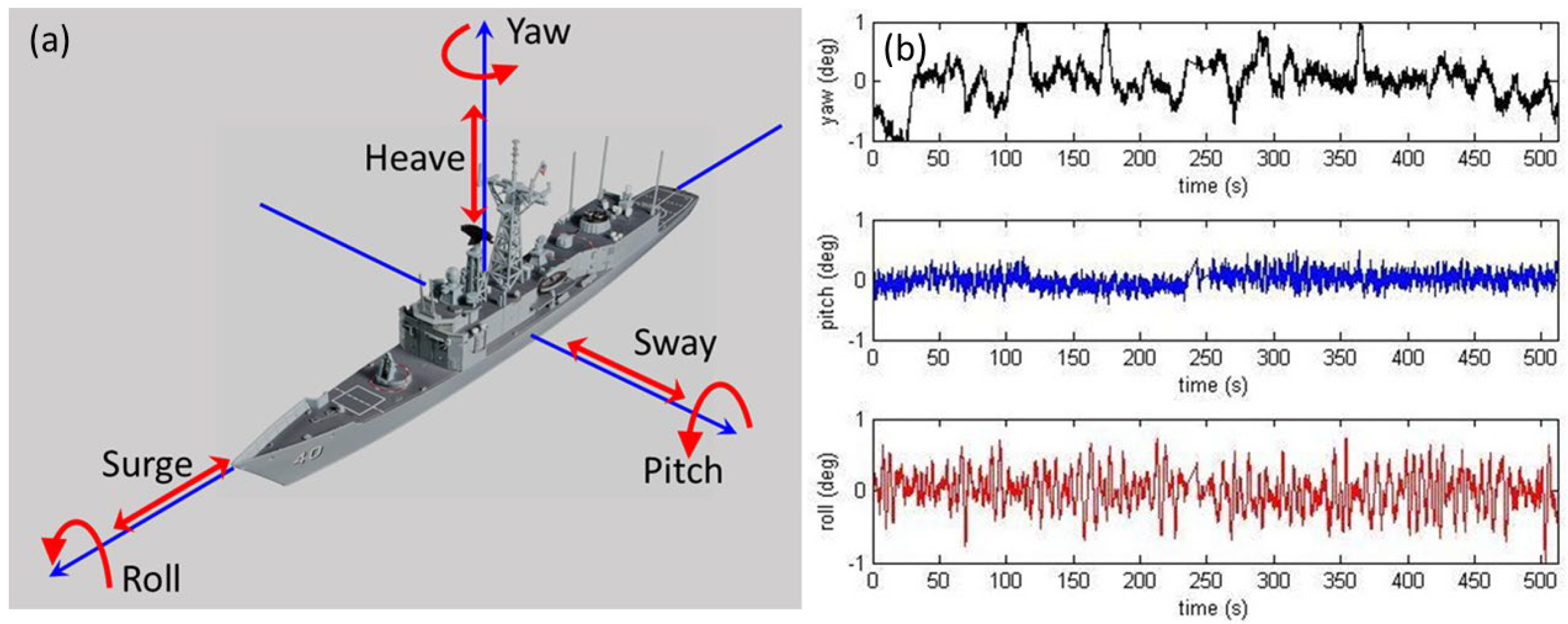
Here, we see a glimmer of hope for all but the highest frequency over most of the aspect domain. But there is another complication. Ships are in dynamic interaction with the ocean wave field, with each of the six degrees of freedom shown in
Figure 10 subject to excitation.
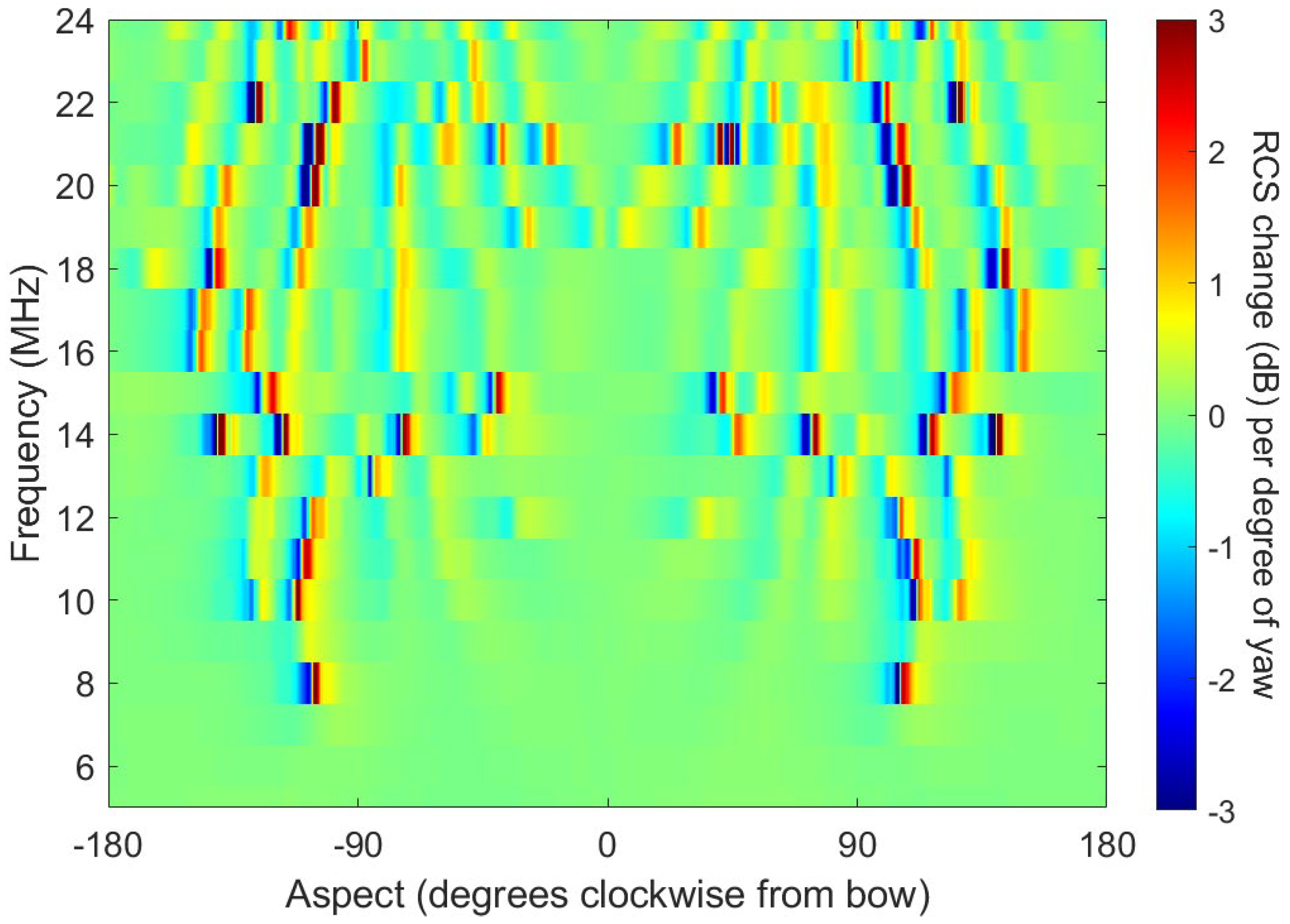
We shall examine this subject in more detail later, in the context of dynamic signatures, but, for now, consider only the yaw motions. As the aspect changes, so does the RCS, and in the case of the FCPB, by up to several dB per degree of yaw at some aspects, as illustrated in
Figure 11 for the FCPB, at integer frequencies from 6 to 24 MHz. To estimate the RCS for classification purposes, we need to know the scattering geometry accurately. This makes heavy demands on the target tracking subsystem, another example of the need for high connectivity in the system architecture.
Of course, the extent of the motions is a function of many variables, but, for a given ship, it is mainly dependent on heading, speed, and the directional wave spectrum. In principle, a well-designed radar can deliver all this information.
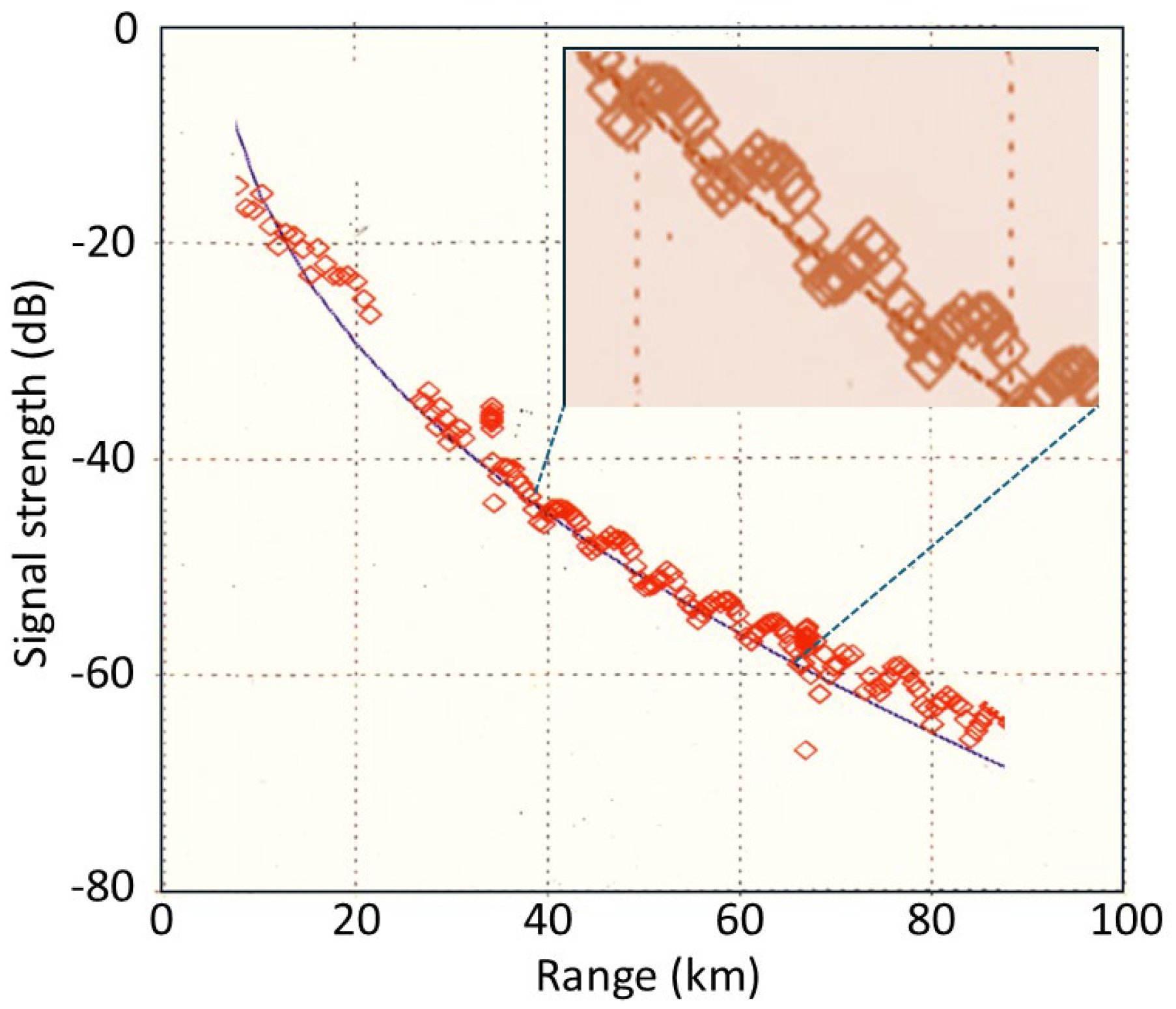
It is evident that every dB is important, so we need to look at other effects that could compromise classification. One such effect is the scalloping loss that modulates the signal as the target (or emitter) moves through range bins.
Figure 12 shows an example recorded with the ILUKA HFSWR in 1997. Hamming window apodization was used for the range processing FFT during that experiment; the theoretical scalloping loss in this case is 1.78 dB, which is in agreement with the data.
So far, we have illustrated the phenomenology with model predictions and measurements from monostatic radars. Bistatic radar configurations [
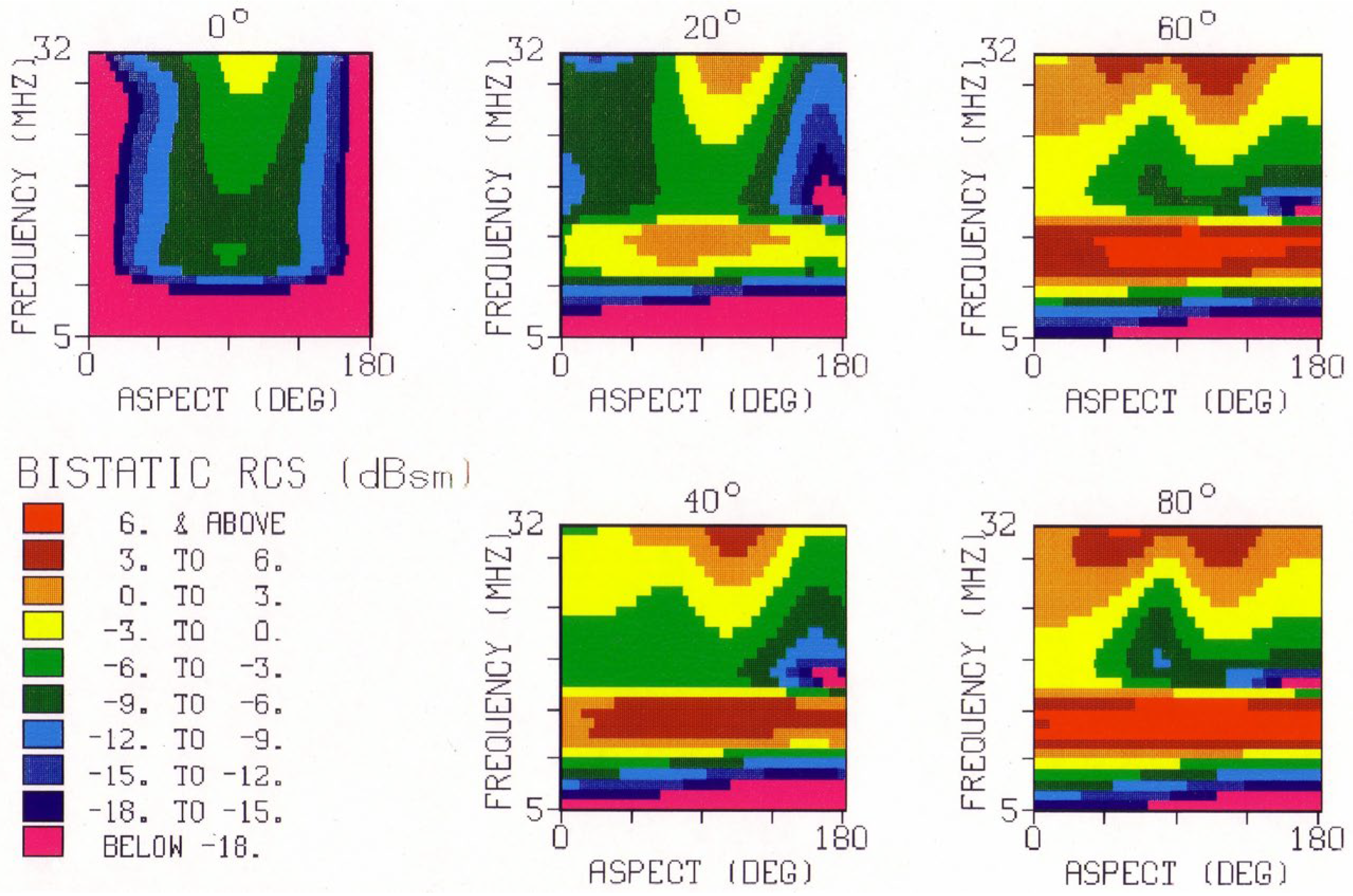
49] increase the complexity of target classification because the radar-target scattering geometry is constantly changing, but the increased dimensionality of signature space can also prove advantageous, as with task scheduling.
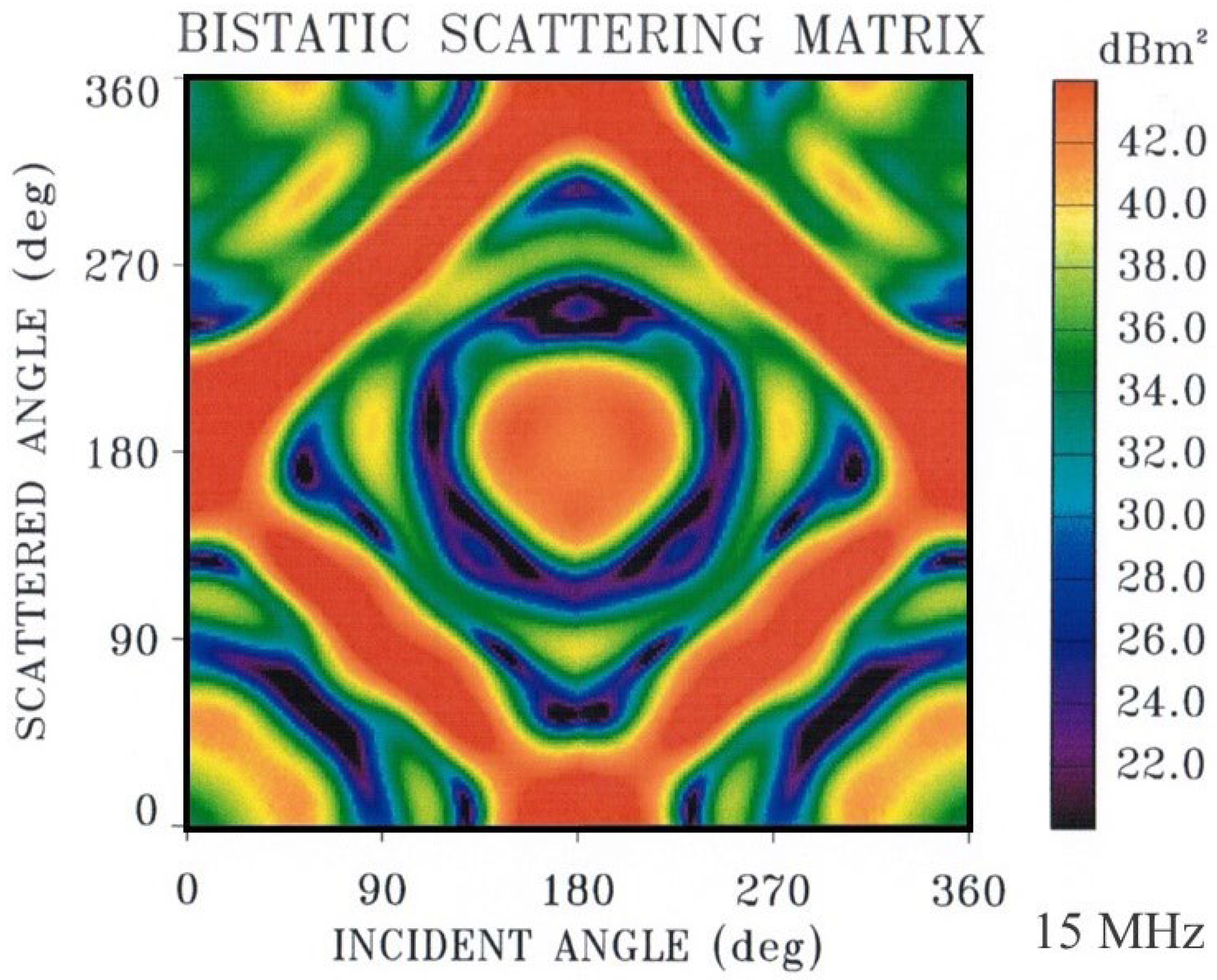
Figure 13 shows an example of the bistatic V-V RCS element for the FCPB at a single frequency, while
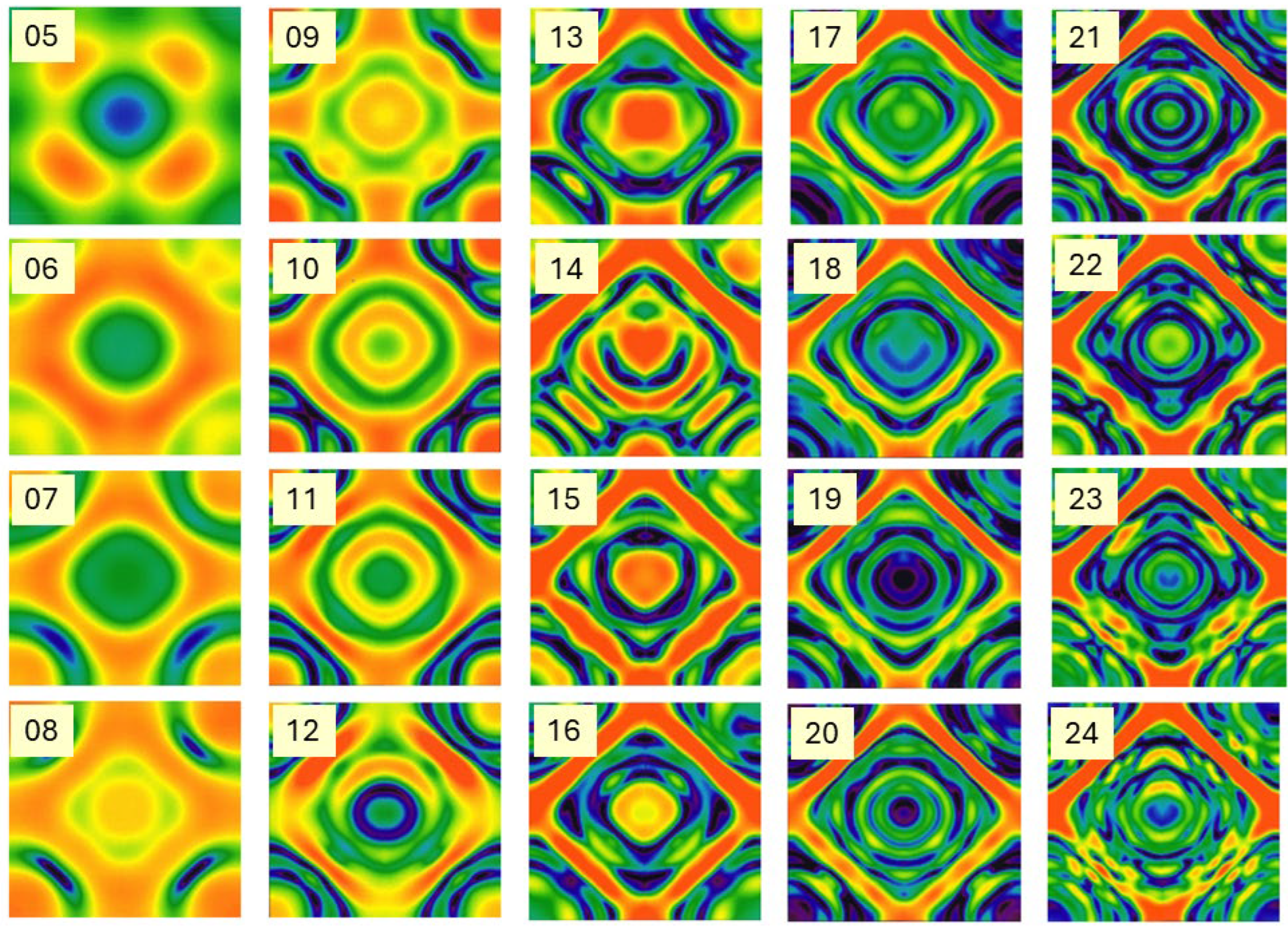
Figure 14 is a mosaic of the same element computed at frequencies from 5 to 24 MHz.
There is obvious value in examining datasets such as this when designing minimal sets of radar frequencies for efficient classification, transmitted sequentially or concurrently depending on the radar design.
HFSWR can also be tasked with detecting and classifying aircraft, providing that the three-dimensional spatial distribution of total field strength is understood and exploited. The corresponding RCS elements for a small aircraft—the AerMacchi M.B.326 (Aermacchi, Varese, Italy)—are shown in
Figure 15 to illustrate the reduced RCS element magnitudes for such targets.
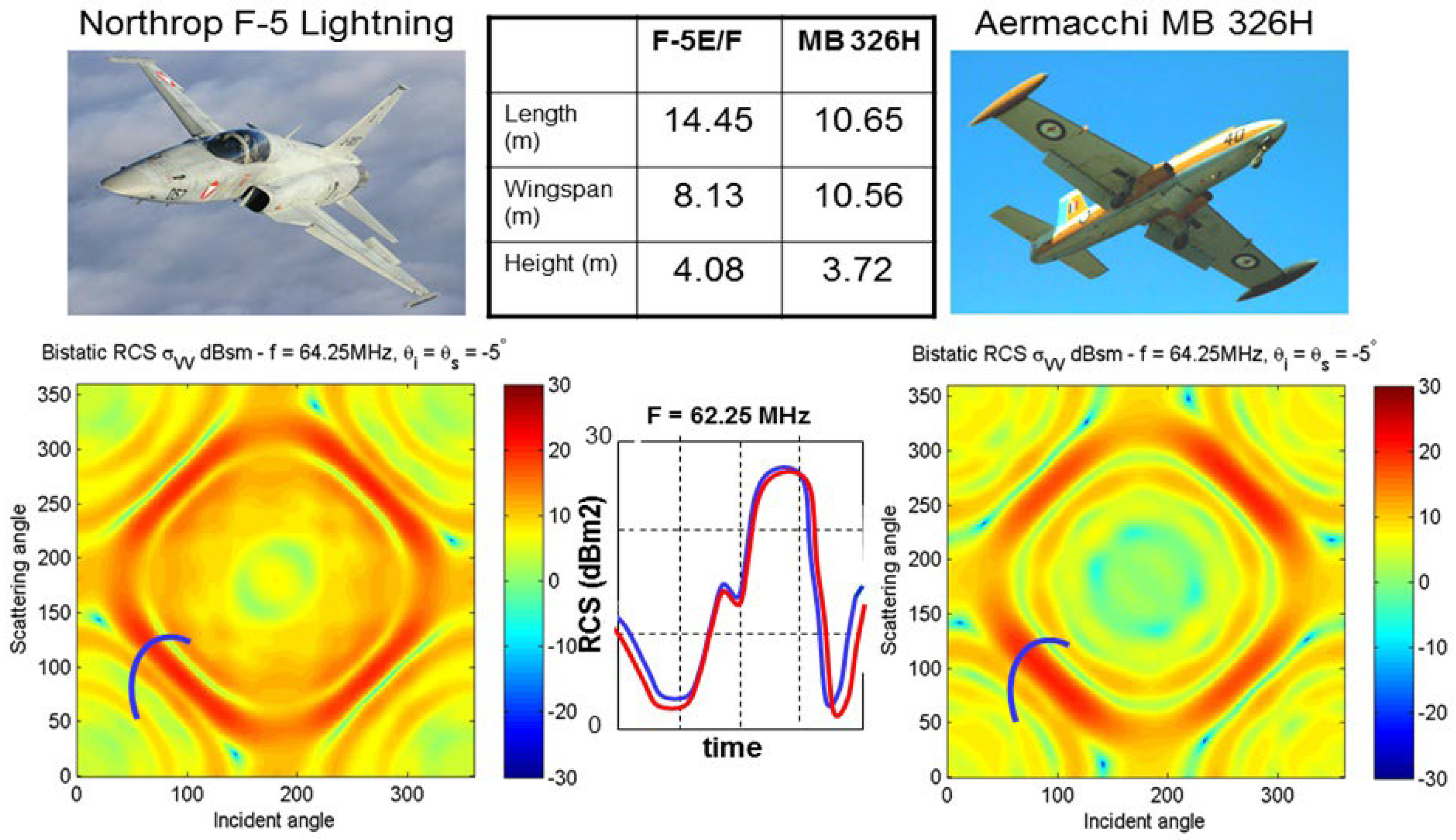
Despite the apparent richness of information in the matrix of bistatic scattering RCS, the fact that scattering from aircraft at HF falls in the resonance regime means that the general form of the matrix is common to many targets. Consider the example in
Figure 16, showing the bistatic H-H RCS matrices for two aircraft—the Macchi and the F-5 Lightning. (This modeling was done at a low VHF frequency, not HF, but serves just as well.) On each panel, we have marked with a black line a hypothetical trajectory of the target in angle space as it follows some flight path. Between the panels, we plot the two RCS element histories along the path, revealing a high degree of similarity.
The lesson here is that extending the signature domain from point values to flight paths may not be sufficient.
We now turn attention to situations where the full scattering matrix is actively involved. This includes all configurations where skywave propagation is involved, fully polarimetric line-of-sight radars, and passive radars where the receive site has antennas able to deliver orthogonal polarization states.
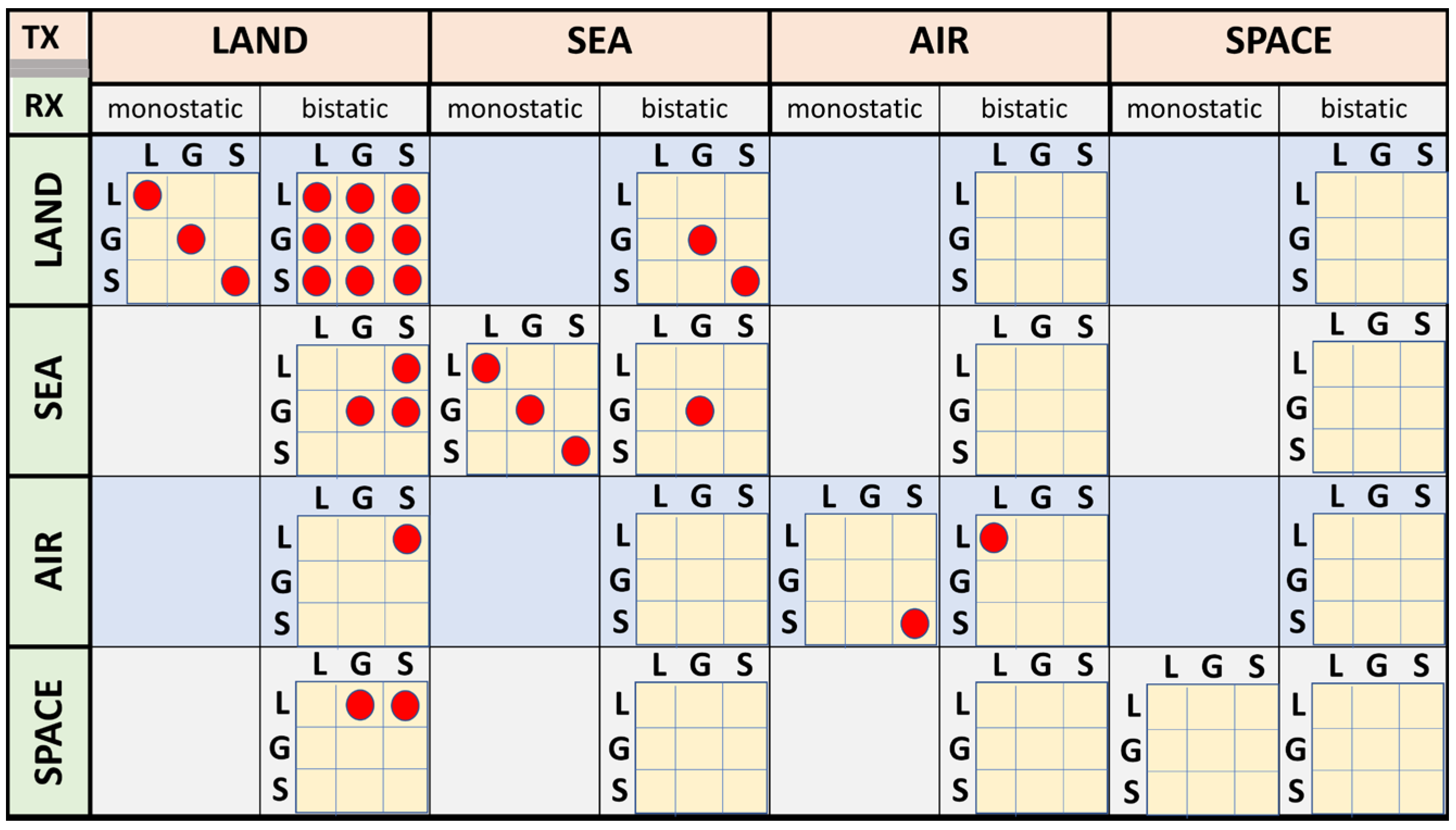
Figure 17, reproduced from [
49], presents a comprehensive taxonomy and identifies some of the many HF radar configurations that have been implemented, at least in experiments if not in operational service.
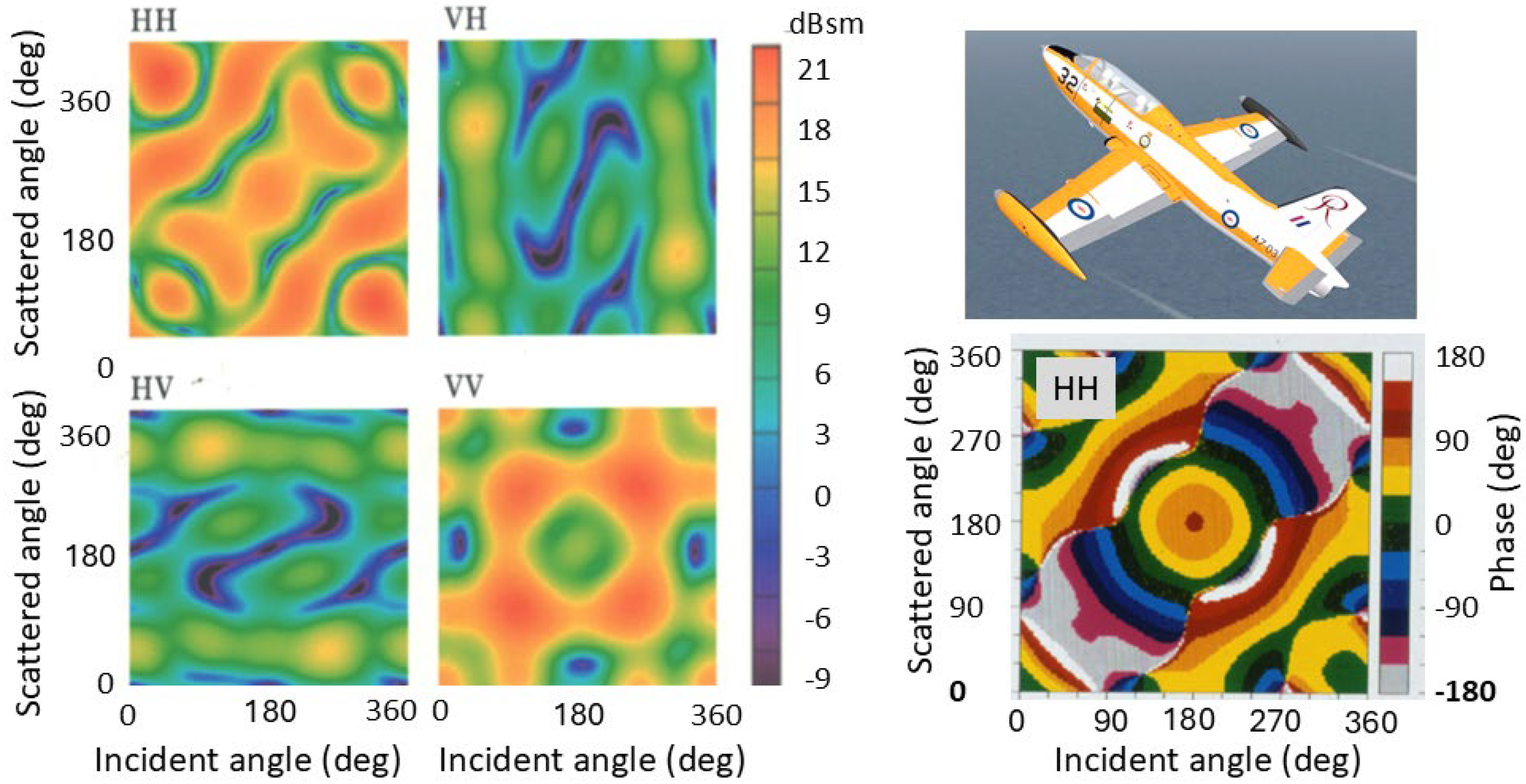
An example of the complex scattering matrix for an aircraft is presented in
Figure 18. Here, the target is the AerMacchi MB 326H; the figure shows the magnitude (squared) of the elements of the polarization matrix, along with the associated phases for just one of the four elements. (The odd choice of color scale for the phase information is a legacy from its creation four decades ago [
50].) The relevant point for target classification is that, for aircraft of fighter size (the AerMacchi has exactly the same wingspan as the F-35 Lightning A, though it is 30% shorter in length), the gradients in these quantities tend to be modest relative to tracking accuracy.
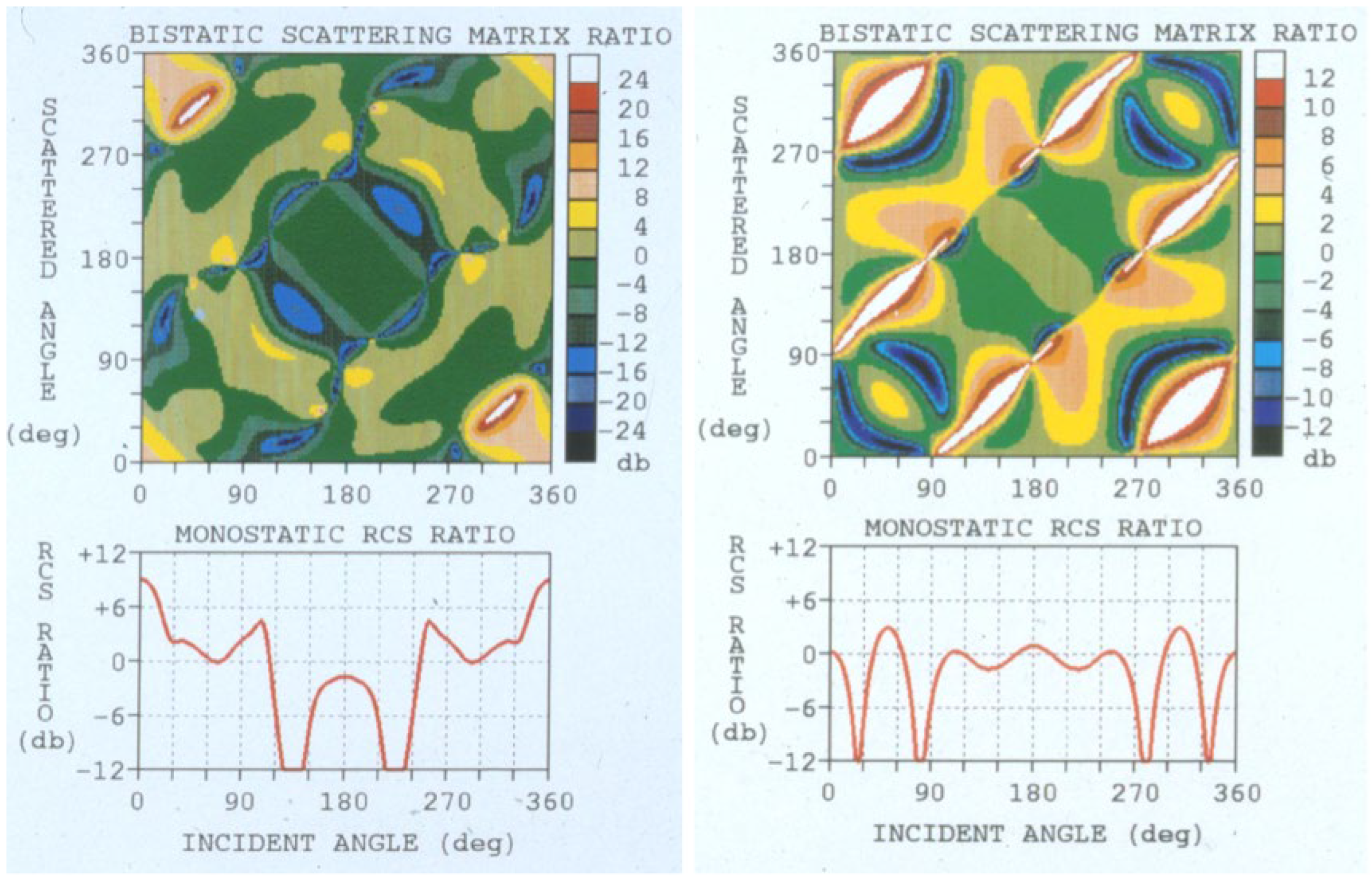
The most direct use of this kind of information for discriminating between two target species is to compare corresponding elements by taking the ratio. Two examples of this are shown in
Figure 19, retrieved from [
41]. One of the aircraft is the AerMacchi, the other is an in-service aircraft that cannot be identified here. The AerMacchi RCS is used as the numerator.
It can be seen immediately that, in the figure on the left, much of the matrix is colored green or khaki, corresponding to values in the range [−4, 4] dB. In other words, there is little discrimination power there. In contrast, at the frequency used to generate the figure on the right, a much larger fraction of bistatic geometries presents ratios exceeding [−4, 4] dB. This appears to hold much greater promise, but there is a secondary consideration: if the radar is a monostatic radar, then the ratios take the form shown in the smaller panels, below the matrices, showing the values along the trailing diagonal. Now the situation is reversed, with the frequency on the left providing nearly twice as much aspect extent above the threshold, though still less than 30%. A monostatic radar is not optimum for this assignment problem.
The appearance of randomness in the measurements, arising predominantly through the propagation operators , and geometrical uncertainties obliges us to apply statistical techniques. We explored this long ago with a skywave radar by constructing scatterers with distinct scattering matrices and then collecting echoes under a range of ionospheric conditions. The same approach was used with many known ship targets that were tracked for long periods.
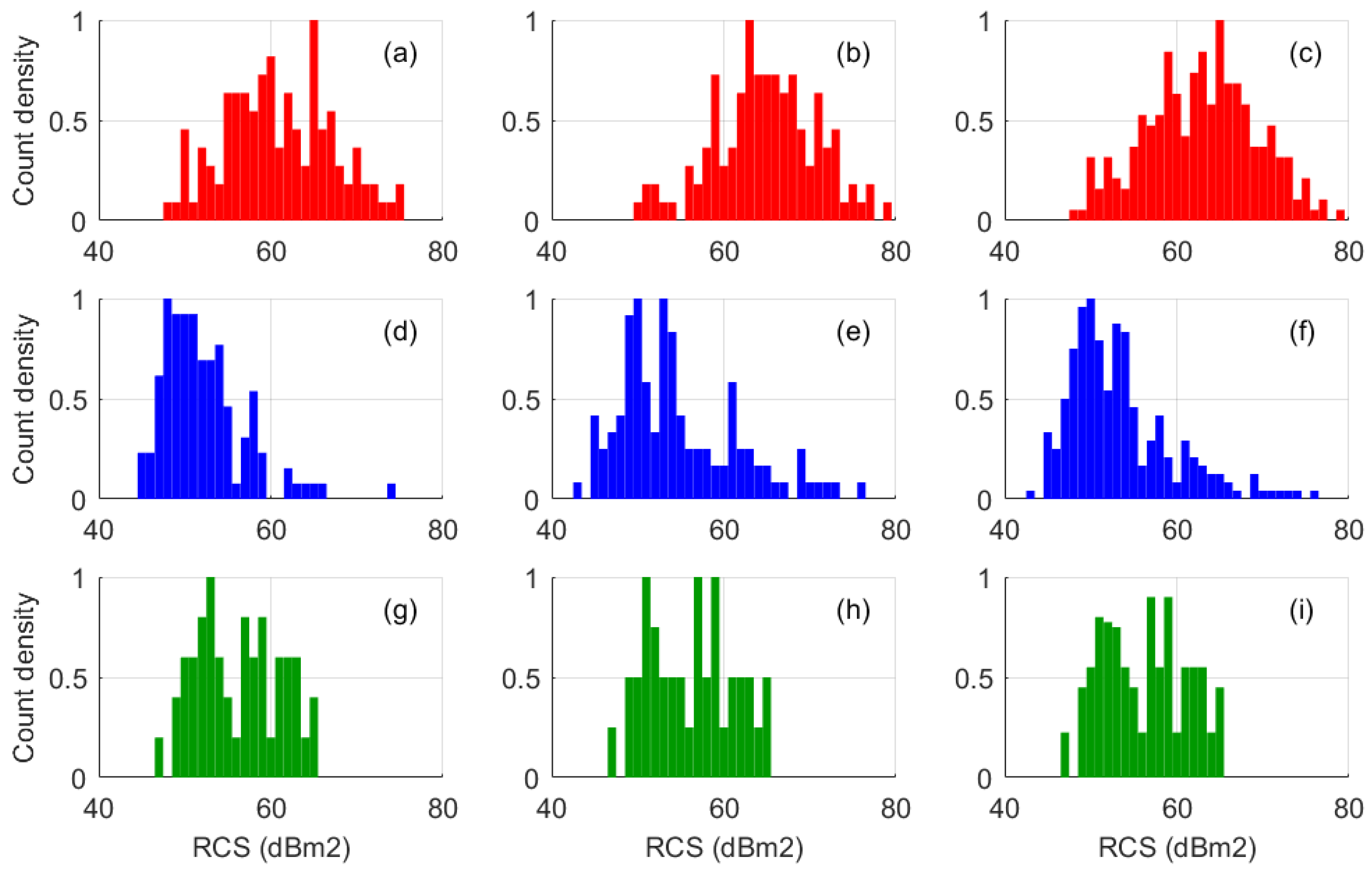
A crude way of inspecting the data is to present it in histogram form, as illustrated in
Figure 20. The echoes from three targets (red, blue, green) were accumulated over a two-hour period on three consecutive days, that period varying from mid-morning (left column) to midday (center column) and then mid-afternoon (right column), in the expectation of a consistent response. There is a danger in adopting this approach because there is no simple way of knowing whether the sampling has been uniform over the stochastic parameter space—the orientation and ellipticity of the polarization state, say—but these histograms did reveal some reasonably consistent forms and with the incorporation of auxiliary information might prove useful. If the shape cannot be trusted, some key order statistics might prove to be more robust signatures.
It may be possible to classify some targets from scalar measures of the scattering matrix according to some metric, such as the Frobenius norm or the condition number, without regard to the structural properties, but it is the latter that holds the greater promise for techniques and guidance. The simplest compound to use as a feature for input to a classifier is a pair of elements from the matrix, such as VV and HH or VV and HV. An extension of this approach is to add a third quantity-differential phase (see
Figure 21).
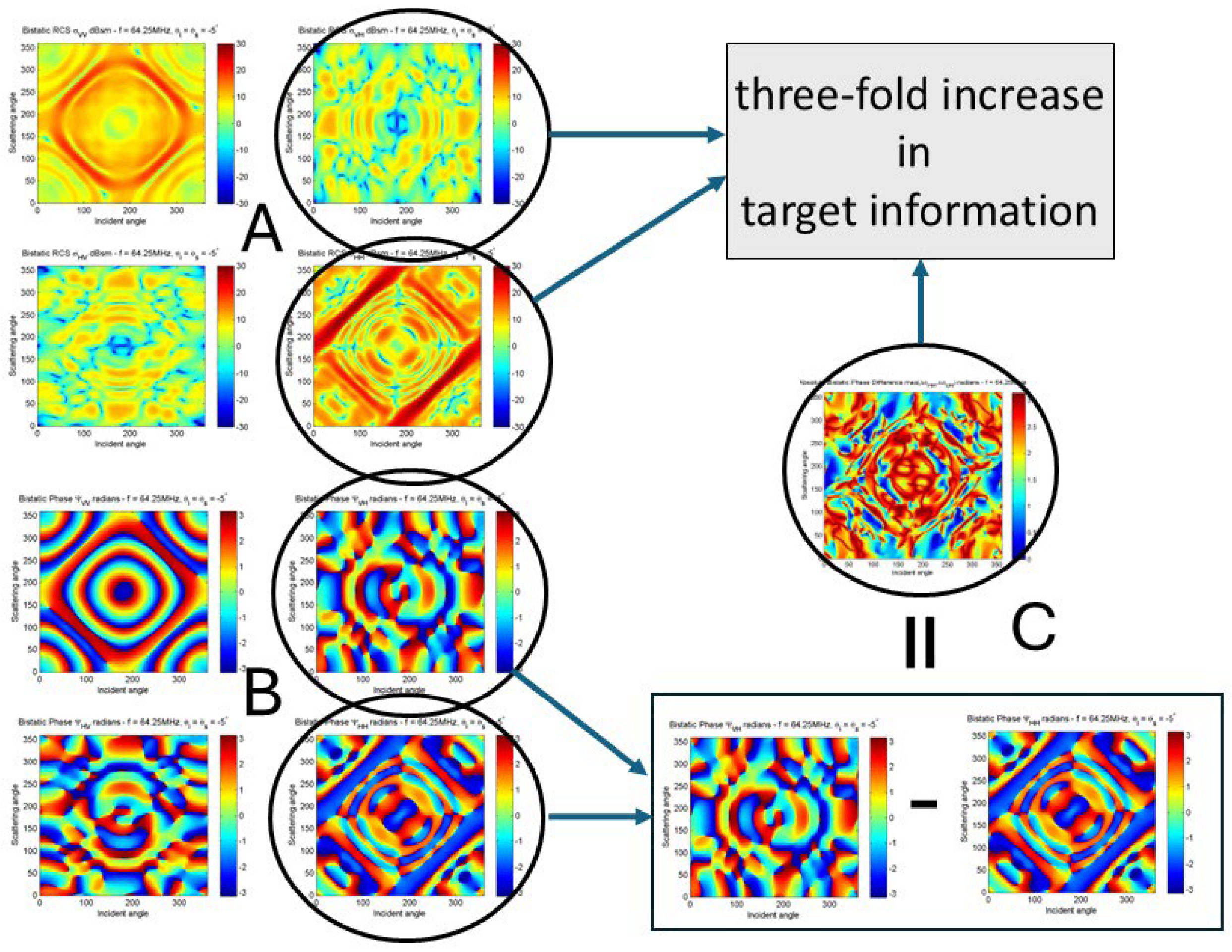
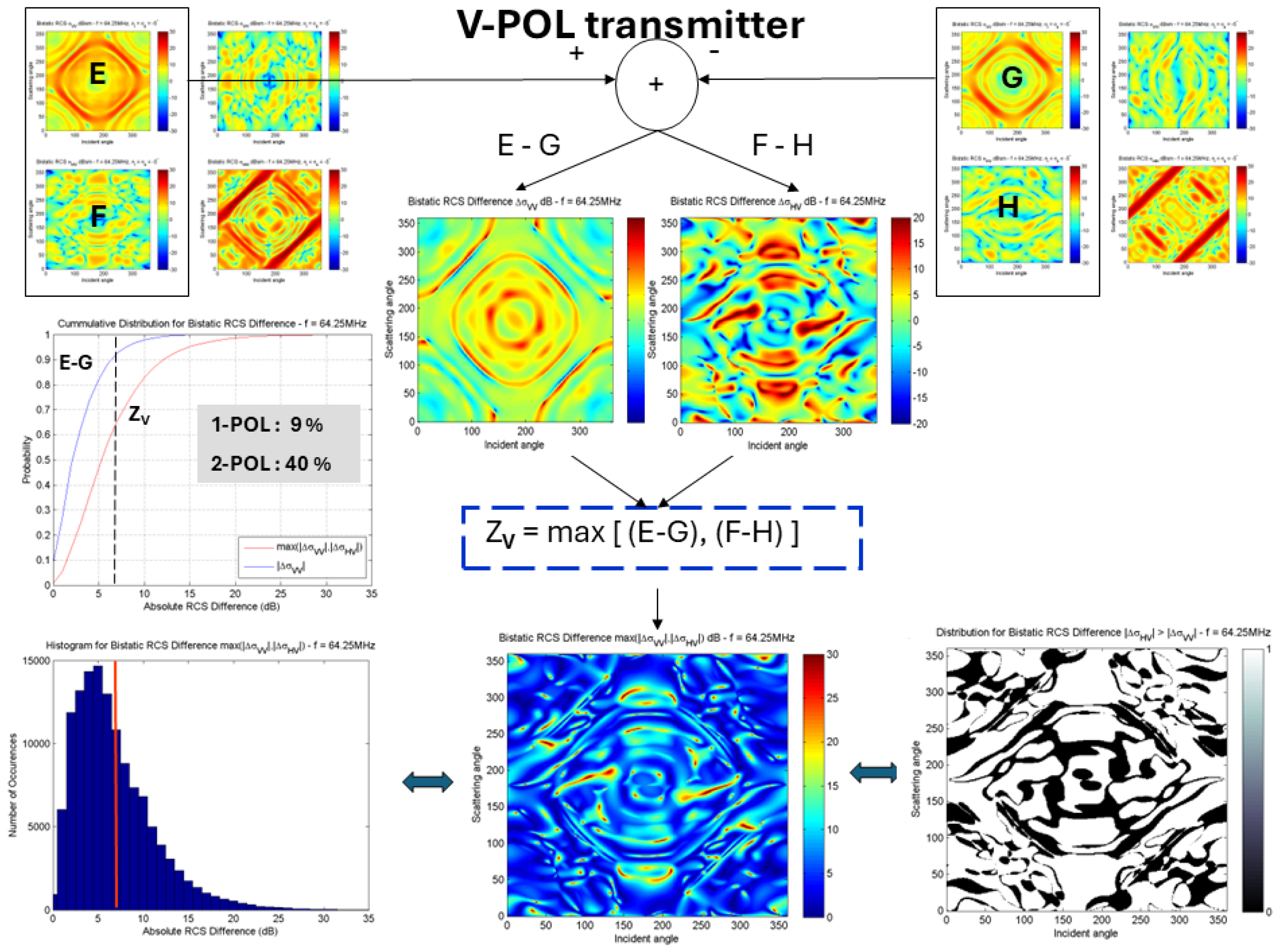
We have investigated this in the context of a passive radar, where transmissions from a commercial TV station provide the illumination of opportunity. In this system the passive radar receives on both horizontal and vertical polarizations, and these are phase calibrated. The radar does not know the transmitted polarization. The targets are those shown in
Figure 16. With this configuration, the number of observables increases three-fold, as shown in
Figure 22, which maps the three classification subspaces.
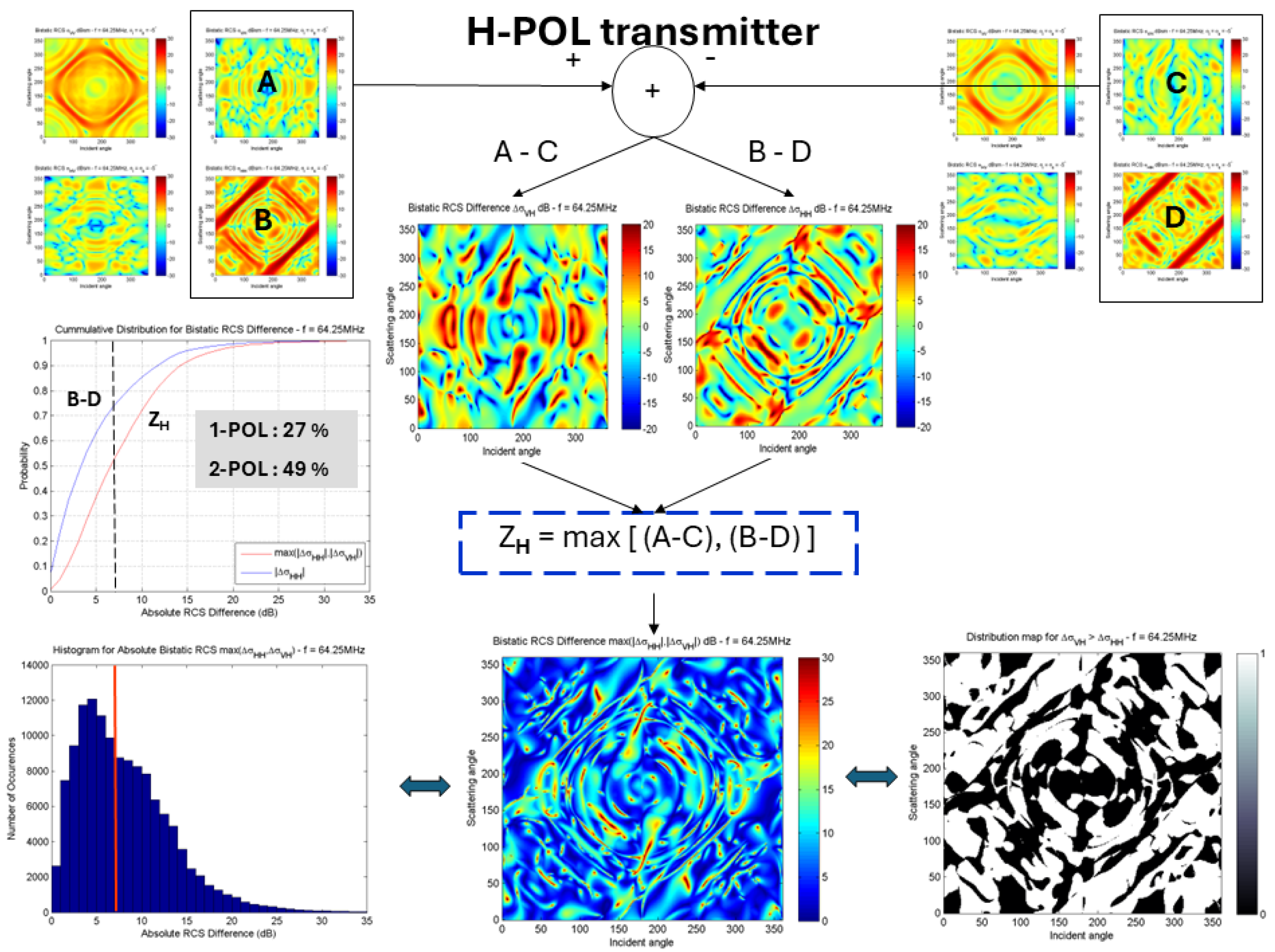
The aim of that investigation was to assess the fraction of the bistatic scattering geometries included in the matrix for which the response differences between target types exceed a threshold and thereby provide a test statistic for classification [
51].
Figure 23 quantifies the benefits for the F-5/Macchi classification task using just the two RCS element values, when the transmitter is H-polarized, while
Figure 24 does the same when the illuminating transmitter employs V polarization. In the former case, a randomly chosen single channel yields a 27% chance of exceeding the threshold averaged over elements in the bistatic difference matrix, while working from two channels achieves 49%. With the H-polarized transmitter, the corresponding values are 9% and 40%.
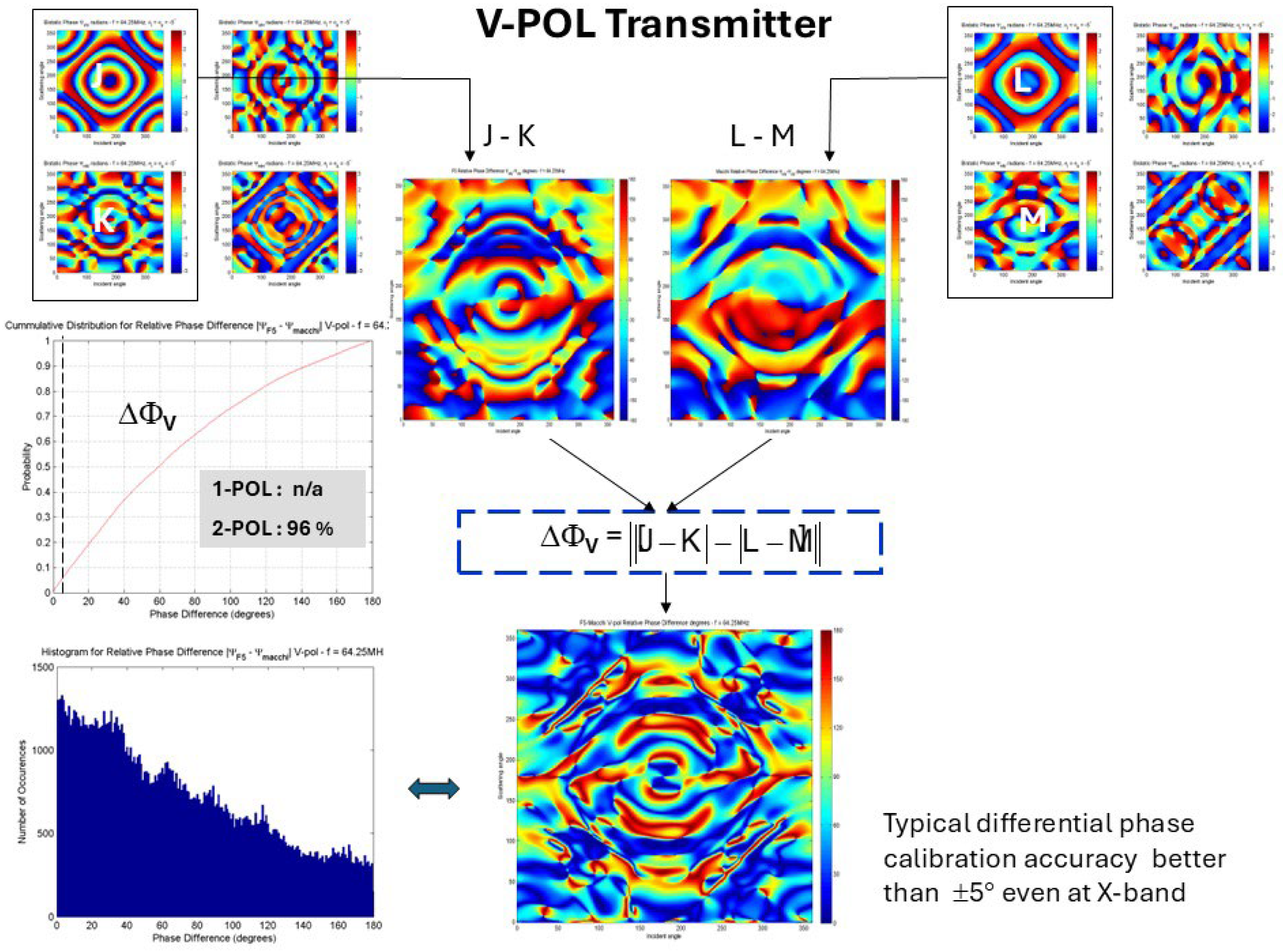
Now we look at the use of the phase difference, bearing in mind that a measurement accuracy of ± 5° is easily achievable.
Figure 25 shows the V-POL case, where 96% of cells in the bistatic phase matrix exceed this threshold, so phase difference is a powerful discriminator.
The concepts described above for the passive radar case have their counterparts with polarimetric radar, where the polarization state of the radiated waveform is under the radar’s control. With skywave radar, some subtleties arise because of polarization transformation in the propagation operators and . Central to the use and success of structural techniques is full polarimetric capability and, in most cases, a facility for estimating the polarization state of the field in the target zone. This can be done using sea clutter, terrain features, known targets in the vicinity, and one or two other methods. This can be challenging, of course, and we caution that some issues remain unresolved. We shall set those issues aside and focus on the intrinsic scattering matrix attributes that have potential for exploitation.
So far, we have treated the elements of the scattering matrix as time-invariant quantities that describe the linear response of a target to an incident electromagnetic field. Many targets have time-varying geometry or time-varying electrical properties, while some manifest nonlinear behavior. It transpires that, for different reasons, these complications present particularly accessible radar signatures, as discussed below.
- B.
Time-dependent scatterers
For scattering in the resonance regime, it is seldom meaningful to isolate the contributions to the scattered field from individual parts of the target, some of which may be moving relative to others and all of which are electrically coupled. Formally, the scattering problem involves time-varying boundary conditions disposed across the changing geometry but, for nonrelativistic targets, it may be approximated quite accurately by the expedient of computing the field scattered from a target whose spatial configuration is taken as instantaneously at rest in the coordinate frame of its center of mass (the quasi-stationary approximation [
52]). In that reference frame, the frequency spectrum (‘Doppler’) of the field scattered from the target can be written
so, for a time-harmonic incident field,
and
In the case of periodic modulation of the target geometry (or electrical properties), with some period T and corresponding fundamental frequency Ω ≡
T−1, the scattering matrix has a representation as a Fourier series,
Substituting,
Hence, after demodulation to baseband at the receiver, the signature takes the form of a line spectrum at harmonics of the fundamental frequency of modulation Ω, shifted by the common Doppler shift associated with the component of the velocity of platform along the axis bisecting the scattering angle.
This kind of signature has been observed by HF radars for at least four target classes: helicopters, propeller-driven aircraft, ships with rotating antennas, and wind turbines. Historically, helicopter line spectra were the first signatures that were automatically extracted from skywave radar echoes and compared with libraries of scatterers with known periodicities.
In the case of a helicopter rotor,
so, the line spacing alone seemingly provides a characteristic signature, unique in almost all cases and independent of the radar frequency, the line intensities, the transmitting and receiving antenna polarizations, and even the bistatic scattering angle for arbitrary geometries.
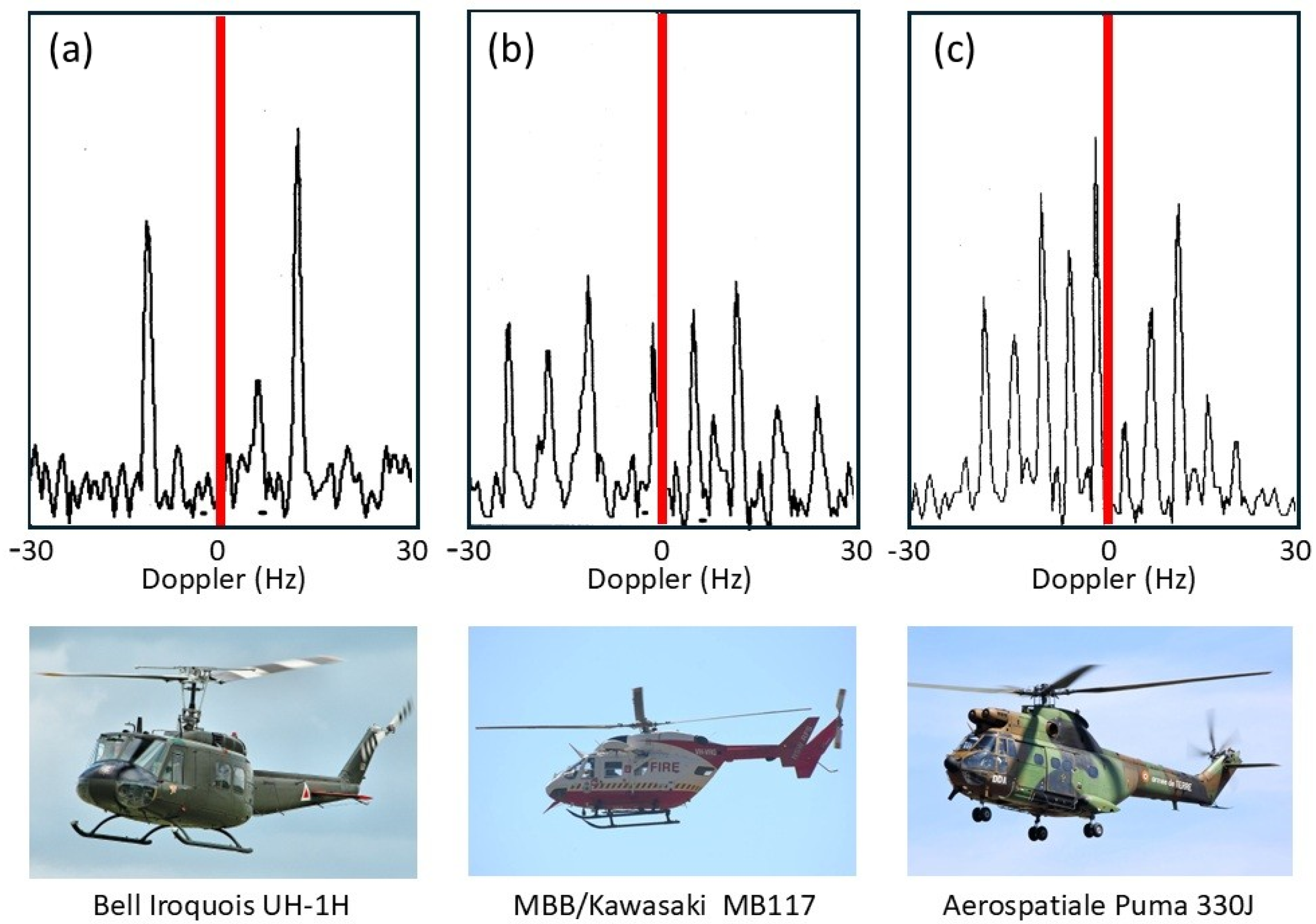
Figure 26 shows the modulation signatures of three helicopters measured in 1983 with the Jindalee radar [
53].
The discrimination power of these signatures is obvious, so helicopter classification/recognition is a viable mission for HF skywave radar, and suitable signal processing techniques that detect families of harmonically related spectral lines have long been implemented in operational skywave radars [
54].
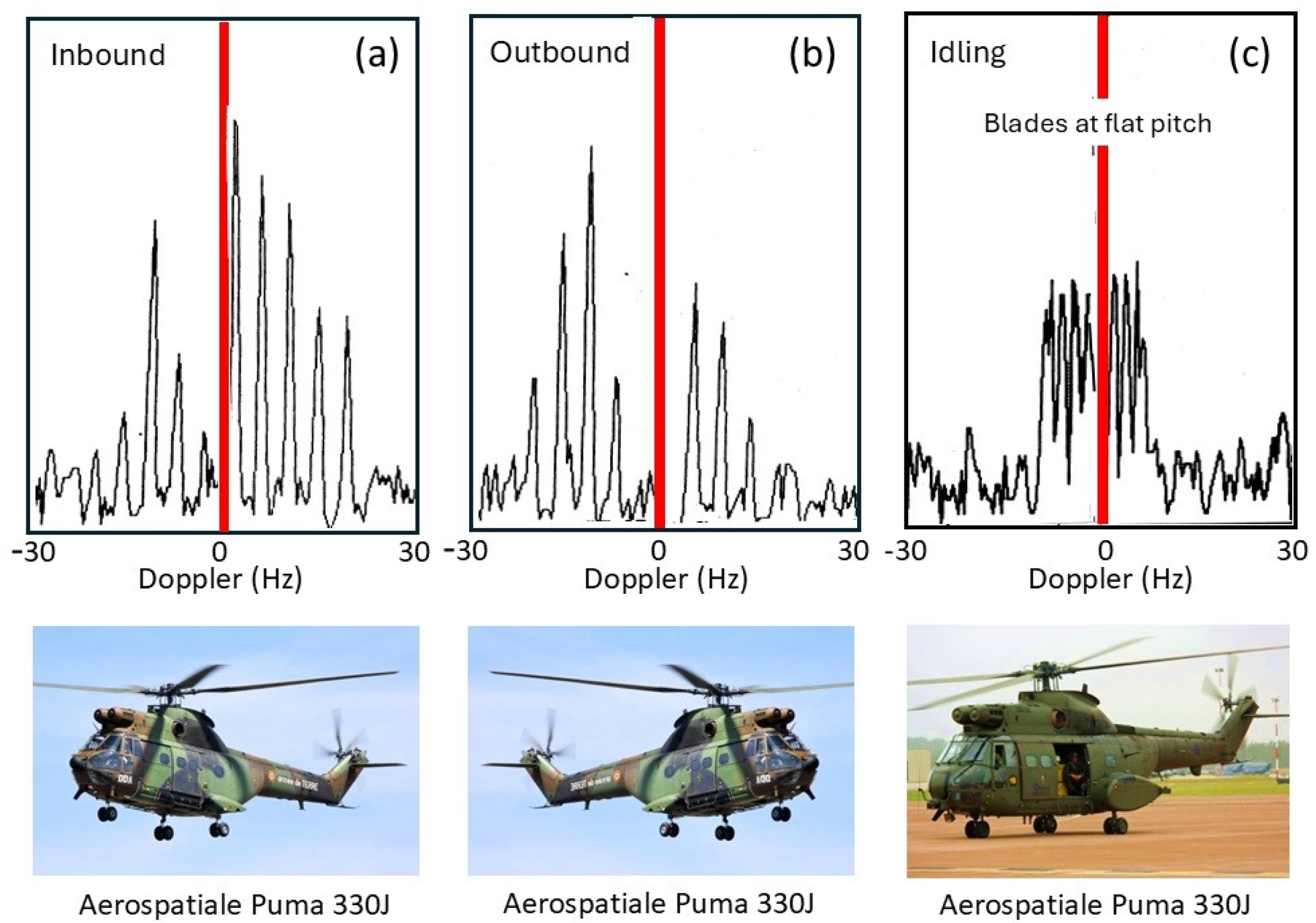
Despite its utility, this rather simple model fails to account for several features of helicopter rotor systems. Most dramatically, the assumption that the blades are electrically identical does not always hold. Helicopters occasionally need to replace individual blades with ones from later production lines, or blades sustain damage, which can be sufficient to change electrical characteristics and thereby reduce the order of rotational symmetry. The measured spectrum of the Aerospatiale SA 330J Puma aircraft shown in the third panel of
Figure 26 is an instance of this. According to the simple theory, the lines should appear at a spacing of Ω = 265
rpm × 4
blades = 17.6
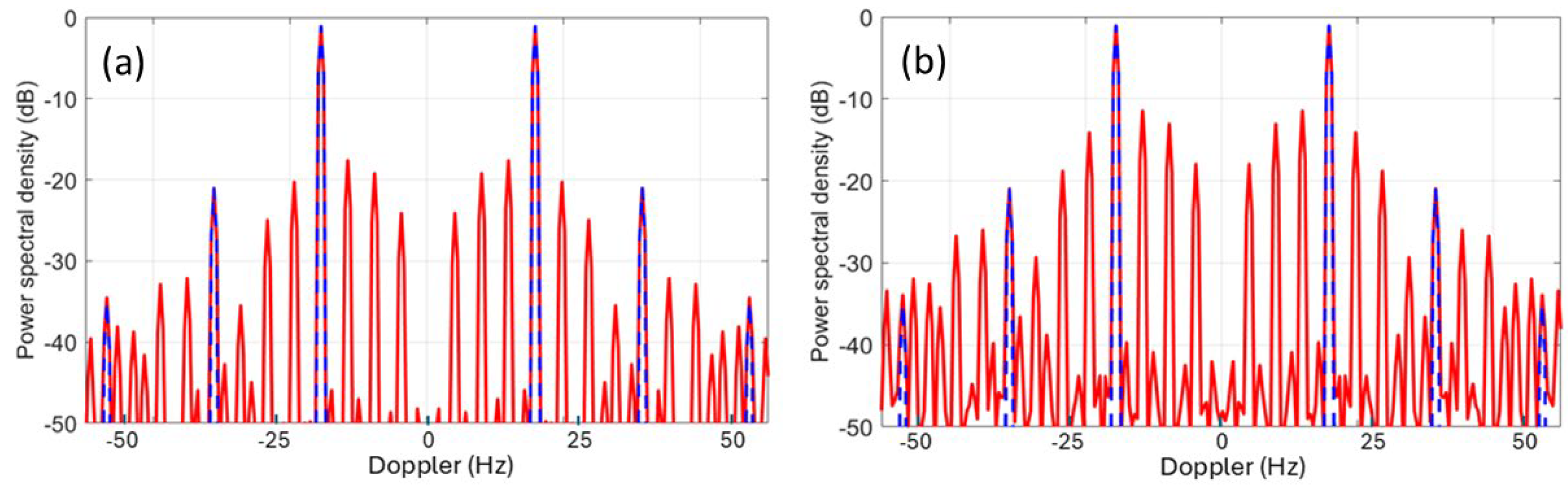
Hz. Instead, lines appear at a spacing of ~4.3 Hz in the figure. To investigate this phenomenon, we began by noting that the main rotor blades of the Aérospatiale SA 330J Puma are of composite construction, specifically glass and carbon fiber with a honeycomb core and a stainless-steel leading edge along most of the length but stopping short of the hub. We modeled the rotor blades as simple conducting rods loaded with an impedance at the hub, first for the electrically identical case and then with one blade loaded with a different impedance. The results for two settings of the impedance are shown in
Figure 27, with the electrically identical case superimposed, shown by blue dashed lines. As expected, the results support the hypothesis. Clearly, by adjusting the anomalous impedance, the model spectrum could be made to match a given measured spectrum, thereby promising a means of identifying the specific helicopter, not just recognizing its type.
Another feature of echoes from helicopters is the asymmetry in line intensities arising from the aspect presented to the radar.
Figure 28 shows typical spectra for (a) a receding and (b) an approaching helicopter. This observation provides an unforeseen benefit—the ability to estimate the orientation of a helicopter from a single radar dwell, which is often impossible when the ‘DC’ Fourier component is buried in clutter. It is worth noting that the feathering of blades as a function of angle is one possible contributor to this asymmetry. Evidence to support this hypothesis can be seen in
Figure 28c, which shows the Doppler spectrum of the SA Puma 330J idling while sitting on the ground before take-off. The rotation rate is low, so the spectrum is compressed, with blades flat, so the feathering asymmetry is absent. This is consistent with the data, where positive and negative components are of equal magnitude.
Yet another complication is the appearance of composite spectra arising from the additional modulation arising from the tail rotor, though this is expected to be seen only in high-dynamic-range echoes.
For HFSWR systems, where the TM electric field has less projection onto the plane of the main rotor, it might be expected that modulation from the tail rotor should dominate, but this is not observed. There are several explanations for this. First, the tail rotor has a diameter of only 3 m compared with 15 m for the main rotor. Second, the rotor–fuselage composite is the scatterer, not just the rotor, and the electrical coupling between the subsystems is the source of modulation. Third, helicopters in flight tilt the main rotor plane by means of a swash plate and employ cyclic pitch control of the individual blades, in addition to tilting the fuselage forwards when accelerating or at speed. Thus, the electric field is not orthogonal to the main rotor plane. A fourth consideration is the fact that over a finitely conducting surface, the electric field of the TM wave has a forward tilt; this is only of the order of one degree over seawater but can exceed 15 degrees over lossy ground.
- 2.
Propeller-driven fixed wing aircraft
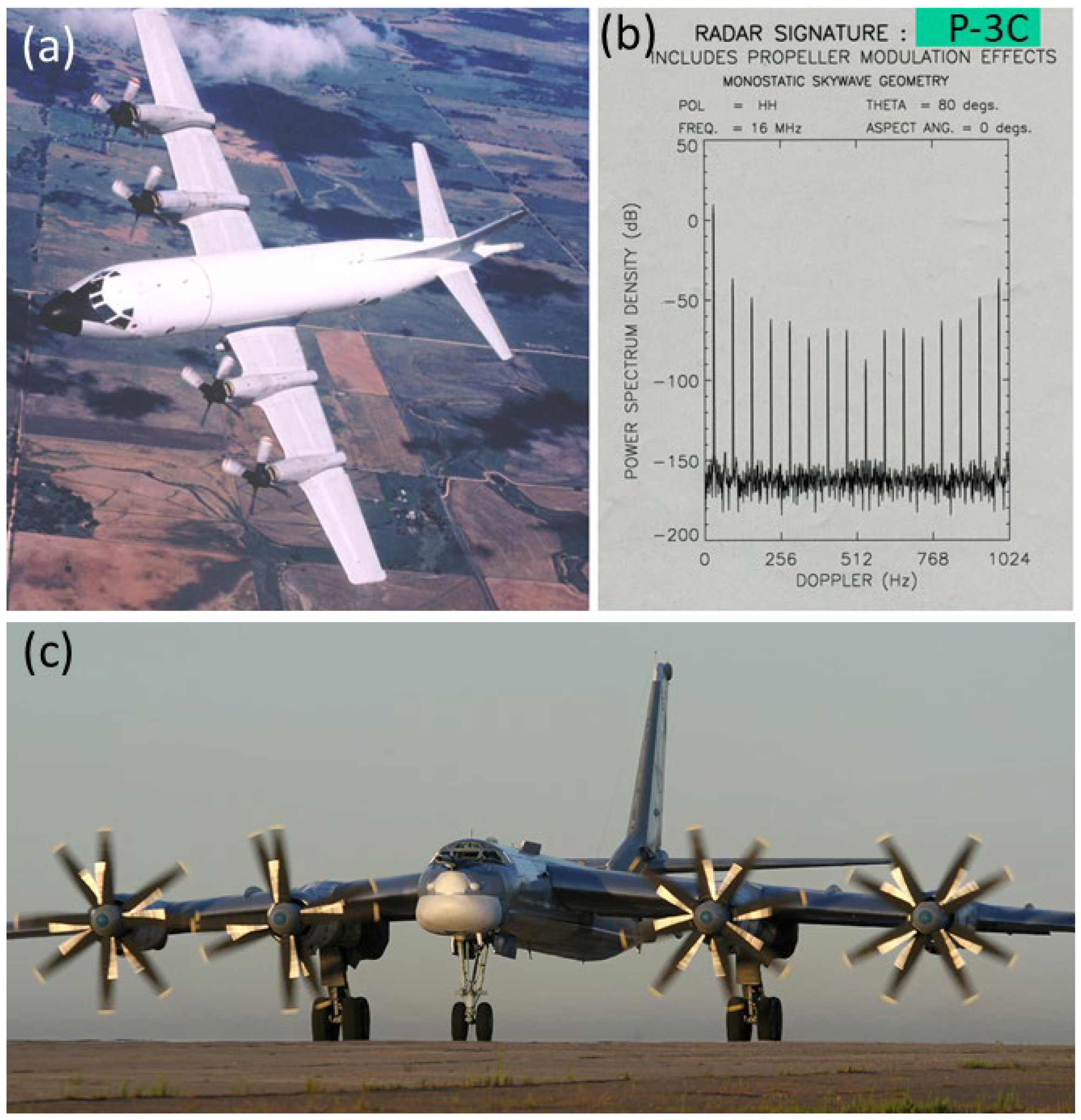
We have previously reported modeled Doppler spectra for the P-3C Orion maritime patrol aircraft (
Figure 29a) with its four 4-bladed propellers each with a diameter of 4.1 m [
41]. The results (
Figure 29b) indicated that the strongest modulation lines would fall some 35 dB below the ‘DC’ echo, too weak to detect under a lot of propagation conditions. Nevertheless, in the 1980s, US researchers reported detections of the modulation lines of the Russian Tu-95 bomber (
Figure 29c) with its four 8-bladed, counter-rotating propellers each with a diameter of 5.6 m (corresponding to roughly 3.5 dB in gain over the Orion) and rotating at 750 rpm. One might expect the fundamental frequency to approximate the sum of the clockwise and anticlockwise rates, multiplied by four, but we have not modeled this. With far greater sensitivity nowadays, propeller modulation spectra should be detectable much of the time.
- 3.
Ship-borne antennas
Although most modern warships employ fixed, phased array radars, large rotating microwave antennas were common until recently and remain in operational use in some vessels.
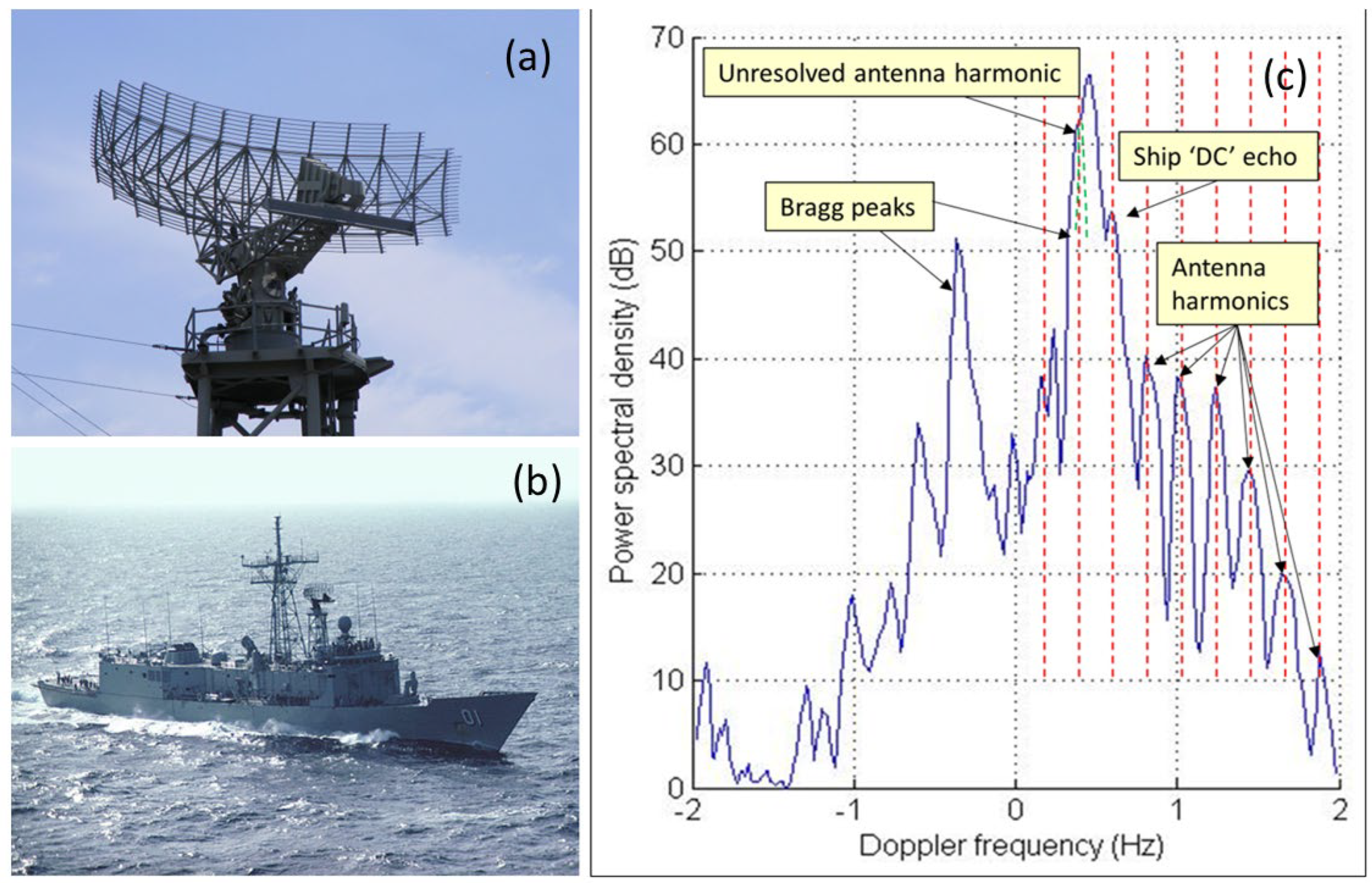
Figure 30a shows the AN/SPS-49 antenna fitted to the Oliver Hazard Perry Class FFG-7 frigate (
Figure 30b); it has a diameter of 7.3 m and has rotation rate options of 6 and 12 rpm.
Figure 30c shows an example of a detection of an FFG-7 with its antenna modulation lines clearly visible. Its rotation rate is selectable from 6 and 12 rpm; for comparison, one foreign equivalent has rates of 7.5 and 15 rpm, easily distinguishable from the AN/SPS-49.
- 4.
Wind turbines
HF radar echoes from wind turbines can spread across the Doppler spectrum and mask target echoes and degrade remote sensing products, so a lot of attention has been paid to characterizing them and devising ameliorative signal processing algorithms [
55]. They can serve a constructive purpose for skywave radars, providing echoes from known locations and thereby providing an additional coordinate registration method. An important property of the echo spectrum—the signature—is the dependence on radar waveform.
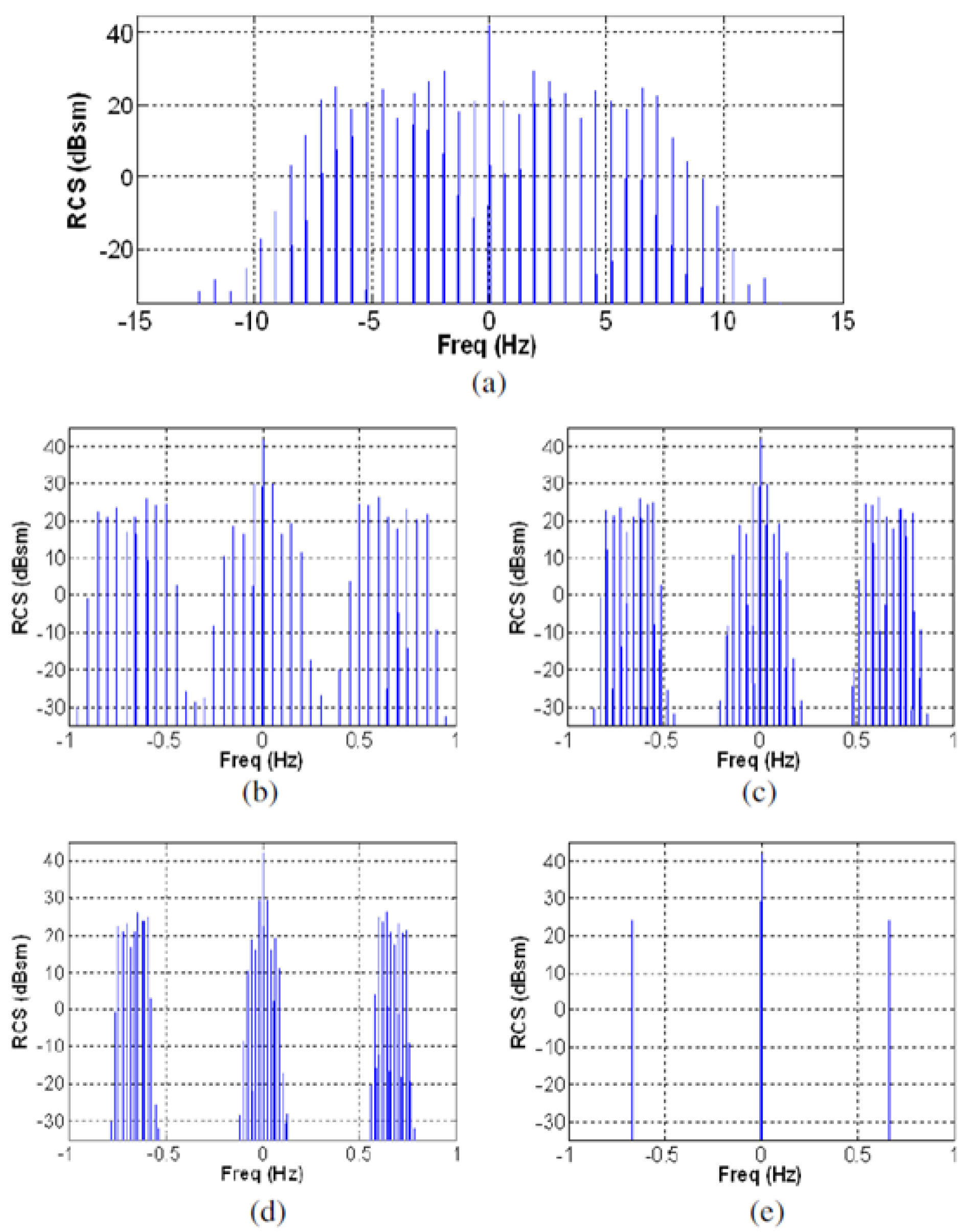
Figure 31 shows modeled spectra from a turbine illuminated with a continuous wave (CW) waveform at various combinations of sampling frequency and turbine rotation rate Ω [
56].
For a sampling frequency of 30 Hz, the line spectrum is unaliased, spreading to roughly ± 12 Hz, shown in
Figure 31a. At a sampling frequency of 2 Hz, as used by the CODAR SeaSonde radar, the echo is severely under-sampled, so lines beyond the fundamental are aliased and appear at spurious locations across the spectrum. By the artifice of varying
Ω for fixed SeaSonde sampling rate, the lines can be made to appear as sidebands localized to different regions around the fundamental tones (
Figure 31b–e), where the last example has the aliased lines exactly superimposed on the fundamental. If an FMCW waveform had been used, the Doppler frequency aliases would be similar, but the lines would fold into different range bins.
It is obviously important to keep this effect in mind when conducting target classification missions. Equally, one should design one’s radar with flexibility to employ a variety of waveforms that, together, are able to distinguish between different sources of modulation. The resemblance of the spectrum shown in
Figure 31 to the signature of the SA-Puma helicopter discussed earlier is a case in point.
- 5.
RADAM—RAdar Detection of Agitated Metals
Studies in the US during the late 1970s, at the Rome Air Development Center and at SRI, [
57] established that the intermittent changes in electrical contacts between structural components on platforms undergoing vibration were detectable at VHF, typically 10–30 dB below the skin echo. In the case of ships in rough seas, where the hull deforms substantially, one might expect this impulse-like impedance modulation mechanism to operate under some sailing conditions, such as slamming in head seas. It may be a relatively minor echo feature, but no comprehensive implementation of a target characterization scheme should discount the possibility.
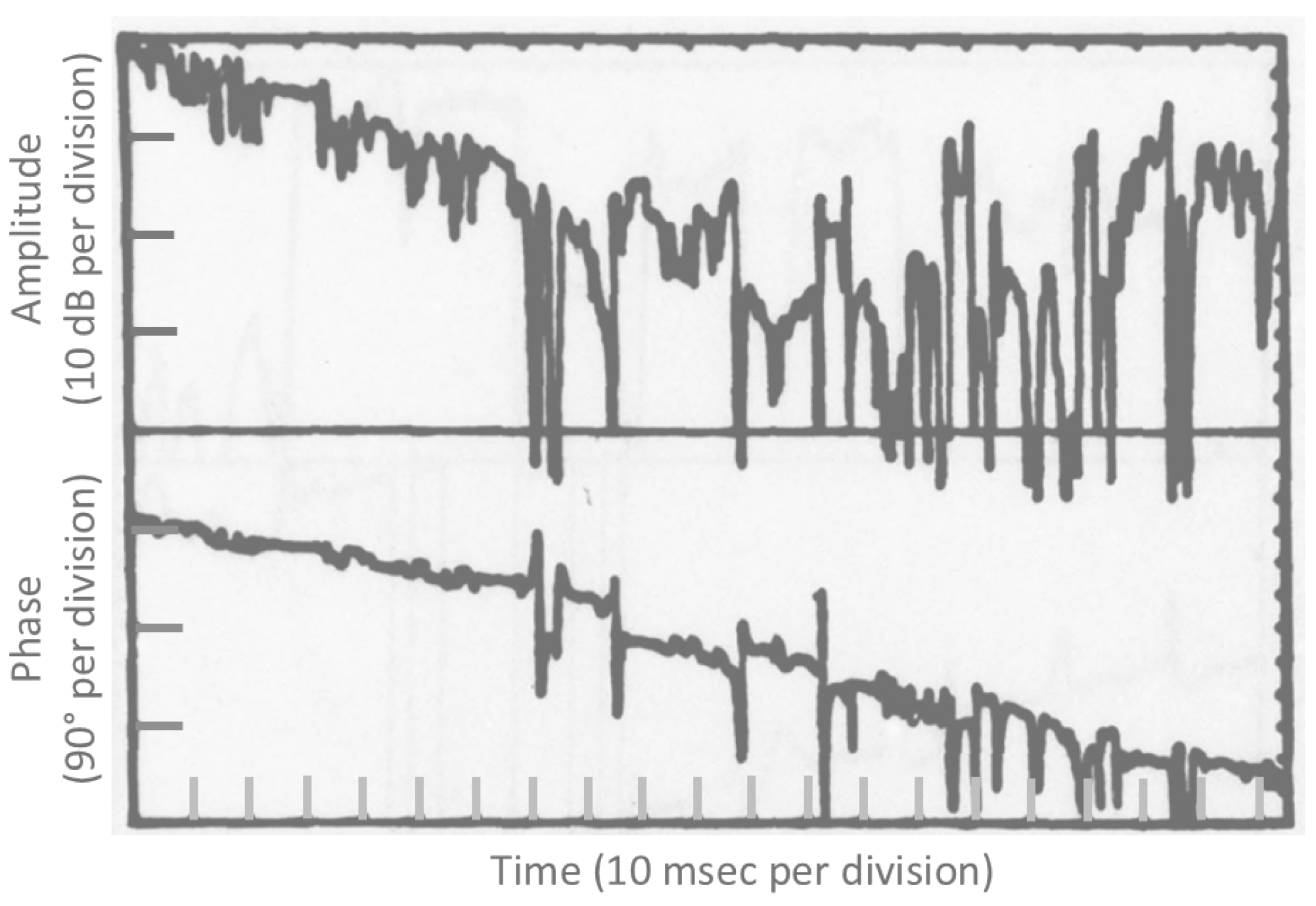
Unlike most of the established target signature mechanisms, it is probably detectable only in the time domain, after localization of the target echo in the frequency domain and inverse transforming.
Figure 32, redrawn from [
57], shows a time domain segment of the measurements from an armed personnel carrier (APC).
In most cases, the physical basis of the modulation is mechanical articulation of metal-oxide junctions, whose static electrical nonlinearity provides a different class of radar signatures, as discussed in the following section. It may be a relatively minor echo feature, but no implementation of a target characterization scheme should discount the possibility.
- 6.
Switched impedance antennas
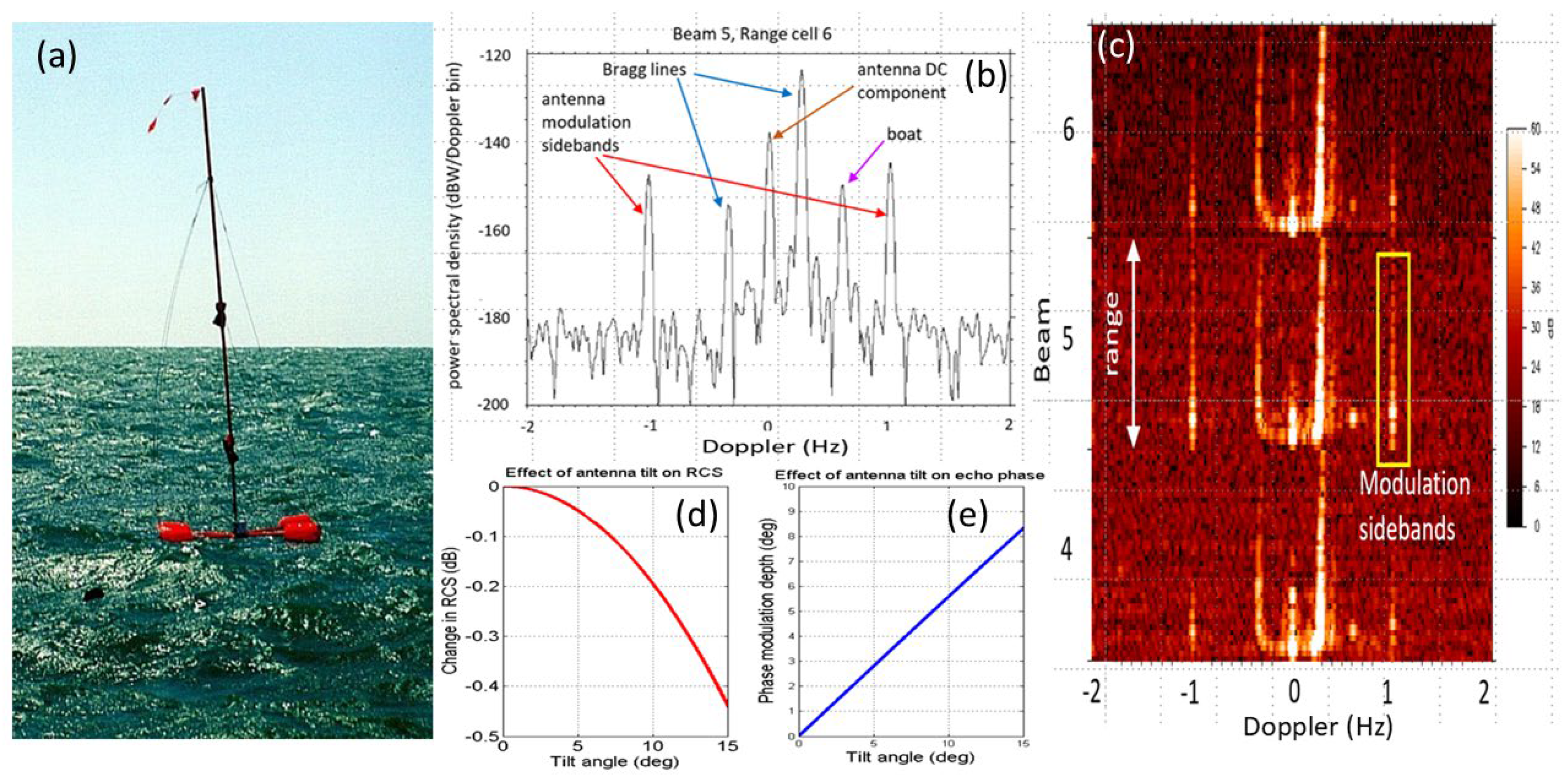
A common utility in HF radar experiments is the switched impedance antenna, usually a monopole. An example is pictured in
Figure 33, mounted on a buoy, along with its Doppler signature. In that example, the waveform repetition frequency was set equal to the antenna switching frequency so that all the sidebands fell in the same Doppler bin, spread across a number of range cells. With simple ON–OFF switching, typically half the energy remains in the DC term; with phase switching, nearly all the energy can be deposited in the Doppler sidebands. These simple implementations are useful as RCS calibration sources, for IFF, and for special propagation measurements impossible by normal means [
58]. Tests using monopole lengths up to 7 m were carried out as part of the Iluka radar program, validating the theoretical models. Air-dropped versions have been developed; some were used in the 1980s.
- C.
Nonlinear scatterers
- (i)
Passive IMD
Almost without exception, the dominant contributions to radar echo energy can be modeled to high precision using the assumption of linear electromagnetic response. Yet one feature of nonlinear scattering is the redistribution of energy across the frequency domain to bands free of the linear returns. When these weak echoes are detectable, they can be unique ‘fingerprints’ of the specific target involved. Moreover, radar scattering from the ocean surface is electrically linear to an extremely high degree, so the nonlinear target echoes do not have to compete with sea clutter, typically 30–70 dB stronger than the primary ship echoes.
Ships are particularly vulnerable to the generation of nonlinear products in passive structures. This can arise from physico-chemical processes of metal surface treatment during fabrication, oxidation from exposure to the marine environment (often known as the ‘rusty bolt’ effect), or the presence of foreign impurities. Measurements associated with shipboard HF communications systems have identified a host of passive contributors, including mooring or anchor chains, expansion joints, cables, slap-down plates, pipe and bracket joints, door hinges, life raft hangers, ladders, armored cables, LSO nets, antenna guying wires, guard rails, booms, gang planks, and roller curtain doors. To give an idea of the severity of the nonlinearity, one test revealed high levels of inter-modulation distortion (IMD) up to the 21st order, with measurable levels up to the 51st order [
59].
In addition to passive contributors, nonlinear contamination can be traced to active contributors, especially electronic subsystems based on semiconductor components such as transmitters, receivers, navigation equipment, loudspeakers, and even deliberately nonlinear elements used to protect sensitive receivers from jamming and EMP. Coupling may occur via antennas, cables, and wires used for normal signal transmission, conducting casings, and capacitive effects.
An important point made in [
60] is that scattering from semiconductors generates both even- and odd-numbered nonlinear products, whereas ‘rusty bolt’ sources produce predominantly odd orders. This gives us another tool for classification. We should also remember that IMD can be regarded as the linear radar waveform mixing with itself. There is no reason why it could not mix with other signals incident on the ship, or generated there, with much higher power densities and resulting IMD products.
The general formulation of nonlinear processes is based on the Volterra series expansion. In the radar context, a reduced description applicable to memoryless nonlinearity has been used to establish a direct mapping between low orders of nonlinear transfer functions and the corresponding orders of radar cross section [
61,
62]. The frequency domain generalizes to a multi-frequency domain, with the RCS elements readily interpreted as the echoing responses of the target to specific combinations of incident frequencies, highlighted in the corresponding radar equations:
How far we might progress through the hierarchy classification—recognition—identification depends on the extent of our prior knowledge of the target’s nonlinear RCS characteristics. Detailed knowledge is unlikely to be available in the great majority of cases, but one might well expect the strength of nonlinearity from corroded structures to increase with the age of the ship.
We have previously calculated the relative contributions of the different RCS orders on target detectability for both skywave and surface wave HF radars, using an equivalent circuit to model the nonlinearity [
63]. The radar parameters (power, antenna designs, etc.) were copied from some existing radars, but the nonlinear coefficients were pure guesswork. The conclusions of that study were marginally encouraging for HFSWR but bleak for skywave radar, largely because the power law for the geometric loss in a monostatic radar takes the form
R−(2n+2) for
n-th order products, and skywave radar ranges are so extreme.
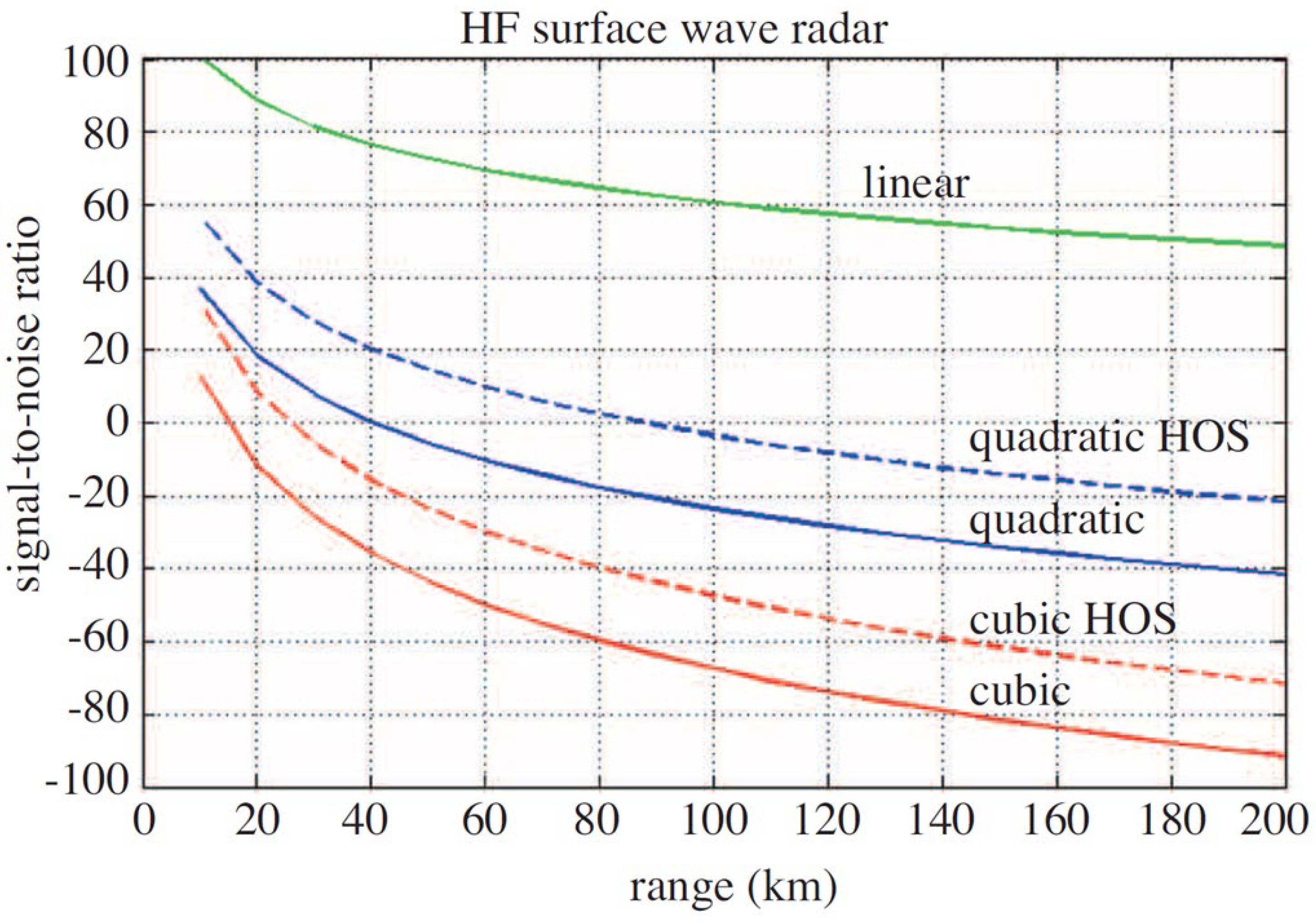
The prediction for HFSWR in a representative scenario, using classical processing of a linear FMCW waveform, are reproduced in
Figure 34, where the quadratic nonlinearity coefficient was set to 10
−3 and the cubic to 10
−2. Note that these are voltages; the powers are −60 dB and −40 dB, which we suspect are very conservative values.
There are several measures that can be adopted to improve the prognosis, some of which were considered in [
63,
64]. First, use of higher-order statistical processing yields a gain in SNR when the noise background is Gaussian. For example, modeling showed an achievable gain of nearly 20 dB for third-order IMD based on sensible record lengths, as shown in
Figure 34. Second, instead of using a continuous waveform, suppose we could employ a pulse waveform with a duty cycle α. For the same average transmitting power, this enhances the strength of the IMD by a factor of
α−n/2. Once detection has been achieved, one might trade off some of the range footprint to permit a lower duty cycle, 25%, say, or even 10%. The former yields an enhancement of the third-order IMD by 9 dB, the latter by 15 dB. Even for second-order products, the corresponding gains are 6 dB and 10 dB. Were the transmit power to be increased to that used in some military-grade radars, the second-order IMD would have an SNR exceeding 5 dB at a range of 200 km.
We have not looked at the exploitation of phase information, discarded in the power spectrum but retained in the higher-order spectra. Whether this could have potential for target characterization is an open question.
- (ii)
Active IMD
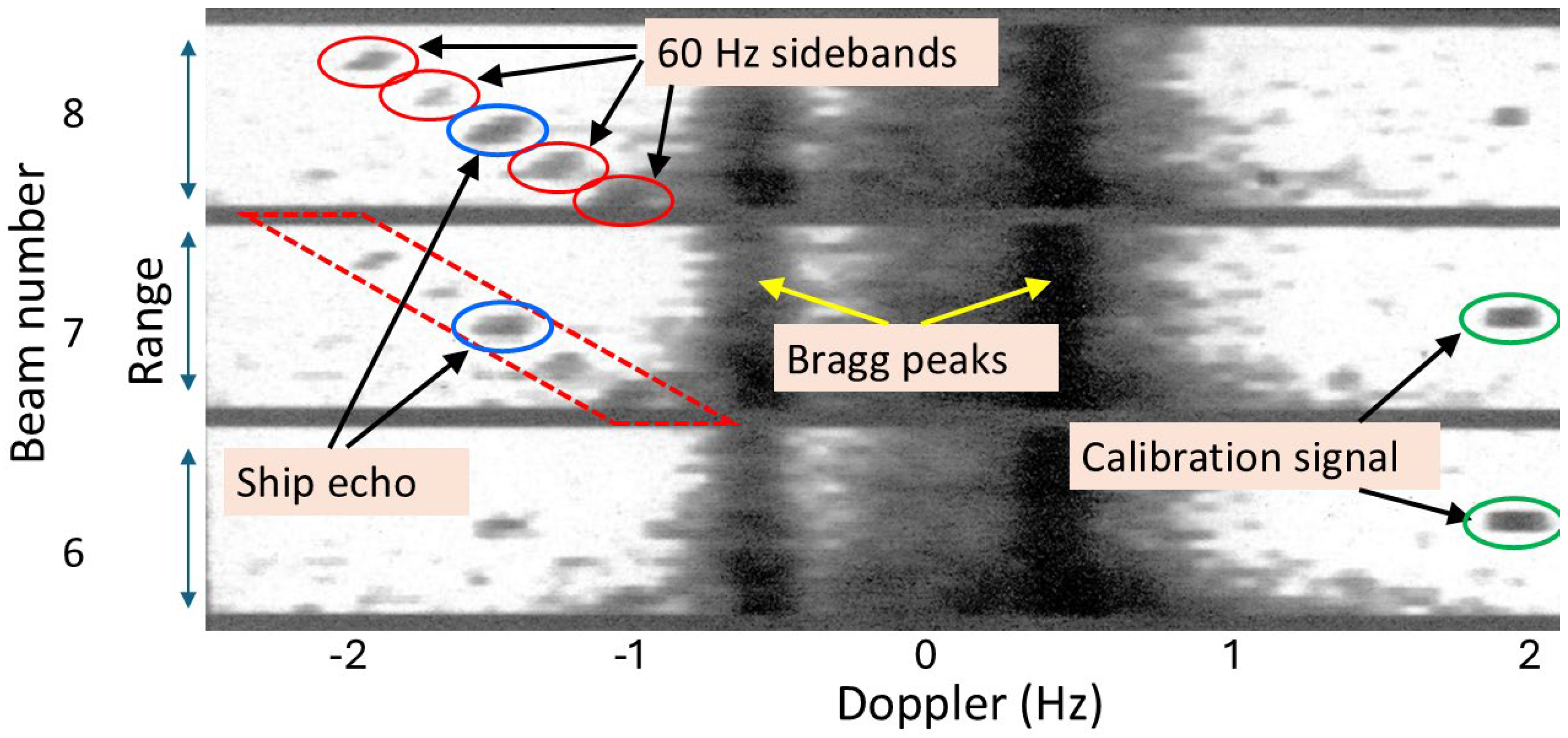
Skywave radars have, on occasion, observed another form of nonlinear signature whose origin remains a matter of speculation, though with some evidential support from the operational context. A frame from one of those instances is presented in
Figure 35, which shows a range–Doppler map with a family of harmonically related lines, spaced by 60 Hz and hence heavily range-aliased. (The individual range lines here are actually multiple range bins averaged noncoherently.)
Our hypothesis starts from the fact that scattering from antennas involves two mechanisms—the structural mode and the antenna mode. The former comprises all the sources that reradiate when a matched load is connected to the antenna feed port, and there is no reflected power from the load, while the latter refers to the contribution from power that is reflected from the load and reradiated into space. If the load were excited with an internally generated field, that modulation could be transferred to the external signal that is being reflected from the load and reradiated. One likely source for such an unwanted internal field is mains power.
The context of the observations was as follows. The skywave radar which acquired the signature in
Figure 35 was involved in a nocturnal exercise that would have drawn the attention of any country interested in this technology. A discreet form of monitoring radar transmissions in the 1- propagation zone, along with echoes from any targets being illuminated, is to position a vessel in the radar footprint and listen, with an HF antenna feeding a sensitive receiver. Given shipboard constraints, mains leakage into the system might be unavoidable and dealt with further through the processing chain. Most ships employ either 50 Hz or 60 Hz mains frequency to power electronic systems, depending on country of origin, so measuring the modulation frequency narrows the options.
- D.
Structural properties of the scattering matrix
Analysis of the scattering matrix can proceed in a number of ways. For example, it may be written as the sum of two or more matrices, each of which is associated with a specific mechanism, or it may be factorized and written as the product of two (or more) matrices, representing sequential scattering processes, or one might find its eigenfunctions, which could identify useful probing states. There are other possibilities, and each approach has its applications. Two approaches have been explored within the HF radar community: optimal polarization states and characteristic modes.
- (i)
Optimal polarization states
Given a matrix, one of the first steps one might take to explore its physical significance is to find its eigenvectors. In the radar context, there is a complication that must first be addressed—the need to adopt a polarization convention for the radar scattering process—either the Forward Scattering Alignment (FSA) or the BackScatter Alignment (BSA). We automatically embed that dichotomy in our radar process model but, when dealing with explicit representations, some care must be taken. The standard formulation for the scattering matrix—the Sinclair matrix—uses the BSA, while most optical processes are framed in the FSA with Jones matrices replacing the Sinclair matrix. The eigenvalue problem in the BSA becomes a coneigenvalue problem,
where
denotes the complex conjugate to
; the FSA is conventional.
We can address our target characterization problem in either convention by focusing instead on the received power, represented by the Graves power scattering matrix,
, satisfying
with
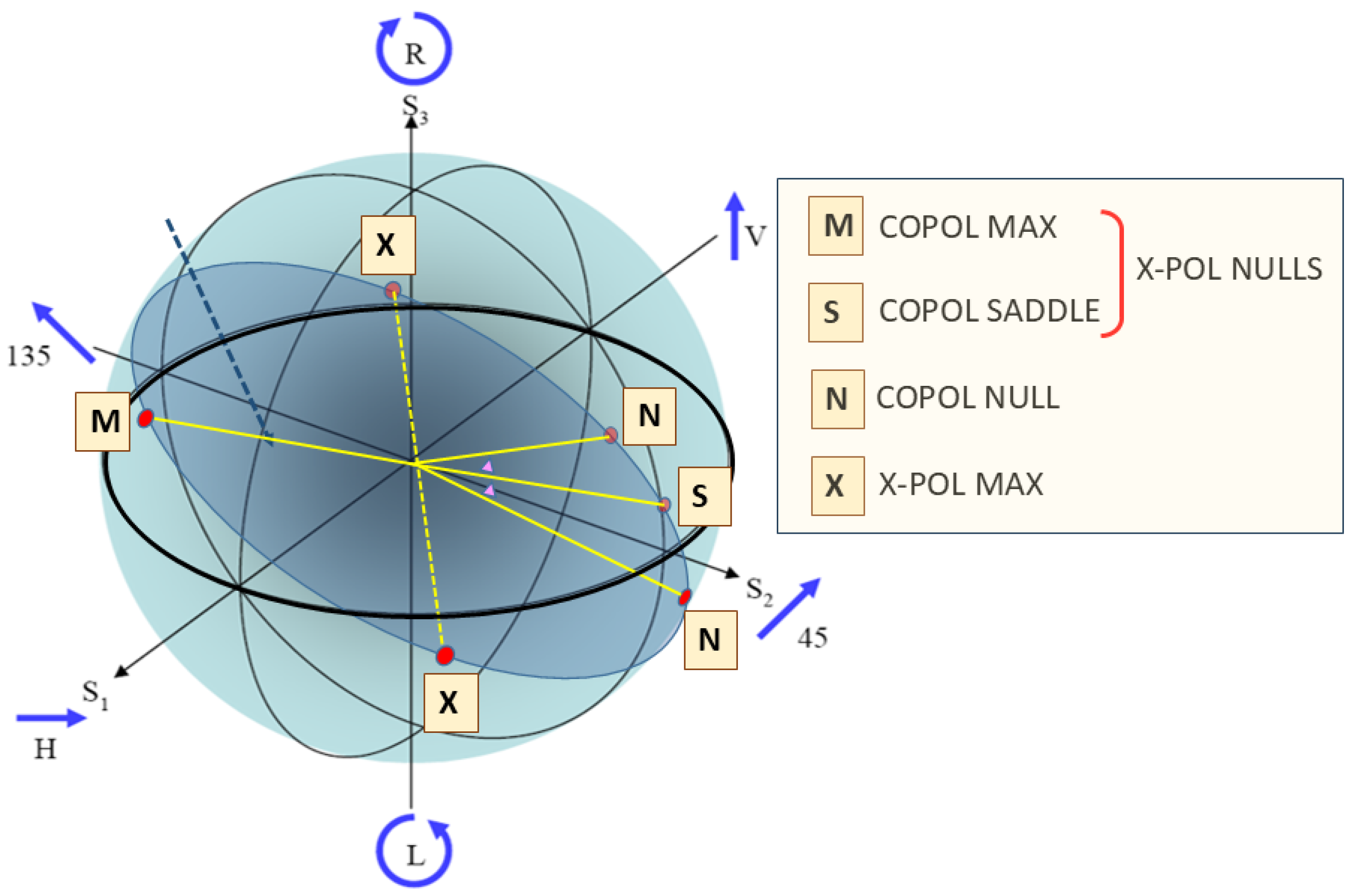
. The optimal eigenvectors fall into five categories:
the co-polarization maxima (CO-POL MAX)
the co-polarization nulls (CO-POL NULL)
the cross-polarization maxima (X-POL MAX)
the cross-polarization nulls (X-POL NULL)
the cross-polarization saddle points (X-POL SADDLE)
In the case of a symmetric scattering matrix representing monostatic measurements in a reciprocal propagation medium, the eigenvectors of
are also the eigenvectors of
; moreover, the CO-POL MAX states coincide with the X-POL NULL states. It was shown by Huynen [
65] that these states have a geometric interpretation as a fork configuration on the Poincare sphere, pictured in
Figure 36.
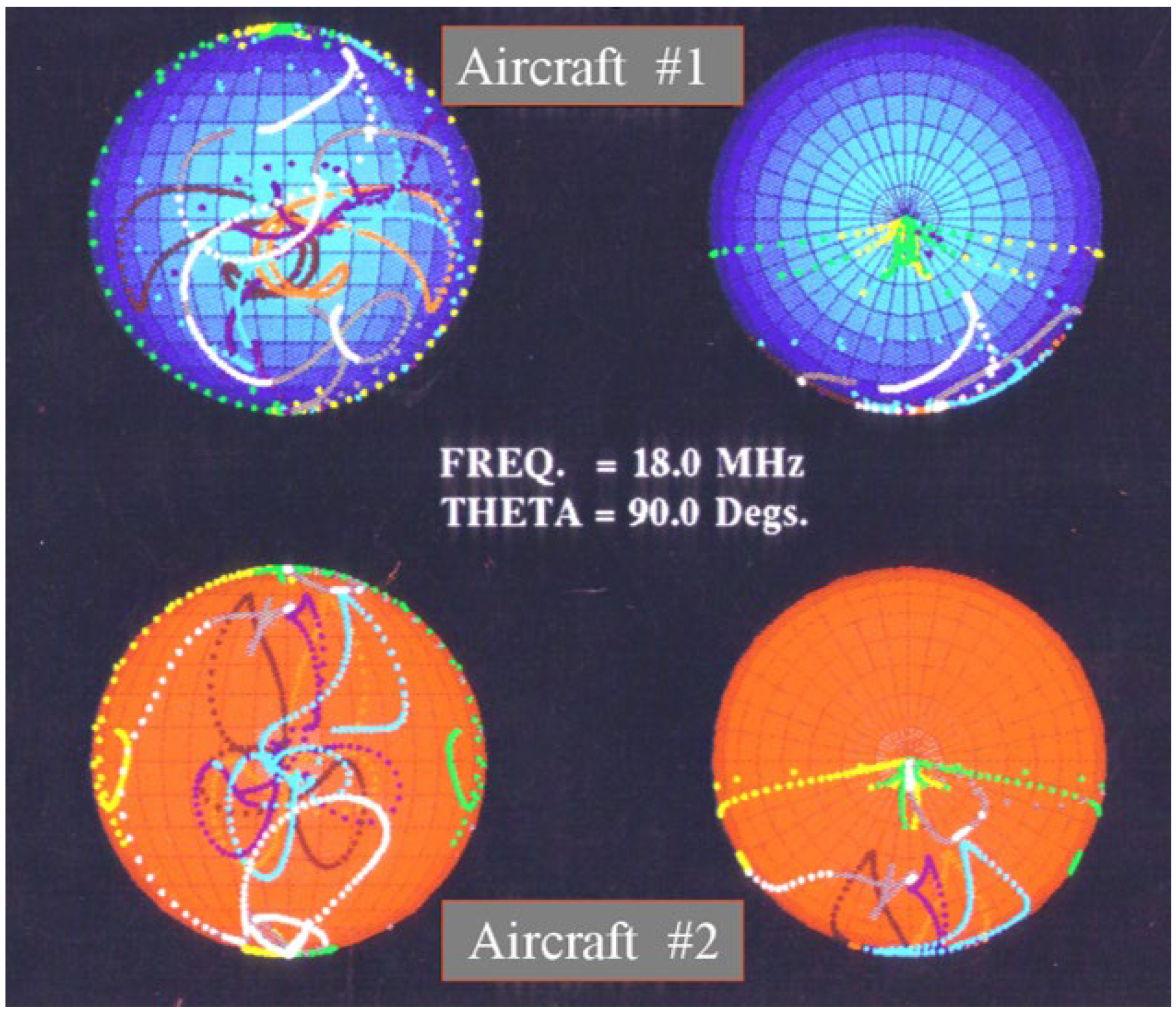
The optimal polarization states characterize the scattering matrix completely, with the advantage that, unlike the scattering matrix or the Stokes parameters, the description is independent of the polarization basis. Any changes to the scattering properties of the target are reflected in the dynamics of the optimal polarizations. Systematic variations of the S-matrix properties map into eigenvector trajectories on the Poincare sphere, as illustrated in
Figure 37.
A strategy for target classification could take the form of sampling with different transmitted polarizations to find one or other NULL state, as nulls are generally sharper than maxima and hence yield more accurate estimates. Recognition would rely on a pre-computed library.
- (ii)
Characteristic modes
The scattering matrix describes asymptotic properties of the field scattered by the target, not the response elicited in the target itself. It was pointed out by Garbacz [
66] that, for targets in the resonance regime for scattering, that is, with dimensions in the range 10
−1–10
1 wavelengths, say, the natural eigenstates of the current distribution induced on the target, should form a meaningful basis for describing the target’s scattering behavior. Moreover, in most circumstances, only a few eigenstates are likely to dominate, much like the dipole and quadrupole moments in Mie scattering.
Central to the utility of characteristic modes is the fact that they are inherent properties of the target, independent of any incident field. What changes with the illuminating field is the modal excitation coefficient (often expressed as modal significance).
To calculate the eigenstates for a target, we need to construct its impedance matrix. The first step is to define the type of problem and select the appropriate surface integral equation for the scattered field. Although there is interest nowadays in platforms made from composite materials, most HF radar studies, including all those calculations included in the present paper, have assumed ship and aircraft targets to behave as closed, perfectly electrically conducting (PEC) targets. Accordingly, the electric field integral equation (EFIE) for the scattered field is rewritten using the PEC boundary condition to yield the relationship between the incident electric field
and the surface current density
induced on the target,
where
denotes the observation point,
the source point, and
S the platform surface.
The impedance operator
, that is, the tangential component of
, is obtained in matrix form by discretizing the equation, as first set out in the seminal papers by Harrington and Mautz [
67,
68]. Unlike Mie scattering, which employs entire-domain basis functions such as spherical harmonics, local, piece-wise functions are used, normally triangular Rao–Willton–Glisson basis functions, which are well suited to modeling complex targets. Inverting the impedance operator
yields the surface current density
on the target by the incident field. The characteristic modes are then obtained by solving the generalized eigenvalue equation
where
and
are the real and imaginary parts of
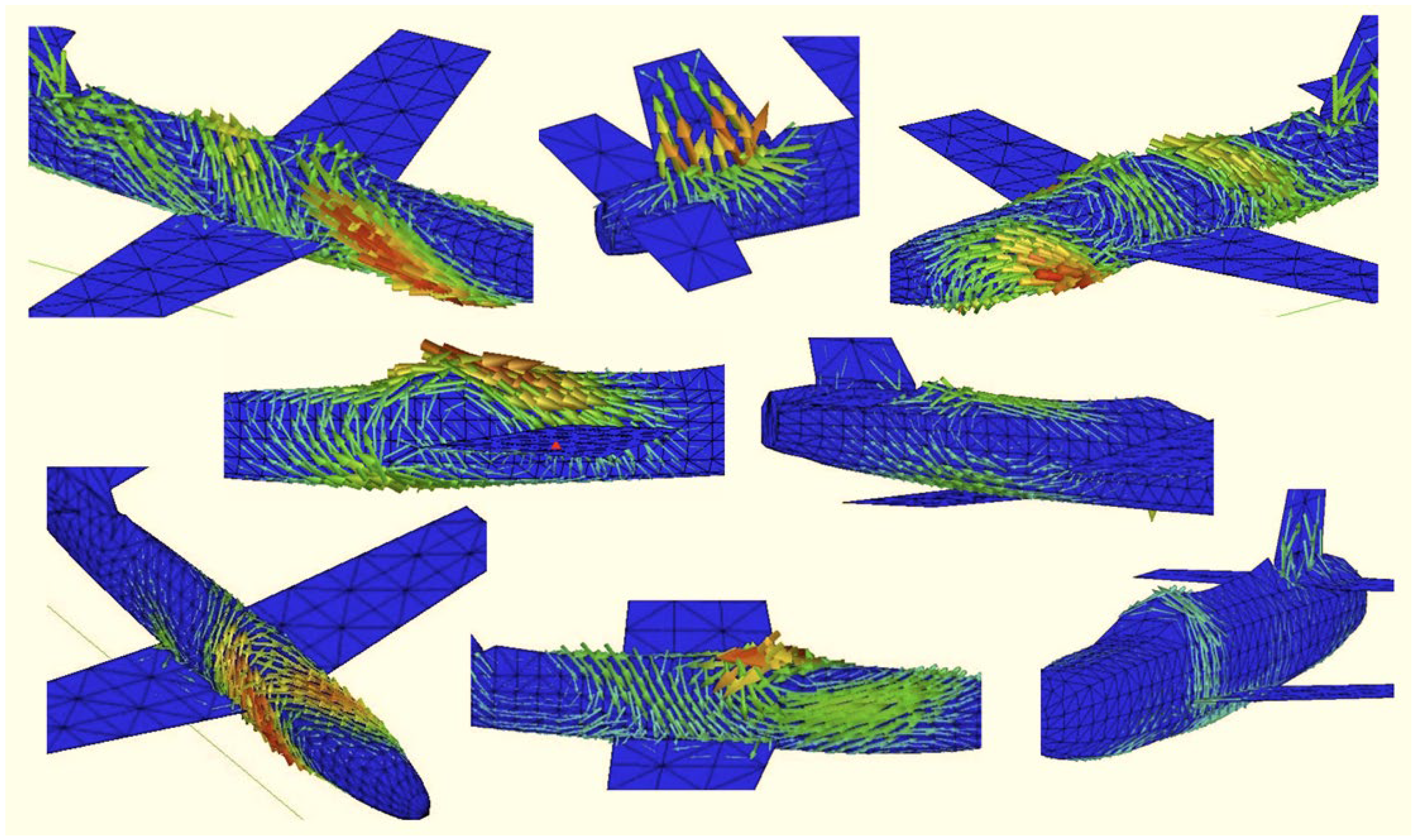
. Importantly, the orthogonality of the characteristic modes is shared by the radiated fields, which then form a basis for the scattering pattern in the far field.
Figure 38 is a composite showing a selection of the eigen-currents computed for the Aermacchi MB 26H, revealing that many have localized spatial support.
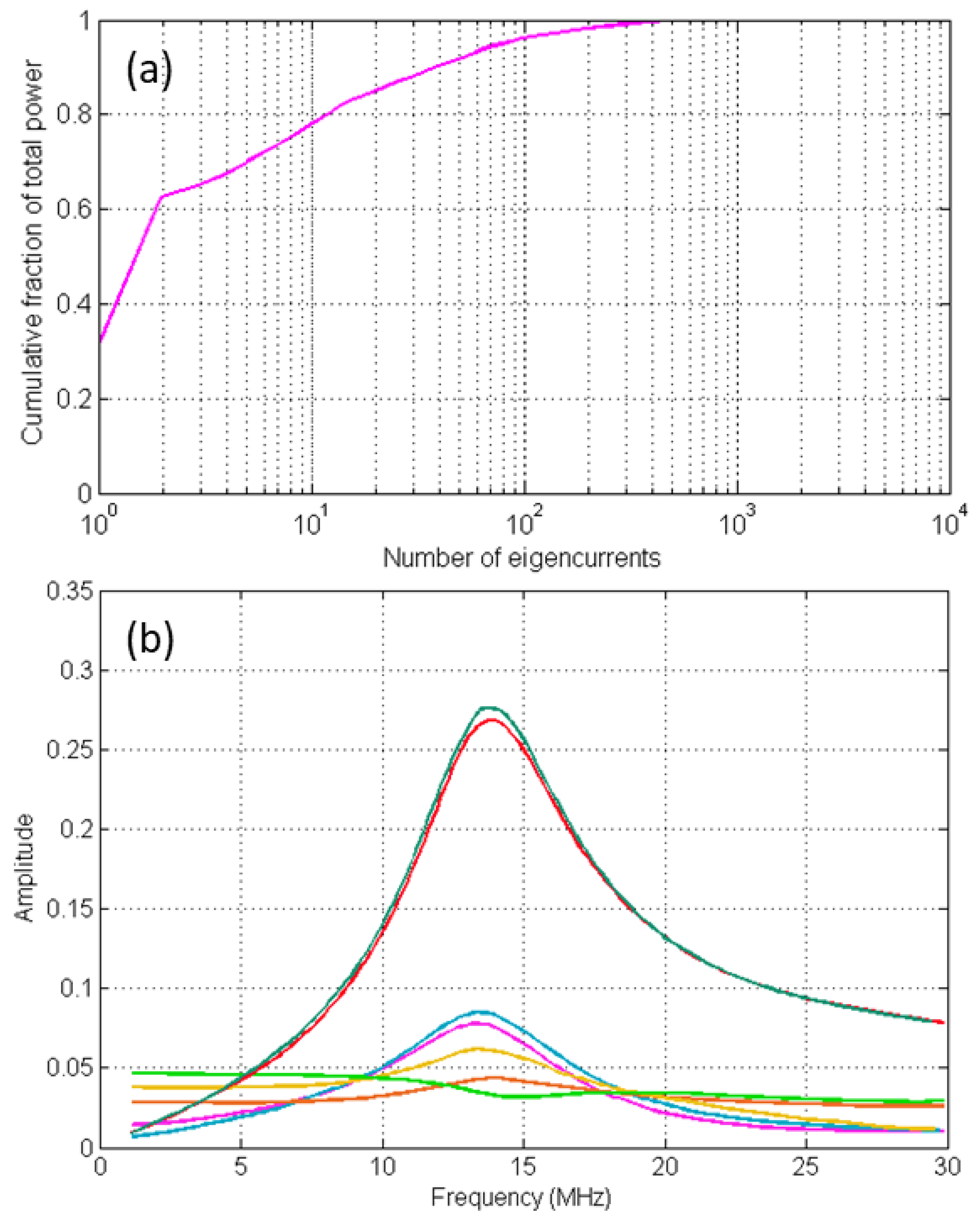
To illustrate the point made above—that in a given scattering scenario, only a few modes contribute significantly—
Figure 39a plots cumulative re-radiated power versus number of modes considered in the case treated above, revealing that, in this instance, the first ten modes were responsible for 80% of the re-radiated power, the first two for over 60%. In
Figure 39b, the modal significance of the same ten modes is plotted as the radar frequency changes under the same illumination geometry.
The role of characteristic mode analysis in the target classification task is indirect and seemingly applicable only to known target types whose eigenstates are stored in the radar database, i.e., target recognition. Its potential contribution depends on the degrees of freedom accessible to the observing radar, such as frequency agility, polarization, bistatic geometry, and so on. Once the scattering geometry is known, that is, detection has been achieved and coordinate registration has been successful, a small optimal set of probing measurements can be designed that discriminates between likely members of the resident library of known target types. In most respects this is similar to classification based on measurements of accessible elements of the scattering matrix, discussed earlier, but there is a measure of physical insight that may be provided by scenario-specific knowledge. For example, the presence of external stores on aircraft would modify currents flowing on the wings. Then, using radar parameter selection to select dominant modes may enable a degree of confirmation. This is perhaps speculative, and it is unlikely that this kind of information could be exploited by human operators in real time, but, increasingly, AI techniques are being brought to bear such problems. What is more immediately feasible is the exploitation by a platform of knowledge about its own modes to activate real-time adaptive signature control, though we shall not pursue this subject here.
- E.
Time domain versus frequency domain
The preceding sections have been framed entirely in the frequency domain. There are several practical reasons for this—the narrow bandwidth of accessible HF channels, the long coherent integration times needed to achieve signal gain against noise and clutter, inability to achieve high power densities on the target that could result in significant energy in post-excitation radiating natural modes, the localization in the frequency domain of most target kinematic phase responses, and the nonGaussian external noise background loaded with decaying waveforms from natural phenomena. Techniques such as the singularity expansion method [
69] have been contemplated on occasion for use in a hostile electromagnetic environment but rejected after back-of-the-envelope calculations.
Despite this, and in keeping with the principle of keeping an open mind, we recall that Bojarski integrated time-domain response theory with the scattering matrix formulation [
70] and made an interesting observation about the possibility of retrieving the matrix through an intervening ionosphere, a subject that was later taken up by others [
71] and generalized to the skywave case [
72]. Nevertheless, at present, we are not aware of any feasible proposal for implementation in HF over-the-horizon radars as a primary domain for detection or classification. Of course, HF radars rely on signal processing techniques that jump between the two domains [
40], or act in the time–frequency domain, to identify propagation distortion mechanisms and compensate for them, but that is a different matter altogether.
4.2. Interactive Signatures
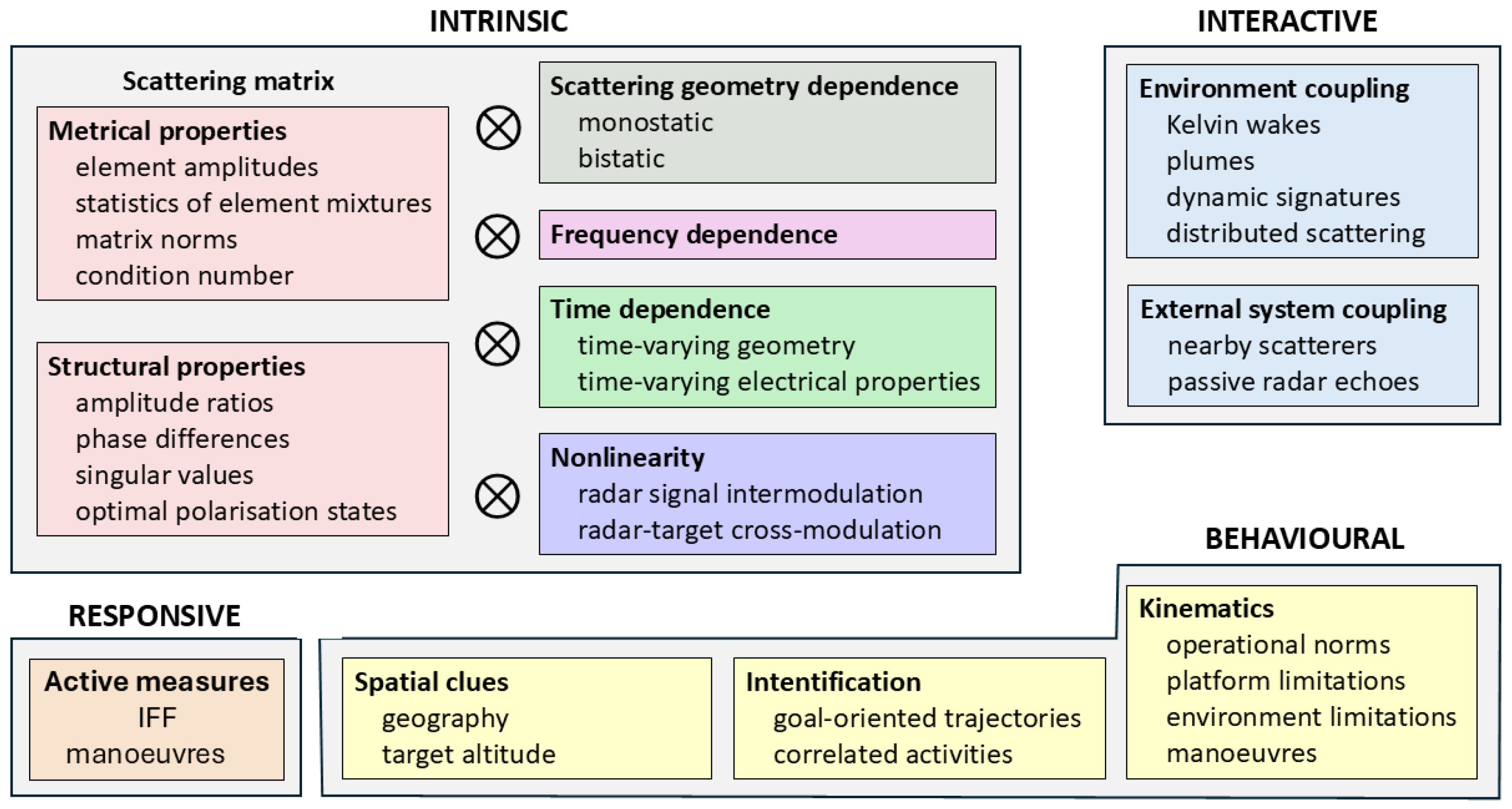
Some of the most informative HF signatures are the result of coupling between the target and its environment. We can distinguish two main classes: those where the target’s intrinsic echo is modified by the interaction, and those where the signature of the environment is perturbed by the presence of the target.
- A.
Kelvin wakes
Within the domain of linearized hydrodynamics in an inviscid fluid, the irrotational flow produced by any pressure distribution within the fluid can be generated by a distribution of Havelock sources, which are point sources possessing the useful attribute that they satisfy the free surface boundary conditions on the mean surface. The velocity potential
due to a source at coordinate
is given by
where
.
The distinctive Kelvin wake that is generated by a body moving in a fluid at speed
can be modeled by a distribution of these pressure sources over the wetted parts of the body, whether the body is a surface-piercing displacement hull or a fully submerged vessel, i.e., a submarine. The resulting surface displacement at any location
is expressible in terms of the integrated response to these contributions once we know the strength of the sources and the shape of the hull that defines the surface of integration. One can address this problem in various approximations. In our previous research, we have followed [
66] and used the ‘thin ship’ approximation, which satisfies both our needs [
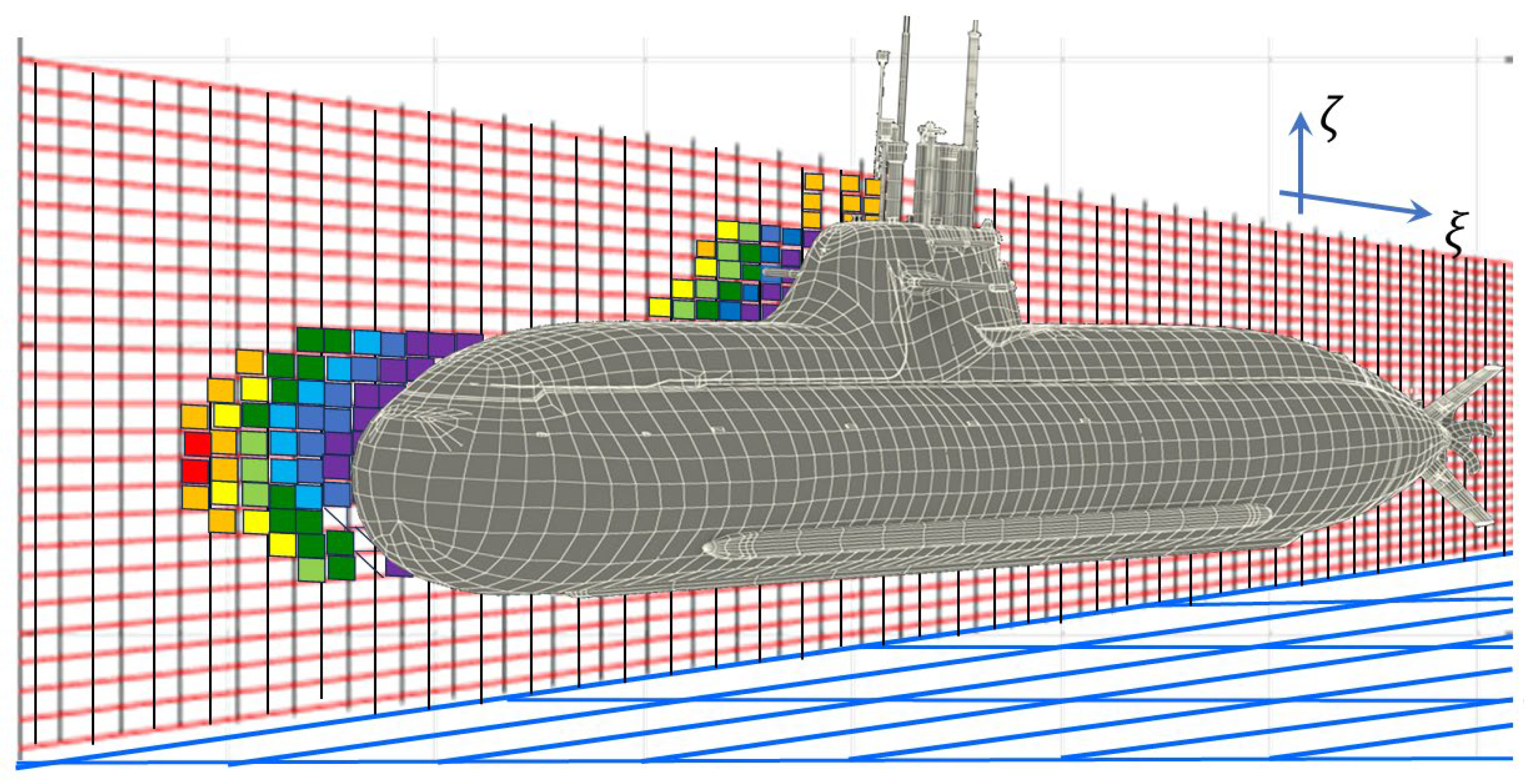
67]. First, the strength of the source at each point on the hull is taken as the gradient of the hull surface along the direction of motion, i.e., the effective area each differential surface element presents to the flow. Second, the surface of integration is approximated by projecting the differential elements of the hull surface onto the vertical center plane
, hence the ‘thin ship’ terminology, as illustrated in
Figure 40 for the case of a submarine.
After some mathematical manipulation (see [
73,
74] for details), this can be written
which we immediately recognize as a spectral representation. This is exactly what we want for our HF radar signature calculation because the scattering theory we use to compute the Doppler spectrum of HF sea clutter uses spectral representations as input. Looking first at the direct problem, in the presence of an ambient directional wave spectrum
, the total wave spectrum becomes
, where
. Substituting in the standard expression for the HF Doppler spectrum and retaining the terms that do not vanish (except for improbable combinations of vessel and radar parameters [
75]),
To solve the inverse problem for , we first need the ambient wave spectrum . This can be retrieved from clutter in neighboring resolution cells assumed free of wakes, as is done routinely in many HF surface wave (and some skywave) radar systems using methods reported in the open literature. Classification is then achieved by solving the linear Fredholm equation and comparing the extracted with entries in a library.
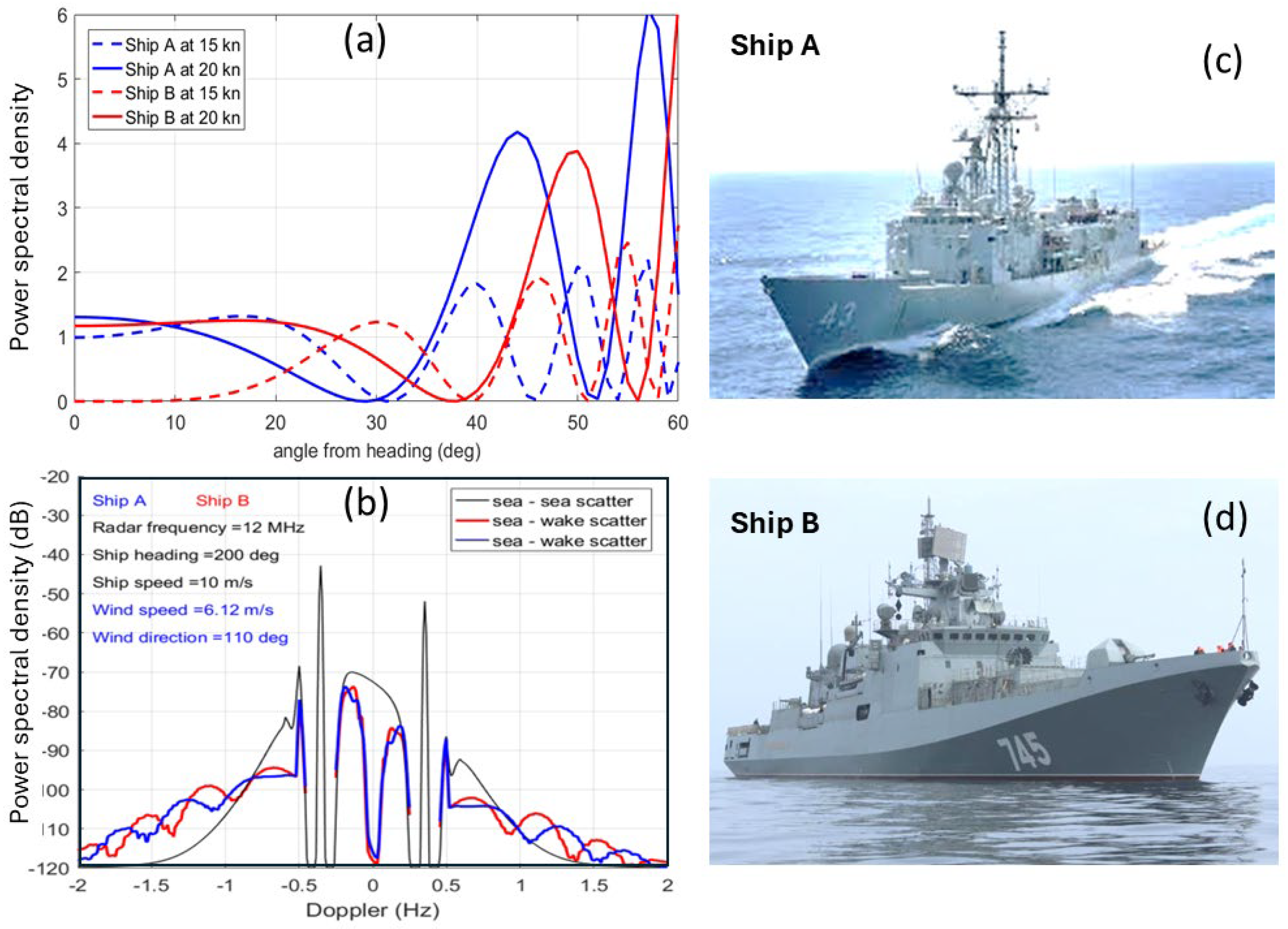
To demonstrate the sensitivity of wake signatures to hull geometry, consider
Figure 41 [
76]. In
Figure 41a, we show computed wake spectra
of two frigates, computed for two speeds; the vessels are pictured in
Figure 41b,d.
Figure 41c, compares their respective Doppler spectra at a common speed. The results indicate that classification to type (recognition) is quite achievable in this case.
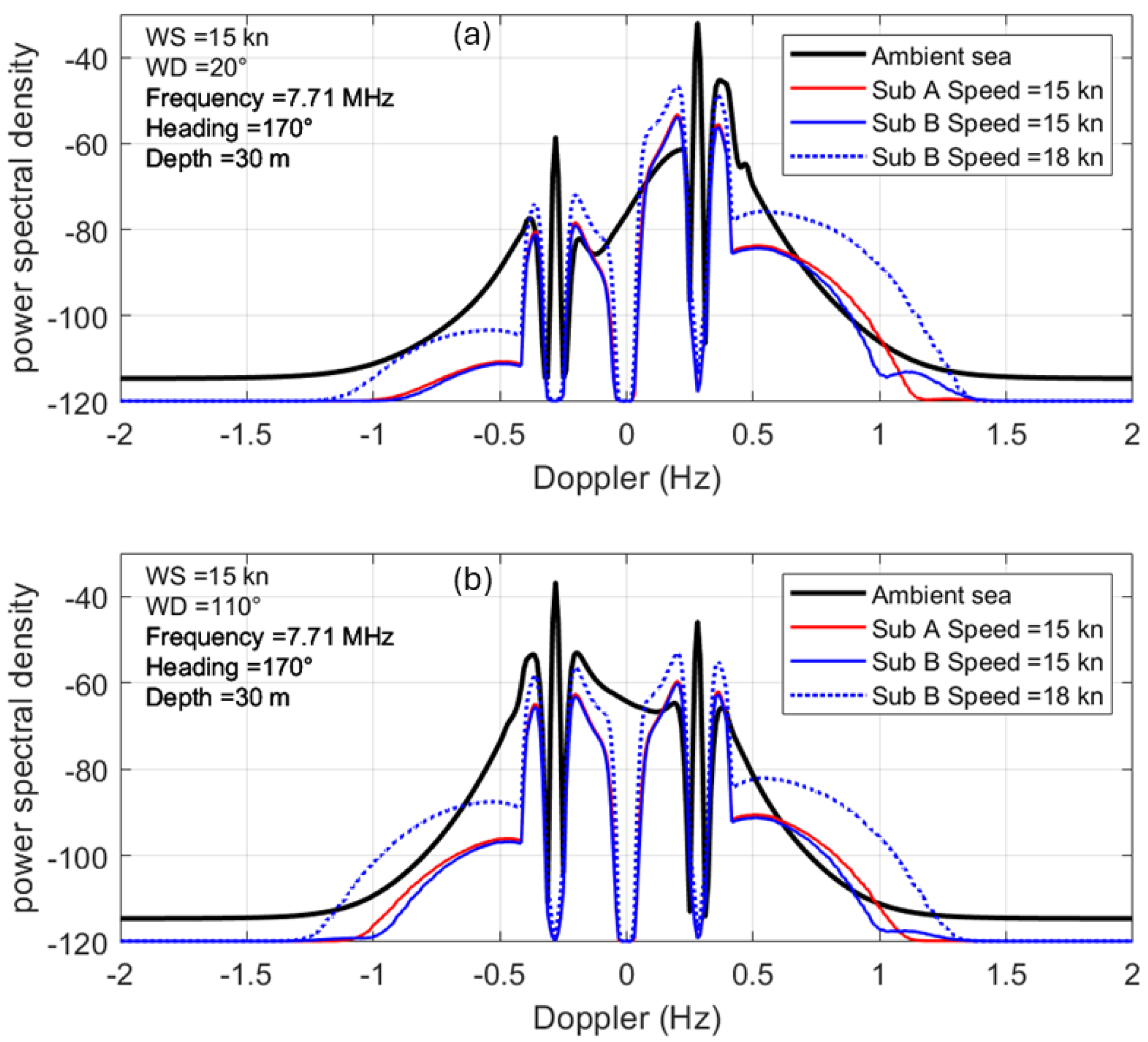
As a second example,
Figure 42 compares the Doppler spectra of two SSK submarines at the same speed, along with the spectrum of one of them at a speed 20% greater. In this example, the submarines have dimensions differing by only a few percent, so their spectra are effectively indistinguishable, but the 20% change in speed has a strong impact.
Another study looked at the possibility of an HF radar ‘Plimsoll line’, that is, determining vessel loading from its wake [
77]. A study of scenario dependence can be found in [
78]. We conclude that wakes are a viable classification and recognition domain for surface ships, even when of the same class, but would be more problematic for submarines.
- B.
Plumes
Rocket exhausts consist of a supersonic stream of combustion products, some ionized, including high concentrations of free electrons. The dimensions and plasma properties of the exhaust plume are functions of the rocket fuel, the nozzle geometry, the velocity of the stream, the ambient pressure, and the speed of the rocket, all parameters of interest for target classification.
Many observations have shown that HF radio waves reflect from the ionized plume, despite the fact that incident radio waves undergo strong attenuation passing through the plume to the rocket body. Several researchers have modeled the rocket–plume composite as a time-invariant but electrically inhomogeneous structure attached to the rocket body. This simplistic model fails to account for the highly Doppler-spread echoes observed in HF radar measurements of rockets in their boost phase, so improved models attribute these components to scattering from plasma inhomogeneities generated by turbulence, as well as continuing combustion of ejected fuel remnants. The large Doppler spread of these echoes can result in energy being aliased across the entire Doppler space, with the extent dependent on the viewing geometry and the radar waveform. Hitherto, interest has focused on the detection problem, so there has been no need to unravel the details of the spectrum.
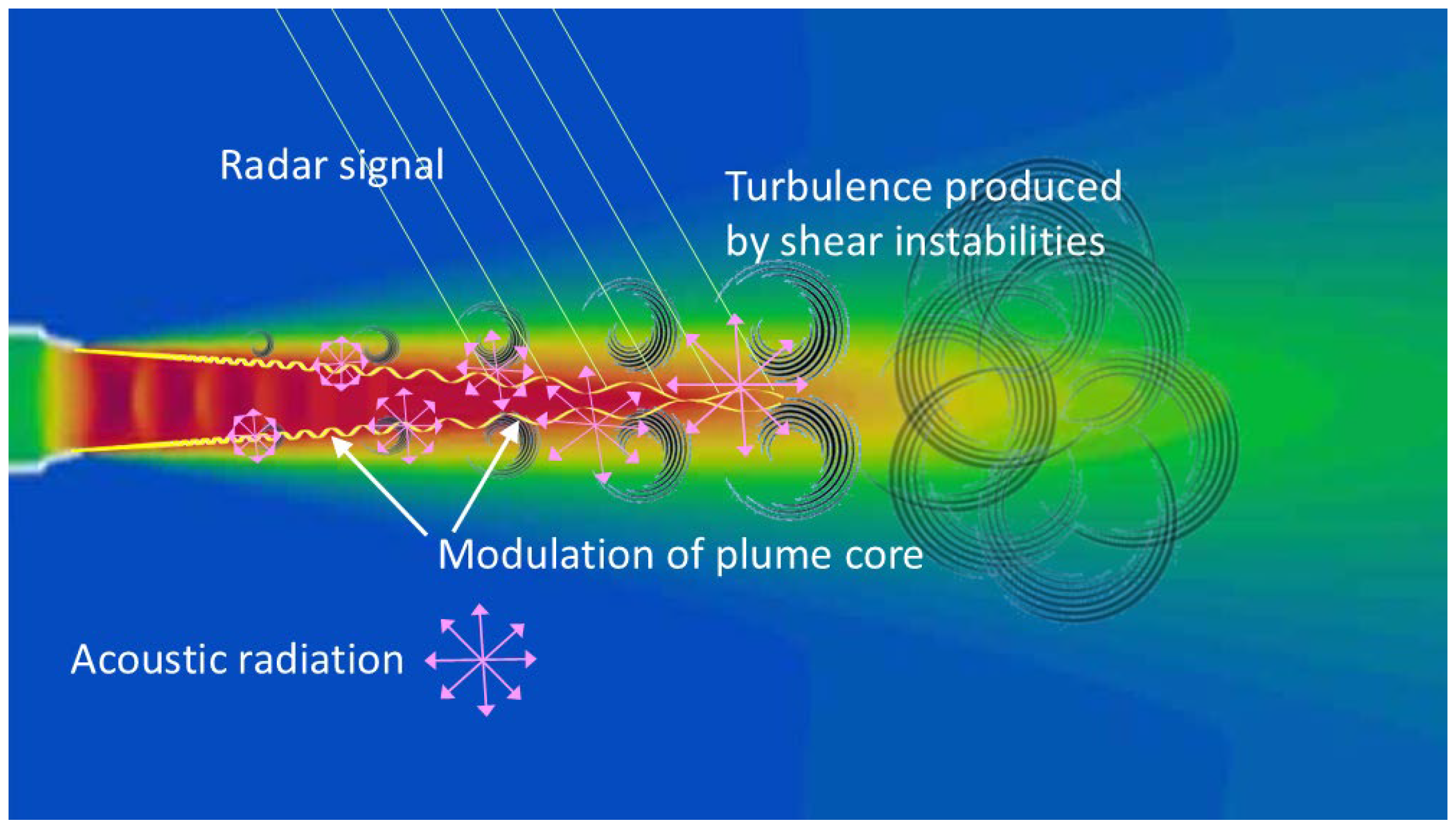
Recently, it has been conjectured that HF scattering from the plume could reveal enough information about the rocket plume characteristics to recognize the type of motor and hence recognize the vehicle. The basis of this proposition is the recognition that there is an additional mechanism for imposing a Doppler spectrum on the radar echoes. As pictured in the cartoon of
Figure 43, the vortices created by shear instabilities along the plume boundary evolve as they are advected along the plume (in the reference frame of the rocket), becoming larger as they travel downstream. The associated pressure fluctuations act as acoustic sources, concentrated in the shear layer.
Measurements of the noise generated during rocket launches, usually with the motivation of assessing effects on people and equipment, have established that the frequency spectrum radiated by these sources moves to lower frequencies as one considers volume elements further downstream, entirely consistent with the source size. Further, the experiments reveal that the strength of the sources rises to a peak near the distance downstream where the shear layer has grown inwards to the core of the plume, where the turbulence levels are amplified due to collision of the unsteady flow features from the circumferential shear layer. In other words, a natural bandpass filter is formed.
In addition to radiating outwards, the highly energetic acoustic radiation also propagates onto the sharp boundary of the highly ionized core. The new hypothesis argues that this would impose a modulation that could manifest itself in radar echoes. The potential for classification then rests on the existence of mathematical or empirical relationships between features in the radar echoes and the plume parameters.
Several such relations exist. First, the laminar core length
can be related to the nozzle exit diameter
and the (fully expanded) exit Mach number
by [
79]
It is convenient to introduce a dimensionless parameter, the Strouhal number
, which is useful for analyzing oscillating unsteady fluid flow. It expresses the ratio of vibration-to-flow velocities and is defined as
where
is the characteristic frequency of vortex shedding on the shear layer boundary,
is the exit flow velocity,
, with
the speed of sound, and
is a characteristic length, often set equal to
, but, in our case, we equate it to
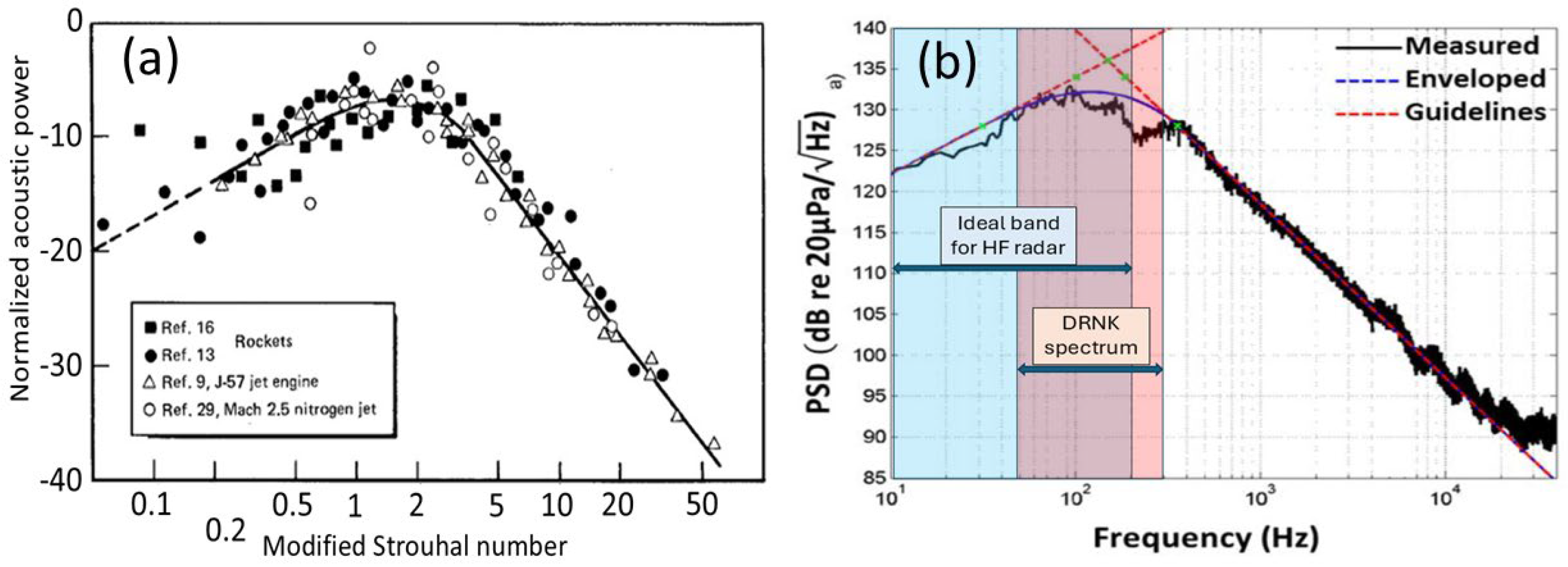
The utility of the Strouhal number stems from universality of the acoustic spectrum shape vs.
, as shown in
Figure 44a; a measurement of the acoustic spectrum of the Orion-50S XLG rocket motor is shown in
Figure 44b to illustrate the suitability of HF radar as a sensor in this context.
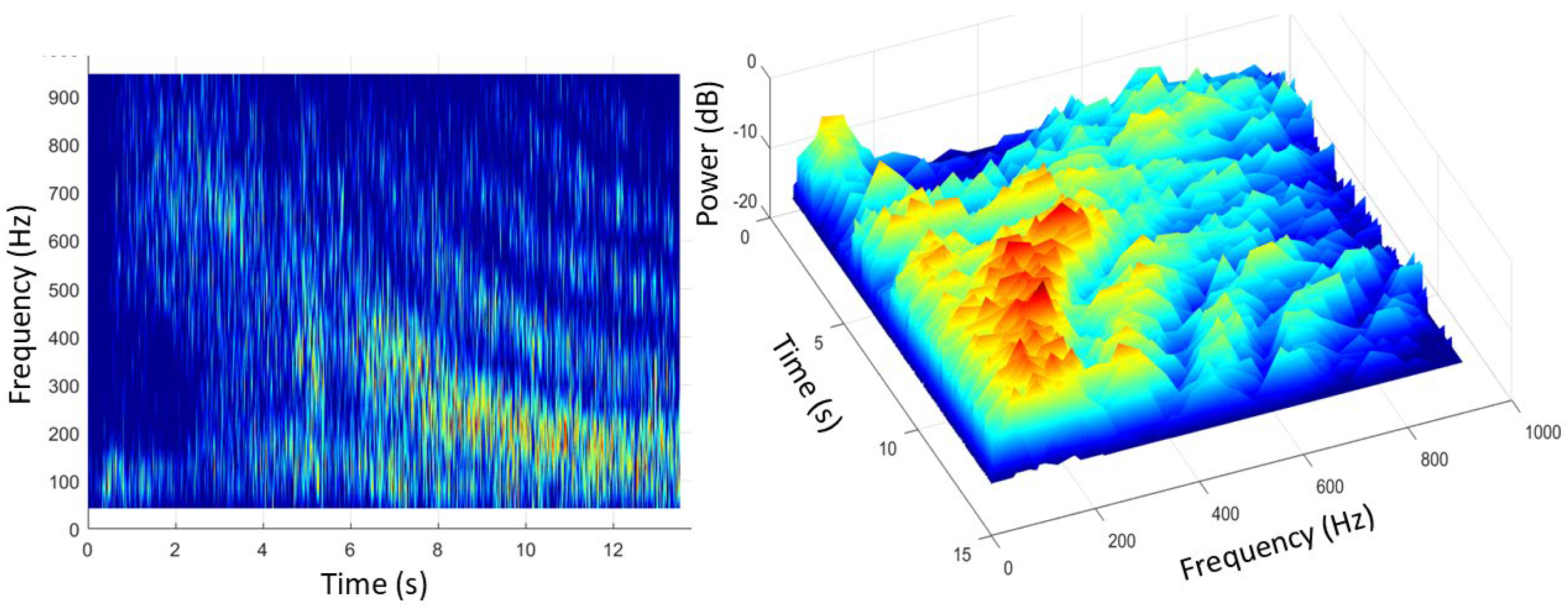
To test this idea, we have carried out spectrum analysis of the audio from an online news video of a ballistic missile launch in the Democratic Republic of North Korea. The spectrogram is presented in
Figure 45. It shows a strong fundamental and several harmonics, with a common drift to lower frequencies as the missile ascends. The frequency band has been added to
Figure 44b, showing that HF radar is well suited to this mission.
The fundamental frequency in this case is near 480 Hz after 6 s, decreasing to about 180 Hz after 12 s when the rocket is clear of the ground. We have no way of knowing whether the nonlinearity responsible for the harmonics resides in the plume source or the equipment used to record the event. In any case, the frequency spread of several hundred Hz certainly accounts for the aliasing seen in the experimental data to which we have had access.
There are more unknowns than measurements, but as an exercise, we have estimated the core length from the video and this, together with the formulae and the figure, leads to an estimate of the exit velocity and thence to an estimate of the nozzle diameter.
We stress that the proposed mechanism for missile classification or recognition is speculative, and our analysis perhaps overly simplistic. Even so, it is an idea worth pursuing with more experiments, especially given the scenarios in which it might be relevant. Moreover, its inclusion here may provoke thought on the part of the reader, who may conceive other approaches that have eluded the present author.
- C.
Diffuse scatter
The standard model for skywave detection of airborne targets allows for ground reflection as well as the ionospherically reflected descending rays, so the propagation operators
and
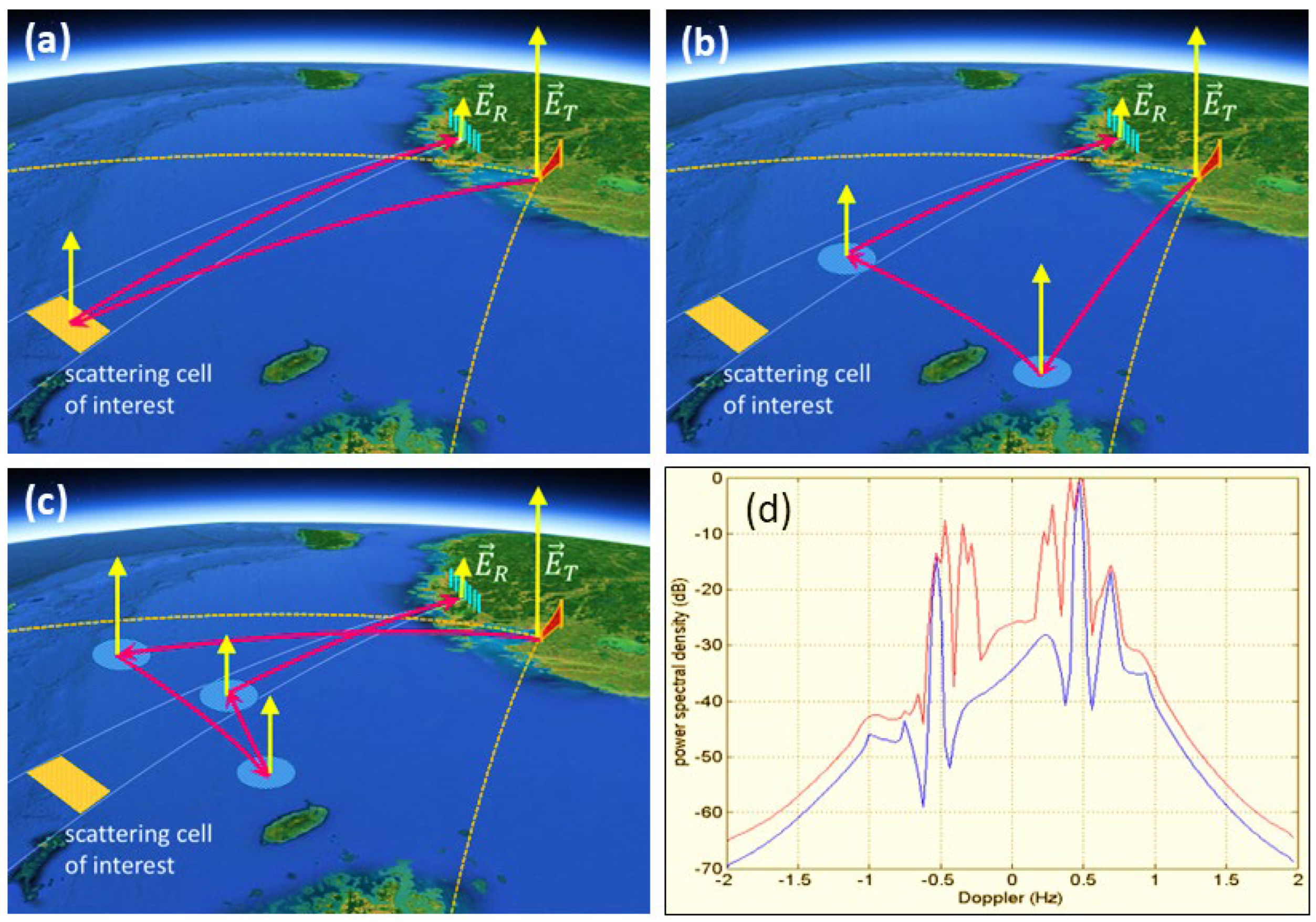
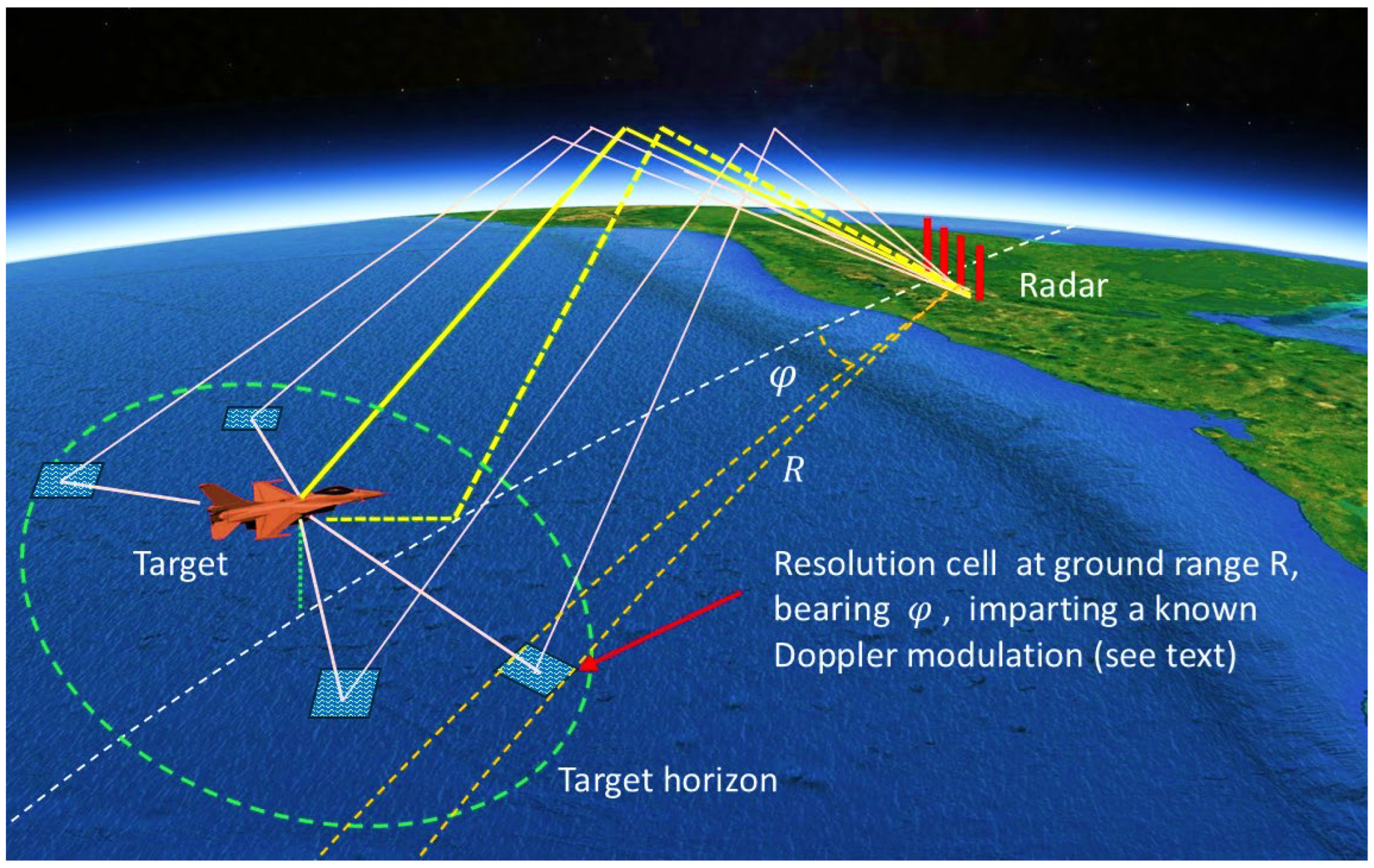
need to accommodate four possible two-way signal paths. (The group paths are slightly different, as well as the scattering geometries and Doppler shifts, motivating some researchers to exploit these effects to estimate target altitude, but with very limited success.) An experiment we carried out in the 1980s demonstrated that this basic four-path model is grossly simplistic. Diffuse scatter from the entire region within the elevated target’s horizon can contribute via bistatic surface scatter, as illustrated in
Figure 46.
Using the process model, the signal
arriving over the one-way path in the absence of diffuse scatter can be written [
81]
where
, , is the atmospheric propagator,
is the skywave propagator, and
is the emitter gain in the direction from
to
. The first term is the direct skywave path, the second the ground-bounce path. If the surface is rough, it will support diffuse scatter, so we need an extra term,
This diffuse scatter brings a host of benefits, most of which we have reported elsewhere [
82]. Here, we focus on the role it can play in target classification. To see this, we linearize the operator expression for the two-way propagation, writing
to represent the combination of the standard great circle 1- and 1+ rays,
Both and terms arrive at the receiver along the great circle through radar and target, so, by spatial filtering, we can isolate the last term. In a more explicit form, the received signal to be used for classification appears as a distribution over group range, azimuth, and Doppler, where the Doppler shift includes the contribution from the target velocity and the modulation from the sea clutter Doppler spectrum (only the first-order terms are significant in our application). The amplitude factor follows immediately from the directional wave spectrum, retrievable from the radar data as mentioned earlier. The remaining unknown is the aircraft altitude . This can be estimated from the limits of the azimuthal spread of the echo, , even when the distribution is asymmetric.
Diffuse scatter in HF surface wave radar presents a similar but less complicated scattering configuration, mentioned in
Section 3.2. A detailed theoretical model was reported in [
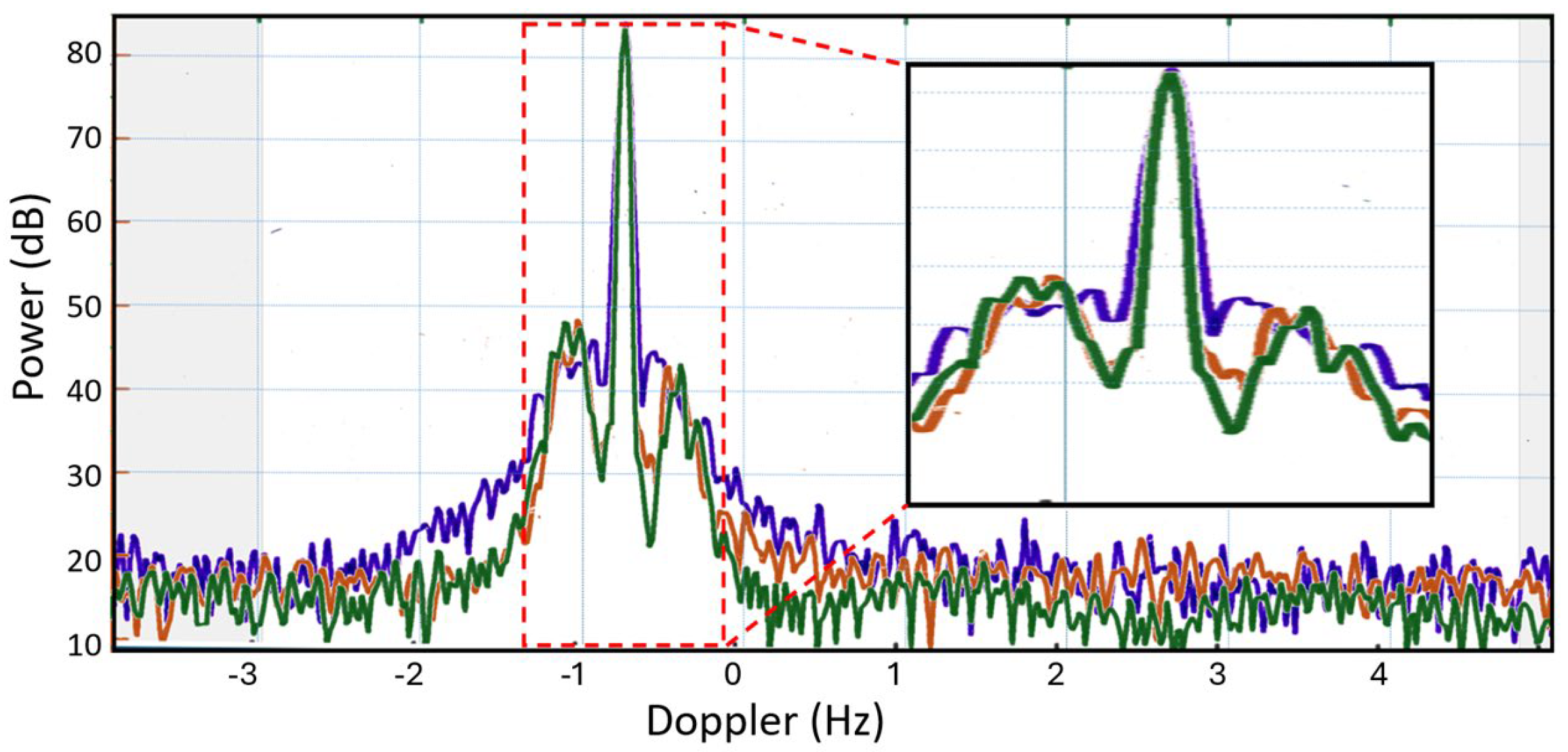
44] and validated in various experiments for the static emitter case. This work was extended by experiments in 1999 with the Iluka HFSWR that measured the one-way propagation operator by radiating from a vertical monopole antenna on a small boat in the target zone at ranges extending to 120 km from the receiving array [
82]. The contributions from diffuse scatter processes were observed with the boat stationary, moving towards, and moving away from the receiver and in tight circles for calibration of the radiation pattern. Measurements confirmed the role of intermediate scattering from the sea surface, as illustrated in
Figure 47. Here, the curves shown in green and brown were recorded from the stationary boat at two ranges, 90 km and 100 km, while that in blue was recorded with the boat traveling towards the radar at 12 knots. For ease of comparison the boat Doppler shift has been removed.
The slight broadening of the direct signal in the blue curve, relative to the others, is indicative of the greater hull motions when underway. The high dynamic range shown does not provide the fine resolution in power needed to reveal any associated small change in peak amplitude, but that is of secondary concern here—we are presenting experimental evidence for the presence and importance of diffuse scatter contributions on HFSWR paths.
Again, the curves show the power received on the shore from the transmitter on the boat, not an echo from a transmitter on the shore. The latter case, involving two-way propagation, can be modeled from the one-way propagation measurements by convolution over the spatial and temporal domains.
The classification potential of the diffusely scattered echoes follows from the bistatic scattering cross section of the vessel, which can be retrieved from the range–Doppler map.
- D.
Dynamic signatures
A conjugate to the generation of wakes by a moving ship is the ship’s response to forcing applied to the wetted surface of the ship by the ambient ocean waves.
Figure 10, presented in
Section 4.1, identifies the six degrees of freedom that describe translational and rotational rigid body motions. Ships are also subject to bending and torsional stresses that are capable, in rough seas, of modifying the ship geometry enough to have an effect on the HF radar signature. Here, we shall consider only the rigid body motions.
To compute the radar signatures associated with these motions, we need models for three separate dynamical processes. First, there is the ambient sea state, customarily represented by a directional wave spectrum of deep-water gravity waves, with secondary effects arising from nonlinear interactions. Parametric models have been developed to represent such spectra, though these usually need to be supplemented with models for swell. Second, there is the response of the ship to the forcing from these waves. This is not straightforward because the spectrum felt by the ship is that observed in its own frame of reference, not the spectrum measurable in geocentric coordinates.
When a platform traveling at speed
encounters a wave with wavevector
and intrinsic angular frequency
, the angular frequency observed by the ship—the encounter frequency—is given by
The wave energy spectrum
that is experienced by the ship is then related to the geocentric energy spectrum
by the Jacobian,
For some degrees of freedom, notably pitch and roll, the wave slope spectrum is the primary actor. In this case,
Within the domain of validity of a linearized approach, the response of a ship to a spectrum of waves is the sum of the responses to the component sinusoidal waves. For each ship degree of freedom, there exists a measure of its response to a given encountered wave, a transfer function defined in the frequency domain. Usually interest focuses on the magnitude, not the phase of the response, so the squared magnitude of that transfer function is used to characterize the sensitivity of that degree of freedom; this is known as the Response Amplitude Operator (RAO) for that degree of freedom [
83]. It follows that the variance of the associated motion of the ship is given by the product of the RAO and the encounter frequency spectrum,
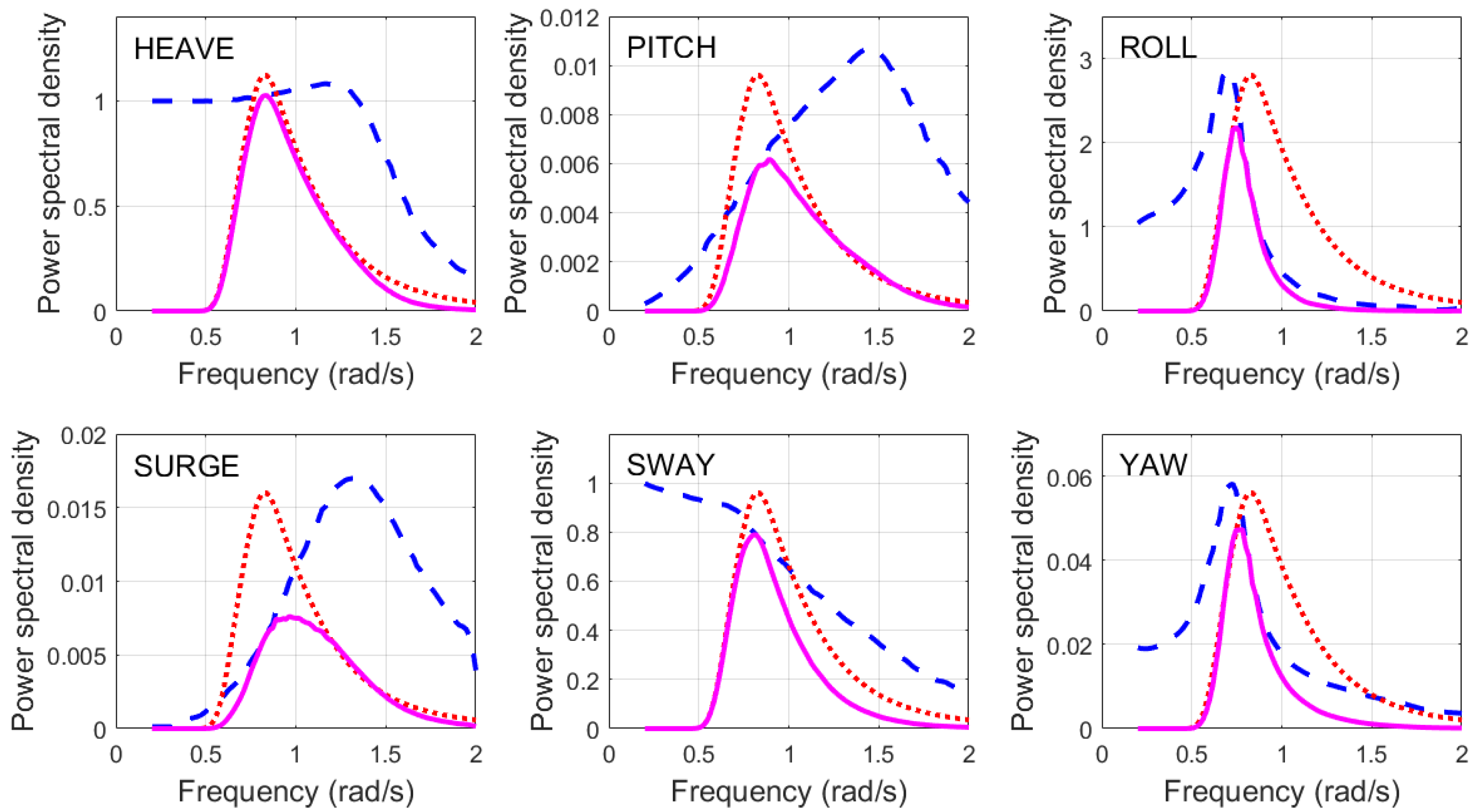
We illustrate this idea in
Figure 48. The importance of this to target characterization with HF radar stems from the fact that the RAOs can be precalculated and stored for known ships, while the radar itself can measure
and hence
, which is easily converted to
or
once the ship heading has been estimated. However, what the radar measures is not
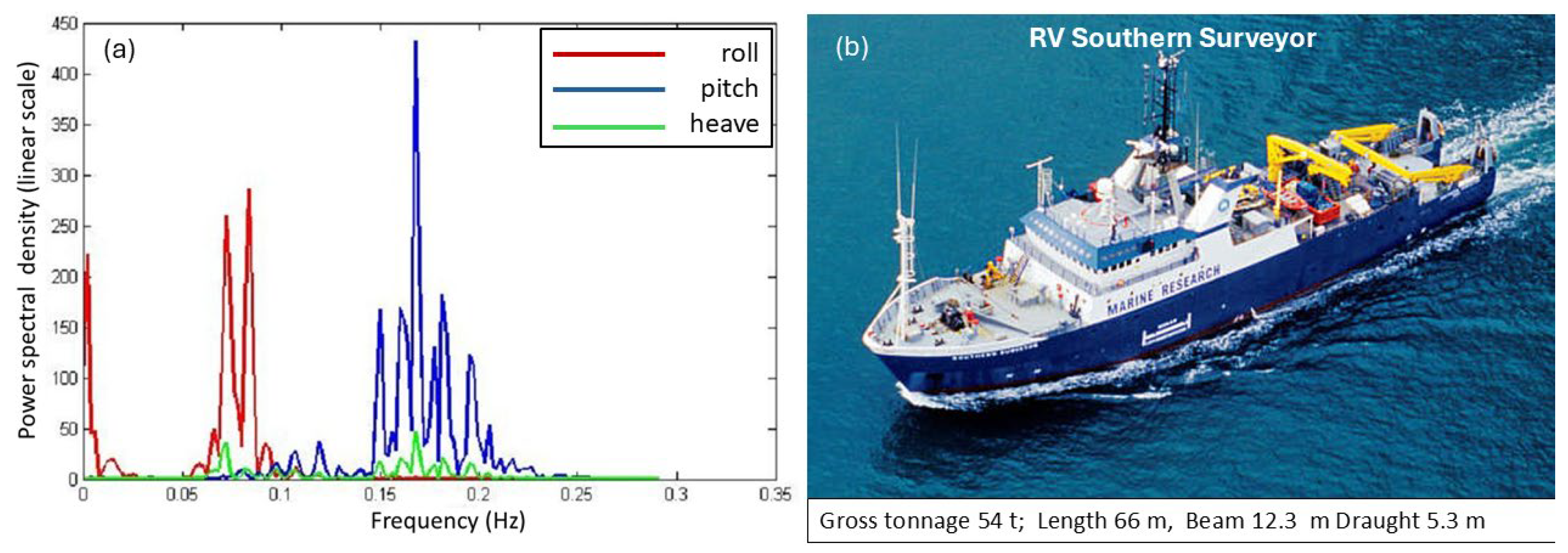
but, as the process model dictates, a proportional quantity that includes as a factor the ship RCS (or scattering matrix), which varies as the ship changes its orientation relative to the radar. Further, if a certain depth of modulation of RCS is observed and associated with ship roll, say, based on the oceanographic measurements, it is hard to discriminate between (i) a large roll angle of a ship with a small RAO and (ii) a small roll angle for a ship with a large RAO. It would seem plausible to suggest that this ambiguity might be resolved by high-fidelity electromagnetic modeling of ship scattering characteristics as a function of aspect. We continue to explore this avenue, guided by measurements such as
Figure 49a, which shows a superposition of onboard measurements of
,
and
recorded on a CSIRO oceanographic vessel, pictured in
Figure 49b. As roll can exceed 25° for frigates in high sea states, and pitch may reach 10° or more in head seas, the resulting aspect modulation of the radar scattering signature is likely to be observable in such conditions.
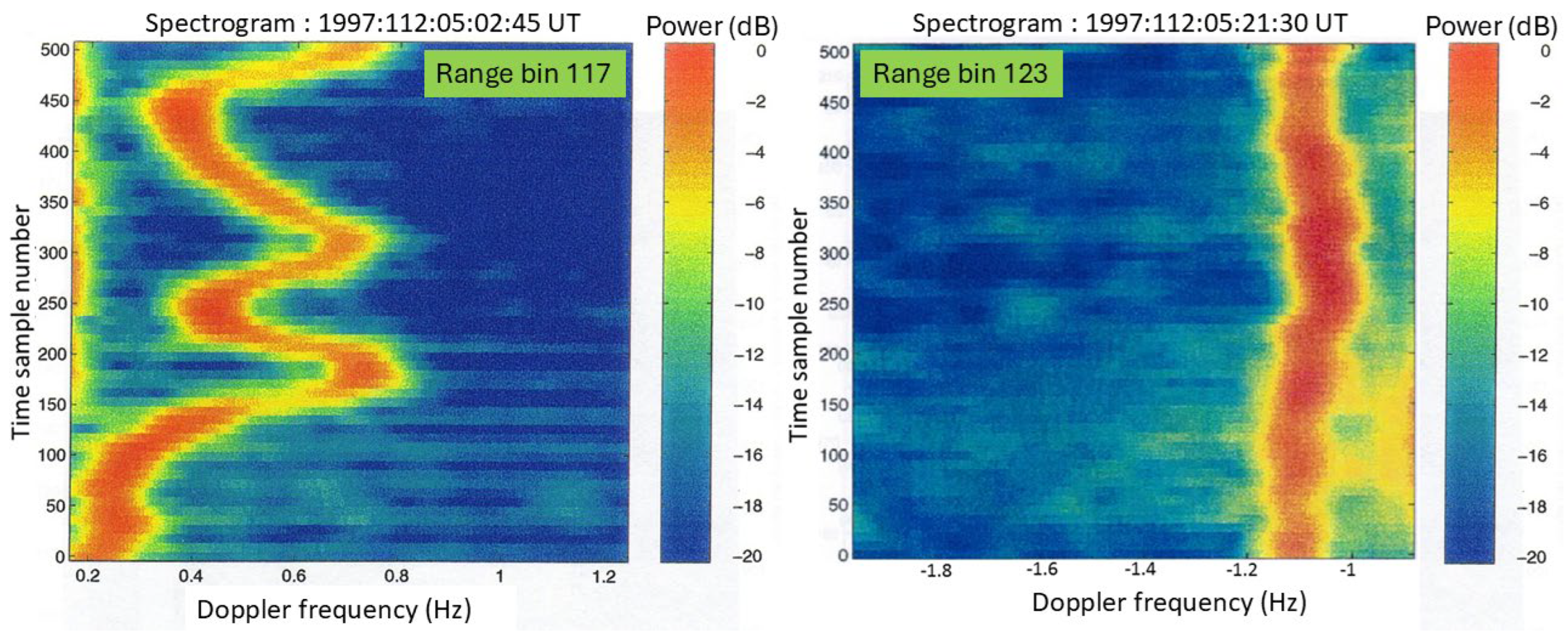
To illustrate the feasibility of the basic idea of what might be termed a form of micro-Doppler, consider
Figure 50, which shows two spectrograms, each recorded over 128 s at a frequency of 3.90 MHz [
86]. On the left, the trace shows the echo from a small motor launch that is maneuvering in a roughly sinusoidal pattern about an inbound course. We can see a correlated variation in amplitude as its aspect changes. On the right, we see the trace from the same boat as it attempts to motor at constant speed in a linear course in sea state 1. We can see fluctuations in Doppler despite the best efforts of the pilot to maintain constancy, surely deserving of the term micro-Doppler.
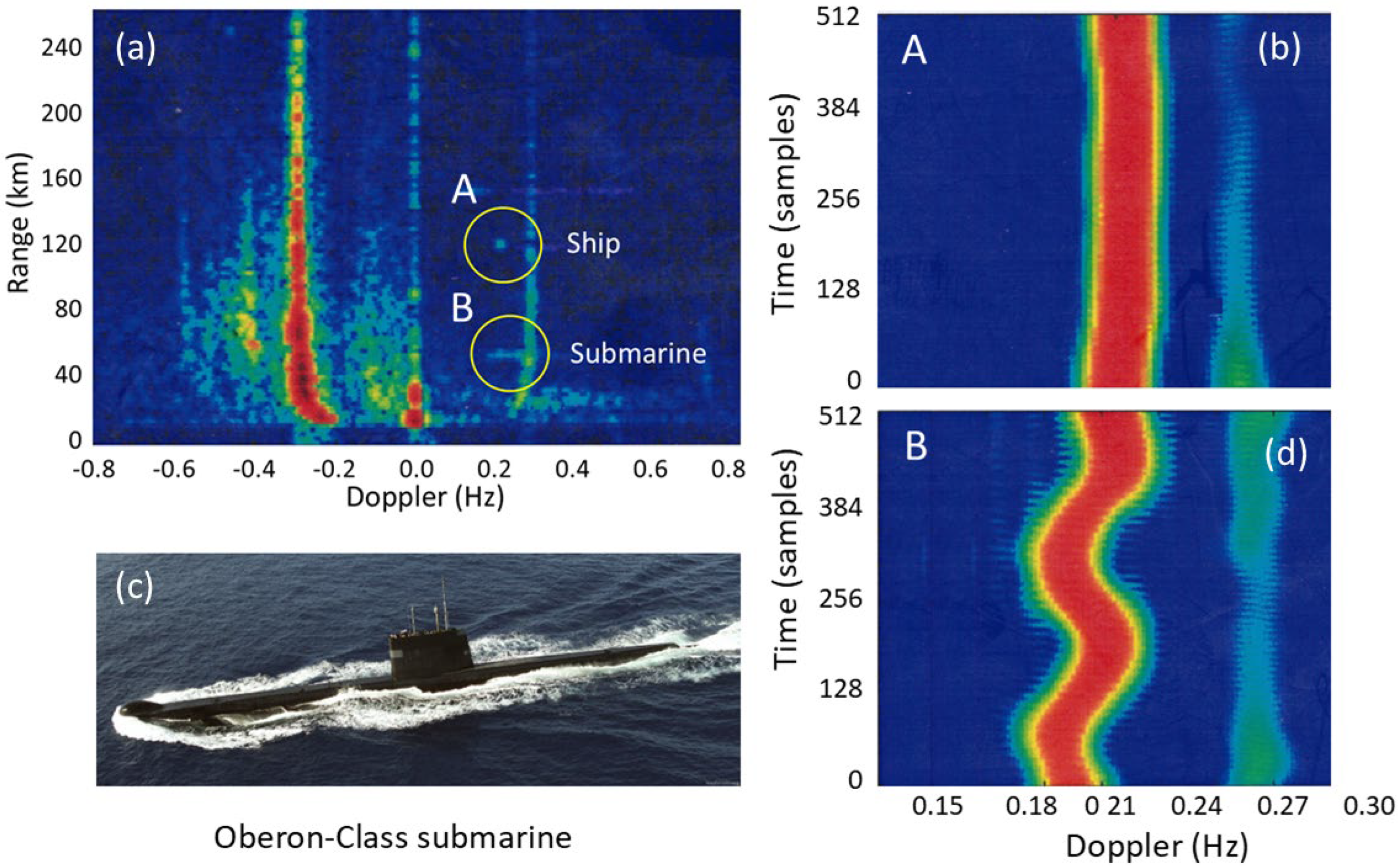
A different situation is shown in
Figure 51, which shows the trace from an Oberon-Class submarine steaming on the surface at an intended constant speed but exhibiting phase modulation that we would normally attribute to platform-controlled Doppler. However, on this occasion, the vessel was experiencing significant pitch and surge motions due to a strong following swell from the Southern Ocean, so the phase modulation could contain the effects of both advective Doppler variation over the phase of the swell and RCS modulation as a function of pitch angle, manifesting as a phase modulation. For short vessels, the latter is observable, but it is unlikely in this case, judging by the results shown in
Figure 33d,e.
This historical data is not accessible for refined analysis of echo power variations but, given a little environmental information, we could obtain a crude estimate of the consistency of the surge hypothesis by modeling the speed-over-ground (SOG) measured by the radar as the sum of the speed-through-water (STW) and the bulk fluid motion associated with the swell of period
. For deep-water waves, the echo modulation period
(for both surge and RCS) is then given by
The results in
Figure 51d show an oscillation with a period of ~16 s, which is in reasonable agreement with the prediction from the formula given typical submarine speeds on the surface and the prevailing environmental conditions—heavy swell with a period in the range 10–13 s.