1. Introduction
With the rapid growth in demand for ubiquitous and seamless communications, network technologies have gradually expanded from terrestrial to space-based. Low-Earth orbit (LEO) satellite networks will occupy an indispensable position in future space–terrestrial integrated networks (STINs) due to their wide coverage, high throughput, and low delay [
1]. In recent years, mega-constellations such as Starlink, OneWeb and Telesat have provided worldwide access and seamless coverage services for terrestrial terminals [
2]. Satellites carrying different payloads can cooperate with each other to provide end-to-end transmission services. Emerging time-sensitive applications such as emergency rescue, combat command, and remote control impose rigorous requirements on deterministic and real-time performances. This time-sensitive traffic needs to be delivered within a bounded low delay, meaning that in the worst case, the delay should satisfy the upper bound of the delay requirement. However, existing LEO satellite networks generally adopt the best-effort forwarding mode, which causes uncertainty in delay. Hence, one of the most challenging current problems is how to implement deterministic communication for time-sensitive traffic appearing in LEO satellite networks.
Fortunately, newly developed deterministic networking technologies such as time-sensitive networking (TSN) [
3,
4] and deterministic networking (DetNet) [
5] can support bounded low delay, high throughput, and high reliability for both terrestrial and non-terrestrial networks. At the same time, these deterministic technologies can support the coexistence of time-sensitive and non-time-sensitive traffic. As the most mainstream deterministic technology, TSN, which originated from terrestrial ethernet, is gradually being applied to the industrial internet [
6] and in-vehicle networks [
7]. Wireless demand is driving the expansion of TSN to wireless networks such as WiFi and 5G [
8,
9]. Recently, some researchers have attempted to migrate terrestrial TSN technologies to the aerospace field [
10,
11] in order to improve the throughput and reliability of internal systems. By analyzing the service quality requirements on switches inside satellites, a possible TSN architecture for an intra-satellite network was designed and the feasibility of the TSN synchronization and scheduling protocols was preliminarily verified [
10]. In addition, TSN ethernet technologies were designed and implemented in microlaunchers through the field-programmable gate array (FPGA) [
11]. These existing studies indicate that TSN technologies can provide determinism and reliability services for an internal network of satellites.
It is well known that the transmission range of time-sensitive traffic should not be limited to internal network of satellites; rather, it is highly necessary to extend TSN technologies to wireless networks through multiple inter-satellite links. The authors of [
12] presented the Space–Terrestrial Time-Sensitive Network (STTSN) architecture, in which space, aerial, and terrestrial TSN clusters are integrated. Some researchers have also attempted to solve the problem of end-to-end deterministic communication in satellite networks. To provide differentiated guarantees, multilevel cyclic queues with latency requirements were investigated in [
13]. Similarly, by modifying cyclic queuing and forwarding (CQF) on a single satellite, a latency tolerance scheduling algorithm through multi-hop collaboration was proposed by [
14]. Motivated by challenges of dynamic topology and limited transmission resources of satellite networks, a deterministic transmission approach was developed from aspects of routing, coding and scheduling in [
15]. To achieve effective transmission of time-sensitive services in STINs, FastTS with multipath redundancy was presented in [
16], with reliability assurance and delay optimization considered simultaneously. These studies all treat the satellite as a single node, but do not consider the internal network.
As can be seen from above, the time-sensitive scheduling mechanisms in intra-satellite and inter-satellite networks have been studied independently. However, the integrated scheduling on the output port of gateway has not been covered. Generally, the transmission rate of intra-satellite wired links is higher than that of inter-satellite wireless links. Inconsistent transmission rates make it impossible for data to be scheduled in a timely manner, which increases the queuing delay at the output port. In the worst case, congestion will occur at the integrated gateway inside the satellite. Thus, the bounded delay requirement of time-sensitive traffic cannot be guaranteed. Consequently, the integrated gateway becomes the bottleneck of deterministic scheduling. Existing research has not addressed this problem. Therefore, it is extremely necessary to explore an integrated scheduling algorithm in satellite networks. In this paper, an LEO constellation with wired and wireless integrated links is used as the application scenario and time-sensitive traffic is taken as the research target. To guarantee the deterministic delay experienced on the satellite, we propose an integrated scheduling algorithm based on matching game theory. The main contributions are summarized as follows:
To accurately quantify the impact of scheduling time slots on deterministic transmission of time-sensitive traffic on the satellite, an integrated scheduling model with the optimization objective of minimizing delay is established. The established model comprehensively takes into account the relationship among time-sensitive traffic, wired time slots, and wireless time slots.
Inspired by scheduling sequences and matching game theory, we transform the integrated scheduling model into a cyclic three-sided matching game model driven by preference lists. This transformed model simultaneously considers the preference demands of three core participating entities, namely, time-sensitive traffic, wired time slots, and wireless time slots. Each participating entity formulates the ordered ranking of decision-making preferences, which constitutes the preference list.
To obtain scheduling optimization solutions, we design an integrated scheduling algorithm based on matching game theory. For time-sensitive traffic, the positions of the wired and wireless time slots are jointly allocated by searching for the “best” triple, and an effective solution can be derived by the proposed algorithm.
The rest of this paper is organized as follows:
Section 2 presents the satellite network scenario and analyzes problems related to integrated scheduling;
Section 3 establishes the network model and formalizes the integrated scheduling problem;
Section 4 designs an integrated scheduling algorithm based on matching game theory;
Section 5 verifies the performance through a large number of simulation experiments; finally,
Section 6 summarizes the paper.
2. Satellite Network Scenario and Problem Statement
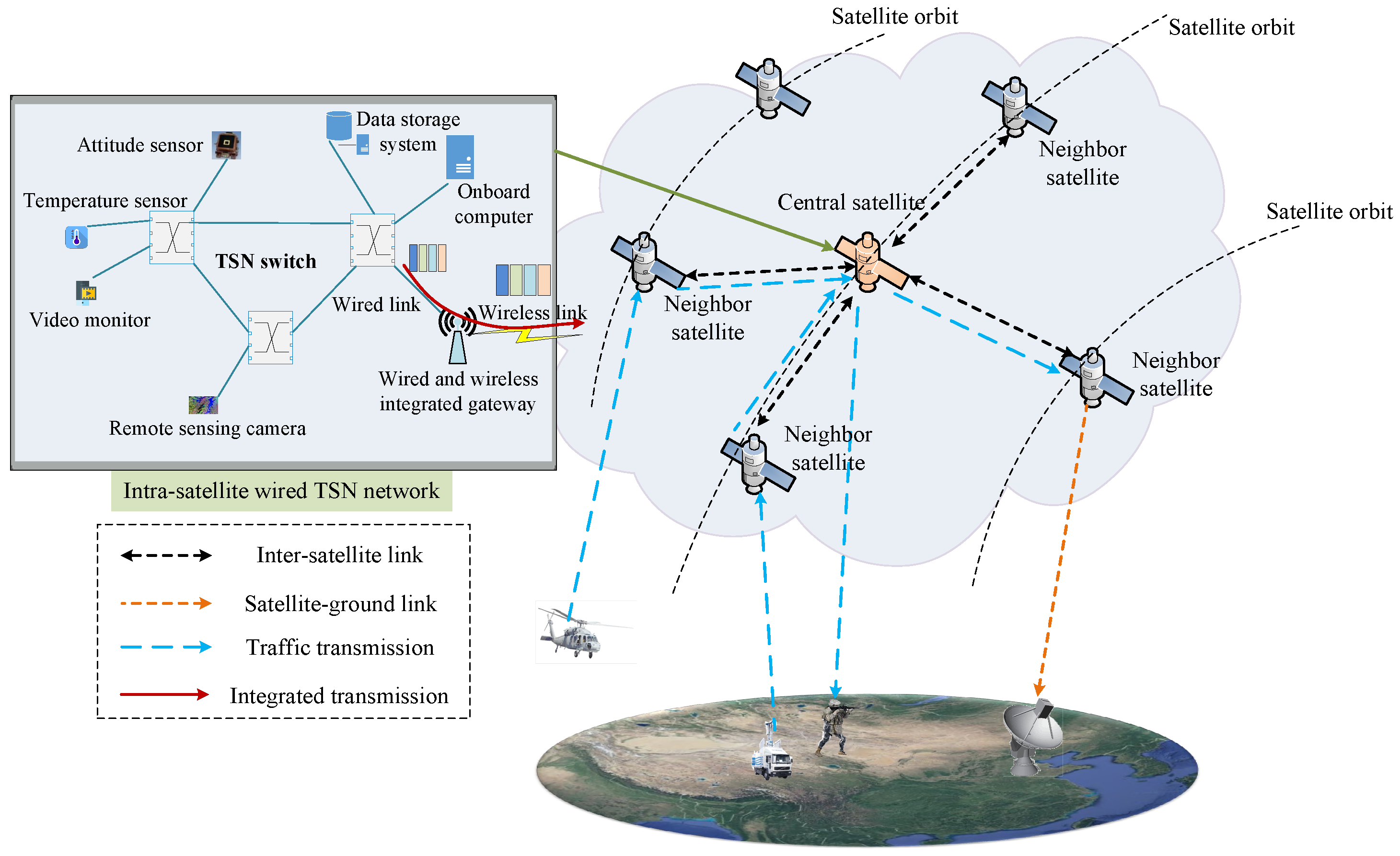
The LEO constellation scenario with wired and wireless integrated scheduling mechanism is shown in
Figure 1. All devices and switches within satellites communicate with each other through wired ethernet that supports TSN technology. Laser inter-satellite links are used as the communication medium between satellites. The typical time-aware shaper (TAS) scheduling mechanism originating from the IEEE 802.1Qbv protocol [
17] is adopted by the intra-satellite wired links; meanwhile, the time-division multiple access (TDMA) scheduling mechanism is utilized by the inter-satellite wireless links. Both TAS and TDMA can effectively avoid collisions by scheduling time-sensitive traffic in different time slots. As is well known, time-sensitive traffic can be transmitted over long distances through cooperation between intra-satellite wired links and inter-satellite wireless links in an LEO constellation. However, the transmission rate of wired links is usually higher than that of wireless links. Inconsistent transmission rates may increase queuing delay or even bring about congestion at the integrated gateway inside satellites. The final result is that the bounded delay requirement of time-sensitive traffic cannot be guaranteed. Fortunately, for time-sensitive traffic, the allocated intra-satellite wired time slots and inter-satellite wireless time slots will jointly determine the delay experienced on satellite. Therefore, it is very necessary to design an integrated scheduling algorithm to jointly allocate wired time slots and wireless time slots. To achieve deterministic scheduling on satellite with integrated links, the following two problems need to be resolved:
(1) How should we characterize the impact of wired and wireless integrated scheduling on the delay experienced at the satellite?
For time-sensitive traffic, the delay experienced at the satellite is determined by both wired and wireless time slots. For example, if the positions of the wired time slot and wireless time slot are both outside the transmission period of time-sensitive traffic, a scheduling timeout will occur. Ultimately, the determinism of delay is further impacted. Therefore, to achieve deterministic scheduling, it is necessary to characterize the impact of integrated scheduling on the delay experienced at the satellite.
(2) How can we achieve joint allocation of both wired and wireless time slots?
Integrated scheduling of intra-satellite wired links and inter-satellite wireless links is the key to realizing deterministic communication. Thus, for time-sensitive traffic transmitted on satellites, it is very necessary to achieve a stable forwarding delay. However, independently or randomly allocating wired time slots and wireless time slots will bring about uncertainty in the delay. Therefore, we face the issue of how to design an algorithm to realize the joint allocation of wired and wireless time slots based on the relationship among time-sensitive traffic, wired time slots, and wireless time slots.
3. Integrated Scheduling System Model
First, we provide an overview of the integrated wired and wireless network model in a satellite network. Second, the relationship between wired and wireless time slots is characterized by the scheduling model. Finally, the optimization objective of integrated scheduling is established.
3.1. Wired and Wireless Integrated Network Model
Regarding the wired and wireless integrated LEO constellation, the network model consists of satellites
and links
. Edge
represents the intra-satellite wired link, while edge
denotes the inter-satellite wireless link. The set
consists of terminals and switches that support TSN technology, and the topological relationship of devices within the satellite is relatively fixed. The set
is composed of edges connecting two adjacent satellites. With the periodic motion of satellites, the ISL distance between two adjacent orbital planes changes with time. However, the topology connection relationship will remain relatively stable in a period of time [
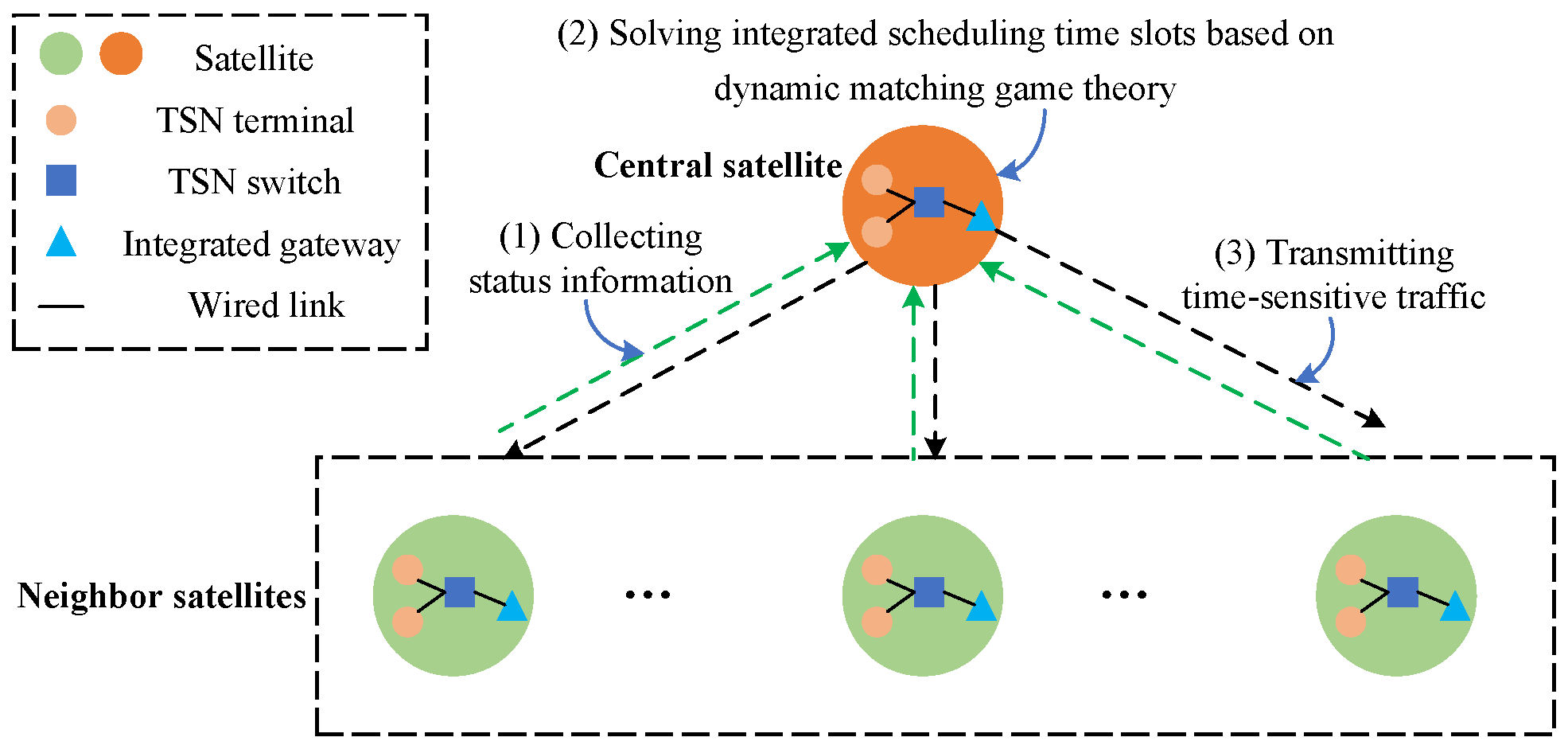
18]. Thus, wired and wireless integrated scheduling can be converted into a problem of continuous scheduling within multiple adjacent time intervals. A simple integrated scheduling process is shown in
Figure 2. To achieve deterministic scheduling on different satellites, the central satellite is responsible for allocating and adjusting scheduling time slots autonomously.
For ease of distinction, we define two types of time slots: topology slots and scheduling slots. A topology time slot means that the connection relationship between satellites remains unchanged within a given time. A scheduling time slot refers to the time slice used to transmit time-sensitive traffic on wired and wireless links. It is worth noting that the duration time of a topology time slot is greater than that of a scheduling time slot; this ensures that time-sensitive traffic is fully scheduled before the topology changes. The topology time slot is represented by
. The total number of topology time slots is
. Let the set
denote time-sensitive traffic in
t, where
; the set
represent wired time slots in
t, where
; and the set
express wireless time slots in
t, where
. The integrated scheduling relationship between
,
and
can be expressed as the three-sided matching
. For ease of reading,
Table 1 provides a description of the main notation.
The variable
indicates the assignment of the wired time slot
to the time-sensitive traffic
. Similarly, the variable
denotes the allocation of the wireless time slot
to the wired time slot
. The above two categories of binary variables are defined as follows:
and
3.2. Wired and Wireless Integrated Scheduling Model
To intuitively display the scheduling relationship between wired time slots and wireless time slots, an integrated scheduling model for time-sensitive traffic is established. Thus, the relationship between integrated scheduling and deterministic transmission is effectively characterized via mathematical model.
3.2.1. Concepts of Hyperperiod and Subperiod
In LEO satellite networks, time-sensitive traffic
is generated at regular intervals with a fixed amount of data. For the sake of convenience, we define several parameters: the traffic generation period is represented by
, the data volume is indicated by
, and the required delay to meet the deadline is denoted as
. Furthermore, the properties of
can be characterized by the tuple
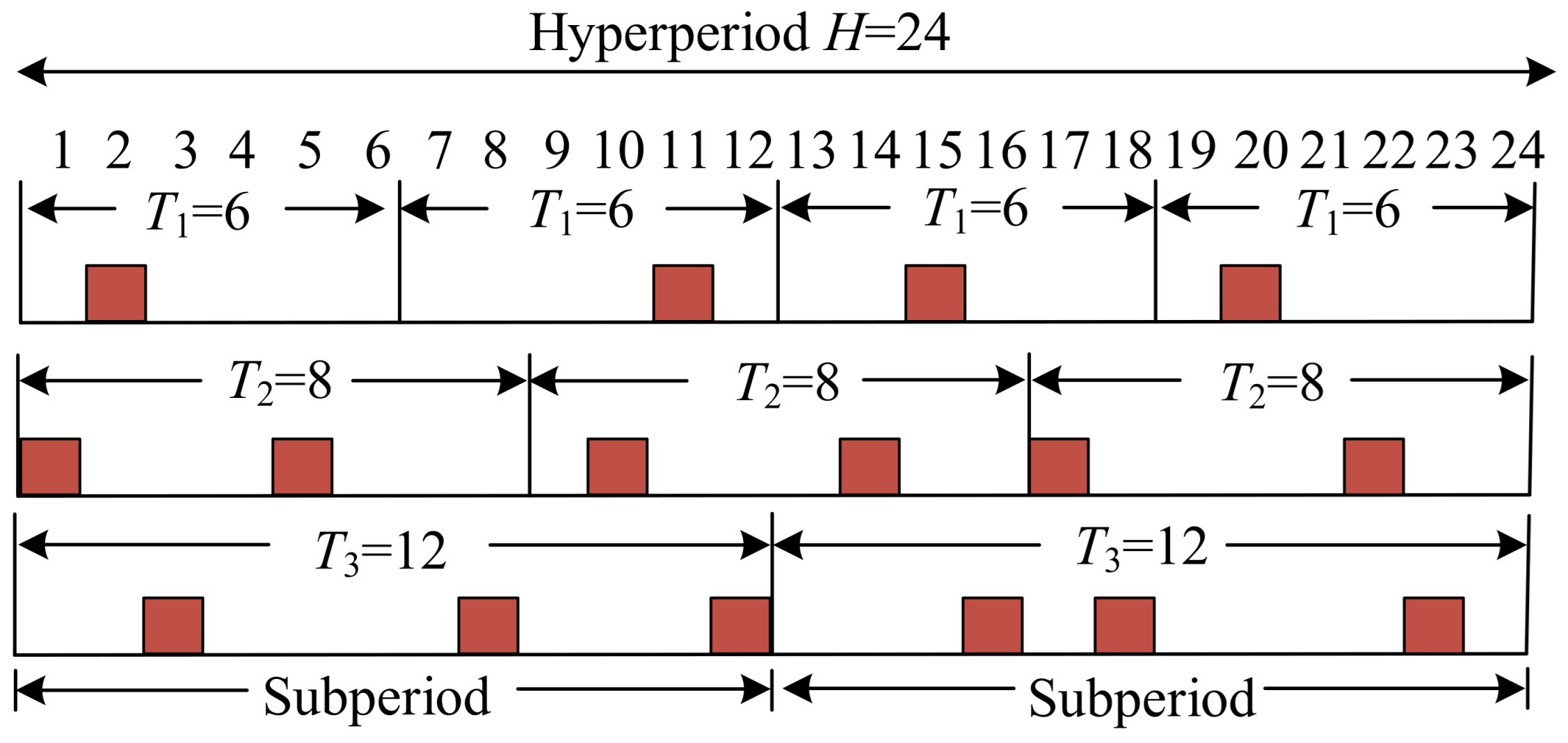
. To facilitate effective scheduling, we introduce the concepts of hyperperiod and subperiod, as illustrated in
Figure 3. The red squares in
Figure 3 represent time slots occupied by time-sensitive traffic. The subperiod is designed to reduce the solution search space, while the hyperperiod is designed to avoid repetitive solution computation. The scheduling mechanism segments continuous time into multiple uniformly-sized time slots. The durations of wired time slots and wireless time slots are represented by
and
, respectively. The duration of the hyperperiod, denoted as
, is established as the least common multiple (LCM) of all individual periods
, specifically,
A subperiod is defined as a repetitive period within a hyperperiod. Hence, all time-sensitive traffic can be accommodated as integer multiples, where the number of subperiods in is defined as .
Within the
mth subperiod of
, the scope of wired time slot numbers is defined as the interval
. The specific expressions are as follows:
and
Similarly, the starting number of wireless time slots is given by
while the ending number of wireless time slot is represented as
3.2.2. Time Slot Allocation in Wired Scheduling
The intra-satellite wired link adopts the mainstream TAS scheduling mechanism. However, TAS only provides fundamental guidelines for different queues in output port through the gate control list (GCL). The specific method for determining the gate status, for example when to open or close the gate, has not been described. Given that time-sensitive traffic imposes stringent requirements regarding delay and jitter, whereas non-time-sensitive traffic does not have such constraints, the integrated scheduling design primarily focuses on the GCL designated for time-sensitive traffic.
The variable
determines the allocation of wired time slots and takes values in
. Specifically,
signifies that the gate is open, allowing scheduling of
in
. Conversely, if
, the gate remains closed, and scheduling is prohibited. To avoid conflicts, each
can only be assigned to one
.
Furthermore, the total number of assigned wired time slots must not surpass the overall number of available wired time slots
.
Let
represent the number of wired time slots allocated to
in the
mth subperiod, which can be expressed as
To guarantee that
is transmitted with low delay and that the generated traffic does not accumulate, it is necessary to complete scheduling within the subperiod. Referring to Equations (
9) and (
10), we derive the following:
3.2.3. Time Slot Allocation in Wireless Scheduling
To prevent collisions during wireless scheduling, it is imperative that each wireless time slot
be assigned exclusively to a single wired time slot
.
Moreover, the cumulative quantity of wireless time slots assigned for wired time slots must not surpass the total number
.
For wireless link
, the transmission rate is denoted as
, which is influenced by link conditions. The specific mathematical expression of
can be found in [
19]. For wired link
, the transmission rate is expressed as
. Generally,
surpasses
, which may lead to congestion at the integrated gateway. To guarantee that the traffic transmitted during a wired time slot is fully accommodated by a corresponding wireless time slot, the following configuration relationship should be satisfied:
To attain integrated scheduling for time-sensitive traffic
, the wired time slot must be scheduled earlier than the wireless time slot. Therefore, the positional relationship between the allocated wired time slot and wireless time slot is represented as follows:
3.2.4. Wired and Wireless Integrated Scheduling Modeling
By integrated scheduling, we mean the phenomenon by which wired and wireless time slots are allocated in conjunction.
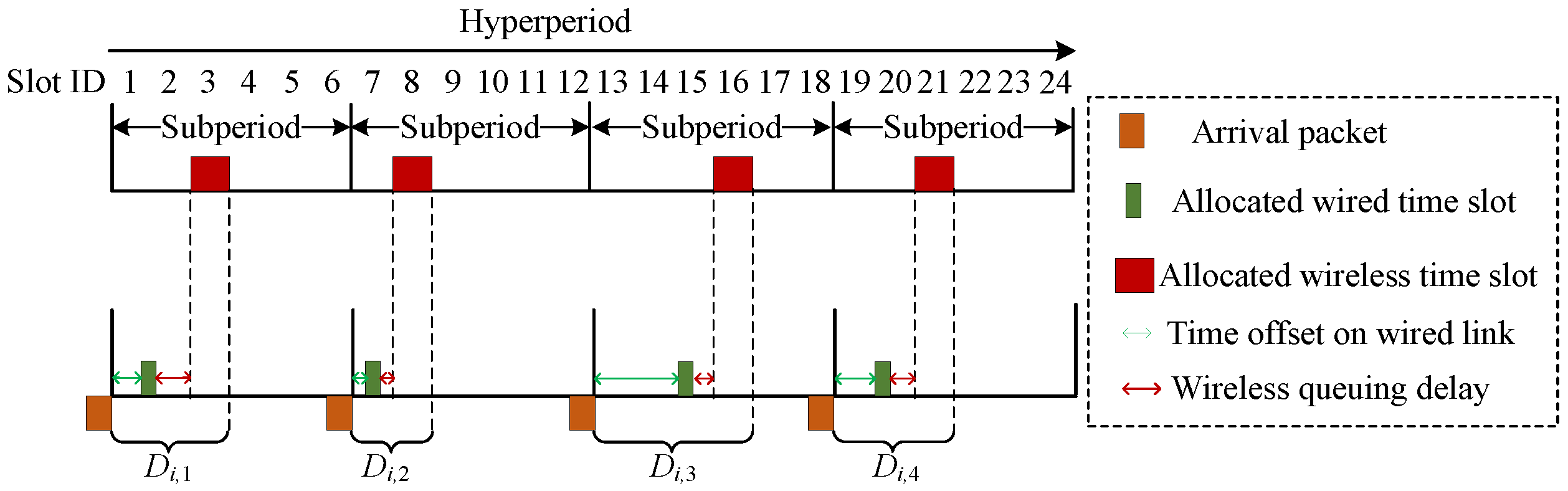
Figure 4 presents a schematic diagram illustrating the components of delay under integrated scheduling. Specifically, the delay experienced by time-sensitive traffic is primarily influenced by periodic arrival characteristics, transmission rates, and scheduling time slots. The time of arrival (ToA) of time-sensitive traffic
in its
mth subperiod is mathematically expressed as
The time is the absolute start time of topology time slot t.
For time-sensitive traffic
in the
mth subperiod, the delay determined by integrated scheduling can be computed as follows:
where
is the time offset on the wired link,
is the transmission delay, and
is the wireless queuing delay.
In addition,
is characterized as the temporal delay that occurs between the moment of traffic generation and the corresponding position of the assigned wired time slot, which is represented as
Here,
is comprised of two components: the transmission delay experienced on the wired link, denoted as
, and the transmission delay experienced on wireless link, represented as
.
In the above equation,
represents the queuing delay before the traffic is scheduled by the wireless time slot but completed by the wired time slot, and is defined as the temporal difference between the finishing of wired scheduling and the beginning of wireless scheduling. Within the integrated scheduling design, the constraint shown in (
15) should be satisfied simultaneously. In accordance with the positional relationship between allocated wired time slot
and wireless time slot
, we can express
as
3.3. Problem Formulation for Integrated Scheduling
As presented in (
21), we establish the optimization objective to minimize the delay associated with time-sensitive traffic. Constraint (
22) indicates whether
is allocated to
. Constraint (
23) indicates whether
is allocated to
. Constraint (
24) indicates that each
can only be allocated to one
. Constraint (
25) means that the aggregate number of wired time slots assigned to all time-sensitive traffic must not surpass the total number of available wired time slots
. Constraint (
26) indicates that each
can be assigned to only one
. Constraint (
27) specifies that the total number of wireless time slots allocated to all wired time slots cannot exceed the total number of wireless time slots
. Constraint (
28) shows that the scheduling of a wired time slot must precede that of a wireless time slot. Constraint (
29) means that the delay associated with integrated scheduling must not exceed the predetermined delay requirement.
The decision variables and indicate that the integrated scheduling problem presented above is classified as a 0–1 integer programming problem, which is recognized as NP-complete. However, the purpose of integrated scheduling is to obtain feasible solutions that satisfy delay constraints. Inspired by scheduling sequences and allocation relationships, we introduce matching game theory to address integrated scheduling problem. The algorithm informed by matching game theory is capable of generating suboptimal solutions while also accommodating the preferences of each involved entity.
4. Integrated Scheduling Algorithm Based on Matching Game Theory
According to types of participating entities, the wired and wireless integrated scheduling model mentioned above can be transformed into a cyclic three-sided matching game model. Moving forward, we design an integrated scheduling algorithm based on matching game theory.
4.1. Three-Sided Matching Game Model
A three-sided matching game can effectively represent the relationship between participating entities, for example the three-sided relationship composed of “man–woman–dog” in the real world [
20]. The main feature of the matching game is that each class of entity only has a preference list for another class of entity [
20]. Therefore, in the integrated scheduling model, time-sensitive traffic only has a preference list
for wired time slots, wired time slots only have a preference list
for wireless time slots, and wireless time slots only have a preference list
for time-sensitive traffic. For time-sensitive traffic
, wired time slot
, and wireless time slot
, all the possible triples are expressed as
. The three-sided matching set is denoted with
. For the matching triple
,
means that wired time slot
is only accepted by time-sensitive traffic
, while
implies that wireless time slot
is only accepted by wired time slot
and
indicates that time-sensitive traffic
is only accepted by wireless time slot
.
The ultimate purpose of the three-sided matching game is to discover a stable matching set under preference lists. The blocking triple can effectively indicate whether the three-sided matching game has reached a stable matching. The specific definition of a blocking triple is expressed below.
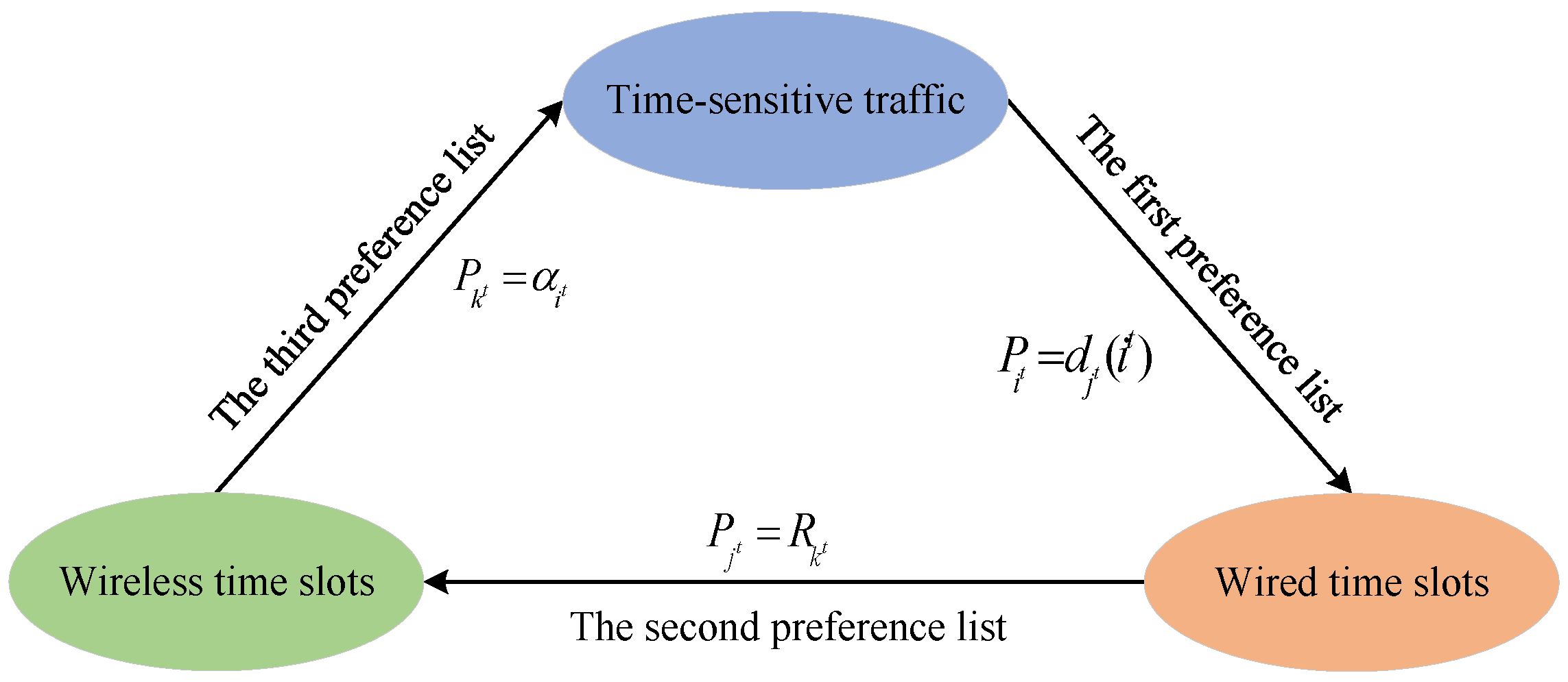
Definition 1. The triple but is a blocking triple if the following set is satisfied:where means that time-sensitive traffic prefers wired time slot to its current matched wired time slot , indicates that wired time slot prefers wireless time slot to its current matched wireless time slot , and indicates that wireless time slot prefers time-sensitive traffic to its current matched time-sensitive traffic . If there are no blocking triples, the three-sided matching is considered stable. However, the traditional three-sided matching game model lacks a representation of relationships among different preference lists, which makes it difficult to solve. Inspired by scheduling sequences, we transform the integrated scheduling model into a cyclic three-sided matching game model for time-sensitive traffic, as shown in
Figure 5. In circular preference lists,
,
, and
are set as the first, second, and third preference lists, respectively. Different matching entities are constrained through corresponding preference lists. Specifically, the preference lists
,
, and
are formed as follows: the preference list
of time-sensitive traffic for wired time slots is sorted according to the wired scheduling delay
, that is, time-sensitive traffic prefers wired time slots with lower delay; the preference list
of wired time slots for wireless time slots is sorted according to the wireless link transmission rate
, meaning that wired time slots prefer wireless time slots with higher transmission rates; and the preference list
of wireless time slots for time-sensitive traffic is sorted in accordance with priority
, that is, wireless time slots preferentially select time-sensitive traffic with high priority for scheduling.
Before providing the details of the designed scheduling algorithm, the necessary sets are defined as follows:
For time-sensitive traffic
, there exists a set of wired time slots that are more preferred than
’s existing matching
:
For wired time slot
, there exists a set of wireless time slots that are preferred over
’s current matching
:
which represents the set of wireless time slots that can still accommodate time-sensitive traffic:
For wired time slot , there is a wireless time slot that is more preferred than ’s existing matching while still being capable of accommodating the time-sensitive traffic .
4.2. Integrated Scheduling Algorithm
By combining the above cyclic three-sided matching game model, we design an integrated scheduling algorithm (ISA) that can realize joint allocation of wired and wireless time slots. The basic idea of the ISA is to search for the “best” triple through circular preference lists. For each time-sensitive traffic instance, it selects the best wired time slot satisfying the requirements; then, the selected wired time slot chooses the best wireless time slot that meets its requirements. When the time-sensitive traffic completes the scheduling request, a stable matching triple between time-sensitive traffic and scheduling time slots is obtained. At last, these generated triples are added to the matching set .
In light of these preference definitions, Algorithm 1 describes the detailed procedures of the proposed ISA. Here, we introduce the indicators “flag” to guide the execution of the algorithm and
to represent the element in
X which has the highest priority in preference list of
z. For the proposed algorithm, the input consists of the participating entities
,
, and
. The output is the matching set
containing integrated scheduling results. The algorithm mainly consists of two stages: the initialization stage (lines 1∼3), and the matching game stage (lines 4∼25). In the initialization stage, the preference lists
,
and
are created according to the known preference information. The set
is initialized to the empty set ⌀ and the “flag” indicator is set to one. To satisfy the deadline delay requirement, the time slot allocation order for time-sensitive traffic is based on priority
in descending order. In the matching game stage, for each time-sensitive traffic
, a better wired time slot
is discovered in steps 7∼9. If there exists such a wired time slot, a better wireless time slot
for
is searched in steps 10∼11. Next, the capacity of time-sensitive traffic
is checked. If
, then the worst matching triple
is deleted (lines 12∼16). Similarly, the capacity of wired time slot
is checked and dealt with in steps 17∼20. Then, the newly generated triple
is added to the set
. The matching process is iterated until reaching maximum cardinality
. At last, a stable matching set
in topology time slot
t is acquired.
| Algorithm 1 Integrated Scheduling Algorithm |
- Input:
, , ; - Output:
; - 1:
Initialization: Create the preference lists , and ; - 2:
Set and flag = 1; - 3:
Sort time-sensitive traffic in descending order of priority ; - 4:
while flag == 1 do - 5:
Set flag = 0; - 6:
for each time-sensitive traffic do - 7:
; - 8:
if then - 9:
; - 10:
; - 11:
; - 12:
if then - 13:
Select the worst matching in set ; - 14:
; - 15:
Set flag=1; - 16:
end if - 17:
if then - 18:
; - 19:
Set flag=1; - 20:
end if - 21:
; - 22:
end if - 23:
end for - 24:
end while - 25:
return ;
|