Quantum-Enhanced Edge Intelligence Leveraging Large Language Models for Immersive Space–Aerial–Ground Communications: Survey, Challenges, and Open Issues



Highlights
- Quantum-enhanced LLMs improve adaptive, high-throughput, and context-aware decision-making across UAV, CubeSat, and terrestrial nodes in SAGIN, enhancing energy efficiency, reliability, and edge learning in 6G networks.
- The integration of UAVs, CubeSats, and terrestrial infrastructures with LLM-driven quantum edge intelligence overcomes classical challenges in bandwidth allocation, dynamic routing, and interoperability, enabling secure, privacy-preserving, and self-optimizing 6G communication systems.
- The integration of quantum-enhanced LLMs into SAGIN enables efficient, reliable, and adaptive communication systems, facilitating ultra-low latency and high-throughput 6G services across UAV, CubeSat, and terrestrial networks.
- By overcoming classical limitations in bandwidth allocation, dynamic routing, and interoperability, quantum-empowered LLMs support secure, privacy-preserving, and self-optimizing intelligent transportation amalgamated with next-generation communication systems.
Abstract
1. Introduction
1.1. Contributions
- (a)
- We present a comprehensive survey of recent research on the integration of quantum-assisted LLMs into SAGINs, with a focus on their role in enabling adaptive, real-time network management and decision-making for 6G environments.
- (b)
- We review and analyze existing studies on distributed LLM inference and quantum-enhanced intelligence across heterogeneous nodes, including UAVs, CubeSats, and terrestrial platforms, highlighting their implications for latency, reliability, scalability, and resource efficiency.
- (c)
- We examine state-of-the-art approaches to quantum-assisted multimodal data fusion in SAGIN-enabled vehicular and aerial communication systems, emphasizing their impact on energy efficiency, bandwidth utilization, interoperability, and robustness in heterogeneous network scenarios.
- (d)
- We survey LLM-driven edge intelligence models deployed at aerial and space nodes, such as UAVs and CubeSats, and analyze their capabilities in supporting context-aware learning, autonomous optimization, and self-organizing network behavior in dynamic and heterogeneous 6G environments.
- (e)
- We consolidate and compare performance metrics, evaluation methodologies, and benchmarking frameworks used in the literature to assess quantum-enhanced LLM integration in 6G SAGIN architectures, identifying limitations of existing evaluations and open challenges for future research.
- (f)
- Based on the surveyed literature, we identify key research gaps and outline future research directions, including quantum-secure LLM-enabled communication, sustainable and energy-efficient network design, and trust-aware semantic control mechanisms for mission-critical 6G applications.
- Intelligence Layer: focuses on LLMs and multimodal foundation models for perception, reasoning, and decision-making at the network edge.
- System and Computing Layer: covers edge–cloud collaboration, distributed intelligence, and digital twins for SAGINs.
- Communication and Networking Layer: Addresses immersive SAGIN communications, non-terrestrial networks, and alignment with 6G IMT-2030 requirements.
- Quantum-Enhanced Layer: Examines the role of quantum communications and quantum intelligence in enhancing security, coordination, and performance in edge intelligence systems.
- Provide an exhaustive review of standalone quantum communication protocols or quantum hardware implementations;
- Survey general-purpose LLM architectures or training methodologies that are not related to or applied to communication systems;
- Address low-level physical-layer modeling in isolation from intelligent networking or edge intelligence;
- Benchmark specific commercial platforms or provide experimental performance evaluations.
- The role of LLMs as distributed cognitive agents enabling context-aware learning, autonomous optimization, and adaptive network management in highly dynamic SAGIN environments.
- By integrating quantum computing and quantum communications with edge intelligence, this work builds upon existing surveys and offers new insights into latency, reliability, and secure multi-node coordination.
- A unified discussion of semantic-driven multimodal sensing, retrieval-augmented generation (RAG), and task-oriented decoding in the context of SAGINs, bridging communication, computation, and AI for real-time decision-making.
- A comprehensive mapping of research challenges, deployment gaps, performance evaluation, and feasible quantum–classical hybrid architectures that provide actionable guidance for future 6G and IMT-2030 network design.
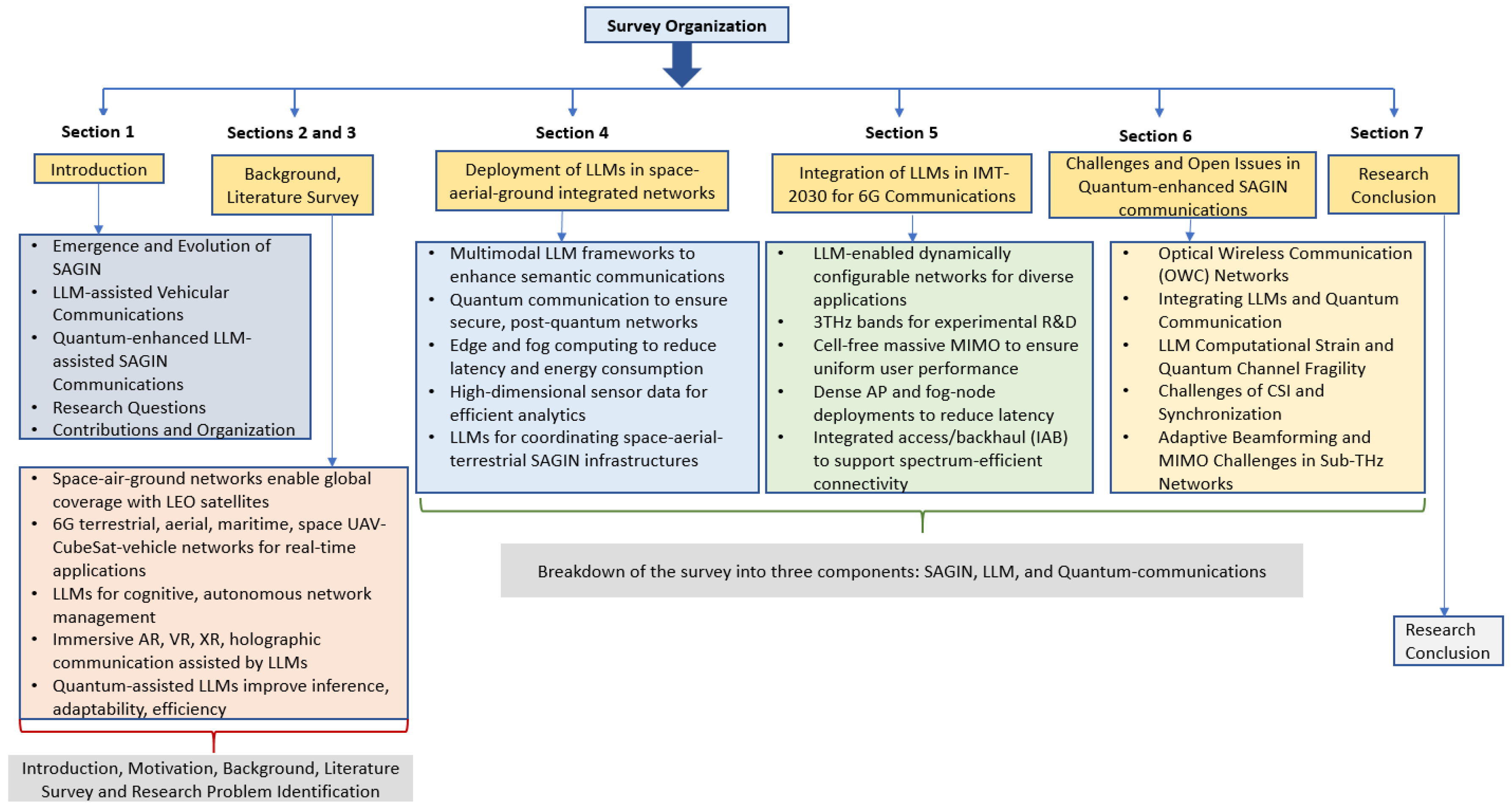
1.2. Organization
2. Low-Latency Applications in Quantum-Enhanced Space–Aerial–Ground Networks
2.1. Emergence of Space–Aerial–Ground Integrated Communications
2.2. Multimodal Large Language Models (MLLMs)
2.3. Storage Capacity Limitations of Mobile Vehicular Edge Servers
2.4. Cloud–Edge Integration for End-to-End Low-Latency Collaborative Intelligence
2.5. Energy Consumption of LLMs on UAVs
3. Effectiveness and Applicability of LLMs in Immersive SAGIN Environments
3.1. Synthetic Data Generation via GANs for LLM Pre-Training in Sparse-Data SAGIN Scenarios
3.2. Understanding User Context and Analyzing Behavioral Patterns with LLMs
3.3. Collaborative Analytics Across SAGINs Using Distributed LLM Agents
3.4. Key Findings
4. Challenges in Deployment of LLMs in SAGINs
4.1. Advantages of LLMs over Conventional DL Techniques for 6G SAGIN Intelligence
4.2. Multimodal Sensor Data Processing in Vehicular Networks Using LLMs
4.3. LLMs for Visual Reasoning Tasks
4.4. Conventional Deep Learning and LLMs
4.5. Fine-Tuning Pre-Trained LLMs for Domain-Specific SAGIN Applications
4.6. Key Findings
5. Integration of LLMs in IMT-2030 for 6G Communications
5.1. AI-Native Vision in IMT-2030 and Its Alignment with LLM-Centric Network Intelligence
- New man–machine interfaces through multiple local devices acting in unison, enabling intuitive access via gestures rather than typing;
- Ubiquitous and distributed computing, integrating multiple local devices with cloud resources for enhanced performance;
- Multi-sensory data fusion to generate immersive multi-verse maps and mixed-reality experiences;
- Precision sensing and actuation to monitor and control the physical environment;
- Extremely low-power or battery-less devices, powered by the network itself;
- End devices evolving into networks or subnetworks, such as machine-area networks or robot-area networks, connecting controllers, actuators, and sensors;
- Devices operating in sub-terahertz spectrum bands to act as active network nodes, enabling standalone or self-organizing networks.
5.2. Architectural Integration of LLMs in SAGINs
5.3. Edge-Intelligence Pipeline and Key Performance Indicators (KPI)
- Perception and Semantic Encoding: Lightweight SLMs or compressed multimodal encoders operate on-device or at near-edge nodes to extract semantic representations from sensory data under strict latency and energy constraints.
- Edge-Level Reasoning and Adaptation: Distilled or fine-tuned LLMs deployed at edge servers, UAVs, or HAPs support time-sensitive inference and task planning.
- Knowledge Augmentation and Caching: Edge–cloud collaboration leverages RAG, semantic caching, and digital twin synchronization to optimize computation and maintain consistency across distributed nodes.
- Cloud-Level Training and Global Intelligence: Centralized or distributed cloud infrastructures handle full-scale LLM training and global policy optimization, potentially accelerated by quantum computing.
- Secure Coordination and Optimization: A quantum-enhanced control plane enables secure model dissemination, trusted coordination, and efficient optimization across SAGIN nodes.
5.4. Pipeline to Key Performance Indicator (KPI) Mapping and Performance Indicators
5.5. Representing Quantum State and Fidelity Information Through Structured LLM Prompts
5.6. LLM-Orchestrated Entanglement Routing in SAGIN
5.7. RAG Parameterization Template and Evaluation Checklist
- Inputs: Multimodal observations, including textual reports, sensor measurements, visual imagery, and telemetry streams, collected from heterogeneous sources such as edge devices, UAV platforms, and satellite systems. These inputs reflect both real-time and near-real-time environmental and operational states.
- Metadata/Time-Stamps: Each input is enriched with auxiliary metadata, including precise time-stamps, geospatial location, originating node or platform, and semantic annotations. This metadata enables temporal-aware retrieval, provenance tracking, and context-sensitive reasoning across distributed nodes.
- Retrieval Strategy:
- –
- Temporal prioritization: Assign higher retrieval weights to recent observations and temporally relevant data to ensure responsiveness to rapidly evolving scenarios.
- –
- Node-aware caching: Cached or locally stored knowledge at the edge to reduce communication overhead and minimize retrieval latency under constrained network conditions.
- –
- Similarity metrics: Employ embedding-based similarity measures derived from multimodal LLMs and SLMs to perform semantic matching across heterogeneous data modalities.
- –
- Fallback mechanisms: Expand retrieval scope to broader or historical knowledge sources when recent or local data is sparse, missing, or unreliable.
- Sources of Error:
- –
- Missing, incomplete, or outdated information in local caches.
- –
- Temporal misalignment or synchronization errors across distributed sensing and computing nodes.
- –
- Retrieval latency exceeding real-time or mission-critical thresholds.
- –
- Semantic inconsistency due to partial retrieval can be identified by answering the following questions:
- *
- Latency compliance: Does the retrieval process satisfy end-to-end time-sensitive and real-time operational requirements?
- *
- Semantic fidelity: Are the retrieved entries contextually accurate and consistent with current observations and mission intent?
- *
- Temporal accuracy: Are time-stamped inputs correctly ranked and prioritized, particularly for recent or fast-changing events?
- *
- Cache efficiency: What proportion of retrievals are served from local edge caches versus remote nodes or cloud resources?
- *
- Robustness to failure modes: How does the system degrade under missing, delayed, or noisy data conditions?
- *
- Energy and computation overhead: Are RAG-related operations feasible within the power, memory, and compute constraints of edge devices?
5.8. Hybrid Quantum–Classical Training and Inference for Next-Generation LLM Models
- :
- UAV dynamics:
- :
- Link capacity constraints:
- :
- Quantum link evolution:
- :
- Quantum fidelity thresholds: , if quantum processing is executed,
- :
- Resource constraints:
5.9. Keyword-Based Retrievals in SAGIN Data Communication Using LLMs
5.10. Key Findings
6. Quantum-Enhanced Communication for Ultra-Intelligent SAGIN
6.1. Improved Quantum Processing for Real-Time Optimization in 6G Networks
6.2. Quantum Communications Assisted by LLMs in 6G Networks
6.3. Quantum Communication and Fidelity Metrics for Secure and Ultra-Low-Latency Links
6.4. Challenges in UAV–Vehicle Quantum Communications Across Dynamic Environments
- Limitations in number of usable qubits: The exponential scaling of quantum state space means that an n-qubit quantum system occupies a Hilbert space of size , requiring substantially greater computational and memory resources to manipulate, simulate, and transmit as n increases [207]. In UAV–vehicle settings, where processors have stringent constraints on power consumption, weight, and size, only a small number of qubits can realistically be supported. This restricts the complexity of quantum communication protocols that can be executed onboard and limits the feasibility of advanced quantum algorithms that require large entangled registers for optimal performance.
- Limitations in quantum measurement Effective QC requires accurate quantum measurements and high-quality quantum memory to store incoming photons for sufficiently long durations to preserve their encoded information. In mobile platforms such as UAVs and vehicles, vibration, thermal fluctuations, and rapid changes in orientation introduce disturbances that can alter the quantum state during measurement [187]. Even minimal inaccuracies during measurement collapse the state unpredictably, leading to significant fidelity loss. As a result, maintaining measurement precision in constantly changing airborne and roadway environments presents a major barrier to reliable quantum communication.
- Restriction in amplification of quantum signals: Classical communication systems often rely on signal amplification to extend communication range, but quantum signals cannot be amplified due to the no-cloning theorem. Since the exact state of a qubit cannot be copied or reconstructed, lost quantum amplitude cannot be recovered mid-transmission [187]. This constraint severely limits the distance over which quantum information can be transmitted between UAVs and vehicles. Additionally, atmospheric attenuation, scattering, and weather-induced turbulence further degrade signal strength, making long-distance quantum communication in dynamic air-to-ground channels particularly challenging.
- Scalability of qubits: Embedding UAVs and vehicles with multiple qubits and enabling reliable short-range connectivity between qubits is non-trivial. Physical qubits often require cryogenic cooling, electromagnetic shielding, or highly stable optical cavities, none of which are easily integrated into lightweight UAV hardware [187]. Even if small quantum processors could be embedded, limited qubit connectivity restricts the ability to perform multi-qubit operations efficiently. This leads to longer operation times, increased decoherence risk, and the reduced scalability of onboard quantum communication systems, slowing down tasks such as entanglement distribution and multi-node quantum networking.
- Low error tolerance: Quantum information encoded within a single photon is extremely sensitive to noise introduced by atmospheric conditions, scattering, turbulence, and hardware imperfections. While quantum error correction can theoretically protect information using multiple redundant physical qubits, implementing these schemes requires additional qubits and computational overhead, which exceeds the capabilities of UAV and vehicular platforms [208]. Consequently, quantum communication links between UAVs and vehicles suffer from decoherence and signal degradation over short distances, significantly reducing the achievable reliability of quantum transmissions.
- Preservation of quantum states: Preserving the fidelity of quantum states is essential for ensuring that the transmitted information remains accurate and usable at the receiver end. Quantum memories can store and process information from multiple sources simultaneously, but their stability is strongly affected by motion dynamics and environmental conditions [208]. As UAV trajectories change due to navigation adjustments, wind patterns, or altitude shifts; the reference frame for previously stored quantum states may drift, making earlier stored states less relevant or even unusable. This limits the effectiveness of quantum repeaters or state buffering techniques during UAV–vehicle QC sessions.
6.5. Key Findings
6.6. Open Issues in SAGIN Communications
6.6.1. Optical Wireless Communication (OWC) Networks for High-Fidelity Semantic Transmission
6.6.2. Challenges in Integrating LLMs and Quantum Communication in Long Range Cell Free Massive MIMO Networks
6.6.3. LLM Computational Strain and Quantum Channel Fragility in High-Frequency LEO, HAPS, and IRS Enabled Networks
6.6.4. Integration Challenges for LLM Semantics and Quantum Links in High-Frequency SAGIN Systems
6.6.5. Challenges of CSI and Synchronization in Dense Cell-Free Massive MIMO Networks
6.6.6. Synchronization and Connectivity Challenges in SAGIN with IAB
6.6.7. Adaptive Beamforming and MIMO Challenges in Sub-THz Networks
6.6.8. THz Networks: LLM and Quantum Communication Challenges
6.6.9. Visible Light Communication and Hybrid Optical–Radio Frequency Networks for Efficient Data Transmission
6.7. Incorporating Protocol Learning in 6G SAGINs
7. Conclusions and Future Work
Author Contributions
Funding
Institutional Review Board Statement
Informed Consent Statement
Data Availability Statement
Conflicts of Interest
Abbreviations
| 3D | Three Dimensional |
| 3GPP | Third Generation Partnership Project |
| 5G | Fifth Generation (Communication networks) |
| 6G | Sixth Generation (Communication networks) |
| ACAP | Adaptive Computing Acceleration Platform |
| AI | Artificial Intelligence |
| AR | Augmented Reality |
| BERT | Bidirectional Encoder Representations from Transformers |
| BS | Base Station |
| CNN | Convolutional Neural Network |
| CoMP | Coordinated Multi-Point |
| CSI | Channel State Information |
| DL | Deep Learning |
| DRL | Deep Reinforcement Learning |
| FL | Federated Learning |
| FSO | Free-Space Optical |
| GANs | Generative Adversarial Networks |
| GEO | Geostationary Earth Orbit |
| GHz | Gigahertz |
| GPT-3 | Generative Pre-trained Transformer-3 |
| HAPS | High-Altitude Platform Stations |
| i.i.d. | Independently Identically Distributed |
| IoIT | Internet of Intelligent Things |
| IoT | Internet of Things |
| IM/DD | Intensity Modulation with Direct Detection |
| IMT | International Mobile Telecommunications |
| IRS | Intelligent Reflecting Surfaces |
| ITU | International Telecommunication Union |
| LEDs | Light-Emitting Diodes |
| LEO | Low Earth Orbit |
| LLM | Large Language Models |
| LMMSE | Linear Minimum Mean Square Error |
| LSE | Least Squares Error |
| MEC | Multi-Access Edge Computing |
| MIMO | Multiple Input Multiple Output |
| ML | Machine Learning |
| MLLM | Multimodal Large Language Model |
| NLoS | Non-Line-of-Sight |
| NOMA | Non-orthogonal Multiple Access |
| OFDM | Orthogonal Frequency-Division Multiplexing |
| OTFS | Orthogonal Time Frequency Space |
| PAPR | Peak-to-Average-Power Ratio |
| QoS | Quality of Service |
| QAM | Quadrature Amplitude Modulation |
| RAN | Radio Access Network |
| RoBERTa | Robustly Optimized BERT Pre-training Approach |
| RSS | Received Signal Strength |
| SAGIN | Space–Aerial–Ground Integrated Networks |
| SNR | Signal-to-Noise Ratio |
| SLM | Small Language Models |
| THz | Terahertz |
| UAV | Unmanned Aerial Vehicle |
| VR | Virtual Reality |
| XR | Extended Reality |
References
- Pennanen, H.; Hanninen, T.; Tervo, O.; Tolli, A.; Latva-Aho, M. 6G: The Intelligent Network of Everything. IEEE Access 2025, 13, 1319–1421. [Google Scholar] [CrossRef]
- Zhou, Y.; Liu, L.; Wang, L.; Hui, N.; Cui, X.; Wu, J.; Peng, Y.; Qi, Y.; Xing, C. Service-aware 6G: An intelligent and open network based on the convergence of communication, computing and caching. Digit. Commun. Netw. 2020, 6, 253–260. [Google Scholar] [CrossRef]
- Chen, J.; Qiu, Y.; Zhao, Q.; Chen, G.; Alfarraj, O.; Yu, K. MCMFL: Monte Carlo Dropout-Based Multimodal Federated Learning for Giant Models in 6G Symbiotic Internet of Things. IEEE Internet Things J. 2025, 12, 41349–41364. [Google Scholar] [CrossRef]
- Su, Y.; Liu, Y.; Zhou, Y.; Yuan, J.; Cao, H.; Shi, J. Broadband LEO Satellite Communications: Architectures and Key Technologies. IEEE Wirel. Commun. 2019, 26, 55–61. [Google Scholar] [CrossRef]
- Iacovelli, G.; Grieco, G.; Petrosino, A.; Grieco, L.A.; Boggia, G. Fair Energy and Data Rate Maximization in UAV-Powered IoT-Satellite Integrated Networks. IEEE Trans. Commun. 2024, 72, 2457–2469. [Google Scholar] [CrossRef]
- Gregory, J.M.; Sega, R.M.; Bradley, T.H.; Kang, J.S. A Tailored Systems Engineering Process for Developing Student-Built CubeSat Class Satellites. IEEE Access 2024, 12, 73187–73195. [Google Scholar] [CrossRef]
- Xiao, Y.; Ye, Z.; Wu, M.; Li, H.; Xiao, M.; Alouini, M.S.; Al-Hourani, A.; Cioni, S. Space-Air-Ground Integrated Wireless Networks for 6G: Basics, Key Technologies, and Future Trends. IEEE J. Sel. Areas Commun. 2024, 42, 3327–3354. [Google Scholar] [CrossRef]
- Gupta, A.; Fernando, X. Personalized Federated Learning based Joint Latency and Power Optimization for UAV-assisted C-V2X Communications. In IEEE ICC Workshop on Cooperative Communications and Computations in Space-Air-Ground-Sea Integrated Networks; IEEE: Montreal, QC, Canada, 2025; pp. 1507–1512. [Google Scholar]
- Gupta, A.; Anpalagan, A.; Guan, L.; Khwaja, A.S. Deep learning for object detection and scene perception in self-driving cars: Survey, challenges, and open issues. Array 2021, 10, 100057. [Google Scholar] [CrossRef]
- Kou, W.B.; Lin, Q.; Tang, M.; Ye, R.; Wang, S.; Zhu, G.; Wu, Y.C. Fast-Convergent and Communication-Alleviated Heterogeneous Hierarchical Federated Learning in Autonomous Driving. IEEE Trans. Intell. Transp. Syst. 2025, 26, 10496–10511. [Google Scholar] [CrossRef]
- Kou, W.B.; Lin, Q.; Tang, M.; Xu, S.; Ye, R.; Leng, Y.; Wang, S.; Li, G.; Chen, Z.; Zhu, G.; et al. pFedLVM: A Large Vision Model (LVM)-Driven and Latent Feature-Based Personalized Federated Learning Framework in Autonomous Driving. IEEE Trans. Intell. Transp. Syst. 2025, 26, 15915–15931. [Google Scholar] [CrossRef]
- Wang, J.; Hong, T.; Qi, F.; Liu, L.; He, X. High-Altitude-UAV-Relayed Satellite D2D Communications for 6G IoT Network. Drones 2024, 8, 532. [Google Scholar] [CrossRef]
- Priyadarshini, I.; Bhola, B.; Kumar, R.; So-In, C. A Novel Cloud Architecture for Internet of Space Things (IoST). IEEE Access 2022, 10, 15118–15134. [Google Scholar] [CrossRef]
- Yang, N.; Fan, M.; Wang, W.; Zhang, H. Decision-Making Large Language Model for Wireless Communication: A Comprehensive Survey on Key Techniques. IEEE Commun. Surv. Tutor. 2025, 28, 3055–3088. [Google Scholar] [CrossRef]
- Liu, Q.; Mu, J.; Chen, D.; Zhang, R.; Liu, Y.; Hong, T. LLM Enhanced Reconfigurable Intelligent Surface for Energy-Efficient and Reliable 6G IoV. IEEE Trans. Veh. Technol. 2025, 74, 1830–1838. [Google Scholar] [CrossRef]
- Cratere, A.; Gagliardi, L.; Sanca, G.A.; Golmar, F.; Dell’Olio, F. On-Board Computer for CubeSats: State-of-the-Art and Future Trends. IEEE Access 2024, 12, 99537–99569. [Google Scholar] [CrossRef]
- Long, S.; Tan, J.; Mao, B.; Tang, F.; Li, Y.; Zhao, M.; Kato, N. A Survey on Intelligent Network Operations and Performance Optimization Based on Large Language Models. IEEE Commun. Surv. Tutor. 2025, 27, 3915–3949. [Google Scholar] [CrossRef]
- Kerrouche, K.D.E.; Wang, L.; Seddjar, A.; Rastinasab, V.; Oukil, S.; Ghaffour, Y.M.; Nouar, L. Applications of Nanosatellites in Constellation: Overview and Feasibility Study for a Space Mission Based on Internet of Space Things Applications Used for AIS and Fire Detection. Sensors 2023, 23, 6232. [Google Scholar] [CrossRef] [PubMed]
- Boateng, G.O.; Sami, H.; Alagha, A.; Elmekki, H.; Hammoud, A.; Mizouni, R.; Mourad, A.; Otrok, H.; Bentahar, J.; Muhaidat, S.; et al. A Survey on Large Language Models for Communication, Network, and Service Management: Application Insights, Challenges, and Future Directions. IEEE Commun. Surv. Tutor. 2025, 28, 527–566. [Google Scholar] [CrossRef]
- Li, J.; Yang, L.; Wu, Q.; Lei, X.; Zhou, F.; Shu, F.; Mu, X.; Liu, Y.; Fan, P. Active RIS-Aided NOMA-Enabled Space- Air-Ground Integrated Networks with Cognitive Radio. IEEE J. Sel. Areas Commun. 2025, 43, 314–333. [Google Scholar] [CrossRef]
- Wang, X.; Xu, L.; Zhou, L.; Liu, Y.; Xiong, N.; Li, K.C. Large language model-driven probabilistic trajectory prediction in the Internet of Things using spatio-temporal encoding and normalizing flows. Digit. Commun. Netw. 2025, in press. [Google Scholar] [CrossRef]
- Zhou, H.; Hu, C.; Yuan, Y.; Cui, Y.; Jin, Y.; Chen, C.; Wu, H.; Yuan, D.; Jiang, L.; Wu, D.; et al. Large Language Model (LLM) for Telecommunications: A Comprehensive Survey on Principles, Key Techniques, and Opportunities. IEEE Commun. Surv. Tutor. 2025, 27, 1955–2005. [Google Scholar] [CrossRef]
- Guo, J.; Wang, M.; Yin, H.; Song, B.; Chi, Y.; Yu, F.R.; Yuen, C. Large Language Models and Artificial Intelligence Generated Content Technologies Meet Communication Networks. IEEE Internet Things J. 2025, 12, 1529–1553. [Google Scholar] [CrossRef]
- Shao, Z.; Yang, H.; Xiong, Z. Intelligent Latency-Oriented Optimization for Multi-UAV-Assisted Mobile Edge Computing in Space-Air-Ground Integrated Networks. IEEE Trans. Commun. 2025, 73, 13384–13398. [Google Scholar] [CrossRef]
- Farouk, A.; Behera, B.K.; Ahmed, E.A. Design and Implement a Quantum Blockchain Framework to Secure 6G Communication for Consumer Applications. IEEE Trans. Consum. Electron. 2025, 71, 8417–8424. [Google Scholar] [CrossRef]
- Han, S.; Wang, M.; Zhang, J.; Li, D.; Duan, J. A Review of Large Language Models: Fundamental Architectures, Key Technological Evolutions, Interdisciplinary Technologies Integration, Optimization and Compression Techniques, Applications, and Challenges. Electronics 2024, 13, 5040. [Google Scholar] [CrossRef]
- Yan, H.; Huang, H.; Zhao, Z.; Wang, Z.; Zhao, Z. Accuracy-Aware MLLM Task Offloading and Resource Allocation in UAV-Assisted Satellite Edge Computing. Drones 2025, 9, 500. [Google Scholar] [CrossRef]
- Shokouhi, M.H.; Wong, V.W.S. Large Language Models for Wireless Cellular Traffic Prediction: A Multi-timespan Approach. In IEEE Global Communications Conference (Online); IEEE: Piscataway, NJ, USA, 2024; pp. 1293–1298. [Google Scholar]
- Xu, S.; Kurisummoottil Thomas, C.; Hashash, O.; Muralidhar, N.; Saad, W.; Ramakrishnan, N. Large Multi-Modal Models (LMMs) as Universal Foundation Models for AI-Native Wireless Systems. IEEE Netw. 2024, 38, 10–20. [Google Scholar] [CrossRef]
- Andrei, V.C.; Djuhera, A.; Li, X.; Monich, U.J.; Saad, W.; Boche, H. Resilient, Federated Large Language Models over Wireless Networks: Why the PHY Matters. In IEEE Global Communications Conference (Online); IEEE: Piscataway, NJ, USA, 2024; pp. 5211–5216. [Google Scholar]
- Ding, X.; Han, J.; Xu, H.; Zhang, W.; Li, X. HiLM-D: Enhancing MLLMs with Multi-scale High-Resolution Details for Autonomous Driving. Int. J. Comput. Vis. 2025, 133, 5379–5395. [Google Scholar] [CrossRef]
- Du, J.; Lin, T.; Jiang, C.; Yang, Q.; Bader, C.F.; Han, Z. Distributed Foundation Models for Multi-Modal Learning in 6G Wireless Networks. IEEE Wirel. Commun. 2024, 31, 20–30. [Google Scholar] [CrossRef]
- Javaid, S.; Khalil, R.A.; Saeed, N.; He, B.; Alouini, M.S. Leveraging Large Language Models for Integrated Satellite-Aerial-Terrestrial Networks: Recent Advances and Future Directions. IEEE Open J. Commun. Soc. 2025, 6, 399–432. [Google Scholar] [CrossRef]
- Bariah, L.; Debbah, M. AI Embodiment Through 6G: Shaping the Future of AGI. IEEE Wirel. Commun. 2024, 31, 174–181. [Google Scholar] [CrossRef]
- Kyriatzis, N.; Gkiaouris, D.; Tegos, S.A.; Diamantoulakis, P.D.; Papanikolaou, V.K.; Schober, R.; Karagiannidis, G.K. Miniaturized Satellite Communication Systems with Lightwave Power Transfer. IEEE Trans. Aerosp. Electron. Syst. 2025, 61, 10529–10540. [Google Scholar] [CrossRef]
- Shah, S.A.A.; Xavier, F.; Rasha, K. Joint Trajectory and Pilot Assignment Optimization for UAV Enabled Cell-Free Massive MIMO. In IEEE ICC Workshop on Cooperative Communications and Computations in Space-Air-Ground-Sea Integrated Networks; IEEE: Montreal, QC, Canada, 2025; pp. 1876–1881. [Google Scholar]
- Hellmann, S.; Olatunji, J.; Parashar, T.N.; Pollock, R. CubeSat Concept for Demonstrating Efficient Directional Magnetic Radiation Protection for Spacecrafts Based on HTS Coils. IEEE Trans. Appl. Supercond. 2025, 35, 3800305. [Google Scholar] [CrossRef]
- Abagero, A.; Abebe, Y.; Tullu, A.; Jung, Y.S.; Jung, S. Deep Learning-Based MPPT Approach to Enhance CubeSat Power Generation. IEEE Access 2025, 13, 40076–40089. [Google Scholar] [CrossRef]
- Jiang, S.; Lin, B.; Wu, Y.; Gao, Y. LINKs: Large Language Model Integrated Management for 6G Empowered Digital Twin NetworKs. In IEEE Vehicular Technology Conference; IEEE: Piscataway, NJ, USA, 2024; pp. 1–6. [Google Scholar]
- Ngeni, F.; Mwakalonge, J.; Siuhi, S. Solving traffic data occlusion problems in computer vision algorithms using DeepSORT and quantum computing. J. Traffic Transp. Eng. 2024, 11, 1–15. [Google Scholar] [CrossRef]
- Li, M.; Wu, T.; Dong, Z.; Liu, X.; Lu, Y.; Zhang, S.; Wu, Z.; Zhang, Y.; Yu, L.; Zhang, J. DeepRT: A Hybrid Framework Combining Large Model Architectures and Ray Tracing Principles for 6G Digital Twin Channels. Electronics 2025, 14, 1849. [Google Scholar] [CrossRef]
- Moraga, Á.; de Curtò, J.; de Zarzà, I.; Calafate, C.T. AI-Driven UAV and IoT Traffic Optimization: Large Language Models for Congestion and Emission Reduction in Smart Cities. Drones 2025, 9, 248. [Google Scholar] [CrossRef]
- Du, J.; Wang, J.; Sun, A.; Qu, J.; Zhang, J.; Wu, C.; Niyato, D. Joint Optimization in Blockchain- and MEC-Enabled Space-Air-Ground Integrated Networks. IEEE Internet Things J. 2024, 11, 31862–31877. [Google Scholar] [CrossRef]
- Abhishek, G.; Fernando, X. Performance Analysis of Unmanned Aerial Vehicle-Assisted and Federated Learning-Based 6G Cellular Vehicle-to-Everything Communication Networks. Drones 2025, 9, 711. [Google Scholar]
- Rahim, S.; Peng, L.; Ho, P.H. TinyFDRL-Enhanced Energy-Efficient Trajectory Design for Integrated Space-Air-Ground Networks. IEEE Internet Things J. 2024, 11, 21391–21401. [Google Scholar] [CrossRef]
- Wei, X.; Fan, L.; Guo, Y.; Han, Z.; Wang, Y. Entanglement From Sky: Optimizing Satellite-Based Entanglement Distribution for Quantum Networks. IEEE/ACM Trans. Netw. 2024, 32, 5295–5309. [Google Scholar] [CrossRef]
- Ata, Y.; Kiasaleh, K. Performance of Optical Seawater-to-Air Wireless Links in the Presence of Seawater Pitching Angle Effect. IEEE Trans. Commun. 2024, 72, 7856–7865. [Google Scholar] [CrossRef]
- Huang, X.; Chen, P.; Xia, X. Heterogeneous optical network and power allocation scheme for inter-CubeSat communication. Opt. Lett. 2024, 49, 1213. [Google Scholar] [CrossRef] [PubMed]
- Abhishek, G.; Fernando, X. Latency Analysis of UAV-Assisted Vehicular Communications Using Personalized Federated Learning with Attention Mechanism. Drones 2025, 9, 497. [Google Scholar] [CrossRef]
- Jia, H.; Wang, Y.; Wu, W. Dynamic Resource Allocation for Remote IoT Data Collection in SAGIN. IEEE Internet Things J. 2024, 11, 20575–20589. [Google Scholar] [CrossRef]
- Yao, Y.; Zhou, Q.; Song, L.; Huang, S.; Yue, X. Optimization of Secure Offloading Data for Space-Air-Ground Integrated Networks Oriented to Mobile Edge Computing. IEEE Internet Things J. 2025, 13, 5733–5744. [Google Scholar] [CrossRef]
- Wang, C.; Pang, M.; Wu, T.; Gao, F.; Zhao, L.; Chen, J.; Wang, W.; Wang, D.; Zhang, Z.; Zhang, P. Resilient Massive Access for SAGIN: A Deep Reinforcement Learning Approach. IEEE J. Sel. Areas Commun. 2025, 43, 297–313. [Google Scholar] [CrossRef]
- Du, J.; Guo, W.; Yan, M.; Zhao, H.; Shao, S. Effect of Frequency Offset on Collaborative Beamforming of UAV Swarm in Space-Air-Ground Integrated Networks. In 2025 IEEE Wireless Communications and Networking Conference (WCNC); IEEE: Piscataway, NJ, USA, 2025; pp. 1–6. [Google Scholar]
- Jia, Z.; Cao, Y.; He, L.; Li, G.; Zhou, F.; Wu, Q.; Han, Z. NFV-Enabled Service Recovery in Space-Air-Ground Integrated Networks: A Matching Game-Based Approach. IEEE Trans. Netw. Sci. Eng. 2025, 12, 1732–1744. [Google Scholar] [CrossRef]
- Chen, H.; Deng, W.; Yang, S.; Xu, J.; Jiang, Z.; Ngai, E.C.H.; Liu, J.; Liu, X. Toward Edge General Intelligence via Large Language Models: Opportunities and Challenges. IEEE Netw. 2025, 39, 263–271. [Google Scholar] [CrossRef]
- Li, J.; Xu, Y.; Huang, H.; Yin, X.; Li, D.; Ngai, E.C.H.; Barsoum, E. Gumiho: A Hybrid Architecture to Prioritize Early Tokens in Speculative Decoding. In Proceedings of the International Conference on Machine Learning (ICML), Vancouver, BC, Canada, 13–19 July 2025. [Google Scholar]
- Wang, X.; Chen, H.; Tan, F. Hybrid OMA/NOMA Mode Selection and Resource Allocation in Space-Air-Ground Integrated Networks. IEEE Trans. Veh. Technol. 2025, 74, 699–713. [Google Scholar] [CrossRef]
- Cao, X.; Nan, G.; Guo, H.; Mu, H.; Wang, L.; Lin, Y.; Zhou, Q.; Li, J.; Qin, B.; Cui, Q.; et al. Exploring LLM-Based Multi-Agent Situation Awareness for Zero-Trust Space-Air-Ground Integrated Network. IEEE J. Sel. Areas Commun. 2025, 43, 2230–2247. [Google Scholar] [CrossRef]
- Wang, Z.; Yang, W.; Xu, Z.; Chen, W.; Liu, J.; Xu, T.; Wang, Z.; Leung, V.C.M. SDANet: A Federated Efficient Remote Sensing Object Detection for Space-Air-Ground IoT. IEEE Internet Things J. 2025, 12, 35634–35648. [Google Scholar] [CrossRef]
- Wang, Z.; Sun, G.; Wang, Y.; Yu, H.; Niyato, D. Cluster-Based Multi-Agent Task Scheduling for Space-Air-Ground Integrated Networks. IEEE Trans. Cogn. Commun. Netw. 2025, 12, 29–42. [Google Scholar] [CrossRef]
- Bakambekova, A.; Kouzayha, N.; Al-Naffouri, T. On the Interplay of Artificial Intelligence and Space-Air-Ground Integrated Networks: A Survey. IEEE Open J. Commun. Soc. 2024, 5, 4613–4673. [Google Scholar] [CrossRef]
- Chen, L.; Xiao, J.; Teo, C.W.R.; Li, J.; Feroskhan, M. Air-Ground Collaborative Control for Angle-Specified Heterogeneous Formations. IEEE Trans. Intell. Veh. 2025, 10, 1483–1497. [Google Scholar] [CrossRef]
- Zhang, G.; Wei, X.; Tan, X.; Han, Z.; Zhang, G. AoI Minimization Based on Deep Reinforcement Learning and Matching Game for IoT Information Collection in SAGIN. IEEE Trans. Commun. 2025, 73, 5950–5964. [Google Scholar] [CrossRef]
- Kamatchi, K.; Pillappan, K.; Angayarkanni, V.; Krishnan, P. SLIPT Enabled Ground-to-UAV FSO Communication for SAGNET in 6G-IoT Systems. IEEE Trans. Green Commun. Netw. 2025, 9, 1268–1279. [Google Scholar] [CrossRef]
- Chen, B.W. Robust Partially Observed Data Sensing via ℓ2,p Norms with Flexible Adaptive Label Marginal Space for Visual IoT. IEEE Internet Things J. 2025, 12, 5435–5448. [Google Scholar] [CrossRef]
- Xu, Y.; Tang, X.; Huang, L.; Ullah, H.; Ning, Q. Multi-Objective Optimization for Resource Allocation in Space–Air–Ground Network with Diverse IoT Devices. Sensors 2025, 25, 274. [Google Scholar] [CrossRef] [PubMed]
- Shamim, N.; Asim, M.; Awad, A.I.; Khurram Khan, M. Anomaly Detection in Internet of Things System Calls Using a Centroid-Based Vector-Space Model. IEEE Internet Things J. 2025, 12, 26868–26881. [Google Scholar] [CrossRef]
- Zhang, S.; Mao, Y.; Clerckx, B.; Quek, T.Q.S. Interference Management in Space-Air-Ground Integrated Networks with Fully Distributed Rate-Splitting Multiple Access. IEEE Trans. Wirel. Commun. 2025, 24, 149–164. [Google Scholar] [CrossRef]
- Zhou, J.; Dang, S.; Shihada, B.; Alouini, M.S. On the Outage Performance of Space-Air-Ground Integrated Networks in the 3D Poisson Field. IEEE Trans. Veh. Technol. 2024, 73, 4401–4406. [Google Scholar] [CrossRef]
- Zheng, X.; Wu, Y.; Fan, L.; Lei, X.; Qingyang Hu, R.; Karagiannidis, G.K. Dual-Functional UAV-Empowered Space-Air-Ground Networks: Joint Communication and Sensing. IEEE J. Sel. Areas Commun. 2024, 42, 3412–3427. [Google Scholar] [CrossRef]
- Zhang, J.; Yang, X.; Chen, X.; Chen, X.; Yi, X.; Khalil, I.; Niyato, D. Energy-Efficient UAV Deployment and Computation Offloading in Space-Air-Ground Integrated Networks. IEEE Trans. Veh. Technol. 2025, 1–17. [Google Scholar] [CrossRef]
- Cheng, L.; Li, X.; Feng, G.; Peng, Y.; Qin, S.; Quek, T.Q. Cooperative Transmission for Space-Air-Ground Integrated Networks: A Multi-Agent Cooperation Method. IEEE Trans. Veh. Technol. 2025, 74, 12879–12894. [Google Scholar] [CrossRef]
- Zhang, S.; Cai, T.; Wu, D.; Schupke, D.; Ansari, N.; Cavdar, C. IoRT Data Collection with LEO Satellite-Assisted and Cache-Enabled UAV: A Deep Reinforcement Learning Approach. IEEE Trans. Veh. Technol. 2024, 73, 5872–5884. [Google Scholar] [CrossRef]
- Mao, S.; Liu, L.; Hou, X.; Atiquzzaman, M.; Yang, K. Multi-Domain Resource Management for Space-Air-Ground Integrated Sensing, Communication, and Computation Networks. IEEE J. Sel. Areas Commun. 2024, 42, 3380–3394. [Google Scholar] [CrossRef]
- Zhang, J.; Zhang, J.; Shen, F.; Yan, F.; Bu, Z. DOGS: Dynamic Task Offloading in Space-Air-Ground Integrated Networks with Game-Theoretic Stochastic Learning. IEEE Internet Things J. 2025, 12, 1655–1672. [Google Scholar] [CrossRef]
- Huang, Y.; Cheng, Y.; Wang, K. Efficient Driving Behavior Narration and Reasoning on Edge Device Using Large Language Models. IEEE Trans. Veh. Technol. 2025, 75, 1563–1567. [Google Scholar] [CrossRef]
- Tan, L.; Guo, S.; Kuang, Z.; Zhou, P.; Li, M. SkyLink: Joint Deployment and Scheduling in Collaborative Integrated Ground-Air-Space Network. IEEE Trans. Wirel. Commun. 2025, 25, 90–106. [Google Scholar] [CrossRef]
- Li, H.; He, Y.; Zheng, S.; Zhou, F.; Yang, H. Dual-Driven Learning-Based Multiple-Input Multiple-Output Signal Detection for Unmanned Aerial Vehicle Air-to-Ground Communications. Drones 2024, 8, 180. [Google Scholar] [CrossRef]
- Arani, A.H.; Hu, P.; Zhu, Y. UAV-Assisted Space-Air-Ground Integrated Networks: A Technical Review of Recent Learning Algorithms. IEEE Open J. Veh. Technol. 2024, 5, 1004–1023. [Google Scholar] [CrossRef]
- Nway Ei, N.; Kim, K.; Kyaw Tun, Y.; Han, Z.; Hong, C.S. Data Service Maximization in Space-Air-Ground Integrated 6G Networks. IEEE Commun. Lett. 2024, 28, 2598–2602. [Google Scholar] [CrossRef]
- Fan, S.; Liu, Z.; Gu, X.; Li, H. Csi-LLM: A Novel Downlink Channel Prediction Method Aligned with LLM Pre-Training. In 2025 IEEE Wireless Communications and Networking Conference (WCNC); IEEE: Piscataway, NJ, USA, 2025; pp. 1–6. [Google Scholar]
- Tahir, H.A.; Alayed, W.; Hassan, W.u.; Do, T.D. Optimizing Open Radio Access Network Systems with LLAMA V2 for Enhanced Mobile Broadband, Ultra-Reliable Low-Latency Communications, and Massive Machine-Type Communications: A Framework for Efficient Network Slicing and Real-Time Resource Allocation. Sensors 2024, 24, 7009. [Google Scholar] [CrossRef]
- Noh, H.; Shim, B.; Yang, H.J. Adaptive Resource Allocation Optimization Using Large Language Models in Dynamic Wireless Environments. IEEE Trans. Veh. Technol. 2025, 74, 16630–16635. [Google Scholar] [CrossRef]
- Liu, C.; Zhao, J. Resource Allocation for Stable LLM Training in Mobile Edge Computing. In Proceedings of the Twenty-Fifth International Symposium on Theory, Algorithmic Foundations, and Protocol Design for Mobile Networks and Mobile Computing; Association for Computing Machinery: New York, NY, USA, 2024; pp. 81–90. [Google Scholar]
- Liu, Y.; Jiang, L.; Qi, Q.; Xie, K.; Xie, S. Online Computation Offloading for Collaborative Space/Aerial-Aided Edge Computing Toward 6G System. IEEE Trans. Veh. Technol. 2024, 73, 2495–2505. [Google Scholar] [CrossRef]
- Sevim, N.; Ibrahim, M.; Ekin, S. Large Language Models (LLMs) Assisted Wireless Network Deployment in Urban Settings. In IEEE Vehicular Technology Conference; IEEE: Piscataway, NJ, USA, 2024; pp. 1–7. [Google Scholar]
- Gao, X.; Mei, Y.; Wang, Y.; Shi, M.; Kang, J.; Yang, K. Secrecy Energy Efficiency Maximization in Space-Air-Ground Networks with an Aerial Eavesdropper. IEEE Trans. Veh. Technol. 2025, 74, 17972–17984. [Google Scholar] [CrossRef]
- Sun, H.; Tian, H.; Ni, W.; Zheng, J.; Niyato, D.; Zhang, P. Federated Low-Rank Adaptation for Large Models Fine-Tuning Over Wireless Networks. IEEE Trans. Wirel. Commun. 2025, 24, 659–675. [Google Scholar] [CrossRef]
- Sallouha, H.; Saleh, S.; De Bast, S.; Cui, Z.; Pollin, S.; Wymeersch, H. On the Ground and in the Sky: A Tutorial on Radio Localization in Ground-Air-Space Networks. IEEE Commun. Surv. Tutor. 2025, 27, 218–258. [Google Scholar] [CrossRef]
- Vegni, A.M.; Ata, Y.; Alouini, M.S. Enhancement of Handover Management Through Reconfigurable Intelligent Surfaces in a 3D Ground-Aerial-Space Network Scenario. IEEE Trans. Wirel. Commun. 2024, 23, 18637–18652. [Google Scholar] [CrossRef]
- Cheng, X.; Liu, B.; Liu, X.; Liu, E.; Huang, Z. Foundation Model Empowered Synesthesia of Machines (SoM): AI-native Intelligent Multi-Modal Sensing-Communication Integration. IEEE Trans. Netw. Sci. Eng. 2025, 13, 762–782. [Google Scholar] [CrossRef]
- Cao, H.; Garg, S.; Kaddoum, G.; Alrashoud, M.; Yang, L. Efficient Resource Allocation of Slicing Services in Softwarized Space-Aerial-Ground Integrated Networks for Seamless and Open Access Services. IEEE Trans. Veh. Technol. 2024, 73, 9284–9295. [Google Scholar] [CrossRef]
- Habib, M.A.; Iturria-Rivera, P.E.; Ozcan, Y.; Elsayed, M.; Bavand, M.; Gaigalas, R.; Erol-Kantarci, M. Harnessing the Power of LLMs, Informers and Decision Transformers for Intent-Driven RAN Management in 6G. IEEE Trans. Netw. Sci. Eng. 2025, 13, 4187–4206. [Google Scholar] [CrossRef]
- Tong, K.; Solmaz, S. ConnectGPT: Connect Large Language Models with Connected and Automated Vehicles. In IEEE Intelligent Vehicles Symposium; IEEE: Piscataway, NJ, USA, 2024; pp. 581–588. [Google Scholar]
- Zhou, Y.; Cui, C.; Peng, J.; Yang, Z.; Lu, J.; Panchal, J.; Yao, B.; Wang, Z. A Hierarchical Test Platform for Vision Language Model (VLM)-Integrated Real-World Autonomous Driving. Acm Trans. Internet Things 2025. [Google Scholar] [CrossRef]
- Yan, Z.; Zhou, H.; Tabassum, H.; Liu, X. Hybrid LLM-DDQN-Based Joint Optimization of V2I Communication and Autonomous Driving. IEEE Wirel. Commun. Lett. 2025, 14, 1214–1218. [Google Scholar] [CrossRef]
- Liu, Y.; Gao, N.; Li, X.; Jin, S. Large Language Model Enabled Lightweight RFFI for 6G Edge Intelligence. In 2025 IEEE Wireless Communications and Networking Conference (WCNC); IEEE: Piscataway, NJ, USA, 2025; pp. 1–6. [Google Scholar]
- Zhang, R.; Zhao, C.; Du, H.; Niyato, D.; Wang, J.; Sawadsitang, S.; Shen, X.; Kim, D.I. Embodied AI-Enhanced Vehicular Networks: An Integrated Vision Language Models and Reinforcement Learning Method. IEEE Trans. Mob. Comput. 2025, 24, 11494–11510. [Google Scholar] [CrossRef]
- Liu, C.; Zhao, J. Resource Allocation in Large Language Model Integrated 6G Vehicular Networks. In IEEE Vehicular Technology Conference; IEEE: Piscataway, NJ, USA, 2024; pp. 1–6. [Google Scholar]
- Hu, Y.; Wang, F.; Ye, D.; Wu, M.; Kang, J.; Yu, R. LLM-Based Misbehavior Detection Architecture for Enhanced Traffic Safety in Connected Autonomous Vehicles. IEEE Trans. Veh. Technol. 2025, 74, 12829–12841. [Google Scholar] [CrossRef]
- Long, S.; Tang, F.; Li, Y.; Tan, T.; Jin, Z.; Zhao, M.; Kato, N. 6G Comprehensive Intelligence: Network Operations and Optimization Based on Large Language Models. IEEE Netw. 2025, 39, 192–201. [Google Scholar] [CrossRef]
- Dicandia, F.A.; Fonseca, N.J.G.; Bacco, M.; Mugnaini, S.; Genovesi, S. Space-Air-Ground Integrated 6G Wireless Communication Networks: A Review of Antenna Technologies and Application Scenarios. Sensors 2022, 22, 3136. [Google Scholar] [CrossRef]
- Zheng, Y.; Chin, K.W. On Data Collection in SIC-Capable Space-Air-Ground Integrated IoT Networks. IEEE Syst. J. 2023, 17, 1431–1442. [Google Scholar] [CrossRef]
- Qu, G.; Chen, Q.; Wei, W.; Lin, Z.; Chen, X.; Huang, K. Mobile Edge Intelligence for Large Language Models: A Contemporary Survey. IEEE Commun. Surv. Tutor. 2025, 27, 3820–3860. [Google Scholar] [CrossRef]
- Qian, L.; Zhao, J. User Association and Resource Allocation in Large Language Model Based Mobile Edge Computing System over 6G Wireless Communications. In IEEE Vehicular Technology Conference; IEEE: Piscataway, NJ, USA, 2024; pp. 1–7. [Google Scholar]
- Chen, X.; Wu, C.; Shen, Y.; Ji, Y.; Yoshinaga, T.; Ni, Q.; Zarakovitis, C.C.; Zhang, H. Communication and Control Co-Design in 6G: Sequential Decision-Making with LLMs. IEEE Netw. 2025, 39, 131–138. [Google Scholar] [CrossRef]
- Qin, X.; Sun, M.; Dai, J.; Ma, P.; Cao, Y.; Zhang, J.; Wang, J.; Xu, X.; Zhang, P.; Niyato, D. Generative AI Meets Wireless Networking: An Interactive Paradigm for Intent-Driven Communications. IEEE Trans. Cogn. Commun. Netw. 2025, 11, 2056–2077. [Google Scholar] [CrossRef]
- Akrout, M.; Mezghani, A.; Hossain, E.; Bellili, F.; Heath, R.W. From Multilayer Perceptron to GPT: A Reflection on Deep Learning Research for Wireless Physical Layer. IEEE Commun. Mag. 2024, 62, 34–41. [Google Scholar] [CrossRef]
- Huang, L.; Wu, Y.; Simeonidou, D. Reasoning AI Performance Degradation in 6G Networks with Large Language Models. In 2025 IEEE Wireless Communications and Networking Conference (WCNC); IEEE: Piscataway, NJ, USA, 2025; pp. 1–6. [Google Scholar]
- Duan, S.; Lyu, F.; Cen, J.; Ren, J.; Yang, P.; Zhang, Y. Flexible and Effective Cellular Traffic Data Synthesis with Large Language Model. In IEEE Global Communications Conference (Online); IEEE: Piscataway, NJ, USA, 2024; pp. 5223–5228. [Google Scholar]
- Hu, J.; Wang, D.; Wang, Z.; Pang, X.; Xu, H.; Ren, J.; Ren, K. Federated Large Language Model: Solutions, Challenges and Future Directions. IEEE Wirel. Commun. 2025, 32, 82–89. [Google Scholar] [CrossRef]
- Kim, M.; Pinyoanuntapong, P.; Kim, B.; Saad, W.; Calin, D. Edge vs Cloud: How Do We Balance Cost, Latency, and Quality for Large Language Models Over 5G Networks? In 2025 IEEE Wireless Communications and Networking Conference (WCNC); IEEE: Piscataway, NJ, USA, 2025; pp. 1–6. [Google Scholar]
- Javaid, S.; Fahim, H.; He, B.; Saeed, N. Large Language Models for UAVs: Current State and Pathways to the Future. IEEE Open J. Veh. Technol. 2024, 5, 1166–1192. [Google Scholar] [CrossRef]
- Yang, W.; Xiong, Z.; Mao, S.; Quek, T.Q.S.; Zhang, P.; Debbah, M.; Tafazolli, R. Rethinking Generative Semantic Communication for Multi-User Systems with Large Language Models. IEEE Wirel. Commun. 2025, 32, 170–178. [Google Scholar] [CrossRef]
- Wang, J.; Feng, G.; Liu, Y.J.; Xu, X.; Cheng, L.; Jiang, W.; Qian, L.P. Split Learning Based Cloud-Edge-End Collaborative Model Training in Heterogeneous Networks. IEEE Trans. Netw. Sci. Eng. 2025, 13, 1569–1585. [Google Scholar] [CrossRef]
- Sheng, Y.; Huang, K.; Liang, L.; Liu, P.; Jin, S.; Li, G.Y. Beam Prediction Based on Large Language Models. IEEE Wirel. Commun. Lett. 2025, 14, 1406–1410. [Google Scholar] [CrossRef]
- Abbas, M.; Kar, K.; Chen, T. Leveraging Large Language Models for Wireless Symbol Detection via In-Context Learning. In IEEE Global Communications Conference (Online); IEEE: Piscataway, NJ, USA, 2024; pp. 5217–5222. [Google Scholar]
- Xue, N.; Sun, Y.; Chen, Z.; Tao, M.; Xu, X.; Qian, L.; Cui, S.; Zhang, P. WDMoE: Wireless Distributed Large Language Models with Mixture of Experts. In IEEE Global Communications Conference (Online); IEEE: Piscataway, NJ, USA, 2024; pp. 2707–2712. [Google Scholar]
- Tang, Y.; Guo, W. Automatic Retrieval-Augmented Generation of 6G Network Specifications for Use Cases. IEEE Commun. Mag. 2025, 63, 95–102. [Google Scholar] [CrossRef]
- Wray, T.; Wang, Y. 5G Specifications Formal Verification with Over-the-Air Validation: Prompting is All You Need. In MILCOM IEEE Military Communications Conference; IEEE: Piscataway, NJ, USA, 2024; pp. 412–418. [Google Scholar]
- Zhang, S.; Cheng, G.; Li, Z.; Wu, W. SplitLLM: Hierarchical Split Learning for Large Language Model over Wireless Network. In IEEE Globecom Workshops; IEEE: Piscataway, NJ, USA, 2024; pp. 1–6. [Google Scholar]
- Lian, S.; Tong, J.; Zhang, J.; Fu, L. Intelligent Channel Allocation for IEEE 802.11be Multi-Link Operation: When MAB Meets LLM. IEEE J. Sel. Areas Commun. 2025, 43, 3650–3665. [Google Scholar] [CrossRef]
- Ni, Z.; Tao, Y.; Yang, X.; Wang, S.; Pan, G.; An, J. Unleashing the Potential of LLMs in Space-Based IoT Networks: Opportunities, Challenges, and Outlooks. IEEE Internet Things Mag. 2025, 8, 24–33. [Google Scholar] [CrossRef]
- Wang, Y.; Farooq, J.; Ghazzai, H.; Setti, G. Multi-UAV Placement for Integrated Access and Backhauling Using LLM-Driven Optimization. In 2025 IEEE Wireless Communications and Networking Conference (WCNC); IEEE: Piscataway, NJ, USA, 2025; pp. 1–6. [Google Scholar]
- Yang, H.; Liu, H.; Yuan, X.; Wu, K.; Ni, W.; Zhang, J.A.; Liu, R.P. Synergizing Intelligence and Privacy: A Review of Integrating Internet of Things, Large Language Models, and Federated Learning in Advanced Networked Systems. Appl. Sci. 2025, 15, 6587. [Google Scholar] [CrossRef]
- Zhou, Z.; Huang, H.; Li, B.; Zhao, S.; Mu, Y.; Wang, J. SafeDrive: Knowledge- and data-driven risk-sensitive decision-making for autonomous vehicles with Large Language Models. Accid. Anal. Prev. 2026, 224, 108299. [Google Scholar] [CrossRef] [PubMed]
- Hassan, S.; Wang, L.; Mahmud, K.R. Integrating Vision and Olfaction via Multi-Modal LLM for Robotic Odor Source Localization. Sensors 2024, 24, 7875. [Google Scholar] [CrossRef]
- Cui, Y.; Huang, S.; Zhong, J.; Liu, Z.; Wang, Y.; Sun, C.; Li, B.; Wang, X.; Khajepour, A. DriveLLM: Charting the Path Toward Full Autonomous Driving with Large Language Models. IEEE Trans. Intell. Veh. 2024, 9, 1450–1464. [Google Scholar] [CrossRef]
- Al-Safi, H.; Ibrahim, H.; Steenson, P. Vega: LLM-Driven Intelligent Chatbot Platform for Internet of Things Control and Development. Sensors 2025, 25, 3809. [Google Scholar] [CrossRef]
- Yin, C.; Mao, Y.; He, Z.; Chen, M.; He, X.; Rong, Y. Edge Computing-Enabled Secure Forecasting Nationwide Industry PM2.5 with LLM in the Heterogeneous Network. Electronics 2024, 13, 2581. [Google Scholar] [CrossRef]
- Kim, G.S.; Cho, Y.; Park, S.; Jung, S.; Kim, J. Quantum Multiagent Reinforcement Learning for Joint Cube Satellites and High-Altitude Long-Endurance Aerial Vehicles in SAGIN. IEEE Trans. Aerosp. Electron. Syst. 2025, 61, 9490–9510. [Google Scholar] [CrossRef]
- Tahir, H.A.; Alayed, W.; Hassan, W.U.; Haider, A. Proposed Explainable Interference Control Technique in 6G Networks Using Large Language Models (LLMs). Electronics 2024, 13, 4375. [Google Scholar] [CrossRef]
- Qiu, K.; Bakirtzis, S.; Wassell, I.; Song, H.; Zhang, J.; Wang, K. Large Language Model-Based Wireless Network Design. IEEE Wirel. Commun. Lett. 2024, 13, 3340–3344. [Google Scholar] [CrossRef]
- Jiang, F.; Peng, Y.; Dong, L.; Wang, K.; Yang, K.; Pan, C.; Niyato, D.; Dobre, O.A. Large Language Model Enhanced Multi-Agent Systems for 6G Communications. IEEE Wirel. Commun. 2024, 31, 48–55. [Google Scholar] [CrossRef]
- Zhou, H.; Hu, C.; Yuan, D.; Yuan, Y.; Wu, D.; Chen, X.; Tabassum, H.; Liu, X. Large Language Models for Wireless Networks: An Overview from the Prompt Engineering Perspective. IEEE Wirel. Commun. 2025, 32, 98–106. [Google Scholar] [CrossRef]
- Baucas, M.J.; Spachos, P.; Gregori, S. Private Blockchain-Based Edge IoT Platform for Secure Large Language Model Services. In 2025 IEEE Wireless Communications and Networking Conference (WCNC); IEEE: Piscataway, NJ, USA, 2025; pp. 1–6. [Google Scholar]
- Zhang, H.; Sediq, A.B.; Afana, A.; Erol-Kantarci, M. Mobile Traffic Prediction using LLMs with Efficient In-context Demonstration Selection. IEEE Trans. Commun. 2025, 73, 11170–11185. [Google Scholar] [CrossRef]
- Wang, Y.; Sun, Z.; Fan, J.; Ma, H. On the Uses of Large Language Models to Design End-to-End Learning Semantic Communication. In 2024 IEEE Wireless Communications and Networking Conference (WCNC); IEEE: Piscataway, NJ, USA, 2024; pp. 1–6. [Google Scholar]
- Zhang, X.; Nie, J.; Huang, Y.; Xie, G.; Xiong, Z.; Liu, J.; Niyato, D.; Shen, X. Beyond the Cloud: Edge Inference for Generative Large Language Models in Wireless Networks. IEEE Trans. Wirel. Commun. 2025, 24, 643–658. [Google Scholar] [CrossRef]
- Lee, H.; Zhou, W.; Debbah, M.; Lee, I. On the Convergence of Large Language Model Optimizer for Black-Box Network Management. IEEE Trans. Commun. 2025, 73, 11385–11402. [Google Scholar] [CrossRef]
- He, J.; Ren, Z.; Yao, J.; Hu, H.; Han, T.X.; Xu, J. Sensing-Assisted Channel Prediction in Complex Wireless Environments: An LLM-Based Approach. IEEE Wirel. Commun. Lett. 2025, 14, 3857–3861. [Google Scholar] [CrossRef]
- Zhang, K.; He, H.; Song, S.; Zhang, J.; Letaief, K.B. Communication-Efficient Distributed On-Device LLM Inference Over Wireless Networks. IEEE J. Sel. Top. Signal Process. 2025, 19, 1301–1317. [Google Scholar] [CrossRef]
- Mendes, P.N.; Teixeira, G.L.; Pinho, D.; Rocha, R.; André, P.; Niehus, M.; Faleiro, R.; Rusca, D.; Zambrini Cruzeiro, E. Optical payload design for downlink quantum key distribution and keyless communication using CubeSats. EPJ Quantum Technol. 2024, 11, 48. [Google Scholar] [CrossRef]
- Zheng, M.; Zeng, J.; Yang, W.; Chang, P.J.; Lu, Q.; Yan, B.; Zhang, H.; Wang, M.; Wei, S.; Long, G.L. Quantum-classical hybrid algorithm for solving the learning-with-errors problem on NISQ devices. Commun. Phys. 2025, 8, 208. [Google Scholar] [CrossRef]
- Yousef Alghayadh, F.; Venkata Naga Ramesh, J.; Keshta, I.; Soni, M.; Rivera, R.; Prasad, K.D.V.; Muhammad Soomar, A.; Tiwari, M. Quantum Target Recognition Enhancement Algorithm for UAV Consumer Applications. IEEE Trans. Consum. Electron. 2024, 70, 5553–5560. [Google Scholar] [CrossRef]
- Khan, M.Z.; Ge, Y.; Mollel, M.; Mccann, J.; Abbasi, Q.H.; Imran, M. RFSensingGPT: A Multi-Modal RAG-Enhanced Framework for Integrated Sensing and Communications Intelligence in 6G Networks. IEEE Trans. Cogn. Commun. Netw. 2025, 12, 298–311. [Google Scholar] [CrossRef]
- Mahargya, I.L.; Shidik, G.F.; Affandy; Pujiono; Rustad, S. A systematic literature review of quantum object detection and recognition: Research trend, datasets, topics and methods. Intell. Syst. Appl. 2025, 26, 200499. [Google Scholar] [CrossRef]
- Zhou, S.; Yang, H.; Xiang, L.; Yang, K. Temporal-Assisted Beamforming and Trajectory Prediction in Sensing-Enabled UAV Communications. IEEE Trans. Commun. 2025, 73, 5408–5419. [Google Scholar] [CrossRef]
- Zhang, W.; Chen, G.; Wang, H.; Yang, L.; Sun, T. EFMF-pillars: 3D object detection based on enhanced features and multi-scale fusion. EURASIP J. Adv. Signal Process. 2024, 2024, 90. [Google Scholar] [CrossRef]
- Peng, Y.; Xiang, L.; Yang, K.; Jiang, F.; Wang, K.; Wu, D.O. SIMAC: A Semantic-Driven Integrated Multimodal Sensing and Communication Framework. IEEE J. Sel. Areas Commun. 2025. [Google Scholar] [CrossRef]
- Majji, S.R.; Chalumuri, A.; Kune, R.; Manoj, B.S. Quantum Processing in Fusion of SAR and Optical Images for Deep Learning: A Data-Centric Approach. IEEE Access 2022, 10, 73743–73757. [Google Scholar] [CrossRef]
- Dharavath, S.B.; Dam, T.; Chakraborty, S.; Roy, P.; Maiti, A. Quantum Inverse Contextual Vision Transformers (Q-ICVT): A New Frontier in 3D Object Detection for AVs. In Proceedings of the 33rd ACM International Conference on Information and Knowledge Management; Association for Computing Machinery: New York, NY, USA, 2024; pp. 3724–3729. [Google Scholar]
- Li, J.; Wang, Z.; Gong, D.; Wang, C. SCNet3D: Rethinking the Feature Extraction Process of Pillar-Based 3D Object Detection. IEEE Trans. Intell. Transp. Syst. 2025, 26, 770–784. [Google Scholar] [CrossRef]
- Roh, E.J.; Shim, J.Y.; Kim, J.; Park, S. Hybrid quantum-classical 3D object detection using multi-channel quantum convolutional neural network: Hybrid quantum-classical 3D object detection. J. Supercomput. 2025, 81, 455. [Google Scholar] [CrossRef]
- Gardiola Perion, J.C.; Domingo Lopez, D.J.; Villafranca Gara, A.J.; Hababag Postrado, A.J.; Espinosa Espanola, R.D.; Chen, C.Y. Performance Analysis of QUBO-translated Non-maximum Suppression for Object Detection. In 2024 IEEE International Conference on Quantum Computing and Engineering (QCE); IEEE: Piscataway, NJ, USA, 2024; Volume 2, pp. 504–505. [Google Scholar]
- Xu, Z.; Sengar, N.; Chen, T.; Chung, H.; Oviedo-Trespalacios, O. Where is morality on wheels? Decoding large language model (LLM)-driven decision in the ethical dilemmas of autonomous vehicles. Travel Behav. Soc. 2025, 40, 101039. [Google Scholar] [CrossRef]
- Cui, C.; Ma, Y.; Cao, X.; Ye, W.; Wang, Z. Drive as You Speak: Enabling Human-Like Interaction with Large Language Models in Autonomous Vehicles. In IEEE Winter Conference on Applications of Computer Vision Workshops (Online); IEEE: Piscataway, NJ, USA, 2024; pp. 902–909. [Google Scholar]
- Fu, D.; Li, X.; Wen, L.; Dou, M.; Cai, P.; Shi, B.; Qiao, Y. Drive Like a Human: Rethinking Autonomous Driving with Large Language Models. In IEEE Winter Conference on Applications of Computer Vision Workshops (Online); IEEE: Piscataway, NJ, USA, 2024; pp. 910–919. [Google Scholar]
- Wang, Y.; Liu, Q.; Jiang, Z.; Wang, T.; Jiao, J.; Chu, H.; Gao, B.; Chen, H. RAD: Retrieval-Augmented Decision-Making of Meta-Actions with Vision-Language Models in Autonomous Driving. In IEEE Computer Society Conference on Computer Vision and Pattern Recognition Workshops; IEEE: Piscataway, NJ, USA, 2025; pp. 3838–3848. [Google Scholar]
- Liu, Q.; Tang, Y.; Li, X.; Du, G.; Li, Z. Enhancing the Collaborative Decision-Making Performance of Connected and Autonomous Vehicles: A Multi-Modal Failure-Aware Graph Representation Approach. IEEE Trans. Intell. Transp. Syst. 2025, 26, 6601–6620. [Google Scholar] [CrossRef]
- Lamichhane, B.R.; Aueawatthanaphisut, A.; Srijuntongsiri, G.; Horanont, T. Context-aware decision making in autonomous vehicles: Integrating social behavior modeling with large language models. Array 2025, 27, 100420. [Google Scholar] [CrossRef]
- Wu, W.; Chang, T.; Li, X.; Yin, Q.; Hu, Y. Vision-language navigation: A survey and taxonomy. Neural Comput. Appl. 2024, 36, 3291–3316. [Google Scholar] [CrossRef]
- Li, C.; Gao, Y.; Fu, R.; Chen, J. U2AD: A UAV-Assisted Autonomous Driving Framework for Enhancing Vehicle Risk Perception and Decision-Making Capabilities. In IEEE International Conference on Acoustics, Speech and Signal Processing (1998); IEEE: Piscataway, NJ, USA, 2025; pp. 1–5. [Google Scholar]
- Senior, H.; Slabaugh, G.; Yuan, S.; Rossi, L. Graph neural networks in vision-language image understanding: A survey: Graph neural networks in vision-language image understanding: A survey. Vis. Comput. 2025, 41, 491–516. [Google Scholar] [CrossRef]
- Wang, J.; Ren, H.; Zhu, X.; Ma, Z. Enhancing Autonomous Vehicle Decision-Making Through Policy Transfer with Large Language Model. IEEE Trans. Intell. Transp. Syst. 2025, 1–10. [Google Scholar] [CrossRef]
- Sharshar, A.; Khan, L.U.; Ullah, W.; Guizani, M. Vision-Language Models for Edge Networks: A Comprehensive Survey. IEEE Internet Things J. 2025, 12, 32701–32724. [Google Scholar] [CrossRef]
- Gur, G.; Porambage, P.; Osorio, D.M.; Yavuz, A.A.; Liyanage, M. 6G Security Vision—A Concise Update. In 2023 IEEE Future Networks World Forum (FNWF); IEEE: Piscataway, NJ, USA, 2023; pp. 1–7. [Google Scholar]
- Xue, N.; Sun, Y.; Chen, Z.; Tao, M.; Xu, X.; Qian, L.; Cui, S.; Zhang, W.; Zhang, P. WDMoE: Wireless Distributed Mixture of Experts for Large Language Models. IEEE Trans. Wirel. Commun. 2025, 559–572. [Google Scholar]
- Nie, T.; Sun, J.; Ma, W. Exploring the roles of large language models in reshaping transportation systems: A survey, framework, and roadmap. Artif. Intell. Transp. 2025, 1, 100003. [Google Scholar] [CrossRef]
- Zhu, Y.; Li, Y.; Li, Z.; Li, Z.; Guo, G. Game-Theoretic Decision-Making for Autonomous Vehicles at Unsignalized Intersections under Communication Interferences: A Novel Risk-Adaptive Approach. IEEE Trans. Veh. Technol. 2025, 1–10. [Google Scholar] [CrossRef]
- Jiao, T.; Xu, Y.; Xiao, Z.; Huang, Y.; Ye, C.; Feng, Y.; Cai, L.; Chang, J.; Liu, F.; He, D.; et al. AI2MMUM: AI-AI Oriented Multi-Modal Universal Model Leveraging Telecom Domain Large Model. IEEE Wirel. Commun. Lett. 2025, 14, 2651–2655. [Google Scholar] [CrossRef]
- Wang, Z.; Zou, L.; Wei, S.; Li, K.; Liao, F.; Mi, H.; Lai, R. Large-Language-Model-Enabled Text Semantic Communication Systems. Appl. Sci. 2025, 15, 7227. [Google Scholar] [CrossRef]
- Yang, L.; Cao, C.; Zhao, Q.; Yang, J.; Fan, A. Lane-Changing Strategy for Autonomous Vehicle with Adaptive Adjustment of Decision-Making Preference based on Game Theory. IEEE Trans. Veh. Technol. 2025, 75, 130–144. [Google Scholar] [CrossRef]
- Zhu, W.; Deng, X.; Gui, J.; Zhang, H.; Min, G. Cost-Effective Task Offloading and Resource Scheduling for Mobile Edge Computing in 6G Space-Air-Ground Integrated Network. IEEE Internet Things J. 2025, 12, 19428–19442. [Google Scholar] [CrossRef]
- Huang, C.; Chen, G.; Xiao, P.; Xiao, Y.; Han, Z.; Chambers, J.A. Joint Offloading and Resource Allocation for Hybrid Cloud and Edge Computing in SAGINs: A Decision Assisted Hybrid Action Space Deep Reinforcement Learning Approach. IEEE J. Sel. Areas Commun. 2024, 42, 1029–1043. [Google Scholar] [CrossRef]
- Tun, Y.K.; Kim, K.T.; Zou, L.; Han, Z.; Dan, G.; Hong, C.S. Collaborative Computing Services at Ground, Air, and Space: An Optimization Approach. IEEE Trans. Veh. Technol. 2024, 73, 1491–1496. [Google Scholar] [CrossRef]
- Xiong, G.; Liu, S.; Yan, Y.; Li, Q.; Li, H. Efficacy of Autonomous Vehicle’s Adaptive Decision-Making Based on Large Language Models Across Multiple Driving Scenarios. IEEE Access 2025, 13, 108076–108092. [Google Scholar] [CrossRef]
- Park, C.; Yun, W.J.; Kim, J.P.; Rodrigues, T.K.; Park, S.; Jung, S.; Kim, J. Quantum Multiagent Actor–Critic Networks for Cooperative Mobile Access in Multi-UAV Systems. IEEE Internet Things J. 2023, 10, 20033–20048. [Google Scholar] [CrossRef]
- Chi, F.; Wang, Y.; Nasiopoulos, P.; Leung, V.C. Multi-Agent Collaborative Decision-Making Using Small Vision-Language Models for Autonomous Driving. IEEE Internet Things J. 2025, 12, 55344–55355. [Google Scholar] [CrossRef]
- Du, H.; Zhang, R.; Niyato, D.; Kang, J.; Xiong, Z.; Cui, S.; Shen, X.; Kim, D.I. Reinforcement Learning with LLMs Interaction For Distributed Diffusion Model Services. IEEE Trans. Pattern Anal. Mach. Intell. 2025, 47, 8838–8855. [Google Scholar] [CrossRef] [PubMed]
- Park, S.; Son, S.B.; Jung, S.; Kim, J. Dynamic Quantum Federated Learning for UAV-Based Autonomous Surveillance. IEEE Trans. Veh. Technol. 2025, 74, 8158–8170. [Google Scholar] [CrossRef]
- Abu Tami, M.; Ashqar, H.I.; Elhenawy, M.; Glaser, S.; Rakotonirainy, A. Using Multimodal Large Language Models (MLLMs) for Automated Detection of Traffic Safety-Critical Events. Vehicles 2024, 6, 1571–1590. [Google Scholar] [CrossRef]
- Muzammul, M.; Assam, M.; Qahmash, A. Quantum-Inspired Multi-Scale Object Detection in UAV Imagery: Advancing Ultra-Small Object Accuracy and Efficiency for Real-Time Applications. IEEE Access 2025, 13, 2173–2186. [Google Scholar] [CrossRef]
- Peng, H.; Liu, C.; Li, H. Large-Language-Model-Enabled Health Management for Internet of Batteries in Electric Vehicles. IEEE Internet Things J. 2025, 12, 6082–6094. [Google Scholar] [CrossRef]
- Xia, T.; Wang, M.; He, J.; Yang, G.; Fan, L.; Wei, G. A Quantum-Resistant Identity Authentication and Key Agreement Scheme for UAV Networks Based on Kyber Algorithm. Drones 2024, 8, 359. [Google Scholar] [CrossRef]
- Wang, Y.; He, Y.; Yu, F.R.; Song, B.; Leung, V.C. Efficient Resource Allocation for Building the Metaverse with UAVs: A Quantum Collective Reinforcement Learning Approach. IEEE Wirel. Commun. 2023, 30, 152–159. [Google Scholar] [CrossRef]
- Zhou, X.; Shen, A.; Hu, S.; Ni, W.; Wang, X.; Hossain, E. Towards Quantum-Native Communication Systems: State-of-the-Art, Trends, and Challenges. IEEE Commun. Surv. Tutor. 2025, 28, 1553–1602. [Google Scholar] [CrossRef]
- De Oliveira, M.M.; Dias, M.A.; Da Silva, A.; De Assis, F.M. Shemesh Theorem and Its Relation with the Zero-Error Quantum Information Theory. IEEE Access 2024, 12, 186153–186159. [Google Scholar] [CrossRef]
- Fukuda, M. Concentration of Quantum Channels with Random Kraus Operators via Matrix Bernstein Inequality. IEEE Trans. Inf. Theory 2025, 71, 5443–5451. [Google Scholar] [CrossRef]
- Alwakeel, M. Neuro-Driven Agent-Based Security for Quantum-Safe 6G Networks. Mathematics 2025, 13, 2074. [Google Scholar] [CrossRef]
- Xiao, H.; Fouzder, T.; Ruan, J.; Sun, C.; Wang, W. Optical Spectral Modulation of CdSe/ZnS Quantum Dot-Based UAV Identification. IEEE Trans. Instrum. Meas. 2024, 73, 5502910. [Google Scholar] [CrossRef]
- Wang, H.; Li, J.; Dong, H. A Review of Vision-Based Multi-Task Perception Research Methods for Autonomous Vehicles. Sensors 2025, 25, 2611. [Google Scholar] [CrossRef]
- Alam, T.; Gupta, R.; Ahamed, N.N.; Ullah, A. A decision-making model for self-driving vehicles based on GPT-4V, federated reinforcement learning, and blockchain. Neural Comput. Appl. 2024, 36, 21545–21560. [Google Scholar] [CrossRef]
- Scalise, P.; Garcia, R.; Boeding, M.; Hempel, M.; Sharif, H. An Applied Analysis of Securing 5G/6G Core Networks with Post-Quantum Key Encapsulation Methods. Electronics 2024, 13, 4258. [Google Scholar] [CrossRef]
- Singamaneni, K.K.; Kumar, B.A.; Kolandaisamy, R.A.L.; Saradhi Dommeti, V.; Katragadda, S. An Efficient Quantum Blockchain Framework with Edge Computing for Privacy-Preserving 6G Networks. IEEE Access 2025, 13, 135722–135740. [Google Scholar] [CrossRef]
- Wei, Z.; Lin, B.; Nie, Y.; Chen, J.; Ma, S.; Xu, H.; Liang, X. Unseen From Seen: Rewriting Observation-Instruction Using Foundation Models for Augmenting Vision-Language Navigation. IEEE Trans. Neural Netw. Learn. Syst. 2025. [Google Scholar]
- Mazzarella, L.; Lowe, C.; Lowndes, D.; Joshi, S.K.; Greenland, S.; McNeil, D.; Mercury, C.; Macdonald, M.; Rarity, J.; Oi, D.K.L. QUARC: Quantum Research Cubesat—A Constellation for Quantum Communication. Cryptography 2020, 4, 7. [Google Scholar] [CrossRef]
- Wang, S.; Typaldos, P.; Li, C.; Malikopoulos, A.A. VisioPath: Vision-Language Enhanced Model Predictive Control for Safe Autonomous Navigation in Mixed Traffic. IEEE Open J. Control Syst. 2025, 4, 562–580. [Google Scholar] [CrossRef]
- Abdel Hakeem, S.A.; Kim, H. Advancing Intrusion Detection in V2X Networks: A Comprehensive Survey on Machine Learning, Federated Learning, and Edge AI for V2X Security. IEEE Trans. Intell. Transp. Syst. 2025, 26, 11137–11205. [Google Scholar] [CrossRef]
- Hu, Y.; Ou, D.; Huang, J.; Wu, M.; Hao, M.; Yu, R. Integrating Vision and Language Foundation Models for Enhanced Navigation and Decision-Making in Connected Autonomous Vehicles. IEEE Trans. Veh. Technol. 2025, 74, 16233–16249. [Google Scholar] [CrossRef]
- Hussien, O.A.A.M.; Arachchige, I.S.W.; Jahankhani, H.; Jahankhani, H. Strengthening Security Mechanisms of Satellites and UAVs Against Possible Attacks from Quantum Computers. In Cybersecurity Challenges in the Age of AI, Space Communications and Cyborgs; Advanced Sciences and Technologies for Security Applications; Springer Nature: Cham, Switzerland, 2024; pp. 1–20. [Google Scholar]
- Lin, Y.; Zhang, R.; Huang, W.; Wang, K.; Ding, Z.; So, D.K.C.; Niyato, D. Empowering Large Language Models in Wireless Communication: A Novel Dataset and Fine-Tuning Framework. IEEE Trans. Commun. 2025, 73, 14260–14274. [Google Scholar] [CrossRef]
- Liu, X.; Gao, S.; Liu, B.; Cheng, X.; Yang, L. LLM4WM: Adapting LLM for Wireless Multi-Tasking. IEEE Trans. Mach. Learn. Commun. Netw. 2025, 3, 835–847. [Google Scholar] [CrossRef]
- Krstic, D.; Suljovic, S.; Djordjevic, G.; Petrovic, N.; Milic, D. MDE and LLM Synergy for Network Experimentation: Case Analysis of Wireless System Performance in Beaulieu-Xie Fading and κ-μ Co-Channel Interference Environment with Diversity Combining. Sensors 2024, 24, 3037. [Google Scholar] [CrossRef] [PubMed]
- Chen, M.; Sun, Z.; He, X.; Wang, L.; Al-Dulaimi, A. LLM-Based Semantic Communication: The Way from Task-Originated to General. IEEE Wirel. Commun. Lett. 2025, 14, 3029–3033. [Google Scholar] [CrossRef]
- Vista, F.; Iacovelli, G.; Grieco, L.A. Hybrid quantum-classical scheduling optimization in UAV-enabled IoT networks. Quantum Inf. Process. 2023, 22, 47. [Google Scholar] [CrossRef]
- Zhang, P.; Chen, N.; Shen, S.; Yu, S.; Wu, S.; Kumar, N. Future Quantum Communications and Networking: A Review and Vision. IEEE Wirel. Commun. 2024, 31, 141–148. [Google Scholar] [CrossRef]
- Hasan, S.R.; Chowdhury, M.Z.; Saiam, M.; Jang, Y.M. Quantum Communication Systems: Vision, Protocols, Applications, and Challenges. IEEE Access 2023, 11, 15855–15877. [Google Scholar] [CrossRef]
- Ata, Y.; Vegni, A.M.; Alouini, M.S. RIS-Embedded UAVs Communications for Multi-Hop Fully-FSO Backhaul Links in 6G Networks. IEEE Trans. Veh. Technol. 2024, 73, 14143–14158. [Google Scholar] [CrossRef]
- Wang, P.; Li, D.; Zhang, Y.; Chen, X. UAV-Assisted Vehicular Communication System Optimization with Aerial Base Station and Intelligent Reflecting Surface. IEEE Trans. Intell. Veh. 2024, 1–12. [Google Scholar] [CrossRef]
- Liu, Z.; Zhang, J.; Zeng, Y.; Ai, B. Energy-Efficient Multi-Agent Reinforcement Learning for UAV Trajectory Optimization in Cell-Free Massive MIMO Networks. IEEE Trans. Wirel. Commun. 2025, 24, 5917–5930. [Google Scholar] [CrossRef]
- Nguyen, M.D.; Ajib, W.; Zhu, W.P.; Kurt, G.K. Integrated Computation Offloading, UAV Trajectory Control, and Resource Allocation Against Jamming in SAGIN. In IEEE Vehicular Technology Conference; IEEE: Piscataway, NJ, USA, 2024; pp. 1–5. [Google Scholar]
- Mohamed, E.M.; Ahmed Alnakhli, M.; Fouda, M.M. Joint UAV Trajectory Planning and LEO-Sat Selection in SAGIN. IEEE Open J. Commun. Soc. 2024, 5, 1624–1638. [Google Scholar] [CrossRef]
- Zhou, Z.; Chen, X.; Ying, M.; Yang, Z.; Huang, C.; Cai, Y.; Zhang, Z. Unified Design of Space-Air-Ground-Sea Integrated Maritime Communications. IEEE Trans. Commun. 2025, 73, 13441–13455. [Google Scholar] [CrossRef]
- Ostir, K.; Gubaidullina, R.; Pepe, A.; Calo, F.; Falabella, F.; Grabrijan, T.; Trajkovski, K.K.; Grigillo, D.; Horvat, V.G.; Hamza, V.; et al. Monitoring Ground Movements by Integrating Space-Borne, Aerial, Terrestrial Remote Sensing and GNSS Observations. In IEEE International Geoscience and Remote Sensing Symposium Proceedings; IEEE: Piscataway, NJ, USA, 2024; pp. 2117–2121. [Google Scholar]
- Yang, H.; Huang, D.; Lin, K.; Huang, C.; Xiong, Z. Aerial Hybrid Active-Passive Reconfigurable Intelligent Surface-Assisted Secure Communications for Integrated Satellite-Terrestrial Networks. IEEE Trans. Inf. Forensics Secur. 2025, 20, 8194–8209. [Google Scholar] [CrossRef]
- Illi, E.; Qaraqe, M. On the Secrecy Enhancement of an Integrated Ground-Aerial Network with a Hybrid FSO/THz Feeder Link. IEEE Trans. Aerosp. Electron. Syst. 2024, 60, 8431–8447. [Google Scholar] [CrossRef]
- Gu, Y.; Wang, R.; Wu, D.; Cui, Y.; He, P.; Yang, B. Multi-Dimensional Modeling and Connectivity Analysis for THz Space-Air-Ground Integrated Network. IEEE Trans. Wirel. Commun. 2025, 24, 4549–4563. [Google Scholar] [CrossRef]
- Xia, G.; Shi, Q.; Hu, X.; Zhou, X.; Shu, F. Symbol-Level Physical Layer Security Design in Space-Air-Ground Integrated Networks. IEEE Trans. Veh. Technol. 2025, 74, 11632–11637. [Google Scholar] [CrossRef]
- Zhao, Z.; Yang, Z.; Chen, M.; Zhu, C.; Xu, W.; Zhang, Z.; Huang, K. Energy-Efficient Probabilistic Semantic Communication over Space-Air-Ground Integrated Networks. IEEE Trans. Wirel. Commun. 2025, 24, 8814–8829. [Google Scholar] [CrossRef]
- Zhou, Z.; Zhang, Q.; Ge, J.; Liang, Y.C. Hierarchical Cognitive Spectrum Sharing in Space-Air-Ground Integrated Networks. IEEE Trans. Wirel. Commun. 2025, 24, 1430–1447. [Google Scholar] [CrossRef]
- Sun, G.; Wang, Y.; Yu, H.; Guizani, M. Proportional Fairness-Aware Task Scheduling in Space-Air-Ground Integrated Networks. IEEE Trans. Serv. Comput. 2024, 17, 4125–4137. [Google Scholar] [CrossRef]
- Kak, A.; Akyildiz, I.F. Towards Automatic Network Slicing for the Internet of Space Things. IEEE Trans. Netw. Serv. Manag. 2022, 19, 392–412. [Google Scholar] [CrossRef]
- Kundu, N.K.; McKay, M.R.; Murch, R.; Mallik, R.K. Intelligent Reflecting Surface-Assisted Free Space Optical Quantum Communications. IEEE Trans. Wirel. Commun. 2024, 23, 5079–5093. [Google Scholar] [CrossRef]
- Mele, F.A.; Palma, G.D.; Fanizza, M.; Giovannetti, V.; Lami, L. Optical Fibers with Memory Effects and Their Quantum Communication Capacities. IEEE Trans. Inf. Theory 2024, 70, 8844–8869. [Google Scholar] [CrossRef]
- Sun, Z.Z.; Cheng, Y.B.; Ruan, D.; Pan, D.; Zhang, F.H.; Long, G.L. Quantum Communication Network Routing with Circuit and Packet Switching Strategies. IEEE J. Sel. Areas Commun. 2025, 43, 1887–1900. [Google Scholar] [CrossRef]
- Al Mahmood, A.; Marpu, P.R. Improving Data Throughput of CubeSats Through Variable Power Modulation. IEEE J. Miniat. Air Space Syst. 2024, 5, 85–93. [Google Scholar] [CrossRef]
- Bouzoukis, K.P.; Moraitis, G.; Kostopoulos, V.; Lappas, V. An Overview of CubeSat Missions and Applications. Aerospace 2025, 12, 550. [Google Scholar] [CrossRef]
- Popescu, O. Power Budgets for CubeSat Radios to Support Ground Communications and Inter-Satellite Links. IEEE Access 2017, 5, 12618–12625. [Google Scholar] [CrossRef]
- Khalil, R.A.; Safelnasr, Z.; Yemane, N.; Kedir, M.; Shafiqurrahman, A.; SAEED, N. Advanced Learning Technologies for Intelligent Transportation Systems: Prospects and Challenges. IEEE Open J. Veh. Technol. 2024, 5, 397–427. [Google Scholar] [CrossRef]
- Schulz, D.; Jungnickel, V.; Alexakis, C.; Schlosser, M.; Hilt, J.; Paraskevopoulos, A.; Grobe, L.; Farkas, P.; Freund, R. Robust Optical Wireless Link for the Backhaul and Fronthaul of Small Radio Cells. J. Light. Technol. 2016, 34, 1523–1532. [Google Scholar] [CrossRef]
- Abadal, S.; Han, C.; Petrov, V.; Galluccio, L.; Akyildiz, I.F.; Jornet, J.M. Electromagnetic Nanonetworks Beyond 6G: From Wearable and Implantable Networks to On-Chip and Quantum Communication. IEEE J. Sel. Areas Commun. 2024, 42, 2122–2142. [Google Scholar] [CrossRef]
- Mei, H.; Ding, J.; Zheng, J.; Chen, X.; Liu, W. Overview of Vehicle Optical Wireless Communications. IEEE Access 2020, 8, 173461–173480. [Google Scholar] [CrossRef]
- Sharma, A.; Rani, S. Context-Aware Authentication Framework for Secure V2V and V2I Communications in Autonomous Vehicles Using LLM. IEEE Trans. Intell. Transp. Syst. 2025, 1–8. [Google Scholar] [CrossRef]
- Maity, I.; ur Rehman, J.; Chatzinotas, S. TAQNet: Traffic-Aware Minimum-Cost Quantum Communication Network Planning. IEEE Trans. Quantum Eng. 2025, 6, 4100216. [Google Scholar] [CrossRef]
- Chen, X.; Lu, X.; Li, Q.; Li, D.; Zhu, F. Integration of LLM and Human-AI Coordination for Power Dispatching with Connected Electric Vehicles Under SAGVNs. IEEE Trans. Veh. Technol. 2025, 74, 1992–2002. [Google Scholar] [CrossRef]
- Dugre, J.; Fritsch, S.; Mohan, R.K. Demonstration of a three-node wavelength division multiplexed hybrid quantum-classical network through multicore fiber. J. Opt. Commun. Netw. 2025, 17, 71–80. [Google Scholar] [CrossRef]
- Qian, Y.; Xie, H.; Zhong, J.; Chen, C.; Bie, Z. Resource Allocation for Hybrid Quantum-Classical Communication Systems in Multiapplication-Enabled Power Grids. IEEE Trans. Ind. Inform. 2025, 21, 267–276. [Google Scholar] [CrossRef]
- Miuccio, L.; Riolo, S.; Samarakoon, S.; Bennis, M.; Panno, D. On Learning Generalized Wireless MAC Communication Protocols via a Feasible Multi-Agent Reinforcement Learning Framework. IEEE Trans. Mach. Learn. Commun. Netw. 2024, 2, 298–317. [Google Scholar] [CrossRef]



| Identified Challenges in Existing Papers | Proposed Solutions in Existing Papers | Adopted Solution Methodology and Approach |
|---|---|---|
| Integration of UAVs, CubeSats, and Geostationary satellites in 6G | Multi-agent collaboration across heterogeneous nodes | Designed as a collaborative multi-agent system where UAVs, CubeSats, and terrestrial nodes coordinate to support seamless connectivity and adaptive task allocation. |
| SAGINs as an integral part of IMT-2030 framework | Collective intelligence alignment across underlying layers | Implement unified control and resource allocation mechanisms to align decision-making among space, aerial, and terrestrial components for robust performance under dynamic conditions. |
| 6G goals: ultra-low latency, high reliability, massive connectivity | Adaptive optimization of communication objectives | Employ real-time optimization techniques and coordinated scheduling to balance latency, reliability, and throughput across diverse agent networks. |
| UAVs and CubeSats to enhance coverage and capacity | Coordinated autonomy for extended coverage | Integrate distributed learning and coordination protocols to enable UAVs and CubeSats to dynamically extend coverage while maintaining consistent performance metrics. |
| LLMs for intelligent network management and data optimization | Cognitive and cooperative role for multi-agent decision-making | Utilize LLMs as cognitive agents to generate semantic representations, resource allocation, and optimize multimodal data processing across SAGIN nodes. |
| Quantum communication for secure and low-latency data transmission | Trust and alignment layer for secure coordination | Incorporate quantum-enhanced communication channels to support privacy-preserving, low-latency data exchange across distributed agents. |
| LLMs and quantum edge intelligence as an emerging research problem | Evolving collaborative paradigm for adaptive control, cooperation and perception | Develop frameworks for LLM-driven quantum edge intelligence to enable context-aware, adaptive, and coordinated decision-making. |
| Quantum-assisted parallelism and entanglement-based optimization | Distributed reasoning and workload partitioning | Apply quantum-assisted parallelism to accelerate joint optimization, multi-agent inference, and real-time decision-making under high data volume. |
| Distributed quantum inference and multimodal fusion | Unified decision-making process across modalities | Implement distributed multimodal fusion and quantum-enhanced inference to ensure coherent, self-optimizing communication in SAGIN. |
| LLMs as cognitive control centers for mission-critical communications | Adaptive coordination engine for critical tasks | Leverage LLMs to orchestrate multi-agent operations, maintain situational awareness, and support dynamic, high-priority communication flows. |
| Performance metrics: energy efficiency, reliability, adaptive learning | Collaborative performance metrics | Measure energy efficiency, reliability, and adaptive learning as indicators of effective multi-agent coordination and cognitive partner contributions. |
| Quantum-enhanced LLMs addressing bandwidth, routing, and interoperability | Joint optimization strategy across nodes | Use quantum-enhanced reasoning to simultaneously optimize bandwidth allocation, dynamic routing, and interoperability among heterogeneous agents. |
| Privacy, security, and future potential of quantum-empowered LLMs | Secure multi-agent alignment | Design mechanisms to ensure privacy, trust, and long-term alignment of multi-agent objectives under scalable, distributed conditions. |
| Overly detailed environment listing that mislead LLMs | Context-aware abstraction for multi-agent deployment | Generalize environmental descriptions while retaining key distinctions such as remote and urban regions to guide adaptive deployment strategies. |
| LLM Size (Parameters) | Platform Type | Inference Mode | Power Consumption | Remarks |
|---|---|---|---|---|
| 125–350 million | Small quadcopter UAV | Onboard real-time | 10–30 W (40–44.8 dBm) | Feasible with lightweight models and short flight durations; suitable for basic tasks without heavy computation. |
| 1–2 billion | Medium UAV/Edge AI Chip | Onboard batched | 50–120 W (47–50.8 dBm) | Requires quantization or model compression to reduce power demands while maintaining real-time processing capabilities. |
| 6–13 billion | Large UAV/FPGA or GPU-equipped | Offloaded/ Collaborative | 150–300 W (51.8–54.8 dBm) | Offloading to edge or cloud is preferred for real-time tasks due to high onboard power consumption and processing requirements. |
| ≥30 billion | High-end UAV or Ground-edge hybrid | Cloud-assisted only | ≥500 W (57 dBm) | Not feasible for standalone UAV operation; suitable for offloaded inference with high-bandwidth connectivity. |
| References | Proposed Work | Methodology | Identified Gaps |
|---|---|---|---|
| [64] | Synthetic data generation and model improvement via generative adversarial networks (GANs) and incremental learning for heterogeneous data fusion at the edge. | Feature extraction, representation learning, split learning, generalized adversarial networks to ensure sensor data consistency. | Limited data availability; heterogeneous sensor data integration; ensuring consistency across distributed models. |
| [65] | Integration of diverse data such as local weather and traffic for network management and real-time adaptability. | Mobile cloud and mobile edge computing platforms; uniform interfaces for data and AI model interoperability. | Latency due to large, distributed deployments; challenges in maintaining interoperability. |
| [59] | Lightweight AI for autonomous edge devices; deployment using virtual machines; optimization of real-time feedback cycles. | Distribution of pre-trained and online-learned models; efficient computation and communication at resource-constrained edge nodes. | Energy consumption, storage limitations, and device mobility affecting algorithm performance. |
| [67] | Exchange of raw data, model parameters, or inferred outputs among edge devices. | Scheduling of resources, communication-aware distributed algorithm design. | Communication uncertainties; constrained bandwidth; trade-off between privacy, energy, and latency. |
| [13] | Privacy-preserving FL with differential privacy and homomorphic encryption. | Keep raw data local; share model parameters securely. | Ensuring lightweight security mechanisms while maintaining inference accuracy. |
| [68] | Understanding user context and behavioral patterns to adapt edge resources. | Incentive mechanisms, lightweight consensus protocols, virtualization and containerization for resource management. | Mobility management and multi-tenant privacy concerns; dynamic resource allocation challenges. |
| [69] | QoS enhancement for XR and latency-sensitive applications. | Data intelligence, multi-level optimization, novel quality metrics beyond throughput and latency. | Limited QoS levels in existing networks; requirement for new end-to-end delay metrics. |
| [70,71] | Payload customization and semantic-aware networking. | Qualitative payload marking, entropy-based redundancy detection, random linear network coding. | Inefficient retransmission for large packets; need for adaptive prioritization of critical data. |
| [72] | Cross-layer innovations leveraging IP extensibility and embedded contracts. | Analytics at network core and edges; hardware acceleration. | Integration complexity for control, routing, and management protocols in 6G. |
| [73] | Machine learning-based analytics for self-organizing and self-healing networks. | Integrated intelligence across service layer, RAN, and core network; high-precision sensor data analysis. | Real-time adaptation challenges; need for automation in distributed network management. |
| [74] | Automated vRAN management with AI-enabled analytics. | Standardized vRAN interfaces; MDAF for performance and fault aggregation; SLA enforcement and QoS prediction. | Scalability and resource optimization in complex vRAN deployments. |
| [21,24] | Smart sensor deployment and in-network preprocessing with LLMs. | Context-aware data aggregation; resolution adjustment; query-based extraction. | Managing massive sensor data volumes; balancing precision, latency, and processing overhead across cloud, transport, and RAN segments. |
| References | Proposed Work | Methodology | Identified Gaps |
|---|---|---|---|
| [81] | LLMs for modeling complex 6G network interactions, replacing heuristic optimization, enabling real-time automated operations and intelligent network control. | End-device computations with predictions fed back to network; distributed network intelligence; dynamic deployment at management, core, and mobile device levels. | Dependence on timely, latency-sensitive data; efficient data transfer mechanisms required; large-scale deployment challenges. |
| [83] | Integration of LLMs for resource management and automated network control. | Computation on mobile devices; prediction aggregation; network-level decision-making. | Avoiding transmission of unused data; dynamic placement optimization. |
| [84] | DL architectures (CNNs, autoencoders, GANs) for 6G applications. | Supervised learning on labeled datasets; classification and regression tasks. | Limited availability of large training datasets; generalization to diverse real-world network conditions. |
| [82] | Addressing heterogeneity of mobile operators and data confidentiality for DL deployment. | Cross-operator learning; platform-specific and application-specific model combination. | Standardization alone insufficient for interoperability; limited shared datasets. |
| [86] | Probabilistic ML and Bayesian inference for 6G, uncertainty quantification, and robust decision-making in noisy environments. | Non-parametric Bayesian methods, e.g., Gaussian processes; Variational Bayes, Expectation Propagation, MCMC. | Computational complexity; scalability in high-dimensional, spatio-temporal problems. |
| [88] | reproducing kernel Hilbert space methods to enhance DL inputs with well-regularized features and fewer hyperparameters. | Feature engineering; integration with DL models. | Limited adoption in practical 6G deployments; computational trade-offs. |
| [91] | Adaptive online learning for mobile positioning and multi-user environments. | Synchronization signal-based FEC and classification; RSS/CSI-based fingerprinting; adaptive learning for NLoS multipath conditions. | Performance drops in dynamic, uncontrolled environments; missing measurements; model adaptability required. |
| [78] | Deep learning-based channel estimation and real-time non-convex optimization (e.g., throughput maximization, beamforming). | Offline and online DL models; iterative optimization; deep learning for real-time control. | Offline-trained models may underperform in dynamic conditions; high computational requirements for real-time execution. |
| References | Proposed Work | Methodology | Identified Gaps |
|---|---|---|---|
| [93] | CNNs for signal classification; deep neural networks for channel estimation and signal detection; multi-input/multi-output downlink beamforming. | End-to-end physical layer optimization using deep learning; autoencoders for transmitter-receiver design; Monte Carlo-style simulations; channel models with noise and multipath effects. | High computational cost; offline training may not generalize across diverse scenarios; adaptation across multiple environments needed. |
| [86,94] | Intelligent deep reinforcement learning for optimization in vehicular networks; FL for user location prediction and VR QoE improvement. | Training under varying distance, speed, environment, and weather conditions; historical data-driven FL. | Ensuring performance consistency across scenarios; high mobility and dynamic conditions may reduce accuracy. |
| [27,72] | Integrating multi-cell data to enhance proactive MAC functions; LLM-enabled resource allocation, traffic prediction, and mobility management in MTC networks. | Optimization and cross-cell data integration; LLM-assisted decision-making for resource allocation. | Multiplexing limitations and self-interference; resource underutilization; dynamic deployment and real-time adaptability challenges. |
| [96] | LLM-based security solutions for SAGIN communications; context-aware traffic classification and resource allocation. | Predictive LLMs for dynamic threat management; sensor fusion; context-aware systems for automated control. | Complexity in distinguishing legitimate vs malicious traffic; real-time adaptation under heterogeneous devices. |
| [30,98,99] | UAV and vehicular networks with LLM-enabled control and opportunistic data transfer. | UAV trajectory and power adjustments; multi-connectivity and ML-based data rate prediction; age-of-information-based transmission optimization. | Channel dynamics in urban/highway areas; low-connectivity regions; robust real-time communication challenges. |
| [96,100] | Digital twin and semantic-guided task-oriented transmission for 6G networks. | LLM-powered semantic encoder/decoder; adaptive fidelity based on channel conditions; bandwidth-efficient content compression; integration of multimodal inputs. | Storage and computational limitations on devices; ensuring semantic fidelity under bandwidth constraints; real-time processing challenges. |
| [101,104] | Edge intelligence for connected autonomous vehicles; multimodal semantic alignment; dynamic resource allocation. | Processing inputs from LiDAR, cameras, and vehicle queries; priority-based multimodal transmission; CLIP-based embedding for vision-text alignment; attention heatmaps for adaptive bandwidth allocation. | Critical real-time latency requirements; semantic alignment across heterogeneous sensors; efficient multimodal data handling under limited resources. |
| References | Proposed Work | Methodology | Identified Gaps |
|---|---|---|---|
| [106,108,109,110] | LLM-enhanced semantic communication for AR, VR, XR; attention-guided bandwidth allocation; diffusion-based denoising. | Cross-modal feature extraction; spatially oriented heatmaps; performance metrics; weighted MSE loss; adaptive SNR-based estimation and distribution matching. | Limited real-time adaptability; bandwidth-constrained environments; computational overhead for diffusion models. |
| [111,112,113] | Mobile and edge LLM agents for real-time task execution; model caching; context-aware collaboration. | Deployment of mobile agents (0–10 B parameters) and edge agents (>10 B); pre-trained models for perception, grounding, alignment; historical context and memory modules; multi-agent collaboration for decision-making. | Mobile devices constrained by computation/storage; complex task offloading to edge; latency in collaborative scenarios. |
| [114,115,117] | Multi-sensory LLM agents for environment perception; unified textual embeddings; collaborative end–edge–cloud framework. | Encoders for vision, audio, tactile, gestures, 3D maps; local perception on mobile agents; edge reasoning with long-term memory; ISAC. | Complexity in modality fusion; noise and bandwidth limitations; ensuring real-time consistency. |
| [118,119] | ISAC-enabled mobile LLM agents; retrieval-augmented generation for knowledge integration. | Radar sensing and simultaneous transmission; short-term memory on mobile agents; long-term memory on edge servers; RAG for historical knowledge-based data integration. | Synchronization between mobile and edge agents; handling dynamic environments; computational demands of RAG and memory management. |
| [120,121] | Step-by-step reasoning; inter-agent grounding; verification and reflection. | Hierarchical reasoning structures; cross-verification between agents; supervised fine-tuning and reinforcement learning for feedback integration. | High computational requirements; scaling for large agent networks; ensuring real-time reasoning and task alignment. |
| [123,125] | Fine-tuning pre-trained LLMs for context-aware and safe responses; split learning in end–edge–cloud computing; autonomous vehicle task execution. | Collaborative split learning; mobile LLM perception, local reasoning, alignment; edge LLM global reasoning and planning; multimodal data collection; task-oriented communication and collaborative processing. | Ensuring privacy and human-value alignment; mobile edge coordination overhead; complexity in real-world autonomous vehicle deployment. |
| Model | Modality | Pros for SAGIN and UAV-Assisted Vehicular Networks | Challenges |
|---|---|---|---|
| GPT-4/GPT-4o Vision | Multimodal LLM (Text and Vision) | Strong multimodal reasoning; rich contextual understanding; capable of high-level decision-making and routing support | High computational cost; latency concerns for real-time edge deployment |
| Claude 3 Vision | Multimodal LLM | Good at processing vision plus text data; safer, interpretable outputs | Requires large resources; not optimized for embedded nodes |
| Flamingo | Vision-Language Model | Flexible multimodal perception; useful for sensor fusion tasks | Does not consider real-time constraints |
| Large Language and Vision Assistant (LLaVA) | Vision + Language Hybrid | Effective at scene interpretation with vision and language; improved perception reasoning | Large model size; needs optimization for edge deployment |
| Otter.ai Vision | Multimodal Processor | Allows visual and conversational reasoning; enables natural language queries over imagery | Targeted toward general applications; integration with SAGIN requires custom pipeline |
| BLIP-2 (Bootstrapped Language-Image Pre-training) | Vision + LLM | Balanced performance with lower resource footprint; good for semantic fusion | Primarily pre-training-focused; less effective for planning/control |
| ViLT (Vision Transformer + LLM) | Vision Transformer + Text | Efficient end-to-end vision-to-text fusion; faster inference than some alternatives | Needs fine-tuning for domain-specific tasks such as UAV routing |
| KOSMOS-2 | Multimodal LLM | Unified perception and reasoning across text and visual inputs; broad capability scope | Still emerging; limited evidence for real-time SAGIN control tasks |
| Custom LLM + CV Module | Hybrid Architecture | Combines best of dedicated perception (YOLO, SAM, ViT) with LLM reasoning; tailored to network tasks | Integration complexity; higher system design overhead |
| Federated LLM Aggregator | Distributed LLM Approach | Enables privacy-preserving distributed learning; supports collaborative optimization | Communication overhead; challenges with model heterogeneity |
| References | Proposed Work | Methodology | Identified Gaps |
|---|---|---|---|
| [29,30,32] | LLM-assisted learning and decision-making in 6G networks; AI-native air interface; digital twin simulations. | GPU-accelerated simulations; city-scale digital twin integration; channel and qubit fidelity measurement. | Limited data for LLM training; reasoning capabilities constrained; hybrid classical–quantum integration challenges. |
| [167,168] | Edge–cloud hybrid deployment of LLMs and SLMs for latency-sensitive 6G tasks; multi-agent collaboration. | Smaller edge models handle real-time tasks; cloud models manage complex computation; task offloading based on prior interactions. | Balancing latency and fidelity; maintaining output quality at the edge; computational and network resource allocation. |
| [127,129,130] | Low-latency, high-fidelity AI services using SLMs on mobile and edge devices; quantum-assisted communication. | Real-time language translation, transcription, generative editing; edge–cloud task allocation; quantum channels for secure transmission. | Optimizing offloading strategies; energy and bandwidth constraints; dynamic user and network conditions. |
| [131,171] | Quantum-enhanced communication for fidelity verification and synchronization in AI-assisted 6G. | Quantum communication links between edge and cloud; federated learning delay analysis; high-fidelity task transmission. | Complexity in hybrid quantum–classical systems; resource-intensive implementations; scalability to large networks. |
| [145,172,174] | LLM fine-tuning and RAG integration for domain-specific accuracy and hallucination mitigation. | Fine-tuning pre-trained LLMs on task-specific datasets; RAG from vector keyword indexes; hybrid semantic-keyword retrieval for knowledge accuracy. | Semantic retrieval may yield partial matches; keyword retrieval lacks context; complexity in parameter selection and tuning; temporal context handling. |
| [175,176,178] | High-fidelity knowledge management and multimodal data processing in 6G networks; evaluation metrics for semantic accuracy. | Vector database storage of queries, context, and answers; multimodal embeddings; metrics include faithfulness, relevance, precision, recall; temporal-aware recall prioritization. | Complexity of parameter optimization in RAG; handling large-scale unstructured data; integrating temporal relevance efficiently. |
| References | Proposed Work | Methodology | Identified Gaps |
|---|---|---|---|
| [97] | Integration of LLMs with RAG and enterprise knowledge bases for communication | LLMs with RAG for high-fidelity, multimodal knowledge retrieval and user intent understanding | Efficient deployment in massive heterogeneous networks; potential latency in real-time operations |
| [180] | Low-power, reliable connectivity | AI-assisted vehicular data processing for low-latency communication | Scalability for billions of devices in 6G; energy-efficient design for large-scale deployments |
| [184] | Real-time control for digital reality applications | Quantum-secured communication, error correction, energy-efficient sensor networks | High-throughput low-latency links remain challenging; power vs. reliability trade-offs |
| [143] | Quantum-enhanced communication for autonomous vehicle navigation | Entanglement-assisted links, localized coordination | Complexity in multi-stakeholder radio environments; integration with legacy networks |
| [181] | Personalized body area networks and Internet of Senses | Wireless energy transfer, bio-implants, entangled quantum links, haptic feedback | Energy constraints for wearables; latency and reliability in immersive applications |
| [183] | Ultra-reliable communication | Quantum communication, resource allocation in unlicensed bands | Spectrum contention; need for standardized protocols |
| [185] | Energy-depleted device support | Spectrum allocation, energy-aware device orchestration | Efficient energy distribution |
| [186] | Dynamic orchestration of end-to-end applications | Software-defined networks, quantum entanglement for synchronization, distributed intelligence | Implementation complexity; performance in heterogeneous dense networks |
| [188] | Ultra-low power quantum transceivers | Sub-THz bands, simple modulation (on-off keying), integrated event-driven architectures | Scaling to dense networks; maintaining fidelity with minimal power |
| [189] | Ambient backscatter and energy-harvesting | Spatial null-steering, path-loss optimization, entanglement backscatter | Interference management; coexistence with legacy systems |
| [190] | Advanced transceiver design and random access | Adaptive receivers, CSI-based intelligent beamforming | Real-time CSI acquisition challenges; dynamic collision handling |
| [194] | Point-to-multipoint delivery with quantum principles | Quantum-enhanced synchronization, persistent scheduling | High-fidelity delivery under variable QoS constraints; energy optimization |
| [195] | Ultra-reliable, low-latency communication for life-critical applications | Latency∼0.1 ms, error rate∼, predictable resource allocation | Efficient resource allocation; balancing latency and energy efficiency |
| [81] | LLM-assisted resource awareness and scheduling | Monitoring network resource availability using LLMs | Integration of LLMs in networks; computational overhead |
| [197] | Digital twins for mMTC devices | Decision-making for overload prevention and resource allocation | Real-time scalability; high-fidelity digital twin modeling |
| [199] | Smart contracts for autonomous transactions | Blockchain for resource-constrained vehicles | 2-way trust in uplink-dominant networks, secure key generation |
| [201] | Ultra-massive MIMO, THz and visible light communications, AI orchestration | Intelligent network orchestration, spectrum expansion, AI-driven analytics | Energy-efficient operation at Tbps-level throughput; integration of space–terrestrial infrastructure |
| [202] | LLM-enabled hyper-localized network adaptation | Network slicing, contextual adaptation, AI-based monitoring and verification | Context-aware AI deployment for large-scale 6G; verification of performance guarantees |
| Challenge | Impact on UAV–Vehicle Quantum Communication |
|---|---|
| Limitations in number of usable qubits | Exponential resource growth with qubit count restricts UAVs and vehicles to very small quantum registers, limiting the complexity of algorithms and protocols that can be executed onboard. |
| Limitations in quantum measurement | Environmental disturbances, vibrations, and mobility-induced noise reduce measurement accuracy, leading to rapid decoherence and fidelity loss during photon storage and readout. |
| Restriction in amplification of quantum signals | No-cloning theorem prevents amplification of quantum states, reducing communication range and making UAV–vehicle quantum communication highly susceptible to atmospheric attenuation and channel loss. |
| Scalability of qubits | Hardware constraints, limited inter-qubit connectivity, and additional shielding or cooling requirements hinder the deployment of scalable quantum processors on UAVs and vehicles, increasing operation time and decoherence risk. |
| Low error tolerance | High sensitivity of quantum states to channel noise and hardware imperfections increases the likelihood of decoherence and makes quantum error correction impractical on lightweight mobile platforms, reducing reliability of quantum communication links. |
| Preservation of quantum states | Quantum memories degrade under motion dynamics and shifting reference frames, causing previously stored states to become irrelevant or distorted as UAV trajectories change, reducing overall communication fidelity. |
| References | Proposed Work/ Concept | Methodology/Technical Approach | Identified Gaps/Challenges |
|---|---|---|---|
| [209] | Real-time reconfigurable 6G framework across multiple frequency bands | Adoption of dynamically configurable architectures using the spectrum; support for seamless mobility across heterogeneous frequencies | Need for efficient real-time adaptation and interoperability across multi-band systems without merging existing wireless interfaces |
| [210] | Cell-free massive MIMO for user-centric connectivity | Dense deployment of low-cost access points and fog nodes to minimize path loss and ensure uniform service | Synchronization and CSI exchange overhead between access points; scalability and complexity in dense networks |
| [211] | Cooperative CSI management in cell-free architectures | Local CSI acquisition for precoding and UAV-assisted signal processing to reduce centralization | High complexity and latency in CSI sharing; challenges in maintaining real-time responsiveness |
| [24] | Fronthaul optimization for vehicular and UAV communications | Clustering vehicles and bidirectional over-the-air signaling to reduce fronthaul load | Excessive fronthaul data rates (e.g., >1 Gigabits per second for 64 vehicles); scalability and bandwidth constraints in dense deployments |
| [212] | Integrated access and backhaul for mmWave 6G | Use of limited fiber-connected access points providing wireless backhaul to others while sharing spectrum with access links | Interference accumulation and variable data load across hops; cost-effective fiber deployment limitations |
| [213] | Traffic-aware integrated access and backhaul systems for dense networks | Dynamic spectrum reuse for simultaneous access and backhaul; hop-based load balancing | Interference mitigation and throughput optimization across multiple hops remain open issues |
| [214] | Integration of terrestrial, airborne, and spaceborne layers | Deployment of LEO satellites for broadband, CubeSats with solar energy harvesting for power efficiency | LEO motion complicates synchronization; limited flexibility of high-gain antennas for mobile use; interference management |
| [215] | Adaptive beamforming and space-time coding for mobile CubeSat links | Combination of adaptive beamforming and coding to counter missing CSI in dynamic conditions | Limited CubeSat processing and power; requirement for robust trajectory tracking mechanisms |
| [216] | Characterization of mmWave propagation in dynamic topologies | Evaluation of Doppler shifts, carrier frequencies, and antenna array parameters in multi-layer SAGINs | Intermittent satellite transmissions and multi-layer interference leading to unstable connectivity |
| [217] | Broadcast/multi-cast optimization for vehicle networks using 5G new radio | Use of OFDM to enhance uplink coverage and power efficiency | Limited scalability for large-scale THz broadcast; robustness against phase noise |
| [218] | THz communication for ultra-high data rate 6G systems | Exploiting THz transmission windows and directional antennas for up to 1 Terabits per second links | Severe propagation loss, water vapor absorption, and need for dense antenna arrays for reliable transmission |
| References | Proposed Work/Concept | Methodology/Technical Approach | Identified Gaps/Challenges |
|---|---|---|---|
| [217] | Single-carrier sub-THz systems | Envelope detection receivers, MIMO with energy detection for low-power, low-complexity operation | Sensitivity to phase noise; need for high spectral efficiency under quasi-optical propagation |
| [219] | Energy and complexity-constrained modulation schemes | Index modulation, high-rate impulse radio, joint optimization of analog and digital signal processing | Efficient implementation for ultra-massive MIMO and adaptive subarray architectures; system complexity |
| [220] | Intelligent reflecting surfaces and ultra-massive MIMO | Non-line-of-sight propagation enhancement, beamforming with adaptive array-of-subarrays | Performance under dynamic channel conditions; real-time adaptive beamforming |
| [221] | Hybrid/analog beamforming in THz systems | Adaptive array-of-subarrays, independent subarray analog beamforming | Hardware constraints, power limitations, and scalability for large arrays |
| [222] | Dynamic bandwidth adaptation in THz channels | Distance-dependent, absorption-defined bandwidth allocation for short and long-range links | Accurate channel characterization and real-time adaptation to molecular absorption effects |
| [43] | Resource allocation for THz communication | Joint optimization of frequency, bandwidth, and antenna resources | High-speed digitalization limits due to sampling rates; highly parallelized processing required |
| [13] | Efficient baseband processing for terabit links | Parallelized channel coding and signal processing architectures | Computational intensity of channel coding; ultra-high data rate support for backhaul and smart mobility |
| [3] | Ultra-reliable low-latency THz communication | High-gain directional antennas and ultra-narrow beamwidths for long-distance links | Intermittent connectivity, trajectory tracking, and low-latency guarantees |
| [64] | Optical wireless communication (OWC) | Infrared, visible, and ultraviolet bands; LEDs and photodetectors for line-of-sight and non-line-of-sight links | Signal limitations due to intensity modulation with direct detection; channel modeling for mobility |
| [223] | Visible light communication and hybrid optical–radio frequency networks | Spatial modulation, optical MIMO, light emitting diodes, high-order quadrature amplitude modulation | Hardware nonlinearities affecting spectral efficiency; integration with radio frequency systems; accurate channel estimation |
| [45] | Advanced modulation and multi-access schemes | OFDM-based waveforms, power-domain/code-domain NOMA, rate splitting, iterative training algorithms | Self-interference in full-duplex, interference management in NOMA, synchronization and channel estimation challenges |
Disclaimer/Publisher’s Note: The statements, opinions and data contained in all publications are solely those of the individual author(s) and contributor(s) and not of MDPI and/or the editor(s). MDPI and/or the editor(s) disclaim responsibility for any injury to people or property resulting from any ideas, methods, instructions or products referred to in the content. |
© 2026 by the authors. Licensee MDPI, Basel, Switzerland. This article is an open access article distributed under the terms and conditions of the Creative Commons Attribution (CC BY) license.
Share and Cite
Gupta, A.; Sultana, A. Quantum-Enhanced Edge Intelligence Leveraging Large Language Models for Immersive Space–Aerial–Ground Communications: Survey, Challenges, and Open Issues. Sensors 2026, 26, 1181. https://doi.org/10.3390/s26041181
Gupta A, Sultana A. Quantum-Enhanced Edge Intelligence Leveraging Large Language Models for Immersive Space–Aerial–Ground Communications: Survey, Challenges, and Open Issues. Sensors. 2026; 26(4):1181. https://doi.org/10.3390/s26041181
Chicago/Turabian StyleGupta, Abhishek, and Ajmery Sultana. 2026. "Quantum-Enhanced Edge Intelligence Leveraging Large Language Models for Immersive Space–Aerial–Ground Communications: Survey, Challenges, and Open Issues" Sensors 26, no. 4: 1181. https://doi.org/10.3390/s26041181
APA StyleGupta, A., & Sultana, A. (2026). Quantum-Enhanced Edge Intelligence Leveraging Large Language Models for Immersive Space–Aerial–Ground Communications: Survey, Challenges, and Open Issues. Sensors, 26(4), 1181. https://doi.org/10.3390/s26041181