Dynamic Response-Based Safety Monitoring and Damage Identification of Concrete Arch Dams via PSO–LSTM

 , ,
, , 
Abstract
1. Introduction
- (1)
- A PSO-LSTM intelligent method based on dynamic responses was proposed for safety monitoring and damage identification of concrete arch dam structures under seismic loading.
- (2)
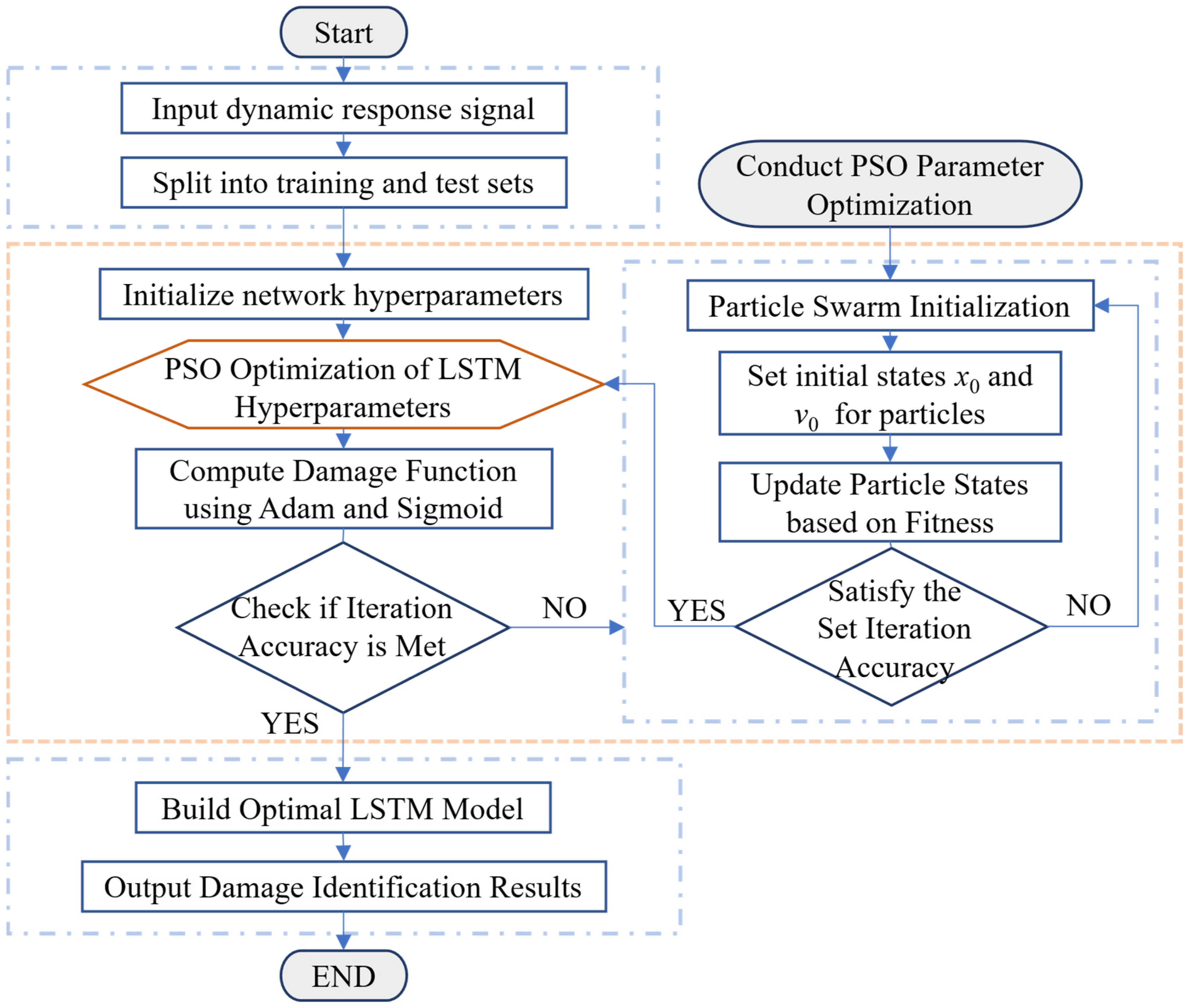
- An optimization framework was established with the objective of maximizing classification accuracy or minimizing the loss function, and the PSO algorithm was employed to adaptively optimize critical hyperparameters of the LSTM network, including the number of hidden-layer neurons, initial learning rate, and maximum training epochs.
- (3)
- A damage detection mechanism based on residuals and the 3σ criterion was proposed, and the effectiveness of the method was validated through both numerical simulation and physical model testing.
2. LSTM-Based Damage Identification Method Using Dynamic Responses
2.1. Long Short-Term Memory (LSTM) Neural Network
2.2. Hyperparameter Optimization of LSTM Neural Networks
2.2.1. PSO Method
2.2.2. SSA Optimization Method
2.3. Damage Index Development and Damage Assessment
- (1)
- Healthy baseline model: An LSTM-based baseline model was trained using measurement data acquired from the undamaged structure, enabling the prediction of dynamic responses under normal operating conditions.
- (2)
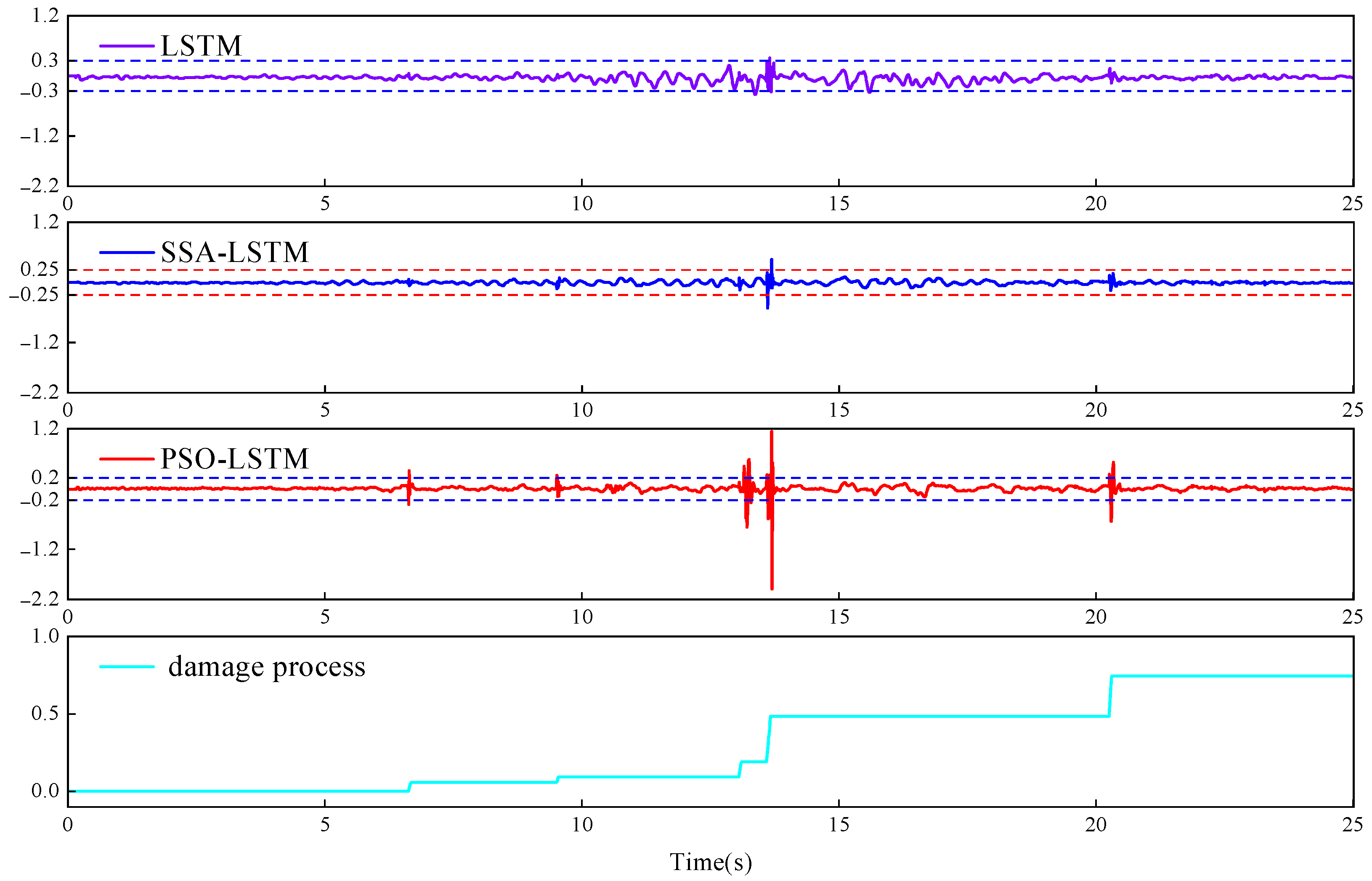
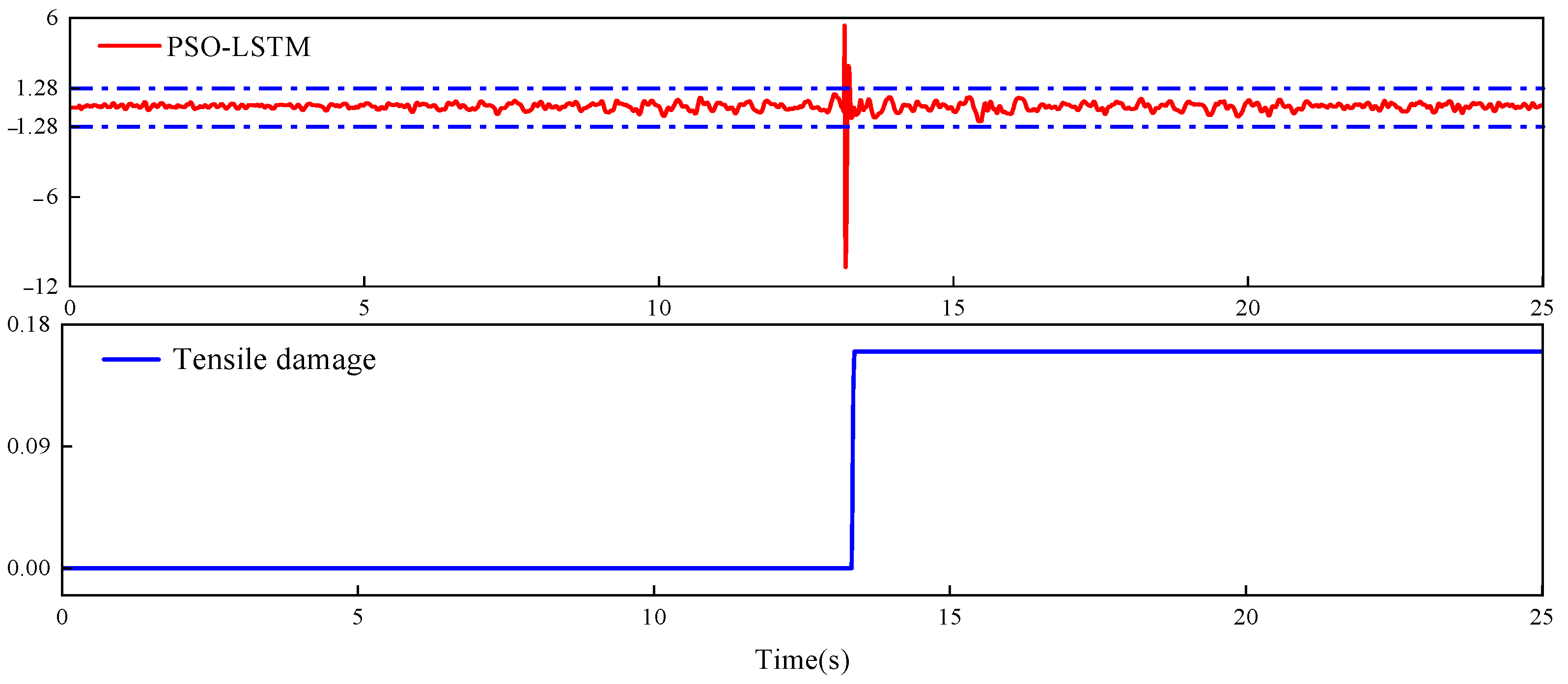
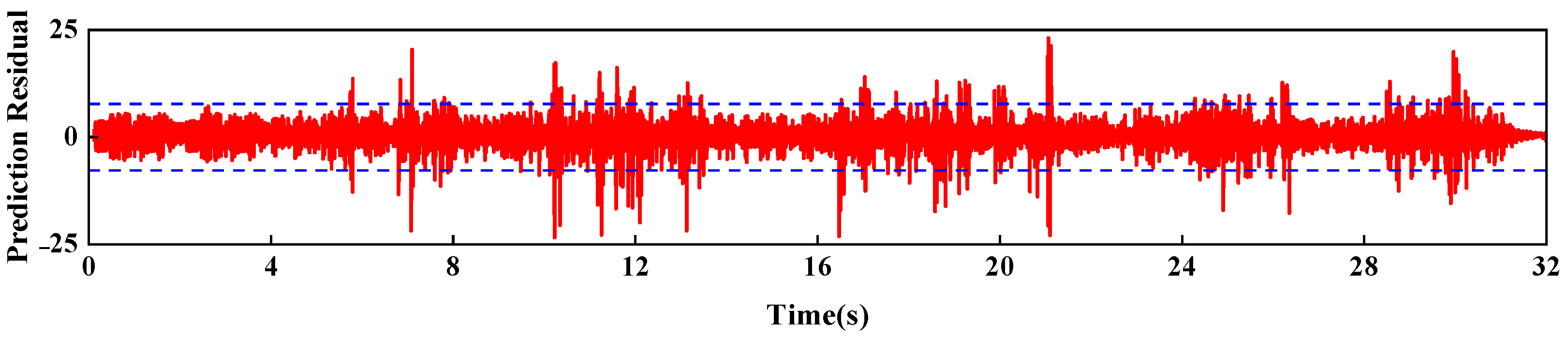
- Residual sequence: The residual et was calculated as the difference between the measured signal yt and the predicted value , expressed as . Structural damage induced significant deviations of et from its baseline statistical distribution—specifically, exceeding the threshold defined by the mean ± 3σ.
3. Examples
3.1. Numerical Simulation Example
3.1.1. Dynamic Simulation of a Concrete Arch Dam
3.1.2. Damage Identification on the Basis of Acceleration Response
3.2. Dynamic Model Experimental Example of an Arch Dam
3.2.1. Arch Dam Model and Arranged Sensors
3.2.2. Damage Identification of the Arch Dam Model
4. Conclusions
- (1)
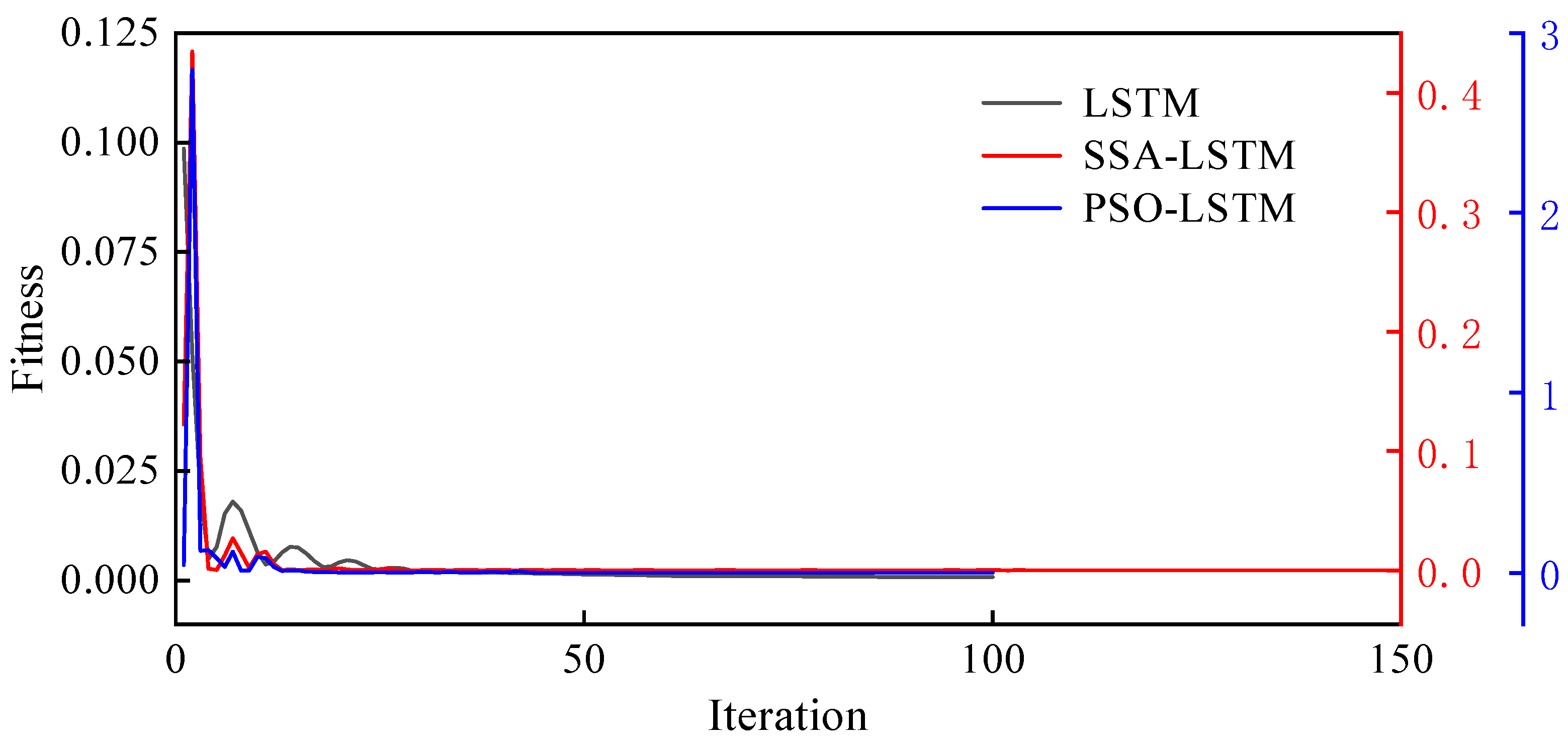
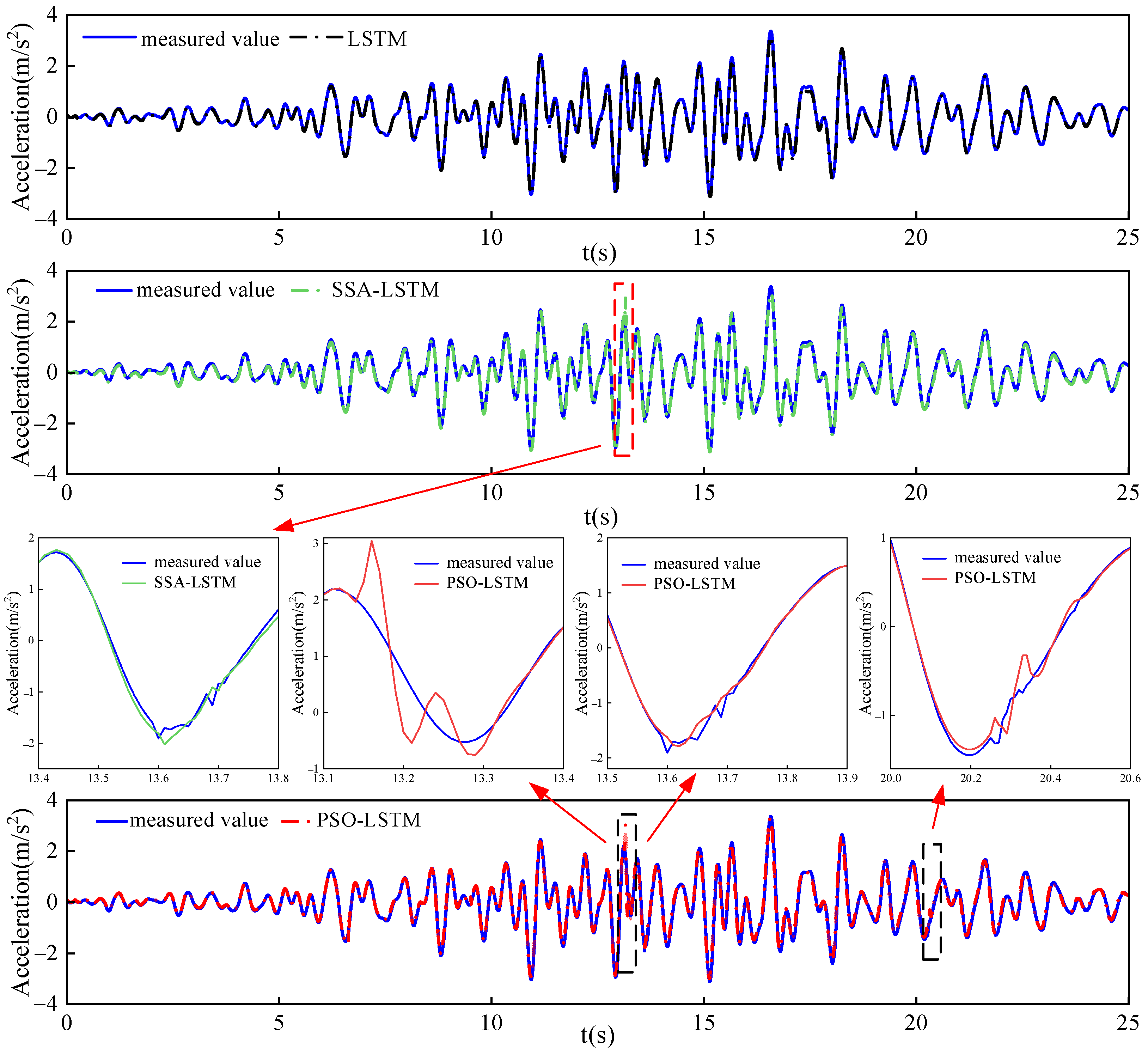
- The PSO algorithm was employed to optimize key hyperparameters of the LSTM network, including the number of neurons in the hidden layer, maximum training epochs, and initial learning rate. This optimization effectively reduced the subjective bias caused by manual parameter tuning and enhanced the accuracy of structural damage identification from dynamic responses. Comparative results demonstrated that the PSO-LSTM model could accurately capture abrupt changes in dynamic responses, resulting in increased sensitivity and reliability. In terms of damage detection accuracy and overall performance, the PSO-LSTM model outperformed both the SSA-LSTM and standalone LSTM models.
- (2)
- The performance of the models was comprehensively evaluated via four quantitative metrics: the root mean square error (RMSE), mean absolute error (MAE), mean absolute percentage error (MAPE), and coefficient of determination (R2). The PSO-LSTM model achieved the best performance across all the evaluation metrics, confirming its superiority in damage identification for concrete arch dams on the basis of dynamic response signals. This hybrid model demonstrated a stronger ability to extract discriminative features from complex dynamic signals, effectively capturing the nonstationary behavior of structures. This study provides a robust technical foundation for real-time monitoring and structural safety assessment in practical engineering applications.
- (3)
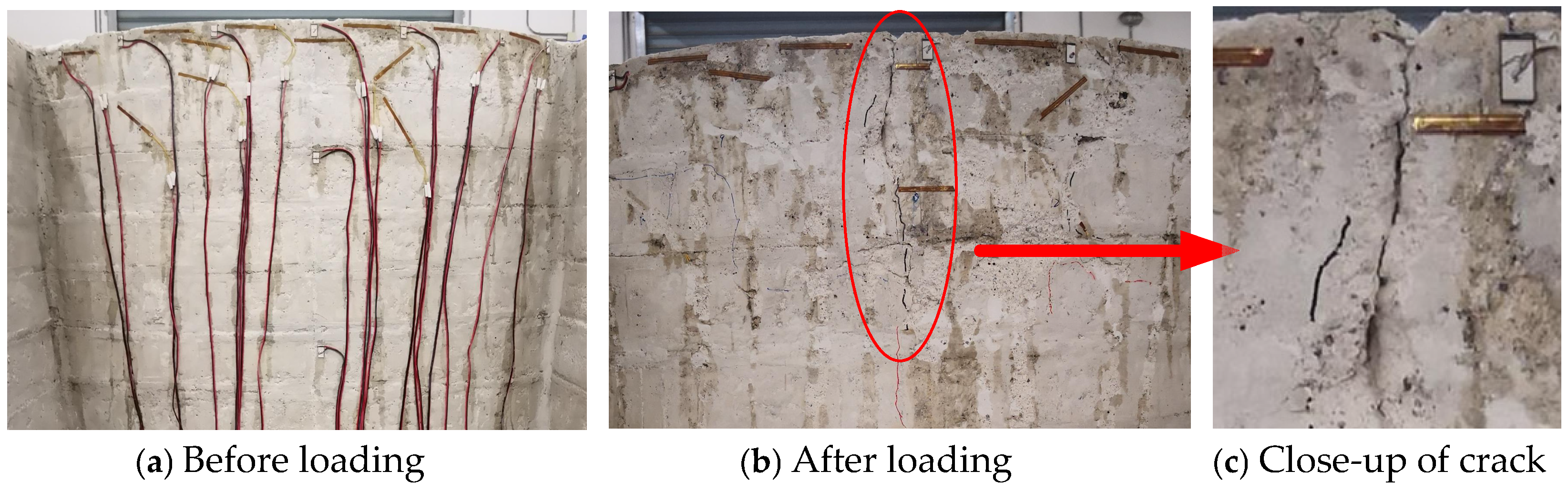
- To further validate the effectiveness of the PSO-LSTM-based damage identification method, shaking table tests were conducted on a scaled-down arch dam model. The test results revealed that the PSO-LSTM model could accurately identify the onset of structural damage and clearly capture the subsequent damage progression. These identification outcomes were highly consistent with the observed crack initiation and propagation processes during the tests, fully verifying the effectiveness of the proposed model in real-world engineering scenarios.
- (4)
- While the proposed PSO-LSTM-based damage identification framework demonstrates strong performance and practical feasibility, there remains scope for further enhancement and extension. In the present study, the model primarily focused on structural dynamic responses under a single seismic excitation, without explicitly incorporating multisource excitation effects such as dam–reservoir interaction. In addition, the experimental verification was conducted using a scaled arch dam model, which, although effective in validating the fundamental applicability of the method, represents a simplified approximation of real-world engineering conditions. Future research will therefore aim to broaden the applicability of the proposed approach by considering more complex excitation scenarios and structural–environmental coupling effects. Moreover, transfer learning techniques will be introduced to improve the adaptability and generalization capability of the model under varying seismic inputs and operational conditions. Further efforts will also be devoted to extending the method to prototype dams and exploring its feasibility for real-time or online implementation, thereby promoting the practical deployment of the proposed framework in structural health monitoring systems for concrete arch dams.
Author Contributions
Funding
Institutional Review Board Statement
Informed Consent Statement
Data Availability Statement
Conflicts of Interest
References
- Yan, Y.J.; Cheng, L.; Wu, Z.Y.; Yam, L.H. Development in vibration-based structural damage detection technique. Mech. Syst. Signal Process. 2006, 21, 2198–2211. [Google Scholar] [CrossRef]
- Du, X.; Wang, J. Seismic response analysis of arch dam-water-rock foundation systems. Earthq. Eng. Eng. Vib. 2004, 3, 283–291. [Google Scholar]
- Ferdousi, A. Seismic performance of arch dams on non-homogeneous and discontinuous foundations (a case study: Karun 4 Dam). Int. J. Adv. Struct. Eng. 2017, 9, 191–203. [Google Scholar] [CrossRef]
- Du, X.; Zhang, Y.; Zhang, B. Nonlinear seismic response analysis of arch dam-foundation systems- part I dam-foundation rock interaction. Bull. Earthq. Eng. 2007, 5, 105–119. [Google Scholar] [CrossRef]
- Chen, J.; Cao, X.; Xu, Q.; Li, J. Exploration on Damage Mechanism and Equivalent Damage Model of High Arch Dams under Earthquakes. KSCE J. Civ. Eng. 2020, 24, 1285–1306. [Google Scholar] [CrossRef]
- Jiang, H.; Lu, W.; Wang, G.; Wu, L.; Liu, J. Damage mechanism of model arch dam subjected to far-field underwater explosion. Eng. Struct. 2025, 322, 119081. [Google Scholar] [CrossRef]
- Li, X.N.; Shi, R. The Dynamic Stability Analysis of Shapai Arch Dam Affected by Wenchuan Earthquake. In IOP Conference Series: Earth and Environmental Science; IOP Publishing: Bristol, UK, 2018; Volume 189. [Google Scholar]
- Qiu, J.; He, W.; Zheng, D.; Xu, Y.; Guo, S.; Ma, T.; Xu, P.; Liu, Y. Dynamic Failure Experimental Study of a Gravity Dam Model on a Shaking Table and Analysis of Its Structural Dynamic Characteristics. Sensors 2024, 24, 1602. [Google Scholar] [CrossRef]
- Hasan, M.; Mehdi, G.; Pegah, A. Modal identification of concrete arch dam by fully automated operational modal identification. Structures 2021, 32, 228–236. [Google Scholar] [CrossRef]
- Zhu, Y.; Jia, Q.; Zhang, K.; Li, Y.; Li, Z.; Wang, H. Damage assessment and diagnosis of hydraulic concrete structures using optimization-based machine learning technology. Front. Struct. Civ. Eng. 2023, 17, 1281–1294. [Google Scholar] [CrossRef]
- Zhu, X.; Qiu, J.; Xu, Y.; Chen, X.; Xu, P.; Wu, X.; Guo, S.; Zhao, J.; Lin, J. Modal Parameter Recursive Estimation of Concrete Arch Dams under Seismic Loading Using an Adaptive Recursive Subspace Method. Sensors 2024, 24, 3845. [Google Scholar] [CrossRef]
- Pereira, S.; Magalhães, F.; Gomes, J.P.; Cunha, Á.; Lemos, J.V. Vibration-based damage detection of a concrete arch dam. Eng. Struct. 2021, 235, 112032. [Google Scholar] [CrossRef]
- Xu, Y.; Wang, Y.; Zhou, L.; Dong, Q. An improved numerical manifold method for crack propagation of concrete gravity dams under seismic loads. Comput. Geotech. 2024, 165, 105927. [Google Scholar] [CrossRef]
- Ahmadzadeh, M.; Zahrai, S.M.; Bitaraf, M. An integrated deep neural network model combining 1D CNN and LSTM for structural health monitoring utilizing multisensor time-series data. Struct. Health Monit. 2025, 24, 447–465. [Google Scholar] [CrossRef]
- Du, J.; Zeng, J.; Wang, H.; Ding, H.; Wang, H.; Bi, Y. Using acoustic emission technique for structural health monitoring of laminate composite: A novel CNN-LSTM framework. Eng. Fract. Mech. 2024, 309, 110447. [Google Scholar] [CrossRef]
- Xu, X.; Pan, T.; Zheng, Y.; Lan, X.; Zhou, Y.; Hou, C. A novel structural damage identification method based on multi-sensor data fusion and multimodal neural networks. Eng. Struct. 2025, 345, 121512. [Google Scholar] [CrossRef]
- Gao, Y.; Zhai, P.; Mosalam, K.M. Balanced semisupervised generative adversarial network for damage assessment from low-data imbalanced-class regime. Comput.-Aided Civ. Infrastruct. Eng. 2021, 36, 1094–1113. [Google Scholar] [CrossRef]
- Liu, Y.; Hou, Y.; Cao, X.; Guo, J.; Shao, Z.; Zhang, X.; Denf, Q.; Fu, P. A Novel Multiscale Feature Fusion Neural Network for Analyzing Uncertain Dynamic Characteristics of Laminated Structures. Polym. Compos. 2025, 46, 14189–14205. [Google Scholar] [CrossRef]
- Ai, D.; Cheng, J. A deep learning approach for electromechanical impedance based concrete structural damage quantification using two-dimensional convolutional neural network. Mech. Syst. Signal Process. 2023, 183, 109634. [Google Scholar] [CrossRef]
- Parida, L.; Moharana, S. The Effect of Corrosion on Reinforced Cement Concrete (RCC) Structure for Long Exposure to Acidic Environment: A Deep Learning-Based Approach. J. Fail. Anal. Prev. 2025, 25, 1514–1527. [Google Scholar] [CrossRef]
- Gu, H.; Li, Y.; Fang, Y.; Wang, Y.; Yu, Y.; Wei, Y.; Xu, L.; Chen, Y. Environmental-aware deformation prediction of water-related concrete structures using deep learning. Comput.-Aided Civ. Infrastruct. Eng. 2025, 40, 2130–2151. [Google Scholar] [CrossRef]
- Sony, S.; Gamage, S.; Sadhu, A.; Samarabandu, J. Vibration-based multiclass damage detection and localization using long short-term memory networks. Structures 2022, 35, 436–451. [Google Scholar] [CrossRef]
- Trifunac, M.D.; Todorovska, M.I. Evolution of accelerographs, data processing, strong motion arrays and amplitude and spatial resolution in recording strong earthquake motion. Soil Dyn. Earthq. Eng. 2001, 21, 537–555. [Google Scholar] [CrossRef]
- Mata, J.; Gomes, J.P.; Pereira, S.; Magalhães, F.; Cunha, Á. Analysis and interpretation of observed dynamic behaviour of a large concrete dam aided by soft computing and machine learning techniques. Eng. Struct. 2023, 296, 116940. [Google Scholar] [CrossRef]
- Li, Y.; Kong, Q.; Xiong, B.; Chi, F.; Qu, Y.; Wang, C. Edge-fog-cloud-based digital twin network for autonomous and distributed structural health monitoring of a mega dam cluster. Autom. Constr. 2025, 172, 106050. [Google Scholar] [CrossRef]
- Han, X.; Cao, Y.; Wu, M.; Wang, W.; Feng, W. Multi-Shaft Speed-Informed Adaptive Window Filtering Method for Acoustic Pressure Signals in Marine Gas Turbines. Signal Process. 2026, 243, 110448. [Google Scholar] [CrossRef]
- Mihel, A.M.; Krvavica, N.; Lerga, J. Regression-based machine learning approaches for estimating discharge from water levels in microtidal rivers. J. Hydrol. 2025, 646, 132276. [Google Scholar] [CrossRef]
- Das, T.; Guchhait, S. A hybrid GRU and LSTM-based deep learning approach for multiclass structural damage identification using dynamic acceleration data. Eng. Fail. Anal. 2025, 170, 109259. [Google Scholar] [CrossRef]
- Chencho; Li, J.; Hao, H. Structural damage quantification using long short-term memory (LSTM) auto-encoder and impulse response functions. J. Infrastruct. Intell. Resil. 2024, 3, 100086. [Google Scholar] [CrossRef]
- Choe, D.-E.; Kim, H.-C.; Kim, M.-H. Sequence-based modeling of deep learning with LSTM and GRU networks for structural damage detection of floating offshore wind turbine blades. Renew. Energy 2021, 174, 218–235. [Google Scholar] [CrossRef]
- Meng, W.; Zhao, P.; Shi, Y.; Li, L.; Meng, Z. Intelligent fault diagnosis of mechanical engineering using NLF-LSTM optimized deep learning model. Optim. Eng. 2025, 26, 891–912. [Google Scholar] [CrossRef]
- Öztürk, M.M. Hyperparameter Optimization of a Parallelized LSTM for Time Series Prediction. Vietnam J. Comput. Sci. 2023, 10, 303–328. [Google Scholar] [CrossRef]
- Mohammed, N.; Ahmed, F.; Mewada, H.; Rathod, R.G.; Sonawane, S.K. Experimental and machine learning optimization of centrifugal pump performance. Flow Meas. Instrum. 2026, 107, 103048. [Google Scholar] [CrossRef]
- Thomas, G.T.; Paul, G.; Fumiya, I. Closing the Control Loop with Time-Variant Embedded Soft Sensors and Recurrent Neural Networks. Soft Robot. 2022, 9, 1167–1176. [Google Scholar] [CrossRef]
- Fu, L.; Tang, Q.; Gao, P.; Xin, J.; Zhou, J. Damage Identification of Long-Span Bridges Using the Hybrid of Convolutional Neural Network and Long Short-Term Memory Network. Algorithms 2021, 14, 180. [Google Scholar] [CrossRef]
- Li, Y.; Zhao, H.; Gu, H.; Wei, Y.; Xiang, Z.; Wang, Y.; Yu, Y.; Bao, T. Automated defect segmentation and quantification in concrete structures via unmanned aerial vehicle-based lightweight deep learning. Comput.-Aided Civ. Infrastruct. Eng. 2025, 40, 4465–4484. [Google Scholar] [CrossRef]
- Huang, L.; Hong, X.; Yang, Z.; Liu, Y.; Zhang, B. CNN-LSTM network-based damage detection approach for copper pipeline using laser ultrasonic scanning. Ultrasonics 2022, 121, 106685. [Google Scholar] [CrossRef]
- Yin, Y.; Wang, D.; Zhu, Q.; Yang, G.; Chen, X.; Liu, X.; Liu, Y. Research on Intelligent Design and Visualization of Gas Extraction Drilling Based on PSO–LSTM. Processes 2024, 12, 1691. [Google Scholar] [CrossRef]
- Xiao, W.; Fu, Z.; Wang, S.; Chen, X. Joint torque prediction of industrial robots based on PSO-LSTM deep learning. Ind. Robot Int. J. Robot. Res. Appl. 2024, 51, 501–510. [Google Scholar] [CrossRef]
- Yue, Y.; Cao, L.; Lu, D.; Hu, Z.; Xu, M.; Wang, S.; Li, B.; Ding, H. Review and empirical analysis of sparrow search algorithm. Artif. Intell. Rev. 2023, 56, 10867–10919. [Google Scholar] [CrossRef]
- Qiu, J.; Zheng, D.; Xu, P.; Cao, Q.; Chen, Z.; Xu, B. Online structural damage state identification of concrete arch dams under dynamic loads using a recursive TVARX approach. Struct. Health Monit. 2023, 22, 2038–2063. [Google Scholar] [CrossRef]
- Ali, A.J.; Ahmed, A.A.; Abbod, M.F. Groundwater level predictions in the Thames Basin, London over extended horizons using Transformers and advanced machine learning models. J. Clean. Prod. 2024, 484, 144300. [Google Scholar] [CrossRef]
- Chen, M.; Xu, P.; Liu, Z.; Liu, F.; Zhang, H.; Miao, S. Air pollution prediction based on optimized deep learning neural networks: PSO-LSTM. Atmos. Pollut. Res. 2025, 16, 102413. [Google Scholar] [CrossRef]
- Alkanhel, R.; El-kenawy, E.S.M.; Elsheweikh, D.L.; Abdelhamid, A.A.; Ibrahim, A.; Khafaga, D.S. Metaheuristic Optimization of Time Series Models for Predicting Networks Traffic. Comput. Mater. Contin. 2023, 75, 427–442. [Google Scholar]



| Swarm Size | Maximum Iteration Number | Optimized Parameters | Lower Bound of Optimized Parameters | Upper Bound of Optimized Parameters |
|---|---|---|---|---|
| 10 | 50 | hd | [30, 0.01, 30] | [200, 0.2, 200] |
| lr | ||||
| E |
| Model | hd | E | lr | L2 | Step | Dropout Ratio | Number of Points |
|---|---|---|---|---|---|---|---|
| LSTM | 50 | 100 | 0.01 | 0.0001 | 50 | 0.2 | 200 |
| SSA-LSTM | 132 | 149 | 0.0237 | 0.098 | 50 | 0.2 | 200 |
| PSO-LSTM | 83 | 100 | 0.0541 | / | 50 | 0.2 | 200 |
| Population Size | Maximum Iteration Number | Optimized Hyperparameters | Lower Bound of Parameters | Upper Bound of Parameters |
|---|---|---|---|---|
| 10 | 20 | hd E lr L2 | [30, 30, 0.01, 0.0001] | [200, 200, 0.2, 0.1] |
| Model | Evaluation Metrics | ||
|---|---|---|---|
| RMSE | MAE | R2 | |
| LSTM | 0.0783 | 0.0628 | 0.8577 |
| SSA-LSTM | 0.0742 | 0.0529 | 0.9897 |
| PSO-LSTM | 0.0674 | 0.0318 | 0.9981 |
Disclaimer/Publisher’s Note: The statements, opinions and data contained in all publications are solely those of the individual author(s) and contributor(s) and not of MDPI and/or the editor(s). MDPI and/or the editor(s) disclaim responsibility for any injury to people or property resulting from any ideas, methods, instructions or products referred to in the content. |
© 2026 by the authors. Licensee MDPI, Basel, Switzerland. This article is an open access article distributed under the terms and conditions of the Creative Commons Attribution (CC BY) license.
Share and Cite
Qiu, J.; He, W.; Long, C.; Zhang, Y.; Liu, X.; Xu, P.; Sun, L.; Zhang, C.; Cheng, L.; Lu, W. Dynamic Response-Based Safety Monitoring and Damage Identification of Concrete Arch Dams via PSO–LSTM. Sensors 2026, 26, 1136. https://doi.org/10.3390/s26041136
Qiu J, He W, Long C, Zhang Y, Liu X, Xu P, Sun L, Zhang C, Cheng L, Lu W. Dynamic Response-Based Safety Monitoring and Damage Identification of Concrete Arch Dams via PSO–LSTM. Sensors. 2026; 26(4):1136. https://doi.org/10.3390/s26041136
Chicago/Turabian StyleQiu, Jianchun, Wenqin He, Changlin Long, Yang Zhang, Xinyang Liu, Pengcheng Xu, Linsong Sun, Changsheng Zhang, Lin Cheng, and Weigang Lu. 2026. "Dynamic Response-Based Safety Monitoring and Damage Identification of Concrete Arch Dams via PSO–LSTM" Sensors 26, no. 4: 1136. https://doi.org/10.3390/s26041136
APA StyleQiu, J., He, W., Long, C., Zhang, Y., Liu, X., Xu, P., Sun, L., Zhang, C., Cheng, L., & Lu, W. (2026). Dynamic Response-Based Safety Monitoring and Damage Identification of Concrete Arch Dams via PSO–LSTM. Sensors, 26(4), 1136. https://doi.org/10.3390/s26041136