Enabling Communication Resiliency in the Connected Car Environment





Abstract
1. Introduction
1.1. Contributions of This Work
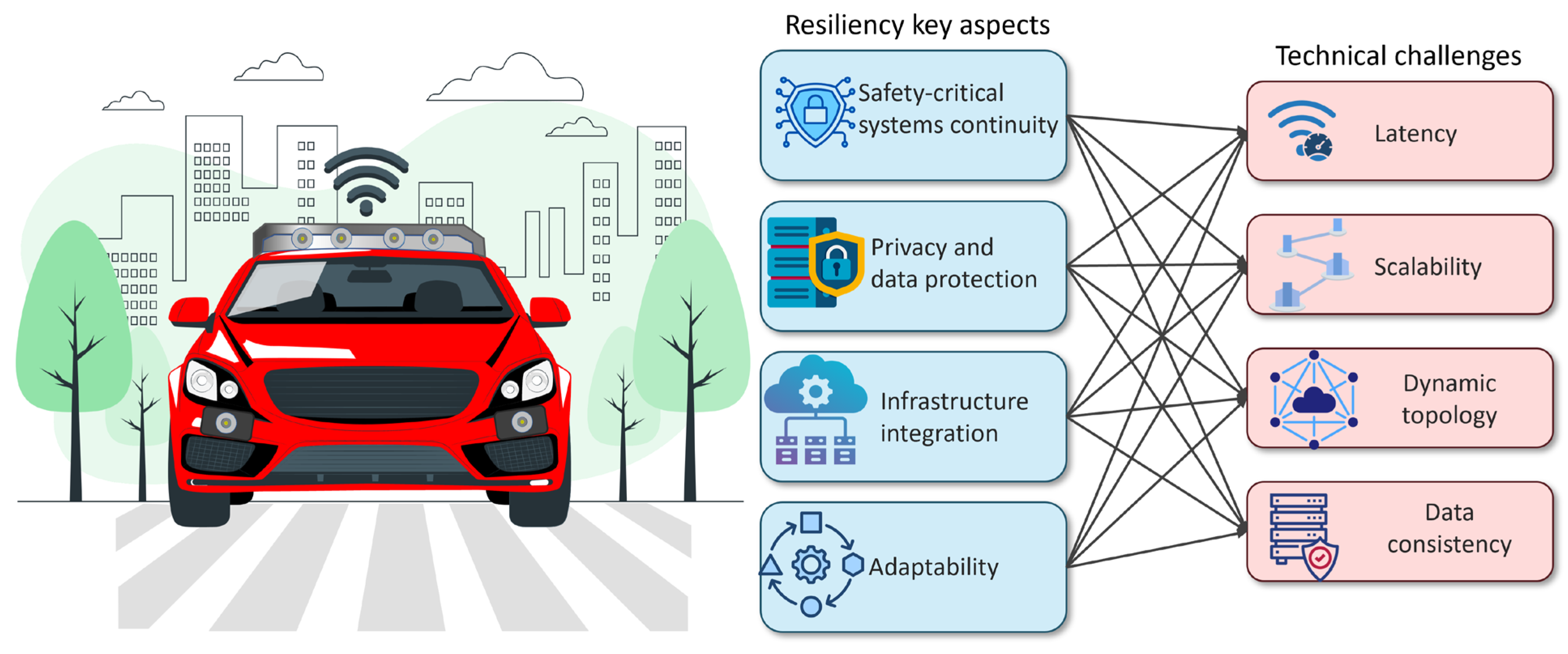
- We examine the technical challenges that affect communication resiliency in the connected car environment. These challenges include latency, scalability, dynamic topology and data integrity.
- To address the identified challenges, we discuss solutions that will increase the communication resiliency in the connected car environment.
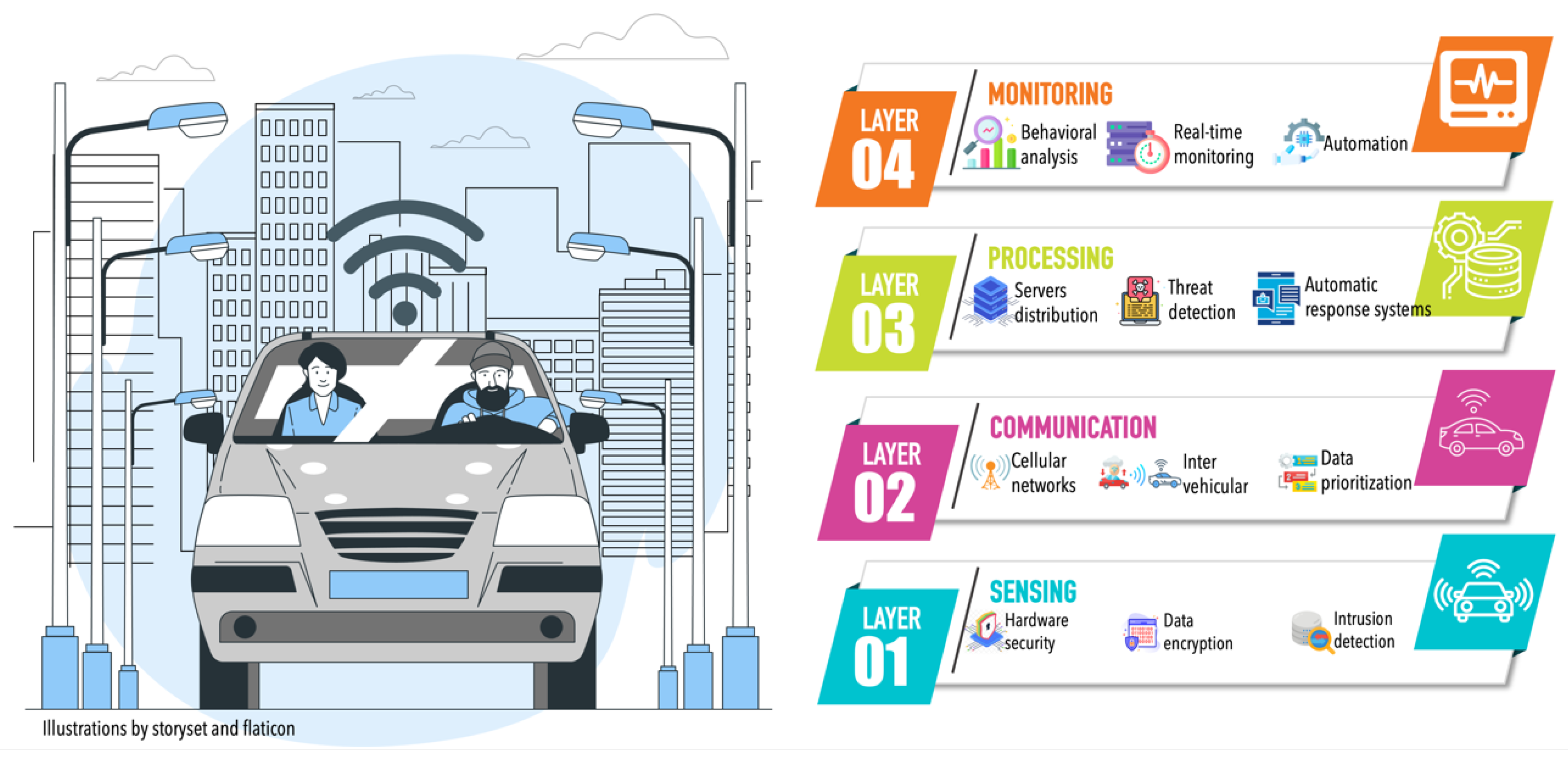
- Based on the state-of-the-art review, we proposed a multi-layer reference architecture that addresses the challenges we identified. It is noteworthy that this proposal represents a conceptual framework. While we validate the architecture through theoretical analysis and asymptotic complexity comparisons, experimental validation via field trials or large-scale testbeds is outside the scope of this paper but will be explored as part of our future work.
1.2. Organization of This Paper
2. The Connected Car Ecosystem
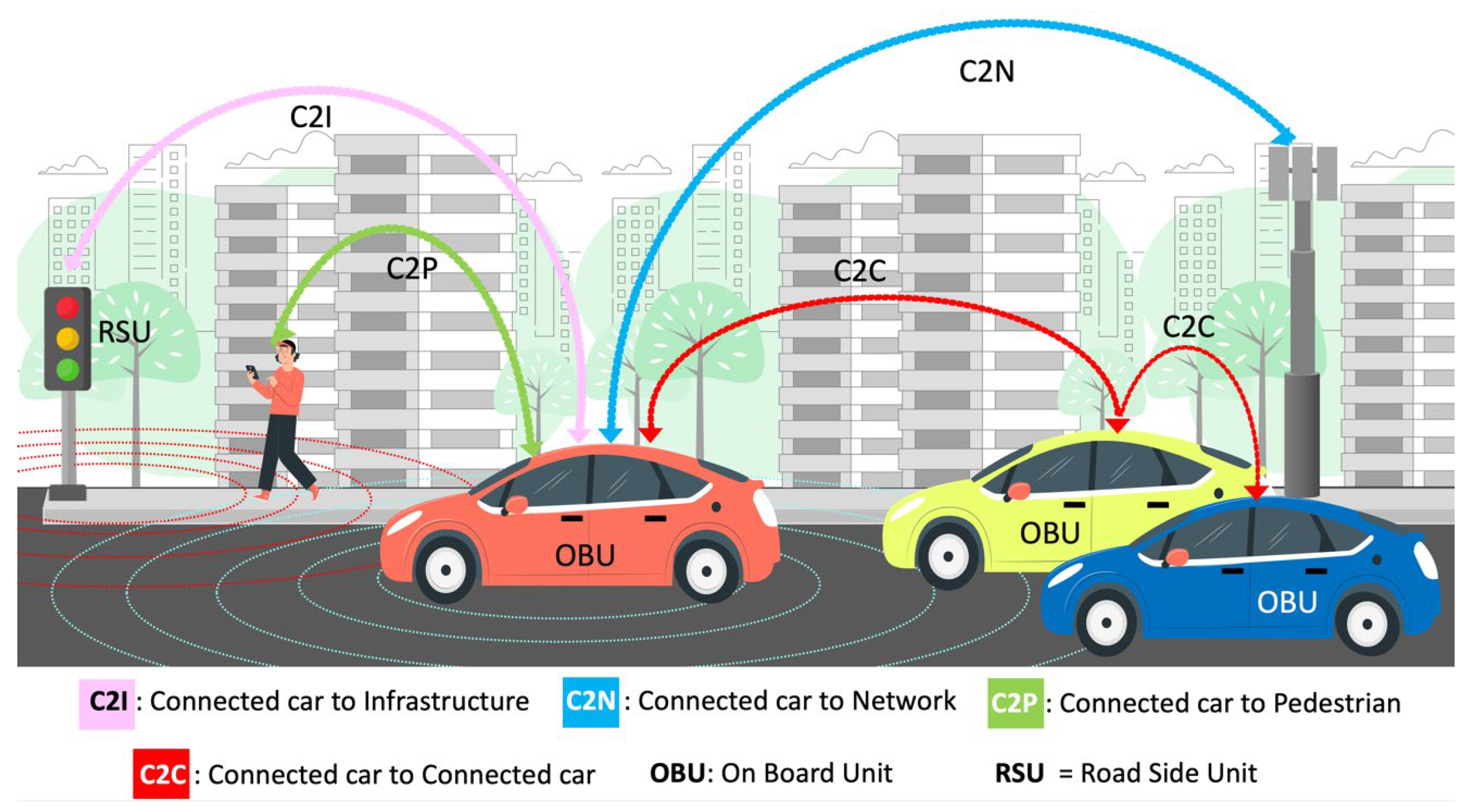
Communication in the Connected Cars Environment
3. Technical Challenges Affecting Communication Resiliency in the Connected Car Environments and Their Solutions
3.1. Latency
3.1.1. Challenges
3.1.2. Solutions
3.2. Scalability
3.2.1. Challenges
3.2.2. Solutions
3.3. Dynamic Topology
3.3.1. Challenges
3.3.2. Solutions
3.4. Data Integrity
3.4.1. Challenges
3.4.2. Solutions
3.5. Survivability
4. Proposed Resilient Architecture for the Connected Car Environment
4.1. Sensing Layer
4.2. Communication Layer
4.3. Processing Layer
4.4. Monitoring Layer
4.4.1. Real-Time Monitoring
4.4.2. Warning Systems
4.4.3. Automatic Alert Management
4.4.4. Auditing
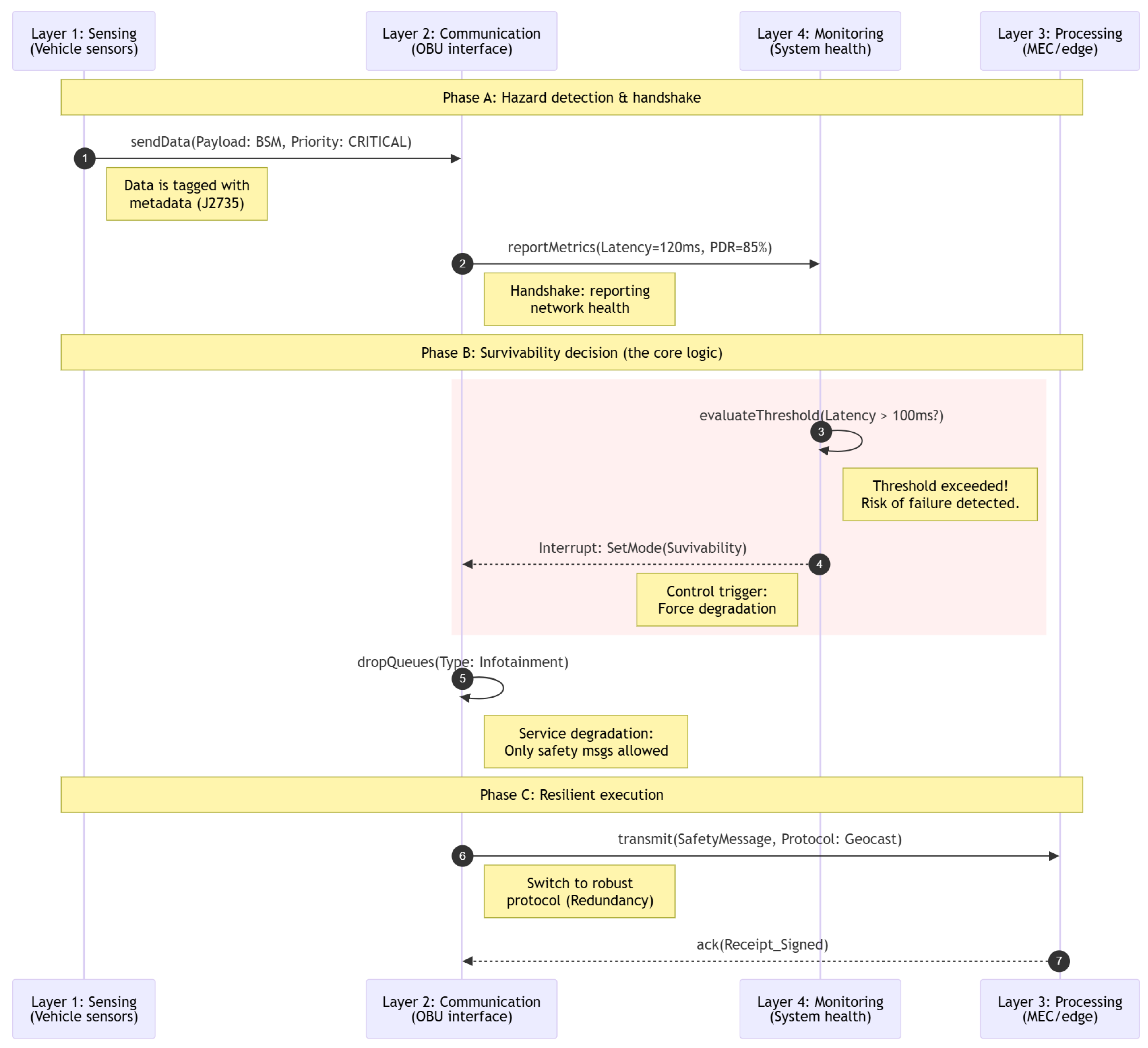
4.5. Cross-Layer Interaction and Data Flow
4.6. Theoretical Validation and Asymptotic Complexity Analysis
4.6.1. Impact of SDN on Routing Latency
4.6.2. Clustering Efficiency and Overhead Reduction
4.6.3. Comparative Qualitative Analysis
5. Conclusions
Author Contributions
Funding
Institutional Review Board Statement
Informed Consent Statement
Data Availability Statement
Acknowledgments
Conflicts of Interest
References
- The World Bank. “Urban Development”, World Bank. Available online: https://www.worldbank.org/en/topic/urbandevelopment/overview (accessed on 10 October 2023).
- World Health Organization. Road Safety. Available online: https://www.who.int/health-topics/road-safety (accessed on 10 October 2023).
- Korotkova, Y.A.; Pashkova, A.A.; Shalagina, E.A.; Pakhomova, A.A.; Dronseiko, V.V. Ensuring Road Safety Using ITS Services. In Proceedings of the 2022 Intelligent Technologies and Electronic Devices in Vehicle and Road Transport Complex (TIRVED), Moscow, Russia, 10–11 November 2022; pp. 1–5. [Google Scholar] [CrossRef]
- Hung, K.V. ITS applications to improve traffic safety in developing countries. In Proceedings of the 2019 International Conference on Advanced Technologies for Communications (ATC); IEE: Hanoi, Vietnam, 2019; p. xxxiii. [Google Scholar] [CrossRef]
- Dubey, A.; Lakhani, M.; Dave, S.; Patoliya, J.J. Internet of Things based adaptive traffic management system as a part of Intelligent Transportation System (ITS). In Proceedings of the 2017 International Conference on Soft Computing and its Engineering Applications (icSoftComp), Changa, India, 1–2 December 2017; pp. 1–6. [Google Scholar] [CrossRef]
- Sankaranarayanan, M.; Mala, C.; Mathew, S. Improved Performance of ITS Application with Verified Traffic Congestion Statistics (TraCoS). In Proceedings of the 2021 International Conference on Computational Performance Evaluation (ComPE), Shillong, India, 1–3 December 2021; pp. 141–146. [Google Scholar] [CrossRef]
- Kadhim, R.M.; Hasson, S.T. A Developed Traffic Light Approach to Control Road Congestions in VANETs. In Proceedings of the 2023 8th International Conference on Smart and Sustainable Technologies (SpliTech), Split-Bol, Croatia, 20–23 June 2023; pp. 1–5. [Google Scholar] [CrossRef]
- Shirabur, S.; Hunagund, S.; Murgd, S. VANET Based Embedded Traffic Control System. In Proceedings of the 2020 International Conference on Recent Trends on Electronics, Information, Communication & Technology (RTEICT), Bangalore, India, 12–13 November 2020; pp. 189–192. [Google Scholar] [CrossRef]
- Gowri, E.A.; Bhoomika, M.; Nerella, K.; Roltsh, L.; Vineeth, N. Reduction of traffic congestion due to accidents by communicating information using VANETs. In Proceedings of the 2021 12th International Conference on Computing Communication and Networking Technologies (ICCCNT), Kharagpur, India, 6–8 July 2021; pp. 1–4. [Google Scholar] [CrossRef]
- Dokur, O.; Katkoori, S. Three Connected V2V Applications Based on DSRC Basic Safety Messages. In Proceedings of the 2022 International Conference on Connected Vehicle and Expo (ICCVE), Lakeland, FL, USA, 7–9 March 2022; pp. 1–6. [Google Scholar] [CrossRef]
- Chai, L.; Cai, B.; ShangGuan, W.; Wang, J. Simulation and testing method for evaluating the effects of position error, communication delay and penetration rate to connected vehicles safety. In Proceedings of the 2017 Chinese Automation Congress (CAC), Jinan, China, 20–22 October 2017; pp. 4389–4394. [Google Scholar] [CrossRef]
- Shah, G.; Valiente, R.; Gupta, N.; Gani, S.M.O.; Toghi, B.; Fallah, Y.P.; Gupta, S.D. Real-Time Hardware-In-the-Loop Emulation Framework for DSRC-Based Connected Vehicle Applications. In Proceedings of the 2019 IEEE 2nd Connected and Automated Vehicles Symposium (CAVS), Orlando, FL, USA, 22–23 September 2019; pp. 1–6. [Google Scholar] [CrossRef]
- Djahel, S.; Hadjadj-Aoul, Y.; Pincemin, R. CR-TMS: Connected Vehicles enabled Road Traffic Congestion Mitigation System using Virtual Road Capacity Inflation. In Proceedings of the 2020 IEEE 23rd International Conference on Intelligent Transportation Systems (ITSC), Rhodes, Greece, 20–23 September 2020; pp. 1–6. [Google Scholar] [CrossRef]
- Cao, Z.; Lu, L.; Chen, C.; Chen, X. Modeling and Simulating Urban Traffic Flow Mixed with Regular and Connected Vehicles. IEEE Access 2021, 9, 10392–10399. [Google Scholar] [CrossRef]
- Siegel, J.E.; Erb, D.C.; Sarma, S.E. A Survey of the Connected Vehicle Landscape—Architectures, Enabling Technologies, Applications, and Development Areas. IEEE Trans. Intell. Transp. Syst. 2018, 19, 2391–2406. [Google Scholar] [CrossRef]
- Sterbenz, J.P.; Hutchison, D.; Çetinkaya, E.K.; Jabbar, A.; Rohrer, J.P.; Schöller, M.; Smith, P. Resilience and survivability in communication networks: Strategies, principles, and survey of disciplines. Comput. Netw. 2010, 54, 1245–1265. [Google Scholar] [CrossRef]
- IEEE Std 802.11p-2010; IEEE Standard for Information Technology—Telecommunications and Information Exchange Between Systems—Local and Metropolitan Area Networks—Specific Requirements—Part 11: Wireless LAN Medium Access Control (MAC) and Physical Layer (PHY) Specifications, Amendment 6: Wireless Access in Vehicular Environments. IEEE: New York, NY, USA, 2010.
- Annu, A.; Rajalakshmi, P. Enhancing Sidelink 5G V2V Communication: A Distributed Probabilistic Congestion Control for Dynamic Resource Allocation. In Proceedings of the 2023 IEEE International Conference on Advanced Networks and Telecommunications Systems (ANTS), Jaipur, India, 17–20 December 2023; pp. 1–6. [Google Scholar] [CrossRef]
- George, S.V.; Baiju, A.; Sunil, D.; Shajahan, S.; Vishnupriya, S.; Jayakumari, J. Performance Analysis of V2V Sidelink Communication. In Proceedings of the 2024 3rd International Conference for Advancement in Technology (ICONAT), Goa, India, 13–15 September 2024; pp. 1–9. [Google Scholar] [CrossRef]
- Annu; Rajalakshmi, P. Towards 6G V2X Sidelink: Survey of Resource Allocation—Mathematical Formulations, Challenges, and Proposed Solutions. IEEE Open J. Veh. Technol. 2024, 5, 344–383. [Google Scholar] [CrossRef]
- Campolo, C.; Molinaro, A.; Sciancalepore, V. 5G Network Slicing for V2X Communications: Technologies and Enablers. In Radio Access Network Slicing and Virtualization for 5G Vertical Industries; John Wiley & Sons, Ltd.: Hoboken, NJ, USA, 2021; pp. 239–257. [Google Scholar] [CrossRef]
- Fardad, M.; Muntean, G.-M.; Tal, I. Latency-aware V2X Operation Mode Coordination in Vehicular Network Slicing. In Proceedings of the 2023 IEEE 97th Vehicular Technology Conference (VTC2023-Spring), Florence, Italy, 20–23 June 2023; pp. 1–6. [Google Scholar] [CrossRef]
- Garrido, L.A.; Dalgkitsis, A.; Ramantas, K.; Ksentini, A.; Verikoukis, C. Resource Demand Prediction for Network Slices in 5G Using ML Enhanced with Network Models. IEEE Trans. Veh. Technol. 2024, 73, 11848–11861. [Google Scholar] [CrossRef]
- Miao, J.; Chai, X.; Song, X.; Song, T. A DDQN-based Energy-Efficient Resource Allocation Scheme for Low-Latency V2V communication. In Proceedings of the 2022 IEEE 5th International Electrical and Energy Conference (CIEEC), Nanjing, China, 27–29 May 2022; pp. 53–58. [Google Scholar] [CrossRef]
- Ding, G.; Yuan, J.; Yu, G.; Jiang, Y. Two-Timescale Resource Management for Ultrareliable and Low-Latency Vehicular Communications. IEEE Trans. Commun. 2022, 70, 3282–3294. [Google Scholar] [CrossRef]
- Khan, N.; Coleri, S. Resource Allocation for Ultra-Reliable Low-Latency Vehicular Networks in Finite Blocklength Regime. In Proceedings of the 2022 IEEE International Mediterranean Conference on Communications and Networking (MeditCom), Athens, Greece, 5–8 September 2022; pp. 322–327. [Google Scholar] [CrossRef]
- Mande, S.; Ramachandran, N. A novel approach for efficient resource allocation in 6G V2V networks using neighbor-aware greedy algorithm and sweep line model. Egypt. Inform. J. 2025, 30, 100693. [Google Scholar] [CrossRef]
- Huang, C.-M.; Tsai, C.-H. A Multi-Routing Paths’ Exploration Algorithm for Multi-paired Communicating Vehicles’ Data Transmission Offloading using the Multi-access Edge Computing Architecture. In Proceedings of the 2024 4th European Conference on Communication Systems (ECCS), Vienna, Austria, 15–17 May 2024; pp. 74–81. [Google Scholar] [CrossRef]
- Liu, F.; Chen, J.; Zhang, Q.; Li, B. Online MEC Offloading for V2V Networks. IEEE Trans. Mob. Comput. 2023, 22, 6097–6109. [Google Scholar] [CrossRef]
- Zhao, J.; Quan, H.; Ge, P.; Huang, Y.; Xiao, Y. Vehicular Edge Computing System: A Survey. IEEE Internet Things Mag. 2025, 8, 122–128. [Google Scholar] [CrossRef]
- Martin-Sacristan, D.; Roger, S.; Garcia-Roger, D.; Monserrat, J.F.; Spapis, P.; Zhou, C.; Kaloxylos, A. Low-Latency Infrastructure-Based Cellular V2V Communications for Multi-Operator Environments with Regional Split. IEEE Trans. Intell. Transp. Syst. 2021, 22, 1052–1067. [Google Scholar] [CrossRef]
- Guo, X.; Hong, X. DQN for Smart Transportation Supporting V2V Mobile Edge Computing. In Proceedings of the 2023 IEEE International Conference on Smart Computing (SMARTCOMP), Nashville, TN, USA, 26–30 June 2023; pp. 204–206. [Google Scholar] [CrossRef]
- Zhang, L.; Guo, H.; Zhou, X.; Liu, J. Trusted Task Offloading in Vehicular Edge Computing Networks: A Reinforcement Learning Based Solution. In Proceedings of the GLOBECOM 2023 IEEE Global Communications Conference, Kuala Lumpur, Malaysia, 4–8 December 2023; pp. 6711–6716. [Google Scholar] [CrossRef]
- Samarakoon, S.; Bennis, M.; Saad, W.; Debbah, M. Distributed Federated Learning for Ultra-Reliable Low-Latency Vehicular Communications. IEEE Trans. Commun. 2020, 68, 1146–1159. [Google Scholar] [CrossRef]
- Yan, J.; Nan, Z.; Zhou, S. V2V-Assisted Timely Hierarchical Federated Learning. In Proceedings of the 2023 IEEE 24th International Workshop on Signal Processing Advances in Wireless Communications (SPAWC), Shanghai, China, 25–28 September 2023; pp. 191–195. [Google Scholar] [CrossRef]
- Zhao, H.; Li, X.; Yang, J.; Ni, Y.; Xia, W.; Gui, G. Long Short-term Memory-based Hybrid V2V/V2I Transmission Latency Method. In Proceedings of the 2021 13th International Conference on Wireless Communications and Signal Processing (WCSP), Changsha, China, 2021; pp. 1–6. [Google Scholar] [CrossRef]
- Choe, C.; Choi, J.; Ahn, J.; Park, D.; Ahn, S. Multiple Channel Access using Deep Reinforcement Learning for Congested Vehicular Networks. In Proceedings of the 2020 IEEE 91st Vehicular Technology Conference (VTC2020-Spring), Virtual, 25–28 May 2020; pp. 1–6. [Google Scholar] [CrossRef]
- Annu; Rajalakshmi, P. Optimizing Semi-Persistent Scheduling in Vehicular Communications: A Comparative Study of Reinforcement Learning Techniques. In Proceedings of the 2024 IEEE Future Networks World Forum (FNWF), Dubai, United Arab Emirates, 14–16 October 2024; pp. 614–619. [Google Scholar] [CrossRef]
- Ibrahim, A.; Goswami, D.; Li, H.; Basten, T. Delay-Aware Multi-Layer Multi-Rate Model Predictive Control for Vehicle Platooning Under Message-Rate Congestion Control. IEEE Access 2022, 10, 44583–44607. [Google Scholar] [CrossRef]
- Mohammed, N.; Kadhim, R.A. A Survey of Congestion Control in Vehicular Ad-Hoc Networks (VANET). In Proceedings of the 2022 Iraqi International Conference on Communication and Information Technologies (IICCIT), Basrah, Iraq, 7–8 September 2022; pp. 20–25. [Google Scholar] [CrossRef]
- Hmaidi, A.; Marouane, H.; Mnif, H. A Novel Traffic Management Scheme Based on Message Prioritization for Intelligent Transportation System. In Proceedings of the 2024 IEEE/ACS 21st International Conference on Computer Systems and Applications (AICCSA), Doha, Qatar, 22–26 October 2024; pp. 1–7. [Google Scholar] [CrossRef]
- Annu; Rajalakshmi, P. Enhancing Sidelink V2X Communication in 6G Networks: Power-Domain NOMA-Based Priority Message Transmission Approach. In Proceedings of the 2024 IEEE Vehicular Networking Conference (VNC), Kobe, Japan, 29–31 May 2024; pp. 117–124. [Google Scholar] [CrossRef]
- Tokunaga, H.; Tang, S. Efficient V2V communications by clustering-based collaborative caching. In Proceedings of the 2022 IEEE International Conference on Vehicular Electronics and Safety (ICVES), Bogota, Colombia, 13–15 December 2022; pp. 1–6. [Google Scholar] [CrossRef]
- Munir, M.U.; Noor, R.M.; Ahmedy, I. Towards a Stable Cluster-Based Routing Algorithm for Safety Traffic Communication in Vehicular Ad Hoc Networks. In Proceedings of the 2025 6th International Conference on Advancements in Computational Sciences (ICACS), Lahore, Pakistan, 18–20 February 2025; pp. 1–8. [Google Scholar] [CrossRef]
- Wu, Y.; Zheng, J. Modeling and Analysis of the Local Delay in an MEC-Based VANET for an Urban Area. IEEE Trans. Veh. Technol. 2022, 71, 13266–13280. [Google Scholar] [CrossRef]
- Ćorluka, R.; Matoš, I.; Damjanović, D.; Balen, J. FOGO—An Optimized Fog and Edge Computing Method for VANETs. In Proceedings of the 2023 46th MIPRO ICT and Electronics Convention (MIPRO), Opatija, Croatia, 22–26 May 2023; pp. 511–516. [Google Scholar] [CrossRef]
- Mosanaei-Boorani, H.; Bayat-Sarmadi, S. A Digital Signature Architecture Suitable for V2V Applications. IEEE Trans. Circuits Syst. I Regul. Pap. 2024, 71, 731–739. [Google Scholar] [CrossRef]
- Kushwah, R.; Kulshreshtha, A.; Singh, K.; Sharma, S. ECDSA for Data Origin Authentication and Vehicle Security in VANET. In Proceedings of the 2019 Twelfth International Conference on Contemporary Computing (IC3), Noida, India, 8–10 August 2019; pp. 1–5. [Google Scholar] [CrossRef]
- Imghoure, A.; El-Yahyaoui, A.; Omary, F. ECDSA-based certificateless conditional privacy-preserving authentication scheme in Vehicular Ad Hoc Network. Veh. Commun. 2022, 37, 100504. [Google Scholar] [CrossRef]
- Sharaf, S.; Mostafa, H. A study of Authentication Encryption Algorithms (POET, Deoxys, AEZ, MORUS, ACORN, AEGIS, AES-GCM) For Automotive Security. In Proceedings of the 2018 30th International Conference on Microelectronics (ICM), Casablanca, Morocco, 16–19 December 2018; pp. 303–306. [Google Scholar] [CrossRef]
- Khan, M.; Ilyas, M.; Bayat, O. Enhancing IoT Security Through Hardware Security Modules (HSMs). In Proceedings of the 2024 International Conference on Intelligent Computing, Communication, Networking and Services (ICCNS), Valencia, Spain, 19–21 June 2024; pp. 278–282. [Google Scholar] [CrossRef]
- Wang, C.; Dong, C.; Li, Y.; Zhao, R. Research on the System of Hardware Security Protection Module of Automobile Chips Based on HSM Vehicle Network. In Proceedings of the 2024 IEEE 7th International Conference on Automation, Electronics and Electrical Engineering (AUTEEE), Shenyang, China, 22–24 November 2024; pp. 719–724. [Google Scholar] [CrossRef]
- Waheed, A.; Shah, M.A.; Mohsin, S.M.; Khan, A.; Maple, C.; Aslam, S.; Shamshirband, S. A Comprehensive Review of Computing Paradigms, Enabling Computation Offloading and Task Execution in Vehicular Networks. IEEE Access 2022, 10, 3580–3600. [Google Scholar] [CrossRef]
- Huang, C.-M.; Wu, Z.-Y.; Lin, S.-Y. The Mobile Edge Computing (MEC)-Based VANET Data Offloading Using the Staying-Time-Oriented k-Hop Away Offloading Agent. In Proceedings of the 2019 International Conference on Information Networking (ICOIN), Kuala Lumpur, Malaysia, 9–11 January 2019; pp. 357–362. [Google Scholar] [CrossRef]
- Khan, A.A.; Abolhasan, M.; Ni, W.; Lipman, J.; Jamalipour, A. An End-to-End (E2E) Network Slicing Framework for 5G Vehicular Ad-Hoc Networks. IEEE Trans. Veh. Technol. 2021, 70, 7103–7112. [Google Scholar] [CrossRef]
- Cao, H.; Garg, S.; Kaddoum, G.; Hassan, M.M.; AlQahtani, S.A. Intelligent Virtual Resource Allocation of QoS-Guaranteed Slices in B5G-Enabled VANETs for Intelligent Transportation Systems. IEEE Trans. Intell. Transp. Syst. 2022, 23, 19704–19713. [Google Scholar] [CrossRef]
- Zhang, Y.; Cheng, N.; Dai, Y.; Yin, Z.; Quan, W.; Zhou, Y.; Zhang, N. Resource Scheduling for eMBB and URLLC Multiplexing in NOMA-Based VANETs: A Dual Time-Scale Approach. IEEE Trans. Veh. Technol. 2025, 74, 4103–4116. [Google Scholar] [CrossRef]
- Sakho, T.M.; Ben Othman, J. MoFoC-VANET: MObility FOrecasting for Connected Vehicles in a Fully Decentralized and Communication-Efficient VANET Environment. In Proceedings of the ICC 2025—IEEE International Conference on Communications, Montreal, Canada, 8–12 June 2025; pp. 5682–5687. [Google Scholar] [CrossRef]
- Ramesh, A.; Punniakodi, S. A Comprehensive Study on QoS Enhancement in SDN based VANET. In Proceedings of the 2024 International Conference on Signal Processing, Computation, Electronics, Power and Telecommunication (IConSCEPT), Karaikal, India, 4–5 July 2024; pp. 1–6. [Google Scholar] [CrossRef]
- Ramesh, A.; Punniakodi, S. QoS Analysis in SDN based VANET for Traffic Congestion Mitigation. In Proceedings of the 2024 International Conference on Communication, Computing, Smart Materials and Devices (ICCCSMD), Chennai, India, 19–20 December 2024; pp. 1–5. [Google Scholar] [CrossRef]
- Bairi, P.; Swain, S.; Bandyopadhyay, A.; Aurangzeb, K.; Alhussein, M.; Mallik, S. Intelligent VANET-based traffic signal control system for emergency vehicle prioritization and improved traffic management. Egypt. Inform. J. 2025, 30, 100700. [Google Scholar] [CrossRef]
- Bintoro, K.B.Y.; Priyambodo, T.K.; Musthofa, M.N. Optimizing AODV Routing Protocol to Improve Quality of Service Performance for V2V Communication. In Proceedings of the 2024 International Conference on Smart Computing, IoT and Machine Learning (SIML), Surakarta, Indonesia, 6–7 June 2024; pp. 180–185. [Google Scholar] [CrossRef]
- Nurwarsito, H.; Jefta, J.C. Analysis of the AODV Protocol with Prediction Node Trend and Static Intersection Node on the Vehicular Ad-Hoc Network (VANET). In Proceedings of the 2021 2nd International Conference on ICT for Rural Development (IC-ICTRuDev), Virtual, 27–28 October 2021; pp. 1–6. [Google Scholar] [CrossRef]
- Sbayti, O.; Ouhmi, S.; Es-Sousy, B.; Housni, K. Enhancement in Quality of Routing Service in Vehicular ad-hoc Networks Based on the MPR Selection Algorithm of the OLSR Protocol. In Proceedings of the 2023 6th International Conference on Advanced Communication Technologies and Networking (CommNet), Rabat, Morocco, 11–13 December 2023; pp. 1–6. [Google Scholar] [CrossRef]
- Alrfaaei, M.H.; Akki, A.S. Vehicle traffic density impact on V2V link lifetime and channel capacity over VANET in Highway: A comparison study using OLSR and ACRP routing protocols. In Proceedings of the 2022 International Conference on Engineering & MIS (ICEMIS), Istanbul, Turkey, 4–6 July 2022; pp. 1–6. [Google Scholar] [CrossRef]
- Akbar, R.Z.; Istikmal; Sussi. Performance Analysis FSR and DSR Routing Protocol in VANET with V2V and V2I Models. In Proceedings of the 2020 3rd International Seminar on Research of Information Technology and Intelligent Systems (ISRITI), Yogyakarta, Indonesia, 10–11 December 2020; pp. 158–163. [Google Scholar] [CrossRef]
- Surasura, P.; Naragund, J.G. Analysis of Highway Routing Protocols for VANETS. In Proceedings of the 2022 International Conference on Smart Generation Computing, Communication and Networking (SMART GENCON), Bangalore, India, 23–25 December 2022; pp. 1–7. [Google Scholar] [CrossRef]
- Tang, F.; Kawamoto, Y.; Kato, N.; Liu, J. Future Intelligent and Secure Vehicular Network Toward 6G: Machine-Learning Approaches. Proc. IEEE 2020, 108, 292–307. [Google Scholar] [CrossRef]
- Song, S.; Fan, M. Emergency Routing Protocol for Intelligent Transportation Systems Using IoT and Generative Artificial Intelligence. IEEE Trans. Intell. Transp. Syst. 2025, 1–12. [Google Scholar] [CrossRef]
- Patankar, P.; Dorle, S.; Wyawahare, N.; Thakre, L.P. Comparative Study on Design Of AI-Based Communication Protocol For VANET. In Proceedings of the 2022 IEEE 4th International Conference on Cybernetics, Cognition and Machine Learning Applications (ICCCMLA), Goa, India, 8–9 October 2022; pp. 451–455. [Google Scholar] [CrossRef]
- Patankar, P.; Dorle, S.; Patil, W.V.; Patil, S.C. A Novel AI-based Approach for the Design of VANET Communication Protocol. In Proceedings of the 2024 International Conference on Innovations and Challenges in Emerging Technologies (ICICET), Greater Noida, India, 20–21 June 2024; pp. 1–7. [Google Scholar] [CrossRef]
- Rashid, S.; Khan, M.A.; Saeed, A.; Hamza, C.M. A Survey on Prediction based Routing for Vehicular Ad-hoc Networks. In Proceedings of the 2021 International Congress of Advanced Technology and Engineering (ICOTEN), Virtual, 4–5 July 2021; pp. 1–8. [Google Scholar] [CrossRef]
- Sharma, M.; Kumar, P.; Tomar, R.S. Vehicle Connectivity Analysis in Delay Tolerant Network for Different Antenna Ranges. In Proceedings of the 2024 International Conference on Electrical, Computer and Energy Technologies (ICECET), Sydney, Australia, 2–3 August 2024; pp. 1–6. [Google Scholar] [CrossRef]
- Nakayima, O.; Soliman, M.I.; Ueda, K.; Mohamed, S.A.E. Combining Software-Defined and Delay-Tolerant Networking Concepts with Deep Reinforcement Learning Technology to Enhance Vehicular Networks. IEEE Open J. Veh. Technol. 2024, 5, 721–736. [Google Scholar] [CrossRef]
- Li, X.; Jing, T.; Li, R.; Li, H.; Wang, X.; Shen, D. BDRA: Blockchain and Decentralized Identifiers Assisted Secure Registration and Authentication for VANETs. IEEE Internet Things J. 2023, 10, 12140–12155. [Google Scholar] [CrossRef]
- Sultana, S.; Hossain, J.; Billah, M.; Shajeeb, H.H.; Rahman, S.; Ansari, K.; Hasan, K.F. A Decentralized Blockchain-Enabled Federated Learning Approach for Vehicular Networks. In Proceedings of the 2023 5th International Conference on Sustainable Technologies for Industry 5.0 (STI), Dhaka, Bangladesh, 9–10 December 2023; pp. 1–6. [Google Scholar] [CrossRef]
- Lim, J.; Oh, H.; Sim, K.; Kim, S.; Kim, K.-H. A V2X Access Authorization Mechanism based on Decentralized ID (DID) and Verifiable Credentials (VC). In Proceedings of the 2023 International Conference on Information Networking (ICOIN), Bangkok, Thailand, 11–14 January 2023; pp. 801–805. [Google Scholar] [CrossRef]
- Nishikawa, S.; Sato, K. Efficient Distribution of CRL with Grouping Method in V2X Communication. IEICE Commun. Express 2024, 13, 134–137. [Google Scholar] [CrossRef]
- Erceylan, G.; Akcayol, M.A. Trust-Chain-Based Certificate Revocation Control in Autonomous Vehicle Networks. In Proceedings of the 2022 5th International Conference on Information and Communications Technology (ICOIACT), Yogyakarta, Indonesia, 24–25 August 2022; pp. 42–47. [Google Scholar] [CrossRef]
- Bussa, S.; Sisto, R.; Valenza, F. Formal verification of a V2X scheme mixing traditional PKI and group signatures. J. Inf. Secur. Appl. 2025, 89, 103998. [Google Scholar] [CrossRef]
- Balaji, V.; Afsal, J.; Santhosh, K.; Andreana, C. An Efficient and Secured Data Transmission in Vanet Using LBK Interfaced AI-Optimized Routing Algorithm. In Proceedings of the 2024 International Conference on Recent Advances in Electrical, Electronics, Ubiquitous Communication, and Computational Intelligence (RAEEUCCI), Chennai, India, 17–19 April 2024; pp. 1–6. [Google Scholar] [CrossRef]
- Abdulali, Z.S.; Al-Aboudy, H.; Kowsalya, S.S.N.; Alsalamy, F.H.; Hadi, M.R.; Ihsan, M. A Hybrid Multiagent Adaptive Clustering Algorithm Using Whale Optimization in VANETs Network. In Proceedings of the 2024 Asian Conference on Communication and Networks (ASIANComNet), Karuizawa, Japan, 25–26 October 2024; pp. 1–7. [Google Scholar] [CrossRef]
- Marques, G.; Senna, C.; Sargento, S.; Carvalho, L.; Pereira, L.; Matos, R. Proactive resource management for cloud of services environments. Future Gener. Comput. Syst. 2024, 150, 90–102. [Google Scholar] [CrossRef]
- Taha, M.B.; Alrabaee, S.; Choo, K.-K.R. Efficient Resource Management of Micro-Services in VANETs. IEEE Trans. Intell. Transp. Syst. 2023, 24, 6820–6835. [Google Scholar] [CrossRef]
- Yang, Q.; Yoo, S.-J. Hierarchical Reinforcement Learning-Based Routing Algorithm with Grouped RSU in Urban VANETs. IEEE Trans. Intell. Transp. Syst. 2024, 25, 10131–10146. [Google Scholar] [CrossRef]
- Somasundaram, K.; Kanna, P.R. Scalable hierarchical balanced clustering-based routing with multipath authentication for secured data transmission in large-scale multicast group communications. Expert Syst. Appl. 2025, 286, 128149. [Google Scholar] [CrossRef]
- Erbati, M.M.; Schiele, G. A novel dynamic service function chaining to enable Ultra-Reliable Low Latency Communication in NFV. In Proceedings of the 2023 17th International Conference on Telecommunications (ConTEL), Graz, Austria, 11–13 July 2023; pp. 1–8. [Google Scholar] [CrossRef]
- Cao, H.; Zhao, H.; Luo, D.X.; Kumar, N.; Yang, L. Dynamic Virtual Resource Allocation Mechanism for Survivable Services in Emerging NFV-Enabled Vehicular Networks. IEEE Trans. Intell. Transp. Syst. 2022, 23, 22492–22504. [Google Scholar] [CrossRef]
- Han, Y.; Tao, X.; Zhang, X.; Jia, S. A Clustered VNF Chaining Scheme with Delay Guarantees in NFV-Based VANETs. In Proceedings of the 2018 IEEE International Conference on Communications Workshops (ICC Workshops), Kansas City, MO, USA, 20–24 May 2018; pp. 1–6. [Google Scholar] [CrossRef]
- Coleman, H.; Tan, S.; Wang, Z. Poster: Dynamic Vehicle Selection and Adaptive Aggregation for Asynchronous Federated Learning Enabled VANET. In Proceedings of the 2024 IEEE 21st International Conference on Mobile Ad-Hoc and Smart Systems (MASS), Seoul, Republic of Korea, 23–26 September 2024; pp. 480–481. [Google Scholar] [CrossRef]
- Lin, C.-H.; Lin, K.-T.; Wang, P.-C. Stable Clustering in VANET Using Federated Deep Reinforcement Learning. In Proceedings of the 2023 IEEE International Conference on Omni-layer Intelligent Systems (COINS), Berlin, Germany, 23–25 July 2023; pp. 1–6. [Google Scholar] [CrossRef]
- Khan, A.; Siddiqui, A.A.; Ullah, F.; Bilal, M.; Piran, J.; Song, H. VP-CAST: Velocity and Position-Based Broadcast Suppression for VANETs. IEEE Trans. Intell. Transp. Syst. 2022, 23, 18512–18525. [Google Scholar] [CrossRef]
- Marinov, T.; Nenova, M.; Iliev, G. Comparative Analysis of Broadcasting Protocols in VANET. In Proceedings of the 2018 IX National Conference with International Participation (ELECTRONICA), Sofia, Bulgaria, 17–18 May 2018; pp. 1–4. [Google Scholar] [CrossRef]
- Johari, S.; Krishna, M.B. Prioritization for time slot allocation and message transmission in TDMA MAC for VANETs. In Proceedings of the 2022 IEEE 11th International Conference on Communication Systems and Network Technologies (CSNT), Indore, India, 23–24 April 2022; pp. 515–520. [Google Scholar] [CrossRef]
- Zhang, C.-Y.; Han, S.-Y.; Zhou, J.; Li, B.-Z.; Yu, X.-J.; Yao, K. A Merge Collision Prediction TDMA-MAC Protocol in Distributed VANET. In Proceedings of the 2021 8th International Conference on Information, Cybernetics, and Computational Social Systems (ICCSS), Beijing, China, 24–26 December 2021; pp. 13–18. [Google Scholar] [CrossRef]
- Singh, R.; Rajavat, A. Selection of Routing Protocols in VANETs under Varying Node Density, Speed, and Transmission Power for Sustainable Impacts. In Proceedings of the 2024 1st International Conference on Sustainability and Technological Advancements in Engineering Domain (SUSTAINED), Gwalior, India, 14–15 June 2024; pp. 549–555. [Google Scholar] [CrossRef]
- Moni, S.S.; Manivannan, D. CREASE: Certificateless and REused-pseudonym based Authentication Scheme for Enabling security and privacy in VANETs. Internet Things 2022, 20, 100605. [Google Scholar] [CrossRef]
- Qi, J.; Gao, T.; Deng, X.; Zhao, C. A pseudonym-based certificateless privacy-preserving authentication scheme for VANETs. Veh. Commun. 2022, 38, 100535. [Google Scholar] [CrossRef]
- Bhatia, J.; Kakadia, P.; Bhavsar, M.; Tanwar, S. SDN-Enabled Network Coding-Based Secure Data Dissemination in VANET Environment. IEEE Internet Things J. 2020, 7, 6078–6087. [Google Scholar] [CrossRef]
- Smida, K.; Tounsi, H.; Frikha, M.; Song, Y.-Q. Efficient SDN Controller for Safety Applications in SDN-Based Vehicular Networks: POX, Floodlight, ONOS or OpenDaylight? In Proceedings of the 2020 IEEE Eighth International Conference on Communications and Networking (ComNet), Hammamet, Tunisia, 27–30 October 2020; pp. 1–6. [Google Scholar] [CrossRef]
- Khan, I.; Somshekhar, D.; Manjula, S.H. Comparative Evaluation of OLSR, DSDV and AODV Routing Protocols Across Varied Propagation Loss Models in VANETs. In Proceedings of the 2023 IEEE 5th PhD Colloquium on Emerging Domain Innovation and Technology for Society (PhD EDITS), Bangalore, India, 18 November 2023; pp. 1–2. [Google Scholar] [CrossRef]
- Akermi, W.; Alyaoui, N.; Guiloufi, A.B.; Chabir, K. Hybrid Routing in VANETs Using OLSR and Q-Learning for Enhanced Performance. In Proceedings of the 2025 IEEE 22nd International Multi-Conference on Systems, Signals & Devices (SSD), Casablanca, Morocco, 17–20 February 2025; pp. 885–890. [Google Scholar] [CrossRef]
- Aljabry, I.A.; Al-Suhail, G.A.; Jabbar, W.A. A Fuzzy GPSR Route Selection Based on Link Quality and Neighbor Node in VANET. In Proceedings of the 2021 International Conference on Intelligent Technology, System and Service for Internet of Everything (ITSS-IoE), Shah Alam, Malaysia, 1–3 November 2021; pp. 1–6. [Google Scholar] [CrossRef]
- Chhabra, J.K.; Barwar, N.C. Evaluation of GPSR-based routing protocols in Vehicular ad-hoc network: A case study of Jodhpur city. In Proceedings of the 2022 First International Conference on Electrical, Electronics, Information and Communication Technologies (ICEEICT), Trichy, India, 16–18 February 2022; pp. 1–8. [Google Scholar] [CrossRef]
- Liu, X.-T.; Hu, B.-J.; Wei, Z.-H.; Zhu, Z.-X. A congestion-aware GPCR routing protocol for vehicular ad-hoc network in urban scenarios. In Proceedings of the 2017 IEEE 9th International Conference on Communication Software and Networks (ICCSN), Guangzhou, China, 12–14 June 2017; pp. 166–170. [Google Scholar] [CrossRef]
- Ding, K.; Zhang, D.; Ding, F.; Zhang, M. A Novel Routing Protocol based on E-GyTAR for VANETs in City Environment. In Proceedings of the 2019 IEEE 1st International Conference on Civil Aviation Safety and Information Technology (ICCASIT), Kunming, China, 17–19 October 2019; pp. 200–203. [Google Scholar] [CrossRef]
- Sampoornam, K.P.; Saranya, S.; Vigneshwaran, S.; Sofiarani, P.; Sarmitha, S.; Sarumathi, N. A Comparative Study on Reactive Routing Protocols in VANET. In Proceedings of the 2020 4th International Conference on Electronics, Communication and Aerospace Technology (ICECA), Coimbatore, India, 5–7 November 2020; pp. 726–731. [Google Scholar] [CrossRef]
- Khayat, G.; Mavromoustakis, C.X.; Mastorakis, G.; Batalla, J.M.; Maalouf, H.; Pallis, E. VANET Clustering Based on Weighted Trusted Cluster Head Selection. In Proceedings of the 2020 International Wireless Communications and Mobile Computing (IWCMC), Virtual, 15–19 June 2020; pp. 623–628. [Google Scholar] [CrossRef]
- Khayat, G.; Mavromoustakis, C.X.; Mastorakis, G.; Batalla, J.M.; Maalouf, H.; Mumtaz, S.; Pallis, E. Successful Delivery in VANETs with Damaged Infrastructures Based on Double Cluster Head Selection. In Proceedings of the 2020 IEEE 25th International Workshop on Computer Aided Modeling and Design of Communication Links and Networks (CAMAD), Virtual, 14–16 September 2020; pp. 1–5. [Google Scholar] [CrossRef]
- Wang, C.; Fu, Q.; Li, Z. A Clustering Model Based on Density Peak Clustering and the Sparrow Search Algorithm for VANETs. Comput. Mater. Contin. 2025, 84, 3707–3729. [Google Scholar] [CrossRef]
- Baalla, M.; Bouzidi, D. Machine Learning Detection Approach Against Trust Manipulation Attack in Trust Management Systems. In Proceedings of the 2024 Sixth International Conference on Intelligent Computing in Data Sciences (ICDS), Marrakesh, Morocco, 16–18 May 2024; pp. 1–6. [Google Scholar] [CrossRef]
- Gao, H.; Liu, C.; Yin, Y.; Xu, Y.; Li, Y. A Hybrid Approach to Trust Node Assessment and Management for VANETs Cooperative Data Communication: Historical Interaction Perspective. IEEE Trans. Intell. Transp. Syst. 2022, 23, 16504–16513. [Google Scholar] [CrossRef]
- Senthilraja, P.; Dhanaraj, S.; Dhayanand, R.P.; Manojkannan, S. Enhancing Conditional Privacy in Vehicular Networks Through Blockchain—Assisted Pseudonym Issuance and Management. In Proceedings of the 2024 10th International Conference on Advanced Computing and Communication Systems (ICACCS), Coimbatore, India, 25–26 January 2024; pp. 140–144. [Google Scholar] [CrossRef]
- Boopathi, R.; Ramakrishnan, P.; Rani, M.J.; Vijayakumar, P.; Kumar, S.S.; Sathya, T. A Blockchain-based Multi-Metric Trust Management Framework for Secure and Scalable Vehicular Ad-Hoc Networks. In Proceedings of the 2025 Third International Conference on Augmented Intelligence and Sustainable Systems (ICAISS), Trichy, India, 8–10 January 2025; pp. 1603–1609. [Google Scholar] [CrossRef]
- Zeng, C.; Wang, Y.; Liang, F.; Peng, X. Fengyi: Trusted Data Sharing in VANETs with Blockchain. In Proceedings of the 2020 IEEE 25th Pacific Rim International Symposium on Dependable Computing (PRDC), Virtual, 1–4 December 2020; pp. 11–20. [Google Scholar] [CrossRef]
- Alladi, T.; Gera, B.; Agrawal, A.; Chamola, V.; Yu, F.R. DeepADV: A Deep Neural Network Framework for Anomaly Detection in VANETs. IEEE Trans. Veh. Technol. 2021, 70, 12013–12023. [Google Scholar] [CrossRef]
- Xiong, G.; Zhang, D.; Xu, J. An Effective Data Filtering Scheme Based on Context in VANETs. In Proceedings of the 2020 IEEE 20th International Conference on Communication Technology (ICCT), Nanning, China, 28–30 October 2020; pp. 752–756. [Google Scholar] [CrossRef]
- Abishek, M.; Benny Israel, J.; Sheeba, A.; Maddu, S. Detection of Sybil Attacks in Vanet using Transformer with CNN Hybrid Architecture and Optimized by AdamW Optimizer. In Proceedings of the 2025 International Conference on Data Science, Agents & Artificial Intelligence (ICDSAAI), Chennai, India, 2–4 January 2025; pp. 1–4. [Google Scholar] [CrossRef]
- Chen, Y.; Lai, Y.; Zhang, Z.; Li, H.; Wang, Y. MDFD: A multi-source data fusion detection framework for Sybil attack detection in VANETs. Comput. Netw. 2023, 224, 109608. [Google Scholar] [CrossRef]
- Xiong, Z.; Xu, H.; Li, W.; Cai, Z. Multi-Source Adversarial Sample Attack on Autonomous Vehicles. IEEE Trans. Veh. Technol. 2021, 70, 2822–2835. [Google Scholar] [CrossRef]
- Nee, L.; Gaba, G.S.; Gurtov, A. Peer-to-Peer Misbehavior Reporting Using Non-Interactive Zero-Knowledge Proofs for Intelligent Transport Systems. In Proceedings of the 2023 IEEE CHILEAN Conference on Electrical, Electronics Engineering, Information and Communication Technologies (CHILECON), Valparaíso, Chile, 5–7 December 2023; pp. 1–6. [Google Scholar] [CrossRef]
- Yang, J.; Zhang, Y.; Lei, H.; Bao, Z.; Wang, X.; Zhang, H. A Privacy-preserving Large-scale Data Marketing System Based on Blockchain and Zero Knowledge Proof for VANETs. IEEE Trans. Veh. Technol. 2025, 75, 1353–1369. [Google Scholar] [CrossRef]
- Vinod, A.; Vinodkumar, M.; Pranav, S.V.M.; Remyakrishnan, P. A Novel Zero-Knowledge Authentication Protocol for Secure Communication in VANET. In Proceedings of the 2024 15th International Conference on Computing Communication and Networking Technologies (ICCCNT), Kamand, India, 24–28 June 2024; pp. 1–7. [Google Scholar] [CrossRef]
- Hbaieb, A.; Ayed, S.; Chaari, L. A survey of trust management in the Internet of Vehicles. Comput. Netw. 2022, 203, 108558. [Google Scholar] [CrossRef]
- Mao, M.; Hu, T.; Zhao, W. Reliable task offloading mechanism based on trusted roadside unit service for internet of vehicles. Ad Hoc Netw. 2023, 139, 103045. [Google Scholar] [CrossRef]
- Elagin, V.; Spirkina, A.; Buinevich, M.; Vladyko, A. Technological Aspects of Blockchain Application for Vehicle-to-Network. Information 2020, 11, 465. [Google Scholar] [CrossRef]
- Peng, C.; Wu, C.; Gao, L.; Zhang, J.; Yau, K.-L.A.; Ji, Y. Blockchain for Vehicular Internet of Things: Recent Advances and Open Issues. Sensors 2020, 20, 5079. [Google Scholar] [CrossRef]
- Jiang, P.; Shi, L.; Cao, B.; Wang, T.; Ji, B.; Li, J. Proof-of-Trusted-Work: A lightweight blockchain consensus for decentralized IoT networks. Digit. Commun. Netw. 2025, 11, 1055–1066. [Google Scholar] [CrossRef]
- Nair, P.R.; Dorai, D.R. Evaluation of Performance and Security of Proof of Work and Proof of Stake using Blockchain. In Proceedings of the 2021 Third International Conference on Intelligent Communication Technologies and Virtual Mobile Networks (ICICV), Tirunelveli, India, 2021; pp. 279–283. [Google Scholar] [CrossRef]
- Yan, S. Analysis on Blockchain Consensus Mechanism Based on Proof of Work and Proof of Stake. In Proceedings of the 2022 International Conference on Data Analytics, Computing and Artificial Intelligence (ICDACAI), Zakopane, Poland, 2022; pp. 464–467. [Google Scholar] [CrossRef]
- Saharuna, Z.; Ahmad, T.; Ijtihadie, R.M. SHAP-based feature selection and MASV-weighted SMOTE for enhanced attack detection in VANETs. Veh. Commun. 2025, 56, 100970. [Google Scholar] [CrossRef]
- Zhao, J.; Guo, Y.; Liao, L.; Wang, D. A blockchain-based efficient traceability authentication scheme in VANET. Digit. Commun. Netw. 2025, 11, 1410–1420. [Google Scholar] [CrossRef]
- Wang, H.; Song, L. Researches on survivability issues of heterogeneous wireless communication network. In Proceedings of 2011 Cross Strait Quad-Regional Radio Science and Wireless Technology Conference, Harbin, China, 26–30 July 2011; pp. 190–193. [Google Scholar] [CrossRef]
- Jamali, A.; Berenjkoub, M.; Saidi, H.; Ghahfarokhi, B.S. Survivability evaluation for networks carrying complex traffic flows. Digit. Commun. Netw. 2023, 9, 534–544. [Google Scholar] [CrossRef]
- Owoade, A.A.; Ogundile, O.O. A review of telecommunication network survivability models. Univ. Ib. J. Sci. Log. ICT Res. 2022, 8, 11–27. Available online: https://journals.ui.edu.ng/index.php/uijslictr/article/view/778/687 (accessed on 20 January 2026).
- Yellanki, P.; Narasimham, M.P. Secure Routing Protocol for VANETS using ECC. In Proceedings of the 2020 International Conference on Computer Science, Engineering and Applications (ICCSEA), Gunupur, India, 13–14 March 2020; pp. 1–5. [Google Scholar] [CrossRef]
- Houmer, M.; Ouaissa, M. An Enhanced Authentication Protocol based Group for Vehicular Communications over 5G Networks. In Proceedings of the 2020 3rd International Conference on Advanced Communication Technologies and Networking (CommNet), Virtual, 4–6 September 2020; pp. 1–8. [Google Scholar] [CrossRef]
- Das, D.; Banerjee, S.; Chatterjee, P.; Ghosh, U.; Biswas, U. A Secure Blockchain Enabled V2V Communication System Using Smart Contracts. IEEE Trans. Intell. Transp. Syst. 2023, 24, 4651–4660. [Google Scholar] [CrossRef]
- Genc, Y.; Habek, M.; Aytas, N.; Akkoc, A.; Afacan, E.; Yazgan, E. Elliptic Curve Cryptography for Security in Connected Vehicles. In Proceedings of the 2022 30th Signal Processing and Communications Applications Conference (SIU), Safranbolu, Turkey, 15–18 May 2022; pp. 1–4. [Google Scholar] [CrossRef]
- Verma, R. An Efficient Secure VANET Communication Using Multi Authenticate Homomorphic Signature Algorithm. In Proceedings of the 2023 International Conference on Distributed Computing and Electrical Circuits and Electronics (ICDCECE), Ballari, India, 29–30 April 2023; pp. 1–5. [Google Scholar] [CrossRef]
- Kumar, S.; Singh, V. A Review of Digital signature and hash function based approach for secure routing in VANET. In Proceedings of the 2021 International Conference on Artificial Intelligence and Smart Systems (ICAIS), Coimbatore, India, 25–27 March 2021; pp. 1301–1305. [Google Scholar] [CrossRef]
- Huang, C.-J.; Hu, K.-W.; Cheng, H.-W. An Adaptive Bandwidth Management Algorithm for Next-Generation Vehicular Networks. Sensors 2023, 23, 7767. [Google Scholar] [CrossRef] [PubMed]
- Wang, T.; Cao, X.; Wang, S. Self-Adaptive Clustering and Load-Bandwidth Management for Uplink Enhancement in Heterogeneous Vehicular Networks. IEEE Internet Things J. 2019, 6, 5607–5617. [Google Scholar] [CrossRef]
- Dai, P.; Liu, K.; Wu, X.; Liao, Y.; Lee, V.C.S.; Son, S.H. Bandwidth Efficiency and Service Adaptiveness Oriented Data Dissemination in Heterogeneous Vehicular Networks. IEEE Trans. Veh. Technol. 2018, 67, 6585–6598. [Google Scholar] [CrossRef]
- He, Y.; Huang, F.; Wang, D.; Chen, B.; Li, T.; Zhang, R. Performance Analysis and Optimization Design of AAV-Assisted Vehicle Platooning in NOMA-Enhanced Internet of Vehicles. IEEE Trans. Intell. Transp. Syst. 2025, 26, 8810–8819. [Google Scholar] [CrossRef]
- Saikia, P.; Huang, W.-J.; Singh, K.; Biswas, S. Enhancing V2X Communication with Active RIS: A Mixed Action DRL Approach with Perfect and Imperfect CSI. IEEE Trans. Veh. Technol. 2025, 74, 15803–15818. [Google Scholar] [CrossRef]
- Huang, C.-M.; Lai, C.-F. The Mobile Edge Computing (MEC)-based Vehicle to Infrastructure (V2I) Data Offloading from Cellular Network to VANET using the Delay-Constrained Computing Scheme. In Proceedings of the 2020 International Computer Symposium (ICS), Tainan, Taiwan, 17–19 December 2020; pp. 1–6. [Google Scholar] [CrossRef]
- Dabbene, S.; Lehmann, C.; Campolo, C.; Molinaro, A.; Fitzek, F.H.P. A MEC-assisted Vehicle Platooning Control through Docker Containers. In Proceedings of the 2020 IEEE 3rd Connected and Automated Vehicles Symposium (CAVS), Virtual, 4 October–16 December 2020; pp. 1–6. [Google Scholar] [CrossRef]
- Sidhu, J. Syscoin: A Peer-to-Peer Electronic Cash System with Blockchain-Based Services for E-Business. In Proceedings of the 2017, 26th International Conference on Computer Communication and Networks (ICCCN), Vancouver, BC, Canada, 2017; pp. 1–6. [Google Scholar] [CrossRef]
- Hedges, C.; Perry, F. Overview and Use of SAE J2735 Message Sets for Commercial Vehicles; No. 2008-01-2650; SAE Technical Paper: Warrendale, PA, USA, 2008. [Google Scholar]
- Carthen, C.; Zaremehrjardi, A.; Estreito, Z.; Tavakkoli, A.; Harris, F.C.; Dascalu, S.M. SpeciServe. a gRPC Infrastructure Concept. In Proceedings of the 2024 IEEE/ACIS 22nd International Conference on Software Engineering Research, Management and Applications (SERA), Honolulu, HI, USA, 2024; pp. 273–276. [Google Scholar] [CrossRef]
- Albita, A.; Selisteanu, D.; Mamuleanu, M. Using MQTT Protocol for Remote Monitoring of Low and Medium Power Electrical Network. In Proceedings of the 2021 16th International Conference on Engineering of Modern Electric Systems (EMES), Oradea, Romania, 2021; pp. 1–4. [Google Scholar] [CrossRef]



| Benefit | Description |
|---|---|
| Greater road safety | The integration of communication technologies enables the exchange of information with other cars and the infrastructure, allowing them to work collaboratively to detect hazardous situations in real time, thereby reducing the likelihood of accidents. |
| Traffic optimization | The exchange of relevant data (location, speed, and destination) will facilitate better traffic management, optimize routes, and efficiently coordinate vehicle flow. |
| Improved user experience | Connected cars will offer different services, including advanced navigation, entertainment, and automated assistance, enhancing the user experience. |
| Energy savings | Connected cars will help reduce fuel consumption by better managing vehicle flow. |
| Sustainability and environment | Connected cars will contribute to reducing pollutant (CO2) emissions by optimizing routes, avoiding traffic congestion, and providing a more efficient and enjoyable driving experience. |
| Transportation as a Service (TaaS) | Connected cars can be integrated into shared mobility ecosystems (car sharing, ride sharing, on-demand transportation), providing real-time data that promotes collaborative and multimodal transportation, where the car is no longer an isolated asset but becomes part of the urban network. |
| Challenge | Relevance | Causes | Consequences |
|---|---|---|---|
| Latency | Many systems and applications for vehicle safety require minimal delays because even a delay of 10–50 millisecond can make the difference between avoiding an accident and a collision. |
|
|
| Scalability | The scalability of V2X communication introduces technical challenges: under high vehicle density, the radio channel can saturate; additionally, spectrum contention in IEEE 802.11p [17] and C-V2X can exacerbate network congestion. This calls for spectrum management, resource allocation, and traffic prioritization mechanisms. |
|
|
| Dynamic topology | High mobility leads to highly dynamic topologies and short-lived links, requiring adaptive protocols (neighbor discovery, routing, and handover) to preserve service continuity. |
|
|
| Data integrity | Data produced by vehicles and the roadside infrastructure may be inconsistent or untrustworthy due to sensor faults, packet loss, malicious tampering, or source heterogeneity. Therefore, distributed verification and consensus schemes (e.g., blockchain over C-V2X) are needed to ensure integrity, traceability, and non-repudiation. |
|
|
| Aspect | Description |
|---|---|
| Safety-critical systems continuity | Connected cars are based on software-controlled systems; thus a resilient design must preserve safety-critical functions such as braking and collision avoidance, even when portions of the network or sensors fail. |
| Privacy and data protection | The information exchanged between elements in the environment is highly significant for all involved. Resilience must implement measures and mechanisms to protect the driver’s privacy and prevent unauthorized access to information exchanged. |
| Infrastructure integration | The success of this environment requires integrating the connected car network and road infrastructures. Resilience should ensure the safety, reliability, and efficiency of interactions between these infrastructures, minimizing the risk of traffic issues. |
| Adaptability | The connected car environment is highly dynamic and requires resilience to ensure that cars adapt and respond to changes while maintaining peak performance. |
| Comparison Criteria | Cloud-Centric Architectures [15] | Pure SDN-Based Approaches [55] | Pure MEC-Based Approaches [29] | Proposed Multi-Layer Architecture |
|---|---|---|---|---|
| Latency management | High (round-trip time > 100 ms). Dependent on the core network backhaul. | Medium. Control plane overhead can delay routing decisions. | Low. Processing at the edge, but potential handover delays. | Ultra-Low. Hybrid approach using direct Layer 2 switching and Edge processing. |
| Scalability | Low. Prone to bottlenecks at the central server. | Medium. Controller saturation risks in high-density scenarios. | High. Distributed processing but complex orchestration. | High. Hierarchical clustering reduces signaling overhead (O(N log N)). |
| Dynamic topology | Poor. Slow convergence: routing tables become stale. | Good. Global view allows adaptation but sensitive to controller link loss. | Medium. Localized view limits optimization of long-range paths. | Robust. Layer 2 redundancy and Layer 4 predictive monitoring handle rapid changes. |
| Data integrity | Centralized trust (single point of failure). | Vulnerable to control plane attacks (e.g., saturation). | Distributed trust but synchronization issues. | Hybrid. Real-time ECDSA verification and asynchronous Blockchain auditing. |
| Privacy support | Low. User data is aggregated centrally. | Medium. Flow rules may reveal trajectory patterns. | High. Data stays local but lacks global accountability. | High. Zero-Knowledge Proofs and local processing minimize data exposure. |
| Failure recovery | Slow. Relies on full system restart or backup. | Fast (control plane). Data plane recovery depends on new flow rules. | Fast (local). Isolation of failed nodes is efficient. | Resilient. “Survivability” mode maintains critical safety services during recovery. |
Disclaimer/Publisher’s Note: The statements, opinions and data contained in all publications are solely those of the individual author(s) and contributor(s) and not of MDPI and/or the editor(s). MDPI and/or the editor(s) disclaim responsibility for any injury to people or property resulting from any ideas, methods, instructions or products referred to in the content. |
© 2026 by the authors. Licensee MDPI, Basel, Switzerland. This article is an open access article distributed under the terms and conditions of the Creative Commons Attribution (CC BY) license.
Share and Cite
Guerrero-Ibáñez, A.; Contreras-Castillo, J.; Zeadally, S.; Hong, E.-K. Enabling Communication Resiliency in the Connected Car Environment. Sensors 2026, 26, 1119. https://doi.org/10.3390/s26041119
Guerrero-Ibáñez A, Contreras-Castillo J, Zeadally S, Hong E-K. Enabling Communication Resiliency in the Connected Car Environment. Sensors. 2026; 26(4):1119. https://doi.org/10.3390/s26041119
Chicago/Turabian StyleGuerrero-Ibáñez, Antonio, Juan Contreras-Castillo, Sherali Zeadally, and Een-Kee Hong. 2026. "Enabling Communication Resiliency in the Connected Car Environment" Sensors 26, no. 4: 1119. https://doi.org/10.3390/s26041119
APA StyleGuerrero-Ibáñez, A., Contreras-Castillo, J., Zeadally, S., & Hong, E.-K. (2026). Enabling Communication Resiliency in the Connected Car Environment. Sensors, 26(4), 1119. https://doi.org/10.3390/s26041119