Bibliometric and Visualization Analysis of Path Planning and Trajectory Tracking Research for Autonomous Vehicles from 2000 to 2025



Highlights
- A systematic bibliometric and visualization analysis fills the gap in quantitative reviews of autonomous vehicle path planning and trajectory tracking.
- Research hotspots and frontier topics are identified, revealing the evolution from traditional control to optimization and learning-based methods.
- By moving beyond descriptive literature analysis toward deeper technical insight, this study clarifies the internal logic and development pathways of the field.
- The revealed trends and emerging directions provide explicit guidance for future research on intelligent planning, decision-making, and control of autonomous vehicles.
Abstract
1. Introduction
2. Research Methods and Materials
2.1. Research Methods
2.1.1. Bibliometric Analysis Method
2.1.2. Method for Analyzing Published Authors
2.1.3. Keyword Analysis Method
2.1.4. Keyword Emergence Analysis Method
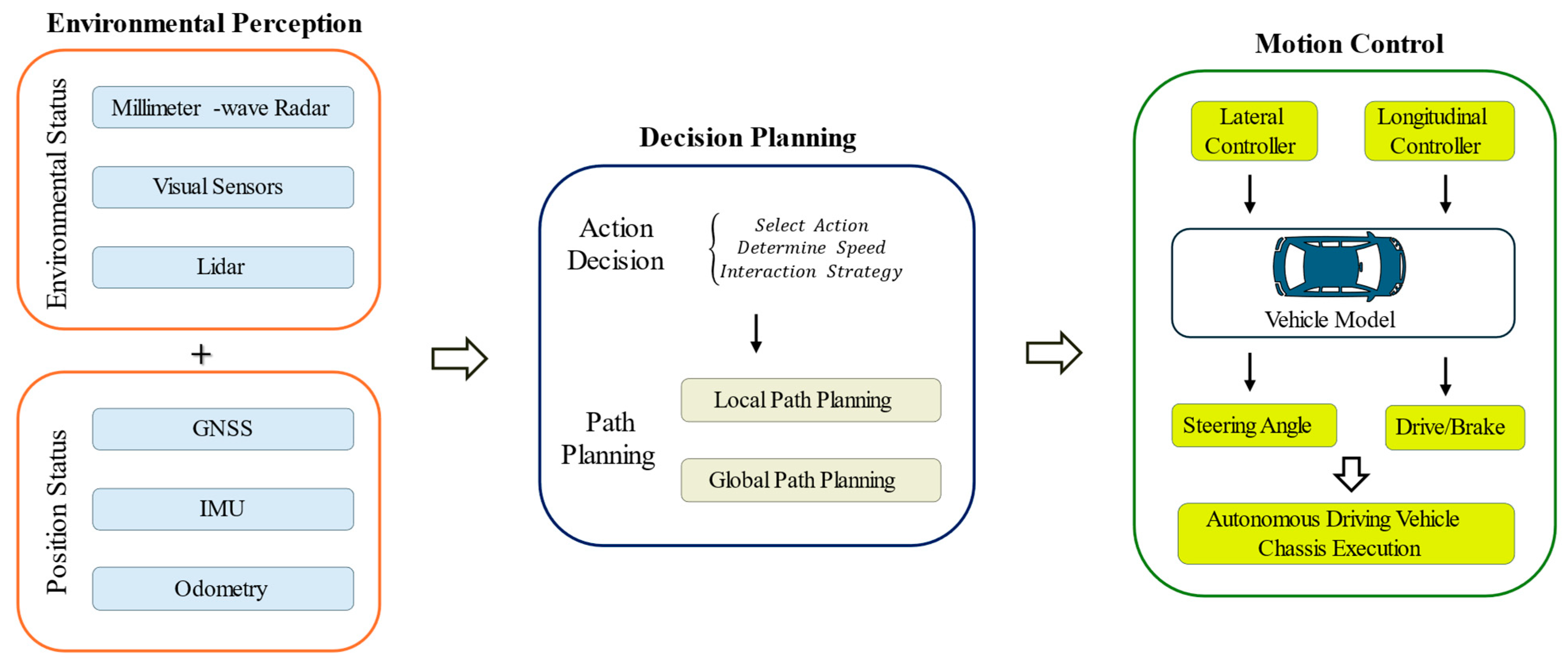
2.2. Autonomous Vehicle Algorithm System Architecture
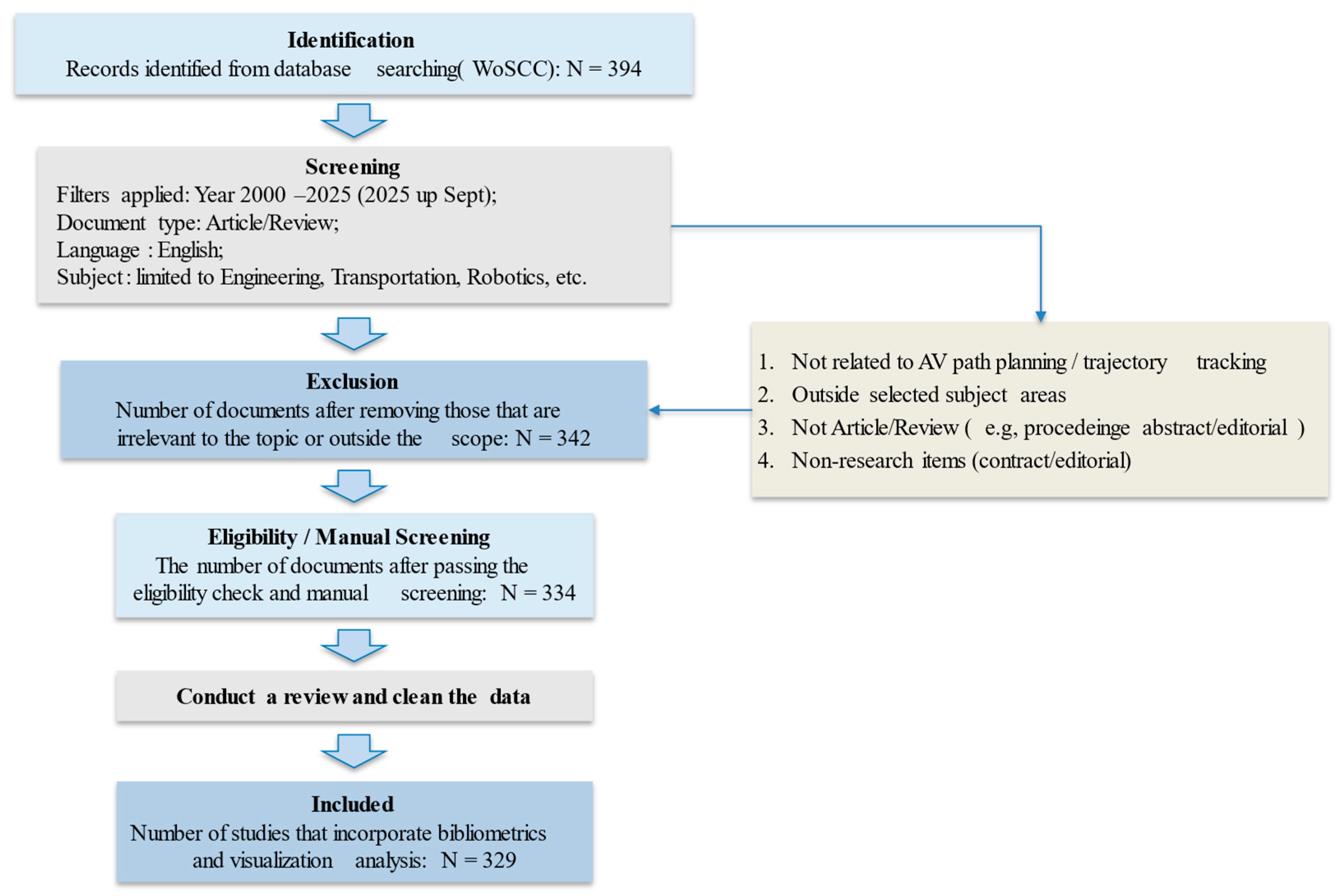
2.3. Origins of Data and Retrieval Methods
3. Analysis of Basic Characteristics of Autonomous Vehicle Path Planning and Trajectory Tracking Research
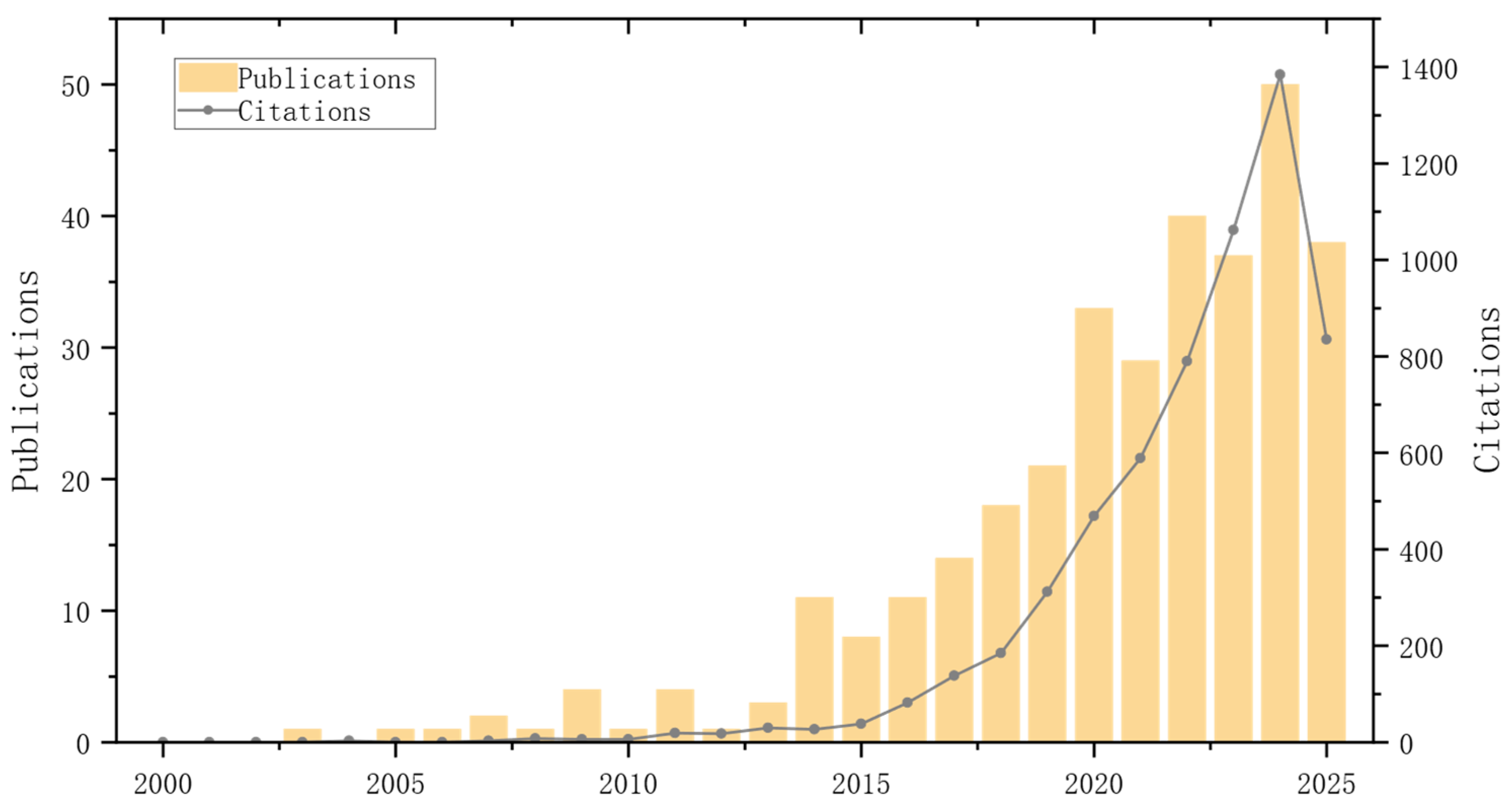
3.1. Descriptive Statistics
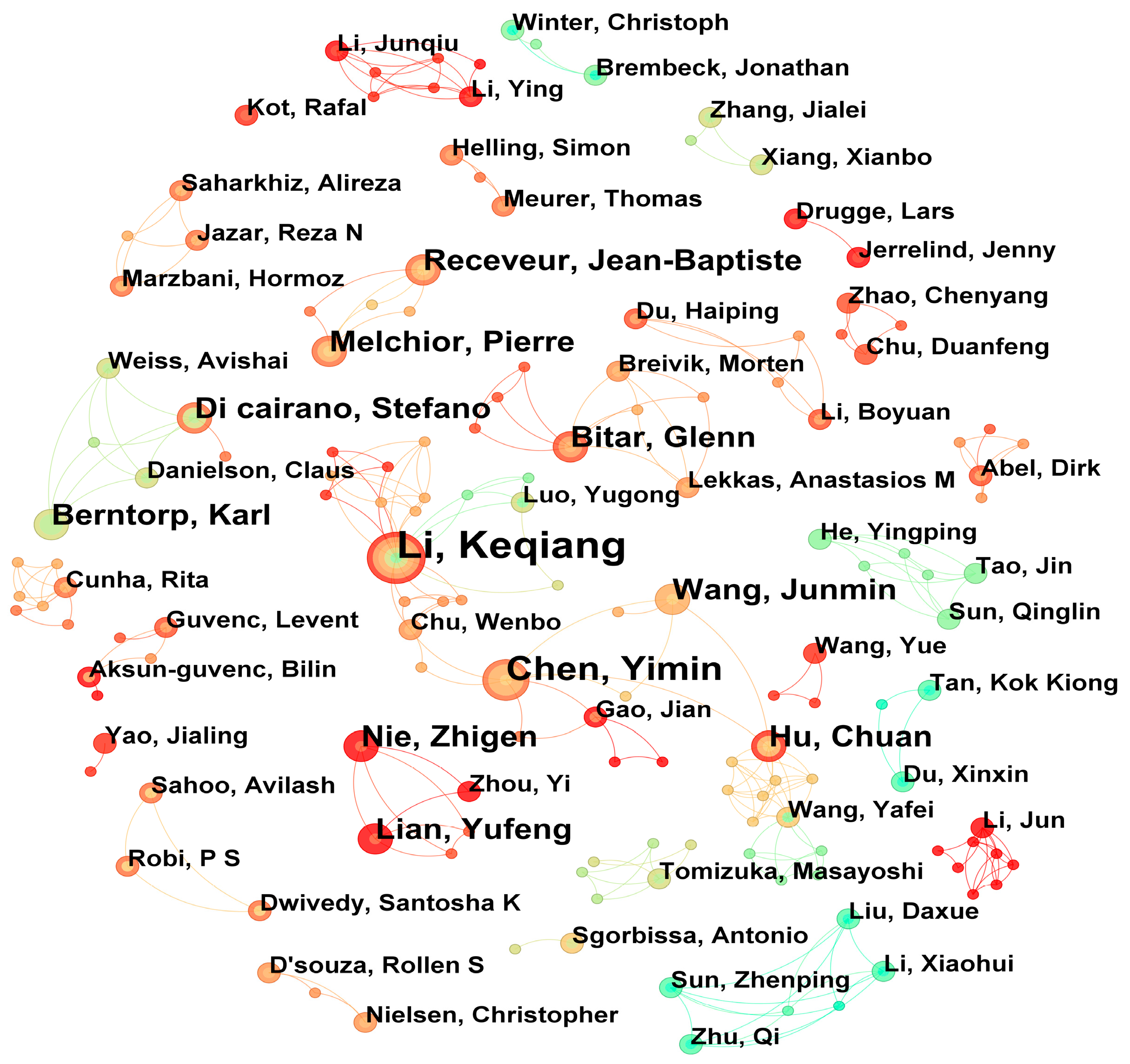
3.2. Analysis of Lead Authors
3.3. Publishing Institutions and Country
3.4. The Most Influential Publishing Institutions
3.5. Research Field Analysis
3.6. Keyword Co-Occurrence Analysis
3.7. Analysis of Emerging Research Frontiers at Different Stages
- (1)
- Perception/Localization outputs (vehicle state, lane geometry, obstacle cues) enable planning feasibility.
- (2)
- Planning outputs (reference path/trajectory) serve as inputs to tracking control.
- (3)
- Control and actuation execute commands subject to dynamics and stability constraints.
- (4)
- Real-time computation bounds the end-to-end latency of (1)–(3), motivating heuristics and efficient solvers.
- (5)
- Vehicle dynamics/stability acts as a shared constraint layer that couples planning and control.
3.8. Most Influential Articles
3.9. Co-Citations
3.10. Overall Summary
4. Discussion
4.1. Research Hotspots in the Field
4.1.1. Research on the Application of Path Planning and Trajectory Tracking Based on Vehicle Model
4.1.2. Research on Data-Driven MPC for Path Planning and Trajectory Tracking
4.1.3. Research on the Application of Decision-Making Methods Based on Game Theory in Path Planning and Trajectory Tracking
4.1.4. Research on the Application of Partially Observable Markov Decision Process (POMDP) in Path Planning and Trajectory Tracking
4.1.5. Research on the Application of Path Planning and Trajectory Tracking Based on End-to-End RL
4.2. Key Technical Bottlenecks and Future Research Directions
4.2.1. Vehicle-Model-Based Planning and Tracking
4.2.2. Data-Driven MPC and Learning-Based MPC (LB-MPC)
4.2.3. Game-Theoretic Interactive Planning and Tracking
4.2.4. POMDP-Based Decision-Making Under Partial Observability
4.2.5. Rule-Based and End-to-End RL and Hybrid Architectures
5. Conclusions and Future Work
5.1. Conclusions
- (1)
- In terms of the number of publications and the time of publication, research in the field of autonomous vehicle path planning and trajectory tracking has been on the rise, especially in the past five years.
- (2)
- In terms of main authors, Li Keqiang’s team at Tsinghua University ranks first in terms of the number of publications and citation frequency, with strong academic influence and wide recognition; other influential authors include Chen Yimin’s team and Bitar Glenn’s team.
- (3)
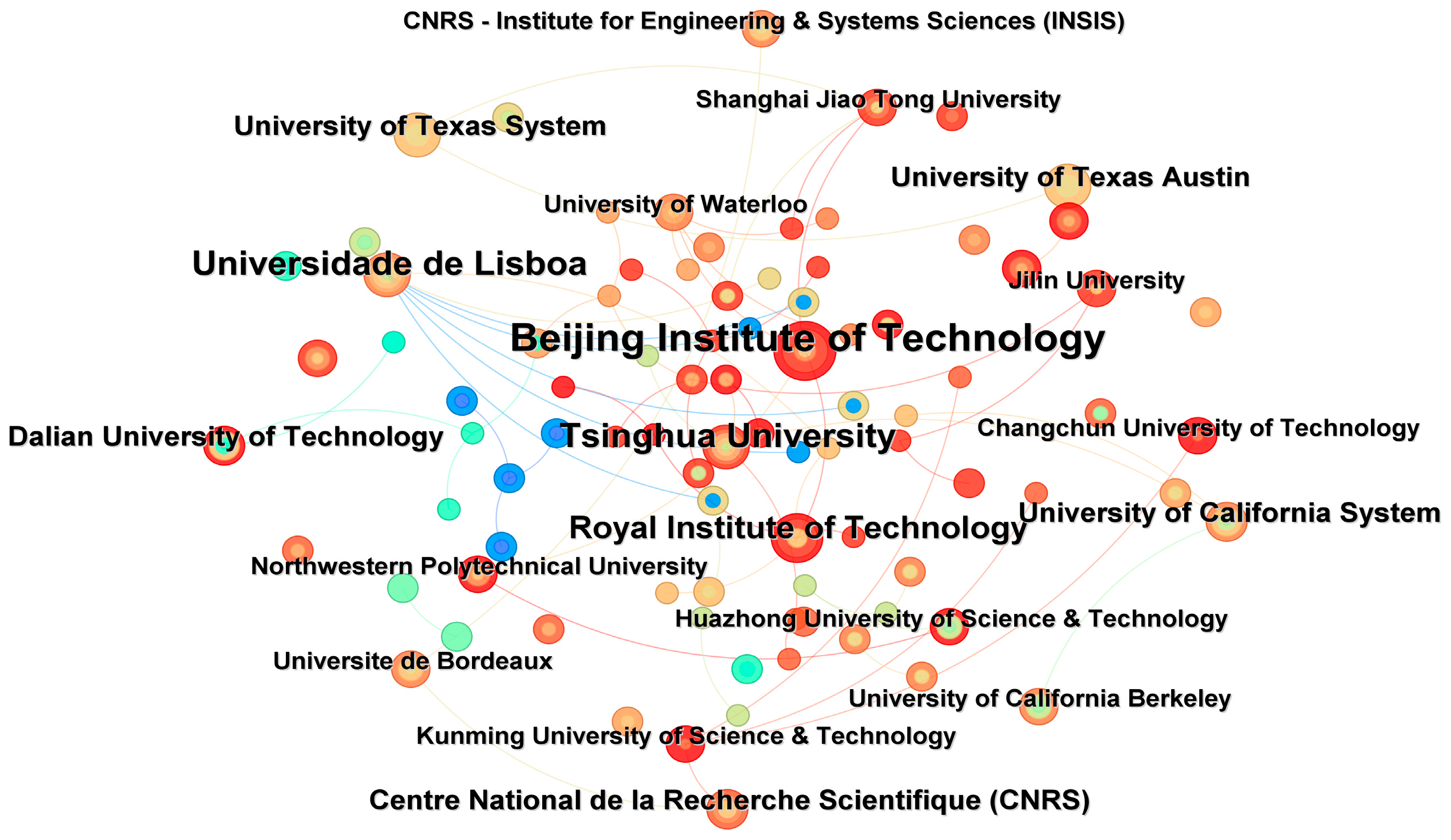
- Tsinghua University, the Norwegian University of Science and Technology (NTNU), and the Beijing Institute of Technology (BIT) lead this field in both publication volume and citation impact. Their prolific output establishes them as the foremost research institutions.
- (4)
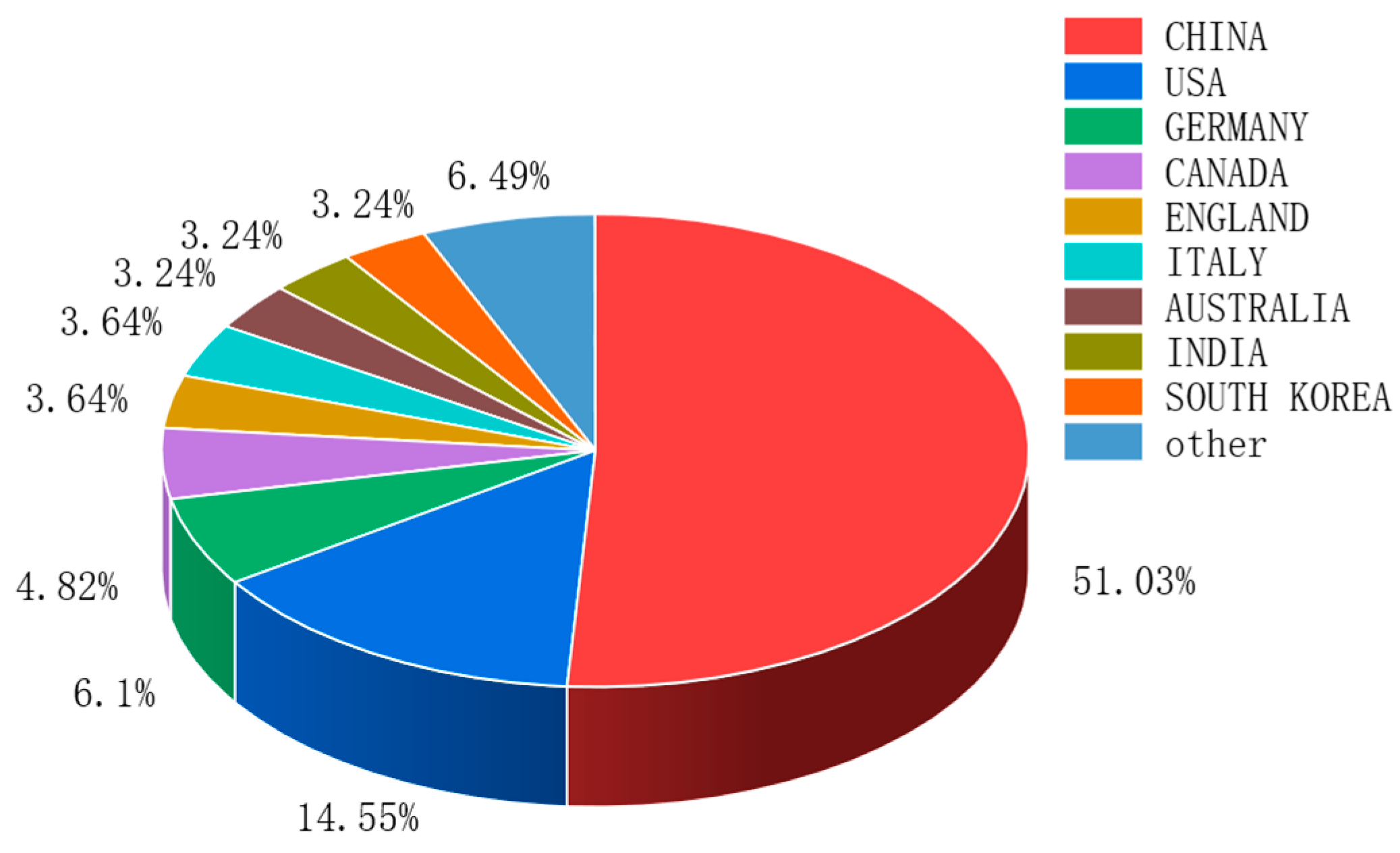
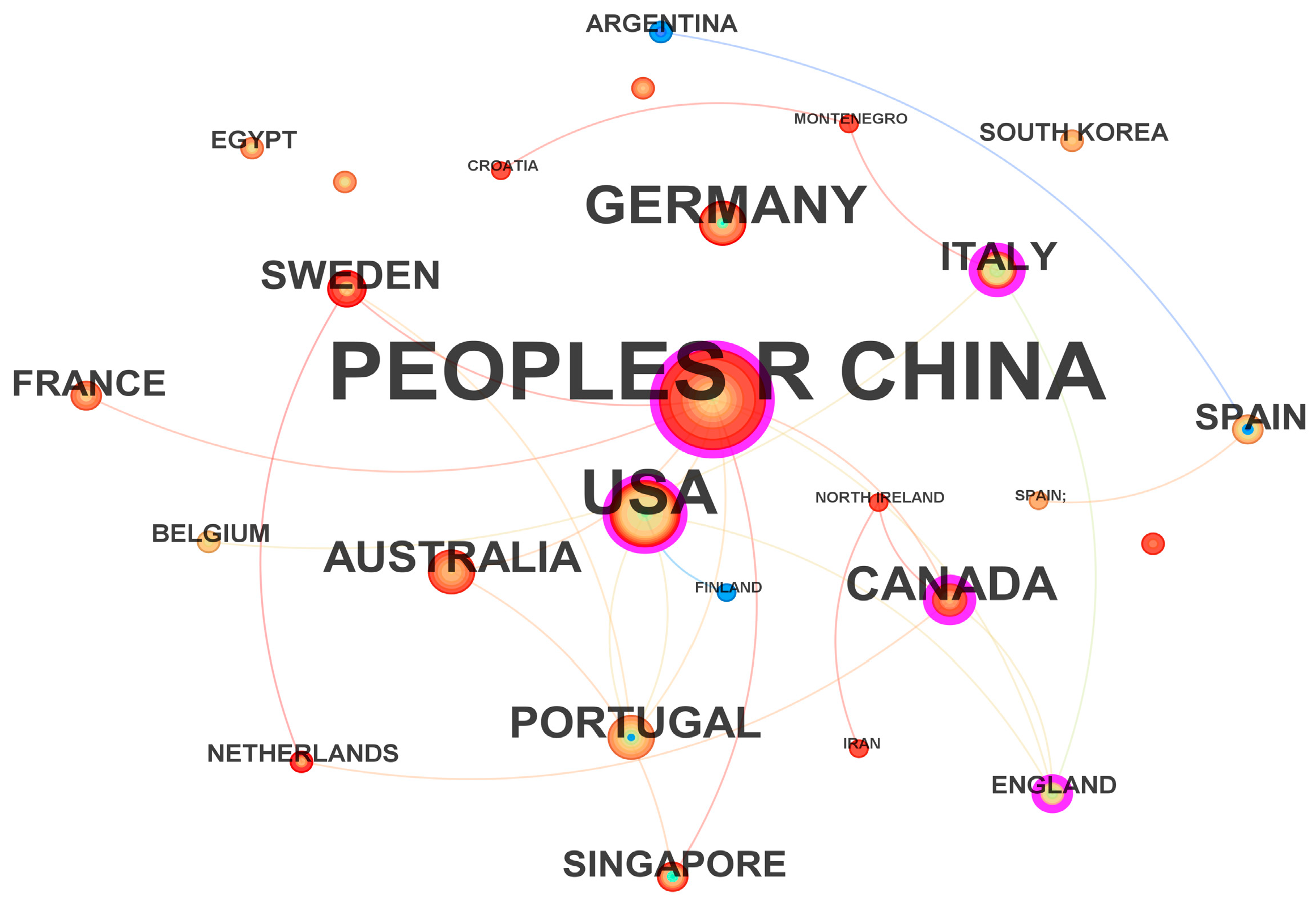
- The main contributions in this field originate from a select group of countries, namely China, the United States, Norway, India, and the United Kingdom. Furthermore, China exhibits the most extensive international collaboration network, working closely with partners such as the United States, Australia, and Canada.
- (5)
- In terms of publishing institution influence, IEEE, Elsevier, and MDPI are the main publishing platforms, accounting for 76% of the total publication volume. Among them, IEEE has a particularly significant influence due to its authoritative position in the field of electrical and electronic engineering.
- (6)
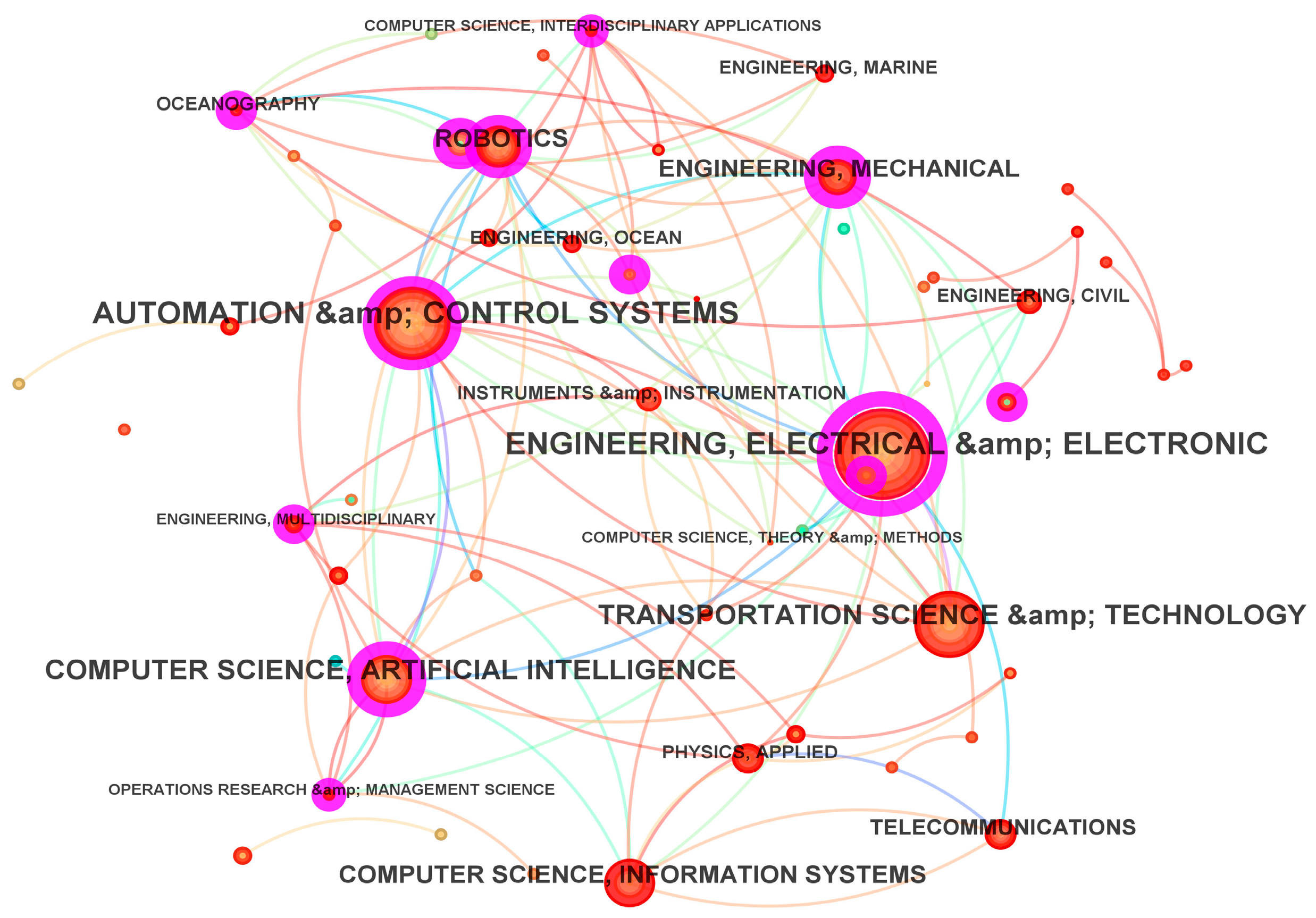
- From the perspective of research field distribution, engineering, electrical and electronic engineering, automated control systems, and computer science are the main research directions in this field. The publication frequency and betweenness centrality values of these fields are relatively high, indicating that they occupy a core position in academic research.
- (7)
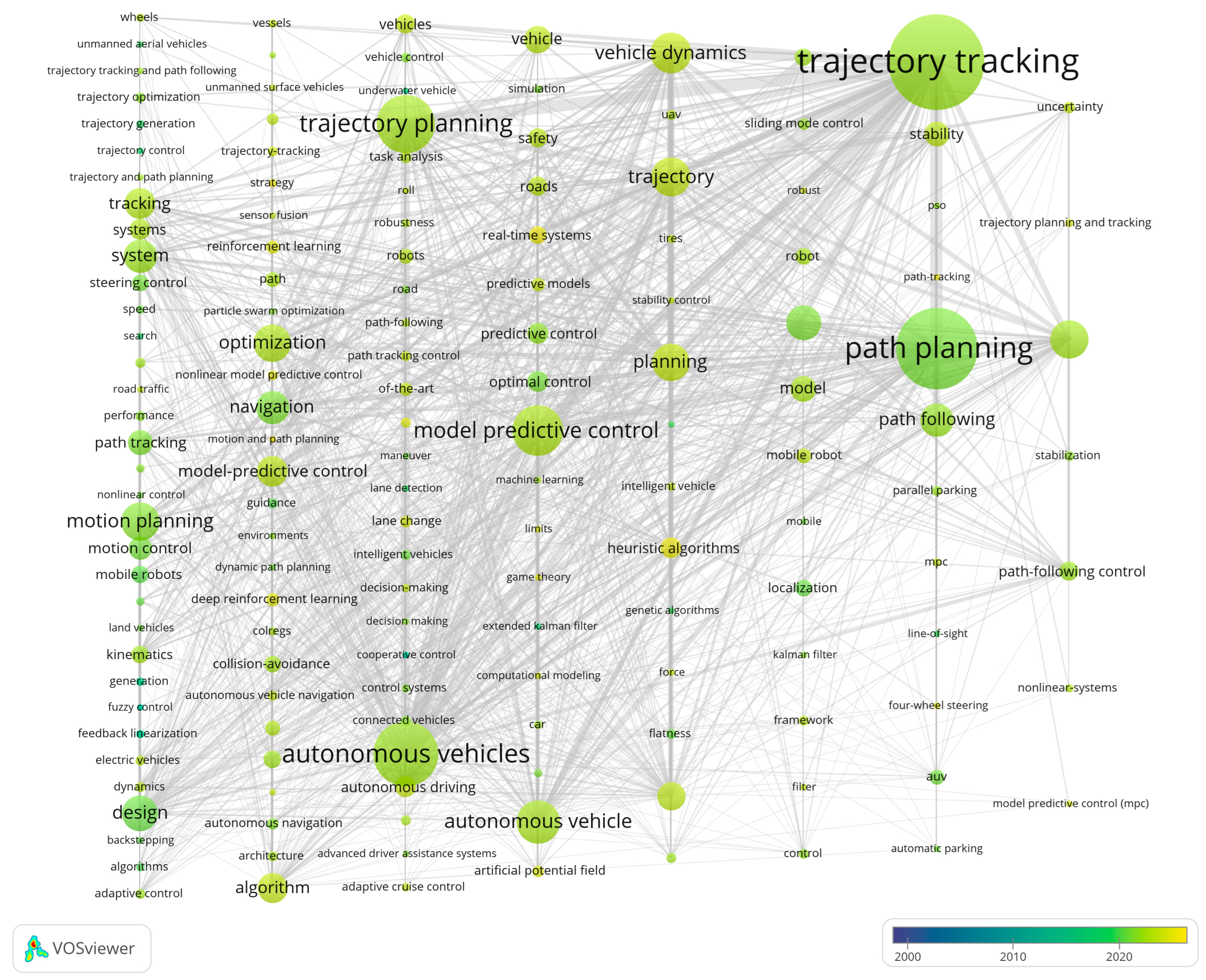
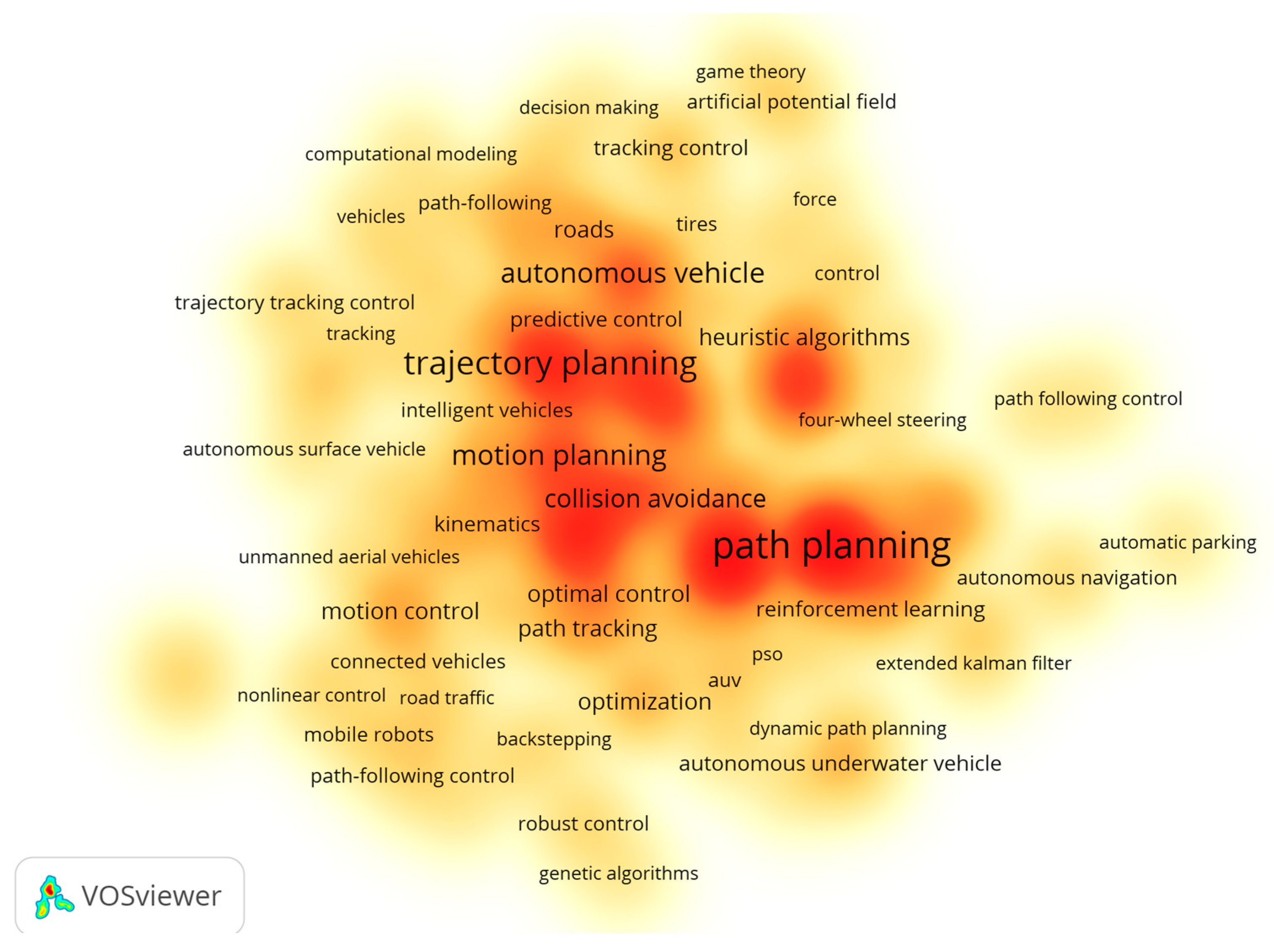
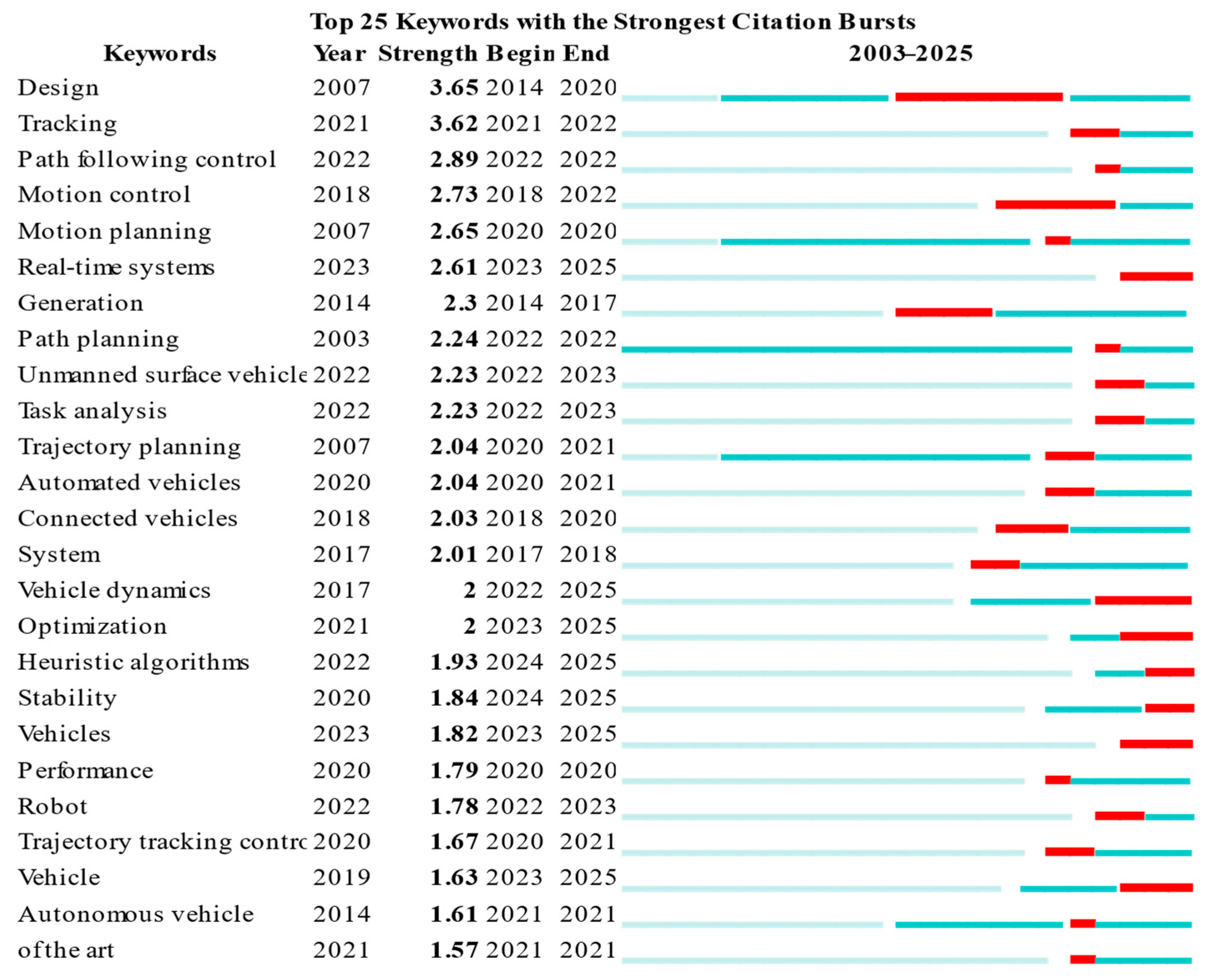
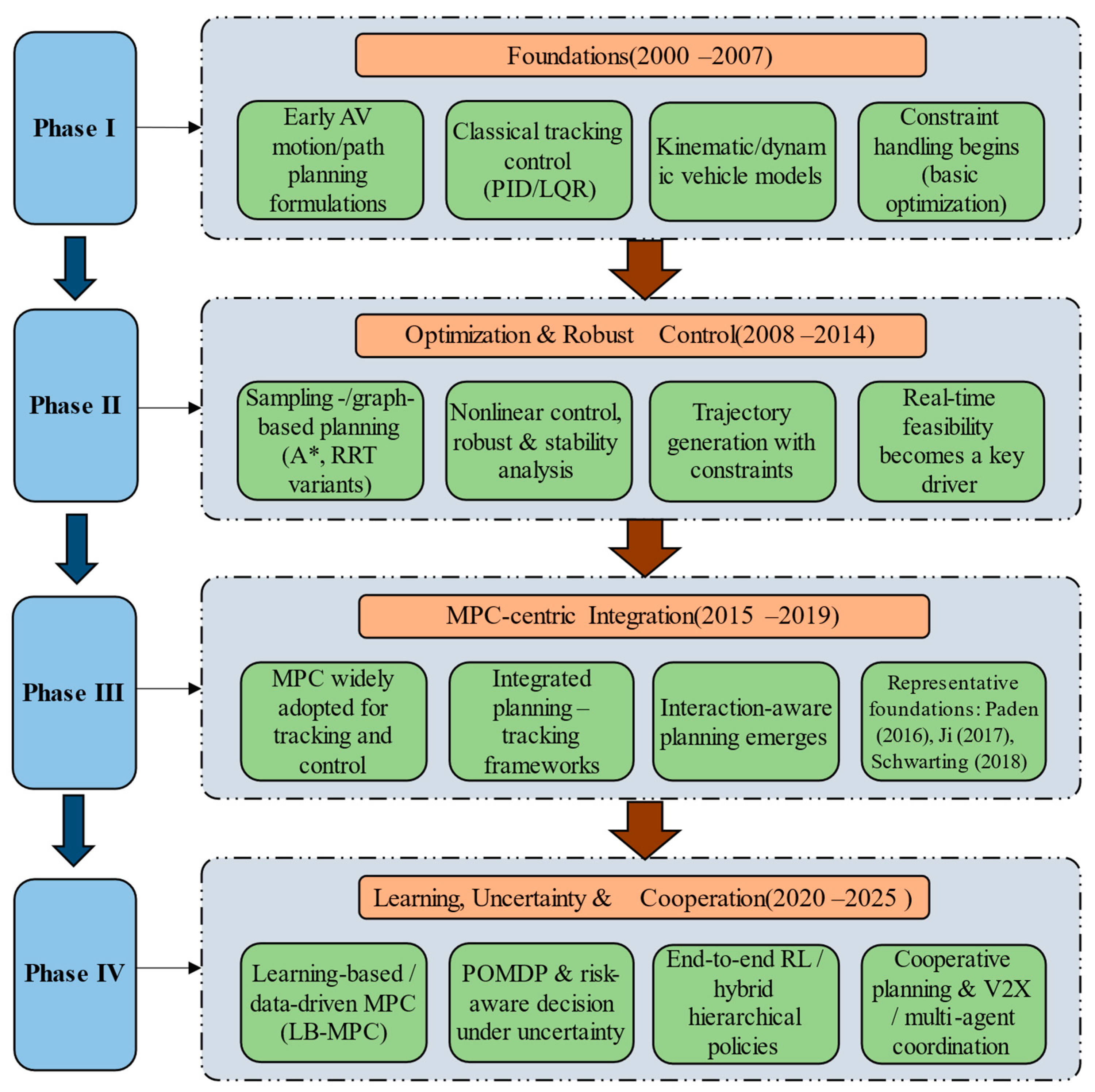
- Keyword co-occurrence results show that trajectory tracking, trajectory planning, motion planning, and MPC appear most frequently, reflecting the core technologies in this field. A keyword emergence analysis identifies DL and RL as rising trends, highlighting their growing application in creating path planning and trajectory tracking solutions for AVs.
- (8)
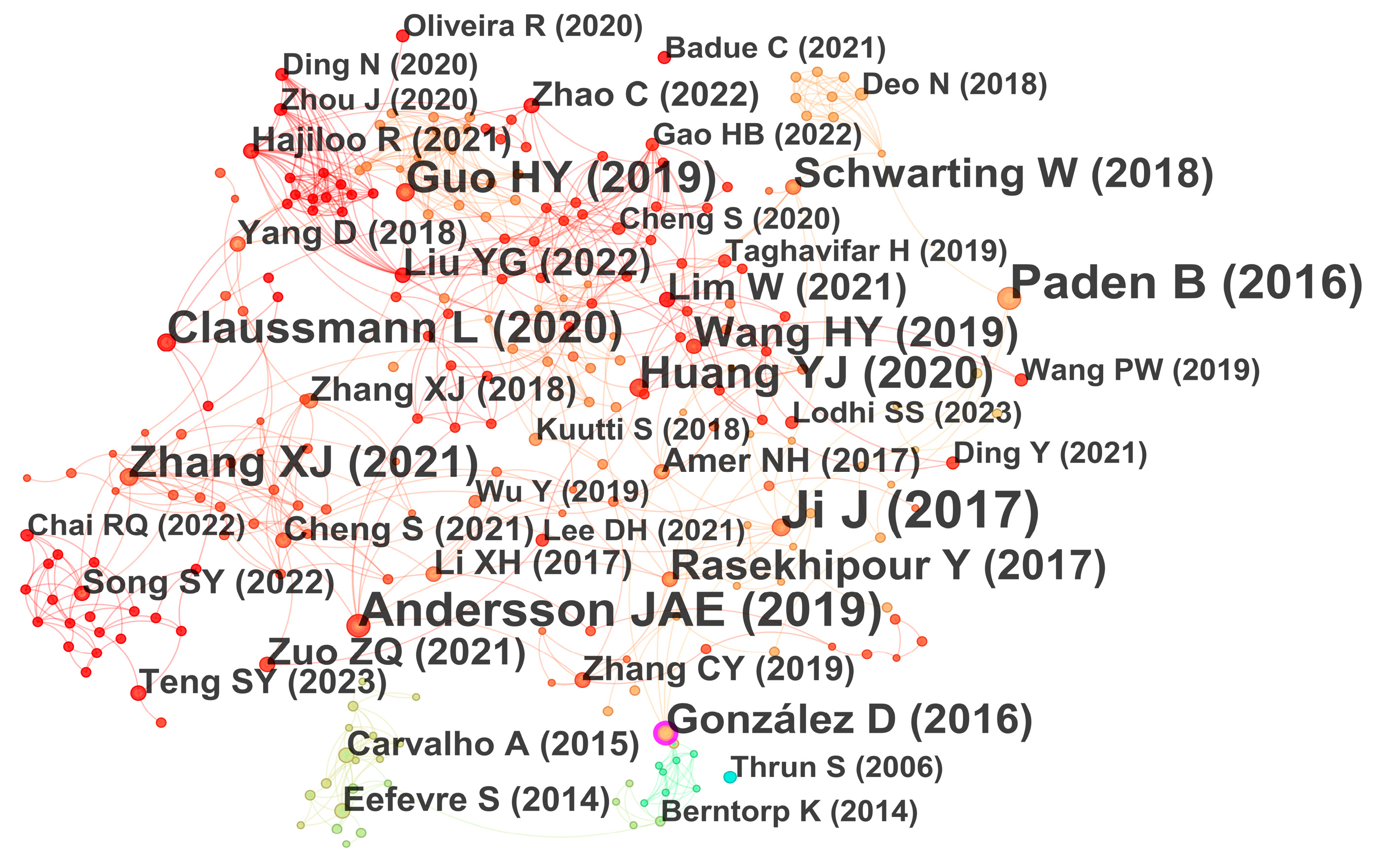
- Judging from the co-citation map of the literature, the literature nodes of Ji J (2017), Paden B (2016), and Andersson JAE (2019) are the largest, among which the literature of Ji J (2017) ranks first in both citation frequency and betweenness centrality, highlighting the important position of the author in this subject field.
5.2. Future Work
- (1)
- In the future, as DL algorithms continue to evolve, end-to-end autonomous driving models will become the mainstream trend. These models integrate multiple modules, such as decision-making, planning, and control, into a unified neural network, directly mapping raw sensor inputs to vehicle control commands or driving trajectories. End-to-end learning avoids the information loss and error accumulation associated with traditional modular architectures, enabling joint optimization of all links and significantly improving the overall performance and generalization capabilities of the system. Large models based on the Transformer architecture, in particular, demonstrate significant potential for processing multimodal data, understanding complex scenarios, and long-term dependencies due to their powerful sequence modeling and parallel processing capabilities. As computing power increases and data volumes accumulate, autonomous driving models with larger parameters and stronger capabilities will continue to emerge. These models will combine advanced AI technologies such as RL, imitation learning, and world models to enable vehicles to approach or even surpass human driving capabilities in path planning and trajectory tracking, providing stronger support for the safe and efficient operation of AVs.
- (2)
- As a pivotal element of intelligent transportation systems, V2X technology offers robust support for the navigation and motion control of highly AVs through improved path planning and trajectory tracking. Through V2X communication, vehicles can exchange information in real time with all relevant entities, encompassing surrounding vehicles (V2V), roadside infrastructure (V2I), pedestrians (V2P), and cloud networks (V2N/V2C), providing a broader perspective and earlier warnings. V2X technology can also help vehicles achieve collaborative driving, such as platooning, to improve traffic efficiency and reduce energy consumption. With the popularization of 5G/6G communication technology and the widespread deployment of roadside intelligent devices, V2X technology will be deeply integrated with single-vehicle intelligence to jointly build a safer, more efficient, and smarter future transportation system, making the path planning and trajectory tracking of AVs more accurate and reliable.
Author Contributions
Funding
Institutional Review Board Statement
Informed Consent Statement
Data Availability Statement
Acknowledgments
Conflicts of Interest
References
- Zhu, W.W. Local Path Planning and Tracking of Autonomous Driving Cars. Master’s Thesis, Shanghai Jiao Tong University, Shanghai, China, 2019. [Google Scholar] [CrossRef]
- Yan, P.K. Research on Unmanned Vehicle Path Planning and Trajectory Tracking Technology. Master’s Thesis, Harbin Engineering University, Haerbin, China, 2024. [Google Scholar] [CrossRef]
- Dijkstra, E.W. A Note on Two Problems in Connexion with Graphs. In Edsger Wybe Dijkstra: His Life, Work, and Legacy; Association for Computing Machinery: New York, NY, USA, 2022; pp. 287–290. [Google Scholar] [CrossRef]
- Hart, P.E.; Nilsson, N.J.; Raphael, B. A Formal Basis for the Heuristic Determination of Minimum Cost Paths. IEEE Trans. Syst. Man Cybern. Syst. 1968, 4, 100–107. [Google Scholar] [CrossRef]
- Meng, S.L. LLM-A*: Large Language Model Enhanced Incremental Heuristic Search on Path Planning. arXiv 2025, arXiv:2407.02511. [Google Scholar] [CrossRef]
- Chiang, H.T.L.; Hsu, J.; Fiser, M.; Tapia, L.; Faust, A. RL-RRT: Kinodynamic Motion Planning via Learning Reachability Estimators From RL Policies. IEEE Robot. Autom. Lett. 2019, 4, 4298–4305. [Google Scholar] [CrossRef]
- Xu, W.D.; Pan, J.; Wei, J.Q.; Dolan, J.M. Motion Planning under Uncertainty for On-Road Autonomous Driving. In Proceedings of the 2014 IEEE International Conference on Robotics and Automation (ICRA), Hong Kong, China, 31 May–7 June 2014; pp. 2507–2512. [Google Scholar] [CrossRef]
- Nguyen, H.D.; Vu, M.N.; Nam, N.N.; Han, K. Hierarchical Motion Planning and Offline Robust Model Predictive Control for Autonomous Vehicles. In Proceedings of the 2024 American Control Conference (ACC), Toronto, ON, Canada, 10–12 July 2024; pp. 4936–4941. [Google Scholar] [CrossRef]
- Ding, W.C.; Zhang, L.; Chen, J.; Shen, S.J. Safe Trajectory Generation for Complex Urban Environments Using Spatio-Temporal Semantic Corridor. IEEE Robot. Autom. Lett. 2019, 4, 2997–3004. [Google Scholar] [CrossRef]
- Zhang, D.K.; Liang, J.M.; Guo, K.; Lu, S.; Wang, Q.; Xiong, R.; Miao, Z.W.; Wang, Y. CarPlanner: Consistent Auto-regressive Trajectory Planning for Large-scale Reinforcement Learning in Autonomous Driving. In Proceedings of the IEEE/CVF Conference on Computer Vision and Pattern Recognition, CVPR 2025, Nashville, TN, USA, 11–15 June 2025. [Google Scholar] [CrossRef]
- Han, Z.C.; Tian, M.Z.; Gongye, Z.; Xue, D.L.; Xing, J.X.; Wang, Q.H.; Gao, Y.M.; Wang, J.P.; Xu, C.; Gao, F. Hierarchically depicting vehicle trajectory with stability in complex environments. Sci. Robot. 2025, 10, 15. [Google Scholar] [CrossRef] [PubMed]
- Deng, J.X.; Zha, Y.F. Overview of the Development of Autonomous Vehicle Path Tracking Control. Automot. Dig. 2023, 1–8. [Google Scholar] [CrossRef]
- Lu, A.; Lu, Z.W.; Li, R.F.; Tian, G.Y. Adaptive LQR Path Tracking Control for 4WS Electric Vehicles Based on Genetic Algorithm. In Proceedings of the 2022 6th CAA International Conference on Vehicular Control and Intelligence (CVCI), Nanjing, China, 28–30 October 2022; pp. 1–6. [Google Scholar] [CrossRef]
- Zhao, C.Y.; Li, B.Q.; Zhu, C.F.; Shi, W.X.; Zhang, X.B. Lateral Control for UGVs by ADRC With Modeling Compensation and Expanded Disturbance Observation. IEEE Trans. Ind. Electron. 2025, 72, 9354–9366. [Google Scholar] [CrossRef]
- Zang, Y.H.; Yang, A.X.; Li, L.Y. Trajectory Tracking Control Method Based on Curvature-adaptive LTV-MPC. J. Anhui Polytech. Univ. 2025, 40, 22–30. [Google Scholar]
- Zhang, T.; Jiao, X.H.; Li, X.K. Improved adaptive iterative learning trajectory tracking control with adaptive high-order internal model for autonomous farming vehicle. Comput. Electron. Agric. 2025, 236, 11. [Google Scholar] [CrossRef]
- Yang, D.S.; Liu, D.; Han, B.; Lu, G.X.; Kong, L.G.; Huang, C.S.; Li, J. Trajectory planning and tracking control for vehicles with tire blowout in complex traffic flows. Sci. China-Inf. Sci. 2025, 68, 22. [Google Scholar] [CrossRef]
- Wang, C.Y.; Zhang, Y.Z.; Zhang, Y.; Li, B.F. A bibliometric analysis of gastric cancer liver metastases: Advances in mechanisms of occurrence and treatment options. Int. J. Surg. 2024, 110, 2288–2299. [Google Scholar] [CrossRef]
- Chen, C.M. CiteSpace II: Detecting and visualizing emerging trends and transient patterns in scientific literature. J. Am. Soc. Inf. Sci. Technol. 2006, 57, 359–377. [Google Scholar] [CrossRef]
- Paden, B.; Cap, M.; Yong, S.Z.; Yershov, D.; Frazzoli, E. A Survey of Motion Planning and Control Techniques for Self-Driving Urban Vehicles. IEEE Trans. Intell. Veh. 2016, 1, 33–55. [Google Scholar] [CrossRef]
- Schwarting, W.; Alonso-Mora, J.; Rus, D. Planning and Decision-Making for Autonomous Vehicles. Annu. Rev. Control Robot. Auton. Syst. 2018, 1, 187–210. [Google Scholar] [CrossRef]
- Yu, S.Y.; Hirche, M.; Huang, Y.J.; Chen, H.; Allgöwer, F. Model predictive control for autonomous ground vehicles: A review. Auton. Intell. Syst. 2021, 1, 4. [Google Scholar] [CrossRef]
- Dixit, S.; Fallah, S.; Montanaro, U.; Dianati, M.; Stevens, A.; McCullough, F.; Mouzakitis, A. Trajectory planning and tracking for autonomous overtaking: State-of-the-art and future prospects. Annu. Rev. Control 2018, 45, 76–86. [Google Scholar] [CrossRef]
- Dong, Y.B.; Pan, H.Z.; Wang, L.; Tang, Z.G. Bibliometric visualization analysis of soil salinization remote sensing. J. China Agric. Resour. Reg. Plann. 2024, 45, 236–248. [Google Scholar] [CrossRef]
- Zhou, Y.; Cheng, Y.; Chen, X. Visual analysis of international knowledge sharing research hotspots and frontiers. Sci. Technol. Manag. 2022, 24, 8. [Google Scholar] [CrossRef]
- Zhang, W.Y.; Cao, L.J.; Li, Y.F.; Ma, B.; Yang, K.H. Analysis of hotspots and frontiers of frailty research: A visualization analysis based on CiteSpace. Chin. J. Evid.-Based Med. 2020, 20, 1308–1315. [Google Scholar] [CrossRef]
- Yan, S.H.; Gao, Y.M.; Wang, H.R.; Li, J.S.; Wang, X.Y. Research status of agricultural brackish water irrigation based on CiteSpace. Sci. Soil Water Conserv. 2021, 19, 132–141. [Google Scholar] [CrossRef]
- Dong, H.B.; Liu, S.B.; Bolormaa, D.; Hou, X.Y. Research on domestic ecological compensation based on CiteSpace. Acta Ecol. Sin. 2020, 42, 8521–8529. [Google Scholar] [CrossRef]
- Li, W.Y. Analysis of the core authors of Archives Management from 1995 to 2005. File Manag. 2006, 48–50. [Google Scholar] [CrossRef]
- Chen, Y.; Chen, C.M.; Liu, Z.Y.; Hu, Z.G.; Wang, X.W. The methodology function of Cite Space mapping knowledge domains. Stud. Sci. Sci. 2015, 33, 242–253. [Google Scholar] [CrossRef]
- Price, D.J.D. A general theory of bibliometric and other cumulative advantage processes. J. Am. Soc. Inf. Sci. 1976, 27, 292–306. [Google Scholar] [CrossRef]
- Chen, C.M.; Ibekwe-SanJuan, F.; Hou, J.H. The Structure and Dynamics of Co-Citation Clusters: A Multiple-Perspective Co-Citation Analysis. arXiv 2010. [Google Scholar] [CrossRef]
- Kleinberg, J. Bursty and hierarchical structure in streams. Data Min. Knowl. Discov. 2003, 7, 373–397. [Google Scholar] [CrossRef]
- Zhu, B.; Jia, S.Z.; Zhao, J.; Han, J.Y.; Zhang, P.X.; Song, D.J. Review of Research on Decision-making and Planning for Automated Vehicles. China J. Highw.Transp. 2023, 37, 215–240. [Google Scholar] [CrossRef]
- Li, L.Z.; Ota, K.R.; Dong, M.X. Humanlike Driving: Empirical Decision-Making System for Autonomous Vehicles. IEEE Trans. Veh. Technol. 2018, 67, 6814–6823. [Google Scholar] [CrossRef]
- Xie, J.W.; Li, D. Design and Application of Autonomous Driving System based on Multi-sensor Fusion. In Proceedings of the 2nd International Conference on Machine Learning and Computer Application, Shenyang, China, 17–19 December 2021. [Google Scholar]
- Gonzalez, D.; Perez, J.; Milanes, V.; Nashashibi, F. A Review of Motion Planning Techniques for Automated Vehicles. IEEE Trans. Intell. Transp. Syst. 2016, 17, 1135–1145. [Google Scholar] [CrossRef]
- Kong, J.; Pfeiffer, M.; Schildbach, G.; Borrelli, F. Kinematic and Dynamic Vehicle Models for Autonomous Driving Control Design. In Proceedings of the 2015 IEEE Intelligent Vehicles Symposium (IV), Seoul, Republic of Korea, 28 June–1 July 2015; pp. 1094–1099. [Google Scholar] [CrossRef]
- Raffo, G.V.; Gomes, G.K.; Normey-Rico, J.E.; Kelber, C.R.; Becker, L.B. A Predictive Controller for Autonomous Vehicle Path Tracking. IEEE Trans. Intell. Transp. Syst. 2009, 10, 92–102. [Google Scholar] [CrossRef]
- Bramer, W.M.; Rethlefsen, M.L.; Kleijnen, J.; Franco, O.H. Optimal database combinations for literature searches in systematic reviews: A prospective exploratory study. Syst. Rev. 2017, 6, 12. [Google Scholar] [CrossRef] [PubMed]
- Donthu, N.; Kumar, S.; Mukherjee, D.; Pandey, N.; Lim, W.M. How to conduct a bibliometric analysis: An overview and guidelines. J. Bus. Res. 2021, 133, 285–296. [Google Scholar] [CrossRef]
- Hu, C.P.; Hu, J.M.; Deng, S.L.; Liu, Y. A co-word analysis of library and information science in China. Scientometrics 2013, 97, 369–382. [Google Scholar] [CrossRef]
- Bornmann, L.; Ye, A.; Ye, F. Identifying “hot papers” and papers with “delayed recognition” in large-scale datasets by using dynamically normalized citation impact scores. Scientometrics 2018, 116, 655–674. [Google Scholar] [CrossRef]
- Bornmann, L.; Haunschild, R.; Mutz, R. Growth rates of modern science: A latent piecewise growth curve approach to model publication numbers from established and new literature databases. Hum. Soc. Sci. Commun. 2021, 8, 15. [Google Scholar] [CrossRef]
- Price, D.J.d.S. Networks of Scientific Papers. Science 1965, 149, 510–515. [Google Scholar] [CrossRef]
- Nakis, N.; Çelikkanat, A.; Boucherie, L.; Lehmann, S.; Morup, M. Time to Cite: Modeling Citation Networks using the Dynamic Impact Single-Event Embedding Model. In Proceedings of the 27th International Conference on Artificial Intelligence and Statistics (AISTATS), València, Spain, 2–4 May 2024; Volume 238. [Google Scholar] [CrossRef]
- Shibata, N.; Kajikawa, Y.; Takeda, Y.; Matsushima, K. Detecting emerging research fronts based on topological measures in citation networks of scientific publications. Technovation 2008, 28, 758–775. [Google Scholar] [CrossRef]
- Sheng, X.P.; Tang, Y.J. Research on open sharing cooperation from the perspective of open access journals: Taking Plos One citing articles as an example. Libr. Inf. Work 2021, 65, 31–40. [Google Scholar] [CrossRef]
- Wang, F.; Zhou, J.J.; Li, X.J.; Zhou, X.F. Adaptive routing protocol based on ant algorithm for P2P networks. Comput. Eng. Appl. 2010, 46, 101–104. [Google Scholar] [CrossRef]
- Wang, S.Y.; Yu, J. A Bibliometric Research on Next-Generation Vehicles Using CiteSpace. Recycling 2021, 6, 14. [Google Scholar] [CrossRef]
- Simoes, F.; Unay-Gailhard, I.; Mujcinovic, A.; Fernandes, B. How to Foster Rural Sustainability through Farming Workforce Rejuvenation? Looking into Involuntary Newcomers’ Spatial (Im)mobilities. Sustainability 2021, 13, 8517. [Google Scholar] [CrossRef]
- Purwanto, E. A Bibliometric Analysis of Trends and Collaborations in Autonomous Driving Research (2002–2024). Mechatron. Intell. Transp. Syst. 2024, 3, 85–112. [Google Scholar] [CrossRef]
- Ozyurt, O.; Cagiltay, N.E.; Ozyurt, H.; Akgun, A. A systematic review and mapping of the literature of virtual reality studies in earth science engineering education. J. Pedagog. Res. 2021, 5, 237–256. [Google Scholar] [CrossRef]
- Feng, J.K.; Yang, Y.S.; Zhang, H.C.; Sun, S.; Xu, B.W. Path Planning and Trajectory Tracking for Autonomous Obstacle Avoidance in Automated Guided Vehicles at Automated Terminals. Axioms 2024, 13, 27. [Google Scholar] [CrossRef]
- Sahoo, A.; Dwivedy, S.K.; Robi, P.S. Advancements in the field of autonomous underwater vehicle. Ocean Eng. 2019, 181, 145–160. [Google Scholar] [CrossRef]
- Callon, M.; Courtial, J.P.; Turner, W.A.; Bauin, S. From translations to problematic networks: An introduction to co-word analysis. Soc. Sci. Inf. Sci. Soc. 1983, 22, 191–235. [Google Scholar] [CrossRef]
- Pourhatami, A.; Kaviyani-Charati, M.; Kargar, B.; Baziyad, H.; Kargar, M.; Olmeda-Gómez, C. Mapping the intellectual structure of the coronavirus field (2000-2020): A co-word analysis. Scientometrics 2021, 126, 6625–6657. [Google Scholar] [CrossRef]
- Durrant-Whyte, H.; Bailey, T. Simultaneous localization and mapping: Part, I. IEEE Robot. Autom. Mag. 2006, 13, 99–108. [Google Scholar] [CrossRef]
- Lee, S.H.; Lee, Y.O.; Son, Y.; Chung, C.C. Multirate Active Steering Control for Autonomous Vehicle Lateral Maneuvering. In Proceedings of the 2012 IEEE Intelligent Vehicles Symposium, Madrid, Spain, 3–7 June 2012; pp. 772–777. [Google Scholar] [CrossRef]
- Ding, Q.X.; Jiang, W.J.; Tong, T.; Wang, Q.; Ma, Y.H. Bibliometric Analysis of Soil Quality RemoteSensing Literature Based on CiteSpace. Chin. J. Soil Sci. 2023, 54, 721–729. [Google Scholar] [CrossRef]
- Kuutti, S.; Bowden, R.; Jin, Y.C.; Barber, P.; Fallah, S. A Survey of Deep Learning Applications to Autonomous Vehicle Control. IEEE Trans. Intell. Transp. Syst. 2021, 22, 712–733. [Google Scholar] [CrossRef]
- Luo, Y.G.; Xiang, Y.; Cao, K.; Li, K.Q. A dynamic automated lane change maneuver based on vehicle-to-vehicle communication. Transp. Res. Pt. C-Emerg. Technol. 2016, 62, 87–102. [Google Scholar] [CrossRef]
- Zhang, W.B.; Jiang, L.J.; Ge, X.X.; Wang, Y.J.; Liang, J.; Li, Y.H. Hot spot analysis and future prospect of rural homestead research in China:Quantitative analysis based on CNKI and CiteSpace. J. Arid Land Resour. Environ. 2022, 36, 16–25. [Google Scholar] [CrossRef]
- Mnih, V.; Kavukcuoglu, K.; Silver, D.; Rusu, A.A.; Veness, J.; Bellemare, M.G.; Graves, A.; Riedmiller, M.; Fidjeland, A.K.; Ostrovski, G.; et al. Human-level control through deep reinforcement learning. Nature 2015, 518, 529–533. [Google Scholar] [CrossRef] [PubMed]
- Fossen, T.I.; Pettersen, K.Y.; Galeazzi, R. Line-of-Sight Path Following for Dubins Paths With Adaptive Sideslip Compensation of Drift Forces. IEEE Trans. Control Syst. Technol. 2015, 23, 820–827. [Google Scholar] [CrossRef]
- Eskandarian, A.; Wu, C.X.; Sun, C.Y. Research Advances and Challenges of Autonomous and Connected Ground Vehicles. IEEE Trans. Intell. Transp. Syst. 2021, 22, 683–711. [Google Scholar] [CrossRef]
- Shen, C.; Shi, Y.; Buckham, B. Integrated Path Planning and Tracking Control of an AUV: A Unified Receding Horizon Optimization Approach. IEEE-ASME Trans. Mechatron. 2017, 22, 1163–1173. [Google Scholar] [CrossRef]
- You, F.; Zhang, R.H.; Lie, G.; Wang, H.W.; Wen, H.Y.; Xu, J.M. Trajectory planning and tracking control for autonomous lane change maneuver based on the cooperative vehicle infrastructure system. Expert Syst. Appl. 2015, 42, 5932–5946. [Google Scholar] [CrossRef]
- Antonelli, G.; Chiaverini, S.; Fusco, G. A fuzzy-logic-based approach for mobile robot path tracking. IEEE Trans. Fuzzy Syst. 2007, 15, 211–221. [Google Scholar] [CrossRef]
- Chai, R.Q.; Liu, D.R.; Liu, T.H.; Tsourdos, A.; Xia, Y.Q.; Chai, S.C. Deep Learning-Based Trajectory Planning and Control for Autonomous Ground Vehicle Parking Maneuver. IEEE Trans. Autom. Sci. Eng. 2023, 20, 1633–1647. [Google Scholar] [CrossRef]
- Zuo, Z.Q.; Yang, X.; Li, Z.; Wang, Y.J.; Han, Q.N.; Wang, L.; Luo, X.Y. MPC-Based Cooperative Control Strategy of Path Planning and Trajectory Tracking for Intelligent Vehicles. IEEE Trans. Intell. Veh. 2021, 6, 513–522. [Google Scholar] [CrossRef]
- Marshakova, I.V. System of document connections based on references. Nauchn.-Tekh. Inf. Ser. 1973, 2, 3–8. [Google Scholar]
- White, H.D.; McCain, K.W. Visualizing a discipline: An author co-citation analysis of information science, 1972–1995. J. Am. Soc. Inf. Sci. 1998, 49, 327–355. [Google Scholar] [CrossRef]
- Ji, J.; Khajepour, A.; Melek, W.W.; Huang, Y.J. Path Planning and Tracking for Vehicle Collision Avoidance Based on Model Predictive Control with Multiconstraints. IEEE Trans. Veh. Technol. 2017, 66, 952–964. [Google Scholar] [CrossRef]
- Andersson, J.A.E.; Gillis, J.; Horn, G.; Rawlings, J.B.; Diehl, M. CasADi: A software framework for nonlinear optimization and optimal control. Math. Program. Comput. 2019, 11, 1–36. [Google Scholar] [CrossRef]
- Ji, J.; Tang, Z.R.; Wu, M.Y.; Fang, J.C. Path Planning and Tracking for Lane Changing Based on Model Predictive Control. China J. Highw. Transp 2018, 31, 172–179. [Google Scholar] [CrossRef]
- Deng, G.H.; Xiao, H.X.; Han, L.H.; Wu, P.F.; Zhang, Y.; Qin, L. Vehicle Tracking Control of Lateral and Longitudinal Based on Model Predictive Control. J. Chongqing Univ. Technol. (Nat. Sci. Ed.) 2021, 35, 18–26+57. [Google Scholar] [CrossRef]
- Pardo, B.J.D. Optimisation of Racing Car Suspensions Featuring Inerters. Ph.D. Thesis, Oxford Brookes University, Oxford, UK, 2012. [Google Scholar]
- Qiao, B.S.; Feng, Y.; Jiang, Z.W.; Yang, Z.Y. Comparison of Intelligent Vehicle Track Tracking Method Based on Model Predictive Control. J. Hubei Univ. Automot. Technol. 2020, 34, 24–28+34. [Google Scholar] [CrossRef]
- Zhou, X.C.; Liu, R.Q.; Zhou, J.Y.; Zhang, Z.Y.; Wang, C.Y.; Zhao, W.Z. Robust Tube-MPC Trajectory Tracking Control for Four-Wheel Independent Steering Vehicles on Intermittent Snowy and Icy Roads. Chin. J. Mech. Eng. 2025, 38, 19. [Google Scholar] [CrossRef]
- Kumar, N.; Pachamuthu, R. Real-Time LPV-Based Non-Linear Model Predictive Control for Robust Trajectory Tracking in Autonomous Vehicles. arXiv 2025. [Google Scholar] [CrossRef]
- Lucia, S.; Navarro, D.; Karg, B.; Sarnago, H.; Lucia, O. Deep Learning-Based Model Predictive Control for Resonant Power Converters. IEEE Trans. Ind. Inform. 2021, 17, 409–420. [Google Scholar] [CrossRef]
- Heshmati-alamdari, S.; Karras, G.C.; Marantos, P.; Kyriakopoulos, K.J. A Robust Model Predictive Control Approach for Autonomous Underwater Vehicles Operating in a Constrained workspace. In Proceedings of the 2018 IEEE International Conference on Robotics and Automation (ICRA), Brisbane, Australia, 21–25 May 2018; pp. 6183–6188. [Google Scholar] [CrossRef]
- Sun, K.; Zhang, N.N.; Li, Z.H.; Ding, H.T.; Zhang, H.S.; Jiang, C.H. Improved MPC for trajectory planning of self-driving cars. PLoS ONE 2025, 20, 33. [Google Scholar] [CrossRef]
- Hobbani, H.; Perez-Pena, F.; Schmidt, K. Modelling and Identification of a Tracked Mobile Robot: A Real-time Feasible Approach Using Particle Swarm Optimization and Information Criteria. Int. J. Control Autom. Syst. 2025, 23, 2687–2703. [Google Scholar] [CrossRef]
- Han, M.; He, H.W.; Shi, M.; Liu, W.; Cao, J.F.; Wu, J.D. Research on Learning-Based Model Predictive Path Tracking Control for Autonomous Vehicles. Automot. Eng. 2024, 46, 1197–1207. [Google Scholar] [CrossRef]
- Xiao, Y.Q.; Zhang, X.L.; Xu, X.; Liu, X.Q.; Liu, J.H. Deep Neural Networks With Koopman Operators for Modeling and Control of Autonomous Vehicles. IEEE Trans. Intell. Veh. 2023, 8, 135–146. [Google Scholar] [CrossRef]
- Yang, S.; Li, S.Z.; Zhao, Z.Y.; Huang, X.P.; Huang, Y.J. Integrated Autonomous Driving Lane Change Policy Based on Temporal Difference Learning Model Predictive Control. J. Mech. Eng. 2024, 60, 329–338. [Google Scholar] [CrossRef]
- Sadigh, D.; Sastry, S.; Seshia, S.A.; Dragan, A.D. Planning for autonomous cars that leverage effects on human actions. RSS 2016, 2, 1–9. [Google Scholar] [CrossRef]
- Fisac, J.F.; Bronstein, E.; Stefansson, E.; Sadigh, D.; Sastry, S.S.; Dragan, A.D. Hierarchical Game-Theoretic Planning for Autonomous Vehicles. In Proceedings of the 2019 International Conference on Robotics and Automation (ICRA), Montreal, QC, Canada, 20–24 May 2019; pp. 9590–9596. [Google Scholar] [CrossRef]
- Schwarting, W.; Pierson, A.; Alonso-Mora, J.; Karaman, S.; Rus, D. Social behavior for autonomous vehicles. Proc. Natl. Acad. Sci. USA 2019, 116, 24972–24978. [Google Scholar] [CrossRef]
- Zhang, Q.Y.; Langari, R.; Tseng, H.E.; Mohan, S.; Szwabowski, S.; Filev, D. Stackelberg Differential Lane Change Game Based on MPC and Inverse MPC. IEEE Trans. Intell. Transp. Syst. 2024, 25, 8473–8485. [Google Scholar] [CrossRef]
- Zhang, C.J.; Wang, J.; Hu, S.Y. A Motion Planning Framework Based on Stackelberg Games for Autonomous Driving in Interactive Scenarios. In Advances in Dynamics of Vehicles on Roads and Tracks III; Springer: Cham, Swiyttzerland, 2024; pp. 461–470. [Google Scholar] [CrossRef]
- Zanardi, A.; Zardini, G.; Srinivasan, S.; Bolognani, S.; Censi, A.; Dörfler, F.; Frazzoli, E. Posetal Games: Efficiency, Existence, and Refinement of Equilibria in Games With Prioritized Metrics. IEEE Robot. Autom. Lett. 2022, 7, 1292–1299. [Google Scholar] [CrossRef]
- Nan, J.; Deng, W.; Zheng, B. Intention Prediction and Mixed Strategy Nash Equilibrium-Based Decision-Making Framework for Autonomous Driving in Uncontrolled Intersection. IEEE Trans. Veh. Technol. 2022, 71, 10316–10326. [Google Scholar] [CrossRef]
- Kollarcik, A.; Hanzalek, Z. Parameter Adjustments in POMDP-Based Trajectory Planning for Unsignalized Intersections. In Proceedings of the 10th International Conference on Vehicle Technology and Intelligent Transport Systems VEHITS, Angers, France, 2–4 May 2024; Volume 1, pp. 522–529. [Google Scholar] [CrossRef]
- Jin, X.J.; Zeng, C.D.; Zhu, S.F.; Liu, C.X.; Cai, P.P. BoT-Drive: Hierarchical Behavior and Trajectory Planning for Autonomous Driving using POMDPs. arXiv 2024, arXiv:2409.18411. [Google Scholar] [CrossRef]
- Brechtel, S.; Gindele, T.; Dillmann, R. Probabilistic decision-making under uncertainty for autonomous driving using continuous POMDPs. In Proceedings of the 17th International IEEE Conference on Intelligent Transportation Systems (ITSC), Qingdao, China, 8–11 October 2014; pp. 392–399. [Google Scholar] [CrossRef]
- Snider, J.M. Automatic Steering Methods for Autonomous Automobile Path Tracking. Master’s Thesis, Carnegie Mellon University, Pittsburgh, PA, USA, 2009. [Google Scholar]
- Koenig, S.; Likhachev, M. Fast replanning for navigation in unknown terrain. IEEE Trans. Robot. 2005, 21, 354–363. [Google Scholar] [CrossRef]
- He, Z.C.; Dong, L.; Sun, C.Y.; Wang, J.W. Asynchronous Multithreading Reinforcement-Learning-Based Path Planning and Tracking for Unmanned Underwater Vehicle. IEEE Trans. Syst. Man Cybern. Syst. 2022, 52, 2757–2769. [Google Scholar] [CrossRef]
- Levine, S.; Finn, C.; Darrell, T.; Abbeel, P. End-to-End Training of Deep Visuomotor Policies. J. Mach. Learn. Res. 2016, 17, 1334–1373. [Google Scholar]
- Ames, A.D.; Coogan, S.; Egerstedt, M.; Notomista, G.; Sreenath, K.; Tabuada, P. Control Barrier Functions: Theory and Applications. In Proceedings of the 2019 18th European Control Conference (ECC), Naples, Italy, 25–28 June 2019; pp. 3420–3431. [Google Scholar] [CrossRef]
- Patrinos, P.; Bemporad, A. An Accelerated Dual Gradient-Projection Algorithm for Embedded Linear Model Predictive Control. IEEE Trans. Autom. Control 2014, 59, 18–33. [Google Scholar] [CrossRef]
- Wen, J.; Liang, X.F.; Wang, Y.W. Path tracking control of rice pollination robot based on DDPG+MPC. J. Agric. Mech. Res. 2025, 47, 18–25. [Google Scholar] [CrossRef]
- Liu, Q.J.; Xiong, P.X.; Zhu, Q.Y.; Xiao, W.; Wang, K.J.; Hu, G.L.; Li, G. A DDPG-based Path Following Control Strategy for Autonomous Vehicles by Integrated Imitation Learning and Feedforward Exploration. Chin. J. Mech. Eng. 2025, 38, 174. [Google Scholar] [CrossRef]
- Lai, J.L.; Wu, Z.Z.; Ren, Z.G.; Tan, Q.; Xie, S.L. Trajectory planning of mobile robot: A Lyapunov-based reinforcement learning approach with implicit policy. Knowl.-Based Syst. 2025, 325, 15. [Google Scholar] [CrossRef]
- Yuan, K.; Huang, Y.J.; Yang, S.; Zhou, Z.W.; Wang, Y.L.; Cao, D.P.; Chen, H. Evolutionary Decision-Making and Planning for Autonomous Driving Based on Safe and Rational Exploration and Exploitation. Engineering 2024, 33, 108–120. [Google Scholar] [CrossRef]
- Zhang, R.X.; Wu, C.X.; Sun, T.C.; Zhao, Z.S. Progress on Deep Reinforcement Learning in Path Planning. Comput. Eng. Appl. 2021, 57, 44–56. [Google Scholar] [CrossRef]
- Silver, D.; Veness, J. Monte-Carlo planning in large POMDPs. In Proceedings of the NIPS’10: 24th International Conference on Neural Information Processing Systems, Vancouver, BC, Canada, 6–9 December 2010. [Google Scholar]
- Tobin, J.; Fong, R.; Ray, A.; Schneider, J.; Zaremba, W.; Abbeel, P. Domain randomization for transferring deep neural networks from simulation to the real world. In Proceedings of the 2017 IEEE/RSJ International Conference on Intelligent Robots and Systems (IROS), Vancouver, BC, Canada, 1–24 September 2017; pp. 23–30. [Google Scholar] [CrossRef]



| Aspect | Paden et al. [20] | Schwarting et al. [21] | Yu et al. [22] | Dixit et al. [23] | This Study |
|---|---|---|---|---|---|
| Scope | Motion planning + control for self-driving urban vehicles | Planning & decision-making for AVs | MPC for AVs | Overtaking scenario: trajectory planning & tracking | Path planning + trajectory tracking (2000–2025) |
| Evidence base | Selected/curated papers | Selected/curated papers | Selected/curated papers | Selected/curated papers | WoSCC; 329 papers after screening |
| Publication year | 2016 | 2018 | 2021 | 2018 | 2025 |
| Coverage window | Not specified | Not specified | Not specified | Not specified | WoSCC 2000–2025, PRISMA screened, n = 329 |
| Methodology | Narrative survey/taxonomy | Narrative synthesis | Algorithm-focused review | Scenario-specific review | CiteSpace/VOSviewer + co-word/burst + topic evolution + LDA |
| Outputs | Conceptual taxonomy, challenges | Problem framing, methods overview | MPC variants, constraints, implementation issues | Comparison by real-time, feasibility, etc. | Trends, core authors/institutions, hotspots, frontiers, topic evolution |
| Search Keywords |
|---|
| “Autonomous” OR “Self-Driving” OR “Driverless” OR “Self-Piloting” |
| “Motion Planning” OR “Trajectory Planning” OR “Path Planning” |
| “Trajectory Tracking” OR “Path Following” |
| “Vehicle” OR “Car” OR “Automobile” OR “Motor Vehicle” OR “Motorcar” |
| Author | Publications | Institution | Country |
|---|---|---|---|
| Li K.Q. | 5 | Tsinghua University | China |
| Chen Y.M. | 4 | Northwestern Polytech University | China |
| Melchior P. | 3 | Centre National de la Recherche Scientifique | France |
| Pascoal A. | 3 | University of Lisbon | Portugal |
| Nie Z.G. | 3 | Kunming University of Science & Technology | China |
| Di Cairano S. | 3 | Mitsubishi Electric Research Laboratories | USA |
| Yue M. | 3 | Dalian University of Technology | China |
| Lian Y.F. | 3 | Changchun University of Technology | China |
| Marzbani H. | 3 | RMIT University | Australia |
| Receveur J.-B. | 3 | University of Bordeaux | France |
| Author | Publications | Citations | Country |
|---|---|---|---|
| Sahoo A., Dwivedy S. K., & Robi P. S. | 2 | 454 | India |
| Li Keqiang | 5 | 388 | China |
| Shi Yang | 2 | 268 | Canada |
| Luo Yugong | 2 | 251 | China |
| Lie Guo | 2 | 210 | China |
| Shen Chao | 2 | 205 | Canada |
| Wang Junmin | 3 | 174 | USA |
| Luo Xiaoyuan | 2 | 129 | China |
| Chu Duanfeng | 2 | 120 | China |
| Zhao Chenyang | 2 | 102 | China |
| Institution | Publications | Citations | Country |
|---|---|---|---|
| Tsinghua University | 10 | 545 | China |
| Norwegian University of Science Technology | 6 | 538 | Norway |
| Beijing Institute of Technology | 17 | 504 | China |
| National Institute of Technology System | 3 | 490 | India |
| Indian Institute of Technology System | 7 | 484 | India |
| Wuhan University of Technology | 3 | 347 | China |
| Chinese Academy of Sciences | 3 | 275 | China |
| Virginia Polytechnic Institute State University | 3 | 241 | USA |
| University of Texas Austin | 4 | 223 | USA |
| Dalian University of Technology | 5 | 221 | China |
| Publishing Institutions | Publications | Citations |
|---|---|---|
| IEEE | 159 | 3129 |
| Elsevier | 52 | 1768 |
| MDPI | 39 | 185 |
| Sage | 21 | 268 |
| Springer Nature | 13 | 289 |
| Wiley | 8 | 132 |
| Taylor & Francis | 6 | 40 |
| Amer Soc Mechanical Engineers | 4 | 2 |
| Hindawi Publishing Group | 3 | 17 |
| Inderscience Enterprises Ltd. | 3 | 5 |
| Research Field | Publications | Centrality |
|---|---|---|
| Engineering, electrical and electronic | 201 | 0.49 |
| Automation control systems | 106 | 0.12 |
| Computer science | 103 | 0.26 |
| Transportation science | 64 | 0.09 |
| Robotics | 50 | 0.15 |
| Telecommunications | 26 | 0 |
| Instruments instrumentation | 19 | 0.01 |
| Oceanography | 17 | 0.38 |
| Physics | 15 | 0.07 |
| Operations research management science | 12 | 0.11 |
| Paper | Year | Times Cited |
|---|---|---|
| Advancements in the field of autonomous underwater vehicle [55] | 2019 | 453 |
| Line-of-sight path following for Dubins paths with adaptive sideslip compensation of drift forces [65] | 2014 | 453 |
| Research advances and challenges of autonomous and connected ground vehicles [66] | 2019 | 239 |
| A dynamic automated lane change maneuver based on vehicle-to-vehicle communication [62] | 2015 | 225 |
| Integrated path planning and tracking control of an AUV: a unified receding horizon optimization approach [67] | 2014 | 204 |
| Trajectory planning and tracking control for autonomous lane change maneuver based on the cooperative vehicle infrastructure system [68] | 2015 | 196 |
| Trajectory planning and tracking for autonomous overtaking: State-of-the-art and future prospects [23] | 2018 | 176 |
| A fuzzy-logic-based approach for mobile robot path tracking [69] | 2016 | 164 |
| DL-based trajectory planning and control for autonomous ground vehicle parking maneuver [70] | 2022 | 158 |
| MPC-based cooperative control strategy of path planning and trajectory tracking for intelligent vehicles [71] | 2020 | 127 |
| Section | Key Finding | Key Representative Objects | Research Implications |
|---|---|---|---|
| 3.1 | The field exhibits a sustained growth trajectory in both publication output and citation impact, with an accelerated expansion after 2014 and a marked increase after 2020; the comparatively low citation count in 2025 is largely attributable to citation lag. | Peak annual output occurs around 2024 (~50 papers); citations increase sharply during 2021–2024. | These trends support the continued research vitality of path planning and trajectory tracking and provide a temporal rationale for further investigations. |
| 3.2 | According to Price’s Law, the core-author threshold is approximately two publications, yielding a sizeable core group; the collaboration structure is characterized by several clusters organized around a small number of hub authors. | Core authors: 94; highest productivity: 5 publications. | The identified hubs and clusters provide practical entry points for benchmarking, collaboration building, and systematic tracking of emerging contributions. |
| 3.3 | Research productivity and influence are highly concentrated at both institutional and national levels; China contributes the largest share of publications and citations, while China–USA links constitute a central axis in the international collaboration network. | China: 51.9% of publications; China citations: 2610; USA: 14.6% of publications; influential institutions include Tsinghua University and NTNU. | The institutional–national landscape informs strategic collaboration planning and helps situate new studies within the global research ecosystem. |
| 3.4 | Publication channels are strongly concentrated among major publishers (IEEE, Elsevier, and MDPI), while citation performance differs across publishers, indicating that publication volume and scholarly influence are not necessarily aligned. | Paper counts: IEEE 159; Elsevier 52; MDPI 39; citation leadership is dominated by IEEE/Elsevier/Springer Nature. | Venue selection should consider both dissemination capacity and expected citation impact, rather than publication volume alone. |
| 3.5 | The dominant Web of Science categories are electrical and electronic engineering, automation and control, and computer science; notably, oceanography shows relatively high betweenness centrality, suggesting cross-domain methodological transfer from AUV-related research. | Engineering, electrical and electronic: frequency 201, centrality 0.49; oceanography centrality 0.38. | The disciplinary distribution motivates interdisciplinary framing and encourages leveraging transferable methodologies from adjacent autonomy domains (e.g., AUV/robotics). |
| 3.6 | Keyword evolution indicates a three-stage thematic progression: early emphasis on classical control (2000–2005), subsequent focus on navigation/localization and trajectory generation (2006–2016), and a recent shift towards optimization-based approaches (e.g., MPC) with increasing attention to DL and RL (2017–2023). | Stage definition: 2000–2005/2006–2016/2017–2023. | This progression provides a structured basis for positioning new contributions and for articulating novelty relative to stage-specific research hotspots. |
| 3.7 | Burst detection highlights frontier transitions: motion control demonstrates a sustained burst over 2018–2022, whereas tracing and path following control show strong short-term bursts; additional emerging themes include real-time systems, heuristic algorithms, and vehicle dynamics/stability considerations. | Burst strength: tracing 3.62; path following control 2.89; motion control 2.73. | Burst signals may be used to prioritize near-term research opportunities and to justify topic selection based on attention shifts within the community. |
| 3.8 | Highly cited publications delineate the intellectual base of the field, with strong influence from AUV-related surveys/control foundations and representative directions including V2V cooperative lane change, integrated planning–tracking frameworks, deep-learning-based parking, and cooperative MPC. | Highest citation count in Top 10: 453. | The high-impact set provides a core reading backbone for literature reviews and facilitates mapping seminal methods onto specific application contexts. |
| 3.9 | Co-citation analysis identifies foundational hubs in both methodology and tooling: Ji J (2017) represents an influential integrated framework combining artificial potential fields with constrained MPC for collision-avoidance trajectory generation and tracking, while CasADi-related work constitutes a key optimization modeling reference. | Ji J (2017): co-cited 11 times; betweenness centrality 0.09. | Hub references support the selection of baseline frameworks and optimization toolchains and motivate methodological extensions for planning–control integration. |
| Discussion Theme | Vehicle Model–Based Path Planning & Trajectory Tracking | Data-Driven MPC/Learning-Based MPC (LB-MPC) | Game Theory–Based Interactive Decision/Planning & Tracking | POMDP Under Uncertainty for Planning & Tracking | End-to-End RL for Planning & Tracking |
|---|---|---|---|---|---|
| Representative methods | Kinematic/dynamic vehicle modeling model-based planning + tracking; model-based MPC/receding horizon; stability-guaranteed controllers (e.g., Lyapunov-based tracking) | Data-driven identification for predictive models; LB-MPC integrating learning with MPC; Koopman-based modeling meta-learning assisted MPC; safety/robust constraints within MPC | Stackelberg/differential games; game-theoretic MPC; interaction-aware planning; intent inference for surrounding agents; equilibrium/strategy-based decision making | Belief-state planning; POMDP-based behavior planning under partial observability; probabilistic inference of hidden states/intent; approximate solvers; risk-aware decision-making | Deep RL/end-to-end policy learning; hierarchical hybrid decision architectures (high-level decision + low-level control); imitation + RL; multi-agent RL with coordination/communication |
| Typical scenarios & challenges | Works well in structured environments with relatively reliable dynamics; key challenges: modeling errors (model mismatch), parameter uncertainty, and real-time feasibility under constraints | Targets unknown/complex scenarios where accurate first-principles models are hard; challenges: stability & safety guarantees, robustness under distribution shift, sample efficiency, and real-time computation | High interaction scenarios (lane change, merge, overtaking); key challenges: multi-agent coupling, behavior uncertainty, computational burden of equilibrium solving, and ensuring safety/comfort under interactive constraints | Real-world uncertainty (occlusion, hidden intentions, incomplete perception); challenges: computational complexity, belief update cost, and integrating uncertainty-aware decision with low-level tracking/control | Complex and high-dimensional tasks; challenges: safety and constraint satisfaction, interpretability, sim-to-real transfer, training stability, and multi-agent coordination |
| Bibliometric evidence | (1) Vehicle models and dynamics are repeatedly emphasized in the keyword analysis (Section 3.6 and Section 3.7); (2) multiple highly cited works focus on integrated planning–tracking with model-based optimization (Section 3.8); (3) structural influence of foundational works is reflected in the co-citation mapping (Section 3.9) | (1) MPC is highlighted as a core hotspot in keyword co-occurrence analysis (Section 3.6) and discussion; (2) emerging-frontier discussion aligns with keyword emergence (Section 3.7); (3) influential works include learning/DL and cooperative MPC (Section 3.8) | (1) Interaction/multi-agent direction is consolidated in the stage-wise frontier analysis (Section 3.7); (2) connected/cooperative driving is reflected in influential works and network structures (Section 3.8 and Section 3.9) | (1) Identified as a key frontier theme in Discussion and consistent with emerging-frontier logic (Section 3.7); (2) can be linked to co-citation clusters related to uncertainty/decision-making (Section 3.9) | (1) Learning-based methods are emphasized as later-stage hotspots consistent with Section 3.7; (2) high-impact DL planning/control works appear in the influential paper list (Section 3.8) |
| Representative core references | [67,68,71,76,77,78,79,80,81,82] | [70,71,83,84,85,86,87,88] | [62,90,91,92,93] | [96,97,98] | [70,99,100,101,102,107,108,109] |
Disclaimer/Publisher’s Note: The statements, opinions and data contained in all publications are solely those of the individual author(s) and contributor(s) and not of MDPI and/or the editor(s). MDPI and/or the editor(s) disclaim responsibility for any injury to people or property resulting from any ideas, methods, instructions or products referred to in the content. |
© 2026 by the authors. Licensee MDPI, Basel, Switzerland. This article is an open access article distributed under the terms and conditions of the Creative Commons Attribution (CC BY) license.
Share and Cite
Niu, B.; Dobretsov, R.Y. Bibliometric and Visualization Analysis of Path Planning and Trajectory Tracking Research for Autonomous Vehicles from 2000 to 2025. Sensors 2026, 26, 964. https://doi.org/10.3390/s26030964
Niu B, Dobretsov RY. Bibliometric and Visualization Analysis of Path Planning and Trajectory Tracking Research for Autonomous Vehicles from 2000 to 2025. Sensors. 2026; 26(3):964. https://doi.org/10.3390/s26030964
Chicago/Turabian StyleNiu, Bo, and Roman Y. Dobretsov. 2026. "Bibliometric and Visualization Analysis of Path Planning and Trajectory Tracking Research for Autonomous Vehicles from 2000 to 2025" Sensors 26, no. 3: 964. https://doi.org/10.3390/s26030964
APA StyleNiu, B., & Dobretsov, R. Y. (2026). Bibliometric and Visualization Analysis of Path Planning and Trajectory Tracking Research for Autonomous Vehicles from 2000 to 2025. Sensors, 26(3), 964. https://doi.org/10.3390/s26030964