1. Introduction
Harmful algal blooms (HABs) in lakes and rivers worldwide present a critical challenge to water resource management and security [
1,
2,
3]. Toxins such as microcystin produced by cyanobacteria not only degrade water quality but also pose serious threats to aquatic life, livestock, and human health upon release into the water [
4,
5]. Consequently, detection of harmful algae and their toxins is a priority for environmental management and public safety. Furthermore, monitoring the progression of algal blooms is critical because massive proliferation can rapidly deplete dissolved oxygen through respiration during non-photosynthetic periods, thereby exerting adverse effects on aquatic ecosystems [
6,
7]. Therefore, this study focuses on the electrochemical detection of the unicellular microalga
Chlorella as a representative model. Additionally,
Chlorella serves as a surrogate for microcystin-producing cyanobacteria because of shared physical and electrical characteristics. For instance,
Microcystis aeruginosa, a primary microcystin-producing cyanobacterium, typically ranges from 2 to 8 µm in size, while
Chlorella measures approximately 2 to 10 µm [
8,
9]. Both species exhibit elliptical or spherical morphologies and possess negative zeta potentials [
10,
11]. These shared properties justify using
Chlorella as a surrogate for microcystin-generating organisms.
Conventional methods for microalgae detection include microscopic counting, chlorophyll absorbance measurement by UV-Vis spectrophotometry, and polymerase chain reaction (PCR) [
12,
13,
14,
15,
16,
17]. While UV-Vis spectrophotometry is widely employed for bulk chlorophyll quantification, its accuracy is often compromised in complex environmental samples [
18,
19]. For instance, chlorophyll-a exhibits strong light absorption near 420 nm, which significantly overlaps with the absorbance spectrum of chromophoric dissolved organic matter (CDOM), originating from decaying plants or algae [
20,
21]. Consequently, the less sensitive absorption peak at 680 nm is preferred to enhance selectivity. Nonetheless, nanoscale contaminants such as nanoplastics or metal oxide particles induce light scattering or absorb light in the Vis-NIR region (e.g., 750 nm), thereby interfering with accurate absorbance measurements and baseline correction [
22,
23,
24]. Recent microfluidic technologies offer precise control and high detection sensitivity [
25,
26]. However, these approaches require complex chip fabrication and sophisticated fluid-handling equipment, which impose inherent limitations in terms of system complexity and cost. Moreover, in flow-cell-based methods, the signal can depend on the cell trajectory within the channel, so cells of the same size may produce different responses depending on their lateral position [
27]. In addition, achieving high sensitivity generally requires an aperture size comparable to the target size, and small apertures are prone to clogging by impurities [
28,
29].
To address these challenges, electrochemical detection via the single-particle collision method using an ultramicroelectrode (UME) was conducted. UMEs are defined as electrodes with at least one dimension (e.g., radius) of 25 µm or less, for which the steady-state mass transfer is readily established. The small geometric area of a UME minimizes capacitive charging current, providing high signal to noise in cyclic voltammetry even at relatively high scan rates. In chronoamperometry, UMEs rapidly attain a constant faradaic current because mass transport is dominated by radial diffusion. This steady state behavior is described by the Shoup–Szabo expression [
30,
31,
32,
33,
34]. In contrast, for electrodes larger than approximately 100 µm, planar diffusion becomes dominant and the current decay is described by the Cottrell equation. Thus, using a UME, current changes arising from collisions of individual particles with the electrode can be readily detected [
35,
36,
37,
38,
39,
40]. This collision-based analytical approach is commonly referred to as Single-Entity Electrochemistry (SEE) and is widely utilized to determine particle concentration, size distribution, and intrinsic electrochemical activity [
41,
42,
43,
44]. Notably, the capability to detect single entities in real-time without complex pretreatment is well suited to complement limitations of existing
Chlorella detection methods. Moreover, this method enables detection by simply immersing a UME in the sample solution, without requiring complex device fabrication. This simple configuration offers advantages in instrument miniaturization, cost-effectiveness, and potential applicability to field-deployable system.
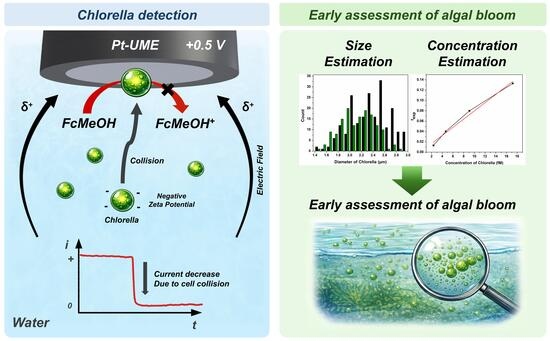
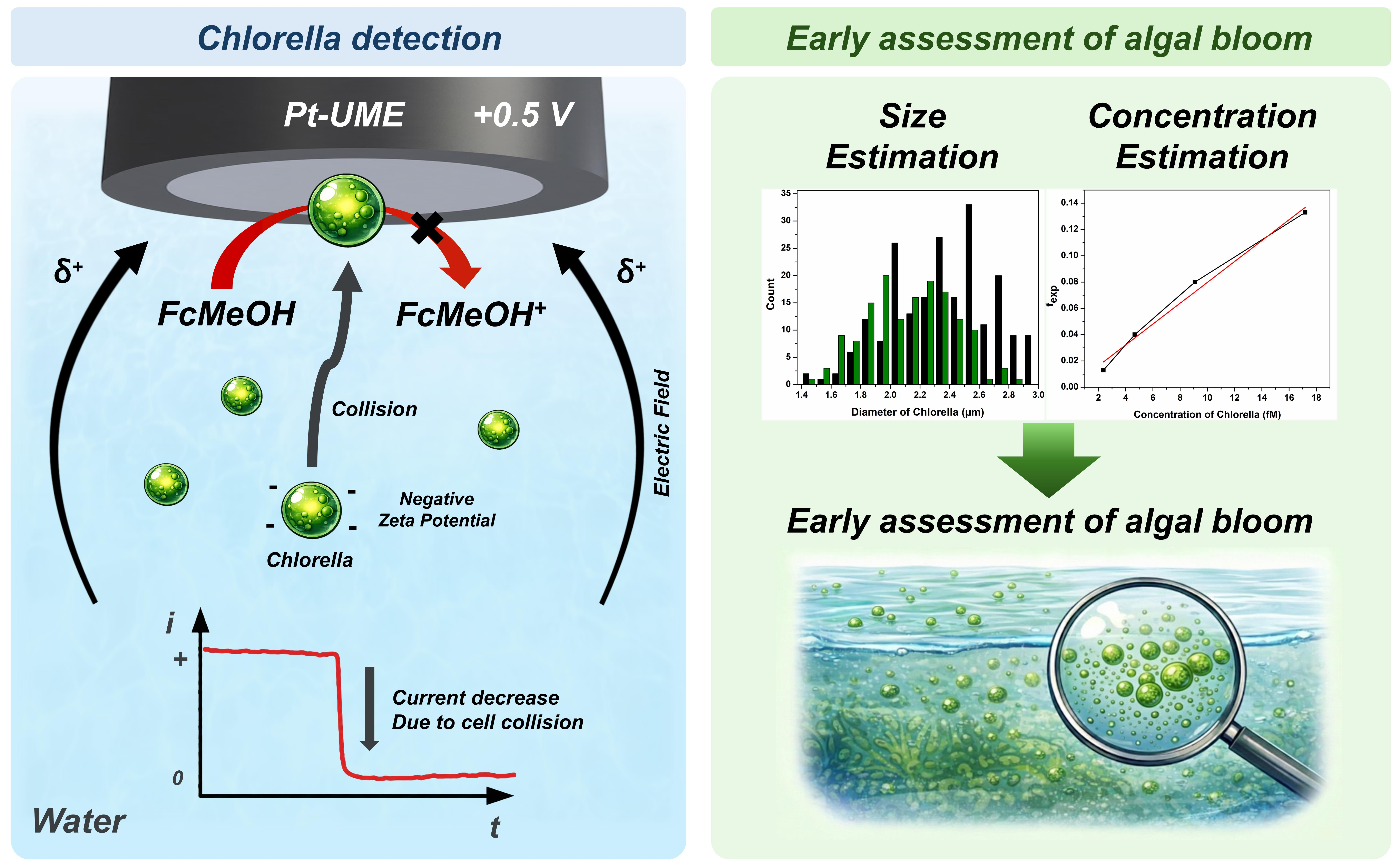
Consequently, the detection of Chlorella was achieved in this study by applying the single-particle collision method to analyze the abrupt current fluctuations arising from particle–electrode collisions. Furthermore, specific electrolyte conditions that induce migration were employed to enhance the collision frequency, thereby improving detection sensitivity. The size of colliding Chlorella was estimated via COMSOL Multiphysics simulations by matching the measured current changes. The collision frequency as a function of cell concentration was also investigated. This methodology enables real-time detection of Chlorella in aqueous environments without the need for pretreatment. Ultimately, it may serve as a monitoring platform for early assessment of algal bloom progression by estimating both the size and concentration of the algal cells.
3. Results and Discussion
Single particle detection at UMEs is based on monitoring transient current changes arising from particle–electrode collisions. When a constant potential is applied to sufficiently drive a redox reaction (e.g., oxidation or reduction) at the electrode surface, a steady-state current is established under mass transfer limitation as redox species are transported to the electrode surface by radial diffusion. Under these conditions, the collision of a non-conductive particle hinders the diffusion of the redox probe by physically blocking part of the electroactive area and introducing steric obstruction, resulting in an abrupt decrease in the absolute value of the current. As the collided particle remains attached at the electrode surface, the current re-establishes to a new steady-state corresponding to the reduced mass transfer of the redox probe. This transition arises from hindered diffusion of redox species due to steric obstruction and a lower consumption rate of the redox probe, manifesting as a distinct staircase-like step response for each collision event. This electrochemical blocking principle enables the discrete detection of individual collision events and was employed in this study to detect Chlorella suspended in aqueous media.
Although
Chlorella is a living biological entity with non-motile properties due to the absence of flagella, its physicochemical properties relevant to this method are comparable to those of other algae of similar size. Specifically,
Chlorella cells predominantly exist as discrete unicellular particles with a near-spherical morphology, except under highly concentrated conditions. In addition, like most microalgae,
Chlorella cells possess a predominantly negative surface charge at near-neutral pH due to the ionization of carboxylate and phosphate groups on the cell wall. Thus, this negative charge facilitates migration of the cells toward the electrode, thereby increasing the collision frequency. To induce migration, the region near the electrode surface should be locally positively charged via a redox reaction that generates positively charged species or consumes negatively charged ones. For migration-based detection system, FcMeOH and ferrocyanide solutions were employed as redox probes to evaluate cells collision tendencies of
Chlorella cells as a function of electrolyte composition and ionic charge of the redox species. FcMeOH, a neutral species under near-neutral pH conditions, is oxidized at the electrode surface to generate the cationic ferrocenium species. Similarly, anionic ferrocyanide ([Fe(CN)
6]
4−) is oxidized to ferricyanide ([Fe(CN)
6]
3−), which is less negatively charged.
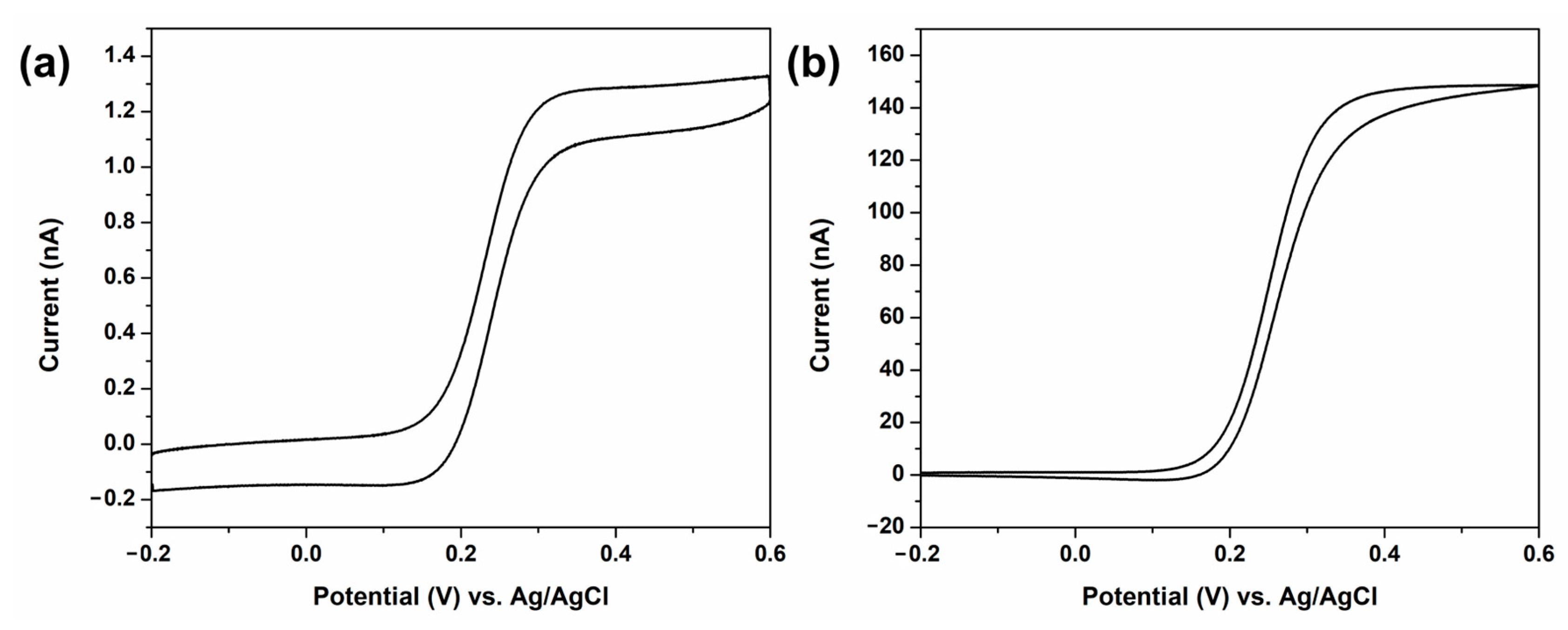
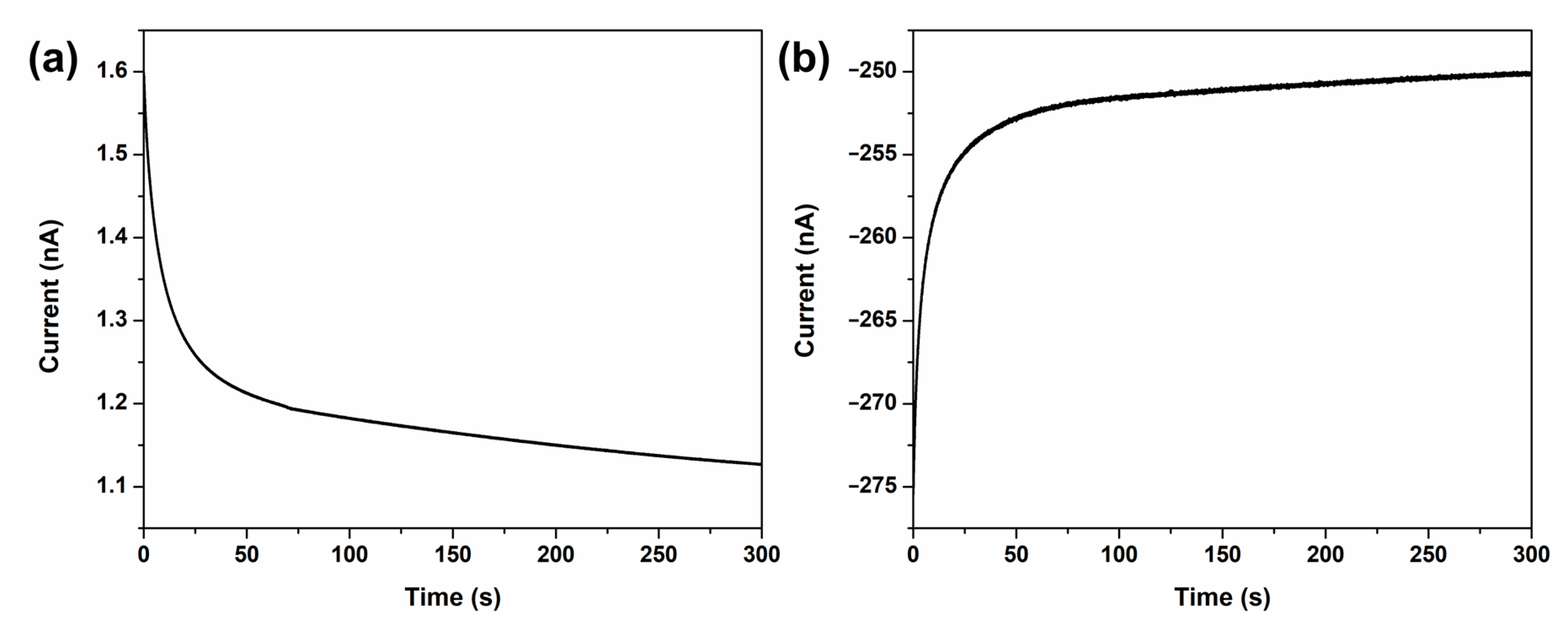
Figure 1 presents the cyclic voltammograms (CVs) for both redox species. As shown in
Figure 1a, the oxidation of FcMeOH initiates above 0.2 V, reaching a steady-state limiting current at potential ≥ 0.4 V. A comparable oxidation profile was observed for K
4[Fe(CN)
6] oxidation within a similar potential range (
Figure 1b). Therefore, the
Chlorella detection experiments were conducted at an applied potential of 0.5 V. This potential is sufficiently positive relative to the half-wave potential of FcMeOH oxidation to establish a steady-state current, which is required to resolve current decreases induced by
Chlorella collision events. In addition, applying potentials more positive than 0.5 V leads to the onset of the oxygen evolution reaction (OER), introducing additional faradaic processes that can increase background noise and compromise collision-based detection. Accordingly, 0.5 V was selected to enable stable FcMeOH oxidation while avoiding side reactions.
To prepare the samples for electrochemical analysis,
Chlorella cells were separated from the culture media via centrifugation, washed briefly with distilled water, and subsequently resuspended in the electrolyte solution. The chronoamperometric
I–
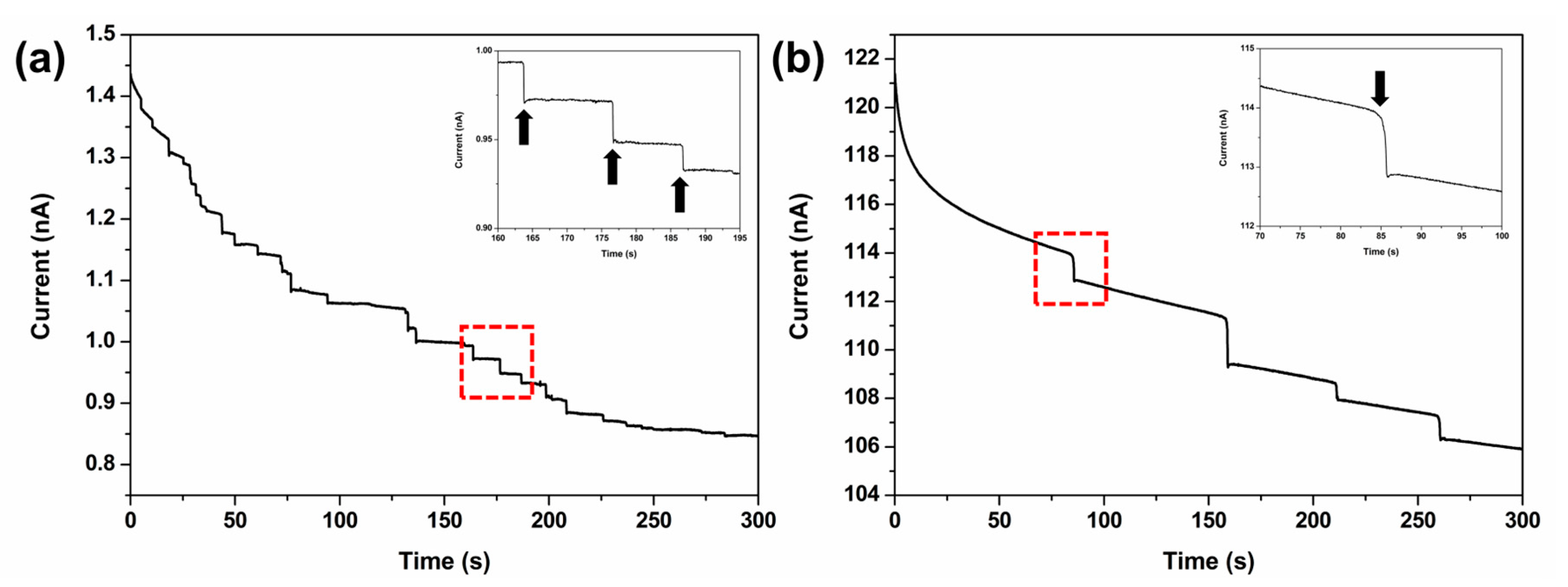
t response in
Figure 2a, recorded in FcMeOH solution in the presence of
Chlorella, exhibits discrete staircase-shaped current decreases corresponding to individual collision events. The clear staircase signals indicate that the collided
Chlorella cells are well attached on the electrode surface, establishing a sustained blockage of mass transfer. Similarly, the chronoamperometric
I–
t response in
Figure 2b, recorded in K
4[Fe(CN)
6] solution in the presence of
Chlorella, exhibits staircase-shaped current decreases with a notably lower collision frequency than in the FcMeOH system. The discrepancy in collision frequency is attributed to differences in migration strength. The strength of migration reflects the electric field gradient developed in the vicinity of the electrode. At a constant current density, the electric field is inversely proportional to the solution’s conductivity, which scales directly with ionic strength. Consequently, maintaining a low ionic strength is critical for effectively inducing migration. In the FcMeOH solution, the ionic strength was maintained at 0.5 mM by adding 0.5 mM KNO
3 as supporting electrolyte. In contrast, in the K
4[Fe(CN)
6] solution, dissociation and ion pairing yield multiple charged species, including [Fe(CN)
6]
4−, K[Fe(CN)
6]
3−, and K
+, resulting in a significantly higher ionic strength. The enhanced ionic atmosphere at elevated ionic strengths hinders ion movement through relaxation and electrophoretic effects, thereby minimizing the contribution of electromigration. Furthermore, because
Chlorella cells tend to sediment due to their density relative to the medium, a robust migrational force is required to counteract gravitational settling and effectively draw the cells toward the electrode surface.
The observed average step magnitudes for FcMeOH (14 pA) and [Fe(CN)6]4− (1.07 nA) correspond to an approximately 76-fold difference. This experimental ratio is consistent with the theoretical prediction based on the 100-fold concentration difference and the 1.2-fold higher diffusion coefficient of FcMeOH, confirming the validity of our single-entity detection system. Furthermore, the slight discrepancy between the theoretical and experimental ratios may be attributed to enhanced mass transfer of FcMeOH by migration. In the low ionic strength regime (0.5 mM KNO3), migration is not negligible and increases the total probe flux above the diffusion limited value.
To demonstrate that
Chlorella detection at the UME is governed primarily by migration, additional experiments were conducted in which the KNO
3 supporting electrolyte concentration was varied while the FcMeOH concentration was held constant. Additional measurements were also performed using an electrolyte containing ferricyanide as an alternative redox probe.
Figure 3a shows the chronoamperometric
I–
t curve recorded in a solution containing 1 mM FcMeOH and 9.08 fM
Chlorella, in which the KNO
3 concentration was increased to 50 mM. However, no staircase-like current decreases were observed. This result indicates that increasing the KNO
3 concentration raises the ionic strength and thereby strongly attenuates migration-driven collision
s.
In addition to electrolyte composition, electrode dimensions also play an important role in the electrochemical detection of Chlorella cells. Ultramicroelectrodes with diameters of 10–30 µm can be used for Chlorella detection. However, the primary limitation arises from signal magnitude. As the electrode size increases, the relative current change induced by a single collision decreases, reducing detection sensitivity. Consequently, reliable detection requires that the ratio of electrode diameter to particle diameter be smaller than approximately 20. On this basis, for Chlorella cells with characteristic diameters of ~2 µm, electrodes with diameters below ~40 µm are expected to be suitable.
To theoretically interpret the results shown in
Figure 3a in comparison with
Figure 2a, the combined contributions of diffusion, migration, and convection to mass transport were evaluated. The total flux of the species in an electrochemical system is governed by the Nernst–Planck equation, expressed as follows:
In this equation,
denotes the total flux of the species,
is the diffusion coefficient of the species,
represents the concentration gradient of the species, and
corresponds to the charge of the ion. Additionally,
, and
represent the Faraday constant, the gas constant, and the absolute temperature, respectively, while
indicates the electric potential and
denotes the fluid velocity. Because the solution was unstirred during the experiments, the convection term (
) was considered negligible. The diffusion contribution, described by Fick’s first law term (
), is expected to be comparable to that in
Figure 2a because the same FcMeOH concentration was used. However, the migration term (
), differs substantially because changing KNO
3 supporting electrolyte concentration alters the potential gradient in solution. In electrochemical measurement, a supporting electrolyte is typically added to suppress the migration of charged species, so that mass transfer is governed primarily by diffusion. Accordingly, increasing the KNO
3 concentration diminishes migration, and diffusion-driven
Chlorella transport alone does not produce staircase current response, even though diffusion flux remains operative in the absence of migration. This is attributed to the fact that the cells are not effectively retained at the electrode surface. These results confirm that migration is essential for transporting negatively charged
Chlorella to the electrode and that the resulting electric field retains the
Chlorella cells at the electrode surface.
Similarly,
Figure 3b shows the chronoamperometric
I–
t curve recorded in a solution containing 100 mM K
3[Fe(CN)
6] and 9.08 fM
Chlorella. Reduction in ferricyanide in the vicinity of the electrode generates a locally negative electric field that electrostatically repels the negatively charged cells, thereby suppressing collisions. In this case, the diffusional and migrational flux oppose one another, and the net flux is governed by the dominant term in Equation (1). Consequently, staircase-like current decreases were not observed.
The step current magnitude associated with
Chlorella collisions at the electrode surface was simulated using COMSOL Multiphysics to estimate the size of the colliding
Chlorella cells. The simulation was performed in two-dimensional axisymmetric mode, with a spherical particle positioned at the center of an electrode of 5 µm radius immersed in electrolyte solution. The bulk concentration was set to 1 mM to match the experimental FcMeOH concentration, and the diffusion coefficient was set to 7.6 × 10
−10 m
2·s
−1 based on the transport properties of FcMeOH [
46,
47]. Under these boundary conditions, the steady-state current at the electrode was calculated as a function of the particle size. The magnitude of the current decrease caused by particle collisions was determined by subtracting the steady-state current calculated in the presence of a particle from that obtained in the absence of a particle. These simulated current decreases were plotted as a function of particle size to generate a calibration curve, and the size of the colliding
Chlorella cells was subsequently calculated by substituting the experimentally measured step currents into this calibration curve. The equation for the calibration curve is expressed as follows:
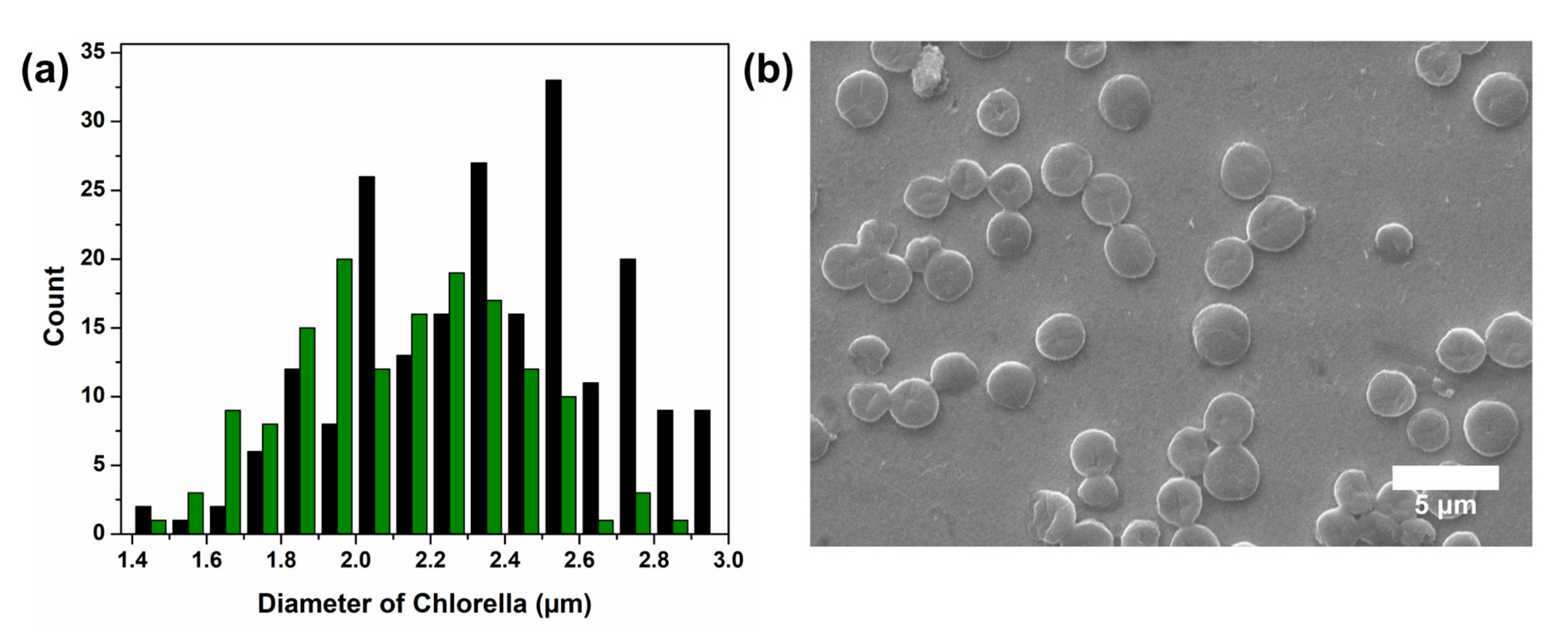
Figure 4a compares the physical
Chlorella size distribution measured by SEM with the electrochemical size distribution obtained by applying the simulation-based calibration curve to the step currents observed in the FcMeOH solution. The SEM-based size distribution was obtained by measuring the diameters of 150 randomly selected
Chlorella cells. Comparison of the two distributions gives an average diameter of 2.34 µm from the simulation-based method and 2.11 µm from the SEM measurements, indicating that the electrochemical estimates are slightly larger than the physical measurements. This overestimation arises because the simulation assumes collision at the center of the electrode, whereas experimental collisions occur randomly across the surface, including near the edge. When a particle collides near the edge of a UME, mass transfer is hindered more strongly because of the radial diffusion profile (the so-called edge effect), resulting in a larger current decrease than for a central collision of a particle of the same size. Consequently, using these amplified current decreases to estimate size leads to values that exceed the actual dimensions. In addition, given that
Chlorella cells have a negative surface charge and the redox probe ([Fe(CN)
6]
4−) is anionic, the overlap of electric double layers within the interstitial spaces between adjacent cells attached to the electrode creates an electrostatic barrier. This repulsion effect hinders the diffusion of redox probe molecules toward the electrode surface, potentially leading to a larger current decrease than that attributed solely to the geometric collision area. Considering these effects, the ~200 nm difference between the mean values indicates that the simulation-based method remains a viable approach for estimating
Chlorella size.
Figure 4b presents an SEM image of the
Chlorella cells, revealing a flattened circular morphology. The cells may appear somewhat flattened relative to their hydrated state because the samples were dried for more than 24 h prior to imaging. The drying process may also contribute to underestimation of
Chlorella size in the SEM measurement.
Estimating the physical dimensions of
Chlorella cells via simulation enables assessment of their growth stage in aquatic environments. Furthermore, quantifying cell population allows monitoring of algal bloom progression.
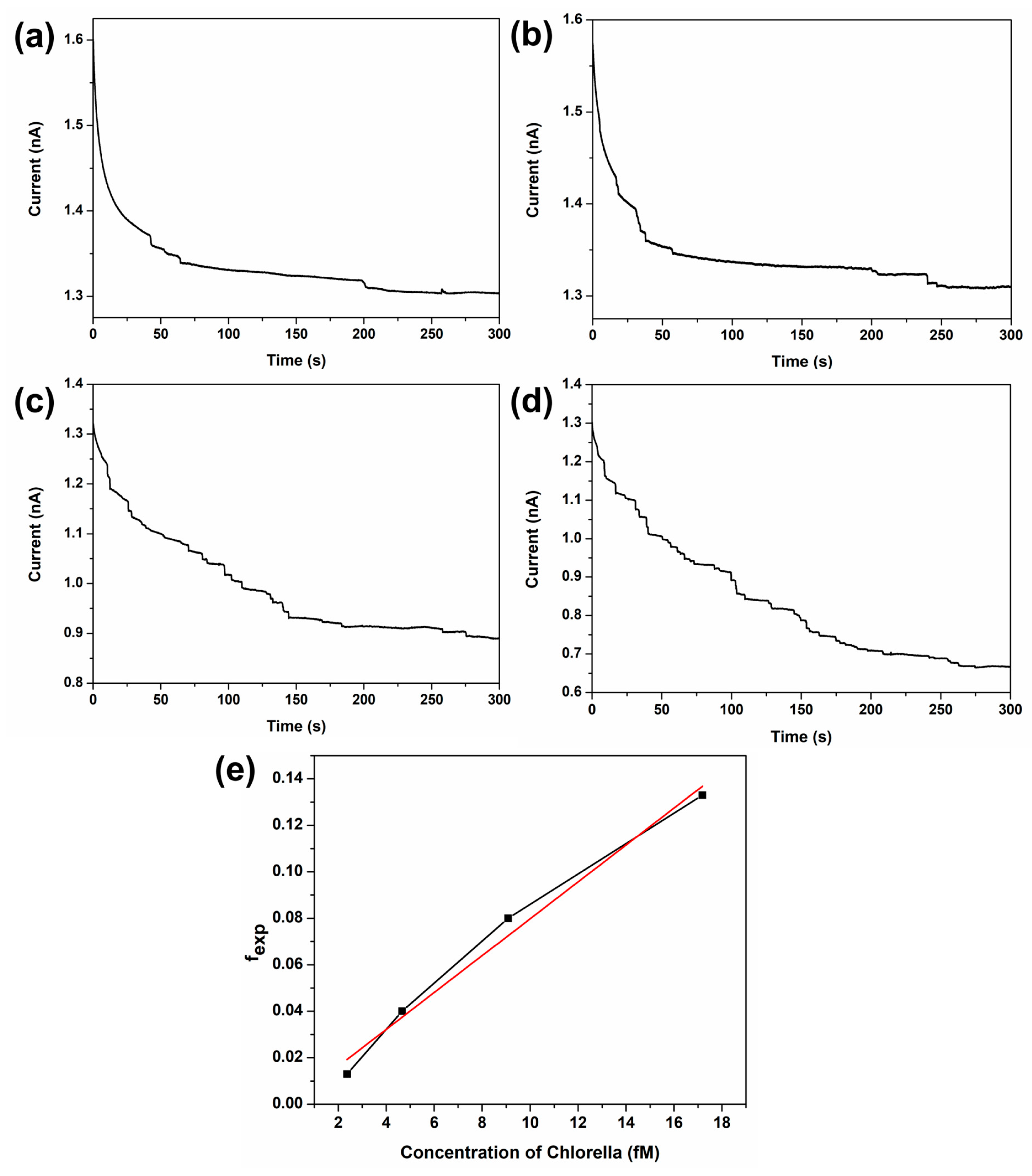
Figure 5 presents collision experiments performed at various
Chlorella concentrations in the FcMeOH solution. The
Chlorella concentration was determined from UV-Vis absorbance measurements using the Beer–Lambert law (
). For the calculation, the absorbance (
) of
Chlorella at 685 nm was used. The molar absorption coefficient (
) was taken as 8.016 × 10
13 L·mol
−1·cm
−1, and the optical path length (
) was 1 cm. The frequency of step currents attributed to
Chlorella collisions increased with
Chlorella concentration. In the diffusion-controlled regime, the collision frequency of single entities is proportional to their concentration, as described by the following equation [
48].
In this equation,
is the diffusion coefficient of the single entity,
is the concentration of the single entity,
is the electrode radius, and
is the Avogadro’s constant. This model assumes diffusion-controlled transport, although charged particles are also transported by migration. To evaluate the origin of collisional flux quantitatively, the diffusion-controlled collision frequency was calculated by substituting the
Chlorella concentration and diffusion coefficient into the equation. The diffusion coefficient of
Chlorella was estimated using the Stokes–Einstein equation, assuming a spherical particle of 2 µm diameter. The Stokes–Einstein equation is as follows:
kB represents the Boltzmann constant,
is the absolute temperature,
denotes the viscosity of water, and
corresponds to the radius of
Chlorella. The calculated diffusion-controlled collision frequency (
) is presented in
Table 1. The theoretical diffusion-controlled collision frequency (
) was approximately 2000 to 3000 times smaller than the experimentally observed frequency (
). This substantial deviation indicates that diffusion alone cannot account for the observed collision frequency of
Chlorella at the electrode.
Collision frequency arising from migration can be estimated quantitatively by calculating the transference number of the charged single entity [
49]. This method relies on the premise that the total current at the electrode equals the sum of the partial currents associated with transport of all ions and charged single entities. In the equation,
represents the effective charge of the specific species
,
denotes its mobility,
is the concentration of the species
,
is the average current of experiment,
is the Avogadro’s constant, and
is the Faraday constant.
In Equation (5), the transference number (
) represents the fraction of the total current carried by each ionic species in the electrolyte. The transference number of
Chlorella (
), although negligible in the overall charge balance, corresponds to its relative flux toward the electrode in the electrolyte solution. The calculation of
considers all species in the electrolyte solution, K
+, NO
3−, and
Chlorella. FcMeOH was excluded from this calculation because it is electrically neutral in near-neutral pH condition. The migration-driven collision frequency (
) was estimated by determining the partial current associated with
Chlorella transport, which is the product of its transference number (
) by the average total current (
). This partial current was then divided by the effective charge of the cell (
) and the Faraday constant (
F) and subsequently multiplied by Avogadro’s number (
NA) to yield the frequency of collision events by migration. For this calculation, the mobility of
Chlorella was estimated using the Einstein–Smoluchowski equation to be 9.55 × 10
−8 m
2·V
−1·s
−1, and the effective charge was assumed to be −10,000. The equation is as follows:
zj is the effective charge of the species
,
represents its diffusion coefficient,
is the Faraday constant,
, and
are the gas constant, and the absolute temperature, respectively. The resulting
values are listed in
Table 1. The calculated
values are comparable to the experimental values (
), in contrast to the diffusion-controlled estimates (
). Thus,
Chlorella collisions at the electrode are governed primarily by migration. The theoretical migration-to-diffusion collision frequency ratio (
), which is approximately 3400 in this system, quantifies the magnitude of the migration effect and confirms its dominance over diffusion.
Finally,
Figure 5e plots the
values as a function of
Chlorella concentration. The red line in
Figure 5e represents the calibration curve for this data, and its equation is expressed as follows:
In this equation, represents the concentration in fM. The standard deviation () was obtained from repeated measurements at the lowest tested concentration (2.37 fM), giving . The limit of detection (LOD) was calculated using the standard criterion , where is the slope of the calibration curve, resulting in an LOD of 0.94 fM. This equation enables the reverse estimation of Chlorella concentration based on the collision frequency observed under the experimental conditions. Collectively, these findings demonstrate the proposed electrochemical collision method enables simultaneous determination of Chlorella cells concentration and size.
Collectively, these findings demonstrate that the proposed electrochemical collision method enables simultaneous determination of the concentration and size of
Chlorella cells. It should be noted, however, that complete blocking of the UME surface is not expected under these conditions. Upon collision,
Chlorella cells are likely to form a three-dimensional, randomly stacked layer on the electrode surface, within which interstitial voids remain. These void spaces permit continued diffusion of FcMeOH to the electrode, thereby preventing full suppression of the background current. This interpretation is consistent with the experimental observations, as the background current does not decrease below approximately 10% of its initial value, even at high collision frequencies (
Figure 5). Such partial blocking behavior is therefore intrinsic to the cell geometry and stacking configuration rather than a limitation of the electrochemical detection method.
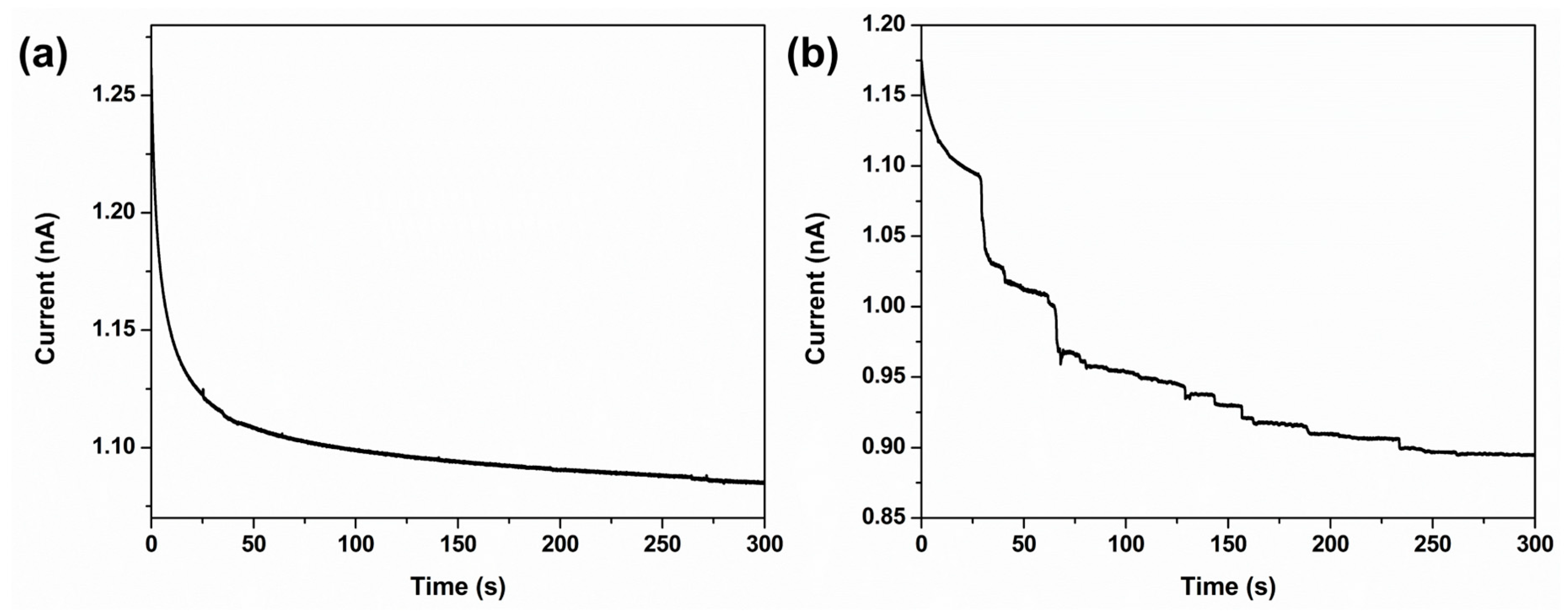
To further evaluate the robustness of the proposed method in complex matrices, additional collision experiments were conducted using water samples collected from a local lake.
Figure 6a shows the
I–
t curve recorded at an applied potential of 0.5 V after injecting lake water without
Chlorella into an electrolyte containing 1 mM FcMeOH and 0.5 mM KNO
3. Under these conditions, no staircase-like current decreases were observed, indicating that the lake water matrix itself does not produce false-positive collision signals. In contrast, when
Chlorella cells were introduced into the same lake water sample and injected into the electrolyte (
Figure 6b), distinct staircase current decreases corresponding to collision events were clearly detected. These results demonstrate that the proposed electrochemical collision strategy remains effective in real environmental samples containing coexisting ions and potential contaminants, confirming its applicability in complex matrices.