A Review of Wireless Charging Solutions for FANETs in IoT-Enabled Smart Environments




Abstract
1. Introduction
- What are the existing methods and architectures for wireless charging technologies for IoT-enabled FANETs? How do they perform in testing compared with the traditional charging of FANETs?
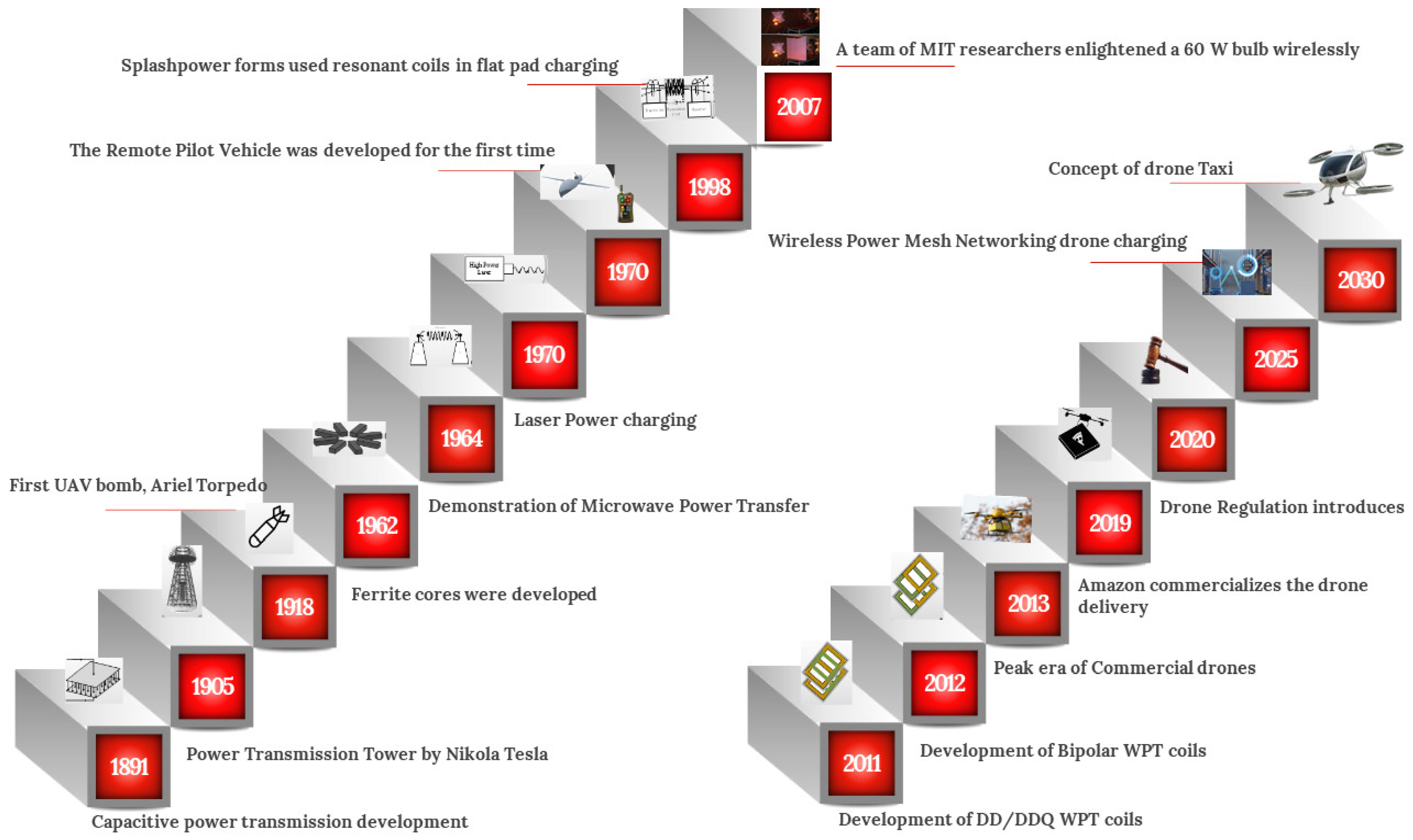
- How has the WPT evolved to recharge UAVs and FANETs as well?
- What are the existing systems and demonstrations of WPT in UAVs?
- What is the role of IoT in optimizing UAV trajectories that are employed as wireless chargers in FANETs?
- What are the current challenges, limitations, and open research gaps in deploying wireless charging in FANETs?
- How is IoT integrated into FANETs for energy management and coordination?
- This review provides a comprehensive synthesis of existing research on the integration of IoT technologies with wireless charging solutions for FANETs. By bridging diverse but interconnected fields, including wireless networking, energy management, UAV control, and smart environments, a multidisciplinary perspective on this state-of-the-art technology can be provided.
- It also identifies and classifies the primary technological approaches and system architectures currently employed in the field. In doing so, it highlights application-specific innovations across a range of domains, including precision agriculture, disaster response, and urban infrastructure. These findings demonstrate the practical relevance and growing interest in deploying IoT-enabled FANETs for energy-intensive missions in real-world scenarios.
- Furthermore, this review critically examines the current limitations of the literature, drawing attention to persistent research gaps related to energy efficiency, interoperability, scalability, and cybersecurity. By analyzing these challenges, we provide a foundation for future research to address the pressing technical and operational barriers.
- In addition to mapping the existing research landscape, this review offers comparative evaluations and design insights that can inform the development of more integrated and efficient systems in the future. The study concludes with strategic recommendations for advancing the integration of IoT and wireless charging in dynamic FANET environments. This study serves as a valuable reference for researchers and practitioners seeking to develop resilient, scalable, and autonomous UAV systems capable of sustained operation in energy-constrained and mission-critical settings.
2. Systematic Literature Review Methodology
2.1. Databases and Data Sources
2.2. Search Strategy
2.3. Search Eligibility Criteria
2.3.1. Inclusion Criteria
- The primary search counted in the peer-reviewed journal articles, scholarly books, and full conference proceedings
- Research study that specifically investigates the wireless charging methods for UAVs in FANETs under IoT smart environments
- Empirical results of simulation, trajectory optimization algorithms/methods evaluation, and their mathematical modeling
- Full articles written in English
- Articles published after 2011
2.3.2. Exclusion Criteria
- Non-peer-reviewed sources such as blogs, preprints, white papers, non-scholarly publications, non-scholarly books, meta-analyses, and editorials
- The study does not primarily address the wireless charging of UAVs in FANETs under IoT smart environments
- Duplicate records of the articles
- Papers that are solely theoretical or conceptual without any form of evaluation, as well as previous versions of the same research
2.4. Time Span
2.5. Study Screening and Selection Process
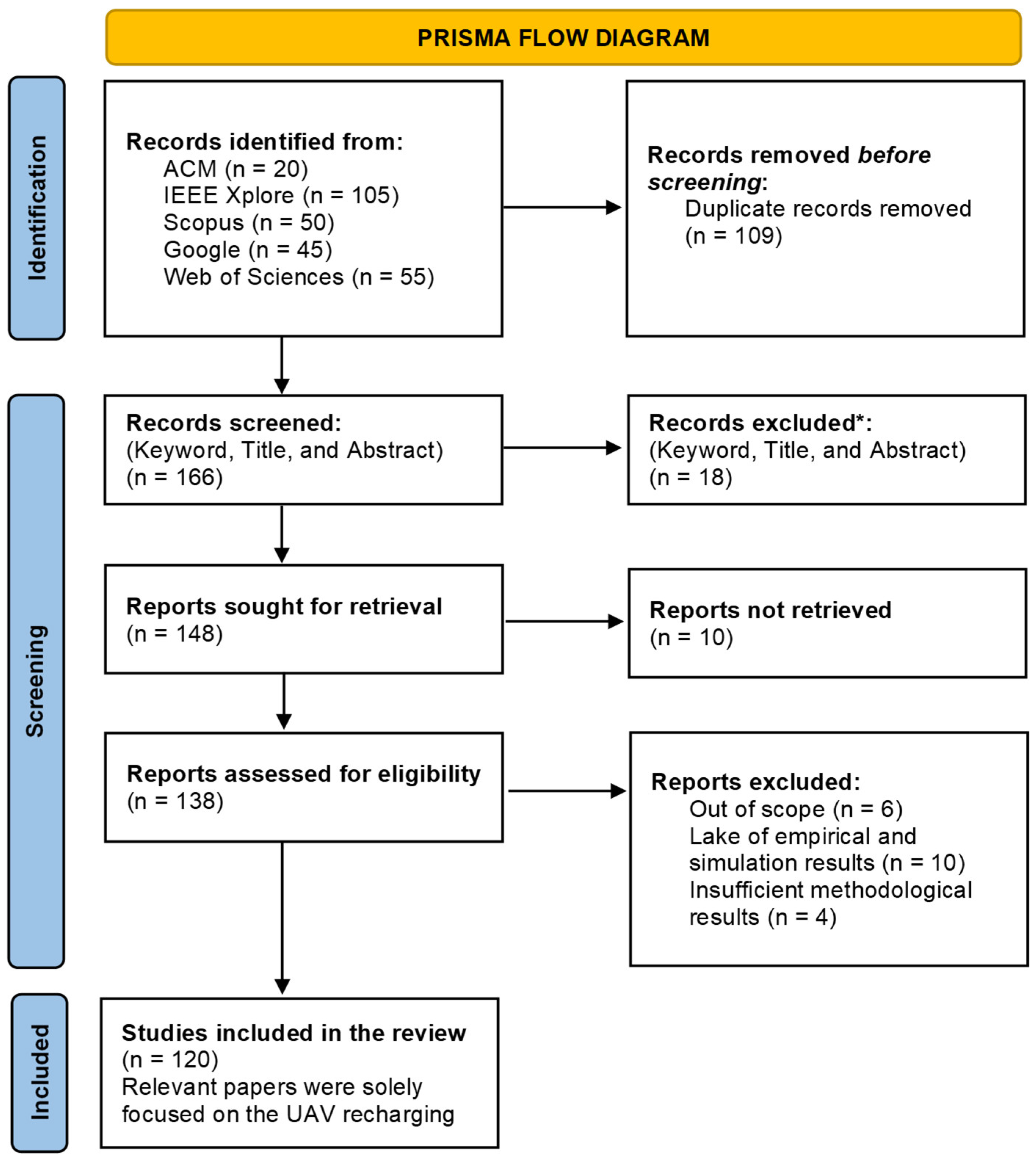
- Identification: The initial database search retrieved a total of 275 records, with 20 from ACM, 105 from IEEE Xplore, 50 from Scopus, 45 from Google, and 55 from the Web of Science Digital Library.
- Duplication Removal: At this phase, 109 duplicate records were removed to obtain 166 unique entries for the next step.
- Screening: The keywords, titles, and abstracts of the remaining 166 records were reviewed to screen the 18 records.
- Eligibility Assessment Criteria: During this step, 10 records were removed as they failed to satisfy the eligibility criteria, resulting in 138 articles being selected for full-text evaluation. Among these, 18 were excluded for the following primary reasons: 6 were out of scope, 8 lacked empirical or simulation results, and 4 had insufficient methodological details.
- Final Selection: The final selection of relevant studies consisted of 120 papers, which were incorporated into the qualitative review.
3. Fundamental Features of Wireless Charging
3.1. Overview of WPT
3.2. Overview of Wireless Recharging in UAVs and FANETs
In-Flight Wireless Recharging
4. Research Challenges of WPT for FANETs
4.1. Energy Constraints and Efficiency
4.2. Range Alignment and Power Delivery
4.3. Safety Interference and Regulatory Concerns
4.4. Infrastructure Scalability and Cost
4.5. Security and Privacy Risks
5. Deployment Issues of Wireless Recharging in FANETs
5.1. Optimization of UAV Trajectories for Wireless Recharging
Mathematical Modeling of Objective Functions for UAV Trajectories
- In the proposed Trajectory Optimization of Laser-Charged (TOLC) algorithm [109], T is calculated as the total working time of the UAV using Equation (1).
- In 2023 [110], an algorithm was proposed to employ an Energy Transfer (ET) UAV for recharging all Energy Receivers (ERs). The goal is to maximize the harvested energy via Equation (4).
- Another Distributed Multiple-Input–Multiple-Output (D-MIMO) [111] setup is anticipated for a three-dimensional trajectory optimization in Equation (6).
- Similarly, a Trajectory Optimization of Multi-UAVs Algorithm (TOUMA) [112] was projected for minimizing the time taken by a UAV to recharge the entire wireless network in (12).
5.2. IoT Integration into FANETs for Energy Management and Coordination
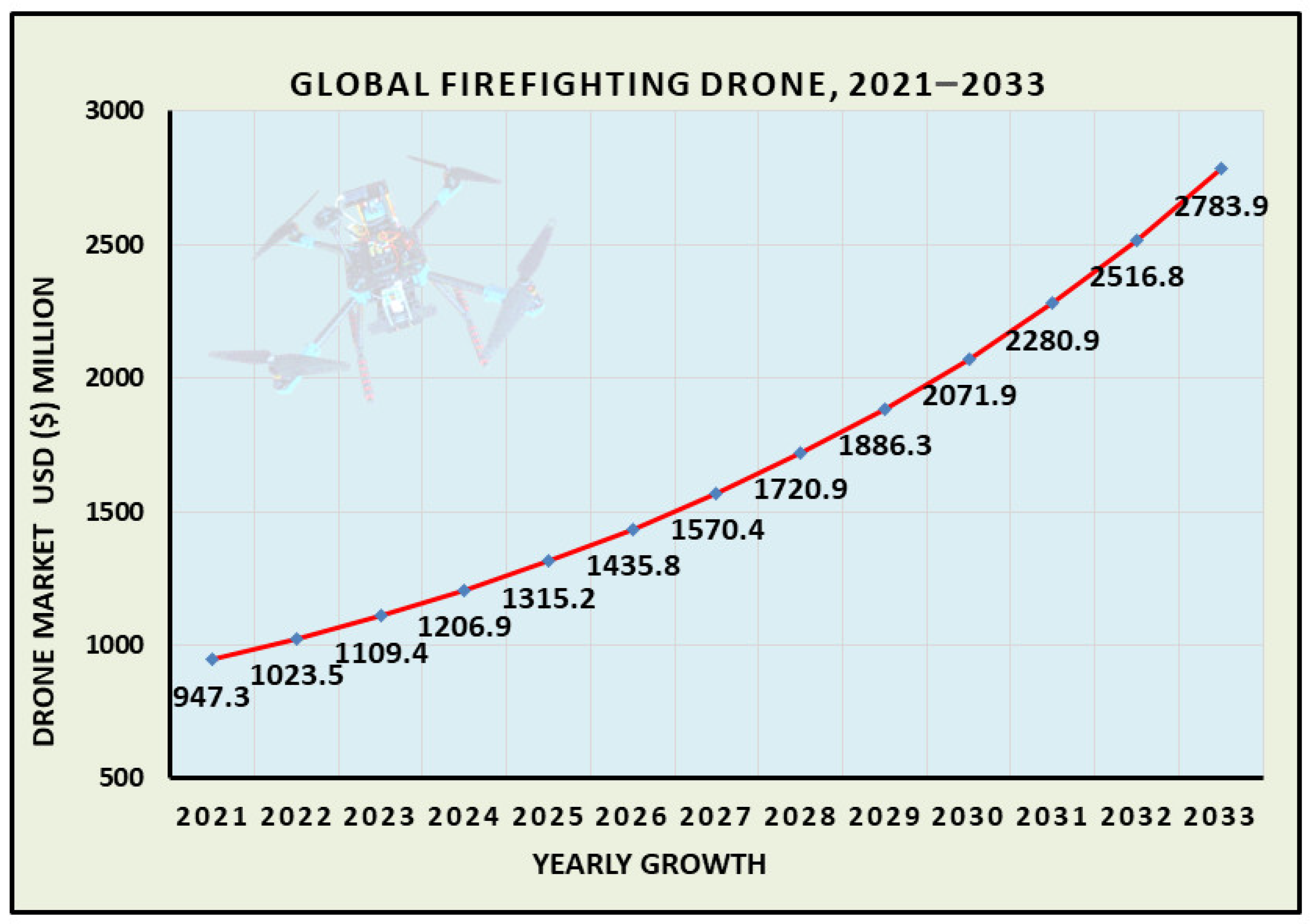
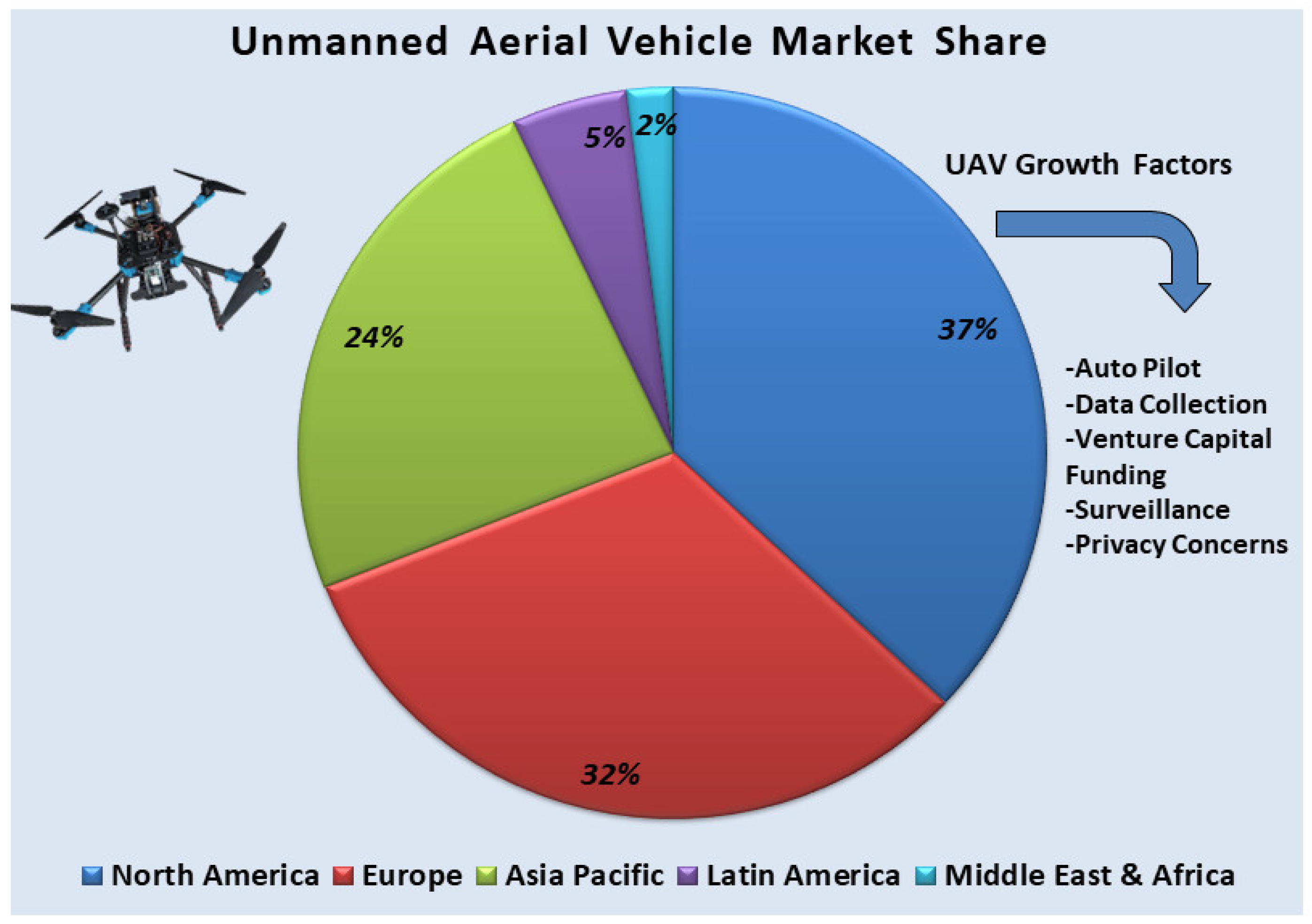
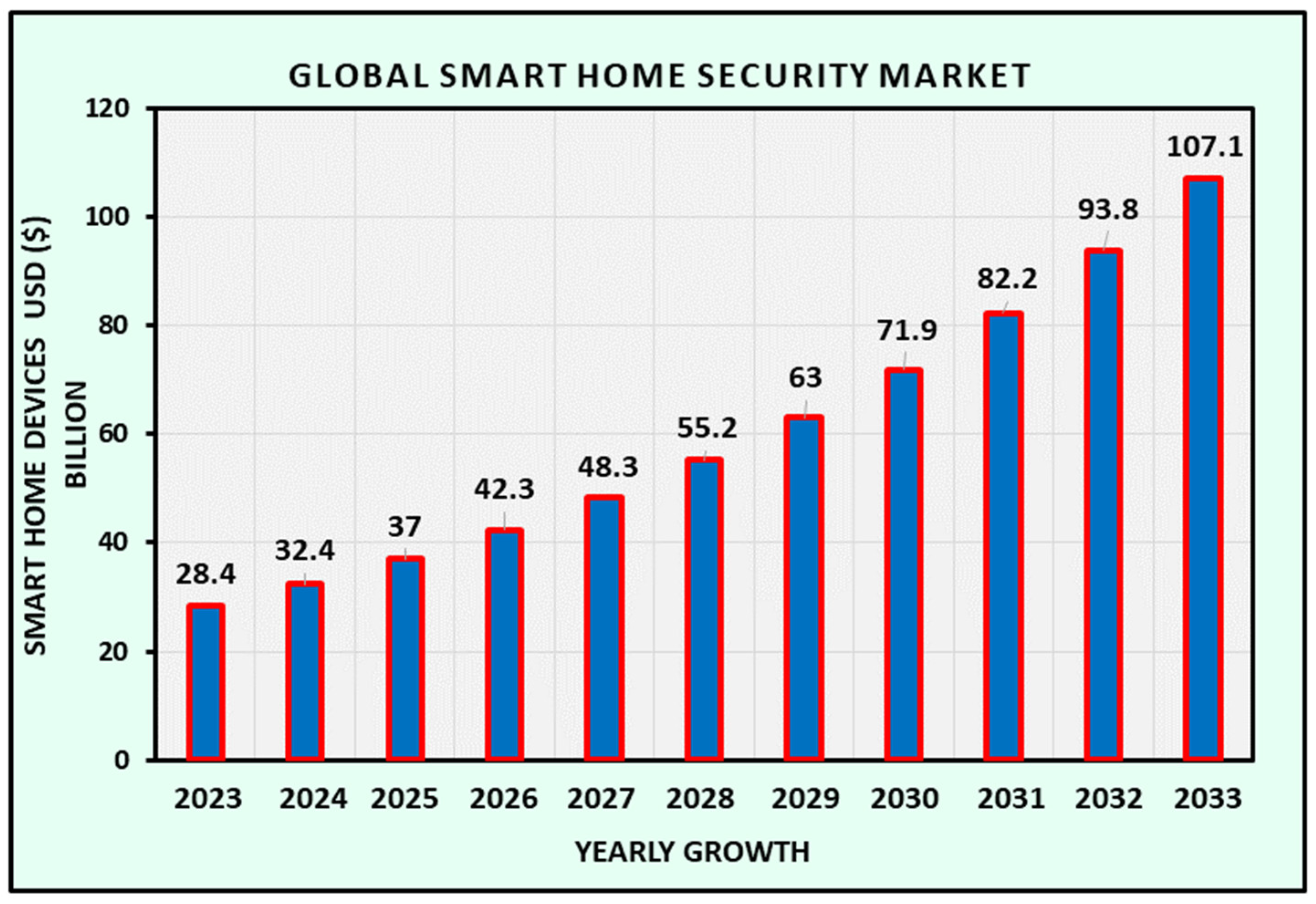
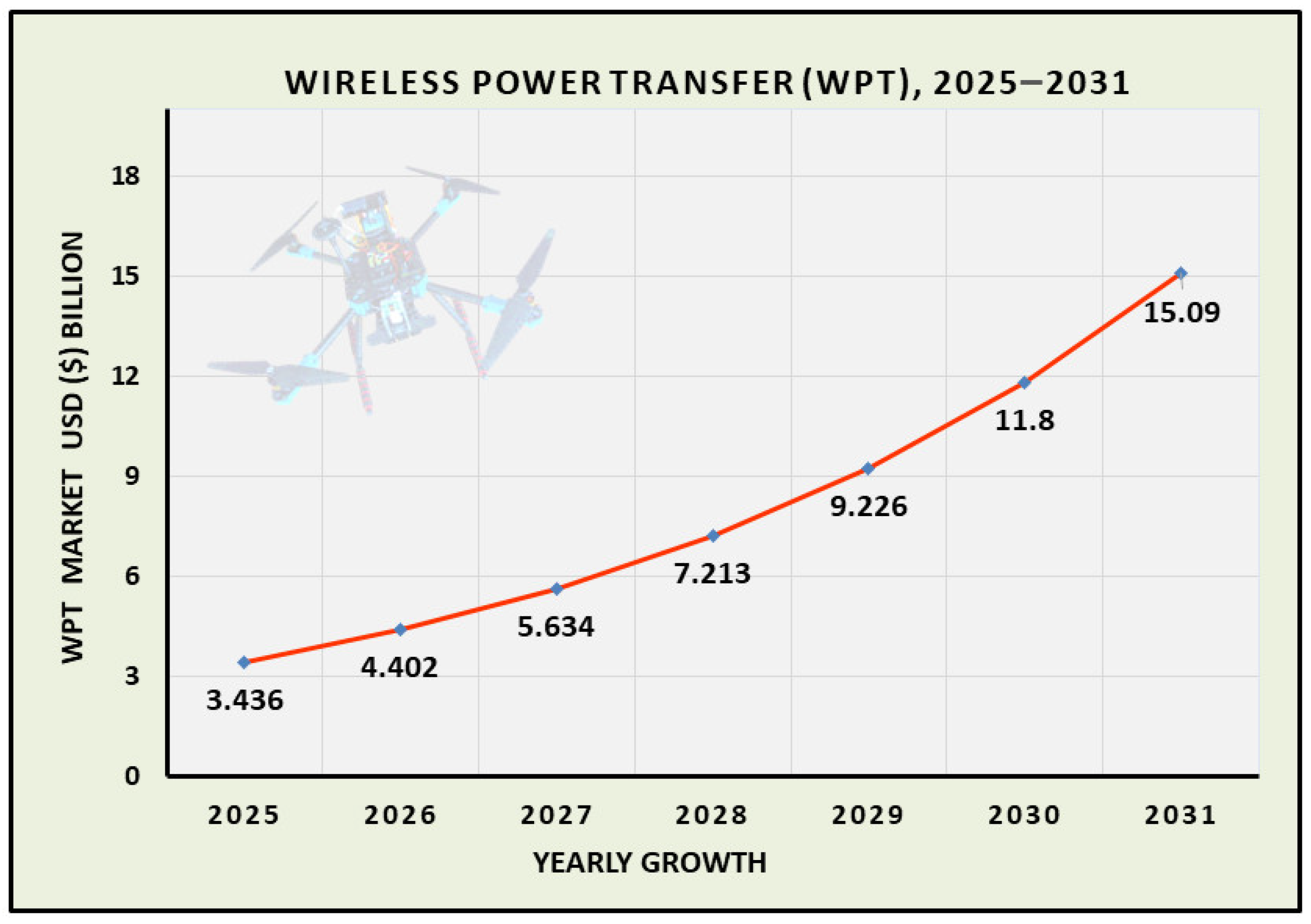
6. Graphical Indications of the Global Market and Implementation of Wireless Recharging in UAVs
7. Potential Open Issues and Research Gaps for WPT in FANETs
7.1. Key Scientific Issues
7.2. Technological Challenges
7.3. Regulatory Issues
7.4. Practical Barriers
8. Conclusions and Future Endeavors
Author Contributions
Funding
Institutional Review Board Statement
Informed Consent Statement
Data Availability Statement
Conflicts of Interest
References
- Abbas, S.; Abu Talib, M.; Ahmed, I.; Belal, O. Integration of UAVs and FANETs in Disaster Management: A Review on Applications, Challenges and Future Directions. Trans. Emerg. Telecommun. Technol. 2024, 35, e70023. [Google Scholar] [CrossRef] [Scilit]
- Khan, M.A.; Safi, A.; Qureshi, I.M.; Khan, I.U. Flying Ad-Hoc Networks (FANETs): A Review of Communication Architectures, and Routing Protocols. In Proceedings of the 2017 First International Conference on Latest Trends in Electrical Engineering and Computing Technologies (INTELLECT), Karachi, Pakistan, 15–16 November 2017; pp. 1–9. [Google Scholar] [CrossRef] [Scilit]
- Bekmezci, İ.; Şahingöz, O.K.; Temel, Ş. Flying Ad-Hoc Networks (FANETs): A Survey. Ad Hoc Netw. 2013, 11, 1254–1270. [Google Scholar] [CrossRef] [Scilit]
- Kuru, K. Planning the Future of Smart Cities with Swarms of Fully Autonomous Unmanned Aerial Vehicles Using a Novel Framework. IEEE Access 2021, 9, 6571–6595. [Google Scholar] [CrossRef] [Scilit]
- Kanellopoulos, D.; Sharma, V.K.; Panagiotakopoulos, T.; Kameas, A. Networking Architectures and Protocols for IoT Applications in Smart Cities: Recent Developments and Perspectives. Electronics 2023, 12, 2490. [Google Scholar] [CrossRef] [Scilit]
- Pal, M.; Mukherjee, A.; Panja, A.K.; Mondal, S. A flying ad-hoc networks framework for smart farming and precision agriculture. In Proceedings of the 3rd International Conference on Sustainable Computing and Data Communication Systems (ICSCDS), Erode, India, 17–18 January 2025; pp. 1719–1725. [Google Scholar] [CrossRef] [Scilit]
- Rahman, K.; Ibrahim, M.; Ahmad, M.; Alhussein, M.; Ghoneim, A. Cognitive lightweight logistic regression-based IDS for IoT-enabled FANET to detect cyberattacks. Mob. Inf. Syst. 2023, 2023, 7690322. [Google Scholar] [CrossRef] [Scilit]
- Mukhopadhyay, A.; Ganguly, D. Fanet-based emergency healthcare data dissemination. In Proceedings of the Second International Conference on Inventive Research in Computing Applications (ICIRCA), Coimbatore, India, 11–12 November 2020; pp. 170–175. [Google Scholar] [CrossRef] [Scilit]
- Mackle, C.; McLaren, D.; Flynn, D.; Parish, D.; McVey, S.; Wilson, J.; Jenkins, P. A data-driven simulator for the strategic positioning of aerial ambulance drones reaching out-of-hospital cardiac arrests: A genetic algorithmic approach. IEEE J. Transl. Eng. Health Med. 2020, 8, 1900410. [Google Scholar] [CrossRef] [Scilit]
- Orfanus, D.; de Freitas, E.P.; Eliassen, F. Self-organization as a supporting paradigm for military UAV relay networks. IEEE Commun. Lett. 2016, 20, 804–807. [Google Scholar] [CrossRef] [Scilit]
- Qu, C.; Sorbelli, F.B.; Singh, R.; Calyam, P.; Das, S.K. Environmentally-aware and energy-efficient multi-drone coordination and networking for disaster response. IEEE Trans. Netw. Serv. Manag. 2023, 20, 1093–1109. [Google Scholar] [CrossRef] [Scilit]
- Xu, J.; Ota, K.; Dong, M. Ideas in the air: Unmanned aerial semantic communication for post-disaster scenarios. IEEE Wirel. Commun. Lett. 2025, 14, 1598–1602. [Google Scholar] [CrossRef] [Scilit]
- Zheng, X.; Zhang, Y.; Li, H.; Wang, J.; Chen, L. UAV swarm-enabled collaborative post-disaster communications in low altitude economy via a two-stage optimization approach. IEEE Trans. Mob. Comput. 2025, 24, 11833–11851. [Google Scholar] [CrossRef] [Scilit]
- Paolone, G.; Iachetti, D.; Paesani, R.; Pilotti, F.; Marinelli, M.; Di Felice, P. A Holistic Overview of the Internet of Things Ecosystem. IoT 2022, 3, 398–434. [Google Scholar] [CrossRef] [Scilit]
- Guillen-Perez, A.; Cano, M.D. Flying ad hoc networks: A new domain for network communications. Sensors 2018, 18, 3571. [Google Scholar] [CrossRef] [Scilit] [PubMed]
- Noor, F.; Khan, M.A.; Al-Zahrani, A.; Ullah, I.; Al-Dhlan, K.A. A review on communications perspective of flying ad-hoc networks: Key enabling wireless technologies, applications, challenges and open research topics. Drones 2020, 4, 65. [Google Scholar] [CrossRef] [Scilit]
- Nawaz, H.; Ali, H.M.; Laghari, A.A. UAV communication networks issues: A review. Arch. Comput. Methods Eng. 2021, 28, 1349–1369. [Google Scholar] [CrossRef] [Scilit]
- Ma, R.; Song, J.; Zhang, Y.; Zhang, H.; Yuan, M. Lifetime-optimized energy management strategy for fuel cell unmanned aircraft vehicle hybrid power system. IEEE Trans. Ind. Electron. 2023, 70, 9046–9056. [Google Scholar] [CrossRef] [Scilit]
- Galkin, B.; Kibilda, J.; DaSilva, L.A. UAVs as mobile infrastructure: Addressing battery lifetime. IEEE Commun. Mag. 2019, 57, 132–137. [Google Scholar] [CrossRef] [Scilit]
- Mohsan, S.A.H.; Othman, N.Q.H.; Li, Y.; Alsharif, M.H.; Khan, M.A. Unmanned aerial vehicles (UAVs): Practical aspects, applications, open challenges, security issues, and future trends. Intell. Serv. Robot. 2023, 16, 109–137. [Google Scholar] [CrossRef] [Scilit]
- Chittoor, P.K.; Chokkalingam, B.; Mihet-Popa, L. A review on UAV wireless charging: Fundamentals, applications, charging techniques and standards. IEEE Access 2021, 9, 69235–69266. [Google Scholar] [CrossRef] [Scilit]
- Le, L.; Truong, T.; Quyen, T.; Nguyen, C.; Nguyen, M. Wireless power transfer near-field technologies for unmanned aerial vehicles (UAVs): A review. EAI Endorsed Trans. Ind. Netw. Intell. Syst. 2020, 7, 162831. [Google Scholar] [CrossRef] [Scilit]
- Chen, W.; Zhao, S.; Zhang, R.; Shi, Q. Resonant beam charging-powered UAV-assisted sensing data collection. IEEE Trans. Veh. Technol. 2020, 69, 1086–1090. [Google Scholar] [CrossRef] [Scilit]
- Rong, C.; Li, X.; Zhang, J.; Wang, H.; Liu, Y.; Yang, Z. Critical review of recent development of wireless power transfer technology for unmanned aerial vehicles. IEEE Access 2023, 11, 132982–133003. [Google Scholar] [CrossRef] [Scilit]
- Mohammadnia, B.; Ziapour, M.; Ghaebi, H.; Khooban, M.H. Feasibility assessment of next-generation drones powering by laser-based wireless power transfer. Opt. Laser Technol. 2021, 143, 107283. [Google Scholar] [CrossRef] [Scilit]
- Jawad, M.; Qureshi, S.; Imran, M.; Ullah, S.; Alhussein, M. Wireless power transfer with magnetic resonator coupling and sleep/active strategy for a drone charging station in smart agriculture. IEEE Access 2019, 7, 139839–139851. [Google Scholar] [CrossRef] [Scilit]
- Parveen, S.; Gulia, D.; Yadav, D.K.; Malik, M.; Gahlawat, V.K. Exploring IoT integration challenges: Causal relationships and strategic implications for business models. Digit. Bus. 2025, 5, 100125. [Google Scholar] [CrossRef] [Scilit]
- Khalid, R.; Naeem, M.; Ejaz, W. Autonomous aerial networks with wireless power transfer: Resource optimization, standardization, and challenges. IEEE Commun. Stand. Mag. 2022, 6, 24–31. [Google Scholar] [CrossRef] [Scilit]
- Phadke, S.; Medrano, F.A. Towards resilient UAV swarms—A breakdown of resiliency requirements in UAV swarms. Drones 2022, 6, 340. [Google Scholar] [CrossRef] [Scilit]
- Rimal, R.; Kong, C.; Poudel, B.; Wang, Y.; Shahi, P. Smart electric vehicle charging in the era of internet of vehicles, emerging trends, and open issues. Energies 2022, 15, 1908. [Google Scholar] [CrossRef] [Scilit]
- Liu, Z.; Zhao, S.; Wu, Q.; Yang, Y.; Guan, X. Joint trajectory design and resource allocation for IRS-assisted UAV communications with wireless energy harvesting. IEEE Commun. Lett. 2022, 26, 404–408. [Google Scholar] [CrossRef] [Scilit]
- Ning, H.; Liu, H. Cyber-physical-social-thinking space-based science and technology framework for the internet of things. Sci. China Inf. Sci. 2015, 58, 1–19. [Google Scholar] [CrossRef] [Scilit]
- Aljumah, N.; Ahanger, T.A.; Ullah, I. Challenges in securing UAV IoT framework: Future research perspective. IEEE Trans. Netw. Serv. Manag. 2025, 22, 2607–2629. [Google Scholar] [CrossRef] [Scilit]
- Page, M.J.; McKenzie, J.E.; Bossuyt, P.M.; Boutron, I.; Hoffmann, T.C.; Mulrow, C.D.; Shamseer, L.; Tetzlaff, J.M.; Akl, E.A.; Brennan, S.E.; et al. The PRISMA 2020 statement: An updated guideline for reporting systematic reviews. BMJ 2021, 372, n71. [Google Scholar] [CrossRef] [Scilit]
- Kitchenham, B.; Charters, S. Guidelines for Performing Systematic Literature Reviews in Software Engineering; Technical Report EBSE-2007-01, EBSE Technical Report; Keele University: Newcastle, UK, 2007. [Google Scholar]
- Minnaert, B.; Mastri, F.; Mongiardo, M.; Costanzo, A.; Stevens, N. Constant capacitive wireless power transfer at variable coupling. In Proceedings of the 2018 IEEE MTT-S International Wireless Symposium (IWS), Chengdu, China, 6–9 May 2018; pp. 1–4. [Google Scholar] [CrossRef] [Scilit]
- Chokkalingam, B.; Padmanaban, S.; Leonowicz, Z.M. Class E power amplifier design and optimization for the capacitive coupled wireless power transfer system in biomedical implants. Energies 2017, 10, 1409. [Google Scholar] [CrossRef] [Scilit]
- Van Mulders, J.; Aerts, W.; Vandenbosch, G.A.E.; Driesen, J.; Stevens, N. Wireless power transfer: Systems, circuits, standards, and use cases. Sensors 2022, 22, 5573. [Google Scholar] [CrossRef] [Scilit]
- Baghel, A.K.; Kulkarni, S.S.; Nayak, S.K. Enhancement of received power in far-field microwave wireless power transfer. In Proceedings of the 2020 IEEE Wireless Power Transfer Conference (WPTC), Seoul, Korea, 15–19 November 2020; pp. 102–105. [Google Scholar] [CrossRef] [Scilit]
- Ustun, D.; Balci, S.; Sabanci, K. A parametric simulation of the wireless power transfer with inductive coupling for electric vehicles, and modelling with artificial bee colony algorithm. Measurement 2020, 150, 107082. [Google Scholar] [CrossRef] [Scilit]
- Wang, S.; Dorrell, D.G.; Guo, Y.; Hsieh, M.F. Inductive charging coupler with assistive coils. IEEE Trans. Magn. 2016, 52, 107082. [Google Scholar] [CrossRef] [Scilit]
- Kim, H.; Ahn, D.; Kim, S.; Kim, C.; Kim, J. Coil design and measurements of automotive magnetic resonant wireless charging system for high-efficiency and low magnetic field leakage. IEEE Trans. Microw. Theory Tech. 2016, 64, 383–400. [Google Scholar] [CrossRef] [Scilit]
- Kouhalvandi, L.; Ozoguz, S.; Koohestani, M. A literature survey with the focus on magnetically coupled wireless power transfer systems developed for engineering and biomedical applications. Micromachines 2023, 14, 786. [Google Scholar] [CrossRef] [Scilit]
- Shi, Y.; Zhang, X.; Li, J.; Chen, H.; Wang, Q. Design of a novel receiving structure for wireless power transfer with the enhancement of magnetic coupling. AEU Int. J. Electron. Commun. 2018, 95, 236–241. [Google Scholar] [CrossRef] [Scilit]
- Juliet, V.; Padmanaban, S.; Mihet-Popa, L. Frequency splitting elimination and cross-coupling rejection of wireless power transfer to multiple dynamic receivers. Applied Sci. 2018, 8, 179. [Google Scholar] [CrossRef] [Scilit]
- Mou, X.; Gladwin, D.; Jiang, J.; Li, K.; Yang, Z. Near-field wireless power transfer technology for unmanned aerial vehicles: A systematical review. IEEE J. Emerg. Sel. Top. Ind. Electron. 2023, 4, 147–158. [Google Scholar] [CrossRef] [Scilit]
- Sheng, Q.; Zhang, L.; Liu, Y.; Wang, J.; Chen, X. Adaptive wireless power transfer via resonant laser beam over large dynamic range. IEEE Internet Things J. 2023, 10, 8865–8877. [Google Scholar] [CrossRef] [Scilit]
- Iyer, V.; Bayati, E.; Nandakumar, R.; Majumdar, A.; Gollakota, S. Charging a smartphone across a room using lasers. Proc. ACM Interact. Mob. Wearable Ubiquitous Technol. 2018, 1, 1–21. [Google Scholar] [CrossRef] [Scilit]
- Ojha, T.; Raptis, T.P.; Passarella, A.; Conti, M. Wireless power transfer with unmanned aerial vehicles: State of the art and open challenges. Pervasive Mob. Comput. 2023, 93, 101820. [Google Scholar] [CrossRef] [Scilit]
- Shinohara, N.; Kubo, Y.; Tonomura, H. Wireless charging for electric vehicle with microwaves. In Proceedings of the 3rd International Electric Drives Production Conference (EDPC), Nuremberg, Germany, 29–30 October 2013; pp. 1–4. [Google Scholar] [CrossRef] [Scilit]
- Yoshida, S.; Hasegawa, N.; Kawasaki, S. Experimental Demonstration of Microwave Power Transmission and Wireless Communication Within a Prototype Reusable Spacecraft. IEEE Microw. Wirel. Compon. Lett. 2015, 25, 556–558. [Google Scholar] [CrossRef] [Scilit]
- Liu, Y.; Zhang, B.; Zeng, X. High-efficiency wireless charging system for UAVs based on PT-symmetric principle. Drones Auton. Veh. 2025, 2, 10008. [Google Scholar] [CrossRef] [Scilit]
- Tesla, N. Art of Transmitting Electrical Energy Through the Natural Mediums. U.S. Patent 787,412, 18 April 1905. [Google Scholar]
- Kurs, A.; Karalis, A.; Moffat, R.; Joannopoulos, J.D.; Fisher, P.; Soljačić, M. Wireless power transfer via strongly coupled magnetic resonances. Science 2007, 317, 83–86. [Google Scholar] [CrossRef] [Scilit]
- Xie, L.; Cao, X.; Xu, J.; Zhang, R. UAV-enabled wireless power transfer: A tutorial overview. IEEE Trans. Green Commun. Netw. 2021, 5, 2042–2064. [Google Scholar] [CrossRef] [Scilit]
- He, Z.; Jiang, C.; Wang, J.; Zhuo, C.; Wu, S. Energy minimization for UAV-enabled wireless power transfer and relay networks. IEEE Internet Things J. 2023, 10, 19141–19152. [Google Scholar] [CrossRef] [Scilit]
- Ağçal, A.; Doğan, T.H. A Novel Folding Wireless Charging Station Design for Drones. Drones 2024, 8, 289. [Google Scholar] [CrossRef] [Scilit]
- Hoseini, S.A.; Hassan, J.; Bokani, A.; Kanhere, S.S. Trajectory optimization of flying energy sources using Q-learning to recharge hotspot UAVs. In Proceedings of the IEEE INFOCOM 2020—IEEE Conference on Computer Communications Workshops (INFOCOM WKSHPS), Toronto, ON, Canada, 6–9 July 2020; pp. 683–688. [Google Scholar] [CrossRef] [Scilit]
- Hoseini, S.A.; Hassan, J.; Bokani, A.; Kanhere, S.S. In Situ MIMO-WPT Recharging of UAVs Using Intelligent Flying Energy Sources. Drones 2021, 5, 89. [Google Scholar] [CrossRef] [Scilit]
- Dou, J.; Zhang, H.; Luo, Y.; Sun, G. Scheduling drone and mobile charger via hybrid-action deep reinforcement learning. IEEE Trans. Mob. Comput. 2025, 24, 7788–7804. [Google Scholar] [CrossRef] [Scilit]
- Xiong, J.; Wu, J.; Zhou, Y.; Xu, S. On energy replenishment station site selection and path planning for drone video streaming. IEEE Trans. Broadcast. 2025, 71, 862–873. [Google Scholar] [CrossRef] [Scilit]
- Khemiri, S.; Kishk, M.A.; Alouini, M.S. Exploiting tethered and untethered UAVs: A hybrid aerial communication system. Sci. Rep. 2025, 15, 15882. [Google Scholar] [CrossRef] [Scilit]
- Gao, F.; Han, Y.; Li, S.E.; Xu, S.; Dang, D. Accurate pseudospectral optimization of nonlinear model predictive control for high-performance motion planning. IEEE Trans. Intell. Veh. 2023, 8, 1034–1045. [Google Scholar] [CrossRef] [Scilit]
- Wang, J.; Chen, R.; Cai, C.; Zhang, J.; Wang, C. An onboard magnetic integration-based WPT system for UAV misalignment-tolerant charging with constant current output. IEEE Trans. Transp. Electrif. 2023, 9, 1973–1984. [Google Scholar] [CrossRef] [Scilit]
- Choi, C.H.; Jang, H.J.; Lim, S.G.; Gaponov, I. Automatic wireless drone charging station creating essential environment for continuous drone operation. In Proceedings of the 2016 International Conference on Control, Automation and Information Sciences (ICCAIS), Ansan, Korea, 27–29 October 2016; pp. 132–136. [Google Scholar] [CrossRef] [Scilit]
- Khonji, M.; Alshehhi, M.; Tseng, C.M.; Chau, C.K. Autonomous inductive charging system for battery-operated electric drones. In Proceedings of the Eighth International Conference on Future Energy Systems (e-Energy ‘17), Hong Kong, China, 16–19 May 2017; pp. 322–327. [Google Scholar] [CrossRef] [Scilit]
- Aboumrad, A.; Haun, J.; McGinnis, A.; Wu, N. An automatic platform for landing and charging of UAVs to extend UAV operations. In Proceedings of the 2020 IEEE International Conference on Distributed Computing in Smart Systems (DCOSS), Nashville, TN, USA, 6–9 July 2020; pp. 343–347. [Google Scholar] [CrossRef] [Scilit]
- Cai, C.; Wu, S.; Jiang, L.; Zhang, Z.; Yang, S. A 500-W wireless charging system with lightweight pick-up for unmanned aerial vehicles. IEEE Trans. Power Electron. 2020, 35, 7721–7724. [Google Scholar] [CrossRef] [Scilit]
- Tudorache, T.; Marinescu, A.; Vintilă, A. Electromagnetic locking/releasing system for UAVs wireless charging stations. In Proceedings of the 2024 International Conference on Applied and Theoretical Electricity (ICATE), Craiova, Romania, 5–7 November 2024; pp. 1–5. [Google Scholar] [CrossRef] [Scilit]
- Wang, R.; Wang, H.; Zhu, K.; Yi, C.; Wang, P.; Niyato, D. Mobile charging services for the internet of electric vehicles: Concepts, scenarios, and challenges. IEEE Veh. Technol. Mag. 2023, 18, 110–119. [Google Scholar] [CrossRef] [Scilit]
- Yassine, A.; Hossain, M.S. Match maximization of vehicle-to-vehicle energy charging with double-sided auction. IEEE Trans. Intell. Transp. Syst. 2023, 24, 13250–13259. [Google Scholar] [CrossRef] [Scilit]
- WiBotic. Fleet-Wide Wireless Charging and Power Optimization; Seattle, WA, USA. 2018. Available online: https://www.wibotic.com/ (accessed on 10 May 2025).
- HEISHA Tech. Robots and Drone Dock Innovation Center, and Manufacturing; Shenzhen, China. 2019. Available online: https://heishatech.com/ (accessed on 10 May 2025).
- H3 Dynamics. Autonomous Tele-Services for Mission-Critical Operations; Singapore. 2019. Available online: https://h3dynamics.com/drones (accessed on 12 May 2025).
- Safonov, A.S.; Khasanov, T.A.; Shakurova, Z.M.; Safin, A.R.; Dolomanyuk, L.V.; Gavrilov, V.A. Review on wireless EV charging systems. E3S Web Conf. 2024, 515, 04014. [Google Scholar] [CrossRef] [Scilit]
- GET. Next Generation in-Flight Wireless Charging Solution for Drones. 2019. Available online: https://getcorp.com/ (accessed on 15 May 2025).
- GuRu Wireless. Guru’s Modular Wireless Power Transfer System Can Power a Drone Forever. Available online: https://www.cnx-software.com/2025/01/12/guru-modularwireless-power-transfer-system-can-power-a-drone-forever/ (accessed on 15 May 2025).
- Marten, E. Laser Power Beaming for in-Flight Charging of Unmanned Aerial Vehicles: A Viability Study. Master’s Thesis, Umea University, Umea, Sweden, 2025. Available online: https://www.diva-portal.org/smash/get/diva2:1983730/FULLTEXT01.pdf (accessed on 20 January 2026).
- Park, C.W.; Chung, H.T. A study on drone charging system using wireless power transmission. Int. J. Trend Res. Dev. 2016, 3, 736–746. Available online: https://www.ijtrd.com/papers/IJTRD6528.pdf (accessed on 20 January 2026).
- Unmanned Airspace. Japanese Research Team Develops Wireless Power Transmission for Longer Drone Flights. 2025. Available online: https://www.unmannedairspace.info/latest-news-and-information/japanese-research-team-develops-wireless-power-transmission-for-longer-drone-flights/ (accessed on 20 January 2026).
- Reach Power. Reach Enables Wireless Power Mesh Networking for in-Flight Drone Charging. 2025. Available online: https://reachpower.com/news/reach-enables-wirelesspower-mesh-networking-for-in-flight-drone-charging/ (accessed on 15 May 2025).
- Mohsan, S.A.H.; Othman, N.Q.H.; Khan, M.A.; Amjad, H.; Zywiolek, J. A comprehensive review of micro UAV charging techniques. Micromachines 2022, 13, 977. [Google Scholar] [CrossRef] [Scilit]
- Liu, Z.; Li, T.; Li, S.; Mi, C.C. Advancements and challenges in wireless power transfer: A comprehensive review. Nexus 2024, 1, 100014. [Google Scholar] [CrossRef] [Scilit]
- Shafiq, Z.; Li, T.; Xia, J.; Li, S.; Yang, X.; Zhao, Y. Addressing EMI and EMF challenges in EV wireless charging with the alternating voltage phase coil. Actuators 2024, 13, 324. [Google Scholar] [CrossRef] [Scilit]
- Liller, J.; Goel, R.; Aziz, A.; Hester, J.; Nguyen, P. Development of a battery free, solar-powered, and energy-aware fixed-wing unmanned aerial vehicle. Sci. Rep. 2025, 15, 6141. [Google Scholar] [CrossRef] [Scilit] [PubMed]
- Saravanakumar, Y.N.; Sultan, M.T.H.; Shahar, F.S.; Giernacki, W.; Łukaszewicz, A.; Nowakowski, M.; Holovatyy, A.; Stępień, S. Power sources for unmanned aerial vehicles: A state-of-the-art. Appl. Sci. 2023, 13, 11932. [Google Scholar] [CrossRef] [Scilit]
- Zhang, M.; Dong, C.; Yang, P.; Tao, T.; Wu, Q.; Quek, T.Q.S. Adaptive routing design for flying ad hoc networks. IEEE Commun. Lett. 2022, 26, 1438–1442. [Google Scholar] [CrossRef] [Scilit]
- Yang, L.; Zeng, Y.; Zhang, R. Wireless power transfer with hybrid beamforming: How many RF chains do we need? IEEE Trans. Wirel. Commun. 2018, 17, 6972–6984. [Google Scholar] [CrossRef] [Scilit]
- Song, W.; Liu, X.; Ansari, N. Green-Energy-Empowered Multibeam Collaborative RF Wireless Charging for IoT. IEEE Internet Things J. 2025, 12, 37886–37897. [Google Scholar] [CrossRef] [Scilit]
- Kim, H.; Kim, T.; Son, C. A study on battery separation drones to extend endurance. In Proceedings of the 34th Congress of the International Council of the Aeronautical Sciences (ICAS), Florence, Italy, 9–13 September 2024; Available online: https://www.icas.org/icas_archive/icas2024/data/papers/icas2024_0785_paper.pdf (accessed on 20 January 2026).
- Lopez, O.L.A.; Rosabal, O.M.; Azarbahram, A.; Khattak, A.B.; Monemi, M.; Souza, R.D.; Popovski, P.; Latva-Aho, M. High-power and safe RF wireless charging: Cautious deployment and operation. IEEE Wirel. Commun. 2024, 31, 118–125. [Google Scholar] [CrossRef] [Scilit]
- Iqbal, S.; Alshammari, N.F.; Shouran, M.; Massoud, J. Smart and sustainable wireless electric vehicle charging strategy with renewable energy and internet of things integration. Sustainability 2024, 16, 2487. [Google Scholar] [CrossRef] [Scilit]
- ElSayed, M.; Foda, A.; Mohamed, M. Autonomous drone charging station planning through solar energy harnessing for zero-emission operations. Sustain. Cities Soc. 2022, 86, 104122. [Google Scholar] [CrossRef] [Scilit]
- Chen, H.; Li, D.; Yin, F.; Wang, Y. UAV hovering strategy based on a wirelessly powered communication network. IEEE Access 2019, 7, 3194–3205. [Google Scholar] [CrossRef] [Scilit]
- Adepoju, W.; Bhattacharya, I.; Sanyaolu, M.; Bima, M.E.; Banik, T.; Esfahani, E.N.; Abiodun, O. Critical review of recent advancement in metamaterial design for wireless power transfer. IEEE Access 2022, 10, 42699–42726. [Google Scholar] [CrossRef] [Scilit]
- ICNIRP. Guidelines for limiting exposure to electromagnetic fields (100 kHz to 300 GHz). Health Phys. 2020, 118, 483–524. [Google Scholar] [CrossRef] [Scilit]
- Miyakoshi, J. Cellular and molecular responses to radio-frequency electromagnetic fields. Proc. IEEE 2013, 101, 1494–1502. [Google Scholar] [CrossRef] [Scilit]
- Han, H.; Bhatti, M.A. Enhancing wireless charging efficiency: Addressing metal interference through advanced electromagnetic analysis and detection techniques. Wirel. Power Transf. 2024, 11, e008. [Google Scholar] [CrossRef] [Scilit]
- Yi, T.; Zheng, H.; Liu, J.P.; Cheng, X.B. Research on location and capacity optimization method for electric vehicle charging stations considering user’s comprehensive satisfaction. Energies 2019, 12, 1915. [Google Scholar] [CrossRef] [Scilit]
- Důbravová, H.; Bureš, V.; Velfl, L. Review of the application of drones for smart cities. IET Smart Cities 2024, 6, 312–332. [Google Scholar] [CrossRef] [Scilit]
- Lucic, M.C.; Bouhamed, O.; Ghazzai, H.; Khanfor, A.; Massoud, Y. Leveraging UAVs to enable dynamic and smart aerial infrastructure for ITS and smart cities: An overview. Drones 2023, 7, 79. [Google Scholar] [CrossRef] [Scilit]
- Rezwan, S.; Choi, W. A survey on applications of reinforcement learning in flying ad-hoc networks. Electronics 2021, 10, 449. [Google Scholar] [CrossRef] [Scilit]
- La Cour, S.; Afridi, K.K.; Suh, G.E. Wireless charging power side-channel attacks. In Proceedings of the 2021 ACM SIGSAC Conference on Computer and Communications Security, Virtual Event, Republic of Korea, 15–19 November 2021; pp. 651–665. [Google Scholar] [CrossRef] [Scilit]
- Javanmardi, S.; Nascita, A.; Pescapè, A.; Merlino, G.; Scarpa, M. An Integration Perspective of Security, Privacy, and Resource Efficiency in IoT-Fog Networks: A Comprehensive Survey. Comput. Netw. 2025, 270, 111470. [Google Scholar] [CrossRef] [Scilit]
- Liptak, C.; Mal-Sarkar, S.; Kumar, S.A.P. Power analysis side channel attacks and countermeasures for the internet of things. In Proceedings of the 2022 IEEE Physical Assurance and Inspection of Electronics (PAINE), Huntsville, AL, USA, 25–27 October 2022; pp. 1–7. [Google Scholar] [CrossRef] [Scilit]
- Alam, M.M.; Moh, S. Survey on Q-learning-based position-aware routing protocols in flying ad hoc networks. Electronics 2022, 11, 1099. [Google Scholar] [CrossRef] [Scilit]
- Tanveer, M.; Khan, A.U.; Nguyen, T.N.; Ahmad, M.; El-Latif, A.A.A. Towards a secure and computational framework for inteernet of drones enabled aerial computing. IEEE Trans. Netw. Sci. Eng. 2023, 10, 3058–3070. [Google Scholar] [CrossRef] [Scilit]
- Karapetyan, N.; Asghar, A.B.; Bhaskar, A.; Shi, G.; Manocha, D.; Tokekar, P. AG-CVG: Coverage planning with a mobile recharging UGV and an energy-constrained UAV. In Proceedings of the IEEE International Conference on Robotics and Automation (ICRA), Atlanta, GA, USA, 19–23 May 2025; pp. 2617–2623. [Google Scholar] [CrossRef] [Scilit]
- Liu, N.; Luo, C.; Cao, J.; Hong, Y.; Chen, Z. Trajectory optimization of laser-charged UAVs for charging wireless rechargeable sensor networks. Sensors 2022, 22, 9215. [Google Scholar] [CrossRef] [Scilit] [PubMed]
- Gou, X.; Sun, Z.; Huang, K. UAV-aided dual-user wireless power transfer: 3D trajectory design and energy optimization. Sensors 2023, 23, 2994. [Google Scholar] [CrossRef] [Scilit] [PubMed]
- Ahmadinejad, H.; Rafieifar, A.; Falahati, A. Joint online 3D trajectory optimization and power allocation of UAVs as mobile access points in a downlink distributed multi-user MIMO system. Phys. Commun. 2023, 62, 102170. [Google Scholar] [CrossRef] [Scilit]
- Zhang, J.; Luo, C.; Liu, N.; Hong, Y.; Chen, Z. Minimizing charging task time of WRSN assisted with multiple MUVs and laser-charged UAVs. High Confid. Comput. 2025, 5, 100272. [Google Scholar] [CrossRef] [Scilit]
- Zhao, Z.; Liu, Y.; Lin, F.; Deng, T. Charging between pads: Periodic charging scheduling in the UAV-based WRSN with pads. Int. J. Distrib. Sens. Netw. 2024, 2024, 8851835. [Google Scholar] [CrossRef] [Scilit]
- Abdelmaboud, A. The internet of drones: Requirements, taxonomy, recent advances, and challenges of research trends. Sensors 2021, 21, 5718. [Google Scholar] [CrossRef] [Scilit]
- Alhaidari, F.; Almotiri, S.H.; Al Ghamdi, M.A.; Khan, M.A.; Rehman, A.; Abbas, S.; Khan, K.M.; Rahman, A.U. Intelligent software-defined network for cognitive routing optimization using deep extreme learning machine approach. Comput. Mater. Contin. 2021, 67, 1269–1285. [Google Scholar] [CrossRef] [Scilit]
- Motlagh, N.H.; Bagaa, M.; Taleb, T. Energy and delay aware task assignment mechanism for UAV-based IoT platform. IEEE Internet Things J. 2019, 6, 6523–6536. [Google Scholar] [CrossRef] [Scilit]
- Gupta, L.; Jain, R.; Vaszkun, G. Survey of important issues in UAV communication networks. IEEE Commun. Surv. Tutor. 2016, 18, 1123–1152. [Google Scholar] [CrossRef] [Scilit]
- Liu, Y.; Dai, H.N.; Wang, Q.; Imran, M.; Guizani, N. Wireless powering internet of things with UAVs: Challenges and opportunities. IEEE Netw. 2022, 36, 146–152. [Google Scholar] [CrossRef] [Scilit]
- Miao, Q.; Zhang, K.; Jiang, B. Fixed-time collision-free fault-tolerant formation control of multi-UAVs under actuator faults. IEEE Trans. Cybern. 2024, 54, 3679–3691. [Google Scholar] [CrossRef] [Scilit]
- Demme, J.; Martin, R.; Waksman, A.; Sethumadhavan, S. Side-channel vulnerability factor. SIGARCH Comput. Archit. News 2012, 40, 106–117. [Google Scholar] [CrossRef] [Scilit]
- Al-Ahmed, S.A.; Ahmed, T.; Zhu, Y.; Malaolu, O.O.; Shakir, M.Z. UAV-enabled IoT networks: Architecture, opportunities, and challenges. In Wireless Networks and Industrial IoT; Springer International Publishing: Cham, Switzerland, 2021; pp. 263–288. [Google Scholar] [CrossRef] [Scilit]
- Ali, H.; Munir, K.; Song, H.; Islam, S.U. A performance-aware routing mechanism for flying ad hoc networks. Trans. Emerg. Telecommun. Technol. 2020, 32, e4192. [Google Scholar] [CrossRef] [Scilit]
- Tanveer, M.; Aldosary, A.; Khokhar, S.-U.; Das, A.K.; Aldossari, S.A.; Chaudhry, S.A. PAF-IoD: PUF-enabled authentication framework for the internet of drones. IEEE Trans. Veh. Technol. 2024, 73, 9560–9574. [Google Scholar] [CrossRef] [Scilit]
- Khan, I.U.; Qureshi, I.M.; Aziz, M.A.; Cheema, T.A.; Shah, S.B.H. Smart IoT control-based nature inspired energy efficient routing protocol for flying ad hoc network (FANET). IEEE Access 2020, 8, 56371–56378. [Google Scholar] [CrossRef] [Scilit]
- Mohamed, A.; Ismail, I.; AlDaraawi, M. IoT-driven intelligent energy management: Leveraging smart monitoring applications and artificial neural networks (ANN) for sustainable practice. Computers 2025, 14, 269. [Google Scholar] [CrossRef] [Scilit]
- Chulerttiyawong, D.; Jamalipour, A. Sybil attack detection in Internet of flying things-IOFT: A machine learning approach. IEEE Internet Things J. 2023, 10, 12854–12866. [Google Scholar] [CrossRef] [Scilit]
- Singh, A.; Dixit, Y.; Hegde, R.M. Information loss minimization in FANET-aided rechargeable IoT networks using Q-learning. In Proceedings of the 2023 National Conference on Communications (NCC), Guwahati, India, 23–26 February 2023; pp. 1–6. [Google Scholar] [CrossRef] [Scilit]
- Zaidi, S.; Atiquzzaman, M.; Calafate, C.T. Internet of flying things (IoFT): A survey. Comput. Commun. 2021, 165, 53–74. [Google Scholar] [CrossRef] [Scilit]
- Khan, I.U.; Abdollahi, A.; Jamil, A.; Baig, B.; Aziz, M.A.; Subhan, F. A novel design of FANET routing protocol aided 5G communication using IoT. J. Mob. Multimed. 2022, 18, 1333–1354. [Google Scholar] [CrossRef] [Scilit]
- Abbood, A.A.; Al-Shammri, F.K.; Alzamili, Z.M.; Al-Shareeda, A.; Almaiah, M.A.; AlAli, R. Investigating quantum-resilient security mechanisms for flying ad-hoc networks (FANETs). J. Robot. Control. 2025, 6, 456–469. [Google Scholar] [CrossRef] [Scilit]
- Zhao, L.; Yao, Y.; Guo, J.; Zuo, Q.; Leung, V.C.M. Collaborative Computation Offloading and Wireless Charging Scheduling in Multi-UAV-Assisted MEC Networks: A TD3-Based Approach. Comput. Netw. 2024, 251, 110615. [Google Scholar] [CrossRef] [Scilit]
- Grand View Research. Global Firefighting Drone Market Size & Outlook, 2024–2033. Grand View Research. 2025. Available online: https://www.grandviewresearch.com/horizon/outlook/firefighting-drone-market-size/global (accessed on 7 June 2025).
- Precedence Research. Unmanned Aerial Vehicle (UAV) Drones Market Size to Hit USD 186.79 Billion by 2034. Precedence Research. January 2025. Available online: https://www.precedenceresearch.com/unmanned-aerial-vehicle-drones-market (accessed on 7 June 2025).
- Market.us Research. Smart Home Security Statistics: Market to Reach USD 107.1 bn by 2033. Market.us, October 2024. Available online: https://scoop.market.us/smart-home-security-statistics-market-news/ (accessed on 7 June 2025).
- Market Report Analytics. Wireless Power Transfer (WPT) Market Dynamics and Growth Analysis. Available online: https://www.marketreportanalytics.com/reports/wireless-power-transfer-wpt-229445 (accessed on 8 June 2025).



| WPT Method | Fundamental Principal | Efficiency | Distance Range | Frequency | Transmission of Power | References |
|---|---|---|---|---|---|---|
| Capacitive Wireless Power Transfer (CPT) | Transfers power using alternating electric fields between conductive plates (capacitors) | High | Millimeters to centimeters | 4.2 × 10⁻³ GHz | 0.0037 kW | [35,36,37,38] |
| Inductive Wireless Power Transfer (IPT) | Energy transfers using alternating magnetic fields between the two coaxial coils | High | Centimeters to tens of centimeters | 2.2 × 10⁻⁵ GHz | 100 kW | [39,40,41,42] |
| Magnetic Resonant Coupling (MRC) | Power transfers by connecting the transmitter and receiver coils that are set to the same frequency | Medium to High | Centimeters to meters | 6 × 10⁻⁵ GHz | 818 kW | [43,44,45,46] |
| Laser Beam Power Transfer (LPT) | A laser beam from the ground is aimed at a photovoltaic (PV) cell on the drone. This cell changes the light into electrical power | Medium | Meters to kilometers | 2.4 GHz | 1 × 10⁻³ kW | [20,47,48,49] |
| Microwave Radio Frequency (RF) Power Transmission | Microwave radiation is used for power transfer from a phased-array transmitter to a rectifying antenna, or “rectenna,” located on the drone. | Low to Medium | Meters to kilometers | 5.8 GHz 2.45 GHz | 5 × 10⁻² kW 4.39 kW | [50,51] |
| Parity-Time-Symmetric WPT | Power transmission is done by maintaining the Parity Time (PT) Symmetric phase stability | High | Centimeters to meters | 1.2 × 10⁻⁴ GHz | 6.5 × 10⁻² kW | [52] |
| WPT Method | Research Proposed | Coil Gap/Beam Type | Coupler Area/Acceleration Time | Passing Medium | Energy Density/Divergence | Power Loss/Line of Sight |
|---|---|---|---|---|---|---|
| CPT | Research was proposed in 1981 | <1 mm | Less | Metals | High | |
| IPT | Research was proposed in 1830 | >10 cm | High | Only air | Low | |
| MRC | Research was proposed in 2007 | 2 m | High | Body tissue, object metals | - | Low |
| LPT | Research was proposed in 1970 | Concentrated | Long | 2.4 GHz | Low divergence | Line of sight required |
| Microwave RF | Research was proposed in 1964 | Non-Concentrated | Short | 0.12 MHz | Very high divergence | No line of sight needed |
| Demonstration System | WPT Method | Device Type | Novel Innovation | Reference |
|---|---|---|---|---|
| Magnetic Integrated WPT System | Magnetic Resonance Coupling | UAV | A stable and misalignment-tolerant charging system for UAV power transfer through a tiny receiver. | [64] |
| Automated Wireless Charging Station | Inductive Power Transfer | UAV | A precise landing of a UAV for wireless recharging but with a longer sensing time and lower efficiency. | [65] |
| Autonomous Charging System | Inductive Power Transfer | UAV | It facilitates adjustable charging for long-range detection, unaffected by varying lighting conditions. | [66] |
| Autonomous Landing and Charging | Inductive Power Transfer | UAV | It proposed efficient computation time but a higher landing time with a small range. | [67] |
| Microwave-Powered UAV | Laser Power Transfer | UAV | A micro-UAV achieved perpetual flight by utilizing energy from a laser on the ground, which was aimed at its photovoltaic cells. | [51] |
| UAV Docking System | Capacitive Power Transfer | UAV | A lightweight, conformal capacitive coupling system that highlights its potential for aerodynamic integration and facilitates charging when briefly in contact with a perch. | [38] |
| Misalignment Tolerance System | Inductive Power Transfer | UAV | A circular-pad transmitter featuring multiple overlapping coils and a compact receiver was developed to maintain efficiency even when misalignment occurs during landing. | [42] |
| 500 W Wireless Charging System | Orthogonal Magnetic Concept | UAV | A proposed network of charging is based on a polarized transmitter and a U-type flat core that is perpendicular to the receiving coil. This system can transfer 500 W of direct current to the batteries of the UAV. | [68] |
| A Robotic Mobile Charging Tender | Conductive Charging | UAVs | An electromagnetic system is proposed that supports the UAVs to lock with a ground charging station and creates a physical connection for efficient conductive charging. | [69] |
| Long-Range Laser Powering | Laser Power Transfer | UAV | The experiment showcased the ability to supply power to a UAV from distances greater than 100 m by a high-power laser in conjunction with an optimized photovoltaic cell array, emphasizing accurate beam tracking and strict safety protocols. | [47] |
| Technology System | Type of Charging | Output Power/Battery | Dimensions of Charging Pad/Alignment | Technology Implication | Key Features | Charging Distance | References |
|---|---|---|---|---|---|---|---|
| WiBotic | Wireless Charging Pad | 100–300 W | 91.4 cm × 91.4 cm | Commercial | Commercially available product that is accessible for public use. | <10 cm | [72] |
| Heisha | Wireless Charging Station | 17.5 V, 6 A maximum | 80 cm × 80 cm | Commercial | Concentrates on worldwide drone charging solutions with industry-leading charging stations. | <10 cm | [73] |
| H3 Dynamics | Autonomous Charging Station | 12 V, 17.5 A maximum | 2 cm × 2 cm | Commercial | An advanced autonomous charging system used for critical mission operations. | <10 cm | [74] |
| Power Republic Corporation | Wireless Power Transfer | 200 W | - | Commercial Android/iOS consumer-focused) | Emphasis on WPT charging solutions for drones. | <10 cm | [75] |
| GET Corporation | In-flight Charging | 12 × 104 W | Circular coils less than 6 m in diameter | Commercial | While in flight, the drone charges for 6 min, increasing its flight duration to 25 min. | 3 m | [76] |
| GuRu | In-flight Charging | >500 W | 90 cm × 90 cm | Commercial | Operating at 24 GHz, it works on high-frequency millimeter-wave radio signals, the same as the frequency used in 5G networks. | 30 feet, near 9 m | [77] |
| Laser Power Beaming | In-flight Charging | 2 × 10³ W | Strict alignment | Laboratory experiment | It provides long-range laser beaming power transfer to micro-UAVs | 100 m–1 km | [78] |
| Drone Charging System | Wireless Charging Pad | 100 W | Precise alignment | Laboratory demonstrations | Usually used for short-range UAV battery charging. | 25 mm | [79] |
| Air Core Beam ATR Japan | In-flight Charging | 3–5 V | Depends on position | Demonstration at Wireless Technology Park, Japan | Power transmission is done by an air core beam (radio waves) to enlighten the drone’s LEDs. | Medium range | [80] |
| Reach Wireless Power DARPA | In-flight Charging | 50 W | Controlled coordinates | Demonstration for DARPA | Multiple power transmitters work in unison, creating a mesh network for recharging the drone. | 6 m | [81] |
| Research Year | Objective of Optimization | Proposed Algorithm | Mathematical Modeling | Reference |
|---|---|---|---|---|
| 2022 |
|
|
RF wireless power transfer model is as follows: In the above, is the distance between the sensors and UAV hover. | [109] |
| 2023 |
|
|
| [110] |
| 2023 |
|
|
| [111] |
| 2025 |
|
|
subject to various constraints for UAV paths and visits.
| [112] |
| 2024 |
|
|
| [113] |
| Research Year | Application/Implementation Focus | Key Contribution | Shortcomings | Reference |
|---|---|---|---|---|
| 2024 | A secure and efficient authentication framework for Internet of Drones (IoD) | PAF-IoD system checks user identity using three methods. These are the AEGIS encryption method, XOR operations, and the SHA-256 hash function to make drone–user interactions more secure and private. | Absence of protection against physical capture, node capture attack, and forward secrecy. | [123] |
| 2020 | Routing protocol for FANETs | It is an energy-efficient routing protocol modified by the AntHocNet protocol. An innovative ‘Energy Stabilization Threshold’ (es_threshold) was introduced to save energy and enhance the lifetime of networks. | The performance of AntHocNet is only validated under Random Way Point rather than realistic patterns. | [124] |
| 2025 | Energy-monitoring system of buildings | It proposes an optimized Artificial Neural Network (ANN)-based predictive framework specifically for energy management. | The data set was collected from Kaggle, which is limited to a few geographical areas. | [125] |
| 2023 | Detection of Sybil attacks in IoFT | The scheme finds Sybil attacks by using data from UAV radio signals. It uses physical layer data like RSSD and TDoA. It can spot both regular and smart malicious nodes in the Internet of Flying Things (IoFT). | Before using the system, more tests may be needed, like how interference and blockages affect it, as well as networks with many nodes close together. | [126] |
| 2023 | Energy-efficient data routing in FANET-assisted rechargeable IoT Network | An optimization problem formulated to reduce both the energy used by UAVs and the information loss in IoT networks. A Q-learning-based data forwarding scheme (QDFS) is suggested to find the best path for data to travel from the source to the base station. | This study did not limit the speed of relay UAVs. As a result, they might move out of the line of sight (LoS) range, leading to information loss. | [127] |
| 2021 | IoFT can work for Flying Cloud, Edge, Fog Computing, and Flying cellular networks. | This survey focuses on the main features of the Internet of Flying Things (IoFT). It compares IoFT with Flying Things (FT) and IoT. The study classifies important IoFT applications. It introduces a new way to organize existing IoFT-related studies. | Energy consumption always remains a significant limitation for both UAVs and IoT. | [128] |
| 2022 | Environment monitoring via FANETs | A new algorithm called Unmanned Aerial-AntHocNet is proposed. It was compared with existing routing protocols. The Random Waypoint mobility model was used in tests to mimic a specific flight pattern for each UAV of a FANET. | FANETs face challenges due to their high mobility, low UAV density, and frequent changes to their topologies, which make communication difficult. | [129] |
| Performance Metric | Traditional FANETs Charging | WPT IoT-FANETs | WPT Charging Advantage | Reference |
|---|---|---|---|---|
| Flight endurance/consistency | 120–60 min | 2–6 h | Very high flight endurance | [19,52,82] |
| Power efficiency% | 75–90% | 65–85% | High charging feasibility | [43,44,82] |
| Human Intervention | Yes | No | No need to land, recharging on demand | [45,46,82] |
| PDR% | 75–88% | 82–95% | Less PDR due to continuous power supply | [127,131] |
Disclaimer/Publisher’s Note: The statements, opinions and data contained in all publications are solely those of the individual author(s) and contributor(s) and not of MDPI and/or the editor(s). MDPI and/or the editor(s) disclaim responsibility for any injury to people or property resulting from any ideas, methods, instructions or products referred to in the content. |
© 2026 by the authors. Licensee MDPI, Basel, Switzerland. This article is an open access article distributed under the terms and conditions of the Creative Commons Attribution (CC BY) license.
Share and Cite
Aslam, N.; Wang, H.; Esmaiel, H.; Junejo, N.U.R.; Agamy, A. A Review of Wireless Charging Solutions for FANETs in IoT-Enabled Smart Environments. Sensors 2026, 26, 912. https://doi.org/10.3390/s26030912
Aslam N, Wang H, Esmaiel H, Junejo NUR, Agamy A. A Review of Wireless Charging Solutions for FANETs in IoT-Enabled Smart Environments. Sensors. 2026; 26(3):912. https://doi.org/10.3390/s26030912
Chicago/Turabian StyleAslam, Nelofar, Hongyu Wang, Hamada Esmaiel, Naveed Ur Rehman Junejo, and Adel Agamy. 2026. "A Review of Wireless Charging Solutions for FANETs in IoT-Enabled Smart Environments" Sensors 26, no. 3: 912. https://doi.org/10.3390/s26030912
APA StyleAslam, N., Wang, H., Esmaiel, H., Junejo, N. U. R., & Agamy, A. (2026). A Review of Wireless Charging Solutions for FANETs in IoT-Enabled Smart Environments. Sensors, 26(3), 912. https://doi.org/10.3390/s26030912