Power Systems and eVTOL Optimization with Information Exchange for Green and Safe Urban Air Mobility




Abstract
1. Introduction
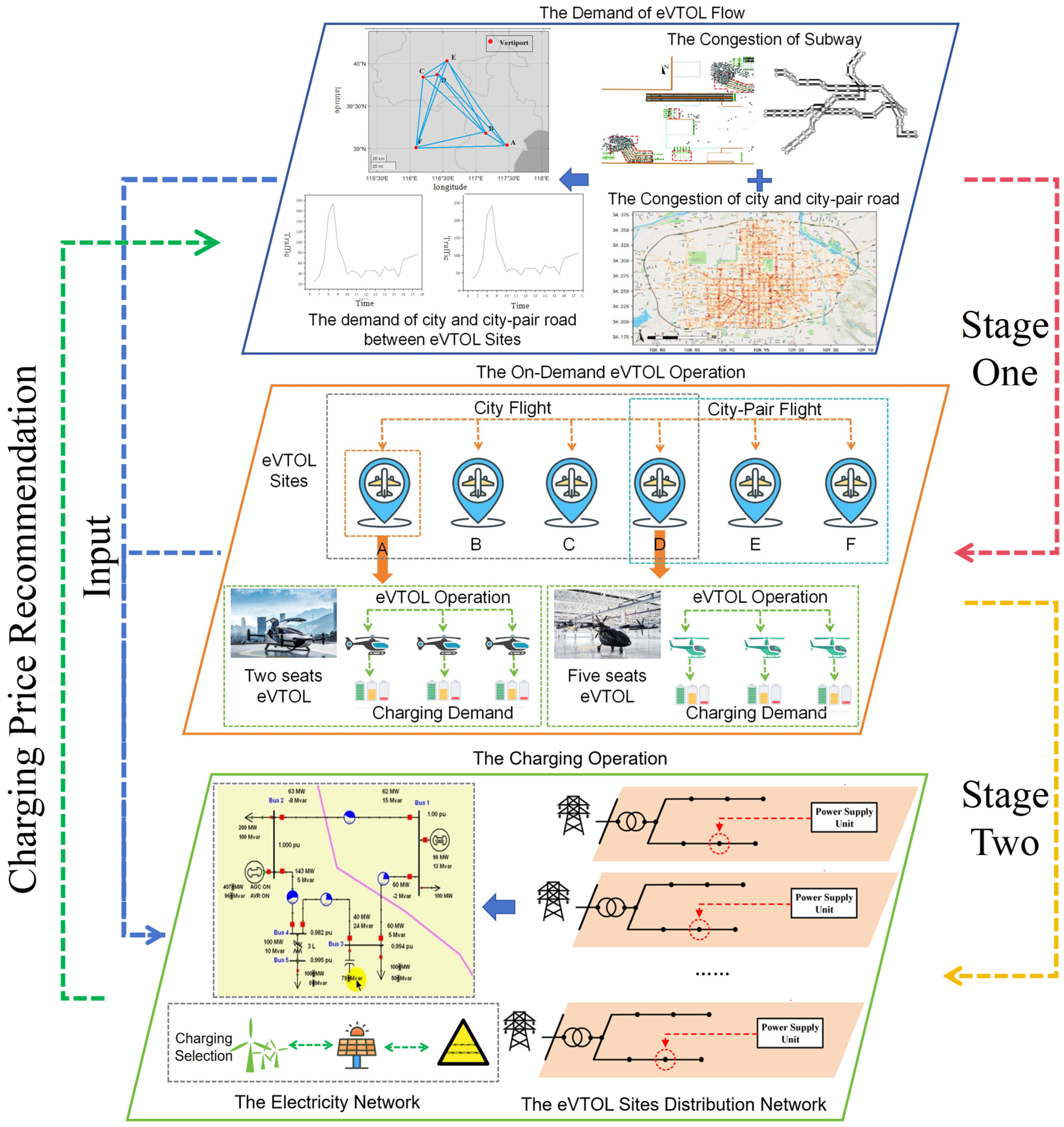
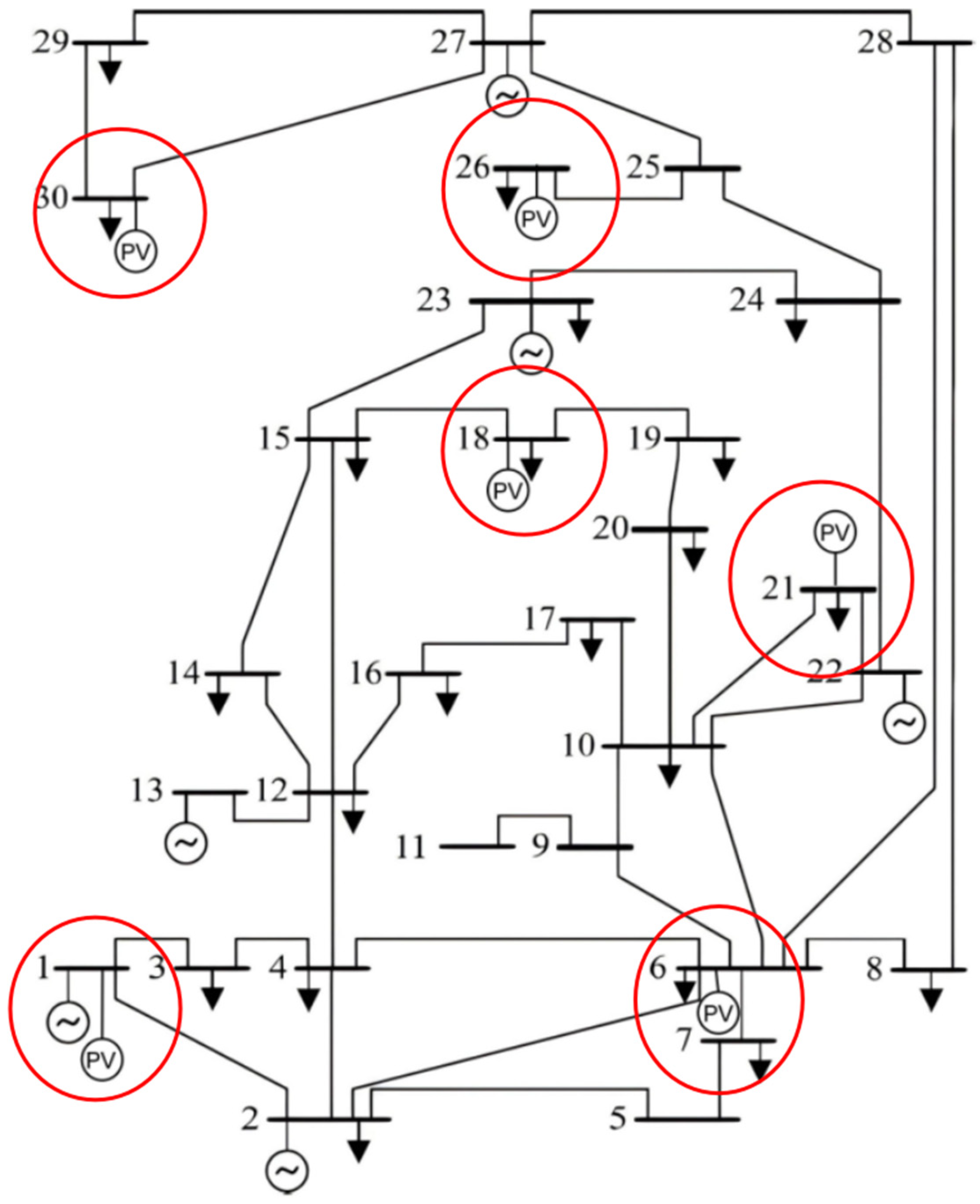
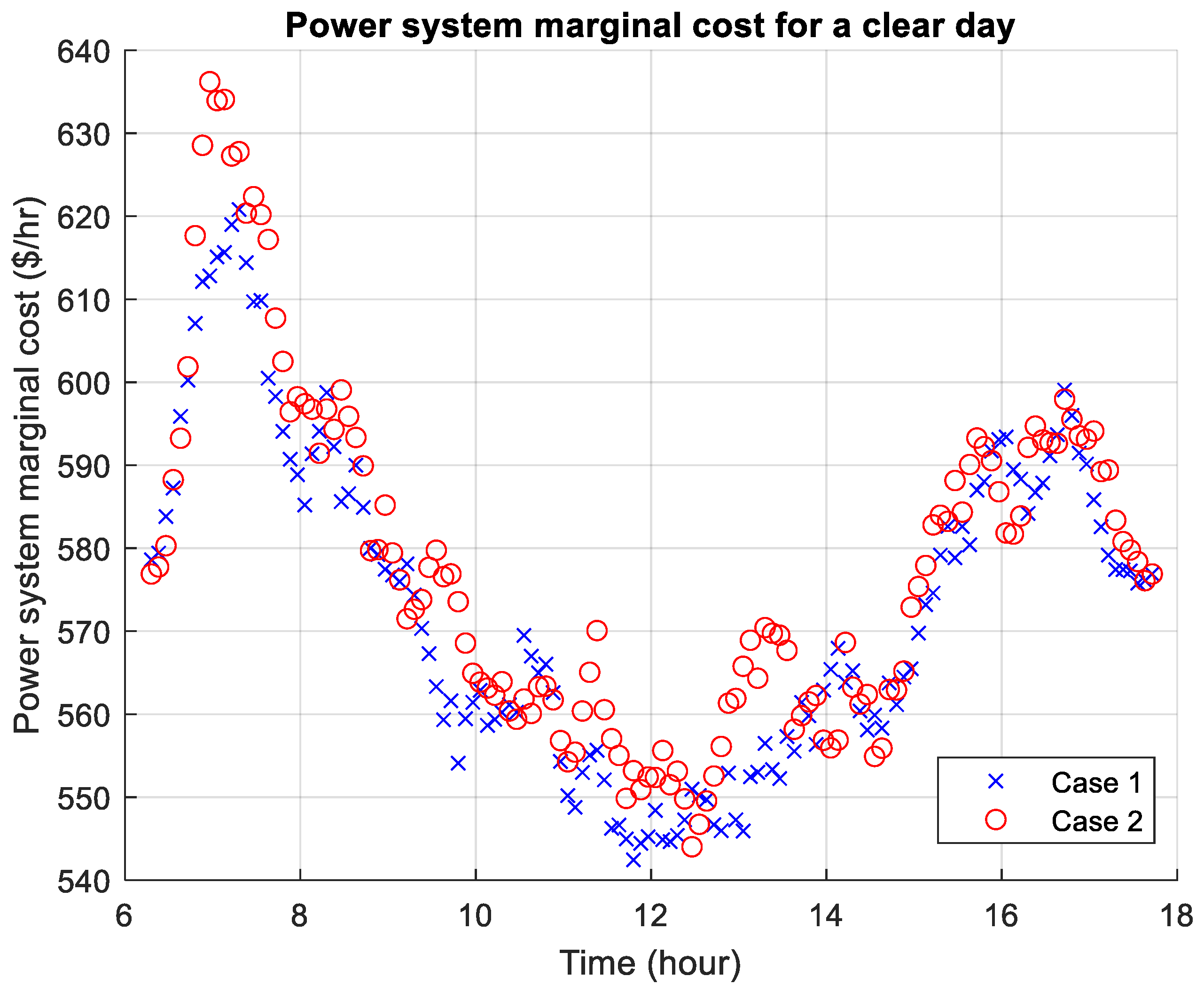
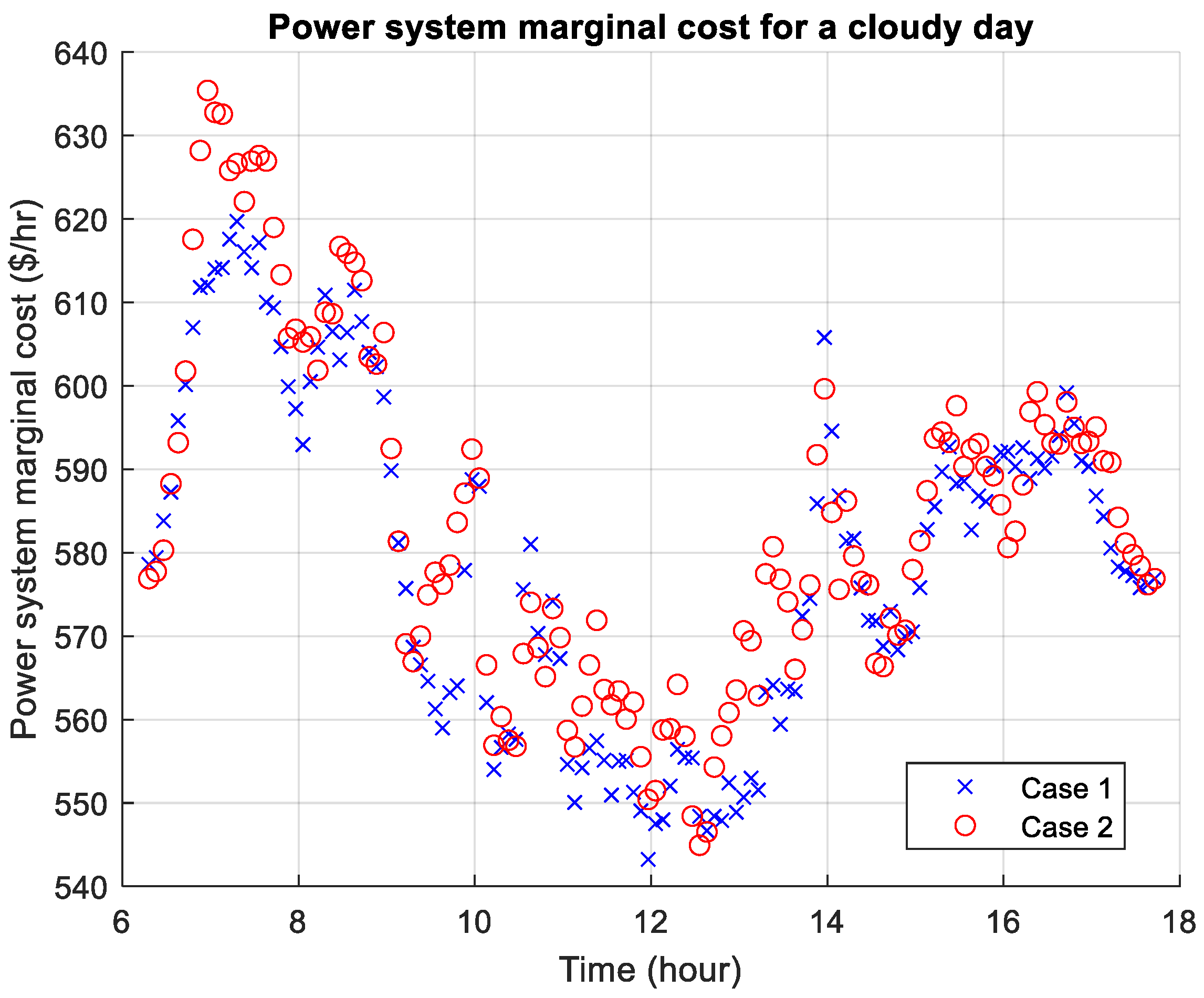
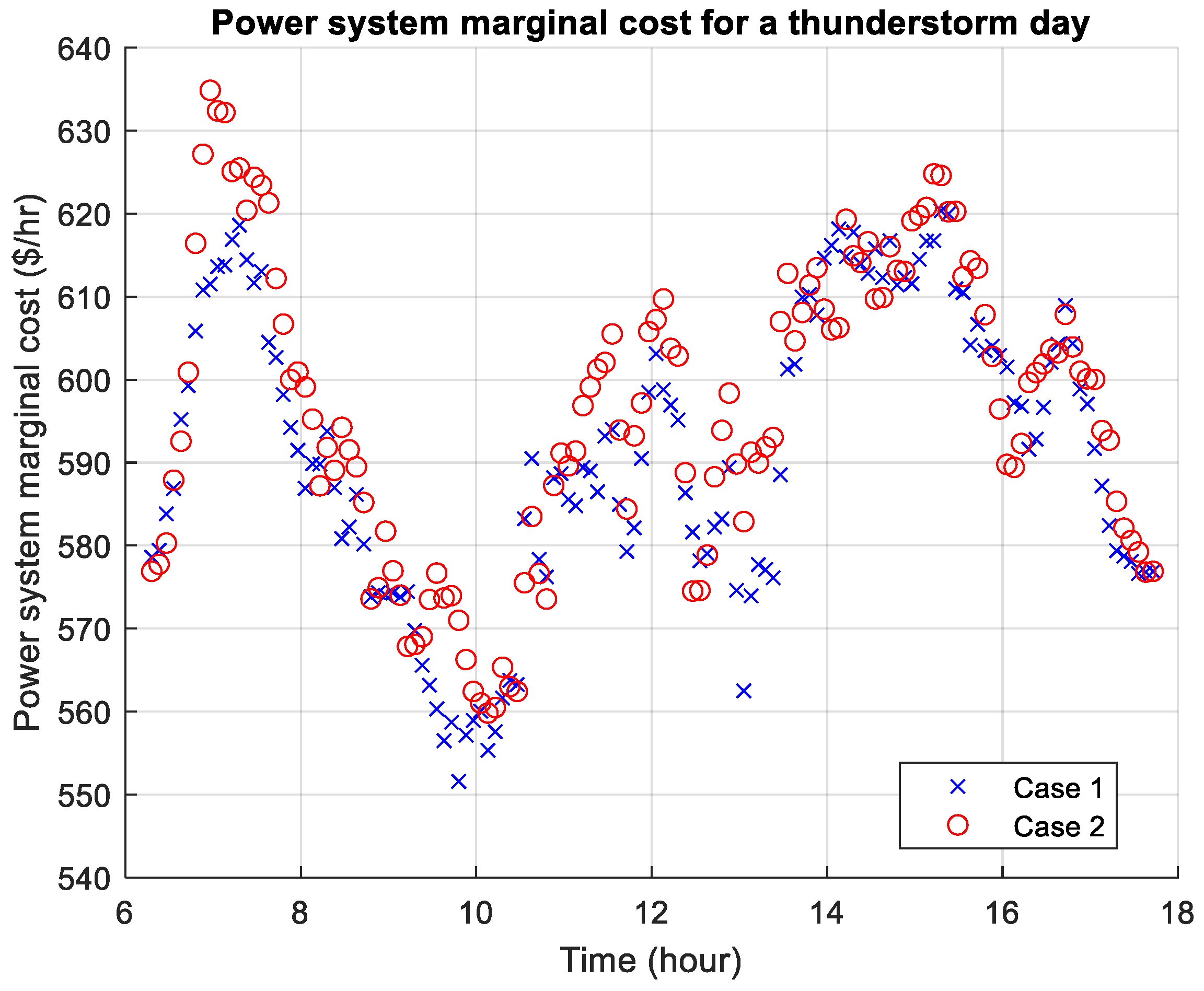
- Developed an integrated eVTOL and power system optimization framework, relying on the realistic modeling of eVTOL operation. For the first time, power flow analysis was investigated under the influence of eVTOL charging with renewable generation. The marginal costs of the power system were investigated, including solar power generation and changes in travel demand.
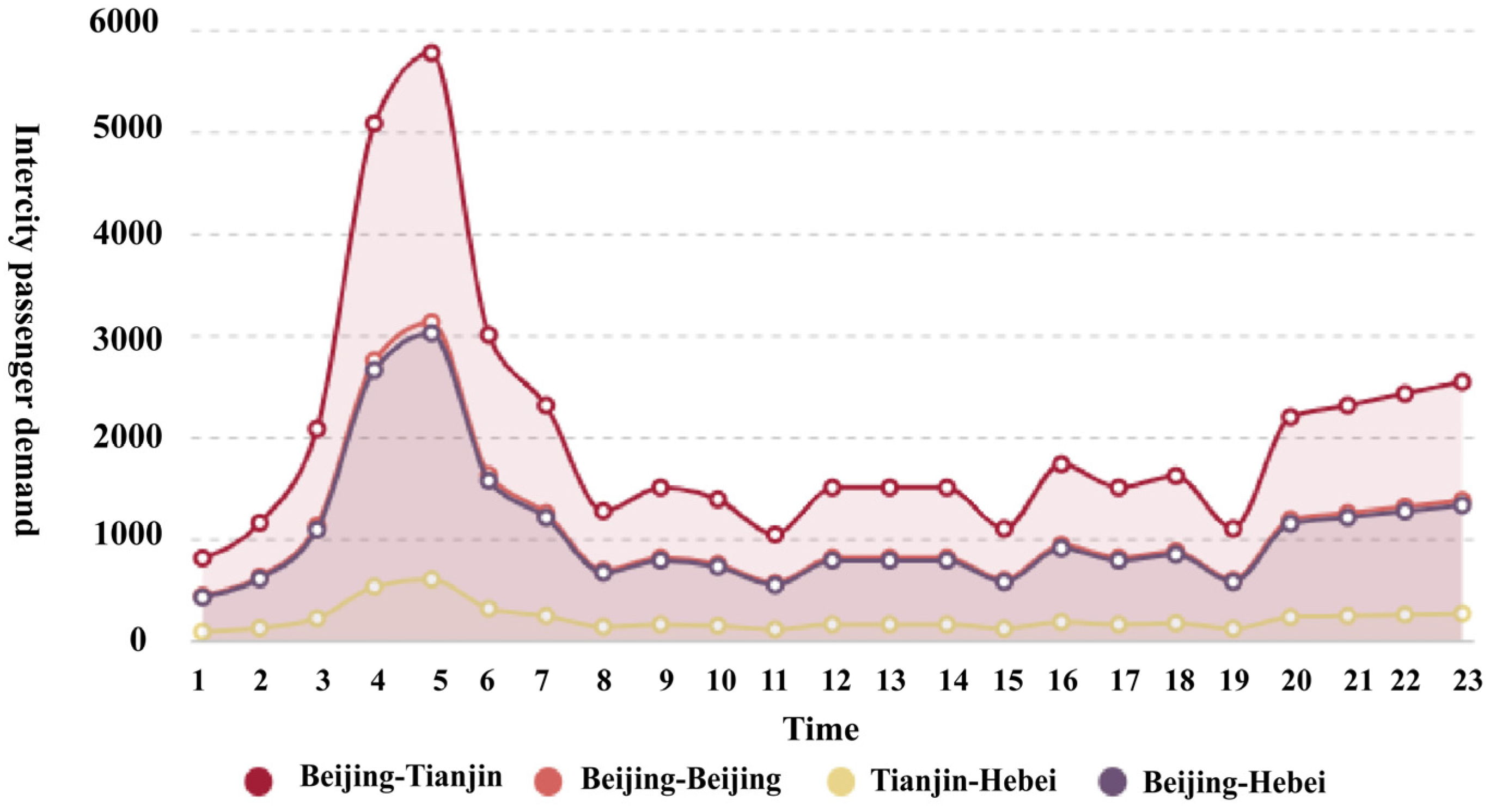
- Created an optimization model to determine the optimal daily flight schedules considering multiple types of eVTOLs. IDex defined in IEEE 2668, a frontier global standard for Internet of Things (IoT) maturity evaluation, was newly incorporated to measure the safety degree of eVTOL and define the safety constraints in this optimization model. The schedules are prepared based on travel demand changes due to weather conditions. The schedules consider eVTOL safety operation and operational cost minimization.
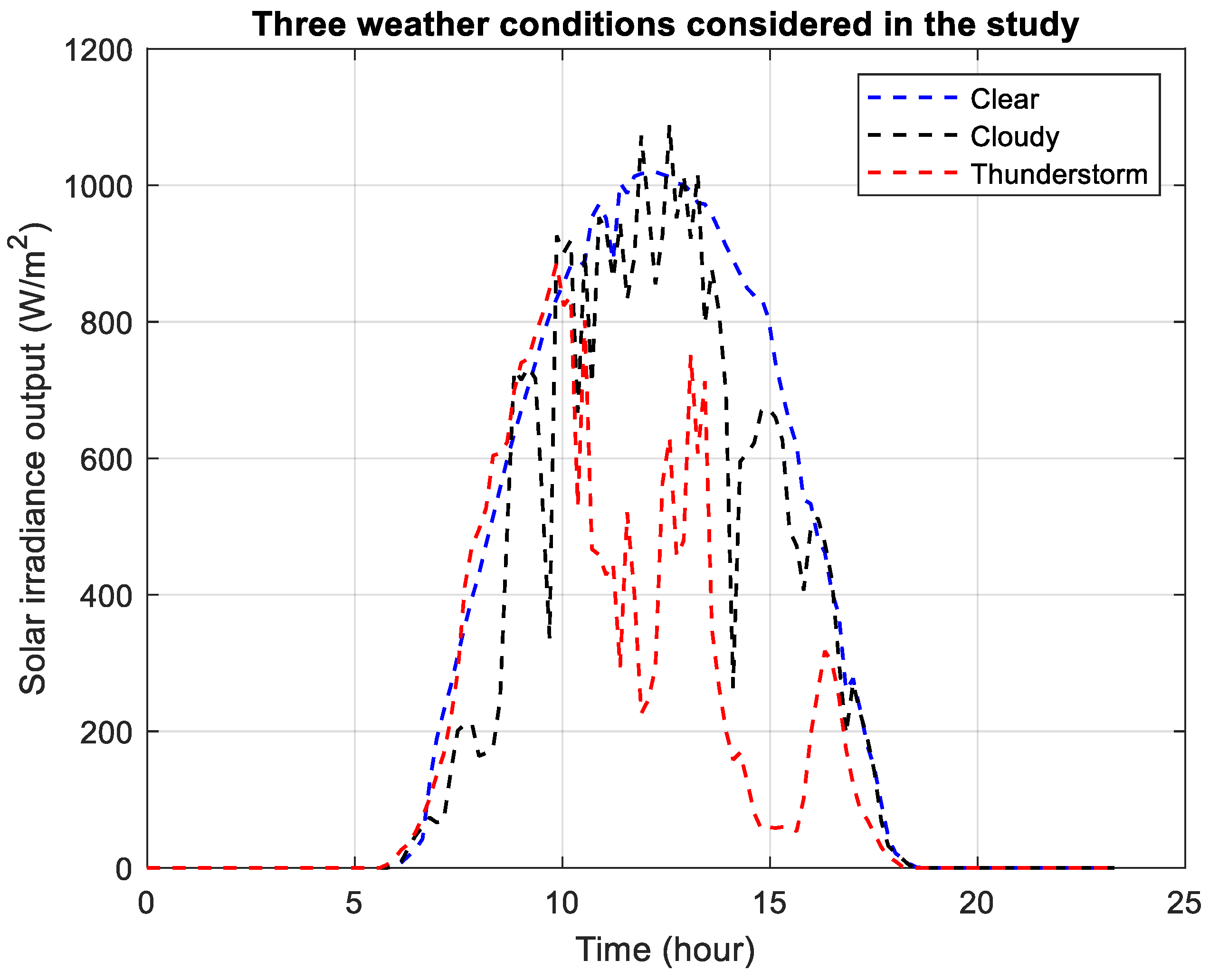
- For the first time, investigated the impact of eVTOLs in power system operations considering three different weather conditions. Adverse weather conditions impact on eVTOL scheduling delay and reduce power availability. Recommendations on eVTOL and power system operations are provided.
2. Related Work
2.1. eVTOL Planning and Operation Optimization
2.2. Energy Management of eVTOL Charging
3. Framework Integrating eTVOLs and Power Systems
3.1. eVTOL Operational Optimization Model
3.2. Formulation of the AC-OPF
- 1.
- Power Balance Constraints
- Real Power Balance:
- Reactive Power Balance:
- 2.
- Generator Limits
- Real Power Limits:
- Reactive Power Limits:where and are the minimum and maximum real power outputs of generator g, and and are the minimum and maximum reactive power outputs of generator g. is the reactive power outputs of generator g.
- 3.
- Line Flow Limits
- 4.
- Voltage Limits
4. Case Studies
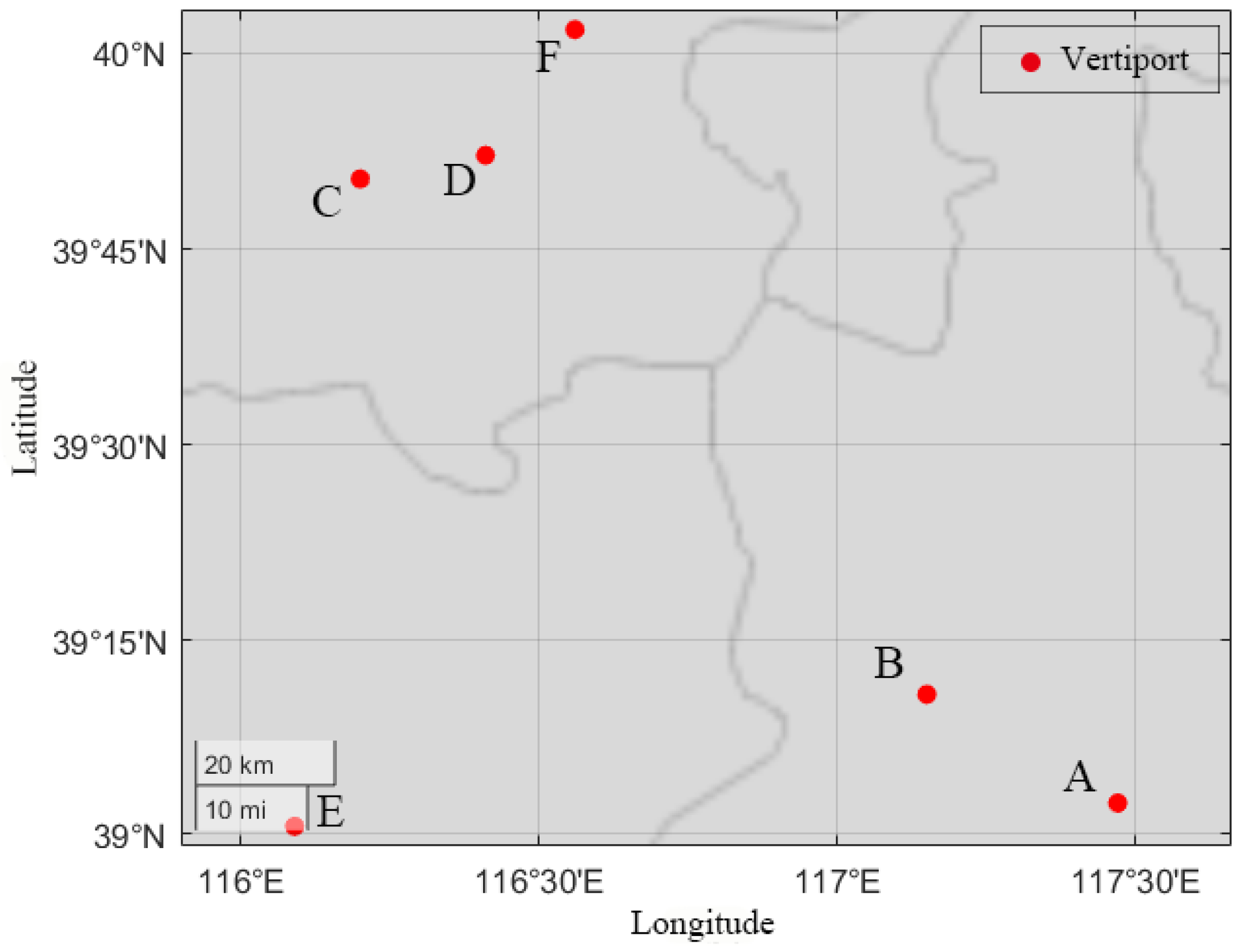
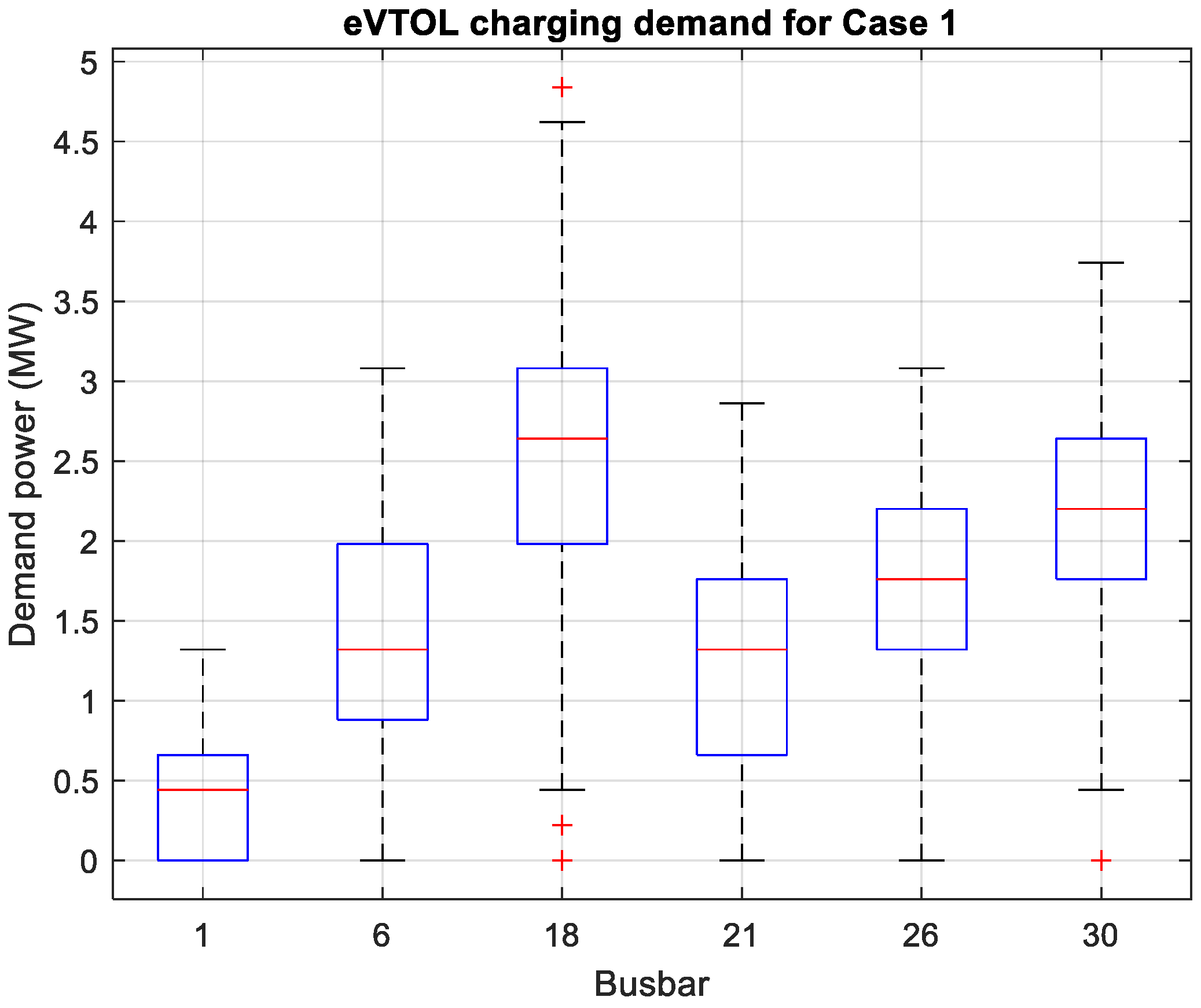
- Case 1: 107 Xpeng X2 eVTOLs and 96 Geely AE200 eVTOLs, with a total 694 passengers’ capacity.
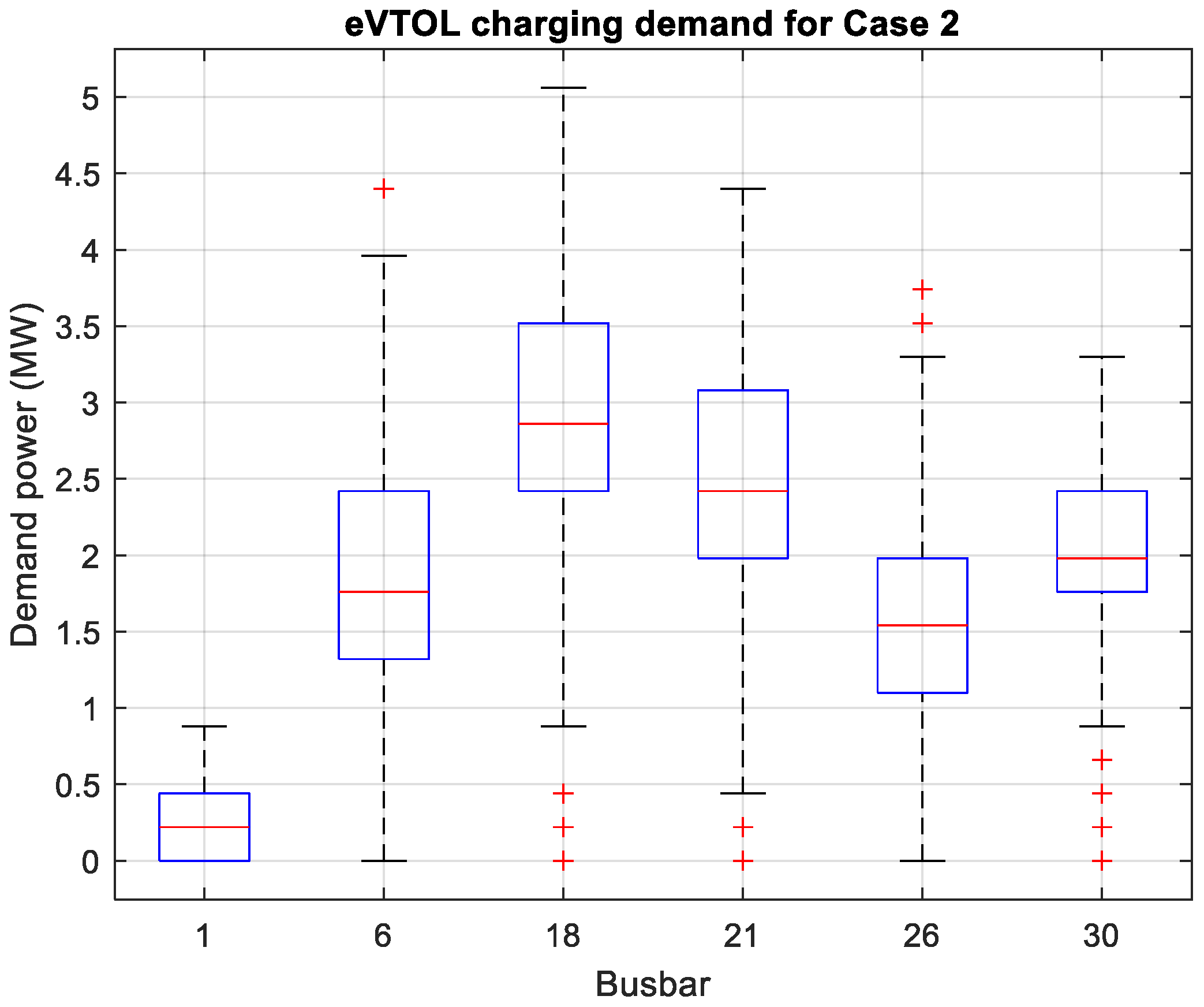
- Case 2: 153 Xpeng X2 eVTOLs and 93 Geely AE200 eVTOLs, with a total 771 passengers’ capacity.
4.1. eVTOL Operational Optimization Model Results
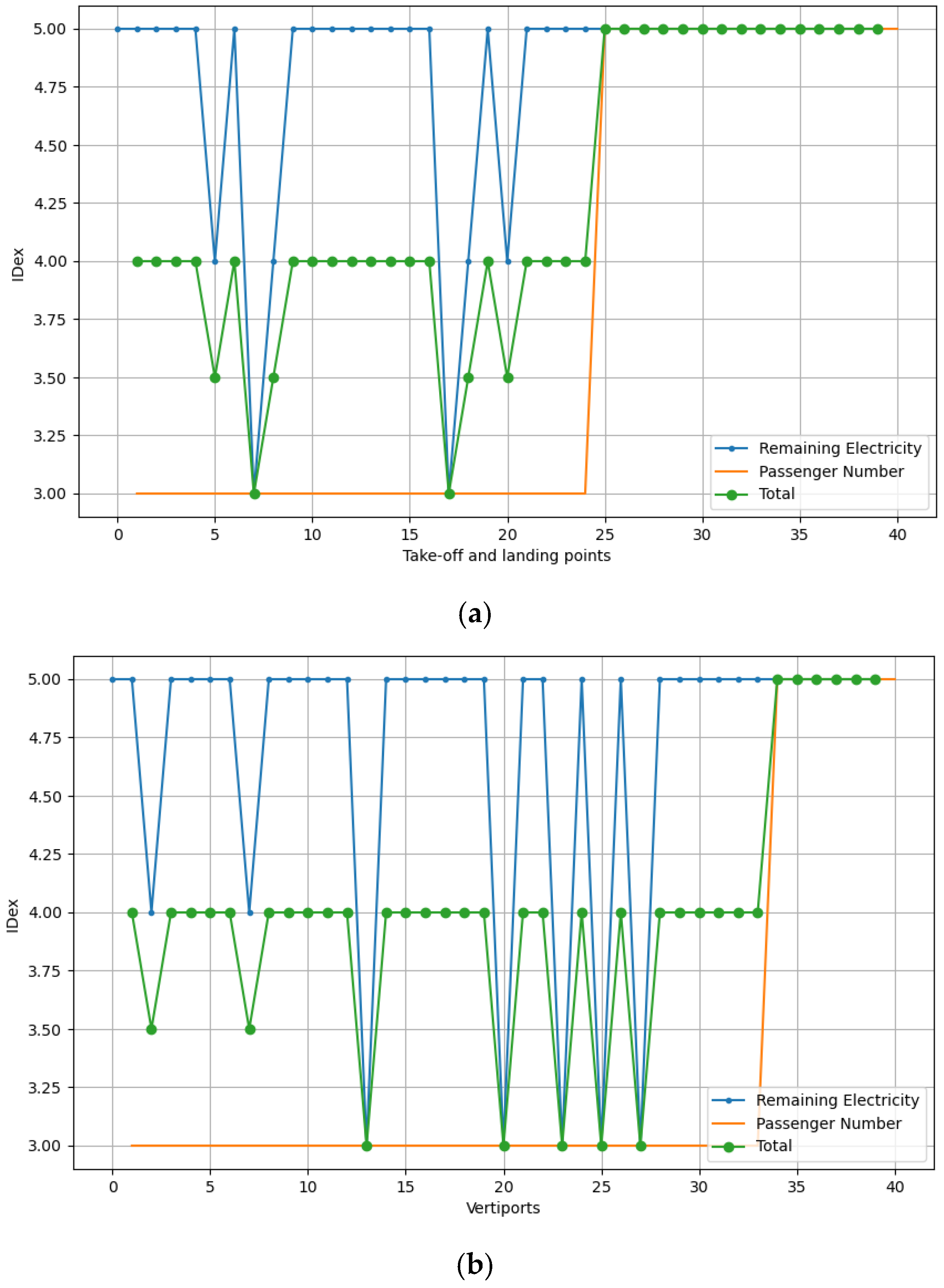
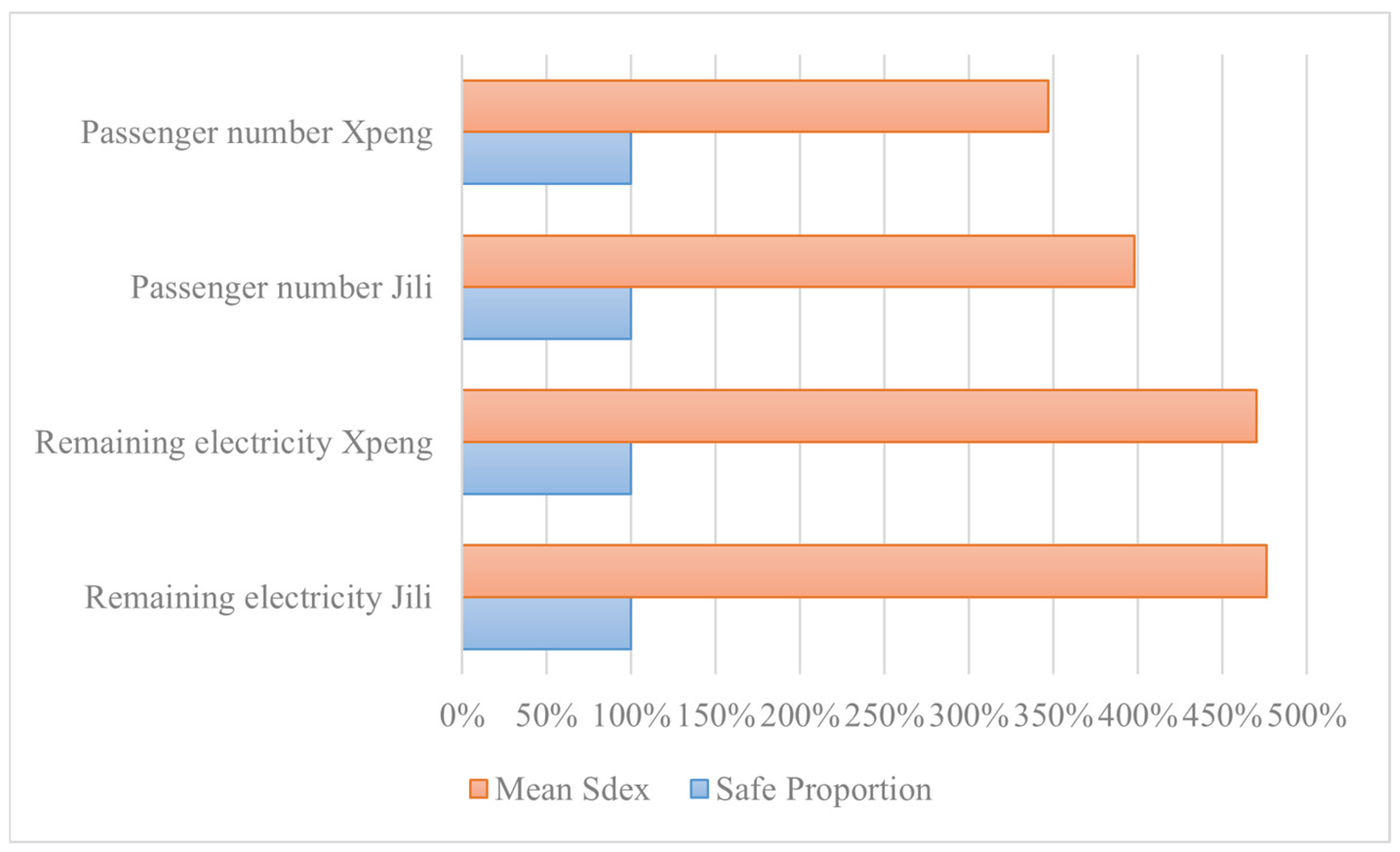
4.2. IEEE 2668 Compliant Safety Constraints
4.2.1. Single eVTOL
4.2.2. Multiple eVTOLs
4.3. Power Flow Analysis
5. Conclusions
Author Contributions
Funding
Institutional Review Board Statement
Informed Consent Statement
Data Availability Statement
Conflicts of Interest
List of Symbols
| Generator cost constants | |
| Total number of takeoff and landing sites in the region (units) | |
| Number of eVTOL models | |
| Total charging susceptance on branch between buses n and m | |
| Number of eVTOLs of type x | |
| Susceptance of the line between buses n and m | |
| Total charging cost of eVTOLs at the take-off and landing site | |
| CM | Total maintenance cost |
| Total purchase cost for each type of eVTOL | |
| Cost function of generator g | |
| Active power demand at bus n | |
| Travel distance of eVTOL x | |
| Distance of the flight between i and j | |
| Battery capacity upper limit | |
| Et−μ | Remaining electricity before μ the maximum waiting time |
| Et− | Remaining electricity level |
| fi | Time-demand function |
| Active power flow on the line between buses n and m | |
| Reactive power flow on the line between buses n and m | |
| G | Generators set |
| Conductance of the line between buses n and m | |
| Safety index for Sxy(t) | |
| Safety index for Et | |
| Electricity required for the next flight segment | |
| Energy consumption per unit distance | |
| k/K | Index/set of bus system nodes |
| L | Line set |
| mq | Evaluated indicator |
| M | Infinite number |
| Ma | Maintenance cost per km |
| Minimum reactive power outputs of g | |
| n | Bus number |
| Number of eVTOLs charging at takeoff and landing site i (units) | |
| Transportation pressure | |
| pg | Power output of generator g |
| pgmin | Minimum real power outputs of g |
| pgmax | Maximum real power outputs of g |
| Pe(t) | Electricity price |
| Po | Charging power |
| Charging power for eVTOL | |
| Purchase cost, price per eVTOL of model x | |
| Reactive power output of generator g | |
| Maximum reactive power outputs of g | |
| Electricity price of the first tier | |
| IDex safety value | |
| Sxy(t) | Passenger number |
| Maximum allowable apparent power flow | |
| t/T | Index/set of time slots |
| Tc | Charging time |
| Electricity consumption range for the first tier of tiered electricity pricing (kWh) | |
| ty | Arrival time of eVTOL y |
| Charging time to complete journey between locations i and j | |
| TS | Minimum safety interval |
| u | Hours ago |
| Cruising speed | |
| vn | Voltage magnitudes of bus n |
| Maximum voltage magnitudes at bus n | |
| Minimum voltage magnitudes at bus n | |
| Weighting | |
| y | The y-th eVTOL |
| μ | Maximum waiting time |
| Reactive power coefficient (the reactive-to-active power ratio of bus n) | |
| Maximum voltage phase angle at bus n | |
| θn | Phase angle of bus n |
| Minimum voltage phase angle at bus n |
References
- Swaminathan, N.; Reddy, S.R.P.; RajaShekara, K.; Haran, K.S. Flying Cars and eVTOLs—Technology Advancements, Powertrain Architectures, and Design. IEEE Trans. Transp. Electrif. 2022, 8, 4105–4117. [Google Scholar] [CrossRef]
- Su, J.; Huang, H.; Zhang, H.; Wang, Y.; Wang, F.-Y. eVTOL Performance Analysis: A Review From Control Perspectives. IEEE Trans. Intell. Veh. 2024, 9, 4877–4889. [Google Scholar] [CrossRef]
- Transport, D.F. Policy Paper Future of Flight Action Plan. March 2024. Available online: https://www.gov.uk/government/publications/future-of-flight-action-plan (accessed on 25 January 2026).
- Wang, Z.; Younesi, A.; Liu, M.V.; Guo, G.C.; Anderson, C.L. AC Optimal Power Flow in Power Systems With Renewable Energy Integration: A Review of Formulations and Case Studies. IEEE Access 2023, 11, 102681–102712. [Google Scholar] [CrossRef]
- Li, X.; Wang, Z.; Zhang, L.; Sun, F.; Cui, D.; Hecht, C.; Figgener, J.; Sauer, D.U. Electric vehicle behavior modeling and applications in vehicle-grid integration: An overview. Energy 2023, 268, 126647. [Google Scholar] [CrossRef]
- Alsabbagh, A.; Wu, B.; Ma, C. Distributed Electric Vehicles Charging Management Considering Time Anxiety and Customer Behaviors. IEEE Trans. Ind. Inform. 2021, 17, 2422–2431. [Google Scholar] [CrossRef]
- Shen, J.; Wang, L.; Zhang, J. Integrated Scheduling Strategy for Private Electric Vehicles and Electric Taxis. IEEE Trans. Ind. Inform. 2021, 17, 1637–1647. [Google Scholar] [CrossRef]
- Yan, D.; Yin, H.; Li, T.; Ma, C. A Two-Stage Scheme for Both Power Allocation and EV Charging Coordination in a Grid-Tied PV–Battery Charging Station. IEEE Trans. Ind. Inform. 2021, 17, 6994–7004. [Google Scholar] [CrossRef]
- Huang, X.; Zhang, Y.; Qi, Y.; Huang, C.; Hossain, M.S. Energy-Efficient UAV Scheduling and Probabilistic Task Offloading for Digital Twin-Empowered Consumer Electronics Industry. IEEE Trans. Consum. Electron. 2024, 70, 2145–2154. [Google Scholar] [CrossRef]
- Kim, S.H. Receding Horizon Scheduling of On-Demand Urban Air Mobility With Heterogeneous Fleet. IEEE Trans. Aerosp. Electron. Syst. 2020, 56, 2751–2761. [Google Scholar] [CrossRef]
- Arafat, M.Y.; Moh, S. JRCS: Joint Routing and Charging Strategy for Logistics Drones. IEEE Internet Things J. 2022, 9, 21751–21764. [Google Scholar] [CrossRef]
- Huang, C.-J.; Hu, K.-W.; Xie, B.Z.; Cheng, H.-W. A Joint Routing and Charging Management for Drones. In Proceedings of the 2023 International Conference on Cyber Management and Engineering (CyMaEn), Bangkok, Thailand, 26–27 January 2023; IEEE: Piscataway, NJ, USA, 2023; pp. 297–300. [Google Scholar] [CrossRef]
- Ghelichi, Z.; Gentili, M.; Mirchandani, P.B. Logistics for a fleet of drones for medical item delivery: A case study for Louisville, KY. Comput. Oper. Res. 2021, 135, 105443. [Google Scholar] [CrossRef]
- Wang, Z.; Yu, J.; Hao, W.; Xiang, J. Joint Optimization of Running Route and Scheduling for the Mixed Demand Responsive Feeder Transit With Time-Dependent Travel Times. IEEE Trans. Intell. Transp. Syst. 2021, 22, 2498–2509. [Google Scholar] [CrossRef]
- Wang, K.; Zhang, X.; Duan, L.; Tie, J. Multi-UAV Cooperative Trajectory for Servicing Dynamic Demands and Charging Battery. IEEE Trans. Mob. Comput. 2021, 22, 1599–1614. [Google Scholar] [CrossRef]
- Xiang, S.; Xie, A.; Ye, M.; Yan, X.; Han, X.; Niu, H.; Li, Q.; Huang, H. Autonomous eVTOL: A summary of researches and challenges. Green Energy Intell. Transp. 2024, 3, 100140. [Google Scholar] [CrossRef]
- EHang. EHang Unveils US$410,000 Suggested Retail Price for EH216-S Pilotless Passenger-Carrying eVTOL Aircraft in Global Markets Outside China. Available online: https://www.ehang.com/news/1049.htm (accessed on 25 January 2026).
- Tesla. Available online: https://www.tesla.com/ (accessed on 25 January 2026).
- Guo, Z.; Hao, M.; Liu, J.; Yu, B.; Jiang, Y. Joint routing and charging optimization for eVTOL aircraft recovery. Aerosp. Sci. Technol. 2022, 126, 107595. [Google Scholar] [CrossRef]
- Wei, H.; Lou, B.; Zhang, Z.; Liang, B.; Wang, F.-Y.; Lv, C. Autonomous Navigation for eVTOL: Review and Future Perspectives. IEEE Trans. Intell. Veh. 2024, 9, 4145–4171. [Google Scholar] [CrossRef]
- Zou, L.; Munir, M.S.; Hassan, S.S.; Tun, Y.K.; Nguyen, L.X.; Hong, C.S. Imbalance Cost-Aware Energy Scheduling for Prosumers Towards UAM Charging: A Matching and Multi-Agent DRL Approach. IEEE Trans. Veh. Technol. 2024, 73, 3404–3420. [Google Scholar] [CrossRef]
- Shihab, S.A.M.; Wei, P.; Shi, J.; Yu, N. Optimal eVTOL Fleet Dispatch for Urban Air Mobility and Power Grid Services. In Proceedings of the AIAA AVIATION 2020 FORUM, Virtual, 15–19 June 2020; American Institute of Aeronautics and Astronautics: Reston, VA, USA, 2020. [Google Scholar] [CrossRef]
- Velaz-Acera, N.; Arcauz-Durán, D.; Borge-Diez, D. Life cycle assessment of eVTOL vehicles in island systems. Case Study: Canary Islands. Transp. Res. Procedia 2023, 71, 387–394. [Google Scholar] [CrossRef]
- IEEE 2668; Standard for Maturity Index of the Internet of Things—Evaluation, Grading, and Ranking. IEEE: Piscataway, NJ, USA, 2023. [CrossRef]
- Chen, J. Integrated Routing and Charging Scheduling for Autonomous Electric Aerial Vehicle System. In Proceedings of the 2019 IEEE/AIAA 38th Digital Avionics Systems Conference (DASC), San Diego, CA, USA, 8–12 September 2019; IEEE: Piscataway, NJ, USA, 2019; pp. 1–7. [Google Scholar] [CrossRef]
- Yuan, Y.; Li, J.; Zhao, X.; Wang, Y. Research on eVTOL Scheduling Schemes for Dynamic Demand and Variable Interval. Acta Aeronaut. Astronaut. Sin. 2025, 46, 631907. (In Chinese) [Google Scholar] [CrossRef]
- Illinois Center for a Smarter Electric Grid (ICSEG). IEEE 30-Bus System. Available online: https://icseg.iti.illinois.edu/ieee-30-bus-system/ (accessed on 25 January 2026).
- State Council of China. General Flight Rules of the People’s Republic of China (2001 Revision). July 2001. Available online: https://lawinfochina.com/display.aspx?id=12839&lib=law (accessed on 25 January 2026).
- Bulusu, V.; Onat, E.B.; Sengupta, R.; Yedavalli, P.; Macfarlane, J. A Traffic Demand Analysis Method for Urban Air Mobility. IEEE Trans. Intell. Transp. Syst. 2021, 22, 6039–6047. [Google Scholar] [CrossRef]
- Lai, C.S.; Jia, Y.; McCulloch, M.D.; Xu, Z. Daily Clearness Index Profiles Cluster Analysis for Photovoltaic System. IEEE Trans. Ind. Inform. 2017, 13, 2322–2332. [Google Scholar] [CrossRef]



| EVs | eVTOLs | |
|---|---|---|
| Purpose | Ground transportation | Aerial mobility |
| Design | Conventional driving | Vertical take-off and landing allow for minimal use of space |
| Operators | Any healthy person with a valid driving license | At present, registered pilot from National Aviation Agencies |
| Charging Infrastructure | Home chargers, public charging stations, and fast-charging networks | Use chargers at vertiports or landing pads, which can be located on rooftops, designated urban areas, or existing helipads |
| Travel routes and mode of operation | On roads and highways with traffic | In sky, with specific routes and air point |
| Use cases | Examples include personal transportation, commercial deliveries, and public transit | Examples include air taxis, medical emergency services, cargo delivery, and regional air mobility |
| Battery storage capacity (kWh) | 40–100 | 100–1000 |
| Travel range (km) | Up to 720 | About 40 |
| Payload (kg) | 500–700 | 100–200 |
| Charging station power rating | Up to 350 kW per vehicle | 2 MW for 3 eVTOLs |
| Highlight Safety features of EVs and eVTOLs | Battery level and traffic environment | Battery level, traffic environment including taking-off and landing interval |
| Reference | Factors Considered in UAM | Factors Considered in Power Grid | Weather Considered? | ||||
|---|---|---|---|---|---|---|---|
| Operating Safety | Operating Cost | Passenger or Customer Served | Power Flow | Operating Cost | Renewable Energy Integration | ||
| Kim [10] | No | Yes | Yes | No | No | No | No |
| Arafat et al. [11] | Yes | No | Yes | No | No | No | No |
| Huang et al. [12] | No | Yes | No | No | No | No | No |
| Ghelichi et al. [13] | No | No | Yes | No | No | No | No |
| Wang et al. [14] | No | Yes | Yes | No | No | No | No |
| Wang et al. [15] | No | No | Yes | No | No | No | No |
| Guo et al. [19] | No | Yes | No | No | No | No | Yes |
| Zou et al. [21] | Yes | Yes | Yes | No | No | Yes | Yes |
| Velaz-Acera et al. [23] | No | No | No | No | No | No | No |
| This work | Yes | Yes | Yes | Yes | Yes | Yes | Yes |
| Safety Level | Remaining Electricity Level | Passenger Number |
|---|---|---|
| 5 | 80% | |
| 4 | 80% 60% | |
| 3 | 60% 30% | |
| 2 | 30% 10% | |
| 1 | 10% |
| Xpeng X2 | Geely AE200 | |
|---|---|---|
| Maximum speed (km/h) | 130 | 264 |
| Number of passengers | 2 | 5 |
| Battery capacity (kWh) | 120 | 250 |
| Charging time from 0% to 100% state of charge (hour) | 0.6 | 1.5 |
| Travel distance (km) and time (hour) | 76 and 0.58 | 200 and 0.76 |
Disclaimer/Publisher’s Note: The statements, opinions and data contained in all publications are solely those of the individual author(s) and contributor(s) and not of MDPI and/or the editor(s). MDPI and/or the editor(s) disclaim responsibility for any injury to people or property resulting from any ideas, methods, instructions or products referred to in the content. |
© 2026 by the authors. Licensee MDPI, Basel, Switzerland. This article is an open access article distributed under the terms and conditions of the Creative Commons Attribution (CC BY) license.
Share and Cite
Yuan, Y.; Lai, C.S.; Chi, H.R.; Wang, H.; Tsang, K.F. Power Systems and eVTOL Optimization with Information Exchange for Green and Safe Urban Air Mobility. Sensors 2026, 26, 888. https://doi.org/10.3390/s26030888
Yuan Y, Lai CS, Chi HR, Wang H, Tsang KF. Power Systems and eVTOL Optimization with Information Exchange for Green and Safe Urban Air Mobility. Sensors. 2026; 26(3):888. https://doi.org/10.3390/s26030888
Chicago/Turabian StyleYuan, Yujie, Chun Sing Lai, Hao Ran Chi, Hao Wang, and Kim Fung Tsang. 2026. "Power Systems and eVTOL Optimization with Information Exchange for Green and Safe Urban Air Mobility" Sensors 26, no. 3: 888. https://doi.org/10.3390/s26030888
APA StyleYuan, Y., Lai, C. S., Chi, H. R., Wang, H., & Tsang, K. F. (2026). Power Systems and eVTOL Optimization with Information Exchange for Green and Safe Urban Air Mobility. Sensors, 26(3), 888. https://doi.org/10.3390/s26030888