Machine Learning-Powered Vision for Robotic Inspection in Manufacturing: A Review



Abstract
1. Introduction
- The manufacturing context, such as the industry sector or application domain, production environment characteristics (high-mix/low-volume, assembly line, etc.), integration with existing systems (Industry 4.0, IoT, collaborative robots), operational constraints or requirements, or the scale of implementation (prototype, pilot, full deployment).
- The system implementation, such as the robot integration approach, the vision system used, camera type and specifications (2D, RGB-D, stereo), additional sensors used (structural light), data fusion approaches, etc.
- The ML approaches used, such as specific algorithms, training methodology, data preprocessing and augmentation techniques, feature extraction methods, or model architecture.
- Performance metrics, such as accuracy for detection/classification, false positives/negatives if reported, detected rates, comparison with baseline, processing speed or inference time, etc.
2. Review Approach
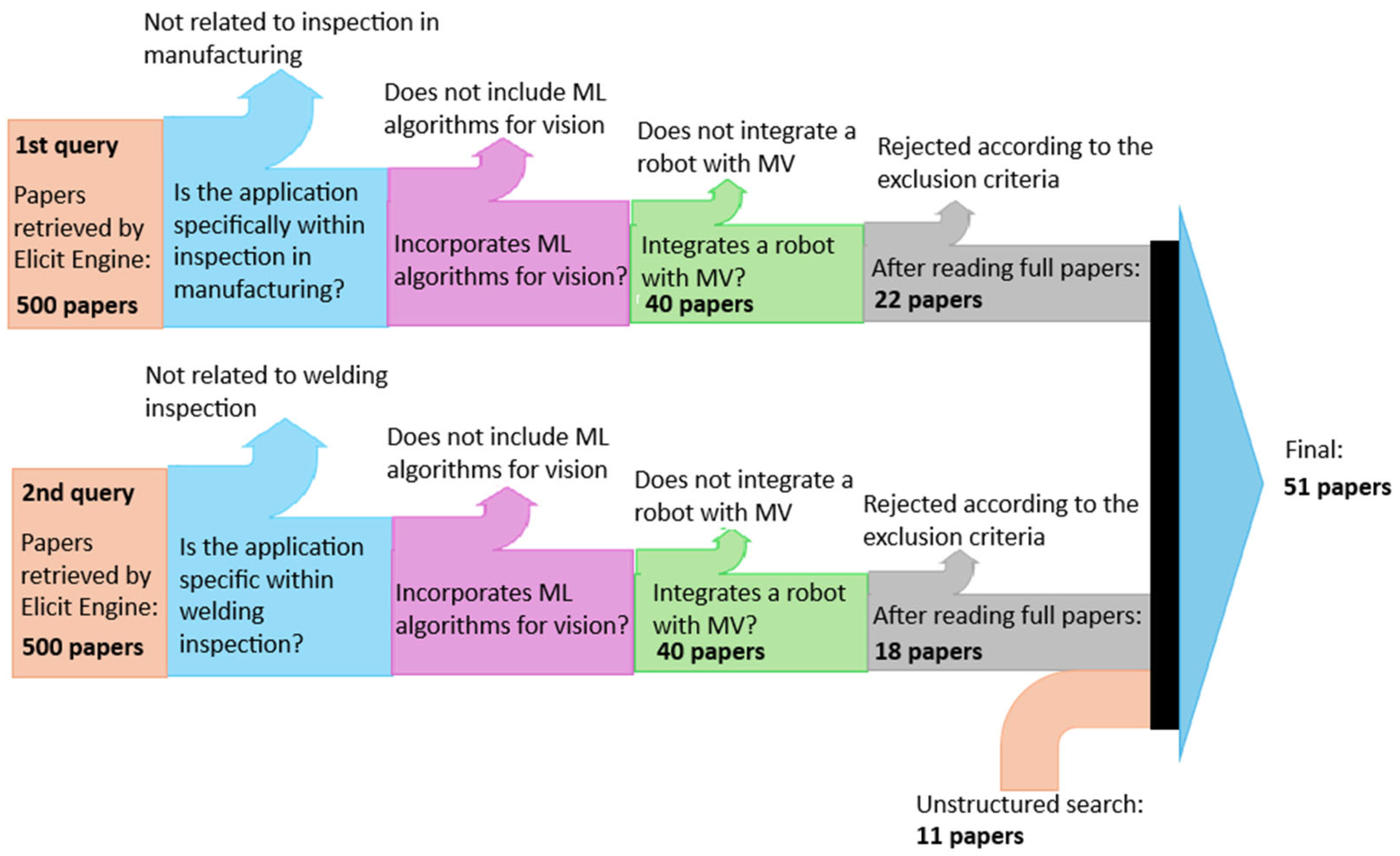
- Does the study involve robotic systems equipped with computer vision capabilities for inspection tasks?
- Is the application specifically within manufacturing environments such as production lines, quality control, or assembly inspection?
- Does the study explicitly incorporate ML algorithms for vision processing such as DL, neural networks (NN), or traditional ML approaches, rather than being purely rule-based or using only traditional image processing?
- Does the research focus on inspection, quality control, defect detection, or monitoring applications?
- Does the study report quantitative or qualitative performance outcomes with empirical validation?
- Does the study include robotic integration rather than focusing solely on computer vision without robotics?
- Is this a full research paper with substantial technical content rather than a conference abstract, editorial, opinion piece, or brief communication?
3. Results
3.1. Characteristics of the Selected Studies
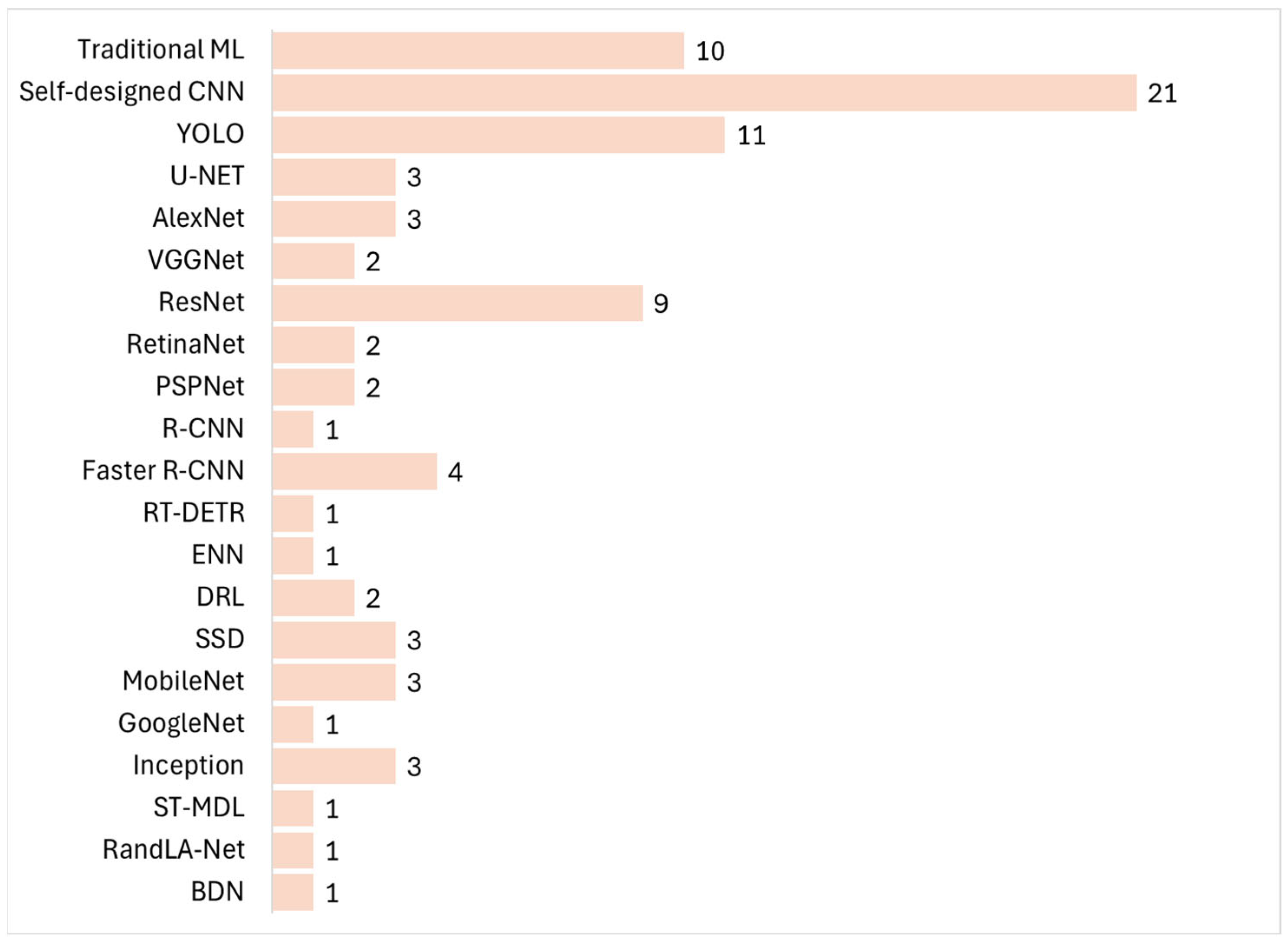
3.2. Machine Learning Technologies and Architectures
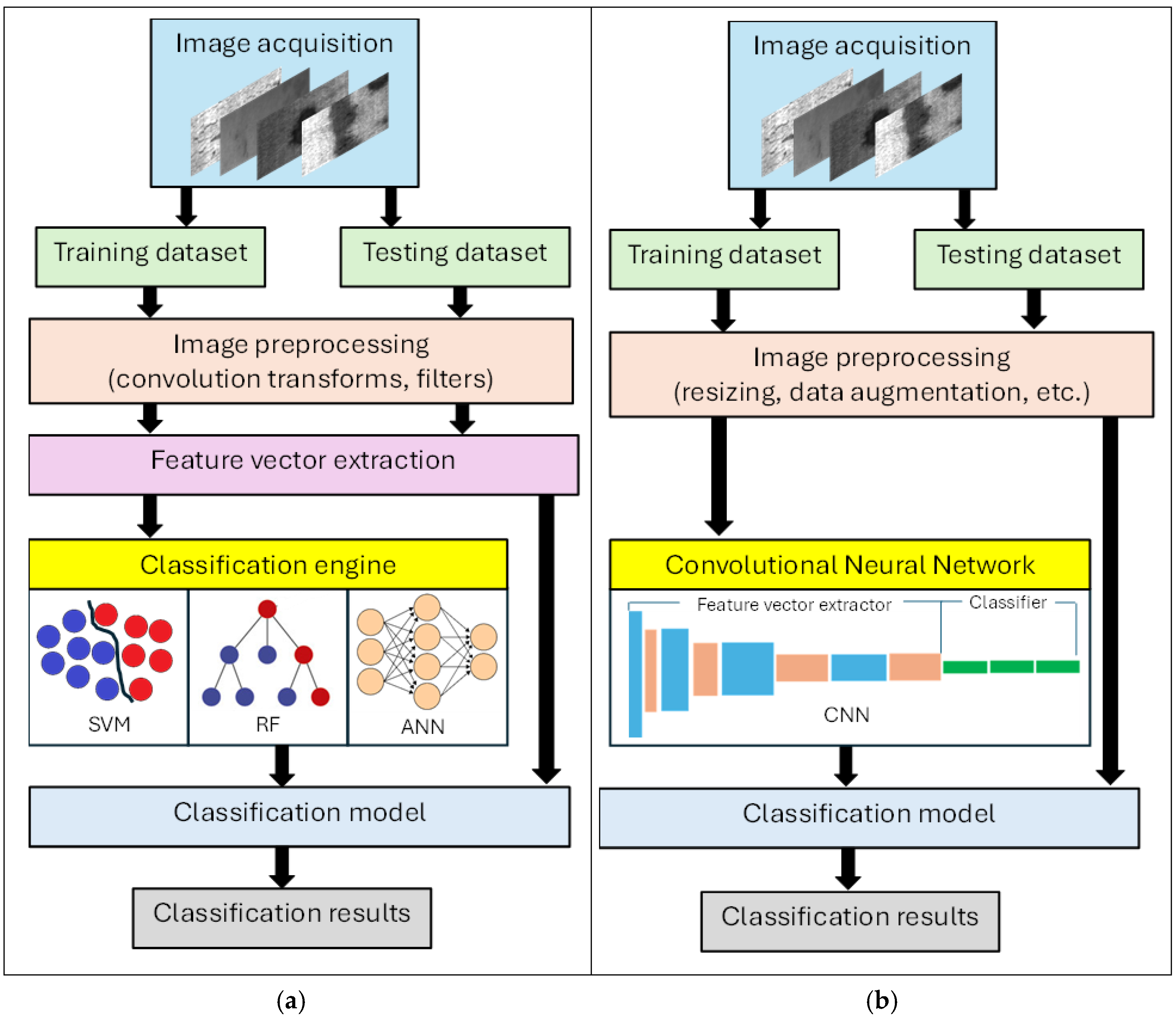
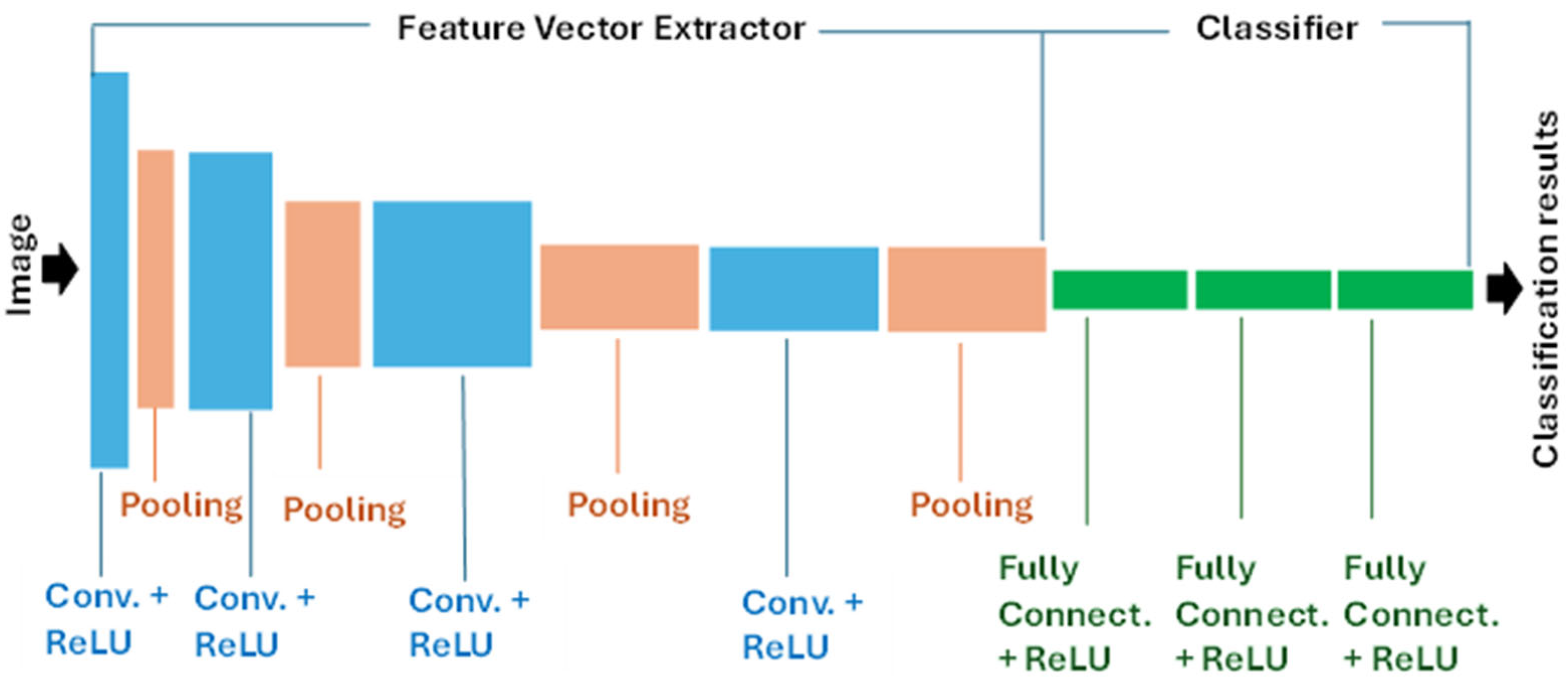
- Classic CNNs, which assigns a single class label to an entire image. Some representative networks used for this application are AlexNet, ResNet, or VGGNet.
- CNNs for defect detection and localization, which identify and locate defects with bounding boxes and assign individual class labels to each of them. Some representative networks used for defect detection and localization are R-CNN, faster R-CNN, or YOLO.
- CNNs for semantic segmentation, which assign a class label to each pixel in an image. They provide a holistic understanding of the image by segmenting it into meaningful semantic regions, without differentiating between individual object instances. Representative networks used for semantic segmentation are U-Net, FCN, DeepLab, PSP Net, or SegNet.
- CNNs for instance segmentation, which combine elements of defect detection and semantic segmentation. They identify and delineate individual defect instances within an image at a detailed pixel level and assign class labels to each identified defect. Representative networks used for instance segmentation are Mask R-CNN, Cascade Mask R-CNN, SOLO, or YOLACT.
3.3. Machine Learning Model Assessment
Context-Specific Performance Patterns
3.4. Machine Learning Architecture Trade-Offs
4. Future Directions
4.1. Use of Synthetic Training Images
4.2. Use of Federated Machine Learning
4.3. Ensemble Learning
4.4. Self-Supervised Learning
4.5. Visual–Language Models for Explainability
4.6. Physics-Informed Machine Learning
5. Conclusions
Author Contributions
Funding
Data Availability Statement
Acknowledgments
Conflicts of Interest
Abbreviations
| AI | Artificial Intelligence |
| AM | Additive Manufacturing |
| BDN | Bayesian Decision Networks |
| BoW | Bag of Words |
| CNN | Convolutional Neural Network |
| DL | Deep Learning |
| DRL | Deep Reinforcement Learning |
| DT | Decision Tree |
| ENN | Ensemble Neural Network |
| F1i | F1 score for class i |
| GAN | Generative Adversarial Network |
| GRU | Gated Recurrent Unit |
| HBP | Histogram of Binary Patterns |
| HOG | Histogram of Gradients |
| IoU | Intersection over union |
| KNN | K-Nearest Neighbor |
| LLM | Large Language Model |
| LSTM | Long Short-Term Memory |
| mAP | Mean average precision |
| ML | Machine Learning |
| MLP | Multi-Layer Perceptron |
| NN | Neural Network |
| 1NN | Nearest Neighbor |
| OA | Overall classifier accuracy |
| Pi | Precision for class i |
| QC | Quality Control |
| Ri | Recall for class i |
| RF | Random Forest |
| RT-DETR | Real-Time Detection Transformer |
| ST-MDL | Semi-supervised Transfer Learning based Multi-Domain learning |
| SSD | Single Shot Detector |
| SVM | Support Vector Machine |
| VAE | Variational Autoencoder |
References
- Rockwell Automation. 2025 State of Manufacturing Report. 10th Annual State of Smart Manufacturing. 2025. Available online: https://www.rockwellautomation.com/en-us/capabilities/digital-transformation/state-of-smart-manufacturing.html (accessed on 12 December 2025).
- Zhang, Z. A flexible new technique for camera calibration. IEEE Trans. Pattern Anal. Mach. Intell. 2000, 22, 1330–1334. [Google Scholar] [CrossRef]
- Strobl, K.H.; Hirzinger, G. More accurate pinhole camera calibration with imperfect planar target. In Proceedings of the IEEE International Conference on Computer Vision Workshops (ICCV Workshops), Barcelona, Spain, 6–13 November 2011; pp. 1068–1075. [Google Scholar] [CrossRef]
- Beschi, R.; Feng, X.; Melillo, S.; Parisi, L.; Postiglione, L. Stereo camera system calibration: The need of two sets of parameters. arXiv 2021, arXiv:2101.05725. [Google Scholar] [CrossRef]
- Hanning, T. Calibration of a stereo camera system. In High Precision Camera Calibration; Vieweg+Teubner: Wiesbaden, Germany, 2011; pp. 91–106. [Google Scholar] [CrossRef]
- Tsai, R.Y.; Lenz, R.K. A new technique for fully autonomous and efficient 3D robotics hand/eye calibration. IEEE Trans. Robot. Autom. 1989, 5, 345–358. [Google Scholar] [CrossRef]
- Park, F.C.; Martin, B.J. Robot sensor calibration: Solving AX=XB on the Euclidean group. IEEE Trans. Robot. Autom. 1994, 10, 717–721. [Google Scholar] [CrossRef]
- Horaud, R.; Dornaika, F. Hand-Eye Calibration. Int. J. Robot. Res. 1995, 14, 195–210. [Google Scholar] [CrossRef]
- Andreff, N.; Horaud, R.; Espiau, B. On-line hand-eye calibration. In Proceedings of the 2nd International Conference on 3-D Digital Imaging and Modeling (3DIM’99), Ottawa, ON, Canada, 4–8 October 1999; pp. 430–436. [Google Scholar] [CrossRef]
- Daniilidis, K. Hand-Eye Calibration Using Dual Quaternions. Int. J. Robot. Res. 1999, 18, 286–298. [Google Scholar] [CrossRef]
- Shah, M. Solving the Robot-World/Hand-Eye Calibration Problem Using the Kronecker Product. J. Mech. Robot. 2013, 5, 031007. [Google Scholar] [CrossRef]
- Li, A.; Wang, L.; Wu, D. Simultaneous robot-world and hand-eye calibration using dual-quaternions and Kronecker product. Int. J. Phys. Sci. 2010, 5, 1530–1536. [Google Scholar]
- Ibrahim, I.A.; Ali, A.I.; Baballe, M.A. Artificial Intelligence-Driven Vision-Based Control: Unlocking the Potential of Robotics Amidst Challenges. Glob. J. Res. Eng. Comput. Sci. 2025, 5, 74–80. [Google Scholar]
- Mahajan, H.B.; Uke, N.; Pise, P.; Shahade, M.; Dixit, V.G.; Bhavsar, S.; Deshpande, S.D. Automatic robot maneuvers detection using computer vision and deep learning techniques: A perspective of internet of robotics things (IoRT). Multimed. Tools Appl. 2023, 82, 23251–23276. [Google Scholar] [CrossRef]
- Choksi, S.; Narasimhan, S.; Ballo, M.; Turkcan, M.; Hu, Y.; Zang, C.; Farrell, A.; King, B.; Nussbaum, J.; Reisner, A.; et al. Automatic assessment of robotic suturing utilizing computer vision in a dry-lab simulation. Artif. Intell. Surg. 2025, 5, 160–169. [Google Scholar] [CrossRef]
- Osita, M.N.; Ogochukwu, C.O.; Ike, J.M. Intelligent robotic object grasping system using computer vision and deep reinforcement learning techniques. Int. J. Sci. Res. Arch. 2025, 14, 511–521. [Google Scholar] [CrossRef]
- Nguyen, V.T.; Nguyen, P.T.; Su, S.F.; Tan, P.X.; Bui, T.L. Vision-Based Pick and Place Control System for Industrial Robots Using an Eye-in-Hand Camera. IEEE Access 2025, 13, 25127–25140. [Google Scholar] [CrossRef]
- Voulodimos, A.; Kosmopoulos, D.; Vasileiou, G.; Sardis, E.; Doulamis, A.; Anagnostopoulos, V.; Lalos, C.; Varvarigou, T. A dataset for workflow recognition in industrial scenes. In Proceedings of the 2011 18th IEEE International Conference on Image Processing, Brussels, Belgium, 11–14 September 2011; pp. 3249–3252. [Google Scholar] [CrossRef]
- Voulodimos, A.; Kosmopoulos, D.; Vasileiou, G.; Sardis, E.; Anagnostopoulos, V.; Lalos, C.; Doulamis, A.; Varvarigou, T. A Threefold Dataset for Activity and Workflow Recognition in Complex Industrial Environments. IEEE Multimed. 2012, 19, 42–52. [Google Scholar] [CrossRef]
- Carletti, V.; Greco, A.; Longobardi, D.; Ritrovato, P.; Saggese, A.; Vento, M. Multi-modal Human-Robot Collaboration in Production Lines Through Speech Commands and Gestures. In Computer Analysis of Images and Patterns, CAIP 2025, Lecture Notes in Computer Science; Castrillón-Santana, M., Travieso-González, G.M., Suarez, O.D., Freire-Obregón, D., Hernández-Sosa, D., Lorenzo-Navarro, J., Santana, O.J., Eds.; Springer: Cham, Germany; Volume 15622. [CrossRef]
- Dreger, F.; Karthaus, M.; Metzler, Y.; Tauro, F.; Carrelli, V.; Athanassiou, G.; Rinkenauer, G. Requirements for Successful Human Robot Collaboration: Design Perspectives of Developers and Users in the Scope of the EU Horizon Project FELICE. In Human Factors in Robots, Drones and Unmanned Systems; Proceedings of the AHFE (2024) International Conference; AHFE International: New York, NY, USA, 2024; Volume 138. [Google Scholar] [CrossRef]
- Villalonga, A.; Cruz, Y.J.; Alfaro, D.; Haber, R.E.; Martínez-Lastra, J.L.; Castaño, F. Enhancing quality inspection in zero-defect manufacturing through robotic-machine collaboration. In Proceedings of the 2024 7th Iberian Robotics Conference (ROBOT), Madrid, Spain, 6–8 November 2024; pp. 1–6. [Google Scholar] [CrossRef]
- Rosell, A.; Svenman, E.; Westphal, P.; Mukundan, A.; Bhattacharya, S.; Bharthulwar, S.; Brahmachari, K.; Jhanardhanan, S. Machine learning-based system to automate visual inspection in aerospace engine manufacturing. In Proceedings of the 2023 IEEE 28th International Conference on Emerging Technologies and Factory Automation (ETFA), Sinaia, Romania, 12–15 September 2023; pp. 1–8. [Google Scholar] [CrossRef]
- Kim, D.; TabkhPaz, M.; Park, S.S.; Lee, J. Development of a vision-based automated hole assembly system with quality inspection. Manuf. Lett. 2023, 35, 64–73. [Google Scholar] [CrossRef]
- Rajesh, P.J.; Balambica, V.; Achudhan, M. Automated gear inspection using Image Processing and Machine Learning Techniques. In Proceedings of the 2024 4th International Conference on Advance Computing and Innovative Technologies in Engineering (ICACITE), Greater Noida, India, 14–15 May 2024; pp. 1643–1648. [Google Scholar] [CrossRef]
- Chen, J.; Van Le, D.; Tan, R.; Ho, D. BubCam: A vision system for automated quality inspection at manufacturing lines. In Proceedings of the ACM/IEEE 14th International Conference on Cyber-Physical Systems (with CPS-IoT Week 2023), San Antonio, TX, USA, 9–12 May 2023; pp. 12–21. [Google Scholar] [CrossRef]
- Karigiannis, J.; Liu, S.; Harel, S.; Bian, X.; Zhu, P.; Xue, F.; Bouchard, S.; Cantin, D. Multi-robot system for automated fluorescent penetrant indication inspection with deep neural nets. Procedia Manuf. 2021, 53, 735–740. [Google Scholar] [CrossRef]
- Kirda, A.W.; Majewski, P.; Bursy, G.; Bartoszuk, M.; Yassin, H.; Królczyk, G.; Akbar, N.A.; Caesarendra, W. Integrating YOLOv5, Jetson nano microprocessor, and Mitsubishi robot manipulator for real-time machine vision application in manufacturing: A lab experimental study. Adv. Sci. Technol. Res. J. 2025, 19, 248–270. [Google Scholar] [CrossRef] [PubMed]
- Zeng, L.; Ye, Z.; Shen, L.; Sun, J.; Wang, Z.; Chen, M.; Cheng, Y.; Zheng, H.; Dong, Q.; Qian, X. VISAR: Vision-based robotic arm system for intelligent industrial inspection. Int. J. Comput. Sci. Inf. Technol. 2025, 6, 46–53. [Google Scholar] [CrossRef]
- Variz, L.; Piardi, L.; Rodrigues, P.J.; Leitão, P. Machine learning applied to an intelligent and adaptive robotic inspection station. In Proceedings of the 2019 IEEE 17th International Conference on Industrial Informatics (INDIN), Helsinki, Finland, 22–25 July 2019; pp. 290–295. [Google Scholar] [CrossRef]
- Shaloo, M.; Princz, G.; Hörbe, R.; Erol, S. Flexible automation of quality inspection in parts assembly using CNN-based machine learning. Procedia Comput. Sci. 2024, 232, 2921–2932. [Google Scholar] [CrossRef]
- Hussain, M.; Chen, T.; Hill, R. Moving toward smart manufacturing with an autonomous pallet racking inspection system based on MobileNetV2. J. Manuf. Mater. Process. 2022, 6, 75. [Google Scholar] [CrossRef]
- Terras, N.; Pereira, F.; Ramos Silva, A.; Santos, A.A.; Lopes, A.M.; Silva, A.F.D.; Cartal, L.A.; Apostolescu, T.C.; Badea, F.; Machado, J. Integration of deep learning vision systems in collaborative robotics for real-time applications. Appl. Sci. 2025, 15, 1336. [Google Scholar] [CrossRef]
- Raj, N.B.M.; Sandeep, N.; Bobby, T.C.; Karthikeyan, R.B. Development of AI model for robotic vision inspection of sheet-metal components in manufacturing. Int. J. Multidiscip. Res. Anal. 2024, 7, 5444–5449. [Google Scholar] [CrossRef]
- Ardic, O.; Cetinel, G. Deep learning-based real-time engine part inspection with collaborative robot application. IEEE Access 2024, 12, 187483–187497. [Google Scholar] [CrossRef]
- Bauer, P.; Schmitt, S.; Dirr, J.; Magaña, A.; Reinhart, G. Intelligent predetection of projected reference markers for robot-based inspection systems. Prod. Eng. 2022, 16, 719–734. [Google Scholar] [CrossRef]
- Mueller, R.; Vette, M.; Masiak, T.; Duppe, B.; Schulz, A. Intelligent real time inspection of rivet quality supported by human-robot-collaboration. SAE Int. J. Adv. Curr. Pract. Mobil. 2019, 2, 811–817. [Google Scholar] [CrossRef]
- Zhou, S.; Le, D.V.; Jiang, L.; Chen, Z.; Peng, X.; Ho, D.; Zheng, J.; Tan, R. RoboCam: Model-based robotic visual sensing for precise inspection of mesh screens. ACM Trans. Sens. Netw. 2025, 21, 1–23. [Google Scholar] [CrossRef]
- Martelli, S.; Mazzei, L.; Canali, C.; Guardiani, P.; Giunta, S.; Ghiazza, A.; Mondino, I.; Cannella, F.; Murino, V.; Del Bue, A. Deep endoscope: Intelligent duct inspection for the avionic industry. IEEE Trans. Industr. Inform. 2018, 14, 1701–1711. [Google Scholar] [CrossRef]
- Deshpande, S.; Roy, A.; Johnson, J.; Fitz, E.; Kumar, M.; Anand, S. Smart monitoring and automated real-time visual inspection of a sealant applications (SMART-VIStA). Manuf. Lett. 2023, 35, 1134–1145. [Google Scholar] [CrossRef]
- Lee, S.K.H.; Mongan, P.G.; Farhadi, A.; Hinchy, E.P.; O’Dowd, N.P.; McCarthy, C.T. In-situ evaluation of hole quality and cutting tool condition in robotic drilling of composite materials using machine learning. J. Intell. Manuf. 2025, 1–22. [Google Scholar] [CrossRef]
- Tang, W.; Jahanshahi, M.R. Autonomous robotic inspection based on active vision and Deep Reinforcement Learning. In Proceedings of the 14th International Workshop on Structural Health Monitoring, Stanford, CA, USA, 12–14 September 2023. [Google Scholar] [CrossRef]
- Yazid, Y.; Guerrero-González, A.; El Oualkadi, A.; Arioua, M. Deep learning-empowered robot vision for efficient robotic grasp detection and defect elimination in industry 4.0. Eng. Proc. 2023, 58, 63. [Google Scholar] [CrossRef]
- Fernandez, A.; Souto, A.; Gonzalez, C.; Mendez-Rial, R. Embedded vision system for monitoring arc welding with thermal imaging and deep learning. In Proceedings of the 2020 International Conference on Omni-layer Intelligent Systems (COINS), Barcelona, Spain, 31 August–2 September 2020. [Google Scholar] [CrossRef]
- Knaak, C.; von Eßen, J.; Kröger, M.; Schulze, F.; Abels, P.; Gillner, A. A spatio-temporal ensemble deep learning architecture for real-time defect detection during laser welding on low power embedded computing boards. Sensors 2021, 21, 4205. [Google Scholar] [CrossRef] [PubMed]
- Knaak, C.; Kröger, M.; Schulze, F.; Abels, P.; Gillner, A. Deep learning and conventional machine learning for image-based in-situ fault detection during laser welding: A comparative study. arXiv 2021, arXiv:202105.0272. [Google Scholar] [CrossRef]
- Xia, C.; Pan, Z.; Fei, Z.; Zhang, S.; Li, H. Vision based defects detection for Keyhole TIG welding using deep learning with visual explanation. J. Manuf. Process. 2020, 56, 845–855. [Google Scholar] [CrossRef]
- Kumar, D.D.; Fang, C.; Zheng, Y.; Gao, Y. Semi-supervised transfer learning-based automatic weld defect detection and visual inspection. Eng. Struct. 2023, 292, 116580. [Google Scholar] [CrossRef]
- Buongiorno, D.; Prunella, M.; Grossi, S.; Hussain, S.M.; Rennola, A.; Longo, N.; Di Stefano, G.; Bevilacqua, V.; Brunetti, A. Inline defective laser weld identification by processing thermal image sequences with machine and deep learning techniques. Appl. Sci. 2022, 12, 6455. [Google Scholar] [CrossRef]
- Li, H.; Wang, X.; Liu, Y.; Liu, G.; Zhai, Z.; Yan, X.; Wang, H.; Zhang, Y. A novel robotic-vision-based defect inspection system for bracket weldments in a cloud–edge coordination environment. Sustainability 2023, 15, 10783. [Google Scholar] [CrossRef]
- Yemelyanova, M.; Smailova, S. Application of machine learning for recognizing surface welding defects in video sequences. SJAITU 2024, 16, 44–52. [Google Scholar] [CrossRef]
- Schmitz, M.; Pinsker, F.; Ruhri, A.; Jiang, B.; Safronov, G. Enabling rewards for reinforcement learning in laser beam welding processes through deep learning. In Proceedings of the 2020 19th IEEE International Conference on Machine Learning and Applications (ICMLA), Miami, FL, USA, 14–17 December 2020. [Google Scholar] [CrossRef]
- Cherkasov, N.; Ivanov, M.; Ulanov, A. Classification of weld defects based on computer vision system data and deep learning. In Proceedings of the 2023 International Conference on Industrial Engineering, Applications and Manufacturing (ICIEAM), Sochi, Russia, 15–19 May 2023; pp. 856–860. [Google Scholar] [CrossRef]
- Kartashov, O.O.; Chernov, A.V.; Alexandrov, A.A.; Polyanichenko, D.S.; Ierusalimov, V.S.; Petrov, S.A.; Butakova, M.A. Machine learning and 3D reconstruction of materials surface for nondestructive inspection. Sensors 2022, 22, 6201. [Google Scholar] [CrossRef]
- Kajan, S.; Trebul’a, M.; Duchoň, F.; Kovaríková, Z.; Švolík, M.; Švec, D. Robotic vision inspection of weld quality using convolutional neural networks. In Proceedings of the 2024 25th International Carpathian Control Conference (ICCC), Krynica Zdrój, Poland, 22–24 May 2024. [Google Scholar] [CrossRef]
- Zhang, S.; Deng, M.; Xie, X. Real-time recognition of weld defects based on visible spectral image and machine learning. MATEC Web Conf. 2022, 355, 03014. [Google Scholar] [CrossRef]
- Truong, V.D.; Wang, Y.; Won, C.; Yoon, J. A deep learning-based machine vision system for online monitoring and quality evaluation during multi-layer multi-pass welding. Sensors 2025, 25, 4997. [Google Scholar] [CrossRef] [PubMed]
- Dai, W.; Li, D.; Tang, D.; Jiang, Q.; Wang, D.; Wang, H.; Peng, Y. Deep learning assisted vision inspection of resistance spot welds. J. Manuf. Process. 2021, 62, 262–274. [Google Scholar] [CrossRef]
- Dong, X.; Taylor, C.J.; Cootes, T.F. A random forest-based automatic inspection system for aerospace welds in X-ray images. IEEE Trans. Autom. Sci. Eng. 2021, 18, 2128–2141. [Google Scholar] [CrossRef]
- Cruz, Y.J.; Rivas, M.; Quiza, R.; Beruvides, G.; Haber, R.E. Computer vision system for welding inspection of liquefied petroleum gas pressure vessels based on combined digital image processing and deep learning techniques. Sensors 2020, 20, 4505. [Google Scholar] [CrossRef]
- Shi, Y.; Zhu, Y.-Y.; Wang, J.-Q. Surface defect detection method for welding robot workpiece based on machine vision technology. Manuf. Technol. 2023, 23, 691–699. [Google Scholar] [CrossRef]
- Gaikwad, A.; Williams, R.J.; de Winton, H.; Bevans, B.D.; Smoqi, Z.; Rao, P.; Hooper, P.A. Multi phenomena melt pool sensor data fusion for enhanced process monitoring of laser powder bed fusion additive manufacturing. Mater. Des. 2022, 221, 110919. [Google Scholar] [CrossRef]
- Rossi, A.; Moretti, M.; Senin, N. Layer inspection via digital imaging and machine learning for in-process monitoring of fused filament fabrication. J. Manuf. Process. 2021, 70, 438–451. [Google Scholar] [CrossRef]
- Zhang, B.; Jaiswal, P.; Rai, R.; Guerrier, P.; Baggs, G. Convolutional neural network-based inspection of metal additive manufacturing parts. Rapid Prototyp. J. 2019, 25, 530–540. [Google Scholar] [CrossRef]
- Cannizzaro, D.; Varrella, A.G.; Paradiso, S.; Sampieri, R.; Macii, E.; Patti, E.; Di Cataldo, S. Image analytics and machine learning for in-situ defects detection in Additive Manufacturing. In Proceedings of the 2021 Design, Automation & Test in Europe Conference & Exhibition (DATE), Grenoble, France, 1–5 February 2021. [Google Scholar] [CrossRef]
- Tsintavi, E. A deep learning approach for automated inspection of 3D printed orodispersible films. Mater. Res. Proc. 2024, 46, 15–22. [Google Scholar] [CrossRef]
- Kaji, F.; Nguyen-Huu, H.; Budhwani, A.; Narayanan, J.A.; Zimny, M.; Toyserkani, E. A deep-learning-based in-situ surface anomaly detection methodology for laser directed energy deposition via powder feeding. J. Manuf. Process. 2022, 81, 624–637. [Google Scholar] [CrossRef]
- Elwarfalli, H.; Papazoglou, D.; Erdahl, D.; Doll, A.; Speltz, J. In situ process monitoring for laser-powder bed fusion using convolutional neural networks and infrared tomography. In Proceedings of the 2019 IEEE National Aerospace and Electronics Conference (NAECON), Dayton, OH, USA, 15–19 July 2019. [Google Scholar] [CrossRef]
- Lu, L.; Hou, J.; Yuan, S.; Yao, X.; Li, Y.; Zhu, J. Deep learning-assisted real-time defect detection and closed-loop adjustment for additive manufacturing of continuous fiber-reinforced polymer composites. Robot. Comput. Integr. Manuf. 2023, 79, 102431. [Google Scholar] [CrossRef]
- Scime, L.; Siddel, D.; Baird, S.; Paquit, V. Layer-wise anomaly detection and classification for powder bed additive manufacturing processes: A machine-agnostic algorithm for real-time pixel-wise semantic segmentation. Addit. Manuf. 2020, 36, 101453. [Google Scholar] [CrossRef]
- Klamert, V.; Achsel, T.; Toker, E.; Bublin, M.; Otto, A. Real-time optical detection of artificial coating defects in PBF-LB/P using a low-cost camera solution and convolutional neural networks. Appl. Sci. 2023, 13, 11273. [Google Scholar] [CrossRef]
- Chen, Z.; Gao, J.; Wang, C.; Zeng, Z.; Zhu, C.; Fan, W. A machine learning approach for enhancing process screening and qualification in metal additive manufacturing. Eng. Sci. Addit. Manuf. 2025, 1, 025280018. [Google Scholar] [CrossRef]
- Muller, A.C.; Guido, S. Chapter 5 Model Evaluation and Improvement. In Introduction to Machine Learning with Python. A Guide for Data Scientists, 1st ed.; O’Reilly Media Inc.: Sebastopol, CA, USA, 2017; ISBN 978-1-449-36941-5. [Google Scholar]
- Raschka, S.; Liu, Y.; Mirjalili, V. Chapter 6: Learning Best Practices for Model Evaluation and Hyperparameter Tuning. In Machine Learning with PyTorch and Scikit-Learn, 1st ed.; Packt Publishing: Birmingham, UK, 2022; ISBN 978-1-80181-931-2. [Google Scholar]



| Study | Industry Sector | ML Technique | Vision System | Robot | Inspection Application | Deployment Scale |
|---|---|---|---|---|---|---|
| A. Villalonga et al. [22] | General manufacturing | YOLOv10 | Mako G192 | UR5e | QC | Pilot line |
| A. Rosell et al., 2023 [23] | Aerospace | U-Net, VGG16, ResNet50 | Not specified | Unspecified | Aerospace engine components | Deployed system |
| D. Kim et al., 2023 [24] | Assembly manufacturing | Self-designed CNN, ResNet50 | Dual cameras | Unspecified | Peg-in-hole assembly quality | Pilot/prototype |
| P. J. Rajesh et al., 2024 [25] | Automotive (gears) | RF | Unspecified | Unspecified | Gear teeth defects (cracks, chips, wear) | Pilot/ prototype |
| J. Chen et al., 2023 [26] | Printing (ink bags) | PSPNet | Single and multi-camera systems | Unspecified | Air bubble volume in ink bags | Pilot/full deployment |
| J. N. Karigiannis et al., 2021 [27] | Aerospace | Self-designed CNN | Unspecified | Fanuc LR-MATE 200iD | Fluorescent penetrant inspection | Proof-of concept |
| A. Kirda et al., 2025 [28] | General manufacturing | YOLOv5, VGG16, ResNet | Unspecified | Mitsubishi | Metal edge detection | Proof-of-concept |
| Liwei Zeng et al., 2025 [29] | Industrial inspection | YOLOv5 | Unspecified | Unspecified | Detect objects in robot workspace | Prototype/pilot |
| L. Variz et al., 2019 [30] | HMI console manufacturing | Self-designed CNN | Mako G125b | UR3e | Button condition, LCD display defects | Prototype/pilot |
| M. Shaloo et al., 2024 [31] | Parts assembly | YOLOv8 | Unspecified | Mitsubishi | Assembly correctness | Prototype/pilot |
| M. Hussain et al., 2022 [32] | Logistics/warehouse | MobileNet | Smartphone camera | Pallet racking damage | Prototype/pilot | |
| N. Terras et al., 2025 [33] | Food products | RetinaNet, RT-DETR, Faster RCNN, YOLO | Unspecified | UR3e | Food sorting and quality | Pilot/full deployment |
| N. Raj et al., 2024 [34] | General manufacturing | Self-designed CNN | Unspecified | Unspecified | Sheet-metal defects (scratches, dimensional deviations) | Prototype/pilot |
| O. Ardiç et al., 2024 [35] | Automotive | Faster R-CNN, SSD | Unspecified | Fanuc CR-15ia | Engine part defects | Full deployment |
| P. Bauer et al., 2022 [36] | Automotive | Self-designed CNN, SVM, MLP | ZEISS COMET 3D Sensor, Canon DSLR | Fanuc M-20ia | Sheet metal reference markers | Prototype/pilot |
| R. Mueller et al., 2019 [37] | Aerospace | Self-designed CNN, | Laser line Sensor + RGB camera | Unspecified | Rivet quality | Prototype/pilot |
| S. Zhou et al., 2025 [38] | Molded pulp packaging | R-CNN, PSPNet | USB camera | UR3e | Clogged pores in mesh screens | Pilot/full deployment |
| S. Martelli et al., 2018 [39] | Aerospace | Self-designed CNN, CNN + LSTM | Microcamera in endoscope | ABB IRB1600 | Gearbox residuals | Prototype/pilot |
| S. Deshpande et al., 2023 [40] | Aerospace (sealant) | BDN | Unspecified | KUKA KR Agilus | Glue dot quality | Prototype |
| S. K. H. Lee et al., 2025 [41] | Aerospace | ENN | Unspecified | KUKA KR210 | Hole quality in composites | Prototype/pilot |
| W. Tang et al., 2023 [42] | General manufacturing | DRL | RGB camera | Unspecified | Cracks on metallic surfaces | Prototype/pilot |
| Y. Yazid et al., 2023 [43] | General manufacturing | YOLOv5 | RGB-D camera | UR5 | Metal part defects on conveyor | Prototype/pilot |
| Study | Primary Application | ML Technique | Robot | Welding Process | Industrial Context |
|---|---|---|---|---|---|
| A. Fernández et al., 2020 [44] | Online monitoring | Self-designed CNN, CNN + LSTM | ABB | Arc welding | Unspecified |
| C. Knaak et al., 2021 [45] | Real-time defect detection | Self-designed CNN, CNN + GRU, ResNet50, MobilNetV2, InceptionV3 | Unspecified | Laser welding | Automotive/ aerospace |
| C. Knaak et al., 2021a [46] | Fault detection | Self-designed CNN, CNN + GRU, ResNet50, MobilNetV2, InceptionV3 | Unspecified | Laser welding | Manufacturing |
| C. Xia et al., 2020 [47] | State recognition | ResNet, SVM | Unspecified | Keyhole TIG | Manufacturing |
| D.D. Kumar et al., 2023 [48] | Porosity detection | ST-MDL, U-Net | Unspecified | Unspecified | Infrastructure |
| D. Buongiorno et al., 2022 [49] | Defect classification | Self-designed CNN, DT, SVM, KNN | Comau NJ220 | Laser welding | Automotive (EV batteries) |
| H. Li et al., 2023 [50] | Defect detection | YOLOv5, ResNet50 | Unspecified | Arc welding | Automotive bracket production |
| M. Yemelyanova et al., 2024 [51] | Surface defect recognition | Perceptron, SVM | Unspecified | TIG welding | Pipe production |
| Markus Schmitz et al., 2020 [52] | Quality evaluation | DRL | Unspecified | Laser welding | Unspecified |
| N. Cherkasov et al., 2023 [53] | Surface defect detection | Self-designed CNN | Fanuc ARC Mate | Unspecified | Steel structures |
| O. Kartashov et al., 2022 [54] | Pipeline weld inspection | YOLOv5 | Unspecified | Fusion welding | Pipeline installation |
| S. Kajan et al., 2024 [55] | Quality inspection | Self-designed CNN, AlexNet, ResNet18, Inception-v3 | Fanuc CRX-25ia | Unspecified | Unspecified |
| S. Zhang et al., 2022 [56] | Real time defect recognition | Self-designed CNN, SVM, KNN | Unspecified | TIG welding | Automation |
| Van-Doi Truong et al., 2025 [57] | Multi-pass monitoring | YOLOv10 | Unspecified | Multi layer multi pass welding | Nuclear pressure vessels |
| W. Dai et al., 2021 [58] | Spot weld inspection | YOLOv3, SSD, Faster R-CNN, RetinaNet | Fanuc | Resistance spot welding | Automotive |
| X. Dong et al., 2020 [59] | Defect inspection | RF | Unspecified | Unspecified | Aerospace |
| Y. J. Cruz et al., 2020 [60] | Pre/post-weld inspection | Self-designed CNN | Unspecified | Unspecified | LPG pressure vessels |
| Yun Shi et al., 2023 [61] | Surface defect detection | 1NN | Unspecified | Unspecified | Industrial manufacturing |
| Study | AM Process | Materials | ML Approach | Sensor Types |
|---|---|---|---|---|
| A. Gaikwad et al., 2022 [62] | Laser Powder Bed Fusion | Metals (inferred) | Self-designed CNN, SVM, MLP, RF, KNN | Two co-axial high-speed cameras, thermal imaging |
| A. Rossi et al., 2021 [63] | Fused Filament | Unspecified | Self-designed CNN, AlexNet, ResNet50, BoW + SVM | Digital camera |
| B. Zhang et al., 2019 [64] | Metal AM | CoCrMo | Self-designed CNN | Unspecified |
| D. Cannizzaro et al., 2022 [65] | Powder Bed Fusion | Metals | U-Net | Off-axis camera |
| E. Tsintavi et al., 2024 [66] | Material Extrusion using syringe | Orodispersible films with Warfarin | GoogleNet | Camera (inferred) |
| F. Kaji et al., 2022 [67] | Laser Direct Energy Deposition via powder feeding | Metals | RandLA-Net | Laser line scanner |
| H. Elwarfalli et al., 2019 [68] | Laser Powder Bed Fusion (Selective Laser Melting) | Metals | AlexNet | IR tomography |
| L. Lu et al., 2023 [69] | Robot-based Composite Fiber-Reinforced Polymer AM | Composite Fiber-Reinforced Polymer | Faster R-CNN, SSD, YOLOv4 | Unspecified |
| L. Scime et al., 2020 [70] | Powder Bed Fusion (laser fusion, binder jetting, and electron beam fusion) | Unspecified | Self-designed CNN | Unspecified |
| V. Klamert et al., 2023 [67] | Laser Powder Bed Fusion | Polyamide PA2200 | Self-designed CNN | Low-cost RGB Camera (Raspberry Pi) |
| Z. Chen et al., 2025 [68] | Laser Direct Energy Deposition | Metals | Self-designed CNN | Unspecified |
Disclaimer/Publisher’s Note: The statements, opinions and data contained in all publications are solely those of the individual author(s) and contributor(s) and not of MDPI and/or the editor(s). MDPI and/or the editor(s) disclaim responsibility for any injury to people or property resulting from any ideas, methods, instructions or products referred to in the content. |
© 2026 by the authors. Licensee MDPI, Basel, Switzerland. This article is an open access article distributed under the terms and conditions of the Creative Commons Attribution (CC BY) license.
Share and Cite
Patrashko, D.Y.; Gurau, V. Machine Learning-Powered Vision for Robotic Inspection in Manufacturing: A Review. Sensors 2026, 26, 788. https://doi.org/10.3390/s26030788
Patrashko DY, Gurau V. Machine Learning-Powered Vision for Robotic Inspection in Manufacturing: A Review. Sensors. 2026; 26(3):788. https://doi.org/10.3390/s26030788
Chicago/Turabian StylePatrashko, David Yevgeniy, and Vladimir Gurau. 2026. "Machine Learning-Powered Vision for Robotic Inspection in Manufacturing: A Review" Sensors 26, no. 3: 788. https://doi.org/10.3390/s26030788
APA StylePatrashko, D. Y., & Gurau, V. (2026). Machine Learning-Powered Vision for Robotic Inspection in Manufacturing: A Review. Sensors, 26(3), 788. https://doi.org/10.3390/s26030788