Integrating Artificial Intelligence into Ventilation on Demand: Current Practice and Future Promises


Abstract
1. Introduction
Contribution
2. Background
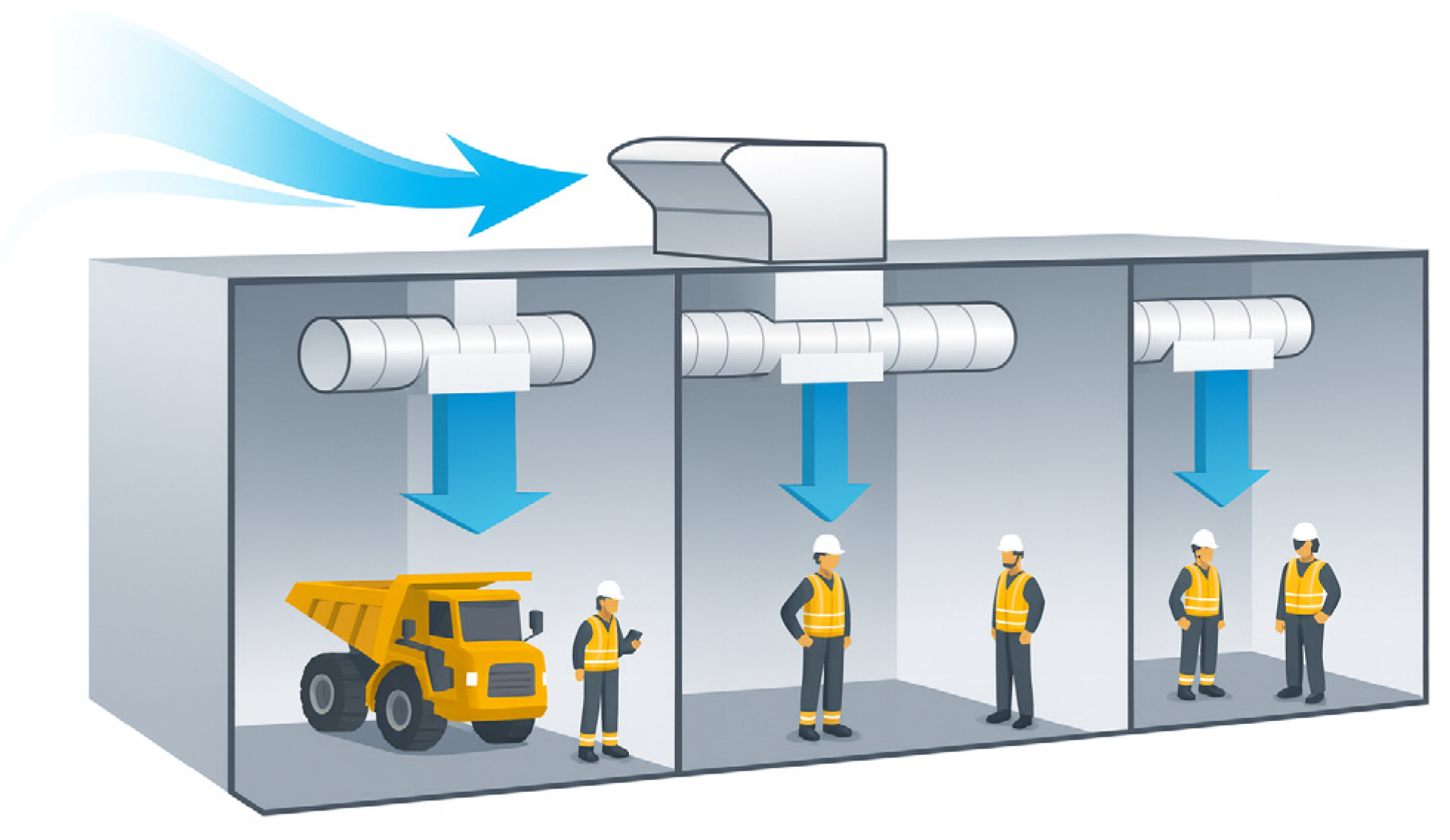
2.1. Ventilation on Demand
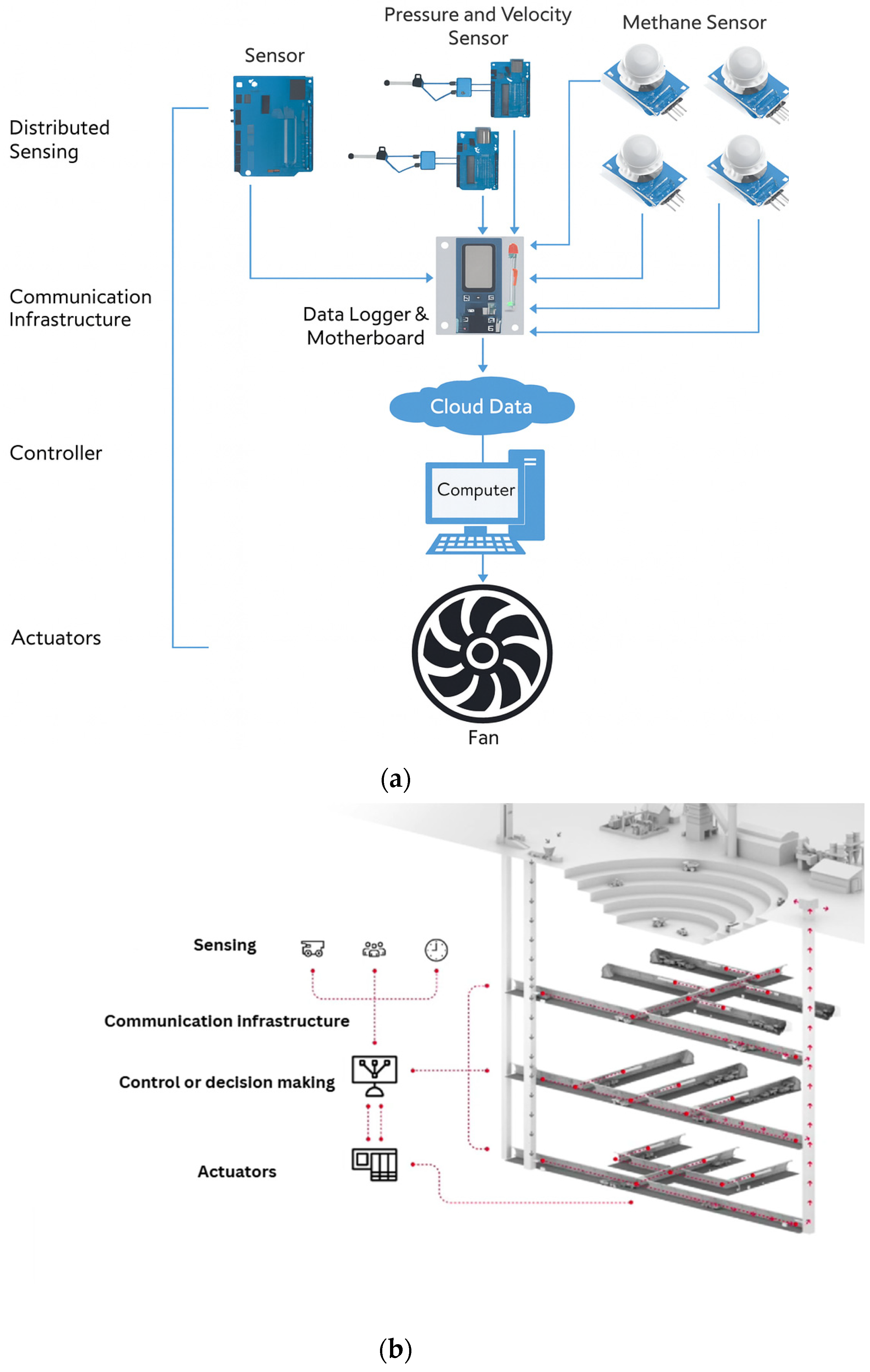
2.1.1. Sensing
2.1.2. Actuators
- Variable Speed Drive (VSD) fans: These dynamically adjust their rotational speed to align with real-time ventilation demands. Their operation is governed by the fan affinity laws, which establish that power consumption varies proportionally to the cube of the fan’s rotational speed [33,34]. This highlights the capability of VSD technology to optimize energy while maintaining safety [35,36].
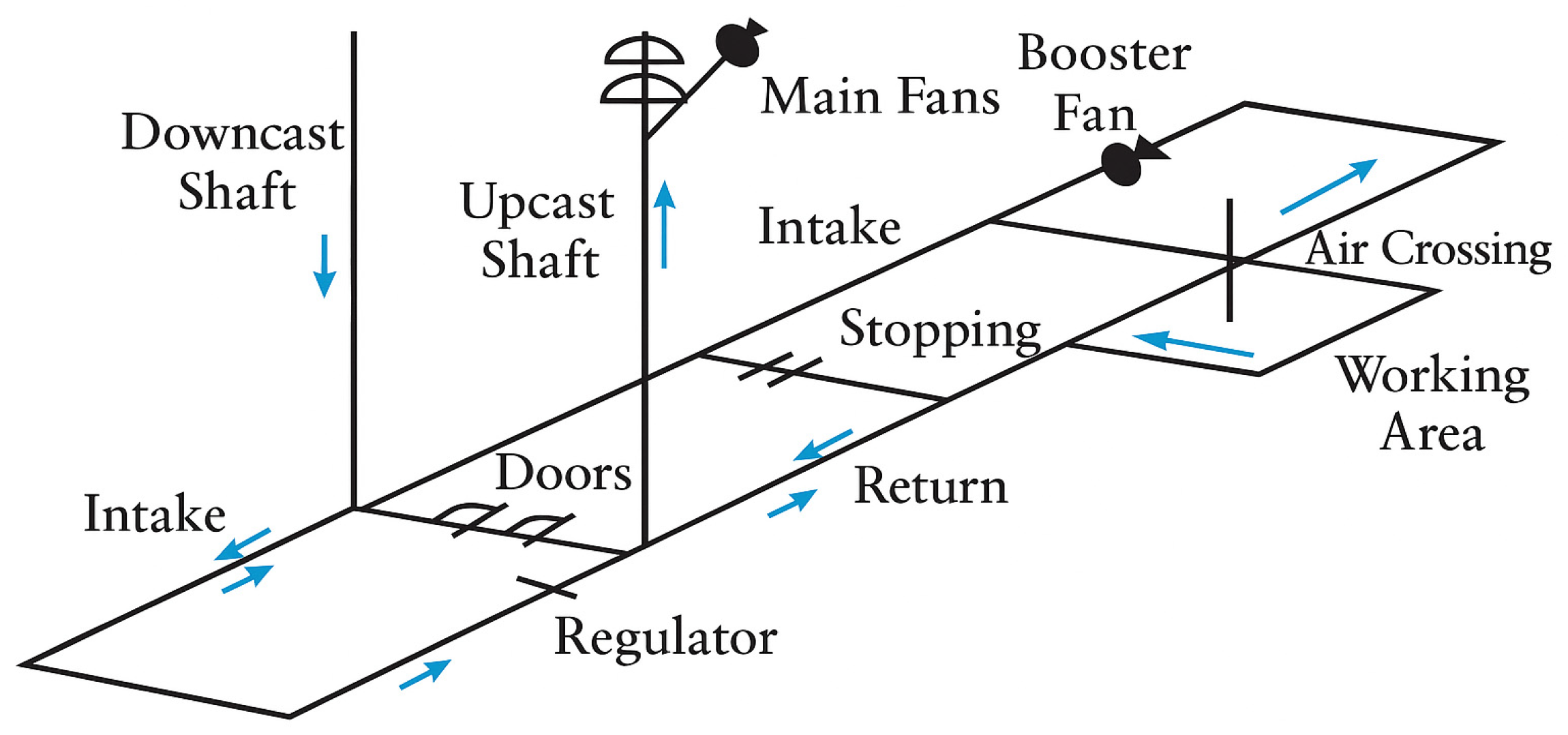
- Automated Dampers: These are responsible for airflow routing and isolation in VOD systems. They allow dynamic reconfiguration of ventilation networks to curb changes in operational conditions. Automated dampers and ventilation doors vary from butterfly dampers (used to provide variable flow control with low pressure drop), Louver damper (used to isolate sections of a mine), ventilation doors (used to isolate for maintenance and emergency conditions), and automatic regulators (used to maintain pressure differences across critical boundaries) [37,38].
2.1.3. Control and Decision Making
2.1.4. Communication
3. Review Methodology and Materials
- Defining review scope and research questions.
- Identifying and acquiring records.
- Screening of the records.
- Reviewing literature.
3.1. Scope and Research Questions
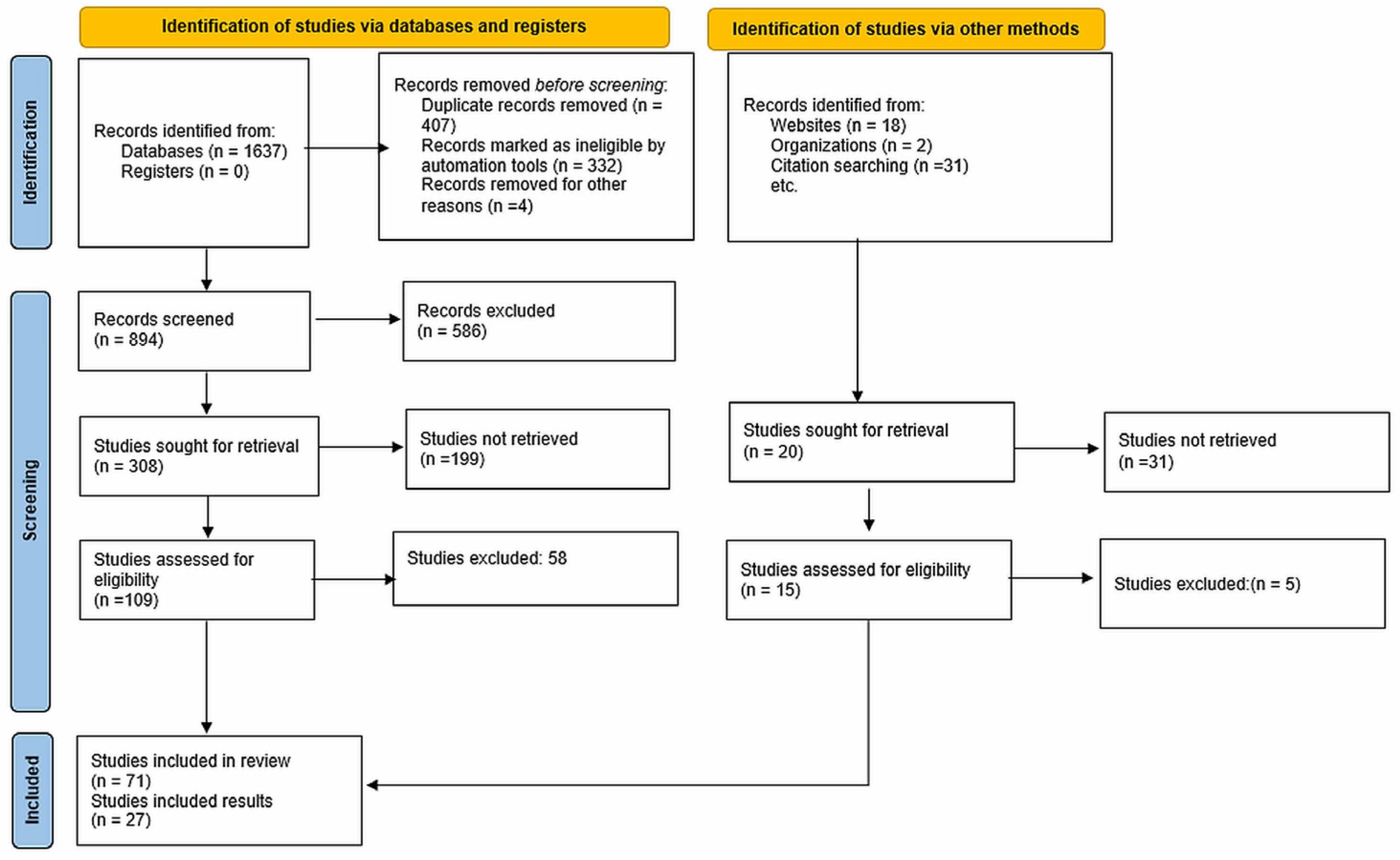
3.2. Search Strategy
3.3. Data Extraction, Outcomes, and Risk of Bias Assessment
3.4. Overview of the Literature Retrieved
- Mining-specific journals: 15 records, including Mining, Metallurgy & Exploration; Mining Report; Journal of the Southern African Institute of Mining and Metallurgy; International Journal of Mining Science and Technology; Mining Technology; Mining; American Journal of Mining Engineering; Academic Journal of Science and Technology; Journal of Mining Institute; and Archives of Mining Sciences.
- General engineering journals: 24 records, including IEEE Access; Processes; Procedia CIRP; Energies; Applied Energy; International Journal of Modern Research in Engineering and Technology; Measurement; Sensors; Mathematics; Applied Sciences; Journal of The Institution of Engineers (India) Series D; Sensors; Scientific Reports; International Journal of Low-Carbon Technology; IEEE Sensors Journal; Procedia Computer Science; Journal of Wind Engineering and Industrial Aerodynamics; Computers and Electrical Engineering; and Machines.
- Journals with focus on AI tools: 5 records, including IEEE Access (AGI survey); Engineering Applications of Artificial Intelligence; Expert Systems with Applications; and Frontiers in Artificial Intelligence.
- Health and safety-focused journals: 5 records, including Journal of Loss Prevention in the Process Industries; Process Safety and Environmental Protection; and International Journal for Housing Science and Its Applications.
3.5. AI Use Disclosure
4. Results
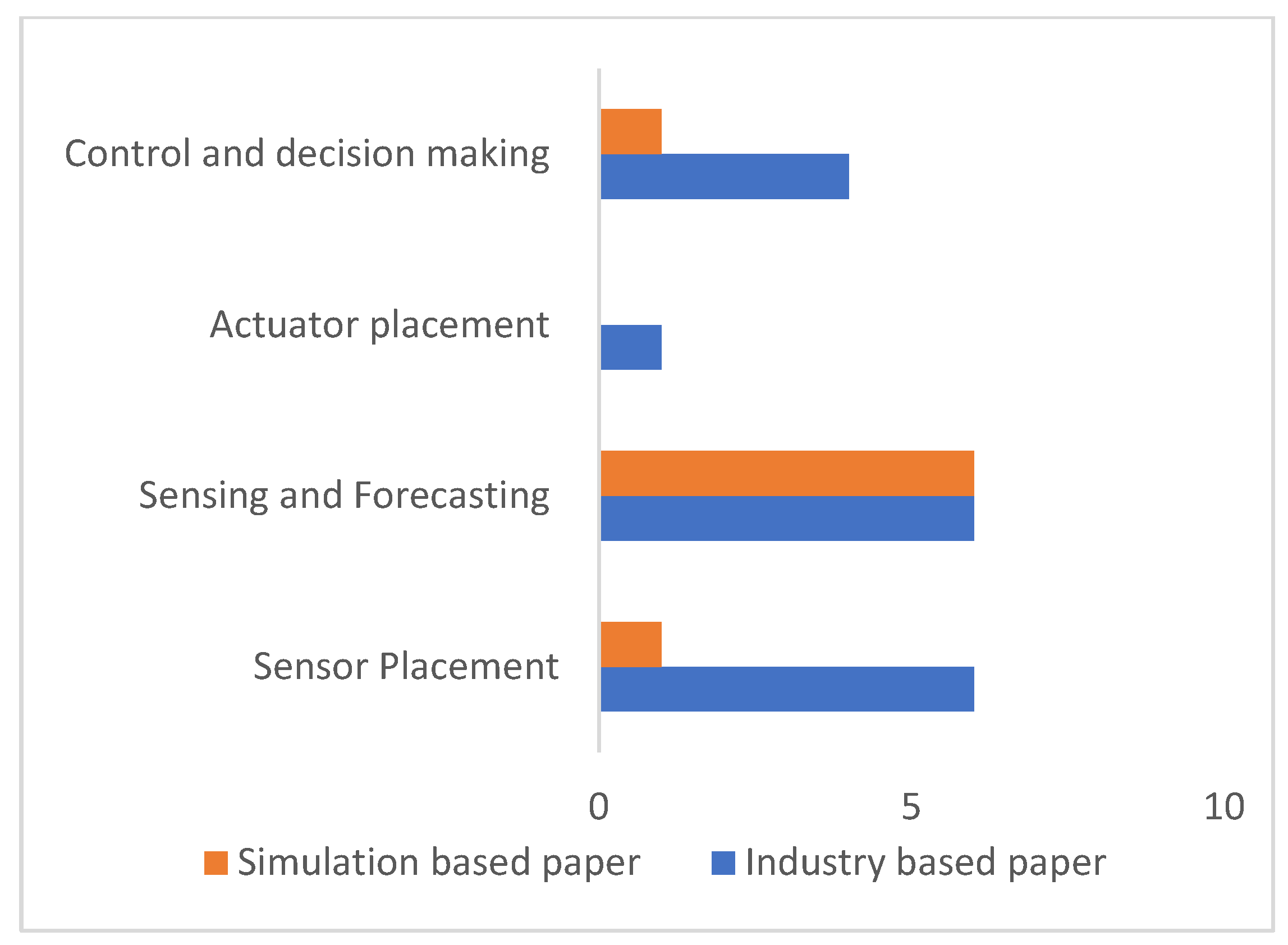
4.1. Operational and Analytical Domains of AI Integration in VOD
4.2. AI Techniques and Models Applied in VOD Systems
4.2.1. Sensor Placement Strategies
4.2.2. Sensing and Forecasting
4.2.3. Actuator Placement and Coordination Strategies
4.2.4. Control and Decision Making
4.3. Existing Limitations, Research Gaps, and Future Promise in the Use of AI for VOD
5. Conclusions
Author Contributions
Funding
Institutional Review Board Statement
Informed Consent Statement
Conflicts of Interest
References
- Dou, S.; Xu, D.; Zhu, Y.; Keenan, R. Critical mineral sustainable supply: Challenges and governance. Futures 2023, 146, 103101. [Google Scholar] [CrossRef]
- Pritchard, C.; Shriwas, M. Ventilation Monitoring and Control in Mines. Min. Metall. Explor. 2020, 37, 1015–1021. [Google Scholar]
- Clausen, E. Mine Ventilation in the 21st Century–Development Towards Adaptive Ventilation Systems. Min. Rep. 2017, 153, 326–333. [Google Scholar]
- Ayres da Silva, A.L.M.; Vieira, J.M.D.C.; da Silva, W.T.; de Eston, S.M. Ventilation on Demand in Brazilian Underground Mines: Current Situation and Perspectives. In Yearbook of Sustainable Smart Mining and Energy–Technical, Economic and Legal Framework; Springer: Cham, Switzerland, 2022; Volume 2. [Google Scholar]
- Tuck, M.A.; Loomis, I. Chapter 23: Mine Ventilation. In SME Underground Mining Handbook; Society for Mining, Metallurgy, and Exploration (SME): Dove Valley, CO, USA, 2023. [Google Scholar]
- Mauricio, A.N.; Celton, R.B. An approach to intelligent ventilation systems for the mining sector: Ventilation systems, conditions and monitoring case studies in brazilian underground. In Proceedings of the 20th International Conference on Experimental Mechanics—Proceedings ICEM20, Porto, Portugal, 2–7 July 2023. [Google Scholar]
- Kumar, M.; Maity, T.; Kirar, K. Energy Savings Through VOD (Ventilation-on-Demand) Analysis in Indian Underground Coal Mine. IEEE Access 2022, 10, 93525–93533. [Google Scholar] [CrossRef]
- Lotito Toro, N.S. Evaluación de un Sistema de Ventilación on-Demand y de la Incorporación de Energía Solar en el Proceso de Ventilación Minera; Universidad de Chile: Santiago, Chile, 2022. [Google Scholar]
- Alvarez, R.; Acuña, E. Chuquicamata Underground Mine Project: 2017 construction ventilation design and commissioning sequence. In Proceedings of the Geomin-Mineplaning 2017, Santiago, Chile, 23–25 August 2017. [Google Scholar]
- Chikande, T.; Phillips, H.; Cawood, F. Ventilation optimization through digital transformation. J. South. Afr. Inst. Min. Metall. 2023, 122, 687–696. [Google Scholar] [CrossRef]
- Sjöström, S.; Klintenäs, E.; Johansson, P.; Nyqvist, J. Optimized model-based control of main mine ventilation air flows with minimized energy consumption. Int. J. Min. Sci. Technol. 2020, 30, 533–539. [Google Scholar] [CrossRef]
- Leandro, d.V.C.; José, M.d.S. Cost-saving electrical energy consumption in underground ventilation by the use of ventilation on demand. Min. Technol. 2020, 129, 1–8. [Google Scholar]
- Moe, M.; Paloma, L. Heat Stress in Hot Underground Mines: A Brief Literature Review. Min. Metall. Explor. 2021, 38, 497–508. [Google Scholar]
- Michelin, F.C.D.; Stewart, M.C.; Loudon, R.A. Cooling on demand–the next step in ventilation automation. In Proceedings of the Australian Mine Ventilation Conference 2022, Gold Coast, Australia, 10–12 October 2022. [Google Scholar]
- Bluhm, S.; Moreby, R.; von Glehn, F.; Pascoe, C. Life-of-mine ventilation and refrigeration planning for Resolution Copper Mine. J. South. Afr. Inst. Min. Metall. 2014, 114, 497–503. [Google Scholar]
- Nikodem, S.; Dariusz, O.; Marek, K.; Justyna, S. Efficiency of Cooling Methods in Polish Underground Mines. In Proceedings of the 11th International Mine Ventilation Congress, Singapore, 4 August 2018; Springer: Singapore, 2019. [Google Scholar]
- Nie, X.; Wei, X.; Li, X.; Lu, C. Heat Treatment and Ventilation Optimization in a Deep Mine. Adv. Civ. Eng. 2018, 2018, 1529490. [Google Scholar] [CrossRef]
- Requist, K.B.; Momayez, M. Minimum Cost Pathfinding Algorithm for the Determination of Optimal Paths under Airflow Constraints. Mining 2024, 4, 429–446. [Google Scholar] [CrossRef]
- Sun, Q.; Wang, Y. Optimization of Airflow Distribution in Mine Ventilation Networks Using the MOBWO Algorithm. Processes 2025, 13, 2193. [Google Scholar] [CrossRef]
- Mikhail, A.S.; Lev, Y.L.; Stanislav, V.M. Development of Automated Mine Ventilation Control Systems for Belarusian Potash Mines. Arch. Min. Sci. 2023, 65, 803–820. [Google Scholar] [CrossRef]
- Raza, A. Advances in Mine Ventilation Engineering: Ensuring Safe Working Conditions. Am. J. Min. Eng. 2021, 2, 8–14. [Google Scholar]
- Russell, S.; Norvig, P. Artificial Intelligence: A Modern Approach; Pearson: London, UK, 2020. [Google Scholar]
- Maria, K.; Benardos, A. Machine Learning Techniques to Model and Predict Airflow Requirements in Underground Mining. In Proceedings of the RawMat 2023, Athens, Greece, 28 August–2 September 2023. [Google Scholar]
- Yenduri, G.; Murugan, R.; Maddikunta, P.K.R.; Bhattacharya, S.; Sudheer, D.; Savarala, B. Artificial General Intelligence: Advancements, Challenges, and Future Directions in AGI Research. IEEE Access 2025, 13, 134325–134356. [Google Scholar] [CrossRef]
- Nikolaos, N.; Giannis, K.; Kyriakos, B.; Kosmas, A. A cyber-physical system approach for enabling ventilation on-demand in an underground mining site. Procedia CIRP 2021, 97, 487–490. [Google Scholar] [CrossRef]
- Li, J.; Li, Y.; Zhang, W.; Dong, J.; Cui, Y. Multi-Objective Intelligent Decision and Linkage Control Algorithm for Mine Ventilation. Energies 2022, 15, 7980. [Google Scholar] [CrossRef]
- Wang, K.; Jiang, S.; Ma, X.; Hu, L.; Wu, Z.; Shao, H.; Zhang, W.; Pei, X.; Wang, Y. An automatic approach for the control of the airflow volume and concentrations of hazardous gases in coal mine galleries. J. Loss Prev. Process Ind. 2016, 43, 676–687. [Google Scholar] [CrossRef]
- Ihsan, A.; Widodo, N.P.; Cheng, J.; Wang, E.Y. Ventilation on demand in underground mines using neuro-fuzzy models: Modeling and laboratory-scale experimental validation. Eng. Appl. Artif. Intell. 2024, 133, 108048. [Google Scholar] [CrossRef]
- Santos, R.D.C.P.; da Silva, J.M.; Junior, W.A.; Pinto, C.L.; Oliveira, M.M.; Mazzinghy, D.B. Development of a Low-Cost Device for Monitoring Ventilation Parameters (Temperature, Humidity and Pressure) in Underground Environments to Increase Operational Safety Using IoT. Mining 2022, 2, 746–756. [Google Scholar] [CrossRef]
- Chatterjee, A.; Zhang, L.; Xia, X. Optimization of mine ventilation fan speeds according to ventilation on demand and time of use tariff. Appl. Energy 2015, 146, 65–73. [Google Scholar] [CrossRef]
- Wang, Y.; Liu, J.; Wang, D.; Liu, X.; Cao, P.; Hua, K. Noise reduction method for mine wind speed sensor data based on CEEMDAN-wavelet threshold. Sci. Rep. 2024, 14, 24869. [Google Scholar] [CrossRef] [PubMed]
- Sierra, C. Mine Ventilation: A Concise Guide for Students; Springer Nature: Berlin/Heidelberg, Germany, 2020. [Google Scholar]
- Gonen, A. Implementation of Variable Frequency Drive on Underground. Int. J. Mod. Res. Eng. Technol. 2018, 3, 31–36. [Google Scholar]
- Zhang, Y.H.; Chen, L.; Huang, Z.A.; Gao, Y.K. Operating conditions of a mine fan under conditions of variable resistance. In Proceedings of the 3rd International Symposium on Mine Safety Science and Engineering, Montreal, QC, Canada, 13–19 August 2016. [Google Scholar]
- Zhou, Y. Air volume reconstruction and sensor optimization distribution in building intelligent ventilation network. Meas. Sens. 2024, 34, 101252. [Google Scholar] [CrossRef]
- Hati, A.S. Convolutional neural network-long short term memory optimization for accurate prediction of airflow in a ventilation system. Expert Syst. Appl. 2022, 195, 116618. [Google Scholar] [CrossRef]
- Wen, L.; Zhong, D.; Bi, L.; Wang, L.; Liu, Y. Optimization Method of Mine Ventilation Network Regulation Based on Mixed-Integer Nonlinear Programmin. Mathematics 2024, 12, 2632. [Google Scholar] [CrossRef]
- Zhang, Z. Research Status and Development Trends of Intelligent Ventilation Technology in Coal Mine. Acad. J. Sci. Technol. 2025, 15, 115–119. [Google Scholar] [CrossRef]
- Semin, M.A.; Grishin, E.L.; Levin, L.Y.; Zaitsev, A.V. Automated ventilation control in mines. Challenges, state of art, areas of improvement. J. Min. Inst. 2021, 246, 623–632. [Google Scholar] [CrossRef]
- Cao, P.; Liu, J.; Wang, Y.; Liu, X.; Wang, H.; Wang, D. Inversion of mine ventilation resistance coefficients enhanced by deep reinforcement learning. Process Saf. Environ. Prot. 2024, 182, 387–404. [Google Scholar] [CrossRef]
- Chen, Y.; Li, Z.; Liu, X.; Tang, W.; Zhang, Q.; Wang, H.; Huang, W. Research on Intelligent Ventilation System of Metal Mine Based on Real-Time Sensing Airflow Parameters with a Global Scheme. Appl. Sci. 2024, 14, 7602. [Google Scholar] [CrossRef]
- Wei, Y.; Jia, Y.; Wang, Y. Control Mode of Mine Ventilation System and Its Implementation Based on Monitoring Data and Safety Information. In Proceedings of the 2018 7th International Conference on Energy and Environmental Protection (ICEEP 2018), Shenzhen, China, 14–15 July 2018. [Google Scholar]
- Scalambrin, L.; Zanella, A.; Vilajosana, X. LoRa Multi-Hop Networks for Monitoring Underground Mining Environments. In IEEE Globecom Workshops; IEEE: New York, NY, USA, 2023; pp. 696–701. [Google Scholar]
- GMG. Underground Mine Communications Infrastructure Guideline; GMG: Dubai, United Arab Emirates, 2024. [Google Scholar]
- Naik, A.S.; Reddy, S.K.; Mandela, G.R. A Systematic Review on Implementation of Internet of Things Based System in Underground Mines to Monitor Environmental Parameters. J. Inst. Eng. Ser. D 2023, 105, 1273–1289. [Google Scholar] [CrossRef]
- Farjow, W.; Daoud, M.; Fernando, X.N. Advanced diagnostic system with ventilation on demand for underground mines. In Proceedings of the 34th IEEE Sarnoff Symposium, Princeton, NJ, USA, 3–4 May 2011; IEEE: New York, NY, USA, 2011. [Google Scholar]
- Cacciuttolo, C.; Atencio, E.; Komarizadehasl, S.; Lozano-Galant, J. Internet of Things Long-Range-Wide-Area-Network-Based Wireless Sensors Network for Underground Mine Monitoring: Planning an Efficient, Safe, and Sustainable Labor Environment. Sensors 2024, 24, 6971. [Google Scholar] [CrossRef]
- Page, M.; McKenzie, J.; Bossuyt, P.; Boutron, I.; Hoffmann, T.; Mulrow, C.; Shamseer, L.; Tetzlaff, J.; Akl, E. The PRISMA 2020 statement: An updated guideline for reporting systematic reviews. BMJ 2020, 372, n71. [Google Scholar]
- Mikhail, S.; Denis, K. Application of artificial intelligence in mine ventilation: A brief review. Front. Artif. Intell. 2024, 7, 1402555. [Google Scholar] [CrossRef] [PubMed]
- Moe, M.; Kate, B.R. An Algorithm for the Efficient Placement of Air Quality Sensors in Underground Mines. Min. Metall. Explor. 2025, 42, 1929–1944. [Google Scholar]
- Liu, Y.; Liu, Z.; Gao, K.; Huang, Y.; Zhu, C. Efficient graphical algorithm of sensor distribution and air volume reconstruction for a smart mine ventilation network. Sensors 2022, 22, 2096. [Google Scholar] [CrossRef]
- Huang, X.; Lei, W. Mine wind speed sensor location selection based on decision tree theory. Int. J. Low-Carbon Technol. 2024, 19, 315–323. [Google Scholar] [CrossRef]
- Zhao, D.; Zhang, H.; Pan, J. Solving Optimization of a Mine Gas Sensor Layout Based on a Hybrid GA-DBPSO Algorithm. IEEE Sens. J. 2019, 19, 6400–6409. [Google Scholar] [CrossRef]
- Liang, S.; He, J.; Zheng, H.; Sun, R. Research on the HPACA Algorithm to Solve Alternative Covering Location. Procedia Comput. Sci. 2018, 139, 464–472. [Google Scholar] [CrossRef]
- Lyu, P.; Chen, N.; Mao, S.; Li, M. LSTM Based Encoder-Decoder for Short-Term Predictions of Gas Concentration using Multi-Sensor Fusion. Process Saf. Environ. Prot. 2020, 137, 93–105. [Google Scholar] [CrossRef]
- Demirkan, D.; Duzgun, H.; Juganda, A.; Brune, J.; Bogin, G. Real-Time Methane Prediction in Underground Longwall Coal Mining Using AI. Energies 2022, 15, 6486. [Google Scholar] [CrossRef]
- Peng, Y.; Song, D.; Qiu, L.; Wang, H.; He, X.; Liu, Q. Combined Prediction Model of Gas Concentration Based on Indicators Dynamic Optimization and Bi-LSTMs. Sensors 2023, 23, 2883. [Google Scholar] [CrossRef]
- Prasanjit, D.; Saurabh, K.; Kumar, C.; Pandit, D.; Chaulya, S.; Ray, S.; Prasad, G.; Mandal, S. t-SNE and Variational Auto-Encoder with a bi-LSTM Neural Network-Based Model for Prediction of Gas Concentration in a Sealed-Off Area of Underground Coal Mines. Res. Sq. 2021, 25, 14183–14207. [Google Scholar]
- Tang, W.; Zhang, Q.; Chen, Y.; Liu, X.; Wang, H.; Huang, W. An intelligent airflow perception model for metal mines based on CNN-LSTM architecture. Process Saf. Environ. Prot. 2024, 187, 1234–1247. [Google Scholar] [CrossRef]
- Gendrue, N.; Liu, S.; Bhattacharyya, S.; Clister, R. An Investigation of Airflow Distributions with Booster Fan for a Large Opening Mine through Field Study and CFD Modeling. Tunn. Undergr. Space Technol. 2023, 132, 104856. [Google Scholar] [CrossRef]
- Yao, S.; Zhou, J.; Khandelwal, M.; Lawal, A.; Li, C.; Onifade, M.; Kwon, S. Intelligent Decision Framework for Booster Fan Optimization in Underground Coal Mines: Hybrid Spherical Fuzzy-Cloud Model Approach Enhancing Ventilation Safety and Operational Efficiency. Machines 2025, 13, 367. [Google Scholar] [CrossRef]
- Farun, A.; Dong, Y.; Haibin, W. Air pollutant removal performance using a BiLSTM-based demand-controlled ventilation method after tunnel blasting. J. Wind. Eng. Ind. Aerodyn. 2024, 253, 105869. [Google Scholar]
- Prasad, B.; Krishna, N.B. An advanced approach for cloud enabled energy efficient ventilation control of multiple main fans in underground coal mines. Comput. Electr. Eng. 2025, 124, 110330. [Google Scholar] [CrossRef]
- Wan, Y. Design and optimization of intelligent ventilation system in coal mine. In Proceedings of the E3S Web of Conferences, Paris, France, 28 November 2024. [Google Scholar]
- Gyamfi, S. Considerations and Development of a Ventilation on Demand System in Konsuln Mine. Master’s Dissertation, Luleå University of Technology, Luleå, Sweden, 2020. [Google Scholar]
- Yuan, K.; Gao, K.; Liu, Y. Enhancing gas concentration prediction and ventilation efficiency in deep coal mines: A hybrid DL-Koopman and Fuzzy-PID framework. Sci. Rep. 2025, 2025, 23630. [Google Scholar] [CrossRef]
- Zhang, J. Application of Artificial Intelligence Algorithms in Coal Mine Methane Monitoring and Prediction. Int. J. Hous. Sci. Its Appl. 2025, 46, 5092–5103. [Google Scholar] [CrossRef]
- Vivas, S.D.; Monsalve, P.A.G.; Pozos, A.T. A Hybrid Conv1D-LSTM Model with Temporal-Difference Reinforcement Learning for Error-Corrected Gas Forecasting in Critical Mining Environments. Pap. Sq. 2025. [Google Scholar] [CrossRef]
- Acuña, E.; Alvarez, R.A.; Hardcastle, S.G. A Theoretical Comparison of Ventilation On Demand Strategies for Auxiliary Mine Ventilation Systems. In Proceedings of the 10th International Mine Ventilation Congress, Sun City, South Africa, 2–8 August 2014. [Google Scholar]
- Aleksei, V.K.; Yuri, V.K. Strategy of mine ventilation control in optimal mode using fuzzy logic controllers. J. Min. Inst. 2023; Online first. [Google Scholar]
- Widodo, N.; Kusuma, G.; Ihsan, A.; Permadi, D.A. Energy Saving with Integration of Cloud Data and ANFIS Method for Ventilation on Demand in Coal Underground Mine. In Proceedings of the Prima ITB 2021 Pameran Riset, Inovasi, dan Pengabdian Masyarakat ITB, Virtual, 21 December 2021. [Google Scholar]



| Q1 | For which operational or analytical tasks have AI methods been applied to VOD systems over the past eleven years? |
| Q2 | Which specific AI techniques or models have been employed to support these VOD-related functions or decision-making processes? |
| Q3 | What are the principal limitations and technical challenges associated with current AI-enabled approaches to VOD implementation? |
| Q4 | In which VOD system components or operational domains could AI provide additional improvements in performance, efficiency, adaptability, or system-level intelligence? |
| Criteria Type | Included | Excluded |
|---|---|---|
| Search Strategy | Queries run in Scopus/Web of Science/IEEE Xplore and major publisher platforms; TITLE-ABS-KEY scope; Boolean + proximity combining (mine ventilation terms) AND (AI terms); NOT filters to remove non-mining contexts (e.g., building/HVAC, medical) | Results from full-text-only searches; records lacking co-occurrence of ventilation and AI terms; hits from non-mining ventilation domains not filtered out |
| Publication Range | Studies published in 2014 to July 2025 reflecting the evolution of technology in VOD | Studies published before 2014 and not reflective of modern AI or VOD advancements |
| Record Type | Peer-reviewed journals, industry white papers, textbooks, or peer-reviewed technical conference papers. | Press releases, unpublished theses, blogs, and editorials |
| Technical Integration | Covers the use of AI across sensing, actuation, control, and decision making for VOD | Focuses only on basic control systems or manual ventilation without intelligent automation or adaptive response |
| Research Focus | Articles addressing VOD systems, AI-based method in the broad sense of the definition provided in Section 1 | Studies that focus solely on surface mining, tunnel construction, or HVAC systems without direct application to underground mines |
| Inputs | Outputs | Methods | Performance Metrics | Ref. |
|---|---|---|---|---|
| ; available; airflow directions; pressure losses; surface roughness | Optimized spatial distribution of fixed air quality sensors; placement for non-regulatory air quality monitors | EPAQS; GA; Modified A * Pathfinding | The pairwise overlap between sensors (average, maximum) and its percentage reduction | [50] |
| ; ; sources and sinks; single-junction cut cells; known air volume measurement | minimum and optimal location of wind speed sensors; reconstruction of air volume for all tunnels | Independent cut set algorithm; Improved Breadth-First Search (IBFS) over spanning tree; matrixing for algorithm optimization; Gaussian elimination | Error of flow reconstruction; ratio of sensor to tunnel number (RST) | [51] |
| and network constraints (node air volume balance, air volume wind pressure); for wind speed; airflow disturbance; roadway support; distance from inlet outlet; roadway type | Scientific layout of the wind speed sensor; classification conditions for sensor location | DT Algorithm; Entropy Information Theory | Efficiency as associated with information entropy/gain, accuracy, and complexity | [52] |
| , shortest airflow time; shortest alarm time; cost and location sets | Optimized sensor layout; minimum; provides the relationship diagram between the shortest alarm time and extra for gas required | Hybrid GA; Discrete Binary Particle Swarm Optimization (GA-DBPSO) | minimum required; number of iterations; variance; coverage proportion | [53] |
| ; node types (required placement, alternative points, wind network nodes); shortest airflow time; monitoring effective level; reliability standard | Optimal sensor location schemes; scientific layout | Hybrid Pareto Ant Colony Algorithm (HPACA) | minimum required; maximum sensor reliability; proportion of total nodes where sensors are installed | [54] |
| Ventilation characteristic curves; database at different frequencies; and resistance; time-series data for wind quantity; hazardous gas concentration; gas threshold value; wind resistance | Branch wind quantity/mine ventilator frequency; unique branch resistance model solution; optimal mine ventilator operating frequency | Chebyshev interpolation method (CIM) (for fan curve fitting); Generalized Cross Checking (GCV); Greed Evolution (GE) algorithm | Curve fitting accuracy; safety margin (concentration/threshold); Response time; instability reduction | [28] |
| Inputs | Outputs | Methods | Performance Metrics | Ref. |
|---|---|---|---|---|
| Multi-sensor gas readings at a coal face (2 min sampling; correlated neighboring sensors used as spatiotemporal features) | Gas concentration at the target point | Encoder–Decoder LSTM with L1-regularized loss | Mean absolute error (MAE) and accuracy improvement | [55] |
| Longwall CFD outputs across 6 shearer positions (~31 M cells/location): x, y, z coordinates; airflow velocity (Vx, Vy, Vz); CH4 concentration; cell volume; plus distance-to-shearer feature | Real-time 3D explosive methane–air zone prediction (spatiotemporal mapping) with ~2 min latency after ingest | Modified LSTM (3D input adaptation with vector ops); trained/validated on CFD outputs; large-scale spatiotemporal sequence learning | Overall accuracy (87.9–92.4% across shearer–location pairs with training/validation accuracy ~89.1–93.8%); prediction time (2 min) | [56] |
| Multivariate monitoring: methane sensors, wind speed, temperature, humidity, barometer, machine currents, pipeline pressure/ΔP, cutter speed (V). | Gas concentration 30 min ahead; abnormal emission prediction | Indicators’ dynamic optimization and bi-directional LSTM network used to extract time-series and spatial–topology features; two-layer standard LSTM network | Regression: R2 (0.965); MAE (0.039, RMSE achieved 0.046 classification: false alarm rate (FAR) (0.0%), missing alarm rate (MAR) (20.1%), and prediction efficiency (R) (79.9%)) | [57] |
| Gas concentration for CH4, CO2, CO, O2, and H2, with 1 h sampling over 153 days | Hour-ahead concentrations of CH4, CO2, CO, O2, and H2 in the sealed-off region | t-distributed stochastic neighbor; variational auto-encoder (VAE) for denoising; and bi-LSTM for prediction | Test MSE/MAE: CH4: 0.077/0.369; CO2: 0.998/1.018; CO: 0.077/0.296; O2: 0.298/0.581; H2: 0.233/0.549. | [58] |
| Wind speed and absolute gas inflow | Gas concentration vs. time under different ventilation speeds | DL-Koopman forecasting model | Mean absolute percentage error (MAPE); accuracy; error analysis | [54] |
| Temperature; humidity; CH4; CO2; NOx; SOx | Airflow of the ventilation system | Hybrid 1D-CNN and Long Short-Term Memory (LSTM) | Accuracy; root mean square error (RMSE); MAE; R2 | [32] |
| Airflow Q from 21 monitoring points (features evaluated included edges, airflow, wind resistance, total resistance, natural wind pressure) | Airflow at 51 perception points across the mine | Hybrid Convolutional Neural Network (CNN) and Long Short-Term Memory (LSTM) | R2, MAE, MAPE, RMSE, RMB | [59] |
| Airflow at 21 monitoring points from wind-speed sensors; wind speed V combined with airway cross-section S to compute input airflow Qs training data generated via ventilation-network simulations (832 scenarios) | Airflow quantity (m3/s) at 51 perception points across the mine (global airflow from partial sensors) | Compared CNN, LSTM, and CNN-LSTM; best is CNN-LSTM multi-output regression | RMSE; MAE; MARE; MAPE | [41] |
| Method | Operating Principle | Performance Metrics | Ref. |
|---|---|---|---|
| MINLP Model I (optimization with selected fans) | Seeks to minimize ventilation energy use by identifying optimal regulator locations and models and minimizing their number. | Minimizes four objectives: ventilation energy consumption (Z1), optimal regulation location (Z2), optimal regulation mode (Z3), and minimum number of regulators (Z4). Achieved energy savings of 65.60% and optimized the regulation network without adding new regulators | [60] |
| MINLP Model II (optimization without selected fans) | It focuses on determining the required air pressure (Hf) of fan branches, which is constrained by the requirement that fan pressure must exceed the algebraic sum of air pressures in the same pathway. | Minimizes four objectives: ventilation energy consumption, optimal regulation location, optimal regulation mode, and minimum number of regulators. Directly solvable by conventional solvers. | [61] |
| Hybrid Spherical Fuzzy-Cloud Model Approach (AHP-based) | Seeks to optimize the selection of booster fans to improve safety and operational efficiency. It employs the analytic hierarchy process (AHP) to structure decision making. Complex spherical fuzzy theory converts expert opinions into superiority scores. Cloud model theory is used for risk analysis and visualization. | Superiority ranking of candidate booster fan solutions (e.g., BF4 > BF3 > BF2 > BF1). Also analyzes risk and optimization potential using cloud model parameters (expectation, entropy, and hyper entropy) for specific indicators. | [61] |
| Improved Parallel Bare-Bones Particle Swarm Optimization (BBPSO-Para-Improved) | It uses optimization to minimize power consumption and maximize safety in terms of maximal air demand. Airflow positioning is considered within the decision parameters in the optimization problem. An evolutionary algorithm using Gaussian sampling. | Average convergence rate, average calculation time (s), global optimization performance, and convergence efficiency | [27] |
| Inputs | Outputs | Methods | Performance Metrics | Ref. |
|---|---|---|---|---|
| and its parameters, atmospheric pressure, dry and wet bulb temperature, and wind speed. Constraints on branch airflow/pressure and fan operation constraints also considered | Pareto set of optimized branch airflows and fan pressures minimizing total fan power and pressure-regulation complexity | MOBWO for airflow distribution; graph-theory-based network model; compared to NSGA-II, MOPSO using GD/IGD/spacing/spread | Energy use reduction: generational distance (GD), inverted generational distance (IGD), GD, spacing, and spread. Case study yields 10.3–21.1% reduction | [19] |
| Air pressure (), air velocity (), air resistance and air quantity, flow rate (), CH4 concentration (), fan power (), and dilution time | (1) optimal for dilution; (2) predicted dilution time of methane concentration to allowable levels. System provides combinations of and decision-making time | Two Sugeno-type ANFIS models to predict optimal fan power and dilution time; Model-1 inputs: with 45 fuzzy rules. Model-2 inputs: with 135 rules | Test accuracy: R2 = 0.84 (optimal ), R2 = 0.96 (dilution time). Laboratory VOD energy savings: up to 43% vs. conventional worst-case sizing; case-by-case savings depend on L/D and CH4 levels | [26] |
| Time-series from CFD/field for the heading area: CO concentration, air volume/velocity, temperature, and relative humidity; past window: 30 s; future horizon: 10 s | Next-step CO concentration (10 s ahead), which is then converted to required air volume for DCV control | Demand-controlled ventilation (DCV) based on DL. BiLSTM for prediction with adaptive moment estimation (Adam) optimizer; SHapley Additive exPlanation (SHAP) method is used as explainable AI | MSE and R2 for training/testing; CO removal efficiency (RE), fan energy consumption (W); coefficient of ventilation performance (COVP); maximum average CO concentration; ventilation time | [62] |
| Real-time sensor data for CH4 concentration, fan speed, and power calculation | Predicted optimal fan speed (), which is used to estimate fan power and provide commands to adjust the variable speed drive (VSD) in real time | Hybrid DL model combining advanced multi-head cross attention-based BiLSTM (AMCABN) and MEMSA for prediction and optimization, respectively | Energy consumption/power reduction (kW and %); convergence rate/speed; accuracy and precision, MSE, RMSE, and R2; CH4 reduction time (18 min); FP reduction (23%); maximum fan power reduction (350 kW) | [63] |
| Air quality, air pressure, air power, efficiency, productivity, safety, flexibility, noise, vibration, and operating cost | Ranked fan solutions for decision-making and risk analysis associated with optimization potential | Hybrid spherical fuzzy-cloud model combination: improved AHP for weighting and structuring decisions, complex spherical fuzzy theory for ranking alternatives, and cloud model theory for risk assessment and optimization | Consistency ratio (CR), superiority scores, cloud model parameters (entropy, hyper entropy and expectation); external validation: compared to the fuzzy TOPSIS (FT) method, showing high consistency in ranking | [61] |
Disclaimer/Publisher’s Note: The statements, opinions and data contained in all publications are solely those of the individual author(s) and contributor(s) and not of MDPI and/or the editor(s). MDPI and/or the editor(s) disclaim responsibility for any injury to people or property resulting from any ideas, methods, instructions or products referred to in the content. |
© 2026 by the authors. Licensee MDPI, Basel, Switzerland. This article is an open access article distributed under the terms and conditions of the Creative Commons Attribution (CC BY) license.
Share and Cite
Chinyadza, C.R.; Risso, N.; Aramayo, A.; Momayez, M. Integrating Artificial Intelligence into Ventilation on Demand: Current Practice and Future Promises. Sensors 2026, 26, 1042. https://doi.org/10.3390/s26031042
Chinyadza CR, Risso N, Aramayo A, Momayez M. Integrating Artificial Intelligence into Ventilation on Demand: Current Practice and Future Promises. Sensors. 2026; 26(3):1042. https://doi.org/10.3390/s26031042
Chicago/Turabian StyleChinyadza, Chengetai Reality, Nathalie Risso, Angel Aramayo, and Moe Momayez. 2026. "Integrating Artificial Intelligence into Ventilation on Demand: Current Practice and Future Promises" Sensors 26, no. 3: 1042. https://doi.org/10.3390/s26031042
APA StyleChinyadza, C. R., Risso, N., Aramayo, A., & Momayez, M. (2026). Integrating Artificial Intelligence into Ventilation on Demand: Current Practice and Future Promises. Sensors, 26(3), 1042. https://doi.org/10.3390/s26031042